Sample Category Title
GBP/USD Daily Outlook
Daily Pivots: (S1) 1.3025; (P) 1.3109; (R1) 1.3157; More....
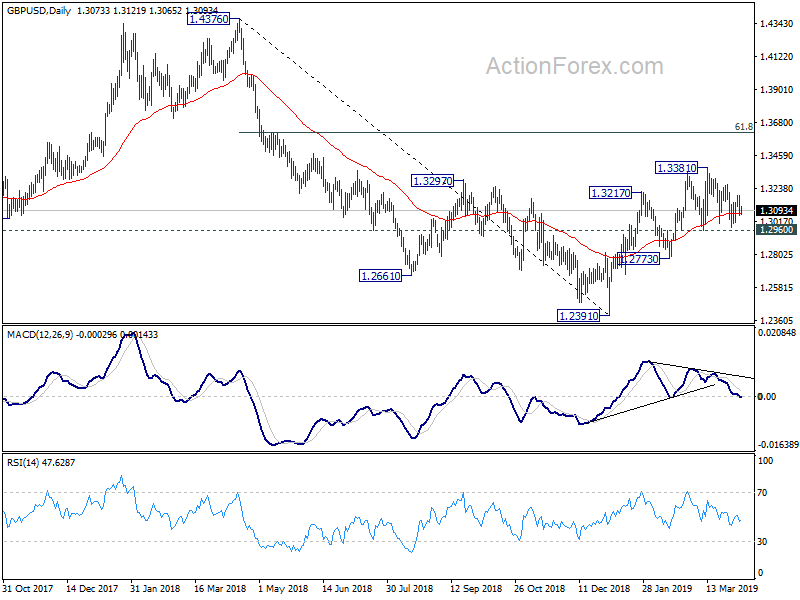
Intraday bias in GBP/USD remains neutral at this point as consolidation from 1.3381 is in progress and extending. On the upside, firm break of 1.3381 will target 61.8% retracement of 1.4376 to 1.2391 at 1.3618 next. However, on the downside, firm break of 1.2960 will indicate that rebound from 1.2391 has completed earlier than expected. Deeper fall would then be seen to 1.2773 support for confirmation.
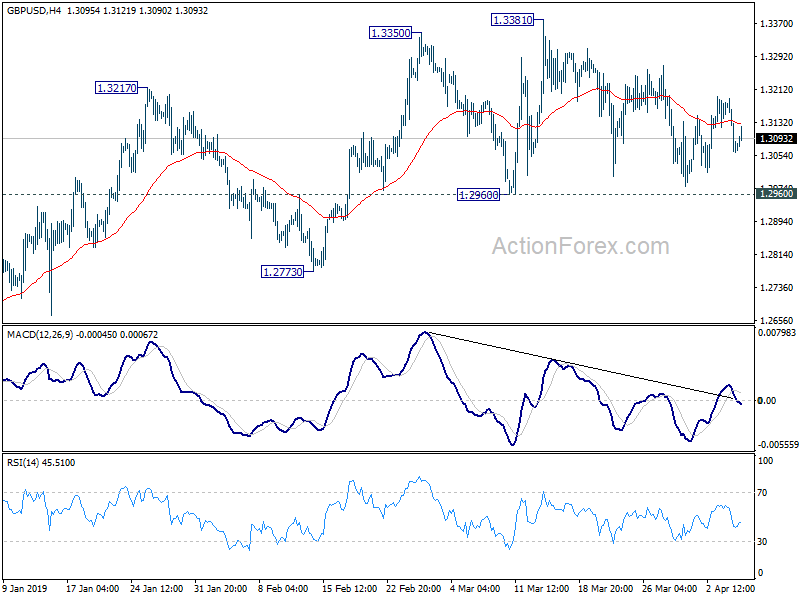
In the bigger picture, medium term decline from 1.4376 (2018 high) should have completed at 1.2391. Rise from 1.2391 is seen as the third leg of the corrective pattern from 1.1946 (2016 low). Further rise could be seen through 1.4376 in medium term. On the downside, though, break of 1.2773 support will dampen this view. Focus will be turned back to 1.2391 low and break will resume the fall from 1.4376 to 1.1946.
USD/CHF Daily Outlook
Daily Pivots: (S1) 0.9977; (P) 0.9991; (R1) 1.0014; More...
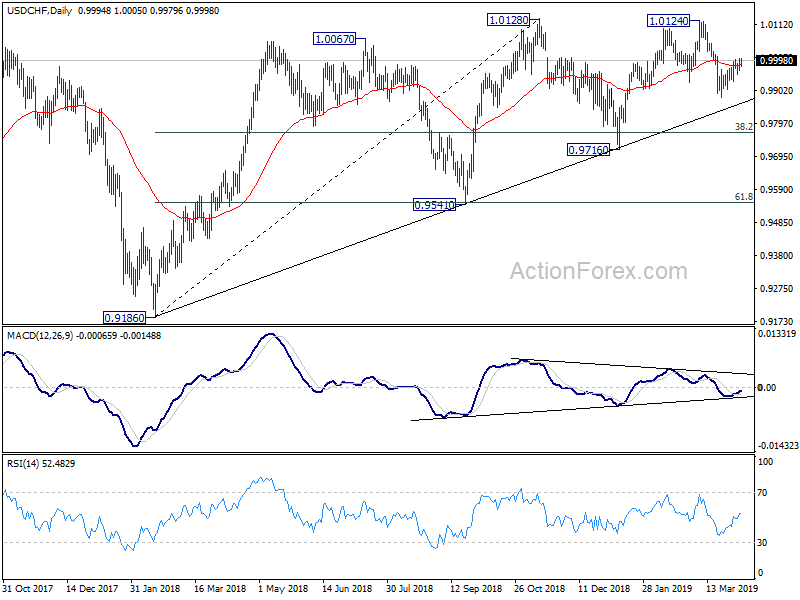
Intraday bias in USD/CHF remains neutral with focus on 1.0010 minor resistance. Firm break there will suggest that pull back from 1.0124 has completed. Intraday bias will be turned back to the upside for 1.0124/28 resistance zone. On the downside, break of 0.9879 will resume the fall from 1.0124 to 0.9716 key support.
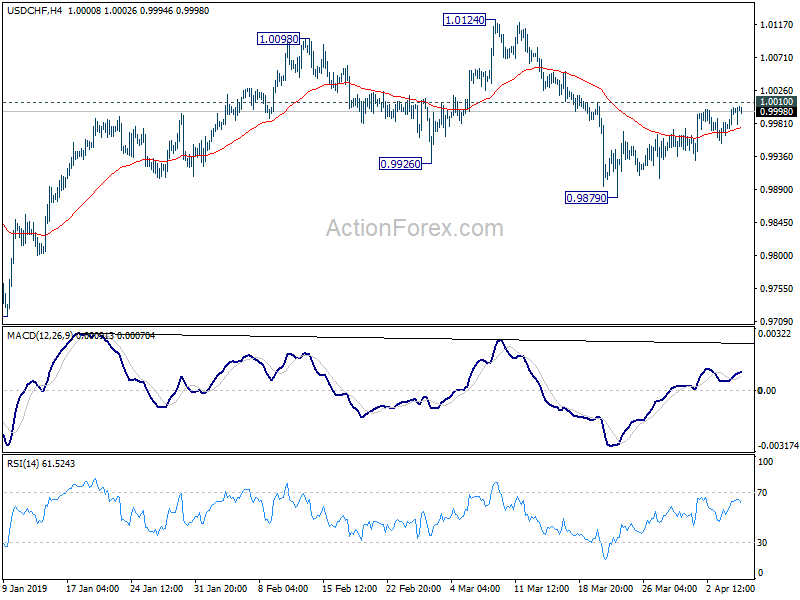
In the bigger picture, focus is back on medium term trend line (now at 0.9849). Decisive break there will argue that whole rise from 0.9186 has completed. Further break of 0.9716 will confirm reversal and target next support level at 0.9541. Nevertheless, there is still a chance that price action from 1.0128 are forming a consolidative pattern with fall from 1.0124 as third leg. If this is the case, stronger support should be seen between 0.9716 and the trend line to contain downside.
GBP/USD 100 Pip Bearish Spike Retests Support Zone
The GBP/USD however also remains close to strong support zones and the bearish price action could also be a retest of the trend lines (blue). Brexit news could also send the Cable impulsively in both directions. For the moment it seems likely that price would bounce at support and the Fibonacci levels and then move up to retest the resistance trend line (red).
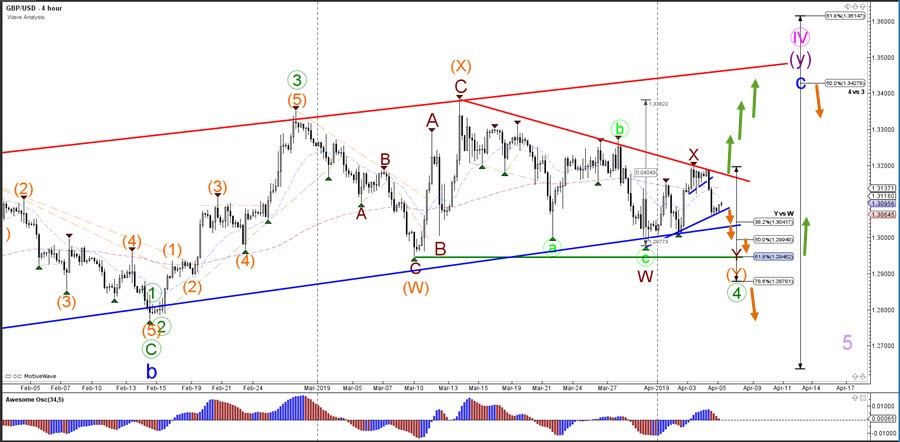
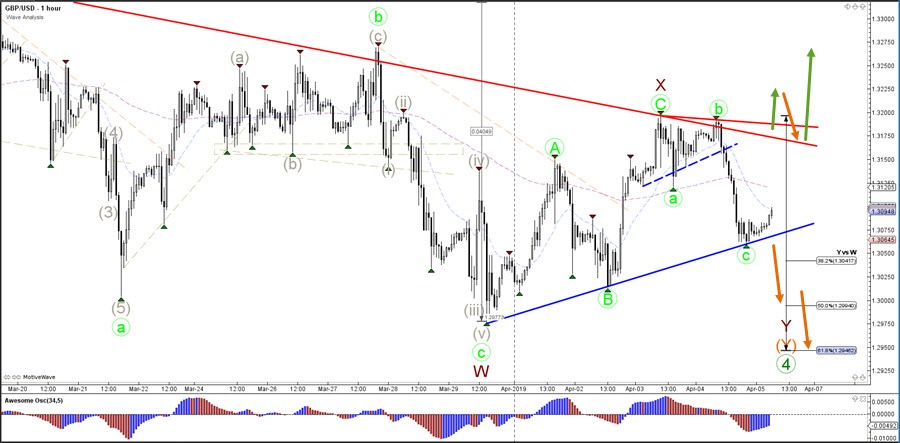
The GBP/USD could have completed a bearish ABC (green) zigzag correction at the support trend line (blue). A break below the support could indicate more bearish pressure towards the Fibonacci levels of wave Y vs W where as a break above the resistance (red) could indicate an uptrend.
Equities Trade Mixed Amid Holidays In China And HK
General Trend:
- Samsung confirms Q1 results to miss expectations, little impact seen on share price
- 7-Eleven owner Seven & I declines over 2% in Japan following its guidance
- Japan Finance Min comments on regional banks and financial services sector M&A
- Australian equities lag as financials decline amid rate cut expectations; Iron ore miners trade mixed
- Apple supplier Largan Precision March sales +24.9% y/y (vs. +14.1% prior)
- LG Electronics may issue Q1 guidance later today
- Japan Feb wages decline at fastest pace since 2015, lower bonuses and revisions cited
- Japan Economy Min declines to confirm dates for US trade talks
- Japan March official reserves rise to multi-year high
- US President Trump: China trade deal could be within the next four weeks
- Press speculation regarding possible US/China summit around the late June G20 meeting in Japan (June 28-29th)
- China Vice Premier Liu He is currently visiting the US for trade talks (April 3-5th)
- On April 3rd, White House Adviser Kudlow suggested that the China delegation could stay in the US for longer than 3 days
- Philippines y/y CPI slows further in March (3.3% v 3.5%e), Peso (PHP) declines
- Philippines Central Bank (BSP) Dep Gov Guinigundo: Sees potential rate cut when inflation slows to 3.0%
- Markets are closed today in China, HK and Taiwan in observance of holidays
- Reserve Bank of Australia (RBA) Dep Gov Debelle is expected to speak on the state of the economy on Wed (April 10th), RBA Financial Stability Review is due to be released on Friday (April 12th)
Headlines/Economic Data
Australia/New Zealand
- ASX 200 opened -0.3%
- (AU) Australia Mar AiG Performance of Construction Index: 45.6 v 43.8 prior
- (AU) Australia sells A$900M v A$900M indicated in 2.50% May 2030 bonds, avg yield 1.9247% v 1.9459% prior, bid to cover: 3.03x v 3.03x prior
- (AU) Australia thermal coal prices have largest weekly decline since 2008 - financial press
- (AU) Australia opposition party pledges to increase spending related to the health care sector ahead of elections, announced A$2.3B cancer-care spending package - financial press
China/Hong Kong
- Shanghai Composite and Hang Seng closed for holidays
- (CN) Pres Trump: If we reach a trade agreement, will have a summit with Pres Xi in Washington; should know in the next 4 weeks; Talks may continue for four weeks and another two after that to get it on paper
- (CN) China Vice Premier Liu He: New consensus reached on text related to US/China economic and trade agreement; to continue to work hard to conclude trade talks ASAP - Xinhua
- (CN) China President Xi calls for early conclusion of China-US trade text, Xi said substantial progress made in US trade talks - Chinese Press
- (CN) Nikkei says US/China summit in Japan in late June is possible
- (CN) Some market observers are still cautious on property market in China despite signs of recovery - South China Morning Post
- (IN) India has started a crackdown on online purchases of goods from e-commerce platforms in China, relates to the evasion of the customs duty and goods and services tax - Indian press
Japan
- Nikkei 225 opened +0.1%
- (JP) JAPAN FEB REAL CASH EARNINGS Y/Y -1.1% V 0.8%E (fastest decline since June 2015); LABOR CASH EARNINGS Y/Y: -0.8% V 0.9%E
- (JP) Japan Feb Household Spending Y/Y: 1.7% v 1.9%e
- (JP) Japan Mar Official Reserve Assets: $1.29T v $1.28T prior (multi-year high)
- (JP) JAPAN FEB PRELIMINARY LEADING INDEX CI: 97.4 V 97.2E; COINCIDENT INDEX: 98.4 V 98.9E
- (JP) Bank of Japan (BOJ) Quarterly Public Opinion of Household Sentiment: Households maintain 1-year inflation outlook at 3.0%; Household maintains 5-year inflation outlook at 2.0%
- (JP) Japan Fin Min Aso: Regional banks need sustainable business models; must take steps to ensure regional banks don't 'disappear'; Mergers are one way of maintaining financial services
- (JP) Japan Economy Min Motegi: Trying to have trade talks with US this month; will announce dates when decided
Korea
- Kospi opened flat
- Samsung Electronics: Guides Q1 (KRW) Op 6.2T ($5.5B) v 6.9Te; Rev 52.0T ($45.8B) v 53.0Te; Q1 Op guidance implies a decline of ~60% y/y (lowest since 2016)
- (KR) South Korea President Moon approval rating declines to 41% (record low) vs 43% prior - Gallup Poll
- (KR) North Korea has built a ballistic nuclear missile submarine - South Korean Press
Other
- (PH) Philippines Mar CPI Y/Y 3.3% v 3.5%e (2nd straight month within inflation target range; lowest since 2017)
- (SG) Monetary Authority of Singapore (MAS) to publish semi-annual monetary policy statement and Q1 advance GDP data on April 12th (Friday)
- (TH) Thailand Central Bank Official Alisara: Baht (THB) volatility to continue on higher uncertainties; has enough tools to manage likely volatility in the baht
North America
- (US) Pres Trump: nominations of Cain and Moore to the Fed are not meant to send any signal whatsoever to the Fed
- (SA) Saudi Arabia said to have discussed plans to 'ditch the US dollar' from oil trades if the US passes NOPEC; The NOPEC bill is not expected to pass in the US and the threat related to the US dollar could be part of Saudi Arabia's contingency planning, according to the article - financial press
Europe
- (UK) EU's Tusk said to offer UK a 12-month extension on Brexit - financial press
- (IE) Ireland Central Bank lowers 2019 GDP forecasts for to 4.2% from 4.4% prior; states Brexit is not only risk to economy
Levels as of 1:20 ET
- Nikkei 225, +0.3%, ASX 200 -0.8%, Hang Seng closed; Shanghai Composite closed; Kospi +0.1%
- Equity Futures: S&P500 +0.1%; Nasdaq100 +0.2%, Dax +0.1%; FTSE100 flat
- EUR 1.1230-1.1218 ; JPY 111.80-111.59 ; AUD 0.7125-0.7107 ;NZD 0.6764-0.6748
- Gold -0.2% at $1,292/oz; Crude Oil flat at $62.09/brl; Copper -0.2% at $2.911/lb
Brexit, NFP And White Paper In Norway
Market movers today
Today, the US jobs report for March is due out. The US labour market looks strong on most parameters and the weak increase in nonfarm payrolls in February was most likely a fluke after the big increase in January. We expect nonfarm payrolls rose 190,000 in March and that average hourly earnings rose +0.25% m/m, implying a fall in the annual growth rate to 3.3% y/y from 3.4% y/y. If we are right, the jobs report should support markets, which have rallied this week based on renewed growth optimism, as the US is not about to fall into recession just yet.
Besides the US jobs report, we get industrial production in February from Denmark , Norway and Germany this morning.
In Norway , at 11.45 CEST, the government will publish a white paper on the investment universe of the Government Pension Fund Global, also known as the "oil fund". Markets are likely to focus in particular on the decision over the bond portfolio, as the fund's proposal in September 2017 included cutting the bond portfolio to three currencies; namely the EUR, USD and GBP. The original proposal also suggested removing all corporate bonds and linkers from the investment universe. The white paper could also include other changes to both the bond and the equity portfolio. As these changes could be far reaching, we expect any changes to be implemented only slowly.
Markets will look out for any breakthroughs in the Brexit negotiations between PM May and Labour leader Corbyn with only a week to Brexit day on 12 April.
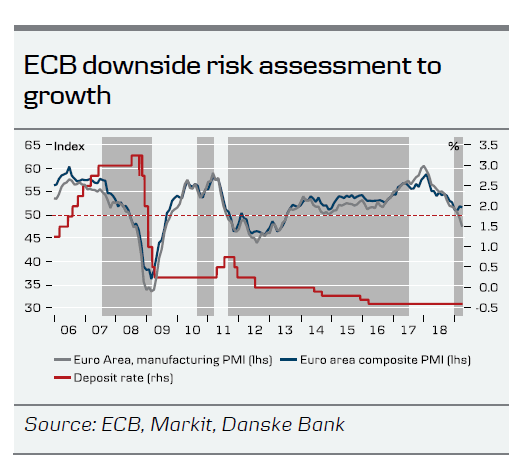
This morning, we have published our ECB preview ahead of next week's meeting. In short, we expect Draghi to repeat his 'delayed, not derailed' inflation message, thereby no new policy signals from the ECB. However, we expect Draghi to strike an overall cautious tone and the ECB to keep its downside risks assessment on growth.
Selected market news
Most Asian equity indices as well as the S&P500 futures are trading modestly in green this morning on the back of positive remarks on the ongoing trade negotiations in Washington between the US and China. Trump stated that "a lot of the most difficult points" had been tackled and that he expected a deal to be reached within four weeks. While Chinese President Xi is not present at the negotiations, Vice Premier Liu He has brought his message calling for an early conclusion to the negotiations. A date has yet to be set for the presidents to meet.
In the UK, four and a half hours of negotiations between PM May and Labour leader Corbyn yielded a set of statements that the negotiations had been "productive" and "technical" - yet still short of any concrete results. The negotiations will continue today.
There is talk that the EU may offer a long but flexible extension at next week's extraordinary EU summit, which would include an option to leave earlier if the UK passes the withdrawal agreement. One precondition is for the UK to call for European elections next month. That said, not all EU leaders agree with this approach and while the probability of no deal Brexit is low in our view, it is still not negligible.
ECB Preview: No New Policy Actions Expected As ‘Inflation I Delayed, Not Derailed’
- The ECB confirmed its 'low-for-longer' narrative at last week's Watchers conference.
- We expect Draghi to repeat his 'delayed, not derailed' inflation message, thereby no new policy signals from the ECB. However, we expect Draghi to strike an overall cautious tone and the ECB to keep its downside risks assessment on growth.
- The economic indicators are yet to show a convincing pickup but positively some stabilisation in indicators (except in the German manufacturing sector and core inflation) has been observed, which we expect Draghi to acknowledge.
- We do not expect TLTRO3 modalities to be announced next week (not until June). We expect questions on a tiering-system but no additional colour to the discussion compared to last week comments from chief economist Peter Praet.
Cautious stance
The ECB kept its downside risk assessment on growth at the last governing council meeting (GC), while launching a new series of TLTROs and extending forward guidance. The ECB keeping its downside risk assessment while announcing policy measures has not been seen before often, which clearly points to awareness of and concern about the outlook. The March minutes showed that a case was made to change the risk assessment after the lower projections. That said, we still expect the ECB to keep its downside risk assessment, reflecting particularly weak manufacturing, which is still to show a pickup. On the positive side, the recent Chinese PMI pointed to an improved global cycle in the near future. Worryingly, though, the minutes said 'that growth might not be mean-reverting, as typically assumed in projections', pointing to China amongst others.
Tiering system and TLTRO3 modalities
We do not expect TLTRO3 modalities until June. We believe the verdict is still out on how favourable the ECB wants to make the operations and more time is needed for this. According to the communication so far, the main refinancing operation rate plays a crucial role in the incentive structure, without further colour of how this is structured.
We also expect markets to be disappointed about additional colour on a potential tiering system. In our ECB Watchers conference: is a tiering system really the answer? and our Government Bonds Weekly we outline why we do not expect a tiering system to be announced. However, given Peter Praet's comments last Thursday we expect Draghi to face questions on the format and timeline of a potential tiering system. We expect Draghi to acknowledge the discussion of a tiering system, but as part of a discussion on how to mitigate the side-effects of the negative deposit rates.
We find it important to stress that we cannot rule out a tiering system at this stage and markets are right by assigning a non-zero probability to this given the comments from Draghi and Praet. However, we reiterate that the important lesson here is that ECB's 'lowfor- longer' narrative is dominating and a discussion on a tiering system shows ECB's willingness to use all instruments, as it is wary of the situation in the euro area.
Low market-based inflation pricing amid no hike on our forecast horizon
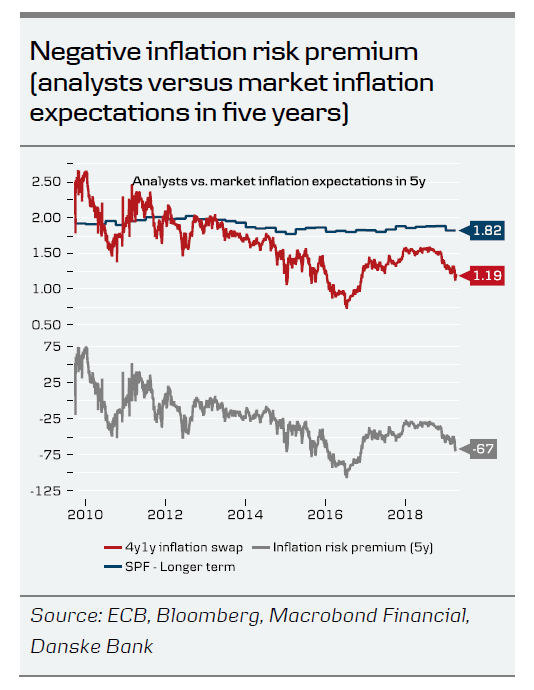
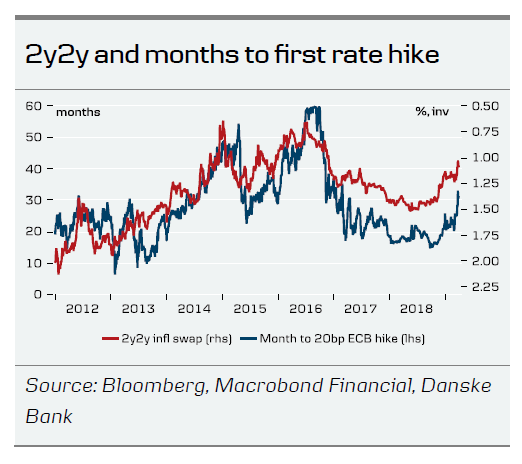
Inflation market pricing, measured by forward inflation swaps, stands c. 15bp lower compared with the GC meeting in March. The 2y2y and 5y5y inflation swap troughed at worryingly low levels of 1.03% and 1.32%, respectively, last week and have since then recorded a small rebound to 1.08% and 1.36% currently. Interestingly, the ECB attributes the recent repricing to a rising negative inflation risk premium (-67bp in five years) as the survey-based inflation measure remains broadly stable. However, we note that the most prominent survey gauge, the Q1 update of the survey of professional forecasters, is set to be released to the GC ahead of the meeting and if the survey points to deteriorating inflation expectations, from the current 1.82%, the ECB may open the door for more easing. Previously, when the longer-term SPF was at 1.77% in Q1 15, the ECB started QE. A similar move is expected to trigger an even more dovish reaction from the ECB. The SPF publication is due for release on 11 April.
As the inflation market pricing and EONIA pricing are strongly correlated with first rate hike pricing (measured by number of months to first rate hike), we need to see a significant pickup in market-based inflation expectations (in turn on the back of a pickup in economic data) before we can actively trade the first rate hike in outright terms.
Lower growth near-term - inflation delayed, not derailed
The downward revision of the staff projections at the March meeting was larger than we and markets had expected. The revisions, which were of a similar size as in the run up to the PSPP announcement in 2015, led to the ECB announcing its third round of targeted liquidity operations and postponing the first rate hike guidance, as a building worry of the slowdown becoming more structural has emerged.
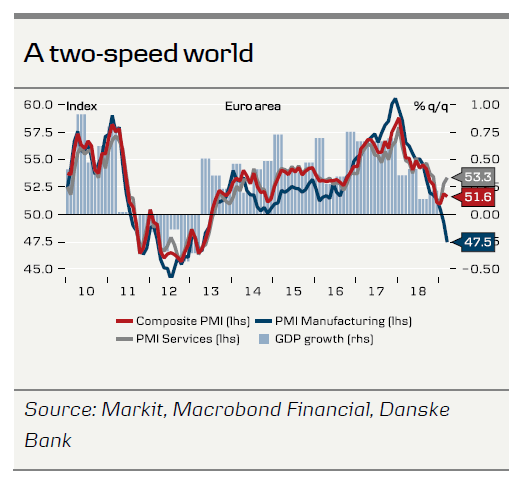
Since the March meeting, only four weeks ago, we have seen some stabilisation in forward looking indicators such as Ifo, ZEW etc. However, the important German PMI manufacturing and inflation data disappointed, euro area growth likely remained subdued in Q1 19 and indicators point to a quarterly growth of 0.2% (in line with the ECB's baseline). Overall, the PMIs paint a two-speed picture of the economic momentum. While the service sector rebounded in signs of strengthening domestic demand, manufacturing is painting a dour picture. Particularly, the Germany manufacturing sector is suffering from the global trade channel, albeit the rise in Chinese data may point to easing headwinds in the (German) manufacturing sector in the future.
The ECB still expects a pickup in growth and in turn inflation figures in a classical textbook (output gap) approach, which points to a loss of growth momentum that implies a later and more subdued pickup in inflation. We agree with this assessment, albeit our core inflation profile is slightly more dovish than the ECB's profile staff projection suggests. The March disappointing core inflation figure of 0.8% was to a large degree driven by seasonal factors due to the timing of Easter (service price inflation declined to 1.1%). That said, the tight labour market conditions and strong wage growth are yet to translate into core inflation. The missing transmission from wages to consumer prices is becoming an increasing worry for the ECB as Draghi also pointed to structural changes during the March press conference. However, so far we believe the ECB to stick to its mantra that 'the sustained convergence of inflation towards the 2% aim has been delayed rather than derailed'.
FX fatigued
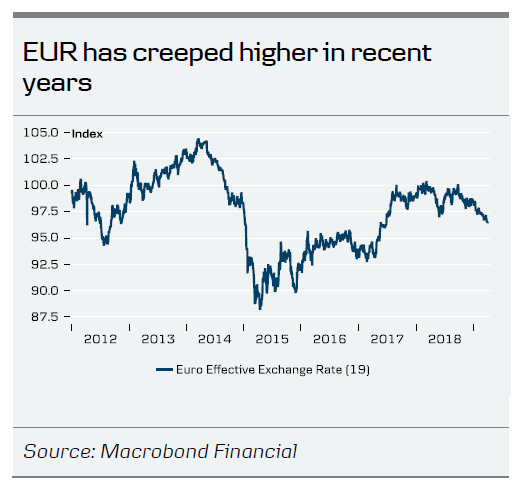
The weak PMI, the collapse in market-based inflation expectations and the turnaround in the ECB's communication at last month's meeting as well as during the Watchers conference have put focus on the potential need for further ECB easing. The discussion has so far centred on forward guidance, TLTRO modalities and a tiered deposit system – none of which has the potential to substantially weaken the EUR in our view. A signal of more QE or rate cuts could do the trick, but that is not for the April meeting, but could come later depending on how the incoming data play out.
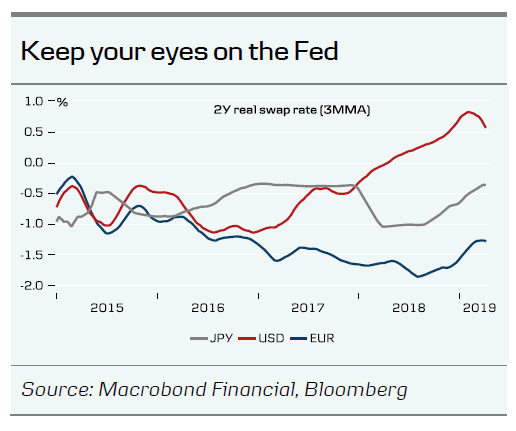
The recent development in short-term real interest rates (illustrated by 2Y OIS real swap rates) highlights the current asymmetric outcome space for EUR/USD with respect to relative monetary policy. The Fed can tighten, as it did last year, when it pushed the real rate about 100bp higher, and Fed can ease, as it has done this year, where the short-term real rate has dropped about 15bp. In contrast, the ECB does not seem to have an answer to the 35bp rise in the real rate since the start of 2018.
For EUR/USD, the coming months will be a tug of war, between the development in global risk sentiment and carry. The recent bout of better Chinese data provides some comforting support for EUR/USD, however, on the other hand, carry on short EUR/USD still sits above 3% in a 1Y FX forward, albeit down from 3.45% last year following the repricing of the Fed. We forecast EUR/USD at 1.13 in 3M and highlight that if the ECB starts to look into QE or rate cut options, we could see a dip to 1.10 in the short term.
Still ECB support for European fixed income
The focus in the fixed income markets is set to turn to the economic outlook, as the effort to find news about the details of the new TLTRO and the potential of a tiering system for deposit rates is unlikely to be fruitful.
Hence, the ECB will hardly rock the boat and the market will conclude once again that any rate hikes are very far away. The first 10bp hike in the depo rate is currently priced in H1 21 and after the tiered rates discussion started at the ECB Watchers conference last week, the market now sees a very small probability that rates could be cut in late 2019. This is unlikely to change next week with no new details of a possible tiering system. We also expect that Bunds will remain supported and 10Y Bund yields are expected to continue to trade in a -10bp to +5bp range after the meeting.
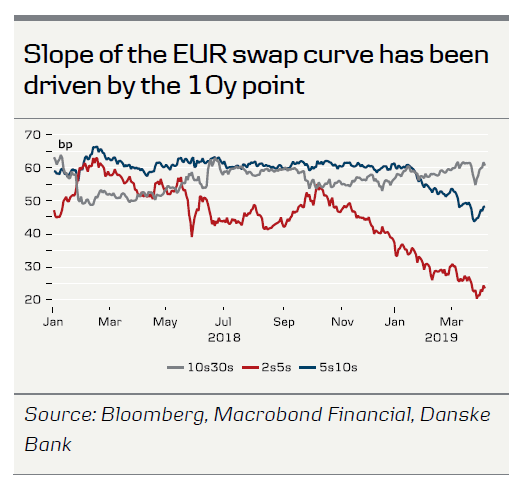
We also hold on to the view that the 'low-for-longer' rhetoric including the tiering discussion has created a very supportive carry or hunt for yields environment in the Eurozone and recommend to overweight periphery and semi-core in the government bond market. The EUR swap curves have steepened after the tiering rates discussion last week. We expect that especially the 5s10s flattening will start again as the pivotal point on the curve has moved out on the curve
Elliott Wave View: DJIA Futures (YM_F) Should Extend Higher
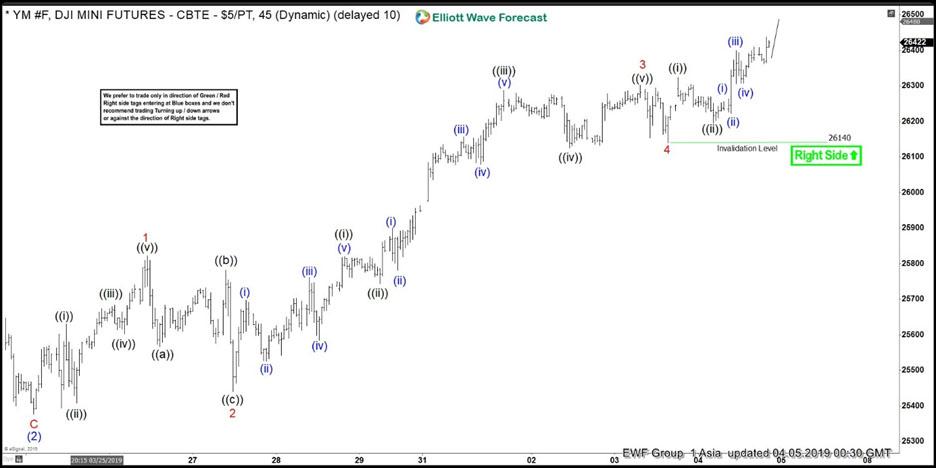
Short term Elliott Wave view on Dow Jones Future (YM_F) suggests that rally from March 9, 2019 low is unfolding as a 5 waves impulse Elliott Wave structure. In the chart below, we can see wave (2) ended at 25377. Wave (3) remains in progress and subdivides in 5 waves of lesser degree. Up from 25377, wave 1 ended at 25822, wave 2 ended at 25441, wave 3 ended at 26302, and wave 4 ended at 26140.
Wave 5 of (3) is currently in progress as a 5 waves. Up from 26140, wave (i) ended at 26324 and wave ((ii)) ended at 26196. Near term, while pullback stays above 26140, expect the Index to extend higher to end wave 5 of (3). Index should then do a larger pullback in wave (4) to correct cycle from March 25, 2019 low. Afterwards, as far as pivot at 25377 low stays intact, expect Index to extend higher again in wave (5). We don’t like selling the Index.
1 Hour YM_F Elliott Wave Chart Asia Update
Germany’s Factory Orders Unexpectedly Declined To A Two-Year Low Level In February
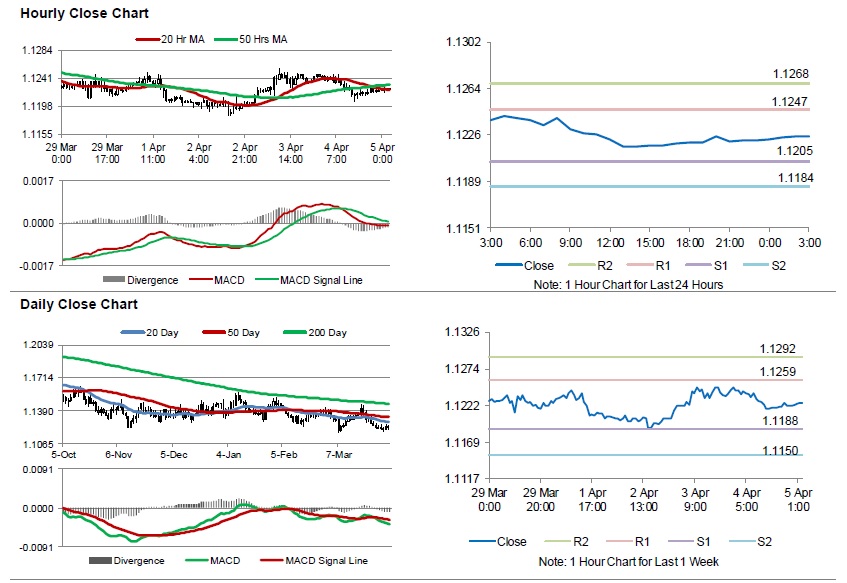
For the 24 hours to 23:00 GMT, the EUR declined 0.19% against the USD and closed at 1.1222, on the back of dismal German factory orders data.
Data showed that Germany's seasonally adjusted factory orders unexpectedly declined to a two-year low level of 4.2% on a monthly basis in February, amid a slump in foreign demand and defying market consensus for a gain of 0.3%. In the preceding month, factory orders had recorded a drop of 2.6%. Meanwhile, the nation's construction PMI advanced to a level of 55.6 in March, following a reading of 54.7 in the previous month.
In the US, data showed that seasonally adjusted initial jobless claims surprisingly fell to a level of 202.0K in the week ended 30 March 2019, hitting its lowest level in almost 50 years and confounding market expectations for a rise to a level of 215.0K. In the prior week, initial jobless claims had recorded a revised level of 212.0K.
In the Asian session, at GMT0300, the pair is trading at 1.1225, with the EUR trading marginally higher against the USD from yesterday's close.
The pair is expected to find support at 1.1205, and a fall through could take it to the next support level of 1.1184. The pair is expected to find its first resistance at 1.1247, and a rise through could take it to the next resistance level of 1.1268.
Going ahead, traders would await Germany's industrial production for February, set to release in a few hours. Later in the day, the US non-farm payrolls, unemployment rate and average hourly earnings, all for March, will pique significant amount of investors' attention.
The currency pair is showing convergence with its 20 Hr moving average and trading below its 50 Hr moving average.
British Pound Reverses Its Losses In The Asian Session
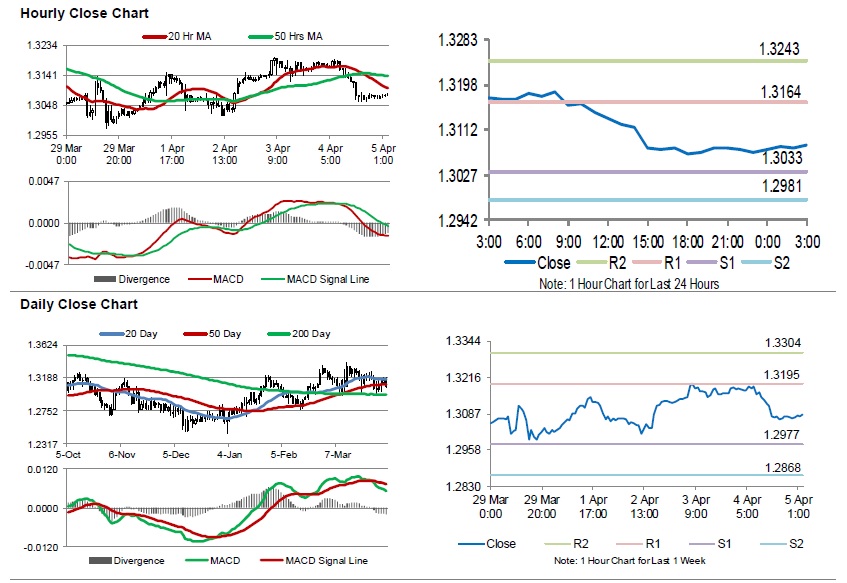
For the 24 hours to 23:00 GMT, the GBP declined 0.81% against the USD and closed at 1.3070, amid rising uncertainty over Brexit.
In the Asian session, at GMT0300, the pair is trading at 1.3085, with the GBP trading 0.11% higher against the USD from yesterday’s close.
The pair is expected to find support at 1.3033, and a fall through could take it to the next support level of 1.2981. The pair is expected to find its first resistance at 1.3164, and a rise through could take it to the next resistance level of 1.3243.
Trading trend in the Sterling today, is expected to be determined by UK’s Halifax house price index for March, slated to release in a few hours.
The currency pair is trading below its 20 Hr and 50 Hr moving averages.
Japanese Yen Trading Lower In The Asian Session
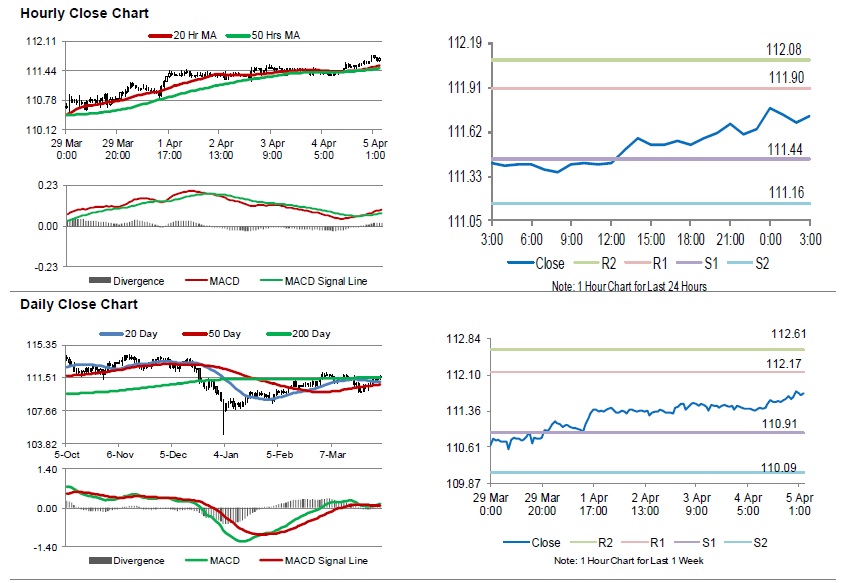
For the 24 hours to 23:00 GMT, the USD rose 0.15% against the JPY and closed at 111.64.
In the Asian session, at GMT0300, the pair is trading at 111.72, with the USD trading 0.07% higher against the JPY from yesterday’s close.
The pair is expected to find support at 111.44, and a fall through could take it to the next support level of 111.16. The pair is expected to find its first resistance at 111.90, and a rise through could take it to the next resistance level of 112.08.
Going ahead, traders would keep an eye on Japan’s leading index and coincident index for February, slated to release in a while.
The currency pair is trading above its 20 Hr and 50 Hr moving averages.