

Sample Category Title
Swiss Franc Extends Its Losses In The Morning Session
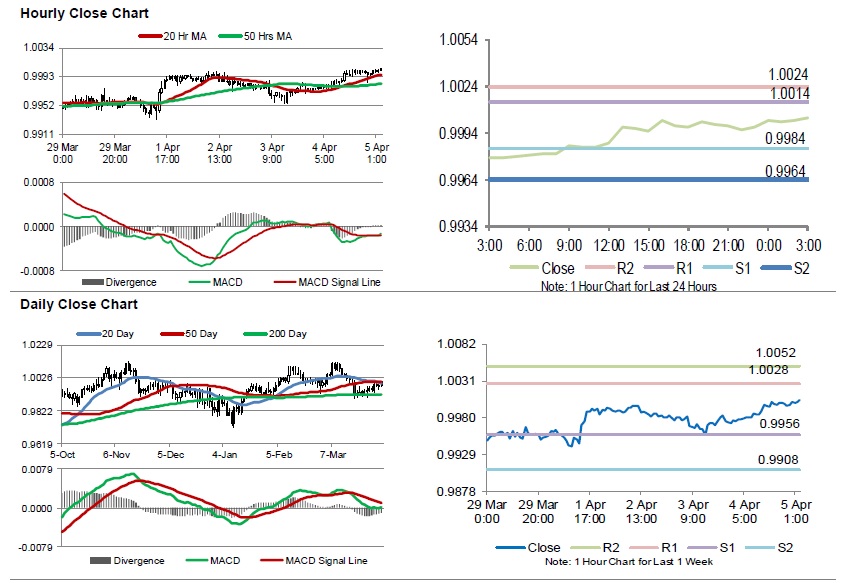
For the 24 hours to 23:00 GMT, the USD rose 0.24% against the CHF and closed at 0.9998.
In the Asian session, at GMT0300, the pair is trading at 1.0004, with the USD trading 0.06% higher against the CHF from yesterday’s close.
The pair is expected to find support at 0.9984, and a fall through could take it to the next support level of 0.9964. The pair is expected to find its first resistance at 1.0014, and a rise through could take it to the next resistance level of 1.0024.
With no macroeconomic releases in Switzerland today, investors would look forward to global macroeconomic releases for further directions.
The currency pair is trading above its 20 Hr and 50 Hr moving averages.
Canada’s Ivey PMI Advanced In March
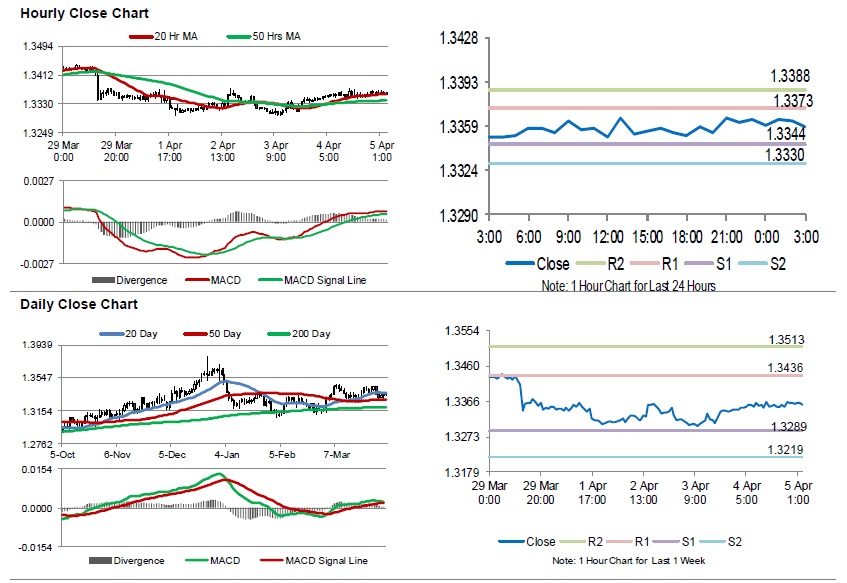
For the 24 hours to 23:00 GMT, the USD rose 0.16% against the CAD and closed at 1.3364.
Data indicated that Canada's seasonally adjusted Ivey PMI rose to a level of 54.3 in March, compared to a reading of 50.6 in the prior month.
In the Asian session, at GMT0300, the pair is trading at 1.3359, with the USD trading slightly lower against the CAD from yesterday's close.
The pair is expected to find support at 1.3344, and a fall through could take it to the next support level of 1.3330. The pair is expected to find its first resistance at 1.3373, and a rise through could take it to the next resistance level of 1.3388.
Looking ahead, traders would keep an eye on Canada's unemployment rate for March, scheduled to release later in the day.
The currency pair is showing convergence with its 20 Hr moving average and trading above its 50 Hr moving average.
Australia’s AIG Performance Of Construction Index Climbed In March
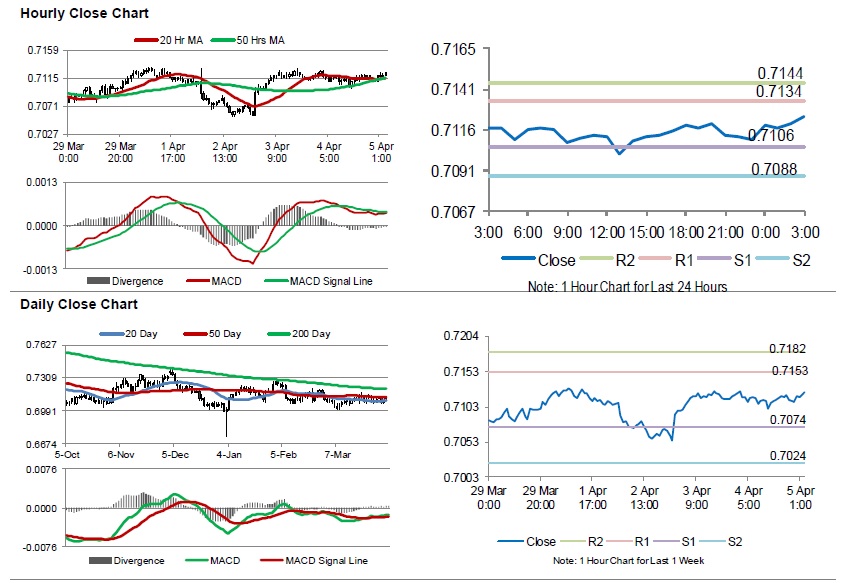
For the 24 hours to 23:00 GMT, the AUD declined 0.11% against the USD and closed at 0.7110.
LME Copper prices declined 0.6% or $0.4/MT to $6444.0/MT. Aluminium prices rose 0.4% or $7.0/MT to $1872/MT.
In the Asian session, at GMT0300, the pair is trading at 0.7124, with the AUD trading 0.20% higher against the USD from yesterday's close.
Overnight data showed that Australia's AIG performance of construction index climbed to a level of 45.6 in March, compared to a level of 43.80 in the preceding month.
The pair is expected to find support at 0.7106, and a fall through could take it to the next support level of 0.7088. The pair is expected to find its first resistance at 0.7134, and a rise through could take it to the next resistance level of 0.7144.
Amid lack of economic releases in Australia today, traders would focus on global macroeconomic events for further direction.
The currency pair is trading above its 20 Hr and 50 Hr moving averages.
Gold: Yellow Metal Reverses Its Gains In The Asian Session
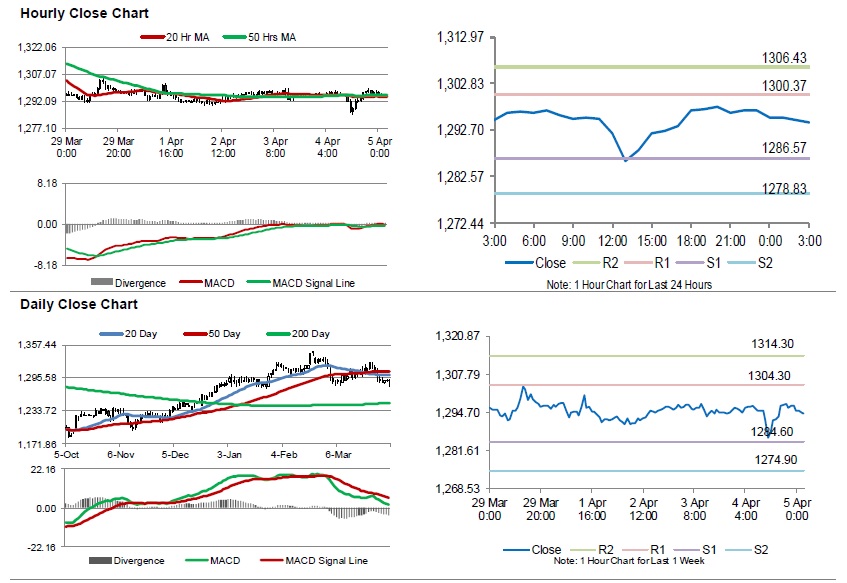
For the 24 hours to 23:00 GMT, Gold rose 0.11% against the USD and closed at USD1297.10 per ounce.
In the Asian session, at GMT0300, the pair is trading at 1294.30, with gold trading 0.22% lower against the USD from yesterday’s close.
The pair is expected to find support at 1286.57, and a fall through could take it to the next support level of 1278.83. The pair is expected to find its first resistance at 1300.37, and a rise through could take it to the next resistance level of 1306.43.
The yellow metal is showing convergence with its 20 Hr and 50 Hr moving averages.
Silver: White Metal Trading On A Weaker Footing In The Morning Session
For the 24 hours to 23:00 GMT, Silver rose 0.07% against the USD and closed at USD15.12 per ounce, tracking gains in gold prices.
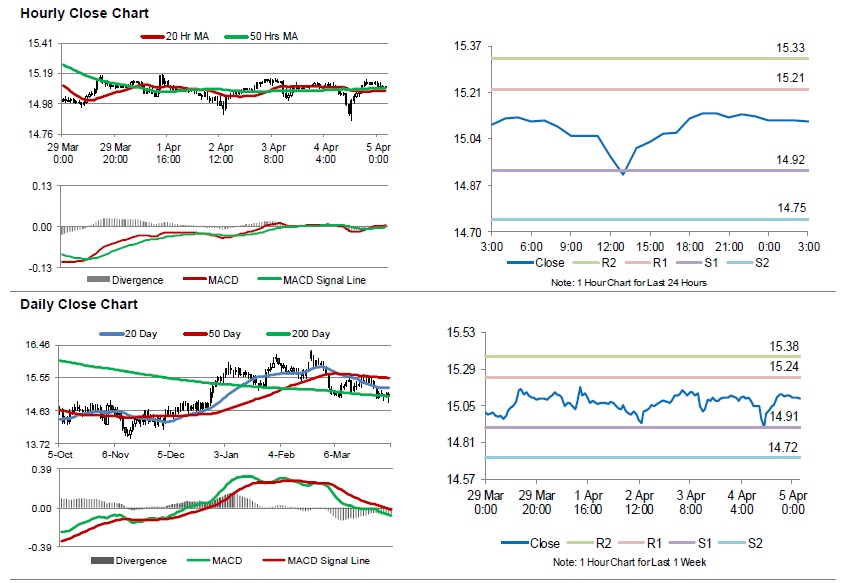
In the Asian session, at GMT0300, the pair is trading at 15.10, with silver trading 0.13% lower against the USD from yesterday’s close.
The pair is expected to find support at 14.92, and a fall through could take it to the next support level of 14.75. The pair is expected to find its first resistance at 15.21, and a rise through could take it to the next resistance level of 15.33.
The white metal is trading above its 20 Hr moving average and showing convergence with its 50 Hr moving average.
Crude Oil: Oil Trading Lower, Ahead Of Baker Hughes Weekly Rig Count Data
For the 24 hours to 23:00 GMT, Crude Oil declined 0.56% against the USD and closed at USD62.09 per barrel.
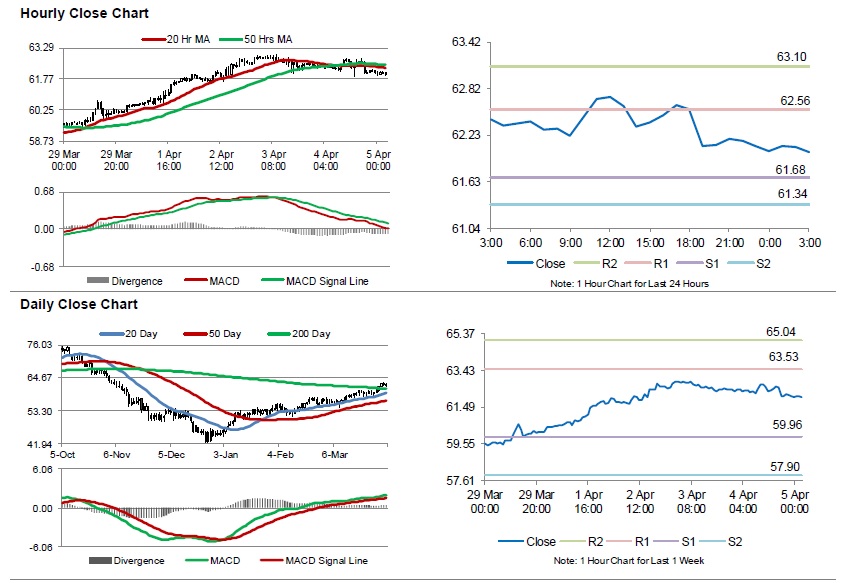
In the Asian session, at GMT0300, the pair is trading at 62.01, with oil trading 0.13% lower against the USD from yesterday’s close.
The pair is expected to find support at 61.68, and a fall through could take it to the next support level of 61.34. The pair is expected to find its first resistance at 62.56, and a rise through could take it to the next resistance level of 63.10.
Crude oil is trading below its 20 Hr and 50 Hr moving averages.
USD/JPY Daily Outlook
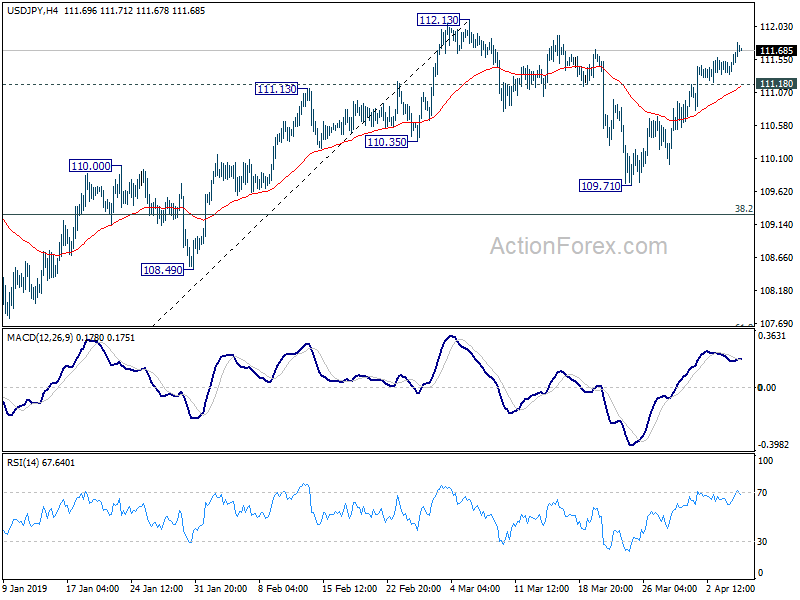
Daily Pivots: (S1) 111.27; (P) 111.42; (R1) 111.65; More...
Intraday bias in USD/JPY remains on the upside as rise from 109.71 is in progress for 112.13 resistance. Decisive break of 112.13 resistance will resume whole rise from 104.69 to 114.54 key resistance next. On the downside, however, break of 111.18 minor support will argue that rebound from 109.71 might be completed. Intraday bias will be turned back to the downside for 109.71, and possibly further to 38.2% retracement of 104.69 to 112.13 at 109.28.
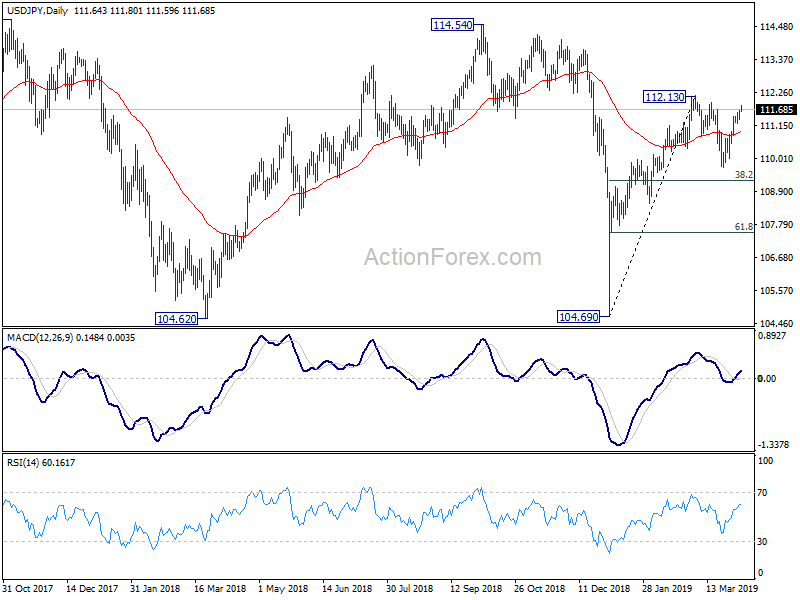
In the bigger picture, medium term outlook in USD/JPY remains a bit mixed as it's staying inside falling channel from 118.65, but there are signs of bullish reversal. On the upside, break of 114.54 resistance will revive the case the corrective fall from 118.65 has completed with three waves down to 104.69. And whole rise from 98.97 (2016 low) is resuming for 118.65 and above. But before that, outlook stays neutral first.
Focus Turns to Non-Farm Payroll after Vague Progress in US-China Trade Talks
Yen is trading softer in otherwise quiet markets today with Hong Kong and China on Holiday. Yen is indeed also the weakest one for the week following rebound in global treasury yields. For now, Swiss Franc is the second weakest for the day, followed by Dollar. Sterling is again strong one in Asian session but it could face some selling pressure again later in the day. Australian Dollar is also firmer, in established range.
Developments regarding US-China trade negotiations remained pretty much the same. News are positive with concrete details. A deal is told to be likely soon, but without specifying how soon is soon. Across the Atlantic, works are in progress to avert no-deal Brexit as April 12 cliff edge looms. Market focus would turn to job data from US and Canada.
In Asia, Nikkei is currently up 0.32%. Singapore Strait Times is up 0.18%. China and Hong Kong are on holiday. Japan 10-year JGB yield rose 0.010 to -0.029. Overnight, DOW rose 0.64%. S&P 500 rose 0.21%. NASDAQ dropped -0.05%. 10-year yield dropped -0.005 to 2.512, staying above 2.5 handle.
Trump: China trade deal in four weeks, or maybe less, maybe more
While there seems to be progress made in US-China trade negotiations, they've yet reached a concluding stage. No Trump-Xi summit was announced at the meeting in the Oval Office with Chinese Vice Premier Liu He. Trump said: "We're getting very close to making a deal. That doesn't mean a deal is made, because it's not, but we're certainly getting a lot closer."
At the time same, he repeated his vague languages regarding the timing of a deal. "And I would think with, oh, within the next four weeks or maybe less, maybe more, whatever it takes, something very monumental could be announced.
Trump added that "some of the toughest things have been agreed to", and "we've agreed to far more than we have left to agree to". "We have to make sure there's enforcement. I think we'll get that done. We've discussed it at length," he added..
It's equally vague on the Chinese side. President Xi Jinping told Trump, through Liu, that "I hope the two sides' trade teams can continue working in the spirit of mutual respect, equality, and mutual benefit to resolve each other's concerns, and finish negotiations on the text of the China-U.S. trade agreement soon." Yet, there was no indication on how "soon" is being soon.
Confirmatory Brexit referendum to be included as option in May's deal with Corbyn
UK Prime Minister Theresa May and opposition Labour leader Jeremy Corbyn held another day of productive (as described by Conservatives) and technical ( as described by Labour) talks on Brexit. No conclusion was made yet and discussions will continue on Friday. May will need to bring back her plans to a EU summit on April 10, just two days before the April 12 cliff edge, if UK is to avoid no-deal Brexit.
Corbyn told Labour MPs that "agenda items were customs arrangements, single market alignment including rights and protections, agencies and programmes, internal security, legal underpinning to any agreements and confirmatory vote." It's reported that in accordance with Labour's demands an option on confirmatory referendum on any Brexit deal would be tabled in any vote next week. That would be included in May's letter to Corbyn on Friday, outlining the agreement. But such a move would definitely trigger blackslashes from pro-Brexit Conservatives.
In the House of Lords, Pro-Brexit members were accused of filibustering to block the bill that blocks no-deal Brexit. The Yvette Cooper bill, which would require the PM to request an article 50 extension and avoid a no-deal Brexit, will remain with the Lords until Monday. It was originally intended to be fast-tracked through the Lords by the end of Thursday.
Non-farm payrolls preview: Solid but uninspiring numbers expected
US Non-Farm Payrolls report will be the major focus for today. Markets are expected 175k job growth is March, a solid rebound from February's terrible number of 20k. Unemployment rate is expected to be unchanged at 3.8%. Average hourly earnings growth is expected to slow to 0.2% mom.
Looking at other employment related data, the employment component of ISM manufacturing rose notably from 52.3 to 57.5. That of ISM non-manufacturing also increased from 55.2 to 55.9. However, ADP employment was rather disappointing, at 129k versus expectation of 184k. Four-week moving average of initial jobless claims dropped to 213.5k. However, Conference Board consumer confidence dropped from 131.4 to 124.1.
All in all, other data suggest that February's disaster won't extend into March, even though there might still be downside surprise. Meanwhile, there is prospect of upside surprise in upward revision in February's number.
Reactions could now be rather tricky. Stock investors might like to see a set of numbers that's not strong enough to push Fed for a rate hike this year. And such relief could also lift treasury yields and then Dollar. Another set of weak number will highlight the underlying vulnerability in the economy. Even though that might add to the case of a Fed cut, the worries could overwhelm and send stocks, yields and Dollar lower.
Here are some suggested readings on NFP:
- NFP Preview: Potential For A Upside Beat…But Will Traders Care?
- US Jobs Growth to Pick Up; Wage Growth to Remain Robust
Elsewhere
Australia AiG performance of construction index rose slightly to 45.6 in March, up from 43.8. Japan overall household spending rose 1.7% yoy in February, versus expectation of 2.0% yoy. Labor cash earnings dropped -0.8% yoy versus expectation of 0.8% yoy rise.
German industrial production and Swiss foreign currency reserves will be featured in European session. US NFP is a major focus for today. But let's not forget Canadian employment data too.
USD/JPY Daily Outlook
Daily Pivots: (S1) 111.27; (P) 111.42; (R1) 111.65; More...
Intraday bias in USD/JPY remains on the upside as rise from 109.71 is in progress for 112.13 resistance. Decisive break of 112.13 resistance will resume whole rise from 104.69 to 114.54 key resistance next. On the downside, however, break of 111.18 minor support will argue that rebound from 109.71 might be completed. Intraday bias will be turned back to the downside for 109.71, and possibly further to 38.2% retracement of 104.69 to 112.13 at 109.28.
In the bigger picture, medium term outlook in USD/JPY remains a bit mixed as it's staying inside falling channel from 118.65, but there are signs of bullish reversal. On the upside, break of 114.54 resistance will revive the case the corrective fall from 118.65 has completed with three waves down to 104.69. And whole rise from 98.97 (2016 low) is resuming for 118.65 and above. But before that, outlook stays neutral first.
Economic Indicators Update
| GMT | Ccy | Events | Actual | Forecast | Previous | Revised |
|---|---|---|---|---|---|---|
| 21:30 | AUD | AiG Performance of Construction Index Mar | 45.6 | 43.8 | ||
| 23:30 | JPY | Overall Household Spending Y/Y Feb | 1.70% | 2.00% | 2.00% | |
| 0:00 | JPY | Labor Cash Earnings Y/Y Feb | -0.80% | 0.80% | 1.20% | -0.60% |
| 5:00 | JPY | Leading Index CI Feb P | 97.4 | 97.2 | 96.5 | |
| 6:00 | EUR | German Industrial Production M/M Feb | 0.80% | -0.80% | ||
| 7:00 | CHF | Foreign Currency Reserves (CHF) Mar | 739B | |||
| 12:30 | CAD | Net Change in Employment Mar | -10.0K | 55.9K | ||
| 12:30 | CAD | Unemployment Rate Mar | 5.80% | 5.80% | ||
| 12:30 | USD | Change in Non-farm Payrolls Mar | 175K | 20K | ||
| 12:30 | USD | Unemployment Rate Mar | 3.80% | 3.80% | ||
| 12:30 | USD | Average Hourly Earnings M/M Mar | 0.20% | 0.40% | ||
| 12:30 | USD | Average Weekly Hours All Employees Mar | 34.5 | 34.4 |
Non-farm payrolls preview: Solid but uninspiring numbers expected
US Non-Farm Payrolls report will be the major focus for today. Markets are expected 175k job growth is March, a solid rebound from February's terrible number of 20k. Unemployment rate is expected to be unchanged at 3.8%. Average hourly earnings growth is expected to slow to 0.2% mom.
Looking at other employment related data, the employment component of ISM manufacturing rose notably from 52.3 to 57.5. That of ISM non-manufacturing also increased from 55.2 to 55.9. However, ADP employment was rather disappointing, at 129k versus expectation of 184k. Four-week moving average of initial jobless claims dropped to 213.5k. However, Conference Board consumer confidence dropped from 131.4 to 124.1.
All in all, other data suggest that February's disaster won't extend into March, even though there might still be downside surprise. Meanwhile, there is prospect of upside surprise in upward revision in February's number. Overall, the set of data is likely to be solid by uninspiring.
Reactions could now be rather tricky. Stock investors might like to see a set of numbers that's not strong enough to push Fed for a rate hike this year. And such relief could also lift treasury yields and then Dollar. Another set of weak number will highlight the underlying vulnerability in the economy. Even though that might add to the case of a Fed cut, the worries could overwhelm and send stocks, yields and Dollar lower.
Here are some suggested readings on NFP:
Cliff Notes: A Growing Call for Stimulus
Key insights from the week that was.
Unsurprisingly, with an election imminent, Budget 2019 focused on short and medium-term income support for households and long-term infrastructure investment while still promising a lasting return to surplus from 2019/20. Our analysis of Budget 2019 is now available at Westpac IQ. Here we focus on the implications for monetary policy.
For the RBA view, the take home from Budget 2019 is that, while supportive of activity over the long-term, the near-term impact on incomes and activity is limited. Labor’s alternative proposals, as per the budget reply, are also spread out over time. So no matter which party wins in May, the headwinds of persistent weak income growth and declining house prices are set to hold growth well below trend through 2019. This is clear justification for interest rate cuts from the RBA, which Westpac believes will come in August and November.
While the RBA is yet to adopt an easing bias, the April meeting decision statement did emphasise the fluidity of the situation, with a change in the wording of the final paragraph highlighting that the Board will continue to monitor developments and set policy accordingly. Albeit subtle, this is the first such change to the final paragraph since Governor Lowe took over in September 2016, and sets the scene for a more decisive shift in tone and forecasts in May, when the next Statement on Monetary Policy is due.
Turning to the Australian data released this week. On the positive side, Australia’s trade balance reached a record high in February on the back of the elevated iron ore price; and similarly, retail sales and dwelling approvals for February also beat expectations. That being said, the trend for retail sales remains weak, and for dwelling approvals, the upside surprise was solely due to a surge in high-rise apartment approvals that is unlikely to be repeated – note all other approval components were well below expectations. CoreLogic house price data for March meanwhile highlighted that the house price correction is still a fair way from stabilising.
Across the Tasman in New Zealand, Westpac has changed its view on the RBNZ outlook. We are now calling for a cut at the May 2019 meeting and another a year later in May 2020. The justification for this view is the clear concern that the RBNZ has shown over the global backdrop; inflation struggling to return to the 2.0%yr target; and our New Zealand team’s long-held concerns over the economic outlook in the early-2020’s. These rate cuts would take the RBNZ cash rate to 1.25% at May 2020.
Further afield in Asia, the data flow has been constructive, with both the NBS and Caixin manufacturing PMI’s rising above 50 once again – signalling growth for industry. The services sector meanwhile has continued to grow at a solid pace, pointing to still-robust momentum within China’s domestic economy despite external headwinds. We continue to hold a positive view on China, believing that fixed asset investment growth will slowly strengthen and broaden across the economy during 2019. GDP growth will however still be at the lower end of authorities 6.0-6.5% target range for this year, as the softer employment growth of the past year affects consumption.
For China and the broader Asian region, the focus of markets this week has not been the above data but rather signs that a trade agreement between the US and China may (finally) be close. Anecdotes from authorities have been positive, and there have also been press reports of agreement over some terms, including China purchasing more goods from the US over the coming decade – to reduce the US’ trade deficit.
For the US, the headline data print of the week, the employment report, is still to come. Other data has been mixed, with consumer spending and inflation soft, but business sector detail robust. We remain of the view that US GDP growth will end 2019 near trend despite a soft start to the year, in part due to the December/ January Government shutdown.
Finally to Europe and the UK. Updates on the European economy this week confirm a general softness in activity but also underscore sectoral divergence in the economy. While retail sales volumes were shown to be tracking at 2.8%yr and the services and construction PMI’s imply continued steadiness, the manufacturing industry remains in the doldrums. Most notably, German factory orders plunged 4.2% in February and the European manufacturing PMI was revised down to be at lows since 2013. With the latter front of mind, along with geopolitical uncertainty, the ECB are concerned about the economic outlook, as confirmed in the release of the March meeting minutes. Not much was offered in these minutes in regards to TLTRO-III incentives and the possibility of a tiered deposit rate. It is unlikely that a decision will be made on incentives at next week’s April meeting, but we expect an update in June.
A key uncertainty weighing on Europe regards the UK and Brexit. We are not surprised that little progress was made this week. While PM May and Labour’s Corbyn began negotiations – and reports are that they were “constructive” – a compromise is still yet to be found ahead of the April 12 Brexit date. At next week’s EU Summit on April 10, the UK will need to present a withdrawal deal to EU-27 leaders or provide guidance on a plan for the way forward. Given the resistance against leaving without a deal, this plan is likely to call for another extension to the Brexit negotiation process. However, this will need to factor in European Parliament elections scheduled for May 23-26.