

Sample Category Title
Into US session: Dollar rebounds on strong jobless claims, Euro enduring string of negative news
Entering into US session, Dollar and Yen are both regaining some grounds as financial markets turned mixed. There are positive reports on US-China trade negotiation, which should be in its final stage. Trump scheduled to meet Chinese Vice Premier Liu He at 2030 GMT and a summit with Xi could be finally announced. Yet, that provides little lift to market sentiments in general. The greenback is somewhat supported additionally by strong initial jobless claims, that fell to lowest since 1969. But the real critical one is tomorrow's no-farm payrolls.
Meanwhile, news out of Europe are generally negative. Germany factory orders contracted sharply by -4.2% mom in March. Germany's leading economic institutes lowered economic growth forecasts for the country in 2019 sharply to 0.8%, down from 1.9%. Italy is said to revise down growth forecasts to as low as 0.1% in 2019, thus raising budget deficit target to 2.3-2.4%. ECB accounts revealed that some policymakers considered pushing timing of first hike to after Q1 2020. There is no special progress in Brexit in UK even though April 12 cliff edge is approaching. Nevertheless, Euro isn't too weak at all. The worst performing ones for now are New Zealand Dollar and Sterling.
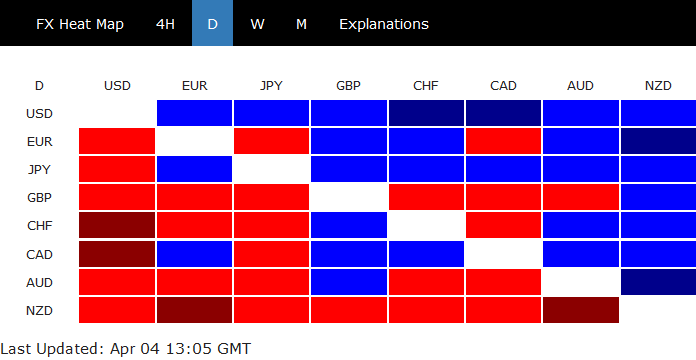
In Europe, currently:
- FTSE is down -0.41%.
- DAX is up 0.24%.
- CAC is down -0.18%.
- Germany 10-year yield is down -0.012 at -0.01, back in negative territory.
Earlier in Asia:
- Nikkei rose 0.05%.
- Hong Kong HSI dropped -0.17%.
- China Shanghai SSE rose 0.94%.
- Singapore Strait Times rose 0.15%.
- Japan 10-year JGB yield rose 0.0108 to -0.04.
Trump attacks Fed again, but anyone cares to listen?
Trump attacks Fed again by describing Fed's actions as "unnecessary and destructive" in his tweet. But he also said despite that the economy is looking very strong, with China and USMCA deals "moving along nicely".
https://twitter.com/realDonaldTrump/status/1113773525188395014
Yesterday, Minneapolis Federal Reserve Bank President Neel Kashkari said in a town hall in Fargo, North Dakota that "Presidents are free to say what they want". However, he added, "I can tell you with great confidence that my colleagues and I don’t pay any attention."
EU Katainen: It’s logical to think we’re rushing toward a hard Brexit
European Commission Vice President Jyrki Katainen warned that "hard Brexit is increasingly possible because we don't know what the alternative is".
He also complained that "You only know what Britain doesn't want, but you don't know what Britain wants and, taking into account the limited number of days we have available, it is logical to think we are rushing toward a hard Brexit. But hopefully I am wrong."
US 500 Index Eases after Hitting Fresh 6-month High
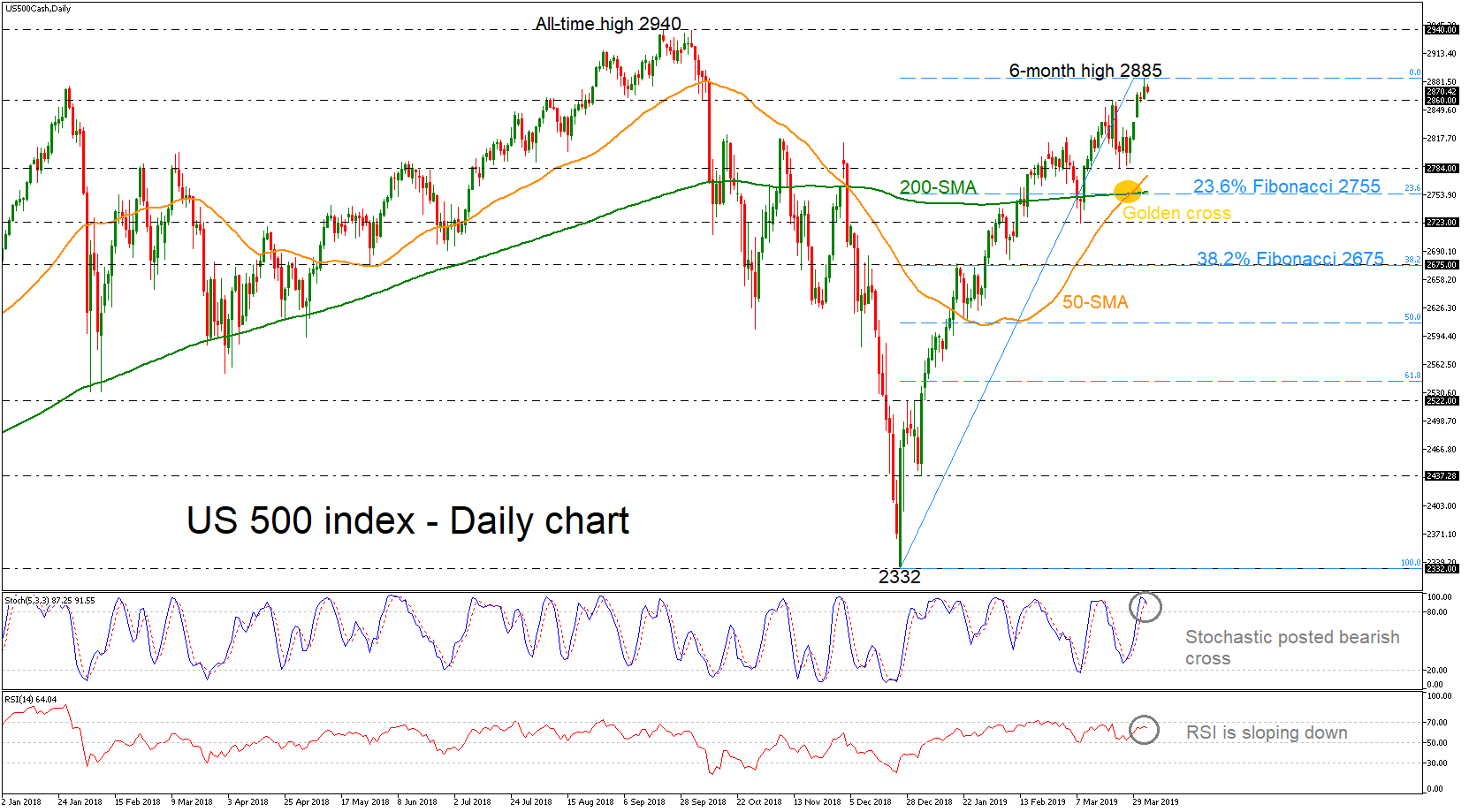
The US 500 stock index is edging slightly lower after finding strong resistance at the fresh six-month high of 2885 that it completed on Wednesday. The price retains bullish action as it holds above the 50- and 200-day simple moving averages (SMAs) which posted a ‘golden cross’ in the preceding sessions.
Looking at momentum oscillators in the daily chart though, they suggest negative movements may be on the cards. The RSI is above its neutral 50 line but is pointing down, while the stochastic reversed lower in the overbought zone, posting a bearish cross within the %K and %D lines, indicating bearish correction.
In case of further gains and a climb above the six-month peak, the next resistance would likely be faced around the all-time high of 2940. A successful surpass of this critical level would shift the long-term outlook back to strong bullish one, challenging a new record peak.
On the other side, if the price loses momentum and declines beneath 2860, it could find support at the 2784 area before touching the ‘golden cross’ near the 23.6% Fibonacci retracement level of the upleg from 2332 to 2885, near 2755. Dropping below this zone could take price towards the 2723 region, registered on March 8.
In the long-term, the index is trying to switch the neutral mode to a more bullish one and this would happen if prices overcome the all-time high set in September 2018.
DAX Approaching 12,000 as Trade Optimism Climbs
It’s been up, up up for the DAX index. Currently, the DAX is at 11,962, up 0.07% on the day. The DAX has soared 3.7% this week, and the index is at its highest level since October 2018. In economic news, German factory orders plunged 4.2%, nowhere near the estimate of 0.3%. The ECB minutes noted that trade tensions continue to weigh on the eurozone economy. On Friday, the U.S. releases wage growth and nonfarm payrolls, so we could see some reaction from the markets.
There is growing optimism with regard to the U.S-China trade talks, which have continued this week in Washington. The sides have made substantial progress, with reports that an agreement between the world’s two largest economies is 90% complete. The outstanding issues include enforcement mechanisms and the removal of trade tariffs. There has been positive news out of China this week, as manufacturing PMI posted a 14-month high, and the China 50 index has climbed to its highest level since March 2018.
German manufacturing numbers continue to point downwards. Factory orders were dismal in February, declining for a fourth successive month. The eurozone’s largest economy has slowed down as a result of the global trade war, with exports and manufacturing particularly hard-hit. Soft global demand could continue, and the Economy Ministry summed up the bleak situation, saying that “manufacturing momentum will continue to be subdued in the coming months, particularly due to lacking external demand”.
US initial jobless claims dropped to 202k, lowest since 1969
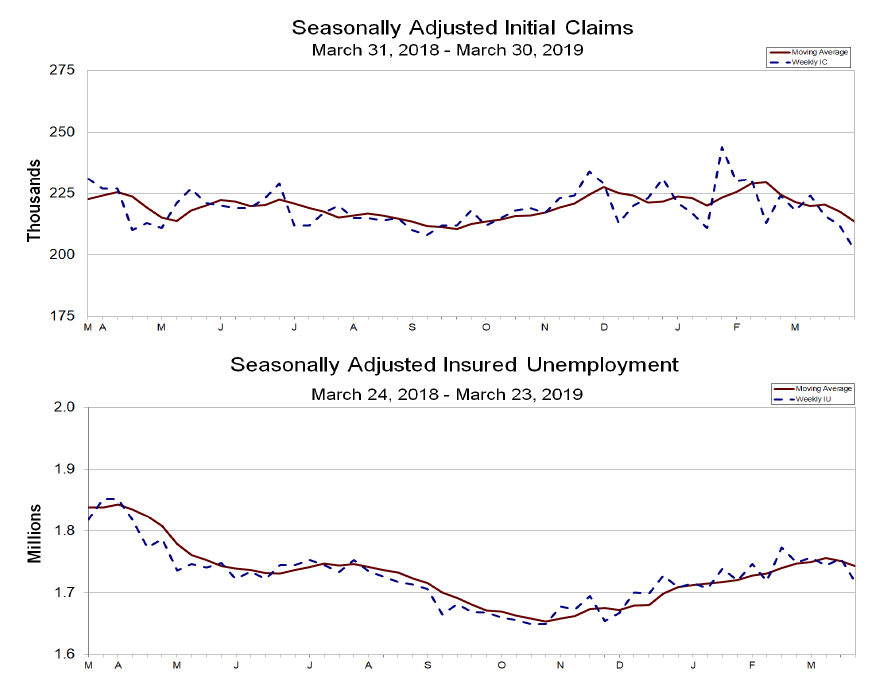
US initial jobless claims dropped -10k to 202k in the week ending March 30, below expectation of 215k. It's also the lowest level since December 6, 1969. Four-week moving average of initial claims dropped -4k to 213.5k.
Continuing claims dropped -38k to 1.717M in the week ending March 23. Four-week moving average of continuing claims dropped -8k to 1.743M.
Canadian Dollar Steady ahead of U.S. Nonfarm Payrolls
The Canadian dollar is drifting in Thursday trade. In the North American session, the pair is trading at 1.3349, down 0.01% on the day. On the release front, Canadian Ivey PMI is expected to improve to 51.4 points. In the U.S., today’s highlight is unemployment claims, which is expected to rise to 215 thousand. On Friday, the U.S. releases wage growth and nonfarm payrolls, so traders should be prepared for movement from USD/CAD.
It’s been a disappointing week for U.S. numbers, and the trend continued on Wednesday. ADP nonfarm payrolls plunged to 129 thousand, down from 183 thousand in the previous release. Is this a precursor of what to expect on Friday? Nonfarm payrolls are projected at 175 thousand, a soft number in comparison to recent releases. ISM Non-Manufacturing PMI also stumbled on Wednesday, falling from 59.7 to 56.1 points.
What can we expect from the Bank of Canada? Governor Stephen Poloz spoke earlier in the week, saying that global trade tensions are weighing on the Canadian economy. Poloz acknowledged that the slowdown has been worse than the BoC anticipated, but insisted that the economy will bounce back in the near future. At the same time, Poloz said that the bank intended to keep interest rates below the neutral range. This dovish stance has made the Canadian dollar less attractive to investors, and the currency could face further headwinds if economic data fails to improve.
Some ECB members considered keeping rates unchanged till Q1 2020, but data-driven gradualist approach adopted
The monetary policy meeting accounts of March ECB meeting revealed debates regarding the extent of the extension in the calendar based leg of the forward guidance. Back then, ECB said interest rates will be kept at current level at least through the "end of 2019", changed from "summer of 2019".
A numbers of members voiced an initial preference for extending the forward guidance through the "end of the first quarter of 2020". That would be "more in line with the markets' pricing of a first interest rate increase". But others argued that "until the end of 2019" was "more consistent with the baseline scenario underlying the projections that foresaw a rebound of the economy in the second half of 2019". Also, "in view of the high prevailing uncertainty, a data-driven gradualist approach was seen as most appropriate"
On the economy, the baseline scenario was a more protracted "soft patch" followed by a return to more solid growth. However, "uncertainty remained elevated" and it was "unclear how persistent the current soft patch would turn out to be." Also "downside risks to the growth outlook continued to prevail despite" despite downward revision in growth forecasts in March.
And, it was highlighted that "growth projections had been revised down in a number of consecutive projection exercises and that growth might not be mean-reverting, as typically assumed in projections." Uncertainty might also turn out to be "more persistent than expected". Risks surround Eurozone growth outlook were "on account of the persistence of uncertainties related to geopolitical factors, the threat of protectionism and vulnerabilities in emerging markets."
Though, it's also emphasized that "while the growth momentum was weaker, it remained positive". And, neither " the euro area, nor the global economy, was currently in recession and the probability of a recession remained relatively low."
Awaiting Word On US-China Trade Talks
Notes/Observations
- RBI again cuts key rates to aid the sluggish economy ahead of upcoming elections
- UK House of Commons voted to block a no-deal Brexit and a softer divorce with the European Union becomes more likely.
- Trump to meet with China Vice Premier Liu He on Thursday in possible sign that trade talks are entering the final stages
Asia:
- Japan PM Abe stated that Japan was not applying modern monetary theory (MMT) and was maintaining trust as yen currency was purchased during times of crisis
- BOJ Gov Kuroda reiterated to continue easing persistently and that it would take some time to reach price target. Modern monetary theory (MMT) was extreme theory and hard to accept as idea of not considering deficit seemed extreme
Europe:
- UK Parliament backed efforts to prevent a disorderly departure from EU as its passed amendment to making changing Brexit date simpler, blocking a no deal Brexit on April 12th Vote was 312-311
- UK Govt issued statement on Brexit vote on Wed noting that it was disappointed that MPs had chosen to back the EU withdrawal bill; if passed bill would place severe constraint on Govt's ability to negotiate an extension
- BoE Gov Carney: Risk of 'no deal' Brexit is alarmingly high. Reiterates that there was no need to worry about the financial sector in the event of a 'no deal' scenario
- UK Labour Leader Corbyn stated that talks with PM May on Wed went "very well", expected more talks soon. Not as much change after talks with PM May; meeting was useful but inconclusive. Discussed red lines on Customs Union; want access to the market. Want European regulations as a minimum on the environment and employment
- UK PM May could request a 9-month delay to Brexit during upcoming EU summit
Americas:
- Fed's Kashkari (dove, non-voter): did not believe that the economy was overheating not that the Fed needed to tap the brakes
- US said to set 2025 target for China to meet trade pledges; US wants binding China pledges, enforced by tariffs
SPEAKERS/FIXED INCOME/FX/COMMODITIES/ERRATUM
Equities
- Indices [Stoxx600 -0.4% at 387.3, FTSE -0.6% at 7371, DAX -0.1% at 11945, CAC-40 -0.3% at 5451, IBEX-35 +0.1% at 9496, FTSE MIB -0.5% at 21651, SMI -0.2% at 9553, S&P 500 Futures -0.1%]
- Market Focal Points/Key Themes: Equities European Indices trade mostly lower consolidating sharp gains seen of late tracking slightly lower US Index futures and mixed Asian Indices. On the corporate front UK Based Saga Plc falls over 30% after earnings and outlook, with Ao World, B&) and Rocket Internet also declining on earnings and trading updates. To the upside Imimobile rises sharply after guiding full year results ahead of consensus, NWF Group, Entertainment One and Homeserve also gain on earnings and updates. In the M&A space Commerzbank trade higher, after reports Unicredit were said to eye a multi billion Euro rival bid, with Deutsche Bank and Unicredit trading slightly lower on the report. In other news, Reneuron Group trades shaprly higher on a study update while Casino Guichard declines on a downgrade at Morgan Stanley. In the US, Tesla shares trades lower in the pre market on Q1 deliveries numbers, while Boeing is active on the official Ethiopian authority response to the crash. Looking ahead notable earners include RPM International, Constellation Brands and Schnitzer Steel.
- Consumer discretionary: Bang & Olufsen [BO.DK] -3.1% (Earnings), Casino [CO.FR] -5.3% (Analyst downgrade), AO World [AO.UK] -5.9% (Earnings)
- Energy: NWF Group [NWF.UK] +8.6% (Trading update)
- Financials: Saga Plc -31% (Earnings, Guidance)
- Healthcare: ReNeuron Group +16% (Study update)
- Industrials: Manz [M5Z] +4.7% (Order)
- Technology: ImIMobile +7.2% (Trading update)
Speakers
- UK Brexit Sec Barclay: Holding European elections would damage public trust. House of Lords to explore flaws in bill passed by commons. Reiterated that a 2nd Brexit referendum was not consistent with Labour manifesto
- Italy Govt said to confirm €18.0B in privatizations in upcoming budget update
- Italy Dep PM Di Maio (5-Star) said to offer finance ministry position to League after the upcoming European Parliamentary elections (**Note: later refuted he wanted to replace Tria)
- Swiss Financial Market Supervisory Authority FINMA called for measures to curb Swiss property market bubble; says mortgage market is 'too big to fail'
- Turkey Central Bank (CBRT): again raises limits on domestic banks swaps with central bank from 30% to 40%
- Poland Labor Ministry: Mar Unemployment Rate seen at 5.9% vs. 6.1% m/m
- India Central Bank (RBI) policy statement noted that the vote was 5-1 to cut rates (dissenter sought a hold). It maintained its neutral stance and added that inflation to be within the 4% target. Saw no reason to activate countercyclical capital buffer (CCCB) at this time
- China Commerce Ministry (MOFCOM) spokesperson Geo Feng reiterated that President Xi sought to talk with Trump via all channels. China was willing to work with US to implement agreement reached by two leaders and would reveal if there's further information on trade talks in Washington
Currencies/Fixed Income
- FX market was quiet with little in terms of key data releases in the session. Markets awaiting further developments on the US-China trade front.
- GBP/USD was steady after UK Parliament voted to block a no-deal Brexit and a softer divorce with the European Union becomes more likely. The motion still needed to go the House of lords
Economic Data
- (NL) Netherlands Mar CPI M/M: 0.4% v 0.9% prior; Y/Y: 2.8% v 2.6% prior
- (NL) Netherlands Mar CPI EU Harmonized M/M: 0.5 v 1.3% prior; Y/Y: 2.9% v 2.9%e
- (IN) India Mar PMI Services: 52.0 v 52.5 prior; PMI Composite: 52.7 v 53.8 prior
- (DE) Germany Feb Factory Orders M/M: -4.2% v +0.3%e; Y/Y: -8.4% v -3.1%e
- (IN) India Central Bank (RBI) cut Repurchase Rate by 25bps to 6.00% (as expected) for its 2nd straight cut
- (CN) Weekly Shanghai copper inventories (SHFE): 257.3K v 261.4K prior
- (DE) Germany Mar Construction PMI: 55.6 v 54.7 prior
- (UK) Mar New car Registrations Y/Y: -3.4% v +1.4% prior
- FAO Mar World Food Price Index: 167.0 v 166.8 prior; M/M: 0.1% v 1.7% prior
- (IS) Iceland Mar Preliminary Trade Balance (ISK): -13.2B v -15.1B prior
Fixed Income Issuance
- (ES) Spain Debt Agency (Tesoro) sold total €3.0B vs. €2.5-3.5B indicated range in 2021 and 2029 bonds
- Sold €1.19B in 0.05% Oct 2021 SPGB; Avg yield: -0.244% v -0.182% prior, Bid-to-cover: 3.25x v 2.06x prior
- Sold €1.81B in 1.45% Apr 2029 SPGB; Avg Yield: 1.121% v 1.100% prior, bid-to-cover: 1.35x v 1.55x prio
- (ES) Spain Debt Agency (Tesoro) sold €515M vs. €250-750M indicated range in 0.65% inflation-linked 2027 bond (SPGBei); Real Yield: -0.338% v -0.154% prior; Bid-to-cover: 2.09x v 1.59x prior
- (FR) France Debt Agency (AFT) sold total €8.998B vs. €7.5-9.0B indicated range in 2029, 2034 and 2050 bonds
- Sold €5.491B in 0.50% May 2029 Oat; Avg Yield: 0.39% v 0.57% prior; Bid-to-cover: 2.06x v 1.88x prior (Mar 7th 2019)
- Sold €1.643B in 1.25% May 2034 Oat; Avg Yield: 0.80% v 0.99% prior; Bid-to-cover: 3.29x v 1.94x prior (Mar 7th 2019)
- Sold €1.864B in 1.50% May 2050 Oat; Avg Yield: 1.46%; Bid-to-cover: 1.94x (syndicated on Feb 19th 2019)
- (SE) Sweden sold SEK 500M vs. SEK500M indicated in I/L Dec 2027 bond; Avg yield: -1.6260%; Bid-to-cover: 3.36x
Looking Ahead
- (BR) Brazil Feb CNI Capacity Utilization: No est v 78.3% prior
- (RU) Russia Mar Light Vehicle Car Sales Y/Y: No est v -4% prior
- 05:30 (HU) Hungary Debt Agency (AKK) to sell 12-month bills
- 05:30 (PL) Poland to sell Bonds
- (PT) Portugal banking sector report
- 06:00 (IE) Ireland Mar Live Register Monthly Change: No est v -3.5K prior; Live Register Level: No est v 196.5K prior
- 06:00 (IE) Ireland Feb Industrial Production M/M: No est v 15.4% prior (revised from 15.3%); Y/Y: no est v -8.6% prior
- 06:45 (US) Daily Libor Fixing
- 07:00 (ZA) South Africa Feb Electricity Production Y/Y: No est v -2.1% prior; Electricity Consumption Y/Y: No est v 0.1% prior
- 07:30 (US) Mar Challenger Job Cuts: No est v 78.6K prior; Y/Y: No est v 117.2% prior
- 07:30 (TR) Turkey Mar Real Effective Exchange Rate (REER): No est v 77.24 prior
- 07:30 (EU) ECB account of March Meeting (Minutes)
- 08:00 (UK) Baltic Bulk Index
- 08:30 (US) Initial Jobless Claims: 215Ke v 211K prior; Continuing Claims: 1.75Me v 1.756M prior
- 08:30 (US) Weekly USDA Net Export Sales
- 09:00 (RU) Russia Gold and Forex Reserve w/e Mar 29th: No est v $487.1B prior
- 10:00 (MX) Mexico Mar Consumer Confidence Index: No est v 116.8 prior
- 10:00 (CA) Canada Mar Ivey Purchasing Managers Index (Seasonally Adj): No est v 50.6 prior; PMI (unadj): No est v 48.9 prior
- 10:00 (PT) Portugal PM Costa in parliament
- 10:20 (BR) Brazil Mar Vehicle Production: No est v 257.2K prior; Vehicle Sales: No est v 198.6K prior; Vehicle Exports: No est v 40.5K prior
- 10:30 (US) Weekly EIA Natural Gas Inventories
- 11:00 (US) Treasury announcement for upcoming 3-year, 10-0year and 30-year bonds
- 11:00 (BR) Brazil to sell July2023 LTN
- 11:30 (US) Treasury to sell 4-Week and 8-Week Bills
- 13:00 (US) Fed's Mester (hawk, non-voter) at Banking Conference
- 15:00 (AR) Argentina Feb Industrial Production Y/Y: -8.0%e v -10.8% prior; Construction Activity Y/Y: No est v -15.7% prior
(ECB) Account of the monetary policy meeting 6-7 March 2019
1. Review of financial, economic and monetary developments and policy options
Financial market developments
Mr Cœuré reviewed the latest financial market developments.
As regards bond market developments, the fall in euro area ten-year overnight index swap (OIS) yields from early October 2018 to mid-February 2019 had recently reversed slightly. Notwithstanding the recent recovery, yields remained compressed compared with the levels observed in early October 2018.
Mr Cœuré recalled that the dominant driver of lower yields in recent months had been a fall in the inflation component, as reflected in revisions to market-based inflation expectations. The pronounced decrease in inflation-linked swap rates, across all maturities, in the fourth quarter of 2018 had likely been related, at least in part, to the sharp parallel fall in oil prices. However, since the end of December 2018 oil prices had gone up by more than 25%, both in US dollar and in euro terms, but the euro area and US medium-term inflation expectations seemed to have responded differently. The US five-year forward inflation-linked swap rate five years ahead had risen by around 20 basis points since early January 2019. In contrast, the equivalent swap rate for the euro area had continued to decline until last week.
As had been indicated on previous occasions, the prevalence of risk premia adjustments in recent months implied that caution was warranted when interpreting monetary policy expectations purely derived from market prices. For the euro area, the latest forward one-month OIS curve indicated that policy expectations in the euro area had remained broadly stable since mid-January 2019. Survey-based expectations of a first hike in the deposit facility rate, however, had continued to shift further out in time.
In the United States, the federal funds futures curve had shifted upward in recent days and had returned to levels observed in the second half of January 2019. Surveys had backtracked somewhat, but mostly in terms of timing, and still pointed to expectations of one more hike in 2019.
Moving to equity markets, risky assets had continued to rally. Both the S&P 500 and the EURO STOXX had gained about 6% since the Governing Council's January monetary policy meeting and were up by around 11% year-to-date. All in all, stock markets had by now almost fully recovered the sharp losses seen in the fourth quarter of 2018. However, at least in the euro area, the gains in share prices did not reflect an improvement in earnings prospects. Rather, higher share prices mainly reflected a fall in the equity risk premium. Emerging markets had also benefited from the improved risk sentiment. The MSCI Emerging Markets Index was already above its pre-October 2018 level and capital inflows into emerging markets had accelerated again.
Credit spreads, too, had continued to narrow on improved risk sentiment. Euro area high yield spreads were down nearly 80 basis points since the Governing Council's monetary policy meeting on 12‑13 December 2018. Investment grade spreads had also come down, both in the United States and in the euro area. Similarly, the spreads of most euro area sovereign bond yields over equivalent German government bond yields had fallen since the start of the year.
Corporate bond issuance volumes in Europe had also been strong. The premium that firms had to pay for issuing new bonds had declined measurably in recent weeks, which suggested that the end of net purchases under the corporate sector purchase programme (CSPP) had not had a meaningful impact on the corporate bond market.
In foreign exchange markets, the euro exchange rate vis-à-vis the US dollar had remained relatively stable and had continued to trade close to the USD/EUR 1.13-1.14 level observed since early October 2018. The euro and the US dollar had depreciated notably against the British pound in recent weeks, which likely reflected the financial markets' view that the risks of a "no-deal" Brexit had diminished lately.
Finally, Mr Cœuré mentioned developments in the EURIBOR term structure, which had seen a gradual and persistent rise in rates, in particular over the longer horizons, and which had become largely disconnected from changes in policy rate expectations.
The global environment and economic and monetary developments in the euro area
Mr Praet reviewed the global environment and recent economic and monetary developments in the euro area.
Regarding the external environment, global growth and trade momentum had slowed further. Global composite output had decreased again in January, pointing to further deceleration in global growth momentum. The weakness had been concentrated in the manufacturing sector, whereas services had remained considerably more resilient. Global trade had slowed significantly around the turn of the year.
Annual consumer price inflation in the OECD area had slowed to 2.1% in January from 2.4% in December, largely driven by decelerating energy prices. Inflation, excluding food and energy, had remained broadly unchanged at 2.2%, suggesting that underlying inflation pressures had remained subdued.
After a period of stability, Brent crude oil prices had increased in mid-February, ending 6% higher than at the time of the Governing Council's January monetary policy meeting. The euro exchange rate had depreciated slightly against the US dollar since the January meeting in bilateral terms (-0.2%) as well as in nominal effective terms (-0.5%).
Turning to the euro area, the latest incoming information pointed to continued subdued growth. Indicators related to the manufacturing sector had weakened further, whereas those related to services had showed signs of stabilisation. Eurostat's second release had put euro area real GDP growth in the fourth quarter of 2018 at 0.2%. In terms of the composition of growth in the fourth quarter of 2018, domestic demand and net exports had provided positive contributions, while inventories had contributed negatively.
Concerning GDP components, private consumption had increased by 0.2% in quarter-on-quarter terms in the fourth quarter of 2018, up from 0.1% in the third quarter. The weakness in consumption growth in recent quarters had been largely driven by non-durable goods, which appeared to be the component of household spending most sensitive to changes in energy prices. Gross fixed capital formation had grown by 0.6% in the fourth quarter of 2018, the same rate as in the previous quarter. Looking ahead, investment growth dynamics were expected to remain subdued, in line with the slowdown in foreign and domestic demand.
Incoming data since the January monetary policy meeting had shown a continuation of solid employment growth in the fourth quarter of 2018, at 0.3%. The PMI for employment had remained in expansionary territory, but had moderated further across most countries and sectors.
Growth of euro area trade in goods had weakened further year-on-year in the final quarter of 2018, driven mainly by intra-euro area trade. Growth of extra-euro area goods exports had also remained subdued, reflecting in particular the contraction of exports to Turkey and the United Kingdom, while export growth to China and the United States had also weakened.
These developments were also reflected in the March 2019 ECB staff projections, which projected real GDP growth at 1.1% in 2019, 1.6% in 2020 and 1.5% in 2021. Real GDP growth had been revised down by 0.6 percentage points in 2019 and by 0.1 percentage points in 2020, reflecting both a more lasting adverse impact of country-specific factors and heightened global uncertainties. The projections for 2021 were unchanged.
Turning to price developments, according to Eurostat's flash estimate, annual euro area HICP inflation had been 1.5% in February, up from 1.4% in January, while the HICP excluding food and energy inflation had decreased somewhat, to 1.0%, from 1.1% in January. Meanwhile, measures of underlying inflation had continued to move sideways. Domestic cost pressures had been increasing, but had yet to translate into higher underlying inflation.
Incoming data pointed to building wage pressures, which were expected to support the upward adjustment in underlying inflation. Annual negotiated wage growth had risen to 2.2% in the fourth quarter of 2018, up from 2.1% in the third quarter, while overall compensation per employee had grown by 2.2% in the fourth quarter of 2018.
ECB staff projected HICP inflation decreasing until the fourth quarter of 2019 and then picking up over the remainder of the projection horizon, to reach 1.6% in 2021. This V-shaped pattern reflected, first, a significant decrease in HICP energy inflation linked to the recent strong drop in oil prices and downward base effects related to their previous increase in 2018 and, second, gradually rising underlying inflation, supported by rising supply constraints and tightening labour markets.
In the March 2019 ECB staff projections, the outlook for HICP inflation had been revised down significantly by 0.3 percentage points in 2019 and by 0.2 percentage points in both 2020 and 2021. HICP excluding energy and food had been revised down by 0.2 percentage points in each year of the projection horizon.
Longer-term market-based inflation expectations, as derived from the five-year inflation-linked swap rates five years forward, had declined to 1.5% compared with around 1.7% one year ago. Longer-term inflation expectations, five years ahead, in the Survey of Professional Forecasters (SPF) stood at 1.8% in the first quarter of 2019.
Financial conditions had eased. This reflected market expectations about future monetary policy and some easing of trade tensions. The impact of these factors on financing conditions had more than offset the impact of the deterioration in the macroeconomic outlook as priced in by financial markets. Equity prices had increased, despite a worsening in earnings expectations, while corporate bond spreads had tightened. The market-implied expected timing of the policy rate "lift-off" was largely unchanged. Credit conditions had remained accommodative.
Turning to money and credit developments, the annual growth rate of broad money (M3) had continued to hover around the rates observed since early 2018, while decreasing to 3.8% in January 2019, from 4.1% in December 2018. Money creation continued to be supported by credit to the private sector. At the same time, loan growth had been lower in January, increasing by 3.0% compared with one year ago. The recent deceleration reflected developments in loans to non-financial corporations (NFCs), in part due to base effects, while loans to households had recently stabilised. Bank profitability remained subdued, while banks were faced with a somewhat higher cost of market funding. At the same time, market concerns had risen about pressures on banks' funding costs due to the forthcoming phasing-out of the TLTRO-II.
As regards fiscal policy, the euro area deficit ratio was projected to worsen in 2019-21, mainly due to a loosening of the fiscal stance.
Monetary policy considerations and policy options
Summing up, Mr Praet remarked that since the January monetary policy meeting financial conditions had eased, mainly on account of a reappraisal of monetary policies at the global level and abating trade tensions. Moreover, credit conditions for households and firms remained accommodative.
Incoming data had continued to be weak, in particular in the manufacturing sector. The growth outlook in the March 2019 ECB staff projections had been revised down substantially for 2019 and, to a lesser extent, for 2020. The euro area expansion would continue to be supported by favourable financing conditions, further employment gains, rising wages, and the ongoing – albeit somewhat slower – expansion in global activity. At the same time, the persistence of uncertainties was weighing on the growth outlook.
Measures of underlying inflation remained muted. Domestic cost pressures, in particular wages, had been strengthening, but had yet to translate into higher underlying inflation. The March 2019 ECB staff projections entailed a marked downward revision in both headline and core inflation across the projection horizon with weaker economic momentum slowing the adjustment of inflation towards the Governing Council's aim. Market-based measures of longer-term inflation expectations had weakened in recent months.
In this light, to ensure that inflation remained on a sustained path to levels that were below, but close to, 2% over the medium term, Mr Praet proposed: (a) to adjust the calendar-based leg of the ECB's forward guidance on the key ECB interest rates to indicate the Governing Council's expectation that rates would "remain at their present levels at least through the end of 2019 and in any case for as long as necessary", as recalibrating the calendar-based leg of forward guidance would signal the Governing Council's determination to provide the monetary accommodation needed for a sustained convergence of inflation; (b) to reiterate the Governing Council's forward guidance on reinvestments; and (c) to launch a new series of quarterly targeted longer-term refinancing operations (TLTRO-III) starting in September 2019 and ending in March 2021, each with a maturity of two years. Counterparties would be entitled to borrow up to 30% of the stock of eligible loans as at 28 February 2019, at a rate indexed to the interest rate on the ECB's main refinancing operations over the life of each TLTRO. These new operations would help to preserve the favourable bank lending conditions and support the smooth transmission of monetary policy. The precise terms of the operations would be communicated in due course. Finally, the ECB's lending operations would continue to be conducted as fixed-rate tender procedures with full allotment for as long as necessary, and at least until the end of the reserve maintenance period starting in March 2021.
As regards external communication, the Governing Council needed to: (a) stress that the weakening in economic data pointed to a sizeable moderation in the pace of the economic expansion that would extend into the current year; (b) emphasise that the weaker economic momentum was slowing the adjustment of inflation towards the Governing Council's aim; (c) adjust the forward guidance on the key ECB interest rates, namely that the Governing Council expected them to "remain at their present levels at least through the end of 2019, and in any case for as long as necessary", while reiterating the forward guidance on reinvestments; (d) announce a new series of quarterly targeted longer-term refinancing operations (TLTRO-III), starting in September 2019 and ending in March 2021, and stress that the new TLTROs would help to preserve bank lending conditions and support the smooth transmission of monetary policy; (e) announce the extension of the fixed-rate tender procedures with full allotment for the ECB's lending operations for as long as necessary, and at least until the end of the reserve maintenance period starting in March 2021; (f) explain that these decisions would support the further build-up of domestic price pressures and headline inflation developments over the medium term; (g) indicate that the risks to the euro area growth outlook were still tilted to the downside because of the persistence of geopolitical uncertainties; (h) stress that significant monetary policy stimulus remained essential for a sustained convergence of inflation towards levels below, but close to, 2% over the medium term, and would continue to be provided by the forward guidance on the key ECB interest rates, reinforced by the reinvestments of the sizeable stock of acquired assets and the new series of TLTROs; and (i) reiterate that, in any event, the Governing Council stood ready to adjust all of its instruments, as appropriate, to ensure a sustained convergence of inflation.
2. Governing Council's discussion and monetary policy decisions
Economic and monetary analyses
With regard to the economic analysis, members broadly shared the assessment of the outlook for economic activity in the euro area provided by Mr Praet in his introduction. Recent data and survey results had continued to be weak, in particular in the manufacturing sector, reflecting the slowdown in external demand compounded by some country and sector-specific factors. While there were signs that some of these domestic factors dampening growth were starting to fade, the weakening in economic data pointed to a sizeable moderation in the pace of the economic expansion that would extend into the current year, with the persistence of uncertainties appearing to weigh on economic sentiment and the growth outlook. This assessment was broadly reflected in the March 2019 ECB staff projections, in which the outlook for real GDP growth had been revised down substantially for 2019 and slightly for 2020 compared with the December 2018 Eurosystem staff projections.
In considering the outlook and risks for the external environment, members took note of the further slowdown in global growth and trade momentum. In particular, there were concerns about the potential impact of trade protectionism on the global outlook and the ongoing risk of an escalation of trade conflicts. Reference was made in the discussion to a number of factors, including the impact of trade tensions between the United States and China, the threat posed by a trade dispute between the European Union and the United States, and the risks surrounding a disorderly withdrawal of the United Kingdom from the European Union. Attention was also drawn to the slowdown in growth in China, as well as developments in the US economy, which was expected to slow as a result of the waning effect of the fiscal package. Against this background, the risks to the external environment were assessed to be on the downside, on account of the persistence of uncertainties related to geopolitical factors, the threat of protectionism and vulnerabilities in emerging markets.
Turning to euro area activity, members concurred that the recent data had continued to be weaker than expected. It was noted that the carry-over effect from weaker growth in the second half of 2018 implied a lower projection for growth in 2019. Recent economic indicators had also been disappointing, with the latest surveys and data releases confirming the need to revise the short-term growth outlook downwards, as partly reflected in the March staff projections. The downside risks to growth identified in earlier discussions had thus, to some extent, materialised. The weakness in growth was seen as being longer-lasting than had previously been expected, with the result that growth was now likely to be below potential for a number of quarters.
Members considered that the downward revisions to the growth projections in the March staff projections were warranted and expressed confidence in the baseline as the central scenario. In this context, it was observed that the updated outlook for euro area growth just released by the OECD in its Interim Economic Outlook, although slightly lower than the ECB staff projections – with 1.0% for 2019 and 1.2% for 2020 – also incorporated a substantial downward revision to euro area growth.
Members acknowledged that, while the baseline scenario of a more protracted "soft patch" followed by a return to more solid growth was the most likely scenario, uncertainty remained elevated and it was unclear how persistent the current soft patch would turn out to be. It was noted that, while some indicators pointed to growth rates in the first and second quarters of this year that were lower than in the March staff projections, there were some positive factors to be taken into account, such as those relating to the impact of fiscal measures and the unwinding of some temporary country and sector-specific factors, notably in the German car industry. Moreover, it was recalled that, beyond the near term, a number of factors continued to support the euro area economic expansion, including favourable financing conditions, further employment gains and rising wage growth, as well as the ongoing, albeit somewhat slower, expansion in global activity. It was also emphasised that, while the growth momentum was weaker, it remained positive. Neither the euro area, nor the global economy, was currently in recession and the probability of a recession remained relatively low.
At the same time, the view was widely shared that downside risks to the growth outlook continued to prevail despite the downward revisions incorporated in the March projections. It was stressed that the revisions to the growth projections were mainly to the short term and that a rebound in activity was expected in the second half of the year, reflecting the fading of temporary factors, an improvement in external trade and an easing of trade conflicts. Following the downward revisions to growth in the first half of the year, growth was expected to return to potential, with quarter-on-quarter growth rates of around 0.4% throughout the projection horizon, which might be considered optimistic. It was highlighted that the growth projections had been revised down in a number of consecutive projection exercises and that growth might not be mean-reverting, as typically assumed in projections. The remark was made that some of the factors behind the slowdown, such as developments in China, were unlikely to fade away in a few months. Uncertainty might also turn out to be more persistent than expected and concern was expressed that, if the current high level of uncertainty persisted, there could be a stronger adverse impact looking ahead, in particular on investment.
As regards the balance of risks surrounding the euro area growth outlook, these were generally assessed to be still tilted to the downside on account of the persistence of uncertainties related to geopolitical factors, the threat of protectionism and vulnerabilities in emerging markets. Although a case could be made that the risks to growth were now somewhat more balanced, following the downward revision to the ECB staff projections, it was considered that overall the global risk factors, which were predominantly on the downside, had the potential to further affect confidence and global activity negatively, with adverse spillovers to activity in the euro area.
In an exchange of views about the outlook for fiscal policy, members reiterated the need for rebuilding fiscal buffers in countries where government debt was high. At the same time, it was argued that, consistent with the country-specific recommendations from the European Commission, jurisdictions that had fiscal space should stand ready to use it, given the downside risks to growth. The mildly expansionary fiscal stance and the operation of automatic stabilisers were providing some support to economic activity.
With regard to price developments, there was broad agreement with the assessment presented by Mr Praet in his introduction. On the basis of current futures prices for oil, headline inflation was likely to remain at around current levels, before declining towards the end of the year. Measures of underlying inflation remained generally muted, but labour cost pressures had strengthened and broadened amid high levels of capacity utilisation and tightening labour markets. Looking ahead, underlying inflation was expected to increase over the medium term, supported by the ECB's monetary policy measures, the ongoing economic expansion and rising wage growth. This assessment was also broadly reflected in the March staff projections, in which annual HICP inflation was projected to rise from 1.2% in 2019 to 1.5% in 2020 and to 1.6% in 2021. Compared with the December 2018 Eurosystem staff projections, the outlook for HICP inflation had been revised down over the whole projection horizon, reflecting in particular the more subdued near-term growth outlook.
Members took note of the implications for the medium-term inflation outlook arising from the downward revisions to the growth outlook and generally agreed that the weaker economic momentum in the March staff projections implied a slower adjustment of inflation to the ECB's price stability objective. Underlying inflation, as measured by the HICP excluding energy and food, was still expected to pick up over the projection horizon but had also been revised down compared with the December 2018 Eurosystem staff projections. Confidence in the upward movement in inflation dynamics was expressed, even though the expected path for inflation was flatter than previously expected and thus the convergence of inflation would take longer than previously expected. Headline inflation was now only expected to reach 1.6% in 2021, at the end of the projection horizon.
Members considered that recent developments in wage growth continued to provide positive support for the outlook for underlying inflation. Although compensation per employee in the euro area had been revised down slightly in the projections, nominal labour costs were expected to strengthen, supported by negotiated wage growth, which stood at 2.2% in December 2018.
The transmission of higher wages to consumer price inflation was considered to remain a key issue for the medium-term outlook for inflation, with higher wage growth not yet having passed through to price inflation, as firms had absorbed increases by lowering profit margins. Some confidence was expressed, however, that as mark-ups could not be squeezed indefinitely, wage pressures would eventually pass through to underlying inflation. At the same time, it was highlighted that a smaller increase in unit labour costs was now projected and that the projected increase in profit margins was predicated on the rebound in economic activity taking place. More generally, it was recalled that the transmission to consumer price inflation was subject to time lags and it was noted that the slowdown in economic activity could weigh on the pass-through from wages to prices. Moreover, the mechanism whereby higher wage costs were transferred to prices might have changed structurally in recent years, as appeared to be the case in both the United States and Europe.
As regards recent developments in longer-term inflation expectations, members noted that expectations had declined further since the Governing Council's January 2019 monetary policy meeting. Market-based inflation expectations, as measured by the five-year forward inflation-linked swap rate five years ahead, currently stood at 1.5%. Longer-term survey-based inflation expectations had been revised down as well, standing at 1.8% in the SPF for the first quarter of 2019. Hence, the gap between survey-based and market-based measures had widened somewhat. While some concern was expressed about the trend in longer-term inflation expectations, the risk of an unanchoring of inflation expectations was assessed as very low.
On the monetary analysis, members concurred with the assessment presented by Mr Praet in his introduction. M3 continued to hover around the growth rates observed since early 2018. While private credit remained the main source of money creation from a counterpart perspective, the decline in the contribution of the asset purchase programme (APP) had recently been replaced by external monetary flows and credit to the general government. The annual growth rate of loans to NFCs had decreased to 3.3% in January 2019, from 3.9% in December 2018, reflecting a base effect but also, in some countries, the typical lagged reaction to a slowdown in economic activity, while growth in loans to households had remained unchanged.
It was underlined that bank lending conditions remained overall very supportive, even if the latest available bank lending survey had pointed to the prospect of some tightening looking ahead. Bank funding conditions had become somewhat less favourable, although banks were partly shielded from less benign conditions in bond markets owing to the increased share of deposits in their funding structures. Concerns were voiced that over time the effects of persistently low rates could depress banks' interest margins and profitability with negative effects on bank intermediation and financial stability in the longer run. It was recalled that the consequences of low rates differed across the maturity spectrum and across banks, depending on their business models and the structure of their assets and liabilities.
Monetary policy stance and policy considerations
With regard to the monetary policy stance, members widely shared the assessment provided by Mr Praet in his introduction that euro area financial conditions had eased, also on account of markets' reassessment of global monetary policy, and remained, overall, very supportive. Borrowing conditions for firms and households were still favourable, as the monetary policy measures put in place since June 2014 were continuing to support access to financing. While the monetary policy stance was assessed as being very accommodative, also in the light of the large stock of assets on the ECB's balance sheet, the downward revisions of growth and inflation across the forecast horizon in the March staff projections were sizeable and larger than market participants had expected, warranting some consideration. At the same time, confidence was expressed that the conditions for a rebound in activity and inflation remained in place to support a sustained convergence of inflation rates towards levels below, but close to, 2% over the medium term.
Against this background, members expressed broad support for the package of measures proposed by Mr Praet. The proposed extension of the calendar-based leg of the Governing Council's forward guidance was generally seen as underpinning the monetary accommodation needed to support inflation converging towards the Governing Council's aim. Reference was made to the publication of the downward revision to the projections, which was in any case likely – by itself – to induce a further delay in the expected date of the first interest rate increase, in line with the state-contingent element of the forward guidance. It was emphasised that the Governing Council would be reacting to the projected decrease in the inflation projections in a data-driven manner in order to provide additional support in a situation that was characterised by various risks. A question was raised about how frequently forward guidance should be adjusted in response to new data. All in all, bringing the calendar-based leg of forward guidance more into line with market expectations of a later date for the first interest rate increase was widely seen as appropriately reflecting the Governing Council's assessment of the inflation outlook.
A number of members voiced an initial preference for extending the forward guidance through the end of the first quarter of 2020, while expressing their readiness to join a consensus forming on Mr Praet's proposal, with the overall policy package seen as finely balanced. Shifting the forward guidance to March 2020 instead of December 2019 would provide additional accommodation and would be more in line with the markets' pricing of a first interest rate increase, compared with survey-based expectations. It was argued that a clear easing signal would be important in view of the significant downward revisions to the ECB staff projections.
Other members preferred to extend the forward guidance until the end of 2019 as this was considered to be more consistent with the baseline scenario underlying the projections that foresaw a rebound of the economy in the second half of 2019. Caution was expressed about committing to a longer horizon well into the following year in a situation of high uncertainty where incoming data could evolve in very different ways. In view of the high prevailing uncertainty, a data-driven gradualist approach was seen as most appropriate, while it was also argued that the Governing Council should avoid giving the impression that policy would be all but predetermined until the end of the year. The need for more analysis of the effects of the various unconventional measures on financial intermediation was mentioned.
All in all, members agreed to extend the Governing Council's forward guidance through the end of 2019 as part of the overall package, as proposed by Mr Praet. Recalibrating the calendar-based leg of the Governing Council's forward guidance would signal the Governing Council's determination to provide the monetary accommodation needed for a sustained convergence of inflation. At the same time, it would not pre-empt the Governing Council's readjustment of its monetary policy, if needed, at one of its coming meetings should the outlook evolve less favourably than expected. Moreover, the state-based leg of forward guidance automatically implied a shift in rate expectations if the economic conditions for an interest rate increase were not yet in place. Satisfaction was expressed that the state-based element of the Governing Council's forward guidance was working well, together with the calendar-based guidance.
Members also expressed broad support for Mr Praet's proposal to launch a new series of quarterly targeted longer-term refinancing operations (TLTRO-III) starting in September 2019 and ending in March 2021, each with a maturity of two years. These new operations would help to ensure that bank lending conditions remained favourable and would support the smooth transmission of monetary policy via the banking sector. In the light of looming cliff effects related to maturing TLTRO-II operations, upcoming regulatory requirements and the risk of some deterioration in funding conditions for banks, TLTRO-III would help to avoid increasing funding pressures for banks.
In the discussion, the mostly pre-emptive nature of TLTRO-III was stressed as in most jurisdictions a tightening of credit conditions had not yet been observed. TLTRO-III would act as a backstop to provide insurance to the economy at a time of high uncertainty with risks tilted to the downside. While it was recalled that TLTROs had been very successful measures for providing accommodation in the euro area's bank-based financial system, their targeted nature was highlighted as well. With respect to the horizon of the new set of operations, a sufficiently long horizon was seen as helpful to ensure sufficient accommodation to bring inflation towards levels of below, but close to, 2% over the medium term and increase the impact on the real economy, also by broadly matching the typical maturity of loans to NFCs. Conversely, a shorter horizon would provide a stronger signal to banks that they needed to be prepared to secure funding on private markets and avoid becoming overly reliant on central bank funding.
Members agreed that the design of the TLTRO-III operations should support the smooth transmission of monetary policy and favourable bank lending conditions, preserving sufficient accommodation to support the convergence of inflation to the Governing Council's aim, while not perpetuating the reliance of banks on unconventional policy measures. Modelling the conditions for the new operations on the design of TLTRO-II was seen as a way to ensure their pass-through to the real economy and limit the use of funds for carry trades in government bonds. Financial stability considerations had to be taken into account, but also needed to be addressed at the country level. With regard to the pricing of TLTRO-III, it was generally agreed that it should be indexed to the interest rate on the main refinancing operations. There was broad agreement that elaborating the details would need more reflection by the Governing Council and they should be communicated in due course.
Members also agreed to continue conducting lending operations as fixed rate tender procedures with full allotment for as long as necessary and at least until the end of the reserve maintenance period starting in March 2021.
Monetary policy decisions and communication
In the light of the foregoing discussion, the President ascertained that all members supported the package of measures as proposed by Mr Praet.
Turning to communication, members widely agreed that it needed to be emphasised that decisions to be taken by the Governing Council would support the further build-up of domestic price pressures and headline inflation developments over the medium term. Moreover, the measures would help to increase the resilience of the euro area economy to the risks resulting from geopolitical uncertainties. At the same time, it was underlined that the decisions should be seen as an appropriate adjustment of the instruments at the Governing Council's disposal in reaction to a weakening of economic data and the inflation outlook and should not be interpreted as a reversal of the policy stance.
In the Governing Council's communication, it was furthermore seen as warranted to reiterate that significant monetary policy stimulus remained essential for a sustained convergence of inflation towards levels below, but close to, 2% over the medium term and that it would continue to be provided by the forward guidance on the key ECB interest rates, reinforced by the reinvestments of the sizeable stock of acquired assets and the new series of TLTROs. As emphasised in previous communication, it also needed to be reiterated that, in any event, the Governing Council stood ready to adjust all of its instruments, as appropriate, to ensure a sustained convergence of inflation.
Taking into account the foregoing discussion among the members, on a proposal from the President, the Governing Council took the following monetary policy decisions:
- The interest rate on the main refinancing operations and the interest rates on the marginal lending facility and the deposit facility would remain unchanged at 0.00%, 0.25% and -0.40% respectively. The Governing Council now expected the key ECB interest rates to remain at their present levels at least through the end of 2019, and in any case for as long as necessary to ensure the continued sustained convergence of inflation to levels that are below, but close to, 2% over the medium term.
- The Governing Council intended to continue reinvesting, in full, the principal payments from maturing securities purchased under the asset purchase programme for an extended period of time past the date when it started raising the key ECB interest rates, and in any case for as long as necessary to maintain favourable liquidity conditions and an ample degree of monetary accommodation.
- A new series of quarterly targeted longer-term refinancing operations (TLTRO-III) would be launched, starting in September 2019 and ending in March 2021, each with a maturity of two years. These new operations would help to preserve favourable bank lending conditions and the smooth transmission of monetary policy. Under TLTRO-III, counterparties would be entitled to borrow up to 30% of the stock of eligible loans as at 28 February 2019 at a rate indexed to the interest rate on the main refinancing operations over the life of each operation. Like the outstanding TLTRO programme, TLTRO-III would feature built-in incentives for credit conditions to remain favourable. Further details on the precise terms of TLTRO-III would be communicated in due course.
- The Eurosystem's lending operations would continue to be conducted as fixed rate tender procedures with full allotment for as long as necessary, and at least until the end of the reserve maintenance period starting in March 2021.
The members of the Governing Council subsequently finalised the introductory statement, which the President and the Vice-President would, as usual, deliver at the press conference following the end of the current Governing Council meeting.
Introductory statement
https://www.ecb.europa.eu/press/pressconf/2019/html/ecb.is190307~de1fdbd0b0.en.html
Press release
https://www.ecb.europa.eu/press/pr/date/2019/html/ecb.mp190307~7d8a9d2665.en.html
Meeting of the ECB's Governing Council, 6-7 March 2019
Members
- Mr Draghi, President
- Mr de Guindos, Vice-President
- Mr Cœuré
- Mr Costa *
- Ms Georghadji
- Mr Hansson
- Mr Hernández de Cos *
- Mr Knot
- Mr Lane
- Ms Lautenschläger
- Mr Makúch
- Mr Mersch
- Mr Nowotny *
- Mr Praet
- Mr Rehn
- Mr Reinesch
- Mr Rimšēvičs
- Mr Stournaras
- Mr Vasiliauskas
- Mr Vasle *
- Mr Vella
- Mr Villeroy de Galhau
- Mr Visco
- Mr Weidmann
- Mr Wunsch
* Members not holding a voting right in March 2019 under Article 10.2 of the ESCB Statute.
Other attendees
- Mr Dombrovskis, Commission Vice-President **
- Mr Teixeira, Secretary, Director General Secretariat
- Mr Smets, Secretary for monetary policy, Director General Economics
- Mr Winkler, Deputy Secretary for monetary policy, Senior Adviser, DG Economics
** In accordance with Article 284 of the Treaty on the Functioning of the European Union.
Accompanying persons
- Mr Alves
- Mr Arce
- Mr Boeckx
- Mr Bonello
- Mr Bradeško
- Ms Buch
- Ms Donnery
- Mr Gaiotti
- Ms Goulard
- Mr Kaasik
- Mr Kuodis
- Mr Mooslechner
- Mr Ódor
- Mr Rutkaste
- Mr Schoder
- Mr Stavrou
- Mr Swank
- Mr Tavlas
- Mr Välimäki
Other ECB staff
- Ms Graeff, Director General Communications
- Mr Straub, Counsellor to the President
- Mr Bindseil, Director General Market Operations
- Mr Rostagno, Director General Monetary Policy
- Mr Sousa, Deputy Director General Economics
- Ms Valla, Deputy Director General Monetary Policy
Release of the next monetary policy account foreseen on Thursday, 23 May 2019.