Sample Category Title
US Weekly Surprise Buildup Puts Crude Rally on Hold
Oil fell on Wednesday after the Energy Information Administration (EIA) reported an unexpected buildup of 7.2 million barrels when the forecast called for a slight drawdown. Crude’s upward momentum was put on pause after the higher supply data point. The API reported yesterday 3 million barrel buildup in US crude stocks and this time it was validated by the EIA with today’s report.
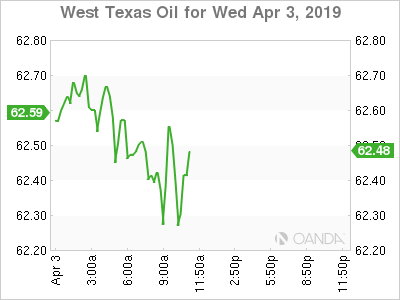
The balance between rising US shale production and the OPEC+ efforts is now tipping in favour of the organization lead by Saudi Arabia. Despite losing the psychological edge by disclosing that its Ghawar oil field is not as large as originally thought, shale production is facing its own problems.
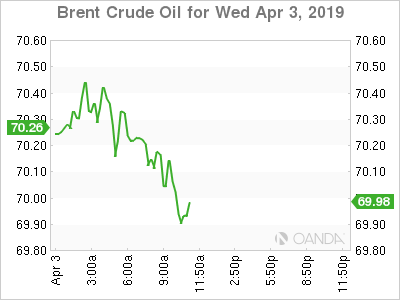
President Trump is not a fan of higher prices and he has used his tweeter influence with limited short term impact. The OPEC+ deal will remain in price until June with a highly anticipated meeting between producers expected to yield another extension.
EU Juncker: April 12 is the ultimate deadline for UK to approve Brexit agreement
European Commission President Jean-Claude Juncker warned that UK will not be granted another short Article 50 extension unless the Brexit Withdrawal Agreement is ratified by the parliament. He told the European Parliament that "the 12th of April is the ultimate deadline for approval of the Withdrawal Agreement by the House of Commons." And, "if it has not done so by then, no further short extension will be possible."
He added: "A 'no-deal' at midnight on the 12th of April is now a very likely scenario. It is not the outcome I want. But it is an outcome for which I have made sure the EU is ready... UK will be affected more than EU because there is no such thing as a 'managed' or 'negotiated no-deal' and there is no such thing as a 'no-deal transition'."
Loonie Gains as Canada Expected to Add Fewer Jobs in March
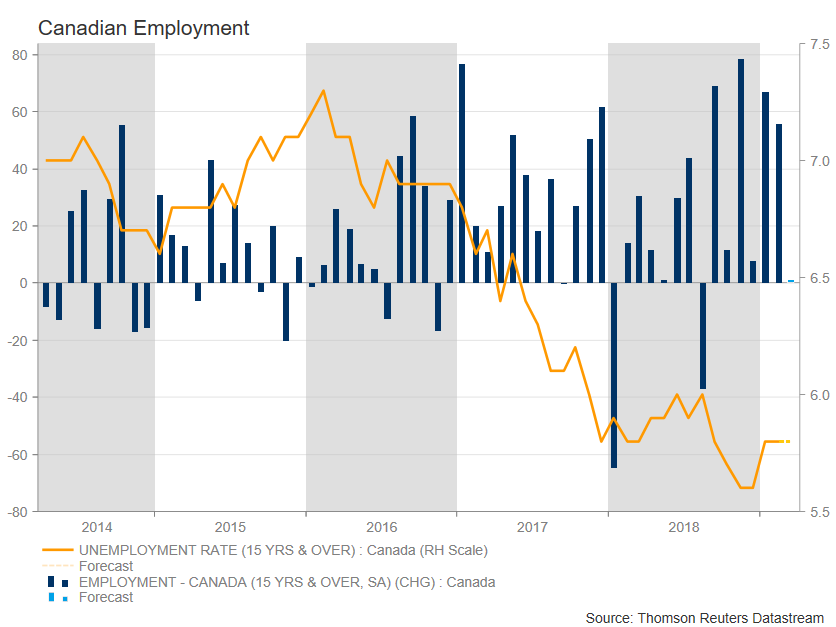
March’s employment report for Canada is likely to attract investor’s attention on Friday at 1230 GMT as the Canadian dollar has been gaining some ground over the past week on the back of rising oil prices. Stronger figures in employment may provide some more relief to the domestic currency, sending dollar/loonie even lower.
The unemployment rate is forecasted to stay at 5.8% in March, the highest level since October, while the net change in employment is expected to show that the economy added only 1,000 jobs from an impressive 55,900 jobs in February. However, the participation rate is expected to drop to 65.7% versus 65.8% previously, while there could be some gains ahead for the loonie if wage growth and employment numbers show some improvement in the labour market.
However, a weak employment report could shift policymakers’ decision more dovish at their next meeting. The Bank of Canada (BoC) left its interest rates unchanged at 1.75% on March 6, as widely expected. It is the highest rate since December 2008. Policymakers said that the outlook continues to warrant a policy interest rate that is below its neutral range. The Committee added that they would turn their attention on household, oil markets and global trade policy developments as there is uncertainty about the timing of future rate hikes. Turning to domestic GDP growth rate, the economy rose by 0.1% quarter-on-quarter in the last quarter of 2018, slowing from a 0.5% expansion in the prior period. It was the weakest growth rate since the second quarter of 2016. Also, the annualized rate expanded by 0.4% from a 0.2% gain in the third quarter.
In a speech on Monday, BoC Governor Stephen Poloz seemed confident in his speech. He expressed that Canada is adjusting to the challenges in the domestic and global economies and noted that “we can see many areas of encouraging economic growth”.
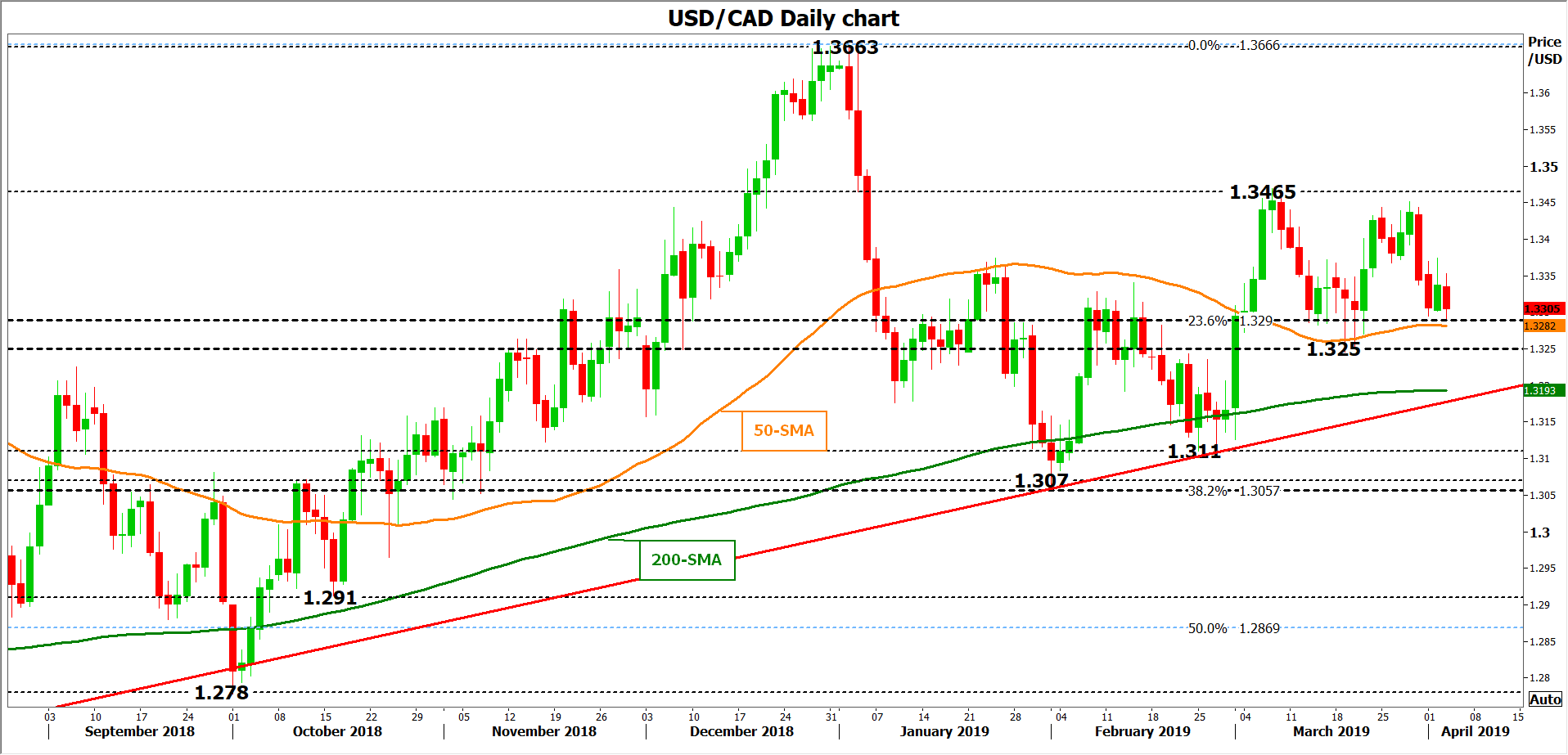
In FX markets, the Canadian dollar lost considerable ground against the dollar in the previous month, helping USDCAD to touch a two-month high of 1.3465. However, a weaker-than-predicted jobs report on Friday, could reduce chances for a rate hike and drive USDCAD to test the 19-month high of 1.3663 strong resistance area, identified by the peaks on December 31.
In the alternative scenario, if the employment report shows growth or/and the unemployment rate shifts lower, the pair could return to the 1.3250 support area, penetrating the 50-day simple moving average (SMA), while steeper declines could also revisit the long-term ascending trend line around the 200-day SMA.
However, the loonie would probably struggle to make any notable gains given the BoC’s dovish tilt.
ECB Minutes to Underline Eurozone Woes as Euro Seeks a Bottom
The euro is trading near its 2019 lows as not even a more dovish Fed has been able to offset any of the gloomy Eurozone outlook from weighing on the single currency. The continent’s deepening economic slowdown finally has the European Central Bank worried, deciding to take action at its March policy meeting to further stimulate the economy. The account of that meeting is due to be published on Thursday at 11:30 GMT and could reveal whether policymakers discussed any additional measures to those already announced.
At the end of its two-day monetary policy meeting on March 7, the ECB confirmed market speculation of a new round of cheap loans for banks by announcing TLTRO-III (targeted longer-term refinancing operations). However, the Bank went one step further and also revised its forward guidance, pushing back the expected timing of a hike in its key interest rates to 2020, having previously signalled a rate increase in the autumn of this year.
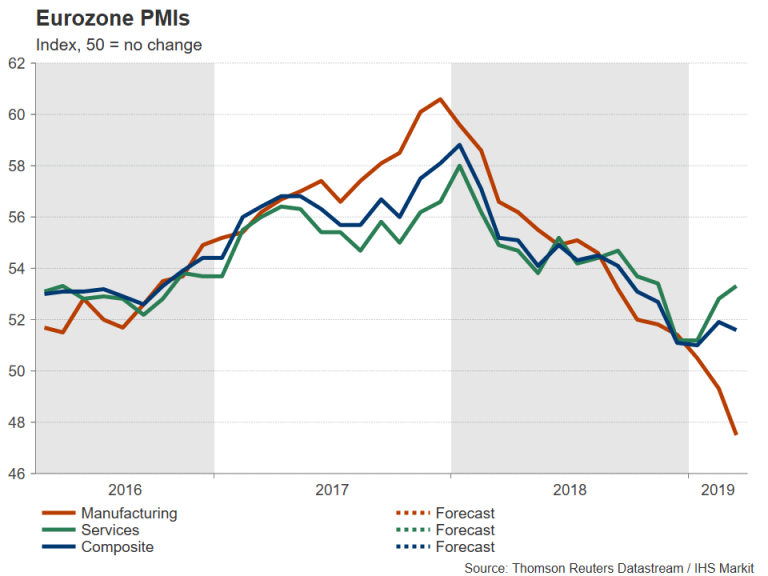
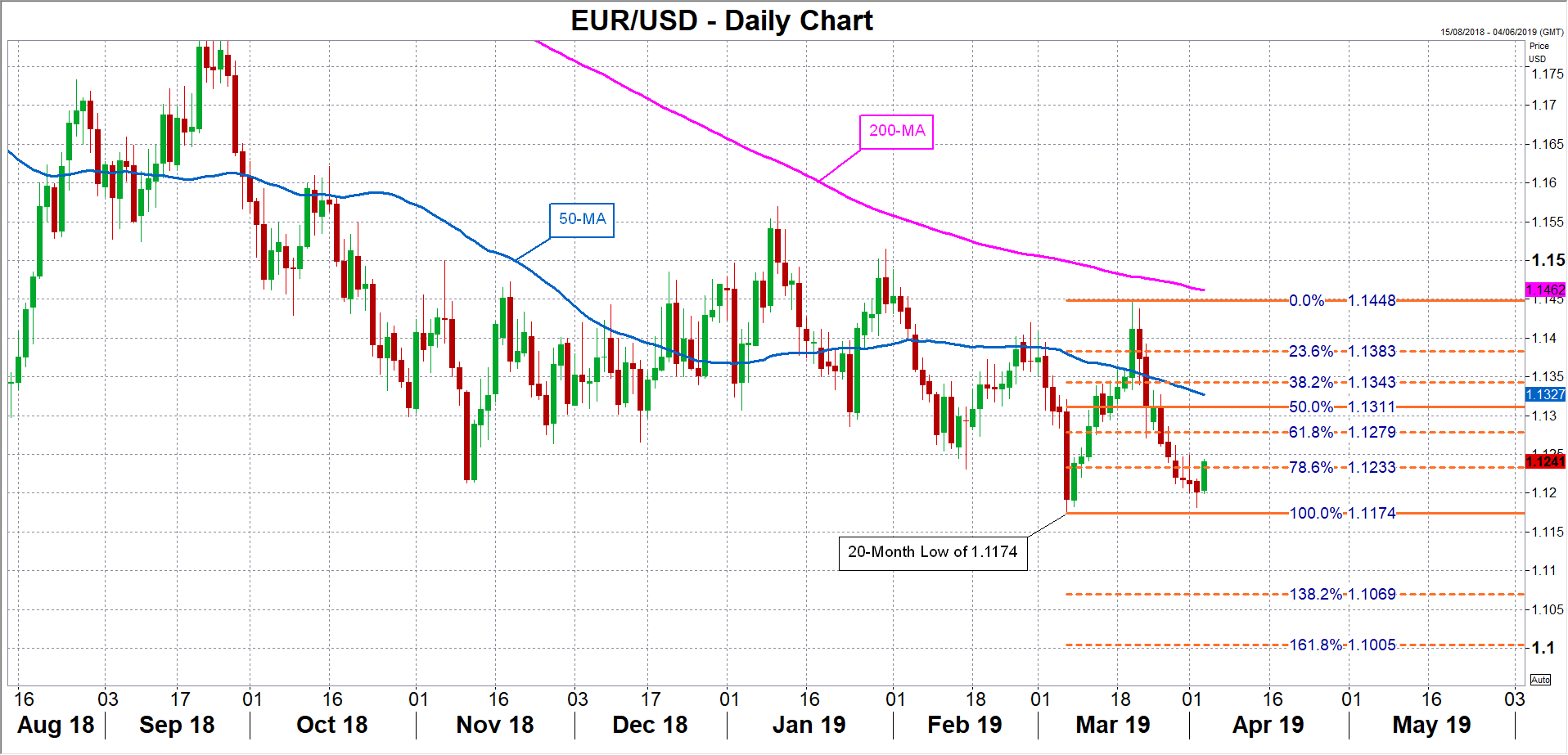
The euro dropped to a 20-month low of $1.1174 following the ECB’s decision and has struggled to gain fresh upside momentum since in the absence of any positive economic indicators and more dovish voices coming from the central bank. Brexit and trade uncertainty having been taking a toll on European manufacturers, particularly in the bloc’s powerhouse – Germany. The closely-watched IHS Markit manufacturing PMI for the Eurozone slumped to a 6-year low of 47.5 in March, although the services PMI provided some hope of a turnaround as it rose for a second straight month.
The continued weakness forced the ECB to lower its macroeconomic projections in March for the euro area. The Bank now expects growth of just 1.1% year-on-year in 2019 versus forecasts 1.7% y/y in its December projections. Inflation meanwhile is expected to average 1.2% y/y compared with prior forecasts of 1.6% y/y.
ECB President Mario Draghi has suggested that should the inflation outlook deteriorate further, the forward guidance on rates could be adjusted again, in a major dovish signal. It should be noted, though, that given Draghi’s term expires at the end of October, making further changes to the forward guidance would probably be difficult until a new president has been appointed.
In another dovish sign, the ECB has said it is studying options of introducing a tiered system for its deposit rate, which, at -0.40%, is hurting banks’ profitability. Exempting banks from being charged a fee on some of their excess cash deposited at the ECB could ease some of the side effects from negative rates on the Eurozone’s banking system.
Other central banks with negative rates, such as the Bank of Japan and Switzerland, already have a tiered structure to mitigate the impact of negative rates. However, while such a policy may relieve cost pressures on commercial banks, it also sends out a message that negative rates are here to stay. Consequently, the euro has been edging lower since the reports on a tiered deposit rate started circulating.
The ECB’s March meeting minutes are unlikely to include such discussions yet but may indicate whether Governing Council members were swaying towards taking further policy steps to counter the slowdown. Dovish minutes would likely push the euro below the 2019 low of $1.1174. A break below this key support region could set the stage for further declines in the short-to-medium term. Key supports below the $1.11 handle could come at the 138.2% and 161.8% Fibonacci extensions of the upleg from $1.1174 to $1.1448, at $1.1070 and $1.1005 respectively.
In the event that the minutes surprise by policymakers expressing confidence that the resilience of domestic demand would be enough to stave off a sharper downturn, the euro could see a modest upside. The single currency could initially climb towards the 61.8% Fibonacci around $1.1280 before aiming for the 50% Fibonacci around $1.1310.
Looking at the euro’s prospects in the months ahead, a resolution to the US-China trade dispute as well as an end to the Brexit deadlock in the UK are key in lifting business sentiment in the region and could help trigger a rebound in economic growth. Without an external boost, however, it’s hard to envision a substantial recovery in the Eurozone given the limited tools the ECB has at its disposal.
Oil Back in the Groove?
Oil prices appear to have found a little bullish momentum again in the last few days, with the rallies we’ve seen in equity markets clearly a major factor. Another reported inventory build from API on Tuesday may have taken some of the gloss off the rally, which should make today’s EIA number all the more interesting, but momentum still looks very much with the bulls.
It now faces a big test around notable resistance though, just as momentum is building. Perhaps this is a bullish signal but so far, we’re yet to see a breakout. If price can break above $70 in Brent crude , then $71.50 would be the next notable resistance.
Brent Daily Chart
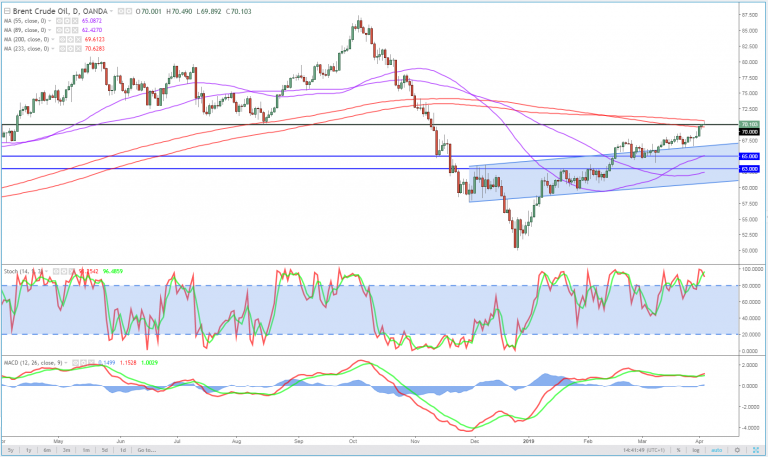
In WTI, the notable levels are $63 in terms of resistance, with further resistance above potentially coming around $64.50-65.
WTI Daily Chart
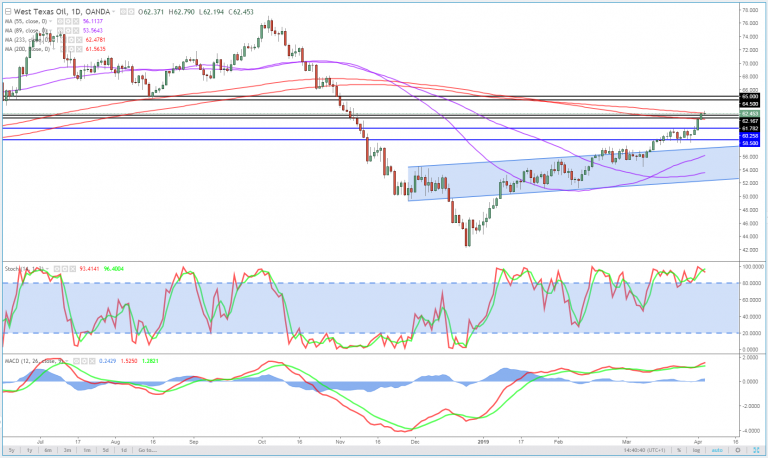
We’ve very much seen oil prices benefit from stronger risk appetite this year and that again appears to be what we’re seeing this week. It also comes at a time when US output is stabilizing, oil rigs are on the decline and OPEC+ remains committed to output cuts. It’s been something of a reluctant rally over the last month or so but it appears to have gathered some momentum this week.
US Oil Production
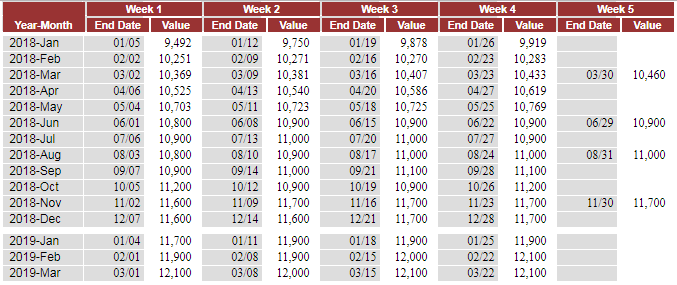
Source – EIA
US Oil Rig Count
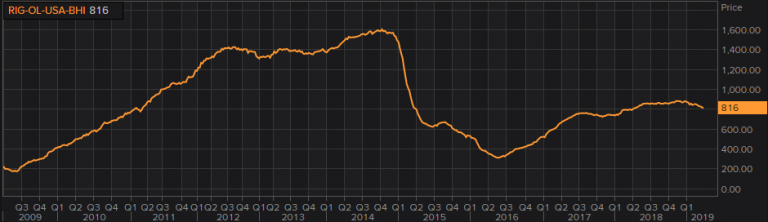
Source – Thomson Reuters Eikon
US ISM non-manufacturing dropped to 56.1, growth cooled off but businesses still optimistic
US ISM non-manufacturing composite dropped to 56.1 in March, down notably from 59.7 and missed expectation of 58.0. Looking at some details, Business Activity Index dropped -7.3 to 57.4. New Orders dropped -6.2 to 59.0. Employment, however, rose 0.7 to 55.9.
ISM noted: "The non-manufacturing sector's growth cooled off in March after strong growth in February. Respondents remain mostly optimistic about overall business conditions and the economy. They still have underlying concerns about employment resources and capacity constraints."
Sunset Market Commentary
Markets
Global core bonds lost ground today risk sentiment flourished overnight. Chinese PMI’s printed stronger than expected while the US and China are said to be close to a trade agreement. Meanwhile, UK PM May reaches out to opposition leader Corbyn to breakdown the Brexit deadlock, raising the chances of a soft and market-friendly Brexit. Core bonds opened lower. The final reading of EMU PMI’s outperformed expectations, weighing core bonds further down. The German 10-yr yield moved back north of the psychological zero line and is fighting to remain in positive territory at the time of writing. The German yield curve bear steepens with changes up to +6.2 bps (30-yr). US Treasuries fell lower during Asian trading on the positive US-Sino trade talks and held on to those losses throughout the day. The ADP Employment change for March disappointed (129k vs. 175k expected) but had little impact on US Treasuries. Investors awaited the more forward-looking non-manufacturing ISM later on the day. The gauge printed below expectations but remains solid whatsoever (infra). The US yield curve is bear steepening as well with changes up to +3.8 bps (30-yr). Peripheral spreads over the German 10-yr yield tightened with Greece (-9 bps), Spain (-3 bps) and Italy (-3 bps) outperforming.
Dollar strength prevailed recently on global currency markets. The US currency was supported by decent US data and higher yields. The trade-weighted dollar came close to the 97.50/75 resistance area. EUR/USD dropped to close to the 1.1177/87 support. The move petered out yesterday. Today, fortunes changed in favour of the euro. The single currency succeeded some kind of catching up move. Final EMU services PMI’s printed stronger than expected. Especially positive surprises from Italy and Spain gave some comfort for euro bulls. EUR/USD rebounded off the low 1.12 area. A positive risk global risk sentiment was also euro supportive. Early in US dealings, ADP labour market growth printed well below consensus (129k vs 175 k expected), but the move was ignored by USD traders, probably as the month-to-month link between ADP and the payrolls is recently rather loose. LT interest rate differentials narrowed slightly in favour of the euro, but US yields still held the upward trajectory from earlier this week. EUR/USD filled offers in the 1.1250/55 area earlier today, but is currently changing hands in the 1.1235 area. USD/JPY again shows no clear trend despite higher core yields and a positive risk sentiment. The pair hovers in the mid 111 area as markets are counting down the the US non-manufacturing ISM.
Sterling initially gained further ground this morning as markets pondered the potential consequence of UK PM May look for support from the labour opposition to get a Brexit deal approved in the UK Parliament. Sterling profited as markets saw growing chance of a softer Brexit. EUR/GBP dropped to low 0.85 area. However, the division within the PM May’s Conservative party makes the outcome of this new political option still highly uncertain. Sterling lost some ground intraday. Later today, EU’s Juncker also repeated that an approval of the withdrawal agreement before the 12 April deadline was needed for the UK to get a ST delay. It is still far from sure that this condition will be met. EUR/GBP is currently again trading in the mid 0.85 area. Cable is also drifting back south (1.3130 area).
News Headlines
Oil prices (Brent) continue to rise, trading just shy of the psychologically important $70 p/b today as recent data (business confidence amongst others) have eased global growth concerns. At the same time production cuts by OPEC, a US-lead Iranian oil boycott and Venezuelan export disruptions have boosted prices from the supply side.
According to Austria’s Chancellor Kurz there is “absolutely no reason” for another extension to brexit beyond April 12. UK’s May asked for a second delay so she could hammer out a revised brexit deal in co-op with Labour’s Corbyn in the meantime. However such a request has to be approved by the EU unanimously.
US non-manufacturing ISM missed estimates (58.0), slipping from 59.7 to a still solid 56.1 in March as new orders fell from a stellar 65.2 to 59.0. Other subcomponents dropped much less sharply or even rose (overall business activity, employment, backlogs, prices paid), suggesting a healthy (domestic) US economy.
MARKET WRAP: ADP Numbers Missed Forecast
Theresa May failed to move Brexit out of its deadlock and the US ADP data has set a soft tone for the US NFP number.
Stocks
- The S&P 500 Index gained 0.02 percent as of 15:10 London time. The Nasdaq Composite Index jumped 0.03 percent and the Dow Jones Industrial Average increased 0.03 percent.
- The Stoxx Europe 600 continued its upward move and gained 0.73 percent.
- The MSCI Emerging Market Index scored 0.4 percent.
Currencies
- The Dollar Spot Index fell after the weak ADP data and lost 0.31 percent.
- The Euro moved back above 1.12 and gained 0.35 percent to $1.1235 due to the strong eurozone PMI economic data
- The British pound moved higher and gained 0.65 percent to $1.3162 despite Brexit chaos.
Bonds
- The yield on 10-year Treasuries gained four basis points to 2.52 percent.
- Germany’s 10-year yield fell two basis points to negative 0.03 percent.
- Britain’s 10-year yield rose seven basis point to 1.08 percent.
Commodities
- West Texas Intermediate jumped 0.10 percent to $62.65 a barrel.
- Gold was still below the 1300 mark, it gained 0.17 percent to $1,291 an ounce.
USD/JPY Mid-Day Outlook
Daily Pivots: (S1) 111.23; (P) 111.34; (R1) 111.44; More...
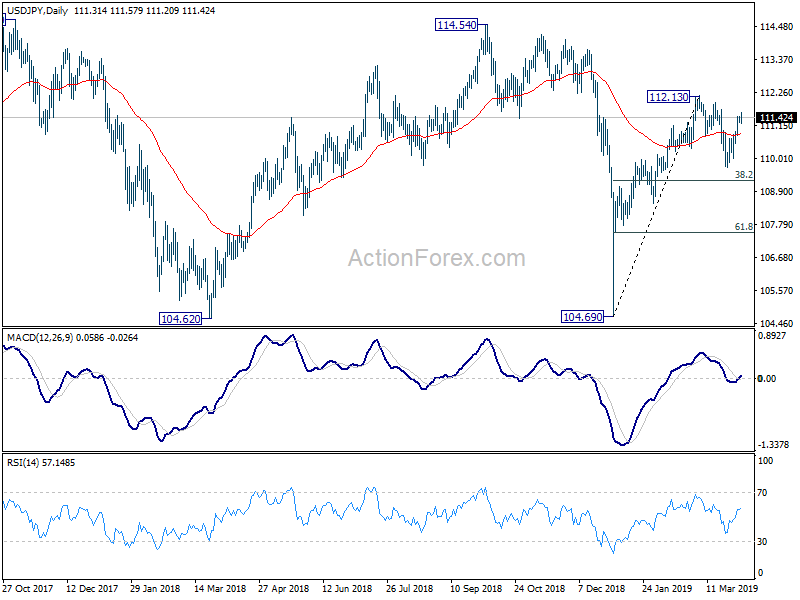
At this point,f further rise is mildly in favor in USD/JPY as long as 110.80 minor support holds. Decisive break of 112.13 resistance will resume whole rise from 104.69 to 114.54 key resistance next. On the downside, below 110.80 minor support will turn bias back to the downside for 109.71, and possibly further to 38.2% retracement of 104.69 to 112.13 at 109.28.
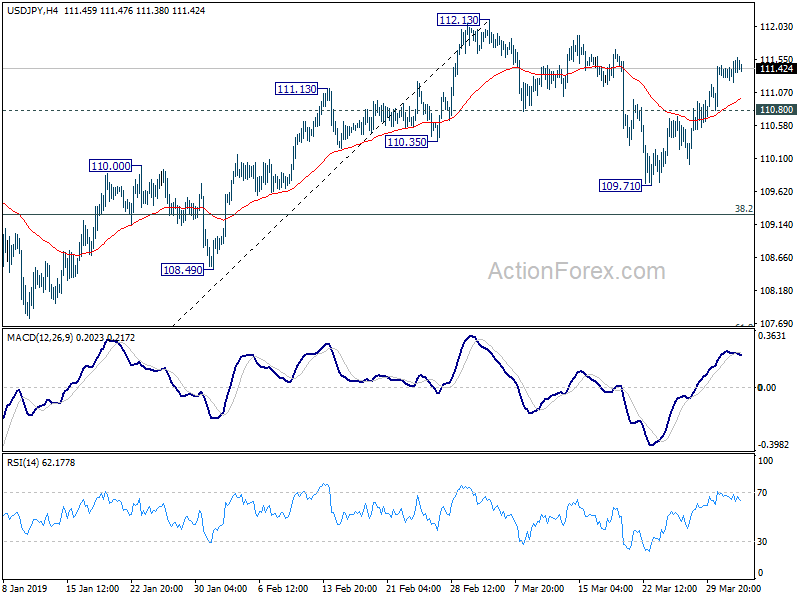
In the bigger picture, while the rebound from 104.69 was strong, USD/JPY failed to sustain above 55 week EMA (now at 110.80), and was kept well below 114.54 resistance. Medium term outlook is turned mixed and we'll wait for the structure of the fall from 112.13 to unveil to make an assessment later. For now, more range trading is expected between 104.69 and 112.13 first.
USD/CHF Mid-Day Outlook
Daily Pivots: (S1) 0.9968; (P) 0.9985; (R1) 0.9998; More...
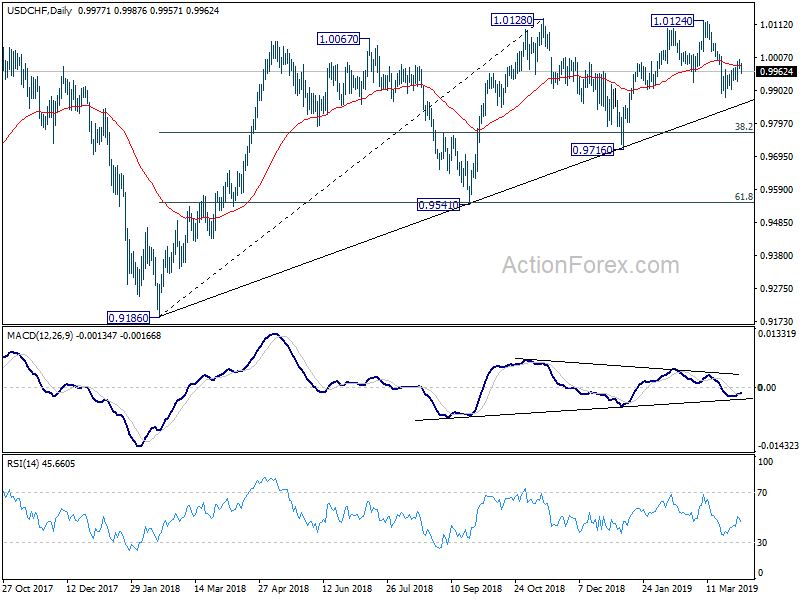
Intraday bias in USD/CHF remains neutral for the moment. On the upside, break of 1.0010 minor resistance will suggest that pull back from 1.0124 has completed. Intraday bias will be turned back to the upside for 1.0124/28 resistance zone. On the downside, break of 0.9879 will resume the fall from 1.0124 to 0.9716 key support.
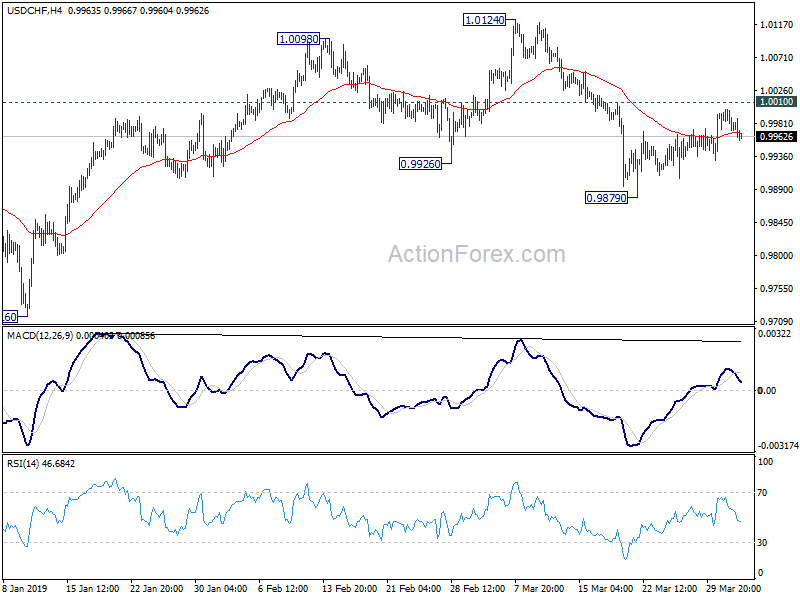
In the bigger picture, focus is back on medium term trend line (now at 0.9849). Decisive break there will argue that whole rise from 0.9186 has completed. Further break of 0.9716 will confirm reversal and target next support level at 0.9541. Nevertheless, there is still a chance that price action from 1.0128 are forming a consolidative pattern with fall from 1.0124 as third leg. If this is the case, stronger support should be seen between 0.9716 and the trend line to contain downside.