

Sample Category Title
Loonie Reverses Its Losses In The Asian Session
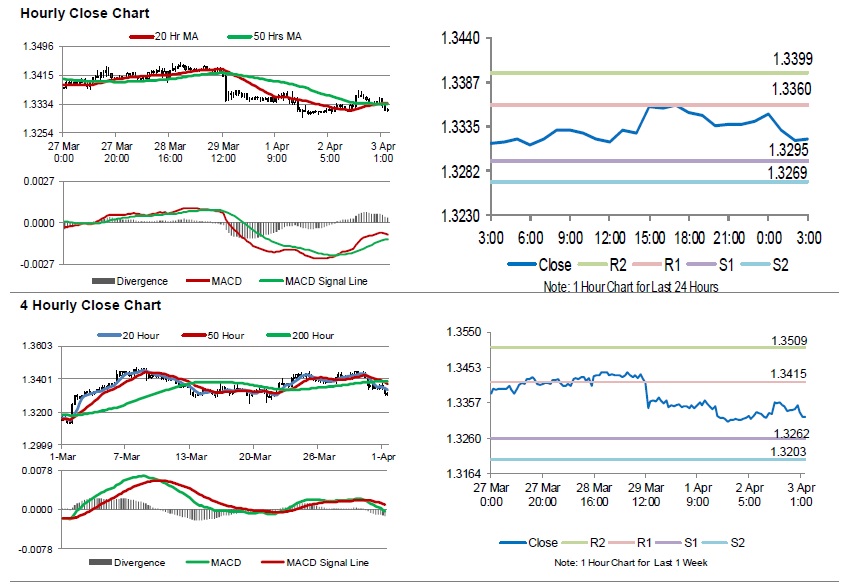
For the 24 hours to 23:00 GMT, the USD rose 0.22% against the CAD and closed at 1.3341.
In the Asian session, at GMT0300, the pair is trading at 1.3320, with the USD trading 0.16% lower against the CAD from yesterday’s close.
The pair is expected to find support at 1.3295, and a fall through could take it to the next support level of 1.3269. The pair is expected to find its first resistance at 1.3360, and a rise through could take it to the next resistance level of 1.3399.
Amid no major economic releases in Canada today, investors would focus on global macroeconomic news for further direction.
The currency pair is trading below its 20 Hr and 50 Hr moving averages.
Australia’s Retail Sales Advanced To A 15-Month High Level In February
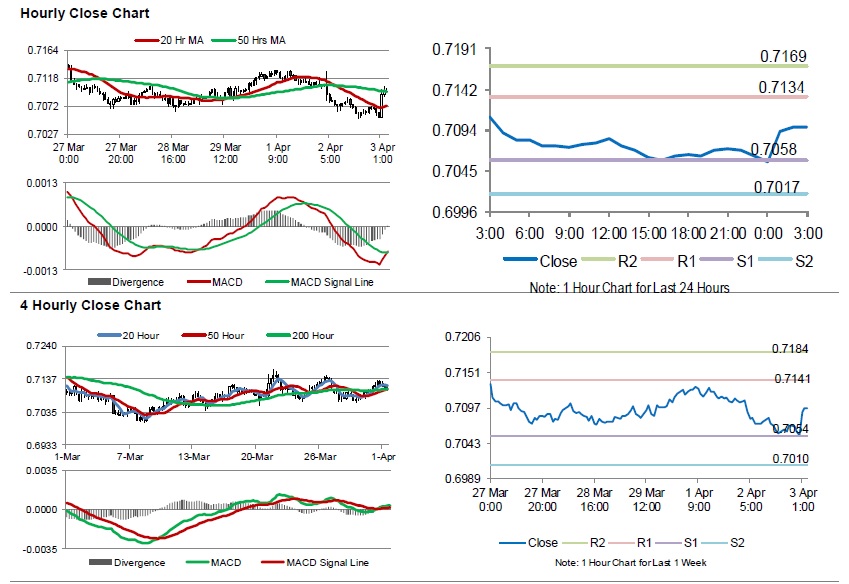
For the 24 hours to 23:00 GMT, the AUD declined 0.70% against the USD and closed at 0.7062.
LME Copper prices declined 1.0% or $67.0/MT to $6431.0/MT. Aluminium prices declined 1.6% or $30.0/MT to $1858.0/MT.
In the Asian session, at GMT0300, the pair is trading at 0.7098, with the AUD trading 0.51% higher against the USD from yesterday's close.
Overnight data showed that Australia's seasonally adjusted trade surplus widened to a record high level of A$4801.0 million in February, following a revised surplus of A$4351.0 million in the prior month. Market participants had anticipated the nation to record a surplus of A$3700.0 million. Moreover, the AiG performance of services index rose to a level of 44.8 in March, following a reading of 44.5 in the prior month. Also, the nation' s seasonally adjusted retail sales hit a 15-month high level of 0.8% on a monthly basis in February, surpassing market expectations for a rise of 0.3%. In the preceding month, retail sales had recorded a rise of 0.1%. On the other hand, Australia's CBA services PMI declined to a level of 49.3 in March, following a reading of 49.8 in the preceding month.
Elsewhere in China, Australia's largest trading partner, the Caixin services PMI index rose more-than-expected to a level of 54.4 in March. The services PMI index had recorded a reading of 51.1 in the previous month.
The pair is expected to find support at 0.7058, and a fall through could take it to the next support level of 0.7017. The pair is expected to find its first resistance at 0.7134, and a rise through could take it to the next resistance level of 0.7169.
In absence of key economic releases in Australia today, investor sentiment would be determined by global macroeconomic events.
The currency pair is trading above its 20 Hr moving average and showing convergence with its 50 Hr moving average
Gold: Yellow Metal Trading Slightly Lower In The Morning Session
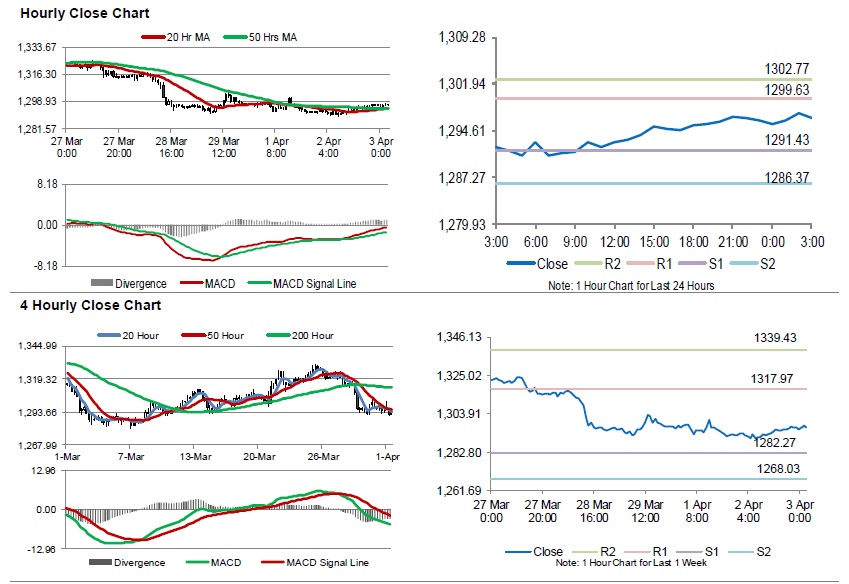
For the 24 hours to 23:00 GMT, Gold rose 0.34% against the USD and closed at USD1296.60 per ounce.
In the Asian session, at GMT0300, the pair is trading at 1296.50, with gold trading a tad lower against the USD from yesterday’s close.
The pair is expected to find support at 1291.43, and a fall through could take it to the next support level of 1286.37. The pair is expected to find its first resistance at 1299.63, and a rise through could take it to the next resistance level of 1302.77.
The yellow metal is trading above its 20 Hr and 50 Hr moving averages.
Silver: White Metal Extends Its Gains In The Asian Session
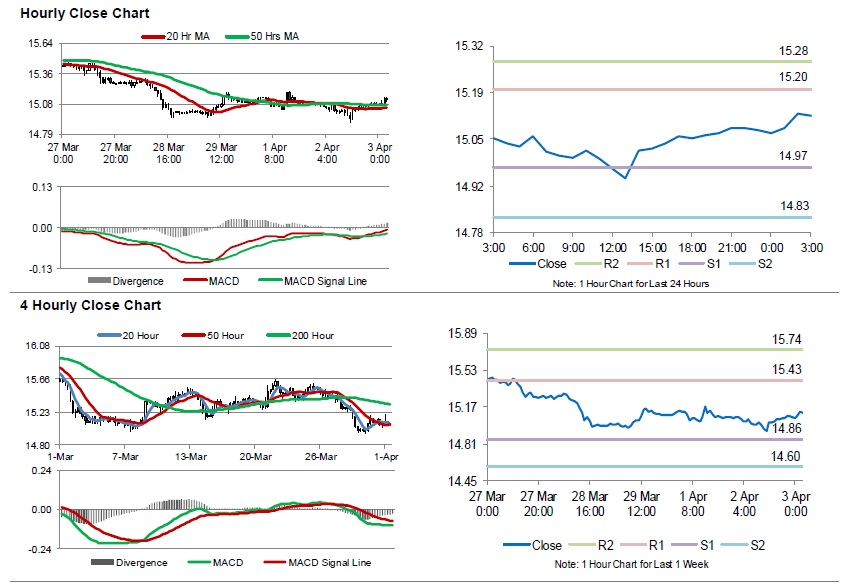
For the 24 hours to 23:00 GMT, Silver slightly rose against the USD and closed at USD15.08 per ounce, supported by gains in gold prices.
In the Asian session, at GMT0300, the pair is trading at 15.12, with silver trading 0.27% higher against the USD from yesterday’s close.
The pair is expected to find support at 14.97, and a fall through could take it to the next support level of 14.83. The pair is expected to find its first resistance at 15.19, and a rise through could take it to the next resistance level of 15.28.
The white metal is trading above its 20 Hr and 50 Hr moving averages.
Crude Oil: Oil Trading Higher, Ahead Of EIA’s Weekly Crude Oil Inventories Data
For the 24 hours to 23:00 GMT, Crude Oil rose 1.28% against the USD and closed at USD62.48 per barrel, amid signs of tightening crude oil supplies and easing concerns over global economic growth.
Meanwhile, the American Petroleum Institute (API) reported that US crude oil inventories climbed by 3.0 million barrels in the week ended 29 March 2019.
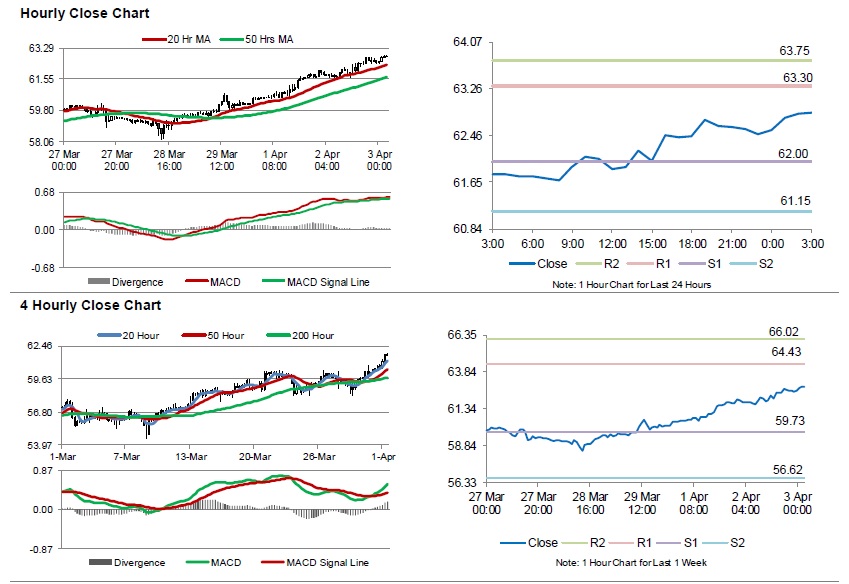
In the Asian session, at GMT0300, the pair is trading at 62.85, with oil trading 0.59% higher against the USD from yesterday's close.
The pair is expected to find support at 62.00, and a fall through could take it to the next support level of 61.15. The pair is expected to find its first resistance at 63.30, and a rise through could take it to the next resistance level of 63.75.
Crude oil is trading above its 20 Hr and 50 Hr moving averages.
Into European session: Australian Dollar strong as roller coaster ride continues
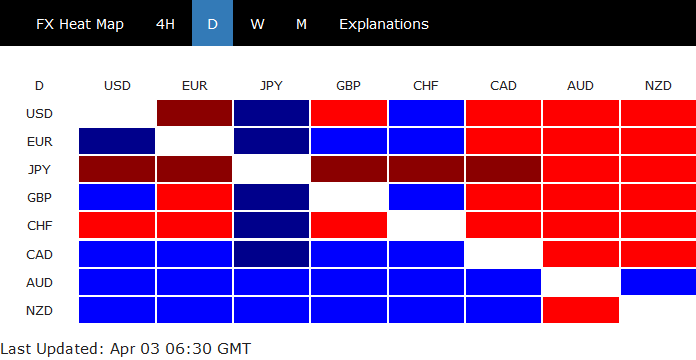
Australian Dollar's roller coaster ride continues today. Entering into European session Aussie is the strongest one for today, lifted by much stronger than expected retail sales data. At least, relative resilient in consumption could give RBA more time to wait and see before deciding to cut interest rates. Improvement in Chinese services data also helps. For now, New Zealand Dollar follows as the second strongest, then Canadian.
Yen is the weakest one today, followed by Dollar and then Swiss Franc. Stock markets in Asia are rallying for another day, Warnings from WTO, IMF and Asian Development Bank regarding slowdown are generally ignored. Meanwhile, Chinese stock markets seem to be rather optimism on US-China trade talks, which will resume in Washington today, despite lack of concrete details regarding the progresses. China Shanghai SSE is pressing 3200 handle for now.
In Asia:
- Nikkei closed up 0.97%.
- Hong Kong HSI is up 0.91%.
- China Shanghai SSE is up 0.57%.
- Singapore Strait Times is up 0.86%.
- Japan 10-year JGB yield is up 0.0244 at -0.043, still negative.
Overnight:
- DOW dropped -0.30%.
- S&P 500 rose 0.00%.
- NASDAQ rose 0.25%.
- 10-year yield dropped -0.016 to 2.481.
China: Renminbi Internationalization Remains Sluggish
Renminbi internationalization
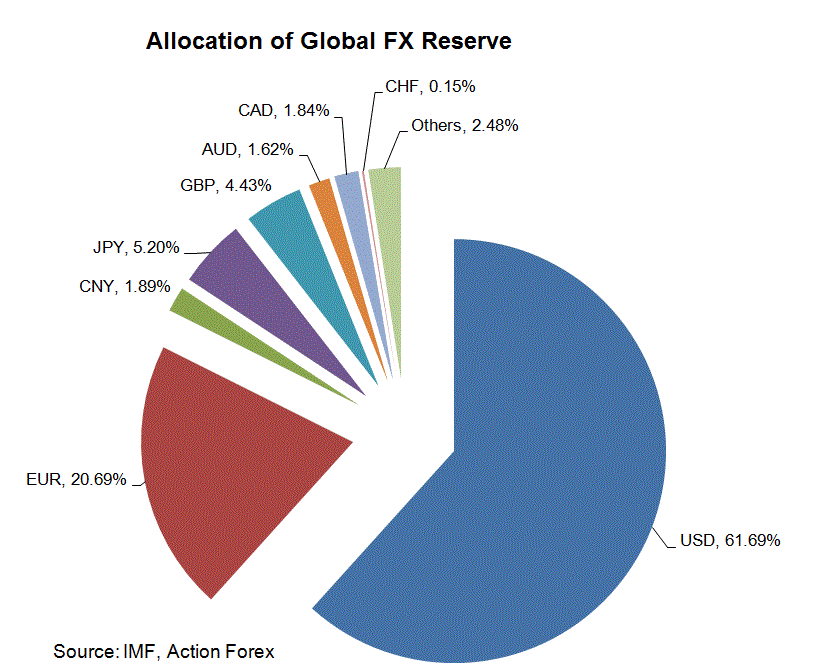
The IMF’s latest report reveals that the process of renminbi internationalization remains sluggish as renminbi (Chinese Yuan) is still a tiny portion of global central banks's FX reserve. In 4Q18, 1.89% global FX reserve was allocated to renminbi , compared with 1.07% in 4Q16, when the currency was first admitted to the Special Drawing Right (SDR) basket.
US dollar remains the world’s dominant reserve currency, although its holdings continue to drop. Global allocation to USD reserve fell to 61.69% in 4Q18, compared with 62.72% in 4Q17 and 65.36% in 4Q16. There are a number of reasons for the erosion of confidence in the greenback. Notwithstanding the fact that the establishment of the euro has led to the shift in demand from USD to the single currency, the persistent twin deficit facing the US government and Fed’s aggressive QE in 2008-2014 to devalue the currency have raised concern over the stability of the greenback.
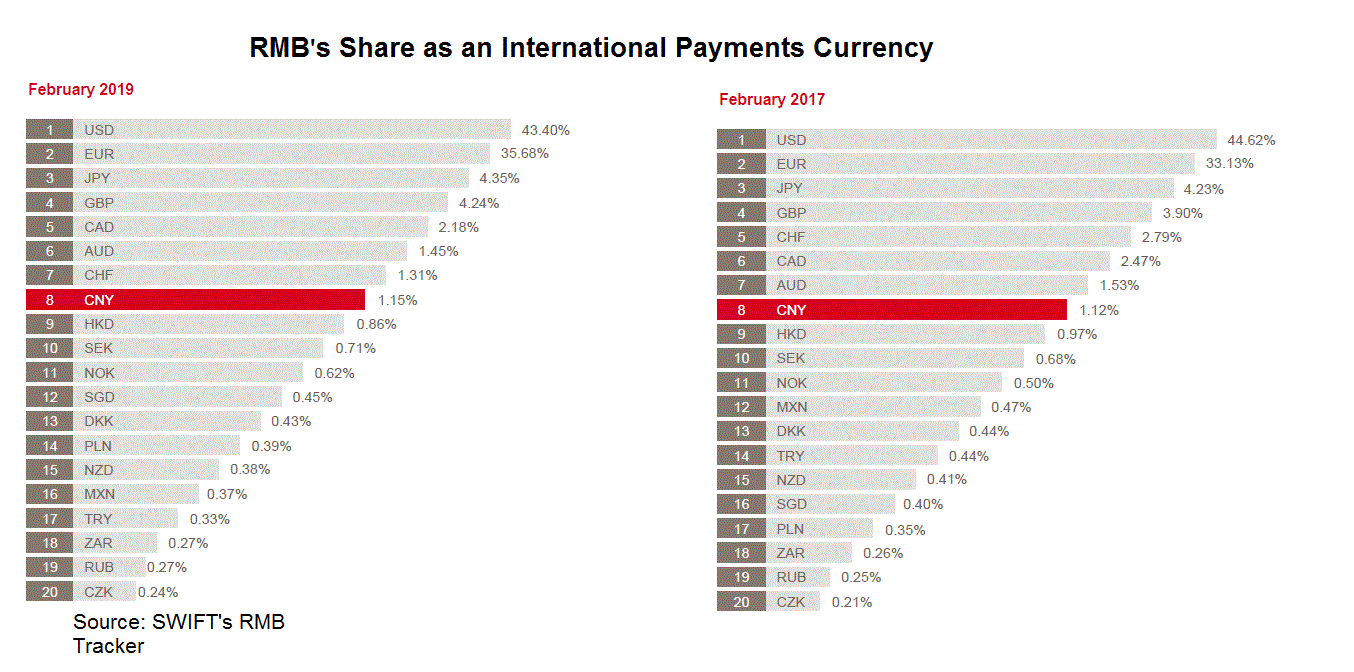
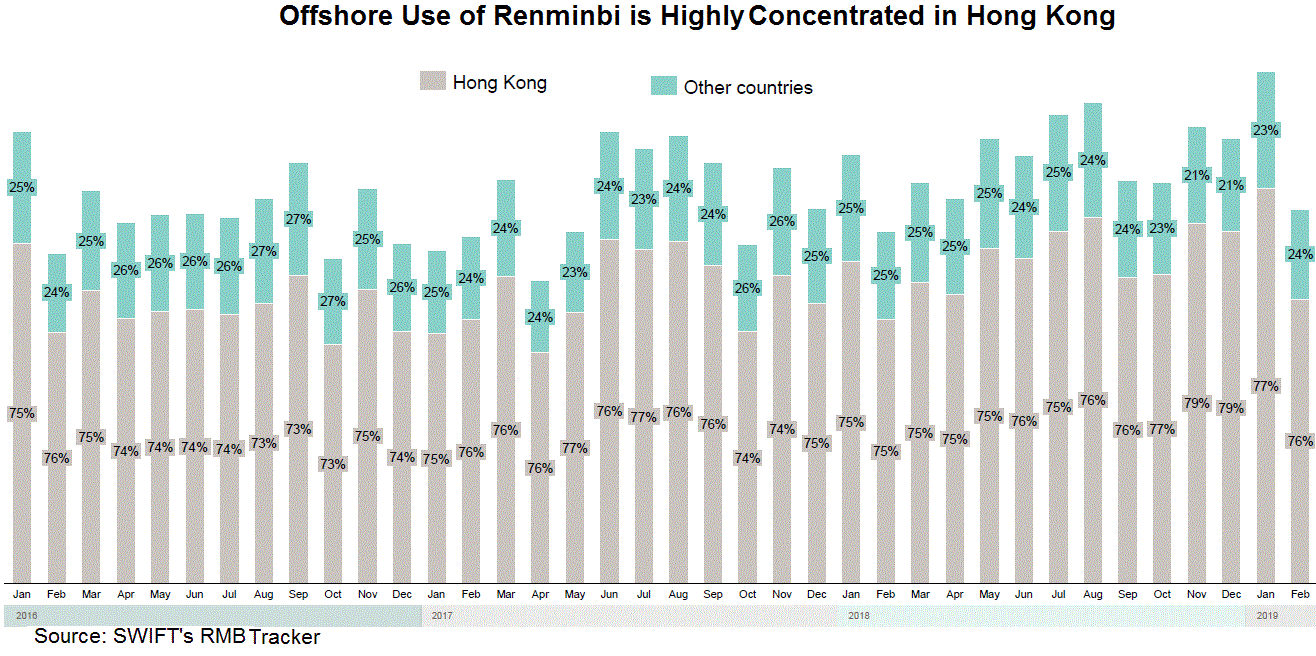
Nevertheless, it remains farfetched to suggest that the rise of renminbi is threatening US dollar’s status of reserve currency. Not only is allocation of renminbi in global FX reserve small, the currency’s share as an international payments currency is also limited. The chart below shows that renminbi took up 1.15% in international payment, compared with 43.4% in US dollar. Note also that, amongst the offshore customers (excl. China) choosing renminbi as a medium of payment, those in Hong Kong take up over 75%. This proves that the process of renminbi internationalization remains limited.
China is the world’s second largest economy, and the world’s largest exporter and second largest importer, the disproportionately small exposure of renminbi the global arena has been driven by the poor governance of the Chinese authority. The lack of transparency in the renminbi fixing scheme, capital control measures and limited participation of foreign investors in the country’s bond markets are prohibiting the renminbi to become a world currency.
Further slowdown in developing Asia on slowing global demand and persistent trade tensions
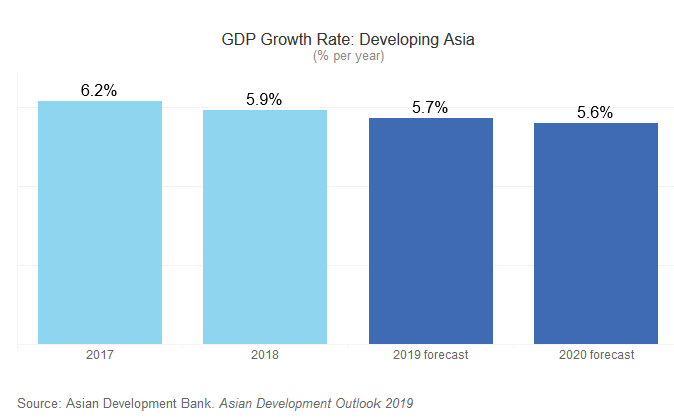
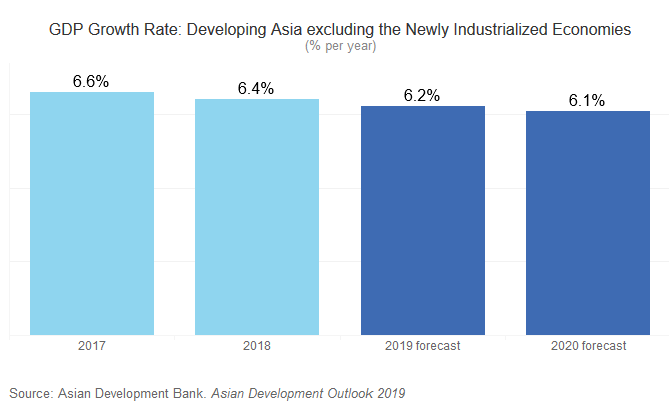
The Asian Development Bank forecasts further slowdown in developing Asia and cited against the backdrop of slowing global demand and persistent trade tensions. In the Asian Development Outlook, ADB projects growth in developing Asia to slow from 5.9% in 2018 to 5.7% in 2019 and 5.6% in 2020. Excluding newly industrialized economies, growth is projected to slow from 6.4% in 2018 to 6.2% in 2019 and 6.1% in 2020.
The report warned that risks remained "tilted to the downside". It said "A drawn-out or deteriorating trade conflict between the People's Republic of China and the United States could undermine investment and growth in developing Asia. With various uncertainties stemming from US fiscal policy and a possible disorderly Brexit, growth in the advanced economies could turn out slower than expected, undermining the outlook for the People's Republic of China and other economies in the region. Though abrupt increases in US interest rates appear to have ceased for the time being, policy makers must remain vigilant in these uncertain times."
China: March PMIs Show Improvement in Economic Activities
Markit/Caixin’s PMI report shows recovery in China’s economy in March. The composite output index rose to 52.9 in March, from 50.7 in the prior month. This marks the highest level since June 2018. While the manufacturing sector returned to the expansionary territory, services activities also showed stronger growth.
It is likely that GDP growth in 1Q19 would stage a rebound from 4Q18. However, we remained cautious about the growth in the second quarter as well as the second half of the year.
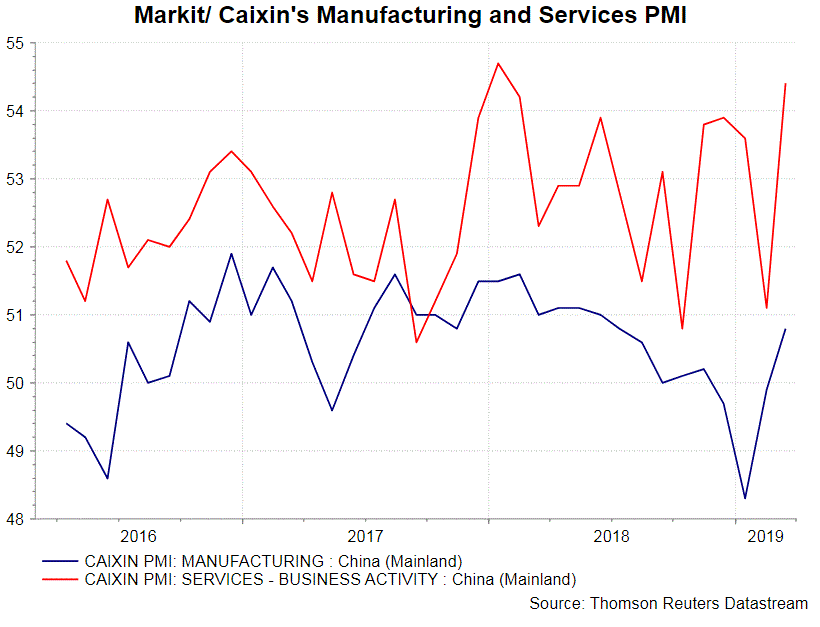
The official NBS manufacturing PMI climbed +0.9 point to 50.8 in March. The improvement in the manufacturing sector was broadly based. For instance, the new orders sub-index rose to the highest level in 4 months, while the new exports orders sub-index drifted back above 50 (indicating expansion). Improvement in the above two sub-indices signaled rebound in both domestic and foreign demand for Chinese goods. The employment sub-index soared to the highest level since January 2013.
On the services sector, the PMI jumped to 54.4 in March from 51.1 in the prior month. Looking into the details, the new business sub-index rose to the highest level since January 2018 while the business expectations sub-index climbed modestly higher. However, concerning the employment situation, the corresponding sub-index softened a bit, despite staying in the expansionary territory.
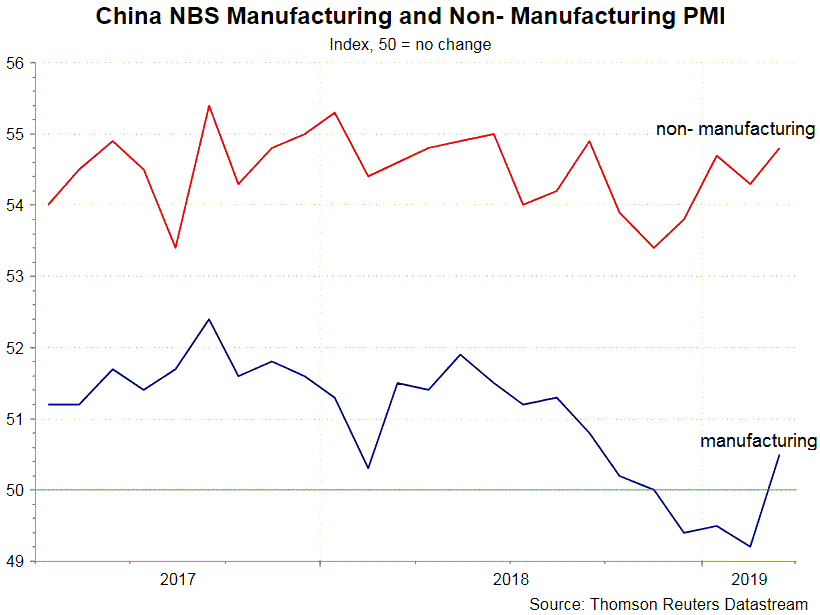
Recall that the Markit/ Caixin PMI focuses on small and medium firms, while NBS’ official report surveys on large corporations. For the latter, the overall composite index improved +1.6 points to 54 in March. Meanwhile, both manufacturing and services activities rebounded during the month. Returning to expansion, the manufacturing PMI climbed +1.3 points to 50.5 while the services PMI gained +0.5 point to 54.8.
US-China trade talks to resume, a perceived critical week
US-China trade negotiation will resume on Wednesday with Chinese Vice-Premier Liu He arriving in Washington. Liu will meet both US Trade Representative Robert Lighthizer and Treasury Secretary Steven Mnuchin.
It's reported that an agreement is within reach, covering most of the core issues including intellectual property theft and forced technology transfer. But there is so far no news regarding subsidies for state owned enterprises, which create unfair playing fields.
In addition, the real crucial topic of enforcement is unresolved. The US is believed to be demanding to keep current punitive tariffs until China implements what are agreed. But this is at the same time firmly objected by China.
Nevertheless, US Chamber of Commerce head of International Affairs Myron Brilliant sounded optimistic. He said yesterday that "we're getting to the point where it's clear that both governments want a deal. The presidents want a deal, and they need to get through the end-game issues. This is a critical week."
Brilliant added, "ninety per cent of the deal is done, but the last 10 per cent is the hardest part, it's the trickiest part and it will require trade-offs on both sides."