Sample Category Title
China Caixin PMI services rose to 54.4, but more evidence need to confirm stabilization
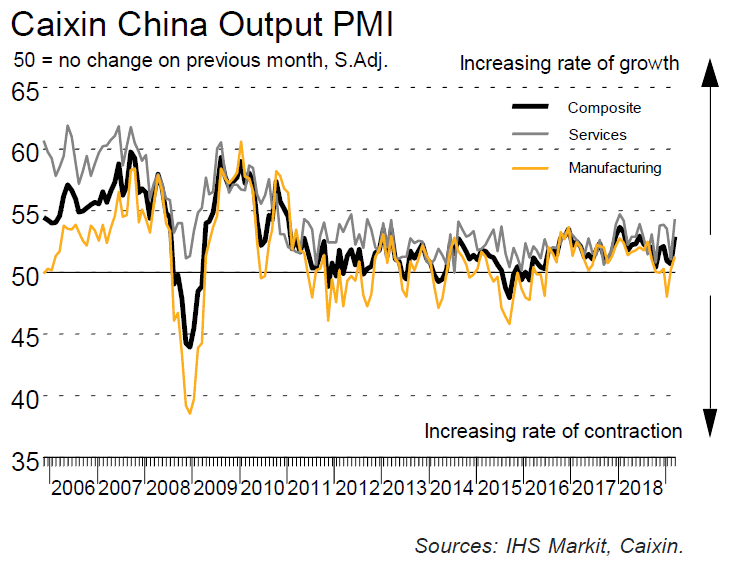
China Caixin PMI services rose to 54.4 in March, up from 51.1, beat expectation of 52.0. That's the highest reading in 14 months. PMI composite rose to 52.9, up from 50.7, strongest since June 2018. Markit also noted that Manufacturers and service providers both signal stronger increases in activity and new work. Renewed rise in manufacturing payrolls leads to first expansion of composite employment for over a year. Overall business confidence edges up to seven-month high.
Commenting on the China General Services PMI™ data, Dr. Zhengsheng Zhong, Director of Macroeconomic Analysis at CEBM Group said:
"In general, China's economic fundamentals recovered in March, with domestic and external demand as well as manufacturing employment improving. However, business sentiment has remained cautious, and inflation was subdued. The three-month moving average of the Caixin China General Manufacturing PMI remained in contraction territory, while the Caixin China Composite Output Index showed tentative signs of recovery following a relatively subdued start to 2019. More evidence is needed to determine whether the Chinese economy has stabilized."
Australia AiG service index rose to 44.8, but all sectors contract
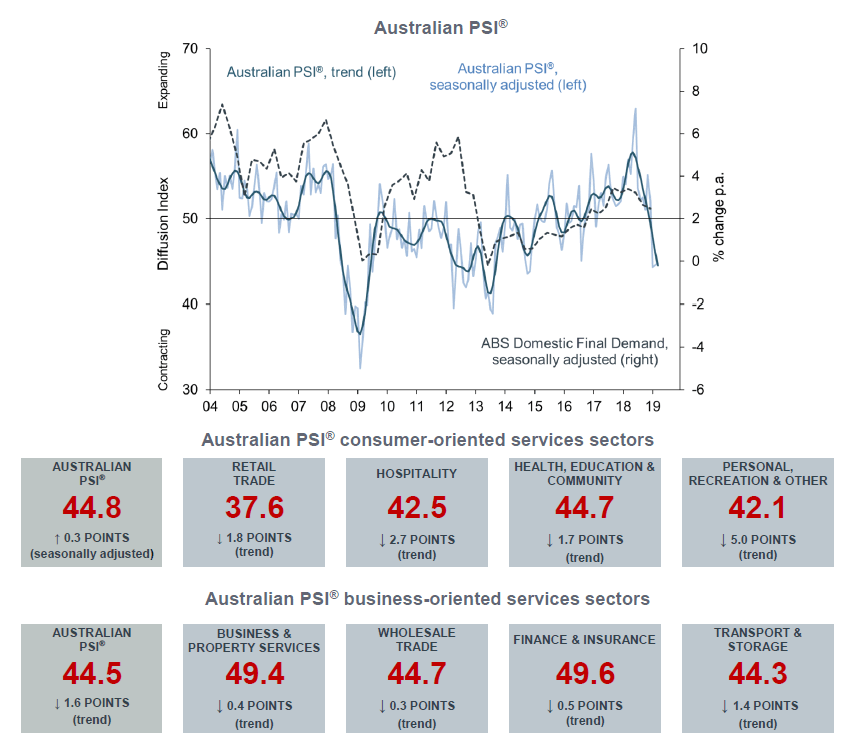
Australia AiG Performance of Service Index rose 0.3pts to 44.8 in March, indicating a "slower rate of contraction. But it's still the third straight month of contractionary conditions following a positive run through most of 2017 and 2018. Despite the slight improvement, it's should noted that it's the first month since August 2010 that all sectors contract.
Also released, Australia trade surplus widened to AUD 4.80B in February, up from AUD 4.35B and beat expectation of AUD 3.71B. Total exports rose AUD 77M to AUD 39.83B. Total imports dropped AUD -374M to AUD 35.03B.
Australia retail sales rose 0.8%, improvement across most industries
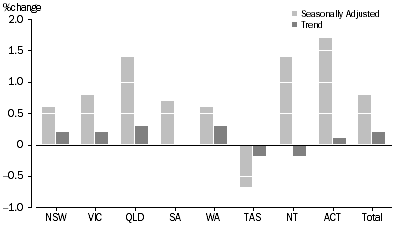
Australia retail sales rose 0.8% mom s.a. in February, much higher than expectation of 0.3% mom. ABS Director of Quarterly Economy Wide Surveys, Ben Faulkner said: "There were improved results across most industries with rises in food retailing (0.8%), department stores (3.5%), household goods retailing (1.1%) and clothing, footwear and personal accessory retailing (1.6%). Other retailing (0.0% and cafes, restaurant and takeaway services (0.0% were relatively unchanged. The rise this month follows subdued results in December 2018 (-0.4%) and January 2019 (0.1%)."
Among the state and territories, there were rises in Queensland (1.4%), New South Wales (0.6%), Victoria (0.8%), Western Australia (0.6%), South Australia (0.7%), the Australian Capital Territory (1.7%) and the Northern Territory (1.4%). There was a fall in Tasmania (-0.7%).
RBA has repeatedly noted that household consumption is a key uncertainty for overall GDP. Tightness in labor market has not much been translated into wage growth and rise is household disposable income. Wealth effect of falling house price could also be a drag. But February data does give some positive news to RBA and some room for it to wait-and-see first.
GBPUSD Retains Upside Pressure On Recovery
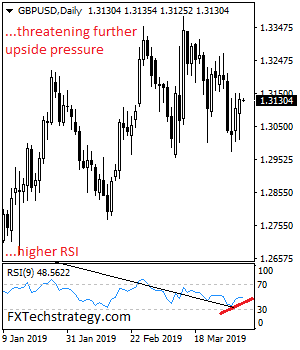
GBPUSD retains upside pressure on recovery higher. Support stands at 1.3000 level. Further down, support comes in at the 1.2950 level where a break will turn focus to the 1.2900 level. Further down, support lies at the 1.2850 level. Below here will set the stage for more weakness towards the 1.2800 level. On the upside, resistance stands at the 1.3050 with a turn above here allowing for additional strength to build up towards the 1.3100 level. Further out, resistance stands at the 1.3150 level followed by the 1.3200 level. On the whole, GBPUSD retains upside pressure on further bull threats.
Market Morning Briefing: Aussie Has Risen Contrary To Our Expectation Of A Further Fall Below 0.705
STOCKS
The resistance at 26250 on the Dow (26179.13, -79.29, -0.30%) seems to be holding as of now. The outlook remains positive. However, a dip to 26000 cannot be ruled out before the DOW breaches 26250 and gears-up for a rally to 27000 and 27250
DAX (11754.79, +72.80, +0.62%) keeps the bullish view intact. With an immediate support at 11710 (200-day moving average), DAX can surge to 11900 and 12000 in the coming days.
Nikkei (21674.13, +168.82, +0.79%) is volatile. But with support at 21415 (21-day moving average) the near-term view is positive for it to test 21930 and 21960.
Shanghai (3180.30, +3.47, +0.11%) continues to move higher, but at a slower pace. A test of 3200 is likely in the coming sessions. A pull-back from 3200 can trigger a corrective fall to 3120. But a decisive break above 3200 will see the upmove extending towards 3250 and 3280
Sensex (39056.65, +184.78, +0.48%) and Nifty 50 (11713.20, +44.05, +0.38%) continue to trade strong and keep the bullish view intact. Sensex can test 39500 in the near term. Indeed the weekly charts are much stronger for it to test 40000 and even higher levels in the coming weeks. Nifty can test 11780-11800 in the near term.
COMMODITIES
Among commodities, oil looks stronger and can move further higher. Gold and Silver sustains above their support and may see some upticks in the coming sessions. Copper looks slightly weak in the near term.
Gold (1292) sustains above 1280. As mentioned yesterday, while above 1280, the possibility of an upmove to test 1300-1305 cannot be ruled out in the near term.
Silver (15.15) has bounced after a brief dip below 15 yesterday. Immediate resistance is at 15.2. A break above it can take silver higher to 15.35.
Copper (2.91) extended its fall yesterday and seems to be under pressure. A key support is in between 2.90 and 2.89. A bounce from there can take it back to 2.95 levels. But a break below 2.89 can drag it to 2.85.
WTI (62.75) has risen above 62 decisively. Supports are at 62.3 and 61.5. WTI can move further higher to 63.7 in the coming sessions.
Brent (69.72) has risen further as expected and is trading in the key 69.7-70 resistance region. The outlook is bullish. A strong break above 70 will pave way for a further rally to 72 in the coming days. Immediate support is at 69.2
FOREX
Currencies are all mixed. Euro is weak while Euro-Yen, Dollar-Yen and Pound have scope to rise just now. Aussie is stuck in a sideways range while Yuan may weaken to test 6.73/74. Dollar-Rupee could start moving up from 68.50/60 levels back to 69+.
Dollar-Index (97.20) has dipped after testing 97.50 on the upside yesterday. We could possibly see some sideways trade above 97 in the near term with the upside limited to 97.75.
Euro (1.1222) tested 1.1187 yesterday, falling below the 1.12 support. Although Euro is trading slightly higher today, there is scope for falling towards 1.11 in the near term. View is bearish for the coming sessions.
Euro-Yen (125.14) has risen well. Only if it manages to break above the 21-MA near 125.40, we would turn bullish towards 126.0-126.8 else a fall back towards 125-124 could be on the cards.
Dollar Yen (111.50) has resistance near 111.50-112.0 from where a rejection is expected, pushing the pair back towards 111-110 in the near term.
Aussie (0.7099) has risen contrary to our expectation of a further fall below 0.705. Although the immediate resistance levels of 0.7150 and 0.72 are holding just now, Aussie is finding difficult to break below 0.7050 and move down towards 0.70.
Pound (1.3141) has been clearly rising from trend support near 1.30. While the rise holds, a test of 1.32 could be seen.
USDCNY (6.7130) has scope of rising towards 6.73/74 while the pair trades above 6.70. In the medium term 6.74/75 is likely to hold and could push the pair back towards 6.70.
Dollar-Rupee (68.7550) declined sharply yesterday in the last 1-hr of the trading session to fall sharply below 68.90/80. Downside could be limited to 68.50 just now while the pair could move back to 69+ levels in the near term.
INTEREST RATES
The US Yields have all risen. The 2YR (2.32%), 5YR (2.31%), 10YR (2.50%) and the 30Yr (2.90%) have all risen sharply and look bullish for the near term. The 30Yr (2.90%) could rise towards immediate resistance at 3% while the 10Yr (2.50%) could rise towards 2.55/58%.
The German-JGB 10YR (0%) has fallen instead of bouncing from immediate support levels. A further fall from current levels could turn the spread negative towards -0.05%.
Contrary to our expectation of decline, USDINR Forward Premia actually went up substantially yesterday, with the 1-mth going up to 8.22% , as compared to 4.63% last Thursday. The 2-mth was 6.22%, as compared to 4.31% last Thursday. Cash-Spot too was very high yesterday. All this is because of an excess supply of Dollar balances and shortage of Rupee balances in the Indian money-market linked to the outsize USDINR buy/sell swaps announced by the RBI. It may take another couple of days for the situation to normalise.
The 10Yr GOI (7.4190%) saw a sharp dip below 7.45% yesterday and may try to push further down towards 7.35% or even lower. Confirmation would come on a break below 7.40%.
Tomorrow's MPC will be keenly awaited. For one, the market is likely pricing in a rate cut. Secondly, the market will also want to know if the RBI aims to do anything about the anomalies currently being seen in the Dollar-Rupee Cash-Spot and Forward Premia markets.
Australian Retail Sales Post Surprise Lift
Feb sales: 0.8%mth, 3.2%yr (mkt f/c 0.3%). Large non-food retailers drive gain, possibly affected by changing seasonal spending patterns.
Retail sales surprised significantly to the upside in February, a 0.8% gain coming very much against the run of play. Sales had risen just 0.1% in January after a 0.4% fall in December with very weak private sector business surveys suggesting conditions had remained difficult in February as well. The sales data instead showed a strong and relatively broad based gain, well above consensus forecasts of a 0.3% increase and taking annual sales growth back above 3% for the first time since October.
Some of the gain may be due to problems with adjusting for changing seasonality – the rising popularity of ‘Black Friday’ sales and shifting timing of post-Christmas sales has created some issues around retail estimates through this period. However, to the extent that this means the February gain is overstated it also implies that previous weakness was also being overstated.
The category detail showed strong gains for food (+0.8%mth, 4.9%yr), household goods (+1.1%mth, –0.1%yr), clothing (+1.6%mth, +3.6%yr) and department stores (+3.5%mth, +1.4%yr) the last three supporting the seasonal sale issue idea) with flat sales across other retail (+3.7%yr) and cafes & restaurants (+2.4%yr).
All major states recorded solid gains: NSW +0.6%mth, +2.4%yr; Vic +0.8%mth, +4.8%yr; Qld +1.4%mth, +4.1%yr; SA +0.7%mth, +2.0%yr; and WA +0.6%mth, +2.9%yr.
Looking by channel, online sales look to have posted a small 0.5% dip in the February month, implying an even stronger month for retail ex online (+0.9%mth) which had seen back to back monthly declines in Dec and Jan.
The breakdown by retailer size shows a particularly strong gain for large non-food retailers, sales up 2.2% in the Feb month to be up 3.7%yr. Large food retailers saw a more muted 0.7% gain in the month but remain the outperformers over the year, sales up 5%yr. Small retailers continue to struggle with a 0.6% decline in sales in Feb and sales barely up 0.5%yr – a result more in line with the very weak business survey reads in recent months.
Overall the better than expected February retail sales result removes a significant downside risk to the outlook with nominal retail sales now tracking a similar pace in the March quarter to that seen in the December quarter. That is still a weak pace but does not indicate a further step down on the slowing over the second half of last year.
GBP/JPY Signaling Bullish Continuation Above 147.00
Key Highlights
- The British Pound recovered and broke the 146.40 resistance against the Japanese Yen.
- GBP/JPY cleared a crucial bearish trend line with resistance at 145.80 on the 4-hours chart.
- The UK Construction PMI in March 2019 increased from 49.5 to 49.7.
- The UK Services PMI for March 2019 is likely to decline from 51.3 to 50.9.
GBPJPY Technical Analysis
This past week, the British Pound tested the key 144.00 support area against the Japanese Yen. The GBP/JPY recovered recently and gained momentum above the 145.00 resistance.
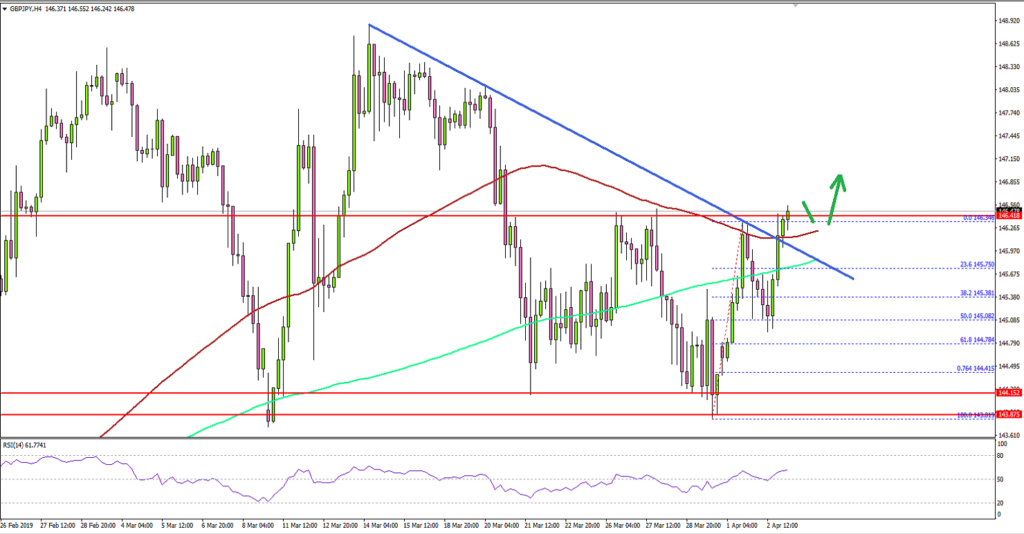
Looking at the 4-hours chart, the pair started a solid upward move from the 143.81 swing low. It climbed above the 144.00 and 145.00 resistance levels. Buyers even pushed the price above the 146.00 level and the 200 simple moving average (4-hours, green).
More importantly, buyers pushed the pair above the key 146.20-146.40 resistance zone. Besides, the pair cleared the 100 simple moving average (4-hours, red), and a crucial bearish trend line with resistance at 145.80 on the same chart.
Intermediately, there was a short term downside correction, but the pair found support near the 50% Fib retracement level of the last wave from the 143.81 low to 146.34 high.
It seems like the pair is now trading above a strong resistance near the same trend line, 146.00, and the 100 simple moving average (4-hours, red). A successful close above 146.50, plus a follow through above 146.60 could only open the doors for further gains.
Conversely, a continuous failure near 146.60 or 146.80 might call for a fresh decline towards the 145.50 support area in the coming sessions.
Fundamentally, the UK Construction PMI for March 2019 was released by both the Chartered Institute of Purchasing & Supply and the Markit Economics. The market was looking for a rise from the last reading of 49.5 to 49.8.
The actual result was lower than the forecast, as the UK Construction PMI increased to 49.7 and posted contraction, signaling sight reduction in overall construction output.
The report added:
Another fall in commercial work and civil engineering activity more than offset a modest upturn in residential building. New business and employment numbers increased only slightly at the end of the first quarter, reflecting subdued underlying demand and delays to decision-making among clients.
Overall, the British Pound could struggle in the short term and it seems like both GBP/USD and GBP/JPY might slide before a fresh increase.
Economic Releases to Watch Today
- Germany’s Services PMI for March 2019 – Forecast 54.9, versus 54.9 previous.
- Euro Zone Services PMI for March 2019 – Forecast 52.7, versus 52.7 previous.
- UK Services PMI for March 2019 – Forecast 50.9, versus 51.3 previous.
- US Services PMI for March 2019 – Forecast 54.8, versus 54.8 previous.
- US ADP Employment Change March 2019 – Forecast 170K, versus 183K previous.
- US ISM Non-Manufacturing Index for March 2019 – Forecast 58.0, versus 59.7 previous
Eco Data 4/3/19
[php_everywhere instance="1"]
UK Services PMI Due, as Pound Eyes Long Brexit Extension
The main release in the UK this week will be the services PMI for March, due out on Wednesday at 09:30 GMT. However, politics will probably eclipse economics in driving the British currency. On that front, Parliament could hold another round of votes on Wednesday, and PM May is reportedly preparing to put her deal for a fourth vote on Thursday. In the bigger picture, a long Brexit extension is looking increasingly likely, an outcome which could bring some relief to the pound next week.
There is no shortage of volatility in the British pound, which continues to be driven almost exclusively by political developments, paying little attention to economic news. This is natural considering that most of the economic issues the UK now faces, such as declining business investment, are owed mainly to the uncertainty emanating from the political arena and thus are unlikely to be resolved until that uncertainty subsides.
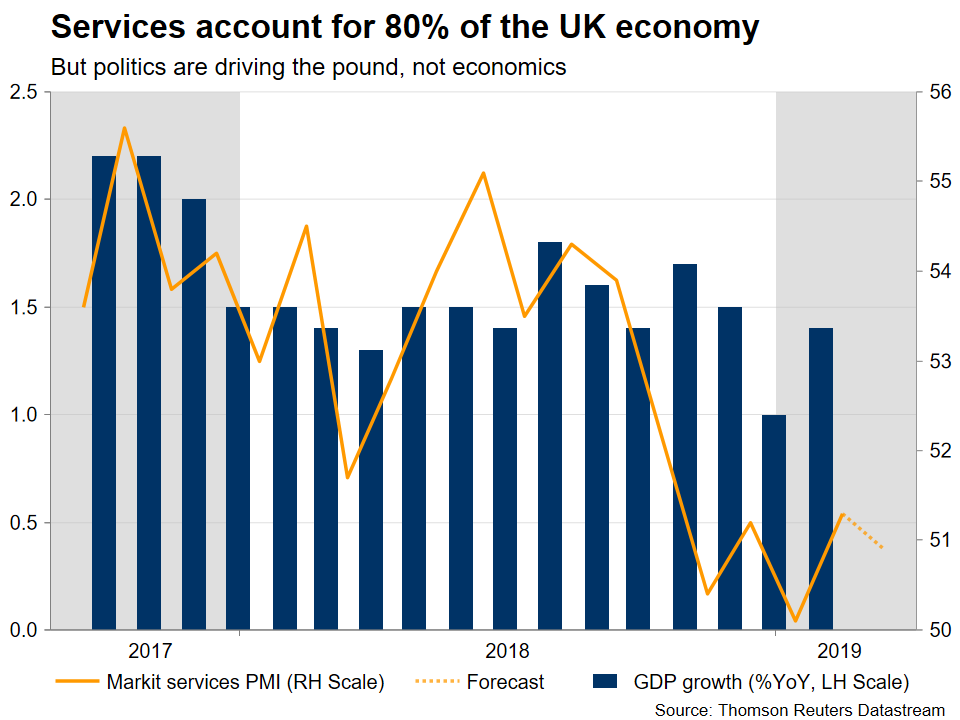
As such, investors will pay some attention to the services PMI for March, since services account for 80% of UK GDP, but the bulk of their focus will remain on Brexit. The services index is forecast to have declined slightly to 50.9, from 51.3 in February, but is still expected to remain above the crucial 50 line that separates expansion from contraction. Such a print is unlikely to prove a game-changer for the pound, as it would merely confirm that the UK’s biggest sector continues to struggle.
What could prove pivotal though, is how the Brexit saga unfolds. Another round of indicative votes in Parliament may take place on Wednesday in an attempt to find a way forward, while Prime Minister May could put her three-times defeated deal back to lawmakers on Thursday. So far, Parliament has been unable to find any majority. The most closely contested vote (276-273) was on establishing ‘a permanent customs union’ with the EU, which would solve the Irish border issue, but leave the UK unable to strike its own trade deals with other countries.
As for May’s deal, even though it was voted down multiple times, it’s worth noting that the margin of rejection was slimmer with each subsequent vote. In fact, May lost the latest vote by 344-286, which means that if she manages to flip just 29 lawmakers she can finally get her agreement approved. That is no easy task, especially since the deal hasn’t changed since the last time, but it is definitely possible.
Either of these two outcomes, namely MPs eventually voting for a customs union or May’s deal, would likely prove positive for sterling. Another round of rejections could weigh on the currency, albeit not massively, as that is probably the market’s base-case scenario already.
In the big picture, a long extension to Brexit – of at least 9 months – is looking more and more likely. Yes, leaving on April 12 without a deal is still the default unless something changes, but that will almost certainly be avoided when push comes to shove. Parliament has repeatedly shown it has no appetite for leaving with no deal, and reports suggest that several Cabinet ministers would also resign if May attempted to take that painful route. Therefore, the PM’s only realistic options if her deal is defeated again are either calling a General Election or asking for a long extension at the special EU summit on April 10. A prolonged extension would likely benefit sterling as it could fuel hopes for another referendum along the way or a softer version of Brexit ultimately being negotiated.
Blending it all together, the scales currently seem tilted towards a favorable Brexit outcome: lawmakers either approving May’s deal or the UK asking for a long extension. While that suggests that the eventual destination for the pound is probably higher, some further weakness in the immediate term cannot be ruled out as we approach April 10, if Parliament rejects all options in front of it again this week.
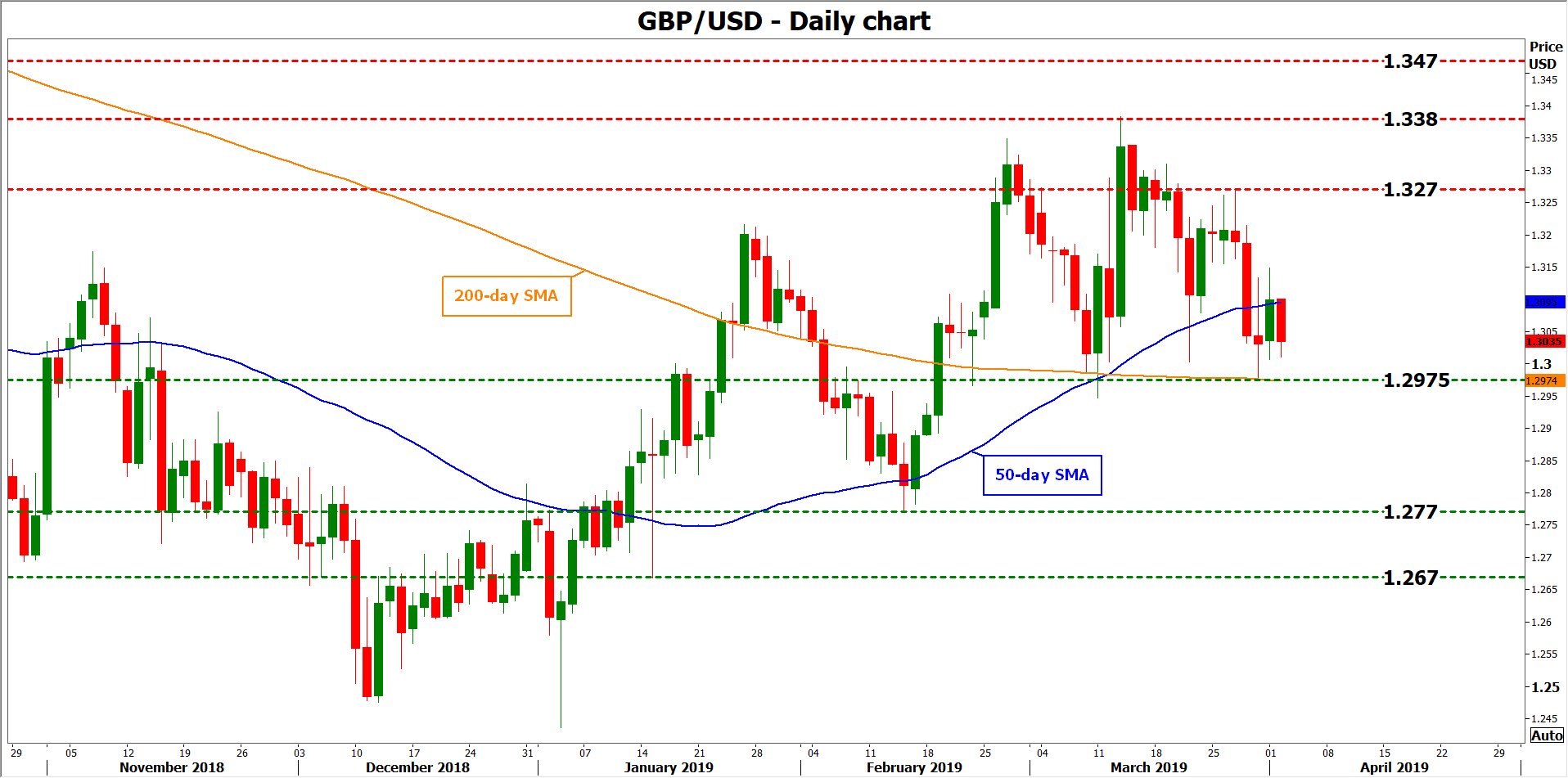
Taking a technical look at sterling/dollar, immediate support to declines may be found near 1.2975, the March 29 low, before the February trough of 1.2770 comes into view.
On the flipside, advances could stall around 1.3270, with an upside break opening the way for a test of the 1.3380 area.
Safe-Haven Currencies Rally as Risk Appetite Takes a Break
Rand
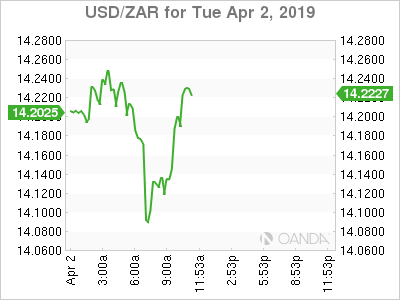
Moody’s gave the rand a bone over the weekend and today’s opinion piece shows they will give the South African government time to stabilize the economy. On Friday, Moody’s decided to defer the schedule review of South Africa’s investment grade credit rating. Expectations were mixed that Moody’s would join S&P and Fitch in cutting their rating to junk status. The deferment combined with the China infused emerging market rally helped the rand rally over the last couple sessions. Today, Moody’s gave a credit opinion that signaled South Africa’s credit rating is in-line with that of Baa3 status, the last level before junk status.
The rand has rallied against the dollar from 14.7418 to 14.0671 and is tentatively finding support from the 14.00 handle.
Brexit
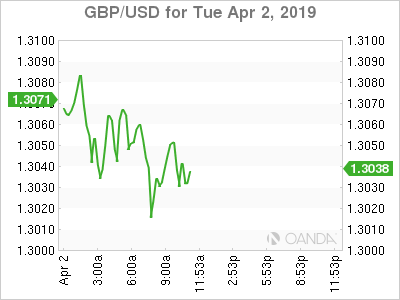
Yesterday, a second attempt of alternative Brexit options failed to yield any results, so its back to the drawing board for Parliament and PM May. Today, she will meet with her cabinet to try to come up with a new solution ending the current impasse. Parliament now has 10 days to find a consensus and avoid a no-deal exit. The British pound remains vulnerable as no-deal risks slowly grow. It is hard to say a base case exist, but many feel a longer extension is likely as Parliament appears they will need to start figuring out a new withdrawal agreement from scratch.
Oil
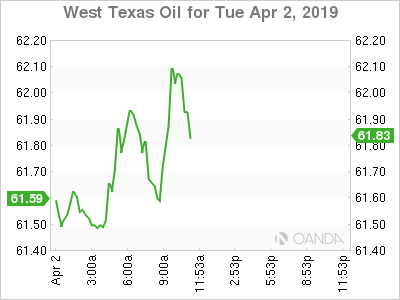
West Texas Intermediate crude continues to ride momentum from China optimism and as OPEC production falls for a fourth consecutive month. Oil is having its best rally in a decade and with WTI both clearing $60 a barrel level and the 200-day SMA, momentum traders are looking for another leg higher.
Gold
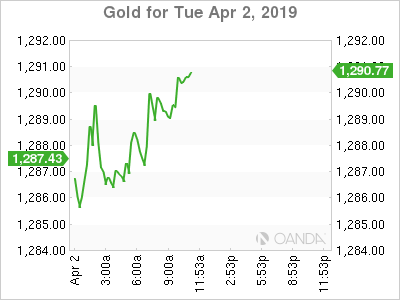
Gold prices are little changed on the day, as risk assets take a break following yesterday’s surge higher. The precious metal remains vulnerable to improving economic data in the US and China. Today’s key data release showed US orders for business equipment declined in February, not as bad as economists’ forecasts, but still the third fall in four months. The trade war is having an impact on corporate investment and this will remain in place until we see a trade deal.
Bitcoin
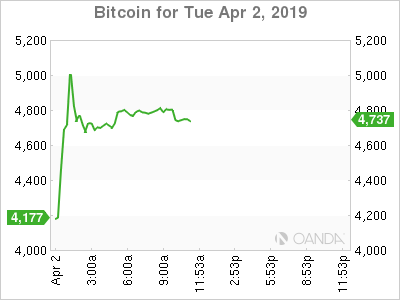
Out of the blue, Bitcoin is back. The cryptocurrency spiked over 20% higher overnight and at one point traded above the $5,000 level. The recent backdrop for the steady climb higher was the fall in volatility with Bitcoin prices, but today’s major move has no specific catalyst. Expectations remain mixed on whether we will see a Bitcoin ETF and many digital currency enthusiasts have lost interests, so if we continue to see wild swings, this could be long-term bearish for the cryptocurrency world.