

Sample Category Title
White House: Progress made in candid and construction trade discussions with China
In a very short statement, White House noted delegations of the US and China "continued to make progress" on trade negotiations in Beijing this week. And there were "candid and constructive discussions on the negotiations and important next steps". US "looks forward to the meetings planned with Vice Premier Liu He and the Chinese delegation in Washington next week."
There are no details again on what those progress is and what those important next steps are.
EU: No-deal Brexit is now a likely scenario on April 12
After UK Prime Minister Theresa May's Brexit Withdrawal Agreement was rejected by the House once again, European Commission issued a swift statement noting that no-deal Brexit is now a likely scenario on April 12.
It noted: No-deal” scenario on 12 April is now a likely scenario. The EU has been preparing for this since 12/2017. Now fully prepared. We will remain united. Benefits of WA, including transition period, will not be replicated in “no-deal” scenario. Sectoral mini-deals are not an option.
https://twitter.com/EU_Commission/status/1111648694703742976
China Weekly Letter: a A US-China Trade Deal is Moving Closer
- Report of 'unprecedented proposal' from China as new talks kick off in Beijing.
- Profit growth falls sharply on weak economy, more monetary stimulus is coming.
- EU's Jean-Claude Juncker says calling China 'rival' is a compliment at meeting with Xi Jinping.
Signs of progress, but deal more important than timing
An insight Reuters story reported that China has made unprecedented proposals on technological transfer, citing unnamed US officials: ''f you looked at the texts a month ago compared to today, we have moved forward in all areas...they're talking about technology transfer in a way that they've never wanted to talk about before'. A new round of high-level talks started in Beijing on Thursday. On the timing of a deal, Donald Trump's economic adviser Larry Kudlow said yesterday that 'This is not time-dependent...If it takes a few more weeks, or if it takes months, so be it. We have to get a great deal'.
US chief negotiator Robert Lighthizer gave some interesting insights in an interview with NPR . On stopping forced technology transfer, he said ' They're committed to do this, but it's going to be a question of whether they can get all the layers of government, I think, to follow through'. On whether China would be willing to make structural changes, Lighthizer said, 'I think you have to start with the proposition that there are people in China who believe that reform is a good idea. And you have to believe that those people are at a very senior level'. Lighthizer also stressed that what the US is asking for is not anti-Chinese and added ' In fact, the reformers would say it's pro-Chinese. It will help their economy, not hurt their economy' .
This seems to be in line with Premier Li Keqiang's speech at the Boao Forum ('Asia's Davos'). Li emphasised that ' No forced technology transfer shall be imposed on foreign investment. We will be true to our words' . Li also stressed intentions to open up further for investments in Chinese services, such as telecommunications, medicare, education, transport and infrastructure. For more on his speech, see SCMP 28 March.
Comment : The Reuters story indicates we are moving closer to a deal but that a deal is made is more important than its exact timing. The key hurdles regard enforcement and whether or not US tariffs are removed immediately. We expect to see a compromise, with tariffs being removed on some goods but not all. We see a 50% probability that the high-level talks in the next two weeks pave the way for a 'signing meeting' between Xi and Trump in late April. We see a low probability of a no-deal outcome, as Trump wants a deal ahead of the coming election campaign.
Lighthizer's comments underline that there is a genuine wish to reform at the top level in China , because it is the only way to deliver on the 'Chinese Dream' and become a prosperous society by 2049. The obstacle for reform is mostly at the local government level, where vested interests block reform. The Chinese LSE professor Keyu Jin has called the trade war a 'strategic gift' to China, because it creates the outside pressure that the leaders need for reforms to be pushed through (see a short interview with SCMP here ) . This was also the case when China reformed to become a member of WTO.
Big fall in profit growth, room for more stimulus
Chinese profit growth fell by 14% y/y in January and February. This is a very weak reading and much more so than suggested by most other data.
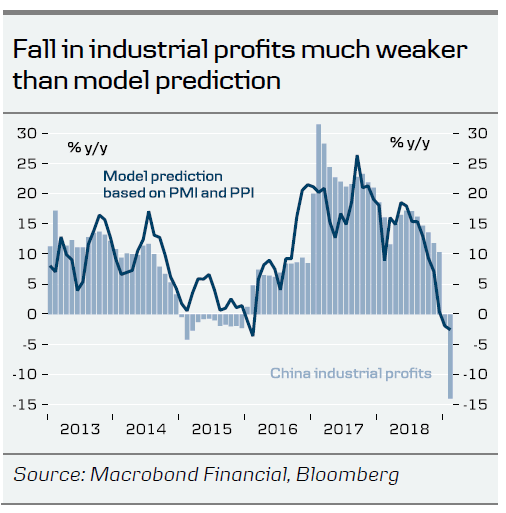
Comment: While we expected negative profit growth in Q1, the fall was far bigger than we looked for. Our model for profits based on producer prices and PMI manufacturing points to profit growth more in the area of -5%. We believe we will see a rebound in the March data: profits tend to correlate with commodity prices and we have seen higher prices for both metals and oil this year, which should underpin profits in coming months. We also expect further monetary easing to add to the stimulus and thus support activity.
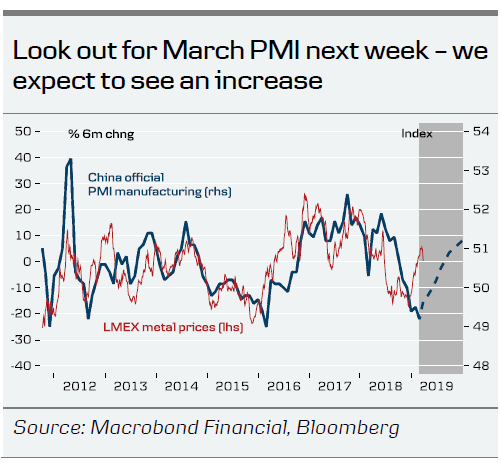
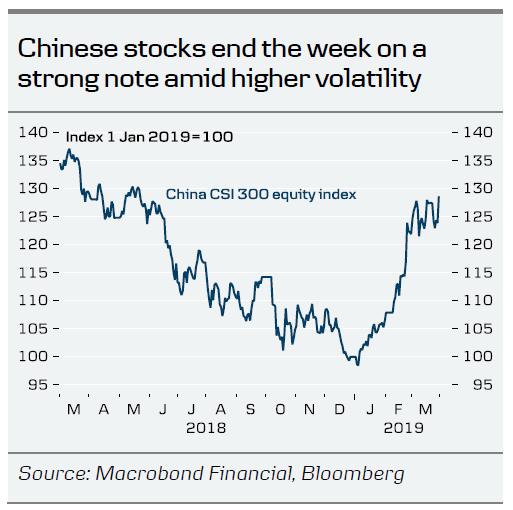
Li Keqiang mentioned in his Boao speech that daily electricity consumption has been growing at a double-digit pace in March. The data has not been released but if this is true, it would underpin the picture of higher activity. Look out for PMI data next week for confirmation of this. Stock markets closed the week on a strong note and reached a new cycle high. We look for higher equities on a six-month horizon driven by a trade deal and recovery.
Juncker says designating China a 'rival' is a compliment
The EU toned down its critical voice on China significantly at a joint summit with Chinese President Xi and French President Emmanuel Macron, German chancellor Angela Merkel and EU President Juncker. On referring to China as a 'systemic rival' in a recent EU Commission strategy paper, Juncker said that the description was a 'compliment' describing shared ambitions.
The four leaders found common ground on working for a multilateral world order and trade system and in a surprisingly positive tone, Merkel said that 'we, as Europeans, want to play an active part' in the Belt and Road Initiative and added 'we are seeing the project as a good visualisation of interaction, interrelation and interdependence'. In a rebuke to Washington, Macron said that 'I don't believe in the efficiency of confrontational postures, but in a demanding spirit of co-operation'. However, the EU leaders also stressed the need for reciprocity and Merkel said the EU is still wrangling over that a bit. EU leaders also made clear that the EU is opposed to any attempt to divide Europe and that it should be consulted on major matters regarding individual countries. Xi described the new world order as one where 'we are marching forward side by side and we should not become suspicious. We should not always be looking behind our backs'.
During Xi's trip, Italy became the first G7 country to sign up to the Belt and Road Initiative (see SCMP, 23 March). In France, Xi's visit also came with a new Airbus order of 300 new planes on top of a range of other business deals with France.
Comment: Xi could hardly have hoped for a better outcome of the trip to Europe. While Xi is facing a very confrontational stance in the US, he is dealing with a Europe that is more critical but also still favouring a path of engagement. One of China's main state media People's Dailywrote 'Xi's fruitful visits boost partnership with Europe'.
Other selected China news of the week
FT had an interesting article on 'Asia's century' (see Financial Times, 26 March).
China's private education industry is booming (see SCMP, 25 March).
Chinese tech firms promote young staff (see Reuters, 25 March).
Forward Guidance: Friday Jobs Reports to Highlight the Week
Friday jobs reports to highlight the week – Canada’s headline employment growth due for a payback but better weather could boost hours worked
Canadian and US jobs reports on Friday will highlight the week’s economic indicators. We are assuming the impressive (almost unbelievable) run of job gains over the last six months in Canada – totalling a whopping 290k – came to an end in March. As usual, headline employment growth will likely get more attention than it deserves given wide confidence bands around changes in the official job count. We have pencilled in a 10k decline for February. We expect the more-stable unemployment rate to hold close to multi-decade lows at 5.8%. Given what still look like relatively tight labour markets, there is room for wage growth to tick up a bit from the 2.3% year-over-year increase in February, particularly given stronger growth closer to 3% in the typically more reliable ‘SEPH’ employment data. Sentiment has taken a hit recently but it would still take more than one bad monthly jobs report to offset recent employment gains. And the 0.3% increase in January GDP may have gone some way to easing concerns that the broader economic backdrop is deteriorating more quickly than previously expected – aside from what is still likely to be a transitory cut in oil production.
That is not to say all is sunshine and rainbows. Indeed, quite the opposite. Bad weather appeared to be behind much of a 0.7% drop in hours worked in February. The number of hours lost to workers staying at home due to weather hit an all-time high for the month. That should unwind to boost hours worked in March but poor weather may yet play havoc with key February retail, manufacturing and wholesale trade reports yet to come. That only reinforces the view that economic growth is likely to be soft in the first quarter in Canada – we continue to track around a 1% Q1 GDP increase. And, to be clear, there is still little chance that the Canadian economy will return to sustained above-trend growth given already low unemployment levels and high household debt. But much of the softness over the winter can still be traced back to transitory factors, and we continue to expect a bounce-back in Q2 GDP growth to a 2% rate as the impact of the Alberta oil cuts and bad weather ease.
Bank of Canada Governor Poloz will have an opportunity to provide his take on recent economic data with a speech on international trade on Monday. The Governor may take some comfort from a somewhat improved recent flow of Canadian economic data but his comments should still reinforce the central bank is firmly in data-watching – as opposed to rate-hiking – mode.
A busy US economic calendar should also be generally supportive of a pickup in activity – notwithstanding what will still likely be a soft-looking Q1 overall. We look for employment growth to bounce back 225k after stalling with just a 20k increase in February. The U.S. employment numbers are also volatile and that 20k gain in February followed on outsized 311k surge in January. Retail sales are expected to tick a touch higher and business orders of capital goods are expected to continue to improve. The tug-of-war between economic data still saying the economic backdrop is reasonably solid versus activity in bond markets flashing recession warning signs will likely continue unabated.
Week Ahead – RBA to Mull Dovish Shift; Resilient Dollar Eyes US Jobs Report
Bond markets will remain on edge in the coming week as the Reserve Bank of Australia could become the next central bank to switch to a dovish stance and possibly amplify the flight to safety, which has sent sovereign bond yields plummeting. Another catalyst for market volatility could come from the US jobs report, which has the capacity to either reverse or extend the rally in bond prices. There will be no shortage of US data with plenty of other key releases on the agenda, while Brexit headlines won’t be going away anytime soon as more votes are planned in the British Parliament.
Pressure grows on RBA to talk rate cuts
After the Reserve Bank of New Zealand this week signalled a rate cut could be on the cards, its Australian counterpart will be under pressure to indicate a similar shift at its policy meeting on Tuesday. However, having dropped its tightening bias only in February, it may be too soon for the RBA to take another big leap, especially as it’s clinging on to hopes that a strong labour market will steer the economy out of the soft patch.
If the RBA does not adjust its policy stance, the Australian dollar is vulnerable to upside moves following this week’s losses when it fell in sympathy with the kiwi. But the aussie could suffer even sharper declines if the central bank does not turn more dovish.
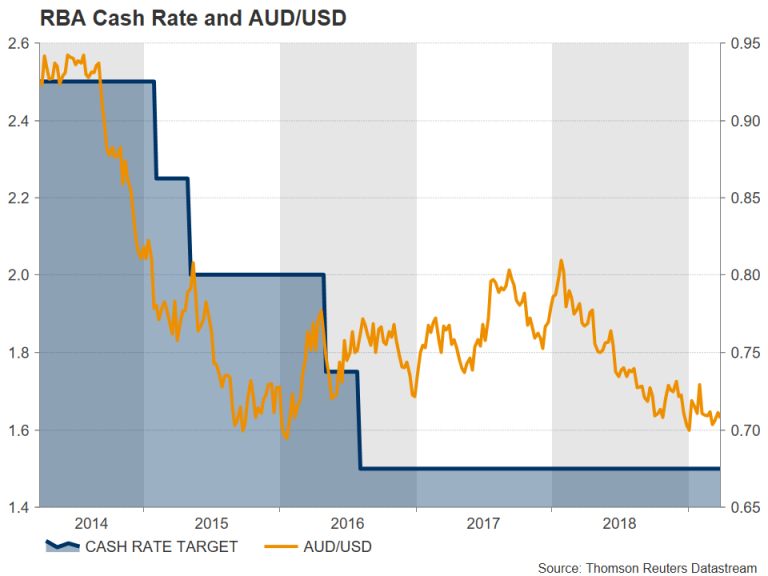
But ahead of the RBA meeting, Chinese manufacturing PMIs could set the tone for the aussie. China’s official manufacturing PMI is due on Sunday with the Caixin/Markit manufacturing PMI following on Monday. Both indices are forecast to stay in contractionary territory below 50 for another month but, at the same time, expected to either edge up or hold steady, suggesting the slowdown could be bottoming out.
Domestic data releases will also be on the radar for aussie traders, which will include the AIG manufacturing and the NAB business conditions gauges for March on Monday, February building approvals on Tuesday and trade numbers on Wednesday.
BoJ Tankan survey to spread more gloom
Another central bank that’s been reluctantly forced to reconsider its policy path is the Bank of Japan. After making several tweaks to their experimental policy of “Quantitative and Qualitative Monetary Easing with Yield Curve Control”, which set the ground for an eventual winding down of the programme, BoJ board members are once again debating whether to easy policy further given the worsening economic environment globally and in Japan.
The BoJ’s own survey – the Tankan – should provide policymakers and investors some clues as to how businesses performed in the first quarter and their outlook for the upcoming quarter. The report out on Monday is forecast to show confidence falling across all sectors of the economy in Q1. But for the second quarter, although manufacturers are expected to become more pessimistic, non-manufacturers will likely signal sentiment holding steady. A bigger worry, though, could be their capital spending plans. Both big and small firms are forecast to report a drop in capital expenditure in Q2, which would point to slower GDP growth.
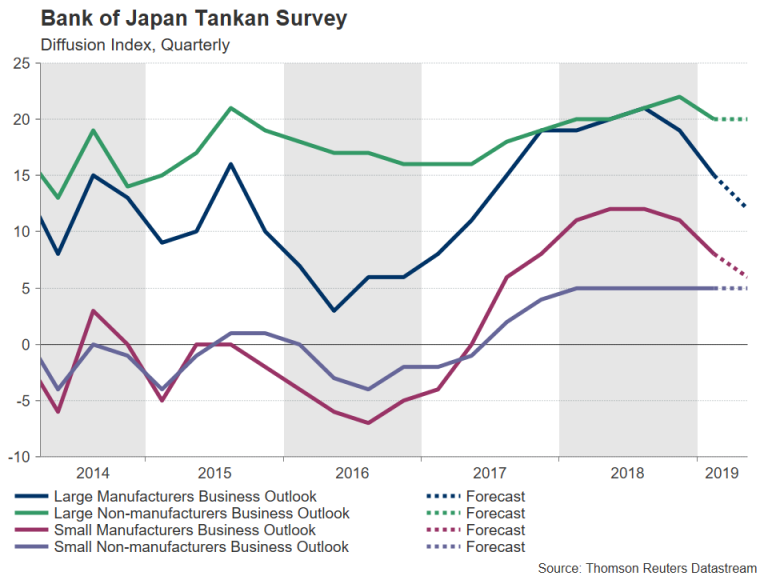
The yen could see some downside pressure if the Tankan survey disappoints. Other data to be watched out of Japan next week will be February household spending and wage growth numbers on Friday.
ECB minutes and flash CPI to underline euro weakness
The euro whipsawed last week, initially rallying from the dovish Fed meeting but later plunging on the back of poor Eurozone PMI figures. There was more euro selling this week after ECB chief, Mario Draghi, hinted at further delays to a rate hike, and the negative pressure will likely continue next week as the European Central Bank publishes its account of the March policy meeting on Thursday.
While no surprises are anticipated from the March minutes when the ECB pushed back its rate hike timeline and announced a fresh round of cheap loans for banks, it will probably highlight the downside risks for euro area growth and inflation. Eurozone data is not expected to do the single currency any favours either.
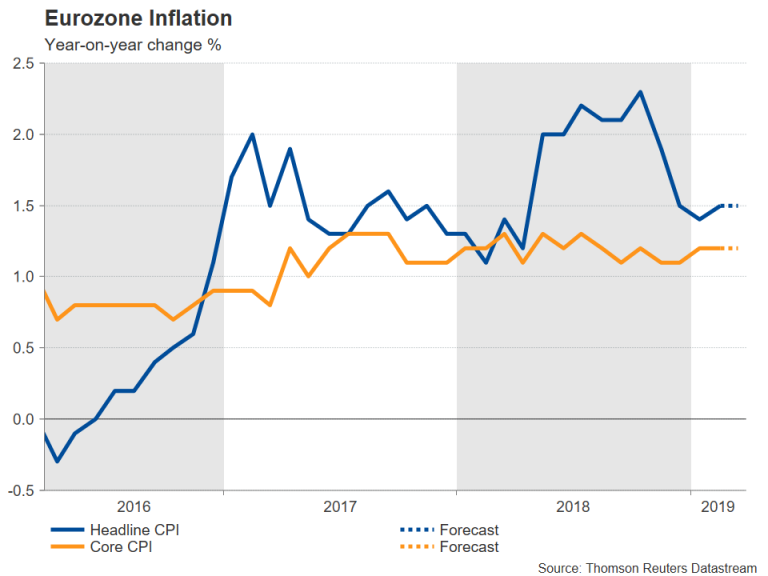
The flash inflation reading for March, due on Monday, is forecast to show both the headline and core CPI rates holding steady at 1.5% and 1.2% year-on-year, respectively. Investors will also be watching German industrial orders (Thursday) and industrial output (Friday), hoping to see some signs of an end to the manufacturing slump that’s inflicted the Eurozone’s largest economy.
More indicative votes on Brexit
The UK economic calendar will be relatively light next week, with the Markit/CIPS PMIs being the only notable releases. The PMIs for manufacturing, construction and services are out on Monday, Tuesday and Wednesday, respectively. However, sterling is unlikely to see much response to the usually closely-watched activity indicators as the Brexit drama doesn’t appear to be ending anytime soon.
After no parliamentary majority was found for any of the eight alternative Brexit options put to a vote this week, another round of voting is scheduled to take place on Monday. If the most popular options from the first round – a customs union and a second referendum – gain further traction next week, the pound could be set for a significant rally. In the meantime, there’s still a chance Prime Minister May could get her divorce deal through Parliament when she puts the Withdrawal Agreement to a new vote this Friday.
NFP report to highlight busy US calendar
It’s going to be a data-packed week in the US and retail sales will be kicking things off on Monday. After December’s unexpected 1.6% month-on-month slump, the modest recovery from January is anticipated to have continued in February, with analysts forecasting a 0.3% m/m gain. Also due on Monday, is the ISM manufacturing PMI, which is expected to dip slightly from 54.2 to 54.1 in March.
On Tuesday, durable goods orders could paint a somewhat less optimistic picture too as they are expected to have declined by 1.3% m/m in February. A bigger focus though before the jobs report will be the ISM non-manufacturing PMI on Thursday. Activity in the non-manufacturing sector, which comprises the biggest chunk of US economic output, likely slowed in March, with the PMI forecast to fall from 59.7 to 58.2.
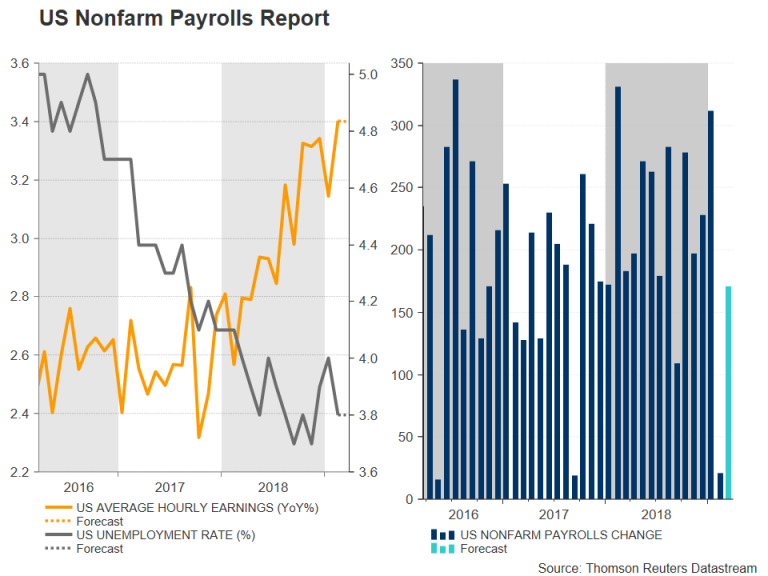
Moving to Friday, all eyes will be on the March nonfarm payrolls report as concerns mount about the strength of the US economy. Just 20,000 jobs were added in February – a surprisingly low figure that was partially from the impact of bad weather. Jobs growth is expected to have picked up in March, however, with the economy projected to have added 170k positions. The unemployment rate is forecast to have remained at 3.8%, and wage growth is also expected to have held steady at 3.4% y/y in March.
Any big misses in the data next week would likely fuel recession fears and send US Treasury yields spiralling downwards, putting pressure on the US dollar. The greenback could also struggle if the trade talks between the US and China, which will enter another round in Washington following on from this week’s meetings in Beijing, point to a nearing of the end of the negotiations. The dollar stands to lose from a positive outcome in the talks due to its safe-haven appeal during the trade dispute.
Finally, Canada will also publish employment numbers on Friday. The Canadian economy added an impressive 55.9k jobs in February. Another solid report for March could help the Canadian dollar ease from 3-week lows plumbed this week, though the loonie would probably struggle to make any substantial gains given the Bank of Canada’s dovish tilt.
Australia & New Zealand Weekly: Will the Federal Budget Impact Monetary Policy?
Week beginning 1 April 2019
- Will the Federal Budget impact Monetary Policy?
- RBA policy decision.
- Australia: Federal budget, retail sales, dwelling prices and approvals, trade balance.
- NZ: Survey of Business Opinion.
- China: Caixin PMI's.
- Europe: ECB minutes, unemployment rate, retail sales.
- US: non–farm payrolls, retail sales, ISM's.
- Key economic & financial forecasts.
Information contained in this report current as at 29 March 2019.
Will the Federal Budget Impact Monetary Policy?
The Reserve Bank Board meets next week on April 2. Unusually, this meeting will be on the same day as the announcement of the Federal Budget at 7:30 pm on that evening. As such, we would expect that the Governor's Statement will be fairly low key with little change from the sentiment we saw in the March meeting. As discussed, Westpac is anticipating that following the May meeting, the RBA will move to a clear easing bias, which will be justified by downward revisions in the growth forecasts. However, it is unlikely that there will be any hints of this action in the April Governor's Statement. In the note below, we speculate on the implications of the Federal Budget for monetary policy.
In previous years the Reserve Bank has generally observed that fiscal policy has had only a very limited bearing on monetary policy decisions. It is reasonable to contemplate whether 2019 will be different.
Firstly, if we take the expected approach from the Budget (an expansionary budget with a focus on supporting households) then the Reserve Bank will be much more interested than in previous years.
We have estimated (see Federal Budget preview) that the government will have around $3bn to allocate before June 30; and $5bn in 2019/20. In addition there will be the $2.5bn in 2019/20 which was earmarked in MYEFO as "allocated but not announced".
Taken together, $10.5bn represents 0.8% of households' annual disposable income or around 1.0% of annual consumer spending. By way of context, 'trend' consumer spending is around 2.8% a year, or 0.7% per quarter, while in 2018 it grew by only 2.0%. In this analysis, we assume that of any boost to household income half is saved and half is spent.
We can speculate as to how the new policy measures may be delivered. If they all take the form of direct payments impacting in a single quarter, then this represents a sizeable injection. If for instance, the $3bn was paid in direct one–off payments to households in late 2018/19 (say end June) and the additional $7.5bn was also paid as direct payments in early 2019/20 (say July) there would be an immediate cumulative injection of $10.5bn, representing 3.5% of quarterly disposable income or 4% of quarterly consumer spending. On the basis that, say, half the payments were saved then total consumer spending could be expected to lift by around 2.7% in the quarter, well in excess of the "trend" of around 0.7%.
If instead the new policy measures are delivered as a more staggered mix of payments and tax cuts then the impact may be less dramatic. For instance, if the $3bn was paid as a lump sum (1.14% of quarterly consumption) in, say, June 2019 then consumer spending could lift by an additional 0.57% in the June quarter on the basis of saving half the payment.
If the additional $7.5bn was allocated to a tax cut which was spread over the year then disposable income growth would be boosted by 0.6% over the year and consumer spending (spend half the tax cut) would be boosted by 0.35%.
In addition to the $10.5bn we have identified above, we have to consider the $4.1bn which is estimated to be received by households in extra tax rebates (as set out in the 2018 Budget). However, the economic impact is unclear as this 2018 Budget initiative was fully funded by measures cracking down on the "black economy". It may be that timing issues mean that, taken together, these new policies might give a one–off boost to spending.
However there are numerous complications to these calculations – suggesting that the ultimate impact on consumers and on the economy of the 2019 Federal Budget will be less than these estimates indicate.
Firstly it is highly unlikely that the government would budget for a $10.5bn "handout". That is likely to be viewed as a lopsided approach. A mix of $3.0bn in "handouts" and $7.5bn in tax cuts, effective from July 1 2019, seems to be a more balanced approach.
A complication is around the effective timing of any new measures. It is uncertain as to whether new budget initiatives can be legislated before the election with both houses of Parliament only sitting for one day after the Budget announcement.
This full allocation of the $10.5bn to personal income tax cuts and cash payments looks extreme given the government's need to consider other interest groups apart from households, including regional Australia and infrastructure and accelerated depreciation allowances to boost investment by small business.
From the perspective of GDP and employment this response in spending is also likely to have a substantial leakage through imports.
Then of course we have the election which is mooted in the press for May 11, or at the latest May 18.
The Opposition currently leads opinion polls convincingly.
If the Opposition chooses to support the Government's tax cuts and handouts it may be possible to legislate before June 30. Delaying the handout to post June 30 would put the 2019/20 surplus in doubt (see our calculations in Federal Budget preview).
Alternatively, the Opposition may choose to only offer tax cuts which are funded by other taxes neutralising the net impact on incomes. Certainly their policies, if successfully implemented, could allow a revenue neutral tax cut, boosting their fiscal credentials or allowing more scope for other initiatives including health and education.
Our current timing for the RBA to move to an easing bias in May (before the election and before the impact of fiscal policy will be known) and a rate cut in August still seems to be the most likely scenario.
Any "bidding war" between the parties, particularly around one–off payments, is likely to be seen by the RBA as a temporary "sugar hit" that will not generate sustained higher income growth.
Tax cuts may allow the RBA to be a little more confident about the income/consumption outlook but that will be after it adjusts its current views to a much more realistic and lower growth trajectory as has become apparent through 2018 H2 and 2019.
With so much uncertainty about the impact of fiscal policy and the negative forces around housing; rising savings rates; low inflation and softening global growth building over the next months the RBA is still likely to move in August particularly now that the move is fully priced in to markets.
The week that was
Early in the week, Assistant Governor (Economic) Luci Ellis highlighted that the RBA believe household income will continue to dictate the pace of consumption growth. The acceleration in wages growth from its low is fledgling, but a positive sign for the Bank nonetheless – particularly given their expectation of robust employment gains hence.
Other factors however linger as headwinds for non–labour (non–wage) income: "[s]ocial assistance payments have been relatively flat for a number of years"; rental income growth has softened; and unincorporated business income has been weak, in part due to the drought but also because real estate activity is deteriorating. A rising tax take is also a factor, restricting gains for disposable income and thus spending. The take home from the above is that the RBA remain optimistic that disposable income growth will strengthen, but acknowledge progress will remain slow.
Whereas the RBA see a wealth effect from housing as only having a narrow impact on vehicle sales and home furnishing demand, Westpac continues to believe that the effect will be broader, holding consumption growth well below trend through 2019 and 2020. To our mind, as laid out in our previews, even an expansionary Federal Budget 2019 is unlikely to change the narrative for growth or the need for the RBA to lower the cash rate.
Over in New Zealand this week, the RBNZ followed the lead of other major global central banks and took a more dovish stance. The RBNZ now see "the more likely direction of the next OCR move [as] down" and the balance of risks as having "shifted to the downside". This change is despite core economic data having remained robust, and the currency holding in line with their expectations. As laid out by our New Zealand team, the RBNZ may be concerned about the potential for a higher currency to suppress inflation, and/or that the domestic economy may not pick up enough to boost inflation.
Turning to the northern hemisphere, FOMC speakers have, in effect, repeated Chair Powell message from last week, highlighting risks and the prudence of patience in uncertain times despite a broad consensus that US GDP growth will remain above trend in 2019.
In Europe, the particularly weak manufacturing PMI outcomes of last Friday were not followed by sharp falls in other business surveys (the IFO up slightly; while EC business climate was down a touch) but remain a concern. While overall, that did not elicit a further dovish shift from President Draghi this week, he did discuss potentially acting to mitigate negative policy rates' impact on bank profitability "if necessary". Reports of internal discussions regarding the potential introduction of a tiered deposit rate on excess reserves supported the idea of a reduced burden for the sector, and more generally, the potential for negative rates to be maintained even longer. However, ECB Chief Economist Praet subsequently noted that this would only occur if a solid monetary–policy case developed, and there were mixed reactions among the other Governing Council members.
Finally in the UK, in the lead–up to Parliament taking control of the Brexit debate and tabling a series of 'indicative votes' on alternative proposals, PM May announced to MPs that she would resign if her withdrawal deal is passed. The indicative votes ended up being another political move with nil benefit, with all the proposals brought before Parliament voted down. Part of PM May's deal (the withdrawal treaty) is reportedly still set to be voted down for a third time this Friday despite PM May's offer to resign.
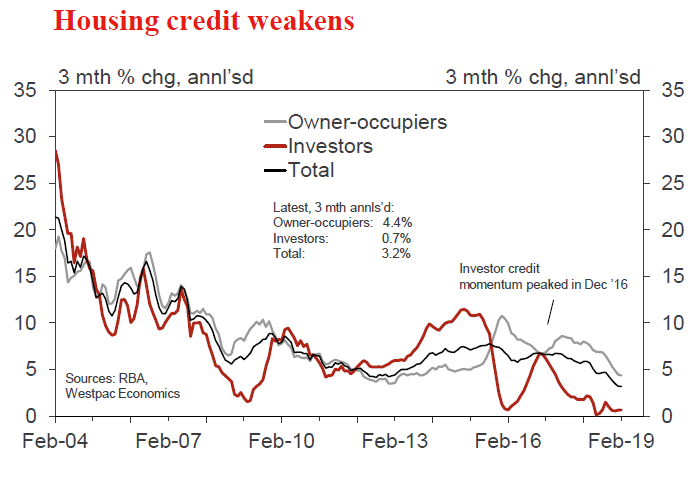
Chart of the week: Australian credit growth
Credit growth has moderated to a slow pace led by the housing downturn.
The softness in credit evident at the turn of the year has continued into 2019. Credit grew by 0.24% in December, rose by 0.22% in January and then increased by 0.26% in February.
Annual growth edged lower to 4.2% – the lowest nominal growth rate in the series history dating back to 1976.
New Zealand: week ahead & data wrap
A new era
It was a pivotal week for the Reserve Bank of New Zealand, which delivered a surprising shift in its monetary policy stance. Our current forecast is for the Official Cash rate to remain on hold over the next few years, but the risks of a rate cut at upcoming reviews, including the next Monetary Policy Statement in May, are very much live. From hereon those decisions will be made by a formal committee, with external and internal members.
This week's OCR review broke decisively from the RBNZ's previous statements, which had noted that the next move could be either up or down. The RBNZ now believes that the balance of risks to the economic outlook "has shifted to the downside," and that "the more likely direction of the next OCR move is down."
This change in stance surprised us as the economic situation hasn't changed a lot since the last OCR review in February. Recent GDP data showed that the domestic economy has kept ticking over, with solid growth in consumer spending and construction. Global growth has softened, but not significantly, and the consequences for the New Zealand economy have not been obvious – in fact, our export commodity prices have been strengthening recently.
What has changed a lot since February, however, is market sentiment on interest rates. In the midst of some mixed economic data, overseas central banks have either shifted to more dovish monetary policy outlooks, or are expected to do so. The RBNZ was apparently concerned that if it didn't join the flock, there could be an undesirable rise in the New Zealand dollar, which would suppress inflation and ultimately force the RBNZ to change its stance anyway.
The other surprising aspect of the RBNZ's statement was the emphasis placed on softer domestic spending and weak business sentiment. We have long thought that the RBNZ was too optimistic on economic growth, and hence too bullish on the extent of a pickup in domestically–generated inflation. While the December quarter GDP result wasn't significantly below the RBNZ's forecast (0.6% vs 0.8%), it may have been the last straw that triggered a change in sentiment. Recent personnel changes within the RBNZ might have also been a factor in the sudden change of view.
The thinking in financial markets has now turned to whether the RBNZ will actually cut the OCR, and if so, when. We're taking the RBNZ's statement at face value: the risks have shifted to the downside. The RBNZ is leaving open the option of cutting the OCR if required, rather than signalling that a cut is imminent.
That said, it does mean that every upcoming OCR review, including the next Monetary Policy Statement in May, is 'live'. Much will depend on the flow of data from both here and overseas in the coming weeks.
On the global front at least, we don't expect sentiment to turn around again in a hurry. We think that the market has become too downbeat on the US economy, which is running at close to full employment and is now seeing a notable pickup in wage pressures. But the US Federal Reserve itself has taken rate hikes off the table for now, and it will need to see an accumulation of evidence before it changes its mind again. Meanwhile, we do expect the Reserve Bank of Australia to move toward rate cuts this year, albeit under very different conditions to what the RBNZ is facing.
In terms of the domestic economy, the RBNZ has highlighted weak business sentiment and the risk that this flows through into domestic demand. This week we saw a further drop in the ANZ business confidence survey for March, reversing most of the modest recovery that occurred at the end of last year. Hiring and investment intentions, as well as profit expectations were all lower.
We'll also be taking a close look at next Tuesday's Quarterly Survey of Business Opinion. This tends to be the single best early indicator of quarterly GDP growth, and it also provides useful insights on the capacity constraints and cost pressures that businesses are facing. The Tax Working Group's recent recommendation to introduce a capital gains tax could weigh on sentiment this time. But beneath the headline, the QSBO will give a valuable read on whether the economy is picking up enough for the RBNZ to avoid cutting.
Actual domestic demand may be stronger these confidence surveys suggest. Electronic card spending has continued to grow at a solid pace, government spending is increasing as planned, and imports of capital equipment have picked up in the early part of this year. Dwelling consents have continued to rise to multi–decade highs, indicating a strong pipeline of building work over the next year or so. Our view remains that growth will pick up in 2019 after a softer patch in the second half of 2018.
The other major monetary policy announcement this week was the membership of the RBNZ's new decision–making committee, which comes into effect from next week. The committee consists of four internal members, including the Governor and senior management, and three external members. The external members that were announced this week are all experienced economists, with respective backgrounds in agriculture, macroeconomics and the labour movement.
These appointments should dampen any concerns that the external committee members will be cowed by the RBNZ internals due to a lack of experience. They will all be quite capable of critiquing the RBNZ's analysis and holding their own in a debate about economics. As for how they might shift the balance of the RBNZ's decisions, the answer is less clear. In particular, they may well have differing views on how to balance the RBNZ's new dual mandate, which focuses on supporting maximum sustainable employment as well as price stability.
Data Previews
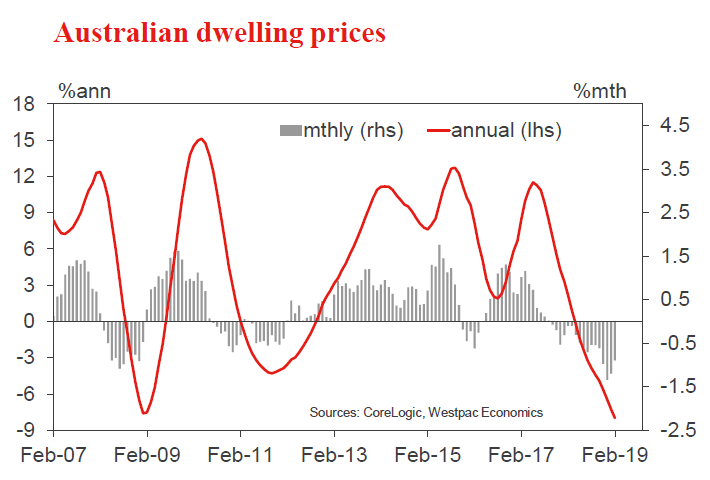
Aus Mar CoreLogic home value index
- Apr 1, Last: –0.9%, WBC f/c: –0.7%
The Australian housing market's very weak finish to 2018 has carried into early 2019, albeit with some tentative signs that the pace of price declines may be easing. The CoreLogic home value index recorded a 0.9% fall in February following average falls of 1.2% over the previous three months.
The daily index points to a 0.7% fall for the March month, which would be the mildest decline since October. The cumulative decline since late 2017 will be close to 10%.
Aus Feb dwelling approvals
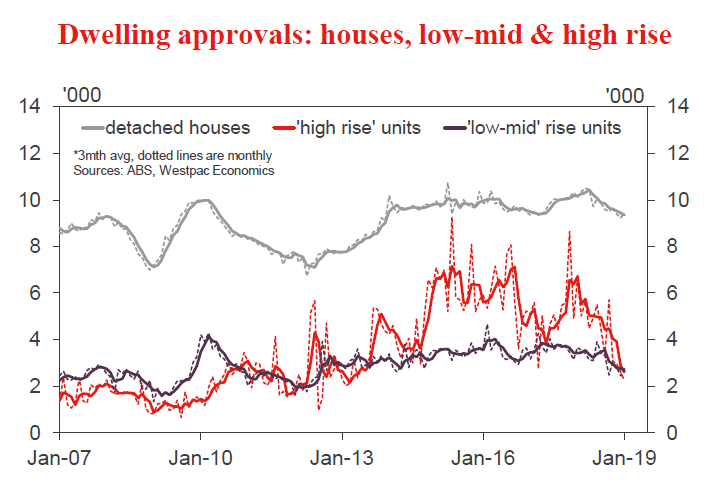
- Apr 2, Last: 2.5%, WBC f/c: –1.0%
- Mkt f/c: –1.8%, Range: –5.0% to 3.0%
Dwelling approvals posted a 2.5% lift in Jan, paring back some of the dramatic weakening seen in late 2018 – approvals slid over 25% through the last three months of 2018.
High rise approvals are now back to multi–year lows, Jan the weakest read since March 2013. Current levels are now around those that prevailed prior to the boom, hence some stabilisation looks likely from here. Meanwhile construction– related finance approvals are also suggesting the weakening in non–high rise approvals is starting to moderate, although this is more likely to show through in coming months. On balance, Feb is expected to see some residual weakness with a 1% decline in total approvals.
Aus RBA policy decision
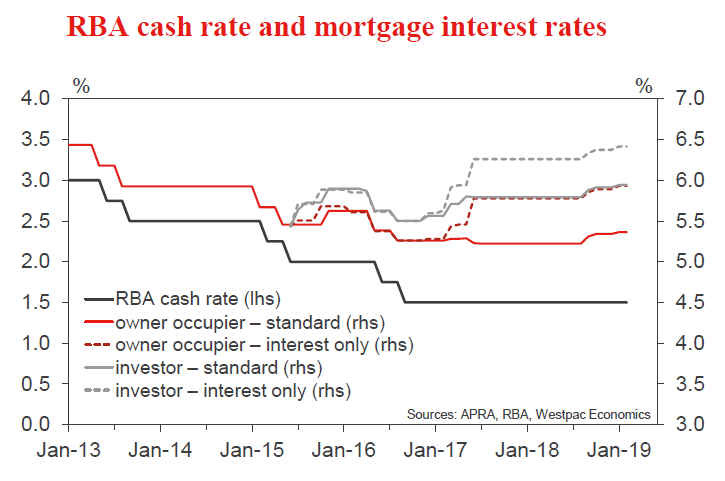
- Apr 2, Last: 1.50%, WBC f/c: 1.50%
- Mkt f/c: 1.50%, Range: 1.25% to 1.50%
The Reserve Bank Board meets next week on April 2. Unusually, this meeting will be on the same day as the announcement of the Federal Budget at 7:30 pm on that evening. As such, we would expect that the Governor's Statement will be fairly low key with little change from the sentiment we saw in the March meeting.
As discussed, Westpac is anticipating that following the May meeting, the RBA will move to a clear easing bias, which will be justified by downward revisions in the growth forecasts. However, it is unlikely that there will be any hints of this action in the April Governor's Statement. In the note on page 2, we speculate on the implications of the Federal Budget for monetary policy.
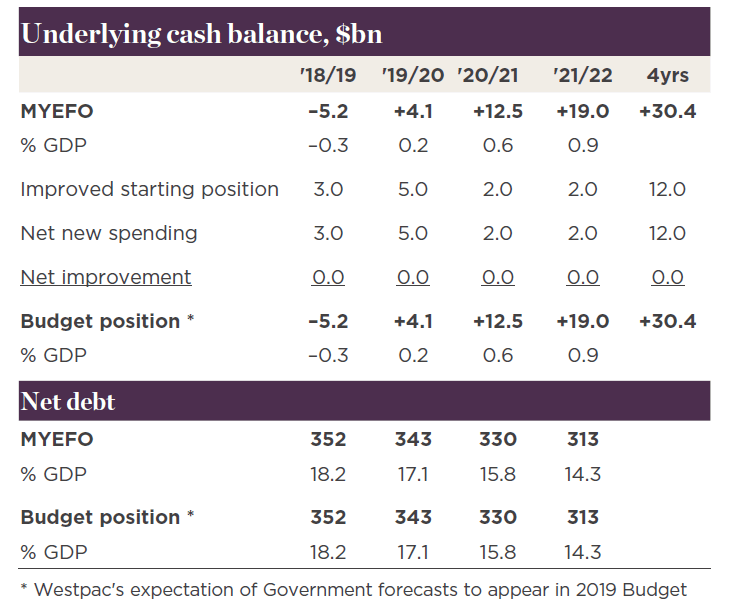
Aus 2019 Federal Budget, AUDbn
- Apr 2, Last: –5.2(e), WBC f/c: +4.1
Federal Budget 2019 will reveal an improved starting position for the budget relative to that in the December Mid–Year Economic & Fiscal Outlook (MYEFO).
Spending is running below forecasts in 2018/19, in part due to stronger than anticipated jobs growth to date.
For 2019/20, the size of the nominal economy is likely to be $10bn larger than anticipated in MYEFO because of upside surprises on commodity prices. This boosts revenue, by around $3bn, plus spending is likely to be running around $2bn below forecast – a combined improvement of $5bn.
The upside surprise to the budget is likely, in our view, to be returned to the people in tax cuts and increased spending. Hence the profile for the budget balance is as in MYEFO.
Aus Feb retail trade
- Apr 3, Last: 0.1%, WBC f/c: –0.1%
- Mkt f/c: 0.3%, Range: –0.1% to 0.6%
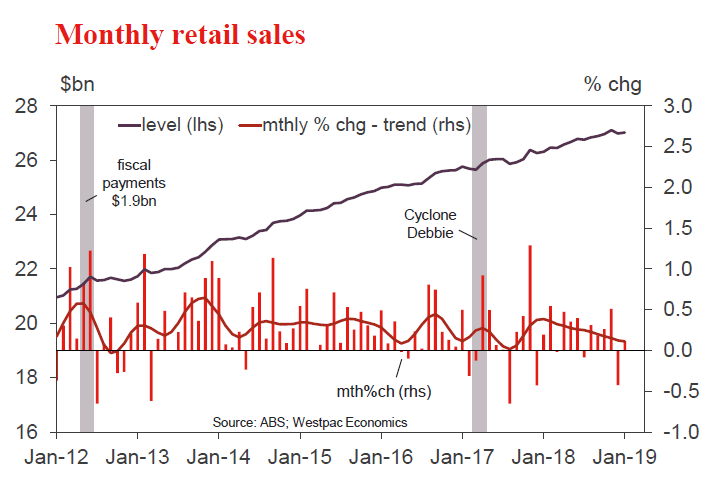
Australian retailers continue to see very difficult conditions. Sales rose just 0.1% in Jan, a disappointing result following the 0.4% fall in Dec, annual growth slowing to 2.7%yr but tracking at a 2% annualised pace over the last six months. The detail showed gains were confined to food sub–categories – both basic food and cafes & restaurants up 0.3%mth – with non food categories down 0.1%mth.
Consumer sentiment had a shaky start to 2019, dipping into net pessimistic territory for the first time since 2017, recovering in Feb but falling back again in March, the survey detail also showing very high levels of risk aversion. Private sector business surveys point to a further significant weakening in conditions for retailers in Feb. While these measures are not good enough to generate month to month point forecasts for retail sales, they are consistent with outright falls. As such we expect Feb to show a 0.1% decline, taking annual sales growth to 2%.
Aus Feb trade balance, AUDbn
- Apr 3, Last: 4.5, WBC f/c: 3.8
- Mkt f/c: 3.7, Range: 2.4 to 5.0
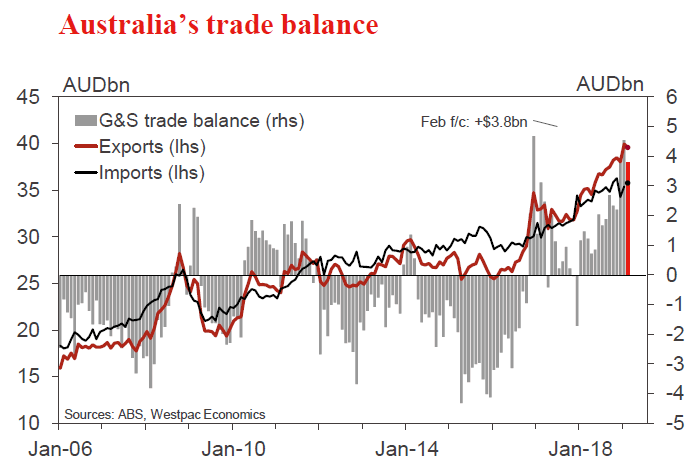
The trade account was in surplus for the past 13 months.
In January, the surplus soared to $4.5bn (the 2nd largest on record), with exports +5.0% and imports +3.3%.
For February, we expect a pull–back to a still sizeable surplus of $3.8bn.
Imports are forecast to rise by a further 1.1%, +$0.38bn, with the potential for fuel to lift following a softer month.
Exports slip by a forecast 0.9%, –$0.36bn, with sizeable falls in gold and coal outweighing a surge in iron ore.
Gold exports are expected to pull–back sharply, –45%, down $1.0bn, off a high base pre–Lunar New Year. Coal earnings are expected to slump by almost 10%, –$0.5bn on a sharp drop in volumes. By contrast, metal ore export earnings are expected to surge, by more than 10%, +$1.1bn, on the jump in the iron ore price to US$85/t.
NZ Q1 Survey of Business Opinion
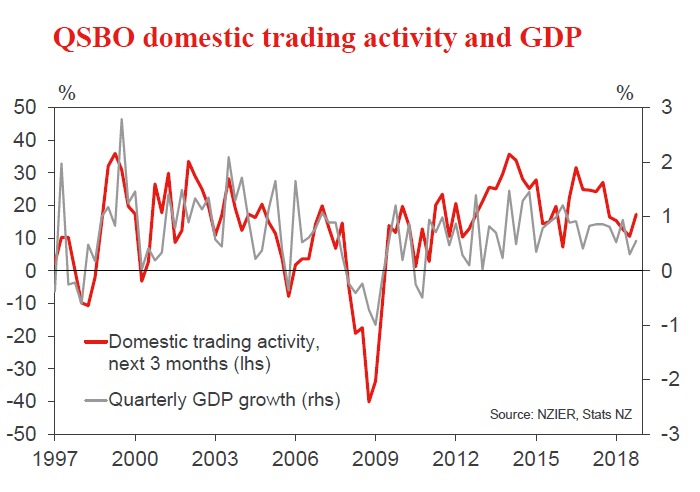
- Apr 2, General business situation, Last: –18
- Domestic trading activity, Last: +17
General business confidence and firms' expectations for their own activity both picked up in the final months of 2018. Nevertheless, the key gauges of business activity in the NZIER's quarterly survey of business opinion remained at low levels in December.
Since the December quarter survey, monthly gauges of business confidence have softened again, and we expect this will be reflected in the March quarter result. GDP growth slowed through the back half of 2018. We've also heard increased concern from some businesses about the potential introduction of a capital gains tax.
The survey is closely watched as an indicator of inflation. Firms have been noting pressure on margins, with rising costs (especially for wages) but limited ability to pass this on due to competitive pressures.
US Mar employment report
- Apr 5, nonfarm payrolls, last 20k, WBC 185k
- Apr 5, unemployment rate, last 3.8%, WBC 3.8%
- Apr 5, hourly earnings, last 3.4%yr, WBC 3.4%yr
The Feb 2019 nonfarm payrolls result came as a significant shock to the market, coming in at just 20k. Still, for the year– to–date, the average monthly gain is robust at 166k. Come Mar, we look for a 185k gain to keep month–average growth around 170k. There is however a material risk of significant positive revisions to Feb, and hence of a softer Mar.
While the unemployment rate will most likely be unchanged at 3.8% in Mar, the trend remains downward. On our expectations, 3.5% could be seen in the second half of 2019.
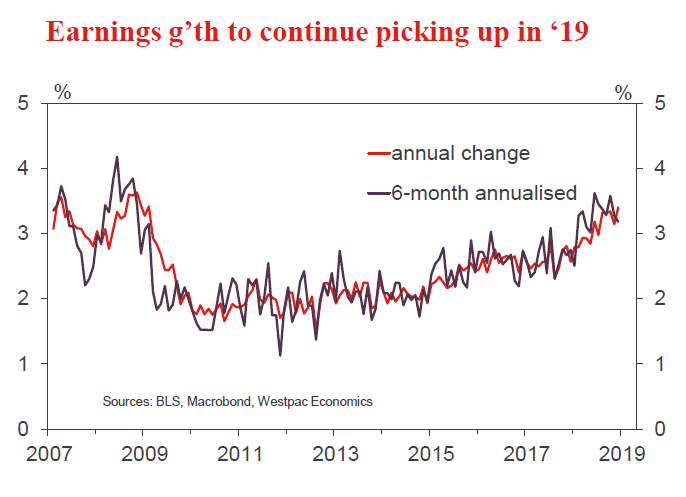
Hourly earnings will remain a focus in coming months. At 3.4%yr, wages growth is well up on its lows, but still not indicative of a 'hot' labour market. This modest uptrend should persist through 2019, to near 4.0%yr.
Weekly Focus: In Limbo Across the Board – Looking to China for Good News
Market movers ahead
- In the US, the jobs report is the most important release next week. We think it is important to keep an eye on whether employment growth starts to decelerate
- In the euro area, we expect March core inflation stayed at 1.0% as the Easter effect will exert downward pressure on service price inflation.
- Concerning Brexit, we are also likely heading for a long extension if the EU27 allow it. In terms of UK economic data releases, we expect weaker PMIs for March.
- The key releases in China next week will be the PMIs. We believe that Q1 will mark the bottom for Chinese activity.
Weekly wrap-up
- The ECB is weighing measures to mitigate the negative side effects of negative rates. The considerations suggest that the ECB is preparing for a potentially long period of negative rates.
- The main headache on Brexit is that there is no majority for any of the different solutions and the pressure is still not high enough for Parliament to be forced to make a decision.
- US and German 10-year yields had another week of sharp declines. The economic slowdown, falling inflation and soft central banks reinforce the search for yield.
- Our new forecast for the Nordics, Nordic Outlook , 28 March, has been released. We expect a sharp slowdown in Sweden, but strong growth in Norway. Denmark in particular has weathered the global slowdown well, but the outlook for both Denmark and Finland remains dependent on the rest of Europe.
Sunset Market Commentary
Markets
Global core bonds lost ground today with US Treasuries underperforming German Bunds. Chinese equities lead the gains as positive signals emerged from the ongoing US-Sino trade talks in Beijing. Core bonds moved with a downward bias overnight, but recovered in the run-up to the EU opening bell. Economic data in the EMU was of secondary importance and had little impact on trading. Sentiment stayed positive throughout the day, pushing core bonds modestly downward. This afternoon, UK Parliament voted May’s Brexit deal down for a third time, pushing German Bunds back north. The German yield curve is steepening with changes in the range of -1.3 bps (2-yr) to +1.4 bps (30-yr). US Treasuries moved steadily today with a downward bias as well. The US PCE Core (Jan) and Chicago PMI (Mar) printed slightly below expectations, while new home sales (Feb) exceeded expectations by a landslide. However, both had only a limited impact on trading. Investors are in wait-and-see modus just before the weekend as next week’s data (retail sales, ISM surveys, ADP employment and payrolls) will give more guidance on the growth concerns that currently grasp markets. The US yield curve is bear flattening with changes up to +4.2 bps (2-yr). Peripheral spreads over the German 10-yr yield are stable with Greece (-6 bps) and Portugal (-4 bps) outperforming.
The gradual EUR/USD downtrend from earlier this week initially continued. EUR/USD filled bids in the 1.1210/15 area during the morning session. EMU data were again mixed (solid German retail sales and labour data, disappointing French data). Over the previous days, there was often USD buying interest at the start of the US trading session but that wasn’t the case today. US income and spending data and the PCE deflator were softer than expected. The data are a bid outdated, but it was enough to block further USD gains. At the same time, the dollar still enjoyed additional interest rate support. The Chicago PMI printed slightly softer than expected at 58.7 (down from 64.7). However, the figure didn’t impress investors enough to cause outright USD losses. US new home sales were even substantially stronger than expected, putting a solid floor for the US currency. EUR/USD is trading near 1.1230. USD/JPY hovers in the 110.80 area. Next week’s key US eco data incl. ISM’s and the payrolls might be the next milestones for USD trading.
Sterling trading was still haunted by Brexit headlines. Early in the session, the UK currency was in the defensive as PM May said she wants to put only the Withdrawal agreement for a third vote in Parliament. UK eco data were mixed. The current account deficit printed again wider than expected (£23.7 b in Q4), but was largely ignored as a factor for sterling trading. During the day sterling regained slightly ground, probably on headlines that some high profile Brexiters would be prepared to support May’s deal. However, today’s vote resulted in another defeat for May by 344 to 286. The UK now has until April 12 to decide what to do next: ask the EU for a long extension or leave without a deal. Sterling reversed earlier gains amidst all of the uncertainty and trades back at EUR/GBP 0.864 currently.
News Headlines
The nationalist Finns Party became Finland’s third most popular party, overtaking PM Sipila’s Centre Party ahead of the early April 14 general elections, a recent polling showed. The government fell on March 8 over a healthcare reform. But with potentially inconclusive election results and Finland’s largest parties already having ruled out to work with the Finns party, a political deadlock looms.
Canadian GDP grew 0.3% MoM (1.6% YoY) in January, beating a meagre 0.1% MoM market consensus and snapping a two month period of economic contraction. Growth was broad-based with particular strength in the construction and manufacturing sectors. The loonie rallied into the mid USD/CAD 1.33/34 area.
Brexit withdrawal agreement defeated once again, by 344-286
UK House of Commons just reject Theresa May’s Brexit withdrawal agreement for the third time, by 344 votes to 286 - a majority of 58.
After the defeat, Prime Minister Theresa May mourned the implications of the results are "grave". With the result, UK is due to leave the EU on April 12 and there is not enough time to legislate a deal. She added "I fear we are reaching the limits of this process in this house". And she will continue to press the case for an "orderly Brexit".
A Soft Start to the Year for U.S. Consumer Spending
In (another) mixed release, the BEA reported a 0.2% gain in personal income in February, and a 0.1% gain in personal spending in January. Both came in below expectations for a 0.3% gain on both metrics. The tepid gain in January's spending came as income pulled back 0.1% in that month.
Falling prices (-0.1%) were partly responsible for the soft growth in nominal spending. On a year-on-year basis, inflation in the PCE deflator decelerated to 1.4% in January (from 1.8%) in December. Core PCE inflation also edged lower to 1.8% from an upwardly revised 2.0% in December.
In real terms, spending was up 0.1% to one decimal place. By major category, real durable goods spending fell 1.6% (falling for a second straight month), nondurable goods were up 0.5%, while services rose 0.2%.
The personal saving rate fell to 7.5% in February from an upwardly revised 7.7% in January.
Key Implications
It’s more backward looking than normal, and still distorted by the government shutdown, but the soft pace of consumer spending suggests another slow start to the year. Even with solid rebounds in February and March, real consumption growth is likely to come in between 0.5 and 1.0% (annualized) in the first quarter.
The income side of things paints a slightly better picture. While the gain in February was modest, the average over the past three months sits at 4.5% (annualized) to February. A relatively high saving rate (up over a percentage point since late last year) suggests considerable scope for spending to bounce back in the months ahead.
Prospects for continued growth hinge on the continued health of the job market. A rebound in job growth in March following the soft outturn in February would go a long way to easing fears that the American economic engine is sputtering.