

Sample Category Title
GBPAUD Hits 1.88 after 2 ½-Years; Gains Could be Limited in Short Term
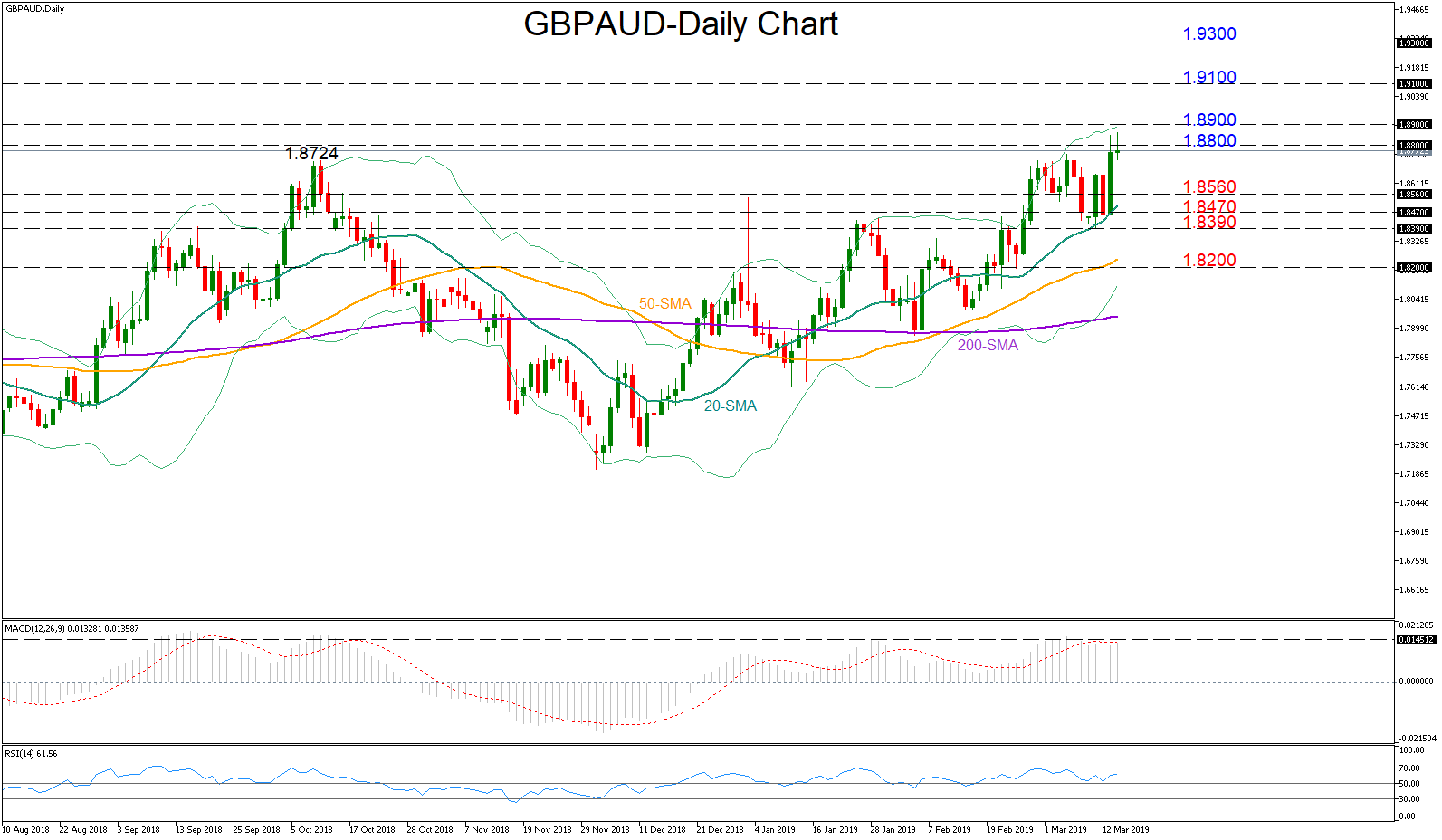
GBPAUD entered the 1.88 zone twice this week after more than 2 ½-years but the market was unable to retain gains above this mark, with the price returning to the 1.87 handle instead. The MACD has rebounded to meet its red signal line but as long as the indicator holds below that line, the pair is less likely to show significant improvement, especially if this is accompanied by a steadier RSI. Besides, with the price trading closer to the upper Bollinger band, room for more gains is limited in the short term.
Should the bulls clear the 1.88 round level, the way would open towards the 1.89-1-91 region where the priced stopped several times during 2014-2016. In such a case, the upward pattern started on October 2016 would extend further, increasing investors’ appetite for more buying. Higher, the 1.9300 mark, taken from the highs on December 2014, could come next into focus.
In the negative scenario, the pair could slide back into the 1.8560-1.8470 area, with the supportive 20-day moving average attracting special attention. Below that the bears need to violate the 1.8390 level to challenge the 1.82 key number.
In brief, GBPAUD faces a positive-to neutral bias in the short term, while in the bigger picture, it is trading in positive territory above all its moving averages.
Japanese Yen Dips ahead of BoJ Statement
After a quiet week, USD/JPY has posted gains on Thursday. In the North American session, the pair is trading at 111.58, up 0.38% on the day. On the release front, U.S. numbers were soft. Unemployment claims climbed to 229 thousand, above the estimate of 225 thousand. Canadian New Housing Price Index declined 0.1%, after posting five straight readings of 0.0%. Later in the day, the focus shifts to the Bank of Japan, which will release a rate statement.
The Bank of Japan holds a policy meeting later on Thursday, and investors should expect “more of the same” with regard to monetary policy. There is little pressure on policymakers to raise interest rates, especially with the Federal Reserve and ECB putting a freeze on rate hikes for the time being. However, the BoJ is concerned that the Japanese yen could rise if the global economy takes a downturn in 2019, which would weigh on exports and push low inflation levels even lower. If the yen does move higher, the BoJ will have to consider additional stimulus in order to keep the currency in check. This means that it’s unlikely that the safe-haven yen will be posting significant gains in the next few months, barring geopolitical turmoil.
What can we expect from the Fed in the next few months? In the U.S., consumer inflation remains soft, which means there is little pressure on policymakers to raise rates in the near future. In February, Core CPI edged down to 0.1%, while CPI remained steady at 0.2%.There is less than a 2% chance that the Fed will raise rates at the March or May meetings, according to the CME Group. Policymakers have been signaling that the Fed could stay on the sidelines until the second half of 2019, and this stance was underscored by Fed Chair Powell in a television interview on Sunday. Powell left no doubt about where the Fed stands, saying that the Fed would remain patient and was in no hurry to change interest rate policy. The dovish stance of the Fed could weigh on the dollar, as a lack of rate hikes makes the greenback less attractive to investors.
Sunset Market Commentary
Markets
Global core bonds are trading mixed today with German Bunds underperforming US Treasuries. European sentiment was positive this morning as investors welcomed the UK Parliamentary vote to avoid a no-deal Brexit at any occasion. EU equity markets moved higher, weighing core bonds down. The Ifo Institute, one of Germany’s most prestigious research institutes, nearly halved its 2019 growth projection to 0.6%, leading German Bunds higher. Rumours that the meeting between US President Trump and his Chinese counterpart Xi Jinping will be delayed to at least April got confirmed today but had little impact on EMU bonds. The German yield curve is edging higher at the time of writing with changes up to +1.7 bps (10-yr). US Treasuries moved sideways this morning but the confirmation of the delay in US-Sino trade talks we a cautious bond-supportive. Weekly jobless claims rose (little) more than expected and January new home sales missed expectations. US equities opened lower, supporting US Treasuries modestly. The US yield curve is mixed with changes in the range of -0.7 bps (5-yr) to +0.3 bps (30-yr). Peripheral spreads over the German 10-yr yield are tightening with Italy (-6 bps) outperforming.
EUR/USD rebounded this week on a constructive risk sentiment, on better (less negative) EMU eco data and as the dollar traded soft ahead of next week’s Fed policy meeting. A positive reaction of European markets after yesterday’s Brexit vote in the UK Parliament propelled EUR/USD to a ST correction top in the 1.1339 area. Today, the bid for the single currency dwindled. The Ifo Institute further downgraded the growth outlook for Germany (0.6% for 2019). Despite yesterday’s vote, the positive impact of recent Brexit developments on the euro also eased. EUR/USD gradually returned to the 1.13 area. US eco data were mixed and didn’t provide any clear directional guidance. USD/JPY rebounded in Asia this morning, but soon settled in the 111.50/70 area. The dollar didn’t receive any additional interest rate support. Sentiment on risk was quite neutral for the USD/JPY cross rate.
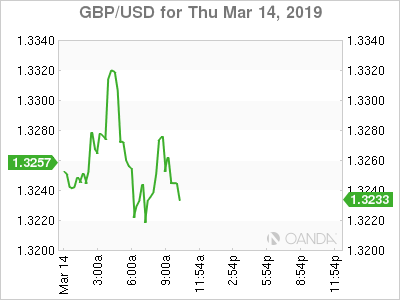
Sterling flourished overnight. Investors adapted positions further as yesterday’s vote in the UK parliament was seen as further reducing the risk of a disorderly Brexit. (Even as a ‘no deal Brexit’ remains the legal ‘by default’ scenario). Sterling trading developed in a more balanced environment today. EUR/GBP hovered up and down mostly in the lower half of the 0.85 big figure. Recent developments were maybe a good reason to reduce sterling short exposure. Question is whether the political and economic prospects on the UK are positive and/or stable enough to warrant outright sterling long positioning. In this respect, BoE’s Haskel warned that recent drop in investment might also affect the UK labour market. He advocated a wait-and-see stance and said the BoE needs evidence of rising inflation before reconsidering further rate hikes. Markets are currently looking forward to this evening’s vote on a delay of Brexit. Even in case Parliament supports a delay, next political steps (both from the UK and from the EU) are not straightforward. EUR/GBP trades currently in the 0.8535 area. Cable is changing hands in the 1.3230 area.
News Headlines
The German Ifo Institute downgraded the 2019 growth forecast from 1.1% to 0.6%. Ifo warns that the German manufacturing industry will largely fail to act as an economic engine this year. Global demand is weak as the global economy continues to lose momentum. The German economy grew by 1.5% last year, the slowest since 2013.
US new home sales missed expectations. A decline of -6.9% m/m was recorded in January vs. a 0.2% pickup expected and well below last month’s 3.7%. Although notoriously volatile and relatively outdated due to the government shutdown, the data did not go unnoticed as stocks slipped after release.
The 21st Century Business Herald reported that Chinese securities regulator instructed brokerages to minimize risks from margin lending and warned analysts to avoid inflammatory language. Last week, China’s largest state-owned brokerage issued a rare sell rating. Chinese equity indices significantly underperformed over the past sessions.
Trade Deal Delay
Presidents Trump and Xi have decided to move back a potential summit to finalize a trade agreement to April, signaling both sides still can’t reach an agreement as major issues still can’t be resolved. At the beginning of the month, expectations were for both leaders to meet by mid-March and now the certainty of a deal happening is starting to wane. US stocks erased earlier gains and commodity currencies extended their decline on the news of the trade deal delay.
- China – Data confirms stimulus and trade deal needed
- GE – Still coming out with bad news
- Brexit – Delay bound
- Oil – OPEC keeps up production cut rhetoric
- Gold – Rising on tame inflation and trade deal uncertainty
China
The data continues to be downright ugly in China and if trade talks continue to drag on, we could see Asia Pacific markets under pressure. Chinese industrial output growth declined to a 17-year low while retail sales continued weaken. Many are believing we are near the low with industrial production as fiscal stimulus will slowly kicking and monetary policy easing is likely to ramp up. China will likely show more signs of stabilizing if they get a trade deal done with the US. If a deal is delayed heavily, we probably will see more stimulus from China.
GE
General Electric may need lessons on how to air out your dirty laundry. At the beginning of the month, they warned that cash flow would likely be negative in 2019. Today’s announcement confirmed that industrial free cash flow would be as low as $2 billion. GE is expecting cash flow to be positive in 2020 and 2021. They also provided full year EPS guidance of $0.50 to $0.60 which was well below the $0.67 analysts’ estimate. CEO Culp’s turnaround is hampered by GE’s $100 billion debt problem. If this is the last of the bad news, GE shares may continue to stabilize. Shares turned higher after CEO noted he sees the power business bouncing back next year.
Brexit
The third day of Parliamentary voting will see UK lawmakers vote on the postponement to the March 29th deadline. The EU appears open to a deadline if the UK can give them a good reason on why the need for a delay. With many Brexit scenarios still out there, it appears that PM May could let it all hang on one last, maybe the third time is the charm meaningful vote next week. After substantial defeats in both votes, it is difficult to believe she will be able to convince Brexiteers and DUP to vote on her Brexit deal. If she is successful, the UK could request a short extension. The base case scenario is that May’s third deal is voted down again, and we see a longer extension to allow new leadership to restart negotiations with the EU.
Oil
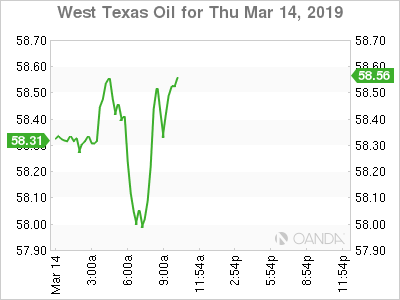
Crude prices remain supported as tightness with US crude and fuel stockpiles and relentless reiterations from OPEC that production cuts amongst the group and allies will continue till year end. The rally with West Texas Intermediate crude is also supported by the sanctions being imposed on Venezuela and Iran crude and if we continue to see draws with US inventories, we may see a clear path towards $60 a barrel and possibly the $64 region.
Gold
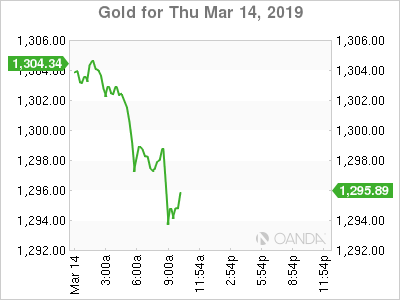
The yellow metal fell back below $1,300 an ounce as the US dollar rallied across the board and markets digest news of a trade deal delay. The overall upbeat mood seen with European equities also kept pressure with gold prices and if we see a continued move higher with US stocks, we could see further pressure for the precious metal.
USD/JPY Mid-Day Outlook
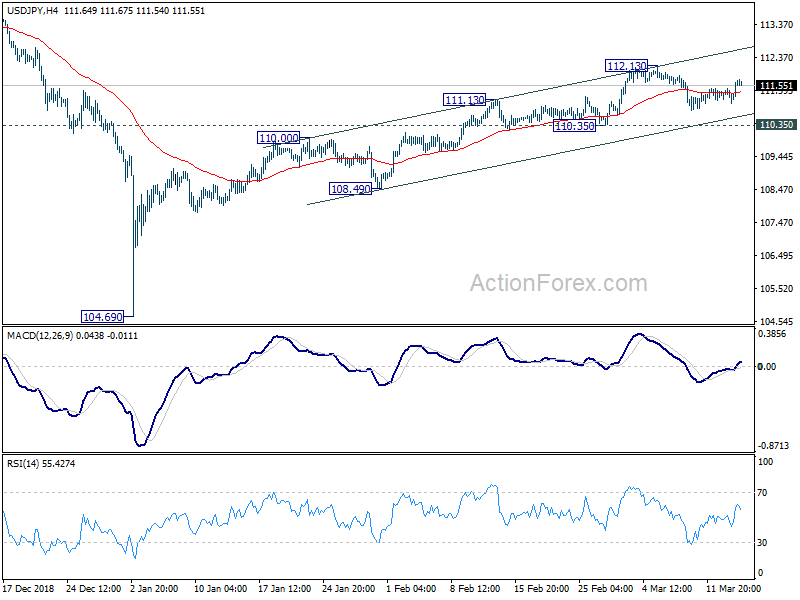
Daily Pivots: (S1) 110.94; (P) 111.20; (R1) 111.41; More...
USD/JPY is staying in consolidation from 112.13 and intraday bias remains neutral. As long as 110.35 support holds, near term outlook remains bullish and rise from 104.69 is still in favor to resume. On the upside, break of 112.13 will target 114.54 resistance next. However, firm break of 110.35 should confirm near term reversal and turn outlook bearish for 108.49 support and below.
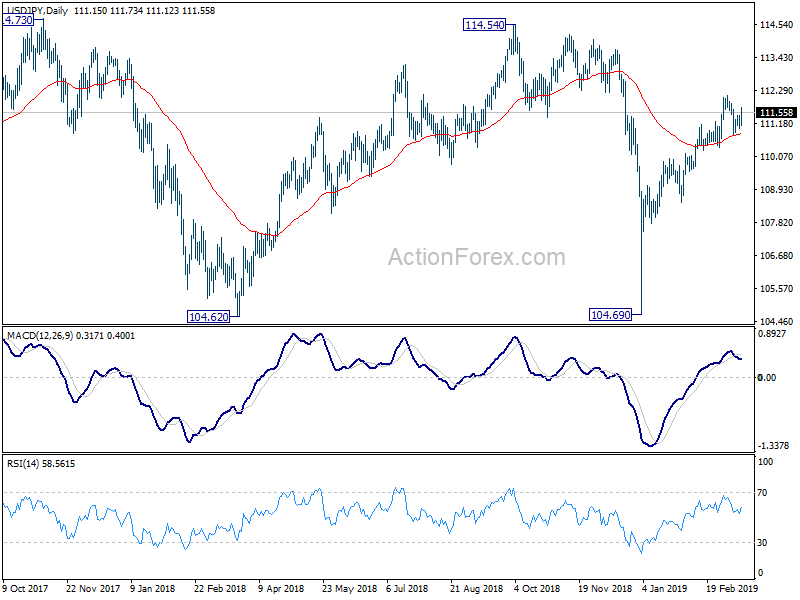
In the bigger picture, strong rebound from 104.69 argues that decline from 118.65 (2016 high) has completed with three waves down to 104.69, after failing 104.62. More importantly, the rise from 98.97 (2016 low) could be resuming. Decisive break of 114.54 resistance will add more credence to this bullish case and target 118.65. This will now be the favored case as long as 110.35 support holds. However, firm break of 110.35 will mix up the medium term outlook again and turn focus back to 104.69 low.
USD/CHF Mid-Day Outlook
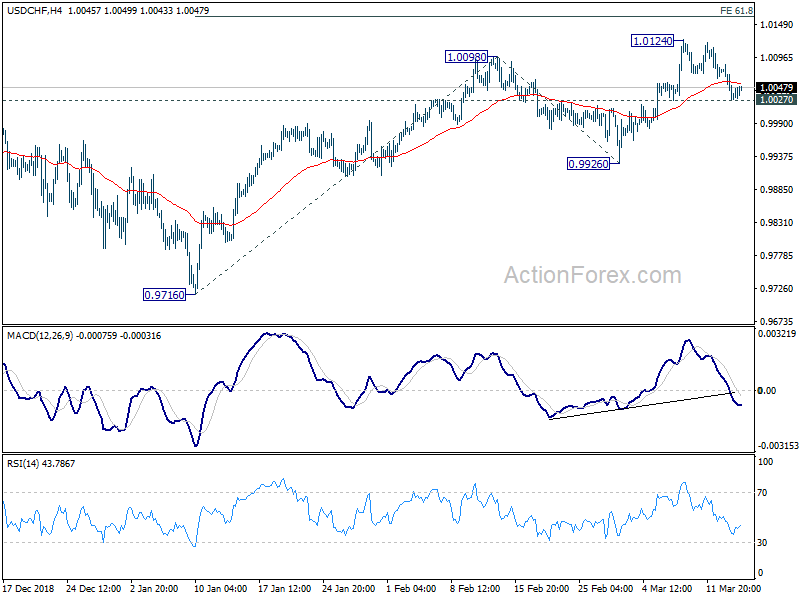
Daily Pivots: (S1) 1.0014; (P) 1.0050; (R1) 1.0072; More....
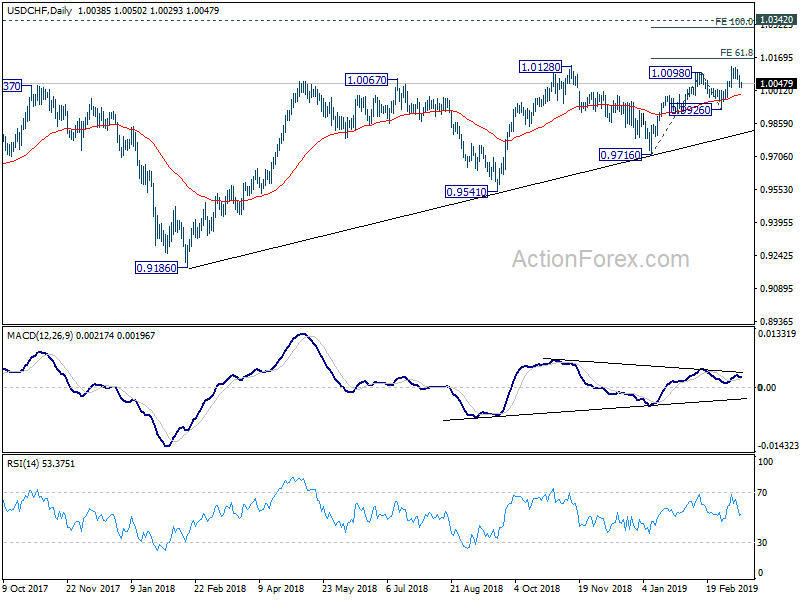
Intraday bias in USD/CHF remains neutral and outlook is unchanged. On the upside, break of 1.0124 will target 61.8% projection of 0.9716 to 1.0098 from 0.9926 at 1.0162 and then 100% projection at 1.0308. However, firm break of 1.0027 will bring deeper decline back to 0.9926 support.
In the bigger picture, USD/CHF drew strong support from medium term trend line and rebounded. That suggests rise from 0.9186 is still in progress. Further break of 1.0128 will confirm up trend resumption and target 1.0342 key resistance. Nevertheless, break of 0.9926 support will be the first signal of medium term reversal and bring another test on the trend line.
EUR/USD Mid-Day Outlook
Daily Pivots: (S1) 1.1292; (P) 1.1315; (R1) 1.1353; More.....
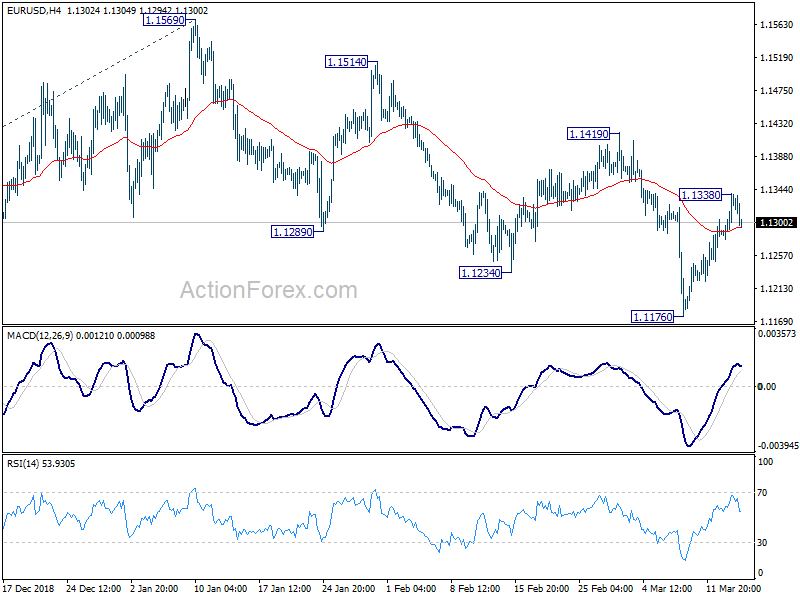
EUR/USD retreats mildly after hitting 1.1338 but downside is contained by 4 hour 55 EMA. Outlook is unchanged so far as rebound from 1.1176 is seen as a corrective move. In case of another rise, upside should be limited well below 1.1419 resistance to bring fall resumption. On the downside, break of 1.1176 will extend the down trend from 1.2555 and target 100% projection of 1.1814 to 1.1215 from 1.1569 at 1.0970 next.
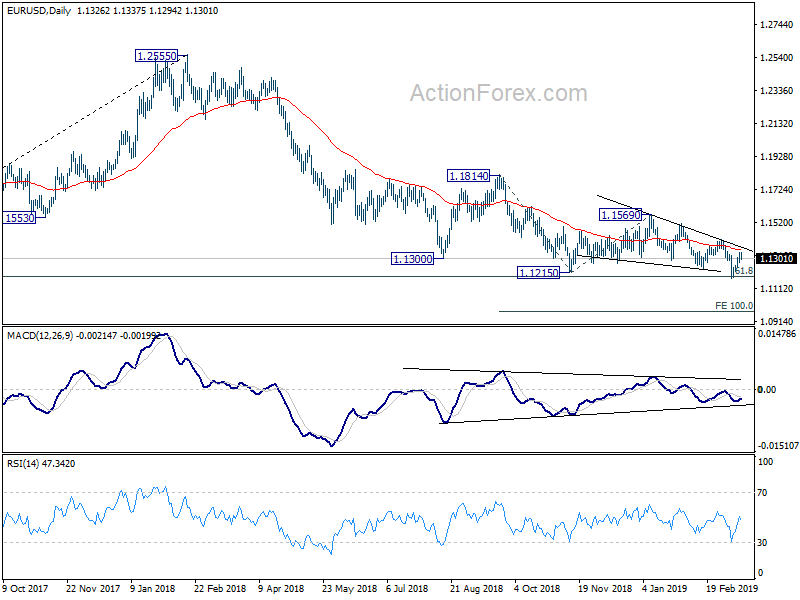
In the bigger picture, down trend from 1.2555 medium term top is still in progress. Bearishness is affirmed by sustained trading below falling 55 week EMA. 61.8% retracement of 1.0339 (2017 low) to 1.2555 at 1.1186 is met. Sustained break there will pave the way to retest 1.0339. On the upside, break of 1.1569 resistance will now indicate completion of such down trend and turn medium term outlook bullish.
Canadian Dollar Dips, U.S. Jobless Claims Rise
The Canadian dollar has lost ground in the Thursday session. In the North American trade, the pair is trading at 1.3340, up 0.30% on the day. On the release, U.S. unemployment claims climbed to 229 thousand, above the estimate of 225 thousand. Canadian New Housing Price Index declined 0.1%, after posting five straight readings of 0.0%. On Friday, the U.S. publishes the Empire State Manufacturing Index and UoM Consumer Sentiment, and Canada releases manufacturing sales.
Was the Bank of Canada too aggressive with its rate hikes? The bank raised rates five times between July 2017 and October 2018, but has since stayed on the sidelines. With the Canadian economy in a slowdown, the bank could stay on the sidelines until the second half of 2019. The sharp jump in rates may have been too much for the economy to handle. One sore spot is the housing sector, which has declined for five straight months, as higher rates have made mortgages more expensive and reduced home purchases. If the economy does not rebound, policymakers will have to consider a rate cut, which could stimulate economic activity but would push the Canadian dollar downwards.
In the U.S., February consumer inflation numbers were soft, which means there is little pressure on policymakers to raise rates in the near future. Core CPI edged down to 0.1%, while CPI remained steady at 0.2%. Inflation remains well below the Federal Reserve’s target of 2.0 percent, so there is little pressure on the Fed to raise rates anytime soon. Policymakers have been signaling that the Fed could stay on the sidelines until the second half of 2019, and this stance was underscored by Fed Chair Powell in a television interview earlier this week. Powell left no doubt about where the Fed stands, saying that the Fed would remain patient and was in no hurry to change interest rate policy. The dovish stance of the Fed could weigh on the greenback, as a lack of rate hikes makes the greenback less attractive to investors.
GBP/USD Mid-Day Outlook
Daily Pivots: (S1) 1.3136; (P) 1.3259; (R1) 1.3462; More....
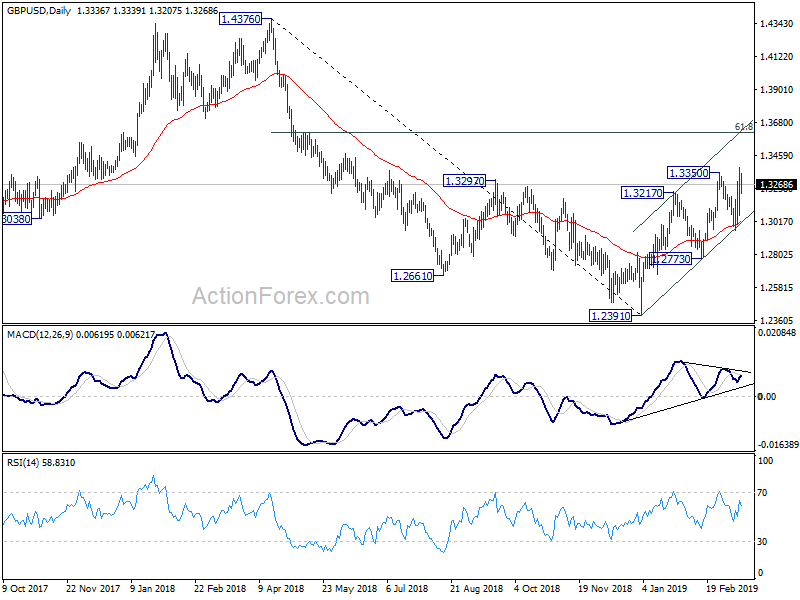
Intraday bias in GBP/USD remains neutral first. For now, as long as 1.2960 support holds and further rise is in favor. Sustained break of 1.3350/3381 will resume whole rebound from 1.2391 low to 61.8% retracement of 1.4376 to 1.2391 at 1.3618 next. However, on the downside, firm break of 1.2960 will indicate that rebound from 1.2391 has completed earlier than expected at 1.3350. Deeper fall would then be seen to 1.2773 support for confirmation.
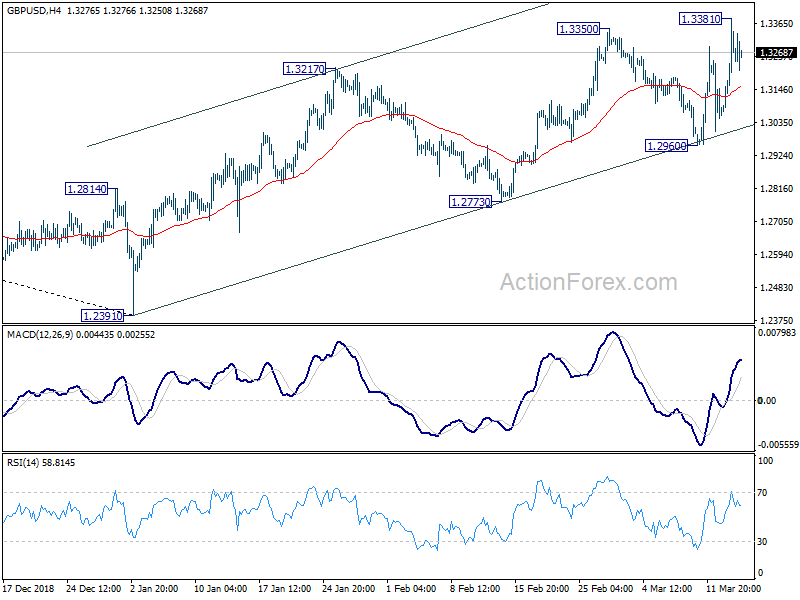
In the bigger picture, medium term decline from 1.4376 (2018 high) should have completed at 1.2391. Rise from 1.2391 is now seen as the third leg of the corrective pattern from 1.1946 (2016 low). Further rise could be seen through 1.4376 in medium term. On the downside, though, break of 1.2773 support will dampen this view. Focus will be turned back to 1.2391 low and break will resume the fall from 1.4376 to 1.1946.
Sterling Mixed as UK Will Decide on Brexit Delay, Aussie Dragged Down by China
Sterling turns mixed as markets await yet another vote about Brexit in the Commons today. MPs is now given a chance to vote for delaying Brexit beyond March 29. The question is whether it would be a short delay with a plan, a short delay without a plan, or a long delay without a plan. We'll soon find out. After the vote, Prime Minister Theresa May will write to the President of the European Council to request for Article 50 extension, with reason and time.
For now, Australian Dollar is the weakest one for today, followed by New Zealand Dollar. Dollar is the strongest one, followed by Swiss Franc. Weak data from China which suggests longer slowdown weighed slightly on sentiment. Also, there are reports that the trade negotiation with US is dragging on. The anticipated Trump-Xi summit is postponed to April at least. Euro is firm as the third strongest even though both German Economy Ministry and Ifo institute expect just modest growth in the country ahead.
Technically, there is no special development so far. The recovery in Dollar is not strong enough to warrant completion of recent corrective pull back yet. Though, USD/CHF is recovering ahead of 1.0027 minor support. Also, USD/CAD also recovers after breaching 1.3301 minor support. More upside in these two pair will reinforce near term bullishness in the greenback.
In Europe, FTSE is up 0.46%. DAX is up 0.40%. CAC is up 0.65%. German 10-year yield is up 0.0095 at 0.075. Earlier in Asia, Nikkei dropped -0.02%. Hong Kong HSI rose 0.15%. China Shanghai SSE dropped -1.20% to 2990.69, below 3000. Singapore Strait Times rose 0.07%, Japan 10-year JGB yield rose 0.0053 to -0.04.
US initial jobless claims rose 9k to 229k, import price rose 0.6% mom
US initial jobless claims rose 6k to 229k in the week ending March 9, above expectation of 225k. Four-week moving average of initial claims dropped -2.5k to 223.75k. Continuing claims rose 18k to 1.776M in the week ending March 2. Four-week moving average of continuing claims dropped -1k to 1.766M. Import price index rose 0.6% mom in February, fasting in 9 months, well above expectation of 0.3% mom.
Trump-Xi summit reported to be postponed to April
Bloomberg reports that the planned summit between Trump and Chinese President Xi Jinping to seal the trade deal would be postponed to April. One of the reason is that China prefers a formal state visit rather than a low-profile appearance just to sign the deal.
But more importantly, as US Trade Representative Robert Lighthizer said earlier this week that there are still unresolved major issues". We've repeatedly pointed out that there has been no concrete details on the core issues, including IP theft, forced technology transfer and market distortion by state-owned enterprises.
Trump has also tried to tone down on the agreement yesterday as he said "I'm in no rush. I want the deal to be right. ... I am not in a rush whatsoever. It's got to be the right deal. It's got to be a good deal for us and if it's not, we're not going to make that deal." And, he is also open to complete the trade agreement before or after the summit.
Former head of National Economic Council Gary Cohn said in a Freakonomics interview that Trump "needs a win" and he is "desperate right now" for a trade deal with China. Cohn added, "the only big open issue right now that he could claim as a big win that he'd hope would have a big impact on the stock market would be a Chinese resolution."
UK Hammond said EU may insist on long Brexit delay, German Altmaier said no artificial boundaries
The vote on delaying Brexit in the Commons is the major focus today. A big question is… for how long. Chancellor of the Exchequer Philip Hammond said, "this is not in our control and the European Union is signaling that only if we have a deal is it likely to be willing to grant a short technical extension to get the legislation through." He added "if we don't have a deal, and if we're still discussing among ourselves what is the right way to go forward, then it's quite possible that the EU may insist on a significantly longer period".
Opposition Labour Party's finance spokesman John McDonnell said "we will be putting an amendment down to ensure parliament considers an extension, it doesn't necessarily have to be a long extension". He added "we will go for a limited extension today."
German Economy Minister Peter Altmaier urged the EU to discuss "constructively" with UK on the question of delaying Brexit. He emphasized "we urgently need clarity, we need clarity fast, but we will not make this by always criticizing our British friends and partners from a high moral standpoint, but only if we reach a reasonable solution". And, he said "I would not set any artificial boundaries here", regarding the time of the delay.
German Economy Ministry expects moderate growth in Q1, weak manufacturing and prospering services
German Economy Ministry said in its March economic report that the economy has a subdued start to 2019. And the country "has become more troubled due to higher risks and uncertainties in the external environment." This applies in particular to manufacturing with significant fall in production in January. The "weak phase" is likely to continue due to "sluggish foreign demand".
Though, the ministry expects growth to continue in other sectors, in particular most service sectors. This was underlined by "recent significant increase in employment" those sectors. With the contrasting tension between weak manufacturing and prospering services, GDP will likely increase "at best moderate" in Q1.
The government lowered 2019 growth forecast to 1.0% back in January and will update the projections again in April.
Ifo lowers 2019 Germany growth forecast from 1.1% to 0.6%, but upgrades 2020 forecasts
German ifo Institute lowers 2019 growth forecast for Germany from 1.1% to 0.6%. Though, 2020 growth forecast is revised up from 1.6% to 1.8%.
Timo Wollmershaeuser, Head of ifo Business Cycle Analysis and Forecasts said: "The current production difficulties in German manufacturing are likely to be overcome only gradually. The industry will largely fail to act as an economic engine in 2019. Global demand for German products is weak, as the international economy continues to lose momentum.
But he emphasized that "domestic driving forces are still intact". Number of people employed should continue to rise even though pace is slowing. Unemployment rate is expected to fall from 5.2% to 4.7-4.9%. Also, Wollmershaeuser added: "This year, strong wage increases, a low inflation rate, reductions in taxes and social security contributions as well as an expansion of public transfers should result in a large increase in real incomes of households. This will bolster private consumption and the construction industry."
Released from Germany, CPI was finalized at 0.5% mom, 1.6% yoy in February. From Swiss, PPI rose 0.2% mom, -0.7% yoy in February, versus expectation of -0.1% mom, -1.0% yoy.
Weak Chinese data point to longer slowdown
A batch of January-February economic data is released from China today which showed that the slowdown is going to extend for longer. In particular, poor employment data could trigger more forceful measures from the Chinese government to maintain social stability.
Industrial production growth slowed to 5.3% ytd yoy in February, down from 6.2% and missed expectation of 5.5%. That also the slowest pace since early 2002.
Retail sales growth dropped to just 8.2% ytd yoy, down from 9.0% but beat expectation of 8.1%. That's nonetheless, the weakest growth since at least 2012. Unemployment rate also jumped sharply to 5.3%, up from 4.9% in December, highest in two years.
Nevertheless, investment offers some positive hope. Fixed assets investment grew 6.1% yoy, up from 5.9% and beat expectation of 6.0%. Real estate investment rose 11.6% yoy, hitting the strongest growth figure since November 2014.
Suggested reading: Slowdown in China Remains Pronounced Even After Adjusting for Seasonal Factors
GBP/USD Mid-Day Outlook
Daily Pivots: (S1) 1.3136; (P) 1.3259; (R1) 1.3462; More....
Intraday bias in GBP/USD remains neutral first. For now, as long as 1.2960 support holds and further rise is in favor. Sustained break of 1.3350/3381 will resume whole rebound from 1.2391 low to 61.8% retracement of 1.4376 to 1.2391 at 1.3618 next. However, on the downside, firm break of 1.2960 will indicate that rebound from 1.2391 has completed earlier than expected at 1.3350. Deeper fall would then be seen to 1.2773 support for confirmation.
In the bigger picture, medium term decline from 1.4376 (2018 high) should have completed at 1.2391. Rise from 1.2391 is now seen as the third leg of the corrective pattern from 1.1946 (2016 low). Further rise could be seen through 1.4376 in medium term. On the downside, though, break of 1.2773 support will dampen this view. Focus will be turned back to 1.2391 low and break will resume the fall from 1.4376 to 1.1946.
Economic Indicators Update
| GMT | Ccy | Events | Actual | Forecast | Previous | Revised |
|---|---|---|---|---|---|---|
| 00:00 | AUD | Consumer Inflation Expectation Mar | 4.10% | 3.70% | ||
| 00:01 | GBP | RICS House Price Balance Feb | -28% | -24% | -22% | |
| 02:00 | CNY | Fixed Assets Ex Rural YTD Y/Y Feb | 6.10% | 6.00% | 5.90% | |
| 02:00 | CNY | Industrial Production YTD Y/Y Feb | 5.30% | 5.50% | 6.20% | |
| 02:00 | CNY | Retail Sales YTD Y/Y Feb | 8.20% | 8.10% | 9.00% | |
| 06:45 | CHF | SECO Economic Forecasts | ||||
| 07:00 | EUR | German CPI M/M Feb F | 0.50% | 0.50% | 0.50% | |
| 07:00 | EUR | German CPI Y/Y Feb F | 1.50% | 1.60% | 1.60% | |
| 07:30 | CHF | Producer & Import Prices M/M Feb | 0.20% | -0.10% | -0.70% | |
| 07:30 | CHF | Producer & Import Prices Y/Y Feb | -0.70% | -1.00% | -0.50% | |
| 12:30 | CAD | New Housing Price Index M/M Jan | -0.10% | 0.00% | 0.00% | |
| 12:30 | USD | Import Price Index M/M Feb | 0.60% | 0.30% | -0.50% | 0.10% |
| 12:30 | USD | Initial Jobless Claims (MAR 09) | 229K | 225K | 223K | |
| 14:00 | USD | New Home Sales M/M Jan | 0.30% | 3.70% | ||
| 14:00 | USD | New Home Sales Jan | 623K | 621K | ||
| 14:30 | USD | Natural Gas Storage | -149B |