Sample Category Title
USD/CAD Weekly Outlook
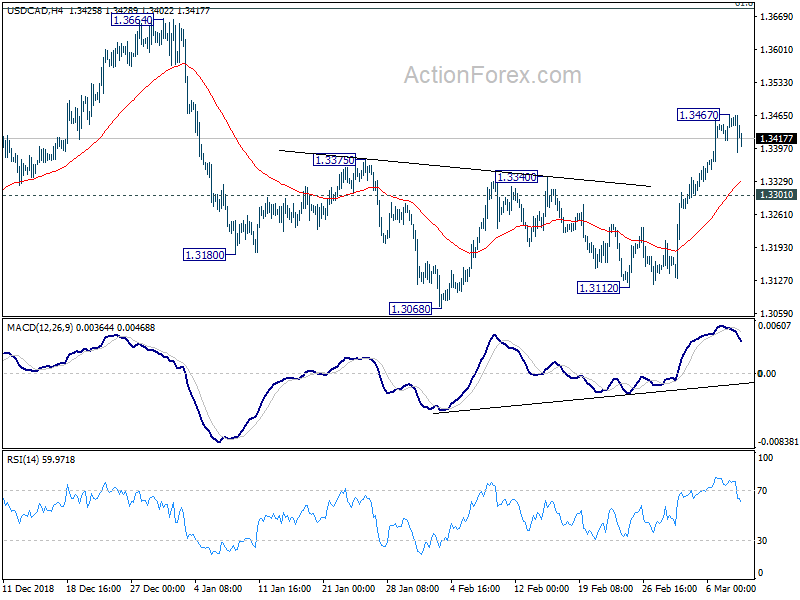
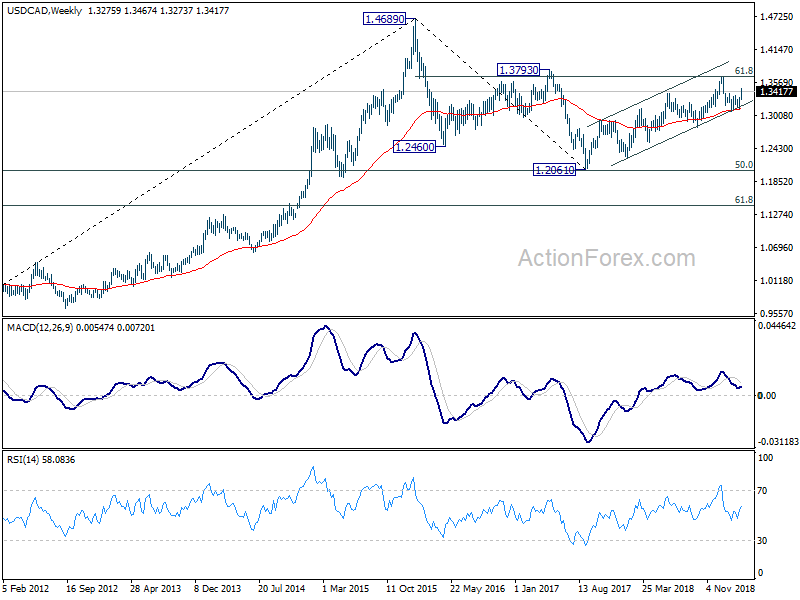
USD/CAD surged to as high as 1.3467 last week but formed temporary top there and retreated. Initial bias is turned neutral this week for consolidation first. The break of 1.3340 resistance confirmed completion of corrective decline from 1.3664. Retreat from 1.3467 should be contained by 1.3301 support to bring another rally. On the upside, break of 1.3467 will target 1.3664 resistance then 1.3685 fibonacci level.
In the bigger picture, structure of the medium term rise from 1.2061 (2017 low) to 1.3664 is not clearly impulsive. Hence, we'd stay cautious on strong resistance from 61.8% retracement of 1.4689 (2016 high) to 1.2061 at 1.3685 and 1.3793 resistance to limit upside, and bring medium term topping. But in any case, medium term outlook will stay bullish as long as channel support (now at 1.3139) holds. Sustained break of 1.3793 will pave the way to retest 1.4689 (2015 high). Firm break of the channel support should confirm reversal target 1.2061 low again.
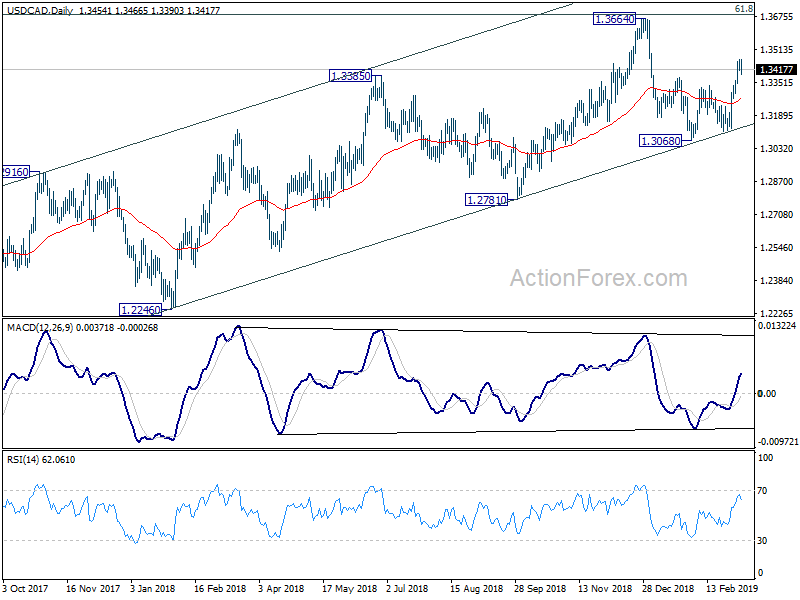
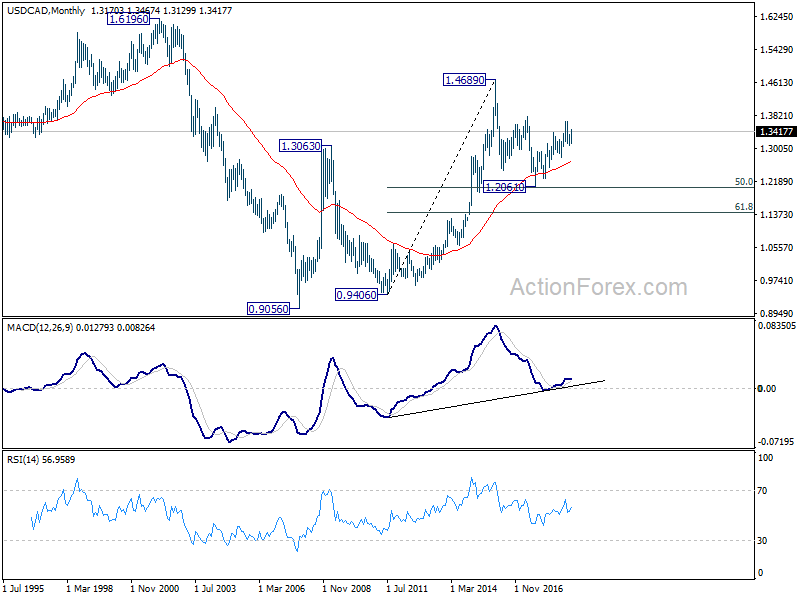
In the longer term picture, corrective fall from 1.4689 (2015 high) should have completed with three waves down to 1.2061, just ahead of 50% retracement of 0.9406 (2011 low) to 1.4689 (2015 high) at 1.2048. The development keeps long term up trend from 0.9406 and that from 0.9056 (2007 low) intact. For now, there is still prospect of extending the long term up trend through 1.4689.
GBP/JPY Weekly Outlook
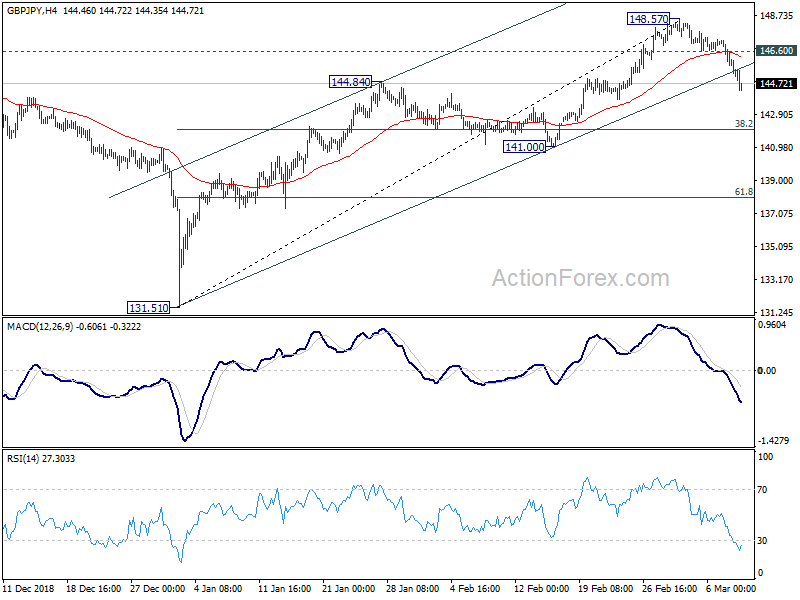
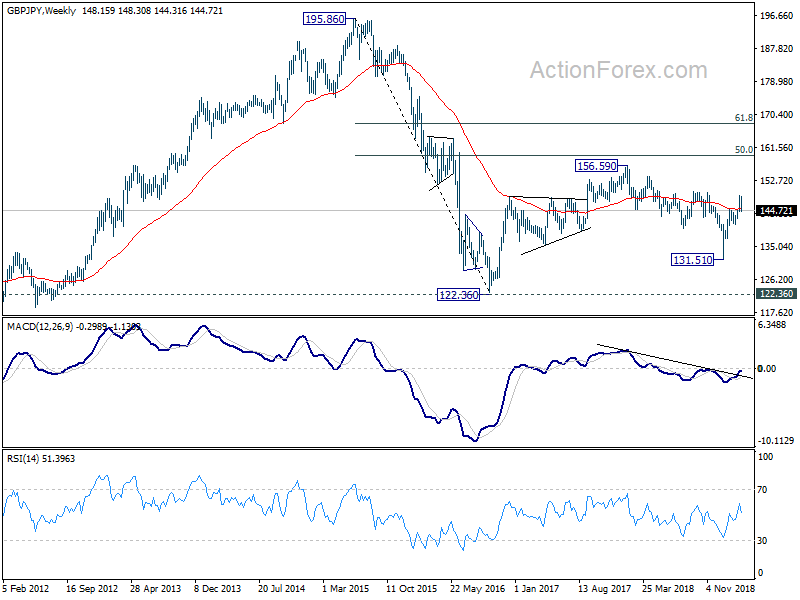
GBP/JPY's decline from 148.57 extended to as low as 144.31 last week. The break of near term trend line support and 144.84 support turned resistance indicates short term topping at 148.57. Initial bias is now on the downside this week for 38.2% retracement of 131.51 to 148.57 at 142.05. On the upside, break of 146.60 minor resistance will indicate completion of the pull back and turn bias to the upside for 148.57.
In the bigger picture, the strong rebound from 131.51 suggests that medium term fall from 156.59 (2018 high) has completed already. The corrective structure of such decline in turn argues that it's the second leg of the corrective pattern from 122.36 (2016 low). And this pattern is starting the third leg. On the upside, decisive break of 149.48 will pave the way to 156.59 resistance and above. However, firm break of 141.00 support will dampen this view and turn focus back to 131.51 low instead.
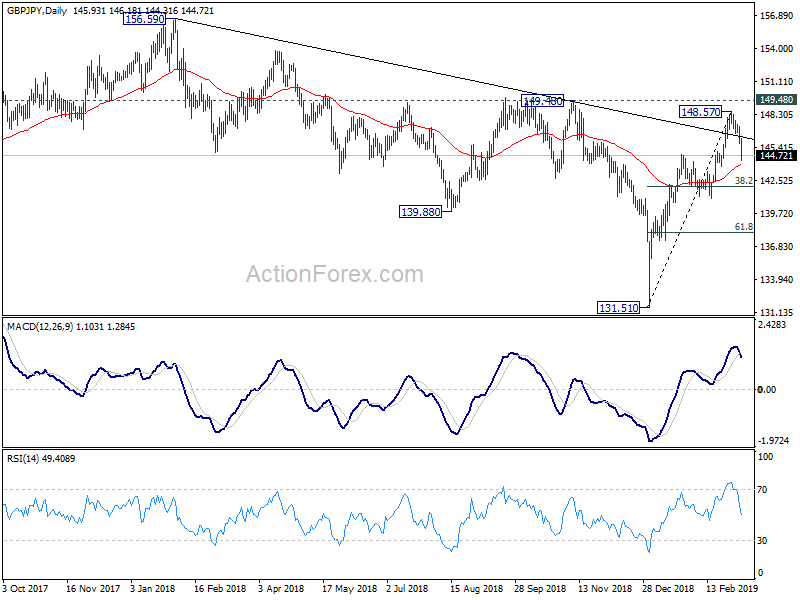
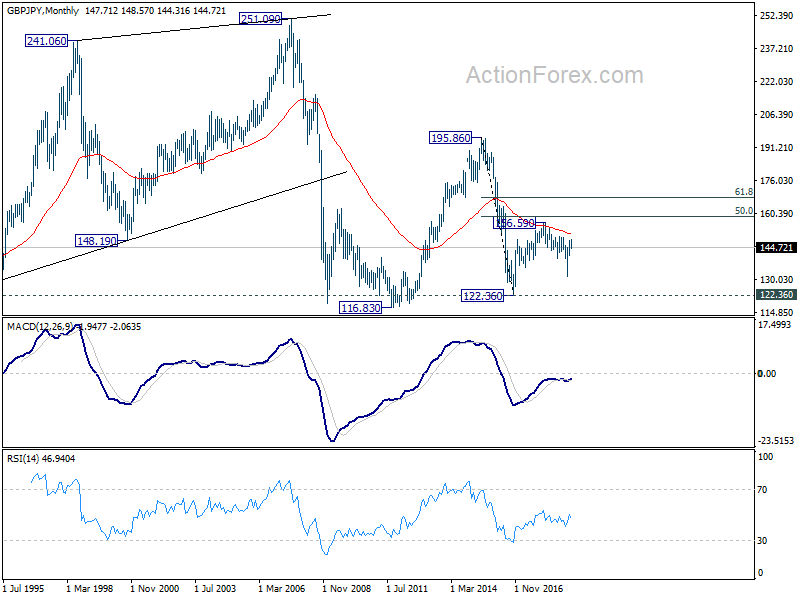
In the longer term picture, the rise from 122.36 (2016 low) to 156.59 (2018 high) doesn't display a clear impulsive structure. Thus, we're treating price actions from 122.36 as a corrective pattern. In case of an extension, strong resistance is likely to be seen at 50% retracement of 195.86 (2015 high) to 122.36 at 159.11 to limit upside. On the downside, break of 131.51 support will bring 122.26 low back into focus.
EUR/JPY Weekly Outlook
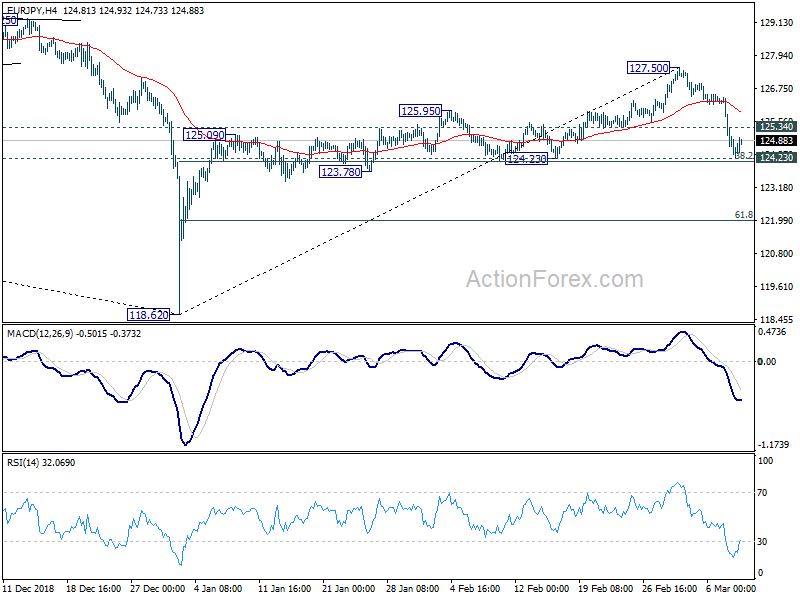
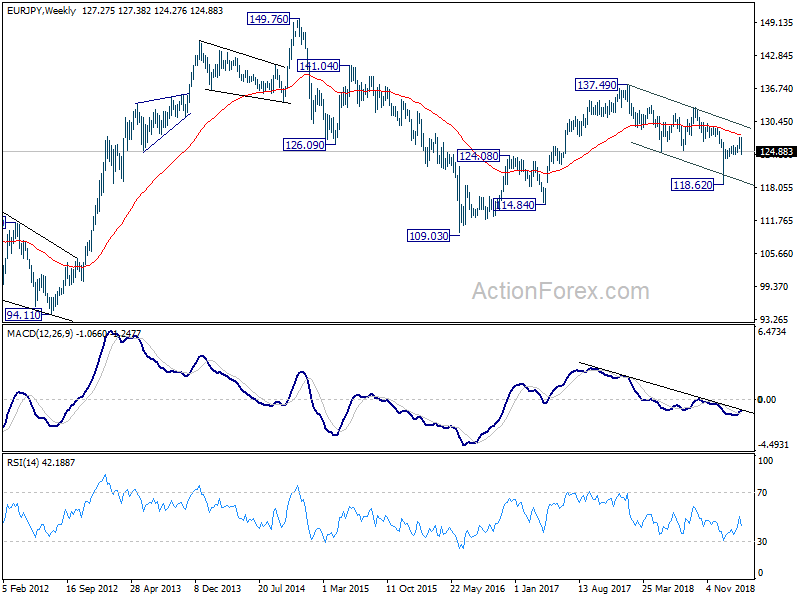
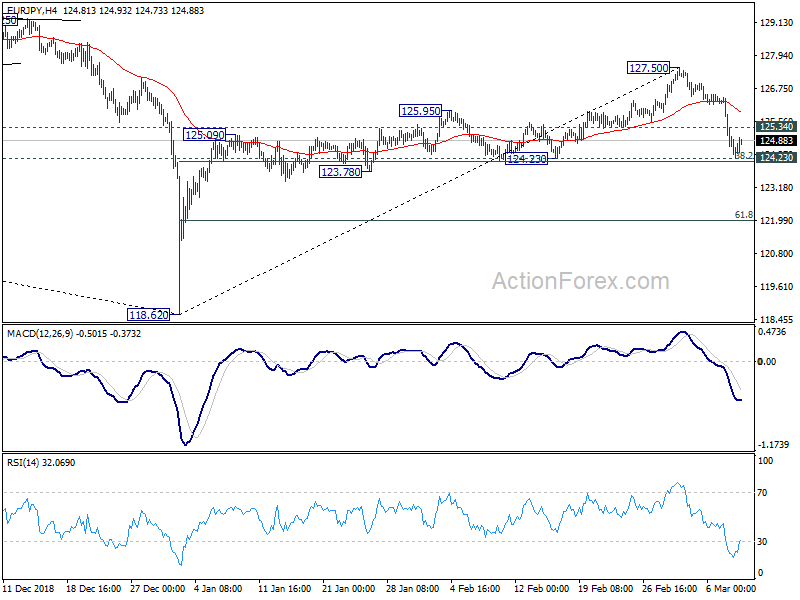
EUR/JPY dropped sharply to as low as 124.27 last week but recovered since then. Initial bias is turned neutral this week first, with focus on 124.23 cluster support (38.2% retracement of 118.62 to 127.50 at 124.10). Decisive break there should confirm completion of whole rebound from 118.61. Deeper fall should at least be seen to 61.8% retracement at 122.01 and below. In this case, the chance of resuming larger down trend will also increase. On the upside, though, break of 125.34 minor resistance after defending 124.10/23 will retain near term bullishness. Intraday bias will be turned back to the upside for retesting 127.50 first.
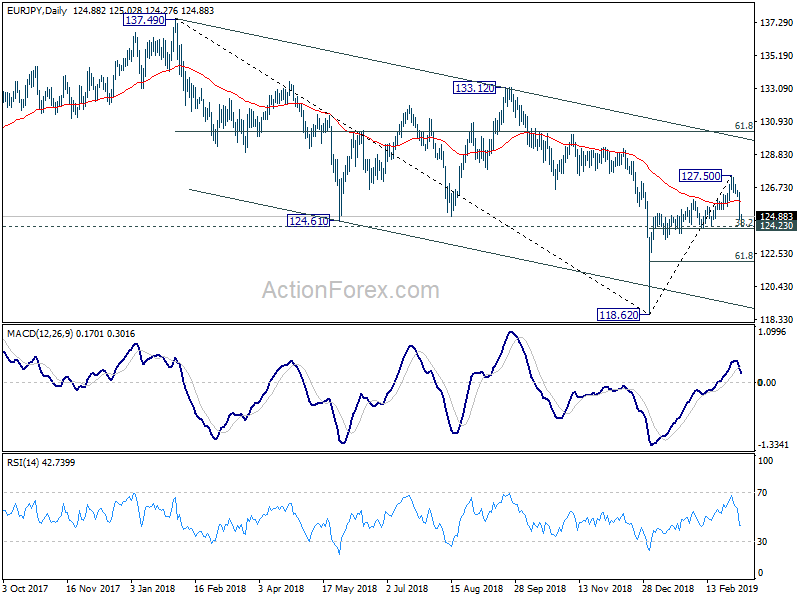
In the bigger picture, current development argues that medium term decline from 137.49 (2018 high) has completed with three waves down to 118.62 already. Decisive break of 133.12 resistance will confirm this bullish case. And whole up trend from 109.03 (2016 low) might resume through 137.49 in that case. On the downside, break of 124.23 support will invalidate this case. And in such case, the down trend from 137.49 could possibly resume through 118.62.
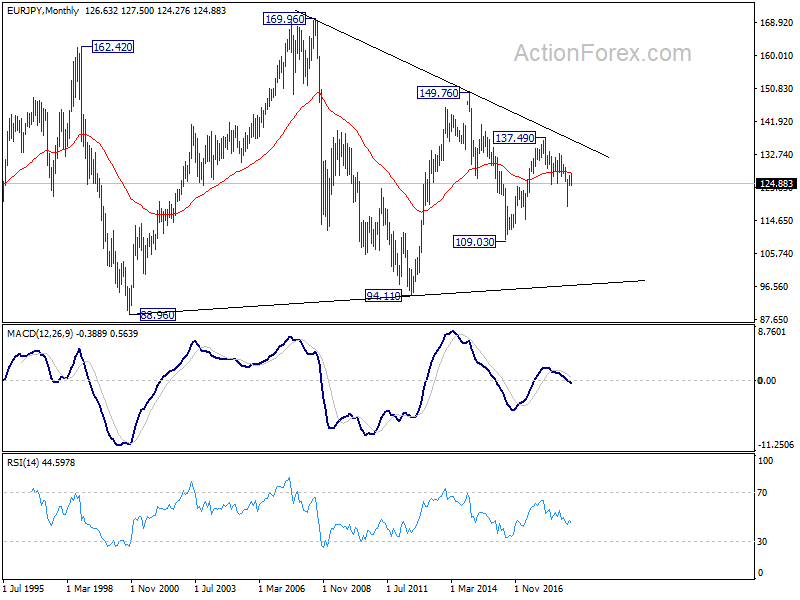
In the long term picture, EUR/JPY is staying in long term sideway pattern, established since 2000. Fall from 137.49 is seen as a falling leg inside the pattern and could have completed. Break of 133.12 resistance will likely send EUR/JPY through 137.49 towards 149.76 (2014 high).
EUR/GBP Weekly Outlook
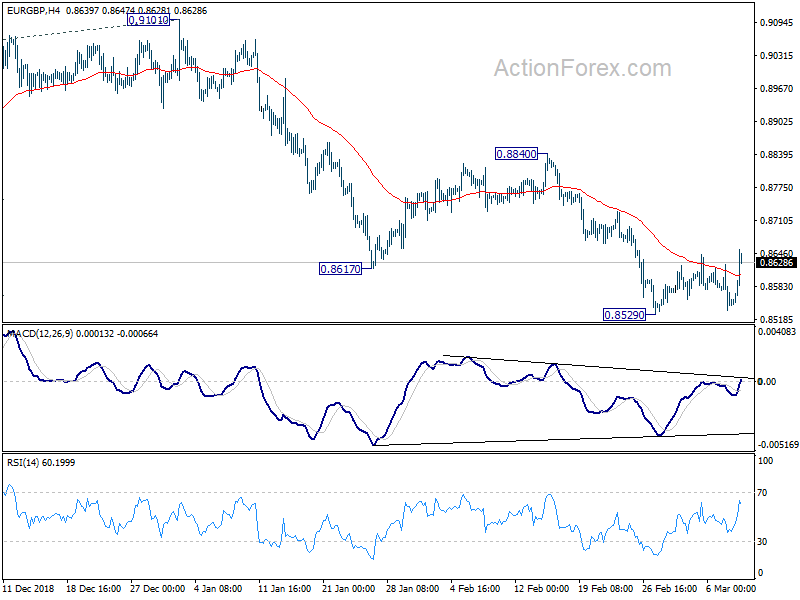
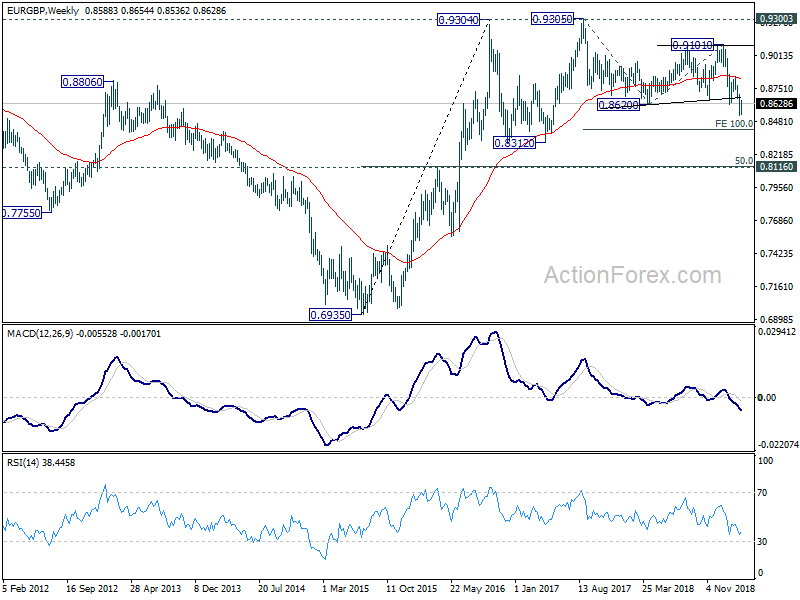
EUR/GBP stayed in consolidation from 0.8529 last week and outlook is unchanged. Initial bias remains neutral this week for some more consolidation. In case of stronger recovery, upside should be limited well below 0.8840 resistance to bring fall resumption. On the downside, break of 0.8529 will target long term projection target at 0.8416 next.
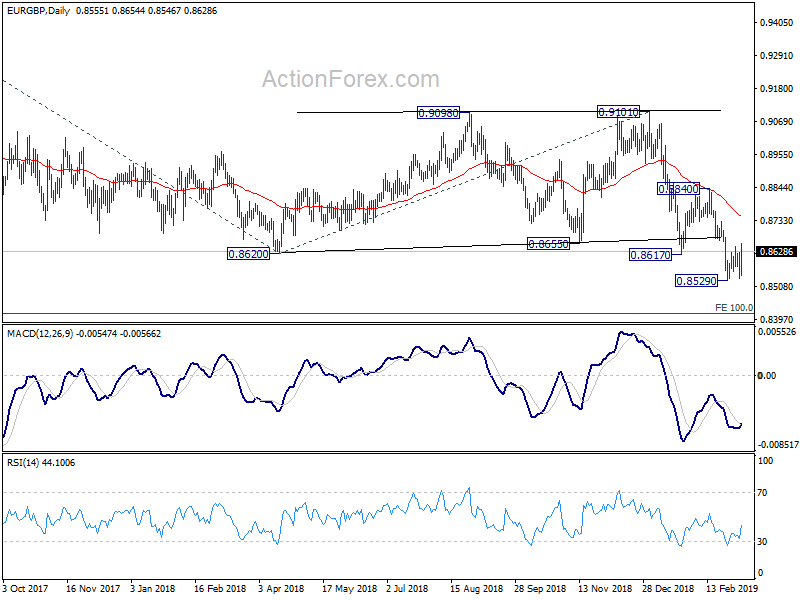
In the bigger picture, EUR/GBP is seen as staying in long term range pattern started at 0.9304 (2016 high). Current fall from 0.9305 (2017 high), is a falling leg inside the pattern. Such decline is now targeting 100% projection of 0.9305 to 0.8620 from 0.9101 at 0.8416 and possibly below. But for now, we'd expect strong support around 0.8312 support to contain downside and bring rebound.
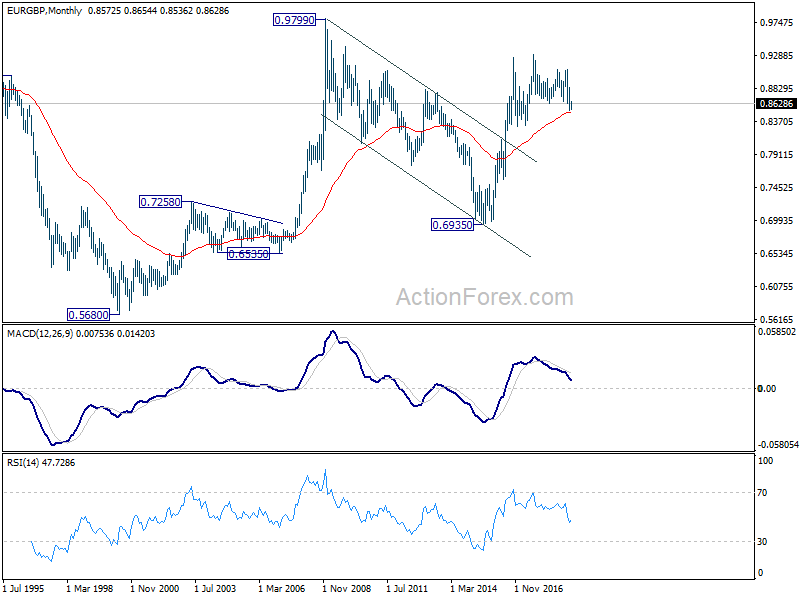
In the long term picture, we're holding on to the view that rise from 0.6935 (2015 low) is resuming the up trend from 0.5680 (2000 low). As long as 050% retracement of 0.6935 to 0.9304 at 0.8120 holds, further rise should be seen through 0.9305 to 0.9799 and above down the road.
EUR/AUD Weekly Outlook
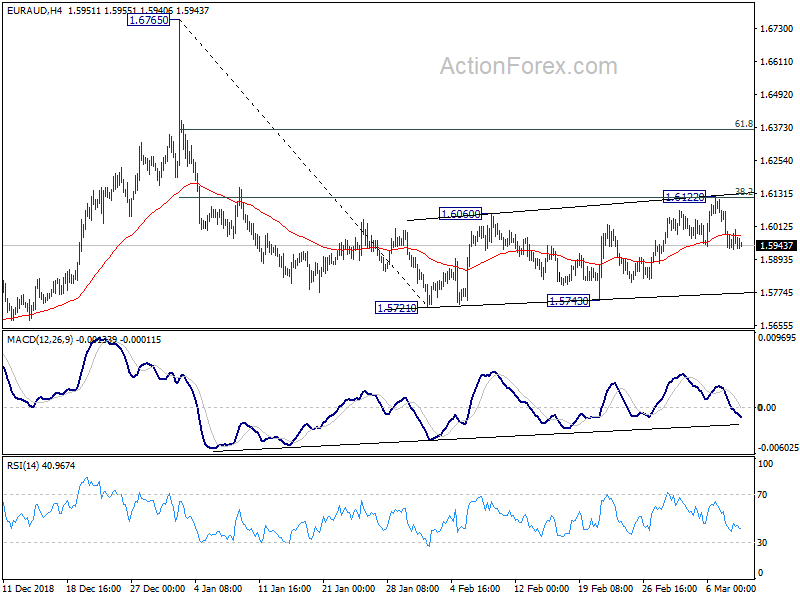
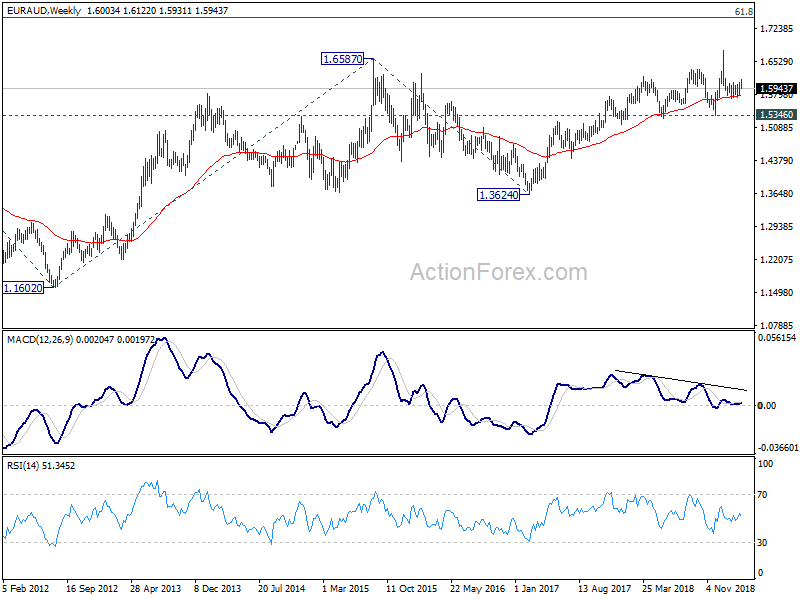
Despite edging higher to 1.6122, EUR/AUD failed to sustain gain and retreated. Initial bias remains neutral this week first. Price actions from 1.5721 so far suggests it's a correction only. That is, fall from 1.6765 isn't over yet. On the downside, break of 1.5721 low will resume the decline from 1.6765 and target 1.5346 support. On the upside, above 1.6122 will resume the corrective rise from 1.5721.
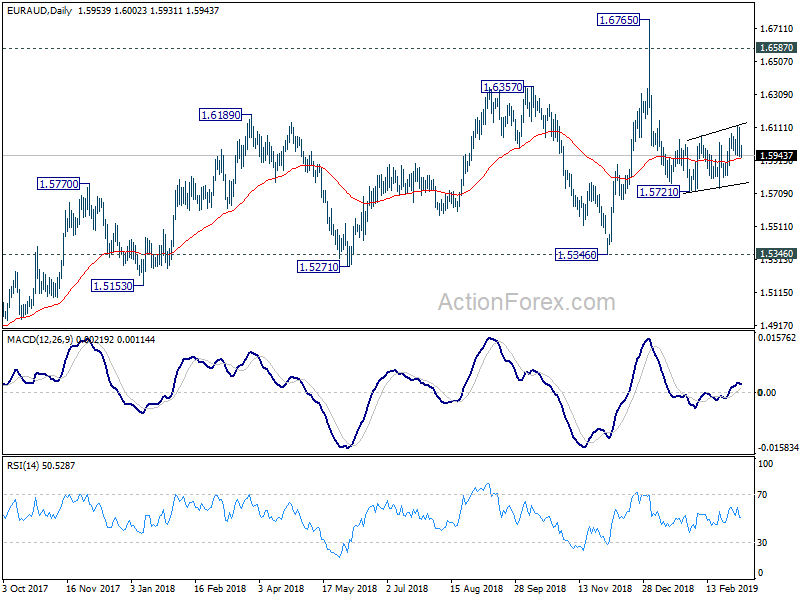
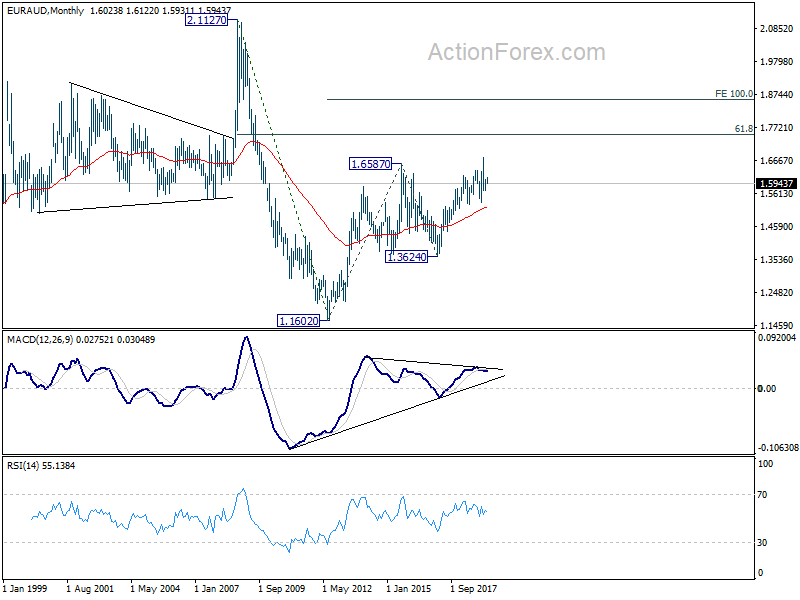
In the bigger picture, as long as 1.5346 support holds, outlook will remain bullish. Uptrend from 1.1602 (2012 low) is expected to resume sooner or later. Break of 1.6765 will target 61.8% retracement of 2.1127 (2008 high) to 1.1602 at 1.7488 next. However, firm break of 1.5346 key support will indicate trend reversal, with bearish divergence condition in weekly MACD, and turn outlook bearish.
In the longer term picture, the rise from 1.1602 long term bottom (2012 low) is still in progress for 61.8% retracement of 2.1127 to 1.1602 at 1.7488. Firm break there will pave the way to 100% projection of 1.1602 to 1.6587 from 1.3624 at 1.8069. This will remain the favored case as long as 1.5346 remains intact.
EUR/CHF Weekly Outlook
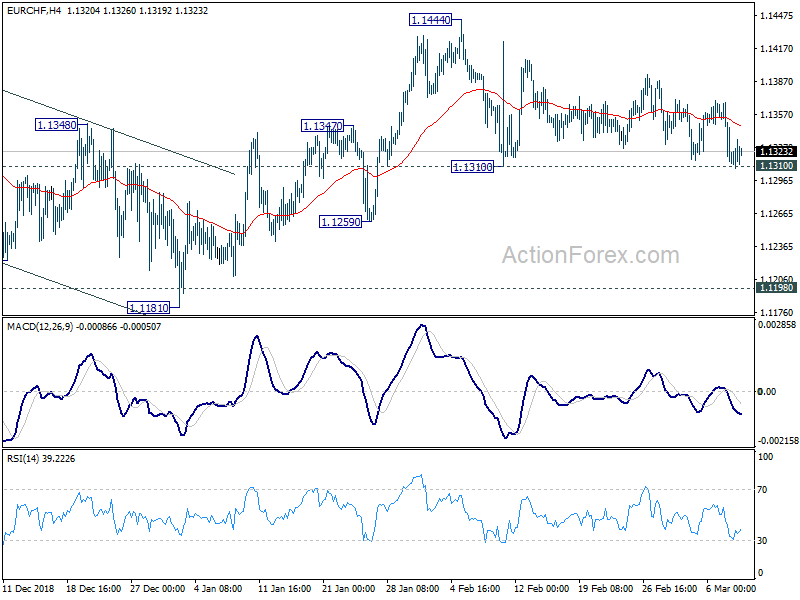
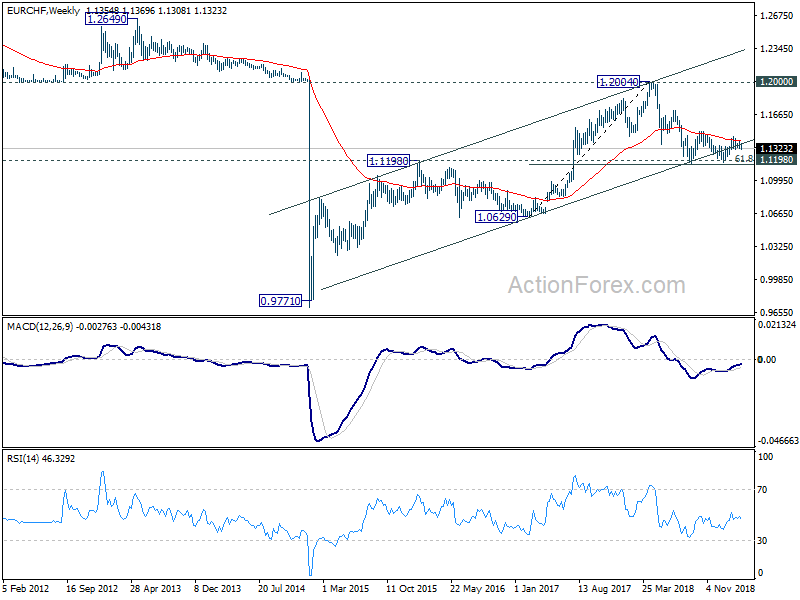
EUR/CHF breached 1.1310 support last week but failed to take out this support decisively. Initial bias remains neutral this week first and more consolidation could be seen. As long as 1.1310 support holds, further rally remains in favor. On the upside, break of 1.1444 will resume the rebound from 1.1181 and target 1.1501 key resistance next. On the downside, firm break of 1.1310 will indicate completion of the rebound. In that case, intraday bias will be turned back to the downside for 1.1181 low again.
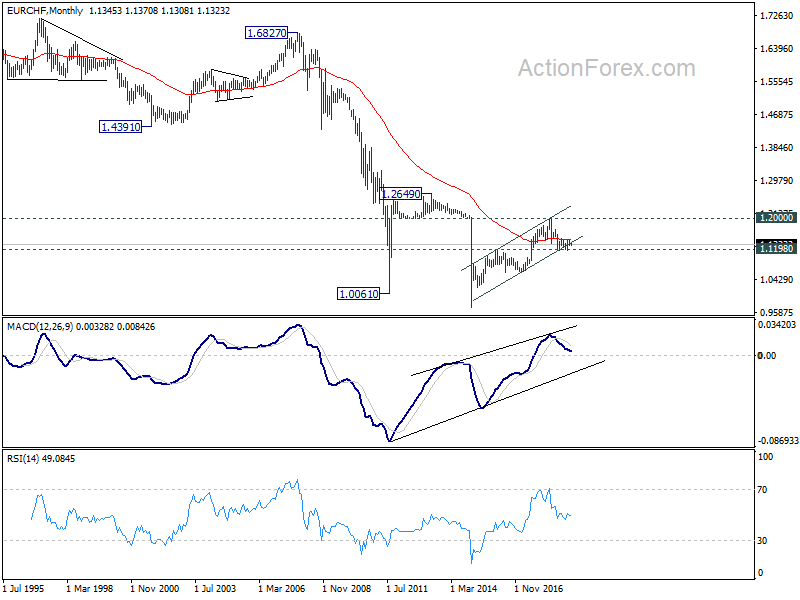
In the bigger picture, price actions from 1.2004 medium term top is seen as a correction only. Downside should be contained by 1.1154/98 support zone to complete it and bring rebound. Decisive break of 1.1501 (38.2% retracement of 1.2004 to 1.1173 at 1.1490) will confirm completion of the correction. Further rise should be seen to 61.8% retracement at 1.1687 and above next.
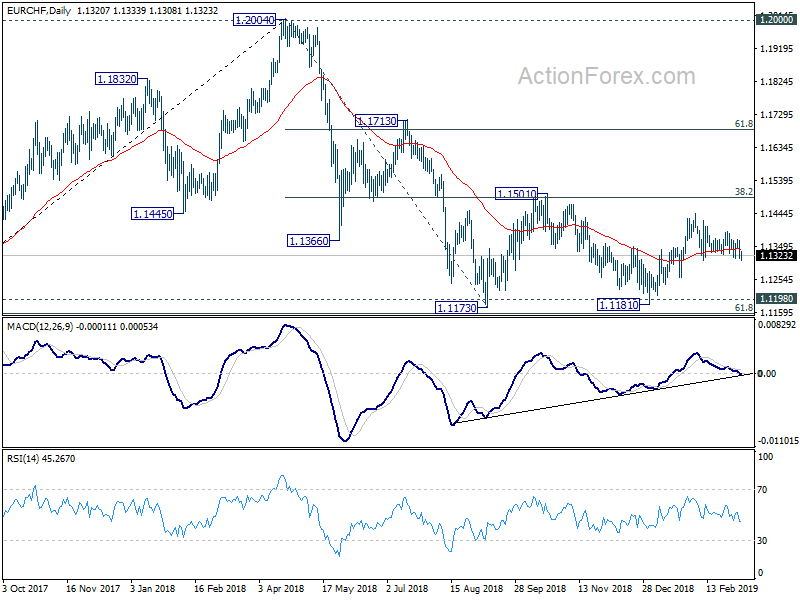
In the long term picture, as long as key support zone of 1.1198 (2016 high) and 61.8% retracement of 1.0629 to 1.2004 at 1.1154 holds, A break of 1.2 key resistance is still expected in the medium to long term. However, sustained break of the mentioned support zone will mark reversal of the long term trend. In that case, 1.0629 key support will be back into focus.
Sentiments Turned Sour on Slowdown Worries, But No Panic Button Hit Yet
Looking through all the financial market news last week, the message was rather unified. That is, 2019 will be a year of slowdown, globally. Economic data, central banks, governments and independent organizations are all reinforcing this message. While ECB's "pre-emptive" dovish turn triggered wild market reactions, it was just the nail for the case. The question now is whether the markets are pessimistic enough on the outlook.
Judging from the technical developments, we see that there are conditions in place for bearish reversals in stocks in US, Germany and Japan. But none of these indices confirmed reversal. Instead, late buying on Friday showed much underlying resilience. We believed the panic buttons weren't hit yet. A lot will depend on upcoming developments in US-China trade negotiations and Brexit.
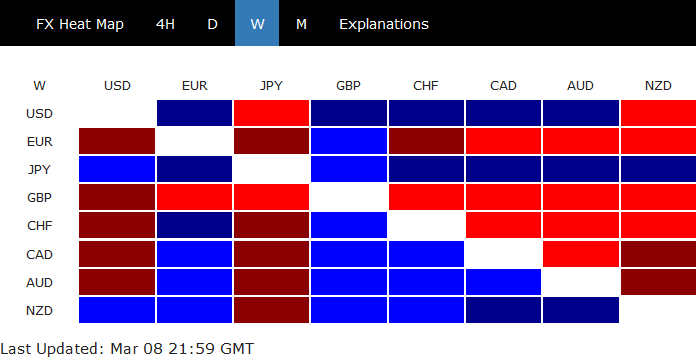
In the currency markets, Yen emerged as the biggest winner on risk aversion, and more so from reversal in global treasury yields. US 10-year yield hit as high as 2.759 on March 1 but closed just 2.625 last week, lowest since early January. German 10-year hit hit as high as 0.21, also on March 1, but closed the week at 0.071. New Zealand Dollar was the second strongest, US Dollar the third. On the other hand, Sterling was the weakest ones as crucial Brexit votes approach. Euro followed as second weakest on ECB.
A quick recap on OECD, China, ECB, BoC, RBA and NFP
Let's have quick recap on some important happenings last week. OECD lowered global growth forecast by -0.2% to 3.3% in 2019 and by -0.1% to 3.4% in 2020. In the Interim Economic Outlook, it's noted that Chinese and European slowdown, and weakening global trade growth are the principal factors weighing on the world economy. For China, while policy stimulus should offset weak trade development, "risks remains of a sharper slowdown" that would hit global growth and trade.
China lowered 2019 GDP growth target to 6-6.5%. The lower bound at 6% would be the slowest pace of growth in nearly three decades. China plans to cut around CNY 2T in taxes and fees for companies, in particular manufacturers. Budget deficit is expected to climb 0.2% to 2.8% of GDP. Shockingly poor February trade data reinforced that China is facing "tough struggle" and serious impact from trade war. February alone, exports contracted -20.7% yoy, decline since February 2016. Imports also dropped -5.2% yoy.
The picture was better if we take out the distortion by Chinese New Year. January and February combined, exports dropped -4.6% yoy while imports dropped -3.1% yoy. These figures were not disastrous but still weak. Zooming into trade with US, the deterioration was rather drastic. Total trade with US dropped -19.9% yoy, exports dropped -14.1% yoy but imports dropped -35.1% yoy. Trade with EU wasn't too bad, still recorded 3.7% yoy growth in total trade, 2.4% yoy rise in exports and 5.7% rise in imports.
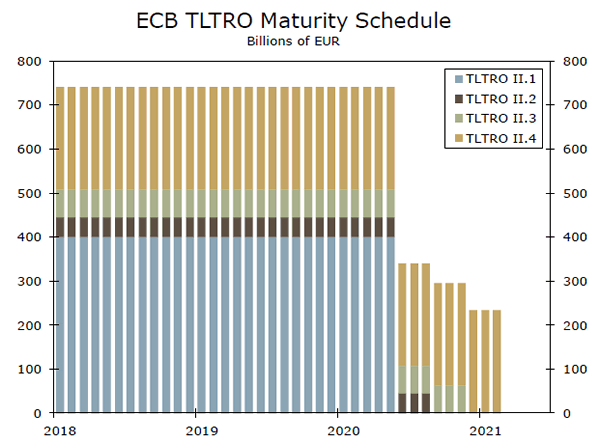
European slowdown is another drag to global economy as noted by OECD. ECB's statement, press conference and policy actions showed policy makers are in deep worry. Firstly, ECB changed the forward guidance and now expects to keep interest rates at present levels "at least through the end of 2019", prolonged from "summer of 2019". TLTRO-III is announced, quarterly from September 2019 through March 2021. It's aiming at preserving favourable bank lending conditions, and smooth transition of monetary policy.
In the post meeting press conference, ECB President Mario Draghi said weakening in data points to a "sizeable moderation" in growth extends into 2019. Impact from slowdown in external demand and country/sector specific factors is "turning out to be somewhat longer-lasting". GDP growth was "revised down substantially in 2019 and slightly in 2020". GDP is projected to grow by 1.1% in 2019, 1.6% in 2020 and 1.5% in 2021. They compare to December's projection of 1.7% in 2019, 1.7% in 2020 and 1.5% in 2021. Risks surrounding outlook are "still tilted to the downside", due to "geopolitical factors, the threat of protectionism and vulnerabilities in emerging markets."
Talking about central banks, after leaving interest rate unchanged at 1.75%, BoC acknowledged that, as "recent data" suggested, global economic slowdown has been "more pronounced and widespread" than previously anticipated. The most surprisingly change comes from the monetary policy stance. BOC judged that the current economic developments "warrant a policy interest rate that is below its neutral range". Moreover, "given the mixed picture that the data present, it will take time to gauge the persistence of below-potential growth and the implications for the inflation outlook". In short, BoC has take a rate hike off the table, at least for now.
Another central bank RBA sounded confident. After leaving interest rate unchanged at 1.50%, RBA maintained the central scenarios of growth, inflation, employment outlook. And continued to expect the "gradual" progress of reducing unemployment and inflation returning to target. Governor Philip Lowe later said that wage growth is expected to offset negative impact from fall in house prices. However, Q4 GDP released, at just 0.2% qoq, was way worse than expected. After the release, more economists are forecasting two RBA cuts this year, including , Westpac, Macquarie, JP Morgan, UBS, Nomura, AMP, Capital Economics, Market Economics...
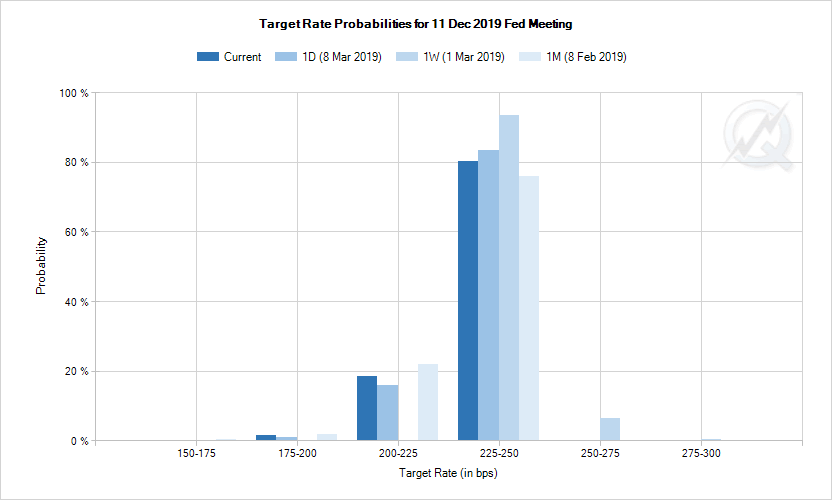
Talking about rate cuts, traders are not back betting on a cut by Fed by the end of the year. Fed futures now imply around 20% chance of that happening. It was practically at 0% chance a week ago and more than 20% chance a month ago. But judging on the fact that the chance just rose little on Friday, non-farm payrolls report didn't have too much impact yet. After all, the 20k job growth in February was undoubtedly poor. But a month of data could distorted by many factors like weather. We may have some upward revision in the data next month. Also, unemployment rate dropped back to 3.8% while average hourly earnings accelerated to 0.4% mom. It's overall not too bad a set of data.
US-China trade talks could drag on to April while tariff damages continue
No additional progress is reported regarding US-China trade talks. Instead, there are rumors that the March 27 Trump-Xi summit in Mar-a-Lago is called off. There are some speculations. Some noted the agreement is better signed in a third country. Some said Xi is concerned Trump will walk away from a deal in Florida, just like what he did to Kim in Vietnam. But most likely reason is the two sides are still far away on some core issues. The ne got at ions could drag on to April.
Meanwhile, we'd like to point out that the phrase "trade truce" is an incorrect description of the current state (admittedly, we used it too). According to Cambridge Dictionary, truce means "a short interruption in a war or argument, or an agreement to stop fighting or arguing for a period of time". If US and China are engaged in a trade war, the cannons are the tariffs. Such tariffs are still "flying", every single day. They just stopped escalating, but the war is still on.
If the punitive and retaliatory tariffs since last year damaged global trade growth and economy, they're still doing it. Hence, the longer the talks, the longer the impacts would be. IP theft, forced technology transfer and unfair trade practices are also happening everyday in China before a deal is made and enforced. Besides, it should be reminded that the steel and aluminum tariffs are still on, and there is no end in sight. It will remain a drag in EU's economy, as well as others.
EU's offer rejected by UK, Brexit votes loom
The crucial votes on Brexit from March 12 to 14 are approaching but there is no clear breakthrough. As a somewhat last ditch effort, EU chief negotiator Michel Barnier reveal, through his tweets, new package of "concessions" to the UK. Firstly, the arbitration panel can give UK the risk to a "proportionate suspension of its obligation under the backstop, as a last resort, if EU breaches its best endeavours/good faith obligations to negotiate alternative solutions."
More controversially, Barnier said "EU commits to give UK the option to exit the Single Customs Territory unilaterally, while the other elements of the backstop must be maintained to avoid a hard border. UK will not be forced into customs union against its will." That means, the UK can choose to apply the backstop just to Northern Ireland, rather than the whole of UK. This idea was rejected by the UK long ago.
The idea drew heavy criticism from the UK government. Cabinet Minister Andrea Leadsom rejected the idea and said she was "absolutely astonished". She also warned that "if the EU doesn't enable us to resolve this issue issue about the permanent nature of the backstop, then in effect what the EU is pushing us towards is leaving the EU without a withdrawal agreement at all". Chairman of the ruling Conservative Party Brandon Lewis also said "we are not going to have an agreement that compromises the unity of the United Kingdom."
Without any fundamental change regarding Irish backstop, there is practically no chance for May to get her Brexit deal through the Parliament on March 12, next Tuesday. A vote on no-deal Brexit will then be held on March 13 to see if there is explicit consent on this path. If not, there will be another vote on Article 50 extension on March 14.
As for Sterling's reactions, it should be noted that its recent rally was built on fading chance of no-deal Brexit. There was no positive development on the deal to push the Pound higher. Last week's decline just put Sterling back to where it was.
Risk sentiments turned sour, but no panic yet
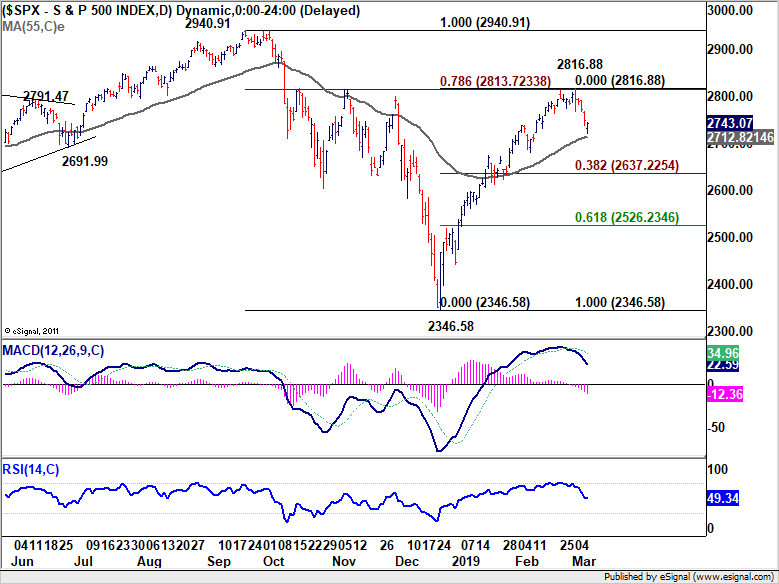
S&P 500's decline last week confirmed short term topping at 2816.88, after hitting 78.6% retracement of 2940.91 to 2346.58 at 2813.72. The index then hit as low as 2722.27. We're viewing rise from 2346.58 as a leg inside the medium term consolidation pattern from 2940.91. Thus, we're expecting such rise to complete between 2813.72 and 2940.91 and reverse.
However, the late buying on Friday argues that SPX could be trying to form a bottom around 55 day EMA (now at 2712.82). Thus, there is no confirmation of near term reversal yet. There could still be another rise through 2816.88 before reversal. Though, sustained break of 55 day EMA will add to the case of reversal and target 38.2% retracement of 2346.58 to 2816.88 at 2637.22 and below.
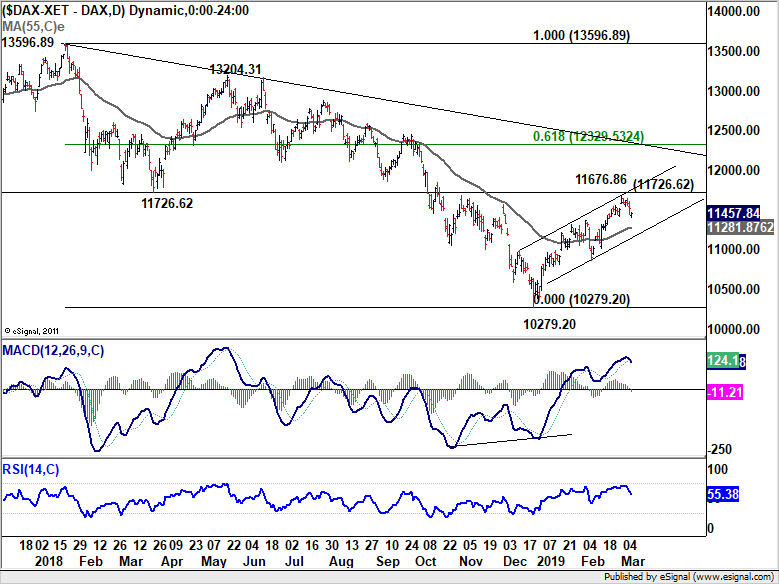
DAX's decline last week indicates short term topping at 11676.86. It is totally possibly for the rebound from 10279.20 to complete around 11726.62 key support turned resistance. This level is close to 55 week EMA at 11752.90 too. But so far, despite the pull back, DAX is held well inside near term rising channel as well as 55 day EMA. Thus, there is no clear indication of reversal yet. The rebound from 10279.20 could still extend to trend line resistance (now at 12350).
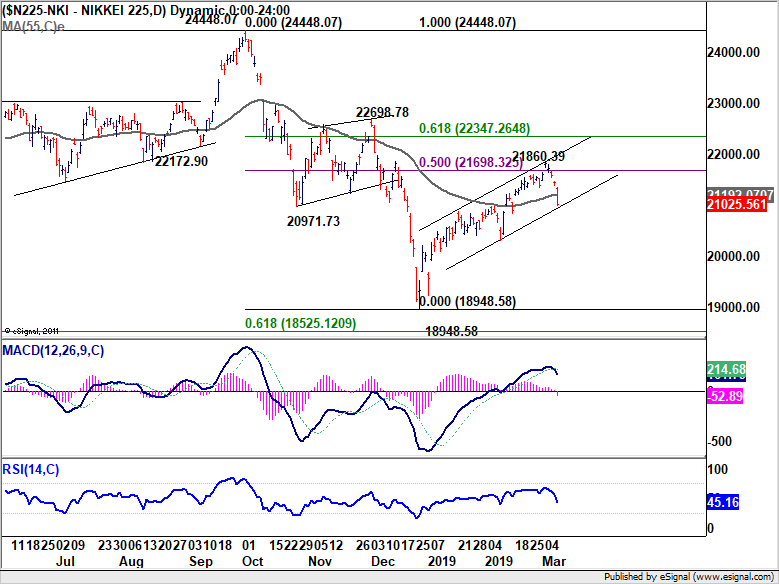
Comparing to the SPX and DAX, the outlook in Nikkei looks more dangerous as it closed below 55 day EMA. It's also reasonable for rebound form 18948.58 to complete around 50% retracement of 24448.07 to 18948.58 at 21698.32, which is close to 55 week EMA at 21564.12. But then, Nikkei is staying inside near term rising channel. Thus, there is still prospect of extending the rebound from 18948.58 to 61.8% retracement at 22347.26. Though, firm break of the channel support should bring deeper fall to retest 18948.58 low.
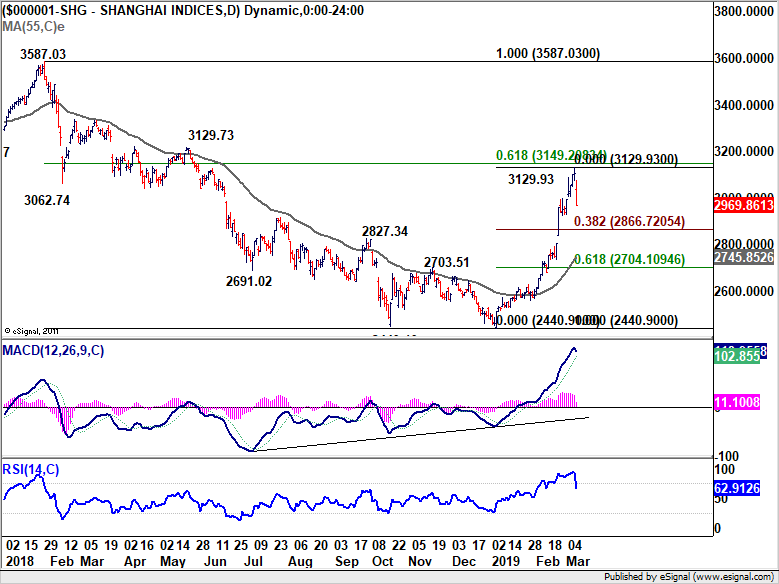
The decline in China Shanghai SSE on Friday, after poor trade data, might look steep. But it should be noted that it came after the index surged to 3219.93 on government tax and fees cut. The index just closed the week down -0.81%. And it's natural to have a set back ahead of 61.8% retracement of 3587.03 to 2440.90 at 3149.20. It's also close to 55 month EMA at 3144.61. There is prospect for the index to gyrate lower in near term. But we'd expect strong support from 38.2% retracement of 2440.90 to 3129.93 at 2866.72 to contain downside. 2440.09 is seen as a long term bottom that completes the long term correction from 2015 high at 5178.19. Thus, further rally is expected to 3587.03 resistance in medium term.
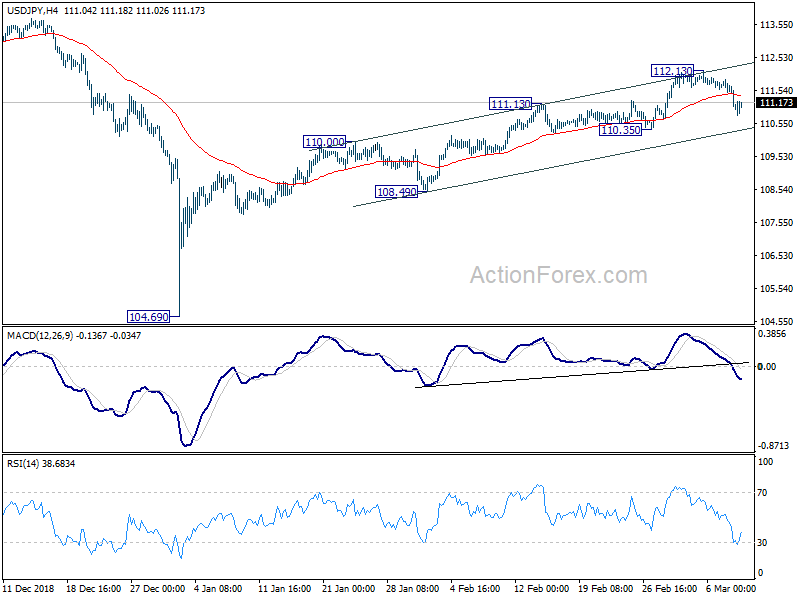
In the currency markets, USD/JPY, despite the sharp fall from 112.13, is holding well above 110.35 support, as well as near term channel support.
EUR/JPY also recovered just ahead of 124.23 cluster support (38.2% retracement of 118.62 to 127.50 at 124.10).
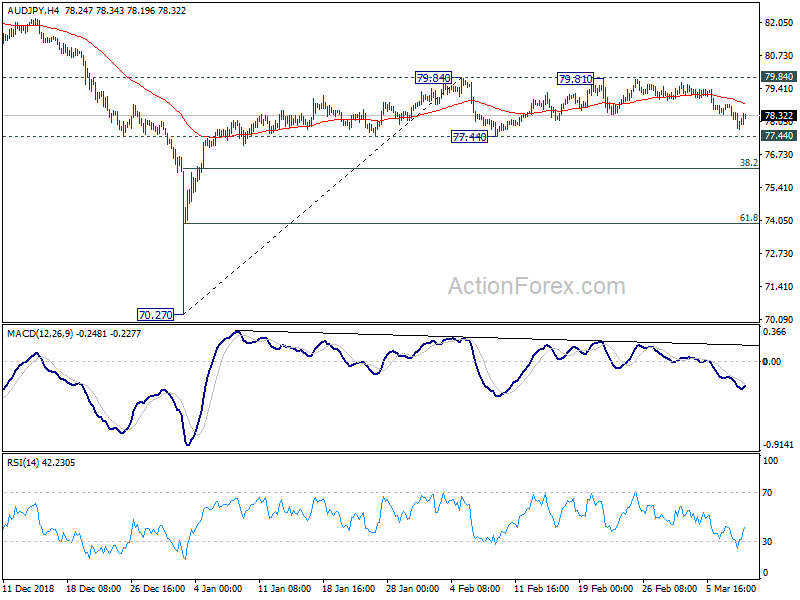
AUD/JPY was held well comfortably above 77.44 support.
CAD/JPY is still holding above 82.26 support.
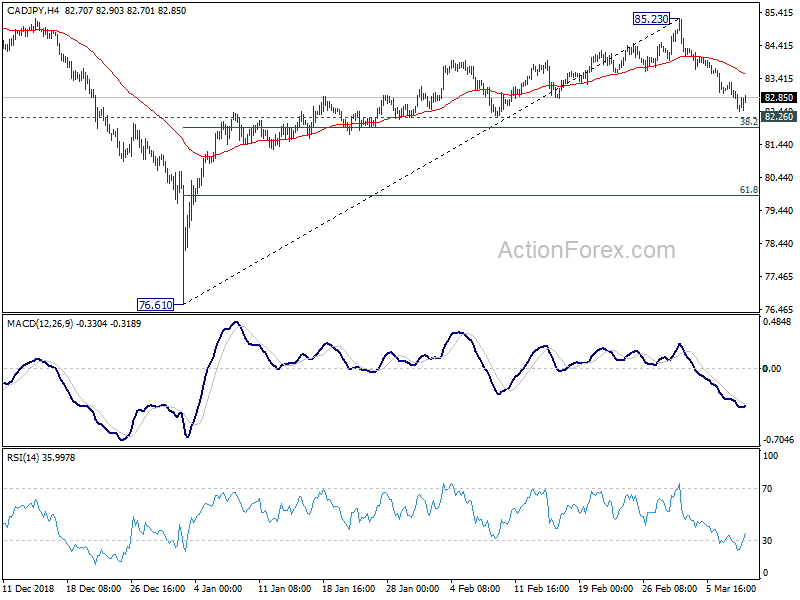
There is so far no confirmation on bullish reversal in the Japanese Yen. More evidence might come this week as the above levels are broken. But for now, the declines in Yen crosses are generally viewed as corrective first.
Position trading
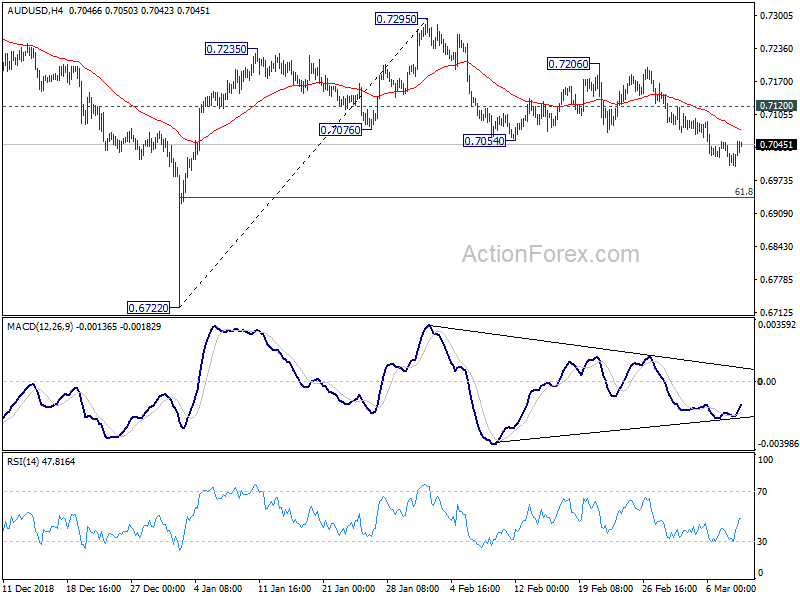
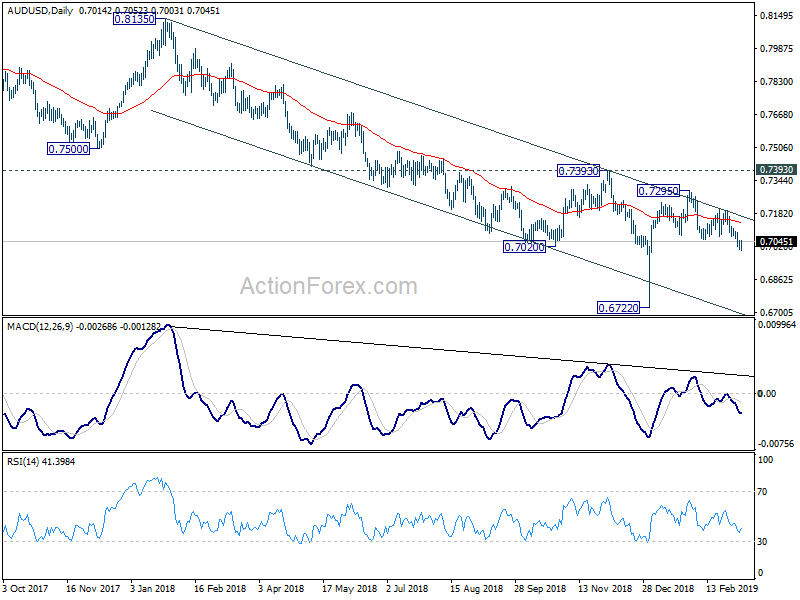
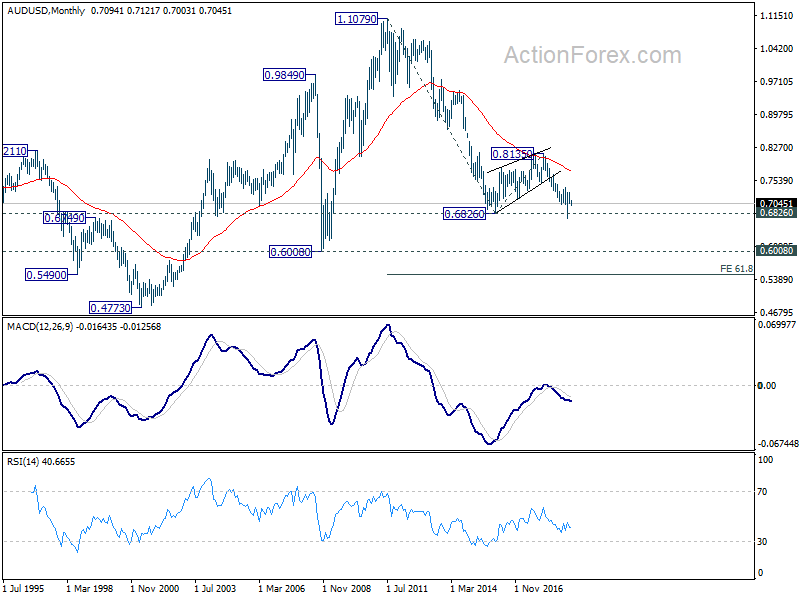
We've switch from AUD/JPY short to AUD/USD short last week, then there it went the turn in market sentiments and sharp decline in global treasury yield. We're admittedly trapped by prior week's rally in yields as we've given up the expectation for Yen to rebound. Though, the bearish view on Aussie still holds. So, we'd stay short in AUD/USD, entered at 0.7050. Stop will be held at 0.7120. 0.6722 low is the first target. But we're actually looking at long term down trend resumption to 0.6008 and below.
EUR/USD Weekly Outlook
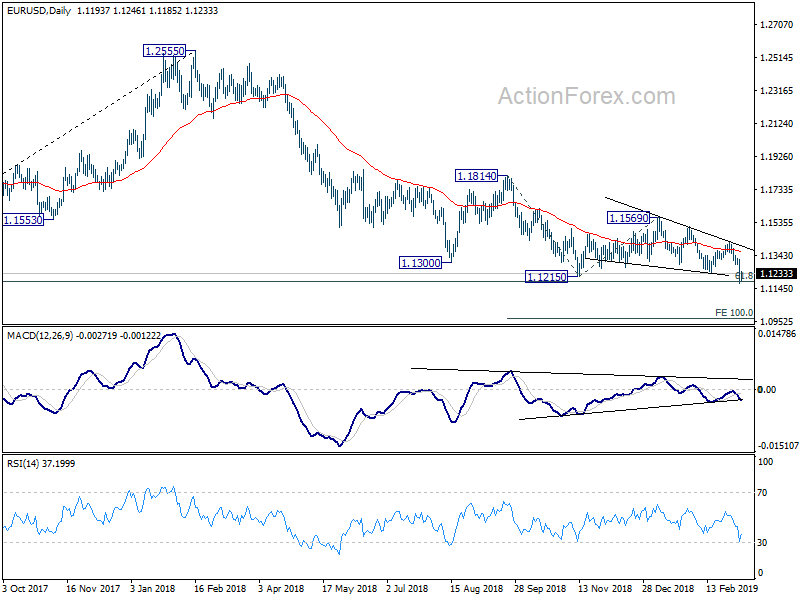
EUR/USD dropped sharply to 1.1176 last week and breach of 1.1215 low indicates resumption of down trend from 1.2555. As a temporary low is formed, initial bias is neutral this week for some consolidations first. Upside of recovery should be limited below 1.1419 resistance to bring down trend resumption. On the downside, break of 1.1176 will target 100% projection of 1.1814 to 1.1215 from 1.1569 at 1.0970 next.
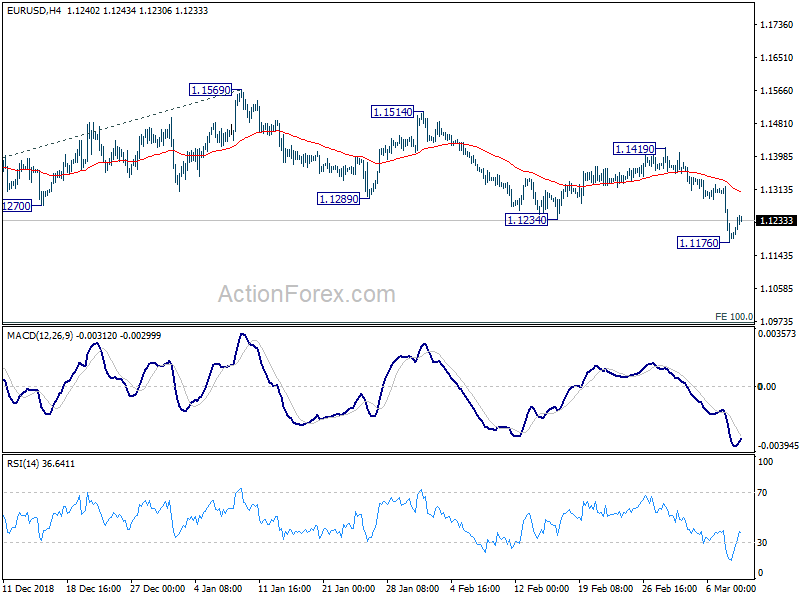
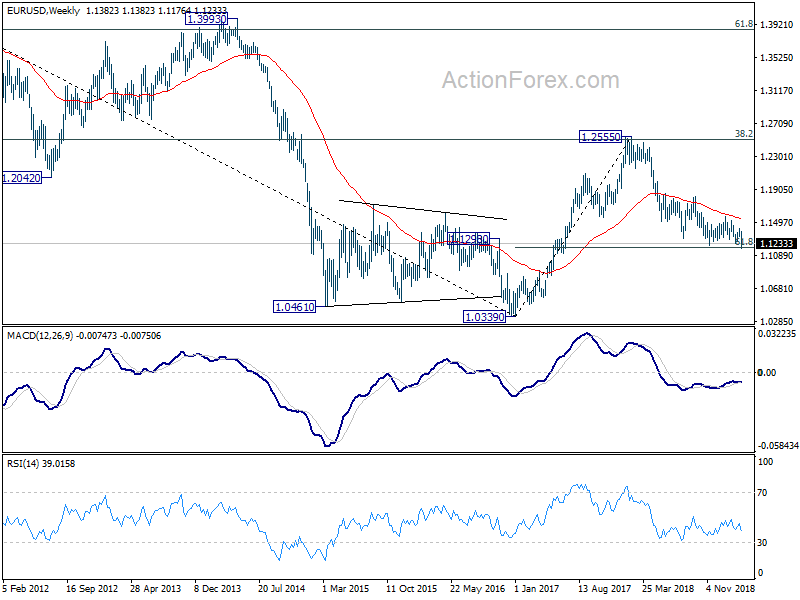
In the bigger picture, down trend from 1.2555 medium term top is still in progress. Bearishness is affirmed by sustained trading below falling 55 week EMA. 61.8% retracement of 1.0339 (2017 low) to 1.2555 at 1.1186 is met. Sustained break there will pave the way to retest 1.0339. On the upside, break of 1.1569 resistance will now indicate completion of such down trend and turn medium term outlook bullish.
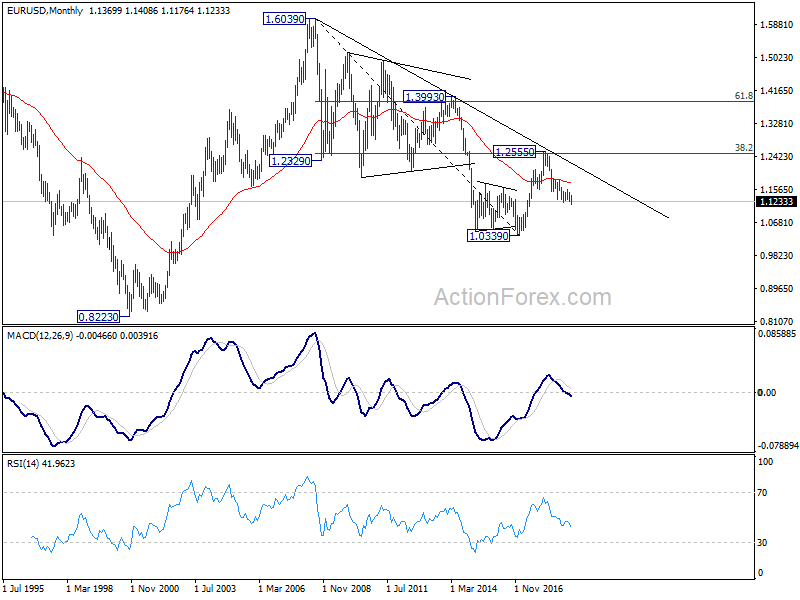
In the long term picture, the rejection from 38.2% retracement of 1.6039 to 1.0339 at 1.2516 argues that long term down trend from 1.6039 (2008 high) might not be over yet. EUR/USD is also held below decade long trend line resistance. Firm break of 61.8% retracement of 1.0339 to 1.2555 at 1.1186 should at least bring a retest on 1.0339 low. This will remain the favored case as long as 1.1569 resistance holds.
Summary 3/11 – 3/15
Monday, Mar 11, 2019
[php_everywhere instance="1"]
Tuesday, Mar 12, 2019
[php_everywhere instance="2"]
Wednesday, Mar 13, 2019
[php_everywhere instance="3"]
Thursday, Mar 14, 2019
[php_everywhere instance="4"]
Friday, Mar 15, 2019
[php_everywhere instance="5"]
China Weekly Letter: Trade Deal to Face Hurdles Close to the Finish Line
- Trade deal to face hurdles close to the finish line, but deal is still coming
- NPC lowers growth target to 6-6½% and announces large-scale tax cuts
- Chinese stocks take a beating after sharp rally and Citic sell recommendation
We are back to the Friday release of the China Weekly Letter. Early next week we will publish our 'Postcard from China' summarising the key takeaways from our trip to Shanghai, Hangzhou and Hong Kong last week.
Trade talks reaching the most difficult points
The US-China trade talks are getting close to the finish line and it is time to deal with the most difficult points. New York Times (NYT), 7 March, reports that Chinese officials are becoming wary of a quick deal and that agreeing on enforcement is the main hurdle. According to NYT Michael Pillsbury from the Hudson Institute (a China hawk close to the White House) said that 'there may be the need for another round of talks before the signing summit' . US ambassador in Beijing Terry Branstad told the Wall Street Journal , 8 March, that 'a date hasn't been finalized' for a meeting between Xi and Trump and that sufficient progress had to be made for both parts to feel confident that a deal can be signed. 'We're not there yet, but we're closer than we've been for a long time' Branstad told the WSJ.
According to sources close to the talks China demands a roll back of the majority of the tariffs to finalise a deal and would in return be willing to make further cuts in tariffs on goods like autos and agriculture, see Yahoo finance 4 March.
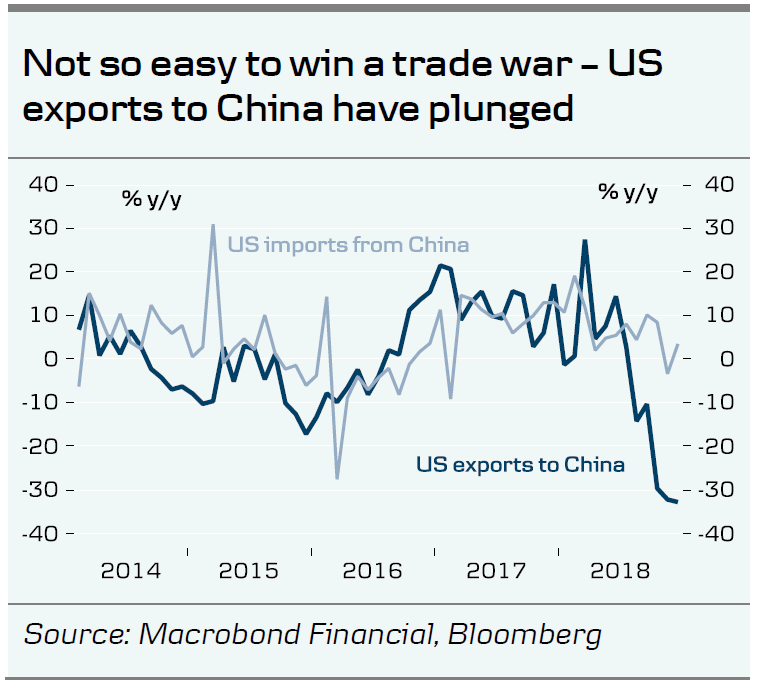
US trade data for December showed that the US-China trade deficit rose to a new record in 2018 of USD419bn from USD375bn in 2017. Interestingly US exports to China have plunged since the trade war started whereas US imports from China are broadly flat (see chart).
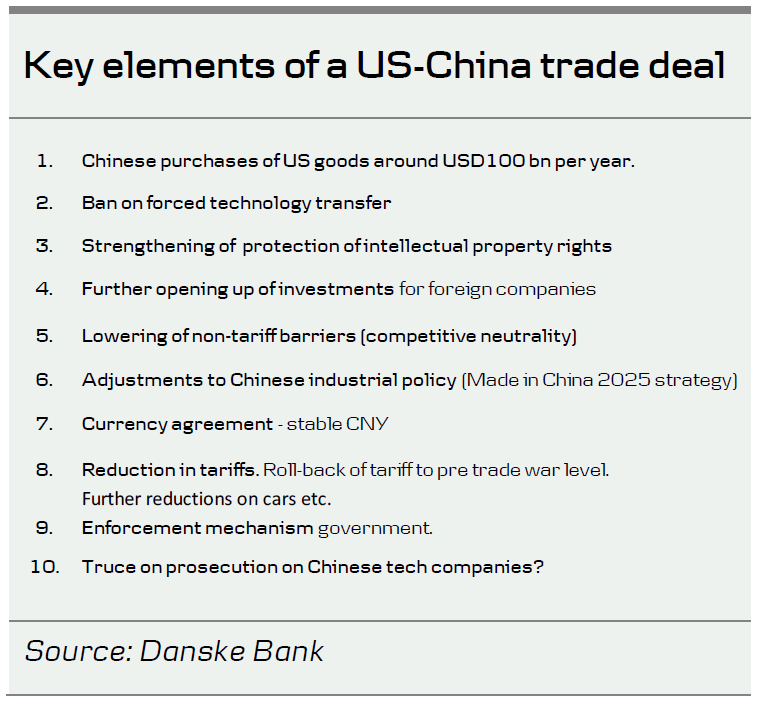
Comment . We rarely see 'high stake' deals be made without a break-down at some point during negotiations. We may be in for some more mixed news towards the end of the negotiations as both sides will aim to get the best possible deal . We have noticed that Trump has started to keep saying 'if we make a deal' every time he says it will be a great deal. His advisers may have told him not to seem too eager to make a deal as it weakens their negotiation position. However, the bottom line is that Trump needs a deal for his election campaign. A failure would send markets sharply lower and hurt the economy, including US farmers who are key voters in major swing states. It may be a while before we get a date for the Xi-Trump summit as both sides needs to be sure a summit ends in a deal. This could make markets nervous. When we get a date we can be quite confident a deal will be made (see table for an overview of what a trade agreement will likely include).
The sharp drop in US exports to China shows that it is not the higher tariff measures that matter for the direct effect on exports. China has only put tariffs on US goods worth USD50bn. Instead, it has been the quantitative measures of simply stopping purchases of certain US goods, such as soy beans, that China has used to hit back at the US.
NPC lowers growth target, and that is actually a good thing
The National People's Congress kicked off Tuesday with Premier Li Keqiang reading out the so-called Work Report to the close to 3000 delegates. The key elements were:
- Growth target lowered to 6-6½% from 6½% (as widely expected). Li was frank about the growth challenges saying 'we must be fully prepared for a tough struggle'.
- Fiscal easing through reduction in VAT rates. For manufacturing companies the VAT rate is cut from 16% to 13% and for construction, transportation and other industries the rate is cut from 10% to 9%. The tax cut and other reductions in costs to social insurance should lead to a reduction in business costs of close to 2% of GDP. It is partly compensated by belt-tightening in other areas, though.
- Further opening-up measures. NPC is set to approve a new Foreign Investment Law, which among other things increases protection of intellectual property rights, bans forced technology transfer, and stresses that foreign and domestic companies should be treated equally, except in prohibited industries: China Daily, 31 January, and China.org, 3 March.
- Still a strong focus on upgrading the manufacturing sector and investments in high-tech – but the label 'Made in China 2025' is gone.
- Measures to improve education. China will take more measures to improve education in rural areas and expand vocational training.
Comment. We see the lowering of the growth target as positive. It illustrates China's prioritisation of 'quality over quantity' and balancing short-term risks to the economy with long-term sustainability in growth. The fiscal easing was generally expected and adds to other stimulus measures. More important for the long-term outlook is China's focus on technology, education, more competition from opening-up and measures to support the private sector. The work report lists a range of measures to underpin so-called 'market entities', the Chinese expression for private sector.
Stock markets take a hit on Friday, exports plunge
After a strong bull run this year, equities hit the wall on Friday with a drop of 4%; the biggest daily drop in five months. Sell recommendations from some of the biggest Chinese securities companies on two major financial companies (China Securities and PICC) seemed to trigger the decline, see Bloomberg 8 March. The recommendations were seen as endorsed by the authorities, as the exuberance in markets is deemed a potential threat to financial stability (as was the case in the 2015 stock market bubble). Weak export data earlier this week also worked to temper the rising optimism over the Chinese economy.
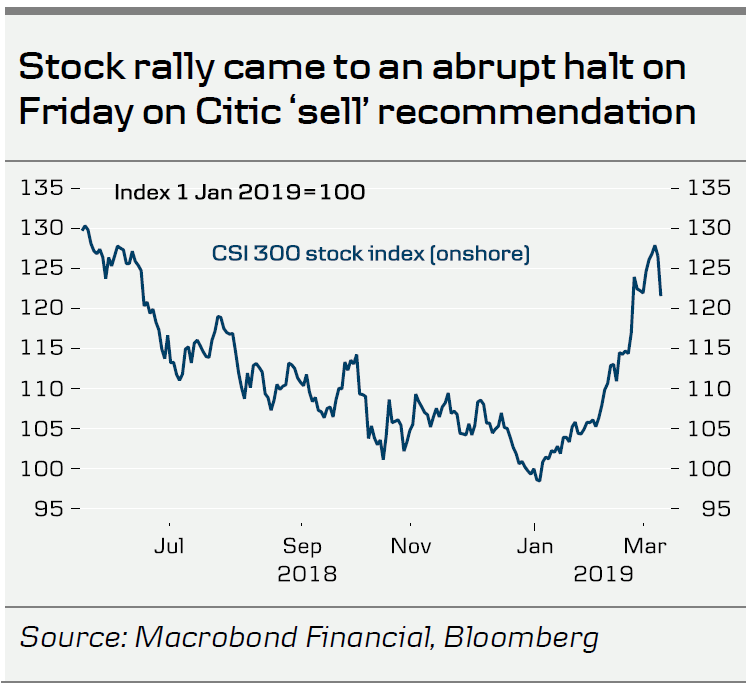
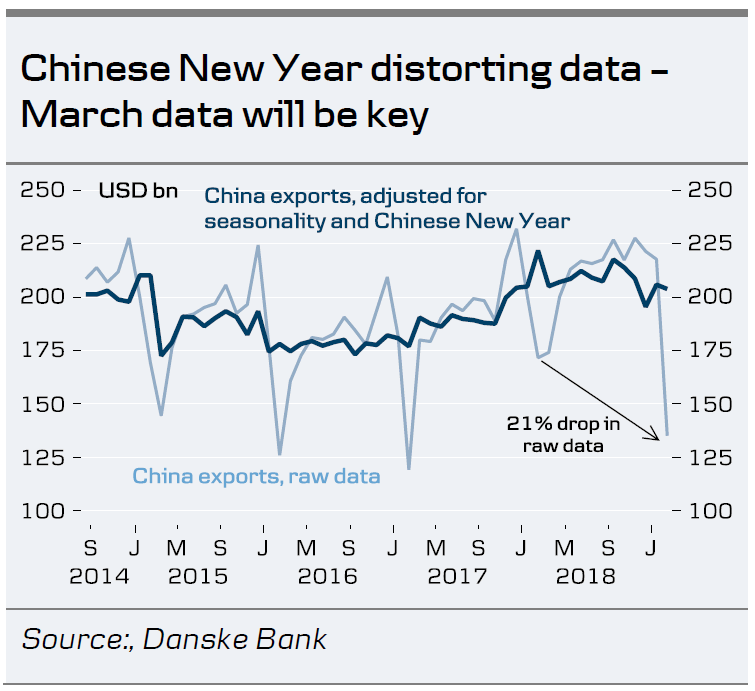
Comment. A correction in the stock market was overdue after a 25% rally in 10 weeks. We see more downside in the short term but are positive on a 6-9 month horizon as we look for a Chinese recovery and lower risk premia on the back of a trade deal. The export data for February were distorted by the Chinese New Year and do not look as bad when correcting for this (see top chart).
Other China news of the week
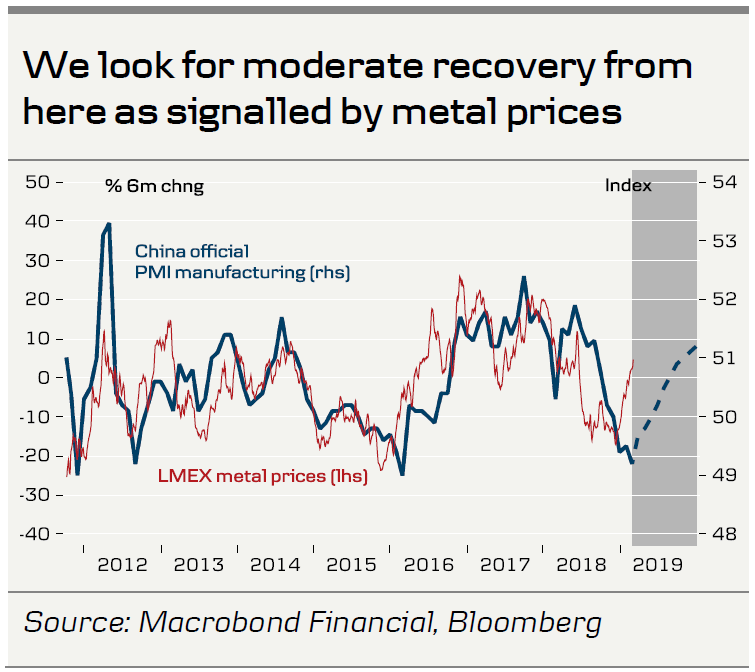
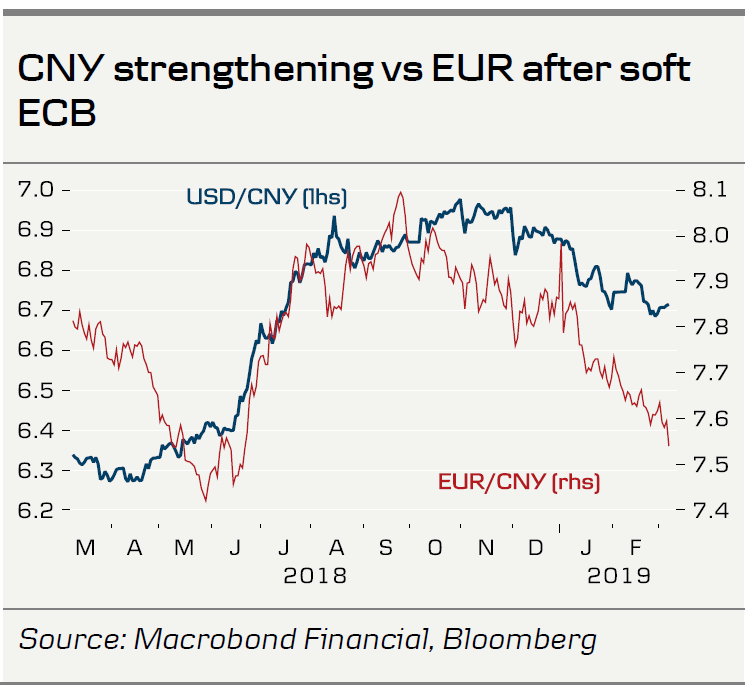
CNY strengthened further versus the EUR following this week's softer-than-expected move by the ECB. The trend is still towards a stronger CNY (see chart).
Italy is set to be the first G7 country to endorse Belt and Road Initiative, see FT 6 March. The Italian move has drawn sharp criticism from Washington. The Chinese Foreign Minister Wang Yi urged the EU to stay 'independent' in dealings with China after the US warning, see SCMP 8 March.
Weekly Economic and Financial Commentary: Labor Market Slowing but Still Strong
U.S. Review
Labor Market Slowing but Still Strong
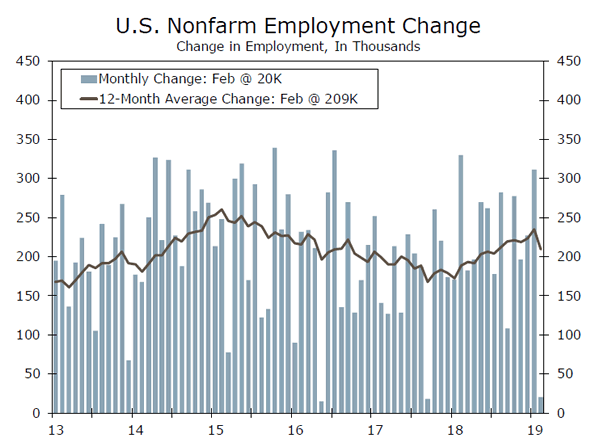
- Nonfarm payrolls came in well below expectations, as employers added 20K new jobs in February after adding 311K in January. The three-month average gain of 186K is still rather strong, but marks a moderation in the pace of job growth.
- The ISM non-manufacturing survey continues to point to robust growth in the service sector, while the manufacturing sector succumbs to trade tensions and slowing global growth. The trade deficit widened to a ten-year high in December.
- Housing starts rebounded in January, as lower rates and improved builder sentiment should provide a moderate boost to the housing market this spring.
Labor Market Slowing but Still Strong
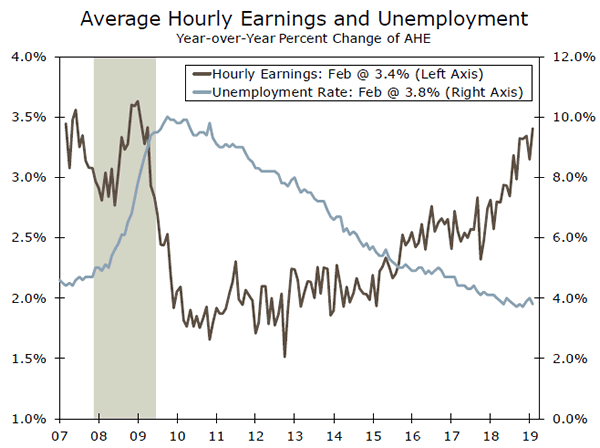
With the Fed firmly on 'pause', all eyes are on incoming data for clues to its next move. Nonfarm payrolls came in well below expectations, as employers added just 20K new jobs in February after adding 311K in January. Through the volatility, the three-month average gain of 186K is still rather strong, but marks a moderation, consistent with an upward tick in jobless claims and more moderate survey evidence from purchasing managers. The unemployment rate fell to 3.8% from 4.0%. An increasingly tight labor market is finally feeding through to higher wage growth, as average hourly earnings rose 0.4%, pushing the year-over-year increase to 3.4%, the highest pace of this cycle. Yet, with the expansion pulling more into the labor force—prime age participation is up 0.4 percentage points this year—the extent of tightness, and, by extension, inflationary pressure, is perhaps overstated. That, along with a pickup in productivity growth of late, provides the Fed further reason to be patient.
Purchasing managers' surveys point to a growing divergence between the manufacturing and service sectors. The ISM non-manufacturing index rebounded three points this week to 59.7, and the underlying cycle highs for business activity (64.7) and new orders (65.2) point to considerable momentum. Such strength in largest sector of the economy, if realized, would likely be justification for the final Fed rate hike we expect for this cycle, in H2-2019. That assumes that the Fed's pause allows the economy to weather ongoing 'crosscurrents'. The ISM manufacturing survey has more clearly succumbed to a slowdown. Down to 54.2, the index has retreated from the sky-high readings of the past couple of years amidst slowing growth overseas and no definitive signs of the long-awaited trade deal with China.
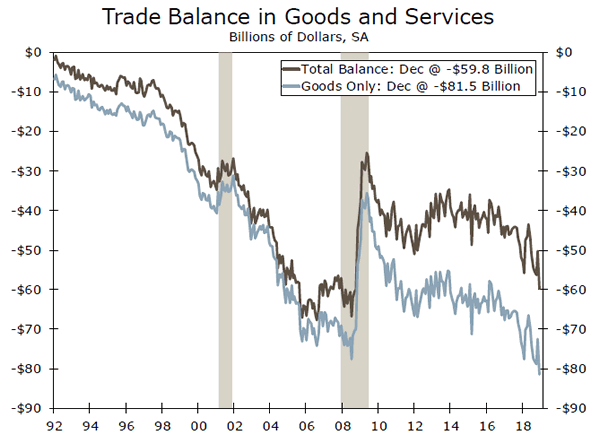
Speaking of trade wars, the U.S. trade deficit widened in December to $59.8 billion, a ten-year high, as exports fell 1.9% and imports rose 2.1%. Exports to China in particular have fallen in seven consecutive months amidst retaliatory tariffs and a slowdown in the world's second largest economy. We now expect revised Q4 GDP data to reflect a drag of 0.3 percentage points from net exports. While the cloud of trade uncertainty will likely persist for the foreseeable future, financial conditions—one of the other major crosscurrents identified by the Fed as a reason to pause on rate hikes—have eased markedly to start the year. We learned this week that household aggregate wealth fell 3.7% in the fourth quarter, with the drop owed entirely to the sharp decline in equity markets. Year to date, equity markets have retraced most of their decline, with the S&P 500 up nearly 10% as investors attempt to price in the Fed's dovish shift.
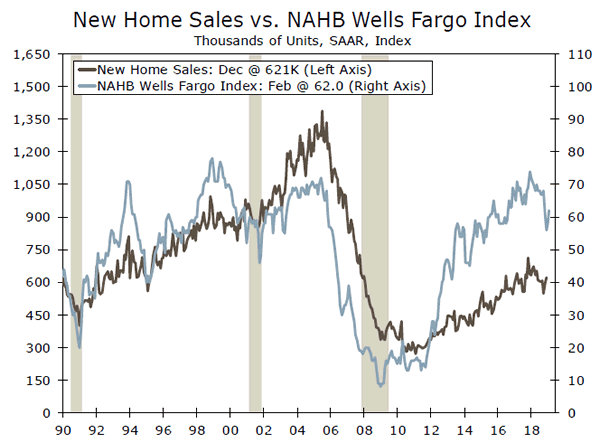
We also suspect the pause in rate hikes came just in time to deliver a much needed reprieve to the housing market. The plunge in the NAHB homebuilders' survey accurately predicted the string of four consecutive monthly declines in housing starts, including the 14% drop in December. Yet optimism rebounded on the Fed's shift and the 50 bps decline in mortgage rates, and the hard data followed, with starts bouncing back 18.6% in January. Permits have risen four out of the past five months and are now running 15% ahead of starts, indicating further relief is likely ahead for housing as we enter the spring buying season with rates lower, price appreciation cooling and builder sentiment improving.
U.S. Outlook
Retail Sales • Monday
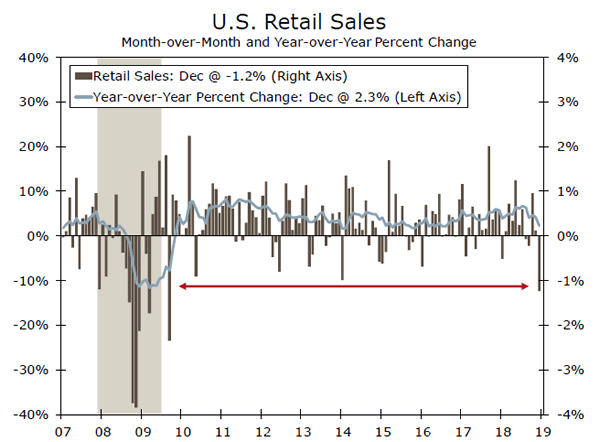
Shoppers did not rush home with their treasures this past December, but was it really the worst month for retailers in 10 years?
Admittedly there were more than a few factors to weigh on holiday spirits. From the high to the low, the S&P 500 shed more than 15% of its value during that month. Unable to pass a budget, the U.S. government shut down. Amid all this uncertainty and a reporting delay due to the shutdown, retail sales cratered 1.2% on the month.
On Monday of next week we will get a look at retail sales for January. Although the shutdown stretched well into that month, the stock market finished January about 15% above the December lows. We look for a partial bounce-back in January and would not be surprised to see an upward revision to December's figures.
Previous: -1.2% Wells Fargo: 0.2% Consensus: 0.0% (Month-over-Month)
CPI • Tuesday
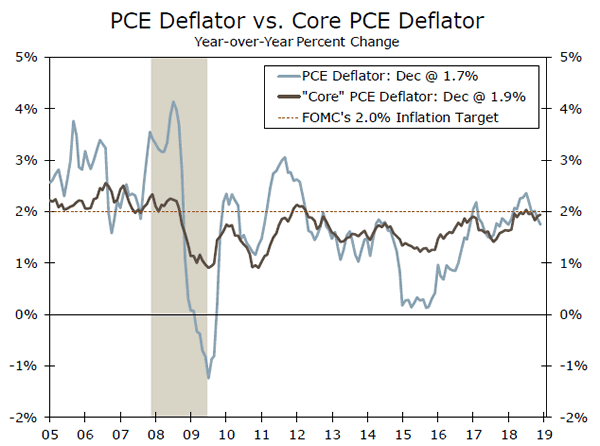
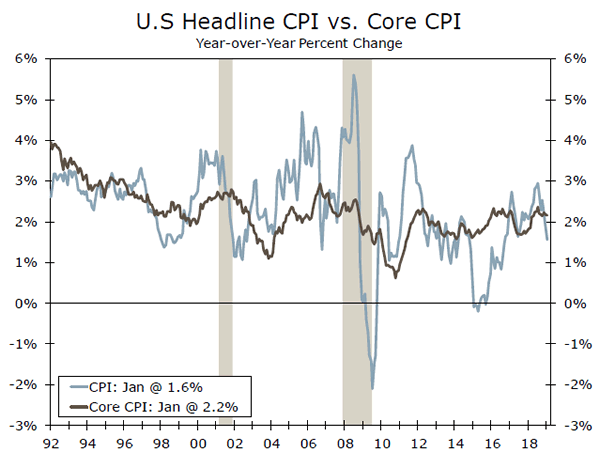
After years of struggling to hit its inflation target, the Fed has been much closer recently. Headline inflation has been pushed lower by soft energy prices, but core measures of inflation have been closer to 2.0%. The core PCE deflator, for example, came in at 1.9% year-overyear in December. The core CPI index registered 2.2% in January, and February figures will print on Wednesday.
The more recent available figures for the CPI can be explained by the government shutdown, which impacted the BEA (tasked with the PCE measure), but did not affect the BLS, keeper of the CPI. By about any reckoning the inflation figures are more or less in line with the Fed's 2.0% target, at least core measures. We are not looking for headline inflation to snap back in this report on Wednesday. Were that to occur, it might shake some of the market complacency about whether or not the Fed will hike rates in 2019.
Previous: 1.6% Wells Fargo: 1.5% Consensus: 1.6% (Year-over-Year)
Industrial Production • Friday
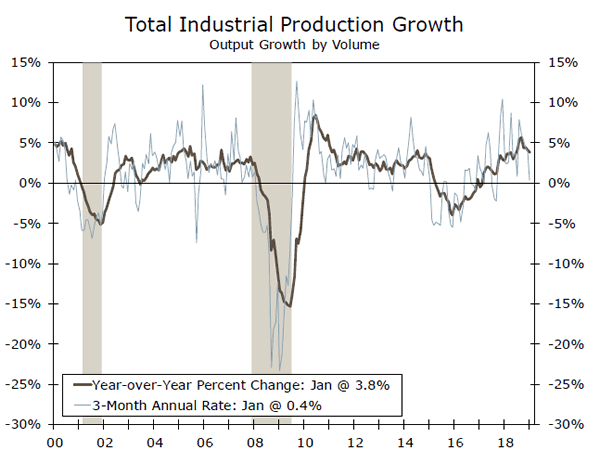
The manufacturing sector has lost momentum. Industrial production increased in nine out of 12 months in 2018, but started 2019 with a decline of 0.6%. Utilities (+0.4%) and mining (+0.1%) each managed a gain in January, but modest as they were, they were easily swamped by the 0.9% decline in the manufacturing category, which comprises about three quarters of all industrial output.
The weakness was most pronounced in motor vehicles and parts, which fell 8.8%, marking the largest one-month drop in auto production since the recession in 2009.
We may see some bounce here in February, but there are not a lot of reasons to be optimistic about manufacturing in general. The ISM index is lower on trend in recent months and core capital goods orders and shipments have both been spotty at best.
Previous: -0.6% Wells Fargo: 0.5% Consensus: 0.6% (Month-over-Month)
Global Review
Central Bankers Acknowledge Global Growth Concerns
- The precarious economic outlook in the Eurozone took center stage this week, capped by a high-profile meeting of the European Central Bank (ECB). Policymakers cut their growth and inflation forecasts and adopted a more dovish stance.
- Although economic growth has been slowing in the Eurozone for the past few quarters, the most recent economic data for Q1 have shown some tentative signs of stabilization.
- The Bank of Canada (BoC) also met this week against a backdrop of weakening domestic growth. Policymakers seemed concerned about global growth, and the Canadian housing market continues to face challenges.
Central Bankers Acknowledge Global Growth Concerns
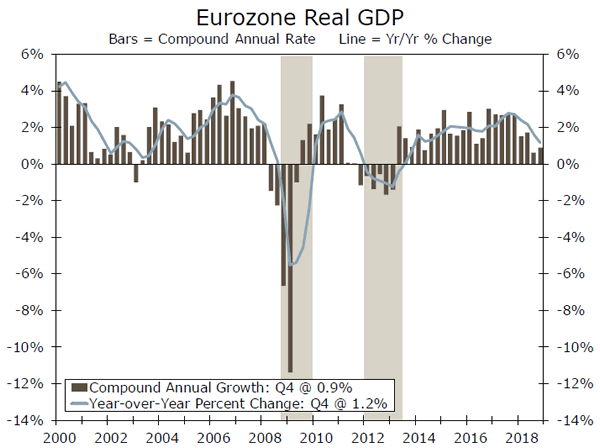
The precarious economic outlook in the Eurozone took center stage this week, capped by a high-profile meeting of the ECB. More details on the ECB meeting can be found in this week's Interest Rate Watch on page 6, but in short, monetary policymakers cut their growth and inflation forecasts, pushed back their forward guidance for future rate increases and introduced a new package of Targeted Longer-Term Refinancing Operations (LTROs).
As illustrated in the chart on the front page, economic growth in the Eurozone has clearly been slowing over the past few quarters, sparking the more dovish stance from ECB policymakers. Despite this slowdown, the most recent economic data have been a bit more encouraging. Eurozone retail sales bounced back from an unusually weak December with a strong 1.3% month-over-month gain in January. On a year-over-year basis, real retail sales were up 2.2%, up from 0.3% in December. While there has clearly been some noise in the data of late, January's rebound was an encouraging start to the first quarter.
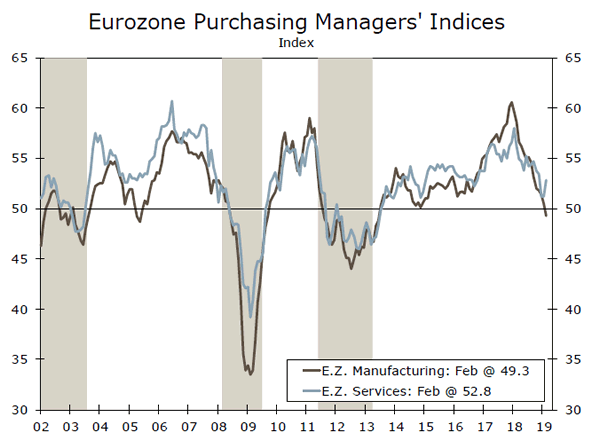
The final Eurozone PMI readings for February also revealed some potential signs of stabilization. As we wrote back in January, a historical analysis of Eurozone PMI data suggests that a reading of 51.0 for the composite index is a key level. Analogous to a bicycle needing to maintain a certain amount of forward momentum to avoid falling over, the idea is that the economy needs to maintain a certain degree of forward momentum to avoid falling into recession. The Eurozone composite PMI reached a low of 51.0 in January but then bounced back to 51.9 in February. While this is only a modest gain and just one data point, when paired with the retail sales data it is encouraging to see the downward momentum at least temporarily halted. One worrisome piece of data, however, was the manufacturing PMI, which fell below 50 for the first time since 2013 (top chart).
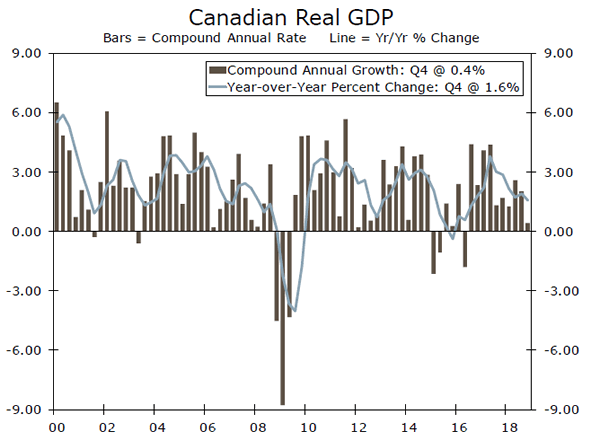
The Bank of Canada (BoC) also met this week against a backdrop of weakening domestic growth. Data released on Friday of last week indicated Canada's economy slowed sharply in Q4. Quarterly GDP grew at an annualized rate of only 0.4%, the weakest quarterly growth rate since mid-2016 (middle chart). Examining the underlying figures more closely, the details are also worrying and raise some concern about an extended economic slowdown. In Q4, household consumption slowed to 0.7%, its slowest pace since 2014 when oil prices first collapsed, while gross fixed capital formation contracted more than 10% in the quarter.
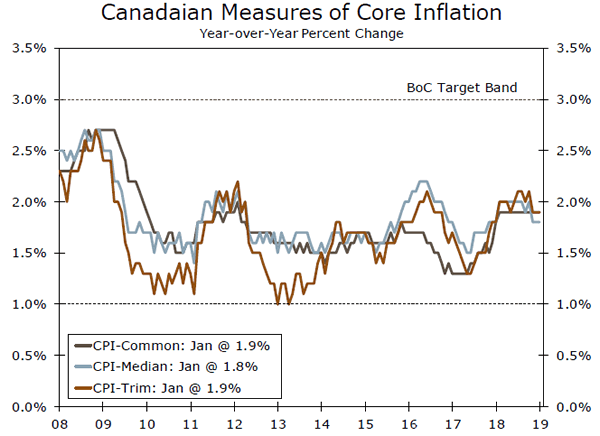
With this in mind, the BoC's policy statement this week led with the following line: "Recent data suggest that the slowdown in the global economy has been more pronounced and widespread than the Bank had forecast in its January Monetary Policy Report." In addition to the global growth challenges, the housing market continues to face headwinds. Like the Fed, we do not believe the BoC is done hiking interest rates in the current cycle. However, the next hike is likely not for a few more months at the earliest, particularly as other central banks have adopted decisively more dovish stances of late.
Global Outlook
Brazil Industrial Production• Wednesday
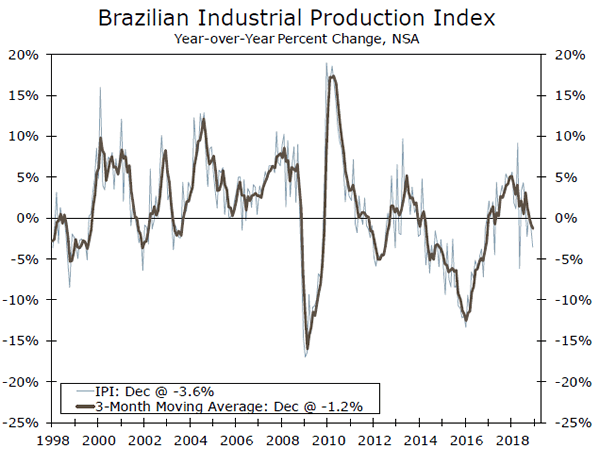
After climbing out of a deep recession, the Brazilian economy has remained fragile over the past year. Industrial production growth has returned to negative territory on a year-over-year basis. Retail sales growth, for which January data will print next Thursday, also exhibited a sharp slowdown towards the end of last year. An uncertain political environment, fiscal imbalances and a generally challenging environment for emerging markets have all likely weighed on the Brazilian economy. Brazil's President, Jair Bolsonaro, submitted his much anticipated pension reform proposal to Congress last week. While the proposal should keep markets optimistic in the short term, a fractured Congress and a lengthy constitutional amendment process are likely to make an approval challenging. Still, given Brazil's sizable budget deficit of roughly 8% at present, any reform proposal to reign in government borrowing is an encouraging step. Previous: -3.6% (Year-over-Year)
China Retail Sales • Wednesday
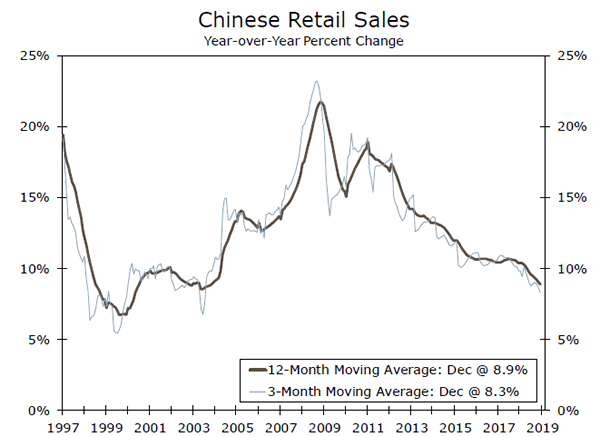
Next Wednesday will see the first release of Chinese retail sales, industrial production and fixed investment spending for 2019. The Chinese economy grew 6.6% in 2018, the slowest pace since 1990. Chinese economic growth was slowing well before the trade dispute with the United States that ramped up in 2018. Working-age population growth has slowed significantly, investment spending growth has been on a secular decline for years and the rapid pace of technological adaption has abated. The recent enactment of several rounds of tariffs has likely contributed to a further slowdown.
Chinese policymakers have done their best to combat this slowdown via monetary and fiscal stimulus. Tax cuts and tariff reductions in particular were ramped up in the second half of 2018 and may help halt the slowdown in retail sales growth. Next week's data will offer a first look at how successful these efforts have been thus far in 2019.
Previous: 9.0% Consensus: 8.1% (Cumulative Year-over-Year)
Bank of Japan Meeting • Thursday
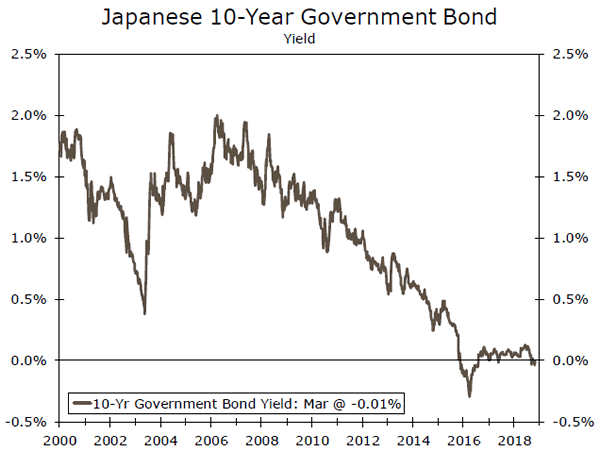
After a period of steady growth, Japan's economy has slowed more recently. The economy experienced up-and-down growth in 2018, while inflation has remained well below the central bank's target. That sluggish momentum has carried into 2019, with activity indicators suggesting economic growth is likely to remain subdued. In addition, fiscal policymakers are set to enact an increase in the consumption tax later this year that, should it take place, will also likely weigh on the economy in the near term.
Previously, we had been looking for the Bank of Japan (BoJ) to make some modest monetary policy adjustments in mid-2019, specifically bringing its policy rate back to 0% (from -0.10%) and further increasing the tolerance band for the 10-year yield. As the economic outlook remains underwhelming, along with a more dovish tone from other central banks, we no longer expect the BoJ to tighten monetary policy this year.
Previous: -0.10% Wells Fargo: -0.10% Consensus: -0.10% (Policy Rate)
Point of View
Interest Rate Watch
Bringing Back the Punch Bowls
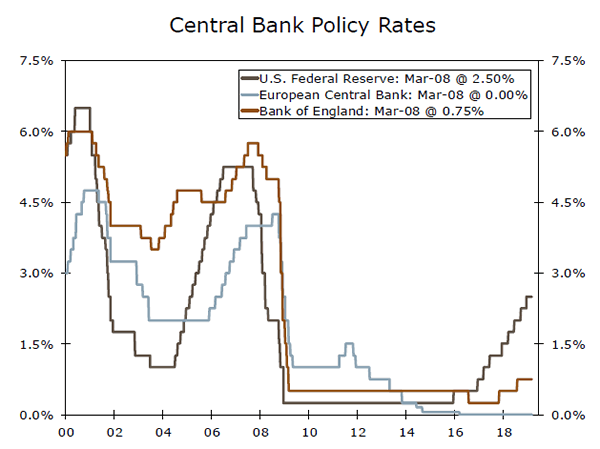
If there was a theme for global central banks in 2018, it was the gradual removal of ultraaccommodative monetary policy. If there is a refrain emerging thus far in 2019, it is one of global central banks demonstrating that there is no rush.
The Federal Reserve has indicated that it is in less of a hurry to raise the fed funds rate and that the shrinkage of its balance sheet would stop this year as it considers new ways to measure its progress toward meeting its mandates amid a dialed-back outlook for U.S. GDP growth.
The Bank of England has said the "fog of Brexit" will weigh on growth prospects and said it could not rule out rate cuts in the event of a hard Brexit as it lowered its forecast for the U.K. economy.
This week, at its scheduled meeting, the European Central Bank (ECB) became the latest monetary authority with a more timid growth outlook and extra measures of reassurance for worried financial markets.
Specifically, the ECB slashed its 2019 GDP forecast for the Eurozone to just 1.1% from 1.7% previously. Rate cuts are likely off the table for 2019 as well, as the ECB expects rates to remain unchanged "at their present levels at least through the end of 2019, and in any case for as long as necessary" to meet its inflation target.
It also announced a new package of what it calls TLTROs–shorthand for Targeted Long-Term Refinancing Operations. These offer the ECB a way to provide low-cost long-term funding to commercial banks in the Eurozone as a means of encouraging those banks to lend to the private sector.
Despite the downgrade to the growth outlook, the postponement of rate hikes and the expansion of TLTROs, we do not see these moves as the opening bids in a sustained campaign to embrace increasingly accommodative monetary policy. However, in light of the new guidance from the ECB, we have pushed back our expected timing of eventual ECB rate hikes to the first quarter of 2020.
Global central banks have lowered growth forecasts, now we see if the measures they've taken can slow the expected decline.
Credit Market Insights
Debt On the Rise
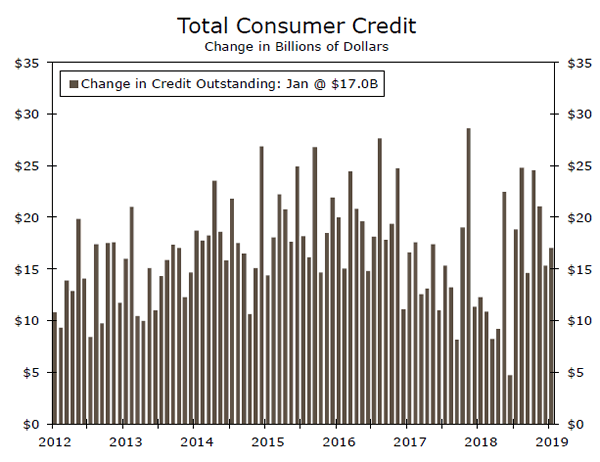
Following a decline in December, consumer credit rose 5.1% or $17.0B in January (bottom chart). Revolving credit outstanding posted a solid $2.6B increase for the month, while non-revolving credit, which includes student and auto loans, increased $14.5B in January.
A separately released report from the Federal Reserve showed that U.S. credit card debt hit a record high $870B in Q4-2018, a $26B increase from the previous quarter. Credit cards are the fourth-largest portion of consumer debt in the United States after mortgages, student loans and auto loans. Credit card limits continued to rise for the 24th consecutive quarter and more borrowers are falling delinquent on their payments. Thirty-seven million credit card accounts are 90+ days delinquent.
The Quarterly Report on Household Debt and Credit at the New York Fed revealed 53.7% of credit card debt is held by Americans who are 50 or older. As expected, the younger population holds the greatest amount of student loan debt. Student loan balances rose $15B to a new high of $1.5T in the fourth quarter, and 11.4% of student debt was 90+ days delinquent.
Overall, consumer credit rose to slightly over $4T in January, marking an all-time high. The Fed's more patient outlook on raising interest rates could further stimulate borrowing, while a tight labor market giving way to higher wages suggests American's have the ability to borrow.
Topic of the Week
The Fed Reconsiders Its Inflation Target
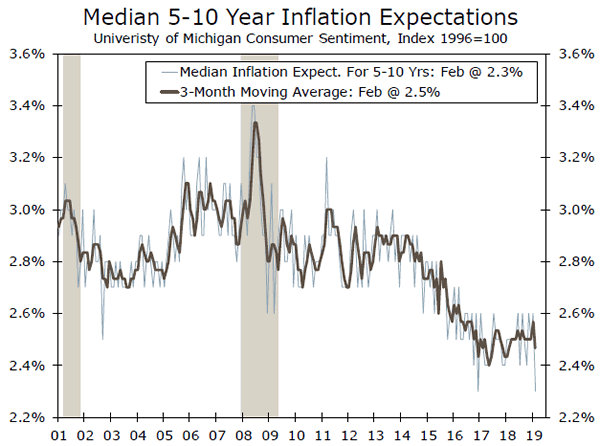
The Fed is currently in the process of rethinking how it conducts monetary policy, and one area it is considering changing is its inflation target of 2%. A key reason for this rethink is that the Fed, like many other global central banks, has generally been facing below-target inflation for much of the current cycle (top chart). Indeed, the risks have generally been skewed toward mild deflation rather than too high inflation. Low inflation can become problematic for a central bank because it limits the central bank's ability to reduce real interest rates to stimulate economic activity in a downturn. A central bank can run out of conventional "ammunition" when its policy rate nears the effective lower bound (ELB) near 0%. Consequently, the Fed's policy review is intended to identify ways to strengthen its credibility in generating 2% inflation over the business cycle and give the FOMC more recession-fighting capability when future downturns arrive.
The Fed has discussed a number of possible alternatives for its current 2% inflation target, including raising its inflation target, moving to an inflation target range or introducing a somewhat more radical approach known as price-level targeting (PLT). However, the approach we see as most likely to be adopted is average-inflation targeting. This framework would involve an explicit aim for inflation to average a given rate over time. For example, if the Fed adopted this framework with its current 2% target, it would aim for 2% inflation on average over the medium or longer term. If inflation were to undershoot 2% for a given period of time, then overshoots would be tolerated with the specific aim of raising the mean rate of inflation over a multiyear period. Implicitly, the Fed already has moved toward averageinflation targeting through its recent emphasis on the "symmetric" nature of the 2% target. If the Fed shifts to this new framework, it would likely lead to higher inflation and inflation expectations. That could see the yield curve steepen, nominal bond yields rise and the dollar depreciate, all else equal.