Sample Category Title
The Weekly Bottom Line: It’s a Hard Knock Life for Central Bankers
U.S. Highlights
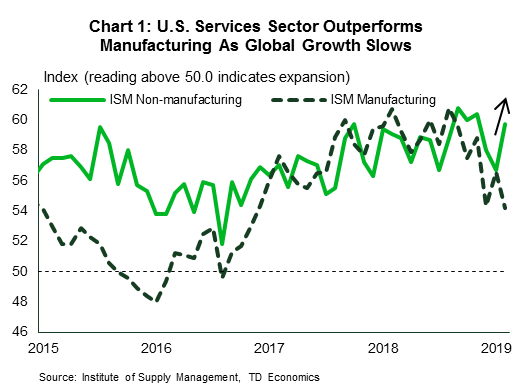
- This week started off on an upbeat note. An uptick in the ISM non-manufacturing index got the ball rolling, with the headline rising by 3.0 points to 59.7 in February.
- In a nice twist to the recent doom and gloom, housing data was also encouraging. Sales of new homes rose 3.6% in December, and housing starts surged by 18.6% in January.
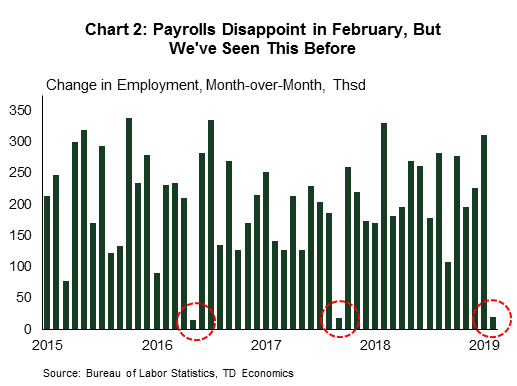
- The positive economic news faced a setback on Friday as the payroll report showed job growth slowing to just 20k in February. The soft payroll print is unlikely to stay, but works to reinforce the Federal Reserve's current "patient" approach.
Canadian Highlights
- The Bank of Canada left the overnight rate at 1.75% this week. Its statement made clear that it is not looking to increase rates anytime soon, noting in its follow up communication that it "need[s] time to better understand what's happening".
- Housing data confirm the Canadian economic malaise continued into the first quarter with home sales down in Toronto and Vancouver and housing starts plunging across the country in February.
- Despite the near-universal bad economic news, the Canadian job market continued to add jobs at an astonishing rate in February. Some 55.9k jobs were added, while the unemployment rate remained near a cyclical low of 5.8% as more people entered the labour market.
U.S. - Positive Economic Data Muted By Weak Payroll Print
In a welcome change from the recent doom and gloom, this week started off on an upbeat note. An uptick in the ISM non-manufacturing index got the ball rolling. Diverging from its manufacturing counterpart, the headline rose 3.0 points to 59.7 in February, reversing two consecutive declines in the prior months. An improved performance in the services sector is echoed in consumer confidence that rebounded with the conclusion of the partial government shutdown and a turnaround in equity markets. It also reaffirms that domestic demand remains solid, corroborated by gains in all 18 industries in February.
Housing data was also encouraging this week. Sales of new homes rose 3.6% in December, edging higher for the second month in a row. Ditto for housing starts. After ending 2018 on a sour note, homebuilding started the year on better footing with starts surging by 18.6% in January. The gain in single-family construction was even more impressive, with starts up by 25% – the highest monthly gain since 1979. As we discuss in our recent report, the housing market has room to grow and demand should rebound alongside rising affordability. With low vacancy rates, housing construction should continue to make gains over the next year.
The positive economic news faced a setback on Friday as the payroll report showed job growth slowing to just 20k new jobs in February. The headline was a big miss on expectations, but notably came after two months of strong consensus-beating gains. There was also plenty of encouraging news in other parts of the report. The unemployment rate edged lower, the labor force participation rate maintained January's gain and hourly earnings accelerated, rising to 3.4% year-on-year – the fastest pace in almost ten years.
There is good reason to look past the dour headline, which was probably influenced by temporary factors and poor weather. We expect job growth to slow in the months ahead, but it will be on the back of a labor market that for all intents and purposes has achieved full employment rather than any pronounced deterioration in domestic demand.
Still, the soft payroll print will reinforce the Federal Reserve's current "patient" approach. On that front, the Federal Reserve has been joined by other global central banks. This week, the ECB unveiled a package of cheap funding for the Eurozone's banks and said it would keep rates on hold until 2020 on the back of softening economic momentum and rising uncertainty related to Brexit and trade. The Bank of Canada's statement this week was similarly dovish – noting the increased difficulty in reading the economic tea leaves given the increase in global crosscurrents. The dovish turn in other global central banks means the U.S. dollar is likely to remain relatively strong, giving the Fed even more reason to remain on the sidelines until at least the second half of this year.
Canada - It's a Hard Knock Life for Central Bankers
Much like its counterparts around the world, the Bank of Canada this week recognized the deterioration in the economic outlook and the haze of uncertainty around the future course of policy. On Wednesday, it left the overnight rate unchanged at 1.75%. Its statement made clear that it is not looking to increase its policy rate any time soon.
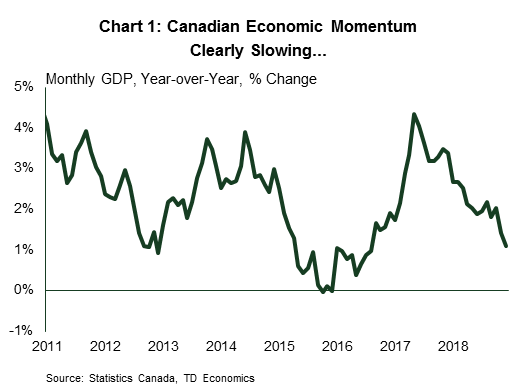
Outside the Labour Force Survey (LFS), the economic data has been unambiguously bad. Even more concerning for the central bank is that the weakest data is in segments of the economy most sensitive to interest rates – namely business investment, housing, and consumer durable goods spending. Investment in both non-residential and residential sectors fell off a cliff in the second half of 2018, and durable goods spending has fallen for three straight quarters.
The data for early 2019 suggest that the pain continued in the first quarter, especially in the housing market. Home sales fell in Toronto and Vancouver in February according to local real estate board data. Meanwhile, housing starts plummeted across the country in the same month.
Given the available data, the Canadian economy appears more likely to have shrunk in the first quarter of the year than shown any meaningful growth. This is not the narrative the Bank of Canada was hoping for. A slowdown in housing and related consumer spending has long been anticipated, but it has come faster and more furiously than expected. Also worrying is that the pullback in business investment is broad-based, and not just an energy story.
In a speech explaining the Bank of Canada's thinking, Deputy Governor Lynn Patterson attributed at least some of the pullback in investment to uncertainty around the free trade deal that has yet to be ratified, but is not overly confident in this view. As its accompanying communication noted, the Bank "need[s] time to better understand what's happening".
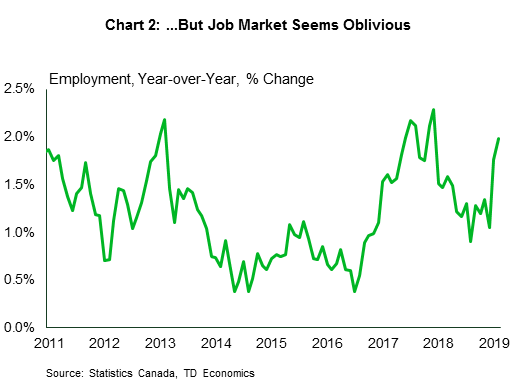
The apparent resilience in the labour market muddies the outlook further. The Canadian job market churned out 55.9k jobs in February. The outsized gain is more than your regular volatility. The six month trend is an equally impressive 48.3k. On a year-on-year basis, employment is up 2.0%, the strongest growth in over a year. Fascinatingly, despite the gain in jobs, the total number of labour hours worked in the country continues to fall, implying that the jobs created are with fewer hours than those existing or replaced (data on job flows by hours worked is unfortunately not available).
While notable, the labour market strength doesn't provide enough assurance because it is typically a lagging indicator. The evidence suggested by a broad range of indicators is that the current stance of policy is more than adequate to stem inflationary pressures. The Bank of Canada's statement still noted the potential interest rate increases, but this will require the data to tell a better story than the one we've been reading over the past several months.
U.S.: Upcoming Key Economic Releases
U.S. Retail Sales - January
Release Date: March 11, 2019
Previous: -1.2%, ex auto: -1.8%, control group: -1.7%
TD Forecast: -0.5%, ex auto: 0.0%, control group: 0.4%
Consensus: -0.1%, ex auto: 0.3%, control group: 0.6%
We expect notably weak auto and gasoline sales to drive headline retail sales 0.5% lower in January, following the sharp 1.2% m/m decline in the prior month. Indeed, headline ex-auto sales should come in flat for the month. Lower gasoline station sales should continue to reflect an unfavorable month-on-month comparison in gasoline prices despite their stabilization in January (this should no longer be a major drag in February). On a positive note, we anticipate core retail sales to bounce back 0.4% m/m after December's unexpected 1.7% tumble.

U.S. CPI - February
Release Date: March 12, 2019
Previous: 0.0% m/m; core 0.2% m/m
TD Forecast: 0.2% m/m; core 0.2% m/m
Consensus: 0.2% m/m; core 0.2% m/m
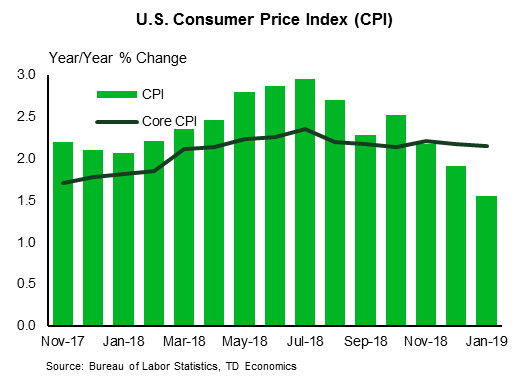
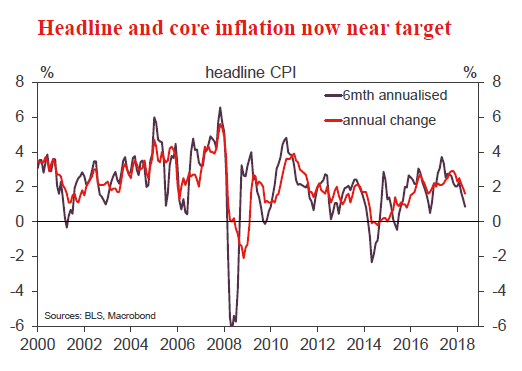
We expect headline CPI to stabilize at 1.6%, reflecting a 0.2% increase with risk for a 0.3% print. Price pressures will benefit higher food and gasoline prices, offset by lower energy services prices. We expect core CPI to print another solid 0.2% increase, leaving the inflation rate unchanged at 2.2%. We expect to see gains in both core goods and services. There is risk for a slight deceleration in shelter, but we expect strength elsewhere across goods and services, including tariff-related categories, medical care and airfares. Looking ahead, we look for headline CPI is likely to remain below 2% until December assuming a modest drift higher in oil prices and core inflation holding slightly above 2%.
Canada: Upcoming Key Economic Releases
Canadian Manufacturing Sales - January*
Release Date: March 15, 2019
Previous: -1.3%
TD Forecast: -0.3% m/m
Consensus: N/A
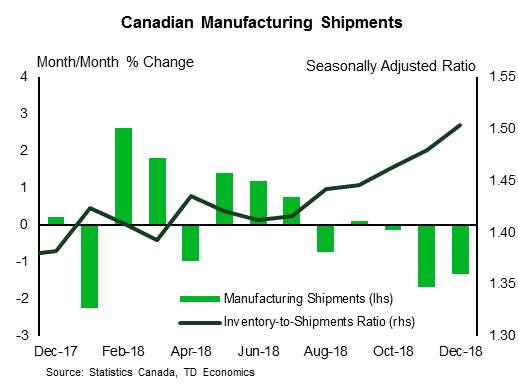
TD looks for manufacturing sales to decline by 0.3% in January on weaker motor vehicle shipments, partially offset by a rebound in petroleum sales. US auto production registered the largest decline since the financial crisis in January, which presents downside risks to Canadian output given the highly integrated supply chains. Other transportation equipment categories are also strong candidates for a pullback, with shipments of aerospace products sitting at their highest level since 2016. A rebound in petroleum output will provide a key offset to weakness in transportation equipment; nominal petroleum sales have fallen by 25% over the last two months on a combination of lower prices and refinery maintenance. Gasoline prices stabilized in January, but lower prices for the industrial sector as a whole should allow real manufacturing sales to outperform the nominal print.
GBP/USD Pound Fails to Capitalize on Dollar Stumble Ahead of Brexit Votes
The US dollar is lower against most majors pairs on Friday after a massive miss in the U.S. non farm payrolls (NFP) report. The US economy only added 20,000 jobs when the forecast was calling for 180,000. Weather factors and for the most part the government shutdown had a lot to do with the disappointing data. The Trump administration was quick to point out the positives such as hourly earning beating the forecast at 0.4 percent. Revisions to the previous report were also upward changes. The size of the miss makes it likely that external factors contributed to the lower number.
The week had a dovish theme set by the Reserve Bank of Australia (RBA), followed by the Bank of Canada (BoC) and it was the European Central Bank (ECB) who further revised growth estimates. Central banks are getting worried, which is why despite the employment miss the US dollar was stronger on a weekly basis as investors see it as a safe haven.
Pound Drops Awaiting Vote as Brexit Anxiety Rises
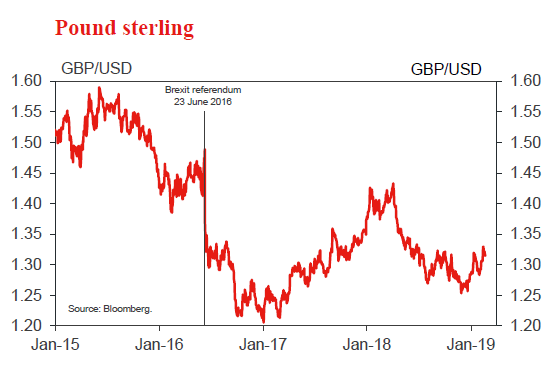
The GBP/USD lost 0.56 percent on Friday. The currency pair is trading at 1.3008 after Theresa May’s Brexit package appears to be headed to another defeat on Tuesday, March 12. The European Union has shown some flexibility and offered to be open to an extension to the March 29 deadline and the definition of the Irish backstop.
The British Prime Minister has been pushing parliament to accept her proposal as a way to end the uncertainty of Brexit. Ms May has been publicly asking MPs to back the deal on the table, rather than await better terms with a no-deal deadline approaching. Though the no-deal exit is the worst case scenario due to the unknown factors, the parliament remains divided on how to exit, or if a divorce is the best solution in the first place.
The Brexit vote in the UK Parliament is the biggest risk event during the week, but also of note are the release of the US retail sales and inflation data. Sales have been underperforming despite job gains in the United States and although several inflation indicators keep hinting at pressures to the upside, the core CPI could show a minimal gain on Tuesday.
Bank of Japan to Join Choir of Doves
The Bank of Japan (BOJ) is expected to join the dovish choir of central banks on Friday, March 15. The CB headed by Kuroda has thrown the monetary policy handbook at the economy with stimulus measures that include bond buying and stock buying without much to show for it. The JPY remains strong given its status as a save haven.
The JPY rose 0.36 percent versus the dollar on Friday. The yen was able to capitalize on the stumble of the USD and was the only currency to score a weekly gain of 0.65 percent on a weekly basis versus the greenback. The appeal of the currency as a safe haven was the decisive factor as dovish rhetoric and growth forecast downgrades have increased the appeal of the dollar over other currencies.
European growth has cooled down, with growing concerns about Germany as its manufacturing sector, auto in particular, could be under threat if the US follows through its car tariff threats. Brexit concerns are on the rise as a amicable split was almost ruled out immediately and the market was presented instead with a long ugly divorce, that in the end could just bring the couple back together.
Sterling Falls Below 1.3000 after the UK Reportedly Rejects the EU’s Latest Proposals on the Backstop
The British pound extended declines against the dollar after the UK reportedly rejected the EU’s latest offer on the backstop. Earlier reports suggested the EU offered that they would allow the Irish backstop to apply only to Northern Ireland and not the entire UK. Cable was lower earlier in the session after EU Brexit negotiator told ambassadors that no progress was made in Brexit talks and that they made two new proposals to the UK on the backstop.
The weakness in the pound is overpowering the broad US dollar selloff that stemmed from the disappointing US employment report. The worst performing currency on the session is now British pound and volatility is expected to pick up ahead of next week’s UK Parliament votes.
Today’s offer from the EU does not come close to meeting PM May’s demands and suggest that so far not enough changes will be made to her Brexit deal to stand of chance of passing Parliament. The next key date is the March 12th deadline for May’s final deal to be voted on. If that fails, the next day will have a vote on a no-deal Brexit, and possibly to vote on an extension on March 14th. Several other potential outcomes still exist, including a hard exit, a second referendum and an orderly exit with a slight delay.
With a Brexit Extension in Sight, What’s the Outlook for Sterling?
The coming week will be a crucial one for the Brexit process, as the UK Parliament will finally have a chance to vote for an extension of the exit date. Alas, even if that happens, such a delay would only be a one-time trick, so ‘something has to give’ by the summer. While the eventual destination for sterling is likely to be higher from current levels, the fact that the deadlock is unlikely to be resolved over the coming months suggests more pain may be in store for the British currency, before the ultimate rally.
Taking stock
The Brexit saga continues to rumble on, with British lawmakers rejecting Prime Minister May’s deal at the turn of the year, opting instead to send their leader back to Brussels to seek more concessions that would make the accord more palatable. The main issue revolves around the Irish border. Namely, how to avoid a hard border between Northern Ireland the Republic of Ireland, if the two sides fail to reach a deal on frictionless trade in two years’ time. In this scenario, Brussels says the entire UK should remain in a customs union with the EU, ensuring no checks along the Irish border until a better solution is found – this has been dubbed as the ‘Irish backstop’. However, London worries it may be trapped in a customs union indefinitely, which would prohibit the UK from striking its own trade agreements around the world.
Hence, Theresa May is now trying to squeeze out some ‘legally binding’ assurances from the EU that if the Irish backstop ever does come into effect, it will be for a limited time only, or the UK should have a unilateral mechanism to exit from it. Unfortunately, this is where the deadlock begins. The EU has repeated time and again it won’t grant such legally binding pledges, as a time limit would defy the purpose of the backstop, which is meant to be an insurance policy against worst-case outcomes.
A week is a long time in politics
This brings us to the upcoming week, and the crucial Parliamentary votes that will take place on Tuesday, Wednesday, and Thursday. The first will be on Theresa May’s Brexit deal. As a reminder, back in January, this accord was voted down by the largest margin in Parliament’s history. Considering that the EU hasn’t granted any meaningful changes since then, and that according to media reports any changes it will grant won’t be legally binding, this deal will probably suffer the same fate – rejection.
Assuming this is indeed rejected again, the next vote will be on whether Parliament would allow the UK to leave the EU on March 29 – the official exit date – without a deal. Bearing in mind that lawmakers already voted in favor of an amendment that would forbid a no-deal Brexit recently, and in fact this was the catalyst behind the pound’s latest rally, it seems likely there will be a majority that votes against a devastating no-deal exit once more.
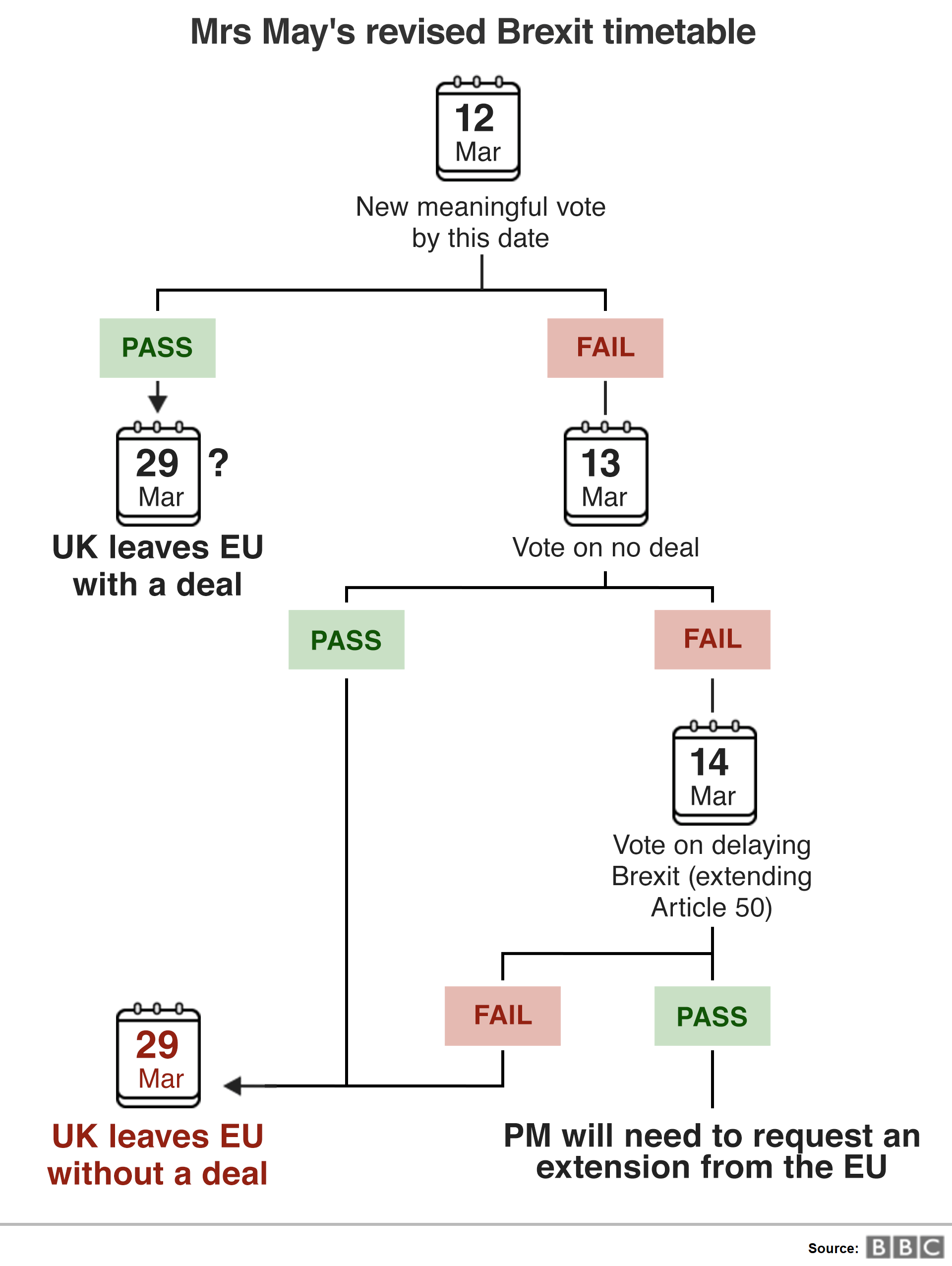
Finally, the last and perhaps most crucial vote on Thursday will be on whether the government should ask the EU for an extension of the exit date. This is the tricky part, because even though it’s reasonable to assume that lawmakers voting against a no-deal Brexit would also vote in favor of a delay given our proximity to March 29, things aren’t always so simple in British politics. The implication is that while the most likely outcome is an extension, this is by no means a ‘sure thing’.
Delaying the inevitable?
Let’s suppose things play out as expected and lawmakers instruct May to seek an extension. The question then becomes: for how long, and for what purpose? On the former, any extension is unlikely to last longer than a few months – let’s say three, more or less. The issue is that for the UK to get a longer extension it would probably need to participate in the European Parliament elections in May, and since there is no appetite for that in Britain, the new exit date would likely be set for June-July, just before the new EU Parliament begins its term. In short, any extension will probably be a short one, and is unlikely to be repeated.
As for what the purpose of the delay would be – nobody really knows. Pro-EU moderates argue it would be an opportunity to negotiate a softer, Norway plus, type of Brexit. Others suggest it could allow the UK more time to prepare for a no-deal outcome, a so-called ‘managed no-deal’. Remainers want to use that time to organize another referendum. It’s safe to say there is no clear consensus for anything, other than the fact that leaving without a deal would be a disaster.
It’s a long way to the top
What does this all mean for the pound? In the immediate term, sentiment will be driven by these Parliamentary votes. If by next Thursday everything goes as expected and the UK asks for an extension, sterling could see some upside, though nothing spectacular as this is probably the market’s base-case scenario already. However, in the unlikely event an extension is voted down, then the pound could collapse, as a no-deal exit would become the default.
On a slightly longer timeframe, so over the next 2-3 months, the outlook for the British currency remains grim. Simply put, there’s no breakthrough on the horizon, and we could be staring down the barrel of the same exact deadlock come summer. Neither side seems ready to make real concessions, and it may come down to the wire – i.e. a few days before the extension ends – before politicians feel enough pressure to make meaningful compromises. Hence, uncertainty is set to remain elevated for a while longer, keeping the risks surrounding the pound tilted to the downside in the near term.
Looking further out, however, the outlook for the British currency is quite bright. Again, it’s simple if one strips out all the noise: the UK Parliament has clearly shown it has no appetite for a no-deal exit, and that it will take matters into its own hands if needed to avert that. Hence, the only other alternatives are Brexit with a deal, or no Brexit at all. Either scenario would send the pound flying, though the latter would clearly be far more bullish for the currency.
Finally, it’s interesting to note that once the pound gets the Brexit clarity it needs to stage a major rally, the rising tide could also lift the euro alongside it as well – to a lesser degree of course. In this sense, any pound strength may be reflected better in pairs such as sterling/dollar and sterling/yen, as opposed to euro/sterling.
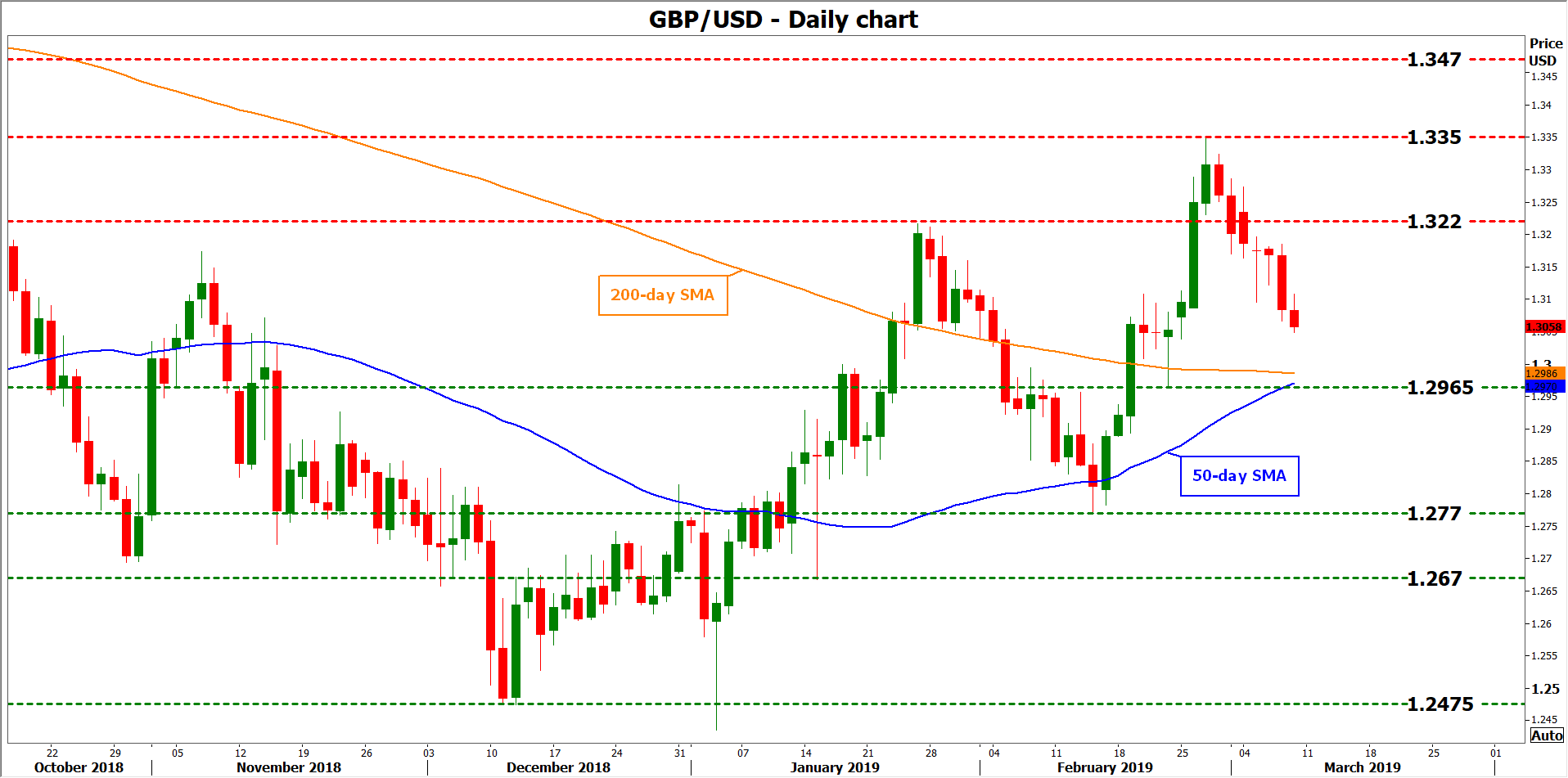
Taking a technical look at sterling/dollar, immediate support to declines may be found near 1.2965, with a downside break opening the door for a test of the 1.2770 area initially. On the flipside, resistance to advances could come around the January top of 1.3220, before the February peak of 1.3350 comes into view.
Australia & New Zealand Weekly: RBA’s Likely Rate Cut Strategy
Week beginning 11 March 2019
- RBA's likely rate cut strategy.
- Australia: Westpac–MI Consumer Sentiment, housing finance, NAB business survey, RBA Deputy Governor Debelle speaks.
- NZ: retail card spending.
- China: fixed asset investment, retail sales, foreign direct investment.
- Europe: CPI, industrial production.
- US: CPI, retail sales.
- Key economic & financial forecasts.
Information contained in this report current as at 8 March 2019.
RBA's Likely Rate Cut Strategy
This GDP print for the December quarter of 2018 shows the Australian economy having slowed in the second half of 2018 from a 4% annualised pace in the first half to a 1% annualised pace in the second half.
The challenge for the Reserve Bank will be to credibly maintain its GDP growth forecasts at 3% in 2019 and 2.75% in 2020. Expecting a lift in the growth momentum from 1% to 3% could only really be justified if the economy was expecting to benefit from a significant stimulus. But global growth is slowing; the residential construction cycle has clearly turned; the AUD remains in a stable range; monetary policy is on hold and fiscal policy will continue to be constrained by the perceived need of both political parties to predict a surplus in 2019/2020.
Consequently the Reserve Bank is likely to see the need to further revise down its growth forecasts when it announces its revised forecasts in the May Statement on Monetary Policy.
Those are likely to have an upper bound of 2.75% in 2019 and 2.5% in 2020. That is a "trend" forecast for 2019 and slightly below trend in 2020. Such forecasts are likely to still be assessed as consistent with steady policy with a clear "easing" bias.
With the residential construction cycle now turning down; business investment mixed; the savings rate now edging up; and house prices and new lending contracting, prospects for being able to maintain those forecasts in August look bleak. We expect by the August Statement on Monetary Policy, the growth forecasts for both 2019 and 2020 will have both fallen below potential (2.75%), probably not to Westpac's current forecasts of 2.2% in both years but sufficiently below trend to invalidate any forecast of a falling unemployment rate and solid wages growth.
In such circumstances, with 150 basis points of "flexibility", the RBA is expected to cut the cash rate by 25 basis points to 1.25% and follow that up with a second cut of 25 basis points in November recognising confirmation of persistent below trend growth. Under such a benign growth outlook it will also be necessary to further push back on the expected timing of the return of underlying inflation into the 2–3% target band.
This expected scenario is consistent with Westpac's forecast for two rate cuts in August and November.
There were a number of significant developments in the GDP report.
Firstly we saw an extension of the contraction in new dwelling construction from the September quarter following a particularly strong first half. Westpac expects this is the start of a long run of falls in residential construction reflecting the downturn in dwelling approvals and an expected further contraction as tight funding conditions and falling house price expectations deter both demand and supply of new construction.
Secondly, we saw a second particularly weak print on consumer spending (0.4% following 0.3%) reflecting weak income growth and some early signs of a negative wealth effect as the savings rate lifted from 2.3% to 2.5%. Wages growth is lifting only very slowly while employment growth is expected to slow in 2019 as political uncertainty, global tensions around trade and softening demand weigh on business employment and investment intentions. There are lags but the tepid growth in the second half of 2018 is likely to weigh on employment growth in 2019.
There is also likely to be a further wealth effect on consumption as the impact of falling house prices on household balance sheets plays out. Evidence of a wealth effect during the boom period for house prices is apparent in the 1.7–1.9 ppt fall in the savings rate in NSW and Victoria. We expect this to gradually unwind over 2019 and 2020 restraining annual consumption growth to around 2.0% in both 2019 and 2020 with an expected lift in the savings rate from 2.5% to near 5% by end 2020. That rise in the savings rate and associated low consumption growth is the main factor behind the expected soft GDP growth outlook.
House prices will be important in 2019. Even though prices have fallen by 13% from their peak in Sydney and 10% in Melbourne, these adjustments follow cumulative increases of 60% and 44% respectively over the previous four years. Affordability is still stretched in both cities.
Unlike previous cycles where affordability was improved through sharp reductions in interest rates and relatively firm income growth, the necessary restoration of affordability in this cycle will need to come from prices. We estimate that further falls of 10% or more in these cities (over 2019 and 2020) will be required to restore affordability given limited interest rate flexibility and a restrictive credit environment. In previous housing downturns interest rates played a critical role in restoring affordability. With the RBA cash rate already down at 1.5%, there is very limited scope for interest rate cuts to perform that traditional role.
As we have recently seen in Perth, affordability can be restored but prices can still fall further if credit is tightened. While there is some unease in official circles around a possible credit squeeze we expect that the regulators will be comfortable to maintain greater scrutiny on lending practices. This is despite decisions by the regulator to release previous policies to limit investor and interest only loans.
There are also challenges with an entrenched low inflationary environment. On a calendar year basis headline inflation has been below the RBA's 2–3% target range since 2013. The concern is that such a protracted period of low inflation is impacting expectations. Our forecasts indicate that headline and core inflation will not reach 2% until June 2021. The RBA recently pushed back its forecast for underlying inflation to reach 2.25% from 2019 to 2020.
On the positive side, government infrastructure spending, continues to lift with overall government spending up 6% in 2018. The mining investment contraction has bottomed out and there is some evidence of a likely modest lift in new mining investment largely focussed on iron ore and lithium.
Services exports are booming. Education spending rose 15% in 2018 while total services exports lifted 9.7%. Overall net services exports contributed nearly 0.5 percentage points to GDP growth. Importantly, this is not specifically a China story, with China explaining around 20% of total services exports, including 33% of education exports. The China story remains vulnerable to any policies aimed at boosting China's shrinking trade surplus.
Household income growth is expected to slow. We expect employment growth to slow to 0.6% in 2019 down from 2.2% in 2018, pushing the unemployment rate up to 5.5% by years end. Wages growth is also lacklustre, partly because considerable slack remains in the labour market. The underemployment rate is forecast at 8.5% by end 2019, largely unchanged since December 2014 despite a drop in the unemployment rate from 6.1% to 5.0%. Accordingly wages growth is expected to remain sluggish – this has been the case even in NSW where the unemployment rate has fallen just below 4.0%.
The week that was
Ahead of the release of the December quarter National Accounts, we had been anticipating a particularly downbeat update. This expectation proved prescient, as the Q4 outturn of 0.2% left annualised GDP growth in the second half of 2018 near 1.0% – a fraction of the first–half's 4.0% gain, and also well below potential at 2.75%.
In terms of the detail, government spending was the sole positive, adding 0.3ppts to growth in Q4. In stark contrast however, private demand flat–lined. Within the private sector, information on the consumer was particularly concerning: annual consumption growth slowed to 2.0%yr in Q4 – just ahead of population growth at 1.6%yr – and the decline in residential construction gathered pace. Business investment growth was also subdued in Q4: equipment investment remained sub–par, affected by both mining and the consumer; while non–residential construction consolidated at a high level.
On the heels of Q4 GDP, January's below–expectation retail sales gain of 0.1% gave further cause to be concerned over economic momentum come 2019, particularly given it followed a 0.4% decline in December and as gains in January were confined to food sub–categories – non–food retail was down 0.1%. Clear here is a hesitancy on the part of the consumer to spend on discretionary items, one that is expected to linger as house prices fall further and income growth remains weak.
The above outcomes strongly support our view that aggregate activity growth will be materially below trend in 2019, circa 2.2%yr. While the RBA held an above–trend growth view ahead of this data, in coming months they will have to revise their expectations lower. This sets the scene for two cuts in the cash rate, in August then November – as per Westpac's view.
Offshore, the March ECB policy meeting marked a significant dovish shift in the policy stance. While before, the ECB held steady in their confidence that the growth slowdown would be temporary, in March they factored in weakness persisting through the first half of 2019.
All up, this saw large downward revisions in the economic projections, the extension of interest rate policy forward guidance to rates expected to be on hold at least through the end of 2019 (previously the summer of 2019), and the announcement of a new Targeted Long–Term Refinancing Operations (TLTRO) package in response to the upcoming maturities.
Prior to the meeting, Q4 GDP was confirmed at 0.2% while Q3 was revised lower to 0.1%. Through the year growth for 2018 was below trend at 1.1%, with a marginally lower 1.4ppt contribution from domestic demand offset by a 0.3ppt reduction from net exports (down from a 1.4ppt contribution last year).
Compared to 2018's annual average growth of 1.8%, the ECB now expects 2019 growth of just 1.1%, a sharp revision from their December forecast of 1.7%. With that below trend pace, the unemployment rate is expected to edge up to 7.9% from 7.8%, and inflation is expected to remain subdued.
Amidst the pervasive uncertainty on the economic outlook, policy has now become proactive to get "ahead of the curve". Accordingly, our previous call for a hike in the deposit rate in December 2019 has been pushed out to March 2020, with growth expected to stabilise in the second half of 2019.
Regarding TLTRO policy, today's announcement was broadly in line with our expectation, maintaining liquidity for longer and incentivising lending to the real economy – the full detail of the incentives are to be announced in due course.
Chart of the week: Q4 GDP – soft private sector
Output grew by only 0.2% in the December quarter, meeting our expectations.
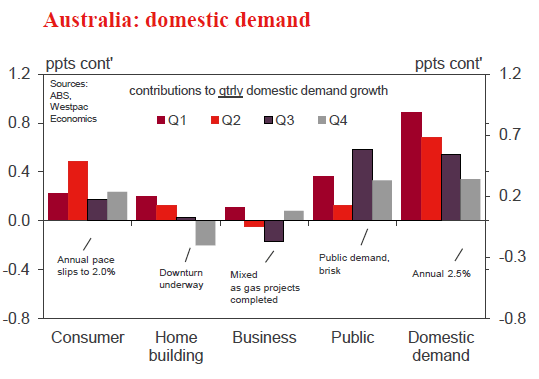
Private sector demand flat–lined over the second half of 2018, declining by 0.1% in Q3 followed by a flat Q4. Against this, government spending, in the form of public demand, continues to expand at a brisk pace, up 6.2% over the year and directly adding 0.3ppts to activity in the final quarter of 2018.
The December quarter was another soft one for the Australian consumer. Incomes posted a better quarter but were coming off a very weak run, and still not strong overall. The flow through to spending was also muted by an uptick in savings. The update confirmed a material slowing in consumer spending over the second half of the year and underscored risks of a further wealth effect driven rise in savings rates undermining demand going forward.
New Zealand: week ahead & data wrap
A Narrowing Gap
Our latest Regional Roundup suggests that growth in regional activity in New Zealand has begun to converge.
Economic activity in the central and southern parts of the North Island and the most southern regions of the South Island remains strong, although momentum is starting to flag in some places. Meanwhile, activity in northern parts has been weaker, but signs of an improvement have become increasingly more evident. A further narrowing of the activity gap is likely as slow population growth and house price inflation in overheating regions begins to cool.
For some time now, New Zealand has been an economy of two halves. The central and southern parts of the North Island and the most southern regions in the South Island have been running hot, propelled by the success of exports, notably those relating to agriculture and tourism, population–induced building booms and healthy house price gains.
However, activity elsewhere has been less impressive. Flat to falling house prices in Auckland have weighed heavily on activity in the upper North Island with contagion effects resulting in a spill–over into neighbouring regions. Meanwhile, Canterbury, struggling to come to grips with life post–quake rebuild, has remained in the doldrums.
This still remains the case today, although the gap between strongly performing regions and the rest of the pack has begun to close.
That's not to say that traditional outperformers such as Gisborne/Hawke's Bay, Otago, and Southland, are not performing well. Thanks to some eye–popping house price gains and export successes, they still are, but momentum has been lost.
At the same time, erstwhile laggards like Northland, Waikato, and Nelson/Marlborough/West Coast, have all picked up pace, bolstered by a combination of supportive agricultural conditions, rising house prices, and improving labour markets. Auckland too has shown signs of picking up, with a sharp lift in regional confidence, retail spending and house sales volumes. Mid–table performer, Taranaki/Whanganui–Manawatu also seems to have a gained a second wind, in part because of strong house price growth, but also raised crude oil prices.
At the national level, the economy lost some impetus in late 2018, but we expect it to regain momentum in 2019. The main reason for this is a large increase in government transfers and spending, which should be felt across the whole country. Added to this the possibility of weaker fuel prices and the outlook for most regions is quite positive.
The three main population centres are likely to stand out from this trend, albeit for different reasons. Wellington is expected to benefit from spending by the Government on the public sector, so the outlook there is particularly strong. In Auckland there has been a very large rise in consents for new dwellings, signalling a lift in construction activity that should boost the local economy over 2019. On the other side of the ledger, activity in Canterbury will remain hampered by a further cooling in reconstruction work.
There are a number of rural regions of New Zealand currently doing very well, and we expect that to continue in 2019. Some are already losing momentum and that may continue this year. Others, such as the Bay of Plenty, have built quite a head of steam and are expected to roll through 2019 in fine form. Many of these rural regions are overheating, and we expect they will cool in time.
Their success has been driven by a combination of factors. The performance of export orientated industries has been key. So too above trend population growth, raised construction activity and rapidly growing house prices.
Some of these factors are likely to further support rural activity over the course of 2019. Others not so much.
A key driver of rural fortunes is likely to be the ongoing success of export orientated industries, such as tourism and agriculture. Despite slowing growth, we expect a record number of tourists from abroad to support spending in tourism dependent regions such as Otago, Southland, and the Bay of Plenty. Even Auckland, which is our largest tourist destination, should benefit.
So too agriculture, although the picture here is a little more complicated. In general, supply and demand fundamentals suggest a pretty positive outlook for most commodities in 2019. How positive, will depend on prevailing weather conditions. As mentioned in our recent Fortnightly Agri Update1, concerns about the impact of recent dry weather are likely to have been a key factor leading to a downgraded forecast for milk production as well as a lift in milk prices. We expect that prices will unwind somewhat when the weather begins to normalise, but still maintain a slightly higher milk price forecast $6.40 for this season.
Other factors, such as population growth, construction activity and rising house prices are not likely to be quite as supportive. Population growth is already slowing in many rural regions, and as it continues to cool the construction booms currently under way will wane. Meanwhile, double–digit house price inflation is currently stimulating strong consumer spending in many regions, but this will not last. When house price inflation slows or goes into reverse as we expect, consumer spending in many regions will slow from the current helter–skelter rates of growth.
Data Previews
Aus Jan housing finance (no.)
- Mar 12, Last: –6.1%, WBC f/c: –2.5%
- Mkt f/c: –2.0%, Range: –3.0% to 2.1%
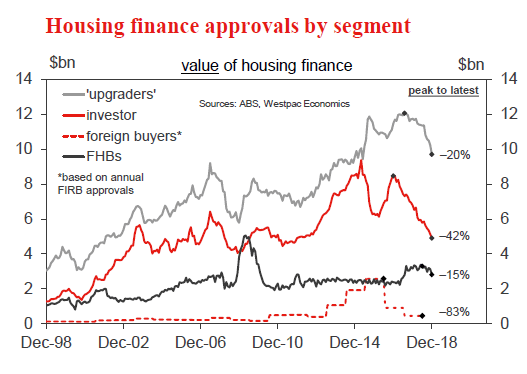
Housing finance approvals posted a very weak finish to 2018 with sizeable declines across all components. The headline number of owner occupier loans fell 6.1%, down a hefty 8.2% ex–refi, and –14.4% for the year. Notably, what was initially an investor–led cycle is now seeing clear weakness in owner occupier activity – both the value and number of loans.
The slide is expected to carry into January with industry data covering the major banks pointing to a further 2.5% decline. The value of investor loans is expected to see a similar fall. As always, the low activity over the holiday season means January reads are less reliable than usual.
Aus Mar Westpac–MI Consumer Sentiment
- Mar 13 Last: 103.8
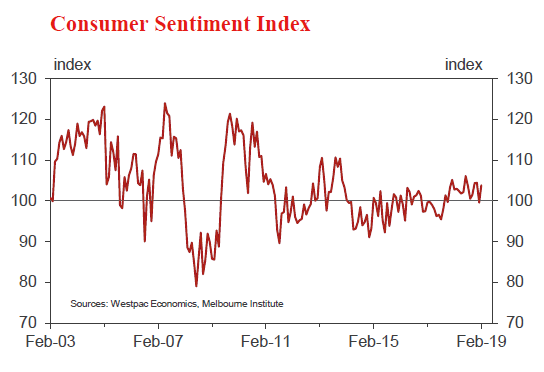
The Westpac Melbourne Institute Index rose 4.3% to 103.8 in Feb, recovering from a dip into slightly pessimistic territory in Jan (a reading of 99.6). The RBA's shift to a more neutral stance on the outlook for interest rates in early Feb appeared to give a modest boost to confidence after a shaky start to the year.
This month's survey is in the field from March 4–9. The main development over the last month has been another run of weak economic data culminating in the soft December quarter national accounts showing annual GDP growth slowed to 2.3%, with press coverage emphasising the weakness of the second half of 2018. Financial markets have remained quite buoyant, the ASX up a further 3% since the last survey, but housing market conditions remained soft.
NZ Feb REINZ house sales and prices
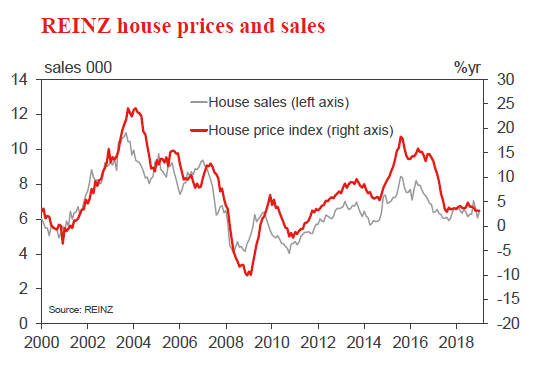
- Mar 11-15 (tbc), Sales last: +6.7%, Prices last: 3.1%yr
Nationwide house sales picked up in January after an unusually weak December. The foreign buyer ban, which took effect in October, probably accounts for some of the recent volatility in monthly sales. Annual house price inflation has slowed, albeit marginally, in that time.
We expect a modest upturn in the housing market in the early part of this year. The RBNZ's restrictions on high-LVR lending were eased in January, while mortgage rates have been pushing down from their already low levels.
Regional differences in price growth are likely to persist, with many areas outside of Auckland and Canterbury likely to see continued strong house price growth. Foreign buyers play little role in many regional centres, and the combination of lower mortgage rates and lending restrictions will give demand a further shot in the arm.
NZ Jan retail card spending
- March 11, Last: 1.8%, WBC : +0.3%, Mkt: + 0.3%
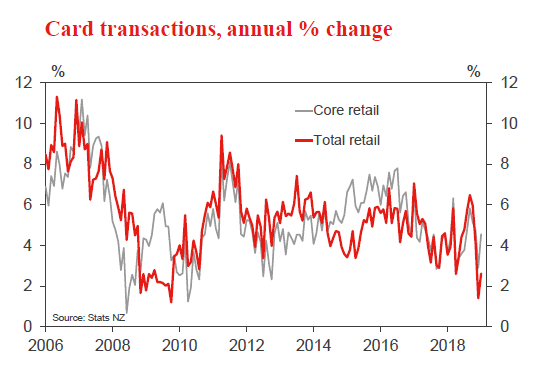
Retail spending rose by 1.8% in January. That large rise was centred on durables spending and followed an unusually large drop in spending through the Christmas shopping that may have been related to processing delays. Looking at spending more generally, household's spending was up in most categories in January. That was likely supported by the fall in petrol prices that put money back in to households' wallets. Over the past year as a whole, core (ex-fuel spending) was up 5.3%.
Following December and January's sharp swings, we expect to see spending returning to trend in February. We're forecasting a 0.3% gain in retail spending over the month, underpinned by a 0.4% lift in core (ex-fuel) categories.
UK Meaningful Brexit votes
- March 12 to 14
On 12 March, the House of Commons will vote on PM May's proposed exit agreement for a second time, and it's likely to be defeated again.
The PM has stated that should her agreement be voted down at its second reading, she would table motions on two pivotal issues on the following days. First, MPs would be asked to vote on whether they support leaving the EU without a withdrawal agreement (i.e. a 'no-deal' Brexit). We expect this motion will be defeated.
Second, assuming MPs reject a 'no-deal' Brexit, they will be asked on whether to seek a short extension to the negotiation period with the EU. We expect that this motion will be approved. EU agreement would still be required, but this would pave the way for Brexit to be delayed beyond the current 29 March deadline.
US Jan retail sales and Feb CPI
- Mar 11, retail sales, Last: –1.2%, WBC f/c: 0.2%
- Mar 12, CPI, Last: 0.0%, WBC f/c: 0.1%
December US retail sales was a significant disappointment to the market, registering a 1.2% decline. Notably, this was not the result of price volatility, with the control group (which excludes volatile items) down 1.7%.
Based on anecdotes of sales into year-end, a positive revision seems a high probability, but presumably, the decline won't be wiped away entirely. If, as we and the market expect, the January retail number is broadly flat, then it will set GDP up for a weak Q1, limiting 2019 growth to nearer 2.0%yr than the 3.1%yr pace of 2018.
For the CPI, there are two key stories. In terms of momentum, energy price volatility remains key. For core prices, inflation looks very sticky around the 2.0%yr medium-term target of the FOMC. This is good for policy makers, with a reactionary stance able to be maintained with little risk.
Week Ahead – Another Brexit Deadline Looms; Bank of Japan Meets
A vote in the British parliament could determine whether the Brexit deadline will be extended, while a Bank of Japan policy meeting will be another highlight for traders in the coming week. Economic indicators will also be watched closely amid renewed growth jitters as industrial output figures for January are reported in China, the Eurozone, the United Kingdom and the United States. Inflation numbers from the US will be the other main release.
Chinese growth likely softened further at start of 2019
Key Chinese indicators for January-February will come under more scrutiny than usual on Thursday given the absence of the January data due to the long Lunar New Year break. Industrial output in China is forecast to have slowed from 5.7% to 5.5% year-on-year in the first two months of the year, potentially signalling a further loss in momentum at the start of 2019. Retail sales are also anticipated to have moderated slightly from 8.2% to 8.1% y/y. But investment in urban areas is expected to edge up from 5.9% to 6.0% y/y.
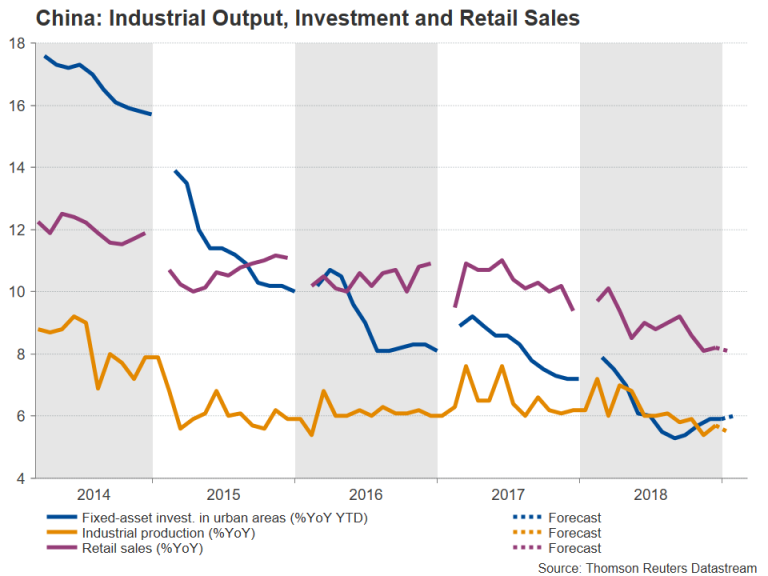
A downside surprise in the numbers would add to concerns about the extent of the slowdown in the world’s second largest economy, especially after this week’s dismal export figures, though there is some support from the recently announced fiscal stimulus measures and optimism about a trade deal with the US. The Australian dollar, which is sensitive to China-related risks, could suffer further losses from more gloomy data. The aussie slipped to 2-month lows this week following a poor domestic GDP print.
No change expected from Bank of Japan
BoJ policymakers will be meeting over two days for their latest policy decision, with the announcement due on Friday. Investors are not anticipating any change in policy by the bank as their targeted inflation, which excludes fresh food prices, remains confined just below 1%. However, Governor Kuroda will probably stick with recent language in his press conference and repeat that the Bank would consider easing policy if the economic slowdown threatens the progress towards achieving its 2% inflation goal, even as the debate within the board on the possible side-effects of a prolonged period of easy policy rumbles on.
In terms of releases, corporate goods prices for February and machinery orders for January will be viewed on Wednesday. But as always, unless there are big surprises from the BoJ or the data, the yen will continue to be driven mostly by dollar moves and safe-haven flows.
UK Parliament could vote to delay Brexit
Theresa May’s Brexit deal will be put to a meaningful vote for a second time on Tuesday, but with the European Union still not budging on the deeply unpopular Irish backstop clause, the chances of the bill passing are looking slim. If MPs reject the deal again, they will get the chance on Wednesday to decide whether they want to block leaving the EU without an agreement. If a no-deal is vetoed, Parliament will hold another vote on Thursday, this time on extending Article 50.
The pound has now retraced all of the gains made following May’s offer to MPs allowing them to vote on a no-deal scenario as it’s become increasingly apparent that even if Parliament does rule out that option, it will do little to end the uncertainty regarding the Brexit process. If lawmakers choose to delay Brexit, a modest rise is attainable for the pound, while a surprise backing of May’s deal could send the pound surging above $1.35. But In the unlikely event that a no-deal wins support, sterling could crash below $1.27.
The Brexit votes will probably steal the limelight away from other important events in the UK. Monthly GDP, trade and production numbers are due on Tuesday, while the UK’s finance minister, Philip Hammond will make his Spring budget statement on Wednesday. Hammond is predicted to reaffirm his promise of big spending increases as the UK’s public finances improve, but the giveaway will be conditional on MPs approving a smooth Brexit.
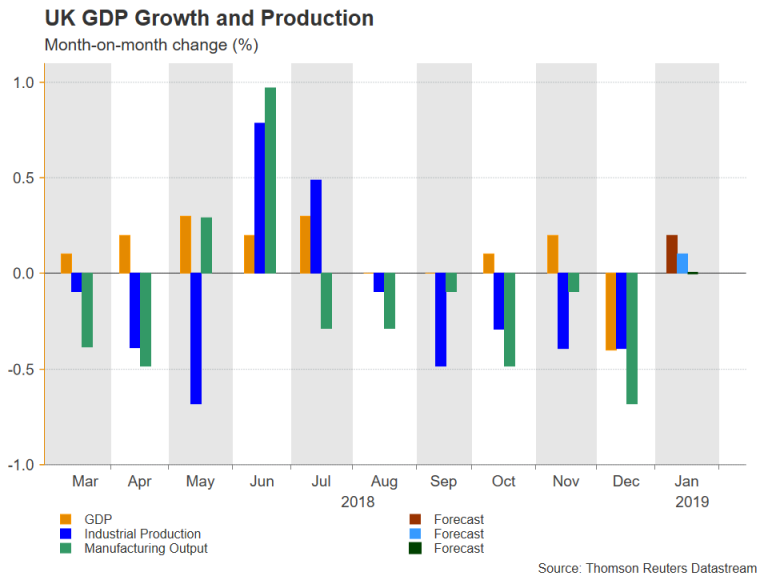
Looking at the data, UK GDP is expected to have expanded by 0.2% month-on-month in January, recouping half of the lost output in December. Industrial production is also projected to grow, though only marginally, by 0.1% m/m. But manufacturing output is expected to have stayed flat in January.
January industrial production eyed in Eurozone
The European calendar will be relatively light in the coming week but industrial output numbers for January should attract some attention as traders look for signs of green shoots in the Eurozone economy. Germany will report its industrial production estimate along with export stats on Monday. Output is forecast to have increased by 0.5% m/m in January, which could make it the first growth in five months. The Eurozone-wide figures will follow on Wednesday, while on Friday, the final inflation print for February will be published. No change is expected to the flash reading of 1.5% y/y for the headline rate.
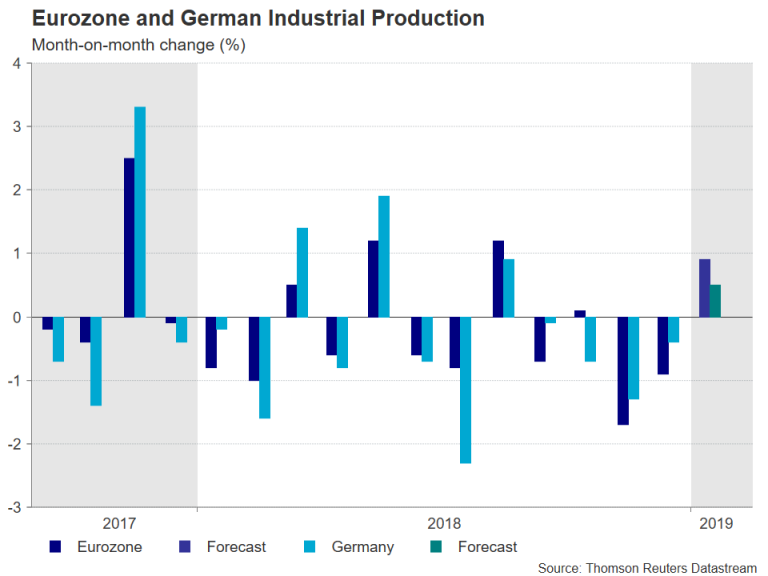
After slumping to 21-month lows this week on the back of a very dovish ECB, the euro could come under further pressure if there are no positive elements in the data.
US retail sales and inflation in focus
The US dollar soared to the highest in almost three-months against a basket of currencies this week as most of its peers floundered. The greenback’s relative attractiveness could continue to be highlighted next week if the upcoming data maintain the view that US economic fundamentals remain sound despite moderating growth.
Kicking off the week on Monday are January retail sales. US consumers sharply cut back their spending in December, raising doubts about the US growth momentum. However, retail sales are forecast to have risen by a modest 0.2% m/m in January, recovering partially from December’s 1.8% tumble. A worse-than-expected figure would only renew fears of weakening consumer spending.
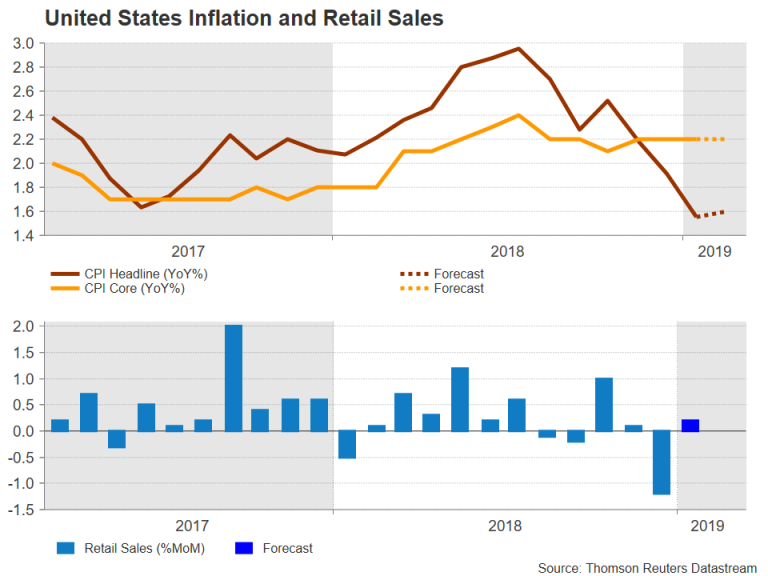
On Tuesday, attention will shift to inflation as the consumer price index is released. Headline inflation is forecast to stay unchanged at 1.6% y/y in February, with core CPI also projected to hold steady at 2.2% y/y. The producer price index on Wednesday is further expected to stress the absence of inflationary pressures. PPI for final demand is forecast to fall to 1.9% from 2.0% in January. Also out on Wednesday are durable goods orders for January. There will be more price gauges to assess on Thursday with February import prices. New homes sales for January are due on Thursday too, and on Friday, the spotlight will fall on the manufacturing sector.
US industrial output is expected to have grown by 0.4% m/m in February, while the more forward-looking Empire State manufacturing index by the New York Fed is forecast to improve from 8.8 to 10.0 in March. Other releases on Friday will include the University of Michigan’s preliminary reading of consumer sentiment for March as well as the JOLTS job openings for January.
Weekly Focus – Another Central Bank Turns Very Dovish
Market movers ahead
- US retail sales will be important to gauge the strength of the US economy currently. We will also keep an eye on US CPI inflation and durable goods orders.
- On Brexit, three important votes are coming up.
- US-China trade talks are entering the final stage, which is also going to be the most difficult one, as challenges remain. The longer it takes to announce a summit between Donald Trump and Xi Jinping, the more markets will start to worry.
- In the euro area, focus is set to be on industrial production data, which fell sharply in December. Car sales should provide insight into how much of a rebound we can expect from the slump in 2018.
- The Bank of Japan is set to keep its policy stance unchanged at its meeting on Friday.
- In Scandinavia, focus turns to Swedish inflation numbers and Norway's regional network survey.
Weekly wrap-up
- The ECB joined the Fed in taking a surprisingly dovish twist in its policy guidance and surprised the markets and ourselves by announcing a new series of liquidity measures (TLTRO3s). We no longer expect an ECB hike within our 12-month forecast horizon.
- EUR/USD and bond yields moved sharply lower on the surprise move by the ECB. Lower risk appetite added to the downward move in yields.
Canada: More Jobs, Fewer Hours in February
55.9k more Canadians were working in February on net. The unemployment rate remained at 5.8% as more of us were engaged with the labour market. The labour force participation rate rose 0.2p.p. to 65.8%.
The jobs mix was generally good, with full-time employment firmly in the driver's seat (+67.4k). Part-time employment fell 11.6k. The private sector led the way, adding 31.8k net positions, while the public sector added 8.8k. Rounding things out was a 15.1k net increase in self-employment.
Younger Canadians again enjoyed the bulk of the gains, as 15-25 year olds saw a 28.6k net increase, which helped bring their unemployment down 0.4p.p. to 10.8%.
The gain was largely due to the service sectors (+46.2k), with notable strength in professional services (+18.3k) and retail/wholesale trade (+12.1k).
For the third month in a row it was Ontario (+36.9k) and Quebec (+14.9k) that drove the overall gains, with little notable movement in the other provinces. Quebec's unemployment rate ticked down to 5.3%, while Ontario's was unchanged at 5.7%.
Wages accelerated again, rising 2.2% for permanent employees (January: + 1.8%). Despite the generally positive details of today's report, aggregate hours worked fell for a third straight month, down 0.7% month-on-month.
The recent strength of labour market gains sent the trend (6mma) pace to 48.3k per month, the strongest it has been since 2002. The year/year pace of gains was a solid 2% in February.
Key Implications
Labour markets didn't get the memo. The weak economic data that closed out 2018, and weak momentum heading into this year has not yet had any impact on labour markets. With the trend pace of hiring the strongest it's been since the turn of the millennium and full-time jobs leading the way, there is a lot to like in today's report, even allowing for the usual disclaimer about the monthly noise. Perhaps most encouraging was the second monthly acceleration of wages, which outpaced inflation for the first time in six months.
If wages were the concern through last year, hours worked may be the new candidate. Employment may be on a tear, but despite all the new jobs, Canadians are working fewer hours in aggregate. This is something to watch, particularly given the implications for economic output.
The Bank of Canada will be happy to see the generally healthy trend in labour markets continued in February, but today's report probably bears even less influence on their thinking than usual. Reinforced by both the weak end to 2018 and Bank communication this week, seemingly solid job trends over the last year or so have not been translating into consumer spending. Until this disconnect is eliminated, and convincingly so, expect little from Governor Poloz and company.
Sunset Market Commentary
Markets
Global core bonds are mixed today with US Treasuries outperforming German Bunds. After the ECB’s change of policy guidance lifted core bonds substantially higher yesterday, German Bunds moved sideways at the start of the day. EU equities lost ground at the opening bell, but that didn’t support core bonds any further as French and Italian industrial production data for January outperformed expectations by a landslide. The German yield curve is mixed with changes varying between -0.8 bps (30-yr) and +2.1 bps (5-yr). US Treasuries remained near opening levels throughout the day, however, holding on to their upward bias ahead of the US February payrolls. The result printed substantially below expectations (20k vs. 180k expected), fueling investor worries about distortions in the US labour market. Especially as US wages rose at their fastest pace this expansion. The US yield curve is mixed with changes in the range of -0.1 bp (5-yr) to +1 bp (30-yr). Italian Deputy PM Salvini threatened to pull the plug on the populist coalition if his partner (5SM) continues to block his plans. Italian BTPs underperform their peripheral peers, causing a widening of the spread over the German 10-yr yield (+5 bps).
(Currency) markets still pondered the consequences of yesterday’s ECB change in interest rate guidance. At the same time, USD traders were looking forward to the February US payrolls report. Doubts on (global & European) growth still dominated trading this morning in Asia. European equity markets also extended yesterday’s decline. (European) yields and EUR/USD confirmed yesterday’s downward setback. EUR/USD recovered a few ticks but basically hovered in the low 1.12 area. US payrolls painted a mixed picture. Wage growth was stronger than expected (3.4% Y/Y) and the jobless rate declined to 3.8%. However, the most important sub-indicator of the report, payrolls growth, missed the consensus by a big margin. In theory, this might be USD negative. However, it also put the issue of global growth back in the spotlight. The risk-off trade resumed and US equity futures declined. Admittedly, yen gains remain modest. USD/JPY cautiously is drifting below the 111 handle. The loss of the dollar against the euro remained very limited given yesterday’s euro decline. EUR/USD is trading in the 1.1230 area. For now, disappointing news on global growth can hardly be considered as euro supportive. EUR/JPY is drifting lower in the 124 big figure.
Sterling traded with a negative bias both against the euro and the dollar today. Uncertainty remains very elevated as UK and EU officials are still trying to reach a comprise on the ‘Irish border backstop issue’. For now, there are no clear signs that a breakthrough is imminent only a few days before the March 12 key Brexit vote in UK parliament. Sterling trading is still overshadowed by this binary Brexit risk. EUR/GBP is again trading in the 0.86 area. Cable is changing hands in the 1.3060/50area, despite tentative USD softness.
News Headlines
February US payrolls disappointed with a 20k net job growth following an upwardly revised 311k in January. Consensus expected a 180k increase. The unemployment rate fell from 4% to 3.8% with the participation rate stable at a 5-yr high of 63.2%. Average hourly earnings rose by 0.4% M/M and 3.4% Y/Y, the fastest pace this expansion.
Bloomberg reports that, according to sources, some ECB policy makers consider the central bank’s new downgraded eco forecast for this year (1.1% from 1.7%) still too optimistic. They argue that the assumed pickup in the second half of the year might not materialize.
February Employment: Labor Market Still Tightening
The trend in hiring is slowing, although the paltry 20K gain in payrolls in February exaggerates the extent. Job growth remains strong enough for further labor market tightening, with unemployment down and wages up.
Not as Dire as It Seems, But Trend is Slowing
Through the extreme swings in payroll gains the past few months, the trend in job growth is moderating. Employers added just 20K new jobs in February. The disappointing print followed an impressive gain in January (upwardly revised to 311K), putting the three-month average at 186K. The slower trend in job growth looks consistent with the upward drift in jobless claims and softer survey readings on hiring from recent purchasing manager indices the past few months.
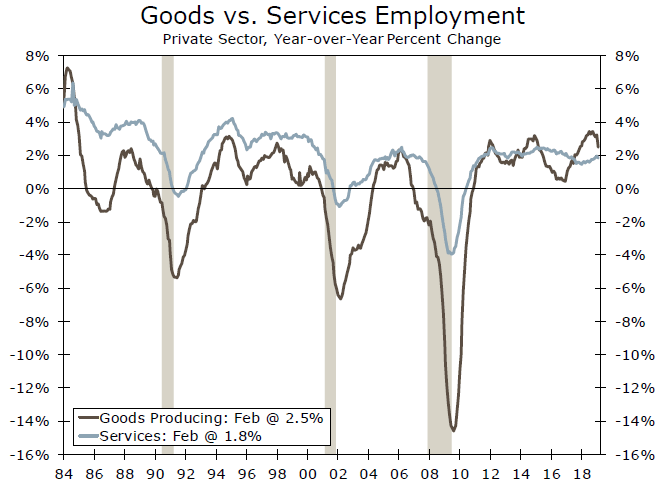
The return of more typical winter weather after a mild January and slowing growth overseas took a toll on hiring in the goods sector (down 32K). Construction payrolls fell 31K, mining was down 5K and manufacturers added the fewest jobs in about a year and a half (+4K). Service sector hiring also slowed (+57K vs. 194K average the previous three months).
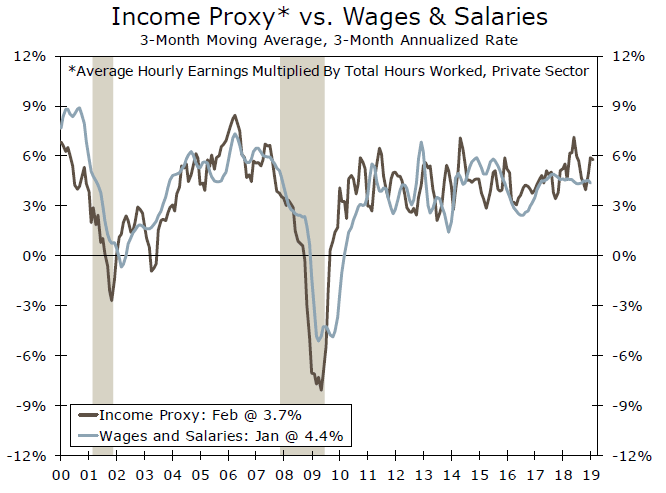
Despite the slowdown, job growth remains strong enough for the labor market to continue tightening and put upward pressure on wages. Average hourly earnings rose 0.4% in February. While the gain might be somewhat exaggerated by the small number of new hires (who start at lower wages), earnings are up 3.4% over the past year, a new cycle high. With wage growth strengthening and more workers collecting a paycheck, income growth is holding up fairly well (middle chart). We look for consumer spending to remain solid as a result and mitigate the impact of slowing investment on GDP growth.
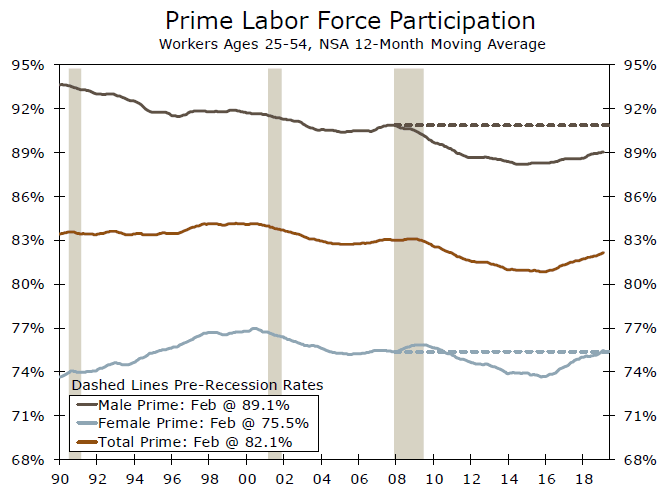
The unemployment rate declined two ticks to 3.8% last month, lowered in part by previously furloughed federal workers being back on the job last month and no longer counted as unemployed. The drop in unemployment leaves the unemployment rate within its recent range. The prime-age (25-54) labor force participation rate is still up 0.4 points over the past year, which has helped to arrest the downward trend in unemployment even as job growth has been robust. The additional pool of labor has given the FOMC one more reason to be "patient" with further policy tightening.
As we write this on International Women's Day, it is an opportunity to highlight that much of the rebound in prime-age labor force participation this cycle has been driven by women (bottom chart). While men are still more likely to be in the labor force, the economy's shift toward services like healthcare, which disproportionately employ women, has increased the relative demand for female labor. The uneven recovery between men and women highlights the challenges about the extent to which participation can rebound further, especially as activity in the more male-oriented industrial sector is beginning to cool. If the improvement in participation slows, we could expect to see the unemployment resume its downward trend, which would support more policy tightening later this year.