

Sample Category Title
CAD Rallies Hard on Strong Jobs Report
- Canada Feb net change in employment: +55.9K vs +1.2Ke
- Unemployment rate: +5.8% vs. +5.8%e –
- Full time employment change: +67.4K vs +0.8Ke
- Part time employment change: -11.6K vs -5.7Ke
- Participation rate: 65.8% vs. 65.6%e
- Hourly Wage Rate y/y: 2.2% vs. 1.7%e
Canada has sideswiped the market with a massive job gain print this morning, all of them full-time, and this despite a weakening domestic outlook from a ‘dovish’ Bank of Canada (BoC) earlier this week.
The Canadian economy added a net +55.9K jobs last month versus a market expectation of +0.6K
The unemployment rate in February remained unchanged at +5.8%, because more people entered the labor force looking for work.
Earlier this week the Bank of Canada (BoC) took the market by surprises and was very “dovish.” Governor Poloz held its key interest rate steady at +1.75% as weaker global and domestic growth prospects led policy makers to express more caution about the pace of future rate increases.
He insists that the economic outlook continues “to warrant a policy rate that is below the neutral range, which is currently estimated around 2.5% to 3.5%.” Poloz warned the market that “weakness could extend into the spring before activity picks up in the second half of the year.”
The CAD has rallied aggressively on the surprise report, currently +0.51% higher at C$1.3402
US NFP grew only 20k, but unemployment rate dropped to 3.8%, wage growth accelerated
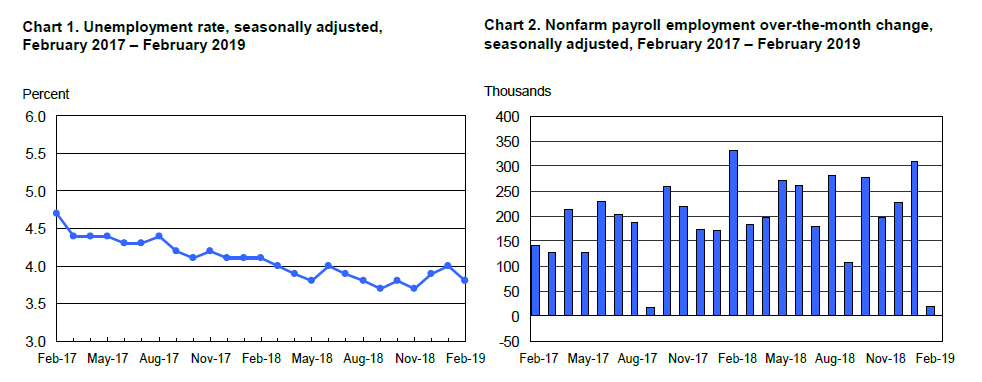
US Non-Farm Payrolls grew only 20k in February, well below expectation of 185k. Unemployment rate dropped to 3.8%, down from 4.0% and missed expectation of 3.9%. Average hourly earnings rose 0.4% mom, beat expectation of 0.3% mom. Labor force participation rate was unchanged at 63.2%.
Also from US, housing starts rose to 1.23M annualized rate in January, above expectation of 1.18M. Building permits rose to 1.35M, beat expectation of 1.29M.
Canada employment data is strong, showing 55.9k growth in February, versus expectation of -2.5k fall. Unemployment rate was unchanged at 5.8%.
Silver Rises after Strong Downfall from 16.20
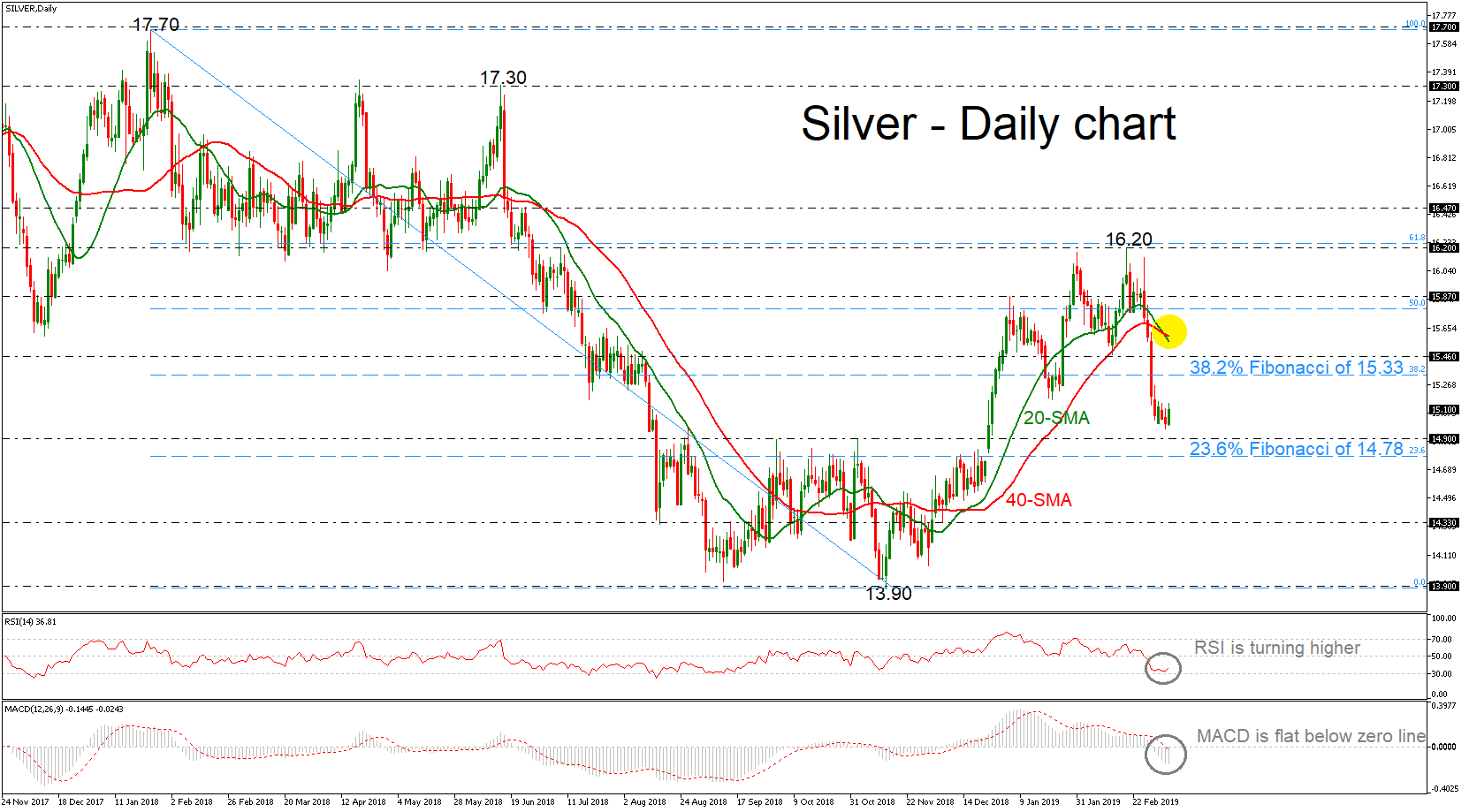
Silver came close to breaking the 14.90 support level on Thursday, finishing the day at a two-and-a-half-month low of 14.96. According to the RSI, the market could shift higher as it is sloping slightly upwards in the negate zone, though the MACD oscillator is losing its strong downside momentum in the bearish territory. Also, the 20- and 40-simple moving averages completed a bearish crossover in the daily timeframe, confirming the recent negative view.
If the price heads higher, immediate key resistance could come from the 38.2% Fibonacci retracement level of the downleg from 17.70 to 13.90 around 15.33, which if successfully broken the door could open for the 15.46 resistance, identified by the inside swing bottom on February 14.
On the other hand, further losses, could send the commodity below the 14.90 support, resting near the 23.6% Fibonacci region of 14.78. Should traders continue to sell, the next hurdle to focus on is the 14.33 support hurdle, taken from the minor low on December 6.
Turning to the long-term picture, the outlook has been cautiously negative since July 2016.
Canadian Dollar Under Pressure ahead of Key Job Data
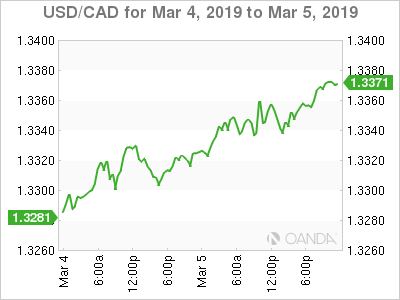
The Canadian dollar is under pressure, after posting losses throughout the week. On Friday, the pair is trading at 1.3461, up 0.04% on the day. On the release front, the focus will be on job numbers, with key indicators on both sides of the border. Canadian employment change is expected to gain a negligible 0.3 thousand, while the U.S. releases wage growth and nonfarm payrolls. Traders should be prepared for some movement from USD/CAD in the North American session.
The U.S. labor market is in very good shape, but the markets are anticipating mixed results on Friday. Wage growth is expected to improve to 0.3%, but nonfarm payrolls are projected to fall sharply to 180 thousand. Nonfarm payrolls have been above the 300-thousand level for the past two months, and a sharp decline could result in some volatility for the pair.
With growing concerns that the U.S. economy could slow down in 2019, the Federal Reserve has shifted to a dovish stance, and could opt to freeze rates until the second half of the year. Fed chair Powell has said the bank would exercise patience before any rate hikes. Earlier this week, Boston Fed President, said that there was some downside risk to the U.S. economy and called on policymakers to be “patient” for several more meetings in order to evaluate the risks to the economy. Without being explicit, Rosengren appears to support the Fed remaining on the sideline for the upcoming policy meetings until the Fed can better gauge the health of the U.S. economy.
As expected, the Bank of Canada stayed on the sidelines and maintained the benchmark rate at 1.75%, where rates have been pegged since October. The rate statement was dovish, as policymakers dropped a reference to rates rising over time. Instead, the bank said that the economy will continue to require stimulus and said that there was “increased uncertainty” about future rate hikes. The pessimistic language is a result of the economic slowdown, which has been worse than the bank anticipated. The BoC’s dovish tone has reinforced market expectations that the bank will not raise rates in the near future, and could lower rates if the economy continues to weaken. Canada’s GDP contracted by 0.1% in November and December, and another decline could send the Canadian dollar even lower. Elsewhere, Canadian Ivey PMI dropped sharply to 50.1 in January, down from 54.7 a month earlier. The soft reading points to a weakness in the Canadian economy.
ECB still in preparation for details of TLTRO-III
ECB announced yesterday to start a new quarterly targeted longer-term refinancing operations (TLTRO-III). in September. That's three month later than some expected. Some lenders might start to face a funding gap in June already. ECB Governing Council member Ewald Nowotny said "to make this a successful program, it has to be well-prepared." Meanwhile, Nowotny also hailed that "what the ECB did was the correct reaction" to risks in the external situation.
Another ECB Governing Council member Vitas Vasiliauskas said the central bank has time up until September to decide details of the TLTRO-III. He added that the program won't be extended to mortgages.
Draghi Releases The Doves And Not The Hounds
Equities sagged and the US surged overnight as the European Central Bank (ECB) spooked global markets by releasing the monetary doves instead of the hounds. European and North American Indices all ended up in the red, on currencies the US dollar Index hit its highest level since June 2017 while bond yields in Europe and the US all fell again.
The ECB left rates unchanged at 0% but was surprisingly downbeat, slashing Eurozone growth forecasts from 1.70% to 1.10%, lowering inflation forecasts with ECB President Draghi bemoaning “pervasive uncertainty” in the global economy. The ECB launched a new round of cheap bank financing and said it would fully reinvest its maturing bond holdings.
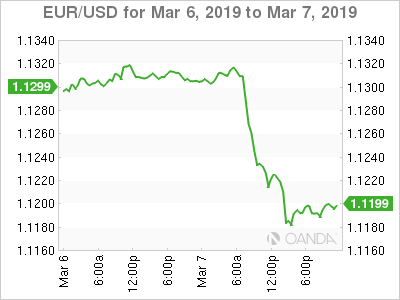
With the Euro-zone likely the next target for President Trump’s trade-talk embrace, a slowing economy, a central bank very low on monetary bullets, an inability by members to mount a joint fiscal response and an impending Brexit by the U.K, it is no surprise that the Euro (EUR) fell out of bed. The single currency fell 1% from 1,1305 to 1.1195, a 20-month low.
The sombre mood flowed into North America with the S&P 500 and Dow Jones falling 0.8% and the Nasdaq 1.1%.
Asia is unlikely to escape Europe’s hangover either following a dismal day on North Asian stock markets yesterday. Local markets will anxiously await China’s trade balance at 1100 am Singapore (USD26.4 exp), followed by German Factory orders (+0.50% exp) before the week’s highlight, the US non-farm payrolls. After last month’s monster 300,000 gain, expectations are more tempered today with the street forecasting 180,000 jobs added. Watch for extensive revisions of the previous months print, with a substantial downward revision potentially holing fragile sentiment below the water line.
FX
The US dollar reigned supreme overnight as haven flows poured into the greenback and onto US treasuries. The EUR dipped below 1.1200 with the pound (GBP) falling 0.7% to 1.3085.
The Australian dollar (AUD), New Zealand dollar (NZD) and Japanese Yen (JPY) all trod water overnight as the news stayed European centric. The China trade data should provide some volatility for all three with sellers emerging on a low print.
The same scenario is likely for regional currencies, with traders likely to reduce holdings on a lower print. Local currencies, in particular, are vulnerable to safe-haven outflows ahead of the weekend.
Equities
Regional stock markets are unlikely to enjoy a happy start to the day with investors likely to see the price action in China, Europe and the US overnight and hit the sell button. We would have expected some lightening of positions anyway ahead of crucial US data and the weekend but overall, the mood will be sombre today.
Oil
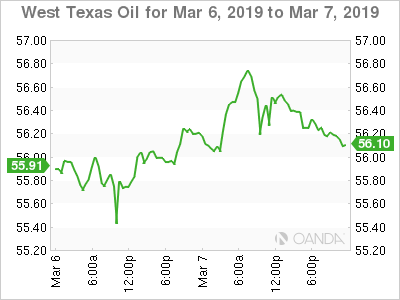
Brent crude and WTI both traded sideways overnight with oil out of the headlights for now. With attention focused elsewhere, oil seems balanced between OPEC cuts and increasing US shale production, at least in the short term. The world talking itself into a recession has the potential to change that balance materially.
Irish Varadkar said Brexit is a problem of UK’s own creation, open to revert to North Ireland only backstop
Ireland Prime Minister Leo Varadkar said today that "it requires a change of approach by the UK government to understand that Brexit is a problem of their own creation." And, "what was agreed was already a compromise" by the EU. UK government failed to secure ratification of the deal and "it should be a question of what they are now willing to offer us."
Varadar also emphasized that "we have made a lot of compromises already and what is not evident is what the UK government is offering to the European Union and Ireland should they wish us to make any further compromises". He added, "we were and remain happy to apply the backstop only to Northern Ireland if they want to go back to that. It doesn't have to trap, or keep, all of Great Britain in the customs territory at all."
European Commission spokesman Alexander Winterstein said "Technical discussions are ongoing. The EU side has offered ideas how to give further reassurances regarding the backstop, you are aware of all this, so there is no need for me to repeat it".
UK Foreign Minister Jeremy Hunt said "History will judge both sides very badly if we get this wrong" And, "we want to remain the best of friends with the EU, that means getting this agreement through in a way that doesn't inject poison into our relations for many years to come".
Separately, it's also reported that the trip of UK Attorney General Geoffrey Cox and Brexit Minister Stephen Barclay to Brussels has been called off. And there is no plan for Prime Minister Theresa May to meet EU officials over the weekend.
U.S. NFP Day Is Here – Which Way Will The Dollar Go?
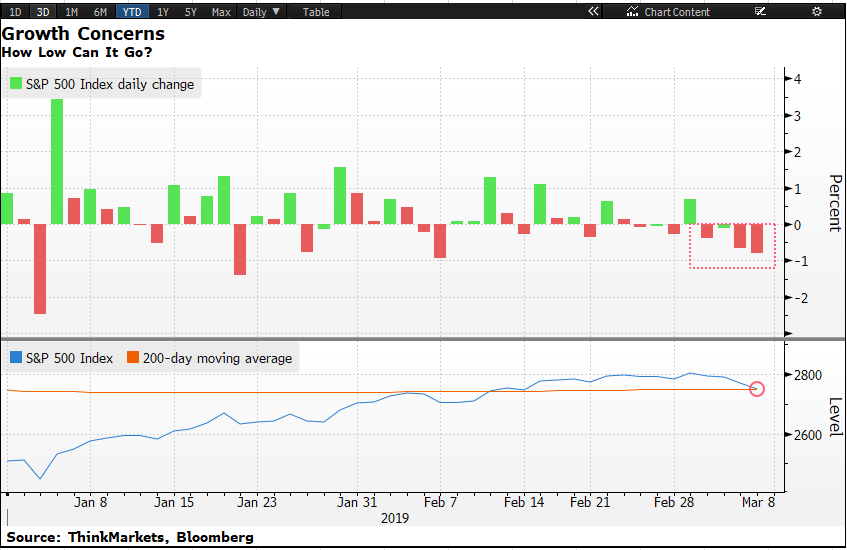
The S&P500 index locked in the longest losing streak for 2019 yesterday ahead of the most important economic data. The index recorded four consecutive days of losses. The equity benchmark lost nearly 0.8 percent, but it is up nearly 9.66 percent year-to-date. The Dow Jones index is up 9.20 percent YTD, but it is the NASDAQ index that is leading the way with a gain of 11.85% YTD.
The U.S. Non-Farm Payroll data is the most critical number for the global markets. The Federal Reserve bank makes its monetary policy decision based on this number. Of course, the bank also factors in other critical elements but the job market’s health trumps them all. The recent data for the US 4Q GDP provided much-needed assurance that the economy is slowing, but it isn't stalling. I believe that that the 1Q GDP is likely going to be underwhelming mainly due to the fact that the inventory bulge is often worked off and this could lead the reading below the 2 percent mark.
Nonetheless, the 4Q GDP reading was well ahead of the consensus estimate. The number came in at 2.6 percent against the forecast of 2.2 percent, beating the previous reading of -3.6 percent. Despite this strong reading, the Fed chairman, Jerome Powell, has maintained his stance towards the monetary policy. The Fed will continue to practice patience and it will continue to monitor the economic data closely before it starts the process of hiking the interest rates again.
The soft patch which we have experienced in the U.S. markets isn't that prominent in the U.S. labour market, which is fairly sturdy. Therefore, today's number has special meaning for the dollar index. The greenback index touched the highest level since December, and this is even though the Fed is continuously assuring the market that the bank isn’t going to rush to hike the interest rate. It looks like the market participants do not believe this.
So, the question is what is ahead for the dollar index?
I believe that the tone is set for a solid February jobs number and it is likely that we would see an increase in hiring, confirming the evidence of mounting wage pressure. This could lead the unemployment rate to return to its old trend, a lower unemployment rate. The 12-month trailing average of non-farm payroll has jumped from 173K p/m from January 2018 to 234K p/m in January 2019 while the average for the past three months sits at 241K.
The forecast for today’s nonfarm payroll change is 180K and any number below 150K would only set a bearish tone. A number above 240K would set a bullish tone and this could push the dollar index above the 98 mark.
Brexit Chaos, Again
It's coming down to the wire. UK Prime Minister Theresa May has hours to get a deal done. Talks on the Irish backstop collapsed, and May's latest Withdrawal Agreement is facing another crushing defeat of up to 100 votes. Parliament might extend the Brexit deadline, which could prevent a no-deal exit for a few months, but also raise uncertainty.
May remains in the fight, with plans to visit Brussels Monday. That will leave hours for her to propose a deal for vote in Parliament on Tuesday. Brexiteers argue that two days are needed to analyse the next proposal, saying they won't be rushed into a vote. As risk rises, GBP/USD continues to drop, and we expected further deprecation.
Draghi shoots his wad
Yesterday's European Central Bank meeting launched TLTROs (cheap refinancing for banks), pushed back prospects of interest hikes and the revised growth projections down. All of this was expected, yet markets reacted violently. EUR fell across the board to $1.1177, more than -1% on the day. In equities, European and US indices bore the brunt of the sell-off. The reaction is surprising, knowing that all the announcements were expected. Maybe investors were in denial about low growth in Europe and across the globe.
The question now is: will central banks be able to manage a slowdown given the size of their balance sheets? We do not see how it is possible. Balance sheets are bloated, so it would very difficult for them to absorb an economic shock. Still, investors haven't surrendered to panic – yet.
Concerns Reverberate Over Global Growth, Focus On US Payroll Data
Notes/Observations
- Concerns over weakening global growth continue; safe-haven plays benefiting
- Also concerns whether a US-China trade deal was imminent as no preparations for US-China Summit seemed underway
- Germany Jan Industrial Orders registered its steepest MoM decline since June 2018
- Focus on Feb US jobs report later today
Asia:
- China Feb Trade Balance registered its smallest surplus in a year as components worsened during the Lunar New Year holiday period but added to concerns over weakening global growth. (Trade Balance: $4.1B v $26.2Be; Exports Y/Y: -20.7% v -5.0%e; Imports Y/Y: -5.2% v -0.6%e)
- China PBoC official said to caution financial risks in 2019. Saw potential risks from local govt hidden debt. Bond defaults and property market might materialize in some regions and affect financial institutions
- Japan Q4 Final GDP revised higher and confirmed no recession (Q/Q: 0.5% v 0.4%e; Annualized GDP QoQ: 1.9% v 1.7%e (*Note: Q3 GDP showed a contraction)
- Japan top currency official Asakawa noted that downside risks in global economy persisted due to China-US Trade war; reiterated always monitoring FX market and stood ready to respond to excess volatility and disorderly moves
Europe:
- ECB said to have opted for more radical easing measures in March only after growth projections showed a bigger than feared economic slowdown. The hawkish ECB members did not put up a fight, conceding that delaying these decisions until April was pointless
- ECB said to lean toward TLTRO rate at premium over benchmark; Some ECB official said to have doubted that 2019 outlook was not cut enough. Draghi said to have pushed for ECB stimulus package
- EU said to have made a new offer to the UK on the Irish backstop and was awaiting response. Reports did indicated that the Brexit offer fell short of what UK demanded
- Labour Party (opposition) said to only back Final Say vote on PM May’s Brexit deal and could support softer Brexit without public being given a say. The party was not advocating a referendum in all circumstances
Americas:
- Fed's Brainard (voter, dove): Navigating cautiously is the right course. Had revised down 2019 economic outlook on increase in risks; it was appropriate to wind down runoff later in year. Softening in recent spending and sentiment data might suggest slowing demand
Macro
- (DE) Germany: Factory orders fell -2.6% m/m in February, but January number was revised sharply higher to +0.9% m/m from -1.6% m/m reported initially. The annual rate also improved to -3.9% y/y from -4.5% y/y. The ECB would have already had the numbers yesterday and the additional confirmation that the German manufacturing sector is crashing under the weight of global trade tensions and rising protectionism will likely have contributed to the ECB’s significantly dovish tilt.
- (CN) China: Exports dropped -20.7% y/y in February, the biggest drop in three years and nowhere near consensus estimates for a fall of -4.8%. Even allowing for seasonal factors the data was being widely read as unambiguously bad. But you have to also consider the tougher comparables related to front end loading head of the introduction of tariffs this time last year. The US-China trade war thus got a lot of blame, though the data did highlight weakening European demand.
- (EU) Eurozone: Reportedly some ECB officials are even more pessimistic about the outlook and consider the latest staff projections, which put growth at 1.1% this year, to be too optimistic. Draghi signaled yesterday that the risks remain skewed to the downside, despite the downward revisions and the new liquidity program and he also admitted that some council members had wanted to push out the guidance for the timing of the first rate hike beyond March next year, rather than December.
- (EU) Eurozone: The ECB's Nowotny said details of new TLTRO program would be announced in June. He said the Eurozone "clearly" is not in a recession, but that the ECB "wanted to give an expansionary signal". Nowotny ahead of the meeting had been on record as saying that he doesn't see the need for an immediate step, but has now admitted that the downward revisions to the German growth outlook forced the ECB's hand. At the same time, Nowotny defended the decision to start the third round of TLTRO loans in September, rather than June, when the banks will probably start to feel the impact of the maturation of the previous round of loans.
SPEAKERS/FIXED INCOME/FX/COMMODITIES/ERRATUM
Equities
- Indices [Stoxx600 -0.63% at 371.52, FTSE -0.75% at 7,103.56, DAX -0.57% at 11,451.59, CAC-40 -0.39% at 5,247.56, IBEX-35 -0.72% at 9,182.90, FTSE MIB -0.51% at 20,592.50, SMI -0.48% at 9,291.80, S&P 500 Futures -0.42%]
Market Focal Points/Key Themes:
- European Indices trade lower across the board following a lower Asian Indices and lower US futures. The Shanghai composite declined over 4% following poor China trade data with Exports reaching a 3 year low declining over 20%.
- On the corporate front shares of GVC trades sharply lower following share sales from the CEO and Chairman. On the earnings front Goals Soccer Centers trades over 25% lower after guiding full year results materially below expectations. Elsewhere fashion name EssilorLuxottica declines after a fall in Revenue and profits while Schouw & Co, VAT Group, SwissQuote and SFS Group are among other decliners on earnings. Bodycote and Ontex are among the notable gainers on earnings, with SIG gaining sharply on earnings and strategic options for its Air Handling Business.
- In other news Debenhams trades higher after Sports Direct has requested a general meeting to shake up the board; BMW declines after a fall in Feb sales.
- Looking ahead notable earners include Big Lots, Vail Resorts and Navistar International.
Equities
- Consumer discretionary: GVC Holdings [GVC.UK] -16% (Chairman and CEO sell shares), Essilor Luxottica [EI.FR] -5.5% (earnings), Debenhams [DEB.UK] +21% (issues statement), Goals Soccer Centers [GOAL.UK] -25% (profit warning)
- Consumer staples: Ontex Group [ONTEX.BE] +4.5% (earnings)
- Industrials: Airbus [AIR.FR] -1.5% (deliveries data), RPC Group [RPC.UK] -1.5% (Berry Global superior offer), VAT Group [VACN.CH] -4% (earnings), Panalpina [PWTN.CH] -0.5% (DSV exec comments)
Speakers
- ECB’s Nowotny ( Austria): Latest decision was meant to send an expansionary signal and was the correct response (**Reports noted that ECB hawks gave little pushback to the dovish ECB move on Mar 7th as they conceded that delaying decisions until April made little sense)
- ECB's Vasiliauskas (Lithuania): General Council acted preemptively as action was needed as was surprised by extend of Staff Forecasts revisions. ECB had time until Sept to agree on TLTRO details but they would not contain mortgage lending
- Sweden Central Bank (Riksbank) Dep Gov Floden: Surprised by the recent weakness in SEK currency (Krona); fundamentals suggested a stronger currency
- Finland govt to resign; PM Siplia to tender resignation on Friday, Mar 8th citing lack of progress on key reforms (**Note: Next elections schedule for April 14th)
- Czech Central Bank Holub (chief economist): May still have room for more rate hikes. Saw range of hikes in 2019 from 0 to 2 (**Note: his prior view was between 1-2). Recent ECB policy move was a reason for CNB to be cautious.
- US Ambassador to China Branstad: No preparations for US-China Summit underway
- China PBoC Advisor Sheng Songcheng: Benchmark interest rates are very low and expected the economy to stabilize in Q2
Currencies/ Fixed Income
- Markets were in a holding pattern ahead of the US payroll report for Feb due out later today with the greenback just humming along its best levels of the year against a basket of currencies
- EUR/USD was holding above the 1.12 level in quiet trading and just off its lowest since June 2017 following the dovish ECB statement on Thursday. ECB pushed back the timing of its first post-crisis interest rate hike to 2020,cut its economic forecasts and launched a new round of TLTRO (bank lending scheme). EUR currently exhibiting its worst weekly decline in over a year with losses of approx. 1.5%.
- The JPY currency was firmer on safe-haven flows as concerns over weakening global growth continued. The ECB staff projections, and poor components from China and Taiwan tarde data prompted the lasted catalyst. USD/JPY lower by 0.5% holding around the 111.00 area.
Economic Data
- (DE) Germany Jan Factory Orders M/M: -2.6% v +0.5%e; Y/Y: -3.9% v -3.2%e
- (NO) Norway Jan GDP M/M: 0.2 v 0.0% prior; GDP Mainland M/M: 0.3% v 0.3%e
- (FI) Finland Jan Industrial Production M/M: 0.2% v 1.4% prior; Y/Y: 2.6% v 3.3% prior
- (CN) Weekly Shanghai copper inventories (SHFE): 236.2K v 227.1K tons prior
- (FR) France Jan Trade Balance: -€4.2B v -€4.9Be
- (FR) France Jan Current Account Balance: +€0.9B v -€0.1B prior
- (FR) France Jan Industrial Production M/M: 1.3% v 0.1%e; Y/Y: 1.7% v 0.5%e
- (FR) France Jan Manufacturing Production M/M: +1.0% v -0.2%e; Y/Y: +0.9% v -0.2%e
- (TW) Taiwan Feb CPI Y/Y: 0.2% v 0.3%e; CPI Core Y/Y: 0.3% v 0.4%e; WPI Y/Y: 0.8% v 0.5% prior
- (TW) Taiwan Feb Trade Balance: $4.9B v $2.1Be; Exports Y/Y: -8.8% v -0.7%e; Imports Y/Y: -19.7% v +4.8%e
- (ES) Spain Jan Industrial Output NSA Y/Y: +1.8% v -4.2% prior; Industrial Output SA Y/Y: +2.4% v -1.6%e; Industrial Production M/M: 3.4% v 1.6%e
- (HU) Hungary Feb CPI M/M: 0.6% v 0.4%e; Y/Y: 3.1% v 2.9%e
- (CZ) Czech Q4 Average Real Monthly Wage Y/Y: 4.7% v 5.9%e
- (CZ) Czech Feb Unemployment Rate: 3.2% v 3.2%e
- (SE) Sweden Jan Household Consumption M/M: +0.7% v -0.4% prior; Y/Y: 1.1% v 0.3% prior
- (IT) Italy Jan Industrial Production M/M: 1.7% v 0.2%e; Y/Y: -0.8% v -3.0%e; Industrial Production NSA (unadj) Y/Y: -0.9% v -2.5% prior
- (IT) Italy Jan PPI M/M: 0.0% v -0.6% prior; Y/Y: 4.4% v 5.2% prior
- (GR) Greece Jan Industrial Production Y/Y: % v 1.3% prior
- (HU) Hungary Feb YTD Budget Balance (HUF): 67.3B v 244.5B prior
Fixed Income Issuance
- (IN) India sold total INR120B vs. INR120B indicated in 2024, 2029, 2033 and 2055 bonds
- (ZA) South Africa sold total ZAR650M vs. ZAR650M indicatedin I/ L 2025, 2038 and 2046 bonds
- (SE) Sweden sold SEK500M vs. SEK500M indicated in 0.125% 2026 Inflation-Linked bonds; Avg Yield: -1.743% v -1.6130% prior; Bid-to-cover: 5.09x v 6.03x prior
Looking Ahead
- (MX) Mexico Feb Nominal Wages: No est v 5.2% prior
- (IT) Italy Debt Agency (Tesoro) announcement for upcoming BTP auction on Mar 13th
- 05:30 (PL) Poland to sell PLN3.0-5.0B in 2021, 2024, 2028 and 2029 Bonds
- 06:00 (BR) Brazil Feb FGV Inflation IGP-DI M/M: 1.1%e v 0.1% prior; Y/Y: 7.6%e v 6.6% prior
- 06:00 (CL) Chile Feb CPI M/M: 0.1%e v 0.1% prior; Y/Y: 1.8%e v 1.8% prior
- 06:00 (CL) Chile Feb CPI (ex-food/energy) M/M: 0.3%e v 0.4% prior; Y/Y: No est v 1.9% prior
- 06:00 (UK) DMO to sell €6.0B in 1-month, 3-month and 6-month bills £2.0B, £2.0B and £2.0B respectively)
- 06:30 (IN) India Weekly Forex Reserves w/e Mar 1st: No est v $399.2B prior
- 06:45 (US) Daily Libor Fixing
- 08:00 (UK) Baltic Dry Bulk Index
- 08:00 (IN) India announces upcoming bill issuance (held on Wed)
- 08:15 (CA) Canada Feb Annualized Housing Starts: 205.0Ke v 207.9K prior (revised from 208.0K)
- 08:30 (US) Feb Change in Nonfarm Payrolls: +180Ke v +304K prior; Change in Private Payrolls: +170Ke v +296K prior; Change in Manufacturing: +12Ke v +13K prior
- 08:30 (US) Feb Unemployment Rate: 3.8%e v 4.0% prior; Underemployment Rate: No est v 8.1% prior; - 08:30 (US) Feb Average Hourly Earnings M/M: 0.3%e v 0.1% prior; Y/Y: 3.3%e v 3.2% prior; Average Weekly Hours: 34.5e v 34.5prior
- 08:30 (US) Jan Housing Starts: 1.195Me v 1.078M prior; Building Permits: 1.287Me v 1.326M prior
- 08:30 (CA) Canada Feb Net Change in Employment: +1.2Ke v +66.8K prior; Unemployment Rate: 5.8%e v 5.8% prior; Full Time Employment Change: +0.8Ke v +30.9K prior; Part Time Employment Change: -5.7Ke v +36K prior; Participation Rate: 65.6%e v 65.6% prior; Hourly Wage Rate Y/Y: 1.7%e v 1.8% prior
- 08:30 (CA) Canada Q4 Capacity Utilization Rate: 82.0%e v 82.6% prior
- 09:00 (MX) Mexico Dec Gross Fixed Investment: -4.9%e v -3.2% prior
- 11:30 (LX) ECB’s Mersch (Luxembourg) at conference
- 12:00 (US) USDA World Agricultural Supply and Demand Estimates (WASDE)
- 13:00 (US) Weekly Baker Hughes Rig Count data
- 20:30 (CN) China Feb CPI Y/Y: 1.5%e v 1.7% prior; PPI Y/Y: 0.2%e v 0.1% prior
- 21:00 (US) Fed Chair Powell