

Sample Category Title
USD/CAD Outlook: Canadian Dollar Rebounds after Downbeat US and Strong Canada’s Jobs Data
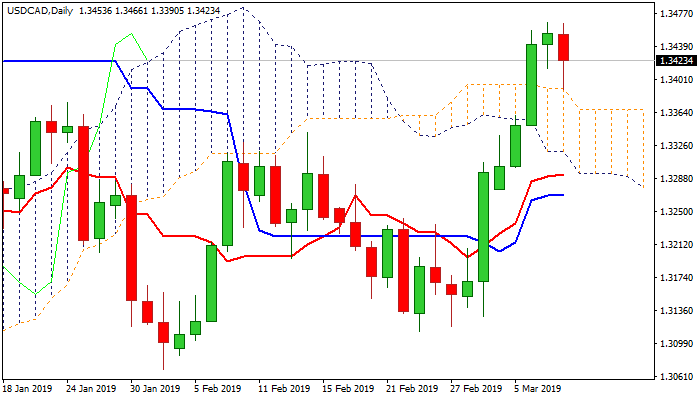
The pair fell some 50 pips in an immediate reaction on US NFP surprise and upbeat Canada's employment figures. Data on Friday showed that US job growth reached levels close to stall, as the economy created only 20K new jobs in Feb, falling strongly below expectations 181K and well below January's upward-revised 311K. US unemployment fell to 3.8% in Feb from 4.0% in Jan and below 3.9% consensus, with negative signals being partially offset by Average Hourly earnings which rose 0.4% in Feb from 0.1% in Jan and above 0.3% forecast. On the other side, Canada's new jobs creation figure rose well above expectations Feb 55.9K vs 0.3K f/c that further boosted demand for loonie as the greenback was lower across the board after data. Fresh weakness dented initial support at 1.3391 (daily cloud top) and signal formation of reversal pattern on daily chart. Penetration of daily cloud and first bearish daily close after six straight days in green would add to negative signals and push the price lower as traders took profit from steep ascend from 1.3112 (25 Feb low). Stronger reversal signal could be expected on extension below 1.3331 (Fibo 38.2% of 1.3112/1.3467), while break below the base of thickening daily cloud (1.3294) would confirm scenario.
Res: 1.3445; 1.3467; 1.3500; 1.3524
Sup: 1.3390; 1.3348; 1.3331; 1.3294
CHI50 Index Loses 6% after 1-Year Highs; Sell-off Could Pause Soon
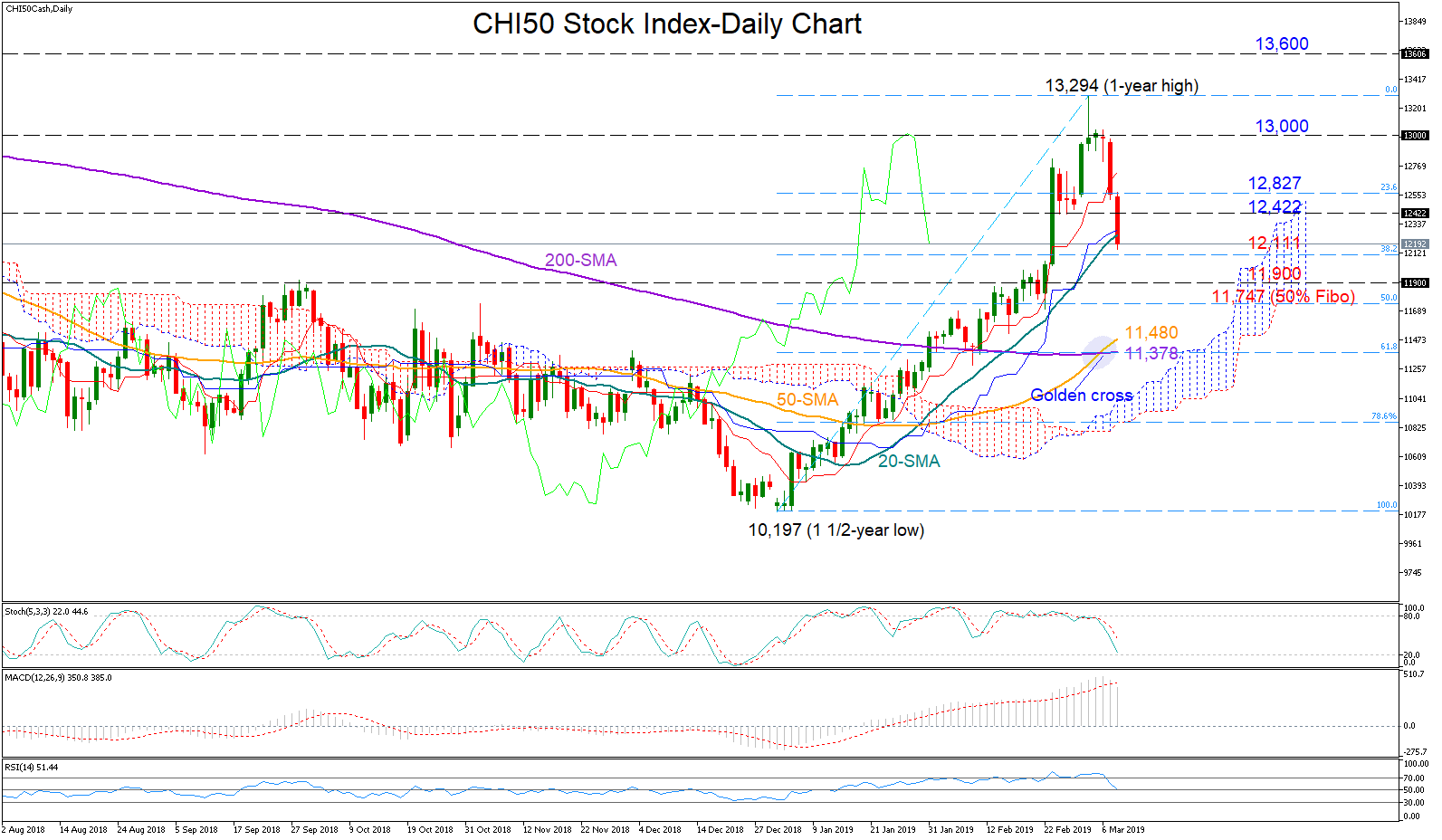
China 50 stock index plunged by more than 6% in the latest two trading sessions after topping at a one-year high of 13,294 on March 4, recording its biggest daily losses since late October.
The RSI has left its overbought zone above 70 and returned to 50, while the MACD slipped below its red signal line, confirming the recent bearish correction. In Ichimoku indicators, though, the red Tenkan-sen line predicts a more positive short-term picture as the index maintains a steep positive slope above the blue Kijun-sen. Meanwhile, according to the Stochastics, which are moving faster towards the 20 oversold mark now, the sell-off may not last for long.
The 38.2% Fibonacci of 12,111 of the upleg from 10,197 to 13,294 is in breathing distance below the price action and therefore could act as an immediate support if negative momentum strengthens even further. Under that level, the bears may rest within the 11,900-11,747 territory before a crucial battle potentially inside the 11,480-11,378 area, encapsulated by the 50- and the 200-day simple moving averages.
In case of a rebound, nearby resistance could appear between 12,422 and the 23.6% Fibonacci of 12,827. Higher, a break above 13,000 may trigger a more aggressive rally towards the 13,294 top. Any significant violation at this point would bring the bullish mode back into play, confirming the sustainability of the January uptrend as well. Higher the next stop could be near 13,600, taken from from the highs on March 18.
Summing up, chances for improvement in the short term have not faded yet, while in the medium-term CHI50 index continues to hold a positive, with the golden cross between the 50- and the 200-day MA increasing hopes for a stronger bull market.
America’s Job Engine Sputters in January
America's job creation engine sputtered in February, generating a measly 20k new jobs. That is the softest hiring tally in a year and a half. The slowdown comes after two months of very strong hiring activity in January (+311k) and December (+227K). Job gains over the past three months averaged 186k.
Other details of the report were more positive. The unemployment rate fell back to 3.8%. It had risen to 4% in January due to workers furloughed during the government shutdown.
Another piece of good news was that the participation rate held on to January's jump up to 63.2%. The rate is up 0.2 percentage points over the past year as a strong labor market draws in a greater share of workers.
Looking at the payrolls data by industry, the slowdown in hiring was widespread. Both goods (-32k) and services(+57k) sectors were weak, and there isn't any one industry that stands out as the culprit. Construction shed workers (-31k), manufacturing hiring slowed (+4k), and the retail sector lost jobs (-6k).
There were bright spots in some industries, including professional and business services (+42k), health care (+21k), and wholesale trade (+11k).
Today is international women's day, and women continue to make gains in the U.S. labor market. The share of women over 16 with a job rose in February to 55.4%, the highest level in over ten years. Looking at women in prime working years, ages 25-54, the employment to population ratio is at 73.4%, above the pre-recession level, and comparable to the level last seen in 2001.
Ending on another positive note, average hourly earnings rose a better-than-expected 0.4% on the month. On a year-on-year basis, wages were up a healthy 3.4% in February, the fastest past in almost ten years.
Key Implications
After January's blowout job gains, most analysts were expecting a slowdown in hiring, but February's slowdown was worse than expected. This will likely raise some concerns about momentum in the broader economy, with indicators suggesting that economic growth in the first quarter is running not much better than 1%. However, we are inclined to fade the unexpected weakness in February's payrolls tally, given the strength we continue to see in other aspects of the report. We have seen hiring tallies of 20k or weaker three times in the past three years. So, while America's job engine may have sputtered in February, we do not think it has stalled.
We continue to expect the U.S. economy to bounce back in the second quarter. But the overall story for 2019 is one of slowing growth after registering a roughly 3% pace in 2018. February's hiring slowdown is a reminder that with not much slack left in the labor market, the trend in hiring is expected to slow too going forward. As far as the Fed is concerned, this report reinforces their wait and see stance, which we expect will continue until the second half of this year.
Odd Jobs Report Leaves Investors Scratching Their Heads
Traders are likely to be scratching their heads after the release of a very strange employment report from the United States for February.
The United States added only 20,000 jobs to its economy last month, which is a stunningly low figure but it has been joined by other data that paints a more encouraging picture. For example, hourly earnings on an annual level increased by 3.4% - which is an impressive number to cap off an odd economic release.
I wonder whether investors will digest the figure off the back of a disappointing retail sales release in the past couple of weeks as an indicator that the global economic slowdown narrative is sneaking its way into the world’s largest economy. The initial selling reaction in the Dollar Index just one day following a downbeat ECB alerted the Dollar divergence trade suggests as much.
This financial market is overall proving a very difficult one to play, but if I had to pick a side I would still favor the Greenback – in spite of this odd jobs report. The data from China this morning was concerning and suggests economic weakness in emerging markets in the months ahead; while the ECB has made no secret of the fact that the Eurozone is very much remaining in its place as the “weak link” in the developed economy. At the same time, Oil has dropped close to 3% as fears over slowing global growth remain high.
I prefer to maintain a negative view on global stock markets as concerns over slowing world economic momentum show no signs of deceleration, while I also do not want to touch the Pound with the Brexit clouds so thick in uncertainty with no one having any idea of what could, or could not happen, with the United Kingdom potentially crashing out of the European Union over the next couple of weeks.
There is no disputing the thick smoke of doom and gloom that is being painted across financial market headlines overall, and although indications of an economic slowdown are also being felt in the United States, the US economy does overall still appear to be in better shape than its global counterparts and the Dollar still looks supported in a very confused market.
USD/JPY Mid-Day Outlook
Daily Pivots: (S1) 111.42; (P) 111.64; (R1) 111.80; More...
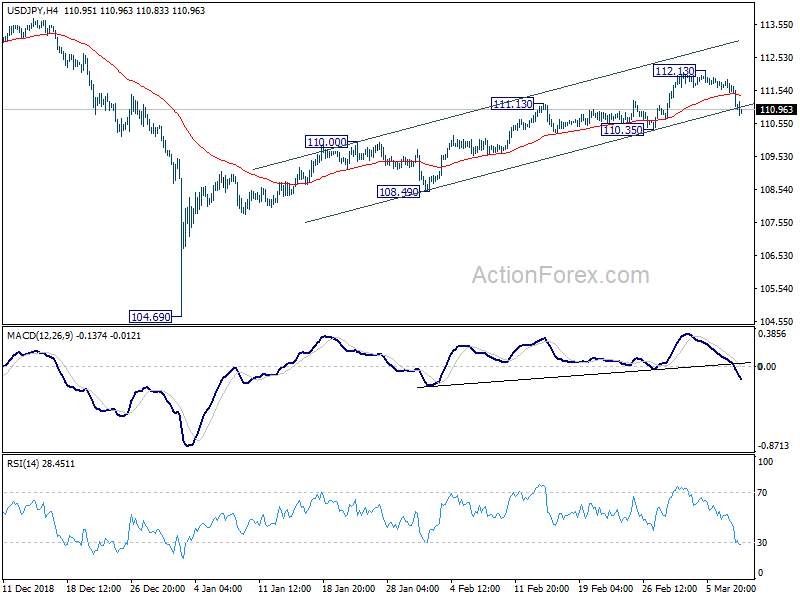
Focus in now on 110.35 support in USD/JPY. With 110.35 support intact, near term outlook remains bullish and rise from 104.69 is still in favor to resume. On the upside, break of 112.13 will target 114.54 resistance next. However, firm break of 110.35 should confirm near term reversal and turn outlook bearish for 108.49 support and below.
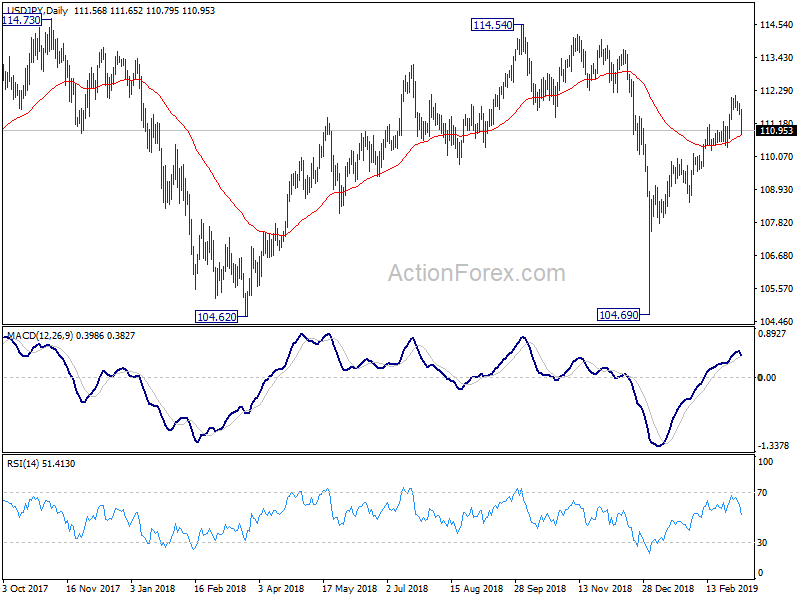
In the bigger picture, current strong rebound from 104.69 argues that decline from 118.65 (2016 high) has completed with three waves down to 104.69, after failing 104.62. More importantly, the rise from 98.97 (2016 low) could be resuming. Focus now turns back to 114.54 resistance, decisive break there will add more credence to this bullish case and target 118.65. This will now be the favored case as long as 110.35 support holds.
USD/CHF Mid-Day Outlook
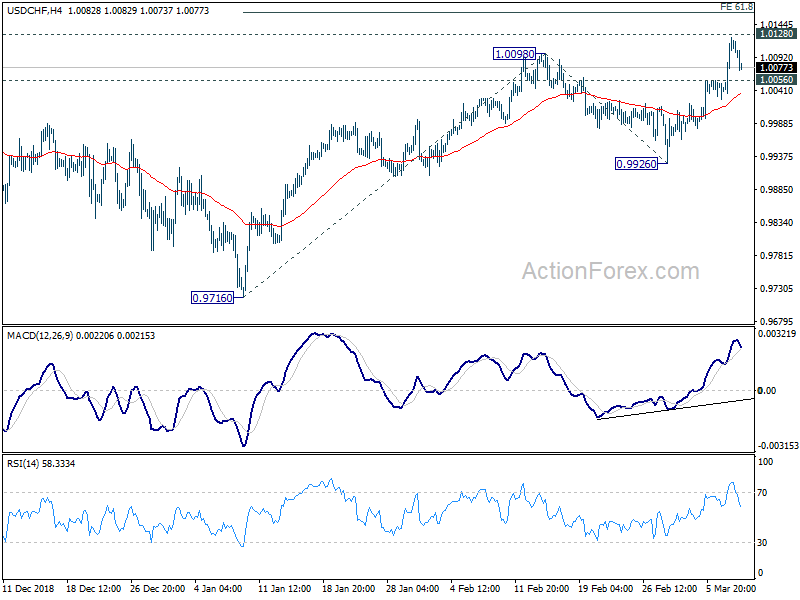
Daily Pivots: (S1) 1.0053; (P) 1.0090; (R1) 1.0150; More....
USD/CHF retreats notably ahead of 1.0128 resistance. But with 1.0056 minor support intact, further rise is expected. On the upside, decisive break of 1.0128 will confirm resumption of rally from 0.9187. Next near term target will be 61.8% projection of 0.9716 to 1.0098 from 0.9926 at 1.0162 and then 100% projection at 1.0308. On the downside, break of 1.0056 minor support will turn intraday bias neutral first.
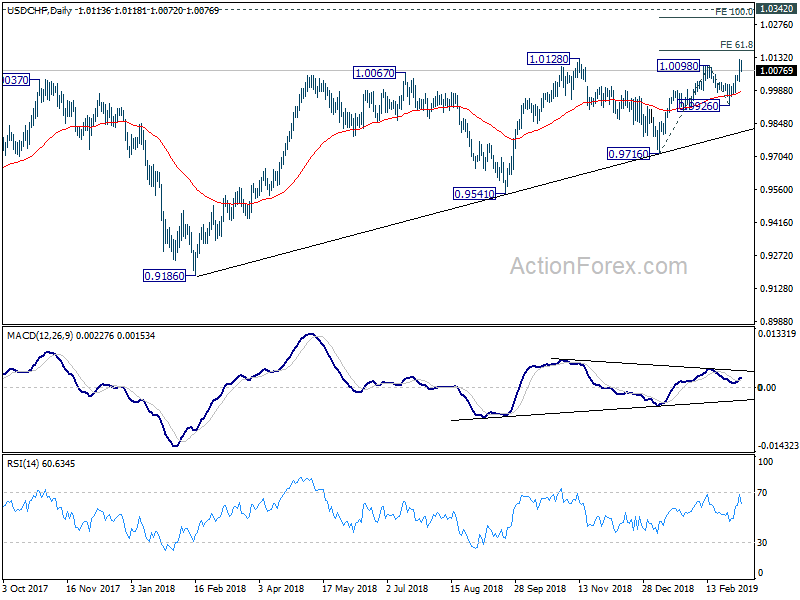
In the bigger picture, USD/CHF drew strong support from medium term trend line and rebounded. That suggests rise from 0.9186 is still in progress. Further break of 1.0128 will confirm up trend resumption and target 1.0342 key resistance. Nevertheless, break of 0.9716 will dampen this bullish view and at least bring deeper fall to 0.9541 key support.
GBP/USD Mid-Day Outlook
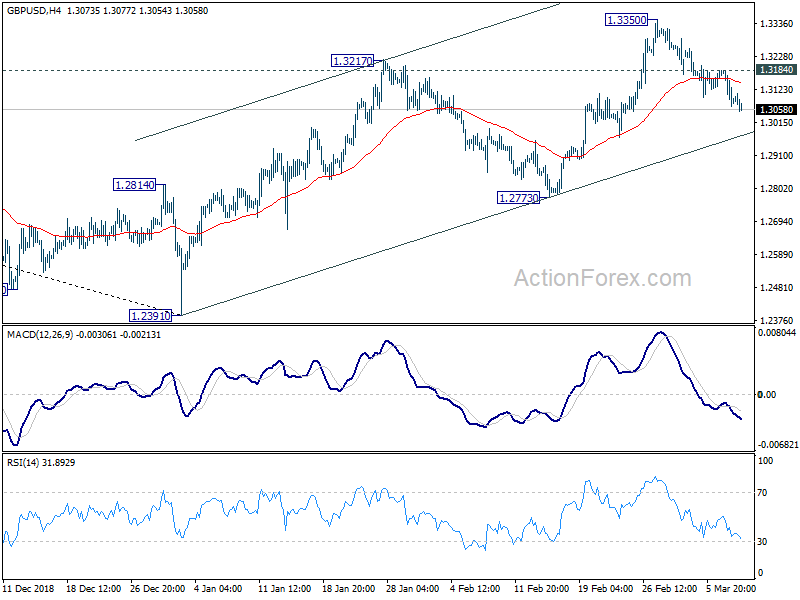
Daily Pivots: (S1) 1.3038; (P) 1.3112; (R1) 1.3156; More....
Intraday bias in GBP/USD remains on the downside for trend line support (now at 1.2980). Decisive break there will add to the case of near term reversal and target 1.2773 support for confirmation. On the upside, above 1.3184 minor resistance will turn bias back to the upside for 1.3350 instead.
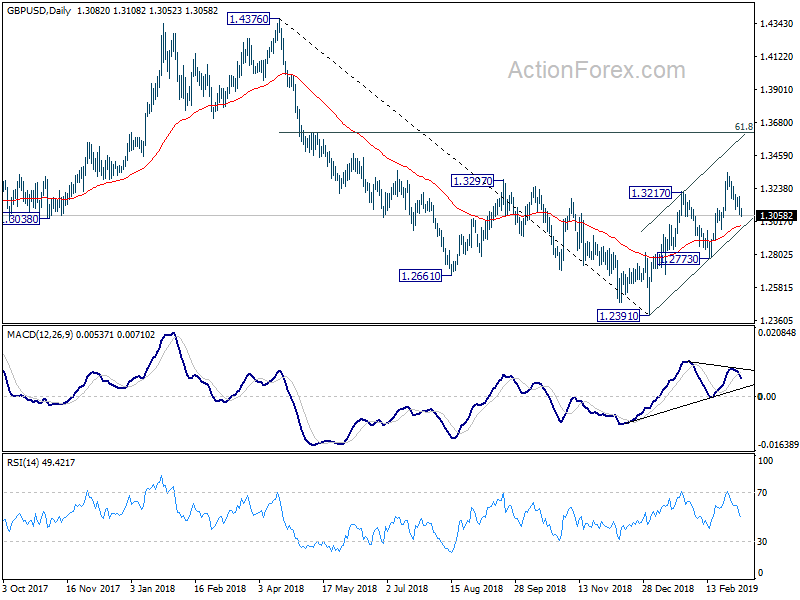
In the bigger picture, medium term decline from 1.4376 (2018 high) should have completed at 1.2391. Rise from 1.2391 is now seen as the third leg of the corrective pattern from 1.1946 (2016 low). Further rise could be seen through 1.4376 in medium term. On the downside, though, break of 1.2773 support will turn focus back to 1.2391 low and then 1.1946.
Dollar and Stocks Sink after Huge Payrolls Miss
- NFP – Jobs data wipes all rate hike expectations
- USD – Dollar bottom may be in place
- China – Trade emphasizes need for a trade deal
- Oil – Norway’s fund concerned of permanent decline in prices
NFP
The US dollar and equities plummeted after the US nonfarm payroll report posted the weakest reading since the fall of 2017. US hiring in February only saw 20,000 jobs created, much lower than the 180,000 eyed by analysts. The unemployment rate also declined from 4.0% to 3.8%, very close to the 1969 low of 3.7%. The closely watched wage data impressed as the annual reading rose 3.4%, the highest level since financial crisis. Housing also provided a positive picture with housing starts recapturing the 1.2 million mark.
USD
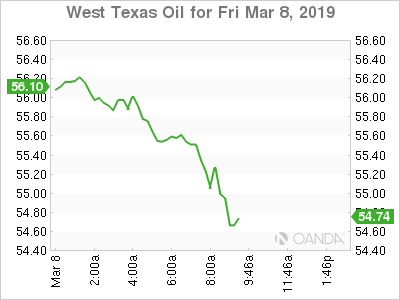
Safe haven assets rallied with the yen being the biggest beneficiary. The dollar also weakened against the euro after initially tentatively breaking below its key range, a possible sign that we could see a key bottom in place. With rate hikes off the table for the Fed, many may look to see if we are at the beginning of a major pullback.
China
February’s Chinese trade data was much worse than expected, highlighting the effects from the trade war. Analysts are focusing on the 20.7% drop in exports, much worse than the expected 5% decline. The trade deficit narrowed to $4.12 billion compared to an expected $26.2 billion and imports fell 5.2%, worse than the analysts’ forecast of a drop of $0.6 billion.
The softer than expected Chinese trade data emphasizes the need for China to end the trade with the US. The NPC’s policy summit unveiled fiscal stimulus and while the market is also expecting monetary stimulus with cuts to interest rates, we may see China hold off on the monetary stimulus until they see the market reaction to a trade deal.
Stocks
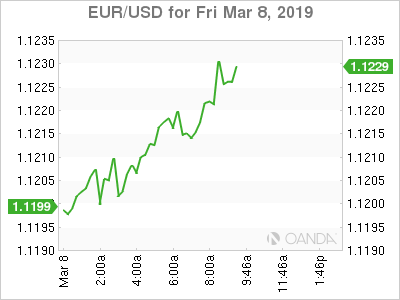
US equities are poised to open significantly lower following a poor jobs report. The soft jobs number removed all expectations for a rate hike. The Fed Funds futures now see a 25.4% chance of a rate cut in the January 2020 meeting. The Fed’s dovish pivot is likely not going to be enough of a reason for investors to buy the dip. The pressure continues to grow for a trade deal to be reached.
Gold
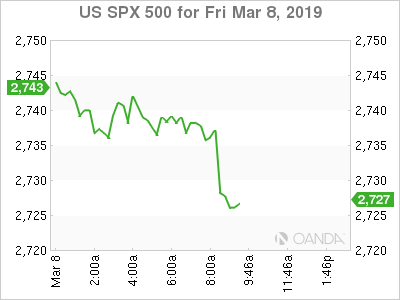
The precious metal rebounded sharply after a poor US jobs number triggered safe-haven demand. Gold prices may have formed a key bottom and could continue to benefit if markets are ultimately disappointed in the framework agreement the US and China come up with.
Oil
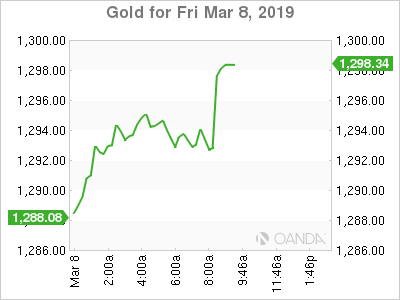
This week crude prices are struck in the narrowest range seen since December 2017. Oil was lower early on the session as global growth concerns remain the dominant theme in financial markets and prices should be capped as US production continues to rise. The other driver for lower oil prices came after Norway’s Sovereign Wealth Fund announced they will be abandoning many of their oil equity positions, they will maintain positions in Norway’s Equinor.
EUR/USD Mid-Day Outlook
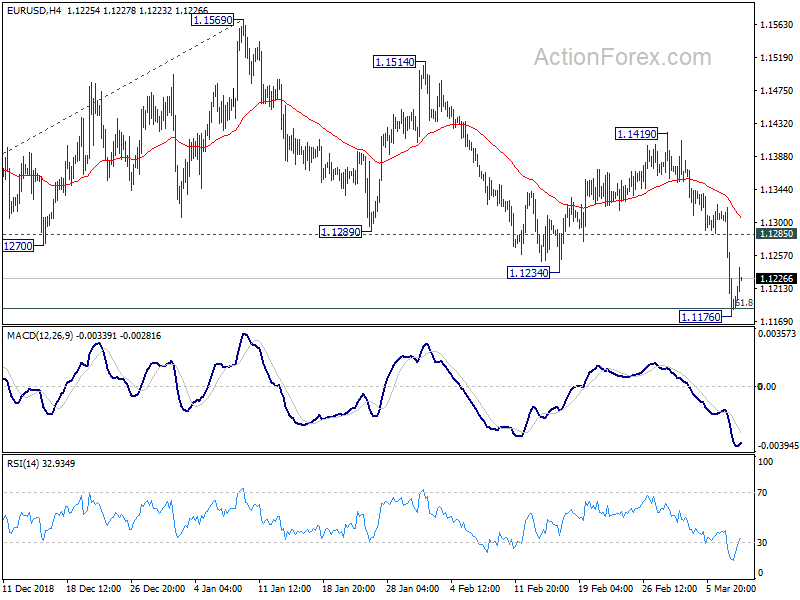
Daily Pivots: (S1) 1.1141; (P) 1.1230; (R1) 1.1284; More.....
EUR/USD recovers notably after hitting 1.1176. But with 1.1285 minor resistance intact, and 4 hour MACD staying below signal line, intraday bias stays on the downside for deeper decline. Prior break of 1.1215 low indicates resumption of whole down trend from 1.2555. Further fall should be seen to 100% projection of 1.1814 to 1.1215 from 1.1569 at 1.0970 next. On the upside, above 1.1285 minor resistance will turn intraday bias neutral first. But outlook will remain bearish as long as 1.1419 resistance holds.
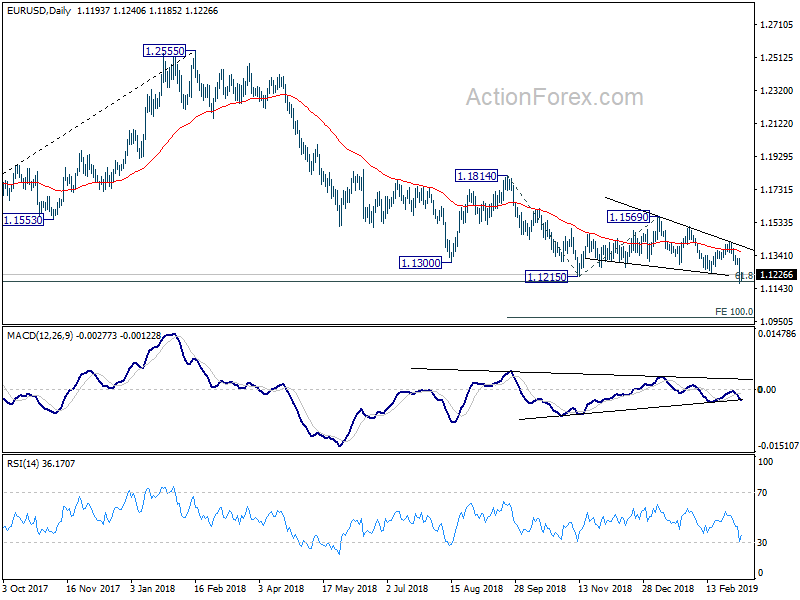
In the bigger picture, down trend down trend from 1.2555 medium term top is still in progress. 61.8% retracement of 1.0339 (2017 low) to 1.2555 at 1.1186 is also met. Sustained break there will pave the way to retest 1.0339. However, break of 1.1569 resistance will now indicate completion of such down trend and turn medium term outlook bullish.
Dollar Weakens after Dismal 20k NFP Growth, But Loss Limited by Improvements in Unemployment Rate and Wage Growth
Dollar trades broadly lower in early US session after poor job report which shows only 20k growth, weakest since September 2017. However, weakness is at this point limited since the set of data is not totally negative. Unemployment rate did decline while wage growth accelerated. For now, Sterling is the weakest one for today on Brexit uncertainty, followed by Dollar, and then Australian. New Zealand Dollar is the strongest one, followed by Yen.
For the week, Yen is the strongest, followed by Dollar, and then Kiwi. Euro is the worst performing one, still holding on to post ECB losses. Sterling is the second weakest while Swiss is the third.
In other markets, DOW futures is currently down -194 pts and will likely have another day of decline before weekly close. In Europe, FTSE is down -1.08%. DAX is down -0.86%. CAC is down -0.81%. German 10-year yield is down -0.0014 at 0.066.
Earlier in Asia, Nikkei dropped -2.01%. Hong Kong HSI dropped -1.91%. China Shanghai SSE dropped -4.40%. Singapore Strait Times dropped -1.04%. Japan 10-year JGB yield dropped -0.0234 to -0.033.
US NFP grew only 20k, but unemployment rate dropped to 3.8%, wage growth accelerated
US Non-Farm Payrolls grew only 20k in February, well below expectation of 185k. Unemployment rate dropped to 3.8%, down from 4.0% and missed expectation of 3.9%. Average hourly earnings rose 0.4% mom, beat expectation of 0.3% mom. Labor force participation rate was unchanged at 63.2%.
Also from US, housing starts rose to 1.23M annualized rate in January, above expectation of 1.18M. Building permits rose to 1.35M, beat expectation of 1.29M.
Canada employment data is strong, showing 55.9k growth in February, versus expectation of -2.5k fall. Unemployment rate was unchanged at 5.8%.
UK PM May to MPs: The only certainty would uncertainty if Brexit deal voted down
UK Prime Minister Theresa May urged MPs to support her Brexit deal in a Grimsby. She said "Back it and the U.K. will leave the EU. Reject it and no one knows what will happen". And she threatened that "we may not leave the EU at all," and "the only certainty would be uncertainty."
UK Foreign Minister Jeremy Hunt said "History will judge both sides very badly if we get this wrong" And, "we want to remain the best of friends with the EU, that means getting this agreement through in a way that doesn't inject poison into our relations for many years to come".
Separately, it's also reported that the trip of UK Attorney General Geoffrey Cox and Brexit Minister Stephen Barclay to Brussels has been called off. And there is no plan for May to meet EU officials over the weekend.
Without any fundamental change regarding Irish backstop, there is practically no chance for May to get her Brexit deal through the Parliament on March 12, next Tuesday. A vote on no-deal Brexit will then be held on March 13 to see if there is explicit consent on this path. If not, there will be another vote on Article 50 extension on March 14.
Irish Varadkar said Brexit is a problem of UK's own creation, open to revert to North Ireland only backstop
Ireland Prime Minister Leo Varadkar said today that "it requires a change of approach by the UK government to understand that Brexit is a problem of their own creation." And, "what was agreed was already a compromise" by the EU. UK government failed to secure ratification of the deal and "it should be a question of what they are now willing to offer us."
Varadar also emphasized that "we have made a lot of compromises already and what is not evident is what the UK government is offering to the European Union and Ireland should they wish us to make any further compromises". He added, "we were and remain happy to apply the backstop only to Northern Ireland if they want to go back to that. It doesn't have to trap, or keep, all of Great Britain in the customs territory at all."
European Commission spokesman Alexander Winterstein said "Technical discussions are ongoing. The EU side has offered ideas how to give further reassurances regarding the backstop, you are aware of all this, so there is no need for me to repeat it".
ECB still in preparation for details of TLTRO-III
ECB announced yesterday to start a new quarterly targeted longer-term refinancing operations (TLTRO-III). in September. That's three month later than some expected. Some lenders might start to face a funding gap in June already. ECB Governing Council member Ewald Nowotny said "to make this a successful program, it has to be well-prepared." Meanwhile, Nowotny also hailed that "what the ECB did was the correct reaction" to risks in the external situation.
Another ECB Governing Council member Vitas Vasiliauskas said the central bank has time up until September to decide details of the TLTRO-III. He added that the program won't be extended to mortgages.
China trade surplus shrank to $4.1B in Feb, US imports tumbled -35% yoy ytd
China's February trade balance data is rather terrible. Trade surplus shrank sharply to USD 4.1B, well below expectation of USD 27.2B. That's primarily due to steep contraction in exports by -20.7% yoy, largest decline since February 2016. The data could be distorted by the timing of the New Year. But January and February combined, exports still dropped -4.6% yoy while imports dropped -3.1% yoy.
Looking at some January and February combined details, trade with the US continued to deteriorate drastically . Total trade with US dropped -19.9% yoy, exports dropped -14.1% yoy but imports dropped -35.1% yoy. Trade with EU wasn't too bad, still recorded 3.7% yoy growth in total trade, 2.4% yoy rise in exports and 5.7% rise in imports. One interesting point to note is that imports from Brazil jumped 33.5% yoy while imports from Canada rose 34.9% yoy.
Japan Q4 GDP finalized at 0.5%, modest recovery with external risks
Japan Q4 GDP growth was finalized at 0.5% qoq, revised up from 0.3% qoq and beat expectation of 0.4%. GDP deflator was finalized at -0.3% yoy, unrevised. In January, overall household spending rose 2.0% yoy, beat expectation of -0.6% fall. Current account surplus widened to JPY 1.8T.
Japan Economy Minister Toshimitsu said Q4's data showed modest recovery but weak external demand warranted attention. He sounded confident that steady recovery has been confirmed. However, the government is watching overseas risks including slowdown in China.
Vice Finance Minister for International Affairs Masatsugu Asakawa also sounded cautious regarding China. He noted that it's "inevitable for Chinese economy to slow, with its potential growth lowering as a trend:. Though, he also noted that "it is unlikely to falter greatly as there's room for authorities' stimulus measures."
EUR/USD Mid-Day Outlook
Daily Pivots: (S1) 1.1141; (P) 1.1230; (R1) 1.1284; More.....
EUR/USD recovers notably after hitting 1.1176. But with 1.1285 minor resistance intact, and 4 hour MACD staying below signal line, intraday bias stays on the downside for deeper decline. Prior break of 1.1215 low indicates resumption of whole down trend from 1.2555. Further fall should be seen to 100% projection of 1.1814 to 1.1215 from 1.1569 at 1.0970 next. On the upside, above 1.1285 minor resistance will turn intraday bias neutral first. But outlook will remain bearish as long as 1.1419 resistance holds.
In the bigger picture, down trend down trend from 1.2555 medium term top is still in progress. 61.8% retracement of 1.0339 (2017 low) to 1.2555 at 1.1186 is also met. Sustained break there will pave the way to retest 1.0339. However, break of 1.1569 resistance will now indicate completion of such down trend and turn medium term outlook bullish.
Economic Indicators Update
| GMT | Ccy | Events | Actual | Forecast | Previous | Revised |
|---|---|---|---|---|---|---|
| 21:45 | NZD | Manufacturing Sales Q/Q Q4 | -0.50% | 2.00% | 1.80% | |
| 23:30 | JPY | Overall Household Spending Y/Y Jan | 2.00% | -0.60% | 0.10% | |
| 23:50 | JPY | GDP Q/Q Q4 F | 0.50% | 0.40% | 0.30% | |
| 23:50 | JPY | GDP Deflator Y/Y Q4 F | -0.30% | -0.30% | -0.30% | |
| 23:50 | JPY | Current Account Total (JPY) Jan P | 1.8.T | 1.38T | 1.56T | 1.63T |
| 00:00 | CNY | Trade Balance (USD) Feb | 4.12B | 27.15B | 39.16B | |
| 00:00 | CNY | Trade Balance (CNY) Feb | 34.4B | 122.0B | 271.2B | |
| 07:00 | EUR | German Factory Orders M/M Jan | -2.60% | 0.50% | -1.60% | 0.90% |
| 13:15 | CAD | Housing Starts Feb | 173.1K | 203K | 208K | 206.8K |
| 13:30 | CAD | Net Change in Employment Feb | 55.9K | -2.5K | 66.8K | |
| 13:30 | CAD | Unemployment Rate Feb | 5.80% | 5.80% | 5.80% | |
| 13:30 | CAD | Capacity Utilization Rate Q4 | 81.70% | 82.10% | 82.60% | 82.80% |
| 13:30 | USD | Change in Non-farm Payrolls Feb | 20K | 185K | 304K | 311K |
| 13:30 | USD | Unemployment Rate Feb | 3.80% | 3.90% | 4.00% | |
| 13:30 | USD | Average Hourly Earnings M/M Feb | 0.40% | 0.30% | 0.10% | |
| 13:30 | USD | Building Permits Jan | 1.35M | 1.29M | 1.33M | |
| 13:30 | USD | Housing Starts Jan | 1.23M | 1.18M | 1.08M | 1.04M |