

Sample Category Title
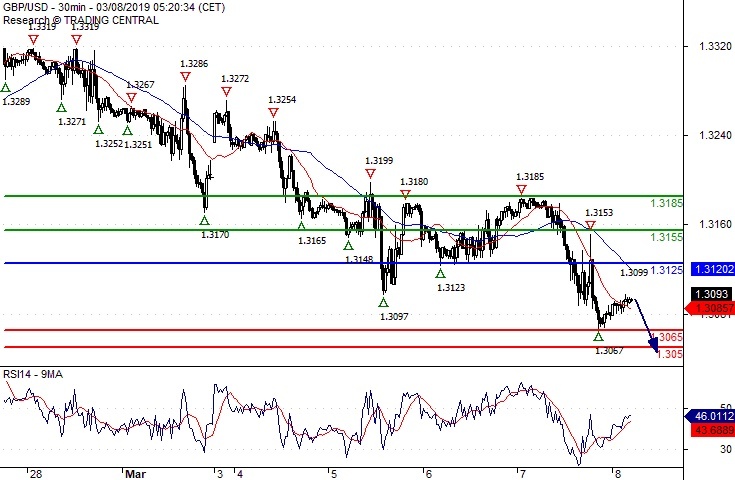
GBP/USD Key Resistance At 1.3125
Pivot (invalidation): 1.3125
Our preference Short positions below 1.3125 with targets at 1.3065 & 1.3050 in extension.
Alternative scenario Above 1.3125 look for further upside with 1.3155 & 1.3185 as targets.
Comment As Long as the resistance at 1.3125 is not surpassed, the risk of the break below 1.3065 remains high.
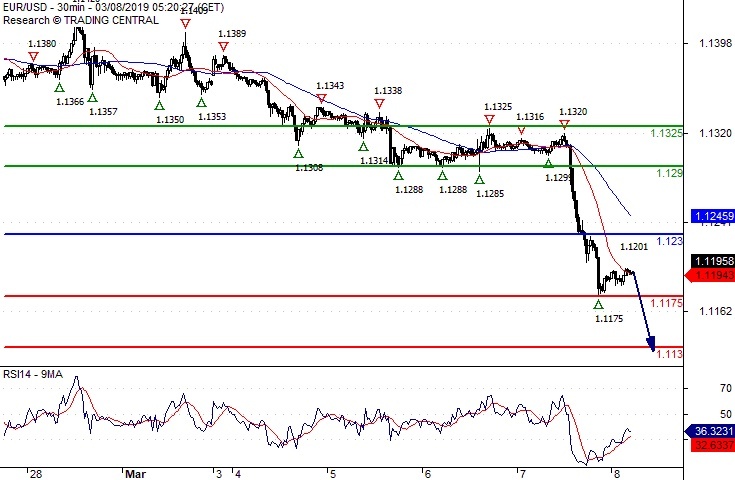
EUR/USD Under Pressure
Pivot (invalidation): 1.1230
Our preference Short positions below 1.1230 with targets at 1.1175 & 1.1130 in extension.
Alternative scenario Above 1.1230 look for further upside with 1.1290 & 1.1325 as targets.
Comment Even though a continuation of the technical rebound cannot be ruled out, its extent should be limited.
Sunrise Market Commentary
Markets
Yesterday, the ECB surprised markets. It extended policy stimulation in a much more profound way than was largely expected. The ECB will start new TLTRO financing, providing 2-year liquidity starting in September this year and running till March 2021. Even more significant, it changed forward guidance and signalled current low rates to remain in place at least through the end of this year. In its staff projections the ECB downwardly revised the growth and inflation forecasts, in particular for this year. The ECB is convinced the EMU economy needs ample stimulus for longer. The ECB guidance triggered a broad market repositioning in EMU but also on broader markets. German yields declined between 3 bp and 6 bp, with the belly of the curve outperforming. Treasuries slightly underperformed Bunds, but the US yield curve showed a similar trend with yields declining between 4.3bp (2-y) and 5.9bp (10-y). The ECB-driven rally of core bonds was reinforced a global risk-off positioning. Markets focused on a poor global growth outlook and weren't convinced that the ECB action will be able to address investor concerns on growth. The risk-off correction also spread to Asian markets this morning. Negative sentiment was exacerbated by a sharp decline of China exports (-20.7% Y/Y) in February. Chinese stocks are underperforming with losses of up to 4.0%. Japan Q4 GDP printed stronger than expected (1.9% QoQa), but didn't stop the bleeding. US Treasuries continue trading near yesterday's peak levels and are nearing key resistance levels.
Today, the fall-out from yesterday's ECB announcement will still be in play. The market focus will gradually shift to the US. February payrolls as investors look for guidance on the health of the US economy after a growing number of indications that the global economy might be losing further momentum at the start of 2019. After yesterday's soft ECB assessment on the EMU economy, there is little room for US eco data to disappoint. Of late, indications on the US labour market were mostly OK. Even so, a solid report is probably needed to prevent the US 10-y yield from retesting the 2.60% support area. The 2.54% 2019 low is again on the radar, especially if risk sentiment would further deteriorate. The German 10-y yield is extensively testing the 0.07% area, the last defence before returning to the 0.0% level last seen at the end of 2016.
Yesterday, the euro lost any perspective on interest rate ‘support' in the foreseeable future as the ECB cut its growth and inflation forecasts and pledged prolonged monetary stimulus. EUR/USD was hammered. The pair already touched the lowest level since mid-2017. The pair is now clearly at risk of falling below the 1.1217/1.1187 support. A sustained break would clearly deteriorate the technical picture. A solid US payrolls report might trigger such break. However, the picture might also be complicated in case of a disappointing US payrolls report. In theory this scenario should be USD negative. However, it might also reinforce an outright risk-off sentiment. In that scenario, the yen might be favoured. A sustained EUR/USD rebound might still be difficult in case this risk-off triggers simultaneous USD/JPY and EUR/JPY selling. A sustained break of the 1.12 area would suggest a new environment of outright euro weakness (rather than USD strength). Stop-loss protection on EUR/USD longs might be warranted. We also keep a close eye at the EUR/JPY charts. FX (and other) markets are at important crossroads.
Uncertainty on the Brexit negotiations and the ECB policy decision were the main drivers for sterling trading yesterday. EUR/GBP rebounded temporary above 0.86 as Brexit uncertainty persisted but nosedived after the ECB decision to close the day at 0.8555. Cable dropped below 1.31, mainly driven by the EUR/USD decline. The EU is said to have made some new proposals on the Irish backstop, but they are not meeting UK demands. Make-or-break negotiations will likely continue into the weekend. Sterling risk remains highly binary in nature.
News Headlines
China foreign trade data added to investor worries that the economy is losing momentum. Exports dropped 20.7 Y/Y in February. The decline came after a strong January performance and might be distorted due to the Lunar new year. Still, the decline was much bigger than expected. Imports (-5.2%) also missed the consensus.
The Japanese economy grew 1.9% QoQa in the first quarter, better than the preliminary reading of 1.4%. Capital investment was solid (2.7% Q/Q), but private consumption disappointed (0.4% Q/Q).
Today, the US payrolls report is the key feature on the eco agenda. Markets still expect job growth of 180k, in line with recent averages. The unemployment rate is expected to decline to 3.9%. Wage growth is expected at 0.3% M/M and 3.3% Y/Y. In EMU, German factory orders and production data in other member states are worth looking at. After the close of US markets, Fed's Powell is scheduled to discuss policy normalization.
EUR/JPY Daily Outlook
Daily Pivots: (S1) 126.15; (P) 126.41; (R1) 126.63; More....
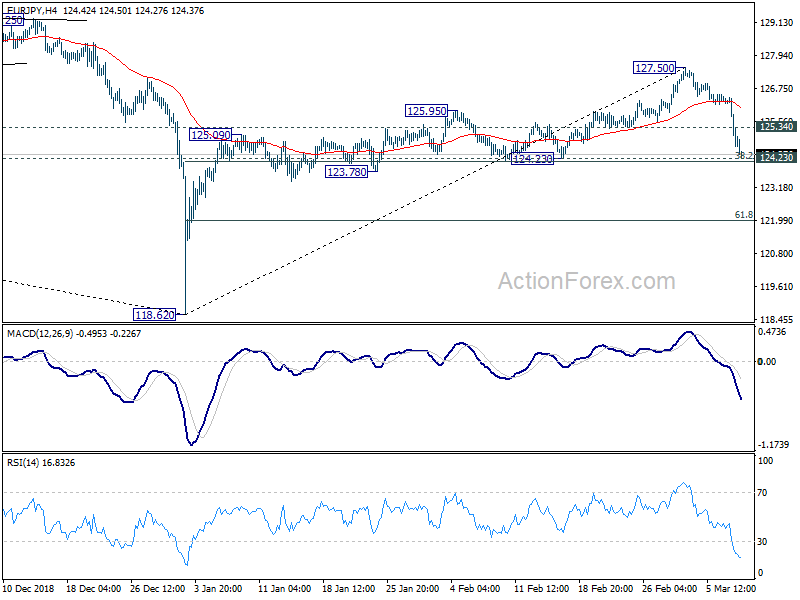
EUR/JPY's fall from 127.50 extends to as low as 124.27 so far today. Focus is now immediately on 124.23 cluster support 38.2% retracement of 118.62 to 127.50 at 124.10). Decisive break there should confirm completion of whole rebound from 118.61. Deeper fall should at least be seen to 61.8% retracement at 122.01. In this case, the chance of resuming larger down trend will also increase. On the upside, though, break of 125.34 minor resistance after defending 124.10/23 will retain near term bullishness. Intraday bias will be turned back to the upside for retesting 127.50 first.
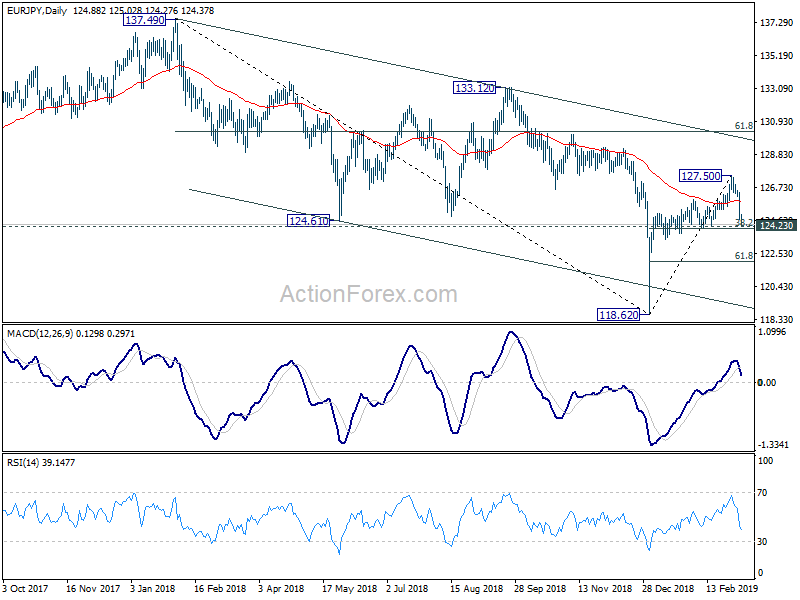
In the bigger picture, current development argues that medium term decline from 137.49 (2018 high) has completed with three waves down to 118.62 already. Decisive break of 133.12 resistance will confirm this bullish case. And whole up trend from 109.03 (2016 low) might resume through 137.49 in that case. On the downside, break of 124.23 support will invalidate this case. And in such case, the down trend from 137.49 could possibly resume through 118.62.
Yen Rally Accelerates as Shocking China Export Contraction Adds to ECB Misery
The impact of dovish ECB quickly spread to the whole world. Following weakness in the US and Europe, Asian stocks tumble broadly today. Adding to the misery, China's February trade data were shockingly terrible, recording -20.7% yoy contraction in exports. Weak export outlook adds to the case of "tough struggle" as described by Chinese Premier Li Keqiang earlier this week. Difficult export environment is a primary reason for lowering growth target to 6.0-6.5%, which lower bound is the slowest in three decades.
Stocks are additionally weighed down after Citic Securities surprisingly advised clients to sell shares of People's Insurance Company of China saying it's "significantly overvalued". Some speculate that such a sell rating must be have greenlight from regulators. That is, the Chinese government could be seeing recent surge in stocks as overheating and prefer to cool it down into a slow bull market. China Shanghai SSE is currently down -4.19% as selloff as selloff accelerates. 3000 handle is lost.
In the currency markets, Yen is naturally the strongest one for today and the week. It boosted by both selloff in stocks as well as treasury yield. Acceleration is seen today entering into European session. Germany 10-year yield at 0.067 is now just 1/3 of this week's high at 0.21. US 10-year yield also lost 2.7 handle. Swiss Franc follows as second strongest. Australian and Dollar are weakest ones.
For the week, after ECB's all-round dovish turn, Euro is undoubtedly the weakest one. Canadian Dollar follows as second worst after BoC dropped tightening bias. Yen and Dollar are the strongest.
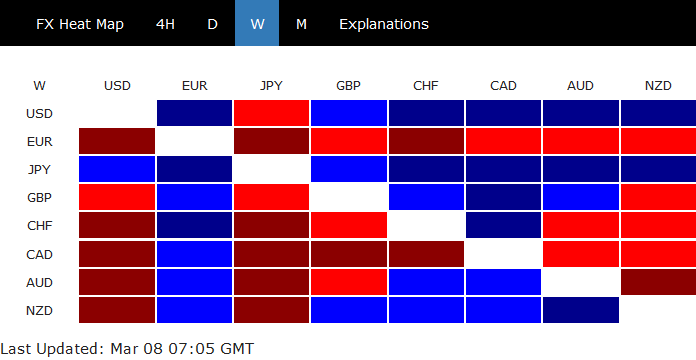
Technically, EUR/USD took out 1.1215 to resume down trend from 1.2555. Focus is now on 1.1186 fibonacci level. USD/JPY broke 1.0098 resistance and is set to test 1.0128 key resistance. The most important developments to watch are in Yen crosses. EUR/JPY is now close to 124.23 support and break will confirm completion of whole rebound from 118.62 and turn outlook bearish. Both USD/JPY and GBP/JPY break near term trend line support already. Focus will be on 110.35 in USD/JPY and 144.84 in GBP/JPY.
In Asia, Nikkei closed down 02.01%. Hong Kong HSI is down -1.61%. China Shanghai SSE is down -4.40%. Singapore Strait Times is down -0.86%. Japan 10-year JGB yield is down -0.0266 at 0.036. Overnight, DOW dropped -0.78%. S&P 500 dropped -0.81%. NASDAQ dropped 01.13%. 10-year yield dropped -0.056 to 2.636. 30-year yield dropped -0.046 to 3.025, still above 3.0 handle
Here are some suggested readings on ECB in case you missed what happened:
- ECB Announces new TLTROs, Markedly Downgrades Growth and Inflation Forecasts
- ECB: Sizeable moderation in growth, substantial downgrade in growth forecasts, risks still tilted to the downside.
- ECB: When Doves Fly
- ECB Review: A Postcard from Japan
- ECB Draghi's Press Conference Comments
China trade surplus shrank to $4.1B in Feb, US imports tumbled -35% yoy ytd
China's February trade balance data is rather terrible. Trade surplus shrank sharply to USD 4.1B, well below expectation of USD 27.2B. That's primarily due to steep contraction in exports by -20.7% yoy, largest decline since February 2016. The data could be distorted by the timing of the New Year. But January and February combined, exports still dropped -4.6% yoy while imports dropped -3.1% yoy.
Looking at some January and February combined details, trade with the US continued to deteriorate drastically . Total trade with US dropped -19.9% yoy, exports dropped -14.1% yoy but imports dropped -35.1% yoy. Trade with EU wasn't too bad, still recorded 3.7% yoy growth in total trade, 2.4% yoy rise in exports and 5.7% rise in imports. One interesting point to note is that imports from Brazil jumped 33.5% yoy while imports from Canada rose 34.9% yoy.
Japan Q4 GDP finalized at 0.5%, modest recovery with external risks
Japan Q4 GDP growth was finalized at 0.5% qoq, revised up from 0.3% qoq and beat expectation of 0.4%. GDP deflator was finalized at -0.3% yoy, unrevised. In January, overall household spending rose 2.0% yoy, beat expectation of -0.6% fall. Current account surplus widened to JPY 1.8T.
Japan Economy Minister Toshimitsu said Q4's data showed modest recovery but weak external demand warranted attention. He sounded confident that steady recovery has been confirmed. However, the government is watching overseas risks including slowdown in China.
Vice Finance Minister for International Affairs Masatsugu Asakawa also sounded cautious regarding China. He noted that it's "inevitable for Chinese economy to slow, with its potential growth lowering as a trend:. Though, he also noted that "it is unlikely to falter greatly as there's room for authorities' stimulus measures."
EU Malmstrom urges US to do an industrial trade agreement to rebuild trust first
EU Trade Commissioner Cecilia Malmstrom said she had productive meetings with US Trade Representative Robert Lighthizer in Washington this week. She noted that both sides have agreed on a problem as "China is dumping the market, China is subsidizing their industry, this creates global distortions".
However, there was obvious disagreement in the solution. Malmstrom complained that "the solution to these problems is not imposing tariffs on the European Union. Why is that so hard to understand?" And, she added "if you want an ally and partner, this is not the way to go about it."
She emphasized that "we should work on common threats and common challenges and not impose tariffs on each other." If US imposes auto tariffs to EU cars, Malmstrom pledged to, "with a very heavy heart", retaliate against EUR 20b US imports.
On EU-US trade agreement, Malmstrom noted there is "no support" for a full comprehensive trade agreement in the EU right now. She reiterated EU's stance that "if we start with industrial goods, which is much less complicated, and which will be beneficial from both sides, we maybe can rebuild that trust and then maybe we'll see later" about agriculture".
UK PM May to EU: It's your interest that we leave with a deal
According to the pre-released extracts, UK Prime Minister Theresa May is expected to tell EU in a speech today that "it is in the European interest for the UK to leave with a deal". And, "just as MPs will face a big choice next week, the EU has to make a choice, too."
May is still seeking legally binding assurances from EU that the Irish backstop, if triggered, will be temporary. May will say "we are working with them but the decisions that the European Union makes over the next few days will have a big impact on the outcome of the vote."
Without any fundamental change regarding Irish backstop, there is practically no chance for May to get her Brexit deal through the Parliament on March 12, next Tuesday. A vote on no-deal Brexit will then be held on March 13 to see if there is explicit consent on this path. If not, there will be another vote on Article 50 extension on March 14.
Looking ahead
Employment data from US and Canada will be the main focuses today. US will release non-farm payrolls, housing starts and building permits. Canada will release job data, housing starts and capacity utilization.
EUR/JPY Daily Outlook
Daily Pivots: (S1) 126.15; (P) 126.41; (R1) 126.63; More....
EUR/JPY's fall from 127.50 extends to as low as 124.27 so far today. Focus is now immediately on 124.23 cluster support 38.2% retracement of 118.62 to 127.50 at 124.10). Decisive break there should confirm completion of whole rebound from 118.61. Deeper fall should at least be seen to 61.8% retracement at 122.01. In this case, the chance of resuming larger down trend will also increase. On the upside, though, break of 125.34 minor resistance after defending 124.10/23 will retain near term bullishness. Intraday bias will be turned back to the upside for retesting 127.50 first.
In the bigger picture, current development argues that medium term decline from 137.49 (2018 high) has completed with three waves down to 118.62 already. Decisive break of 133.12 resistance will confirm this bullish case. And whole up trend from 109.03 (2016 low) might resume through 137.49 in that case. On the downside, break of 124.23 support will invalidate this case. And in such case, the down trend from 137.49 could possibly resume through 118.62.
Economic Indicators Update
| GMT | Ccy | Events | Actual | Forecast | Previous | Revised |
|---|---|---|---|---|---|---|
| 21:45 | NZD | Manufacturing Sales Q/Q Q4 | -0.50% | 2.00% | 1.80% | |
| 23:30 | JPY | Overall Household Spending Y/Y Jan | 2.00% | -0.60% | 0.10% | |
| 23:50 | JPY | GDP Q/Q Q4 F | 0.50% | 0.40% | 0.30% | |
| 23:50 | JPY | GDP Deflator Y/Y Q4 F | -0.30% | -0.30% | -0.30% | |
| 23:50 | JPY | Current Account Total (JPY) Jan P | 1.8.T | 1.38T | 1.56T | 1.63T |
| 0:00 | CNY | Trade Balance (USD) Feb | 4.12B | 27.15B | 39.16B | |
| 0:00 | CNY | Trade Balance (CNY) Feb | 34.4B | 122.0B | 271.2B | |
| 7:00 | EUR | German Factory Orders M/M Jan | 0.50% | -1.60% | ||
| 13:15 | CAD | Housing Starts Feb | 203K | 208K | ||
| 13:30 | CAD | Net Change in Employment Feb | -2.5K | 66.8K | ||
| 13:30 | CAD | Unemployment Rate Feb | 5.80% | 5.80% | ||
| 13:30 | CAD | Capacity Utilization Rate Q4 | 82.10% | 82.60% | ||
| 13:30 | USD | Change in Non-farm Payrolls Feb | 185K | 304K | ||
| 13:30 | USD | Unemployment Rate Feb | 3.90% | 4.00% | ||
| 13:30 | USD | Average Hourly Earnings M/M Feb | 0.30% | 0.10% | ||
| 13:30 | USD | Building Permits Jan | 1.29M | 1.33M | ||
| 13:30 | USD | Housing Starts Jan | 1.18M | 1.08M |
Shanghai Composite Trades Below 3,000 Amid Focus On ECB And Trade
General Trend:
- China Securities regulator said to eye certain margin financing (financial press)
- Property index leads early declines in China
- Transports and Financials weigh on the Japanese markets
- China’s trade surplus with the US narrowed in Feb
- Japan Q4 GDP revised higher on business spending (as expected), private consumption revised lower
- Asian government bond yields trade generally lower after ECB.
- AUD/JPY drops over 0.5%, JPY broadly firmer
- Taiwan Semi Feb Sales -5.8% y/y
- AU Optronics Feb Sales -8.4% y/y
Headlines/Economic Data
Australia/New Zealand
- ASX 200 opened -0.5% at 6,230
- (AU) Australia sells A$900M v A$900M indicated in 2.50% May 2030 bonds, avg yield 2.0677% v 2.1472% prior, bid to cover: 3.41x v 3.39x prior
- (AU) NAB sees two Reserve Bank of Australia (RBA) rates cuts in 2019 vs expectation for RBA to leave rates unchanged over the forecast horizon (prior view); Becomes second big Aussie bank to call for rate cuts in 2019
- (NZ) NEW ZEALAND Q4 VOLUME OF ALL BUILDINGS Q/Q: 2.7% V 1.0%E
China/Hong Kong
- Shanghai Composite opened -2.2%, Hang Seng -1.3%
- (CN) Chinese officials reportedly becoming wary of quick trade deal; persuading Pres Xi to attend Mar-a-Lago summit is 'no easy task' - NY Times
- (CN) Pres Trump: China trade talks are going 'pretty well'
- (CN) CHINA FEB TRADE BALANCE: $4.1B V $26.2BE (smallest trade balance since March 2018); Exports Y/Y: -20.7% v -5.0%e (largest decline since Feb 2016)
- (CN) China said to punish certain lenders for channeling money into stocks - State Media
- (CN) China Securities regulator's Guangdong branch reports it is closely monitoring grey-market margin financing - press
- (CN) Certain large cities in China said to have cut taxes on property sales - China Securities Times
- (CN) China PBoC Sets Yuan Reference Rate: 6.7235 v 6.7110 prior
- (CN) China PBoC Open Market Operation (OMO): Skips OMO (7th consecutive skip); Net: 0 v CNY0 prior
Japan
- Nikkei 225 opened -0.5%
- (JP) Japan March Nikkei Futures and Options expected to settle at around 21,348
- (JP) JAPAN Q4 FINAL GDP Q/Q: 0.5% V 0.4%E; ANNUALIZED Q/Q: 1.9% V 1.7%E
- (JP) JAPAN PRELIM BOP CURRENT ACCOUNT ADJUSTED: ¥1.8T V ¥1.4TE; BOP CURRENT ACCOUNT BALANCE: ¥600.4B V ¥161.0BE
- (JP) JAPAN JAN PRELIM TRADE BALANCE (BOP BASIS): -¥964.8B V -¥1.1TE
- (JP) JAPAN JAN HOUSEHOLD SPENDING Y/Y: +2.0% V -0.5%E
- (JP) Japan top currency official Asakawa: Downside risks in global economy persist due to China-US Trade war; reiterates always monitoring FX market and stand ready to respond to excess volatility and disorderly moves
- (JP) Japan Finance Min Aso: Not thinking about any new economic counter measures, we are not in a situation of needing extra measures
- (JP) Former BOJ Official Yamaguchi: Risk of Japan slipping into a recession is not small, BoJ could consider additional easing as global headwinds hurt exports and economy
Korea
- Kospi opened -0.6%
- (KR) South Korea Automobile Manufactures Association: US made cars sold in Korea in 2018 up 8.2% y/y
- (KR) South Korea President Moon approval rating declines to 46% v 49% prior - Gallup Poll
- (KR) South Korea Jan Current Account Balance: $2.78B v $4.82B prior; Balance of Goods (BOP): $5.61B v $6.53B prior
Other
- (PH) Philippines Central Bank (BSP) official Guinigundo: Reserve ratio requirement (RRR) cut always on the table, timing is the issue; notes ample liquidity in financial system
- (PH) Philippines Central Bank (BSP) newly named Gov Diokno: Reiterates reserve ratio requirement (RRR) is still too high.
North America
- (US) Fed's Brainard (voter, dove): has revised down 2019 economic outlook on increase in risks; it's appropriate to wind down runoff later in year - comments in NJ
- (US) Fed Chair Powell to appear on '60 Minutes' on Sunday 3/10 – press
- (US) Dow Transports decline for 10th straight day, equals record losing streak - FT
Europe
- (EU) ECB ANNOUNCES NEW TLTRO PROGRAM: Announces new series of two-year TLTROs to start in Sept 2019, ending in 2021
- (EU) ECB’s Draghi: New ECB measures are adding accomodation; decisions taken following the revised Staff Projections to increase resilience of Euro Zone
- (EU) Reportedly ECB opted for more radical easing measures today only after growth projections showed a bigger than feared economic slowdown - press
Levels as of 12:50 ET
- Nikkei 225, -2.2%, ASX 200 -1.0%, Hang Seng -1.5%; Shanghai Composite -3.2%; Kospi -1.3%
- Equity Futures: S&P500 -0.3%; Nasdaq100 -0.3%, Dax -0.3%; FTSE100 -0.3%
- EUR 1.1202-1.1179 ; JPY 111.70-111.21 ; AUD 0.7029-0.7005 ;NZD 0.6772-0.6746
- Gold +0.2% at $1,289/oz; Crude Oil -0.7% at $56.27/brl; Copper -0.5% at $2.899/lb
Worried ECB Opens The Door For Easing
Market movers today
Markets will continue to digest the ECB news yesterday. Note that the ECB's Nowotny is speaking this morning at 09.00 am CET.
The key focus today will be the US labour market report at 14.30 CET. We think average hourly earnings rose +0.25% m/m in February, which means an increase in the annual growth rate to 3.3% y/y, up from 3.2%, while we expect the change in nonfarm payrolls to come in at 190k. Regarding nonfarm payrolls, it seems employment growth has reached its high and has stabilised around its current level of 1.7% y/y. At the moment, the labour market is still strong, but in our view it is important to keep an eye on deceleration in employment.
German factory orders are also worth keeping an eye on at 08.00 CET. The numbers should give an indication of whether the euro area is close to the bottom or not.
A range of data is due in the Scandi region today including Norwegian GDP, see pg 2.
Selected market news
The ECB admittedly surprised us yesterday by delivering an all-round dovish message – and last night this was topped by ECB sources saying that some ECB officials still see the growth forecasts as too optimistic. First of all, contrary to our call but in line with market expectations, the ECB announced a liquidity injection with a new 2Y TLTRO3 starting in September 2019. Second, the ECB surprised markets by also extending the forward guidance on rates and now expects these to remain at current levels 'at least through the end of 2019' (vs ‘through the summer' previously). Third, growth and inflation forecasts were taken down across horizons, and it is clear that the Governing Council is much less convinced by its previous narrative and has opened the door for further easing. As highlighted in our ECB review, 7 March 2019, on the back of this we have changed our ECB rate expectations: we now forecast no interest rate changes to either of the ECB's key interest rates over our forecast horizon for the next 12M (vs a first hike in Dec-19 previously).
The markets responded sharply as the ECB has effectively opened the door for further easing. The German 10Y bund yield fell to 2016 lows, standing at only 0.067%, and not least the Italian 10Y yield fell by some 12bp as the soft ECB alleviates the funding pressure for Italian banks. Equities fell in Europe, as the downward revision to the outlook and the prospect of lower rates for longer weighing on banks dominated any positive impact from the ECB on an extended hold. The negative sentiment has continued in both the US and Asian sessions, where data overnight showed notably Chinese export orders faltering in February. EUR/USD fell markedly during the day, and the follow-through as technical resistance levels were broken continued last night. Separately, EU trade commissioner Malmstrom said the EU is preparing a list of US-manufactured products worth EUR22bn on which to retaliate should Trump move on with tariffs. Indeed, the ECB-induced EUR depreciation could be an eyesore for Trump as it is weighing on US competitiveness towards Europe, and increases the risk the US administration will lash out after the EU on trade next.
Scandi markets
Norway. Mainland GDP growth accelerated to 0.9% in Q4 after slowing temporarily in Q3, and today brings data for January. The monthly numbers have proved somewhat volatile and we do not yet have much information about January beyond unemployment, retail sales and the PMI. It is therefore only on a very uncertain basis that we predict mainland GDP growth of 0.2% m/m (consensus: +0.3 %) in January. Sweden. The January household consumption indicator should rebound on the back of retail sales, noting that last year's data has been revised lower (release at 09:30 CET). Already at 08:00 CET, Riksbank vice governor Martin Flodén will give a speech on the state of the economy. On that note, we think the negative response in the krona to the ECB news was fair since a more dovish ECB will, all else being equal, affect the Riksbank.
Fixed income markets
The new TLTROs combined with the new extended forward guidance and the press conference message from Draghi that that ECB now has an easing bias and is ready to do more has reignited the hunt for yield. Italy is of course the main beneficiary of the new TLTRO. But also, the new outright lower yield levels that have pushed 10Y Spain towards 1% and 10Y France below 0.50% are forcing carry investors towards Italy. We believe the carry-game will continue for the next couple of months and even though the 5Y segment in periphery rallied strongly yesterday, this is still our favourite segment of both the BTP and SPGB curves. Among the semi-cores, 10Y Finland looks interesting vs core. There is now little to price out of the money market curve, as the first 10bp hike is priced autumn 2020. Hence, we believe that the German curve both 2s10s and 5s10s will continue to flatten. We also think that we are heading for a sub-zero level for 10Y bund yields, and our expected trading range for the next two months is -15 to 10bp. After the ECB sources story from last night stating that ECB officials still see the growth forecasts as too optimistic, there should be room to rally today as the race towards the bottom continues.
FX markets
The ECB clearly took us by surprise today and as the expectation of a 2019 hike was a pillar of our bullish EUR/USD view this year we have changed our EUR/USD call, see FX Strategy - ECB introduces 'easing risk premium' on EUR. Near term, we now expect EUR/USD to drift somewhat below the 1.12 mark. With the risk of pockets of USDstrength from renewed pricing of Fed hikes and a trade deal that will not provide much imminent support, this opens the possibility for a EUR/USD move towards 1.10 out to a 3M horizon. In the medium term (beyond 3M), we expect EUR/USD to stabilise and move back into the 1.12-1.16 range and stress that any drift higher will be limited, with upside mainly deriving from positive spillover to the euro area from a turn in the global (China) cycle. Our new forecast profile for EUR/USD thus reads 1.11 in 1M, 1.13 in 3M (previously 1.15), 1.15 in 6M (previously 1.20) and 1.17 in 12M (previously 1.25).
A surprisingly dovish ECB spilled over to the SEK, USD/SEK once again broke through 9.40 and EUR/SEK drifted upwards as well. We think a weaker SEK is warranted on the back of the ECB's dovish shift, as this has direct consequences for the Riksbank's forward guidance and subsequent hiking ambitions. As emphasised by Ingves, the correlation between the KIX-weighted (of which the Eurozone weighs approximately 50%) policy rate and the Riksbank's repo rate is very high (0.92). This means that as the ECB policy rates are set to be kept unchanged this year, it is a severe blow to the Riksbank's own hiking expectations. Indeed, Stibor curves shifted down and EUR/SEK traded higher post ECB.
Also, the NOK suffered from especially USD/Scandi buying yesterday. However, we do think that Norges Bank's monetary policy is less sensitive to the shift of tone from the ECB as the domestic growth and inflation case is much different from that of Sweden and the Eurozone. That is also why the Nibor curve flattened less than the Stibor curve, with the Norges Bank March hike probability virtually unchanged (roughly 19 bp priced). The next three sessions should confirm this pricing with GDP today, inflation on Monday and finally, but not least, the Regional Network Survey on Tuesday.
EUR/DKK dropped to around the 7.46038 central rate on the ECB meeting yesterday. We attribute this move to the rally in the EUR fixed income market and the drop in EUR/USD, which are both important factors in driving DKK buying via FX hedging rebalancing. The dividend season in Denmark is coming up (the bulk of flows will take place between 14- 22 March), which could entail some temporary EUR/DKK positive flows;hence, we see limited further downside for EUR/DKK in the very near term.
The ECB Kept Its Benchmark Interest Rate Unchanged, Downgraded Growth Forecast
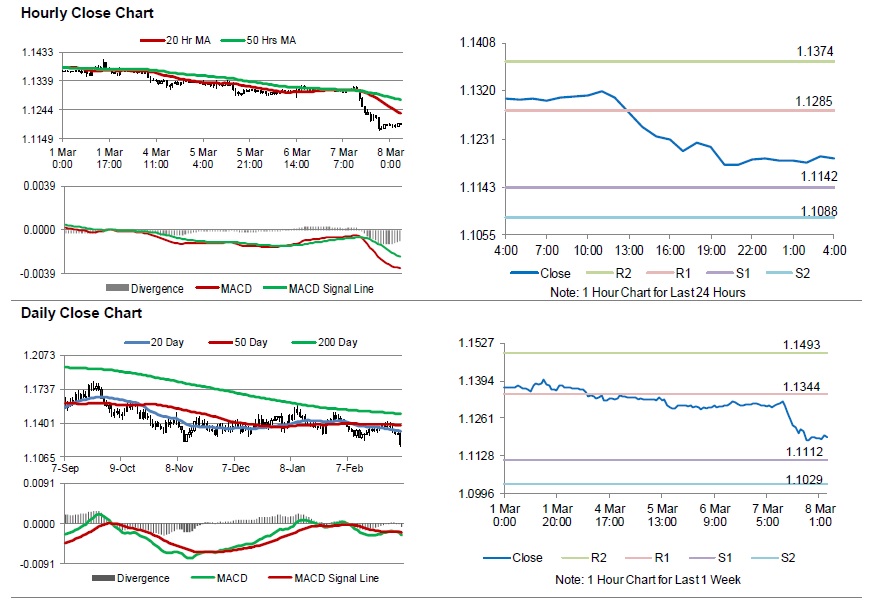
For the 24 hours to 23:00 GMT, the EUR declined 1.01% against the USD and closed at 1.1195, after the European Central Bank (ECB) decided not to raise interest rates until 2020 and slashed its growth forecast for the euro area.
On the data front, Euro-zone’s seasonally adjusted second estimate of gross domestic product (GDP) rose 0.2% on a quarterly basis in 4Q 2018, at par with market expectations and confirming the preliminary figures. The GDP had registered a similar rise in the prior quarter.
The ECB, in its March monetary policy meeting, decided to keep its benchmark interest rate steady at 0.00%, and stated that there would be no changes to the monetary policy before 2020. Further, the central bank trimmed its economic growth forecast for the euro area to 1.1% from 1.7% for 2019. Also, the ECB announced the launch of a new series of targeted longer-term refinancing operations (TLTRO), in an effort to aid the bank lending conditions.
In the US, data showed that the seasonally adjusted initial jobless claims eased to a level of 223.0K in the week ended 02 March 2019, compared to a revised level of 226.0K in the prior week. Market participants had envisaged the initial jobless claims to fall to a level of 225.0K. Additionally, consumer credit advanced by $17.1 billion in January, more than market expectations. In the previous month, consumer credit had advanced by a revised $15.4 billion.
In the Asian session, at GMT0400, the pair is trading at 1.1196, with the EUR trading a tad higher against the USD from yesterday’s close.
The pair is expected to find support at 1.1142, and a fall through could take it to the next support level of 1.1088. The pair is expected to find its first resistance at 1.1285, and a rise through could take it to the next resistance level of 1.1374.
Going forward, traders would await Germany’s factory orders for January, set to release in a few hours. Later in the day, the US housing starts and building permits for January along with non-farm payrolls, unemployment rate, average hourly earnings, all for February, will keep traders on their toes.
The currency pair is trading below its 20 Hr and 50 Hr moving averages.
Britain’s Halifax House Prices Advanced More-Than-Estimated In February
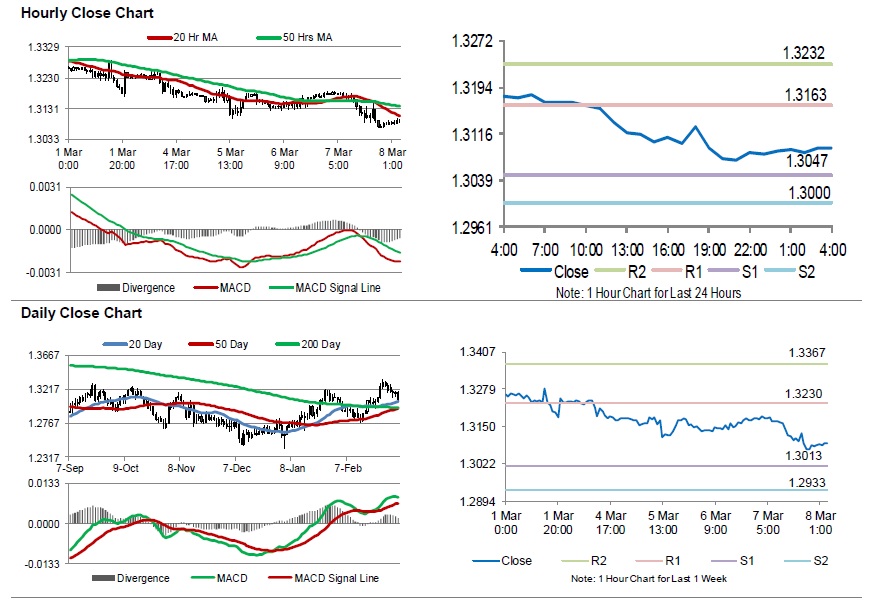
For the 24 hours to 23:00 GMT, the GBP declined 0.68% against the USD and closed at 1.3083.
On the macro front, data showed that UK's Halifax house price index advanced 5.9% on a monthly basis in February, overshooting market consensus for a rise of 0.1%. In the prior month, the index had recorded a revised fall of 3.0%.
In the Asian session, at GMT0400, the pair is trading at 1.3094, with the GBP trading 0.08% higher against the USD from yesterday's close.
The pair is expected to find support at 1.3047, and a fall through could take it to the next support level of 1.3000. The pair is expected to find its first resistance at 1.3163, and a rise through could take it to the next resistance level of 1.3232.
Moving ahead, investors would keep an eye on UK's gross domestic product, manufacturing production, industrial production and trade balance, all slated to release next week.
The currency pair is trading below its 20 Hr and 50 Hr moving averages.
Into European Session: Yen jumps as risk aversion extends on poor China exports
Risk aversion extended from US to Asian session today. It started off overnight after the all-round dovish turn of ECB which triggered steep decline in stocks as well as treasury yields. Asian markets picked up and are sent further lower by terrible trade data from China. In short, China's exports contracted steeply by -20.7% yoy in February, largest decline since 2016. Trade surplus shrank to just USD 4.1B. The data highlights the "tough struggle" that Chinese Premier Li Keqiang mentioned earlier. Difficult export environment is a primary reason for lowering growth target to 6.0-6.5%, which lower bound is slowest in three decades.
Adding to negative sentiments, Citic Securities surprisingly advised clients to sell shares of People's Insurance Company of China saying it's "significantly overvalued". Some speculate that such a sell rating must be have greenlight from regulators. That is, the Chinese government could be seeing recent surge in stocks as overheating and prefer to cool it down into a slow bull market. China Shanghai SSE is currently down -3.09% but stays above 3000 handle nevertheless.
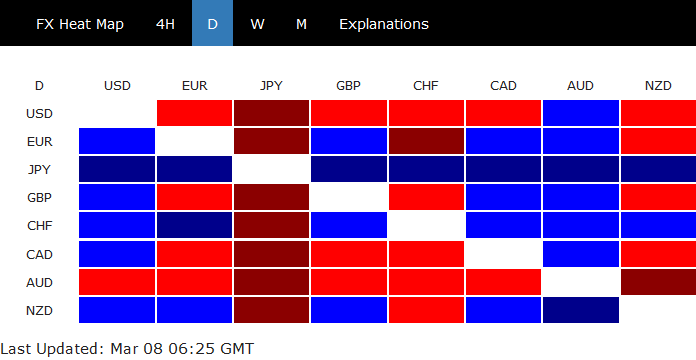
In the currency markets, Yen is overwhelmingly the biggest winner for today and the week, followed by Swiss Franc. Global treasury yields staged a u-turn this week with German 10-year yield back at 0.067, after hitting as high as 0.21 earlier in the week. US 10 year-yield also lost 2.7 handle again. Japan 10-year JGB yield only turned positive for a brief little while. As for today, Australian Dollar is the worst performing one, followed by Dollar and Canadian. Focus will turn to job data from both US and Canada later in the day.
In Asia:
- Nikkei dropped -2.01%.
- Hong Kong HSI is down -1.62%.
- China Shanghai SSE is down -3.07%.
- Singapore Strait Times is down -0.81%.
- Japan 10-year JGB yield is down -0.0254 at 0.035.
Overnight:
- DOW dropped -0.78%.
- S&P 500 dropped -0.81%.
- NASDAQ dropped 01.13%.
- 10-year yield dropped -0.056 to 2.636.
- 30-year yield dropped -0.046 to 3.025, still above 3.0 handle