

Sample Category Title
UK PM May to EU: It’s your interest that we leave with a deal
According to the pre-released extracts, UK Prime Minister Theresa May is expected to tell EU in a speech today that "it is in the European interest for the UK to leave with a deal". And, "just as MPs will face a big choice next week, the EU has to make a choice, too."
May is still seeking legally binding assurances from EU that the Irish backstop, if triggered, will be temporary. May will say "we are working with them but the decisions that the European Union makes over the next few days will have a big impact on the outcome of the vote."
Without any fundamental change regarding Irish backstop, there is practically no chance for May to get her Brexit deal through the Parliament on March 12, next Tuesday. A vote on no-deal Brexit will then be held on March 13 to see if there is explicit consent on this path. If not, there will be another vote on Article 50 extension on March 14.
EU Malmstrom urges US to do an industrial trade agreement to rebuild trust first
EU Trade Commissioner Cecilia Malmstrom said she had productive meetings with US Trade Representative Robert Lighthizer in Washington this week. She noted that both sides have agreed on a problem as "China is dumping the market, China is subsidizing their industry, this creates global distortions".
However, there was obvious disagreement in the solution. Malmstrom complained that "the solution to these problems is not imposing tariffs on the European Union. Why is that so hard to understand?" And, she added "if you want an ally and partner, this is not the way to go about it."
She emphasized that "we should work on common threats and common challenges and not impose tariffs on each other." If US imposes auto tariffs to EU cars, Malmstrom pledged to, "with a very heavy heart", retaliate against EUR 20b US imports.
On EU-US trade agreement, Malmstrom noted there is "no support" for a full comprehensive trade agreement in the EU right now. She reiterated EU's stance that "if we start with industrial goods, which is much less complicated, and which will be beneficial from both sides, we maybe can rebuild that trust and then maybe we'll see later" about agriculture".
Japan Q4 GDP finalized at 0.5%, modest recovery with external risks
Japan Q4 GDP growth was finalized at 0.5% qoq, revised up from 0.3% qoq and beat expectation of 0.4%. GDP deflator was finalized at -0.3% yoy, unrevised. In January, overall household spending rose 2.0% yoy, beat expectation of -0.6% fall. Current account surplus widened to JPY 1.8T.
Japan Economy Minister Toshimitsu said Q4's data showed modest recovery but weak external demand warranted attention. He sounded confident that steady recovery has been confirmed. However, the government is watching overseas risks including slowdown in China.
Vice Finance Minister for International Affairs Masatsugu Asakawa also sounded cautious regarding China. He noted that it's "inevitable for Chinese economy to slow, with its potential growth lowering as a trend:. Though, he also noted that "it is unlikely to falter greatly as there's room for authorities' stimulus measures."
ECB: When Doves Fly
Executive Summary
- The ECB made two key policy changes today. First, it pushed back its interest rate guidance to signal the first hike probably will not come this year. It also announced a new package of TLTROs, the terms of which were not as favorable as past offerings.
- The change in rate guidance was more of a surprise, in our view. In light of this new guidance, we are pushing back our forecast for the first ECB deposit rate hike to March 2020.
- We remain of the view that the direction of ECB policy over the medium term will be toward less accommodation, even if that process is delayed somewhat. That continues to support the case for a stronger euro versus the dollar over time, in our view, even if euro gains do not come until later this year.
What did the ECB Announce Today?
The European Central Bank (ECB) announced two key changes to its monetary policy stance today:
- New interest rate guidance that now suggests rates will remain 'at present levels at least through the end of 2019.'
- A new package of Targeted Longer-Term Refinancing Operations (TLTROs). The ECB also cut its GDP and CPI forecasts. It now sees GDP growth of just 1.1% in 2019 (down from 1.7% previously), while it also cut its CPI forecasts (1.2% in 2019 vs. 1.6% previously, with cuts to 2020 and 2021 as well). The forecast cuts were generally anticipated, even if they were more significant than expected. However, the change in interest rate guidance and the new TLTROs were more of a surprise.
ECB Lends Banks a Hand
Let us first discuss the new TLTROs that were announced. As a reminder, TLTROs are essentially a means for the ECB to provide low-cost long-term funding to commercial banks in the Eurozone as a means of encouraging those banks to lend to the private sector, particularly to non-financial corporates. In a recent report, we said that if the ECB announced a new round of TLTROs at today’s meeting, it would probably be to send accommodative policy signals and spur more bank lending growth—Draghi’s comments largely confirmed that view. The terms of the new round of TLTROs are as follows:
- Maturity: Two years
- Interest rate: Indexed to the ECB refinancing rate over the life of the loan
We view these terms as less favorable for banks, at least compared to prior rounds of TLTROs. The last two rounds of TLTROs were offered at a rate fixed to the ECB refinancing rate at the time the loans were allotted. The terms on the new round of loans allow for the possibility for a bank’s funding costs to rise over the life of the loan if the central bank raises interest rates, something that was not a risk with the prior two rounds of loans. Moreover, the two-year maturity is less favorable than the four-year maturity offered by the first two rounds of TLTROs. Thus, while the act of offering TLTROs today was relatively accommodative in and of itself, the terms of these loans suggest the central bank wants to continue to provide support to banks but not at such favorable terms that they become overly reliant on this form of funding.
Rates: The Waiting is the Hardest Part
More surprising, in our view, was the ECB’s change in interest rate guidance. The central bank now sees rates 'at present levels at least through the end of 2019,' whereas previously it noted that rates would be steady 'at least through summer 2019.' In light of this change in guidance, we shift our call for the first ECB deposit rate hike to March 2020 (from December 2019 previously). The market pricing for short-term European interest rates also adjusted meaningfully, with markets now pricing in essentially no change in interest rates from the ECB over the next year or so (Figure 1).
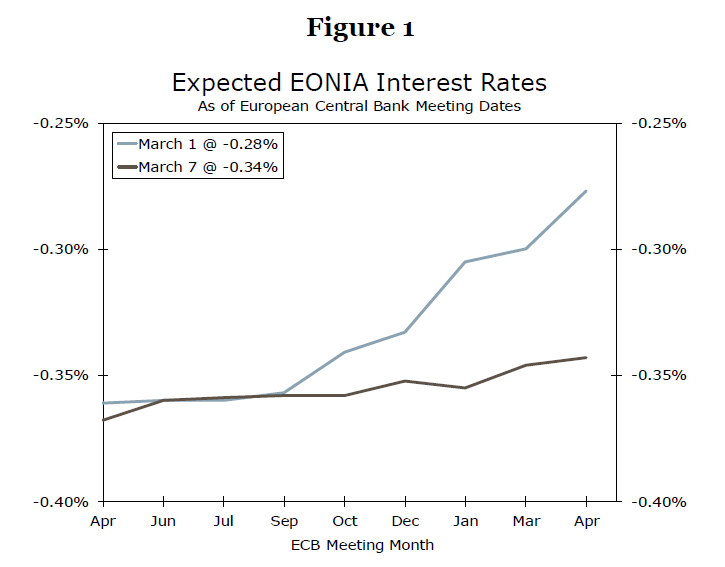
While the ECB pushed back its rate guidance and announced new loans, this does not strike us as the start of a sustained shift toward easier monetary policy from the central bank. The terms of the new TLTROs are not particularly favorable compared to prior rounds of lending, and there was no talk of a possible rate cut or another round of asset purchases. To be sure, the domestic backdrop in the Eurozone remains challenging, as highlighted by the ECB’s forecast downgrades today. However, we do not see a looming recession for the Eurozone domestic economy, and expect a rebound in activity as the year progresses. If the Eurozone economy stabilizes as we expect and the ECB eventually raises rates, we would still look for the euro to rise over time, even if those eventual euro gains may not come until later this year.
Market Morning Briefing: Pound Has Fallen Below 1.31
STOCKS
Concerns of the global growth slowing down has taken back the center stage again after the European Central Bank cut its growth forecast yesterday. As a result the Asian equities are trading deeply in red following the sharp fall in the US equities overnight. This could weigh on the Indian indices today which have been moving higher over the last few days.
Dow Jones (25,473.23, -200.23, -0.78%) has declined decisively below the 21-day moving average support level of 25,695. This keeps the bearish outlook intact for a fall to 25,100 and 25,000 which we have been reiterating over the last few days.
After consolidating in a narrow range for a few days, DAX (11,517.80, -69.83, -0.60%) below the key resistance level of 11,550. While below 11,550, a fall to 11,350 is possible in the coming days.
Nikkei (21,142.75, -313.26, -1.46%) has tumbled below the crucial support level of 21,400. Next key support is at 21,000 will be tested in the coming sessions. A break below it can drag the index to 20,850.
Shanghai (3,034.15, -72.27, -2.33%) has come-off sharply from Thursday's high of 3130. A test of 3,000 is possible. Whether it breaks further below 3000 or not will decide the next move.
Sensex (36,725.42, +89.32, +0.24%) and Nifty 50 (11,058.20, 5.20, +0.05%) moved further higher as expected. However, the daily candle for yesterday on the Sensex reflects indecisiveness. This chart pattern coupled with the sharp fall in the global indices could pull the Indian equities lower today. As such Sensex and Nifty 50 can test their key support levels of 36,500-36,480 and 10,980 respectively.
COMMODITIES
In spite of a sharp rise in the dollar index, commodities are trading stable and continue to consolidate within their broad sideways range. This is something interesting that indicates that further downside, though cannot be ruled out in the near term, could be limited. It also leaves the possibility high of the commodity prices reversing higher going forward. We will have to wait and see to get further confirmation on this.
Gold (1286) is continuing to hold above 1280. A strong break above 1290 can trigger a corrective rally to 1300-1303. However, the weekly chart is bearish and a fall to test 1275 and 1270 is still cannot be ruled out while gold remains below 1300.
Silver (15.02) has been inching lower slowly over the last couple of days. It looks vulnerable to break below the psychological level of 15 and fall to 14.85 in the coming days.
Copper (2.91) continues to consolidate between 2.89 and 2.98 as expected.
Brent (65.9) spiked to test 67 as expected yesterday and has come-off from there. A dip to 65.3 and 64.8 looks likely in the near term. The broader 64-68 sideways range remains intact. WTI (56.35) is stable within its overall 55-58 sideways range.
FOREX
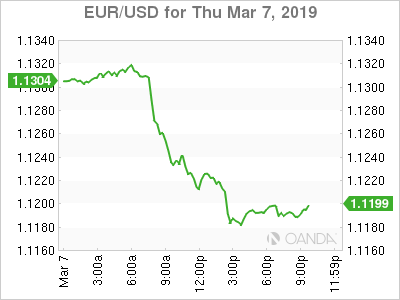
Dollar-Index (97.56) rose sharply above 97 as Euro (1.1199) declined after the dovish ECB comments yesterday. The ECB announced fresh TLTROs starting in September while rates are expected to remain at current levels. Growth and inflation projections have been revised lower as expected.
US NFP data is due today. Consensus expectation is around 180,000 jobs added in Feb’19 after Jan’s figure of 304,000. The data released around expected figures could possibly have less impact on Dollar Index whereas a figure higher than expected could boost the rising momentum in the index. Overall technically, 97.70 is an important resistance level on the chart and while that holds, a corrective dip could be expected back towards 97.50-97.00 just now. A sustained break above 97.70, if seen would intimate fresh bullishness.
Euro (1.1199) broke below our expected support at 1.1250 falling towards lower support at 1.11. On the weekly candles, 1.11 is an important support which could produce a small bounce towards 1.1250-1.1300 again in the medium term.
Euro-Yen (124.89) broke below 125.70 on sharp decline in Euro. 124.40 is an immediate support on the daily candles which could hold; else the fall could extend towards lower support at 123. While Euro heads towards 1.11, Euro-Yen could test 123 on the downside before bouncing back from there.
Dollar Yen (111.51) is almost stable but is gradually tilted to fall towards 111 in the near term from where a fresh bounce back towards 112.5 is possible.
Pound (1.3094) has fallen below 1.31 opening chances of falling towards 1.30-1.2950 in the near term as mentioned yesterday. Interim support is visible at 1.3025 from where a small bounce is possible.
Aussie (0.7020) has dipped a bit too but is unable to decide further direction from here. A rise from here would enable a test of 0.7150 again; else we will have to consider a fall to 0.6950/30 before Aussie bounces back in the medium term.
USDCNY (6.7185) has risen back to re-test immediate resistance near 6.72/73. Unless a break above the resistance is seen, Yuan could strengthen towards 6.70/68 again in the near term.
Dollar Rupee (70.00) majorly trading near 70 yesterday, could possibly see a small bounce towards 70.15/20 today before again coming back to re-test 70.0-69.75 levels in the medium term. Scope of testing lower support at 69.80/75 remains intact for next week. For today the pair could trade above 70 with possible extension to 69.90 on the downside.
INTEREST RATES
The US yields fell sharply after the ECB said that it would delay its plan to hike interest rates and launch a program to stimulate banking lending in the Eurozone. The 2Yr (2.48%), 5Yr (2.44%), 10Yr (2.65%) and 30Yr (3.03%) have fallen to our expected levels mentioned yesterday. There is scope of some more fall in the yields over the next 1-2 sessions followed by a bounce from support levels. The 30Yr, 10Yr and 5Yr could test 3%, 2.60% and 2.40% respectively before a bounce is seen.
Markets await the US NFP and unemployment data today.
The German bund yields have also fallen. The 2Yr, 5Yr, 10Yr and 30Yr yields are trading at -0.57%, -0.36%, 0.07% and 0.73% respectively. The fall is likely to continue for a couple of sessions more before a corrective bounce comes in.
Downsides In USD/JPY Remains Supported
Key Highlights
- The US Dollar climbed higher recently above the 112.00 level against the Japanese Yen.
- There is a strong support formed near the 111.20 level on the 4-hours chart of USD/JPY.
- The US Initial Jobless Claims for the week ending Feb 26, 2019 declined from 226K to 223K.
- The US nonfarm payrolls for Feb 2019 will be released today, which could post 180K, down from 304K.
USDJPY Technical Analysis
The US Dollar followed a bullish path from the 110.35 swing low and climbed higher against the Japanese Yen. The USD/JPY pair broke the 111.00 and 111.80 resistance levels to move into a positive zone.
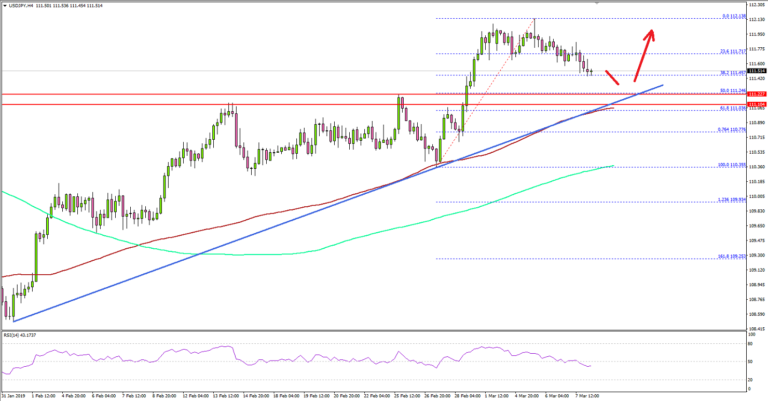
Looking at the 4-hours chart, the pair placed itself above the 111.20 pivot level, the 200 simple moving average (green, 4-hours), and the 100 simple moving average (red, 4-hours). It opened the doors for more gains and the pair recently climbed above the 112.00 level.
It traded as high as 112.13 and later corrected lower below the 111.80 level and the 23.6% Fib retracement level of the last wave from the 110.35 low to 112.13 high.
However, there is a strong support formed on the downside near the 111.20 level. It coincides with the 50% Fib retracement level of the last wave from the 110.35 low to 112.13 high, plus a bullish trend line on the same chart.
Below 111.20, the next key support is near 111.00 and the 100 simple moving average (red, 4-hours). If there is a close below the 111.00 support, the pair could extend correction towards the 110.50 level.
On the upside, an initial resistance is near the 112.00 level, above which buyers are likely to push the pair above the 112.20 and 112.40 levels.
Fundamentally, the US Initial Jobless Claims figure for the week ending Feb 26, 2019 was released recently. The market was looking for no change from the last reading of 225K.
The result was mixed as the US Initial Jobless Claims declined to 223K, but the last reading was revised up from 225K to 226K. The report added that:
The 4-week moving average was 226,250, a decrease of 3,000 from the previous week’s revised average. The previous week’s average was revised up by 250 from 229,000 to 229,250.
Recently, there was a sharp decline in EUR/USD and GBP/USD, but it seems like downsides in USD/JPY are likely to find buyers near 111.20 and 111.00.
Economic Releases to Watch Today
- US nonfarm payrolls Feb 2019 – Forecast 180K, versus 304K previous.
- US Unemployment Rate Feb 2019- Forecast 3.9%, versus 4.0% previous.
- Canada’s employment Change Feb 2019 – Forecast 2K, versus 66.8K previous.
- Canada’s Unemployment Rate Feb 2019 – Forecast 5.8%, versus 5.8% previous.
Dollar Surges As ECB Joins The Global Growth Concern Club
Stocks are poised to have their worst trading week of the year as global growth concerns outweigh the recent wrath of dovishness from central banks. This morning the ECB’s dovish message took the euro to the lowest levels against the dollar since June 2017 and was the main contributor to the broad risk off trading day.
NFP – Job growth may come back down to trend
ECB – Dovish policy measures shows things might be worse than feared
CAD – Expected to see minimal job gains
Oil – Tightness in market continues to outweigh US production concerns
Gold- Unable to deliver strong rally on today’s risk off trading
NFP
Tomorrow’s employment and wage report for the US could either support the view that both the labor market and wages remain strong or that we are finally seeing softness hit these metrics. The Fed has clearly signaled they are on hold for the foreseeable future and the financial markets are undecided on what will be the next move, a rate hike or cut.
Following last month’s blockbuster report of 304,000 jobs created in January, expectations are for the February reading to show 180,000 jobs created, with a low estimate of 85,000 and a high forecast of 250,000. Investors however should not be surprised if we see a disappointing headline number and significant downward revision.
The Fed’s Beige Book noted that employment growth is now ‘modest to moderate’ and while economic activity for most regions expanding at a slight to moderate pace, expectations will likely grow for employers to ease up on hiring. This week’s ADP report showed private payrolls added 163,000 jobs, while the Challenger, Gray & Christmas report showed 76,835 job cuts in February, which was the highest total since July 2015. If we see softer wage data and a sub 100,000 nonfarm payroll headline, expectations will grow for the Fed’s next move to be a rate cut. A strong beat could see the euro collapse towards 1.1050.
ECB
ECB’s Draghi went into the toolbox and unleashed a handful of measures to help an ailing euro zone. Many expected a dovish policy meeting, but the extraordinary steps taken were more than what was priced in.
The ECB downgraded both their inflation and growth forecasts a little more than what most were expecting and the announcement of cheap loans to help trouble banks came perhaps one meeting before than what most expected. The financial markets already priced in no rate hikes for 2019 and the ECB finally pushed their guidance back for the December rate hike. The Bank also noted they will keep reinvesting principal payments from maturing securities to assure favorable liquidity conditions. The ECB also will help allow counterparties control the amount of liquidity by operating with a fixed-rate tender procedures with full allotment. To sum up, this was more dovish than what most economists expected and suggests the ECB thinks things are much worst than feared.
CAD
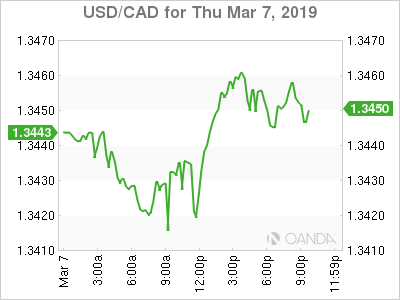
The political and economical headlines have been very concerning for Canada and many are curious to see if we will see that weakness trickle down to the labor market. January’s employment report posted a robust 66,800 reading with an unemployment rate of 5.8%, slightly above the 44-year low of 5.6%. Current expectations for the February reading are for 1,200 jobs created and for the unemployment rate to remain steady. A soft employment number will support the Bank of Canada’s dovish pivot and will further cement expectations for the next move to be a rate cut.
Oil
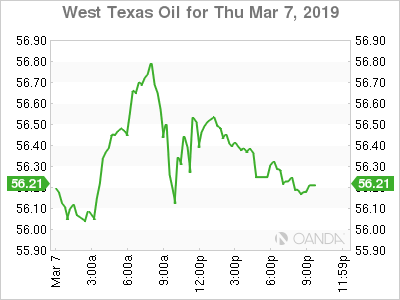
Crude prices are higher today on expectations tightness will be the story for the first half of the year. What is impressive about today’s price action is that oil’s rally is shrugging off the slower growth concerns that are hitting the other asset classes. Rising US production should eventually cap any major rally from here, but until we see US production consistently post bigger builds in stockpiles, prices might see less resistance to the upside.
Gold
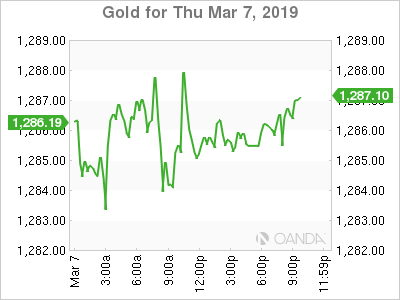
Surprisingly gold has been unable to muster up a decent rally following today’s risk off trading. The stimulus packaged revealed by the ECB did little to alleviate the risk off tone as markets remain focused on slower growth concerns. If we see softer wage and employment from the US, that may be the catalyst to help the precious metal.
Eco Data 3/8/19
[php_everywhere instance="1"]
ECB Review: A Postcard from Japan
- Today, the ECB surprised us by announcing a series of TLTRO3 starting in September 2019 and continuing until March 2021, each with a two-year maturity. The ECB further extended the rate forward guidance to rates remaining at present levels 'at least through the end of the 2019'.
- The ECB was less convinced by its previous narrative and opened the door for further easing. The market responded dovishly to the downbeat signals as the ECB opened the door for further easing.
- Consequently, we change our interest rate expectations and forecast no interest rate changes to either of the ECB's key interest rates within our forecast horizon of the next 12 months.
Tightening may not be the next move
Mario Draghi was surprisingly soft, a sign of worry that the recent slowdown is of a more structural than temporary nature. Draghi stressed that the TLTRO announcement was part of an accommodating monetary policy stance and that all tools were available. He made it clear that the package today was an easing bias. With the recent move, we do see similarities to the Japanese monetary policy stimuli agenda in the past decade.
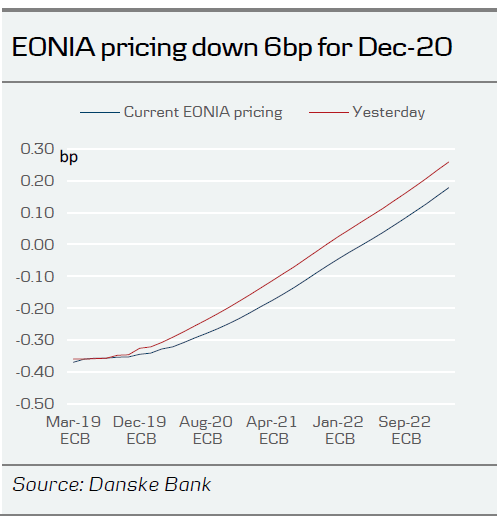
However, we think the ECB's projections brought an ambiguous message, which is somewhat at odds with the surprisingly dovish policy message and actions announced. The ECB expects the euro area expansion pace to slow but with momentum still recovering some ground towards end-2019. Although the ECB cut its core inflation forecasts, its overall inflation confidence remains alive and the Governing Council still judges the risk of a euro area recession and deanchoring of inflation expectations as very low. Our growth new tracker comes to the same conclusion. See more in Euro Area Research – Is the euro area heading for recession?, 4 March.
TLTRO – Italy set to be the main beneficiary
The ECB announced a series of seven operations, with a quarterly frequency starting in September this year (and ending in March 2021), all with two-year maturity. It is yet to publish the detailed modalities and will publish these in due course. However, the operations will be linked to lending requirements as in TLTRO1 and TLTRO 2. The rate will be indexed to the MRO prevailing during the life of the operation. Further, the decision points to favourable lending terms, which could indicate an MRO or down to deposit rate. However, this is too early to judge. Lending is set at 30% of the eligible loan stock. In ECB Research - TLTRO3: Italy to be main beneficiary, 9 November 2018, we pointed to the maximum additional liquidity being EUR1trn. However, it is likely to be much less, as core banks may not take as much as they can.
With the announcement of TLTRO, it also means that excess liquidity will remain abundant until well into the new decade (likely 2023), while Draghi has opened the possibility of the new president changing the rates should this be warranted. The favourable liquidity conditions are set to prevail well into 2023.
Staff projections: an ambiguous message
As Draghi outlined during the press conference, the significant downward revision in the growth and inflation outlook were an important factor behind the announcement of new measures during the meeting, as the ECB felt an urge to react to the slowdown. However, the ECB's narrative on the macroeconomic outlook remains surprisingly unchanged compared with its previous communication.
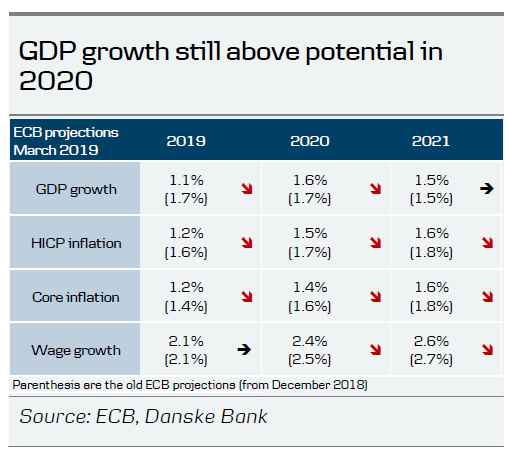
Particularly on the growth front, the updated projections showed marked downward revisions, with growth in 2019 (1.1%) significantly below the potential level (1.5%). The ECB acknowledged that incoming data continued to be weaker than expected, weighing on the near-term outlook but, importantly, it still expects growth rates to pick up towards the end of the year and sees growth at 1.6% back above potential in 2020, on the back of favourable financing conditions and a strong labour market. Risks to the growth outlook are still seen as skewed on the downside, not least due to pervasive uncertainties leaving their mark on economic sentiment. Interestingly, the ECB projections do not take into account a possible US-China trade deal, so one could argue there remain upside risks to the ECB's gloomy near-term growth outlook.
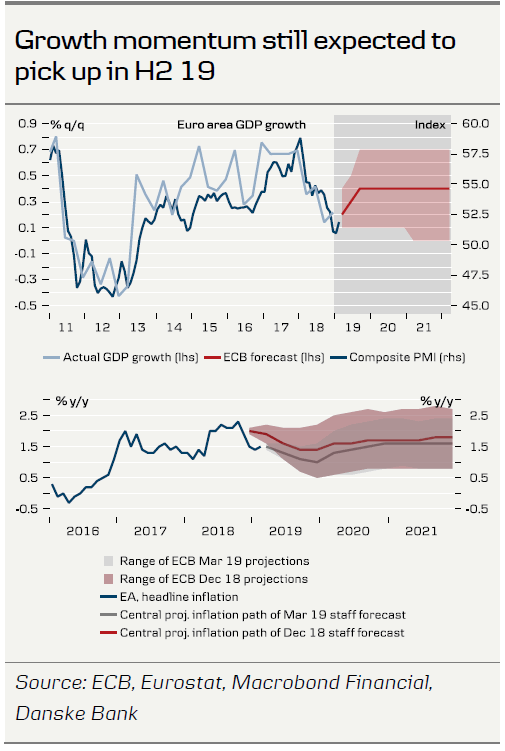
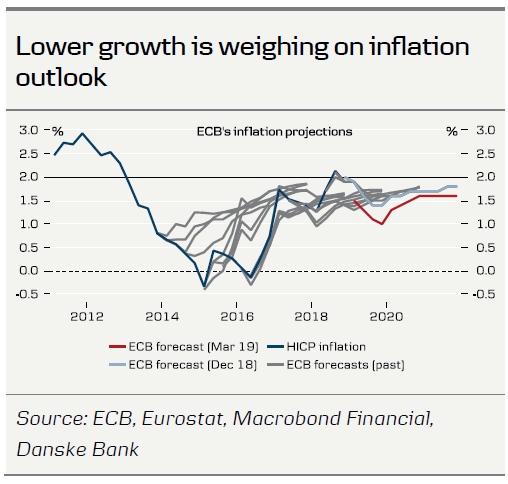
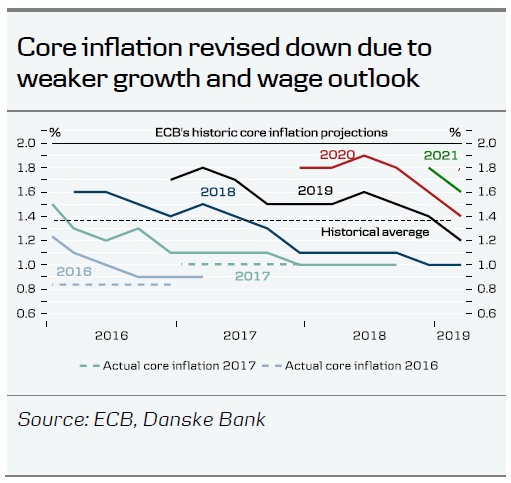
In line with our expectations, the growth downward revision also left its mark on the (core) inflation outlook, which was lowered by 0.2% across the years (see table). Despite this, the ECB's overall inflation narrative was not much changed. Draghi acknowledged that core inflation has remained muted but stressed that wage growth remains strong with dispersion of nominal wage growth rates across countries at historical lows. Patience remains the mantra about the transmission from wages to consumer prices.
FX: ECB introduces 'easing risk premium' on EUR
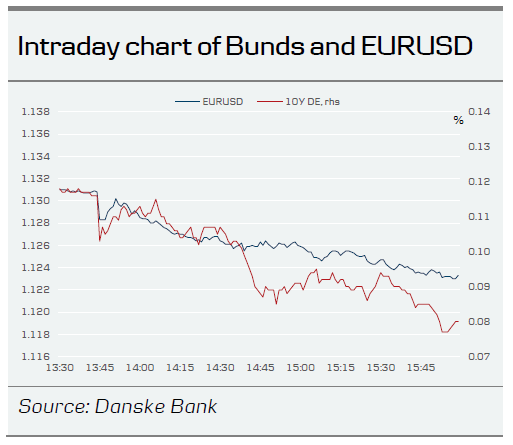
The ECB clearly took our EUR call by surprise today as the expectation of a 2019 hike was a key pillar for our bullish EUR/USD view this year. In light of the very soft ECB message, the fall in EUR/USD from just above the 1.13 mark before the announcement to briefly below 1.1250 was not as large as this significantly dovish package warrants in our view. Indeed, we would expect to see the cross slide further in coming days.
We have previously stressed that prospects for the end of ECB-Fed policy divergence this year held the potential for a sustained uptick in EUR/USD towards the end of the year, i.e. that an end to Fed hikes, a US-China trade deal and a first ECB hike would, in combination, take the cross towards 1.25 in 12M. The latter driver is now effectively taken out of the equation, with this not in sight on a 12M horizon. Indeed, the ECB's communication today highlights that all policy options are back on the table and – crucially for the FX market – this opens up the range of possible policy outcomes and introduces an 'ECB easing risk premium'. Importantly, it also postpones the potential for a capital-flow reversal to support EUR, as negative rates will rein in the eurozone for some time still. This said, valuation still holds a hand under EUR/USD and a US-China trade deal with positive spillover to Europe remains a medium-term positive.
Near term, we expect EUR/USD to drift below the 1.12 mark – watch out for 1.1216 (2018 low) resistance and 1.1179 (27-Jun-17 low) thereafter. With the risk of pockets of USD strength from renewed pricing of Fed hikes and a trade deal that will not provide much imminent support, this opens the possibility for a EUR/USD move towards 1.10 on a 3M horizon. Over the medium term (3-6M out), we expect EUR/USD to stabilise and move back into the 1.12-1.16 range and stress that any drift higher will be limited, with any upside deriving mainly from positive spillover to the euro area from a turn in the global (China) cycle.
FI: 10Y German bunds heading to negative territory
The new TLTROs combined with the new extended forward guidance and the message that the ECB stands ready (Draghi underlined the easing bias at the press conference) to do more if necessary is very positive for market sentiment. The hunt for yield and carry is on.
Italy is the main beneficiary of the new TLTRO. In addition, the new outright yield levels that have pushed 10Y Spain towards 1% and 10Y France below 0.50% are pushing carry investors towards Italy. Given the clear easing bias from Draghi, we believe the carry game will continue for the next couple of months and even though the 5Y periphery rallied strongly today, this is still our favourite segment of the both the BTP and SPGB curve.
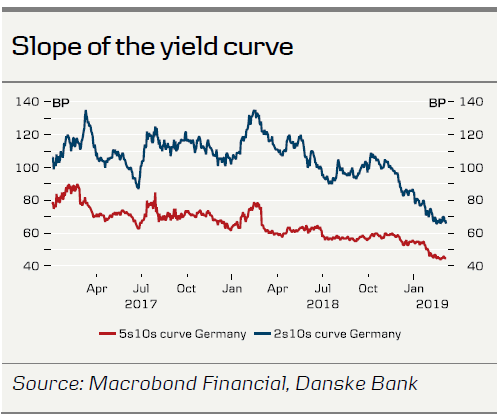
In respect of the German curve, we believe both the 2s10s and 5s10s curves will continue to flatten. We also believe that we are heading for a sub-zero level for 10Y bund yields and our expected trading range for the next two months is -15 to 10bp.
British Pound Slips on PMI, Brexit Worries
GBP/USD has posted considerable losses in the Thursday session, showing significant movement for the first time this week. In North American trade, the pair is trading at 1.3102, down 0.52% on the day. There is only one key event on the calendar. U.S. employment claims dipped to 223 thousand, below the estimate of 225 thousand. On Friday, the focus will be on employment numbers, as the U.S. releases wage growth and nonfarm payrolls.
With the Federal Reserve continuing to send a dovish message to the markets, we may not see a rate hike in the first half of 2019. After four rate hikes last year, the Fed has become much more dovish, and this stance was reinforced by Jerome Powell in testimony before Congress. On Tuesday, Boston Fed President Eric Rosengren, who is a considered a hawk on monetary policy, said that there was some downside risk to the U.S. economy and called on policymakers to be “patient” for several more meetings in order to evaluate the risks to the economy. Without being explicit, Rosengren appears to support the Fed remaining on the sidelines for upcoming policy meetings until the Fed can better gauge the health of the U.S. economy.
Ahead of Brexit, investors will be watching British economic data closely, and soft numbers could trigger a loss of confidence in the U.K. economy and the British pound. February PMI reports have been soft, and the pound has responded this week with losses. On Wednesday, Services PMI edged up to 51.3, above the 50-level which separates contraction from expansion. Still, the reading points to stagnation in the services sector. Earlier in the week, construction PMI dropped to 49.5, the first time that the PMI has indicated contraction since March 2018. The turmoil over Brexit is at least partly to blame for soft construction numbers, as clients re-evaluate whether to take on commercial projects in a time of uncertainty. Last week, manufacturing PMI dipped to 52.0, marking a 4-month low. Aside from Brexit jitters, the U.S.-China trade war has also taken a toll on the economy, in particular on the export and manufacturing sectors.