

Sample Category Title
EUR/JPY: Retains Downside Pressure With Eyes On 125.53 Zone
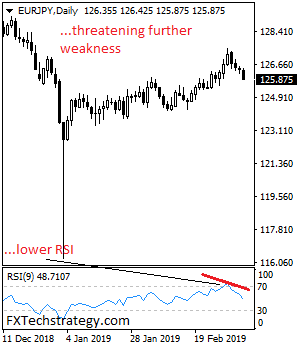
EURJPY retains downside pressure with eyes on 125.53 zone. Support comes in at the 125.50 level where a break if seen will aim at the 125.00 level. A cut through here will turn focus to the 124.50 level and possibly lower towards the 124.00 level. Its daily RSI is bearish and pointing lower suggesting further weakness. On the upside, resistance resides at the 126.50 level. Further out, we envisage a possible move towards the 127.00 level. Further out, resistance resides at the 127.50 level with a turn above here aiming at the 128.00 level. On the whole, EURJPY faces further price weakness in the short term.
ECB Lifts Stocks Off Lows and Sinks Euro
Stocks in Asia and Europe turned positive after the ECB announcement of fresh loans, shrugging off a lower start that stemmed from slower economic growth concerns persist and uncertainty remaining high on what type of trade deal will be reached between China and the US. The ECB joined the dovish camp of central banks worldwide with fresh cuts to their outlook and new long-term loans. Two weeks ago, expectations were for President Trump and Xi to reach a possible accord by mid-March, but if we do not see a date set in stone for a meeting in Mar-a-Lago, stocks could continue to fall under pressure and safe-haven currencies may accelerate gains.
- EURO – ECB surprises some with fresh loans
- Brexit – EU not optimistic for a breakthrough
- Stocks – Reversed earlier losses on ECB stimulus
- Gold – Follows euro move lower
- Oil – Crude rises on tightness in markets; banks keep bullish forecasts
EURO
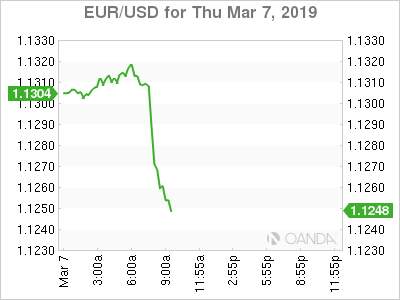
The ECB joined the recent camp of dovish central bankers and announced a new series of two-year TLTROs . This round of cheap loans to banks cemented the view that the ECB is nowhere near raising rates with some believing a rate hike could now happen at the end of 2020. The euro has been stuck in a frustrating 1.12 and 1.16 range against the dollar, and while some are disappointed the Targeted Long-Term Loans details, we may see this fresh dovish stance not see as much weakness as we would normally as dovish stances have also been queued up by the Fed and PBOC.
GBP
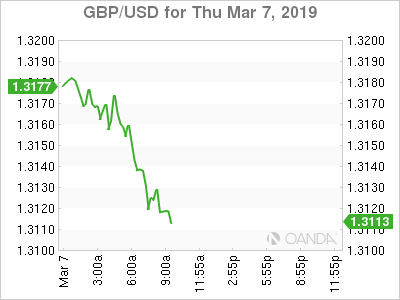
It appears that European and UK officials are starting to realize a breakthrough is unlikely. Next week will likely deliver three key votes, with expectations favoring May’s Brexit deal to get voted down, no-deal Brexit to be taken off the table, and for Article 50 to be extended. The base case is that we will probably see a short Brexit delay and that some form of the current deal will eventually be accepted. The uncertainty that persists ahead of these key votes are dragging down the British pound.
Stocks
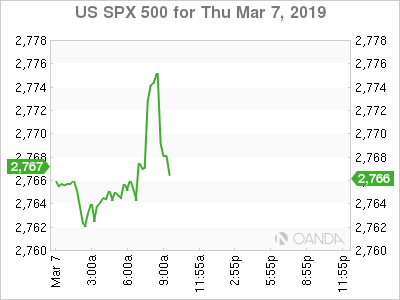
US equities are poised to open higher after the ECB announced fresh loans to support the banks and cuts to all their inflation forecasts and slashing 2019 GDP growth from 1.7% to 1.1%. The dovish ECB meeting further confirms a global deceleration that is seeing other major banks, like the Fed and PBOC, becoming more dovish. The Fed is holding rates steady and will like end their quantitative tightening sooner than later, China will deliver fiscal and monetary stimulus, and stocks will have this backdrop of easy money supporting risk assets. Earnings seasons is ending, and the street has priced in a soft first quarter with hopes of a stronger second half of the year.
Gold
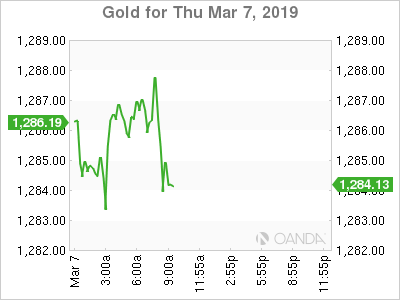
The precious metal is tracking the euro lower this morning and gold bulls will look to see if we finally see support hold if we test $1,270. Gold’s recent pullback has been supported by strong trade talk optimism between China and the US, relief that a no-deal Brexit is unlikely and US economic growth is cooling, not collapsing. With most of the advanced economies remaining or becoming accommodative, gold could soon find some support.
Oil
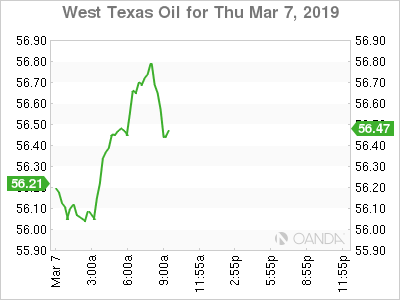
Crude prices were supported on news Venezuela’s PDVSA is having difficulty exporting oil due to the US sanctions, supporting the view that supplies are still tightening despite US output continuing to rise to record levels. Oil forecasts by banks are still calling for prices to rise in the first half of the year, supported by a tight second quarter. By 2020, the banks are seeing WTI trade near $63 a barrel, with Brent at $68.
ECB Draghi’s Press Conference Comments
The ECB surprised everyone by announcing a new series of refinancing operations and delaying when it expects to raise interest rates.
European policy makers now say interest rates will remain at their present levels “at least through the end of 2019” versus “at least through the summer of 2019” at its previous statement.
The ECB announced new targeted longer-term refinancing operations on a quarterly basis, starting in September 2019 and ending in March 2021.
Headline comments from Dow-Jones:
- Draghi: Weakening in Econ Data Points to Moderation in Growth Extending in 2019
- Weaker Econ Momentum Slowing Inflation Adjustment to Aim
- Significant Monetary Policy Stimulus Still Needed
- ECB Stands Ready to Adjust All Instruments, If Needed
- Recent Data Still Weak, Reflecting Soft Foreign Demand, Special Factors
- Near-Term Growth Momentum Weaker Than Previously Expected
- Activity Supported by Benign Financing Conditions, Rising Wage Growth
- Eurozone 2019 GDP Seen +1.1% on Yr vs Earlier Estimate of +1.7%
- Eurozone 2020 GDP Seen +1.6% on Yr vs Earlier Estimate of +1.7%
- Eurozone 2021 GDP Seen +1.5% on Yr vs Earlier Estimate of +1.5%
- Risks Surrounding Eurozone Growth Outlook Still Tilted to Downside
- Substantial Downward Revision to 2019 Growth Estimate
- Measures of Underlying Inflation Remain Generally Muted
- Headline Inflation Likely to Decline Toward Year-End
- Underlying Inflation Expected to Increase Over Medium Term
- Eurozone 2019 HICP Seen +1.2% on Yr vs Earlier Estimate of +1.6%
- Eurozone 2020 HICP Seen +1.5% on Yr vs Earlier Estimate of +1.7%
- Eurozone 2021 HICP Seen +1.6% on Yr vs Earlier Estimate of +1.8%
- New TLTROs Will Help Ensure Favorable Bank-Lending Conditions
- In Coming Years “Congestion” of Bank Funding
- Design of TLTROs Reflects Changed Econ Conditions
- Moved Calendar-Based Part of Forward Guidance From Sep to Dec 2019
- Financing Conditions Even Eased Since Last Meeting
- All ECB Measures Data-Driven, Following Cuts in Staff Forecasts
- ECB Committed to Act When, If Needed
- Decision Was Taken Unanimously
- “Positive Sign” That There is Unanimity
- Uncertainty Partly Related to External Factors
- Probability of Recession “Very Low” in ECB Assessment
- Revisions to Inflation Path Show That it Will Take Longer to Reach Target
- We Kept Econ Risk Assessment as Being “Tilted to the Downside”
- Latest ECB Actions Increase Resilience of Eurozone Economy
- We Didn’t Tighten Monetary Policy When We Stopped QE
- Conditions Are “Very, Very” Accommodative
- Several Members Presented Option of Changing Calendar Guidance to Mar 2020
- Markets Have “Pretty Well Understood” ECB’s Reaction Function
- Latest Decisions Enhanced Credibility of ECB’s Foreward Guidance
The EUR has extended its fall outright, dropping -0.45% to a three-week low of €1.1255, as ECB President Draghi announces cuts to growth and inflation forecasts.
EUR/USD Mid-Day Outlook
Daily Pivots: (S1) 1.1285; (P) 1.1307; (R1) 1.1327; More.....
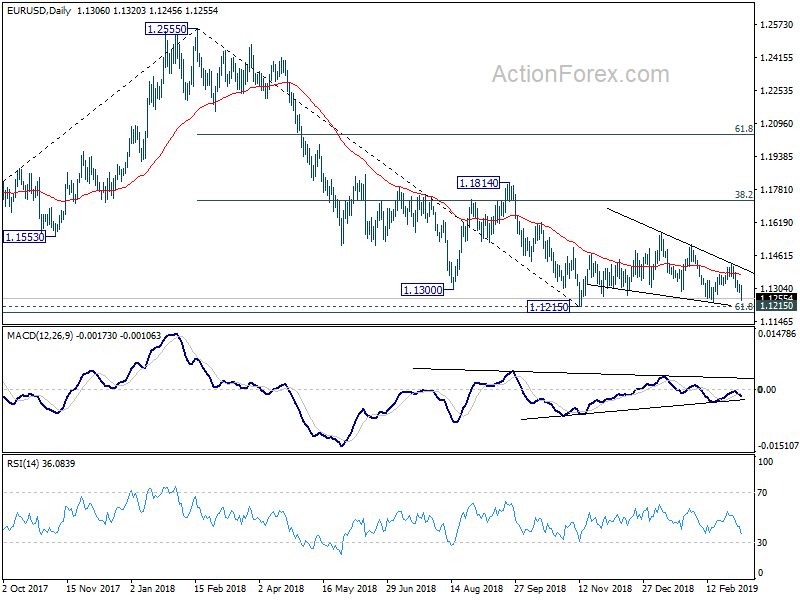
EUR/USD drops to as low as 1.1245 so far and intraday bias remain on the downside for 1.1215 low. Decisive break there will resume larger down trend from 1.2555. On the upside, above 1.1345 minor resistance will turn bias to the upside for 1.1324 resistance to extend the consolidation from 1.1215.
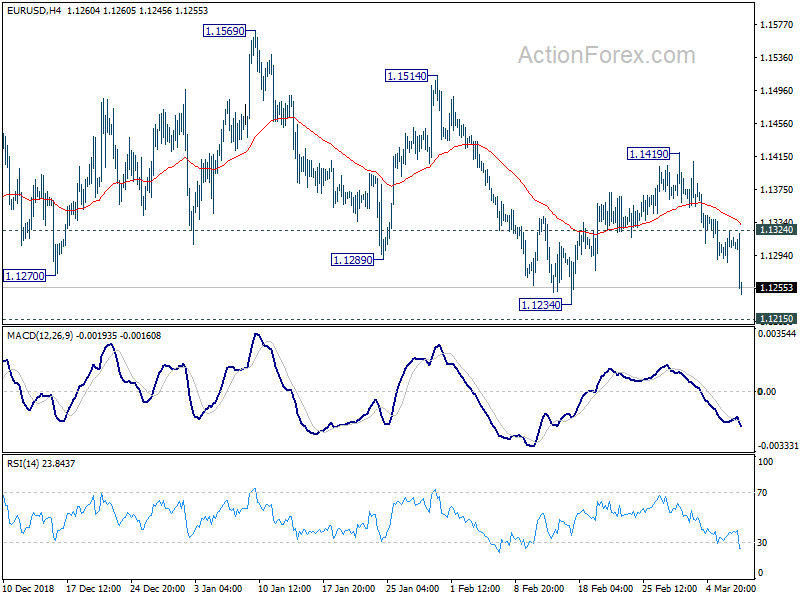
In the bigger picture, as long as 1.1814 resistance holds, down trend down trend from 1.2555 medium term top is still in progress and should target 61.8% retracement of 1.0339 (2017 low) to 1.2555 at 1.1186 next. Sustained break there will pave the way to retest 1.0339. However, break of 1.1814 will confirm completion of such down trend and turn medium term outlook bullish.
EUR/USD Dives after All-the-Way Dovish ECB, Heading Towards 1.1215 Low
Euro tumbles broadly after ECB delivered and all-the-way dovish meeting. There will be no rate hike until at least 2020. New TLTRO-III is announced. ECB expects sizeable moderation in growth. GDP growth forecast was revised down substantially. Yet, risks surrounding outlook are still tilted to the downside. Selloff in Euro is dragging down other European majors, as well as German 10-year yield, which is back below 0.1 handle.
Staying in the currency markets, commodity currencies are surprisingly the strongest ones today, despite dovish outlook on RBA, RBNZ and even BoC. Pull back in global treasury yield could be a factor helping them. Even US 10-year yield is now back below 2.7 handle and is moving downward. Overall, Yen and Dollar are mixed.
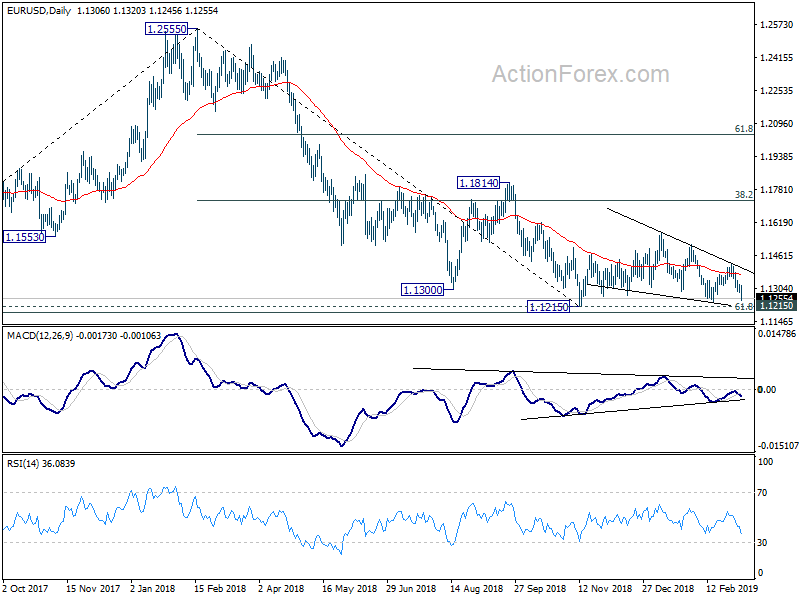
Technically, EUR/USD is heading back to 1.1215 low and break will confirm resumption of larger down trend from 1.2555. USD/CHF will likely test 1.0098/0128 resistance zone too. GBP/USD is back pressing 1.3109 but it's stubbornly holding on to this support so far.
In Europe, FTSE is down -0.28%. DAX is down -0.16%. CAC is down -0.10%. German 10-year yield is down -0.033 at 0.095, back below even 0.1 handle. Earlier in Asia, Nikkei dropped -0.65%. Hong Kong HSI dropped -0.89%. China Shanghai SSE rose 0.14%. Singapore Strait Times rose 0.21%. Japan 10-year JGB yield dropped -0.0062 to -0.001.
All-the-way dovish ECB to keep interest rates unchanged longer
Euro drops broadly after an all-the-way dovish ECB meeting and takes European majors lower. ECB keeps interest range unchanged at 0.00% as widely expected. The central bank now expects to keep interest rates at present levels "at least through the end of 2019", prolonged from "summer of 2019". Also, TLTRO-III is announced, quarterly from September 2019 through March 2021. It's aiming at preserving favorable bank lending conditions, and smooth transition of monetary policy.
In ECB's post meeting press conference, President Mario Draghi said there are signs that "some of the idiosyncratic domestic factors dampening growth are starting to fade". However, the weakening in data points to a "sizeable moderation in the pace of the economic expansion that will extend into the current year". Underlying inflations "continues to be muted". And weaker economic momentum is "slowing the adjustment of inflation" towards target.
Draghi added that Incoming have continued to be weak, in particular in manufacturing, "reflecting the slowdown in external demand compounded by some country and sector-specific factors". And the impact is "turning out to be somewhat longer-lasting". Thus, near-term growth outlook will be weaker than previously anticipated
In the new staff projections, GDP growth was "revised down substantially in 2019 and slightly in 2020". GDP is projected to grow by 1.1% in 2019, 1.6% in 2020 and 1.5% in 2021. They compare to December's projection of 1.7% in 2019, 1.7% in 2020 and 1.5% in 2021. Risks surrounding outlook are "still tilted to the downside", due to "geopolitical factors, the threat of protectionism and vulnerabilities in emerging markets."
HICP inflation is projected to be at 1.2% in 2019, 1.5% in 2020 and 1.6% in 2021. They compare to December's projection of 1.6% in 2019, 1.7% in 2020 and 1.8% in 2021.
More on ECB: ECB Announces new TLTROs, Markedly Downgrades Growth and Inflation Forecasts
Eurozone Q4 GDP growth finalized at 0.2% qoq, employment grew 0.3% qoq
Eurozone Q4 GDP growth was finalized at 0.2% qoq, unrevised. Annually, GDP grew 1.1% yoy. Over the whole 2018, GDP grew 1.8%. During Q4, household final consumption expenditure rose by 0.2%. Gross fixed capital formation increased by 0.6%. Exports increased by 0.9%. Imports increased by 0.5%. Eurozone Employment growth in Q4 was finalized at 0.3% qoq, 1.3% yoy.
Also released in European session, Swiss unemployment rate was unchanged at 2.4% in February. Foreign currency reserves dropped to CHF 739B in February.
US initial jobless dropped -3k to 223k
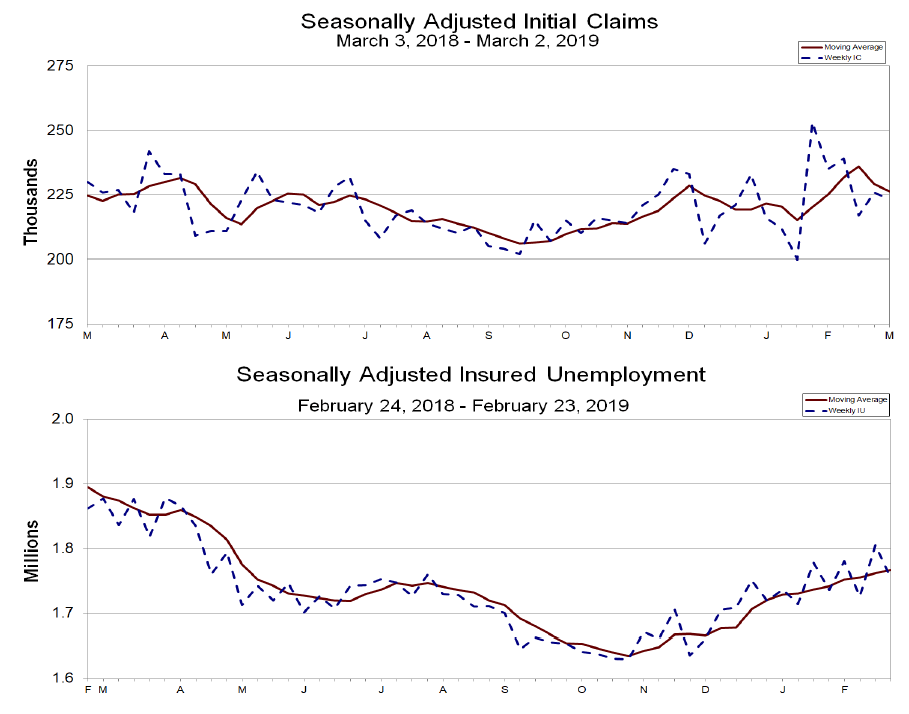
US initial jobless claims dropped -3k to 223k in the week ending March 12, slightly below expectation of 225k. The four-week moving average of initial claims dropped -3k to 226.25k. Continuing claims dropped 50k to 1.755M in the week ending February 23. Four-week moving average of continuing claims rose 4.75k to 1.767M. Also release, US non-farm productivity was finalized at 1.9% in Q4, unit labor cost at 2.0%. Canada building permits dropped -5.5% mom in January.
BoE Tenreyo: Effect of Brexit uncertainty on demand increasingly evident
BoE MPC member Silvanna Tenreyo said the "effect of that Brexit uncertainty on demand has become increasingly evident in recent months". The effect is most apparent in business as "investment has been falling in the UK at a time when it has been growing in our international peers; business confidence surveys have slumped; hiring intentions have fallen back.".
There were also signs of impact on households as "housing market is weakening; consumer confidence has deteriorated. This all happened at a time when household real incomes are rising and all else equal, one might normally have expected spending to be rising too."
On monetary policy in case of disorderly Brexit in a speech. She echoed the view that seems to be the consensus in the MPC now. That is, "a situation where the negative demand effects outweigh those other effects is more likely, which would necessitate a loosening in policy."
But she also noted reiterated that "the monetary policy response to such a scenario will depend on the balance of these effects on supply, demand and the exchange rate". And, it is "to envisage other plausible scenarios requiring the opposite response."
UK Hammond: The governor will not vote for no-deal Brexit
Chancellor of the Exchequer Philip Hammond told BBC radio that "The government is very clear where the will of parliament is on this. Parliament will vote not to leave the European Union without a deal," and he had "a high degree of confidence about that."
At the same time, he also warned that voting against Prime Minister Theresa May's deal, the UK "will then be in unknown territory where a consensus will have to be forged across the House of Commons and that will inevitably mean compromises being made."
The UK parliament is scheduled to have another Brexit deal meaningful vote on March 12. If it's rejected, there will be a vote on no-deal Brexit on March 13. Then if both are rejected, there will be a vote on Article 50 extension.
Australia recorded second largest trade surplus in Jan, but retail sales missed
Australia trade surplus widened to AUD 4.55B in January, up from AUD 3.77B and beat expectation of AUD 2.90B. That's also the second largest surplus on record. Exports rose 5% to AUD 1.90B while imports rose 3% to AUD 1.12B.
However, retail sales was disappointing. Sales grew merely 0.1% mom in January, rebounding from -0.4% decline in prior month, but missed expectation of 0.3% mom.
Also from Australia, AiG Performance of Construction index rose 0.7 to 43.8 in February, indicating a slower rate of contraction.
China: Some regions will face relatively big budgetary pressure this year
China plans to cut around CNY 2T in taxes and fees for companies in 2019 as growth could slow to the lowest pace in three decades at 6.0-6.5%. Yet, its Finance Minister Liu Kun warned that "considering the downward pressure on the economy and the upcoming policy of larger tax and fee cuts, some regions will still face relatively big budgetary pressure this year."
Budget deficit is targeted to be at 2.8% of GDP, up from 2.6% in 2018. Liu said "the arrangement on the budget deficit ratio has fully considered factors including fiscal revenue and local government special bonds and leaves more policy room for future macro adjustments." To offset the reduction in tax and fee revenue, Liu noted the government will collect more profits from some state-owned financial institutions and companies. The government is also trying to secure funding via other channels "which allows us not to raise the deficit ratio too high."
EUR/USD Mid-Day Outlook
Daily Pivots: (S1) 1.1285; (P) 1.1307; (R1) 1.1327; More.....
EUR/USD drops to as low as 1.1245 so far and intraday bias remain on the downside for 1.1215 low. Decisive break there will resume larger down trend from 1.2555. On the upside, above 1.1345 minor resistance will turn bias to the upside for 1.1324 resistance to extend the consolidation from 1.1215.
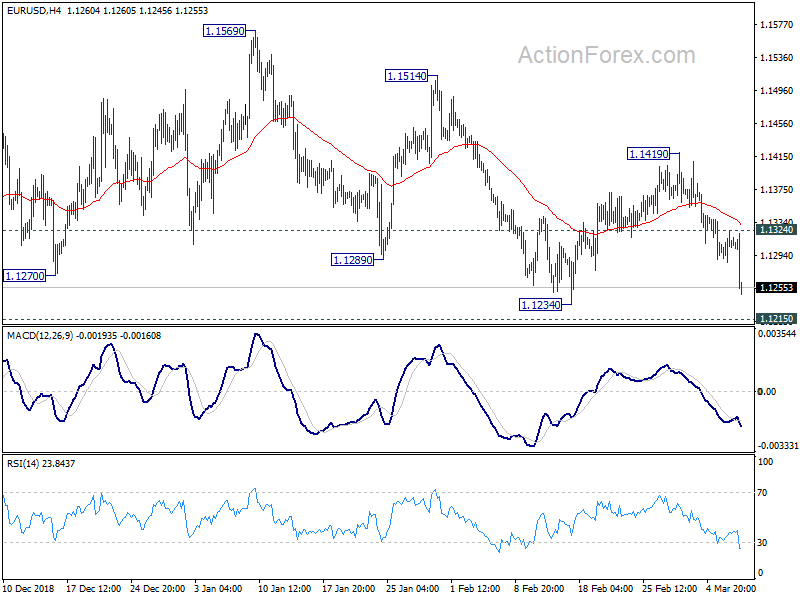
In the bigger picture, as long as 1.1814 resistance holds, down trend down trend from 1.2555 medium term top is still in progress and should target 61.8% retracement of 1.0339 (2017 low) to 1.2555 at 1.1186 next. Sustained break there will pave the way to retest 1.0339. However, break of 1.1814 will confirm completion of such down trend and turn medium term outlook bullish.
Economic Indicators Update
| GMT | Ccy | Events | Actual | Forecast | Previous | Revised |
|---|---|---|---|---|---|---|
| 21:30 | AUD | AiG Performance of Construction Index Feb | 43.8 | 43.1 | ||
| 00:30 | AUD | Trade Balance (AUD) Jan | 4.55B | 2.90B | 3.68B | 3.77B |
| 00:30 | AUD | Retail Sales M/M Jan | 0.10% | 0.30% | -0.40% | |
| 05:00 | JPY | Leading Index CI Jan P | 95.9 | 96 | 97.5 | |
| 06:45 | CHF | Unemployment Rate Feb | 2.40% | 2.40% | 2.40% | |
| 08:00 | CHF | Foreign Currency Reserves (CHF) Feb | 739B | 741B | ||
| 10:00 | EUR | Eurozone Employment Q/Q Q4 F | 0.30% | 0.30% | 0.30% | |
| 10:00 | EUR | Eurozone Employment Y/Y Q4 F | 1.10% | 1.20% | 1.20% | |
| 10:00 | EUR | Eurozone GDP Q/Q Q4 F | 0.20% | 0.20% | 0.20% | |
| 12:30 | USD | Challenger Job Cuts Y/Y Feb | 117.20% | 18.70% | ||
| 12:45 | EUR | ECB Rate Decision | 0.00% | 0.00% | 0.00% | |
| 13:30 | EUR | ECB Press Conference | ||||
| 13:30 | CAD | Building Permits M/M Jan | -5.50% | -1.50% | 6.00% | 6.40% |
| 13:30 | USD | Initial Jobless Claims (MAR 02) | 223K | 225K | 225K | 226K |
| 13:30 | USD | Nonfarm Productivity Q4 F | 1.90% | 1.60% | 2.30% | |
| 13:30 | USD | Unit Labor Costs Q4 F | 2.00% | 1.70% | 0.90% | |
| 15:30 | USD | Natural Gas Storage | -141B | -166B |
ECB Announces new TLTROs, Markedly Downgrades Growth and Inflation Forecasts
ECB left the main refi rate, the marginal lending rate and the deposit rate unchanged at 0.00%, 0.25% and -0.40%, respectively. However, much change was made in the economic assessment and the forward guidance, as a result of “moderation in the pace of the economic expansion”. The central bank also unveiled a new lending facility to encourage bank lending. Overall, ECB turned more dovish than the January meeting as both domestic data flow and the global dynamic pointed to further downside risk on growth.
Forward Guidance
ECB forecast that the policy rates would “remain at their present levels at least through the end of 2019”, pushing back the timing from “at least through the summer of 2019” previously. The language on reinvestment stayed unchanged. It reaffirmed that the central bank would “continue reinvesting, in full, the principal payments from maturing securities purchased under the asset purchase programme for an extended period of time past the date when it starts raising the key ECB interest rates, and in any case for as long as necessary to maintain favourable liquidity conditions and an ample degree of monetary accommodation”.
TLTROs
As we expected, ECB announced new lending facility – Targeted Long term Refinancing operations (LTROs). As mentioned in the statement, “a new series of quarterly targeted longer-term refinancing operations (TLTRO-III) will be launched, starting in September 2019 and ending in March 2021, each with a maturity of two years”. At the press conference, President Mario Draghi noted that “the operation will help to preserve favourable bank lending conditions”.
Economic Projections
As noted in the accompanying statement, "the persistence of uncertainties in particular relating to geopolitical factors and the threat of protectionism is weighing on economic sentiment". At the press conference, Draghi added that all members judged that the chance of recession is low. GDP growth for this year is revised significantly lower to +1.1%,from December’s +1.7%. Growth in 2020 is revised to +1.6% (-0.1 percentage point lower than December’s estimate), before easing again to +1.5% in 2021. On the price level, ECB downgraded the CPI forecast, by +0.4 percentage point, to +1.2% y/y for 2019. Inflation is expected to improve to +1.5% and +1.6% in 2020 and 2021, respectively. Both are trimmed from December's +1.5% and+1.6% respectively.
ECB: Sizeable moderation in growth, substantial downgrade in growth forecasts, risks still tilted to the downside.
In ECB's post meeting press conference, President Mario Draghi said there are signs that "some of the idiosyncratic domestic factors dampening growth are starting to fade". However, the weakening in data points to a "sizeable moderation in the pace of the economic expansion that will extend into the current year". Underlying inflations "continues to be muted". And weaker economic momentum is "slowing the adjustment of inflation" towards target.
Draghi added that Incoming have continued to be weak, in particular in manufacturing, "reflecting the slowdown in external demand compounded by some country and sector-specific factors". And the impact is "turning out to be somewhat longer-lasting"Thus near-term growth outlook will be weaker than previously anticipated
In the new staff projections, GDP growth was "revised down substantially in 2019 and slightly in 2020". GDP is projected to grow by 1.1% in 2019, 1.6% in 2020 and 1.5% in 2021. They compare to December's projection of 1.7% in 2019, 1.7% in 2020 and 1.5% in 2021. Risks surrounding outlook are "still tilted to the downside", due to "geopolitical factors, the threat of protectionism and vulnerabilities in emerging markets."
HICP inflation is projected to be at 1.2% in 2019, 1.5% in 2020 and 1.6% in 2021. They compare to December's projection of 1.6% in 2019, 1.7% in 2020 and 1.8% in 2021.
(ECB) Introductory Statement to the Press Conference
Mario Draghi, President of the ECB,
Luis de Guindos, Vice-President of the ECB,
Frankfurt am Main, 7 March 2019
INTRODUCTORY STATEMENT
Ladies and gentlemen, the Vice-President and I are very pleased to welcome you to our press conference. We will now report on the outcome of today's meeting of the Governing Council, which was also attended by the Commission Vice-President, Mr Dombrovskis.
Based on our regular economic and monetary analyses, we have conducted a thorough assessment of the economic and inflation outlook, also taking into account the latest staff macroeconomic projections for the euro area. As a result, the Governing Council took the following decisions in the pursuit of its price stability objective.
First, we decided to keep the key ECB interest rates unchanged. We now expect them to remain at their present levels at least through the end of 2019, and in any case for as long as necessary to ensure the continued sustained convergence of inflation to levels that are below, but close to, 2% over the medium term.
Second, we intend to continue reinvesting, in full, the principal payments from maturing securities purchased under the asset purchase programme for an extended period of time past the date when we start raising the key ECB interest rates, and in any case for as long as necessary to maintain favourable liquidity conditions and an ample degree of monetary accommodation.
Third, we decided to launch a new series of quarterly targeted longer-term refinancing operations (TLTRO-III), starting in September 2019 and ending in March 2021, each with a maturity of two years. These new operations will help to preserve favourable bank lending conditions and the smooth transmission of monetary policy. Under TLTRO-III, counterparties will be entitled to borrow up to 30% of the stock of eligible loans as at 28 February 2019 at a rate indexed to the interest rate on the main refinancing operations over the life of each operation. Like the outstanding TLTRO programme, TLTRO‑III will feature built-in incentives for credit conditions to remain favourable. Further details on the precise terms of TLTRO-III will be communicated in due course.
Fourth, we will continue conducting our lending operations as fixed rate tender procedures with full allotment for as long as necessary, and at least until the end of the reserve maintenance period starting in March 2021.
Today's monetary policy decisions were taken to ensure that inflation remains on a sustained path towards levels that are below, but close to, 2% over the medium term. While there are signs that some of the idiosyncratic domestic factors dampening growth are starting to fade, the weakening in economic data points to a sizeable moderation in the pace of the economic expansion that will extend into the current year. The persistence of uncertainties related to geopolitical factors, the threat of protectionism and vulnerabilities in emerging markets appears to be leaving marks on economic sentiment. Moreover, underlying inflation continues to be muted. The weaker economic momentum is slowing the adjustment of inflation towards our aim. At the same time, supportive financing conditions, favourable labour market dynamics and rising wage growth continue to underpin the euro area expansion and gradually rising inflation pressures. Today's decisions will support the further build-up of domestic price pressures and headline inflation developments over the medium term. Significant monetary policy stimulus will continue to be provided by our forward guidance on the key ECB interest rates, reinforced by the reinvestments of the sizeable stock of acquired assets and the new series of TLTROs. In any event, the Governing Council stands ready to adjust all of its instruments, as appropriate, to ensure that inflation continues to move towards the Governing Council's inflation aim in a sustained manner.
Let me now explain our assessment in greater detail, starting with the economic analysis. Euro area real GDP increased by 0.2%, quarter on quarter, in the fourth quarter of 2018, following growth of 0.1% in the third quarter. Incoming data have continued to be weak, in particular in the manufacturing sector, reflecting the slowdown in external demand compounded by some country and sector-specific factors. The impact of these factors is turning out to be somewhat longer-lasting, which suggests that the near-term growth outlook will be weaker than previously anticipated. Looking ahead, the effect of these adverse factors is expected to unwind. The euro area expansion will continue to be supported by favourable financing conditions, further employment gains and rising wages, and the ongoing – albeit somewhat slower – expansion in global activity.
This assessment is broadly reflected in the March 2019 ECB staff macroeconomic projections for the euro area. These projections foresee annual real GDP increasing by 1.1% in 2019, 1.6% in 2020 and 1.5% in 2021. Compared with the December 2018 Eurosystem staff macroeconomic projections, the outlook for real GDP growth has been revised down substantially in 2019 and slightly in 2020.
The risks surrounding the euro area growth outlook are still tilted to the downside, on account ofthe persistence of uncertainties related to geopolitical factors, the threat of protectionism and vulnerabilities in emerging markets.
According to Eurostat's flash estimate, euro area annual HICP inflation was 1.5% in February 2019, after 1.4% in January, reflecting somewhat higher energy and food price inflation. On the basis of current futures prices for oil, headline inflation is likely to remain at around current levels before declining towards the end of year. Measures of underlying inflation remain generally muted, but labour cost pressures have strengthened and broadened amid high levels of capacity utilisation and tightening labour markets. Looking ahead, underlying inflation is expected to increase over the medium term, supported by our monetary policy measures, the ongoing economic expansion and rising wage growth.
This assessment is also broadly reflected in the March 2019 ECB staff macroeconomic projections for the euro area, which foresee annual HICP inflation at 1.2% in 2019, 1.5% in 2020 and 1.6% in 2021. Compared with the December 2018 Eurosystem staff macroeconomic projections, the outlook for HICP inflation has been revised down across the projection horizon, reflecting in particular the more subdued near-term growth outlook.
Turning to the monetary analysis, broad money (M3) growth decreased to 3.8% in January 2019, from 4.1% in December 2018. M3 growth continues to be backed by bank credit creation, notwithstanding a recent moderation in credit dynamics. The narrow monetary aggregate M1 remained the main contributor to broad money growth.
The annual growth rate of loans to non-financial corporations declined to 3.3% in January 2019, from 3.9% in December 2018, reflecting a base effect but also, in some countries, the typical lagged reaction to the slowdown in economic activity, while the annual growth rate of loans to households remained at 3.2%. Borrowing conditions for firms and households are still favourable, as the monetary policy measures put in place since June 2014 continue to support access to financing, in particular for small and medium-sized enterprises. The policy measures decided today, and in particular the new series of TLTROs, will help to ensure that bank lending conditions remain favourable going forward.
To sum up, a cross-check of the outcome of the economic analysis with the signals coming from the monetary analysis confirmed that an ample degree of monetary accommodation is still necessary for the continued sustained convergence of inflation to levels that are below, but close to, 2% over the medium term.
In order to reap the full benefits from our monetary policy measures, other policy areas must contribute more decisively to raising the longer-term growth potential and reducing vulnerabilities. The implementation of structural reforms in euro area countries needs to be substantially stepped up to increase resilience, reduce structural unemployment and boost euro area productivity and growth potential. This is particularly important in view of the overall limited implementation of the 2018 country-specific recommendations, as recently communicated by the European Commission. Regarding fiscal policies, the mildly expansionary euro area fiscal stance and the operation of automatic stabilisers are providing support to economic activity. At the same time, countries where government debt is high need to continue rebuilding fiscal buffers. All countries should continue to increase efforts to achieve a more growth-friendly composition of public finances. Likewise, the transparent and consistent implementation of the European Union's fiscal and economic governance framework over time and across countries remains essential to bolster the resilience of the euro area economy. Improving the functioning of Economic and Monetary Union remains a priority. The Governing Council welcomes the ongoing work and urges further specific and decisive steps to complete the banking union and the capital markets union.
We are now at your disposal for questions.
US initial jobless dropped -3k to 223k
US initial jobless claims dropped -3k to 223k in the week ending March 12, slightly below expectation of 225k. The four-week moving average of initial claims dropped -3k to 226.25k. Continuing claims dropped 50k to 1.755M in the week ending February 23. Four-week moving average of continuing claims rose 4.75k to 1.767M.
Also release, US non-farm productivity was finalized at 1.9% in Q4, unit labor cost at 2.0%. Canada building permits dropped -5.5% mom in January.
ECB press conference live stream
https://www.youtube.com/watch?v=LcLeDIZp9kc
INTRODUCTORY STATEMENT
Ladies and gentlemen, the Vice-President and I are very pleased to welcome you to our press conference. We will now report on the outcome of today's meeting of the Governing Council, which was also attended by the Commission Vice-President, Mr Dombrovskis.
Based on our regular economic and monetary analyses, we have conducted a thorough assessment of the economic and inflation outlook, also taking into account the latest staff macroeconomic projections for the euro area. As a result, the Governing Council took the following decisions in the pursuit of its price stability objective.
First, we decided to keep the key ECB interest rates unchanged. We now expect them to remain at their present levels at least through the end of 2019, and in any case for as long as necessary to ensure the continued sustained convergence of inflation to levels that are below, but close to, 2% over the medium term.
Second, we intend to continue reinvesting, in full, the principal payments from maturing securities purchased under the asset purchase programme for an extended period of time past the date when we start raising the key ECB interest rates, and in any case for as long as necessary to maintain favourable liquidity conditions and an ample degree of monetary accommodation.
Third, we decided to launch a new series of quarterly targeted longer-term refinancing operations (TLTRO-III), starting in September 2019 and ending in March 2021, each with a maturity of two years. These new operations will help to preserve favourable bank lending conditions and the smooth transmission of monetary policy. Under TLTRO-III, counterparties will be entitled to borrow up to 30% of the stock of eligible loans as at 28 February 2019 at a rate indexed to the interest rate on the main refinancing operations over the life of each operation. Like the outstanding TLTRO programme, TLTRO‑III will feature built-in incentives for credit conditions to remain favourable. Further details on the precise terms of TLTRO-III will be communicated in due course.
Fourth, we will continue conducting our lending operations as fixed rate tender procedures with full allotment for as long as necessary, and at least until the end of the reserve maintenance period starting in March 2021.
Today's monetary policy decisions were taken to ensure that inflation remains on a sustained path towards levels that are below, but close to, 2% over the medium term. While there are signs that some of the idiosyncratic domestic factors dampening growth are starting to fade, the weakening in economic data points to a sizeable moderation in the pace of the economic expansion that will extend into the current year. The persistence of uncertainties related to geopolitical factors, the threat of protectionism and vulnerabilities in emerging markets appears to be leaving marks on economic sentiment. Moreover, underlying inflation continues to be muted. The weaker economic momentum is slowing the adjustment of inflation towards our aim. At the same time, supportive financing conditions, favourable labour market dynamics and rising wage growth continue to underpin the euro area expansion and gradually rising inflation pressures. Today's decisions will support the further build-up of domestic price pressures and headline inflation developments over the medium term. Significant monetary policy stimulus will continue to be provided by our forward guidance on the key ECB interest rates, reinforced by the reinvestments of the sizeable stock of acquired assets and the new series of TLTROs. In any event, the Governing Council stands ready to adjust all of its instruments, as appropriate, to ensure that inflation continues to move towards the Governing Council's inflation aim in a sustained manner.
Let me now explain our assessment in greater detail, starting with the economic analysis. Euro area real GDP increased by 0.2%, quarter on quarter, in the fourth quarter of 2018, following growth of 0.1% in the third quarter. Incoming data have continued to be weak, in particular in the manufacturing sector, reflecting the slowdown in external demand compounded by some country and sector-specific factors. The impact of these factors is turning out to be somewhat longer-lasting, which suggests that the near-term growth outlook will be weaker than previously anticipated. Looking ahead, the effect of these adverse factors is expected to unwind. The euro area expansion will continue to be supported by favourable financing conditions, further employment gains and rising wages, and the ongoing – albeit somewhat slower – expansion in global activity.
This assessment is broadly reflected in the March 2019 ECB staff macroeconomic projections for the euro area. These projections foresee annual real GDP increasing by 1.1% in 2019, 1.6% in 2020 and 1.5% in 2021. Compared with the December 2018 Eurosystem staff macroeconomic projections, the outlook for real GDP growth has been revised down substantially in 2019 and slightly in 2020.
The risks surrounding the euro area growth outlook are still tilted to the downside, on account ofthe persistence of uncertainties related to geopolitical factors, the threat of protectionism and vulnerabilities in emerging markets.
According to Eurostat's flash estimate, euro area annual HICP inflation was 1.5% in February 2019, after 1.4% in January, reflecting somewhat higher energy and food price inflation. On the basis of current futures prices for oil, headline inflation is likely to remain at around current levels before declining towards the end of year. Measures of underlying inflation remain generally muted, but labour cost pressures have strengthened and broadened amid high levels of capacity utilisation and tightening labour markets. Looking ahead, underlying inflation is expected to increase over the medium term, supported by our monetary policy measures, the ongoing economic expansion and rising wage growth.
This assessment is also broadly reflected in the March 2019 ECB staff macroeconomic projections for the euro area, which foresee annual HICP inflation at 1.2% in 2019, 1.5% in 2020 and 1.6% in 2021. Compared with the December 2018 Eurosystem staff macroeconomic projections, the outlook for HICP inflation has been revised down across the projection horizon, reflecting in particular the more subdued near-term growth outlook.
Turning to the monetary analysis, broad money (M3) growth decreased to 3.8% in January 2019, from 4.1% in December 2018. M3 growth continues to be backed by bank credit creation, notwithstanding a recent moderation in credit dynamics. The narrow monetary aggregate M1 remained the main contributor to broad money growth.
The annual growth rate of loans to non-financial corporations declined to 3.3% in January 2019, from 3.9% in December 2018, reflecting a base effect but also, in some countries, the typical lagged reaction to the slowdown in economic activity, while the annual growth rate of loans to households remained at 3.2%. Borrowing conditions for firms and households are still favourable, as the monetary policy measures put in place since June 2014 continue to support access to financing, in particular for small and medium-sized enterprises. The policy measures decided today, and in particular the new series of TLTROs, will help to ensure that bank lending conditions remain favourable going forward.
To sum up, a cross-check of the outcome of the economic analysis with the signals coming from the monetary analysis confirmed that an ample degree of monetary accommodation is still necessary for the continued sustained convergence of inflation to levels that are below, but close to, 2% over the medium term.
In order to reap the full benefits from our monetary policy measures, other policy areas must contribute more decisively to raising the longer-term growth potential and reducing vulnerabilities. The implementation of structural reforms in euro area countries needs to be substantially stepped up to increase resilience, reduce structural unemployment and boost euro area productivity and growth potential. This is particularly important in view of the overall limited implementation of the 2018 country-specific recommendations, as recently communicated by the European Commission. Regarding fiscal policies, the mildly expansionary euro area fiscal stance and the operation of automatic stabilisers are providing support to economic activity. At the same time, countries where government debt is high need to continue rebuilding fiscal buffers. All countries should continue to increase efforts to achieve a more growth-friendly composition of public finances. Likewise, the transparent and consistent implementation of the European Union's fiscal and economic governance framework over time and across countries remains essential to bolster the resilience of the euro area economy. Improving the functioning of Economic and Monetary Union remains a priority. The Governing Council welcomes the ongoing work and urges further specific and decisive steps to complete the banking union and the capital markets union.
We are now at your disposal for questions.