

Sample Category Title
Canadian Dollar Softens on Dovish BoC
The Canadian dollar has steadied on Thursday, after considerable losses on Wednesday. Currently, the pair is trading at 1.3427, down 0.11% on the day. On the release front, U.S. jobless claims are expected to hold steady at 225 thousand. In Canada, building permits are expected to plunge 4.6%, after two straight gains. On Friday, the focus will be on employment numbers on both sides of the border. Canadian employment change is expected to gain a negligible 0.3 thousand, while the U.S. releases wage growth and nonfarm payrolls. Traders should be prepared for some movement from USD/CAD in the Friday session.
As expected, the Bank of Canada stayed on the sidelines and maintained the benchmark rate at 1.75%, where rates have been pegged since October. The rate statement was dovish, as policymakers dropped a reference to rates rising over time. Instead, the bank said that the economy will continue to require stimulus and said that there was “increased uncertainty” about future rate hikes. The pessimistic language is a result of the economic slowdown, which has been worse than the bank anticipated. The BoC’s dovish tone has reinforced market expectations that the bank will not raise rates in the near future, and could lower rates if the economy continues to weaken. Canada’s GDP contracted by 0.1% in November and December, and another decline could send the Canadian dollar even lower.
The U.S-China trade war has weighed on the global economy and caused significant volatility in the equity markets. Now that trade tensions have eased between the two super-economies, investor risk appetite has improved. If progress continues and the sides ink an agreement, traders can expect the markets to climb sharply. An agreement between the U.S. and China would be good news for the Canadian economy, which is heavily reliant on its export sector.
Into European session: Euro lower after ECB, commodity currencies recover
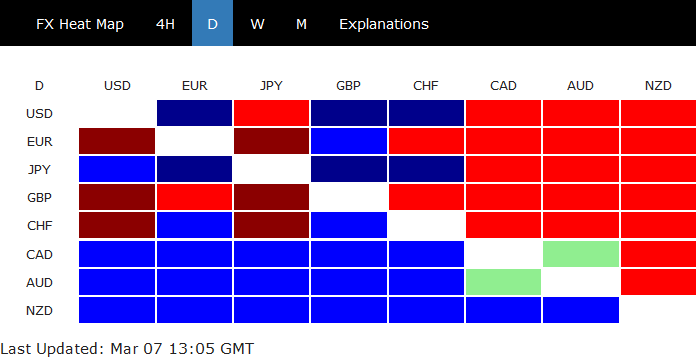
Entering into US session, European majors are the weakest ones today. Euro dips notably after ECB left interest rate unchanged and revised forward guidance. It will now keep interest rates at present level through the end of 2019, prolonged from summer of 2019. Also a new round of quarterly TLTRO-III is announced. These are actually not surprising given the deterioration in Eurozone outlook. Focus will turn to ECB President Mario Draghi's press conference and new economic projections. Sterling in the currency markets, Sterling is the weakest as there is sign of any breakthrough in Irish backstop impasse. Commodity currencies are generally higher even though outlook for BoC, RBA and RBNZ are all dovish.
In Europe, currently:
- FTSE is down -0.29%.
- DAX is down -0.19%.
- CAC is down -0.06%.
- German 10-year yield is down -0.0165 at 0.113, heading back to 0.1 handle.
Earlier in Asia:
- Nikkei dropped -0.65%.
- Hong Kong HSI dropped -0.89%.
- China Shanghai SSE rose 0.14%.
- Singapore Strait Times rose 0.21%.
- Japan 10-year JGB yield dropped -0.0062 to -0.001.
GER30 Index Finds Resistance at the Neckline of the Inverted Head and Shoulders Pattern
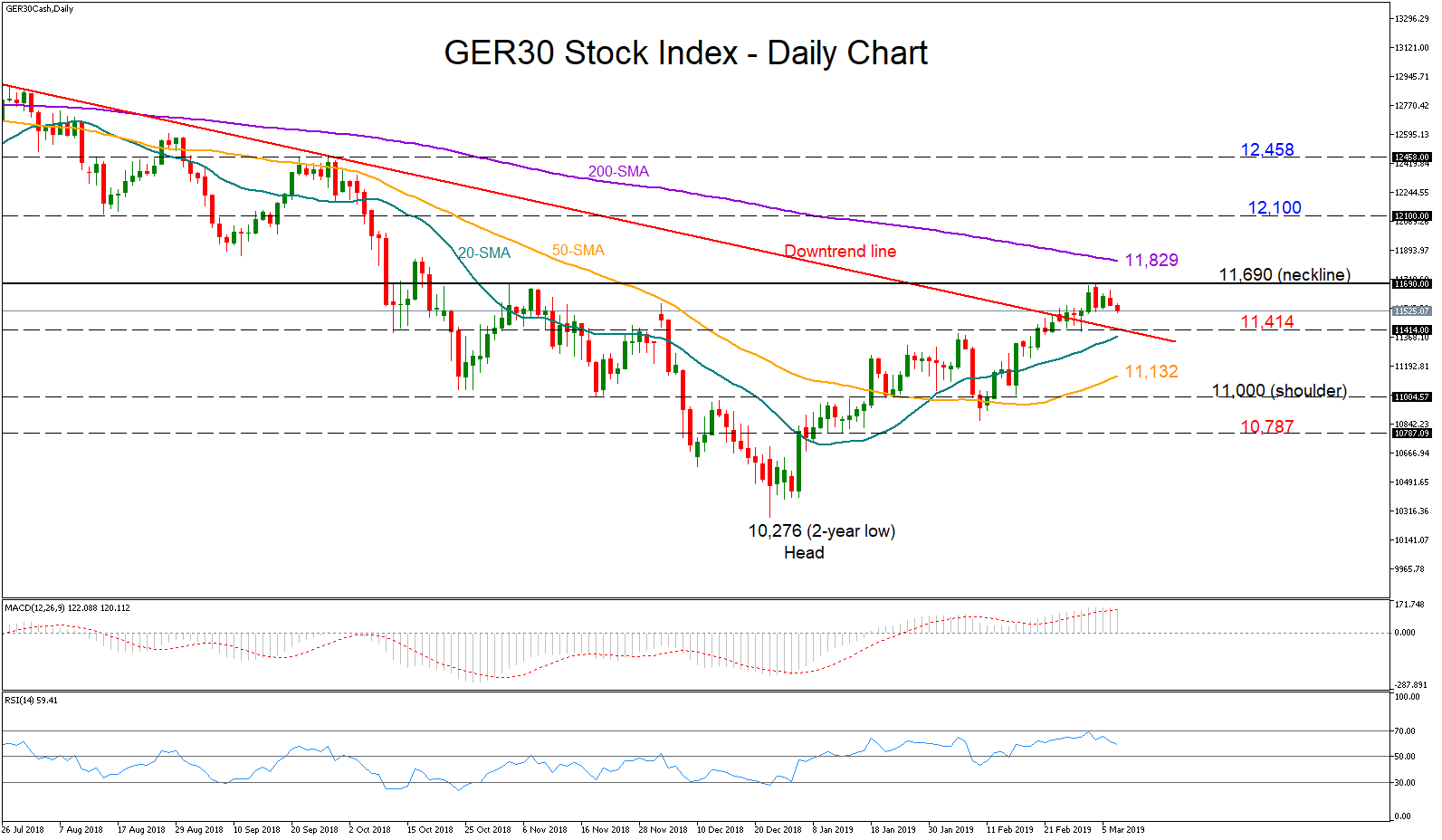
German 30 stock index (DAX 30) stretched above the June downtrend line but was unable to pierce the 11,690 neckline of the inverted head (10,276) and shoulders (11,000) pattern this week, with the price correcting lower instead.
The technical indicators suggest a neutral bias for the short term at the moment as the RSI is heading towards its 50 neutral mark and the MACD is moving around its red signal line. The risk, however, could turn to bearish if the former drops below 50 and the latter finally slips under the red line.
Should the market extend losses, a rebound could potentially emerge around 11,414, at the top of the downtrend line. Otherwise, the price could continue falling until it catches the shoulders at 11,000. Before that, however, the bears need to clear the 50-day moving average at 11,132. A close below the 10,787 support zone could open the way towards the 10,276 bottom.
On the upside, the bulls would have to violate the neckline around 11,690 and more importantly pierce the 200-day MA currently at 11,829 to take the bullish tendency to the next level. Higher, the August 15 low of 12,100 could pause bullish pressure before a stronger resistance appears around 12,458.
ECB stands pat, to keep rates unchanged at least through end of 2019, announces TLTRO-III
ECB keeps interest range unchanged at 0.00% as widely expected. The central bank now expects to keep interest rates at present levels "at least through the end of 2019", prolonged from "summer of 2019".
Also, TLTRO-III is announced, quarterly from September 2019 through March 2021. It's aiming at preserving favourable bank lending conditions, and smooth transition of monetary policy.
Euro weakens after the release, taking Sterling and Swiss lower too. Focus will now turn to ECB President Mario Draghi's press conference and new economic projections.
Here is the full statement:
Monetary Policy Decisions
At today's meeting the Governing Council of the European Central Bank (ECB) took the following monetary policy decisions:
(1) The interest rate on the main refinancing operations and the interest rates on the marginal lending facility and the deposit facility will remain unchanged at 0.00%, 0.25% and -0.40% respectively. The Governing Council now expects the key ECB interest rates to remain at their present levels at least through the end of 2019, and in any case for as long as necessary to ensure the continued sustained convergence of inflation to levels that are below, but close to, 2% over the medium term.
(2) The Governing Council intends to continue reinvesting, in full, the principal payments from maturing securities purchased under the asset purchase programme for an extended period of time past the date when it starts raising the key ECB interest rates, and in any case for as long as necessary to maintain favourable liquidity conditions and an ample degree of monetary accommodation.
(3) A new series of quarterly targeted longer-term refinancing operations (TLTRO-III) will be launched, starting in September 2019 and ending in March 2021, each with a maturity of two years. These new operations will help to preserve favourable bank lending conditions and the smooth transmission of monetary policy. Under TLTRO-III, counterparties will be entitled to borrow up to 30% of the stock of eligible loans as at 28 February 2019 at a rate indexed to the interest rate on the main refinancing operations over the life of each operation. Like the outstanding TLTRO programme, TLTRO-III will feature built-in incentives for credit conditions to remain favourable. Further details on the precise terms of TLTRO-III will be communicated in due course.
(4) The Eurosystem's lending operations will continue to be conducted as fixed rate tender procedures with full allotment for as long as necessary, and at least until the end of the reserve maintenance period starting in March 2021.
The President of the ECB will comment on the considerations underlying these decisions at a press conference starting at 14:30 CET today.
(ECB) Monetary Policy Decisions
At today's meeting the Governing Council of the European Central Bank (ECB) took the following monetary policy decisions:
(1) The interest rate on the main refinancing operations and the interest rates on the marginal lending facility and the deposit facility will remain unchanged at 0.00%, 0.25% and -0.40% respectively. The Governing Council now expects the key ECB interest rates to remain at their present levels at least through the end of 2019, and in any case for as long as necessary to ensure the continued sustained convergence of inflation to levels that are below, but close to, 2% over the medium term.
(2) The Governing Council intends to continue reinvesting, in full, the principal payments from maturing securities purchased under the asset purchase programme for an extended period of time past the date when it starts raising the key ECB interest rates, and in any case for as long as necessary to maintain favourable liquidity conditions and an ample degree of monetary accommodation.
(3) A new series of quarterly targeted longer-term refinancing operations (TLTRO-III) will be launched, starting in September 2019 and ending in March 2021, each with a maturity of two years. These new operations will help to preserve favourable bank lending conditions and the smooth transmission of monetary policy. Under TLTRO-III, counterparties will be entitled to borrow up to 30% of the stock of eligible loans as at 28 February 2019 at a rate indexed to the interest rate on the main refinancing operations over the life of each operation. Like the outstanding TLTRO programme, TLTRO-III will feature built-in incentives for credit conditions to remain favourable. Further details on the precise terms of TLTRO-III will be communicated in due course.
(4) The Eurosystem's lending operations will continue to be conducted as fixed rate tender procedures with full allotment for as long as necessary, and at least until the end of the reserve maintenance period starting in March 2021.
The President of the ECB will comment on the considerations underlying these decisions at a press conference starting at 14:30 CET today.
EUR/USD – Euro Steady As Investors Eye ECB Rate Statement
EUR/USD is steady in the Thursday session, after remaining unchanged on Wednesday. Currently, the pair is trading at 1.1312, up 0.05% on the day. On today’s calendar, the highlight is the ECB policy meeting. The bank is expected to hold rates at a flat 0.00%. As well, eurozone GDP is expected to post a gain of 0.2% for a second successive quarter. In the U.S., unemployment claims are expected to hold steady at 225 thousand. On Friday, Germany releases factory orders, and the U.S .will release nonfarm payrolls and wage growth
All eyes will be on the monthly ECB policy meeting. The bank is expected to stay on the sidelines and maintain interest rates at 0.00%, where they have been pegged since March 2016. With the ECB winding up its massive stimulus program in December, any improvement in economic data (or rise in inflation) is bound to raise speculation about a rate hike. The eurozone economy showed some strength in the first half of 2018, which led to talk of a rate hike in the second half of 2019. However, with Germany and the eurozone in the midst of a slowdown triggered by global trade tensions, it’s unlikely that the ECB will make a rate move before 2020. Current economic conditions are such that both downside and upside risks to the cross appear limited, so the euro could continue to drift.
The Federal Reserve has been in dovish mode since December, and this was reinforced by Boston Fed President Eric Rosengren, who is a considered a hawk on monetary policy. Rosengren said that there was some downside risk to the U.S. economy and called on policymakers to be “patient” for several more meetings in order to evaluate the risks to the economy. Without being explicit, Rosengren appears to support the Fed remaining on the sideline for the upcoming policy meetings until the Fed can better gauge the health of the U.S. economy.
Dollar Subdued Ahead Of ECB
Thursday March 7: Five things the markets are talking about
Global equities are mostly lower as revised lower economic forecasts add to investor worries about the outlook for global growth. The ‘big' dollar has climbed for a seventh consecutive session while U.S Treasuries ticked a tad higher.
Already this week, the OECD cut global growth estimates again and the U.S trade deficit widened to levels not seen in a decade.
Ahead of this morning's ECB monetary policy meeting, global central banks continue to stay on a “dovish” path. On Monday, RBA governor Lowe signaled it is hard to think “rates will rise,” while yesterday it was the Bank of Canada (BoC) “very bleak” policy statement which put further pressure on the loonie (C$1.3440).
Separately, an ECB sourced report ahead of the today's scheduled meeting (07:45 ET) suggests that growth rate forecasts are likely to come down enough to justify launching a new TLTRO program later this year.
Trade remains the dominate theme for markets with investors waiting for details of a possible China-U.S accord, as President Trump is itching to cut a deal with Beijing soon.
Elsewhere, sterling (£1.3173) is steady despite European officials being pessimistic about the chances of a breakthrough in Brexit talks this week. In commodities, investors are weighing up a U.S crude-stockpile surge – will it be a threat to OPEC's bid to avert a glut against a drop-in fuel inventory?
On tap: ECB policy makers are expected to leave rates unchanged amid a deteriorating outlook. Draghi will hold a news conference at 08:30 am ET.
1. Stocks have mixed feelings
In Japan, the Nikkei hit a one-week low overnight, with chip-related stocks tracking a decline in their U.S. peers and financials retreating as they slash profit outlooks. The Nikkei share average ended down -0.65%, while the broader Topix dropped -0.84%.
Down-under, Aussie shares advanced overnight as hopes for an RBA rate cut supported consumer and financial stocks, but gains were capped by a weak mining sector. The S&P/ASX 200 index rose +0.3% at the close of trade. The benchmark gained +0.8% on Wednesday. In S. Korea, the Kospi index fell for a fifth straight session, tracking Wall Street losses the OECD cut global growth forecasts again. The benchmark index fell -0.45%overnight, the index has lost -3.1% in the last five sessions.
In China, blue-chips fell overnight after four consecutive sessions of gains while Shanghai shares closed slightly higher, after the finance minister reiterated that China “would not seek to flood a slowing economy with stimulus.” At the close, the Shanghai Composite index was up +0.14%, while the blue-chip CSI300 index ended -1.02% lower. In Hong Kong, stocks fell on Thursday on investor caution over the outlook for global growth. At the close of trade, the Hang Seng index was down -0.89%, while the Hang Seng China Enterprises index fell -1.14%.
In Europe, regional bourses trade mostly lower across the board following a mixed session in Asia and lower U.S Index futures ahead of today ECB rate meeting.
U.S stocks are set to open in the ‘red' (-0.23%).
Indices: Stoxx600 -0.42% at 373.90, FTSE -0.52% at 7,158.87, DAX -0.53% at 11,526.43, CAC-40 -0.39% at 5,268.38, IBEX-35 +0.09% at 9,305.49, FTSE MIB -0.17% at 20,816.50, SMI -0.52% at 9,348.50 S&P 500 Futures -0.23%
2. Oil edges up on sanctions and OPEC supply cuts, gold unchanged
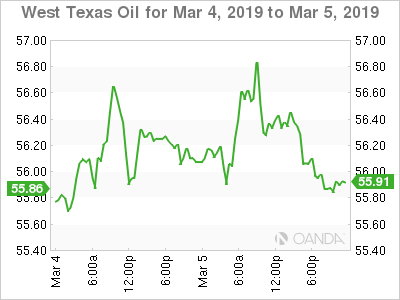
Oil prices are a tad higher ahead of the U.S open amid ongoing OPEC+ led supply cuts and U.S sanctions against exporters Venezuela and Iran. However, gains are being capped by a record U.S crude output and rising commercial fuel inventories.
Brent crude futures are at +$66.12 per barrel, up +13c, or +0.2%, from Wednesday's close. U.S West Texas Intermediate (WTI) crude oil futures are at +$56.24 per barrel, up +2c.
Prices are being supported by efforts led by OPEC+ who have agreed to withhold around +1.2M bpd of oil, a strategy aimed at tightening markets.
Also, U.S sanctions against the oil industries of Iran and Venezuela have also had an impact Venezuela's state-run oil firm PDVSA this week declared a maritime emergency, citing trouble accessing tankers and personnel to export its oil amid the sanctions.
However, despite these factors, oil remains in plentiful supply, thanks to surging U.S production, which has resulted in weaker WTI vs. Brent prices. U.S crude oil stockpiles rose much more than expected last week, according to EIA data yesterday, inventories were up by +7.1M barrels to +452.93M barrels.
Note: U.S crude oil production remains at a record +12.1M bpd, an increase of more than +2B bpd since early 2018.
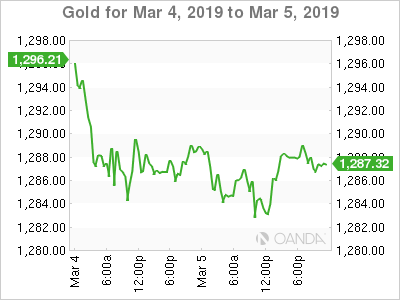
Gold prices are steady as the U.S dollar trades atop of its two-week high, while lacklustre appetite for riskier assets is offering support to the safe-haven metal ahead of this morning's ECB meeting. Spot gold is down -0.1% at $1,284.59 per ounce, while U.S gold futures have slipped -0.2% to $1,284.90 an ounce.
3. Sovereign yields fall ahead of ECB
Euro sovereign bond yields are lower on reports that the European Central Bank is likely to cut its forecasts enough to warrant kicking off a new round of ultracheap long-term loans for banks.
The yield on the 10-year German Bund has fallen to a session low of +0.129%, while the 10-year U.S Treasury yield fell off its session high and was at +2.706%.
Analysts have been speculating whether the ECB was likely to take the step to bolster the ailing European economy. So-called TLTROs have been one way the ECB has tried to kickstart growth over the years.
Elsewhere, short-dated Italian bond yields have hit their lowest level in seven months ahead of the ECB meet.
Italy's two-year bond yields hit +0.198% in early trade, before settling at +0.23%, still down -4 basis points on the day.
4. Dollar subdued ahead of ECB
FX markets are again very quiet in the overnight sessions as investors shift their focus to the ECB rate decision and President Draghi's press conference (08:30 am).
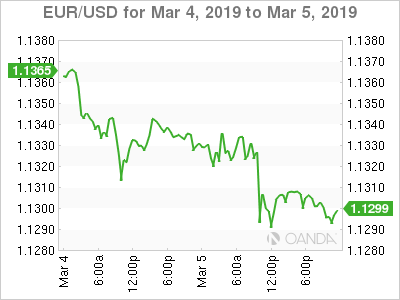
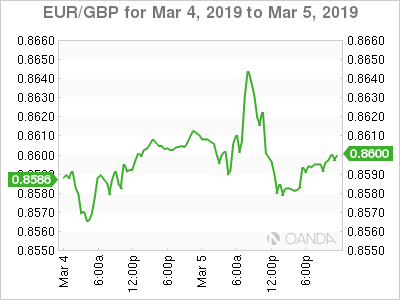
EUR/USD (€1.1313) is steady holding above the psychological €1.13 level ahead of the ECB rate decision. No change in rates are expected, but the market is looking to see if anything is said in regard to the TLTRO operation. Given the recent prolonged economic slowdown in the region many expect the ECB would be eventually forced to provide further stimulus and shift its rate guidance.
Note: Market expectations for first potential rate hike was seen in early Q4 2020, compared to the ECB forward guidance of key rates to remain at present level at least through the summer of 2019.
In the U.K, Brexit talks appear to be heading nowhere fast, but the GBP/USD (£1.3159) remains confined to a tight range. All the sterling fireworks are expected next week.
The Japanese yen is unchanged at ¥111.77 per dollar.
5. Eurozone growth held back by drawdowns
Data this morning showed that the eurozone economy picked up in Q4 of 2018, although growth was held back by businesses drawing down on inventories rather than producing new goods.
Data from the European Union's statistics agency showed GDP rose at an annualized rate of +0.9% in the three months through December, up from +0.6% in Q3 and slightly higher than the previous estimate of 0.8%.
Note: Growth was supported by a rise in exports, as well as an acceleration in government spending, and a smaller pickup in consumer spending.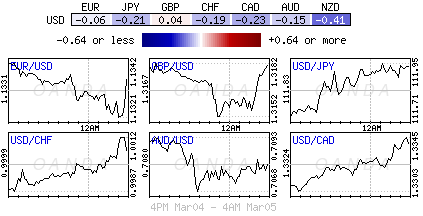
WTI Oil Outlook: Oil Price Ticks Higher But Remains In The Middle Of Three-Week Congestion
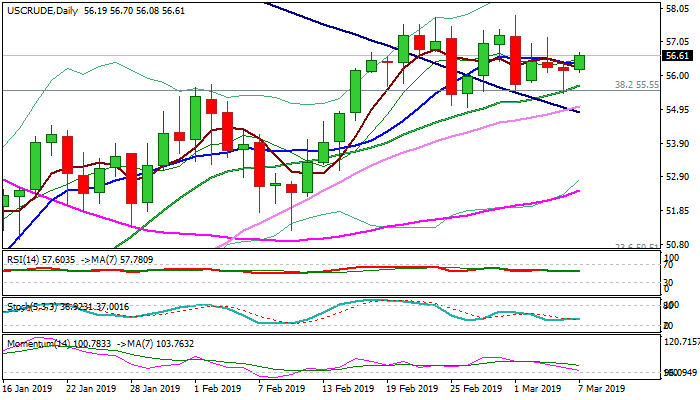
WTI oil price stands at the front foot on Thursday as sentiment improved and positive impact from OPEC production cut and sanctions on Venezuela and Iran offset negative effect from record US oil output and unexpected strong rise in crude inventories after EIA report showed surprise build of 7 mln bls vs expected increase of 1.2 mln bls and previous week's drav of 8.6 mln bls. However, current price action remains near the mid-point of larger $55.01/$57.85 range as both, technical and fundamental signals are mixed and lack clearer direction signal. Double-Dojis on Tue/Wed, one with long upper shadow and the other with long tail, confirm directionless mode. Today's brief advance cracked 10SMA barrier ($56.38), with close above needed for initial bullish signal, which would require confirmation on extension above Tuesday's high ($57.17) to expose the upper boundary of the range. Conversely, failure to clear 10SMA would weaken near-term tone, with extension below 20SMA ($55.70) to generate negative signal and unmask range floor ($55.01) reinforced by rising 30SMA. Break of either side on near-term congestion would provide fresh direction signal.
Res: 57.17, 57.40, 57.85, 58.34
Sup: 56.08, 55.70, 55.55, 55.01
ECB Can Push The Euro And Gold Lower
ALL Eyes on ECB
The Euro area 4Q GDP came as per the consensus. This has strengthened the ECB’s current (neutral monetary policy) stance to some extent.
For the euro traders, today is the big day- the European Central Bank is going to make a decision on its monetary policy. We are expecting a somewhat balanced statement from the ECB. But it is likely that their acknowledgment of the slowdown in the European economy may be perceived as a sign that the bank is in no rush to raise the rates. In our opinion, the chances of the first rate hike by the ECB are next to zero for this year. In fact, it is highly likely that we may not see any rate hike until 2020.
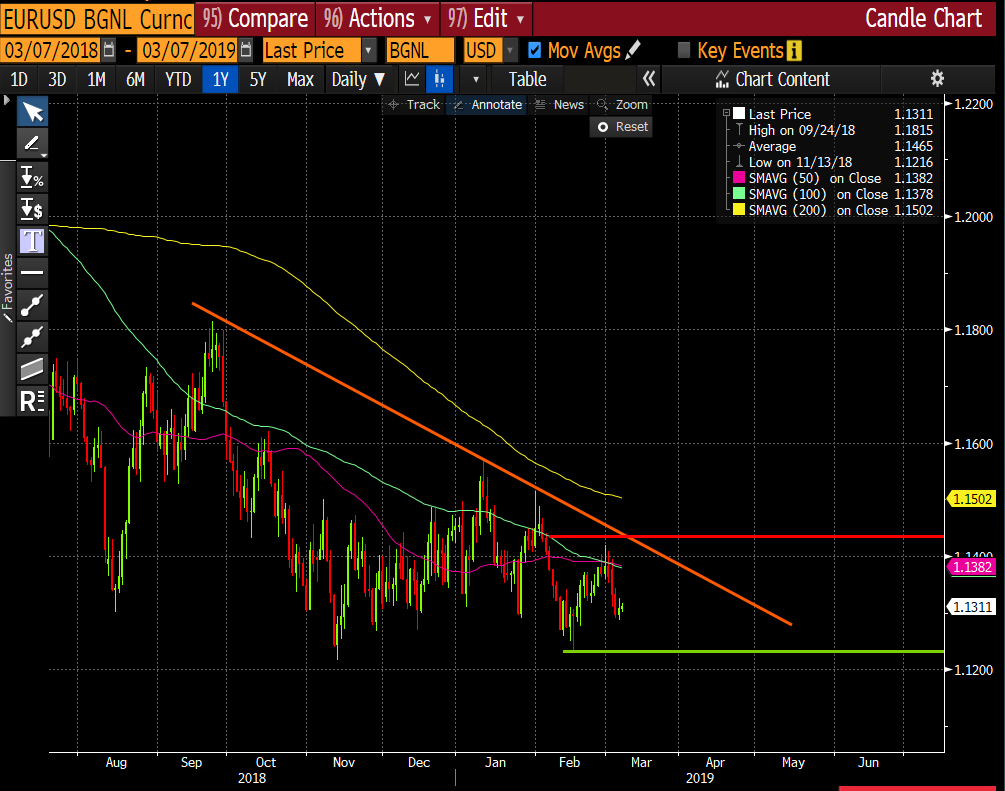
The euro is still holding its ground against the dollar, and as long as the price is above the 1.13 mark, we think the bulls have a chance to push the price higher. Looking at the price action, I think the path of the least resistance is skewed to the downside and the reason for this is that the price is trading below the downward trend line (shown in orange colour) on a daily time frame.
The bulls need the price to move above the 50-day, 100-day and 200-day moving averages. Currently, the price is trading below all of these important moving averages, this gives more strength to the bears.
Later today, between 12:45 to 13:30 London time, we are expecting higher volatility for the Euro. It is likely that may see more swings in the market when the ECB president, Mario Draghi starts to speak at 13:30 London time. The chances are that the price may move lower because of the extended discussion around the TLTROs.
Gold Bulls Are Little Hesitant |
The precious metal is under the critical level of 1300 and this has dampened the outlook for the bulls who are aching to push the price higher. The fact is that there is simply less
demand for the metal and the evidence of this can be seen by looking at the gold ETF. The exchange-traded fund for gold has reduced its holding by 71,418 troy ounces of gold.
Investors are also a little hesitant ahead of the ECB meeting because the central bank is expected to acknowledge some weakness in the European growth and this means more accommodative policy by the bank. This should push investors towards riskier assets. Such a move could take more shine off the precious metal.
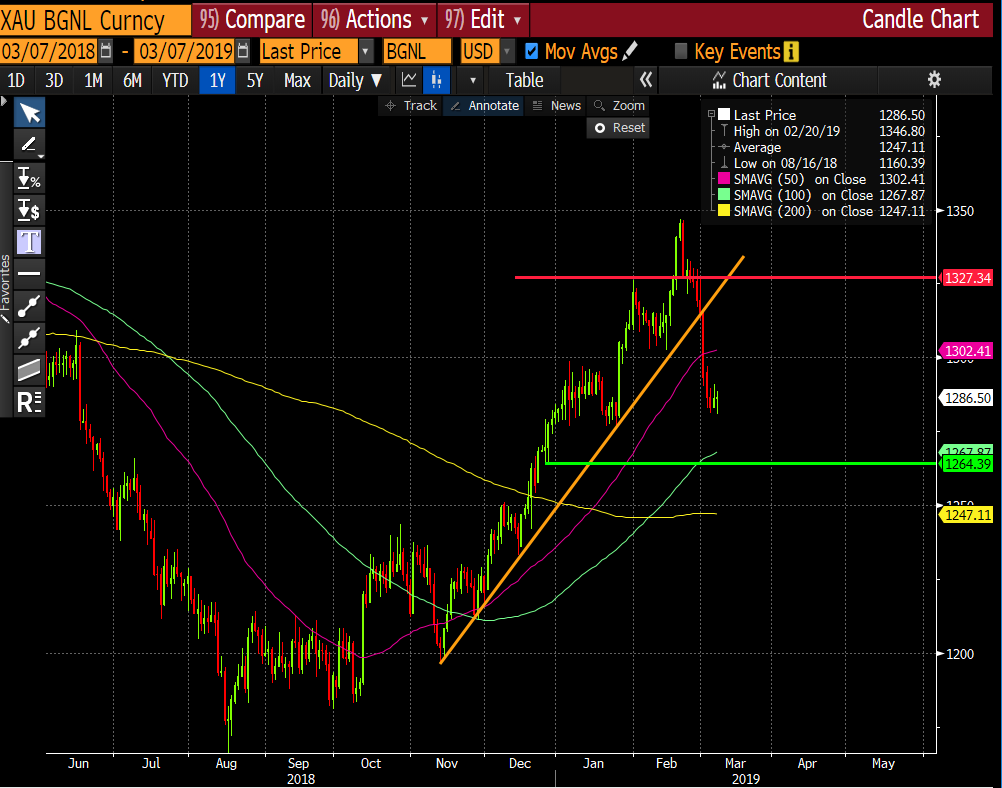
In terms of technical analysis, the price has clearly broken its upward trend line and this confirms that the bulls have lost control of the price. The price has also moved below the 50-day moving average, but the bulls have some hopes alive. This is because the price is trading above the 100-day and 200-day moving averages. The immediate support for gold is shown by the horizontal green line which sits at 1264 and the resistance is at 1327, shown by the red horizontal line.
BoE Tenreyo: Effect of Brexit uncertainty on demand increasingly evident
BoE MPC member Silvanna Tenreyo said the "effect of that Brexit uncertainty on demand has become increasingly evident in recent months". The effect is most apparent in business as "investment has been falling in the UK at a time when it has been growing in our international peers; business confidence surveys have slumped; hiring intentions have fallen back.".
There were also signs of impact on households as "housing market is weakening; consumer confidence has deteriorated. This all happened at a time when household real incomes are rising and all else equal, one might normally have expected spending to be rising too."
On monetary policy in case of disorderly Brexit in a speech. She echoed the view that seems to be the consensus in the MPC now. That is, "a situation where the negative demand effects outweigh those other effects is more likely, which would necessitate a loosening in policy."
But she also noted reiterated that "the monetary policy response to such a scenario will depend on the balance of these effects on supply, demand and the exchange rate". And, it is "to envisage other plausible scenarios requiring the opposite response."