Sample Category Title
US 500 Index Challenges Significant Obstacle Near 2812; Holds above 200-day SMA
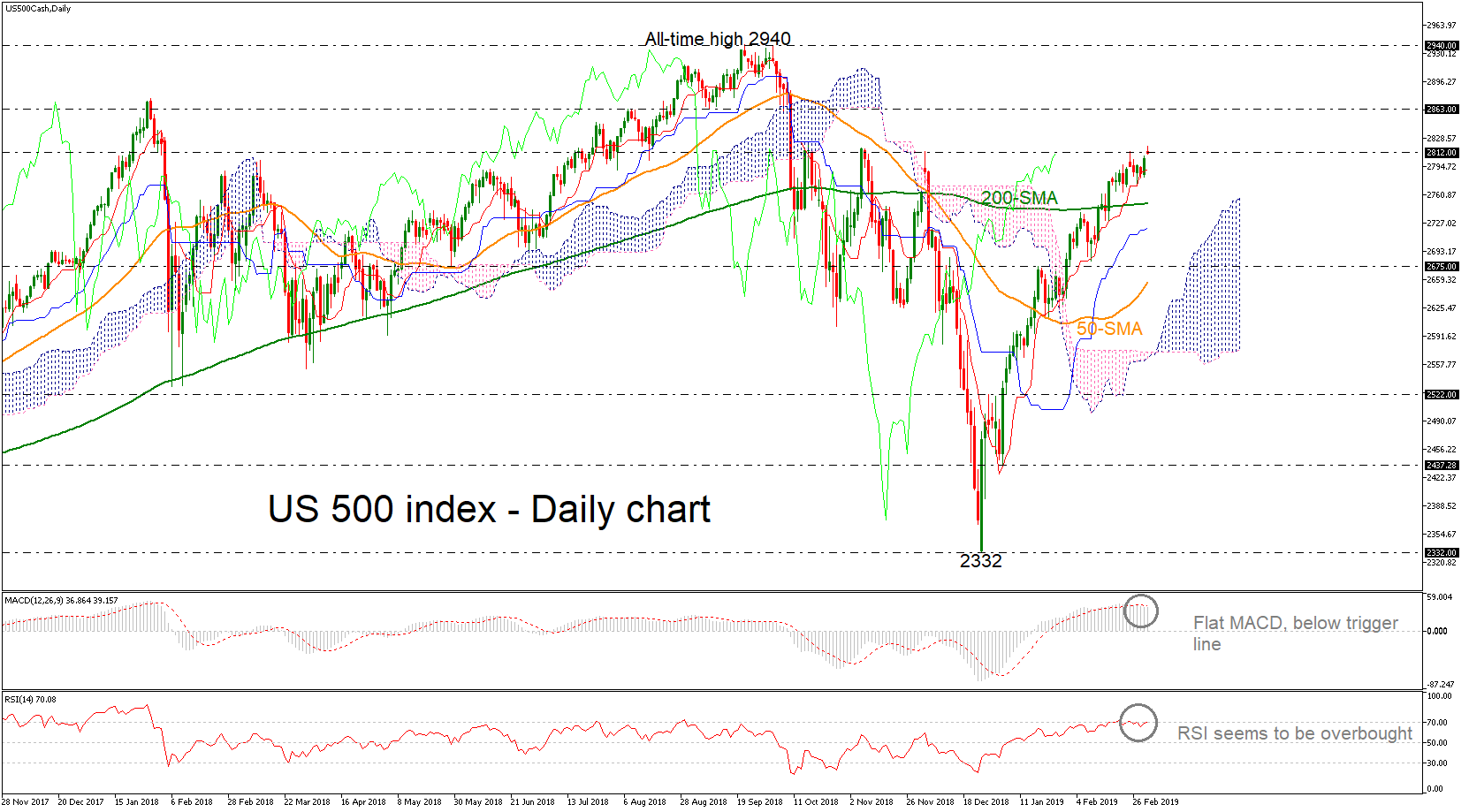
The US 500 stock index jumped above the 2812 strong barrier, which had been holding since December 3, pointing for more bullish pressures in the near term. Prices hit an almost five-month high of 2819 earlier today, however, the technical indicators seem to be overbought. The MACD is trying to recover somewhat below trigger line, while the RSI is flattening near 70 level.
In case of further gains the next resistance would likely be faced around the 2863 barrier, taken from the inside swing bottom on September 7. A jump above this region would increase positive sentiment until the all-time high of 2940, returning the medium-term outlook back to bullish.
On the other side, if the price loses momentum and retreats below the red Tenkan-sen line, it could find support at the 200-simple moving average (SMA), which is flattening currently at 2750 in the daily timeframe. Dropping below this area could take prices towards the 2675 support before hitting the 50-SMA around 2657.
In the medium-term, the index is trying to switch the neutral mode to a more bullish one after the significant rebound on the 2332 area.
USD/TRY Outlook: Bulls Face Strong Headwinds at 200SMA Barrier and Eye CBRT Policy Meeting for Fresh Signals
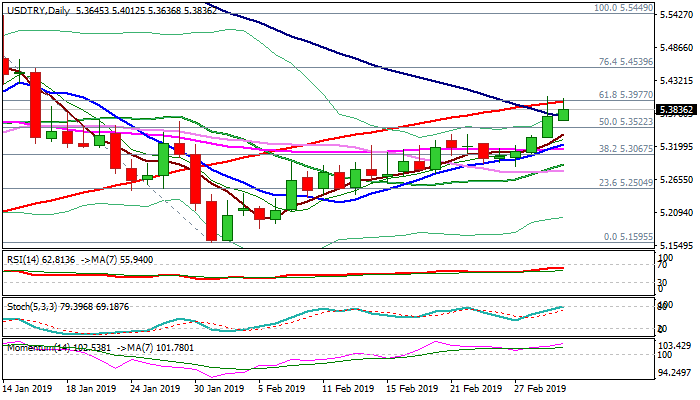
The pair retests key barriers at 5.3964/77 (200SMA/Fibo 61.8% of 5.5449/5.1595) on Monday, in attempts to extend Feb's 3.3% advance.
Daily studies are in bullish setup and supportive, however bulls face strong headwinds and may not clear barrier in first attempts.
The notion is supported by President Trump's verbal action in attempts to lower the US currency and significant event – 6 Mar CBRT policy meeting.
Turkish central bank is likely expected to hold ultra-high interest rates (24%) until inflation drops from current level near 20%, which could also have negative impact on pair's near-term action.
Further hesitation at 200SMA pivot would result in fresh weakness, which could be seen as positioning while the price remains above significant supports at 5.31/30 support zone.
Sustained break above 200SMA would provide more evidence of formation of double-bottom (5.1323/5.1595) and boost recovery action off 5.1595 (2019 low) towards targets at 5.4493/5.5045 (base and top of thickening daily cloud) and 5.5413/49 (14/9 Jan highs), with possible extension towards Fibo barrier at 5.5984 (Fibo 23.6% of 7.1074/5.1323 descend). Conversely, sustained break below 5.30 supports would weaken near-term structure and signal top.
Res: 5.3977; 5.4493; 5.5045; 5.5449
Sup: 5.3636; 5.3412; 5.3247; 5.3158
Into US session: NZD, AUD strongest on risk appetite, Euro lost ground
The financial markets are generally in risk seeking mode today on optimism that there will be a trade deal between US and China soon. WSJ reported that a signing summit could be held on March 27. Also, Bloomberg reported that China is planning to cut VAT that covers manufacturing sector by 3%, as a measure to support the slowing economy.
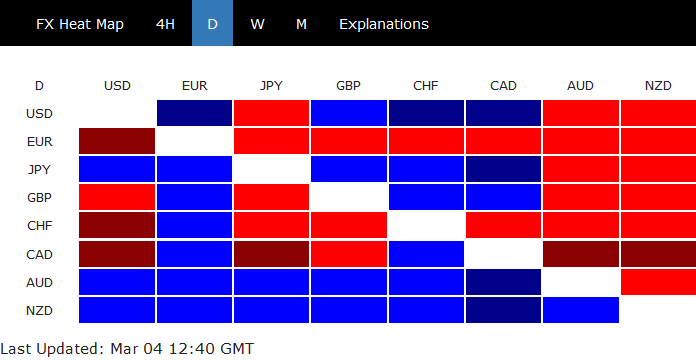
New Zealand and Australian Dollar trading mildly higher. But gain in so far rather limited as traders guard against any dovish twist in RBA statement tomorrow. Nomura follows Westpac and forecasts RBA to cut interest rate by 50bps this year. Meanwhile, Euro is the weakest one as selling comes in during early European session. But there is no follow through selling yet. Slightly better than expected Sentix investor confidence provides no support to the common currency. Swiss Franc is the second weakest one for now, followed by Canadian.
In Europe, currently:
- FTSE is up 0.71%.
- DAX is up 0.22%.
- CAC is up 0.64%.
- German 10-year yield is down -0.0163 at 0.17.
Earlier in Asia:
- Nikkei rose 1.02%.
- Hong Kong HSI rose 0.51%.
- China Shanghai SSE rose 1.12%.
- Singapore Strait Times rose 0.95%.
- Japan 10-year JGB yield rose 0.0103 to 0.002, turned positive.
UK Services Sector Likely Contracted In February, But Pound Buoyed By Brexit Hopes
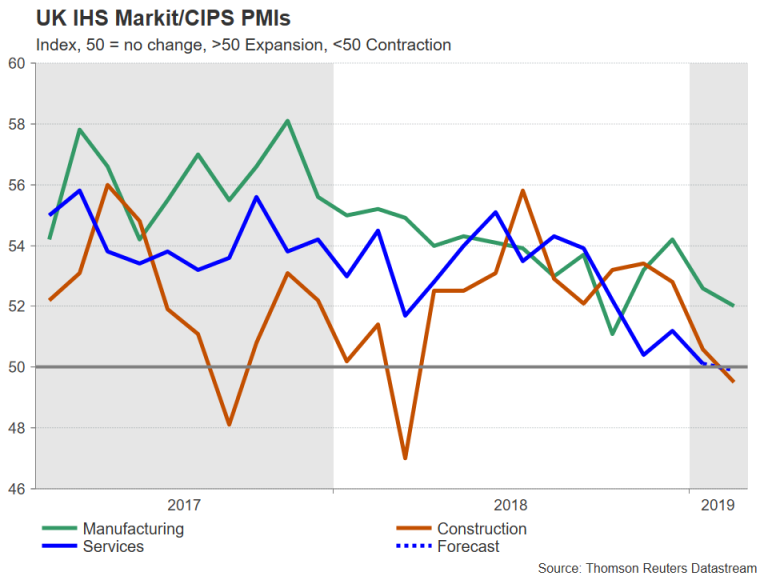
The UK services PMI for February will be watched on Tuesday at 09:30 GMT amid increasing evidence that the Brexit uncertainty is putting the brakes on growth. However, with recent developments at Westminster significantly reducing the odds of a no-deal Brexit scenario, the pound is revelling near 7½-month highs and could take any negative reading in its stride.
Activity in the services sector, which comprises about 80% of Britain’s economic output, moderated in January to the slowest level since immediately after the Brexit referendum in June 2016, according to IHS Markit/CIPS. The PMI gauge is forecast to dip further in February, falling to 49.9. If the expected figure is met or missed, it would take the index below the critical 50 level that separates expansion from contraction.
It would also point to stagnant growth in the first quarter, with the UK’s other sectors not faring any better. Data on Friday showed manufacturing activity eased to 52.0 in February to a 4-month low, while the construction PMI unexpectedly fell to 49.5 on Monday to the lowest since March 2018. As Parliament continues to wrangle over Brexit and the global economy also undergoes a steep a slowdown, there’s not much to be optimistic about the near-term outlook for the UK economy.
But even though there’s no clear end in sight to the Brexit saga, with a possible extension of Article 50 looking increasingly likely, markets are at least able to take some comfort from the receding fears of a disorderly Brexit. The odds of Britain crashing out of the EU have fallen dramatically after the prime minister, Theresa May, offered MPs a vote on extending Article 50 if they oppose a no-deal outcome in the event that her tweaked Brexit deal gets voted down again when the next meaningful vote is held by March 12.
The turn of events has catapulted sterling to above the 1.33 level against the US dollar, while the euro has plummeted to 21-month lows, hitting 0.8527 pounds. Cable has since eased to around 1.3220 and could retreat further if the services PMI falls below the consensus estimate. Downside pressure could see pound/dollar initially seeking support at the 78.6% Fibonacci of the downleg from 1.3216 to 1.2770, at 1.3121, before testing the 61.8% Fibonacci at 1.3046. A bigger test for the pair, though, would be the 50% Fibonacci at 1.2993, which is also where the 200-day moving average has flatlined.
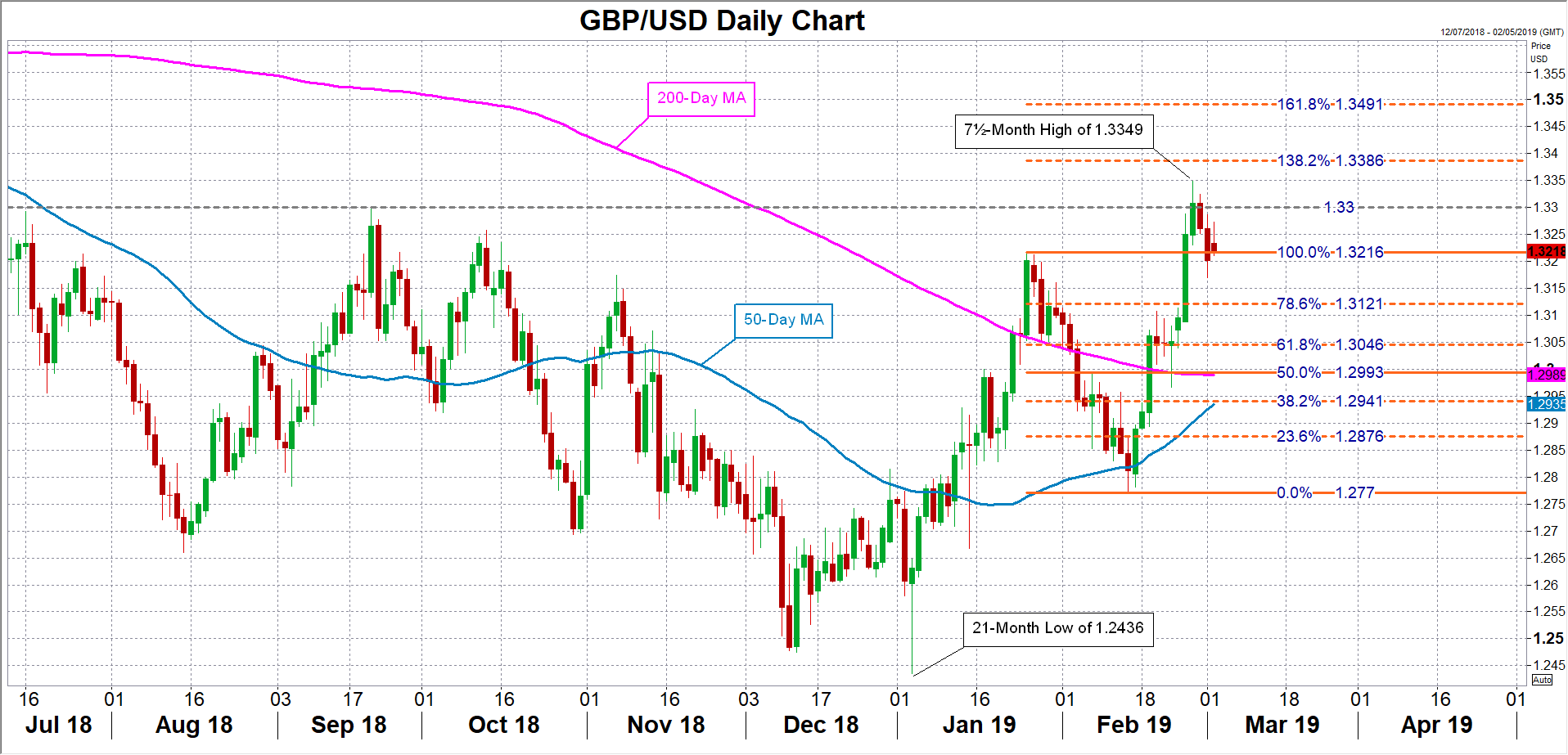
A better-than-expected reading could help cable nudge upwards, but a bigger boost is more likely to come from headlines suggesting that the EU has provided the UK legal assurances that the Irish backstop is a temporary arrangement as this would help May win her party’s backing for her deal. Should pound/dollar resume its uptrend, immediate resistance could come at the 1.33 handle before aiming to match last week’s top of 1.3349. Clearing these hurdles would bring the 138.2% Fibonacci extension into range at 1.3386. Even higher, the 161.8% Fibonacci at 1.3491 would be the next significant level to watch.
Continuing Optimism On US-China Trade Front
Notes/Observations
- Trade optimism between US-China continue to percolate; potential meeting of a Xi-Trump meeting later this month.
- Growing optimism that UK parliament was moving towards supporting PM may Brexit plan
- UK Feb PMI Construction falls into contraction for the 1st time in almost a year
- Some key events this week include: China National People's Congress (Tuesday); ECB meeting (Thursday); US Feb payroll report (Friday)
Asia:
- China said to have offered US to lower tariffs on US farm goods, autos and other goods; US was considering removing most if not all of the sanctions imposed against Chinese products since last year; close to a final agreement on trade
- US Department of Defense (DOD) said to be preparing to announce that annual large joint military exercises with South Korea would no longer be held
- Japan PM Abe: Trust BOJ Govt Kuroda ability to run monetary policy, leave concrete steps up to him to adopt
- South Korea Feb Manufacturing PMI: 47.2 v 48.3 prior (lowest since June 2015); New export orders contract for the 7th consecutive month
Europe:
- EU Brexit Negotiator Barnier said to have stated that EU was ready to give Britain further guarantees that Irish backstop was only temporary
- PM May said to have told European Council President Tusk that Brexit might have to be delayed even if Parliament supported her Brexit deal
- UK Attorney General (AG) Cox said to have ended attempts to secure a hard time-limit or unilateral exit mechanism for the Ireland backstop. Ministers said to believe that measure was considered too blunt and have been rejected by the EU. Cox said to be working on an enhanced arbitration mechanism
- Labour party Finance spokesperson John McDonnell (Shadow Chancellor): Labour Party did not want a second Brexit referendum, had been forced into supporting one by PM May who was running down the clock on negotiations
- Moody's raised Greece sovereign rating two notches to B1 from B3; outlook stable
Americas:
- US President Trump stated that Fed's tight monetary policy was contributing to a strong dollar, hurting the US' competitiveness. wanted a strong dollar, but one that's great for our country, not a dollar that was so strong that it was prohibitive for us to be dealing with other nations
- President Trump tweeted that he asked China to immediately remove all tariffs on US agricultural products " based on the fact that we were moving along nicely with Trade discussion" and that the US didn't raise tariffs to 25%
- S&P revised Mexico outlook to negative; affirms BBB+ sovereign rating
Macro
- (CN) China: The continued risk-on theme was fueled by press reports suggesting that the US may lift most if not all of its tariffs on Chinese imports, and that a summit between Trump and Xi later this month could by the stage where a final trade deal is signed. With the National People's Congress on the horizon there is some expectation that they will introduce a foreign investment law that may go some way to placating US demands on structural issues including strengthening intellectual property protections.
- (EU) Eurozone: The ECB Board meets on policy this week, where updated staff projections should bring downward revisions to growth and inflation projections, but recent remarks from member Lane, the bank's next chief economist, suggest that these may not be very large. The key focus will therefore be on whether the ECB thinks the current slowdown will be temporary, or is the start of a more protracted slowdown and if so there clearly would be arguments in favor of another round of TLTRO loans to offset the negative impact on banks.
SPEAKERS/FIXED INCOME/FX/COMMODITIES/ERRATUM
Equities
- Indices [Stoxx600 +0.34% at 375.52, FTSE +0.33% at 7,133.28, DAX +0.03% at 7,133.28, CAC-40 +0.53% at 5,293.30, IBEX-35 +0.15% at 9,281.29, FTSE MIB +0.01% at 20,697.50, SMI +0.14% at 9,420.50, S&P 500 Futures +0.21%]
- Market Focal Points/Key Themes: European Indices trade mostly higher across the board tracking mostly higher Asian Indices and firmer US Index futures. On the macro front China-US trade talks optimisism helps boosts inidices. On the Brexit front negotiations are still taking place between the EU and the UK ahead of next weeks meaningful vote, with Irish backstop developments at the forefront. On the corporate front shares of Electromagnetic Geo-services trades almost 40% higher after being awarded contracts which improves the companies liquidity position; Shield Therapeutics trades sharply higher on positive Feraccru study results. On the earnings front Abcam falls sharply after cutting its EBITDA margin outlook; Synthomer and Rotork are other notable decliners on earnings. While Keller Group and Kardex are some of the names trading higher on earnings. Elsewhere International Consolidated Airlines trades lower after reports its lowered its FCF guidance over the weekend. Looking ahead notable earners include Inter Parfum, Spark Energy and Magic Software.
Equities
- Consumer discretionary: Ahold Delhaize [AD.NL] -3% (in response to Amazon's plans to open grocery stores), Ted Baker [TED.UK] +1.5% (CEO resigns), Inter Parfums [ITP.FR] +6% (earnings; raises outlook), Wizz Air [WIZZ.UK] +0.5% (load factor), Ryanair [RYA.UK] -0.5% (load factor), bet-at-home.com [ACX.DE] +5% (earnings)
- Consumer staples: British American Tobacco [BATS.UK] -0.5% (response to Quebec court)
- Energy: Alpiq Holding [ALPH.CH] -1.5% (earnings)
- Financials: Nordea Bank [NDA.SE] -5% (potential money laundering allegations to be aired later on Monday), Aviva [AV.UK] +1.5% (appoints CEO)
- Healthcare: Fresenius Medical Care [FMS.DE] -2% (US looking to decrease in-clinic dialysis), Novartis [NOVN.CH] -2% (releases data)
- Industrials: Synthomer [SYNT.UK] -6% (earnings)
Speakers
- Turkey Fin Min Albayrak reiterated Govt stance that inflation would continue to retreat
- Thailand Central Bank Dep Gov Vachira Arromdee reiterated that movement in THB currency (Baht) was in-line with regional peers. THB currency strength impact on exports seen limited as performance depended mainly on global trade
- South Korea to name new ambassadors for Russia, China and Japan
- Iran Supreme leader Khamenei said to have advised his govt last year not to rely on EU package to protect the country against US sanctions
Currencies/Fixed Income
- Risk on speculation was aided on hopes that US-China trade deal was inching closer. Global equities market were higher but markets experienced a limited impact in the FX arena as the typical safe-haven currencies barely moved.
- GBP/USD was firmer by 0.3% to test above 1.3250 area on optimism that UK parliament was moving towards supporting PM may Brexit plan
- EUR/USD was lower by 0.3% on the back of overall USD strength. ECB policy meeting on Thursday was in focus. Dealers doubted that the General Council would announce any fresh measures on liquidity at this time.
- Greek government 10-year bonds yields were lower by approx. 5bps after Moody's upgraded the country's credit rating by two notches to B1 from B3
Economic Data
- (TR) Turkey Feb CPI M/M: 0.2% v 0.4%e; Y/Y: 19.7% v 19.9%e; CPI Core Index Y/Y: 18.1% v 18.8%e
- (TR)) Turkey Feb PPI M/M: 0.1% v 0.5% prior; Y/Y: 29.6% v 32.9% prior
- (ES) Spain Feb Net Unemployment M/M: +3.3K v +83.5K prior
- (HU) Hungary Dec Final Trade Balance: €0.4B v €0.4B prelim
- (CH) Swiss Total Sight Deposits w/e Mar 1st (CHF): 576.4B v 576.5B prior; Domestic Sight Deposits: 491.4B v 493.6B prior
- (IS) Iceland Q4 Current Account Balance (ISK): 0B (flat) v 75B prior
- (EU) Euro Zone Mar Sentix Investor Confidence: -2.2 v -3.1e
- (UK) Feb Construction PMI: 49.5 v 50.5e - (EU) Euro Zone Jan PPI M/M: 0.4% v 0.3%e; Y/Y: 3.0% v 2.9%e
Fixed Income Issuance
- (NO) Norway sold NOK2.0B vs. NOK2.0B indicated in 6-month Bills; Avg Yield: 1.05% v 0.99% prior; Bid-to-cover: 3.08x v 2.22x prior
Looking Ahead
- (RU) Russia Feb Sovereign Wealth Funds: Wellbeing Fund: No est v $59.1B prior
- 05:30 (NL) Netherlands Debt Agency (DSTA) to sell €1.0-2.0B in 6-month Bills
- 05:30 (ZA) South Africa announces details of upcoming I/L bond sale (held on Fridays)
- 06:00 (IL) Israel to sell bonds
- 06:25 (BR) Brazil Central Bank Weekly Economists Survey
- 06:45 (US) Daily Libor Fixing
- 07:00 (CL) Chile Jan Retail Sales Y/Y: 2.0%e v 2.4% prior; Commercial Activity Y/Y: No est v 2.8% prior
- 08:00 (SG) Singapore Feb Purchasing Managers Index: 50.4e v 50.7 prior; Electronics Sector Index: No est v 49.6 prior
- 08:00 (UK) Baltic Dry Bulk Index
- 08:00 (ES) Spain Debt Agency (Tesoro) announces size of upcoming issuance
- 09:00 (FR) France Debt Agency (AFT) to sell combined €3.7-4.9B in 3-month. 6-month and 12-month Bills
- 09:00 (MX) Mexico Jan Leading Indicators M/M: No est v -0.08 prior
- 09:00 (MX) Mexico Feb Vehicle Domestic Sales: No est v 111.2K prior
- 09:45 (US) Feb ISM New York
- 10:00 (US) Dec Construction Spending M/M: 0.2%e v 0.8% prior
- 10:00 (CO) Colombia Jan Exports: $3.4Be v $3.4B prior
- 11:00 (DK) Denmark Feb Foreign Reserves (DKK): No est v 455.5B prior
- 11:30 (US) Treasury to sell 3-Month and 6-Month Bills
- **Note: Update sent out on system at 05:20 ET but not as an email alert to clients
UK PMI construction dropped to 49.5, Brexit anxiety intensified
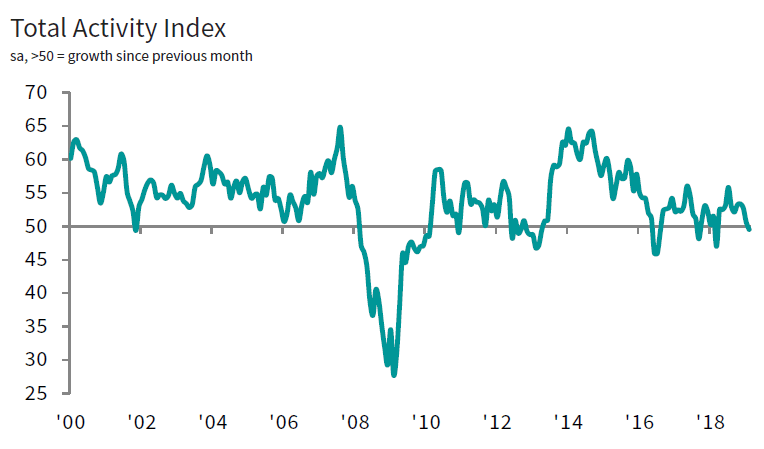
UK PMI construction dropped to 49.5 in February, down from 50.6, missed expectation of 50.5. That's also the first contraction in eleven months. Markit noted there was slight fall in construction output, led by commercial and civil engineering work. And, housing was the only category to register growth. And there was sharp deterioration in supplier performance.
Tim Moore, Economics Associate Director at IHS Markit, which compiles the survey:
"The UK construction sector moved into decline during February as Brexit anxiety intensified and clients opted to delay decision-making on building projects. Risk aversion in the commercial sub-category has exerted a downward influence on workloads throughout the year so far. This reflects softer business spending on fixed assets such as industrial units, offices and retail space. The fall in commercial work therefore hints at a further slide in domestic business investment during the first quarter, continuing the declines seen in 2018.
"There were also reports that the more fragile housing market confidence has begun to act as a brake on residential work, which adds to signs that house building has lost momentum since the end of last year. This leaves the construction sector increasingly reliant on large-scale infrastructure projects for growth over the year ahead.
"Construction companies pared back their purchasing activity in response to subdued demand in February, but delivery delays for inputs were among the highest seen over the past four years. Survey respondents noted that stockpiling efforts by the UK manufacturing sector had an adverse impact on transport availability and supplier capacity across the construction supply chain.
"On a more positive note, input price inflation held close to January's two-and-a-half year low. The slowdown in cost pressures from the peaks seen in the first half of 2018 provides a signal that the worst phase has passed for supplier price hikes related to sterling depreciation."
Stocks Get The Green Light From Trade Talks
Monday March 4: Five things the markets are talking about
Global stocks have started the week on the front foot on signs of progress in U.S-China trade negotiations. News of trade progress is also boosting oil prices, which snapped a two-week winning streak when they fell last week.
This is a busy week for central bank’s monetary policy announcements. Investors will be looking to see if growth forecasts are cut by the ECB, whether the RBA’s is fearful of its housing weakness growth and if the Bank of Canada become slightly more ‘dovish’ and worried about slowing growth.
Dovish signals from the European Central Bank (ECB) and the Fed in recent weeks is also helping equities bounce off its December slump. Downgrades to the ECB’s staff forecasts should provide the backdrop for an announcement of extra bank funding.
In currencies, sterling has found support as some members of the European Research Group are conditionally prepared to back PM Theresa May’s Brexit deal. An immediate Brexit crash out is appearing less and less likely and the March 29 deadline looks to be pushed back.
Stateside, Friday’s payrolls report is the highlight for U.S economic data releases this week, and investors will also get a look at the latest Beige Book on Wednesday.
A number of Fed officials take the stage this week – Mar 5 – Kashkari and Barkin, Mar 6 – Williams and Mester, Mar 7 – Brainard – and on Friday evening Fed Chair Powell discusses monetary policy normalization and review.
On tap: Reserve Bank of Australia (RBA) monetary policy announcement (Mar 4/5), AUD GDP (Mar 5), CAD Trade balance, Bank of Canada (BoC) rate announcement & AUD retail sales (Mar 6), European Central Bank (ECB) rate announcement (Mar 7), U.S non-farm payrolls (NFP) & CAD employment release (Mar 8).
1. Stocks get the green light
Equities have certainly had a big bounce this year. The Dow Jones Industrial Average has gained +11.1% during the first two-months of 2019, its best two months since August 2009, while the S&P 500 has also rallied +11%, its best two-months since October 2010.
In Japan, the Nikkei rallied to a fresh three-month high overnight, as companies with exposure to China found support on signs Beijing and Washington are closing in on a trade deal to end their bitter year-long tariff dispute. The Nikkei share average gained +1.02%, while the broader Topix gained +0.7%.
Down-under, Aussie shares climbed to a six-month closing high overnight as investors hailed a possible end to the Sino-U.S trade conflict. The S&P/ASX 200 index rallied +0.4%, extending gains for a fourth consecutive session. The benchmark also advanced +0.4% on Friday. In S. Korea, the Kospi stock index fell -0.2% overnight after the summit between North Korea and the U.S collapsed last week, and investors moved to the Chinese market.
In Asia, Chinese shares were the biggest gainers, with the blue-chip index up as much as +3%, while in Hong Kong, the Hang Seng index added +0.7%.
Note: China’s CSI300 index rallied last week after index provider MSCI quadrupled its weighting for mainland shares in its global benchmarks.
In Europe, regional bourses trade higher across the board following a ‘green’ light session in Asia and higher U.S futures.
U.S stocks are set to open in the ‘black’ (+0.2%).
Indices: Stoxx600 +0.45% at 371.42, FTSE +0.51% at 7,123.39, DAX +0.09% at 11,610.89, CAC-40 +0.51% at 5,290.46, IBEX-35 +0.42% at 9,170.09, FTSE MIB +0.04% at 20,450.50, SMI +0.44% at 9,395.50, S&P 500 Futures +0.20%
2. Oil prices rise on trade deal hopes, OPEC supply cuts, gold higher
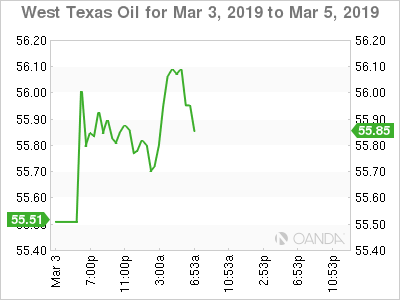
Oil prices start the week higher, supported by output cuts by OPEC+ and on reports that the U.S and China are close to a trade deal to end a bitter tariff row that has slowed global economic growth.
Brent crude futures are at +$65.25 a barrel, up +18c, or +0.3%, from Friday’s close. U.S West Texas Intermediate (WTI) crude futures are at +$55.94 per barrel, up +14c, or +0.3%.
A recent survey by Reuters shows supply from OPEC+ fell to a four-year low in February, as top exporter Saudi Arabia and its allies over-delivered on the group’s supply pact while Venezuelan output registered a further involuntary decline – data shows that exports are off by -1.5M bpd since last November.
Stateside, there are signs that the oil production boom, which has seen crude output rise by more than +2M bpd since early 2018 to more than +12M bpd, may slow down. U.S energy firms last week cut the number of oil rigs looking for new reserves to the lowest in almost nine months. Some producers are looking to cut back on spending.
Ahead of the U.S open, gold has edged a tad higher, after falling below the critical +$1,300 level on Friday, as the ‘big’ dollar dipped on the prospect of a trade deal between China and the U.S. Spot gold is up about +0.3% at +$1,296.52 per ounce, after printing its lowest price in four-weeks at +$1,289.91 on Friday. U.S gold futures are down -0.2% at +$1,297.10 an ounce.
Note: The ‘yellow’ metal fell -2.6% last week on a firmer dollar.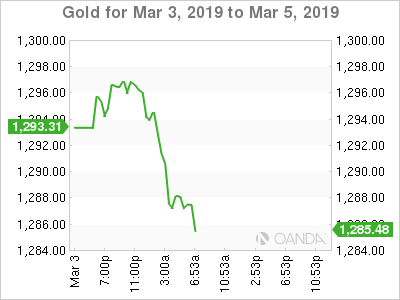
3. Greek bond yields hit 12-year low on Moody’s ratings boost
Greece’s benchmark 10-year government bond yields dropped to their lowest in 12-years this morning after Moody’s raised its rating last Friday, encouraging investor optimism towards the eurozone’s most “indebted” country. Moody’s lifted Greece’s issuer ratings to B1 from B3, citing the effectiveness of the country’s reform programme. Greece’s 10-year yield dropped to +3.622%.
Broader eurozone yields are generally flat to slightly lower, though still trade atop of their recent two-week highs on signs of a possible U.S-China trade deal. Germany’s 10-year Bund yield is a tad lower at +0.18%, down from a four-week high of +0.208% last Friday.
Elsewhere, the yield on 10-year Treasuries has backed up less than +1 bps to +2.75%, while in the U.K, the 10-year Gilt yield has rallied +1 bps to +1.306%.
Note: The U.S Treasury will auction bills this week: 3- and 6-month bills today and 4- and 8-week bills on March 7.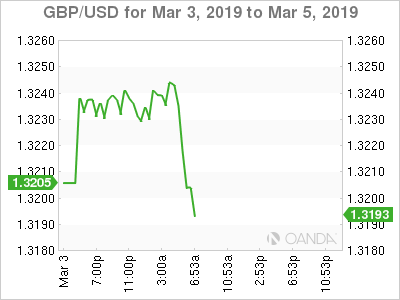
4. Rising odds of May’s deal succeeding is supporting the pound
The fact that some members of the European Research Group are conditionally prepared to back U.K PM Theresa May’s Brexit deal is helping the pound, which is last up +0.3% at £1.3241. However, the probability of her deal being voted through remains below +50%. Many expect Article 50 will need to be extended for further negotiations.
Note: Tomorrow’s U.K services PMI (4:30 am ET), is more important for the pound short-term direction given that the U.K economy relies on the dominant services sector.
EUR/USD is under pressure, down -0.5% to €1.1337, pulling further away from last week’s peak of €1.1422, though the pair is still trading within the range it’s been in for the past several months. Weak eurozone data of late and the Fed taking a break from hiking interest rates has many investors unsure on the future direction and content in sitting on the sidelines.
Elsewhere, the Japanese yen has declined less than -0.05% to ¥111.93, the weakest in almost 11-weeks, while the offshore yuan has gained +0.3% to ¥6.6972, the largest gain in a week.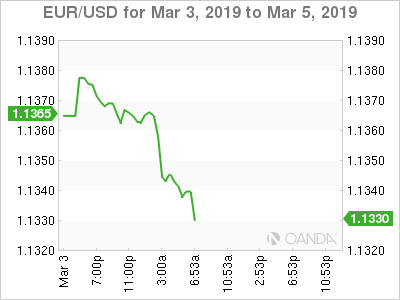
5. Eurozone producer prices rise slightly faster than expected
Data this morning showed that eurozone producer prices rose slightly faster than expected last month, pushed up by a jump in energy and capital goods.
Eurostat said prices at factory gates in the 19 countries sharing the ‘single unit’ rose +0.4% m/m for a +3% y/y increase. Market consensus had expected a +0.3% monthly rise and a +2.9% annual gain.
Digging deeper, Eurostat said energy prices rebounded in January, rising +0.4% after a -2.7% fall in December. Capital goods prices rose +0.6% after no change in December.
EUR/USD – Euro Dips In Data-Light Monday
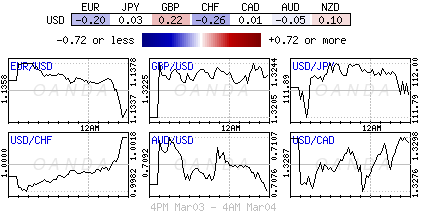
EUR/USD has edged lower in the Monday session. Currently, the pair is trading at 1.1338, down 0.24% on the day. There are no major events out of the eurozone or the U.S., so traders can expect limited movement from the pair on Monday. On Tuesday, Germany and the eurozone will publish services PMIs, and the U.S. releases ISM Non-Manufacturing PMI.
Germany is a bellwether for the rest of the eurozone, and Friday’s data pointed to a strong labor market but trouble in the manufacturing sector. On the employment front, German unemployment rolls fell by 21 thousand, crushing the estimate of -5 thousand. The eurozone unemployment rate dropped to 7.8% in January, down from 7.9% a month earlier. The manufacturing industry continues to struggle, as the global trade war has reduced the demand for European exports. German and eurozone manufacturing PMIs in February came in below the 50-mark, which separates contraction from expansion. German consumers opened up the purse strings in January , as retail sales bounced back with a 3.3% gain, after a 4.3% decline in December.
In the U.S., Friday’s numbers were a disappointment, but the dollar still held its own. Personal Spending declined 0.5%, its first decline in almost three years. The ISM Manufacturing PMI fell to 54.2, short of the estimate of 55.6 points. As well, UoM consumer sentiment improved to 93.8, but still missed the forecast of 95.8 points. The focus will be on employment numbers this week, starting with ADP nonfarm payrolls on Wednesday.
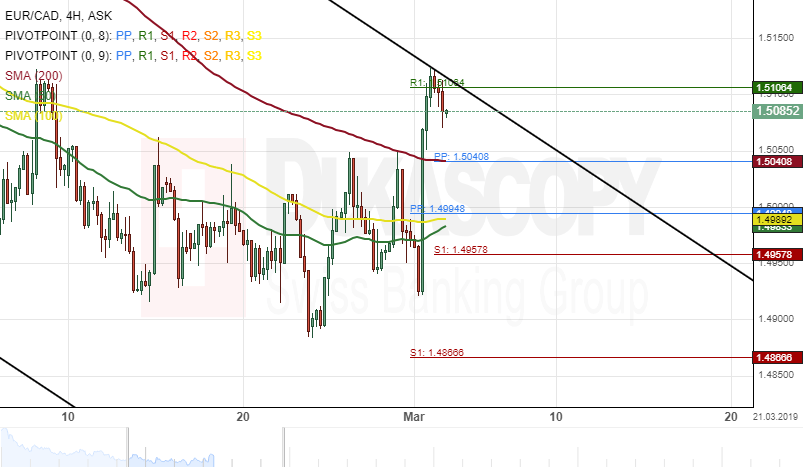
EUR/CAD 4H Chart: Set For Breakout
The Eurozone single currency appreciated about 230 base points against the Canadian Dollar during the past week. The currency pair breached both the 50-, 100– and 200-hour SMAs during last week's trading session.
Currently, the exchange rate is trading near the upper boundary of a descending channel pattern at 1.5106.
If a resistance level formed by the upper boundary of the descending channel holds, a pullback towards the 50– and 100– hour simple moving averages at 1.4989 could be expected.
However, if the pair breaks the channel pattern, the next target for bullish traders will be at the 1.5300 region.
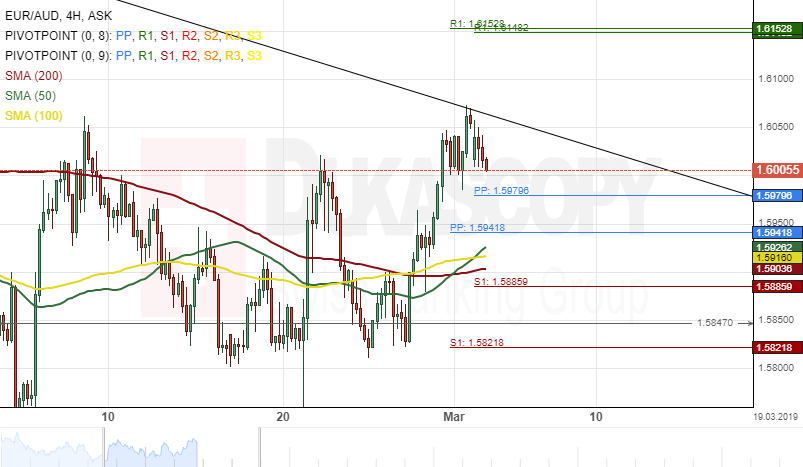
EUR/AUD 4H Chart: Brief Retracement Likely
The single European currency appreciated about 1.59% in values against the Australian Dollar during the last week. The currency pair tested the upper boundary of a junior descending channel pattern at 1.6050.
As for the near future, it is likely that the currency exchange rate makes a brief retracement towards a support cluster formed by the 50-, 100– and 200-hour SMAs at 1.5915.
If the support cluster holds, a potential upside reversal could be expected during the following trading sessions.