Sample Category Title
GBP/USD Rally Unwinds But Not Likely Over
Key Highlights
- The British Pound surged above 1.3250 before sellers appeared near 1.3350 against the US Dollar.
- A major declining channel is in place with resistance near 1.3240 on the 4-hours chart of GBP/USD.
- The UK Construction PMI declined from 50.6 to 49.5 in Feb 2019.
- The UK Services PMI for Feb 2019 will be released today, which could decline from 50.1 to 49.9.
GBPUSD Technical Analysis
After forming a strong support above 1.2980, the British Pound started an uptrend above the 1.3200 resistance against the US Dollar. The GBP/USD pair climbed above 1.3300 before topping near the 1.3350 level.
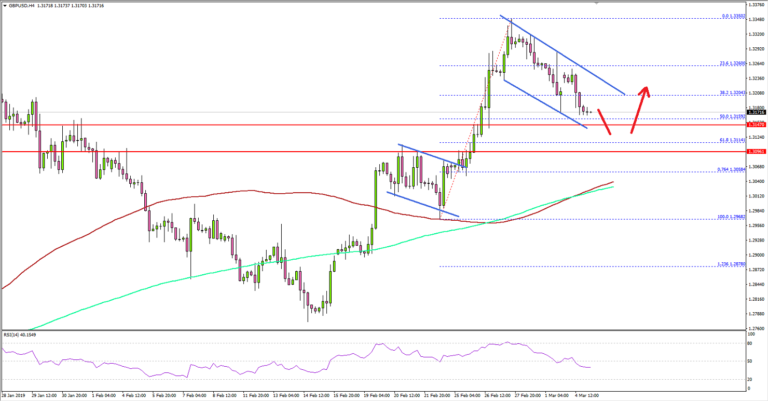
Looking at the 4-hours chart, the pair traded as high as 1.3350 and later started a significant downside correction. It broke the 1.3250 support level and the 38.2% Fib retracement level of the last wave from the 1.2968 low to 1.3350 high.
However, there are many supports on the downside near the 1.3150 level and the 50% Fib retracement level of the last wave from the 1.2968 low to 1.3350 high. Below 1.3150, the pair could decline towards the 1.3090 support (a key pivot area).
At the outset, there is a major declining channel is in place with resistance near 1.3240 on the same chart. A break above the channel resistance and 1.3250 will most likely start a fresh upward move towards the 1.3300 or 1.3350 level.
Fundamentally, the UK Construction PMI report for Feb 2018 was released recently. The market was looking for a minor decline from the last reading of 50.6 to 50.3.
The result was disappointing as there was a sharp decline to 49.5 and the UK Construction PMI posted contraction for the first time in 11 months, led by commercial and civil engineering work.
The report added that:
The drop in construction work was led by reductions in commercial building and civil engineering activity. A soft patch for new orders so far in 2019 meant that job creation remained subdued in February.
The result weighed on GBP/USD, resulting in bearish moves. Going forward, today's Services PMI reading and BOE's Governor Mark Carney Speech could impact the market sentiment for the cable in the near term.
Economic Releases to Watch Today
- Germany's Services PMI for Feb 2019 – Forecast 55.1, versus 55.1 previous.
- Euro Zone Services PMI for Feb 2019 – Forecast 52.3, versus 52.3 previous.
- UK Services PMI for Feb 2019 – Forecast 49.9, versus 50.1 previous.
- US ISM Non-Manufacturing Index for Feb 2019 – Forecast 57.2, versus 56.7 previous
- BOE's Governor Mark Carney Speech.
Daily Markets Broadcast
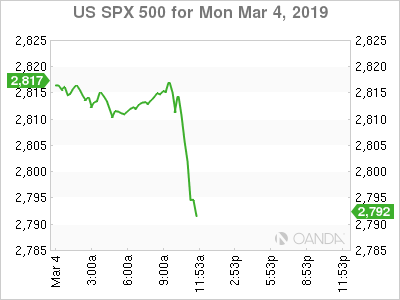
Wall Street slumps on growth concerns
Reports suggesting the US economy was suffering the most from the tariff war pressured Wall Street yesterday, though most indices closed off their intra-day lows. China’s NPC set 2019 growth target at 6.0-6.5%, in line with expectations. Oil prices rose as Russia plans to speed up production cuts.
US30USD Daily Chart
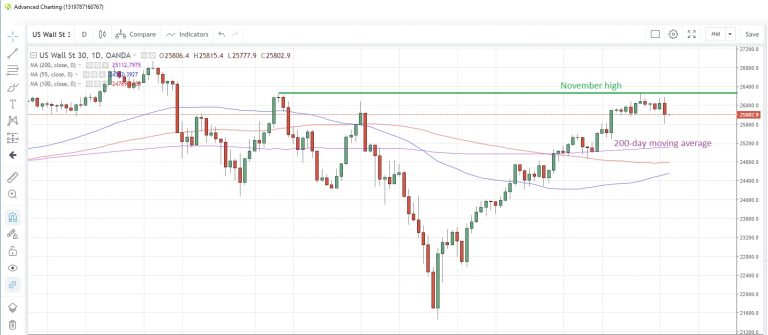
The US30 index fell the most in more than a month yesterday, pressured by expectations that US growth may be downgraded as a direct result of the trade tariff war
Resistance at the November high of 26,249 remains intact. Support may be found at the 200-day moving average at 25,112
The ISM non-manufacturing index is expected to outperform the manufacturing one in February, with a reading of 57.2 from 56.7 in January. New home sales are seen falling 9.1% m/m in December, further evidence of how this sector is lagging behind the rest of the economy.
DE30EUR Daily Chart
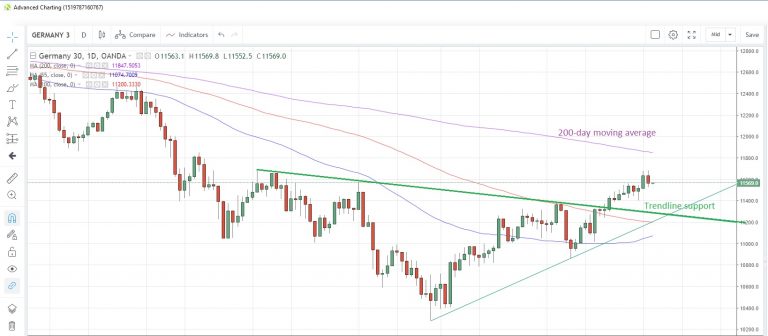
The Germany30 index touched a four-month high yesterday before closing in the red for the first time in three days
The index appears to be shying away from the 200-day moving average, which is at 11,847 today. Trendline support (former resistance) may be found around the 11,288 level
Euro-zone retail sales are expected to rebound in January from December’s decline. Economists are forecasting a 0.8% gain from a month earlier.
WTICOUSD Daily Chart
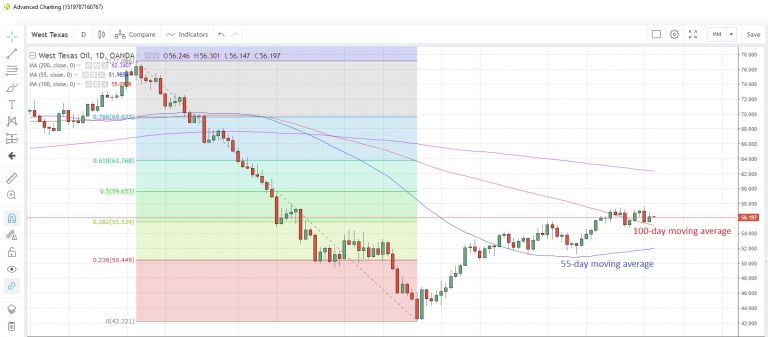
Oil prices overcame weakness in the equity markets to rise 1.3% yesterday after Russia’s energy minister said they plan to accelerate output cuts this month
WTI has been oscillating around the 100-day moving average, which is at 55.09 today, for the past two weeks. The 55-day moving average at 51.985 has supported prices on a closing basis since January 17
Crude oil output from OPEC hit a four-year low in February as production cuts took hold. API weekly crude oil stocks are due later today. Last week saw a drawdown of 4.2 million barrels.
Markets Continue Mechanical Links To US Equities
Markets continue mechanical links to US equities
Wall Street pared its gains overnight as US construction spending fell 0.6% unexpectedly overnight. This took the froth off the markets, which started the week in the green as the US and China appeared to be edging towards a trade deal. The S&P fell 0.39%, and the Nasdaq dropped 0.23%. The Dow Jones fared the worst, falling 0.82%, weighed down by the healthcare sector as OxyContin maker Purdue Pharma announced it is exploring Chapter 11 bankruptcy options.
The dollar rose as Wall Street fell, firming against its G-10 counterparts. US bond yields were also rising slightly across the curve. The lock-step manner in which currencies and bonds are moving to the nuances of equities suggests that many investors remain on the sidelines awaiting a clearer macroeconomic and trade picture.
The data calendar is light today with the Reserve Bank of Australia (RBA) rate decision at 11:30 am Singapore time. The RBA is expected to leave rates unchanged and attention will be focused on any comments accompanying the decision. Traders will be looking for more evidence that the RBA is swinging from neutral to dovish. Eurozone retail sales may spark some short-term activity before the US ISM Non-Manufacturing data this evening.
Equities
Asia Pacific reacted as expected yesterday with most bourses moving into the green as news emerged on positive progress on the US-China trade talks. Regional stocks will perhaps be more muted today following a directionless session from Wall Street. The trade talks remain the most important game in town for local markets, and we expect listless trading today until we see more clarity on that front.
FX
The US dollar strengthened on haven flows as Wall Street edged lower reflecting the mechanical nature of the currency markets at the moment. With implied volatility at near-record lows in the options market, the FX markets are apparently waiting for clearer macroeconomic or geopolitical drivers before committing heavily to new positioning.
Oil
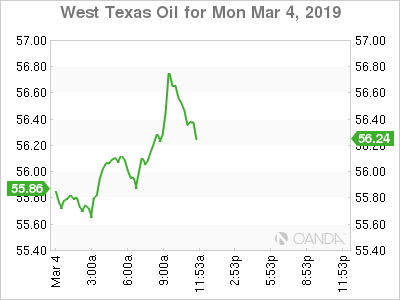
As expected, oil firmed overnight on a reduction in US-China tariff tensions. Brent crude rose 1% to USD65.50 a barrel and WTI rose 1.20% to USD56.40 a barrel. The energy markets will continue to bask in trade optimism.
Gold
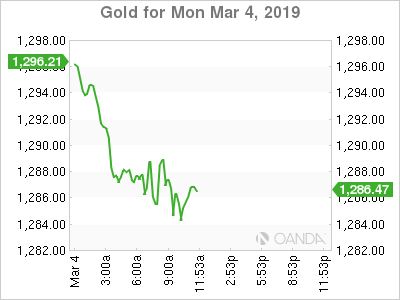
Gold fell USD7 to USD1,286.00 an ounce overnight as the dollar strengthened and unwinding of long positioning continued apace. USD1,275.00 looms as the next significant technical support for the yellow metal.
Eco Data 3/5/19
[php_everywhere instance="1"]
Two Thine Own Inflation Target Be True? Fed Policy Review Part 1
Executive Summary
In the first of a series of reports examining how the Fed's framework and toolkit may evolve in the coming years, we look at potential changes to the Fed's current inflation target. After watching inflation average less than 2% over the past two decades, officials would like to see it run slightly higher in order to provide more space to cut real interest rates during future recessions. To facilitate 2% inflation on a more sustained basis, Fed officials are assessing the merits of average-inflation targeting or price-level targeting. With past misses on inflation no longer treated as "bygones," actual inflation and inflation expectations should run higher. As a result, nominal interest rates should be higher, the yield curve should steepen and the dollar should depreciate, all else equal.
Monetary Policy Review Underway at the Fed
By most measures, the current economic expansion in the United States, which is currently in its tenth year, is on solid footing. Nevertheless, officials at the Fed are starting to think about strategies to better achieve its dual mandates of price stability and maximum employment throughout the business cycle, and to combat future downturns.
For example, Richard Clarida, the Vice Chairman of the Federal Reserve Board, discussed the Fed's ongoing review of its policy strategy and tools in a recent speech.1 Clarida noted that the "neutral" interest rate (so-called r*) appears to have fallen in the United States over the past decade or so. In that regard, the mid-point of the Fed's target range for the fed funds rate is only 2.38% at present, and it appears that the Federal Open Market Committee (FOMC) may be nearing the end of its tightening cycle, if it has not been reached already. With only 200 bps or so of room to cut rates, would the Fed have enough traditional "ammunition" to combat the next recession?
The limited capacity to stimulate growth is unlikely to be an issue unique to the current business cycle. In this series of reports, we will look at some of the new strategies and policy tools that the Fed may employ in the future as well as the implications of some of those potential changes. Future reports will analyze negative interest rates, renewed asset purchases (i.e., quantitative easing) and the Fed's output gap framework. We should stress that the strategy review at the Fed is ongoing, and that the FOMC has not yet made any changes to its monetary strategy or policy toolkit. But we think it is prudent to discuss some potential changes to the way the Fed may operate going forward so that readers are prepared for those changes if and when they occur.
Is the Fed's Current Inflation Target "Broken"?
The United States Congress has tasked the Fed with a mandate of promoting "stable prices," although Congress did not explicitly define the term. Congress also gave the Fed the goals of "full employment" and "moderating" long-term interest rates. In contrast, the government of New Zealand in 1989 gave its central bank a single mandate of an explicit inflation target (midpoint of a 1% to 3% target range), and governments in Canada and the United Kingdom gave their respective central banks similar inflation targets in the following decade. The Fed did not adopt an explicit inflation target of 2% until 2012.2
Broadly speaking, the proliferation of inflation targets for central banks at the end of the 20th century was for the most part a means for them to bring inflation lower. The pioneers of explicit inflation targeting, including governments in New Zealand, Canada and the United Kingdom, introduced inflation targeting during periods when inflation was high and authorities wanted to reduce it. An explicit target was thought to demonstrate a central bank's commitment to low inflation and improve its ability to do so by reining in inflation expectations. For the most part, central banks–the Federal Reserve included–were successful in their efforts to reduce inflation from the rates that prevailed throughout the 1990s and the early years of the current century.
But some observers could reasonably argue that central banks have been too successful in reducing inflation. In the wake of the Great Recession, the risks to "stable prices" have generally been skewed toward mild deflation rather than unacceptably high inflation. For example, CPI inflation in Japan has averaged just 0.5% even though the Bank of Japan currently has a "price stability" target of 2%. The primary objective of the European Central Bank is "price stability," which it defines as an inflation rate that is "below, but close to, 2% over the medium term." Yet the core rate of CPI inflation, which is a good measure of underlying inflationary pressures in an economy, has not been "close to" 2% for a decade (Figure 1). In the United States, core PCE inflation has been running below the Fed's 2% target for almost the entirety of the current cycle and has averaged just 1.6% since the end of the Great Recession (Figure 2).
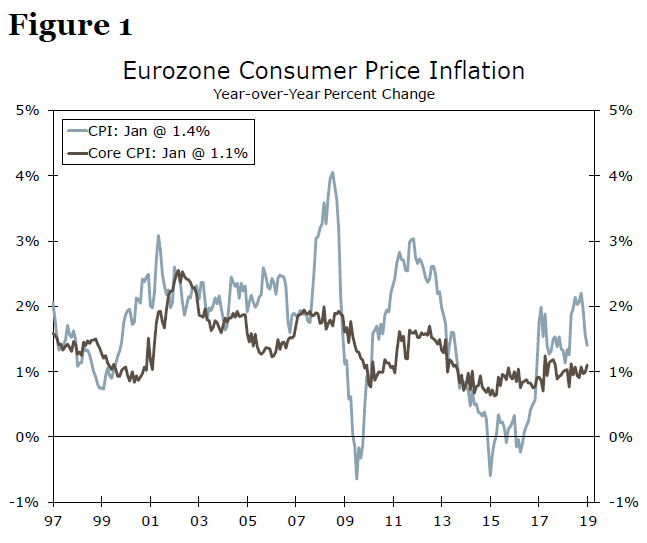
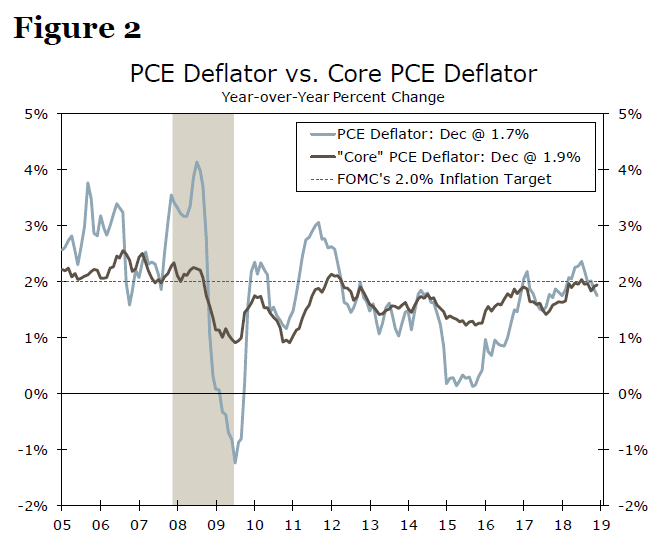
An extended undershoot of a central bank's inflation target can lead to depressed inflationary expectations that can make it difficult for the central bank to raise the realized inflation rate. The practical issue of depressed inflationary expectations and abnormally low inflation is that it limits the central bank's ability to reduce real interest rates to stimulate economic activity during a downturn. A central bank can run out of conventional "ammunition" when its policy rate nears the effective lower bound (ELB) near 0%. Consequently, the Fed's policy review is intended to identify ways to strengthen its credibility in generating 2% inflation over the business cycle and give the FOMC more recession-fighting capability when future downturns arrive. We now turn to four potential changes that the Fed could make to its inflation target.
Leading Contenders: Average-Inflation Rate and Price-Level Targeting
Traditionally the Fed (and almost all other central banks) has taken a forward-looking approach to inflation. Past misses on inflation, whether to the upside or downside, are not considered when setting policy. In other words, the Fed lets bygones be bygones. However, average-inflation rate targeting and price-level targeting (PLT) would challenge that convention.
Average-inflation targeting involves an explicit aim for inflation to average a given rate over time. For example, if the Fed adopted this framework with its current 2% target, it would aim for 2% inflation on average over the medium or longer term. If inflation were to undershoot for a given period of time, then overshoots would be tolerated with the specific aim of raising the mean rate of inflation over a multiyear period. With the explicit aim for inflation to average a given rate over time, inflation expectations and realized inflation should be higher, consequently reducing the time monetary policy is constrained by the ELB.3
Under a strategy of average-inflation targeting, the Fed could choose the length of the "lookback" period, or the number of years in which inflation's prior performance was factored into policy decisions. That would limit the potential for inflation expectations to become unglued. Policymakers would continue to emphasize "price stability" in terms of the rate of inflation, making it only a moderate departure from the current single-target framework. Implicitly the FOMC already has moved toward average-inflation targeting through its recent emphasis on the "symmetric" nature of the 2% target. 4
A more radical—but similar—approach, in our view, would be price-level targeting (PLT). With PLT the Fed would attempt to keep the level of prices rising at a steady rate. Similar to average-inflation targeting, there would also be a "makeup" period for times when policy was constrained by the ELB. Yet with PLT, the makeup period could be quite long. For example, if the FOMC set the price level in 2006 to be consistent with 2% trend inflation, the FOMC would still be waiting to raise interest rates (Figure 3).
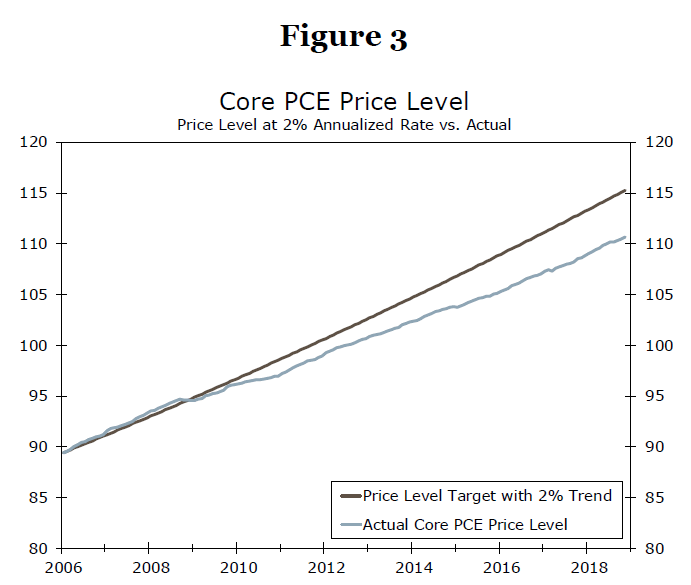
The built-in makeup period would be a form of forward guidance, because the FOMC would be committing to keeping monetary policy accommodative until the price level (as opposed to the inflation rate) returned to target. Because inflation would need to rise measurably to return the price level to target, inflation expectations would be higher, especially in periods of low inflation.5 In short, monetary policy should be constrained by the ELB less frequently.6
A downside to PLT is its potential to lead to monetary tightening if prices rise faster than the Fed's desired path due to temporary factors like a spike in gasoline prices. This potential disadvantage to PLT is why some central bankers tend to favor it only temporarily.7 Once the price level catches up to its targeted path, the Fed would revert back to its current 2% inflation target. If history is a useful guide, the FOMC likely would "look through" temporary deviations of the inflation rate from target that were caused by significant changes in energy prices.
Yet even on a temporary basis, PLT has some disadvantages. First, communicating such a regime shift to the public is not likely to be easy. After a prolonged undershoot of the price level, it may take an extended period of high inflation to bring prices up to the desired level. If not well understood, temporary PLT would not stimulate the economy during downturns, and it also risks a marked unmooring of inflation expectations during the makeup period. Financial imbalances may also accumulate during this "lower for longer" period.8 But the explicit price level goal could inhibit the FOMC's flexibility to address such imbalances if more targeted macro prudential policies are deemed inadequate. Because Congress has tasked the Fed with managing multiple priorities, the Fed has historically shied away from adopting explicit policy rules (such as the Taylor Rule) so as not to be constrained in its flexibility.
Other Approaches: Raise the Inflation Target or Use an Inflation Range
A more straightforward solution for generating more room to reduce real rates would be for the FOMC to raise its current 2% inflation target. A higher inflation target would signal the central bank's willingness to tolerate greater inflation, thereby lifting inflation expectations and, presumably, realized inflation. However, the Fed has all but ruled out a shift to a higher inflation target in its recent communications. While it would be a relatively simple change to the framework, it could de-anchor inflation expectations and lead to political concerns around the impact of higher inflation on the public. Thus, we see this as a low probability option for the Fed moving forward.
Switching to a target range for inflation may be more feasible. Boston Fed President Eric Rosengren and former New York Fed President William Dudley have previously advocated for specifying a range of acceptable inflation outcomes, say from 1.5-3.0% or a bit narrower at 1.5-2.5%.9 The upper end of the range would give the FOMC greater flexibility in remaining accommodative after periods at the ELB. Alternatively, the lower end of the range would give the FOMC cover to tighten policy for financial stability reasons.
Similar to average-inflation targeting, the FOMC's emphasis on the "symmetric" nature of its target could also be considered a step toward an inflation range. Yet the adoption of specific range would give more clarity on the degree to which an under-shoot or an over-shoot would be tolerated by the FOMC before triggering a policy change. While we acknowledge the potential merits of this framework, Fed policymakers have seemingly not been as keen on adopting an inflation range in recent communications. It could resurface as an option if policymakers do not choose to adopt average-inflation rate targeting or PLT, but for now we see it as a relatively unlikely option.
Implications for Financial Markets
All of the options discussed above, with the possible exception of an inflation range, should lead to higher inflation expectations and, consequently, higher realized rates of inflation. Although these potential changes to the Fed's inflation-targeting framework should not have any effects on real variables such as the economy's long-run potential growth rate and the "natural" unemployment rate, they could have implications for nominal variables.
For starters, higher inflation expectations should lead to higher bond yields, everything else equal. Consequently, the "neutral" fed funds rate should be higher on a nominal basis, although the "neutral" rate on a real basis (so-called r*) should remain largely unaffected. Furthermore, higher inflation expectations could lead to a steeper yield curve, everything else equal. It is also possible that higher inflation leads to a more active Treasury Inflation Protected Securities (TIPS) market, although that is not a given since some analysis suggests that while higher, inflation would be less variable.10
Changing the inflation target could also have implications for the value of the U.S. dollar. If the policy change leads to higher inflation expectations and realized rates of inflation in the United States, that should lead to a weaker greenback all else equal. Meanwhile, the dollar could also face headwinds to the extent that U.S. rates are lower for longer in the next cycle as the Fed tries to stoke higher inflation.
Conclusion
Of the four potential changes to the Fed's current 2% inflation target framework, we view average-inflation targeting and price level targeting as the leading contenders. Both regimes look to generate inflation more closely in line with the Fed's goal and suggest policy would be constrained by the ELB less frequently. However, we give a slight edge to average-inflation targeting since it continues to focus on the inflation rate, rather than the price level, and therefore could be viewed as a less radical policy shift and easier to communicate. In fact, the FOMC has already implicitly moved toward an average-inflation target by more frequently describing its 2% target as "symmetric."
An inflation range may also be relatively easy to communicate, but may not be successful in driving inflation expectations higher since sub-2% would still be tolerated. A higher inflation target is very unlikely given the political pushback it would receive as well as the fact that inflation would likely be higher all the time, not just during makeup periods.
Importantly, the successful transition to any of the proposed frameworks depends on the Fed credibly communicating the change. If businesses and households do not fully understand the changes, or do not believe the policy is credible, inflation may continue to come in lower than target. If that is the case, policy would still likely be encumbered by the effective lower bound on a more regular basis, which would cause the FOMC to stay "lower for longer" and potentially spur financial imbalances. In light of these challenges, the FOMC may need to do more than alter its inflation framework to mitigate the next downturn. In our next reports, we look at some of the tools the FOMC could possibly employ to better achieve its policy goals, beginning with negative rates.
1 See Clarida, Richard H. "The Federal Reserve's Review of Its Monetary and Policy Strategy, Tools, and Communication Practices." Presented at the 2019 U.S. Monetary Policy Forum, the Initiative on Global Markets at the University of Chicago Booth of Business, Feb. 22, 2019.
2 The Federal Reserve adopted this explicit inflation target on its own accord. Congress did not give the Fed the specific number.
3 Mertens, Thomas and John C. Williams. "Monetary Policy Frameworks and the Effective Lower Bound on Interest Rates." Federal Reserve Bank of New York Staff Reports, no. 877. January 2019.
4 Since March 2017, the FOMC has described its inflation goal as "symmetric" in post-meeting statements.
5 Mertens and Williams, 2019.
6 Bernanke, Ben S., Michael T. Kiley, and John M. Roberts. "Monetary Policy Strategies for a Low-Rate Environment." Finance and Economics Discussion Series 2019-009. Washington, Board of Governors of the Federal Reserve System.
7 See for example, Bernanke, Ben S. "Temporary Price-Level Targeting: An Alternative Framework for Monetary Policy." The Hutchins Center for Fiscal and Monetary Policy, Oct. 12, 2017, or Clarida (2019).
8 Brainard, Lael. "Rethinking Monetary Policy in a New Normal." Presented at the conference on Rethinking Macroeconomic Policy, Peterson Institute of International Economics, Oct. 12-13, 2017.
9 Rosengren, Eric S. "Considering Alternative Monetary Policy Frameworks: An Inflation Range With an Adjustable Inflation Target." Presented at the Money, Models & Digital Innovation Conference, Global Interdependence Center, Jan. 12, 2018.
Dudley, William C. "Important Choices for the Federal Reserve in the Years Ahead." Remarks at Lehman College, Apr. 18, 2018.
10 Bernanke et al. 2019
RBA Rate Decision and Q4 GDP Growth ahead for the Aussie
The Reserve Bank of Australia is scheduled to set monetary policy on Tuesday at 0030 GMT but economic uncertainty at home, and in the global economy more generally, are currently giving little flexibility to policymakers to adjust interest rates, potentially leading to another uneventful meeting. The next day, Australian GDP growth figures for the final quarter of 2018 will likely endorse the decision as analysts forecast further economic moderation.
After slowing for two consecutive quarters, Australian GDP growth is said to have inched up by 0.1 percentage points to 0.4% quarter-on-quarter in the last three months of the year to December. In yearly terms though, expansion is expected to have flipped back to 2.6% from 2.8% in Q3 and down from the strong 3.4% increase registered in Q2, ending the year almost where growth was at its beginning.
While last week’s Q4 private new capital expenditure data advanced more rapidly than analysts projected, brushing some worries over the business sector aside, new data on Monday indicated that firms’ profits and wages rose modestly in the three months to December, a sign that companies are struggling to make money. Consumption remained a concern and therefore a potential headwind for growth as well, as home prices nationally continued to fall in February. The numbers also revealed that the downturn in the housing sector was more widespread, raising questions about whether the discounting would bottom out anytime soon.
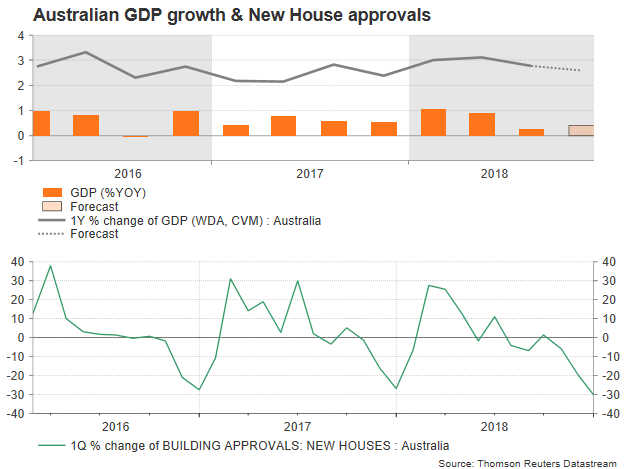
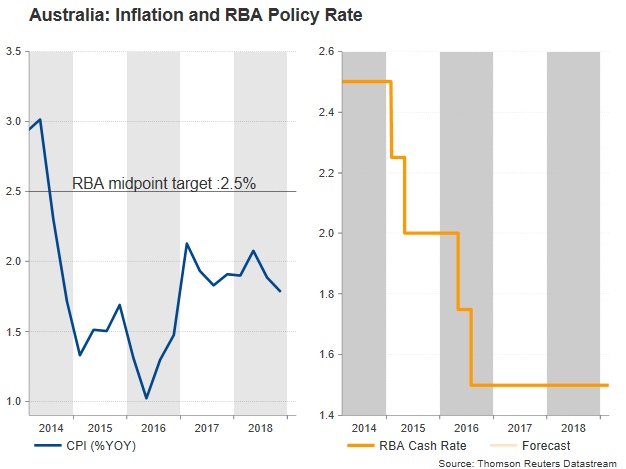
With the cooling property market hitting household wealth at a time when debt-to-disposable income is still uncomfortably high (190%), the RBA will certainly avoid hiking rates above the current level of 1.5% on Tuesday. The central bank’s governor Philip Lowe is also planning to stretch its record spell of steady rates throughout the year but at some point next year, he is optimistic that borrowing costs will go up if the unemployment rate drops further and inflation moves higher in line with the Bank’s projections, saying that the property downturn is unlikely to “derail the economy”.
Lowe’s recent upbeat tone, however, did little to convince markets that the next move in rates will be up, as the overnight indexed swaps keep displaying an 84% probability of a 25 bps rate cut by November 2019. It is reasonable to say that policymakers have still a lot to consider before taking the decision to tighten monetary policy. If wage growth doesn’t kick into higher gear, consumption and hence inflation, might take longer to pick up, delaying any rate rise that would make household debt unsustainable.
Economic developments outside the country should be watched carefully as well. Despite the latest headlines reporting that the US and China are close to agreeing on a deal that would end the tariff war, the story has taken many surprising turns lately and hence more needs to be done from both sides to convince markets that the trade war might be finally approaching an end. More specifically, new laws on foreign investment during China’s annual National People’s Congress in the next two weeks might signal that an agreement is close at hand if parliamentary members decide to limit technology transfer and increase intellectual property protection as the White House desires. Yet, Beijing will weigh the cons and pros of such a decision as more protection for outsiders could lead to less favorable conditions for domestic businesses. Note that in any case, all Australia wants is its major export partner, China, to keep growing in a healthy way.
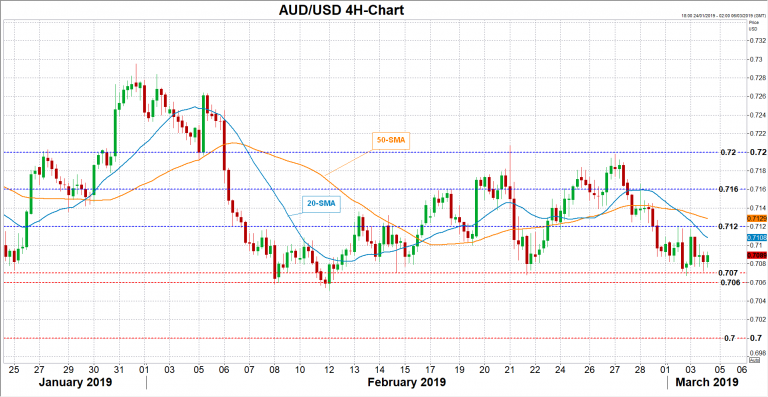
In the FX space, Monday’s encouraging trade headlines did not help the risk-sensitive Australian dollar much as investors turned their focus on weak business data, which lowered GDP growth prospects a little. Should the RBA shift its tone to the downside in the rate statement from the neutral currently expected – potentially heightening worries over the housing slowdown – AUDUSD could slip towards the 0.7070-0.7060 support area. In case GDP growth figures disappoint too, a stronger sell-off could emerge between 0.70 and 0.69.
In the alternative scenario, if the RBA messages that a rate hike is more likely than a rate cut in the next year and/or GDP readings beat expectations, the pair could jump into the 0.7120-0.7160 zone. Higher, a break above the 0.7200 level could prove even more significant to the market.
It is also worth noting that the RBA governor will be speaking at the Australian Financial Review’s 2019 Business Summit on Tuesday at 2210 GMT.
US and China Inch Closer to a Deal
US stocks opened higher as expectations are overly optimistic that a trade deal will be done After many ups and downs in this trade war rollercoaster, it appears both sides have made many concessions, with the most recent being the US will end their tariffs in exchange for Chinese concessions. With all signs pointing to a mid-March meeting between President Xi and Trump. Stocks gave up most of the overnight rally as continued concerns with the housing market in the US was reemphasized after December construction came in much lower than expected.
The US dollar started the week initially higher after President Trump went on the attack and accused Fed Chair Powell of being someone who likes raising interest rates, loves quantitative tightening and likes a very strong dollar. The dollar recovered all of its losses on optimism on the trade front.
- USD – Trade Deal inches closer
- STOCKS – Headwinds from last year are almost all gone
- GOLD – Remains vulnerable as geopolitical risks ease and dollar refuses to break
- OIL – Crude became overbought by hedge funds
USD
Normally, when we see expectations for a big risk event to be taken off the table, high-beta currencies deliver stronger rallies. The optimism for a final deal is fairly priced in now and the next big move in currencies may need to come from China’s National People’s Congress summit. The annual policy address will unveil China’s economic growth target, policy priorities, plans for reform and stimulus measures. For risk appetite to remain in play, China will need to confirm that their deleveraging initiatives are on hold and they will continue to deliver stimulus via monetary and fiscal policies.
Stocks
Global equities last year sold off mainly because of the trade war, Fed was overly hawkish and China began to deleverage. The Fed in January successfully delivered a dovish pivot that has the market convinced rate hikes are on hold for the first half of the year. The trade war appears to be nearing a deal that could be finalized in the middle of the month.
The key focus this week, may fall on the China’s NPC summit and the confirmation that they are not changing course and will continue to stimulate the economy and keep deleverage on hold. If China clearly sends this message, we could see the risk off catalysts from last year taken off the table.
Gold
Gold prices are accelerating lower as optimism remains high the US-China trade war is nearing its end and expectations are priced in that China will confirm they will continue to support their domestic economy with increases in fiscal and monetary stimulus.
Oil
Crude prices are seeing a positive start to the week as trade optimism points to a possible strong rebound in Asia, which would make the energy sector be the big winner. The oversupply argument took a break late last week as US rig data showed a steep decline of 10 rigs to 843. If OPEC compliance remains high, US production stabilizes, and a conclusive trade deal is reached that starts immediately, we could see the case for higher prices improve.
USD/CAD: Loonie Remains Under Increased Pressure, Could Fall Further on Dovish BoC
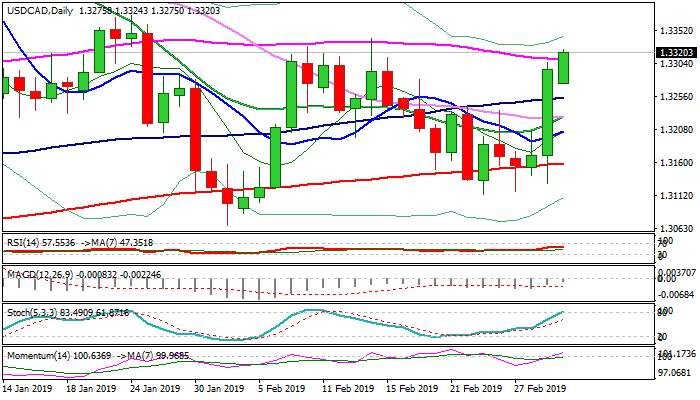
The pair maintains firm bullish tone and extends advance from last Friday (daily gains of nearly 1%) above 1.33 barrier, to threaten retest of 14 Feb recovery high (1.3340) and attack at daily cloud base (1.3355).
Sentiment for loonie remains negative, following downbeat Canada’s GDP data which signal economic growth stall and could have negative impact on BoC policy decision on Wednesday.
Tones from the central bank’s policymakers were until now rather optimistic, keeping alive hopes for rate hike in the near future, bit strong signs of Canada’s slowing economy could put these plans on hold.
More dovish comments in light of most recent data could increase pressure on Canadian dollar, as initial bullish technical signal would be generated on close above broken Fibo barrier at 1.3296 (38.2% of 1.3664/1.3068) and confirmation could be expected on lift above daily cloud that would open way for further correction of 1.3664/1.3068 fall.
Res: 1.3340; 1.3355; 1.3366; 1.3395
Sup: 1.3275; 1.3255; 1.3226; 1.3204
Japanese Yen Takes Pause after Rough Week
USD/JPY is showing little movement at the start of the trading week. In Monday’s North American session, the pair is trading at 111.81, down 0.06% on the day. On the release front, there are no major indicators out of Japan or the United States. On Tuesday, the U.S. releases ISM Non-Manufacturing PMI.
The yen suffered another rough week , as USD/JPY climbed 1.0 percent. The catalyst for the yen’s drop was increased risk appetite, as investors are increasingly confident that the U.S and China will reach a deal on their trade dispute, which has rocked the global economy. If the positive momentum continues, President Trump and Chinese President Xi could sign a trade agreement in late March. Still, it’s unclear what the agreement will look like, as the sides have been very tight-lipped. Investors will be most concerned as to whether U.S. tariffs on Chinese products would be eliminated immediately or phased out over time. If speculation rises that a breakthrough is imminent, the safe-haven yen could fall sharply.
The Bank of Japan has persisted with its ultra-accommodative monetary policy, but inflation levels have remained well below the target of around 2 percent. Annual core consumer inflation was just 0.8% in January, as the BoJ has been unable to boost inflation to its target of around 2%. The lack of success on the inflation front has led to dissenting voices calling for change. Last week, BoJ member Goushi Kataoka called on the bank to increase stimulus in order to achieve its inflation target. However, unless BoJ Governor Kuroda decides to take stronger easing steps, current monetary policy will remain in place and inflation will stay low. This means that any rate hikes are unlikely for the foreseeable future.
GBP/USD Outlook: Bearish Near-Term Bias But Key Supports Still Intact
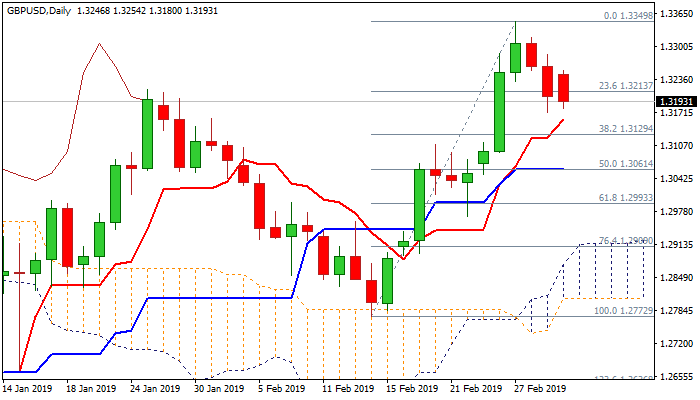
Cable is trading around 1.32 handle in early US trading on Monday, following bearish acceleration that probed below 1.32 support (session low at 1.3180). Recovery attempts stalled and formed hourly lower platform at 1.3250 zone, with bears attempting to extend pullback from 1.3349 high. Stronger greenback across the board weighs, with traders taking profit and repositioning for fresh upside after fears of no-deal Brexit faded, improving the sentiment. While pivotal supports at 1.3151/29 (10 SMA / Fibo 38.2% of 1.2772/1.3349) holds, dip-buying would remain preferred scenario. Otherwise, deeper correction could be expected on sustained break lower.
Res: 1.3250; 1.3286; 1.3319; 1.3349
Sup: 1.3172; 1.3151; 1.3129; 1.3061