

Sample Category Title
Asian update: Dollar strongest as RBA and China shrugged. Stocks mixed
Following the decline in US stocks, Asian markets turned slightly weaker today. Chinese stocks are resilient though, fluctuating in tight range between gain and loss. The government lowered 2019 growth target to 6.0-6.5%, with the lower bound at lowest pace in more than three decades. But the move was widely expected and thus triggered little reactions. RBA kept interest rate unchanged at 1.50% too. It maintained the central scenarios of growth, inflation and employment forecasts. The tone of the statement is a touch more optimistic comparing to February's. But it's largely shrugged off by the Australian Dollar.
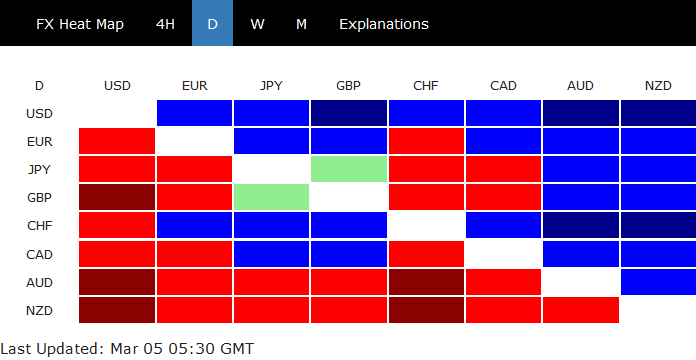
In the currency markets, Dollar is so far the strongest one for today, followed by Euro and Swiss Franc. EUR/USD breached 1.1316 support overnight but there was no follow through buying. The greenback will need to flex some more muscles to show that it's regaining near term strength. Commodity currencies are the weakest ones, led by New Zealand Dollar.
In Asia:
- Nikkei is down -0.60%.
- Hong Kong HSI is down -0.10%.
- China Shanghai SSE is up 0.15%.
- Singapore Strait Times is down -0.46%.
- Japan 10-year JGB yield is up 0.0023 at 0.003, staying positive.
Overnight:
- DOW dropped -0.79%.
- S&P 500 dropped -0.39%.
- NASDAQ dropped -0.23%.
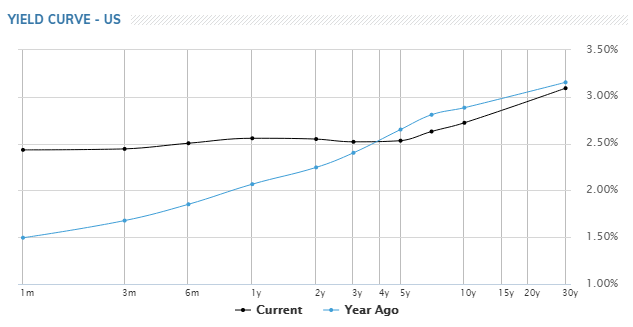
- 10-year yield dropped -0.033 to 2.722.
There is some improvements in yield curve inversion in the US. 5-year yield at 2.531 is now back above 6-month yield at 2.504. Ad it's not far from 1-year yield at 2.557.
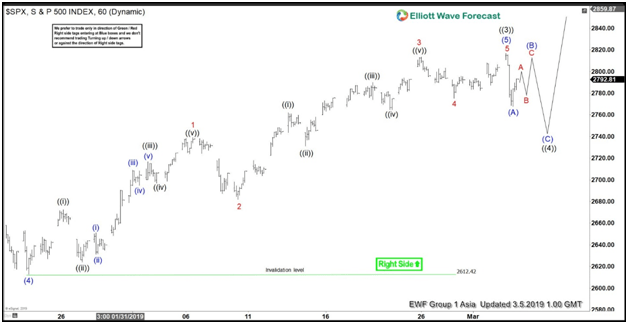
Elliott Wave View: S&P 500 (SPX) Correction Should Find Buyers Again
Short Term Elliott Wave view in S&P 500 (SPX) suggests the rally from December 26, 2018 low (2348.50) is unfolding as an impulse. Index has ended wave ((3)) of this impulse move at 2816.88. In the chart below, we can see wave (5) of ((3)) move from 2612.42 low subdivides in 5 waves impulse of a lesser degree. Up from 2612.42 low, wave 1 ended at 2738.98 and pullback to 2681.83 ended wave 2. Index then rallied again and ended wave 3 at 2813.49. Wave 4 pullback ended at 2775.13, and wave 5 of ((3)) ended at 2816.88.
Wave ((4)) pullback of the larger degree is currently in progress before Index resumes the rally higher in wave ((5)). The internal of wave ((4)) is unfolding as a zigzag where the first leg down to 2767.66 ended wave (A). While wave (B) bounce stays below wave ((3)) at 2816.88, expect Index to turn lower to continue the zigzag correction within wave ((4)). We believe dips in the Index still can see buyers in 3, 7, or 11 swing for 1 more leg higher in wave ((5)) before cycle from December 20, 2018 low ends. We don’t like selling the Index.
1 Hour S&P 500 (SPX) Elliott Wave Chart
RBA Board Keeps Rates on Hold; Slightly More Positive Assessment of the Economy
- Changes to the Governor’s Statement were minimal with the issues around growth developments and the housing market still in flux.
- As expected, the Reserve Bank Board decided to leave the Cash Rate unchanged at 1.50%.
- There were minimal changes in the wording from the Statement following the February Board meeting.
In fact, at least in the February Board meeting, it was recognised that “some downside risks have increased” for the domestic economy. In this Statement, that downside risk is not mentioned. The Governor does point out that “other indicators suggest growth in the Australian economy slowed over the second half of 2018”. Of course, the extent of this slowing will be revealed in the GDP report which prints at 11:30 am tomorrow. Westpac expects that the six month annualised growth pace in the economy will slow from 4 per cent in 2018 H1 to 1 per cent in 2018 H2. This spectacular slowing, even if at 1.5% in H2, is surely worthy of stronger language than seen in this Statement. It is also no surprise that the Board still forecasts growth around 3 per cent this year. Any change will only be made following the May Board meeting.
There has been considerable uncertainty as to whether the Bank assesses falling house prices as a threat to household consumption. Some official comments deny the existence of significant wealth effects. Today’s Statement seems to confirm that there is a concern of a wealth effect, “the main domestic uncertainty continues to be the strength of household consumption in the context of weak growth in household income and falling house prices in some cities”. That seems to indicate recognition of a wealth effect.
Commentary around the housing market is, surprisingly, slightly more constructive. In February, the markets were described as “weakened further”, whereas today’s Statement notes “conditions remain soft”. The data would indicate further deterioration.
The labour market continues to be described as “strong”, and the unemployment rate forecast of 4 ¾ per cent over the next couple of years is confirmed. Westpac expects that given a much softer growth environment, there will be a modest increase in the unemployment rate through 2019.
Conclusion
We are not surprised that the Governor chose not to repeat his commentary in a recent speech that prospects for interest rates are now evenly balanced. This commentary and the ‘rate hike’ commentary has never appeared in the Governor’s Statement and was limited to Board minutes; Statement on Monetary Policy; and some speeches.
We have to recognise that the Statement today is slightly more upbeat than we saw in February. As we later found out, the Board decided in February to restate the risks around interest rates to be more symmetric than had been the consistent practice through 2018. Perhaps, that significant change required strong language, whereas today, despite no real encouragement from the data, it was considered more appropriate to be circumspect.
Nevertheless the changes are very small and the real issues around growth developments and the housing market are yet to unfold.
Westpac confirms its view that the RBA Board will decide to cut rates by 25bps in both August and November 2019.
China, facing tough struggle, lowers 2019 growth target to 6-6.5%
Chinese Premier Li Keqiang delivered his annual work report to the National People's Congress today. Li warned that "China will face a graver and more complicated environment as well as risks and challenges that are greater in number and size". And he emphasized "China must be fully prepared for a tough struggle."
GDP growth target for 2019 is lowered to 6-6.5%, notably down from 2018's target of around 6.5%. The lower bound at 6% would be the slowest pace of growth in nearly three decades.
To help the manufacturing sector, a 3% cut to top bracket of VAT was announced, from 16% to 13%. Also, there will be with 1% cut to the 10% VAT bracket for transport and construction sectors, down from 10% to 9%. It's estimated the cuts are equivalent to as much as CNY 800B. Social security fees paid by businesses will be reduced to 16%.
Budget deficit for 2019 was set at 2.8% of GDP, larger than 2018 target of 2.6%. Total reduction in tax and social security fees would add up to CNY 2T.
China CBIRC Guo: Can absolutely open financial market access to US
China's top banking regulator said today that it can "absolutely" reach an agreement top open up the financial sector to the US. Guo Shuqing, chairman of the China Banking and Insurance Regulatory Commission, said "On the opening of the financial sector, China and the United States absolutely can reach agreement. Though at present there may be a few small disagreements, the problems are not that great"
Separately, Commerce Minister Zhong Shan said trade talks have achieved a breakthrough in some areas. While the negotiations were difficult, Zhong said both teams are continuing with their work.
Trump to end preferential trade treatment to India and Turkey
Trump sent a letter to Congressional leaders notifying his intention to end preferential trade treatment to India. He complained that "I am taking this step because, after intensive engagement between the United States and the Government of India, I have determined that India has not assured the United States that it will provide equitable and reasonable access to the markets of India."
Under Trump's instruction, the US Trade Representative also issued a statement on its intention to terminate Generalized System of Preferences (GSP) designation of both India and Turkey. The statement noted that "India's termination from GSP follows its failure to provide the United States with assurances that it will provide equitable and reasonable access to its markets in numerous sectors. Turkey's termination from GSP follows a finding that it is sufficiently economically developed and should no longer benefit from preferential market access to the United States market."
And, "by statute, these changes may not take effect until at least 60 days after the notifications to Congress and the governments of India and Turkey, and will be enacted by a Presidential Proclamation."
RBA kept cash rate at 1.50%, central scenarios of growth, inflation, employment unchanged
RBA left cash rate unchanged at 1.50% today as widely expected. The message of the accompanying statement is largely unchanged. RBA maintained the central scenarios of growth, inflation, employment outlook. And continued to expect the "gradual" progress of reducing unemployment and inflation returning to target.
The central back acknowledged that "economy slowed over the second half of 2018". But it maintained the "central scenario" is still to grow by around 3% this year. The outlook is supported by "rising business investment, higher levels of spending on public infrastructure and increased employment." Inflation remains "low and stable". The central scenario is for underlying inflation to be at 2% in 2019 and 2.25% in 2020. Labor markets remains "strong" and further decline in unemployment rate to 4.75% is expected over the next couple of years.
Main domestic uncertainty remains the "strength of household consumption in the context of weak growth in household income and falling housing prices in some cities." But RBA expects household income growth to pick-up and support spending over the next year. On housing markets, it's noted that adjustment in Sydney and Melbourne is continuing. Conditions remains "soft" in both markets with low rent inflation. Credit demand by investors slowed noticeably. And growth in owner-occupiers eased further.
Full statement below.
Statement by Philip Lowe, Governor: Monetary Policy Decision
At its meeting today, the Board decided to leave the cash rate unchanged at 1.50 per cent.
The global economy grew above trend in 2018, although it slowed in the second half of the year. The slower pace of growth has continued into 2019. The outlook for the global economy remains reasonable, although downside risks have increased. The trade tensions remain a source of uncertainty. In China, the authorities have taken further steps to ease financing conditions, partly in response to slower growth in the economy. Globally, headline inflation rates have moved lower following the earlier decline in oil prices, although core inflation has picked up in a number of economies. In most advanced economies, unemployment rates are low and wages growth has picked up.
Overall, global financial conditions remain accommodative. They have eased recently after tightening around the turn of year. Long-term bond yields have declined, consistent with the subdued outlook for inflation and lower expectations for future policy rates in a number of advanced economies. Also, equity markets have risen, supported by growth in corporate earnings. In Australia, short-term bank funding costs have moderated, although they remain a little higher than a few years ago. The Australian dollar has remained within the narrow range of recent times. While the terms of trade have increased over the past couple of years, they are expected to decline over time.
The Australian labour market remains strong. There has been a significant increase in employment and the unemployment rate is at 5 per cent. A further decline in the unemployment rate to 4¾ per cent is expected over the next couple of years. The vacancy rate is high and there are reports of skills shortages in some areas. The stronger labour market has led to some pick-up in wages growth, which is a welcome development. The improvement in the labour market should see some further lift in wages growth over time, although this is still expected to be a gradual process.
Other indicators suggest growth in the Australian economy slowed over the second half of 2018. The central scenario is still for the Australian economy to grow by around 3 per cent this year. The growth outlook is being supported by rising business investment, higher levels of spending on public infrastructure and increased employment. The main domestic uncertainty continues to be the strength of household consumption in the context of weak growth in household income and falling housing prices in some cities. A pick-up in growth in household income is nonetheless expected to support household spending over the next year.
The adjustment in the Sydney and Melbourne housing markets is continuing, after the earlier large run-up in prices. Conditions remain soft in both markets and rent inflation remains low. Credit conditions for some borrowers have tightened a little further over the past year or so. At the same time, the demand for credit by investors in the housing market has slowed noticeably as the dynamics of the housing market have changed. Growth in credit extended to owner-occupiers has eased further. Mortgage rates remain low and there is strong competition for borrowers of high credit quality.
Inflation remains low and stable. Underlying inflation is expected to pick up over the next couple of years, with the pick-up likely to be gradual and to take a little longer than earlier expected. The central scenario is for underlying inflation to be 2 per cent this year and 2¼ per cent in 2020. Headline inflation is expected to decline in the near term because of lower petrol prices.
The low level of interest rates is continuing to support the Australian economy. Further progress in reducing unemployment and having inflation return to target is expected, although this progress is likely to be gradual. Taking account of the available information, the Board judged that holding the stance of monetary policy unchanged at this meeting would be consistent with sustainable growth in the economy and achieving the inflation target over time.
(RBA) Statement by Philip Lowe, Governor: Monetary Policy Decision
At its meeting today, the Board decided to leave the cash rate unchanged at 1.50 per cent.
The global economy grew above trend in 2018, although it slowed in the second half of the year. The slower pace of growth has continued into 2019. The outlook for the global economy remains reasonable, although downside risks have increased. The trade tensions remain a source of uncertainty. In China, the authorities have taken further steps to ease financing conditions, partly in response to slower growth in the economy. Globally, headline inflation rates have moved lower following the earlier decline in oil prices, although core inflation has picked up in a number of economies. In most advanced economies, unemployment rates are low and wages growth has picked up.
Overall, global financial conditions remain accommodative. They have eased recently after tightening around the turn of year. Long-term bond yields have declined, consistent with the subdued outlook for inflation and lower expectations for future policy rates in a number of advanced economies. Also, equity markets have risen, supported by growth in corporate earnings. In Australia, short-term bank funding costs have moderated, although they remain a little higher than a few years ago. The Australian dollar has remained within the narrow range of recent times. While the terms of trade have increased over the past couple of years, they are expected to decline over time.
The Australian labour market remains strong. There has been a significant increase in employment and the unemployment rate is at 5 per cent. A further decline in the unemployment rate to 4¾ per cent is expected over the next couple of years. The vacancy rate is high and there are reports of skills shortages in some areas. The stronger labour market has led to some pick-up in wages growth, which is a welcome development. The improvement in the labour market should see some further lift in wages growth over time, although this is still expected to be a gradual process.
Other indicators suggest growth in the Australian economy slowed over the second half of 2018. The central scenario is still for the Australian economy to grow by around 3 per cent this year. The growth outlook is being supported by rising business investment, higher levels of spending on public infrastructure and increased employment. The main domestic uncertainty continues to be the strength of household consumption in the context of weak growth in household income and falling housing prices in some cities. A pick-up in growth in household income is nonetheless expected to support household spending over the next year.
The adjustment in the Sydney and Melbourne housing markets is continuing, after the earlier large run-up in prices. Conditions remain soft in both markets and rent inflation remains low. Credit conditions for some borrowers have tightened a little further over the past year or so. At the same time, the demand for credit by investors in the housing market has slowed noticeably as the dynamics of the housing market have changed. Growth in credit extended to owner-occupiers has eased further. Mortgage rates remain low and there is strong competition for borrowers of high credit quality.
Inflation remains low and stable. Underlying inflation is expected to pick up over the next couple of years, with the pick-up likely to be gradual and to take a little longer than earlier expected. The central scenario is for underlying inflation to be 2 per cent this year and 2¼ per cent in 2020. Headline inflation is expected to decline in the near term because of lower petrol prices.
The low level of interest rates is continuing to support the Australian economy. Further progress in reducing unemployment and having inflation return to target is expected, although this progress is likely to be gradual. Taking account of the available information, the Board judged that holding the stance of monetary policy unchanged at this meeting would be consistent with sustainable growth in the economy and achieving the inflation target over time.
ECB Preview: The Loan Time Is Running Out (TLTRO)
Executive Summary
- The ECB will probably downgrade its GDP and CPI forecasts at its announcement on Thursday. We do not expect any changes to forward guidance on interest rates. We will also be watching closely for any news on Targeted Long-Term Refinancing Operations (TLTROs).
- Our base case scenario is that the ECB will not announce a new round of TLTROs this week but that it will leave the door open to announcing more loans at a later date.
- Meanwhile, we do not expect any changes to interest rate guidance until the June ECB announcement, and still expect the first deposit rate hike in December.
What to Watch For
The European Central Bank (ECB) announces policy on Thursday, and we think there are three key things to watch:
- Changes to GDP and CPI forecasts
- Potential changes to forward guidance
- Any updates on a potential new package of TLTROs
Regarding ECB economic forecasts, policymakers are widely expected to lower estimates for GDP and CPI for 2019. Our estimate for GDP growth in 2019 is 1.5%, although we see risks as tilted to the downside. Meanwhile, regarding forward guidance, we do not expect that the ECB will make any changes to its interest rate guidance at this meeting. Its current language that rates will remain at present levels “at least through summer 2019” affords it flexibility to wait until subsequent meetings (probably June) to make adjustments to that language. Instead, we think the most interesting element of the meeting to watch will be any updates on the ECB’s long-term lending program.
Long-Term Loans Become Short-Term Focus
A number of ECB policymakers have recently stated in public comments that the central bank will be discussing possible adjustments to its TLTRO program ahead of its upcoming policy announcement this week. As a refresher, let us briefly remind our readers what the TLTRO program is and explain why the ECB is discussing it again.
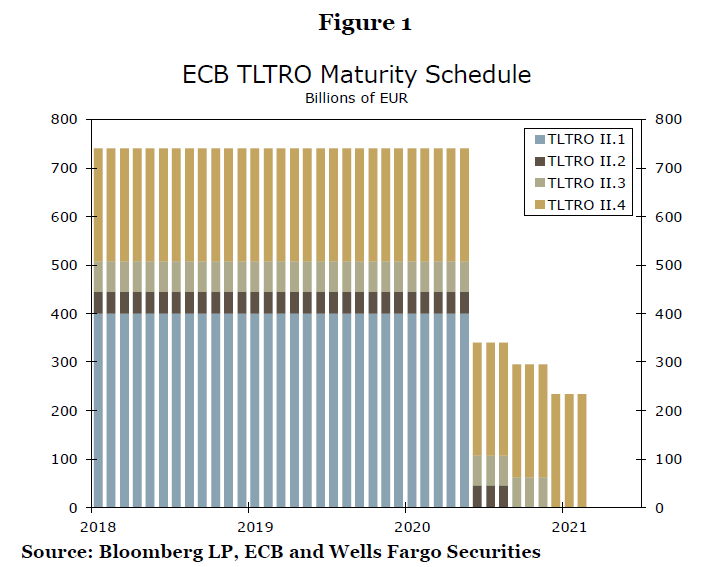
TLTROs are, in short, a means for the ECB to provide low-cost long-term funding to commercial banks in the Eurozone, ultimately as a means of encouraging those banks to lend to the private sector, particularly non-financial corporates. Indeed, commercial banks must meet a minimum lending target to receive these loans for the full timeframe. The last round of TLTROs (TLTRO II) was allotted in four disbursements during 2016-17, and loans allotted during the first of those disbursements are set to start expiring in June 2020. While that is still more than a year away, the potential decline in liquidity could be dramatic if the ECB does not offer a new round of TLTROs and if the loans are simply allowed to expire (Figure 1). For reference, the current amount of TLTROs outstanding represents about 40% of excess liquidity in the Eurozone and about 6% of GDP. Moreover, that liquidity reduction could begin sooner than June 2020 if banks start to repay those loans in size before they are due to expire.1 Meanwhile, aside from potential liquidity concerns, the Eurozone economy has weakened considerably in recent months, and lending activity has shown signs of modest slowing. Accordingly, ECB policymakers are starting to consider whether a new round of TLTROs is warranted.
Why Do More Loans?
Let us first consider why the ECB might announce another round of TLTROs. One reason that might seem obvious is to address the potential liquidity drain that is set to occur starting in June 2020 if the loans are simply left to expire. However, that is more than a year away, and it seems too early in our view for the ECB to announce new loans to help banks refinance some or all of the old ones. What if banks repay those loans early and the liquidity reduction happens earlier than June 2020? That is a legitimate concern because Eurozone commercial banks may be motivated to repay their loans early—specifically, one year before maturity—for regulatory reasons which are beyond the scope of this report. However, the ECB has explicitly stated that it will not do another round of TLTROs for regulatory reasons.
Instead, we think the main reason the ECB would announce another round of TLTROs at this time would be for monetary policy purposes, including spurring increased bank lending and sending accommodative policy signals to support a weaker economy. Thus, if the ECB decides to announce TLTROs later this week, we expect markets to read it as a signal that the ECB is not confident in the current state of lending activity or the domestic economy more broadly.
Still, the details of any announcement will matter. The last round of TLTROs were offered for four years at a fixed rate of -0.40-0.00%. Yes, under TLTRO II, banks could effectively be paid by the ECB to lend if they reached certain lending thresholds. We doubt the ECB will offer funding at quite such attractive levels under any new TLTRO program, but even if they allot funding at a fixed rate of 0.00%, that would probably be considered generous and read as dovish. More austere would be a variable rate offer based on an average interest rate over the life of the loan—these were the terms of the original Long-Term Refinancing Operations (LTRO) in 2011. The term of the loans will also matter—three or four years will probably be seen as fairly dovish, while two years or less should be taken as more hawkish.
What if the ECB does not announce TLTROs next week? As usual, the message will matter, and Draghi will certainly do what he can to massage expectations. The most hawkish scenario would be one in which Draghi says it will not do a new round of TLTROs either now or at subsequent meetings. We see no reason for the ECB to be so aggressively hawkish, particularly given the weakness in the economy, and instead expect the central bank to keep the door open to announcing more TLTROs at a later date. Our base case scenario is that the ECB does not announce TLTROs at its meeting this week but leaves the door open to a new round of loans at subsequent meetings. Recent data show lending to non-financial corporates in the Eurozone has slowed, but not dramatically, and we think the ECB will opt for a wait-and-see approach amid tentative signs of stabilization in the economy.
Overall, while our base case is that the ECB will not announce a new round of TLTROs this week, we still think rate hikes are a long way off (we expect the first deposit rate hike in December). The June meeting seems to be the most likely candidate for its next rate signal, and thus could be the key one to watch in assessing whether the euro is in fact eventually headed higher on a more sustained basis.
Market Morning Briefing: Aussie Seems To Be Breaking Below Immediate Support At 0.71
STOCKS
Asians are trading in red following the overnight sell-off in the US markets. Some consolidation / correction within the overall uptrend seems likely in the global equities in the coming days. The Sensex and Nifty 50 which were closed on Monday on account of a public holiday may open on a negative note taking cues from the Asian indices.
Dow Jones (25,819.65, -206.67, -0.79%) witnessed a sharp fall on Monday. It has closed decisively below the psychological level of 26,000 and keeps the view intact for a test of 25,750. A break below 25,750 can test 25,600.
DAX (11,592.66, -9.02, -0.08%) is mixed. It has support at 11,500 which can limit the downside in the near term. While above 11,500 the outlook will remain positive for the index to move up to test 11,750 and 11,800 levels going forward.
Nikkei (21,690.06, -131.98, -0.60%) can test the 21,600-21,500 support region in the coming sessions. A bounce thereafter will have the potential to take the index higher towards 22,000.
Shanghai (3,027.30, -0.28, -0.0092%) spiked to 3,090 on Monday and has come-off sharply from there. A test of 3,000 is likely in the near term. A range bound move between 3,000 and 3,100 can be seen for some time.
Sensex (36,063.81, +196.37, +0.55%) and Nifty 50 (10,863.50, 71.00, 0.66%) has a significant support at 35,730 and 10,750. Though a test of these supports cannot be ruled out in the near term, the outlook will turn negative only if the indices break below these supports.
COMMODITIES
Oil continues to consolidate. Gold and Silver has tumbled as against our expectation, breaking below their key supports. Near-term view is negative for them. Copper is on a corrective fall. It can dip further before reversing higher again.
Contrary to our expectation, Gold (1286) and Silver (15.1) has declined breaking below their key support levels of 1300 and 15.55 respectively. While below 1295, gold can test 1280 and 1275 in the coming sessions. Silver on the other hand can fall to 14.85 on a break below 15.
Copper (2.92) broke below 2.93 and fell to test 2.90. A further dip to 2.89-2.88 in the near term cannot be ruled out before the overall uptrend resumes.
Brent (65.55) is holding above its support at 64. The sideways range movement between 64 and 68 remains intact. Within this range, while above 65, a rise to 67 is possible in the near term. WTI (56.4) remains mixed and is continuing to remain range bound between 55 and 58.
FOREX
Overall currencies are mixed. While Dollar has some scope of strengthening in the near term, it may not be sustained in the longer horizon. Need to watch important support and resistance levels in the near term while most of the currencies could be ranged within narrow zones just now.
Dollar-Index (96.68) rose from levels near 95.82 seen last week instead of falling further towards 95. While the index trades higher, it could test 97.0-97.50 on the upside before coming off from there again towards 96-95.75 levels. Only on a break above 97.50, if seen would indicate bullishness towards 98.50 in the medium term.
Euro (1.1336) has come off well from 1.1420 levels but need to continue towards 1.13-1.1250 levels in the near term. Overall an initial fall towards 1.1250 is possible before rising back towards 1.1450.
Euro-Yen (126.81) has important near term resistance at 127.60 on the daily candles and while that holds, a corrective dip towards 126 or lower is possible in the coming sessions. Near term looks bearish below 127.60.
Dollar Yen (111.88) is rising well towards resistance at 112.5 from where a rejection towards 111 is possible in the near term. Immediate region of trade is between 112.50 and 111.00.
Pound (1.3172) has immediate support near 1.3150 which if holds could pull pound higher towards 1.3350 or higher again in the near term. On the other hand, a break below 1.3150 could be medium term bearish with a possible downside target of 1.2950.
Aussie (0.7075) seems to be breaking below immediate support at 0.71 and that could open up chances of testing further lows of 0.695 in the coming sessions. Only an immediate bounce back from current levels could prevent further fall and instead turn it upwards targeting 0.72-0.7250 again.
USDCNY (6.6995) is holding above 6.66 well and looks bullish in the near term towards 6.72 from where a corrective dip looks possible.
Dollar Rupee (70.9150) could trade in the 71.0-70.60 region with a possible extension to 71.25 on the upside. Only a break below 70.60, if seen would open up chances of testing 70.20 on the downside. For now we may expect 70.60 to hold for a few sessions.
INTEREST RATES
The US yields are trading lower. The 2Yr (2.54%), 5Yr (2.53%), 10Yr (2.72%) and 30Yr (3.09%) have fallen from 2.57%, 2.56%, 2.75% and 3.12% respectively. The fall could extend for a few sessions taking the 10Yr towards 2.69% and 30Yr towards 3.06%. The 5Yr could head towards 2.49%. Near term looks bearish for the US yields.
The US-JGB 10Yr (2.72%) has dipped a bit and could re-test support near 2.66% before again trying to rise from there.
The UK-US 10YR (-1.45%) has risen sharply but could soon see a corrective dip from current levels targeting -1.51%.
The 10Yr GOI (7.5558%) has immediate support near 7.52-7.50% from where arise towards 7.70% is possible in the near term. This could indicate that Rupee could possibly trade weaker against the US Dollar in the coming sessions.