

Sample Category Title
No Major Changes Likely to ECB’s Rate Guidance
- Minor downgrades to ECB's growth outlook
- Guidance on rates to remain unchanged, but its flexibility may be emphasised Prospect of new TLTRO's in June
- Gently positive for EUR/USD and EUR rates
We retained two things from the ECB's first policy meeting of the year back in January. First, the central bank didn't wait for new growth and inflation projections to downgrade the balance of risks to the eco scenario. The central bank clearly stated that they moved to the downside. Second, ECB President Draghi highlighted a split between governors who fear that the temporary slowdown will affect the confidence channel and hence take on a permanent character and those who expect that weakness would likely be temporary and would accordingly be irrelevant given the medium term orientation of ECB policymaking.
Over one month has passed since the January 24 ECB meeting and developments in the interim have been broadly consistent with the second view that current weakness may prove temporary. From an event risk point of view, the economic clouds are not quite as dark. US President Trump dropped (at least for now) his threat to impose 25% tariffs on all Chinese exports, the probability of a hard or no-deal brexit appears to have declined and the US government shutdown has ended. However, rising trade tensions between the EU and the US over car (parts) imports is a new short term risk.
The stabization of EMU eco data also suggests that the EMU economy is not in freefall and could gradually recover from a dismal Q3 and Q4 2018. Q1 2019 GDP won't be bright, but at least another big setback will be avoided. The EMU composite PMI ended a 5-month declining strike by ticking up from 50.7 to 51.4. The January and February data suggest 0.1% Q/Q growth in the first quarter. Details showed a significant dispersion between externally oriented manufacturing (weak) and domestically driven services (strong) gauges. This variation will likely prompt some ECB officials to argue that there is no pressing case to boost domestic demand further through increased monetary accommodation and that the continuation of the current very slow pace of normalization remains the appropriate policy path.
Inflation pressures remain subdued, but the situation also didn't deteriorate. EMU core inflation is stubbornly low at 1% Y/Y in February while headline inflation picked up towards 1.5% Y/Y, thanks to the revival of the oil price. Importantly, inflation expectations, as measured by the 5y5y EMU forward inflation swap, stopped declining. The measure fell from 1.7% early November to 1.43%in February. Over the past days, we've seen a welcome if modest rebound to 1.5%. The majority within the ECB is still of the view that tight labour markets and upward wage pressure will lift core inflation to the central bank's 2% inflation target over the medium term even if there is an acceptance that this process may take more time than previously thought.
The ECB council will consider new staff growth and inflation projections at this week's meeting. In December, the central bank forecasted 1.7% growth this year and in 2020 and 1.5% in 2021. CPI was expected to gradually rise from 1.6% this year to 1.7% next year and 1.8% in 2020. Growth forecasts will be subject to downward revisions, especially for 2019 given the disappointing end year figures for 2018, but the likelihood is that revisions will be relatively modest for 2020. Market expectations have been building that a new downgrade would be complemented by a change/delay in the ECB's forward guidance on interest rates. The ECB, since June last year, has vowed to keep policy rates unchanged at least though the summer of 2019. However, markets anticipate a longer wait for the first tightening move. The 3- month forward Euribor strip curve only discounts a 20 bps deposit rate hike by the end of 2020.
Recent rhetoric from prominent ECB members suggests that developments don't warrant changes to the ECB's (interest rate) normalization plans.The current wording is open ended in terms of when tightening might begin and this aspect will only become meaningless in terms of guidance as we move into summer.
At the January meeting, ECB president Mario Draghi emphasized that markets fully understood its dual nature that made it date and state contingent. Hence, as the ECB has committed not to tighten before the end of the summer and not until it is confident that inflation is clearly set on a path towards its medium term target of below but close to 2%, there is no need at present to significantly alter this forward guidance at this point in time. A pressing case for a substantive change in guidance would only be warranted now if the ECB felt financial conditions were too tight or the risks of a lasting and severe stepdown in growth and hence in inflation prospects had greatly increased.
The message from recent comments from a range of officials suggest this is not the case. Philip Lane, who succeeds chief economist Praet in June, said that Europe isn't in a "super fragile situation". The ECB's current strategy can deal with the downward revisions in data. It needs a bigger or more persistent shock (eg unemployment to go up again and inflation to actually go in reverse) to prompt action to reach the 2% inflation target over the medium term. French ECB member Villeroy de Galhau warned against applying negative interest rates for too long because of "possible adverse consequences for the smooth transmission of monetary policy". Hawkish Bundesbank governor Weidmann clearly stated that there's no acute need to adjust the ECB's rate guidance, nor to be overly pessimistic about the outlook.
One special topic likely to command increasing market attention will be the prospect of developments in regard to the ECB's liquidity providing policy. The ECB's 4 remaining outstanding Targeted longer-term refinancing operations mature between June 2020 (€379.85bn) and March 2021 (€233.2bn). The September 2020 (€44.31bn) and December 2020 (€61.48bn) maturities are smaller. Over the past months, rumours repeatedly suggested the ECB might announce an extension of these TLTRO loans by mid- 2019. The TLTRO-loans are included in commercial banks' long-term liquidity ratio's (NSFR). These will face a negative impact when the residual maturity drops below 12 months (50% haircut) and below 6 months (100% haircut). Cashstrapped banks will have to rely on market funding to replace these TLTRO's which might come at a heavy cost and effectively amount to a monetary policy tightening. We don't think that the ECB wants to send such signal. Indeed, the account of the December policy meeting suggest the matter had been raised by some governors.Therefore, ECB President Draghi might this week ask an ECB task force to exploit the options to replace TLTRO's.
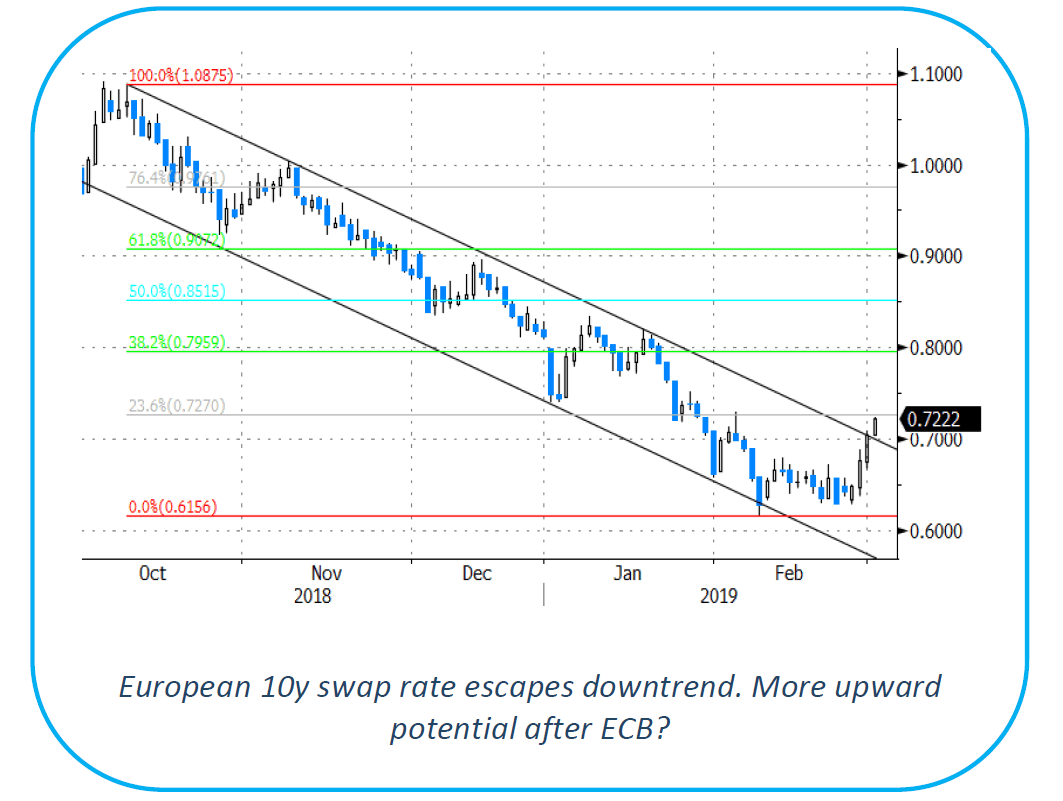
Markets currently expect a TLTRO extension. We expect a significant market reaction (widening spreads, higher yields, slightly stronger euro) if the ECB doesn't address this issue or hints at an end to the TLTRO-programme. A largely unchanged forward guidance on interest rates, ie while Mr Draghi may emphasise the policy flexibility that the current guidance allows, is also likely to keep open the option of an end of 2019 rate hike. In current market sentiment, the absence of a clear shift in ECB guidance could help the euro higher and extend the recent rebound in European yields, steepening the curve. Rather than fundamentally alter the ECB's message, Draghi could remind markets that patience has been repeatedly emphasized as a key element in the ECB's policy stance and that at least in this regard the US Federal Reserve may now be following the ECB's lead. In such circumstances, markets might enjoy new reflationary momentum with increased confidence that central banks are side-lined, event risk is diminishing and growth and inflation data may be set to pick up.
GBPUSD Faces Price Weakness With Eyes On 1.3108 Support Zone
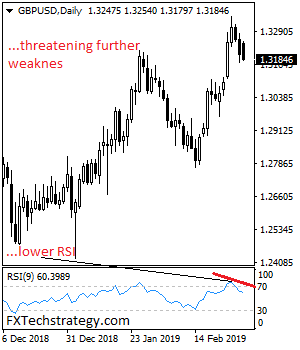
GBPUSD faces price weakness with eyes on 1.3108 support zone. This is coming on the back of a move lower the past week. Support stands at 1.3150 level. Further down, support comes in at the 1.3100 level where a break will turn focus to the 1.3050 level. Further down, support lies at the 1.3000 level. Below here will set the stage for more weakness towards the 1.2950 level. On the upside, resistance stands at the 1.3250 with a turn above here allowing for additional strength to build up towards the 1.3300 level. Further out, resistance stands at the 1.3350 level followed by the 1.3400 level. On the whole, GBPUSD faces further downside pressure on more weakness.
Sunset Market Commentary
Markets
Global core bonds edge higher today with German Bunds outperforming US Treasuries. News of the weekend was a WSJ message saying that the US and China were close to entering the final stages of the trade negotiations, lifting sentiment across Asia. The uptick in sentiment caused EU equities to open higher but surprisingly didn’t pull core bonds down. The German Bund initially stabilized overnight after last week’s sell-off and rebounded at EU opening. With an empty event calendar, there was nothing to trigger a reversal of direction. German Bunds moved higher through the day, causing the German yield curve to edge lower. Changes mount up to -1.9 bps (10-yr). US Treasuries cautiously moved higher during EU trading and didn’t change course when US investors joined the debates. Similar to the EU, there was only risk sentiment to guide trading. The US yield curve is flattening with changes in the range of -1.1 bp (30-yr) to +0.1 bp (2-yr). Greece mandated banks to syndicate a new 10-yr bond in the near future, likely tomorrow. Greek 10-yr bonds moved lower on the news. Peripheral spread over the German 10-yr yield remain stable, with only the Greek (+5 bps) and Italian (+3 bps) spreads widening.
USD trading showed a diffuse picture today as there were few important data. In the end, the trade-weighted dollar gained a few ticks. USD/JPY held a tight sideways range close to, mostly slightly below the 112 big figure. So, the yen hardly declined on the constructive headlines regarding the US-China trade talks this weekend. EUR/USD also lost quite some ground in the 1.13 big figure. Again, we didn’t see any high profile/concrete news. Markets at least were not impressed by comments from US president Trump as he wants the Fed to be cautious on interest rate hikes and not to pursue a strong dollar. Last week’s extensive, but rejected test of the 1.14 area apparently caused some short-term players to turn more cautious on EUR/USD longs. Maybe investors are also cautious on the euro in the run-up to the ECB meeting as Draghi and Co are expected to reduce growth forecasts further. In this context, we don’t expect the ECB to explicitly change its guidance on interest rates. EUR/USD is currently trading near 1.1330.
Trading in sterling was mostly technical in nature. Cable dropped from the mid 1.32 area to (temporary?) trade below 1.32. However, at least part of this move was due to an intraday rebound of the dollar. EUR/GBP hovered up and down in the upper part of the 0.85 big figure. An overall soft euro pushed EUR/GBP to the 0.8560 area, but the pair rebounded later. The UK construction PMI was of second tier importance for sterling trading, but the index dropping into contraction territory (49.5 from 50.6) didn’t help sterling. High level talks to reach an ‘amended’ Brexit deal between the UK and the EU will continue this week as the 12 March deadline looms. For now there is no concrete news to trigger a directional move of sterling. PM May’s roadmap as set out last week is still in place.
News Headlines
Sources suggest that Chinese PM Li Kequiang will announced a 3 percentage points reduction of the highest VAT rate for the manufacturing sector at tomorrow’s annual report on economic policy. The fiscal stimulus measure is forecast to deliver a 0.6% of GDP push in the economy’s back.
OPEC sources said they would delay a decision on their output policy from April to June as they want a better picture of the impact of their supply cuts. An extension is the most likely scenario at this stage. Brent crude rose back above $66/barrel.
USD/JPY Mid-Day Outlook
Daily Pivots: (S1) 111.48; (P) 111.78; (R1) 112.23; More...
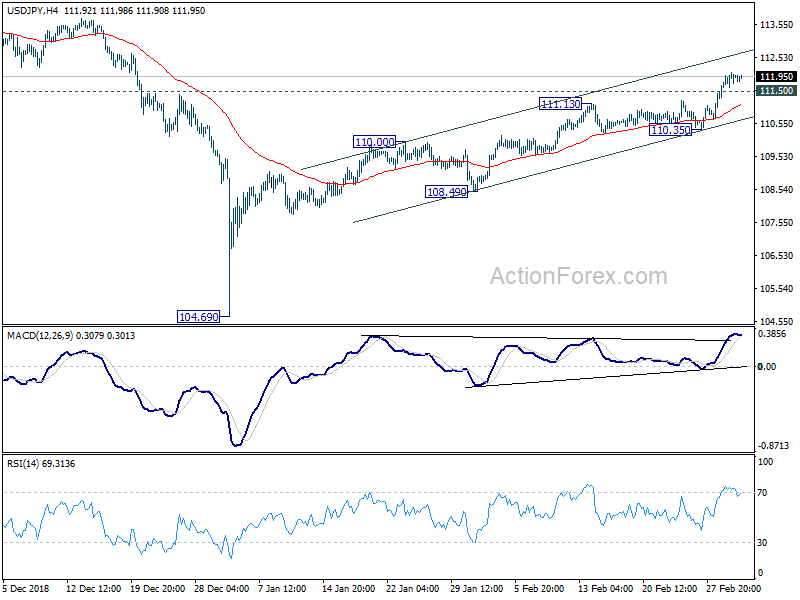
With 111.50 minor support intact, intraday bias in USD/JPY stays on the upside. Current rise from 104.69 should target 114.54 resistance next. On the downside, below 111.50 minor support will turn intraday bias neutral and bring consolidations. But downside should be contained above 110.35 support to bring another rally.
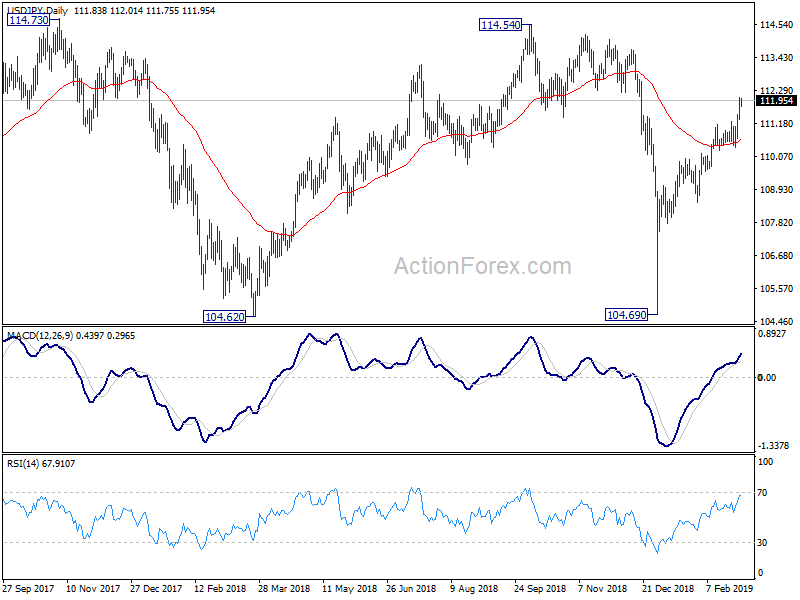
In the bigger picture, current strong rebound from 104.69 argues that decline from 118.65 (2016 high) has completed with three waves down to 104.69, after failing 104.62. More importantly, the rise from 98.97 (2016 low) could be resuming. Focus now turns back to 114.54 resistance, decisive break there will add more credence to this bullish case and target 118.65. This will now be the favored case as long as 110.35 support holds.
USD/CHF Mid-Day Outlook
Daily Pivots: (S1) 0.9966; (P) 0.9988; (R1) 1.0013; More...
Focus is now on 1.0014 minor resistance with today's rise. Firm break there will suggest that the pull back from 1.0098 is completed. Intraday bias will then be turned back to the upside for retesting 1.0098. On the downside, below 0.9926 will extend the corrective fall to 61.8% retracement of 0.9716 to 1.0098 at 0.9862. We'd look for bottoming signal again below there.
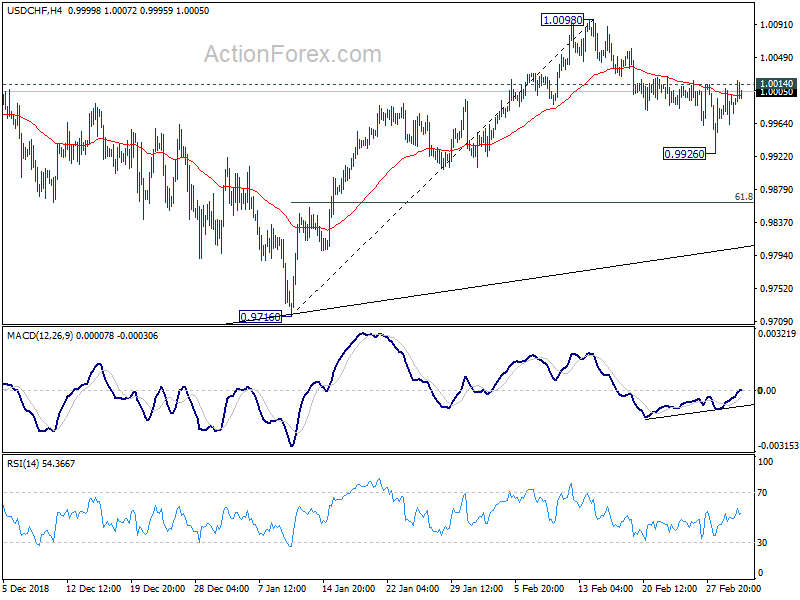
In the bigger picture, USD/CHF drew strong support from medium term trend line and rebounded. That suggests rise from 0.9186 is still in progress. Further break of 1.0128 will confirm up trend resumption and target 1.0342 key resistance. Nevertheless, break of 0.9716 will dampen this bullish view and at least bring deeper fall to 0.9541 key support.

GBP/USD Mid-Day Outlook
Daily Pivots: (S1) 1.3157; (P) 1.3221; (R1) 1.3272; More....
GBP/USD is staying in consolidation from 1.3350 temporary top and intraday bias remains neutral. Deeper retreat could be seen but downside should be contained by 1.3109 support to bring anther rally. On the upside, On the upside, break of 1.3350 will extend the rise from 1.2391 to 61.8% retracement of 1.4376 to 1.2391 at 1.3618 next. Sustained break will pave the way to 1.4376. However, break of 1.3109 will turn focus back to 1.2773 near term support instead.
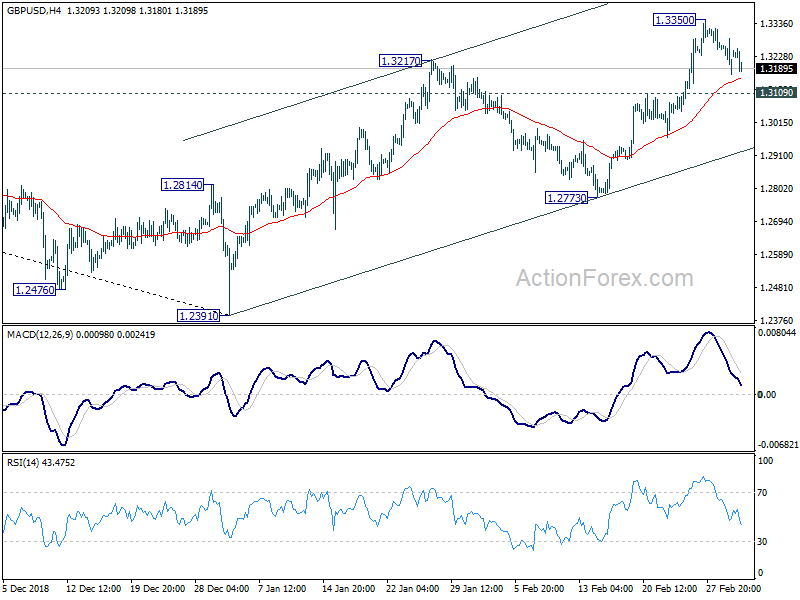
In the bigger picture, medium term decline from 1.4376 (2018 high) should have completed at 1.2391. Rise from 1.2391 is now seen as the third leg of the corrective pattern from 1.1946 (2016 low). Further rise could be seen through 1.4376 in medium term. On the downside, though, break of 1.2773 support will turn focus back to 1.2391 low and then 1.1946.
EUR/USD Mid-Day Outlook
Daily Pivots: (S1) 1.1343; (P) 1.1375; (R1) 1.1398; More.....
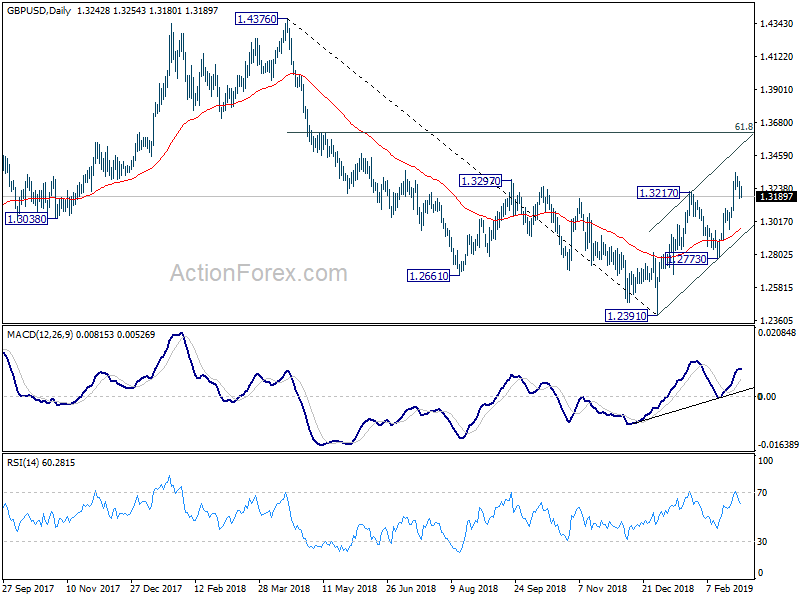
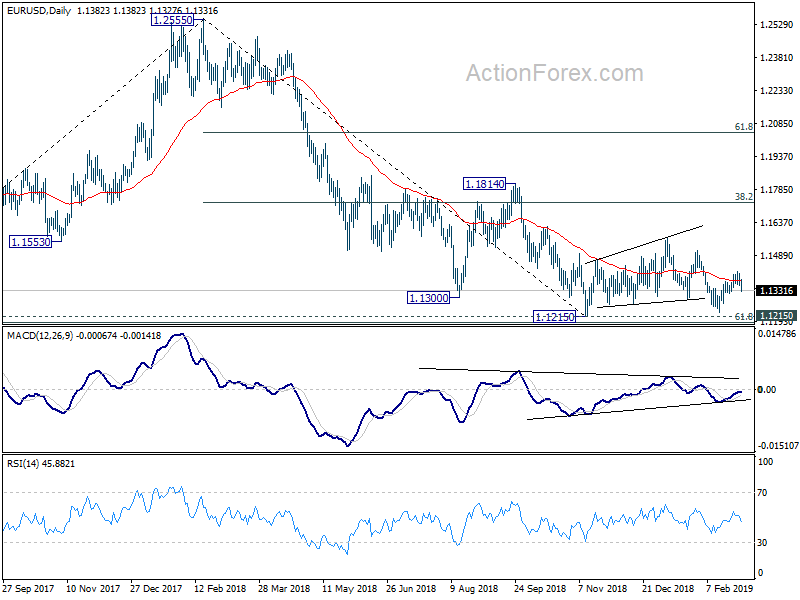
EUR/USD drops notably today and focus is back on 1.1316 minor support. Firm break there will indicate completion of rebound from 1.1234. In such case, intraday bias will be turned back to the downside for retesting 1.1215 low. On the upside, break of 1.1410 resistance will extend the rebound from 1.1234, which is a leg in the consolidation pattern from 1.1215, to 1.1514 resistance next.
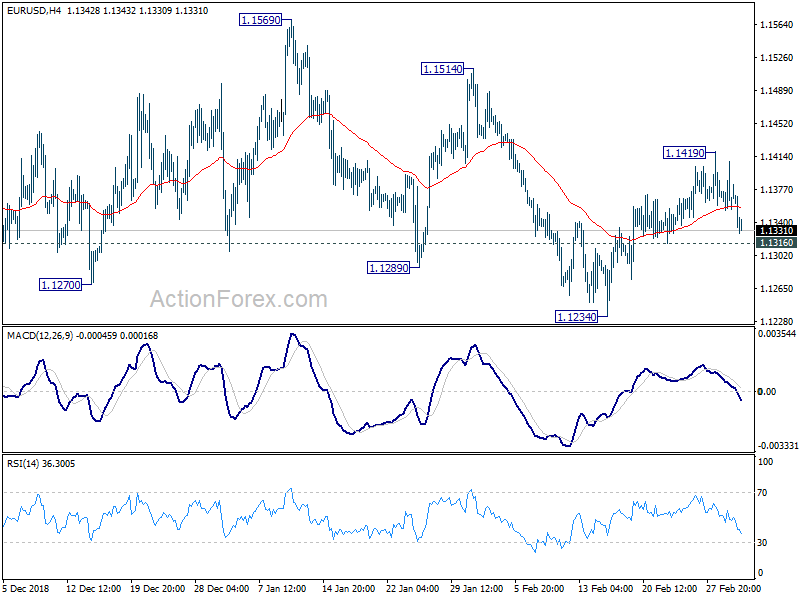
In the bigger picture, as long as 1.1814 resistance holds, down trend down trend from 1.2555 medium term top is still in progress and should target 61.8% retracement of 1.0339 (2017 low) to 1.2555 at 1.1186 next. Sustained break there will pave the way to retest 1.0339. However, break of 1.1814 will confirm completion of such down trend and turn medium term outlook bullish.
Euro Lower Despite Stabilization Signs, Risk Appetite Continues on Trade
Global stock markets are generally higher today, continuing to ride on trade optimism. White House economic adviser Kevin Hassett added to the positive mood and said US Trade Representative Robert Lighthizer has made a lot of progress with China. And the deal may be finished some time soon. Also, WSJ reported that a signing summit could be held on March 27. On the other hand, EU-US trade negotiations will also start this week.
The currency markets are relatively quiet though. Euro is trading as the weakest one today despite better than expected investor confidence data. Pull back in German yield could be a factor weighing on the common currency. Swiss Franc is follows as the second weakest and then Canadian. New Zealand and Australian Dollars are the strongest one for today so far. But gains are limited as traders guard against any dovish twist in RBA statement tomorrow. Nomura follows Westpac and forecasts RBA to cut interest rate by 50bps this year.
In other markets, FTSE is currently up 0.66%. DAX is up 0.24%. CAC is up 0.76%. German 10-year yield is down -0.0156 at 0.171. Earlier in Asia, Nikkei rose 1.02%. Hong Kong HSI rose 0.51%. China Shanghai SSE rose 1.12%. Singapore Strait Times rose 0.95%. Japan 10-year JGB yield rose 0.0103 to 0.002, turned positive.
EU Malmstrom and USTR Lighthizer to meet on March 6 on trade negotiations and tariffs
EU Trade Commissioner Cecilia Malmstrom is scheduled meet U.S. Trade Representative Robert Lighthizer on March 6 in Washington to resume trade negotiations. On the following day, Secretary-General of the European Commission, Martin Selmayr, will meet US National Economic Council Director Larry Kudlow.
European Commission spokesman Margaritis Schinas said 'the discussions will focus on the next steps toward the implementation of the July 2018 Joint Statement and on the EU-US cooperation on World Trade Organization reform and level playing field issues". He added that "the Commission will update the U.S. side on the state of play of the adoption of the negotiating mandates for EU-U.S. trade agreements on industrial goods and on conformity assessment."
Also, Schinas said "the Commission will also raise the EU's concerns on the tariffs imposed by the U.S. on steel and aluminum products and on the possible consequences of the recently concluded investigation on whether automobile imports represent a threat to the US' national security".
Eurozone Sentix shows signs on stabilization, Asia ex-Japan on the rise
Eurozone Sentix Investor Confidence improved to -2.2 in March, up from -3.7 and beat expectation of -3.1. Current Situation index dropped from 10.8 to to 6.3, lowest since September 2016 and the seventh monthly decline. Expectations Index improved to -10.3, up from -17.3. Sentix noted that the indexes are "sending signs of stablisation" and "fueling hopes that there will be no recession. However, "it is too early to give the all-clear".
And, thematically "investors expect slight support from monetary policy in the coming months from a pause in the interest rate cycle. Nevertheless, the central bank policy barometer does not give the impression that a sustained easing of monetary policy is to be expected. On the one hand, a rapid comeback of the economy would also surprise the central bank and, on the other, investors expect inflationary pressures to rise again.
On development to now in the strong improvement in Asia ex-Japan. Overall Investor Confidence index rose 9.9 to 15.3, highest since August 2018. Current Situation index rose from 22.3 to 24.5. Expectations index rose from -1.8 to 6.5, highest since March 2018. Sentix noted that the Chinese "government's measures to stimulate economic growth both in fiscal and monetary terms are well received by the investors surveyed by Sentix.
Also from Eurozone, PPI rose 0.4% mom, 3.0% yoy in January versus expectation of 0.3% mom, 2.9% yoy.
UK PMI construction dropped to 49.5, Brexit anxiety intensified
UK PMI construction dropped to 49.5 in February, down from 50.6, missed expectation of 50.5. That's also the first contraction in eleven months. Markit noted there was slight fall in construction output, led by commercial and civil engineering work. And, housing was the only category to register growth. And there was sharp deterioration in supplier performance.
Tim Moore, Economics Associate Director at IHS Markit, noted "construction sector moved into decline during February as Brexit anxiety intensified and clients opted to delay decision-making on building projects." And, "risk aversion in the commercial sub-category has exerted a downward influence on workloads throughout the year so far."
UK Cox given up Irish backstop time limit or unilateral exit
UK Brexit Minister Stephen Barclay and Attorney General General Geoffrey Cox will travel to Brussels again tomorrow to meet EU Brexit negotiator Michel Barnier. Ahead of that, the Telegraph reported that Cox has given up the request on a time-limit on the Irish backstop or unilateral exit mechanism. Cox wanted to push for an independent arbitration mechanism which both UK and EU could give formal notice to end the backstop. But such independent arbitration would be outside the jurisdiction of the European Court of Justice. That is seen as totally unacceptable by the EU.
Separately, Trade Minister Liam Fox said he would be "shocked" if EU would insist on a delay of 21 months or two years extension of Article 50, if requested. He said "the European Union does not want Britain to fight the European elections." Fox added it's still "entirely possible" for leave EU on March 29. But a short extension to Article 50 may be needed to deliver a smoother exit.
BoJ Kuroda: Will debate exit strategy when appropriate time comes
BoJ Governor Haruhiko Kuroda said there is no specific stimulus exit strategy yet as it would take "significant time" to achieve the 2% inflation target. For now, BoJ will "patiently" maintain current monetary easing while "the economy is sustaining momentum for achieving the BOJ's price target."
Though, he acknowledged that "to ensure markets remain stable, it's important to come up with a strategy and guidance at an appropriate timing on how to proceed with an exit". And, "when the appropriate time comes, we will debate at our policy meetings an exit strategy and guidance, and communicate them appropriately."
On the side effect of monetary easing, Kuroda said "there's a concern low-rate environment and competition will prolong downward pressure on financial institutions' profits. As a result I'm aware of risks that financial intermediation could stagnate and financial system could become unstable". But he added "I don't think such risks are large at the moment given that financial institutions are equipped with ample capital base."
EUR/USD Mid-Day Outlook
Daily Pivots: (S1) 1.1343; (P) 1.1375; (R1) 1.1398; More.....
EUR/USD drops notably today and focus is back on 1.1316 minor support. Firm break there will indicate completion of rebound from 1.1234. In such case, intraday bias will be turned back to the downside for retesting 1.1215 low. On the upside, break of 1.1410 resistance will extend the rebound from 1.1234, which is a leg in the consolidation pattern from 1.1215, to 1.1514 resistance next.
In the bigger picture, as long as 1.1814 resistance holds, down trend down trend from 1.2555 medium term top is still in progress and should target 61.8% retracement of 1.0339 (2017 low) to 1.2555 at 1.1186 next. Sustained break there will pave the way to retest 1.0339. However, break of 1.1814 will confirm completion of such down trend and turn medium term outlook bullish.
Economic Indicators Update
| GMT | Ccy | Events | Actual | Forecast | Previous | Revised |
|---|---|---|---|---|---|---|
| 23:50 | JPY | Monetary Base Y/Y Feb | 4.60% | 4.50% | 4.70% | |
| 0:00 | AUD | TD Securities Inflation M/M Feb | 0.10% | -0.10% | ||
| 0:30 | AUD | Company Operating Profit Q/Q Q4 | 0.80% | 3.00% | 1.90% | 1.20% |
| 0:30 | AUD | Building Approvals M/M Jan | 2.50% | 1.50% | -8.40% | -8.10% |
| 9:30 | EUR | Eurozone Sentix Investor Confidence Mar | -2.2 | -3.1 | -3.7 | |
| 9:30 | GBP | Construction PMI Feb | 49.5 | 50.5 | 50.6 | |
| 10:00 | EUR | Eurozone PPI M/M Jan | 0.40% | 0.30% | -0.80% | |
| 10:00 | EUR | Eurozone PPI Y/Y Jan | 3.00% | 2.90% | 3.00% | |
| 15:00 | USD | Construction Spending M/M Dec | 0.20% | 0.80% |
EU Malmstrom and USTR Lighthizer to meet on March 6 on trade negotiations and tariffs
EU Trade Commissioner Cecilia Malmstrom is scheduled meet U.S. Trade Representative Robert Lighthizer on March 6 in Washington to resume trade negotiations. On the following day, Secretary-General of the European Commission, Martin Selmayr, will meet US National Economic Council Director Larry Kudlow.
European Commission spokesman Margaritis Schinas said "the discussions will focus on the next steps toward the implementation of the July 2018 Joint Statement and on the EU-US cooperation on World Trade Organization reform and level playing field issues". He added that "the Commission will update the U.S. side on the state of play of the adoption of the negotiating mandates for EU-U.S. trade agreements on industrial goods and on conformity assessment."
Also, Schinas said "the Commission will also raise the EU's concerns on the tariffs imposed by the U.S. on steel and aluminum products and on the possible consequences of the recently concluded investigation on whether automobile imports represent a threat to the US' national security".
Canadian Dollar Under Pressure
The Canadian dollar has steadied in the Monday session, after sharp losses on Friday. Currently, the pair is trading at 1.3306, up 0.07% on the day. It’s a quiet start to the week, with no Canadian events and one minor event in the United States. On Tuesday, the U.S. releases ISM Non-Manufacturing PMI.
The Canadian dollar slipped almost 1 percent on Friday, after a soft GDP report. In December, the economy contracted by 0.1% for a second straight month. The economy was stagnant in Q4, with a negligible gain of 0.1%. For all of 2018, the economy expanded 1.8%, shy of the BoC target of 2.0%. The Bank of Canada has said that it expected the economic slowdown to be temporary, but a sluggish Q4 is raising concerns about the health of the economy. The BoC hiked rates three times last year, and this may have hurt consumer spending, which was weak in the fourth quarter. With economic growth headed in the wrong direction and inflation levels below the BoC target of 2.0%, BoC policymakers are unlikely to raise interest rates in the near term.
In the U.S., Friday’s numbers were a disappointment, but the dollar still held its own. Personal Spending declined 0.5%, its first decline in almost three years. The ISM Manufacturing PMI fell to 54.2, short of the estimate of 55.6 points. As well, UoM consumer sentiment improved to 93.8, but still missed the forecast of 95.8 points. The focus will be on employment numbers this week, starting with ADP nonfarm payrolls on Wednesday.