Sample Category Title
USD Strengthens On Rising Yields And Solid GDP
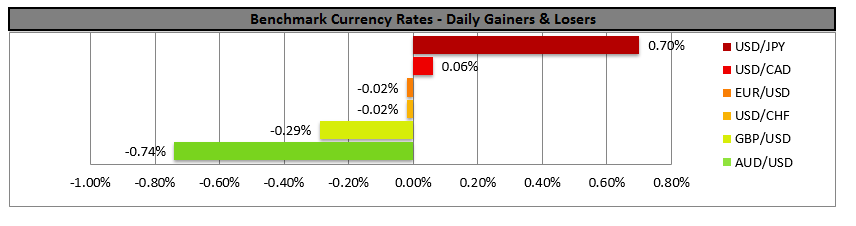
The USD strengthened against the Yen yesterday, as the US GDP growth rate exceeded expectations and US treasury yields rose. Analysts point out that the dollar may have gotten a clean break, after the Treasury yields rose and a robust US GDP growth rate for Q4. The USD had suffered some short dips against the JPY in the past two days as the tension between India and Pakistan rose and at the same time US President Trump and North Korean leader Kim walked from negotiations without a deal. Analysts also point out that even as the Fed has paused policy normalization, the rates differentials of the Fed with the ECB and the BoJ continue to support the USD. We could see the USD getting further support if US Treasury yields rise further, while at the same time be more data driven in the near term. USD/JPY rose yesterday and during today’s Asian session, as the pair broke above the 111.40 (S1) resistance line (now turned to support). Should the USD strengthen even further we could see the pair continuing to rise, however today’s financial releases could threaten such course. Should the pair find fresh buying orders along its path, we could see the pair aiming if not breaking the 112.55 (R1) resistance line. Should on the other hand the pair come under the selling interest of the market, we could see it breaking below the 111.40 (S1) support line and aim for the 110.15 (S2) support level.
EUR rallies for a short period as optimism grows
The common currency rallied against the USD for a short period yesterday, as hopes for further improvement of the economy increased. Analysts point out that the short Euro rally was due to growing expectations that the Eurozone may have turned a corner for the better. The EUR could remain heavily data dependent in the next few days as the pair seems to be in a crucial crossroad, which could affect ECB’s forward guidance in the coming months. We could see volatility extending for the EUR today as financial data may confirm or correct expectations for Eurozone. EUR/USD rose yesterday, breaking the 1.1385 (R1) resistance line and at some point threatening the 1.1420 (R2) resistance level, yet stabilized lower during the American session. We could see some bullish tendencies for the pair today, if the financial releases favor the common currency and at the same time weaken the USD. Should the bulls dictate the pair’s direction, we could see the pair breaking the 1.1385(R1) resistance line and aim once again for the 1.420 (R2) resistance level. Should on the other hand, the bears be holding the reigns of the pair’s direction, we could see it breaking the 1.1345 (S1) support line and aim for lower grounds.
Today’s other economic highlights
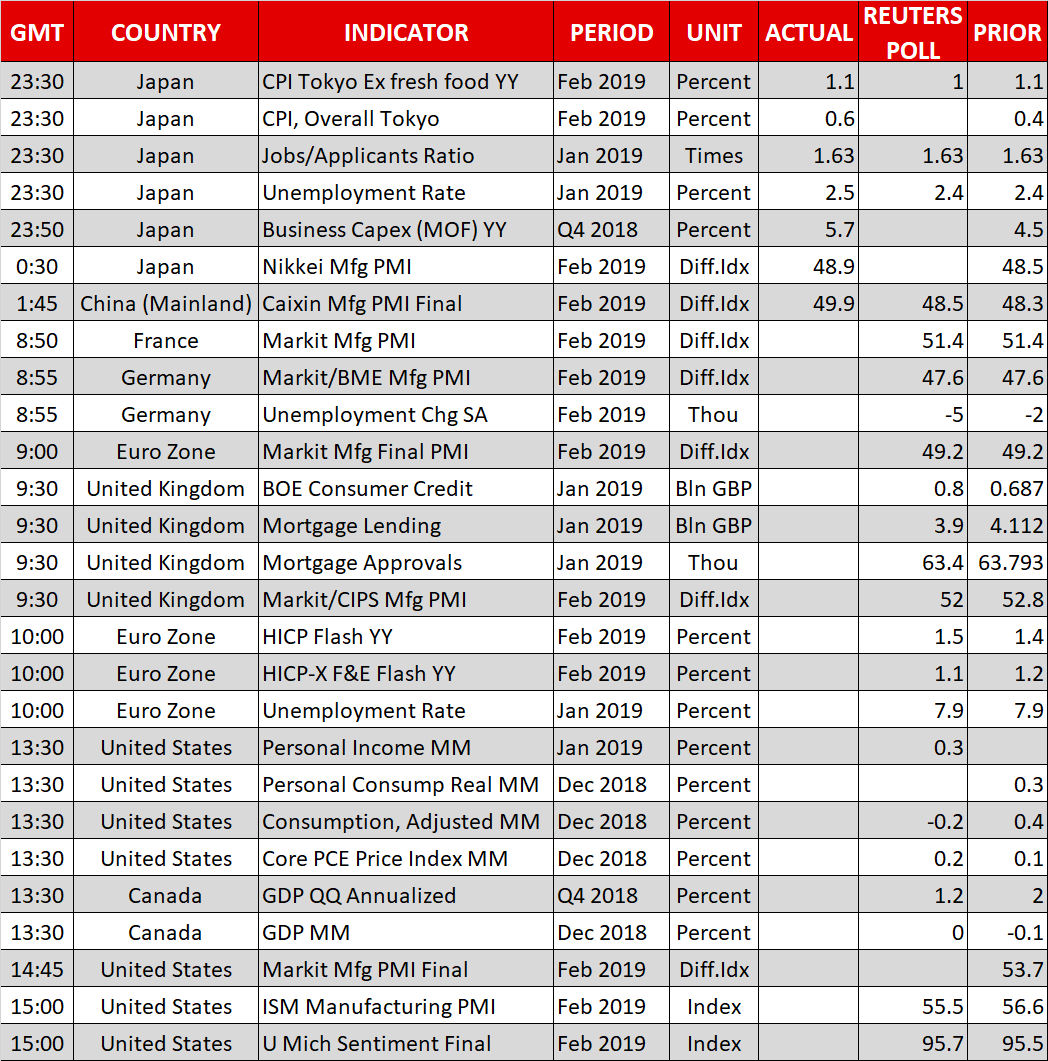
During the European session today, we get Germany’s final Mfg PMI for February, Germany’s unemployment data for February, UK’s manufacturing PMI for February and Eurozone’s preliminary CPI rate for February as well as Eurozone’s unemployment rate for January. In the American session from the US we get the consumption rate for December, the core PCE Price Index for December, the ISM manufacturing PMI for February, the final Michigan Consumer Sentiment for February, while from Canada the GDP growth rate for Q4. As for speakers, please note that Atlanta Fed president Raphael Bostic speaks.
USD/JPY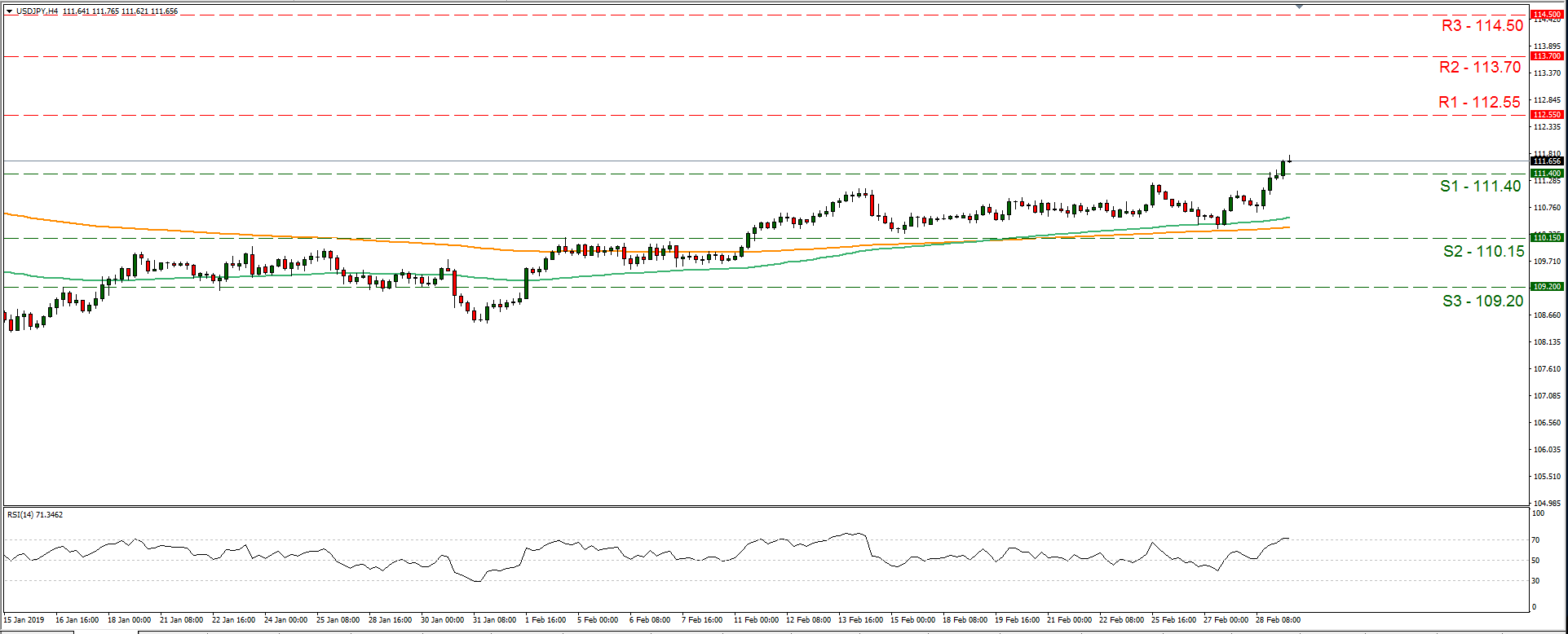
Support: 111.40 (S1), 110.15 (S2), 109.20 (S3)
Resistance: 1112.55 (R1), 113.70 (R2), 114.50 (R3)
EUR/USD H4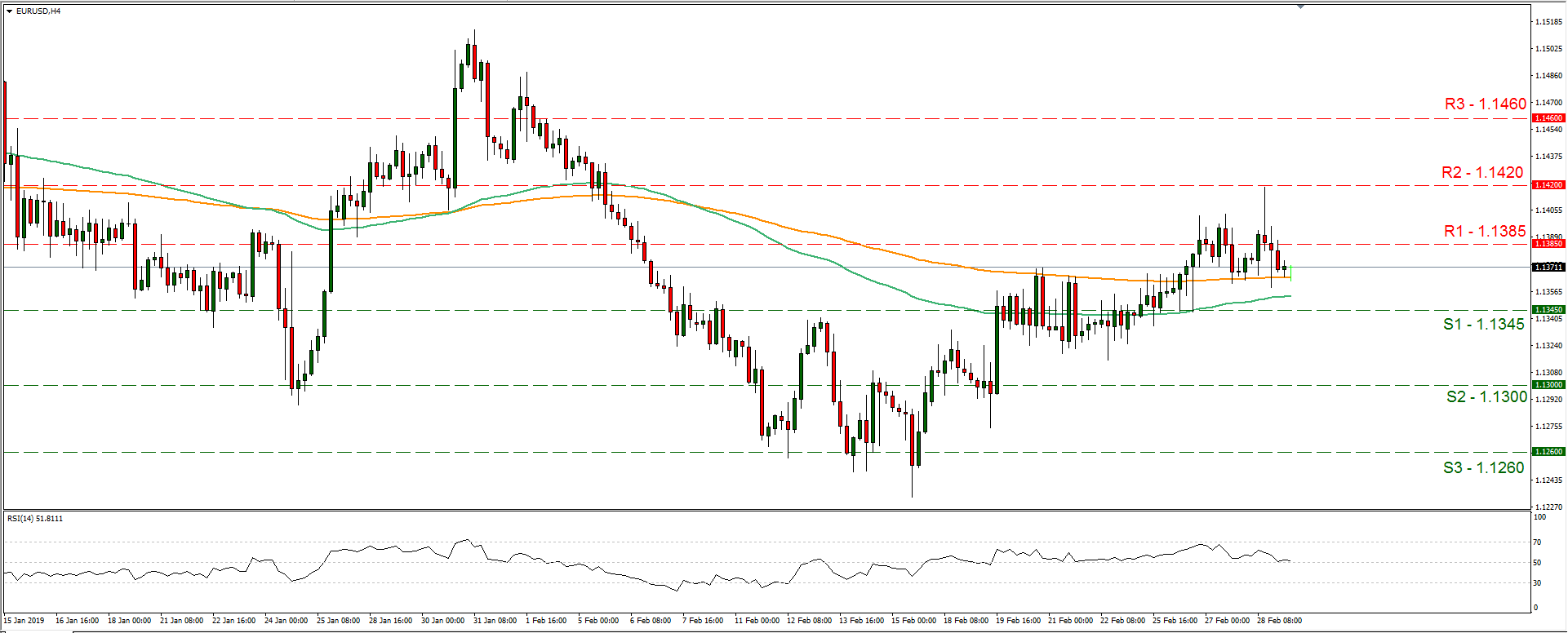
Support: 1.1345 (S1), 1.1300 (S2), 1.1260 (S3)
Resistance: 1.1385 (R1), 1.1420 (R2), 1.1460 (R3)
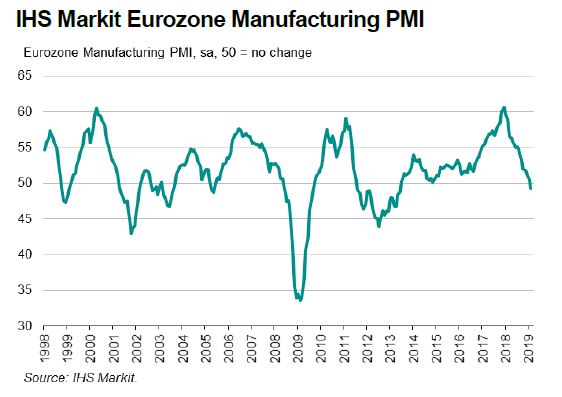
Eurozone PMI manufacturing: Deepest downturn for almost six years
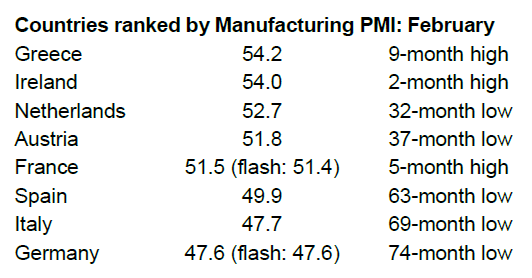
Eurozone PMI manufacturing is finalized at 49.3 in Febuary, up from initial estimate of 49.2, but down from January's 50.5. That's also the first contraction reading since June 2013. Markit ntoed there were concurrent declines in output and new orders. Also, price pressures continued to soften. Among the countries, Germany PMI manufacturing was finalized at 74-month low at 47.6, Italy at 69-month low at 57.5, Spain at 63-month low at 49.9. Though, France recovered to 3-month high at 51.5.
Commenting on the final Manufacturing PMI data, Chris Williamson, Chief Business Economist at IHS Markit said:
"Euro area manufacturing is in its deepest downturn for almost six years, with forward-looking indicators suggesting risks are tilted further to the downside as we move into spring.
"Most worrying is the downward trend in new orders. Orders are falling at a faster rate than output to a degree not seen for seven years, meaning production is likely to be pared back further in coming months unless demand revives. The new orders to inventory ratio has also fallen to its lowest since 2012, with many companies reporting excess warehouse stocks.
"Spare capacity is consequently developing, which means companies are likely to take a more cautious approach to hiring and investment, and instead focus on cost control.
"The weakening demand environment has meanwhile been accompanied by a marked easing of inflationary pressures to the lowest since late- 2016. Cost inflation has eased, but companies also report a lack of pricing power.
"The downturn is being led by Germany and Italy, but Spain has also now fallen into contraction and only modest expansions are being seen in France, Austria and the Netherlands.
"In addition to widespread trade war worries, often linked to US tariffs, and concerns regarding the outlook for the global economy, companies report that heightened political uncertainty, including Brexit, is hitting demand and driving increased risk aversion."
Also released, Germany retail sales rose 3.3% mom in January, above expectation of 1.9% yoy. Unemployment dropped -21k in February while unemployment rate was unchanged at 5.0%. From Swiss, retail sales dropped -0.4% yoy in January versus expectation of 0.4% yoy. Swiss PMI manufacturing rose to 55.4, up from 54.3 and beat expectation of 55.4.
Yen Crumbles As Risk Sentiment Improves, Dollar Rebounds
- Dollar rebounds after US GDP beats expectations, looks to ISM manufacturing index
- Yen falls to two-month lows as solid Chinese PMIs reinvigorate risk appetite
- Busy schedule today: Eurozone inflation data, UK manufacturing PMI, Canadian GDP
Dollar inches up as US GDP tops forecasts, but stocks struggle
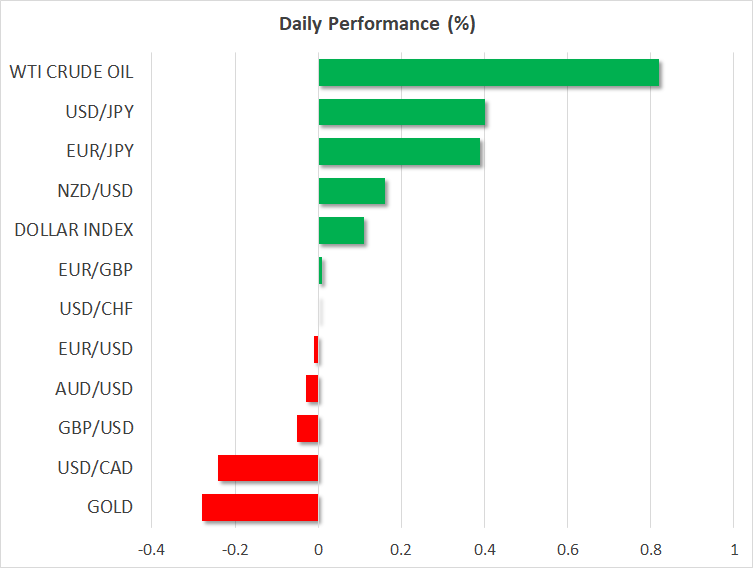
The dollar was the main winner in Thursday’s session, drawing support from stronger-than-anticipated US GDP data for Q4 to outperform all its G10 peers outside of the Swiss franc. Economic growth clocked in at a 2.6% annualized pace, overcoming the forecast for a more severe slowdown to 2.3%, and likely allaying some concerns around the health of the US economy. Accordingly, US Treasury yields rose as investors cut back on Fed rate-cut bets, with the market implied odds for a rate cut this year shifting back towards zero.
Despite the ‘good news’ on the economy, US stock markets struggled, closing modestly in the red for a third straight session as the fading probability for near-term Fed easing likely curbed the appeal of riskier assets. That said, futures are pointing to a much higher open today, following some trade headlines that US officials are preparing a final deal that could be signed by the two Presidents as soon as mid-March. Solid manufacturing PMI data out of China overnight are probably helping as well (see below).
Today, the dollar and US equities will take their cue from a raft of crucial data releases. Personal income and spending, as well as the core PCE prices index for December are all on the docket, though considering that these may be seen as somewhat out-of-date by now, traders could pay more attention to the ISM manufacturing PMI for February.
Yen crumbles as China’s Caixin PMI rebounds, calms slowdown fears
Asian markets are mostly higher on Friday, after China’s Caixin manufacturing PMI for February rose by more than expected, calming some nerves around a prolonged slowdown in the world’s second-largest economy. The solid print probably came as a surprise, considering that the official manufacturing PMI for the same month – released yesterday – declined further into contractionary territory, sending the opposite signal on growth.
Consequently, the safe haven Japanese yen is getting hammered in this risk-on environment, touching fresh two-month lows against both the dollar and the euro. Separately, news that Pakistan will release a captured Indian pilot as a ‘peace gesture’ likely eased fears regarding an escalation in the geopolitical sphere, further weighing on the defensive yen. The outlook for the yen remains clouded, particularly considering that economic data out of Japan have been losing steam lately, putting to bed speculation for any BoJ tightening in the foreseeable future.
Day ahead: Euro area inflation, UK manufacturing PMI, Canadian GDP data
The calendar is relatively packed on Friday, as besides the above-mentioned US releases, there are also several other first-tier data on the schedule.
Out of the Eurozone, preliminary inflation figures for February could shed some light on whether or not the ECB will recalibrate its policy language in a more dovish direction at next week’s policy meeting. It’s noteworthy that the bloc’s composite PMI for the month showed that prices charged rose at the slowest pace in 18 months, which suggests scope for a negative surprise in the CPIs today. Any disappointment, particularly in the core rate, could drag the euro lower.
In the UK, the manufacturing PMI for February is due, though as always, the pound will likely be more responsive to anything Brexit-related.
In Canada, GDP data for Q4 will hit the markets. The loonie has firmed a little lately, supported by the recovery in oil prices; the correlation between these two assets has returned with a vengeance lately, after disappearing for most of last year.
Forex Technical Analysis: EUR/USD, USD/JPY, GBP/USD
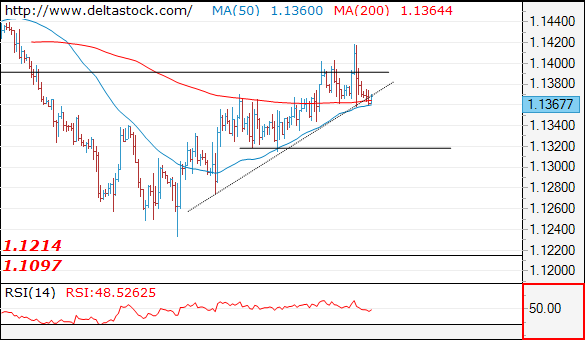
EUR/USD
Current level - 1.1367
The minor reversal at 1.1420 could be the final spike of the upmove since 1.1230 low, so my outlook is bearish, for a slide towards 1.1320, en route to 1.1230.
| Resistance | Support | ||
| intraday | intraweek | intraday | intraweek |
| 1.1420 | 1.1630 | 1.1320 | 1.1214 |
| 1.1450 | 1.1820 | 1.1275 | 1.1100 |
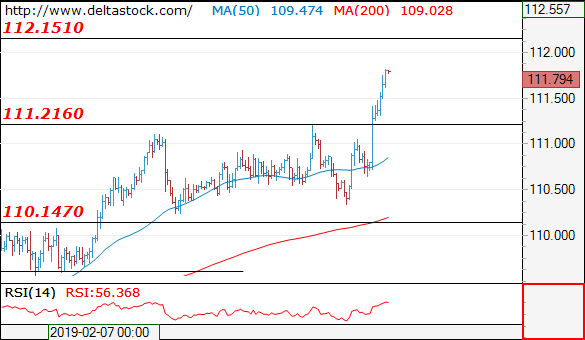
USD/JPY
Current level - 111.79
The violation of 111.20 hurdle signals a renewal of the uptrend, currently focused on 112.15 resistance. Initial intraday support lies at 111.20.
| Resistance | Support | ||
| intraday | intraweek | intraday | intraweek |
| 112.15 | 113.00 | 111.20 | 110.20 |
| 113.00 | 114.50 | 110.20 | 108.50 |
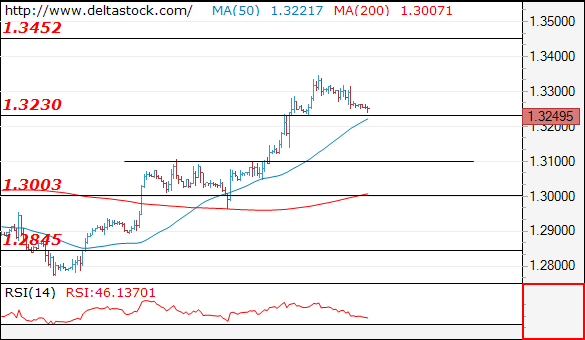
GBP/USD
Current level - 1.3249
The bias is still bearish within the slide since 1.3350 peak and an eventual break through 1.3230 will extend the losses towards 1.3100 static support.
| Resistance | Support | ||
| intraday | intraweek | intraday | intraweek |
| 1.3350 | 1.3290 | 1.3230 | 1.2800 |
| 1.3450 | 1.3450 | 1.3100 | 1.2610 |
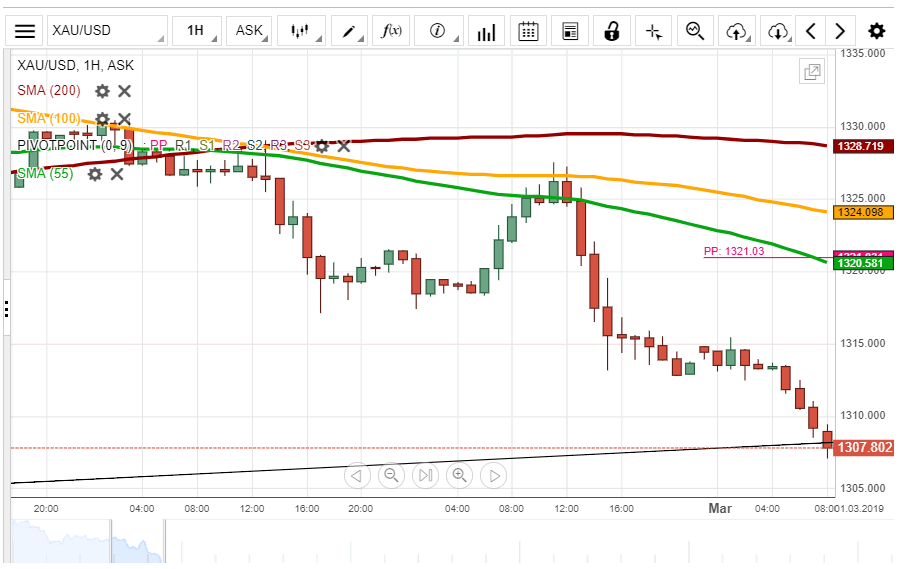
Gold Drops Below 1,310.00
The fundamental strength of the US Dollar has caused a drop of gold prices below the long term support line. By the middle of Friday's trading session on the hourly chart the metal had no support as low as 1,295.13.
Although, take into account that the 1,300.00 level will provide support. In general, there are two scenarios. First one is a simple continuation of the decline due to the lack of support.
On the other hand, such sharp moves like the one just experienced are often followed by a period of consolidation. Namely, the metal might trade sideways.
Meanwhile, take into account that the long term support line is show incorrectly on the hourly chart. First zoom out and that way load the previous price information. Then the line will have available exact reference points.
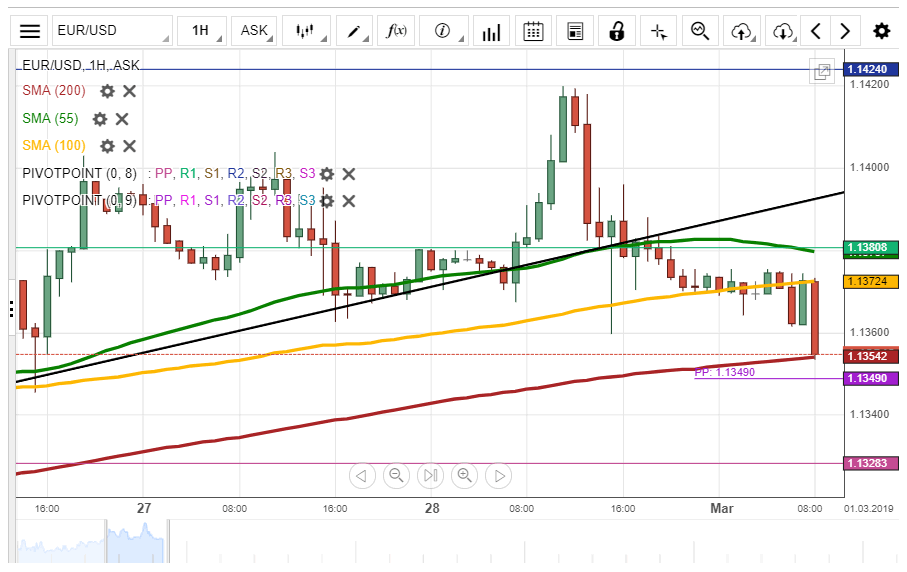
EUR/USD Retreats To 1.1370
The EUR/USD has passed the lower trend line of the ascending pattern. Although it occurred after reaching the 1.1400 mark for a third time, as expected. Moreover, the pair reached above it to the 1.1420 level.
On Friday, the rate was squeezed in between the technical levels that were providing resistance at 1.1380 and the support levels at 1.1365 and 1.1355. In addition, the 100-hour SMA was crossing the hourly candles at 1.1373.
In general, watch the pair closely, as passing the resistance at 1.1380 or the support at 1.1350 would signal a larger move up or down.
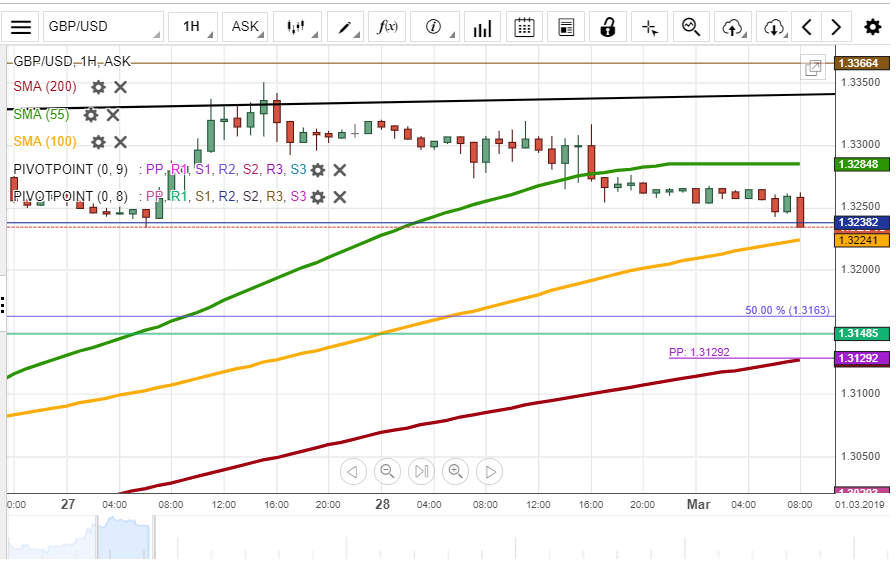
GBP/USD Might Get Squeezed In
GBP/USD continued to retreat on Friday morning. The rate passed the support of the 55-hour SMA and retreated down to the weekly R2 at 1.3238.
The future short term forecast is built around the 55 and 100-hour SMAs and the weekly R2. It could be observed that the SMAs were set to meet one another and squeeze the rate at the weekly R2.
The squeeze should result in a break out to either the upside and 1.3366 or a drop down to 1.3160.
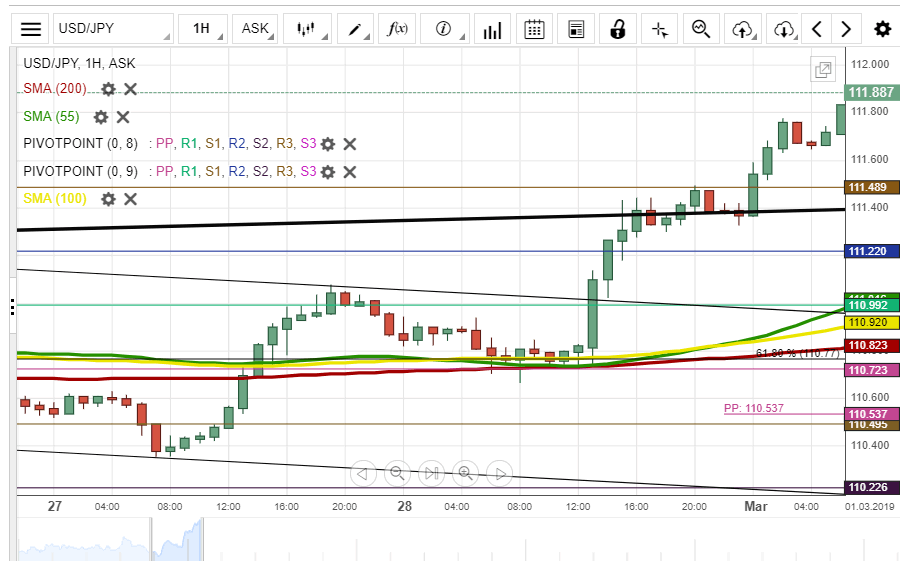
USD/JPY Jumps And Breaks All Resistance
The USD/JPY has made another large fundamental move. The rate has suddenly surged, breaking all the previously used pattern trend lines.
Although, our forecast had described a surge that would occur from the 110.80 level. If one would have used properly trailing stop losses, he should still be in a profitable position that caught the whole move.
In regards to the near term future, the pair is expected to reach for the 112.00 level, where it would test the psychological resistance of this round level.
EUR/JPY Daily Outlook
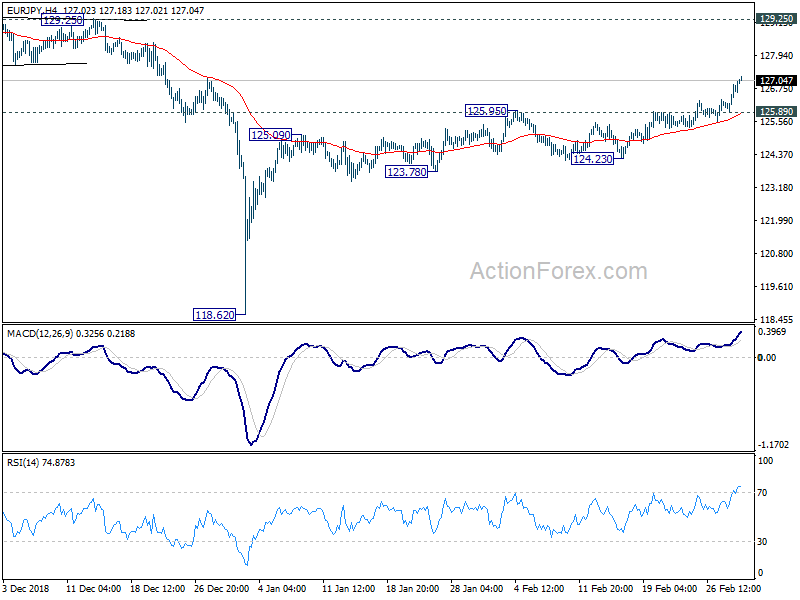
Daily Pivots: (S1) 126.06; (P) 126.48; (R1) 127.08; More....
Intraday bias in EUR/JPY remains on the upside. Current rise from 118.62 low should target 129.25 resistance next. Decisive break there will target 133.12 key resistance. On the downside, below 125.89 minor support will turn intraday bias neutral first. But near term outlook will remain cautiously bullish as long as 124.23 support hoods.
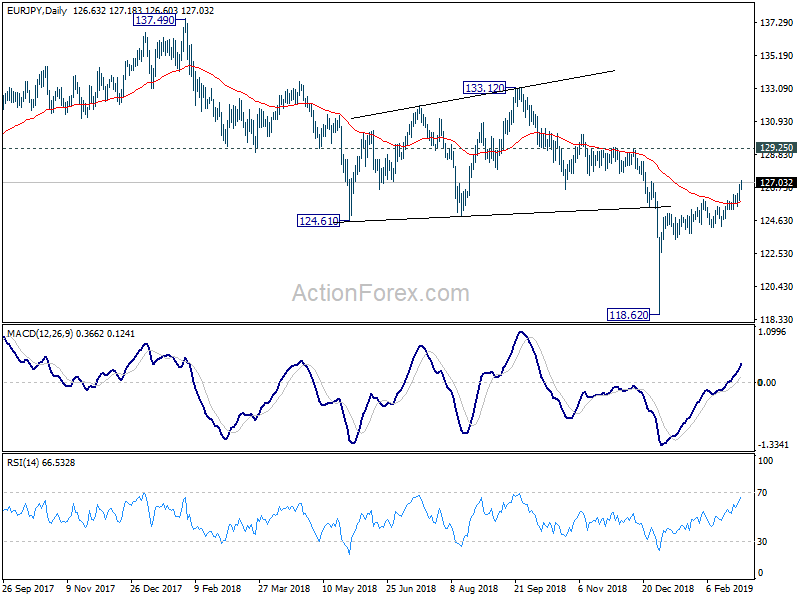
In the bigger picture, current development argues that medium term decline from 137.49 (2018 high) has completed at 118.62 already. Decisive break of 133.12 resistance will confirm this bullish case. And whole up trend from 109.03 (2016 low) might resume through 137.49 in that case. On the downside, break of 124.23 support will invalidate this case and turn focus back to 118.62 instead.
GBP/JPY Daily Outlook
Daily Pivots: (S1) 147.05; (P) 147.65; (R1) 148.31; More...
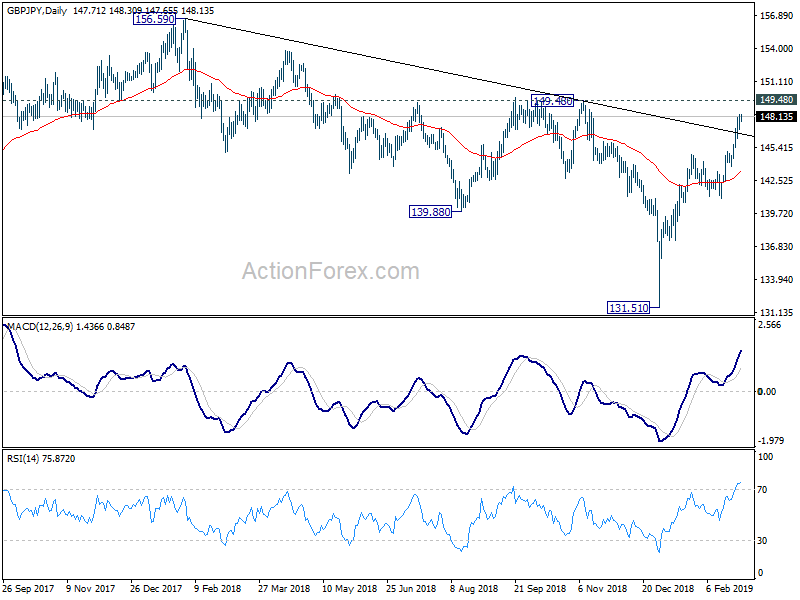
Intraday bias in GBP/JPY remains on the upside at this point. Current rally from 131.51 should target 149.48 resistance next. Decisive break there will pave the way to 156.95 key resistance next. On the downside, below 146.98 minor support will turn intraday bias neutral for consolidation first. In case of deeper pull back, downside should be contained by 141.00/144.84 support zone to bring rally resumption.
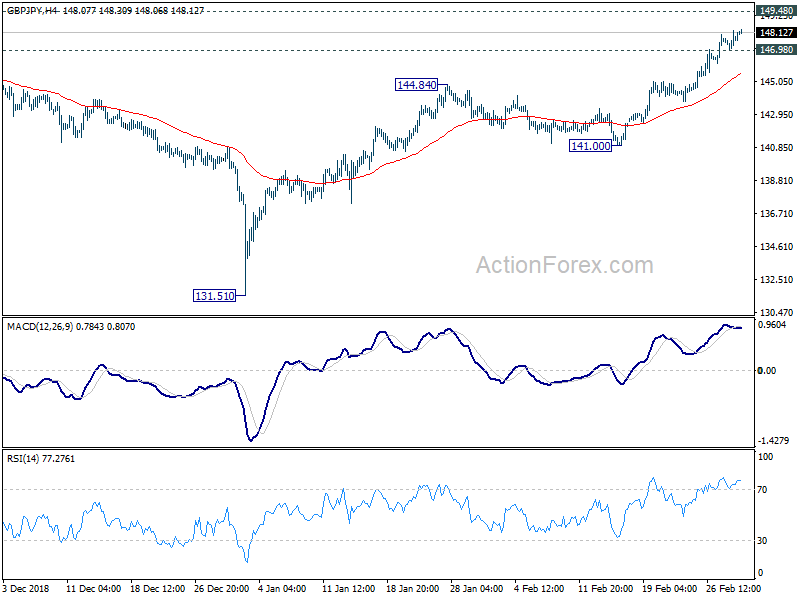
In the bigger picture, the strong rebound from 131.51 suggests that medium term fall from 156.59 (2018 high) has completed already. The corrective structure of such decline in turn argues that it's the second leg of the corrective pattern from 122.36 (2016 low). And this pattern is starting the third leg. On the upside, decisive break of 149.48 will pave the way to 156.59 resistance and above.