Sample Category Title
USD/CAD Outlook: Loonie Tumbles after Weak Canada GDP Data
The Canadian dollar fell almost a hundred pips against its US counterpart on Friday, pressured by downbeat Canada's GDP data.
Canada's economy grew 0.4% y/y in Q4, decelerating significantly from Q3 growth of 2%.
Monthly figure also disappointed expectations (Dec m/m -0.1% vs 0.0% f/c) in line with previous month release (-0.1).
The growth slowed mainly due to lower crude oil export prices and is at its lowest pace since Q2 2016.
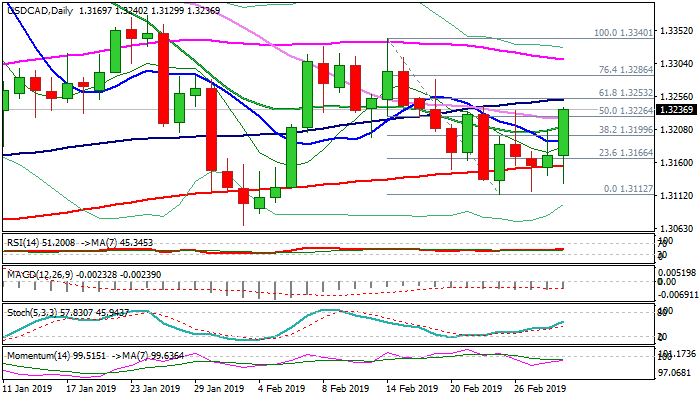
Today's USDCAD's bounce pushed the price from dangerous zone after descend from 1.3340 (14 Feb high) based at 1.3120 zone and was contained by rising 200SMA (currently at 1.3156).
Fresh recovery surged through barriers provided by 10;20 &30SMA's and so far retraced over 50% of 1.3340/1.3112 bear-leg.
Near-term sentiment is turning positive and daily techs improved, setting scope for further advance.
Bulls pressure 100SMA/Fibo 61.8% of 1.3340/1.3112 (1.3251), break and close above which would add to positive outlook.
Weaker than expected US personal spending data (Dec -0.5% vs -0.2% f/c and 0.6% prev) showed minor negative impact, with focus turning on US ISM Manufacturing PMI data for fresh signals.
Res: 1.3251; 1.3286; 1.3310; 1.3340
Sup: 1.3226; 1.3212; 1.3190; 1.3156
USD/JPY Mid-Day Outlook
Daily Pivots: (S1) 110.87; (P) 111.18; (R1) 111.70; More...
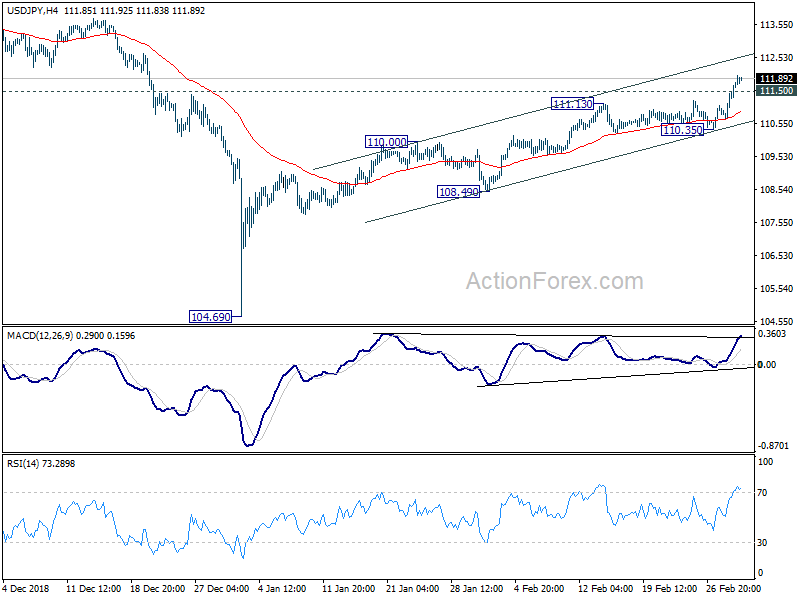
USD/JPY accelerates further to as high as 111.98 so far today and intraday bias stays on the upside. Current rally from 104.69 should now target 114.54 resistance next. On the downside, below 111.50 minor support will turn intraday bias neutral and bring consolidations. But downside should be contained above 110.35 support to bring another rally.
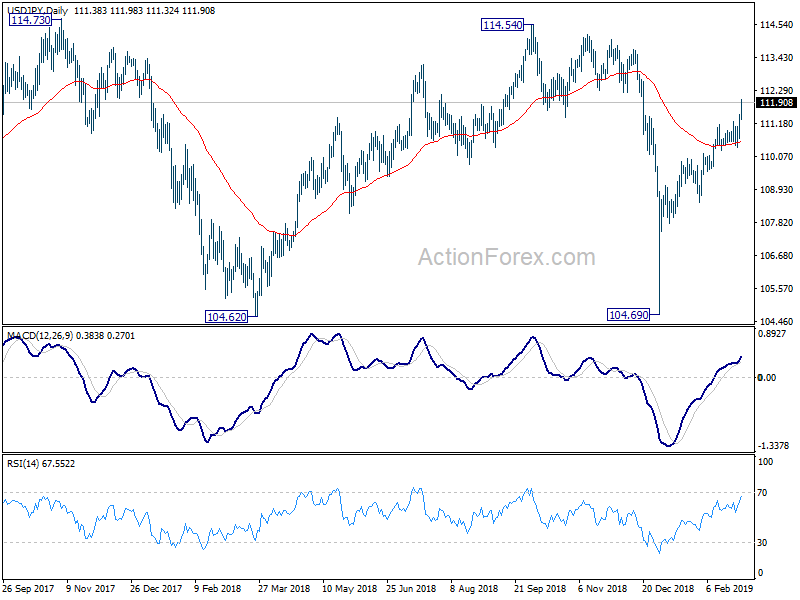
In the bigger picture, current strong rebound from 104.69 argues that decline from 118.65 (2016 high) has completed with three waves down to 104.69, after failing 104.62. More importantly, the rise from 98.97 (2016 low) could be resuming. Focus now turns back to 114.54 resistance, decisive break there will add more credence to this bullish case and target 118.65. This will now be the favored case as long as 55 day EMA (now at 110.59) holds.
Markets Cheer Positive News from China, Yen Drops Further
The financial markets are back in full risk on mode today. China Shanghai SSE jumped 1.8% to 2994.01, just missed 3000 handle. Optimism of bottoming in the slowdown is a factor as Caixin PMI manufacturing rebounded to 49.9, just missed 50. More importantly, MSCI said that it will quadruple the weighting of China-listed shares in its benchmark indexes. Billions of dollars are expected to flow into the market this year. Additionally, German retail sales jumped more than expected while subdued Eurozone inflation could keep ECB on hold for longer.
Yen is trading as the weakest one for today naturally. Additionally, the Japanese currency is pressured by surging global treasury yield. German 10 year yield is now at 0.203 comparing to 0.096 a week ago. US 10-year yield broke 2.7 handle yesterday and is set to extend the rally. Mixed US personal income and spending data is not derailing the upward trajectory. At the time of writing, Kiwi and Aussie are the strongest one. Canadian is the second weakest as oil price retreat and Canadian GDP contracted unexpectedly.
In European markets, FTSE is up 0.49%. DAX is up 1.17%. CAC is up 0.56%. German 10-year yield is up 0.173 at 0.203. Earlier in Asia, Nikkei rose 1.02%. Hong Kong HSI rose 0.63%. China Shanghai SSE rose 1.80% to 2994.01, just missed 3000. Singapore Strait Times rose 0.24%. Japan 10-year JGB yield rose 0.0164 to -0.009, still negative.
US PCE inflation remains muted, income surged while spending dived
US personal income rose 1.0% in December, beat expectation of 0.3%. That's the biggest rise since 2012. Personal spending dropped -0.5%, missed expectation of 0.1%. The decline in spending was the steepest since 2009. Inflation data are muted. Headline PCE slowed to 1.7% yoy, down from 1.8% yoy. PCE core was unchanged at 1.9% yoy.
From Canada, GDP dropped -0.1% mom in December, below expectation of 0.0% mom.
Eurozone PMI manufacturing: Deepest downturn for almost six years
Eurozone PMI manufacturing is finalized at 49.3 in February, up from initial estimate of 49.2, but down from January's 50.5. That's also the first contraction reading since June 2013. Markit noted there were concurrent declines in output and new orders. Also, price pressures continued to soften. Among the countries, Germany PMI manufacturing was finalized at 74-month low at 47.6, Italy at 69-month low at 57.5, Spain at 63-month low at 49.9. Though, France recovered to 3-month high at 51.5.
Chris Williamson, Chief Business Economist at IHS Markit said "Euro area manufacturing is in its deepest downturn for almost six years, with forward-looking indicators suggesting risks are tilted further to the downside as we move into spring." And, "the downturn is being led by Germany and Italy, but Spain has also now fallen into contraction and only modest expansions are being seen in France, Austria and the Netherlands." Also, "in addition to widespread trade war worries, often linked to US tariffs, and concerns regarding the outlook for the global economy, companies report that heightened political uncertainty, including Brexit, is hitting demand and driving increased risk aversion."
Eurozone core CPI slowed to 1.0%, unemployment rate dropped to 7.8%
Eurozone CPI accelerated back to 1.5% in February, up from 1.4% yoy, matched expectations. CPI core, however, slowed to 1.0% yoy, missed expectation of 1.1% yoy. Unemployment rate was unchanged at 7.8%, beat expectation of 7.9%. That's the lowest level since October 2008. For EU 28, unemployment also dropped to 6.5%, down from 6.6%, lowest since record started in January 2000.
Also released, Germany retail sales rose 3.3% mom in January, above expectation of 1.9% yoy. Unemployment dropped -21k in February while unemployment rate was unchanged at 5.0%. From Swiss, retail sales dropped -0.4% yoy in January versus expectation of 0.4% yoy. Swiss PMI manufacturing rose to 55.4, up from 54.3 and beat expectation of 55.4.
UK PMI manufacturing dropped to 52, UK economy faces a difficult 2019
UK PMI manufacturing dropped to 52.0 in February, down from 52.6 and matched expectation. Markit noted that stocks on inputs and finished goods rose sharpy. However, rate of job losses was at six-year high as optimism hits series low.
Rob Dobson, Director at IHS Markit said that "the current elevated degree of uncertainty is also having knock-on effects for business confidence and employment, with optimism at its lowest ebb in the survey's history and the rate of job losses accelerating to a six-year high." And, "apart from the uncertain outlook, manufacturers also face a darkening backdrop of a domestic market slowdown and weakening inflows of new export business, as global growth decelerates and trade tensions bite. Manufacturing and the broader UK economy therefore face a difficult 2019, with the slowdown being exacerbated later in the year as inventory positions are unwound and Brexit-related headwinds likely to linger."
Also from UK, mortgage approvals rose to 67k in January. M4 money supply rose 0.2% mom in January.
Japan PMI manufacturing finalized at 48.9, sharper reductions in output and demand
Japan PMI manufacturing was finalized at 48.9 in February, revised up from 48.5. It's the first contractionary reading since August 2016. Demand conditions in Japan deteriorated at stronger rate while business outlook was broadly neutral having fallen for the ninth straight month.
Joe Hayes, Economist at IHS Markit noted that "Sharper reductions in output and demand drove the Japanese manufacturing economy into contraction during the midway point of Q1, compounding reductions already recorded in January. Global trade frictions and weak domestic manufacturing demand pose considerable risks to Japan's goods producers. As such, firms pared back expectations to near-neutrality. The rebound seen in the official Q4 GDP estimate does not appear to be reflective of underlying economic conditions in Japan.
"With the consumption tax hike set to come into play later this year, weak domestic demand will only heighten fears that the economy could be poised for a downturn. Focus turns towards service sector data, which will need to show signs of resilience in order to offset the manufacturing drag."
Also from Japan, unemployment rate rose 0.1% to 2.5% in January, versus expectation of 2.4%. Tokyo CPI core was unchanged at 1.1% yoy in February, versus expectation of 1.0% yoy. Capital spending rose 5.7% in Q4 versus expectation of 4.5%. Consumer confidence dropped -0.4 to 41.5 in February, slightly missed expectation of 41.6.
China Caixin PMI manufacturing rose to 49.9, easing of the economic downturn
China Caixin PMI manufacturing rose to 49.9 in February, up from 48.3 and beat expectation of 48.7. The key points are "renewed rise in output as total new business picks up, "backlogs continue to rise, but employment trend remains subdued", and "selling prices increase for first time in four months".
Zhengsheng Zhong, Director of Macroeconomic Analysis at CEBM Group said "Overall, with the early issuances of local governments' special-purpose bonds and targeted adjustments to monetary policy, the situation in the manufacturing sector recovered markedly in February due to the effect of increased infrastructure investment. Prices of industrial products also picked up due to improving demand and the rebound in international commodity prices. However, the pressure on manufacturers' capital turnover became obvious again, which may reflect that the financing environment was not easing as expected, and the effect of credit expansion is not yet significant."
Suggested reading on China: China's February PMI Sent Mixed Message. Update on PBOC's New Tool...
Australia manufacturing PMI rose to 54, but conditions appear to be diverging
Australia AiG Performance of Manufacturing Index rose 1.5 to 54.0 in February. That's the best monthly result since October 2018 and signals a better month of recovery following and "unreasonably slow summer". While it's still the 30th month of expansion, the trend has suggested "slowing growth rates since its recent peak in March 2018".
Also, AiG noted that "conditions appear to be diverging" across the larger manufacturing sectors and their main locations. Three of the six sectors expanded, one was stable and two contracted. And, "the downturn in housing construction is already affecting some sectors, as is the uncertainty of impending elections".
New Zealand terms of trade dropped -3%, largest fall since 2015
New Zealand terms of trade index dropped -3.0% qoq in Q4, much worse than expectation of -1.0% qoq. It's also the largest decline since September 2015 quarter. Also ,falling global prices for milk powder and butter meant overall export prices dropped -1.7%. However, Stats NZ noted that "despite the latest fall, the terms of trade remained near the historic high in the December 2017 quarter." Also from New Zealand, building permits rose 16.5% mom in January.
USD/JPY Mid-Day Outlook
Daily Pivots: (S1) 110.87; (P) 111.18; (R1) 111.70; More...
USD/JPY accelerates further to as high as 111.98 so far today and intraday bias stays on the upside. Current rally from 104.69 should now target 114.54 resistance next. On the downside, below 111.50 minor support will turn intraday bias neutral and bring consolidations. But downside should be contained above 110.35 support to bring another rally.
In the bigger picture, current strong rebound from 104.69 argues that decline from 118.65 (2016 high) has completed with three waves down to 104.69, after failing 104.62. More importantly, the rise from 98.97 (2016 low) could be resuming. Focus now turns back to 114.54 resistance, decisive break there will add more credence to this bullish case and target 118.65. This will now be the favored case as long as 55 day EMA (now at 110.59) holds.
Economic Indicators Update
| GMT | Ccy | Events | Actual | Forecast | Previous | Revised |
|---|---|---|---|---|---|---|
| 21:30 | AUD | AiG Performance of Manufacturing Index Feb | 54 | 52.5 | ||
| 21:45 | NZD | Building Permits M/M Jan | 16.50% | 5.10% | 5.40% | |
| 21:45 | NZD | Terms of Trade Index Q/Q Q4 | -3.00% | -1.00% | -0.30% | -0.10% |
| 23:30 | JPY | Jobless Rate Jan | 2.50% | 2.40% | 2.40% | |
| 23:30 | JPY | Tokyo CPI Core Y/Y Feb | 1.10% | 1.00% | 1.10% | |
| 23:50 | JPY | Capital Spending Q4 | 5.70% | 4.50% | 4.50% | |
| 00:30 | JPY | PMI Manufacturing Feb F | 48.9 | 48.5 | 48.5 | |
| 01:45 | CNY | Caixin PMI Manufacturing Feb | 49.9 | 48.7 | 48.3 | |
| 05:00 | JPY | Consumer Confidence Feb | 41.5 | 41.6 | 41.9 | |
| 07:00 | EUR | German Retail Sales M/M Jan | 3.30% | 1.90% | -4.30% | |
| 07:30 | CHF | Retail Sales Real Y/Y Jan | -0.40% | 0.40% | -0.30% | -0.20% |
| 08:30 | CHF | PMI Manufacturing Feb | 55.4 | 53.6 | 54.3 | |
| 08:45 | EUR | Italy Manufacturing PMI Feb | 47.7 | 47 | 47.8 | |
| 08:50 | EUR | France Manufacturing PMI Feb F | 51.5 | 51.4 | 51.4 | |
| 08:55 | EUR | Germany Manufacturing PMI Feb F | 47.6 | 47.6 | 47.6 | |
| 08:55 | EUR | German Unemployment Change Feb | -21K | -5K | -2K | |
| 08:55 | EUR | German Unemployment Claims Rate Feb | 5.00% | 5.00% | 5.00% | |
| 09:00 | EUR | Eurozone Manufacturing PMI Feb F | 49.3 | 49.2 | 49.2 | |
| 09:30 | GBP | Mortgage Approvals Jan | 67K | 63K | 64K | |
| 09:30 | GBP | Money Supply M4 M/M Jan | 0.20% | 0.30% | 0.40% | |
| 09:30 | GBP | PMI Manufacturing Feb | 52 | 52 | 52.8 | |
| 10:00 | EUR | Eurozone Unemployment Rate Jan | 7.80% | 7.90% | 7.90% | 7.80% |
| 10:00 | EUR | Eurozone CPI Estimate Y/Y Feb | 1.50% | 1.50% | 1.40% | |
| 10:00 | EUR | Eurozone CPI Core Y/Y Feb A | 1.00% | 1.10% | 1.10% | |
| 13:30 | CAD | GDP M/M Dec | -0.10% | 0.00% | -0.10% | |
| 13:30 | USD | Personal Income Dec | 1.00% | 0.30% | 0.20% | |
| 13:30 | USD | Personal Spending Dec | -0.50% | 0.10% | 0.40% | 0.60% |
| 13:30 | USD | PCE Deflator M/M Dec | 0.10% | 0.00% | 0.10% | 0.00% |
| 13:30 | USD | PCE Deflator Y/Y Dec | 1.70% | 1.70% | 1.80% | |
| 13:30 | USD | PCE Core M/M Dec | 0.20% | 0.20% | 0.10% | 0.20% |
| 13:30 | USD | PCE Core Y/Y Dec | 1.90% | 1.90% | 1.90% | |
| 14:30 | CAD | Manufacturing PMI Feb | 53 | |||
| 14:45 | USD | Manufacturing PMI Feb F | 53.7 | 53.7 | ||
| 15:00 | USD | ISM Manufacturing Feb | 56 | 56.6 | ||
| 15:00 | USD | ISM Prices Paid Feb | 52 | 49.6 | ||
| 15:00 | USD | ISM Employment Feb | 55.5 | |||
| 15:00 | USD | U. of Mich. Sentiment Feb F | 95.8 | 95.5 |
US PCE inflation remains muted, income surged while spending dived
US personal income rose 1.0% in December, beat expectation of 0.3%. That's the biggest rise since 2012. Personal spending dropped -0.5%, missed expectation of 0.1%. The decline in spending was the steepest since 2009. Inflation data are muted. Headline PCE slowed to 1.7% yoy, down from 1.8% yoy. PCE core was unchanged at 1.9% yoy.
From Canada, GDP dropped -0.1% mom in December, below expectation of 0.0% mom.
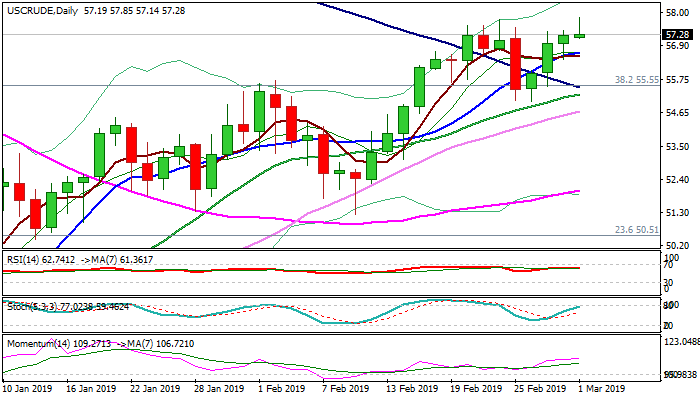
WTI OIL Outlook: Strong Fundamentals Continue to Underpin Oil Price for Final Break above $57.79/85 Highs
WTI oil cracked previous high at $57.79 (22 Feb) and posted new, marginally higher high at $57.85 on Friday, but was so far unable to sustain break.
The price holds in green for the fourth straight day, as solid US GDP and stronger than expected China's Manufacturing data further brightened the outlook after oil advanced 2.5% on unexpected strong draw in US crude inventories (-8.6 mln bls vs 2.8 mln bls f/c).
Criticism of President Trump on high oil prices shook markets this week but negative impact was short-lived, as OPEC's production cut along with above mentioned factors continues to inflate oil price.
Bullish daily studies support for final break above $57.79/85 highs for test of 100WMA ($58.32) and possible extension towards targets at $59.62/$60.00 (50% retracement of $76.88/$42.36/psychological barrier).
The WTI contract ended February in green, marking the second straight bullish month and is on track for the third consecutive bullish week, that adds to positive signals for extension of recovery leg from $42.36 (low 2018, posted on 24 Dec).
Rising 10SMA offers solid support at $56.69, which should ideally contain dips and guard more significant broken Fibo barrier at $55.55.
Res: 57.85; 58.32; 58.85; 59.62
Sup: 57.14; 56.69; 56.42; 55.55
Into US session: Yen pressured as market in full risk on mode
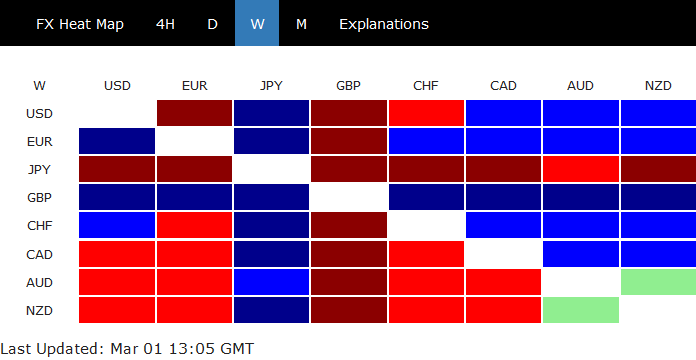
Entering into US session, Yen remains the weakest one today as markets are back on risk on mode. It somehow started yesterday with better than expected US GDP. China Caixin PMI manufacturing improved to 49.9 in February, just 0.1 below 50. German retail sales rose strongly by 3.3% mom while unemployment dropped more than expected by -21k. UK PMI manufacturing just dropped slightly to 52.0. The theme of bottoming of slowdown could be being built up.
With turn around in market sentiments, commodity currencies are now broadly higher today. Euro follows NZD, AUD and CAD as helped by extended rally in German 10-year yield, which hit 0.2 handle. Dollar is turned mixed. Focus will turn to US personal income and spending and ISM manufacturing for source of more optimism.
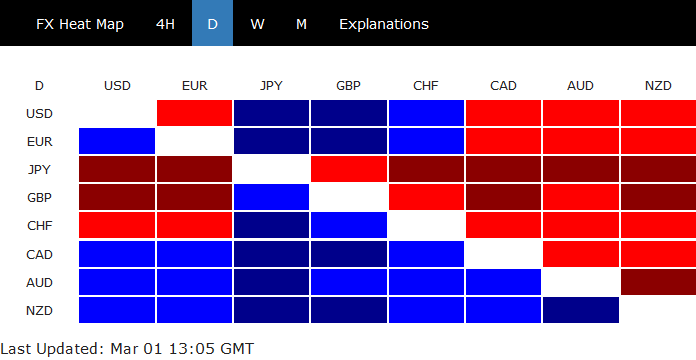
Over the week, Sterling remains the strongest one though, followed by Euro and then Swiss Franc. Yen is the weakest one followed by Aussie and then Kiwi.
In Europe, currently:
- FTSE is up 0.51%.
- DAX is up 1.23%.
- CAC is up 0.72%.
- German 10-year yield is up 0.0149 at 0.20.
Earlier in Asia:
- Nikkei rose 1.02%.
- Hong Kong HSI rose 0.63%.
- China Shanghai SSE rose 1.80% to 2994.01, just missed 3000.
- Singapore Strait Times rose 0.24%.
- Japan 10-year JGB yield rose 0.0164 to -0.009, still negative.
Canadian Dollar Edges Higher ahead of GDP
The Canadian dollar has gained ground in the Friday session. Currently, the pair is trading at 1.3132, down 0.33% on the day. It’s a busy day for fundamentals. Canada releases GDP, which is expected to come in unchanged at 0.0%. In the U.S., the focus will be on consumer data, highlighted by the Core PCE Price Index and personal spending.
The U.S. received a GDP report card on Thursday, and the results were good. Advance GDP, which was released a month late due to the government slowdown, showed a gain of 2.6% in Q4. Although this was weaker than the 3.4% gain in Q3, it was well above the estimate of 2.2%. The unexpectedly solid reading can be credited to strong consumer spending and business investment. It’s hard to argue that the U.S. economy is not performing well, with a strong expansion of 3.1% in 2018. Even with the GDP release, it’s unlikely that the Federal Reserve will veer from it dovish stance.
It is Canada’s turn on Friday, with the release of GDP for December. Recent numbers have not been encouraging. The economy has declined by 0.1% in the past two months, and recent retail sales reports also pointed lower. The Bank hiked rates three times last year, but has since stayed on the sidelines, with the benchmark rate pegged at 1.75%. Inflation levels remain weak, as CPI posted a small gain of 0.1% in January, after two successive declines. With inflation well below the BoC’s target of 2%, it’s unlikely that the bank will raise rates unless the Canadian economy shows clear signs of improvement.
DAX – European Blue-Chips Jumps on Strong Corporate Profits, U.S. GDP
The DAX has posted sharp gains in the Friday session. Currently, the DAX is at 11,658, up 1.24% on the day. In France, the CAC 40 has gained 0.80%, trading at 5281 points. The indices have received a boost from strong corporate profits as well as an unexpectedly strong U.S. GDP, which led to sharp gains in U.S. markets on Thursday, and Asian and European markets on Friday.
Corporate profit reports boosted European stock markets on Friday. Carmaker shares are up sharply on both the DAX and CAC. The biggest gainers on the day include Peugeot (3.22%), Volkswagen (2.58%) and Daimler (1.96%).
German numbers were a mix on Friday. Retail sales bounced back with a 3.3% gain in January, after a 4.3% decline in December. The manufacturing sector continues to struggle, as Manufacturing PMI fell below the 50-level for a second straight month, pointing to contraction. German and eurozone manufacturing has fallen off due to the global trade war, which has led to less demand for eurozone and German products. On the labor front, unemployment rolls fell by 21 thousand, crushing the estimate of -5 thousand. There was more good news as the eurozone unemployment rate dropped to 7.8% in January, down from 7.9% a month earlier.
In the U.S., Advance GDP for Q4, which was released a month late due to the government slowdown, showed a gain of 2.6%. Although this was weaker than the 3.4% gain in Q3, it was well above the estimate of 2.2%. The unexpectedly solid reading can be credited to strong consumer spending and business investment. It’s hard to argue that the U.S. economy is not performing well, with a strong expansion of 3.1% in 2018. Still, even with the positive GDP release, it’s unlikely that the Federal Reserve will veer from it dovish stance.
Stock Markets Rally after a Rough and Rocky Week
Market sentiment swung back and forth this week as ongoing trade developments, Brexit-related drama, an abrupt ending to the US-North Korea summit and other geopolitical tensions influenced risk appetite.
The overall mood across financial markets has improved today, following positive economic data from China and Germany, with the change of attitude clearly evident across stock markets. Although global stocks are set to end the week on a positive note amid cooling fears over slowing global growth, the fundamental drivers weighing on equity markets remain present. Geopolitical risks have left global sentiment extremely fragile, while there is still a fair degree of uncertainty over trade developments. With the stock market rally built on weak foundations, equity bears are just waiting for the right catalyst to return with a vengeance.
Gold bulls lose the battle, but war still rages on
With risk appetite coming back to the fore, Gold bulls lost their iron grip this week with pricing sinking towards $,1308 as of writing.
Gold’s recent performance indicates that markets are pricing in the increased likelihood of a US-China trade deal happening sooner rather than later. With UK Prime Minister Theresa May also opening up the possibility of an extension to Article 50, investors are hopeful that the much-feared no-deal Brexit will be avoided, ultimately supporting risk appetite. However, the end result for either of these major risks remains uncertain at this point in time. Concrete and positive resolutions may result in a surge in demand for riskier assets and conversely be negative for Gold. It should also be kept in mind that Gold bulls remain inspired by geopolitical risk factors and speculation over the Fed taking a break on monetary tightening this year.
Should Gold break meaningfully below $1,310, it may open a path towards the psychologically-important $1,300. In the event of risk aversion creeping up, Gold could still stage a rebound back towards the $1,318 resistance level.
 Commodity spotlight – WTI
Oil continues its year-to-date voyage higher, as it wrapped up two consecutive months of gains to test the $58/bbl mark.
Despite US President Donald Trump calling for lower Oil prices and telling OPEC to “relax and take it easy”, Oil producers are pressing on with output cuts that will potentially extend into 2H19 – a favourable outcome for Oil bulls. Oil was granted further support from US sanctions on Iran and Venezuela, coupled with the surprise drop in US inventories, which last week saw their biggest decline since September 2018. However, political pressures and US Shale production remain the ‘wild cards’ in ongoing efforts to rebalance markets.
On the demand side, the base case remains that global growth is expected to cool down in 2019. However, there is optimism over China’s economy potentially picking back up, especially after February’s Caixin Manufacturing PMI exceeded market expectations. Whether this print marks a turning point, or a blip, in China’s moderating growth narrative, remains to be seen.
In regards to the technical perspective, WTI Oil is trading around the $57.41 level as of writing. The inverse head and shoulders pattern on the daily charts suggest that WTI has the potential to push higher. A solid daily close above the $57.50 level is likely to encourage an incline higher towards $60.00.
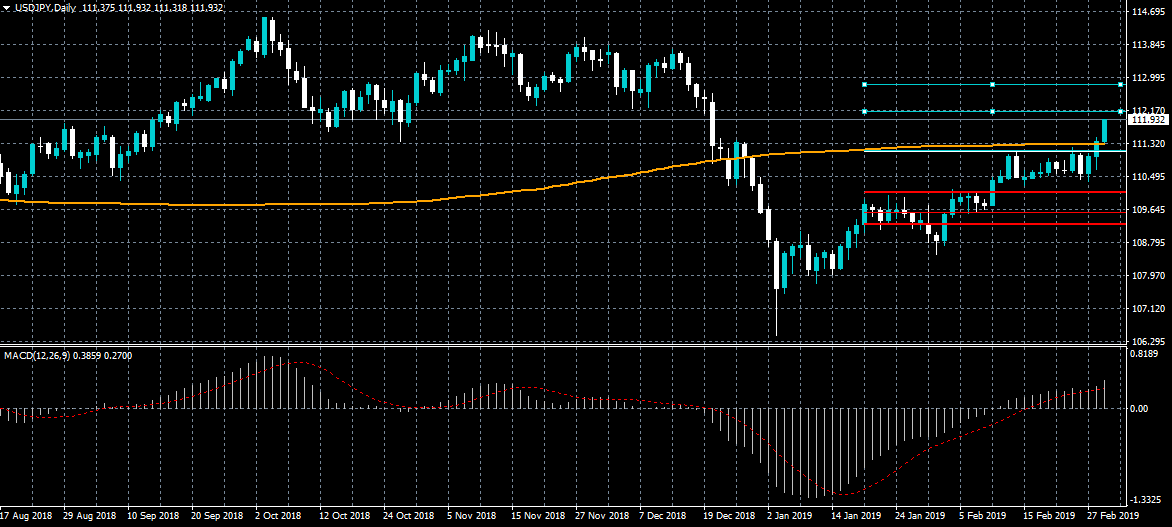
USDJPY Targeting 112.20
The US dollar has continued to rally higher against the Japanese yen currency during the European trading, with bulls moving the pair close to the 112.00 resistance level. The first target for buyers is likely to be the 112.20 level, with the 112.80 level extended resistance. Technical indicators on the daily time frame continue to signal further gains ahead for the USDJPY pair.
The USDJPY pair is strongly bullish while trading above the 111.40 level, key technical resistance is found at the 112.20 and 112.80 levels.
If the USDJPY pair trades below the 111.40 level, sellers may test towards the 111.12 and 110.80 support levels.