

Sample Category Title
Weekly Economic and Financial Commentary: Global Uncertainty Remains Elevated For the Time Being
U.S. Review
Drawing the Curtain on 2018
- Economic data out the gate this week provided some clarity on how the economy fared through the end of 2018.
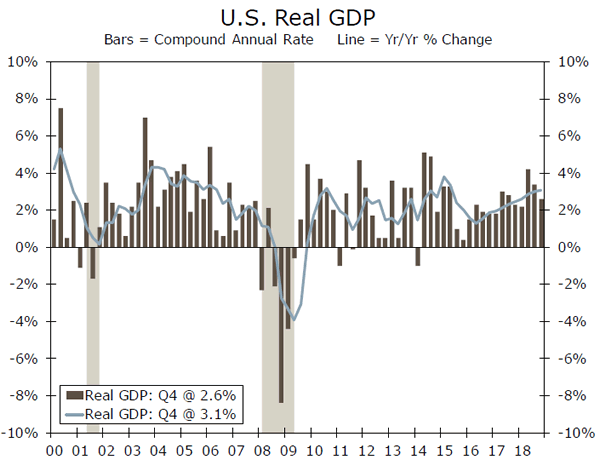
- Real GDP in the United States grew at an annualized rate of 2.6% in the fourth quarter. This marked a deceleration from the breakneck pace seen in the prior two quarters, but was above the market expectation of a 2.2% gain.
- Q4 GDP data and housing starts and personal income and spending data now available through December, confirmed our expectation of a slowdown in growth to end 2018.
Drawing the Curtain on 2018
Economic data out the gate this week provided some clarity on how the economy fared through the remainder of 2018. The partial government shutdown, which began in December and lasted well into January, had continued to delay important data releases, clouding analysts' assessments of the economy's performance. Data on Q4-GDP, and housing starts and personal income and spending data now available through December, confirmed our expectation of a slowdown in growth to end 2018.
The U.S. Commerce Department released data on Thursday which showed that real GDP grew at an annualized rate of 2.6% in the fourth quarter. While this pace of growth still represents a step down from the strong growth rates experienced earlier last year, at 2.6% growth was above the market expectation of 2.2%.
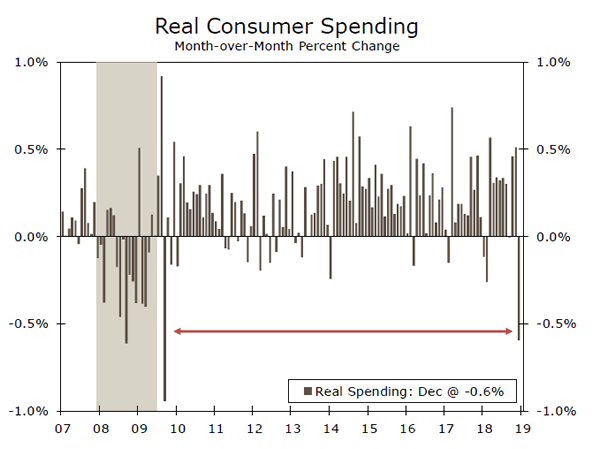
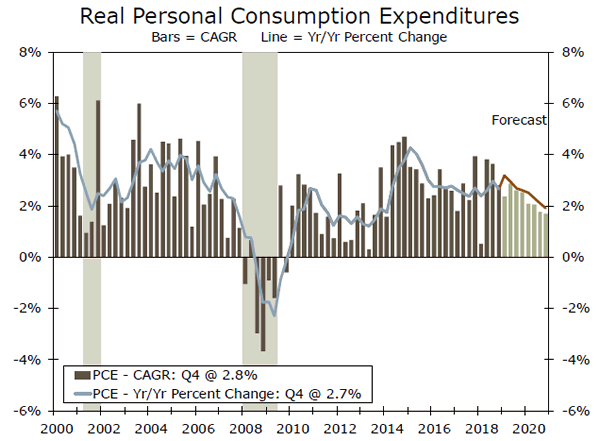
Real personal consumption expenditures (PCE), grew only 2.8% in the fourth quarter, leading much of the deceleration in GDP growth. The weakness can be traced to the weak spending environment in December, with both personal spending and retail sales experiencing their largest declines since the recession year of 2009. Real PCE was in part boosted earlier last year by personal tax cuts, but these real income-boosting effects will likely fade this year. Personal income rose 1.0% in December, but fell 0.1% in January. Income growth should regain some strength this year, due to the robust labor market.
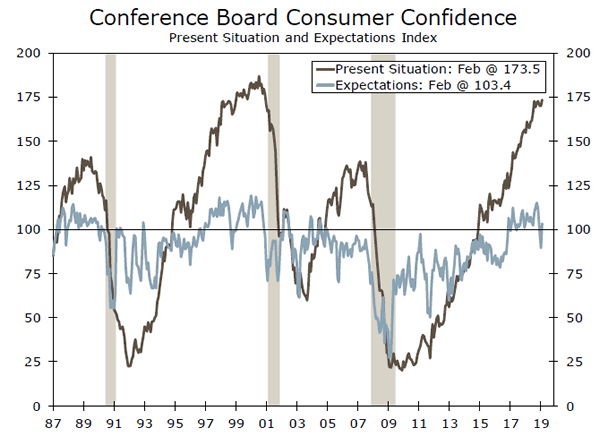
Consumer confidence data for February suggested consumers have regained some optimism. The present-situation component of the index improved to a cycle-high of 173.5, while the expectations component jumped 14 points. Expectations of job prospects and improvements in income have propelled the outlook, but fewer purchasing plans of autos, homes and major appliances weighed on overall optimism. Taking this anecdotal indication with recent hard data on durable goods orders suggests that growth in capital spending will likely be anemic in the first half of 2019.
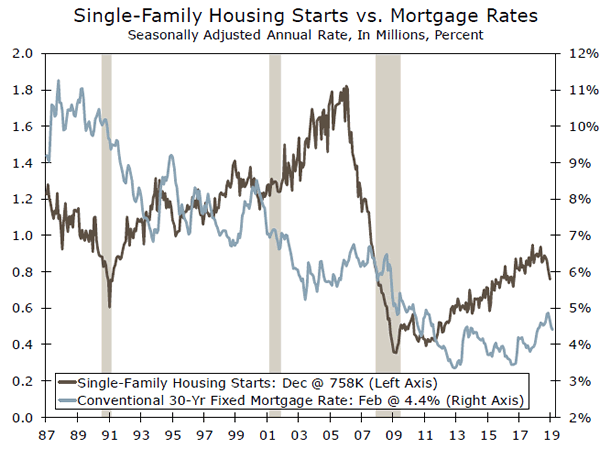
After a slow pace of growth in the third quarter, business fixed investment (BFI) spending rebounded at a rate of 6.4% in the fourth quarter. But, the construction components of BFI remained weak. Non-residential construction fell 4.2%, while the residential side declined for the fourth consecutive quarter. A separate press release from the Commerce Department revealed that housing starts plunged 11.2% in December. Mortgage rates were up to a near 5% last year, which threatened to worsen the affordability crisis that has been dragging home sales and new home construction lower since March of last year. Rising home prices had only exacerbated weakness in residential construction last year. But, with mortgage rates now lower and building permits having risen in January, there may be some upside pressure to housing starts in 2019.
Despite the slowdown in the fourth quarter, the stronger-thanexpected GDP outturn should alleviate some concern that the economy is in serious trouble. As we look further ahead to 2019, our current forecast looks for a further deceleration in the first quarter but for a modest rebound starting in the second quarter.
U.S. Outlook
ISM Non-Manufacturing • Tuesday
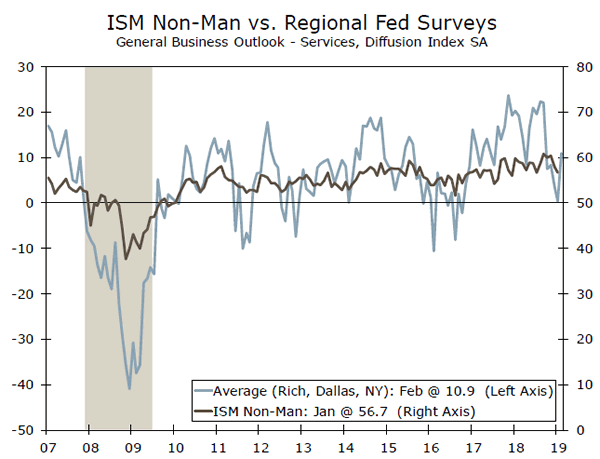
The ISM non-manufacturing index fell 1.3 points in January. At 56.7, the index remains consistent with the economy expanding at a decent rate, but the pullback added to the evidence that the U.S. economy has lost some momentum since the second half of 2018. Part of the drop in January may have been attributable to the government shutdown, as a number of survey respondents noted its negative effect in their comments. With the shutdown over, we expect to see a modest bounce-back in the February ISM nonmanufacturing index, consistent with the service-sector PMIs from the Federal Reserve system rebounding.
Another near-60 reading would suggest that the U.S. economy is handling recent "crosscurrents" without much issue and therefore raise the prospect of the FOMC increasing the fed funds rate again this year. A downside miss, however, would support the FOMC remaining in its current holding pattern on rates.
Previous: 56.7 Wells Fargo: 57.2 Consensus: 57.3
Employment • Friday
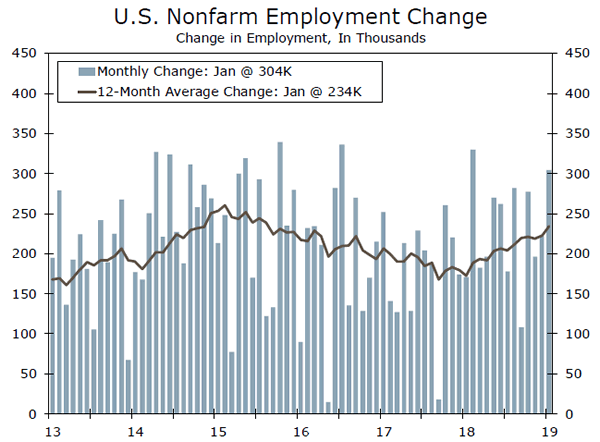
Hiring got off to a robust start to the year with employers adding 304,000 new jobs in January. We suspect job growth moderated in February, however. Jobless claims have drifted up over the past month, PMI employment readings have softened since late last year and hiring of temporary help has slowed. In addition, the partial government shutdown that stretched nearly all of January and was only tentatively resolved through the first half of February likely delayed some federal sector and private contractor hiring. With furloughed workers back on the job in February, however, the jobless rate should resume its downward trend and fall to 3.9%.
Another blowout report would raise questions about how long the FOMC may remain "patient" before lifting rates further this year. A surprisingly soft number, however, is unlikely to sway the Fed's nearterm policy stance given that a broad array of data still point to a strong jobs market overall.
Previous: 304,000 Wells Fargo: 195,000 Consensus: 188,000
Housing Starts • Friday
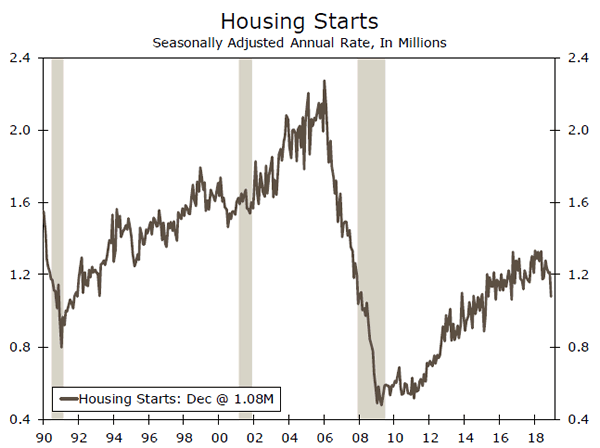
Housing starts tumbled at the end of 2018, dropping 11.2%. That was the third decline in four months, as builder confidence late in the year was sapped by higher mortgage rates. We expect to see a modest rebound in housing starts for January, and further improvements in the following months. Since nearly reaching 5.00% in November, mortgage rates have fallen roughly 60 bps, fueling some improvement in homebuilder sentiment. At the same time, multifamily permits have been running ahead of starts.
Housing data this time of year must be interpreted with caution given that low levels of activity in the winter can lead to exaggerated readings after seasonal adjustment. With that caveat in mind, another surprisingly soft print in January would suggest that the housing sector remains in a somewhat perilous position, while a stronger-than-expected rebound would suggest that the Fed's softer stance is already feeding through to the economy.
Previous: 1.08M Wells Fargo: 1.20M Consensus: 1.17M
Global Review
Global Uncertainty Remains Elevated For the Time Being
- Geopolitical developments dominated headlines for the majority of the week, highlighted by President Trump's second meeting with Kim Jung Un, a delay in additional tariffs on Chinese exports, as well as military engagement between India and Pakistan.
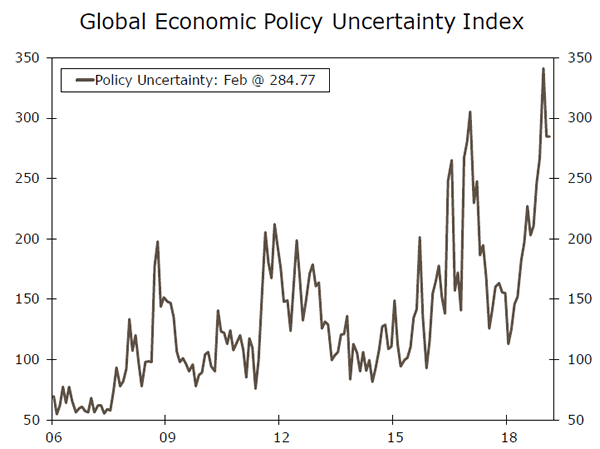
- While each of these situations presents its own risks, in aggregate they have the ability to result in heightened levels of global uncertainty. While we do not expect any major escalations in these geopolitical events at this time, it is worth noting these potential event risks still exist and can potentially have lasting impacts on market sentiment.
Geopolitics Remain in Focus
Many of the headlines we witnessed this week were dominated by geopolitical developments around the world, highlighted by president Trump's second meeting with North Korean leader Kim Jung Un as well as President Trump's decision to delay additional tariffs on Chinese exports to the United States. As expected, the second meeting between President Trump and Kim Jung Un did not yield too many tangible results towards the de-nuclearization of North Korea. In fact, media reports suggest the meeting ended rather abruptly, with neither side willing to make sufficient concessions at this time. While tensions in 2017-2018 have receded, the North Korean leaders' unwillingness to completely destroy missile test sites and abandon the country's nuclear capabilities, along with President Trump's cautious approach towards removing economic sanctions on North Korea, may add to additional uncertainty going forward.
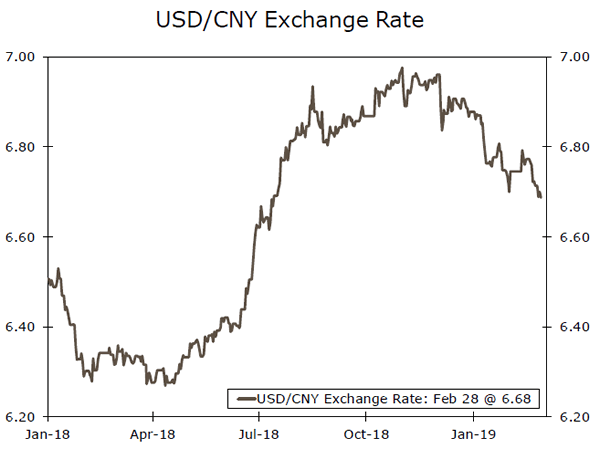
In contrast, some progress has been made over the past few months in regard to the United States' ongoing trade negotiations with China. While a long-term deal has yet to be made, President Trump's decision to delay additional tariffs on Chinese exports was greeted with optimism, suggesting a deal may be made in the near future. As of now, China has agreed to purchase additional U.S. goods, particularly as it relates to agricultural products; however, differences still exist over issues of technology transfers and intellectual property theft. These differences culminated in U.S Trade Representative Robert Lighthizer commenting that the two countries are still far apart on making a trade deal. However, markets seem to be relatively optimistic for the prospects of a deal, evidenced by the recent strength of the Chinese renminbi, arguably the most sensitive asset to tariffs and trade discussions.
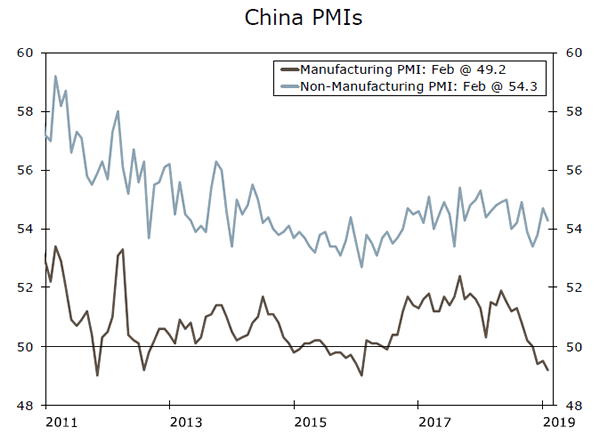
The persistent trade tensions also appear to be having a more notable impact on China's economy as well. While a deceleration in Chinese economic activity has been underway for some time, the imposition of tariffs has likely exacerbated a slowdown in China's growth. Recent data continue to suggest a further slowdown in the Chinese economy, with February's manufacturing PMIs falling further, while the non-manufacturing PMIs slowed as well.
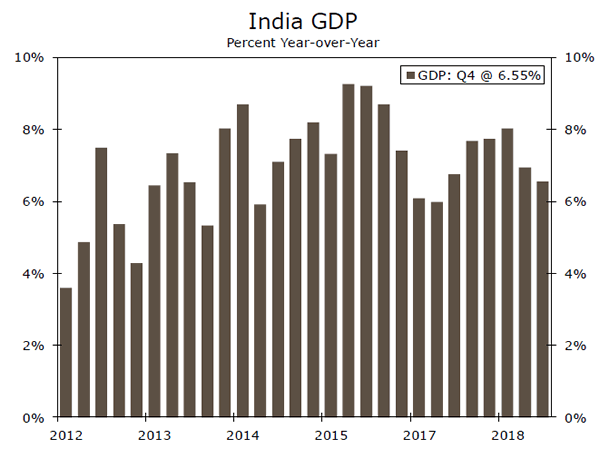
Outside of geopolitical developments directly involving the U.S., India and Pakistan engaged in military activity with each other this week. The ongoing skirmish originated from a Pakistani terrorist attack in India, which prompted retaliation from India's military. At the current juncture, Pakistan is holding an Indian pilot captive, although recent comments from the Prime Minister of Pakistan suggest his willingness to release him in an effort to de-escalate the situation. Should this escalate any further, it could result in a slowdown of foreign capital flowing into India, which may have an impact on the country's growth outlook. GDP growth in India has recently underperformed expectations, with Q4 growth of 6.6% YoY missing estimates and indicating a further slowdown in the economy. These developments could also have implications for India's upcoming general election, where current Prime Minister Narendra Modi has already lost some of his support.
Global Outlook
Australia GDP • Tuesday
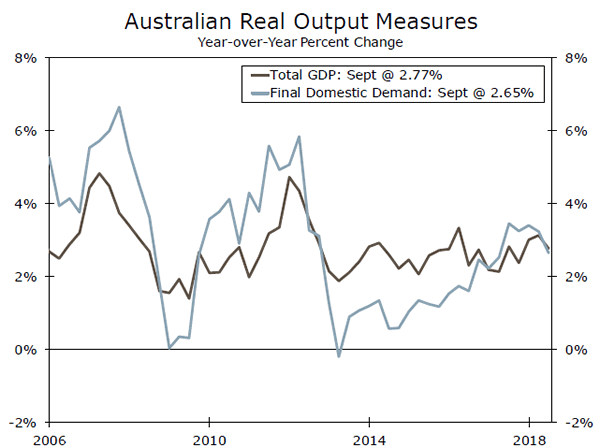
Australian economic data have been quite weak over the past few months, highlighted by a notable GDP slowdown in Q3-2018. That sluggishness may have carried over into Q4 as well, with leading indicators suggesting another subdued quarter of GDP growth. Domestic imbalances have likely contributed to the weak data; however, we expect China's slowdown has played a sizeable role in Australia's softening economy as well. Economic ties between the two Asia-Pacific countries are significant, with about 35% of Australia's total exports going to China. As China's economy continued to show signs of slowing down towards the end of last year, we expect this to impact Australia's Q4-GDP release next week. The slowdown in Australia's economy has caught the attention of the Reserve Bank of Australia (RBA) as well. The RBA recently shifted to a more neutral monetary policy stance, moving away from a slightly hawkish bias, citing concerns over the country's outlook.
Previous: 0.3% Consensus: 0.5% (Quarter-over-Quarter)
Central Bank of Turkey • Wednesday
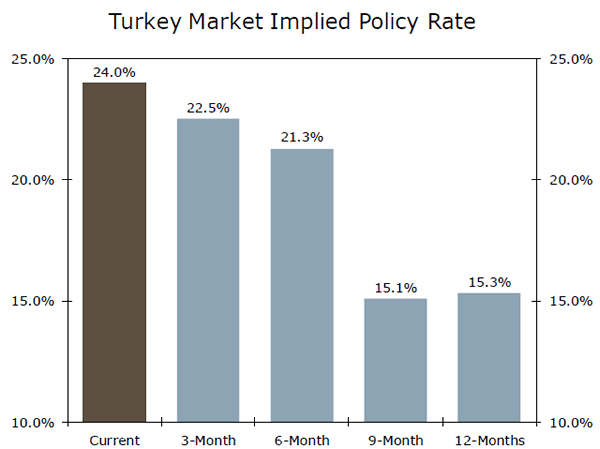
The central bank of Turkey will announce its decision on its main policy rate next week, with consensus forecasts suggesting a hold is likely. However, we believe the likelihood for a policy rate cut at the March 6 meeting is higher than consensus forecasts currently anticipate. With CPI inflation softening more than expected, and a lira that has been relatively stable since its significant depreciation in 2018, this could provide the central bank with scope to prematurely cut policy rates. Concerns regarding the independence of the central bank still exist as well, and with local elections coming up at the end of March, the Turkish administration may choose to put pressure on the central bank to prioritize growth and reduce policy rates. Markets may be taking that view as well, as they are currently pricing in 150 bps of rate cuts over the next three months and also imply about 900 bps of cumulative rate cuts over the next 12 months may be coming as well.
Previous: 24.00% Consensus: 24.00%
European Central Bank • Thursday
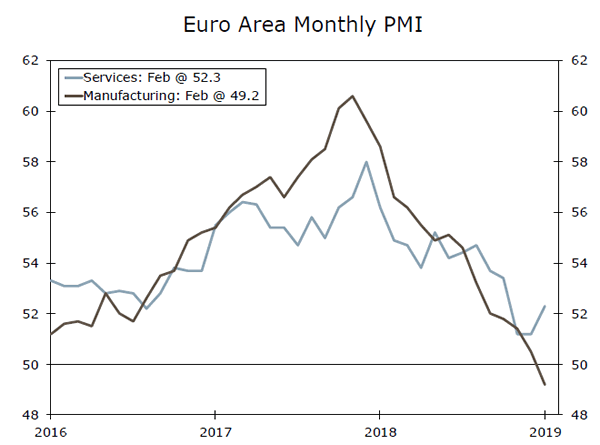
With economic data indicating a further deceleration in the broader European economy, markets will likely be paying close attention to next week's ECB meeting. While a policy rate move is not expected, market participants are likely to be focused on ECB President Mario Draghi's comments as well as any revised growth and inflation targets. While we expect some additional downward revisions to the ECB's growth and inflation forecasts, we will also be looking for any shift in commentary surrounding the balance of risks to the European economy. A further acknowledgement of downside risks could potentially be accompanied by an additional round of stimulus measures, particularly in the form of Targeted Long-Term Refinancing Operations (TLTROs). In addition, we believe markets will also look for hints that the ECB may delay policy rate hikes longer than expected and continue to keep accommodative monetary policy in place through the end of the year.
Previous: -0.40% Wells Fargo: -0.40% Consensus: -0.40%
Point of View
Interest Rate Watch
Powell Reiterates "Patience"
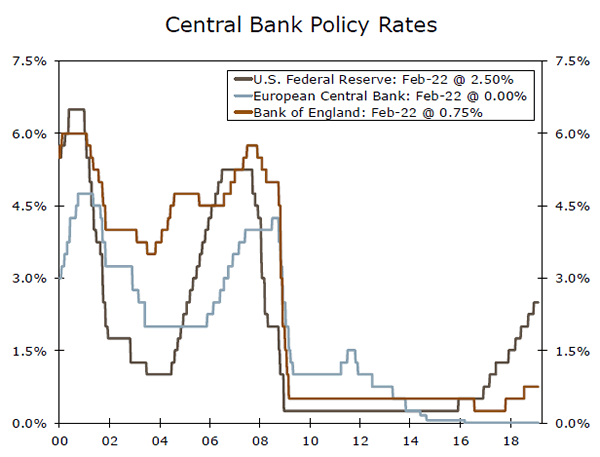
Federal Reserve Chairman Powell presented the Fed's Semi-Annual Monetary Policy Report to two congressional committees this week. In general, Powell presented a fairly upbeat assessment of the U.S. economy. He said that the Federal Open Market Committee (FOMC) views "current economic conditions as healthy and the economic outlook as favorable," and he characterized the job market as "strong."
That said, Powell also acknowledged "some crosscurrents and conflicting signals." Powell mentioned the volatility that hit financial markets late last year and signs of slower growth in some major foreign economies. Both factors, if prolonged, could cause the U.S. economy to decelerate even more than it already has.
During the Q&A session, Powell continued to stress that the FOMC could be "patient" regarding its next policy steps. Although the economy has decelerated somewhat, the overall pace of economic activity appears to remain solid. Furthermore, consumer price inflation is currently running more or less at the Fed's target of 2%. Thus, there is no need for the FOMC to rush into further rate hikes. Nor does growth appear weak enough that the FOMC needs to start easing policy. Fed policymakers have the luxury of being able to see what incoming economic data over the next few months portend for the economic outlook.
In that regard, we continue to forecast that the FOMC will judge it necessary to tap on the brakes again with another 25 bps rate hike later this year. For starters, overall financial market conditions are less tight today than they were at the end of last year. In addition, the drag from the housing market on real GDP growth should lessen due to the recent decline in mortgage rates. Investment spending should also strengthen somewhat if, as we expect, uncertainties related to trade policy begin to dissipate. Although we look for real GDP growth to slow in Q1 from the 2.6% rate that it registered in Q4-2018, we forecast that growth will strengthen again in Q2. If, as we forecast, the labor market tightens further in coming months, then the FOMC should conclude that another rate hike is needed.
Credit Market Insights
Shock and Spend
When consumers receive a sudden boost to their income, they are most likely to save or pay down debt. And when their income unexpectedly drops, they are most likely to reduce spending, according to the New York Fed's survey of consumers' marginal propensity to spend. Upon receiving an unexpected windfall, consumers report that they would spend only 17%, while saving or paying down debt with the remainder. More than a year after the passage of the Tax Cuts and Jobs Act—which reduced taxes on average by $1,600 per household, according to the Tax Policy Center—we can attempt to look at how consumers behaved. The household sector has certainly deleveraged over the past decade, with the debt-todisposable income ratio currently sitting at the lowest level since 2001, and down almost a third since its peak in 2007. Domestic demand for safe assets has also been quite strong. At the same time, personal consumption grew quite strongly over 2018, fueled by the aforementioned fiscal stimulus as well as a robust labor market that is finally generating some higher wage growth.
The survey suggests an asymmetric response to income shocks—when income unexpectedly drops, 75% is covered by reduced spending. The possibility of smaller tax refunds to start this year provides another interesting case study of how consumers respond to external shocks to their income. Still, we do not expect lower refunds to significantly reduce consumer spending this year—read more here.
Topic of the Week
December Chill in Consumer Spending
The year 2018 ended with a thud. Stock markets nosedived into the final days of the year to mark one of the biggest year-end selloffs in memory. Congress was also unable to reach agreement on an appropriations bill and was thus forced to shut down the government on December 22.
It is fair to say that some consumers were simply not in the holiday spirit. After peaking in October, measures of consumer confidence slipped for three straight months and some retailers reported lighter activity in the final month of the year.
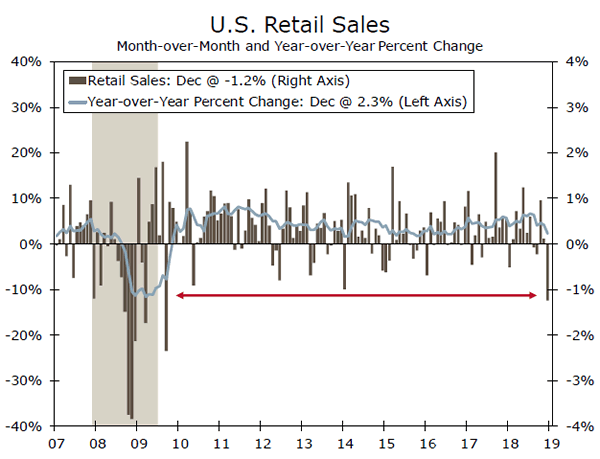
Another cost of the government shutdown (beyond adding to consumer anxieties) was that it delayed the release of the December retail sales report. When those numbers finally became available, they raised more than a few eyebrows. Control group retail sales, which serve as a proxy for consumer spending as it is reported in the GDP accounts, plunged 1.7%, the biggest sequential decline in almost 20 years and larger than any single month drop during the 2007-2009 recession. Are things really that bad?
The quick answer is no. That was more or less confirmed this week with the GDP report which revealed a respectable 2.8% growth rate for real PCE in the fourth quarter. But on Friday, the picture came a bit more into focus with the release of the combined December and January personal income and spending report.
The shadow of the shutdown still hangs over us and the report offered only personal income figures for January and the usual full report for December. Yes, spending slipped in December, but it was revised higher for November. A scant decline in income for January may reflect payback after an upwardly revised surge in December. Consumer confidence is rebounding, as evident in the University of Michigan's survey of consumer sentiment which improved in February. Consumers face some headwinds and we see scope for a moderation in growth, but this is not the beginning of a steep retrenchment in our view.
US: Strong 2018 Finish But a Soft Start to 2019
Highlights
- The U.S. economy grew a robust 2.9% in 2018, the best performance since 2015, but growth moderated at the end of the year and at the start of 2019. The government shutdown and soft consumer spending in December are expected to translate into near 1% growth this quarter.
- Extending the barrage of negative housing data, housing starts plunged by 11.2% (m/m) in December to 1.08 million (annualized).
- Manufacturing data remained soft. The U.S. ISM manufacturing index declined in February, and manufacturing contraction in Europe and Asia broadened further. Soft global activity reinforces the Fed's patient stance.
Data released this week confirms that in 2018 the U.S. economy clocked its best annual growth since 2015. The bad news is that a repeat performance is unlikely, with higher-frequency data suggesting the economy is heading into 2019 with decidedly less gusto.
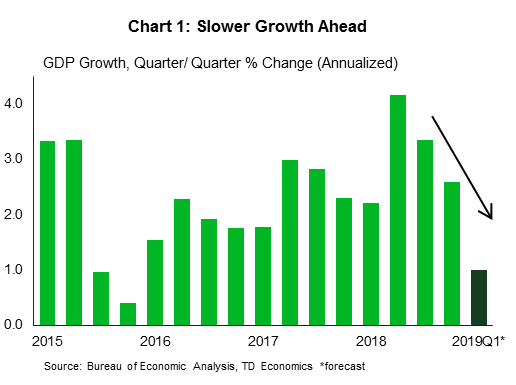
The fourth quarter GDP report painted a picture of solid but moderating growth. For the year as a whole, the economy expanded by a robust 2.9% in 2018. However, the headline conceals the fact that growth moderated as the year progressed, slowing to 2.6% (annualized) in Q4 from the 3.4% and 4.2% pace seen in Q3 and Q2, respectively. Looking at the individual components, consumer spending moderated to 2.8% in Q4 from 3.5% in Q3. Business investment surprised to the upside, with growth accelerating to 6.2% from a 2.5% pace in the previous quarter. However, trade and residential investment were a drag on growth both in Q4 and for the year as a whole.
A solid end to 2018, but momentum has clearly waned at the start of this year. Consumer spending data for December confirmed that the weak retail print was not a fluke, as the negative mood led consumers to hold on tight to their wallets. In what's become a recurring theme, first quarter growth will be bleak. The government shutdown and soft consumer spending translate to growth slowing to 1% in Q1 (Chart 1). However, as in prior years, the slowdown should prove temporary, with output forecast to rebound to an above 2% pace in the second quarter.
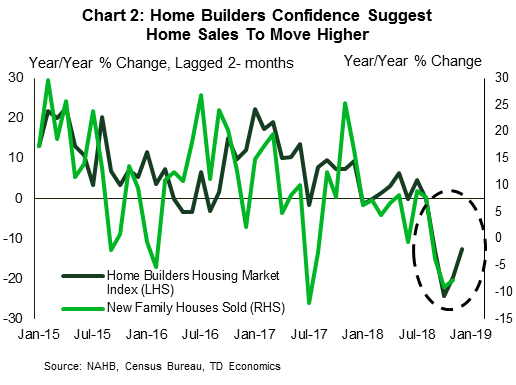
Extending previous declines, housing starts ended 2018 by plunging 11.2% (m/m) in December to 1.08 million (annualized). Rising mortgage rates amid high financial market volatility at the end of last year dented builders' confidence, which fell to a 3-year low in December. Moreover, California wildfires also likely weighed on the headline. Although housing activity is not expected to race too far ahead in 2019, it should see a modest rebound. The recent decline in mortgage rates, back-to-back gains in home builder confidence in January and February, and a large gain in pending home sales this week all bode well for better performance in coming months (Chart 2).
Less hopeful is the underwhelming manufacturing data from this morning that suggests that the global manufacturing rout is not easing. The U.S. ISM manufacturing index declined in February, falling to the lowest level in more than a year, but remaining firmly in expansionary territory. Trade and Brexit uncertainty are a bigger drag on business sentiment in the Euro Area, where a broadening contraction in manufacturing PMIs is underway. Ditto for Japanese, Chinese, and ASEAN manufacturers.
On a positive note, trade tensions with China appear to be easing somewhat. Substantial progress on a trade deal has been made and the scheduled March 1st increase in tariffs on imports from China has been suspended. However, the progress on talks may have come too little too late, and the tariff cloud may continue to cast a shadow on global economy for some time, reinforcing the Fed's patient stance.
U.S.: Upcoming Key Economic Releases
U.S. Employment - February*
Release Date: March 8, 2019
Previous: 304k, unemployment rate: 4.0%
TD Forecast: 190k, unemployment rate: 3.9%
Consensus: 185k, unemployment rate: 3.9%
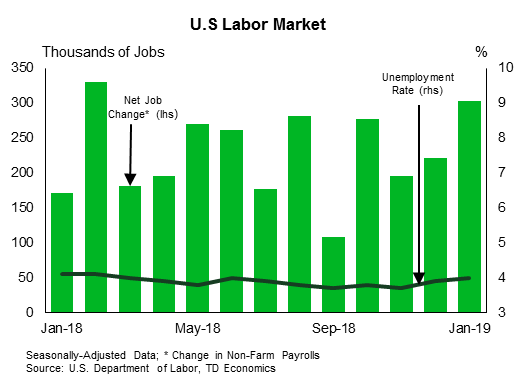
Following two consecutive reports with 300k+ prints for December and January, we look for payrolls to mean-revert to 190k in February. In particular, we see scope for softness in the construction and in the leisure/hospitality sectors given recent above-average strength in hiring. Conversely, the phase-out of the impact from the government shutdown on the household survey should be reflected on a tick down in the unemployment rate to 3.9% in February, as furloughed federal employees exit their "unemployed on temporary layoff" status. Lastly, we expect wages to rise by a "soft" 0.3% m/m pace on a favorable reference week, increasing the annual print by a tenth to 3.3% in February. However, a "strong" 0.3% print could see an even larger increase in the annual pace to 3.4%.
Global Growth Hinges on China’s Big Week
Mixed economic data, a rollercoaster ride in trade, and fresh geopolitical risks saw US equities edge higher on the week, while the dollar was little changed. With the data dependent Fed likely to be on hold for at least the first half of the year, financial markets will closely focus on China’s policy summit for clues on their goals for the year. Many will focus on the economic growth target, but what could be just as important, if not more, are any announcement on stimulus, plans for reform and opening up their markets. The trade war also remains a hot button as expectations grow for a Trump – Xi meeting to occur in the middle of the month. Special counsel Robert Mueller is also nearing completion of his report on whether the Trump campaign colluded with Russia. Once the report is submitted to Attorney General Bill Barr, it could be days or weeks before we find out his ruling.
A busy week filled with interest rate decisions might see key rates unchanged, but investors will closely watch to see if growth forecasts are slashed by the ECB, will the RBA’s fears of global risks and housing weakness grow and will the Bank of Canada become slightly less hawkish and more worried about slowing growth. The US February nonfarm payrolls number will be released on Friday and the employment situation is expected to return closer to trend with 185,000 jobs created, many would not be surprised if the January reading of 304,000 is revised down.
- RBA, ECB and BOC rate decisions could see lower outlooks
- China Policy Summit to outline annual growth target and fiscal/monetary policies
- Trade deal crunch time and Mueller report watch
USD
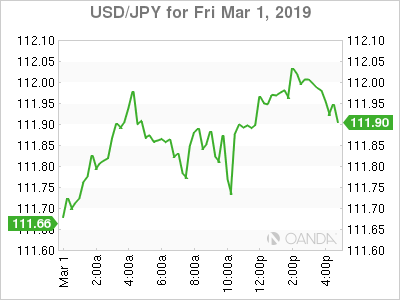
The US dollar continues to struggle to breakout as mixed data confirms the data-dependant Fed’s stance on being patient. The US economy delivered better than expected growth in the fourth quarter, but fresher data suggests housing remains weak, personal income is soft, inflation is muted, while consumer confidence is rebounding. The greenback’s gains have been strongest to the yen and Canadian dollar.
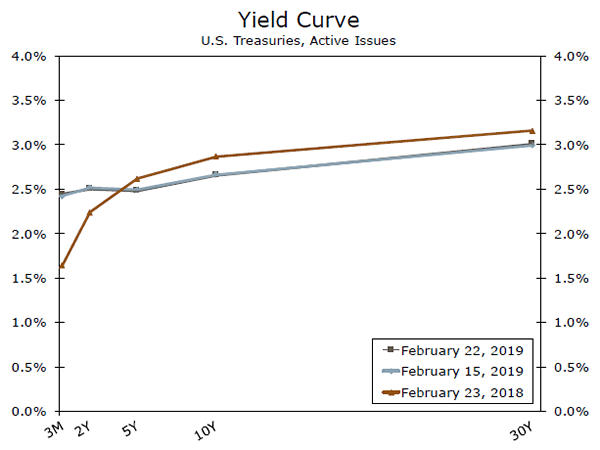
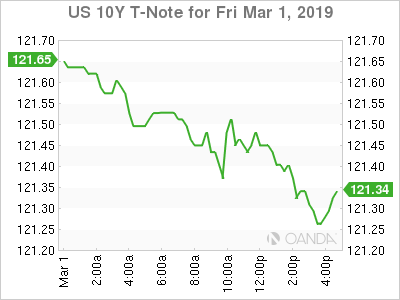
The month of February saw Treasuries trade in the narrowest range since 1979 (2.62% to 2.74%). The yield on the benchmark 10-year Treasury yield did however steadily climb higher this week from 2.66% to 2.75%. Falling expectations that the Fed’s next move will be a rate cut helped push yields higher. The markets will closely await the updated Fed’s projections on March 20th. The Fed downgraded their forecast to 2 hikes for 2019 at the December meeting. Recent economic data suggests the Fed could downgrade their rate hike forecast down to one hike.
Rate Decisions
The Reserve Bank of Australia (RBA) is unanimously expected to keep policy steady at 1.50% . How concerned the RBA is with the housing sector could unveil clues as to whether they are going to start to have a more accommodative stance.
The Bank of Canada (BOC) is also expected to keep rates unchanged at 1.75% and they will they likely ease up on their hawkish outlook following softer inflation and the recent deterioration in GDP and retail sales.
The ECB will keep policy steady unchanged as inflation continues to struggle. They will downgrade their inflation forecasts and expectations for a rate hike could fall to 2020.
Stocks
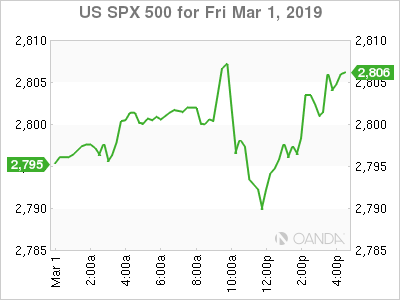
Geopolitical events and a wrath of testimonies dominated headlines this week. Stocks heavily reacted to the tensions from India and Pakistan, a failed Trump-Kim summit, and testimony from US Trade Representative Lighthizer that suggested a lot of work still needs to be done before we see an agreement on trade with China.
Earnings season is approaching the end and we will see several key reports from consumer discretionary stocks. Key results will be released from Target, Salesforce.com, Kohls, Dollar Tree, Costco and Kroger. The performance in US stocks for the first two months of the year delivered the best performance seen in almost three decades.
Oil
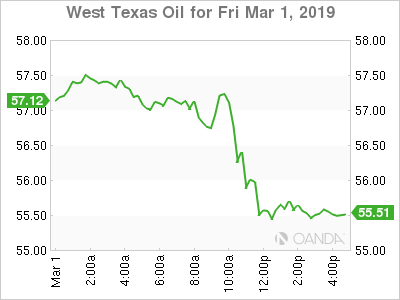
West Texas Intermediate crude appears to be at an inflection point as the OPEC + production cuts appear to have run their course while US production is expected to increase in the coming months. Softer economic data from the largest economy in the world also put a damper on demand, but that may not matter much in the short-term if China signals major policy changes that will help stabilize growth. The supply-side will likely keep any rallies in oil capped, but any disappointment with the demand side could keep the prices under pressure.
Gold
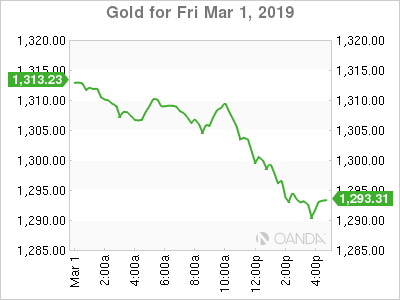
The precious metal lost its luster after fading expectations for the Fed’s next move to be a rate cut saw the psychological $1,300 level penetrated. Technical traders are focusing on the key break of the bullish trend line that started back in October and the close below the 50-day SMA.
Monday, March 4
- 10:30pm AUD RBA Interest Rate Decision
Tuesday, March 5
- China Policy Summit Begins (11-day event)
- 4:30am GBP Services PMI
- 10:00am USD ISM Non-Manufacturing PMI
- 5:10pm AUD RBA Gov Lowe speaks
- 7:30pm AUD GBP q/q
Wednesday, March 6
- 8:15am USD ADP Employment Change
- 8:30am USD Trade Balance
- 8:30am CAD Trade Balance
- 10:00am CAD Bank of Canada (BOC) Interest Rate Decision
- 7:30pm AUD Trade Balance
Thursday, March 7
- 7:45am EUR ECB Interest Rate Decision
- 8:30am EUR ECB Press Conference
- CNY Trade Balance
- 6:50pm JPY Q4 Final GDP
Friday, March 8
- 8:30am USD Non-Farm Employment Change and Unemployment Rate
- 8:30am CAD Employment Change and Unemployment Rate
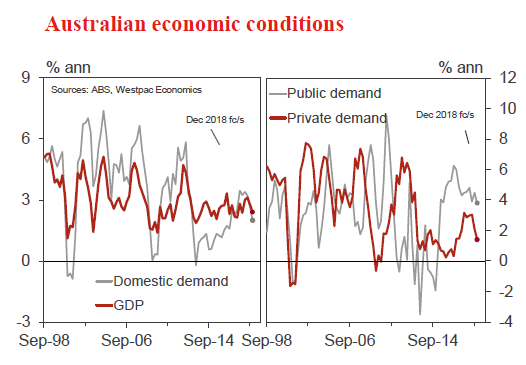
Australian Q4 GDP, a Preview: A Loss of Momentum – Housing and the Consumer
Real GDP: f/c 0.2%qtr, 2.4%yr, Domestic demand: f/c 0.2%qtr, 2.0%yr
- The Australian National Accounts, to be released on Wednesday March 6, will provide an estimate of economic activity for the December quarter.
- The economy experienced a considerable loss of momentum from mid-2018. Growth was 4% annualised over the first half of the year, slowing to as little as a 1% pace in the second half. Key to this development is the turning down of the housing sector, as lending conditions were tightened further, and the consumer, constrained by weak wages growth and weighed down by high debt levels and falling house price.
- Recall, in the September quarter, real GDP grew by 0.3%qtr, 2.8%yr. The arithmetic for the quarter was: domestic demand 0.3%; inventories, -0.3ppts; and net exports +0.3ppts.
- For the December quarter, we expect real GDP growth of 0.2%, slowing annual growth to 2.4%.
- The Q4 arithmetic is: domestic demand +0.2%; inventories 0.1ppts; and net exports -0.1ppt.
- There was an absence of strength in the December quarter, in part due to unfavourable weather (Sydney experienced above average rain, delaying construction work, while much of regional NSW remains in drought).
- The partials suggest / reveal that: retail sales stalled (+0.1%, including a -1.1% for NSW); construction activity declined sharply, -3.1% (a sizeable fall in housing, sharp drop in public works and softness in business); and exports likely stalled (dented by rural goods reflecting the ongoing drought).
- Private final demand (the sum of the consumer, housing and business) may have stalled over the second half of 2018, a -0.1% outcome in Q3 and a forecast +0.1% in Q4.
- The labour market was somewhat mixed in the quarter. Employment numbers grew at a reasonable pace, around 0.7%qtr, 2.3%yr. However hours worked rose by a more modest +0.4%qtr, 1.5%yr. As to productivity, this may have declined in Q4 in part due to weather disruptions.
- On the consumer, accounting for 57% of domestic demand, the national accounts provide us with a detailed update on spending, saving and incomes.
- National income is a point of strength and the December quarter was a positive one. Commodity prices moved higher and the terms of trade increased by 2.5%qtr, 5.5%yr we estimate. Nominal GDP growth is a forecast 1.0%qtr, 5.4%yr.
- The Business Indicators survey, on Monday, will provide partial information on incomes for the quarter, including wages and profits, key inputs into our GDP(I) view.
- For 2019, we expect GDP growth to be around 2.2%, with: consumer spending sluggish; home building activity contracting sharply; business equipment spending weak (in part due to uncertainty around the Federal election); but strength in government demand and a positive contribution from net exports, led by LNG (additional capacity) and services (strong demand from the Asian region and supported by the low Australian dollar).
- Against this backdrop and with uncertainty around the election, jobs growth is likely to ease, moderating to a pace below that for working age population (currently around 1.7%), placing upward pressure on the unemployment rate.
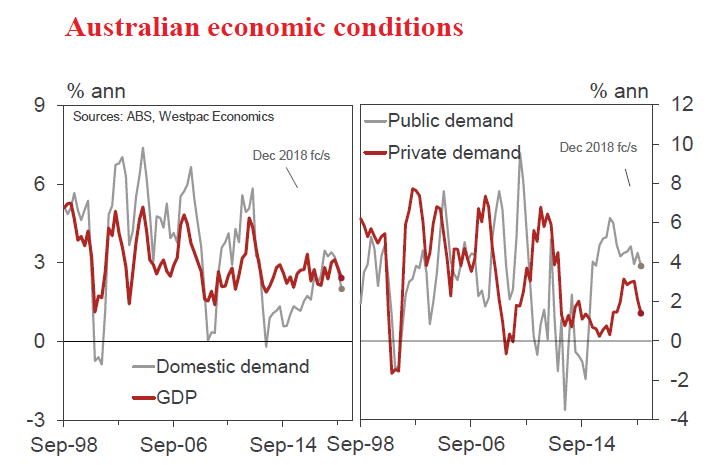
Household consumption (0.5%qtr, 1.9%yr): A choppy consumer spending profile (at least in the official estimates) appears to have given way to a period of softness. In mid- 2018, annual consumption growth was 2.9%. But in Q3, spending grew by only 0.3% and we expect a sluggish 0.5% in Q4. Retailing, +2.4% in the year to June, all but stalled over the second half of 2018 (+0.2% in Q3 and a +0.1% in Q4). The housing downturn and drought in NSW, as well as ongoing weak wages growth, are clearly having an impact. Vehicle sales have been declining as lending conditions tighten.
Dwelling investment (-3.0%qtr, +3.6%yr): New home building peaked in mid-2018. Strength over the opening two quarters (+4.3% and +4.0%) was followed by sizeable falls (-2.5% and -3.6%). Further declines are in prospect with approvals almost 30% below levels prevailing over the second half of 2017. Renovations remain choppy, up in Q3 but reversing in Q4.
New business investment (+0.4%qtr, -0.7%yr): A mixed quarter, with gains in equipment, led by the service sectors (0.7% in capex survey) and most likely computer software but with commercial building broadly flat (-0.2%) and infrastructure activity easing (-1.3%) following the recent finalisation of major gas projects.
Public spending (0.4%qtr, 3.8%yr): Public demand has been a key growth driver and we see further upside particularly with tax revenues boosted by higher commodity prices and low government borrowing rates. However, public construction hit a pot hole in Q4, down 6.0% (bottlenecks and weather may have been a factor). Public consumption spending (including health) is a potential upside risk for the quarter.
Net exports (-0.1ppt, +0.9ppts yr): Exports stalled over the second half of 2018 (dented by drought and supply disruptions in the resource sector). Imports rose modestly following a surprise dip in Q3 - a profile which has net exports swing from +0.3ppts in Q3 to -0.1ppt in Q4.
Private non–farm inventories (+0.3%, +0.1ppt contribution): Inventory levels, which typically rise to meet expanding demand, stalled in Q3. We anticipate a modest rise in Q4, which would see them make a small 0.1ppt contribution.
Australia & New Zealand Weekly: Some Risks Next Week, and Observations on the US
Week beginning 4 March 2019
- Some risks next week, and observations on the US.
- RBA: policy decision, Governor Lowe speaks.
- Australia: GDP partials, GDP, dwelling approvals, retail sales, trade balance.
- NZ: building work put in place.
- China: National People's Congress, trade balance.
- Europe: ECB policy decision, GDP 3rd estimate.
- US: non-farm payrolls, Fed Chair Powell speaks.
- Key economic & financial forecasts.
Information contained in this report current as at 1 March 2019.
Some Risks Next Week, and Observations on the US
The Reserve Bank Board meets next week on March 5.
On February 21 Westpac announced a change in view for the outlook for the cash rate.
After correctly forecasting unchanged policy since August 2016 (despite the RBA; the market and most economists predicting rate hikes) we finally changed our call to a 25 basis point cut in August and another 25 basis point cut in November.
We would be very surprised if the Board decided to move next week but, given our change of view, must accept that as we move closer to our August target, meetings will become increasingly "more live".
The reasons behind our change in view have been extensively explained in the note on February 21.
The GDP report for the December quarter 2018 which prints on March 6 will be important for the rate outlook. Following the 3.1% reported fall in construction (around 14% of GDP) we have further revised down our forecast for Q4 GDP growth to 0.2%. That would follow a currently reported 0.3% for Q3, implying that the economy lost considerable momentum through the second half of 2018. This forecast is based on consumer spending growth of the reported 0.3% in Q3 and our estimated 0.5% in Q4. Risks to our consumption view are substantial statistical revisions to Q3 and a stronger than expected lift in Q4, despite weak retail sales and falling vehicle sales.
Insights on the US and FOMC policy
On February 18, I returned from a two week marketing trip in the US where I met with a number of FOMC members; real money managers; hedge funds; and corporates.
One consequence of this visit has been the decision to revise our forecast for the federal funds rate in 2019 from hikes in June and September to one hike which will be delayed until December.
We had been aware that on November 28 (Economic Club of New York) Chairman Powell noted: "Interest rates are still low by historical standards, and they remain just below the broad range of estimates of the level that would be neutral for the economy — that is, neither speeding up nor slowing down growth".
Subsequently on December 15, he further increased the federal funds rate by 25 basis points.
With that move and the expectation that the economy was likely to slow from a 3% growth pace in 2018 to a 2–2.5% pace in 2019, the appetite for rate increases from the Federal Reserve has dissipated in the markets.
While it is accepted that the consumer will continue to support growth, other, more cyclical parts of the economy, are seen to be slowing. These include business investment; housing and exports.
Even the economists who confidently expected multiple rate hikes from the Federal Reserve as recently as early December have now retreated to expecting "maybe" one more hike near the end of the year.
It is accepted that it will take considerable time for the FOMC to make a case for higher rates. The earliest likely opportunity would be around the Jackson Hole Conference in August. The Chairman is also likely to need to link any further hikes to a clear rhetoric around the economy (i.e. the FOMC did not raise rates, it was the US economy).
Proponents of the "neutral" setting approach accept that the measure of neutral is too imprecise to be able to assess that rates are at or above neutral.
It was much easier in 2018 – rates were clearly below neutral; and the economy had tailwinds – fiscal policy; global growth and easy financial conditions.
In 2019, rates are 100 basis points higher; the stimulatory effect of fiscal policy is dissipating and should a range of spending programs expire by 2019 H2 (as currently legislated), fiscal policy will become a headwind. In addition, global growth is slowing and financial conditions are tightening.
While equities usually have a relatively low weight in Financial Conditions Indexes (around 5–10%) they are more significant in assessing the outlook for the economy – as a proxy for risk and for businesses' outlook on growth. While the share market has regained much of the losses of early December, this volatility signals a degree of caution is warranted.
"Neutral" or R* is broadly defined as the interest rate setting that is consistent with 2% inflation (as measured by core PCE) and potential growth. Although, in 2018, inflation had hovered below the 2% target, GDP growth of 3% was substantially above the measure of potential which is 1.75–2.0%.
For 2019, growth is expected to slow to 2–2.5%, slightly above potential, but inflation is expected to remain "sticky" at around 2%, indicating that policy is very close to "neutral". We must also respect the argument that inflationary expectations need to be anchored around 2%. Allowing inflation to lift above 2% to emphasise symmetrical policy is generally supported.
There is universal confidence, almost complacency, that prospects for a "blow–out" in inflation are limited. Risks on inflation continue to be pitched to the downside.
From my perspective, the risk with this benign outlook for policy is around the labour market and wages. Responding to tightening conditions in the labour market (although overstated by the headline unemployment rate due to ongoing slack associated with the low participation rate) we have seen upward pressures on wages growth. In 2016 and 2017, average weekly earnings grew around an annual pace of 2.5–3.0%. That has now lifted to around 3.5% in 6 month annualised terms. Momentum in the jobs market does not seem to be easing and a reasonable view is that wages growth will continue to climb.
The consensus outlook for wages growth is mixed but generally relaxed – labour's bargaining power has declined structurally; businesses have limited pricing power to pass on wage increases; business is committed to labour saving investments; and wage and price expectations are low.
Discussions with researchers highlight the lack of a relationship between wages growth and core PCE inflation (one economist told me he worked in the wages and prices section of the Washington Fed for five years and was unable to prove a significant causal relationship). Furthermore, there is limited "cyclicality" in core PCE with "administered" prices and "shelter" playing important roles.
Theory, of course, dictates that wage growth is determined by inflation (or inflationary expectations) and productivity growth. The productivity outlook for the US is not encouraging so theory would dictate that a lift in wages should be associated with rising inflation. No response from inflation can only mean that inflation is being incorrectly measured or there is some other explanatory variable like "labour slack" that fills in the gap. Certainly there is a legitimate concern that wages might experience some non–linear surge as "catch–up" to the slow adjustment in the early stages of the recovery – previously, wages did not fall despite the collapse in demand post GFC. For now, I am comfortable with the benign consensus view but am still troubled by a rising wages/sticky inflation scenario.
We doubt the recession thesis for the US. Recessions in the US are typically caused by a large financial shock (dot–com bubble and GFC) or the FOMC losing control of inflation and over tightening. To date, there is limited evidence of extreme financial excess, while "stable" core PCE inflation represents no marked threat of overshooting. With only one more hike pencilled in for 2019 and no recession on the horizon, we expect the federal funds rate to be steady through 2020.
The week that was
This week, investment partial data for the December quarter cast a long shadow over Australian GDP – next week's key release.
Each quarter in Australia, we receive two updates related to investment ahead of the GDP report: construction work done; and the CAPEX survey. The former outlines activity across the construction sub-sectors, while the latter is a guide for equipment investment.
In Q4, construction work done was a material disappointment, aggregate activity falling 3.1% against the market's expectation of +0.5%. The main contributors to this downside surprise were public construction (which was expected to rise) and residential construction (which surprised by declining at a faster-thanexpected pace). Ahead, public work is set to bounce, with the pipeline of work lasting years into the future. Residential construction however is a very different story, with further sizeable falls to come in 2019 and 2020. With the construction sector making up 14% of our economy, the 3.1% decline in total activity in Q4 should take 0.4ppts from GDP growth. Note though that outcomes for this survey do not always translate one-for-one to GDP.
The CAPEX survey was, in contrast, essentially in line with our expectation, with spending on equipment up a modest 0.7% in Q4. Given this result, our focus quickly shifted to assessing the investment intentions of survey recipients, provided for both the 2018/19 and 2019/20 financial years. Based on average realisation ratios, we calculate that the current estimates for financial years 2018/19 and 2019/20 imply an increase in business investment of just 3% and 1% respectively. By industry, the end of the mining investment downswing is apparent, with investment intentions for the sector swinging from –8% in 2018/19 to +5% in 2019/20. Meanwhile the forward view for manufacturing and services points to a reduced appetite for investment come 2019/20. Note that this is only the first estimate for 2019/20, and often these prove unreliable. Historically it has been the case that firms typically upgrade their investment intentions as the year progresses. Still, given our expectation of a weak consumer and the deterioration in residential construction, not to mention global uncertainties, business investment growth in the coming two years is likely to remain subdued.
Q4 GDP will be released for Australia next Wednesday. Given the weak read for construction and no offset from equipment spending, we have revised down our forecast to just 0.2%, 2.4%yr. If it prints around this level, and absent a material revision to Q3, then growth will have more than halved from the first half of 2018 to the second. Within the detail of the GDP report, the state of consumer incomes and spending will be a particular focus. The consumer is key to our call for two 25bp rate cuts in 2019, in August and November.
Moving offshore, US GDP beat market expectations in Q4, but was in line with our own at 2.6% annualised. This is a robust outcome which leaves year-average growth at 2.9%, well above potential. Looking forward, the detail of the Q4 release highlights an important shift in the make-up of growth. Simply, the consumer is increasingly dictating headline momentum, as business investment moderates and residential construction falls. The importance of the consumer will only grow hence, given these business and residential investment trends are set to persist, and support from government spending will also likely end in late-2019. The most probable outlook for the US is still growth a little above trend in 2019 and 2020, circa 2.0%. As per comments from Chair Powell and other FOMC members this week, this warrants a view that a further rate hike may prove necessary, but that it will only be delivered after inflation and activity data justify it. We hold that the US real economy will warrant one more hike at end-2019, though global and domestic risks have to recede fully by then for this outturn to transpire.
Finally, ahead of next week's Annual National People's Congress in China, the NBS manufacturing PMI confirmed the sector remains under considerable pressure from weak external demand. The PMI printed below 50 for a thirdconsecutive month, at a three-year low. Though growth in fixed asset investment remains historically soft, total orders of manufacturers lifted back above the 50 expansion/ contraction mark in February, even as external orders weakened further to their lowest level since the GFC. Along with the relative strength of the services PMI, February's orders outcomes point to underlying domestic momentum building in China's business sector. As we recently outlined in our 2019 outlook, the worst is behind China with respect to investment growth. A modest but enduring uptrend should now take hold, as policy easing takes effect and authorities pursue quality, long-term growth in their capital stock and for the economy at large.
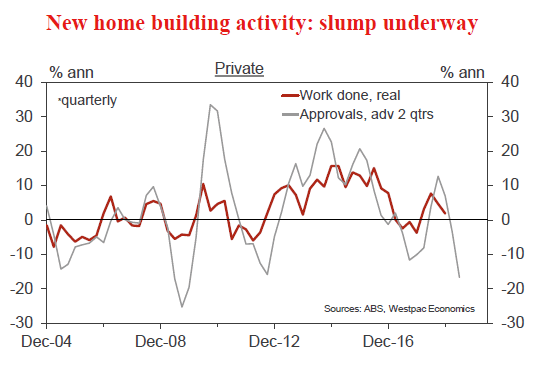
Chart of the week: Australian housing construction
The deterioration in the construction sector was a key development in 2018, contributing to the material loss of momentum in the economy from the middle of the year.
Consistent with this, the private business surveys have reported a significant slowing in business conditions.
The housing sector is now in a downturn, with further sizeable falls ahead. This follows a strong and extended upswing over recent years.
Private new home building activity grew strongly in Q1 and Q2, +4.3% and +4.0%, respectively. That was followed by sizeable declines in Q3 and Q4, -2.5% and -3.6%.
Private dwelling approvals collapsed late in 2018, tumbling by 17.5% over the two months to December. Approvals are now around 30% below the levels prevailing over the second half of 2017.
New Zealand: week ahead & data wrap
Ups and downs
The recent data for New Zealand has taken on a distinctly mixed complexion. But at the least it has provided some support for our view that last year's spike in petrol prices was a temporary hindrance to activity.
Developments in household spending have been something of a puzzle in recent times. Employment has been rising at a solid pace, and wage growth has picked up to some degree. On top of this, the Government's Families Package came into full force in July, putting more money into the pockets of lower income households. Yet retail sales volumes in the September quarter were close to flat.
We took the view that the impact of the Families Package was being cancelled out by a spike in petrol prices, which reached new record highs in September and early October. That increase siphoned at least $130 million out of households' wallets between July and October, leaving them with less to spend on other items.
The spike in petrol prices has since been completely unwound, giving household budgets some relief. Combined with the ongoing payments from the Families Package, we expected retail spending to regain some momentum again.
That turned out to be the case. Retail sales in the December quarter rose by 1.7%, bouncing back by even more than we expected. There were gains across most categories, including large gains in areas such as supermarkets and dining out.
It remains true that the pace of growth in retail spending has come off its highs in the last couple of years. Slowing population growth has been one factor. And the household wealth effect is alive and well – spending growth has slowed as house price inflation has cooled off. Both of these factors are likely to weigh further on spending growth in the coming years.
Elsewhere, the theme of mixed data continued this week. On the positive side, building consents were surprisingly strong in January, with a 16% jump in seasonally adjusted terms. (In raw terms, the consent numbers were up slightly in what is normally a slow month.) The monthly gain was very much centred on Auckland, and was driven by both apartments and standalone houses.
Over 13,200 new homes were consented in Auckland in the last year, the highest level in several decades (the official figures go back to 1990). The number of homes being consented is now roughly in line with changes in the population. And with population growth itself set to slow down in the coming years, we think the construction cycle is nearing a peak.
Another positive development – of sorts – was an upgrade to Fonterra's farmgate milk price forecast for this season to $6.30-6.60 per kg (previously $6.00-6.30). However, the higher payout reflects an expected shortfall in milk collections over the remainder of the season, as a result of the unusually hot and dry weather over the past month. Prices in the twicemonthly GlobalDairyTrade auctions have risen by 15% since the start of year, which to some degree will already reflect an awareness of the recent climatic conditions. Nevertheless, it will be interesting to see how next week's auction fares after the Fonterra announcement.
The less welcome news this week came from the ANZ business confidence survey, where the modest recovery in confidence we saw over the last quarter of 2018 was unwound in February (the survey is not held in January). There was a deterioration across most activity indicators including expectations of profitability, employment, investment and export intentions. The results were mixed across sectors, with a particularly sharp fall in expectations for firms in the construction sector.
Business confidence has been markedly weaker since the change of government in 2017, much more so than other indicators that point to modest growth in economic activity. There has no doubt been an element of 'protest vote' to the survey responses, though there were signs that this aspect was easing off by the end of 2018. It will be interesting to see how confidence fares in the March survey, after the release of the Tax Working Group's final report which, among other things, recommended the introduction of a capital gains tax on investment properties, farms, and businesses.
Next week brings the last of the sectoral surveys that will be used to calculate December quarter GDP, including manufacturing, wholesaling and building activity.
Notwithstanding the strong retail trade figures, the sectoral details that we have to date have been on the soft side; we're currently forecasting just a 0.3% rise in GDP. But there's a good chance that some of this weakness has just been survey noise, or issues of timing. Our view remains that GDP growth will pick up again over 2019, supported by rising government spending and a lift in construction activity.
Data Previews
Aus Q4 company profits
- Mar 4, Last: 1.9%, WBC f/c: 1.0%
- Mkt f/c: 3.0%, Range: 0.5% to 4.7%
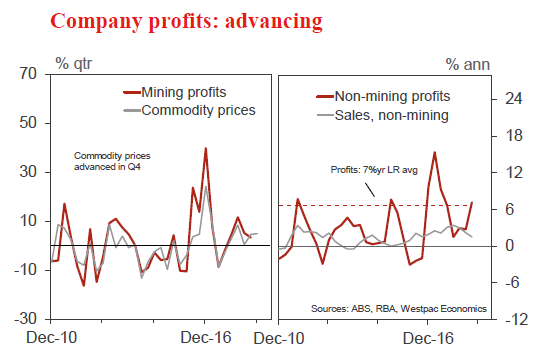
Profits are advancing, boosted by higher commodity prices.
In Q3, profits rose by 1.9%, including a 3.4% increase for mining and around a 1% gain across the broader economy.
For Q4, we anticipate a 1.0% rise in profits (as reported by the Business Indicators survey).
Mining profits will likely post another strong gain, up almost 5% in line with higher commodity prices. Since the low at end 2015, mining profits have jumped by almost 130%.
For the non-mining sectors, the loss of economic momentum may have seen profits move sideways. That would still leave profits up by more than 20% from end 2015.
As to the national accounts estimate of profits (which abstracts from variations in the value of inventories) we expect a gain in Q4 of around 1.8%.
Aus Q4 inventories
- Mar 4, Last: 0.0%, WBC f/c: 0.3% (+0.1ppt)
- Mkt f/c: 0.3%, Range: 0.0% to 0.8%
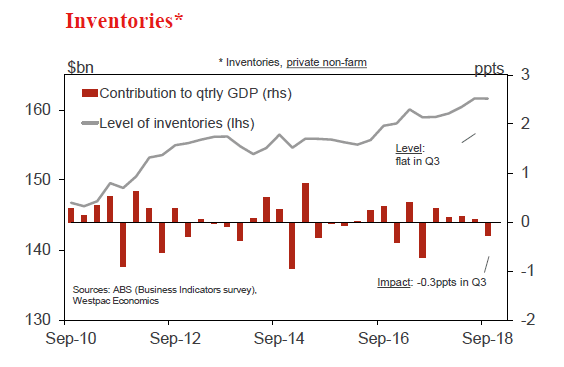
Over the past year, inventories increased by a moderate 1.8% in response to rising domestic demand.
In the June quarter, inventories expanded by 0.6%, with a lift in mining (which more than outweighed a temporary dip in manufacturing) and with a 0.7% rise across other sectors.
For the September quarter, inventories are expected to expand further, albeit at a marginally slower pace, up a forecast 0.5%. Housing and consumer spending took on a softer tone in the quarter, weighing on the need to add to inventories.
This would see inventories make a very small subtraction from growth in Q3, in the order of -0.1ppt.
Aus Jan dwelling approvals
- Mar 4, Last: –8.4%, WBC f/c: –1.0%
- Mkt f/c: 1.5%, Range: -5.0% to 8.0%
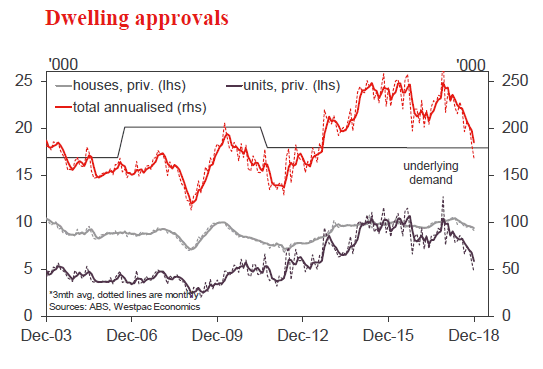
Dwelling approvals slid sharply into year end – declining 8.4% in the final month to be down 26% over the fourth quarter. The composition also showed a notable shift with a continued decline in high rise approvals but weakness starting to show through in other segments as well. The shorter 'lags' on non high rise work means these declines will likely impact activity through the first three quarters of 2019.
High rise approvals are likely to settle around current low levels. While there is a risk of a technical bounce following two big negatives, we expect the Jan update to reflect the 'one-way traffic' in housing markets evident through late 2018. On balance we expect Jan to show a 1% decline. As always, risks are compounded by the very low activity over the holiday season which means moves can be significantly amplified by seasonal adjustment.
Aus Q4 net exports, ppt's cont'n
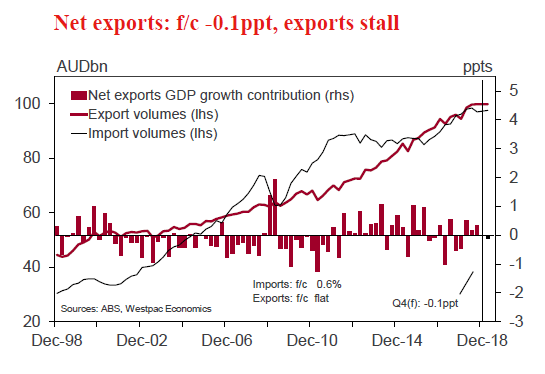
- Mar 5, Last: +04, WBC f/c: -0.1
- Mkt f/c: -0.1, Range: -0.4 to 0.2
Net exports were a positive in Q3, adding 0.4ppts to growth. This was despite flat exports and was driven by a 1.5% dip in import volumes.
For Q4, net exports are likely to be a negative - a small one, subtracting 0.1ppt from activity.
Export volumes appear to have stalled for a second quarter. The drought is a material headwind. Falls in rural goods exports (led by cereals) is offsetting gains in services and manufactures, while resources remain patchy constrained by supply disruptions.
Import volumes appear to have advanced modestly, up around 0.6% we estimate.
Aus Q4 current account, AUDbn
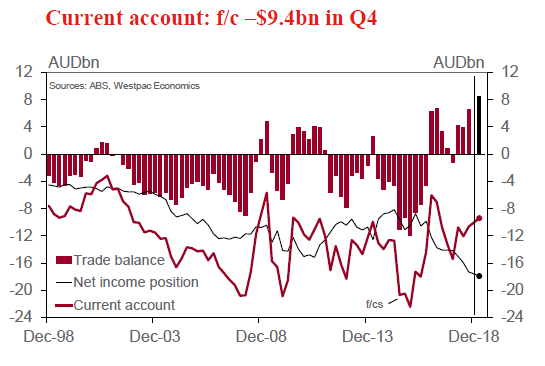
- Mar 5, Last: -10.7, WBC f/c: -9.4
- Mkt f/c: -9.2, Range: -11.5 to -8.5
Australia's current account deficit is relatively well contained currently, at 2.2% of GDP in the September quarter, well below the post 1990s average of 4.2%.
In Q3, the deficit was $10.7bn, with a trade surplus of $6.6bn (since revised lower to $5.8bn) and an income deficit of $16.9bn (well up from $13.7bn a year earlier).
For Q3, the current account deficit is expected to narrow a little to a forecast $9.4bn.
The trade surplus widened to $8.5bn. Key to this improvement, export earnings were boosted by higher commodity prices. The terms of trade rose by around 2.5% we estimate.
The net income deficit is expected to widen further, to $17.9bn, as the higher commodity prices boost returns to foreign investors in the mining sector.
Aus Q4 public demand
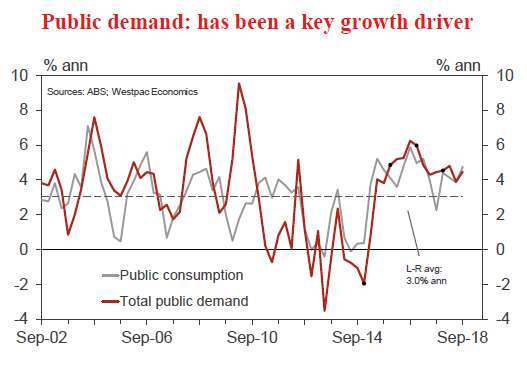
- Mar 5, Last: 1.5%, WBC f/c: 0.4%
The public sector - directly accounting for almost a quarter of the economy - has been a key growth driver over recent years, increasing by 4.9% in 2015, 6.0% in 2016, 4.5% in 2017 and by 4.5% in the year to 2018 Q3.
Public investment is trending sharply higher, off low levels, with a focus on long overdue transport projects. Health spending (included in 'consumption') is also moving higher at a brisk pace.
However, in Q4, public demand is expected to advance at a much more modest pace, up by 0.4%.
Notably, public construction surprised, reporting a 6.0% decline - possibly reflecting bottlenecks and unseasonable weather (Sydney had a particularly wet spring). The pipeline of work remains sizeable and a near-term rebound is likely.
Aus RBA policy announcement
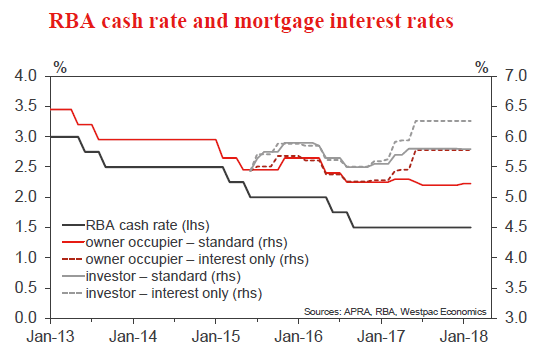
- Mar 5, Last: 1.50%, WBC f/c: 1.50%
- Mkt f/c: 1.50%, Range: 1.50% to 1.50%
The Reserve Bank Board meets on March 5. On February 21 Westpac announced a change in view for the outlook for the cash rate to a 25bps cut in August and another 25bps cut in November. We would be very surprised if the Board decided to move next week but, given our change of view, must accept that as we move closer to our August target, meetings will become increasingly "more live".
At 9 am on Wednesday, Governor Lowe is speaking on "The Housing Market and the Economy". In his most recent speech on February 22nd, he noted possible spill-overs from declining house prices to weaker consumption and dwelling construction. Nonetheless, he reiterated the RBA's view that the "adjustment in the housing market is not expected to derail the economy". Westpac believes these spill-overs will be more material, and indeed through the latter half of 2018, data has already shown dwelling construction turn lower, weak retail sales, and falling vehicle sales.
Aus Q4 GDP
- Mar 6, Last: 0.3%qtr, 2.8%yr, WBC f/c: 0.2%qtr, 2.4%yr
- Mkt f/c: 0.5%, Range: 0.1% to 0.6%
The Australian economy lost considerable momentum between the first and second half of 2018, from a 4% annualised pace to our forecast of only a 1% pace.
The slowing was centred on housing and the consumer as lending conditions tightened and wages remained sluggish.
For Q4, we expect real GDP growth of 0.2%qtr, 2.4%yr. The arithmetic is: domestic demand, 0.2%, inventories +0.1ppt and net exports, -0.1ppt.
Partials suggest / reveal that: retail sales stalled (+0.1%, including a -1.1% for NSW); construction activity declined sharply, -3.1% (a sizeable fall in housing, sharp drop in public works and softness in business); and exports likely stalled (dented by rural goods reflecting the ongoing drought).
Hours worked rose, but not strongly, +0.4%, and productivity may have declined due to weather disruptions.
Aus Jan retail trade
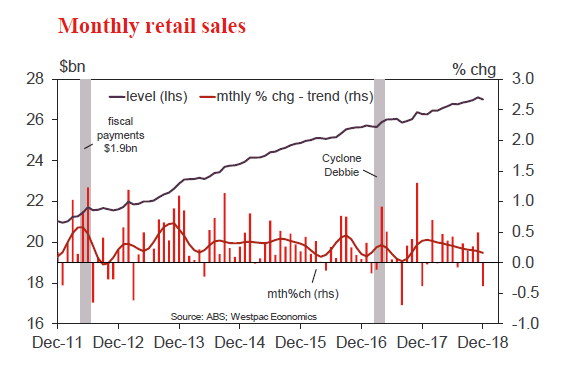
- Mar 7, Last: –0.4%, WBC f/c: –0.1%
- Mkt f/c: 0.3%, Range: -0.1% to 0.7%
Retailers recorded a weak finish to 2018, monthly sales dipping 0.4% in December. While some of this likely reflects 'residual seasonality' with the ABS struggling to adjust for the shifting in timing of sales around the Christmas period (the rising popularity of 'Black Friday' and new year sales in particular) the underlying trend is still clearly weak. At 2.8%yr, annual growth is sluggish at best with the six month annualised pace below 2%.
Consumer sentiment had a shaky start to 2019, dipping into net pessimistic territory for the first time since 2017 but recovering in Feb. Private sector business surveys suggest there has been no respite for retailers with a sharp deterioration in conditions in Dec extending into Jan. We expect total retail sales to show a 0.1% dip for the Dec month.
Aus Jan trade balance, AUDbn
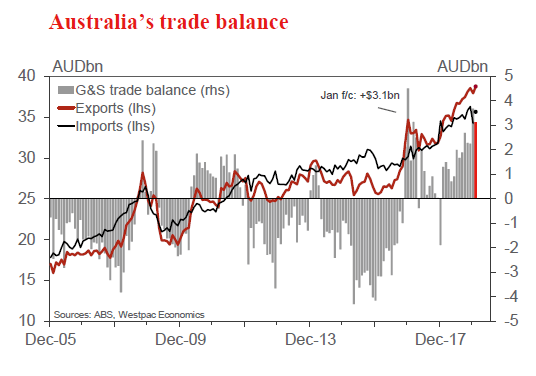
- Mar 7, Last: 3.7, WBC f/c: 3.1
- Mkt f/c: 3.0, Range: 2.2 to 4.5
Australia's trade account is expected to begin the 2019 year in surplus, for a 13th consecutive month.
In December, the surplus jumped by $1.4bn to $3.7bn largely on a sharp drop in imports.
For January, we expect a partial reversal, to a surplus of $3.1bn, on a likely rebound in imports.
The import bill is expected to bounce back in January, up by around $1.4bn (+4%), largely reversing the $2.1bn drop evident in December.
Export earnings over the past year have been boosted by higher commodity prices - a dynamic that has extended in to 2019. Exports are expected to rise by around 2.2% in January, +$0.8bn, on: higher iron ore prices; a rebound in gold (off a low level); but with a possible partial offset from weakness in rural goods.
NZ Q4 building work put in place
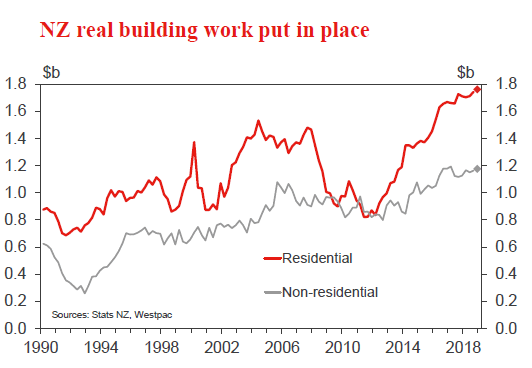
- Mar 8, Last 0.7%, Westpac f/c: 1.0%
- Mkt f/c: 1.0%, Range: -0.8% to 1.5%
Construction activity rose by 0.7% in the September quarter, and was up 2.1% over the year. The September quarter rise was underpinned by a 1.2% increase in residential building centred on Auckland, while non-residential construction was flat over the quarter.
We're expecting another quarter of modest growth in December, with total building activity expected to increase by 1%. That's being supported by modest gains in both residential and non-residential building.
Building activity is set to take another step up over 2019 as home building in Auckland picks up. However, the construction cycle is close to peaking, especially with postearthquake reconstruction winding down.
US Feb employment report
- Mar 8, nonfarm payrolls, last 304k, WBC 175k
- Mar 8, unemployment rate, last 4.0%, WBC 3.9%
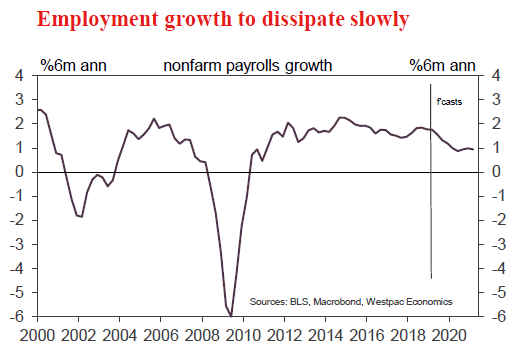
After a strong 2018, employment growth started 2019 with extraordinary vigour, nonfarm payrolls rising 304k in the month. Admittedly, employment in the prior two months was revised down by 70k. Still, the net addition of 234k is unquestionably strong.
Come February, we look for a moderation back to around 175k for monthly employment growth. If seen in both February and March, this pace would result in a Q1 monthlyaverage pace in line with 2018's.
Looking ahead, employment gains in 2019 are expected to be softer than in 2018, but still ahead of labour force growth. The consequence will be a steady drift lower in the unemployment rate towards 3.5%.
Euro Area ECB policy decision
- Mar 7, deposit rate: -0.4%
March will focus on projections, guidance, and liquidity.
Regarding macroeconomic projections, the ECB have downplayed the current slowdown's impact on the mediumterm outlook, highlighting temporary factors. The incoming ECB Chief Economist Lane noted recent data suggests "reasonably small adjustments to the [ECB] forecasts". But, a high level of geopolitical uncertainty underscores caution.
In terms of the implications for policy rate forward guidance, the Bank of France Governor noted that if the downturn continues into summer, then the ECB will be "ready to adapt their monetary policy guidance". For now, there is sufficient 'state-contingency' contained in the current guidance with rates on hold "at least through the summer of 2019".
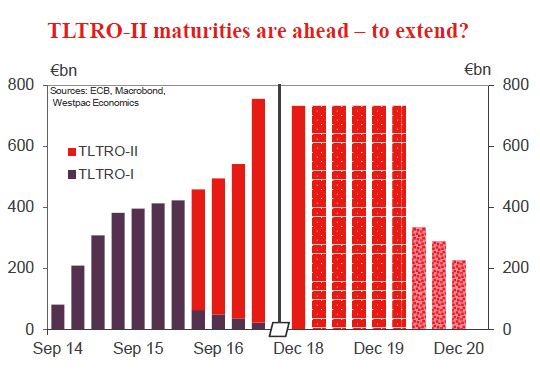
The liquidity discussion is on the maturing first €400bn operation of TLTRO-II in June 2020. This will affect banks in June 2019 due to regulatory funding ratios. The question is on how the ECB may extend loans to avoid "cliff effects".
Week Ahead – ECB, RBA and BoC Meetings Eyed Amid Potential Policy Shifts; US Jobs Report in Focus Too
Central banks will move to the fore next week as the European Central Bank, the Reserve Bank of Australia and the Bank of Canada will be holding policy meetings. With all three central banks recently lowering their outlooks for their respective economies, markets will be on standby for possible shifts in policy stance. The US February jobs report will be another highlight for investors. Other key releases will be Q4 GDP numbers from Australia, Canadian employment figures, and UK and US services PMIs.
Australian GDP and RBA meeting could drag on aussie
It’s going to be a crucial week for the Australian dollar with a data-heavy economic calendar and an RBA policy meeting likely to test some key technical levels for the aussie/dollar pair. First up on the agenda are January building approvals and fourth quarter business inventories on Monday. There will be more Q4 barometers on Tuesday with the release of net exports contribution. The real highlight though will be the Q4 GDP estimates on Thursday. Australia’s economy is forecast to have expanded by 0.4% quarter-on-quarter in the final three months of 2018 to produce an annual rate of 2.6%. January retail sales and trade numbers will wrap up the week on Friday.
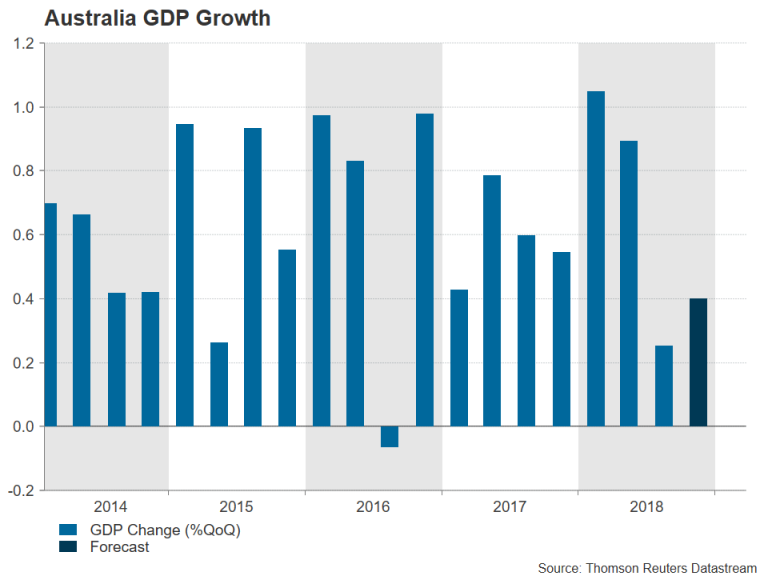
The RBA, which will announce its latest policy decision on Tuesday, is expected to keep rates on hold but may backtrack on its overoptimistic 2019 growth predictions of around 3% if the GDP data comes in line or below expectations. A dovish RBA and disappointing growth figures could weigh heavily on the aussie.
Chinese trade issues to stay under the spotlight
With plenty of domestic concerns to inundate aussie traders next week, China-related risks will also be playing their part in driving the Australian currency.
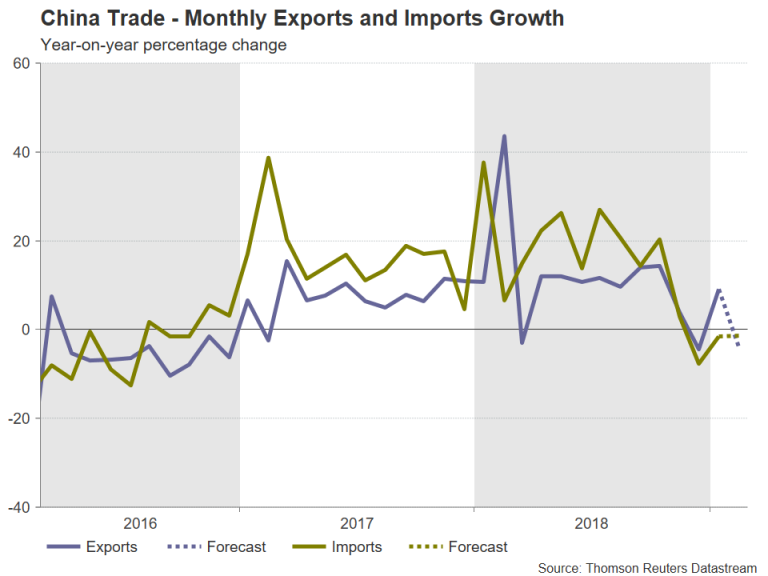
As US and Chinese negotiators try to resolve their remaining differences in their long-running trade conflict, monthly export numbers from China will be looked at to assess the impact of the dispute on the economy. The country’s exports are forecast to have fallen by 4.5 year-on-year in February, while imports are expected to have slid by 1.4% y/y. Other data worth watching will be consumer and producer inflation figures on Saturday.
Another event markets will be keeping an eye on is the National People’s Congress, which starts on March 5. Reports suggest the Chinese government wants parliament to vote on a new law on foreign investments. The proposed legislation will likely address US demands for better protection of foreign businesses operating in China and their intellectual property. Such a move could potentially pave the way for US and Chinese trade negotiators to close a deal very soon, helping to extend the risk rally in place since the start of the year.
Japan to publish revised GDP estimates
Revised Japanese GDP estimates out on Friday will likely confirm that the economy returned to growth in the final quarter of 2018, with a small upward revision being expected following the strong business spending figure released this week. But this week’s data also revealed very weak industrial output in January, and so the focus has now shifted to the first quarter. Thus, household spending numbers due on Friday will be watched for further clues about the strength of the Japanese economy at the start of 2019.
The yen is unlikely to see much reaction to the data, though it could face some downside pressure if they point to unexpected weakness.
Range-bound euro awaits cues from ECB meeting
It’s going to be an important week for the euro as the European Central Bank could announce fresh support measures for the Eurozone economy. There will also be a good deal of data to draw investors’ attention. Starting the week on Monday is the Eurozone sentix index along with January producer prices for the region. On Tuesday, the final February services PMI from IHS Markit and retail sales for January are out. Revised GDP estimates for the fourth quarter are due on Thursday but no change is being forecast to the prior reading of 0.2% q/q.
Hence, the big attraction on Thursday will be the ECB policy decision. The central bank is widely anticipated to maintain interest rates and its forward guidance unchanged. However, there is increasing speculation that policymakers will signal, if not announce, a new round of cheap loans (TLTRO) for Eurozone banks to boost lending in the bloc. Updated staff macro-economic projections will be available for the Governing Council to sift through at the March meeting so if there is a significant downgrade of growth and inflation projections, it is almost certain to prompt Council members into action.
It is difficult to predict the market’s response to any ECB decision on TLTRO as, on the one hand, a lending stimulus could ease fears of a further slowdown, lifting the euro. While on the other, it would signal a more dovish central bank, especially if there are also hints that the planned rate hike for late 2019 could be pushed back, and this would be negative for the single currency.
Light UK calendar could be spoiled by Brexit again
The Markit/CIPS construction and services PMIs will be the main releases to come out of the UK next week. However, there’s a chance British Prime Minister Theresa May could bring the meaningful vote on her Brexit deal to Parliament early before the March 12 deadline if she manages to secure the legal assurances she is seeking from the EU that the Irish backstop would be temporary if triggered.
There seems to be growing movement within MPs, particularly among Eurosceptics, to back the deal if May obtains the legal guarantee after she offered lawmakers a vote on ruling out a no-deal scenario and extending Article 50. Labour’s backing of a second referendum also rattled hardline Brexiteers who may now fear Brexit could be postponed or even aborted.
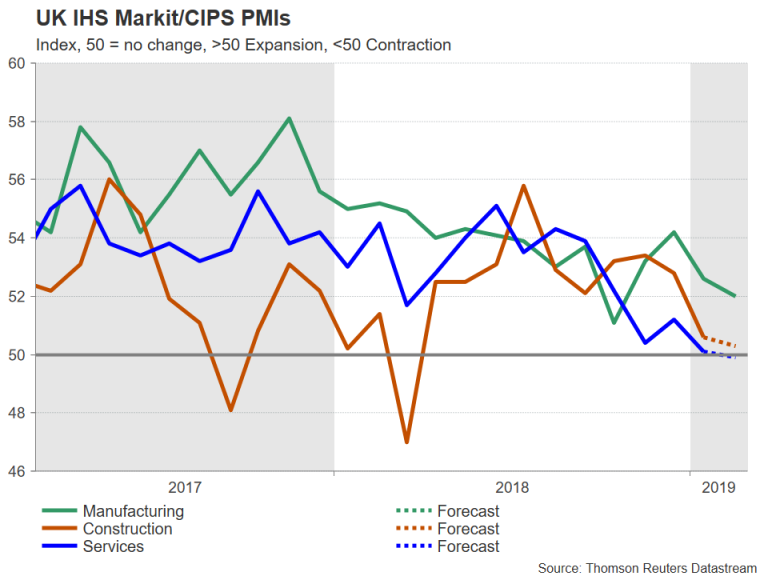
The pound’s strong rally over the past week will either unravel or be fuelled depending on which way the vote goes if it’s held in the next seven days. Otherwise, the only focal point for traders will be the services PMI on Tuesday. The index is forecast to have slipped into contraction territory to 49.9 in February, which would reinforce the stagnant growth picture at the start of 2019.
BoC to stand pat
Rising oil prices may have been supporting the Canadian dollar since the start of the year, but a more dovish Bank of Canada has kept the loonie’s gains in check. Investors will be hoping to get a clearer picture about the Bank’s future rate plans amid mixed signals about the Canadian economy in recent weeks. The BoC will announce its latest policy decision on Wednesday and is expected to hold rates at 1.75%.
Canadian economic indicators will also be monitored, with December trade figures and the February Ivey PMI scheduled for Wednesday, as well as the February employment numbers on Friday.
US jobs growth to slow but wages to inch up
Although the Fed has made it clear it has no plans to act on interest rates in the first half of this year, markets are undecided whether there will be a rate hike or a cut towards the end of 2019/early 2020. Traders are therefore still actively adjusting their positions in the US dollar in response to incoming US data.
The main interest next week will fall on the ISM non-manufacturing PMI for February and December new home sales on Tuesday, the December trade balance on Wednesday and the nonfarm payrolls report for February on Friday, which, as usual, is expected to attract the most attention.
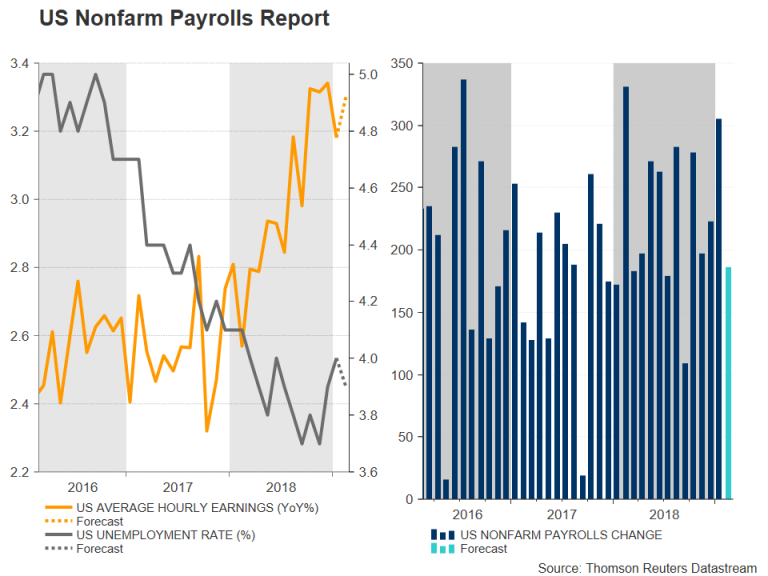
The US economy is thought to have created 185k jobs in February, slowing from the impressive 304k positions added in January. The unemployment rate is forecast to dip from 4.0% to 3.9%, while wage growth is expected to have quickened slightly from 3.2% to 3.3% y/y.
A stronger-than-expected figure could boost the dollar, as well as Treasury yields, as it would make it more likely that the Fed would resume its rate hikes later this year.
U.S. Manufacturing Activity Gives Back January Gains
The Institute for Supply Management (ISM) manufacturing index shed 2.4 percentage points to 54.2 in February, giving back January's gains. Markets were expecting a relatively flat reading.
Aside from inventories (+0.6 points to 53.4), four of the five subcomponents that comprise the headline index declined in February. The good news is that activity continues to expand, just at a slower pace. Production led the way lower, (-5.7 to 54.8), wiping out much of January's gain. Employment (-3.2 to 52.3), new orders (-2.7 to 55.5), and supplier deliveries (-1.3 to 54.9) round out the remaining subcomponents.
The trade components of the report firmed a bit in February. Nevertheless, both the moves in new export orders (+1 to 52.8), and import orders (+1.5 to 55.3) were not material enough to suggest a reversal of the downtrend that's been ongoing since U.S. imposed steel and aluminum tariffs last March.
Prices paid held steady in February (-0.2 to 49.4), maintaining January's pullback. We caution that large price moves are not unusual, given volatile commodity prices and the fact that the index is not seasonally adjusted. Reduced price pressures continue to reflect declines in the price of aluminum and steel products (prices have now normalized near pre-tariff levels), and crude oil/gas.
Sixteen of eighteen manufacturing industries reported growth in February, up from fourteen in January. For the second consecutive month, only the nonmetallic mineral products industry reported a contraction.
Key Implications
U.S. manufacturing activity remains in expansion mode, unlike many of its global peers. But, today's report suggests that a return to the same high rate of expansion achieved through the first half of 2018 is unlikely. Still, there are some bright spots in the report. New orders held on to much of January's gains, while the sharper drop in production could reflect temporary, weather related disruptions. Survey respondents are optimistic about the domestic outlook, but are less confident about foreign demand. For the second consecutive month there were no comments about labor shortages, however electronic component shortages persist.
Elsewhere, there were few signs that the rout in global manufacturing activity is easing. This morning's surveys confirm a broadening contraction in activity in the Euro Area in February, with new orders contracting faster than production – a sign of more pain to come. Germany and Italy are leading the decline, but weakness has spread to Spain. The global economic slowdown continues to weigh on Asian manufacturers as well. Japanese, Chinese, and ASEAN manufacturers suggest ongoing contraction, but somewhat less so in China. With trade and Brexit uncertainty clouding the horizon for some time to come, weak foreign demand will continue to test the mettle of U.S. manufacturers in the near-term.
Weekly Focus – How Will ECB Respond to Economic Weakness?
Market movers ahead
- Anyone looking for new liquidity measures from the ECB at its meeting on Thursday could well be disappointed, and it will be interesting to see how the bank's economic projections reflect recent data weakness.
- The US jobs report should show quite strong wage growth, but job growth seems to have reached its peak.
- Maybe the weakest spot in the US economy is the housing market, so keep an eye on housing data.
- Chinese exports were likely weak in February after quite a strong January.
- Danmarks Nationalbank intervened to defend the DKK in December and January, and reserve data will show whether that continued in February.
Weekly wrap-up
- President Trump has postponed increasing tariffs on Chinese goods, and signals from trade negotiations are mostly optimistic.
- Key Brexit votes have been scheduled for mid-March, and the probability of a 'decent Brexit' has increased somewhat. A postponed deadline seems very likely.
- The Fed is coming closer to announcing an end to balance sheet reduction, and is unhappy with low inflation expectations.
- Oil prices dropped after a bearish tweet from Donald Trump.
Stocks and Dollar-Yen Maintain Gains Following Inflation and Income Data
The overnight rally in global equities remained intact after a wrath of US economic data supported the current narrative for the US economy, inflation is going nowhere and the first quarter will be soft. Both the January reading on Personal Income and December print on Personal Spending support the big miss we saw in retail sales and the cautious outlook for first the first quarter.
- Fed – Data confirms wait and see approach
- Oh Canada – loonie sinks on poor GDP and falling oil
- Tesla – Here come the sellers
- Oil – Production cuts have run their course
- Gold – Falls toward key support
Fed
The Fed’s wait and see approach was confirmed as economic data for this week came in-line with the Fed’s overall stance of the US economy. The better than expected fourth quarter GDP pretty much confirmed the annual target the Fed had and their preferred inflation gauge came in line with market expectations, confirming inflation is stable. The rest of the data confirmed December was weak and January is showing softness and that the financial markets will need to wait to see how soft the first quarter is before seeing the market price in what the next move will be for the Fed.
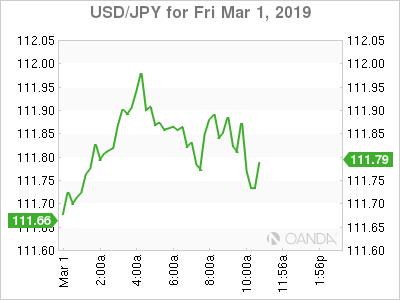
Canada
A big miss with Canadian GDP along with collapsing headline inflation means the Bank of Canada will keep rates steady at the March 6th meeting and that expectations for the next move could switch from a rate hike to a cut. The loonie is looking vulnerable here on both softer Canadian macro data along with a fizzling oil rally which could be losing momentum from the OPEC + production cuts as US production is poised to ramp up in the coming months.
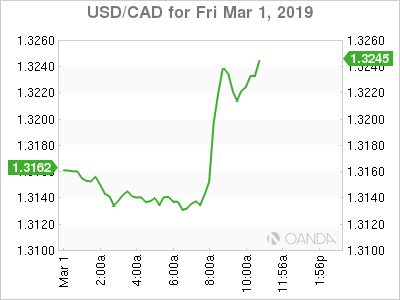
Tesla
Tesla short-sellers have more ammunition following yesterday’s announcement of job cuts, a cheaper model 3 and failure to keep promise on being profitable. While the measures announced yesterday will likely help them become profitable in the future, it will take a few quarters for them to reap the rewards of the $35,000 Model S. The first quarter is going to disappoint and with an earnings loss and stress on cash flow, shares could see further pressure if technical levels are breached.
Oil
Crude prices are struggling to deliver another weekly gain as the start of the new month means we are getting further away from winter and that US production will take centerfold in the coming months. The market has priced in OPEC to extend their production cuts until year end and markets may need a new catalyst to take crude higher. While sanctions remain firmly in place for Venezuela, many are starting to wonder if we will see Maduro step down sooner than later as political violence grows and it appears he is struggling for cash. Yesterday, he reportedly successfully removed 8 tons of central bank gold last week. Eventually Maduro will concede and that could hurt oil prices in the short-term.
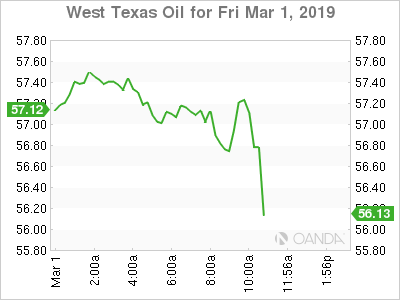
Gold
Gold is on track to have its worst week since November and is approaching very key technical levels, the psychological $1,300/oz handle and the 50-day SMA. The uncertainty in what will be the next move from the Fed is preventing the precious metal from breaking higher and right now the path of least resistance appears to be on the side of sellers.
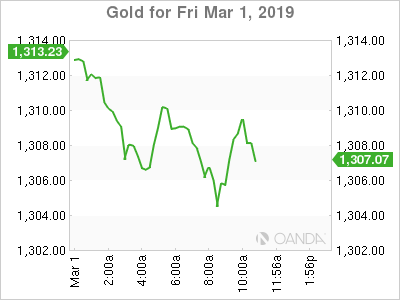
MARKET WRAP: US-China Deal Optimism Pushed Markets Higher
Markets remained positive today and mostly focused on the Chinese economic numbers. Hopes are high about the possibility of some sort of deal between the US and China.
Stocks
- The S&P 500 Index jumped on the back of the positive Chinese economic data- the Caixin economic numbers were strong. The index moved higher by 0.84 percent as of 15:13 London time, while the Nasdaq Composite Index popped more than 0.75 percent and the Dow Jones Industrial Average also climbed nearly 0.85 percent.
- The Stoxx Europe 600 continued its upward trend. This was supported by the German Retail sales number, it came better than the estimates. The benchmark moved up by 0.68 percent.
- The MSCI Emerging Market Index followed the global trend and the index moved up by 0.57 percent.
- The VIX index moved lower by 3.72 percent and VTSOXX index dropped by 3.2 percent.
Currencies
- The Dollar spot index moved lower after the poor reading of the US ISM manufacturing data. At 15:02 London time, it traded at 96.15, down by .001 percent.
- The Euro reclaimed its 1.14-mark against the dollar and moved higher by 0.16 percent to $1.1401.
- The British pound is back below the 1.33-mark, it moved lower by 0.13 percent. The high of the day was 1.3286 and low of the day was 1.3219.
Bonds
- The yield on 10-year Treasuries jumped up by two basis points to 2.74 percent.
- Germany’s 10-year yield also soar by two basis points to 0.20 percent.
- Britain’s 10-year yield jumped higher by two basis points to 1.32 percent.
Commodities
- West Texas Intermediate continued its upward trend and climbed nearly 0.47 percent.
- Gold may break the 1300 mark today and if we finish the week below the 1300-level, it would send a bearish signal. At 15:08, it traded at 1311, down by 0.33 percent.