Sample Category Title
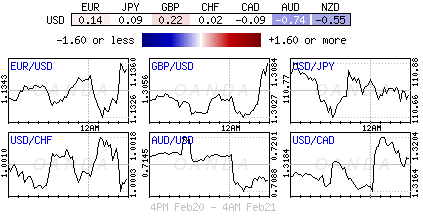
Into US session: GBP and EUR strongest, AUD weakest
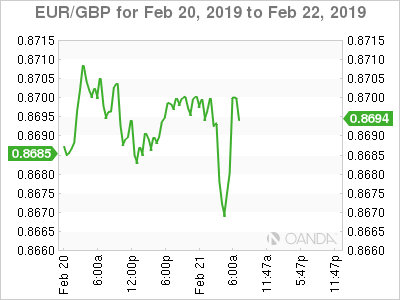
Entering into US session, Sterling is generally firm in tight range today, consolidating this week's rally. UK and EU are working on an updated Brexit agreement, most likely with some legally firmer assurances outside of the main agreement. There is prospect of having another vote next week on February 27. Euro follows as the second strongest as PMI composite improved. But it should be noted that manufacturing did deteriorate while that's offset by domestic strength in services only. ECB accounts provided nothing special.
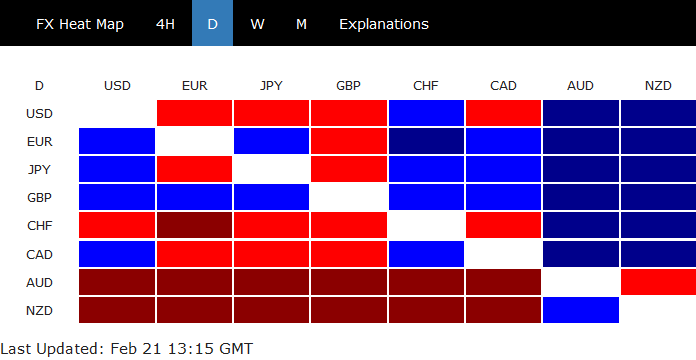
On the other hand, Aussie is leading the way down, followed by Kiwi. Australian Dollar was firstly pressured as Westpac forecast two RBA cuts this year. Then, it suffered further selloff news that China's Dalian port has banned imports of Australian coal. China's foreign ministry spokesman Geng Shuang said the goals of the ban were to "better safeguard the legal rights and interests of Chinese importers and to protect the environment".
A bunch of US data will be released today including Philly Fed survey, jobless claims, durable goods, PMIs, leading index and existing home sales. Traders will also want to know more about the multiple MOUs the US and China trade negotiation teams are working on.
In Europe, currently:
- FTSE is down -0.96%.
- DAX is up 0.12%.
- CAC is down -0.07%.
- German 10-year yield is up 0.0376 at 0.138.
Earlier in Asia:
- Nikkei rose 0.15%.
- Hong Kong HSI rose 0.41%.
- China Shanghai SSE dropped -0.34%.
- Singapore Strait Times dropped -0.01%.
- Japan 10-year JGB yield dropped -0.003 to -0.039.
ECB: Risk largely external but there were pass-through and spillovers
In the accounts of January monetary policymeeting, ECB noted that "a stronger case could now be made for assessing the risks as having moved to the downside" In "large measure", downside risks could be attributed to external environments including heightened protectionism and Brexit. But there were "pass-through and spillovers" to domestic demand.
ECB also acknowledged that "slowdown in euro area growth appeared to be deeper and more broad-based than previously anticipated". And, "negative developments had become more widespread across the euro area, and risked affecting several components of demand". The slowdown has previously be related primarily to trade. But private consumption growth was weaker in Q3, and employment growth decelerated. ECB noted that "if exports and consumption were both weaker, this was likely to be transmitted to investment in the period ahead. "
All in all, "members concurred with the view that the risks to the euro area outlook had moved to the downside on account of the persistence of uncertainties related to geopolitical factors and the threat of protectionism, vulnerabilities in emerging markets and financial market volatility." Outlook for economy would be "reassessed in more depth" in March meeting, when the new ECB staff projections would be available.
(ECB) Account of the monetary policy meeting 23-24 January 2019
1. Review of financial, economic and monetary developments and policy options
Financial market developments
Mr Cœuré reviewed the latest financial market developments. In the first few weeks of 2019 volatility had remained elevated across different market segments, in particular in equity and commodity markets. Brent oil prices had declined further after the Governing Council's previous monetary policy meeting on 12-13 December 2018 but had since recovered. The volatility in oil prices was evidence of the heightened geopolitical uncertainty and its impact on oil supply, as well as concerns about the global growth outlook and its impact on oil demand.
Volatility had also increased recently in some foreign exchange markets. In particular, following the rejection by the British Parliament of the EU Withdrawal Agreement, the pound sterling had appreciated markedly against both the euro and the US dollar. By contrast, volatility in emerging market currencies had come down from the elevated levels observed in 2018.
As regards global bond market developments, yields had fallen measurably. Since the beginning of October 2018 the yields on ten-year US Treasuries had fallen from around 3.2% to 2.75%, while ten-year German government bond yields had fallen from around 0.60% to around 0.25%. The spread between the two had thus narrowed, returning to the levels that had been observed over most of the summer of 2018.
A decomposition of euro area and US ten-year overnight index swap rates into the inflation and the real components suggested that two countervailing factors had been driving yields over this period on both sides of the Atlantic. First, the rise in real yields that had emerged in late summer had persisted and likely reflected a rise in the real term premium. Second, there had been a fall in the inflation component, which had offset the impact from the rise in real yields. A comparison between survey and market-based expectations for long-term inflation suggested that the fall in the inflation component may have predominantly reflected a fall in the inflation risk premium. It would hence be premature to conclude that market participants had materially reappraised their medium-term inflation expectations.
Spreads of higher-yielding euro area sovereign bonds versus German bonds had broadly stabilised in recent weeks. Ten-year sovereign bond spreads for Italy, Spain and Portugal against Germany had either been stable or had fallen since early October 2018.
For the euro area, the forward money market curve was notably flatter than in October 2018, suggesting that expectations of a first ECB deposit facility rate increase had shifted from September 2019 to April 2020. Revisions to survey expectations had been more moderate and saw this occurring in the fourth quarter of 2019.
Looking at equities, overall valuation losses in the euro area were of the same order as in the United States, amounting to some 8-9% since early October 2018. A model-based analysis showed that euro area equity price movements had also reflected lower earnings expectations, whereas in the United States they had, by and large, been due to an increase in the equity risk premium.
Global corporate bond markets had experienced some broad-based repricing. Spreads of US high-yield bonds had increased by around 120 basis points since early October 2018. In the euro area, the repricing had been less pronounced, but spreads of high-yield bonds had nevertheless risen by around 90 basis points. Spreads of euro area investment-grade corporate bonds had also increased measurably over this period.
Finally, turning to year-end developments in the euro area repo market, more orderly conditions had been observed than in previous years. The smooth year-end had likely reflected better preparations by market participants.
The global environment and economic and monetary developments in the euro area
Mr Praet reviewed the global environment and recent economic and monetary developments in the euro area.
Regarding the external environment, the global growth and trade momentum was slowing further. In particular, the global composite output Purchasing Managers' Index (PMI) had decreased in the fourth quarter of 2018 compared with the third quarter, on the back of a weaker manufacturing sector component, while the services sector component had remained broadly unchanged. Trade indicators had also weakened towards the end of 2018, possibly reflecting growth headwinds as well as elevated policy uncertainty regarding US-China trade relations.
Annual consumer price inflation in the OECD area had slowed to 2.7% in November, largely driven by lower energy price inflation. Inflation excluding food and energy had decreased marginally, to 2.2%. At the same time, wage dynamics had showed some stabilisation, with compensation per employee growing at a rate close to 3% in the first three quarters of 2018. Brent crude oil prices had increased by around 3% since the December monetary policy meeting. Over the same period, food prices had increased by 4%, while metal prices had declined by 2%. The euro exchange rate had remained broadly stable, both in nominal effective terms and in bilateral terms against the US dollar.
Turning to the euro area, incoming data had generally surprised on the downside and the near-term growth momentum would likely be weaker than previously anticipated. The headline manufacturing PMI for the euro area for December had stood at 51.1, down from 52.7 in November. The latest PMI survey data had pointed to a further slowing of the growth momentum, in particular in more cyclically sensitive industries, such as capital and intermediate goods. At the same time, domestic demand was being supported by favourable financing conditions and labour market dynamics, rising wages and lower energy prices. In particular, private consumption could be expected to remain resilient.
Employment had increased by 0.2%, quarter on quarter, in the third quarter of 2018, down from 0.4% in the previous two quarters. The unemployment rate had fallen further in November to 7.9%, thereby reaching its lowest level since October 2008. Survey indicators had signalled weaker but still positive employment growth in the coming quarters. In particular, the PMI employment indicator had weakened notably since the summer, but remained in expansionary territory, standing at 53.4 in December.
Extra-euro area exports were expected to remain subdued on account of weakening foreign demand growth. Growth in euro area goods exports had declined in the third quarter of 2018, by 0.4% in quarter-on-quarter terms. The decline in the third quarter could be attributed to a drop in capital goods exports, and in particular in motor vehicles. The latest trade data for October and November, together with the latest survey indicators with leading properties, consistently pointed to a further deterioration in the euro area trade outlook in the fourth quarter of 2018.
Turning to price developments, according to Eurostat's flash estimate, euro area annual HICP inflation had stood at 1.6% in December, down from 1.9% in November, while HICP inflation excluding food and energy had remained unchanged at 1.0%. The decrease in HICP inflation had mainly reflected lower energy price inflation. Overall, the December data had turned out weaker than expected, driven by energy and services price inflation. Meanwhile, measures of underlying inflation had continued to move sideways. Domestic cost pressures had increased, but had yet to translate into consumer price inflation. Along the supply chain, import and producer price inflation for both goods and services were rising. The upward cost pressure stemming from labour costs had intensified in the third quarter of 2018, with unit labour cost growth increasing to 2.2%, from 1.6% in the second quarter.
The results from the ECB Survey of Professional Forecasters for the first quarter of 2019 had pointed to average inflation expectations of 1.5% for 2019, 1.6% for 2020 and 1.7% for 2021. Compared with the previous survey for the fourth quarter of 2018, this represented downward revisions of 0.2 percentage point for 2019 and 0.1 percentage point for 2020. This implied a weaker profile than in the December 2018 Eurosystem staff projections, which could largely be accounted for by different oil price assumptions. Market-based inflation expectations had also been revised down somewhat, with the five-year forward break-even inflation rate five years ahead standing at 1.54%.
Financial conditions had tightened somewhat in recent months in the context of heightened market volatility, while being broadly unchanged compared with the December meeting. Overall, credit conditions remained favourable. Compared with the situation at the time of the December meeting, euro area non-financial equities had rebounded somewhat, although earnings expectations had been revised down. The expected timing of a first ECB policy rate increase had shifted out further.
Turning to money and credit developments, broad money (M3) growth had moderated slightly further to 3.7% in November. Money creation was increasingly driven by credit to the private sector. The annual growth rate of loans to the private sector had stabilised in recent months, standing at 3.3% in November 2018, after strengthening since early 2014. At the same time, euro area banks' composite funding costs had been increasing somewhat in recent months, mainly owing to increases in bank bond yields, and bank equity prices had declined. Meanwhile, bank lending rates remained favourable, standing only marginally above their historical lows.
As regards fiscal policy, the euro area fiscal stance – as measured by the change in the cyclically adjusted primary balance – was expected to be mildly expansionary in 2019 and 2020.
Monetary policy considerations and policy options
Summing up, Mr Praet remarked that financial conditions had tightened somewhat in recent months in a context of heightened market volatility, but remained supportive. The ECB's monetary policy had contributed to dampening the impact of prevailing uncertainties on financial conditions. Credit conditions for households and firms remained accommodative.
Incoming data on growth had continued to be weaker than expected on account of softer external demand and country and sector-specific factors, with the near-term growth momentum likely to be weaker than previously anticipated.
The risks surrounding the euro area growth outlook had moved to the downside, as the persistence of uncertainties related to geopolitical factors and the threat of protectionism, vulnerabilities in emerging markets and financial market volatility was increasingly weighing on economic sentiment.
HICP inflation had fallen in December, reflecting mainly lower energy price inflation, and was likely to decline further over the coming months. Measures of underlying inflation remained muted, but labour cost pressures were continuing to strengthen and were expected to pass through to underlying inflation in the period ahead.
While the ongoing economic expansion continued to support confidence in the convergence of inflation to the ECB's inflation aim, recent developments called for thorough analysis as regards their implications for the medium-term outlook.
Against this background, Mr Praet proposed at this stage to confirm the Governing Council's enhanced forward guidance, which – especially under the current circumstances – had contributed to more supportive market interest rates.
External communication should: (a) stress that incoming information had continued to be weaker than expected, signalling a slower near-term growth momentum; (b) acknowledge that the risks surrounding the euro area growth outlook had moved to the downside on account of the persistence of uncertainties related to geopolitical factors and the threat of protectionism, vulnerabilities in emerging markets and financial market volatility; (c) underline that the ongoing euro area expansion and gradually rising inflation pressures continued to support confidence in the sustained convergence of inflation to the Governing Council's aim; (d) emphasise that significant monetary policy stimulus remained essential to support the further build-up of domestic price pressures and headline inflation developments over the medium term, and that this stimulus would be provided by the Governing Council's forward guidance on the key ECB interest rates, reinforced by the reinvestments of the sizeable stock of acquired assets; (e) reiterate that, in any event, the Governing Council stood ready to adjust all of its instruments, as appropriate, to ensure that inflation continued to move towards its aim in a sustained manner.
2. Governing Council's discussion and monetary policy decisions
Economic and monetary analyses
With regard to the economic analysis, members broadly shared the assessment of the outlook for economic activity in the euro area provided by Mr Praet in his introduction, and they discussed the balance of risks. Recent data and survey results had continued to be weaker than expected, on account of softer external demand and some country and sector-specific factors affecting domestic activity. While the impact of some of these factors was expected to fade, incoming data suggested that the near-term growth momentum was likely to be weaker than previously anticipated. However, no clear-cut conclusions could be drawn regarding the implications of slower growth in the short term for the outlook for activity in the medium term, in the light of significant uncertainty about whether the country and sector-specific factors would be transitory or longer-lasting. In this context, it was underlined that the outlook for activity would be reassessed in more depth by the Governing Council at its meeting in early March, when the new ECB staff projections would be available.
In considering the outlook and risks for the external environment, members noted that global growth and trade momentum had slowed further. In particular, there were concerns among members about an increasing impact of trade protectionism, and an escalation of trade conflicts, on the global outlook over time. It was noted that Chinese imports at the end of 2018 had been much lower than expected, which likely reflected the negative impact of trade tensions between the United States and China. In addition, acute risks remained surrounding the United Kingdom's withdrawal from the EU. It was widely agreed that uncertainties and risks related to geopolitical factors, the threat of protectionism, vulnerabilities in emerging markets and financial market volatility had remained prominent and appeared to be exacting an increasing toll on the world economy. Against this background, the downside risks to global activity and trade were seen as having increased.
Turning to euro area activity, members observed that the recent data had been weaker than expected. Real GDP growth had slowed from 0.4% to 0.2%, quarter on quarter, in the third quarter of 2018. Some other hard data had also disappointed, and more recent indicators based on the latest European Commission business surveys and purchasing managers' surveys had declined further. Altogether, the evidence pointed to the likelihood of growth being at or even below potential for several quarters. It also had to be acknowledged that the carry-over effect from slower growth in the second half of 2018 would in itself entail a lower projection for growth in 2019. However, it was emphasised that growth remained positive, and that the probability of a recession remained low. Nonetheless, the perception was widely shared that there was elevated uncertainty at present regarding how persistent the current soft patch would be. At the same time, it was emphasised that the euro area economic expansion continued to be supported by fundamental factors, and in particular by favourable financing conditions, further employment gains and rising wages, lower energy prices and the ongoing – albeit somewhat slower – expansion in global activity.
In their exchange of views about the interpretation of incoming data, members shared information on recent developments in their respective national economies and sought to provide an assessment of the likely persistence of the factors behind the recent weakening in activity. The impact of new emissions testing standards on car production and registrations was again mentioned as a dampening factor in the largest euro area economy. However, new car registrations were rising again. The slump had lasted longer than initially expected and, while there were signs that it might now be ending, there was uncertainty about how quickly activity in this sector would recover. It was also pointed out that, even in the absence of shocks, growth in the euro area would have been expected to slow – given the maturity of the business cycle – from rates above potential towards rates closer to potential.
Members discussed in greater detail the risks to the euro area growth outlook. It was widely felt that it was not yet possible to judge with any confidence how persistent the present soft patch would be and to what extent slower growth in the short term could affect the medium-term growth outlook, as some factors were temporary or sector or country-specific. However, members concurred with the assessment provided by Mr Praet that a stronger case could now be made for assessing the risks as having moved to the downside. In large measure, downside risks could be attributed to risks in the external environment, such as those related to heightened protectionism and the United Kingdom's withdrawal from the EU, which were increasingly weighing on sentiment in the euro area. The cumulative impact from the persistence of a wide range of risks, both external and domestic, was emphasised, with soft data in the euro area having declined more than hard data. Concern was expressed that the persistence of the prevailing high level of uncertainty was affecting confidence, as reflected in further falls in business surveys, which in turn could adversely affect domestic demand.
Arguments were put forward that an assessment of risks to growth as still being broadly balanced could be supported by lower oil prices and the stimulus from fiscal measures. Moreover, the negative impact of a shock to global growth could also be partially offset by policy responses in various jurisdictions.
At the same time, it was underlined that the observed slowdown in euro area growth appeared to be deeper and more broad-based than previously anticipated, affecting not only the car sector, but also other manufacturing sectors. Negative developments had become more widespread across the euro area, and risked affecting several components of demand. Although the slowdown appeared to be mainly due to external factors, pass-through and spillovers in the euro area explained why domestic demand had also slowed. While the slowdown had previously been related primarily to trade, private consumption growth had been weaker in the third quarter of 2018 and employment growth had decelerated. It was suggested that if exports and consumption were both weaker, this was likely to be transmitted to investment in the period ahead. Furthermore, it was reiterated that past revisions to growth in the staff projections had essentially reflected the incorporation of new data regarding the short term, leaving the growth path for the remainder of the projection horizon practically unchanged.
All in all, members concurred with the view that the risks to the euro area outlook had moved to the downside on account of the persistence of uncertainties related to geopolitical factors and the threat of protectionism, vulnerabilities in emerging markets and financial market volatility.
With regard to price developments, there was broad agreement with the assessment presented by Mr Praet in his introduction. According to Eurostat, euro area annual HICP inflation had declined to 1.6% in December from 1.9% in November, mainly reflecting a decline in energy price inflation. On the basis of current futures prices for oil, headline inflation was likely to decrease further over the coming months. Measures of underlying inflation remained generally muted, but domestic cost pressures were continuing to strengthen and broaden amid high levels of capacity utilisation and tightening labour markets. Looking ahead, underlying inflation was expected to increase over the medium term, supported by the ECB's monetary policy measures, the ongoing economic expansion and rising wage growth.
As regards the possible implications of weaker growth for the medium-term inflation outlook, it was argued that more information was needed for a thorough assessment. In this context, it was noted that the labour market had so far continued to improve, with labour shortages becoming more apparent in some Member States, although more broadly some deceleration in employment growth had been observed. Members considered that recent developments in wage growth continued to provide some reassurance regarding the outlook for underlying inflation. Compensation per employee in the euro area as a whole had risen by 2.5% in the third quarter of 2018, having increased steadily since 2016, while the pick-up in wage growth had become broader-based across countries and sectors. It was also argued that the relatively high level of headline inflation in 2018 would continue to affect wage negotiations, which often contained a backward-looking component.
It was widely emphasised that the transmission of higher wages to consumer price inflation was a key issue for the medium-term outlook for inflation and an important source of uncertainty regarding the inflation outlook that was seen to require close monitoring. It was noted that while the relationship between wages and unemployment appeared to be intact, there had so far been little response in underlying inflation measures to improving labour market conditions. This was illustrated by the fact that over the previous five years underlying inflation had been stable at around 1%, while unemployment had fallen from around 12% to just below 8%. Underlying inflation had not risen even in the period when the economy was growing very quickly.
Members also discussed the behaviour of profit margins and mark-ups. It was noted that higher wage growth had not been passed through to price inflation because firms had absorbed it by lowering profit margins, and attention was drawn to the drop in gross operating surplus growth to practically zero in the third quarter of 2018. However, it was argued that mark-ups could not be squeezed indefinitely, and that this effect would serve only to delay the pass-through of higher wages to consumer prices. More generally, it was underlined that the transmission to consumer price inflation was subject to time lags, and it appeared that more time and patience were needed. However, it was also argued that more structural or longer-lasting factors might still be at play, for example related to changes in the competitive environment and to pressures on margins from e-commerce.
As regards recent developments in longer-term inflation expectations, members noted that both market-based and survey-based measures had fallen since the previous monetary policy meeting of the Governing Council. Expectations of inflation five years ahead in the Survey of Professional Forecasters for the first quarter of 2019 had been revised down to 1.8%, from 1.9% in the fourth quarter of 2018. Market-based inflation expectations, as measured by the five-year forward inflation-linked swap rate five years ahead, stood at 1.54%, slightly below the level prevailing at the time of the December 2018 Governing Council meeting and at their lowest level since June 2017. While the risk of deflation had been negligible for some time, the short-term outlook for inflation had weakened due to lower oil prices and weak developments in domestic services prices. Concern was expressed that there might be a risk that this renewed weakness could start to weigh on inflation expectations if it were to persist.
Regarding fiscal policies, the Governing Council reiterated the need to rebuild fiscal buffers. This was particularly important in countries where government debt was high and for which full adherence to the Stability and Growth Pact was critical for safeguarding sound fiscal positions.
With regard to the monetary analysis, members widely shared the assessment provided by Mr Praet in his introduction. The annual growth rate of broad money (M3), which had moderated somewhat in November 2018, continued to be underpinned by bank credit creation. The narrow monetary aggregate M1 remained the main contributor to broad money growth. Reference was made to the results of the euro area bank lending survey for the fourth quarter of 2018, which showed that overall bank lending conditions had remained favourable in the euro area, following an extended period of net easing, while demand for bank credit had continued to rise. Credit standards on loans to enterprises and households had tightened slightly, mostly on account of developments in one large euro area economy that had been subject to financial market volatility, and bank funding costs had also edged up. Looking ahead, it was felt that some consideration should be given to the outlook for liquidity conditions in the banking sector, as the redemptions of outstanding targeted longer-term refinancing operations were approaching, which might give rise to "cliff effects".
Monetary policy stance and policy considerations
With regard to the monetary policy stance, members widely shared the assessment provided by Mr Praet in his introduction. There was broad agreement that the stance remained highly expansionary overall and that it had contributed to dampening the impact of prevailing uncertainties on financial conditions, which remained favourable. It was remarked that, alongside uncertainty about the external environment, uncertainty regarding the euro area economy had risen recently – pertaining to both the growth outlook and inflation – owing to not only lower oil prices but also the slow pass-through from wages to prices.
There was broad agreement among members that supportive financing conditions, favourable labour market dynamics and rising wage growth continued to underpin the euro area expansion, thus supporting confidence in the convergence of inflation to the Governing Council's aim. While measures of underlying inflation remained muted, labour cost pressures were strengthening further and were expected to pass through to underlying inflation in the period ahead. In this regard, it was underlined that the euro area was still experiencing growth momentum, with labour market conditions improving and lower oil prices supporting consumption.
Looking ahead, a key question was seen to be the extent to which the weaker growth momentum might turn out to be more persistent than currently envisaged. More information, including the March projections, was needed to deepen the analysis and obtain greater clarity before conclusions could be drawn about the medium-term inflation outlook.
Against this background, all members agreed with the monetary policy considerations put forward by Mr Praet in his introduction. This entailed confirming the enhanced forward guidance on the path of the key ECB interest rates and on the reinvestments of acquired assets while acknowledging that the risks surrounding the euro area growth outlook had moved to the downside on account of the persistence of uncertainties related to geopolitical factors and the threat of protectionism. Significant monetary policy stimulus would continue to be provided by the forward guidance on the key ECB interest rates and on the reinvestments of the sizeable stock of acquired assets. At the same time, the Governing Council would reiterate that it stood ready to adjust all of its instruments, as appropriate, to ensure that inflation continued to move towards the Governing Council's inflation aim in a sustained manner.
Members underlined that specifying the forward guidance on the Governing Council's policy instruments in terms of both a time-based leg and a state-contingent leg had served it well. The observation was made that, in response to the recent weaker than expected data, some easing in financial conditions had taken place through an outward shift in market expectations for the timing of a first rise in key ECB interest rates. This endogenous response was viewed as being consistent with the state-based elements of the Governing Council's forward guidance and contributed to preserving the financial conditions on which the projected inflation convergence remained contingent. The "chained" forward guidance on the key ECB interest rates and the reinvestments was seen as functioning as a kind of automatic stabiliser, particularly in situations when further easing was deemed desirable in reaction to weaker than expected data.
There was wide agreement that the continued convergence of inflation to the Governing Council's aim in the period ahead still required an ample degree of monetary accommodation.
A number of remarks were made regarding available monetary policy tools in the domain of longer-term liquidity provision. Any potential new operations should reflect the monetary policy objectives to be achieved. While any decisions in this respect should not be taken too hastily, the technical analyses required to prepare policy options for future liquidity operations needed to proceed swiftly.
On communication, members widely concurred with the elements proposed by Mr Praet in his introduction. Accordingly, it was seen as appropriate to acknowledge that the incoming data had continued to be weaker than expected but that supportive financing conditions, favourable labour market dynamics and rising wage growth continued to underpin the expansion and gradually rising inflation pressures in the euro area. At the same time, it had to be recognised that the risks surrounding the euro area growth outlook had moved to the downside on account of the persistence of uncertainties related to geopolitical factors and the threat of protectionism, vulnerabilities in emerging markets and financial market volatility. In this regard, the need to communicate cautiously was stressed, in order to strike the right balance between credibility in acknowledging the weaker than expected data and conveying confidence in the adjustment towards the Governing Council's medium-term inflation aim.
Consequently, the Governing Council would reconfirm its forward guidance on the key ECB interest rates and on the reinvestment of the principal payments from maturing securities purchased under the asset purchase programme.
Members agreed that monetary policy needed to remain prudent, patient and persistent and to continue to follow a data-driven approach in the period ahead. At the current juncture, a steady hand was seen as warranted and discussions with regard to monetary policy operations or the forward guidance were deemed premature. At the same time, the Governing Council needed to reiterate that it was prepared to act if needed.
Monetary policy decisions and communication
Taking into account the foregoing discussion among the members, on a proposal from the President, the Governing Council decided that the interest rate on the main refinancing operations and the interest rates on the marginal lending facility and the deposit facility would remain unchanged at 0.00%, 0.25% and -0.40% respectively. The Governing Council reiterated that it expected the key ECB interest rates to remain at their present levels at least through the summer of 2019, and in any case for as long as necessary to ensure the continued sustained convergence of inflation to levels below, but close to, 2% over the medium term.
With regard to non-standard monetary policy measures, the Governing Council intended to continue reinvesting, in full, the principal payments from maturing securities purchased under the asset purchase programme for an extended period of time past the date when it started raising the key ECB interest rates, and in any case for as long as necessary to maintain favourable liquidity conditions and an ample degree of monetary accommodation.
The members of the Governing Council subsequently finalised the introductory statement, which the President and the Vice-President would, as usual, deliver at the press conference following the end of the current Governing Council meeting.
Introductory statement
https://www.ecb.europa.eu/press/pressconf/2019/html/ecb.is190124~cd3821f8f5.en.html
Press release
https://www.ecb.europa.eu/press/pr/date/2019/html/ecb.mp190124~5c00d09d5d.en.html
Meeting of the ECB's Governing Council, 23-24 January 2019
Members
- Mr Draghi, President
- Mr de Guindos, Vice-President
- Mr Cœuré
- Mr Costa
- Ms Georghadji
- Mr Hansson
- Mr Hernández de Cos
- Mr Knot *
- Mr Lane
- Ms Lautenschläger
- Mr Makúch
- Mr Mersch
- Mr Nowotny *
- Mr Praet
- Mr Rehn
- Mr Reinesch *
- Mr Stournaras
- Mr Vasiliauskas
- Mr Vasle
- Mr Vella *
- Mr Villeroy de Galhau
- Mr Visco
- Mr Weidmann
- Mr Wunsch
* Members not holding a voting right in January 2019 under Article 10.2 of the ESCB Statute.
Other attendees
- Mr Dombrovskis, Commission Vice-President **
- Mr Teixeira, Secretary, Director General Secretariat
- Mr Smets, Secretary for monetary policy, Director General Economics
- Mr Winkler, Deputy Secretary for monetary policy, Senior Adviser, DG Economics
** In accordance with Article 284 of the Treaty on the Functioning of the European Union.
Accompanying persons
- Mr Alves
- Mr Arce
- Mr Aucremanne
- Ms Buch
- Mr Demarco
- Mr Dolenc
- Ms Donnery
- Mr Gaiotti
- Ms Goulard
- Mr Kaasik
- Mr Kuodis
- Mr Mooslechner
- Mr Ódor
- Ms Razmusa, Alternate to Mr Rimšēvičs
- Mr Rutkaste
- Mr Schoder
- Mr Stavrou
- Mr Swank
- Mr Tavlas
- Mr Välimäki
Other ECB staff
- Ms Graeff, Director General Communications
- Mr Straub, Counsellor to the President
- Mr Bindseil, Director General Market Operations
- Mr Rostagno, Director General Monetary Policy
- Mr Sousa, Deputy Director General Economics
- Mr Stracca, Deputy Director General International and European Relations
Release of the next monetary policy account foreseen on Thursday, 4 April 2019.
DAX Rally Continues as US-China Talks Gain Steam
The DAX index continues to head higher this week. Currently, the DAX is at 11,418, up 0.14% on the day. It’s a busy day on the release front. German CPI declined 0.8%, matching the forecast. Manufacturing data was dismal, as German and eurozone manufacturing PMIs dropped below the 50-level, pointing to contraction. Services PMIs were stronger, as the German and eurozone readings indicated expansion. As well, the ECB releases the minutes of the January policy meeting. On Friday, Germany releases GDP and Ifo Business Climate, and the eurozone will post CPI data.
The global trade war continues to weigh on the manufacturing sectors worldwide, and the eurozone and Germany have not been immune. German manufacturing PMI fell to 47.6, its second successive contraction. This was the lowest level since December 2012. The all-euro reading slipped to 49.2, its first contraction since June 2013. Earlier this week, ZEW economic sentiment surveys posted scores deep in negative territory for Germany and the eurozone. With the German locomotive showing clear signs of a slowdown, the ECB is unlikely to raise rates in the near future, possibly holding off until 2020.
There is increasing optimism over the U.S-China trade talks. The sides are holding a fourth round of talks in Washington this week. The talks are reportedly making substantial progress, as negotiators are preparing memorandums of understanding on key issues such as cyber theft and intellectual property rights. The trade war has triggered a slowdown in China and weighed on global stock markets. The U.S. has threatened to raise tariffs on March 1 if a deal is not reached, so there is strong pressure to reach a deal before the deadline. If the negotiations continue to make progress, traders can expect the DAX to move higher.
UK Leadsom confirms schedule for next Brexit vote on Feb 27
UK Leader of the House of Commons Andrea Leadsom confirmed to hold a vote on Brexit on Wednesday February 27. Prime Minister Theresa May will deliver a statement on Tuesday first. The vote will either be on an updated Brexit agreement, or on the other way ahead.
Leadsom said "if the government has not secured a majority in this house in favor of a withdrawal agreement and a political declaration, the government will make a statement on Tuesday Feb. 26, and table an amendable motion relating to the statement and a minister will move that motion on Wednesday Feb. 27, thereby enabling the house to vote on it and any amendments to it on that day."
Fed Bullard: Monetary policy normalization is coming to and end
St. Louis Fed President James Bullard said in a CNBC Squawk Box interview that Fed is already near the end of rate hikes and balance sheet rolloff. And, "the message from my point of view is the normalization process in the United States is coming to an end."
To him, interest rates are actually too high now. But this is a minority view in FOMC. He further explained that December rate hike was "a step too far" and he "argued against that Move".
After December's hike, Bullard noted "a bad reaction in financial markets. I think the market started to think we were too hawkish, might cause a recession."
Canadian Retail Sales Expected To Further Dent BoC Rate Hike Odds
December retail sales will be watched out of Canada on Friday at 13:30 GMT for clues on the prospect of rate increases by the Bank of Canada in 2019. As the Canadian economy loses some steam, the BoC has been forced to sit on the sidelines, dashing the odds of any rate hike in the coming months. The Canadian dollar, meanwhile, is enjoying newfound support from higher oil prices, though doubts about the global growth outlook and trade uncertainty are holding the loonie back.
Recent data out of Canada have been somewhat mixed. Inflation in December was unexpectedly strong, and employment rose sharply in January. However, manufacturing sales recorded a shock slump in December, while the recent oil production and investment cuts in Alberta are likely to weigh on first quarter GDP growth. The Bank of Canada has been quick to acknowledge the weakening economic backdrop, signalling that further rate hikes are not on the cards unless the data improves.
That improvement, however, is not expected to come from Friday’s retail sales figures. Retail sales are forecast to have dropped by 0.3% between and November and December, adding to the prior period’s 0.9% decline. Excluding autos, retail sales are also anticipated to have fallen by 0.3% over the month.
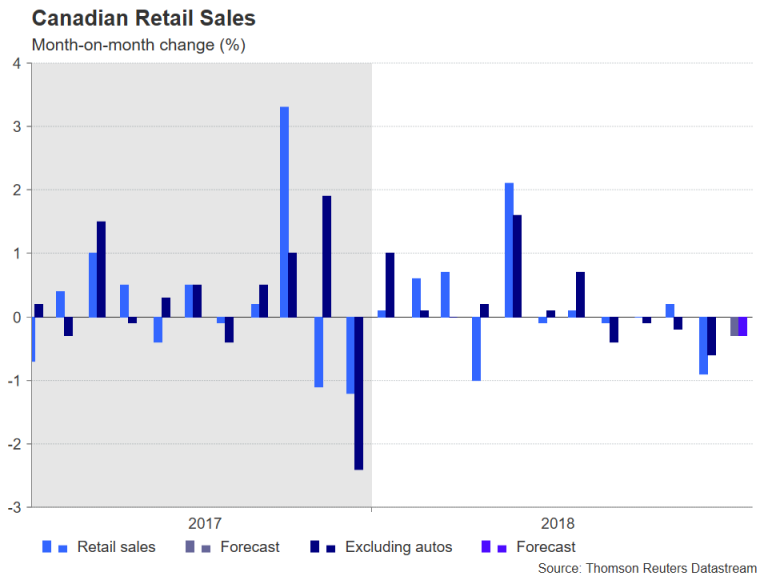
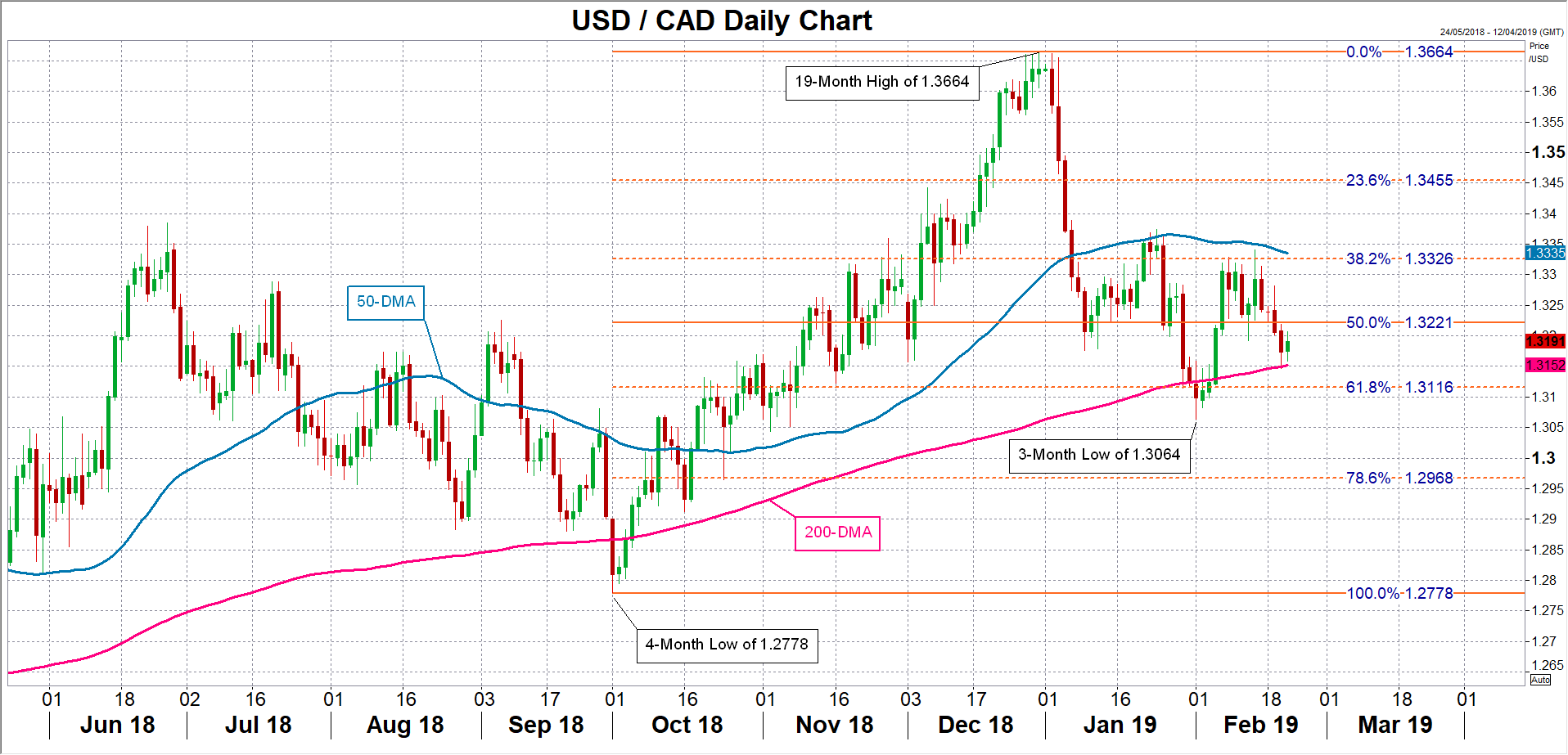
The loonie could pare some of its recent gains versus its US counterpart if the data confirms the weakening consumption picture in Canada. Dollar/loonie could jump back above the 50% Fibonacci retracement of the upleg from 1.2778 to 1.3664, at 1.3221. A climb above the 50% Fibonacci would risk shifting the current bullish bias for the loonie to a neutral-to-bearish one. It would also turn the focus on the 38.2% Fibonacci at 1.3326, which is near the 50-day moving average (MA).
But should the retail sales numbers surprise to the upside, dollar/loonie could extend its recent losses to fresh two-week lows and cross below the 200-day MA at 1.3150. A break below the 200-day MA could set the path towards February’s three-month trough of 1.3064.
With the BoC looking increasingly likely to remain on hold for at least the next few meetings, the local dollar has been benefiting from a rebound in the price of oil – Canada’s biggest export. Movements in oil prices, as well as overall market sentiment, will probably continue to be the main driver of the loonie until investors begin to wager higher chances of a rate hike in 2019. At the moment though, there’s only about a 16% probability of a 25-basis point rate increase by the BoC before the year end.
The Analytical Overview Of The Main Currency Pairs
The EUR/USD currency pair
Technical indicators of the currency pair:
Prev Open: 1.13398
Open: 1.13362
% chg. over the last day: -0.03
Day's range: 1.13205 – 1.13631
52 wk range: 1.1214 – 1.2557
Yesterday the major currencies were calm. The FOMC Minutes did not affect the USD. The Federal Reserve officials mentioned that the US economy and the Labour Market remain stable. At the same time, the regulator plans to track the growing risks in the world economy more carefully, and is not going to hurry with raising the key interest rates this year. The trading instrument is testing 1.13600-1.13700. 1.13300 acts as the key support. You should open positions from these levels.
The Economic News Feed for 21.02.2019:
- Array of Reports on Business Activity (EU) – 11:00 (GMT+2:00);
- Bank of Europe Meeting on Monetary Policy (EU) – 14:30 (GMT+2:00);
- Durable Goods Sales Report (US) – 15:30 (GMT+2:00);
- Philadelfia's Federal Reserve's PMI (US) – 15:30 (GMT+2:00);
- Secondary Real-Estate Sales (US) – 17:00 (GMT+2:00);
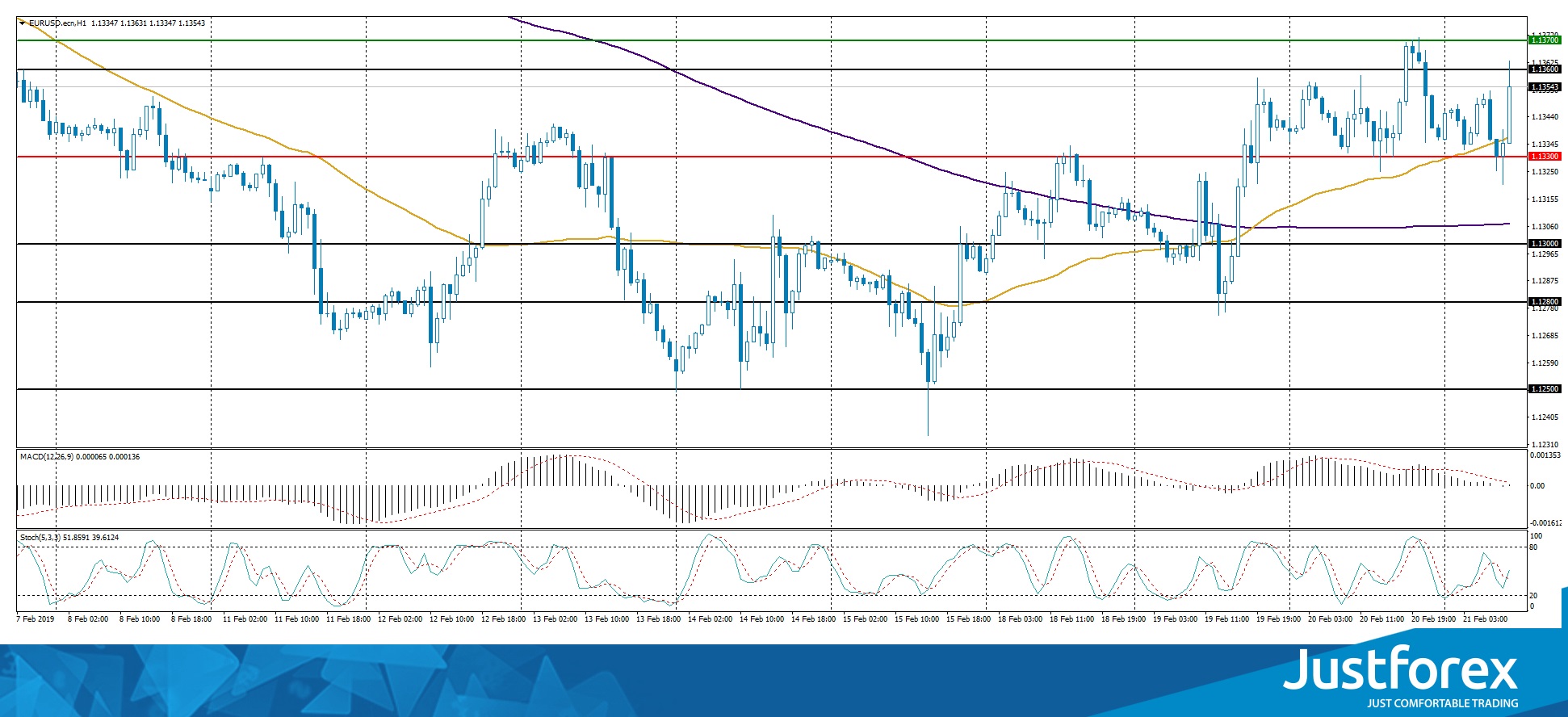
The indicators do not provide precise signals, the price crossed 50 MA.
The MACD histogram is close to 0.
The Stochastic Oscillator is in the neutral zone, the %K line is crossing the %D line. There are no signals.
Trading recommendations
Support levels: 1.13300, 1.13000, 1.12800
Resistance levels: 1.13700, 1.14000, 1.14400
If the price crosses above 1.13700, expect the quotes to grow toward 1.14000-1.14200.
Alternatively, the quotes can descend toward the round 1.13000.
The GBP/USD currency pair
Technical indicators of the currency pair:
Prev Open: 1.30605
Open: 1.30503
% chg. over the last day: -0.15
Day's range: 1.30261 – 1.30876
52 wk range: 1.2438 – 1.4378
GBP/USD is stabilizing after a sharp growth. The trading instrument is consolidating. The GBP/USD quotes are testing the key support and resistance levels: 1.30250 and 1.30850. The financial market participants are watching the Brexit situation. Theresa May declared that the Brexit negotiations are so far successful. The pound can recover further. You should open positions from the key levels.
The Economic News Feed for 21.02.2019 is calm.
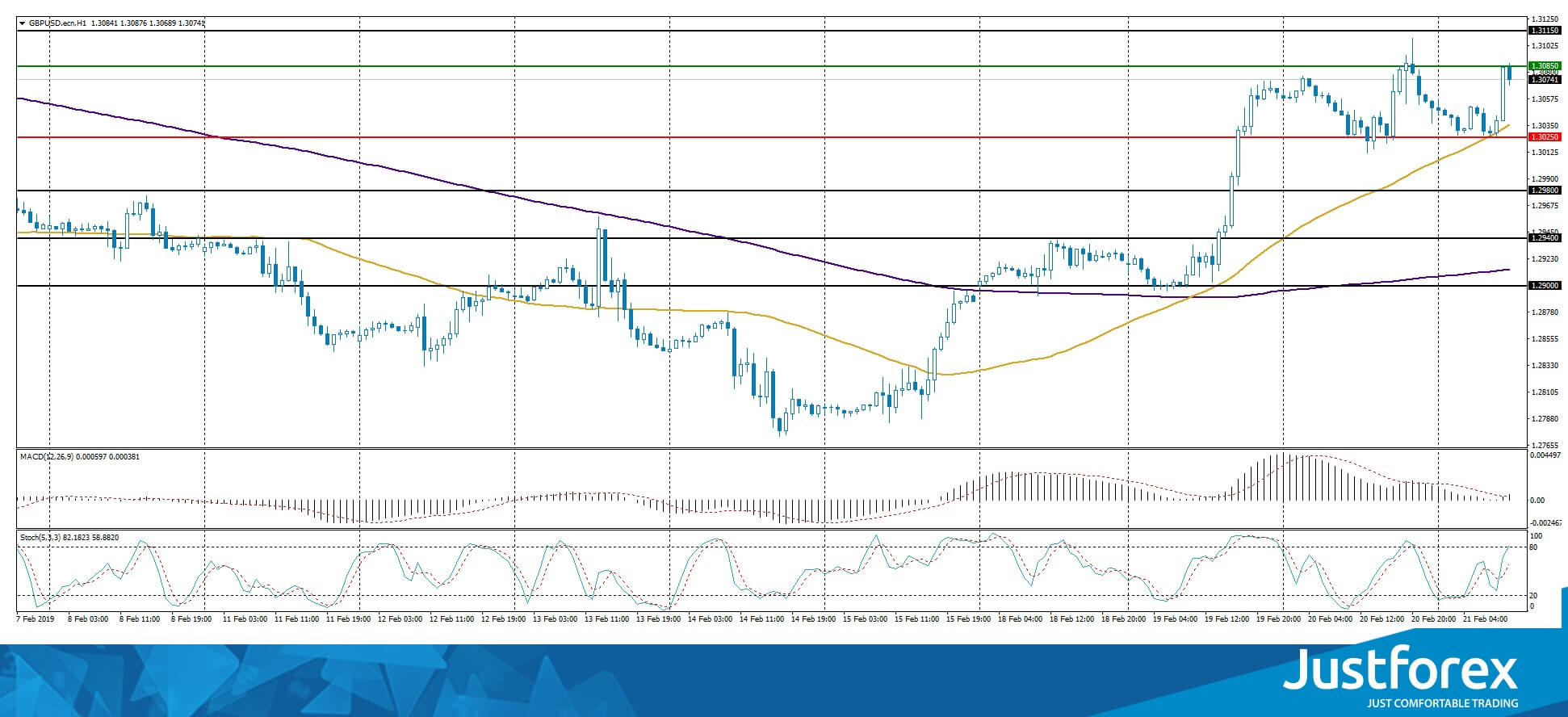
The indicators point to the power of the buyer: the price fixed above 50 MA and 200 MA.
The MACD histogram is in the positive zone, which recommends buying GBP/USD.
The Stochastic Oscillator is in the neutral zone, the %K line is above the %D line which points to bullish mood.
Trading recommendations
Support levels: 1.30250, 1.29800, 1.29400
Resistance levels: 1.30850, 1.31150, 1.31500
If the price fixes above 1.30850, the quotes are expected to grow toward 1.31250-1.31400.
Alternatively, the quotes can descend toward 1.29800-1.28600.
The USD/CAD currency pair
Technical indicators of the currency pair:
Prev Open: 1.32117
Open: 1.31752
% chg. over the last day: -0.27
Day's range: 1.31635 – 1.32065
52 wk range: 1.2248 – 1.3664
USD/CAD is showing an ambiguous technical picure. Right now the CAD is in a flat. USD/CAD is testing the key support and resistance levels: 1.31800 and 1.32100. The trading instrument has a tendency to descend. An additional support is provided by the positive oil quotes dynamics. You should keep an eye on the US economic reports. You should open positions from the key levels.
The Economic News Feed for 21.02.2019:
Official Statement by the Head of Bank of Canada (CAD) – 19:35 (GMT+2:00);
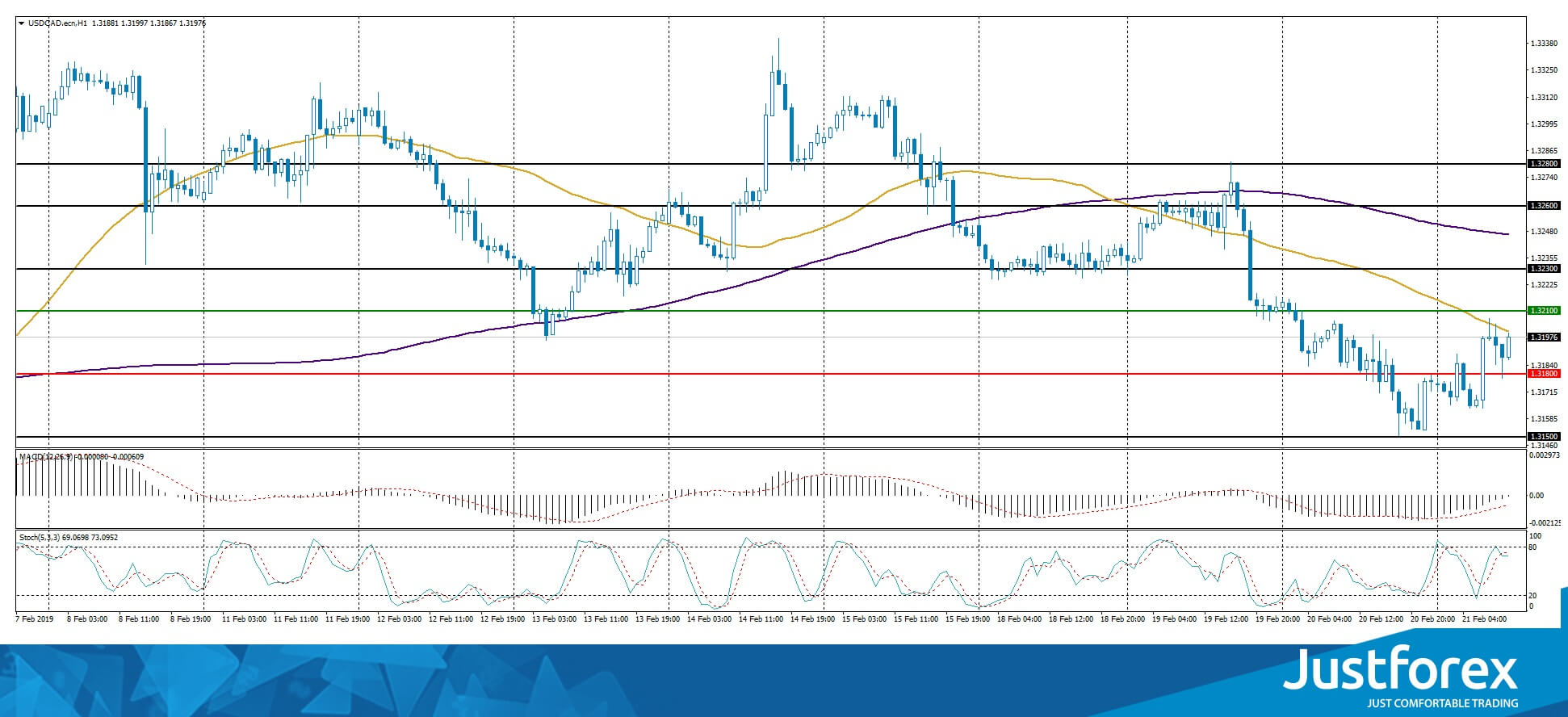
The indicators do not provide precise signals, the price is testing 50 MA, which acts as a strong dynamic resistance.
The MACD histogram is close to 0.
The Stochastic Oscillator is in the neutral zone, the %K line is crossing the %D line. There are no signals at the moment.
Trading recommendations
Support levels: 1.31800, 1.31500
Resistance levels: 1.32100, 1.32300, 1.32600
If the price fixes below the 1.31800 support level, you should expect a further descend of the USD/CAD quotes. The movement will tend toward 1.31500-1.31300.
Alternatively, the quotes can grow toward 1.32300-1.32500.
The USD/JPY currency pair
Technical indicators of the currency pair:
Prev Open: 110.607
Open: 110.828
% chg. over the last day: +0.12
Day's range: 110.591 – 110.861
52 wk range: 104.56 – 114.56
The safe haven currency is stable. The USD/JPY quotes are consolidating at 110.650-110.900. The financial market participants are waiting for additional drivers. The US economic reports are in the spotlight. Keep an eye on the relevant data regarding the US/China negotiations and open positions from the key levels.
The Economic News Feed for 21.02.2019 is calm.
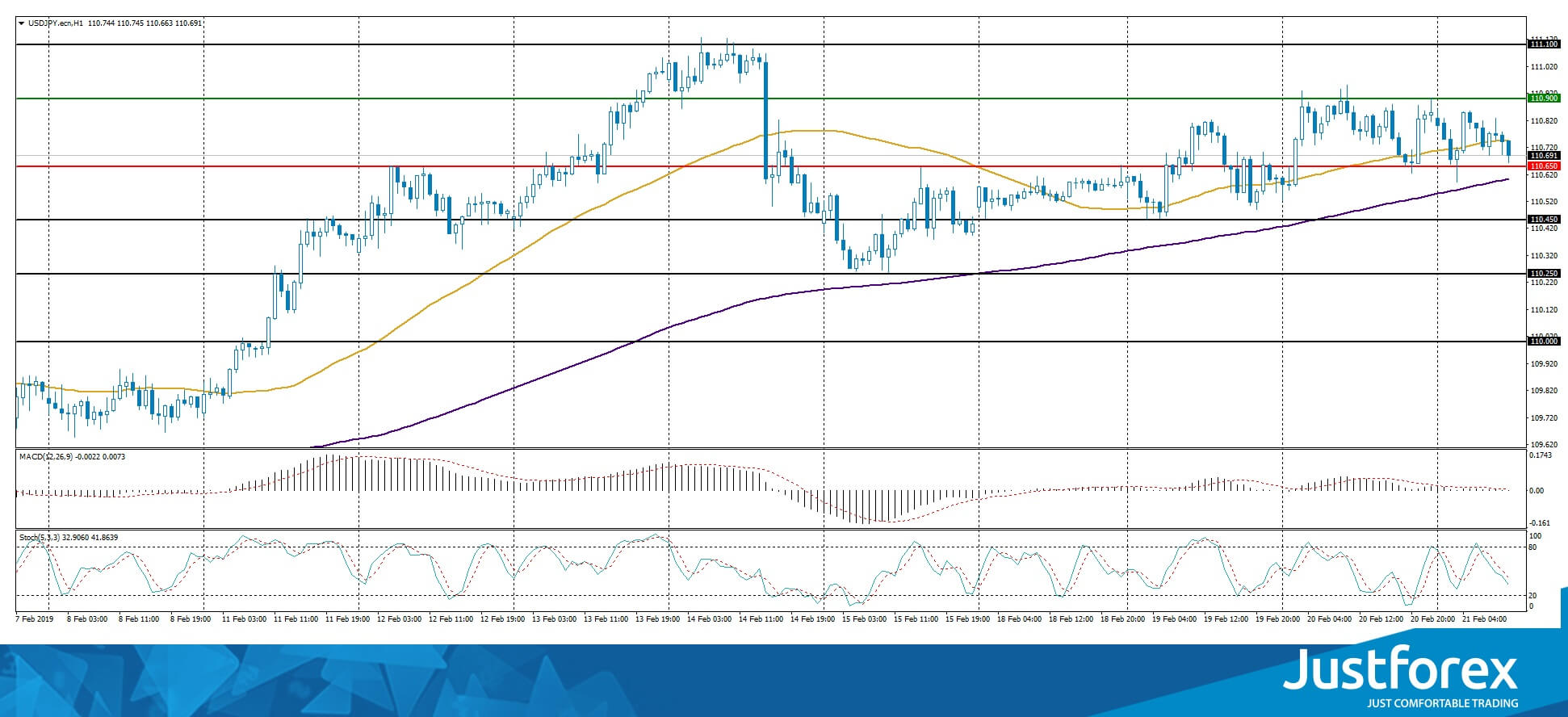
The indicators do not provide precise data, the price has crossed 50 MA and 200 MA.
The MACD histogram is close to 0.
The Stochastic Oscillator is in the neutral zone, the %K line is below the %D line, which points to a bearish mood.
Trading recommendations
Support levels: 110.650, 110.450, 110.250
Resistance levels: 110.900, 111.100, 111.500
If the price fixes below 110.650, expect the quotes to fall toward 110.400-110.200.
Alternatively, the quotes can fall toward 111.100-111.400.
CRUDE OIL Risk Remains To The Upside On Further Strength
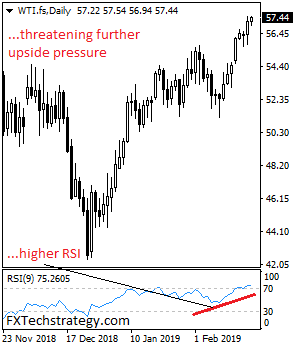
CRUDE OIL risk remains to the upside on further strength as it looks to build on its Wednesday gain. Support lies at the 57.00 level where a break will expose the 56.50 level. A cut through here will set the stage for a run at the 56.00 level. Further down, support comes in at the 55.50 level. On the upside, resistance resides at the 58.00 level. Further out, resistance comes in at the 58.50 level. A break above here will aim at the 59.00 level and then the 59.50 level followed by the 60.00 level. Its daily RSI is bullish and pointing higher suggesting further strength. All in all, CRUDE OIL remains biased to the upside on further strength.
Aussie Dollar Drops On Coal Ban
Thursday February 21: Five things the markets are talking about
Euro equities are struggling for direction, unlike most of its Asian counterparts in the overnight session. The ‘big’ dollar has edged a tad higher after Wednesday’s FOMC minutes, while the Chinese yuan extended gains ahead of Sino-U.S trade talks amongst senior officials. Down-under, the AUD (A$0.7108) dropped as much as -1.1% in the overnight session after a news report said China’s Dalian port authorities had banned imports of Australian coal.
Hawkish U-turn
Yesterday’s highly anticipated January Fed minutes did not disappoint. They showed officials see “tighter financial conditions” as one of the biggest risks to the U.S economy. They cited “slower global growth and deteriorating consumer and business sentiment as risks to the outlook.”
Their December statement said the risks were “roughly balanced,” but in the January statement, they dropped this language and instead emphasized that “global economic and financial conditions” called for the Fed to be patient in evaluating the economic outlook. This suggests the Fed has put its plans for rate hikes on hold, despite officials signalling that a rate increase remains on the table!
On tap: The European Central Bank (ECB) releases its monetary policy minutes this morning (07:30 am ET), while Bank of Canada (BoC) Governor Stephen Poloz will also speak on Thursday (12:35 pm ET) and ECB President Mario Draghi speaks on Friday (10:30 am ET), a day after Reserve Bank of Australia (RBA) Governor Philip Lowe gives his parliamentary testimony (05:30 pm ET).
1. Stocks mixed results
In Japan, the Nikkei reversed course and ended higher overnight on investor optimism over Sino-U.S trade talks supporting companies which have large exposure to China. The Nikkei share average ended +0.2% higher, for a fourth consecutive session of gains. The broader Topix ended flat at the close.
Down-under, Aussie stocks traded higher over night after Australian conglomerate, Wesfarmers (+7%), reported a jump in profit and wider margins, while robust January jobs data boosted overall sentiment. The S&P/ASX 200 Index at the close was +0.7% higher. In S. Korea, the Kospi index recouped losses to end flat overnight following reports that the U.S and China were outlining agreements on the “stickiest trade issues.” The index lost -0.05%.
In Hong Kong, stocks ended higher as signs of progress in trade talks between the U.S and China boosted investor hopes. The Hang Seng index settled +0.41% higher, while the Hang Seng China Enterprises index rose +0.68%.
The outlier was China, were stocks surrendered gains to end lower overnight, as enthusiasm over progress in U.S trade talks gave way to concerns that the PBoC would not resort to aggressive interest rate cuts to boost growth. At the close, the Shanghai Composite index fell -0.34%, while the blue-chip CSI300 index declined -0.27%.
In Europe, regional bourses are trading under caution despite continued trade talk optimism and the promise of patience by the Fed.
U.S stocks are set to open in the ‘black’ (+0.12%).
Indices: Stoxx600 -0.11% at 3, FTSE -0.63% at 7,183.25, DAX +0.17% at 11,421.85, CAC-40 -0.06% at 5,192.70, IBEX-35 0.00% at 9,180.87, FTSE MIB -0.36% at 20,231.50, SMI +0.52% at 9,363.70, S&P 500 Futures +0.12%
2. Oil hovers atop of year highs on cuts, gold little changed
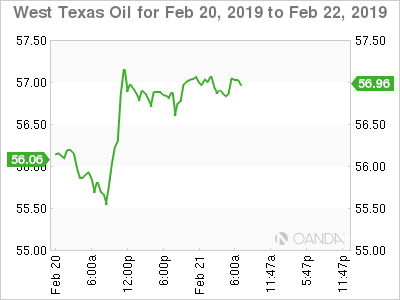
Oil prices hovered atop of this year’s highs this morning, supported by OPEC+ led supply cuts and U.S sanctions on Venezuela and Iran, however, crude prices are capped by slowing growth in the global economy.
Brent crude futures have eased by -14c, or -0.2%, to +$66.94 after touching a 2019 high yesterday at +$67.38, while U.S West Texas Intermediate (WTI) crude oil futures are at +$57.14 a barrel, down -2c, but close to a 2019 high of +$57.55 reached Wednesday.
The supply curbs led by OPEC have helped crude prices rally more than +20% in 2019.
Note: OPEC member Nigeria signaled yesterday that it would limit output after its production climbed last month.
The main factor keeping oil prices from rising even further is soaring U.S output, which rose by more than +2M bpd last year to a record +11.9M bpd.
The increase in production has resulted in rising U.S oil inventories. Data from API yesterday showed that U.S crude oil stocks rose by +1.3M barrels to +448.5M barrels in the week to Feb. 15.
Expect traders to take direction from this morning’s production data report which is due from the U.S Energy Information Administration (EIA) at 11.00 am ET.
Note: OPEC last week lowered its forecast for growth in world oil demand this year to +1.24M bpd – however, there are some analysts who believe that number “could be weaker still.”
Ahead of the U.S open, gold is trading a tad shy of its 10-month peak as the ‘big’ dollar has gained some support on rate ‘hawks’ optimism that the Fed has another rate hike on their agenda this year. Spot gold is steady at +$1,338.76 per ounce, having touched +$1,346.73 per ounce in the previous session, its highest level since April 2018. U.S gold futures are down -0.5% at +$1,341.80 an ounce.
Note: Investors are also keeping a close eye Sino-U.S trade talks.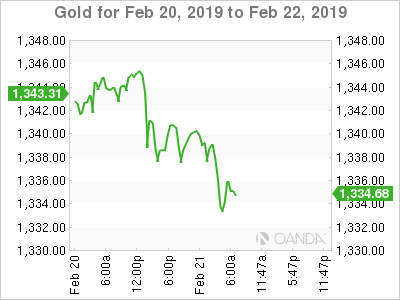
3. Eurozone yields back up as PMI’s signal growth
Eurozone bond yields backed up +2-3 bps along the curve after surveys showed business activity was surprisingly firm this month, particularly in France, though poor manufacturing readings across the bloc kept a lid on the move.
French PMI’s showed that French business activity rose more than expected as manufacturing growth helped offset slack in services and this despite the “yellow vests protests.”
In Germany, Europe’s strongest economy, the PMI number was more of a mixed picture, with the services sector accelerating to a five-month high, compensating for a second successive monthly contraction in manufacturing.
Germany’s 10-year Bund yield was +1 bps higher at +0.11%, having hit a one-week high of +0.124% earlier, just after the French PMI survey.
Elsewhere, the yield on U.S 10-year notes climbed +1 bps to +2.66%, while in the U.K, the 10-year Gilt yield advanced +1 bps +1.19%, reaching the highest in two-weeks on its fifth straight advance.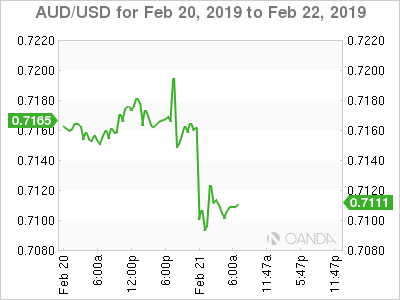
4. Aussie dollar drops on coal ban
The AUD (A$0.7108) dropped as much as -1.1% in the overnight session after a news report said China’s Dalian port authorities had banned imports of Australian coal. Apparently, they imposed the indefinite ban covering five harbors at the start of February. Coal was Australia’s second-biggest export in the year through June 2018, making up +15% of exports.
EUR/USD (€1.1342) saw its initial gains erode after the major European PMI data registered mixed readings. Germany’s export-heavy manufacturing sector fell deeper into contraction territory, while Eurozone registered its first contraction in over five-years. Investors now wait for this morning’s ECB minutes.
GBP/USD (£1.3064) has drifted off its highs after EU’s Juncker stated that “Brexit was a disaster” and that he was suffering from Brexit fatigue. Could not exclude the possibility of a no deal with terrible consequences. Earlier Chancellor of the Exchequer Hammond had noted that he saw some movement from EU side on backstop issue.
5. U.K posts record budget surplus
Data this morning showed that the U.K. government posted its largest budget surplus for a single month in January.
The ONS said the government brought in +£14.9B more in tax and other revenues during the month than it spent, the largest surplus for a single month since records began in 1993.
Note: January historically tends to be a strong month as it’s the month in which many people settle their tax bills.
The large surplus would suggest that U.K government could still meet its +£25.5B borrowing target, despite a slowing economy.