Sample Category Title
USDZAR Trades Below Downtrend Line, Outlook Still Begative
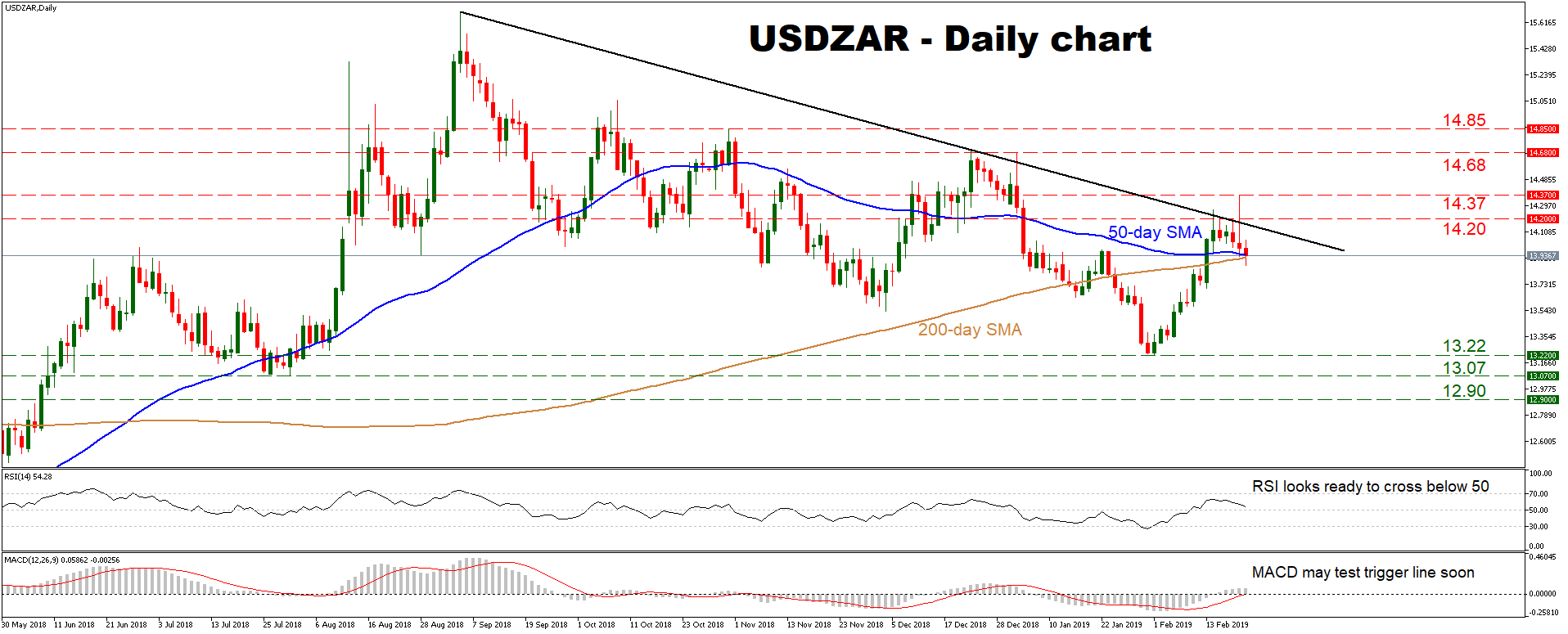
USDZAR continues to trade in a downward pattern, with the price structure consisting of lower highs and lower lows below a downtrend line drawn from the September highs. Moreover, the 50-day simple moving averages (SMA) looks ready to cross below the 200-day one, which would mark a so-called ‘death cross’ – a bearish sign.
Momentum oscillators also paint a cautiously negative picture, with the RSI looking ready to cross back below its neutral 50 line, while the MACD may also test its red trigger line soon.
Further declines in the market could encounter support near the January lows at 13.22, with even steeper declines aiming for 13.07, the July 2018 trough. If the bears break below that hurdle too, the next obstacle may be the 12.90 area, marked by the peak of May 2018.
On the upside, resistance to advances may come near the crossroads of the aforementioned downtrend line and the 14.20 zone. A bullish violation could set the stage for a test of 14.37, the peak of February 20. Another break above that area, would mark a higher high on the daily chart, turning the outlook to a more neutral one.
Summing up, the picture remains negative, with a decisive break above 14.37 required to bring that into question.
Sunset Market Commentary
Markets
Global core bonds lost ground today with US Treasuries underperforming German Bunds. News that the US and China are working on several memorandums of understanding to lay the groundwork for a potential trade deal lifted risk sentiment overnight. Core bonds edged lower but stabilized in the run-up to European dealings. Mixed EMU PMI’s kept German Bunds in their downward tendency. No additional negative news is interpreted as positive news by the bond market. The ECB January meeting minutes showed a cautious approach on launching new TLTRO’s. The German yield curve is edging higher with changes in the range of +1.3 bps (2-yr) to +4.0 bps (10-yr). US Treasuries continued to slide in the run-up to the US opening bell. US labour data printed strong, though the Philly Fed Business sentiment for February was the weakest reading since May 2016. Disappointing factory data didn’t support safe haven bids into US Treasuries. The US yield curve is moving higher with gains varying between +2.9 bps (2-yr) to +4.3 bps (10-yr). Spain successfully tapped the market today, proving that the political disquiet has little impact on investor appetite for Spanish paper. The Spanish spread over the German 10-yr yield even tightens with 2 bps. Other peripheral spreads are tightening too with Italy and Portugal (-4 bps) outperforming.
There were plenty of interesting data released in EMU and the US. However, the data were not able to unlock recent indecisive EUR/USD trading pattern. EMU PMI’s were mixed. The manufacturing sector is drifting further into contraction territory, but services showed an encouraging rebound. EUR/USD moved up and down. The euro finally slightly outperformed as a rise in German yields (limited) narrowed the US/German (EMU) interest rate differential. Markets might also expected an even softer tone from the accounts of the January policy meeting. The early morning US data (mediocre Philly Fed and durables, decline in jobless claims) were mixed but not convincing. The dollar lost a few ticks against the euro and the yen. EUR/USD is trading near 1.1350. Yesterday’s rebound top was within reach, but was eventually left intact. USD/JPY is trading in the 110.65 area, on the lower side of the intraday trading range. USD momentum is fading, but no important technical levels are under test, yet.
Sterling trading continued similar to the script of previous days. Brexit headlines caused of modest intraday swings, but in the end sterling resilience prevailed. EUR/GBP upticks were capped in the in the low 0.87 area. Cable is holding well north of the 1.30 mark. (FX) Markets still assume that an outright disorderly Brexit can be avoided. This morning, first headlines suggested that substantial progress might have been made. UK Fin Min Hammond even indicated that a new vote was possible in the coming days. Optimism on an imminent deal eased again later, but the (negative) impact on sterling was modest. EUR/GBP is currently trading in the 0.8780 area. Cable trades near 1.3075.
News Headlines
Bloomberg cites officials with knowledge of a plan that China is proposing to buy an additional $30bn a year of US agricultural products including soybeans, corn and wheat as part of a possible trade deal between the two countries.
The February EMU Composite PMI unexpectedly picked up from 51 to 51.4. A stronger services PMI (52.3 from 51.2) offset the negative impact from the manufacturing gauge (49.2 to 50.5). The latter fell below the 50 boom/bust mark for the first time since June 2013 and crashing (export) orders suggest little improvement ahead. PMI’s suggest that GDP may struggle to rise by more than 0.1% Q/Q in Q1.
US eco data printed mixed. Weekly jobless claims fell more than forecast, from 239k to 216k, underlying tightness on the labour market. The Philly Fed business outlook recorded an horrendous miss, falling from 17 to -4.1 in February, the weakest reading since May 2016. Headline durable goods orders rose less than forecast in December (1.2%), but shipments of non-military goods excluding aircraft, used a proxy for investments in GDP, rose better than expected 0.5% M/M).
USD/JPY Mid-Day Outlook
Daily Pivots: (S1) 110.61; (P) 110.78; (R1) 111.02; More...
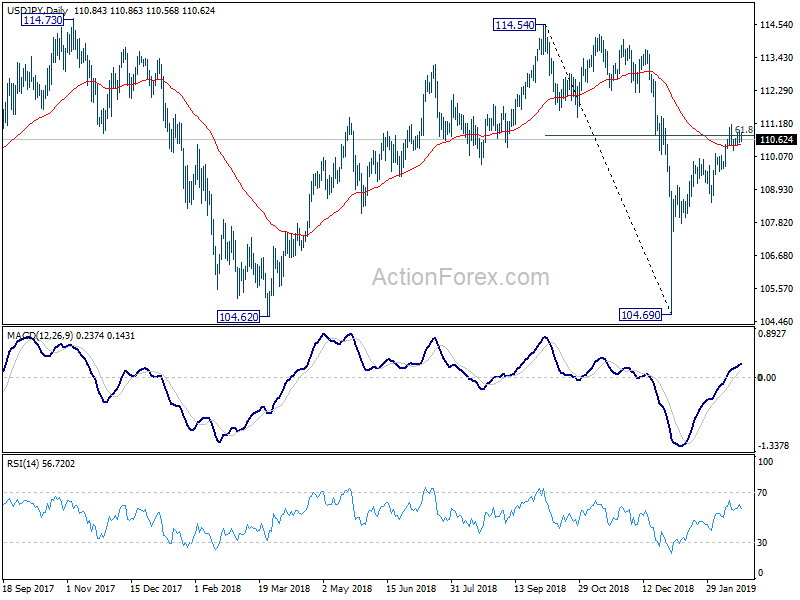
USD/JPY is staying in range below 111.13 temporary top and intraday bias remains neutral. On the downside, break of 110.00 resistance turned support will suggest rejection by 61.8% retracement of 114.54 to 104.69 at 110.77 and the rebound from 104.69 has likely completed. Intraday bias will be turned back to the downside for 108.49 support for confirmation. Nevertheless, break of 111.13 should confirm resumption of rise from 104.69 for 114.54 resistance.
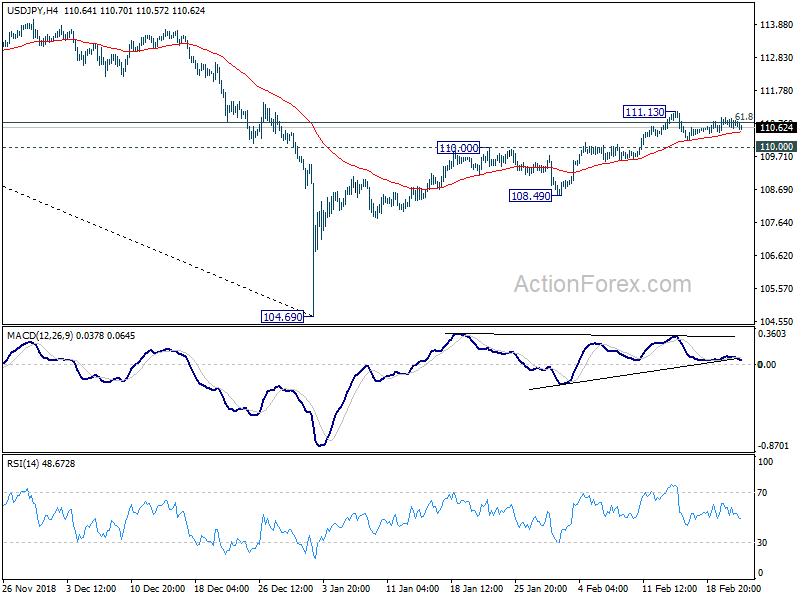
In the bigger picture, while the rebound from 104.69 was stronger than expected, it couldn't sustain above 55 day EMA yet. Outlook is turned mixed first. On the downside, break of 108.49 support will revive that case that such rebound was a correction. And, larger down trend is still in progress for another low below 104.62. But sustained trading above 55 day EMA will turn focus to 114.54. Decisive break there will confirmation completion of the decline from 118.65 (2016 high).
USD/CHF Mid-Day Outlook
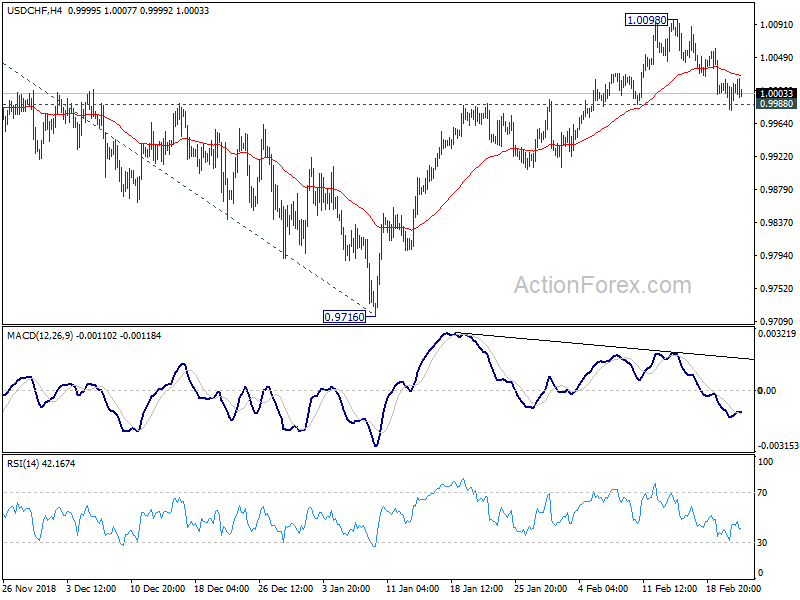
Daily Pivots: (S1) 0.9986; (P) 1.0005; (R1) 1.0029; More....
Intraday bias in USD/CHF remains neutral at this point. On the upside, above 1.0098 will target 1.0128 first. Break will confirm resumption of up trend from 0.9186. Next target will be 100% projection of 0.9541 to 1.0128 from 0.9716 at 1.0303. However, sustained break of 0.9988 will indicate rejection by 1.0128 and turn intraday bias to the downside for 0.9716 support again.
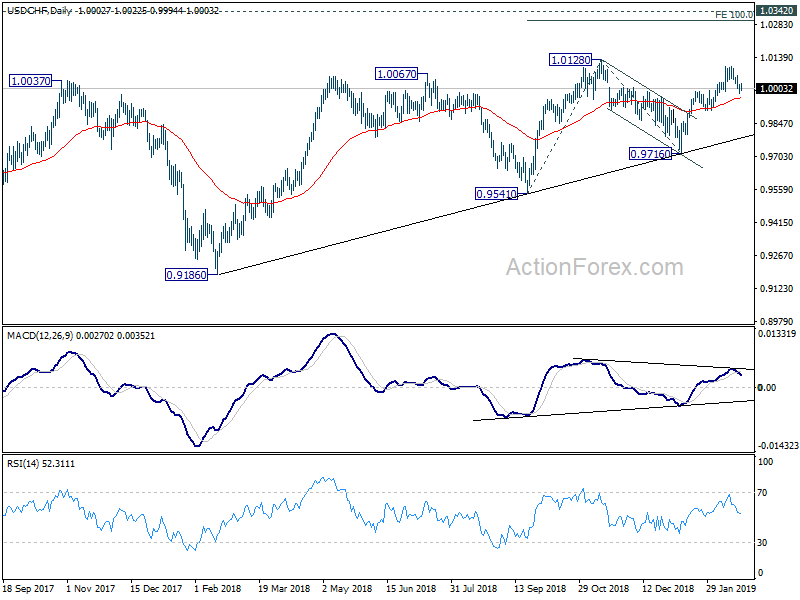
In the bigger picture, USD/CHF drew strong support from medium term trend line and rebounded. That suggests rise from 0.9186 is still in progress. Further break of 1.0128 will confirm up trend resumption and target 1.0342 key resistance. Nevertheless, break of 0.9716 will dampen this bullish view and at least bring deeper fall to 0.9541 key support.
EUR/USD Mid-Day Outlook
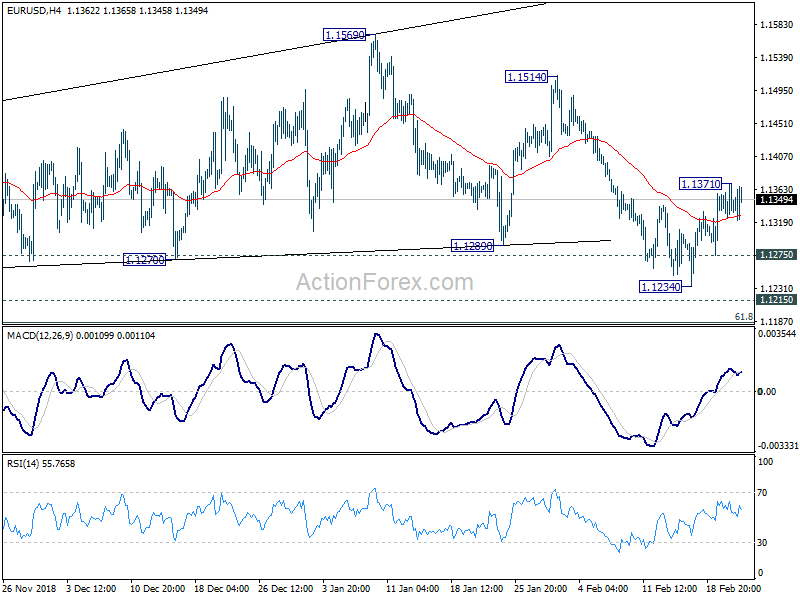
Daily Pivots: (S1) 1.1318; (P) 1.1344; (R1) 1.1364; More.....
Intraday bias in EUR/USD remains neutral first. On the upside, above 1.1371 will extend the rebound from 1.1234, towards 1.1514 resistance. On the downside, though, break of 1.1275 minor support will turn bias back to the downside for 1.1215 low instead. Decisive break there will confirm completion of consolidation from 1.1215, and resumption of down trend from 1.2555.
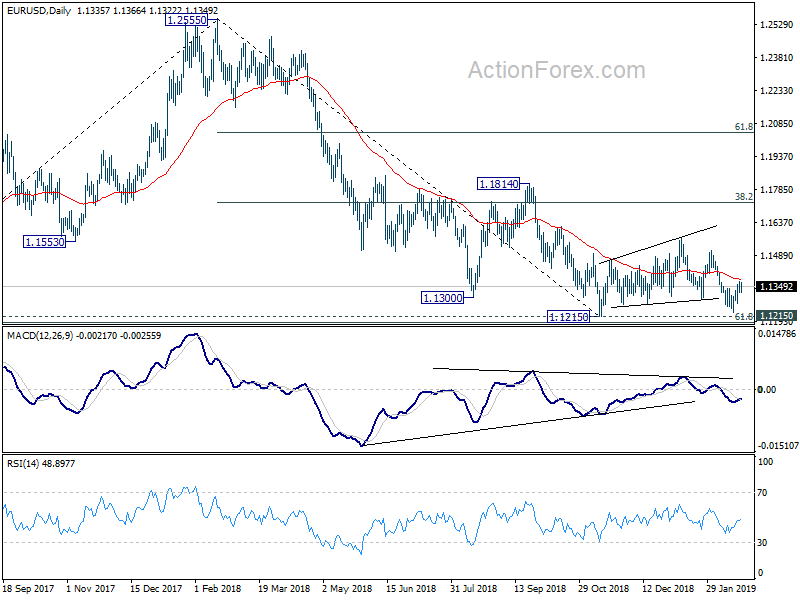
In the bigger picture, as long as 1.1814 resistance holds, down trend down trend from 1.2555 medium term top is still in progress and should target 61.8% retracement of 1.0339 (2017 low) to 1.2555 at 1.1186 next. Sustained break there will pave the way to retest 1.0339. However, break of 1.1814 will confirm completion of such down trend and turn medium term outlook bullish.
GBP/USD Mid-Day Outlook
Daily Pivots: (S1) 1.3004; (P) 1.3057; (R1) 1.3101; More....
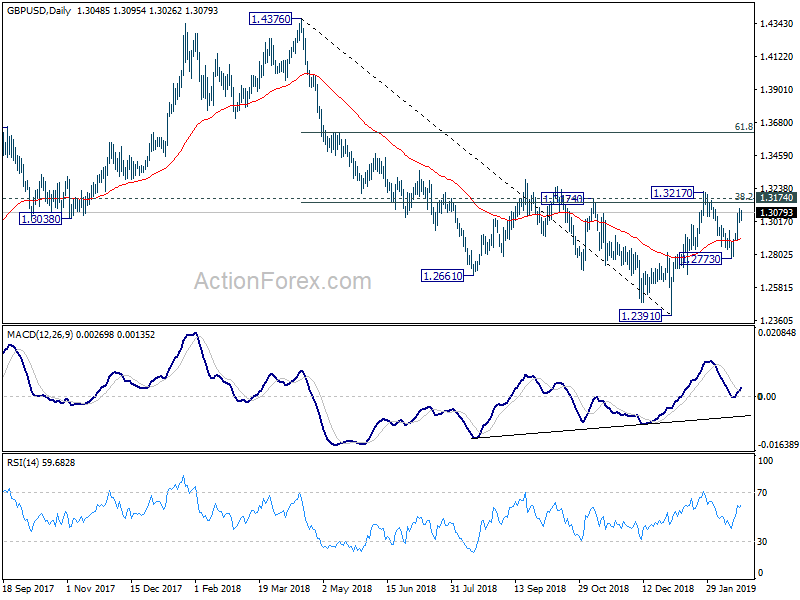
Intraday bias in GBP/USD remains neutral for the moment. On the upside, above 1.3109 will target 1.3174/3217 resistance zone. Decisive break there will complete a head and shoulder bottom pattern (ls: 1.2661, h: 1.2391, rs: 1.2773). That would indicate bullish reversal for 61.8% retracement of 1.4376 to 1.2391 at 1.3618 next. On the downside, break of 1.2935 minor support will turn bias back to the downside for 1.2773 instead.
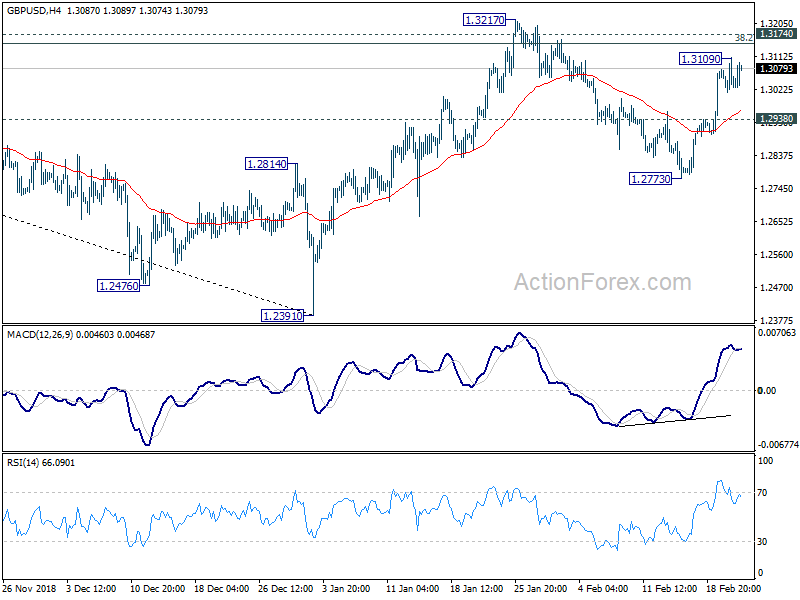
In the bigger picture, focus is back on 1.3174 resistance with current rebound. Break will indicate completion of decline from 1.4376. Rise from 1.2391 would then be seen as the third leg of the corrective pattern from 1.1946 (2016 low). In that case, further rise could be seen through 1.4376 resistance. Nevertheless, rejection by 1.3174 again will extend the decline from 1.4376 through 1.2391 to 1.1946 low.
Dollar Weakens Again on Data Disappointment, Eyes Trade Talk Results
Dollar turns weaker again in early US session after data disappointment. Also, the USDA reported that US farm exports to China will suffer steep decline. Business in the US are eager to know more about the progress of US-China trade negotiation. There are reports that China offers to buy USD 30B more US agricultural products a year. And the two teams are working on multiple MOUs to conclude this week's meetings. But so far, there's no confirmation on any of the rumors yet.
Staying in the currency markets, Dollar is just the third weakest one for today, next to Australian and New Zealand Dollar. Aussie was knocked down as Westpac forecast two RBA cuts this year. Then, it suffered further selloff news that China's Dalian port has banned imports of Australian coal. Sterling is the strongest on for today on hope there will be an updated Brexit deal to vote on next week. Euro follows as PMI composite improved in February.
In other European markets, currently, FTSE is down -0.87%. DAX is up 0.35%. CAC is up 0.09%. German 10-year yield is up 0.0424 at 0.143. Earlier in Asia, Nikkei rose 0.15%. Hong Kong HSI rose 0.41%. China Shanghai SSE dropped -0.34%. Singapore Strait Times dropped -0.01%. Japan 10-year JGB yield dropped -0.003 to -0.039.
US initial claims dropped to 216k, but Dec durable goods missed
US headline durable goods orders rose 1.2% in December, below expectation of 1.8%. Ex-transport orders rose 0.1%, below expectation of 0.3% . Philadelphia Fed Business Outlook dropped to -4.1 in February, down from 17 and missed expectation of 14.8. That's also the lowest level since 2016.
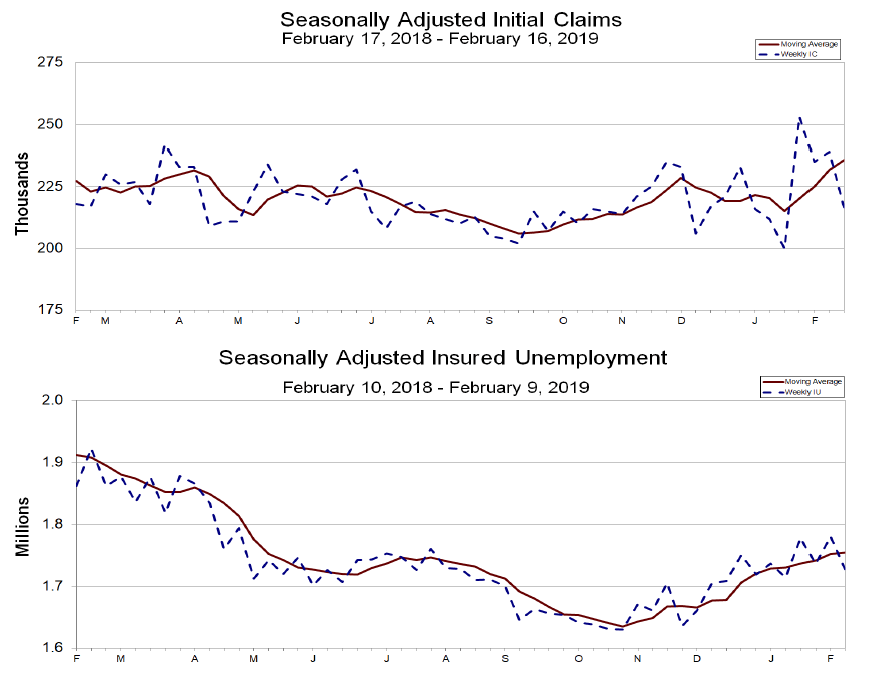
Initial jobless claims dropped -23k to 216k in the week ending February 16, between than expectation of 230k. Four-week moving average of initial claims rose 4k to 237.75k, highest since January 20, 2018. Continuing claims dropped -55k to 1.725M. Four-week moving average of continuing claims rose 2.75k to 1.755M.
Fed Bullard: Monetary policy normalization is coming to and end
St. Louis Fed President James Bullard said in a CNBC Squawk Box interview that Fed is already near the end of rate hikes and balance sheet rolloff. And, "the message from my point of view is the normalization process in the United States is coming to an end."
To him, interest rates are actually too high now. But this is a minority view in FOMC. He further explained that December rate hike was "a step too far" and he "argued against that Move".
After December's hike, Bullard noted "a bad reaction in financial markets. I think the market started to think we were too hawkish, might cause a recession."
UK Leadsom confirms schedule for next Brexit vote on Feb 27
UK Leader of the House of Commons Andrea Leadsom confirmed to hold a vote on Brexit on Wednesday February 27. Prime Minister Theresa May will deliver a statement on Tuesday first. The vote will either be on an updated Brexit agreement, or on the other way ahead.
Leadsom said "if the government has not secured a majority in this house in favor of a withdrawal agreement and a political declaration, the government will make a statement on Tuesday Feb. 26, and table an amendable motion relating to the statement and a minister will move that motion on Wednesday Feb. 27, thereby enabling the house to vote on it and any amendments to it on that day."
Chancellor of Exchequer Philip Hammond said, regarding next week, "there may be an opportunity to bring a vote back to the House of Commons – there may be an opportunity, but that will depend on the progress that is made in the next few days."
He added that Prime Minister Theresa May's meeting with European Commission President Jean-Claude Juncker went well. And "both sides have acknowledged that the political declaration could be expanded, for example, to address concerns that have been expressed in some parts of the House of Commons about workers rights."
Separately, it's believed that May and Juncker are working on a statement called "appropriate legal assurance to both sides". Brexit minister Steve Barclay and Attorney General Geoffrey Cox will visit Brussels again today.
ECB: Risk largely external but there were pass-through and spillovers
In the accounts of January monetary policy meeting, ECB noted that "a stronger case could now be made for assessing the risks as having moved to the downside" In "large measure", downside risks could be attributed to external environments including heightened protectionism and Brexit. But there were "pass-through and spillovers" to domestic demand.
ECB also acknowledged that "slowdown in euro area growth appeared to be deeper and more broad-based than previously anticipated". And, "negative developments had become more widespread across the euro area, and risked affecting several components of demand". The slowdown has previously be related primarily to trade. But private consumption growth was weaker in Q3, and employment growth decelerated. ECB noted that "if exports and consumption were both weaker, this was likely to be transmitted to investment in the period ahead. "
All in all, "members concurred with the view that the risks to the euro area outlook had moved to the downside on account of the persistence of uncertainties related to geopolitical factors and the threat of protectionism, vulnerabilities in emerging markets and financial market volatility." Outlook for economy would be "reassessed in more depth" in March meeting, when the new ECB staff projections would be available.
Eurozone PMIs: Eurozone to grow 0.1% in Q2, Germany 0.2%, France to stagnate
Eurozone PMI manufacturing dropped to 49.2 in February, down from 50.5 and missed expectation of 50.3. That's the lowest level in 69-month. PMI services, however, rose to 52.3, up from 51.2 and beat expectation of 51.3. PMI composite improved to 51.4, up from 51.0.
Chris Williamson, Chief Business Economist at IHS Markit said, "the Eurozone economy remained close to stagnation in February... continuing to indicate one of the weakest rates of expansion since 2014" The data suggest GDP may struggle to rise by much more than 0.1% in Q1. Meanwhile, Germany is on course to 0.2% growth but France looks set to stagnate, or even contract very slightly.
He added that "the weakness is being led by manufacturing, which has now entered its first downturn since mid- 2013. " But "solid domestic demand in many countries, notably Germany, continued to help support service sector growth and offset the downturn of the manufacturing sector. "
Germany PMI manufacturing dropped to 47.6 in February, down from 49.7 and missed expectation of 49.9. That' the lowest level in 74 months. PMI services, however, rose to 55.1, up from 53.0 and beat expectation of 52.9. PMI composite improved slightly to 52.7, up from 52.1.
France PMI manufacturing rose to 51.4 in February, up from 51.2 and beat expectation of 51.0. PMI Services rose to 49.8, up from 47.8 and beat expectation of 48.5. PMI composite also improved to 49.9, up from 48.2.
Also from Eurozone, German CPI was finalized at -0.8% mom, 1.4% yoy in January.
China Dalian harbours ban Australian coal imports
China's Dalian port has banned imports of the Australia's coal. The ban came effective at the start of February already and it's indefinite. Under the control of Dalian customers, Dalian, Bayuquan, Panjin, Dandong and Beiliang harbour will not allow Australian coal to clear through customers. That's part of the measures to cap overall coal imports through the above harbours to 12m tonnes this year. Coal imports from Russia and Indonesia will not be affected. It's also reported that clearing times for Australian coal at other ports are prolonged to at least 40 days.
China's foreign ministry spokesman Geng Shuang said the goals of the ban were to "better safeguard the legal rights and interests of Chinese importers and to protect the environment". Australia's Minister for Trade Simon Birmingham said "I'm aware of unconfirmed and unsourced media reports and have asked our Ambassador in Beijing to urgently clarify their veracity." He added that "We continue to engage closely with industry on matters of market access ... China is a valued partner of Australia and we trust that our free trade agreement commitments to each other will continue to be honored."
Westpac forecasts two RBA cuts in 2019
Australian Dollar was initially lifted by the employment data, but was then knocked down as Westpac forecasts RBA to cut interest rate in August and November. Westpac noted that "the forces around a slowing economy, falling house prices, and weak consumer spending are already apparent." But RBA might take time to recognize this "persistence". The central bank's decision to "accept the possibility that interest rates could fall further, despite the current record low levels, is profoundly important." Westpac is now "confident" that if their growth profile does evolve, RBA will be "prepared to act".
Australian job market grew 39.1k in January, more than double of expectation of 15.2k. Full time jobs rose 65.4k to 8.M. Part-time jobs dropped -26.3k to 4.01M. Particular rate also rose 0.1% to 65.7% while unemployment rate was unchanged at 5.0%, a seven-year low. Also from Australian, CBA PMI manufacturing dropped to 53.1 in February, down from 53.9. CBA PMI services dropped into contraction region at 49.3, down from 51.0.
Japan PMI manufacturing dropped to 48.5, chance of recession in 2019 rises
Japan PMI manufacturing PMI dropped to 48.5 in February, down from 50.3. That's the lowest level in 32 months and the first contraction reading since 2016. Markit noted that "deterioration in manufacturing sector reflects stronger falls in production and new orders." Also, "future output expectations turn negative for the first time since November 2012."
Joe Hayes, Economist at IHS Markit, said the data reflected "sharper reductions in demand and production" and "underlying business conditions are unfavourable.".And, "this was further highlighted by output expectations turning negative for the first time in over six years, which comes as no surprise given the international headwinds Japanese manufacturers are facing such as a China slowdown and the global trade cycle losing further steam.
He added that "unless service sector activity can offset manufacturing weakness, the chance of Japan entering a recession in 2019 looks set to rise."
Also from Japan, all industry activity index dropped -0.4% mom in December, below expectation of -0.2% mom.
GBP/USD Mid-Day Outlook
Daily Pivots: (S1) 1.3004; (P) 1.3057; (R1) 1.3101; More....
Intraday bias in GBP/USD remains neutral for the moment. On the upside, above 1.3109 will target 1.3174/3217 resistance zone. Decisive break there will complete a head and shoulder bottom pattern (ls: 1.2661, h: 1.2391, rs: 1.2773). That would indicate bullish reversal for 61.8% retracement of 1.4376 to 1.2391 at 1.3618 next. On the downside, break of 1.2935 minor support will turn bias back to the downside for 1.2773 instead.
In the bigger picture, focus is back on 1.3174 resistance with current rebound. Break will indicate completion of decline from 1.4376. Rise from 1.2391 would then be seen as the third leg of the corrective pattern from 1.1946 (2016 low). In that case, further rise could be seen through 1.4376 resistance. Nevertheless, rejection by 1.3174 again will extend the decline from 1.4376 through 1.2391 to 1.1946 low.
Economic Indicators Update
| GMT | Ccy | Events | Actual | Forecast | Previous | Revised |
|---|---|---|---|---|---|---|
| 22:00 | AUD | CBA PMI Manufacturing Feb P | 53.1 | 53.9 | ||
| 22:00 | AUD | CBA PMI Services Feb P | 49.3 | 51 | ||
| 00:30 | JPY | PMI Manufacturing Feb P | 48.5 | 50.3 | ||
| 00:30 | AUD | Employment Change Jan | 39.1K | 15.2K | 21.6K | |
| 00:30 | AUD | Unemployment Rate Jan | 5.00% | 5.00% | 5.00% | |
| 04:30 | JPY | All Industry Activity Index M/M Dec | -0.40% | -0.20% | -0.30% | |
| 07:00 | EUR | German CPI M/M Jan F | -0.80% | -0.80% | -0.80% | |
| 07:00 | EUR | German CPI Y/Y Jan F | 1.40% | 1.40% | 1.40% | |
| 08:15 | EUR | France Manufacturing PMI Feb P | 51.4 | 51 | 51.2 | |
| 08:15 | EUR | France Services PMI Feb P | 49.8 | 48.5 | 47.8 | |
| 08:30 | EUR | Germany Manufacturing PMI Feb P | 47.6 | 49.9 | 49.7 | |
| 08:30 | EUR | Germany Services PMI Feb P | 55.1 | 52.9 | 53 | |
| 09:00 | EUR | Eurozone Manufacturing PMI Feb P | 49.2 | 50.3 | 50.5 | |
| 09:00 | EUR | Eurozone Services PMI Feb P | 52.3 | 51.3 | 51.2 | |
| 09:30 | GBP | Public Sector Net Borrowing Jan | -15.8B | -11.1B | 2.1B | |
| 12:30 | EUR | ECB Monetary Policy Meeting Accounts | ||||
| 13:30 | CAD | Wholesale Trade Sales M/M Dec | 0.30% | -0.30% | -1.00% | -1.10% |
| 13:30 | USD | Philadelphia Fed Business Outlook Feb | -4.1 | 14.8 | 17 | |
| 13:30 | USD | Initial Jobless Claims (FEB 16) | 216K | 230k | 239k | |
| 13:30 | USD | Durable Goods Orders Dec P | 1.20% | 1.80% | 0.70% | 1.00% |
| 13:30 | USD | Durables Ex Transportation Dec P | 0.10% | 0.30% | -0.40% | -0.20% |
| 14:45 | USD | US Manufacturing PMI Feb P | 55 | 54.9 | ||
| 14:45 | USD | US Services PMI Feb P | 54.3 | 54.2 | ||
| 15:00 | USD | Leading Index Jan | 0.20% | -0.10% | ||
| 15:00 | USD | Existing Home Sales Jan | 5.01M | 4.99M | ||
| 15:30 | USD | Natural Gas Storage | -78B | |||
| 16:00 | USD | Crude Oil Inventories | 3.6M |
Weekly Risk Assessment
Global trade talks dominated proceedings in this holiday shortened trading week, along with central bank rhetoric and Brexit posturing.
There have been a number of reports that senior Sino-U.S negotiators are working on multiple “memorandums of understanding” that would form the basis of a final trade deal. Markets are expecting some announcement on Friday Feb 22.
With one trade war potentially winding down, another may be beginning – China and Australia. There are reports that China’s Dalian port authorities have banned imports of Australian coal. Apparently, they imposed the indefinite ban covering five harbors at the start of February. Coal was Australia’s second-biggest export in the year through June 2018, making up +15% of exports.
Central bank views
Reserve Bank of Australia minutes (RBA) Feb minutes were in line with most recent quarterly statement on monetary policy. The board saw “significant uncertainties” on the economic outlook and forecast.
Riksbank the weaker-than-expected outturn for Swedish inflation in January this week suggests that the Riksbank will be in no rush to raise interest rates again. With core inflation remaining subdued, and increasing downside risks to economic growth, the chance of an interest rate hike in 2019 has fallen.
Federal Open Market Committee minutes (FOMC) January Federal Reserve minutes revealed the extent of the shift from “hawkish” to a more “dovish” tone. Fed officials expressed concern about risks to economic growth, according to the minutes, prompting a halt to rake hikes and commitment to data dependency.
European Central Bank minutes (ECB) More data is needed to assess medium term impact of economic slowdown; growth in region could be below potential for several-quarters. Officials discussed new long-term loans for Banks at the January meeting and will review economic outlook at the March policy meeting. And not a surprise, officials flagged “acute risks” over Brexit
Brexit
The next key date is February 27, when parliament will vote on the government’s withdrawal plan, or alternatives if PM May has failed to win any concessions. It is also possible, although not certain, that parliament could vote to rule out a no-deal Brexit scenario.
Sterling remains susceptible to Brexit rhetoric. The pound has drifted off its month highs after EU’s Juncker stated that “Brexit was a disaster” and that he was suffering from Brexit fatigue and he could not exclude the possibility of a no deal with terrible consequences. Earlier Thursday, Chancellor of the Exchequer Hammond had noted that he saw some movement from EU side on backstop issue.
On the Economic Calendar, Kiwi retail sales will be released on the open Sunday Feb 24 (04:45 pm ET).
Market concerns:
- U.K/Brexit fallout – PM May’s Brexit vote Feb 27
- Sino/U.S – trade & tariffs
- China/Aussie – coal war begins
- Weaker China data
- Muller/Trump – AG Barr is set to announce the completion of the report
- OPEC, Saudis, Venezuela & Trump
- Geo-political concerns in Russia, Ukraine and France
- ‘Twitter Trump’
- U.S debt ceiling worries
- Spanish snap elections expected to be full of surprises April 28
Next week: NZD retail sales (Feb 24), U.K inflation hearings & U.S consumer confidence (Feb 25), CAD CPI, U.K Parliamentary Brexit vote, ANZ business confidence & AUD private capital expenditure (Feb 27), U.S advanced GDP (Feb 28), CAD GDP & U.S ISM manufacturing PMI (Mar 1).
Canadian Dollar Improves to 2-Week High as Fed Preaches Patience
The Canadian dollar continues to improve this week. Currently, the pair is trading at 1.3169, down 0.06% on the day. Canada will release ADP nonfarm payrolls and wholesale sales. In the U.S., the markets are expecting positive news. Durable goods orders is projected to post a strong gain of 1.6%, while unemployment claims is forecast to fall to 228 thousand.
The Federal Reserve has presented a dovish stance in 2019, and this position was underscored in the minutes from the January 2019 policy meeting. Participants reiterated that the Fed will remain cautious, stating that a “patient approach to monetary policy” was appropriate. However, members added that if economic projections improved, the Fed could revise the “patient approach”. The minutes noted that the employment market had strengthened and economic activity was rising, but expected GDP in 2019 to slow down compared to 2018.
Is a breakthrough around the corner in the U.S-China trade talks? The sides are holding a fourth round of talks in Washington this week. Talks are reportedly making substantial progress, as negotiators are preparing memorandums of understanding on key issues such as cyber theft and intellectual property rights. The trade war between the two largest economies in the world has triggered a slowdown in China and weighed on global stock markets. The U.S. has threatened to raise tariffs on March 1 if a deal is not reached, so there is strong pressure to reach a deal before the deadline. If the March 1 deadline is removed, traders can expect risk appetite to jump and the Canadian dollar to respond with strong gains.
US initial claims dropped to 216k, but Dec durable goods missed
US headline durable goods orders rose 1.2% in December, below expectation of 1.8%. Ex-transport orders rose 0.1%, below expectation of 0.3% . Philadelphia Fed Business Outlook dropped to -4.1 in February, down from 17 and missed expectation of 14.8.
Initial jobless claims dropped -23k to 216k in the week ending February 16, between than expectation of 230k. Four-week moving average of initial claims rose 4k to 237.75k, highest since January 20, 2018. Continuing claims dropped -55k to 1.725M. Four-week moving average of continuing claims rose 2.75k to 1.755M.