Sample Category Title
Markets Await US-China Trade Talk Results, NZD Hammered by RBNZ
The financial markets are slightly firmer today but lacks conviction. All eyes are on the results of US-China negotiations in Washington. There were rumors that the teams are drafting MOUs, and China pledged to increase agricultural purchases. But no details were leaked regarding the real core issues, in particular on enforcement of the agreement. Trump is set to meet Chinese Vice Premier Liu He again today. And we'll see if they'll release something of substance.
Meanwhile, for today, New Zealand Dollar is the weakest one so far. RBNZ is proposing to raise capital requirements for top banks. But markets are concerned that eventually, tighter financial conditions will force the central bank to cut interest rates. Yen is the second weakest on mild risk appetites. Canadian Dollar is the third weakest as rally in oil prices lost momentum. Canadian retail sales will be a test for Loonie's resilience.
On the other hand, Australian Dollar is the strongest one for today. But it's just paring some of this week's steep losses. Officials are trying to talk down the significance of China Dalian port's ban of Australian coal imports. Euro is the second strongest. German Q4 GDP confirmed to have grown 0% qoq, narrowly avoiding a technical recession in H2 of last year. Swiss Franc is so far the third strongest.
Technically, USD/CAD's recovery and break of 1.3225 minor resistance now turns focus back to 1.3340 resistance. AUD/USD will be looking at 0.7054 key support in next fall. Against Europeans, Dollar is mildly tin favor to extend this week's pull back. But EUR/USD and GBP/USD have to break 1.1371 and 1.3109 temporary tops first.
In Asia, Nikkei closed down -0.18%. Hong Kong HSI is up 0.17%. China Shanghai SSE is up 1.62%. Singapore Strait Times is down -0.26%. Japan 10-year JGB yield is up 0.0018 at -0.038. Overnight, DOW dropped -0.40%. S&P 500 dropped -0.35%. NASDAQ dropped -0.39%. 10-year yield rose 0.034 to 2.688.
RBNZ to raise top banks' capital requirement, might cut interest rate
New Zealand Dollar drops broadly today after RBNZ proposed to raise capital requirement for top banks of the country. Capital ratios would be increased to 16% of frisk-weighted assets. Combined the top four banks might need to raise NZD 20B over the next five years to meet the rule.
RBNZ Deputy Governor Geoff Bascand said the move would only lead to a "marginal tightening of monetary conditions". But he added that the central could consider to loosen up monetary further is needed. Bascand said "when we set the OCR (Official Cash Rate), we set it with for a 18 month to 2 year look ahead. So let's say we are making a decision in the third quarter of this year...we just have to feed that into our regular monetary policy decision making". And, "if we were worried, and thinking we were undershooting inflation, undershooting maximum sustainable employment, then we would obviously look for an OCR change...that is the implication."
RBA Lowe: What's of concern is accumulation of downside risks
RBA Governor Philip Lowe said today that the central scenario for 2019 is for growth of around 3%, inflation of around 2%and unemployment of around 5. And "this is not a bad set of numbers". However, what is more of concern is the "accumulation of downside risks".
The first major area of risks globally is "political risks" including US-China trade and technology tensions, Brexit, rise of populism and strains in some wester European countries. Second area of international risk is China slowdown. Domestically, RBA board has recently been paying "particularly close attention" to household spending and housing market. Lowe noted that " underlying trend in consumption is softer than it earlier looked to be". Decline housing prices could also affect overall spending.
On monetary policy, Lowe reiterated that "the probability that the next move is up and the probability that it is down are more evenly balanced than they were six months ago."
AU FM Cormann: Dalian coal ban unrelated to bilateral relationship between Australia and China
Australian Dollar tumbles broadly yesterday on news that China's Dalian port banned the countries' coal import. But Australian offices are quick to talk down the implication. Mathias Cormann, Minister for Finance, said "when decisions like this have been made in the past at local port level, it was related to domestic supply related issues, environmental issues at a local level". Cormann emphasized "it was unrelated with anything to do with the bilateral relationship between Australia and China."
RBA Governor Philip Low said "I wouldn't jump yet to the conclusion that this is something directed to Australia". And, "It may well turn out to be that it's being driven by concerns about the environment in China and the profitability of the coking coal industry in China."
UK Barclay, Cox to meet EU Barnier again next week
There appears to be no breakthrough on Brexit for now. Brexit Minister Stephen Barclay and Attorney General Geoffrey Cox met EU chief Brexit negotiator Michel Barnier yesterday. They had "productive meeting" and discussed the "positions of both ides". And it's agreed that "talks should now continue urgently at a technical level". Cox will explore "legal options" with the commission's team. The trio will discuss again next week.
UK is seeking legal binding assurance that the Irish border backstop would be temporary if triggered. It's believed that once this issue is solved, especially with the endorsement of Cox, the Brexit deal would get through the Commons. However, European Commission President Jean-Claude Juncker was "not very optimistic". He noted that "in the British parliament every time they are voting, there is a majority against something, there is no majority in favor of something."
On the data front
Japan national CPI core rose to 0.8% yoy in January, up from 0.7% yoy and matched expectations. But that's still way off BoJ's 2% target. Germany will release GDP final, Ifo business claims today. Eurozone will also release CPI final. Canada retail sales will be the main focus later in the day.
EUR/USD Daily Outlook
Daily Pivots: (S1) 1.1313; (P) 1.1341; (R1) 1.1361; More.....
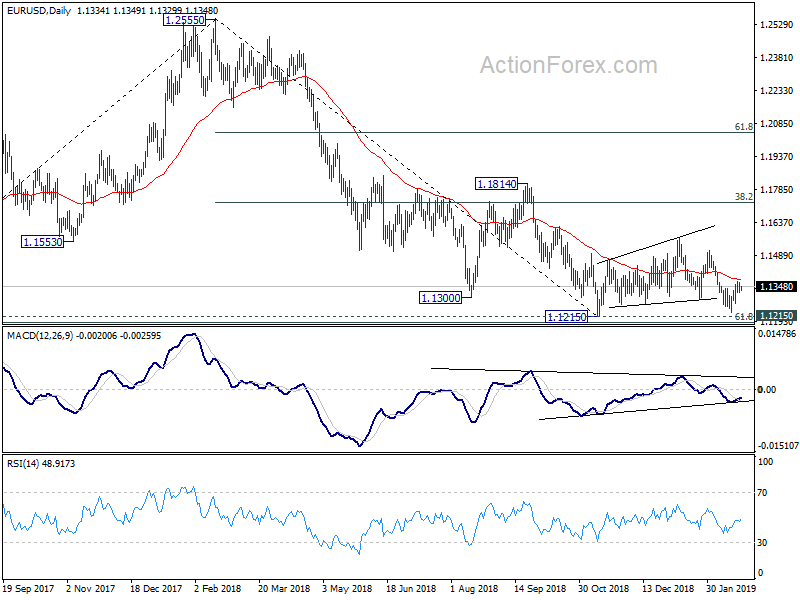
EUR/USD is staying in tight range below 1.1371 and intraday bias remains neutral. Further rise is mildly in favor with 1.1275 minor support intact. Rebound fro 1.1234 is seen as another leg in consolidation pattern from 1.1215. On the upside, above 1.1371 will extend the rebound from 1.1234, towards 1.1514 resistance. On the downside, though, break of 1.1275 minor support will turn bias back to the downside for 1.1215 low instead. Decisive break there will confirm completion of consolidation from 1.1215, and resumption of down trend from 1.2555.
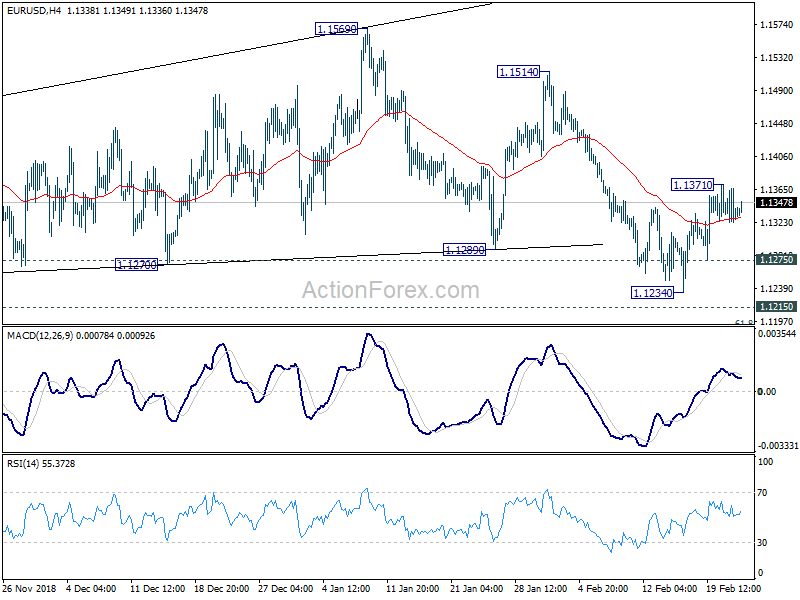
In the bigger picture, as long as 1.1814 resistance holds, down trend down trend from 1.2555 medium term top is still in progress and should target 61.8% retracement of 1.0339 (2017 low) to 1.2555 at 1.1186 next. Sustained break there will pave the way to retest 1.0339. However, break of 1.1814 will confirm completion of such down trend and turn medium term outlook bullish.
Economic Indicators Update
| GMT | Ccy | Events | Actual | Forecast | Previous | Revised |
|---|---|---|---|---|---|---|
| 23:30 | JPY | National CPI Core Y/Y Jan | 0.80% | 0.80% | 0.70% | |
| 07:00 | EUR | German GDP Q/Q Q4 F | 0.00% | 0.00% | 0.00% | |
| 09:00 | EUR | German IFO Business Climate Feb | 98.9 | 99.1 | ||
| 09:00 | EUR | German IFO Expectations Feb | 94.2 | 94.2 | ||
| 09:00 | EUR | German IFO Current Assessment Feb | 103.9 | 104.3 | ||
| 10:00 | EUR | Eurozone CPI Core Y/Y Jan F | 1.10% | 1.10% | ||
| 10:00 | EUR | Eurozone CPI M/M Jan | -1.10% | 0.00% | ||
| 10:00 | EUR | Eurozone CPI Y/Y Jan F | 1.40% | 1.60% | ||
| 13:30 | CAD | Retail Sales M/M Dec | -0.30% | -0.90% | ||
| 13:30 | CAD | Retail Sales Ex Auto M/M Dec | -0.30% | -0.60% |
Into European session: NZD weakest, AUD recovers
Entering into European session, New Zealand Dollar is the weakest one for today. RBNZ's proposal to raise capital requirements for top banks apparent hurt sentiments towards the Kiwi. Such a move might tighten up financial conditions which eventually force the central bank to cut interest rates again. Yen is trading as the second weakest followed by Canadian. Rally in oil prices appear to be losing some momentum. Loonie will look into retail sales data today for renewed strength.
Australian is the strongest one for today, paring some of this week's losses. Officials have been trying to talk down the importance of China Dalian port's ban of Australian coal imports. Swiss Franc and Euro are the next strongest for now.
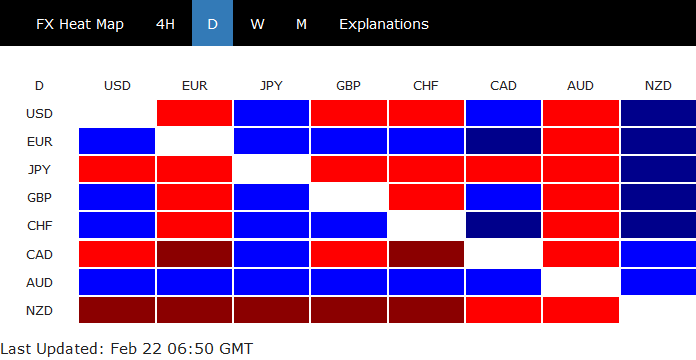
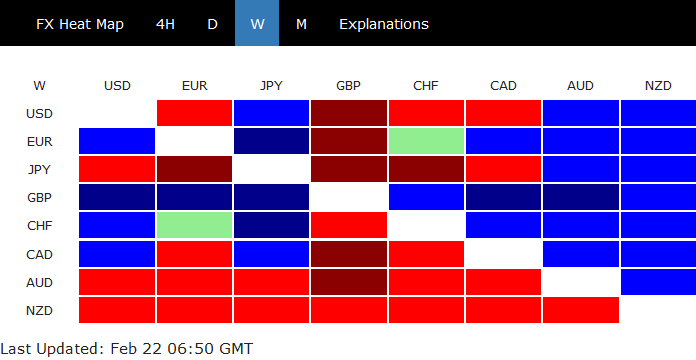
Over the week, Sterling is still the strongest one despite the lack of concrete breakthrough in Brexit impasse. Swiss Franc is the second strongest, followed by Euro. New Zealand Dollar, Australian Dollar and Yen are the worst performing ones.
In Asia:
- Nikkei closed down -0.18%.
- Hong Kong HSI is up 0.17%.
- China Shanghai SSE is up 1.62%.
- Singapore Strait Times is down -0.26%.
- Japan 10-year JGB yield is up 0.0018 at -0.038.
Overnight:
- DOW dropped -0.40%.
- S&P 500 dropped -0.35%.
- NASDAQ dropped -0.39%.
- 10-year yield rose 0.034 to 2.688
Gold Price And Crude Oil Price Could Correct Lower
Gold price rallied recently above $1,325 and later faced sellers near $1,346. Crude oil price is placed in a bullish zone, but a break below the $56.75 support could trigger a downside correction.
Important Takeaways for Gold and Oil
- Gold price tested the $1,345-1,346 resistance area and later corrected lower against the US Dollar.
- There was a break below a major bullish trend line with support at $1,335 on the hourly chart of gold.
- Crude oil price remained in an uptrend and it recently traded above the $57.00 resistance.
- There is a crucial bullish trend line in place with support at $56.75 on the hourly chart of XTI/USD.
Gold Price Technical Analysis
In the past few days, there was a strong upward move from the $1,305 swing low in gold price against the US Dollar. The price gained momentum and broke the $1,320 and $1,325 resistance levels.
The price even broke the $1,340 resistance and the 50 hourly simple moving average. It traded towards the $1,345 resistance and formed a high near $1,346 on FXOpen. Later, the price started a downside correction and traded below the $1,340 support.
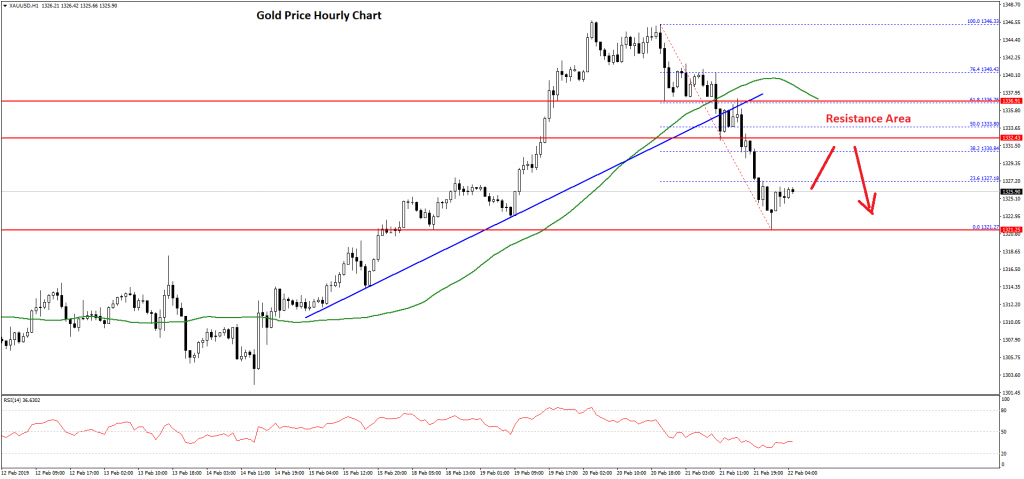
There was also a break below a major bullish trend line with support at $1,335 on the hourly chart of gold. The price even broke the $1,325 support and the 50 hourly simple moving average.
A low was formed near $1,321 and the price is currently correcting higher. An initial resistance is near the 23.6% Fib retracement level of the recent decline from the $1,346 high to $1,321 low. In the short term, there could be an upward move, but it is likely that sellers appear near the $1,330 resistance.
The main resistance is near the $1,335 level and the 50 hourly simple moving average. The 50% Fib retracement level of the recent decline from the $1,346 high to $1,321 low is also near the $1,333 level.
Therefore, upsides are likely to be capped near the $1,330, $1,333 and $1,335 resistance levels. On the downside, the price could test the $1,315 support before a fresh increase.
Oil Price Technical Analysis
Crude oil price followed a strong uptrend this week and climbed above the $54.00 and $55.00 resistance levels against the US Dollar. The price gained pace and broke the $57.00 resistance to climb to a new monthly high.
It traded as high as $57.60 and settled above the 50 hourly simple moving average. Later, the price started a downside correction and traded below the $57.50 and $57.30 levels.
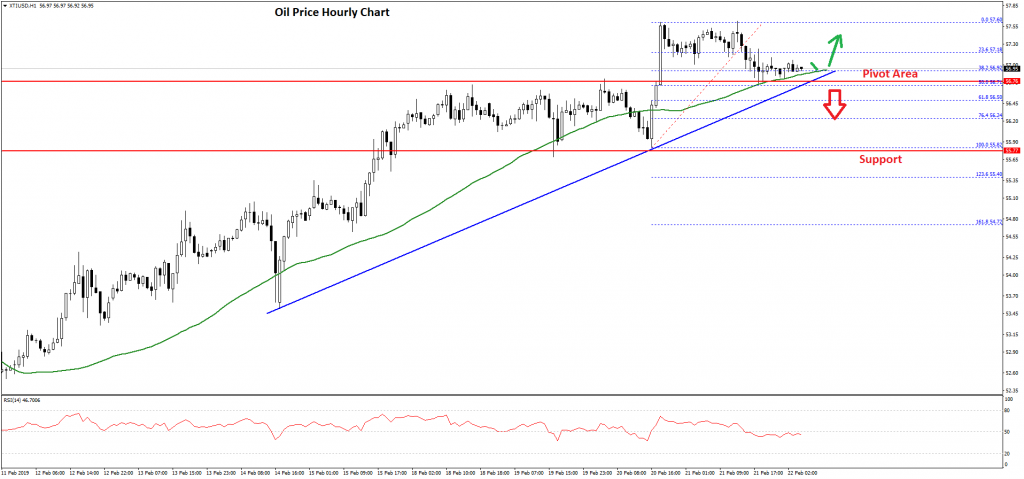
There was a break below the 23.6% Fib retracement level of the recent wave from the $55.82 low to $57.60 high. However, there is a strong support formed near $56.75 level. There is also a crucial bullish trend line in place with support at $56.75 on the hourly chart of XTI/USD.
The 50% Fib retracement level of the recent wave from the $55.82 low to $57.60 high is also near the $56.75 level. Therefore, there are two possible outcomes – first, the price breaks the $56.75 support and correct lower towards the $55.00 support.
Alternatively, it could bounce back and break the $57.60 high in the near term. The next key resistance is near the $58.50 and $59.00 levels.
Chinese Tech Names Rise Amid Focus On Trade Talks
General Trend:
- Property sector in Shanghai lags, Jan new home price growth slowed on m/m basis
- Consumer Discretionary and Financial shares rise in Australia
- South Korea utility KEPCO rises over 2% after earnings
- Recent round of US/China trade talks due to conclude today
- US President Trump expected to meet China Vice Premier Liu He on Friday (Feb 22) at 2:30 PM EST
- New Zealand Dollar (NZD) declines amid RBNZ comments
- Little impact on bond market seen from RBA Gov Lowe’s comments
- Thai Baht (THB) declines on weaker trade data
- Alibaba says it will not cut jobs
Headlines/Economic Data
Australia/New Zealand
- ASX 200 opened +0.1%
- (AU) Reserve Bank of Australia (RBA) Gov Lowe: Reiterates there's no strong case for a near-term change in cash rate, rate outlook is more evenly balanced than six months ago
- (AU) Reserve Bank of Australia (RBA) Dep Gov Debelle: Need for quantitative easing (QE) is highly unlikely in Australia
- (AU) Australia PM Morrison: Should not leap to conclusions on report of China coal ban, nothing to suggest the move on coal was out of the normal
- (AU) Australia Treasurer Frydenberg: Australia-China trade ties are strong; China has not banned any Australian imports - radio interview
- (AU) Australia Trade Minister Birmingham: No basis to believe China banned coal imports, China processing of coal imports may have slowed
- (NZ) Reserve Bank of New Zealand (RBNZ) Deputy Gov Bascand: Bank capital increase could lead to eventual rate cut, plan may result in marginal tightening in conditions
China/Hong Kong
- Shanghai Composite opened -0.1%, Hang Seng -0.5%
- (US) US/China trade talks said to be 'positive' - CNBC
- (US) US President Trump expected to meet China Vice Premier Liu He on Friday (Feb 22) at 2:30 PM EST; meeting to occur at the White House
- (CN) CHINA JAN NEW HOME PRICES M/M: 0.6% V 0.8% PRIOR (slowest growth since April 2018); Y/Y: 10.0% V 9.7% PRIOR
- (CN) China PBoC sets Yuan Reference Rate: 6.7151 v 6.7220 prior
- (CN) China PBoC Open Market Operation (OMO): Injects CNY40B in 7-day reverse repos v skipped prior; Net: CNY40B injection v CNY0B prior
- (CN) China Finance Ministry (MOF) sells 30-year bonds: yield 3.6902%; bid to cover 2.2x
Japan
- Nikkei 225 opened -0.4%
- (JP) Bank of Japan (BOJ) Gov Kuroda comments after meeting with PM Abe: Did not discuss monetary policy with Abe, Meeting with Abe is a 'regular' event
- (JP) Japan Cabinet Office (Govt) Feb Monthly Economic Report: Downgrades assessment in industrial production, downgrades assessment in corporate profits
- (JP) Allies of PM Abe reportedly floating possibility of fourth term for Prime Min Abe in order to retain influence to pass his agenda – Nikkei
- (JP) Japan Fin Min Aso: Know of US/China talks but can't comment on currency; Trump has not mentioned currencies when discussing trade issues with Japan
- (JP) JAPAN JAN NATIONAL CPI Y/Y: 0.2% 0.2%E; EX-FRESH FOOD (CORE) Y/Y: 0.8% V 0.8%E
Korea
- Kospi opened -0.3%
- (KR) South Korea Vice Fin Min said to be concerned about Feb exports - Local Press
- (KR) South Korea President Moon approval rating declines to 45% v 47% prior - Gallup Poll
Other
- (MY) Malaysia Jan CPI Y/Y: -0.7% v -0.4%e (first drop since 2009)
- (SL) Sri Lanka Central Bank (CBSL) leaves rates unchanged (as expected); Cuts Statutory Reserve Ratio by 100bps to 5.00%
- (TH) Thailand Jan Customs Trade Balance: -$4.0B v -$326Me
North America
- (US) US President Trump: US economy stronger than it's ever been before
- (US) SEMI: Jan North America Billings $1.9B v $2.11B prior, -10.5% m/m and -20.8% y/y
- Newmont Mining [NEM]: Barrick Gold said to have studied offer for the company, said to have studied joint bid with company such as Australia's Newcrest - US financial press
Europe
- (UK) Govt spokesperson: EU's Barnier and UK Brexit Sec Barclay agreed to focus on what we can do to conclude a successful deal as soon as possible
- (UK) Japan Trade Min Seko: Japan/EU trade deal won't apply to the UK if 'No-deal' Brexit
Levels as of 12:45 ET
- Nikkei 225, -0.1%, ASX 200 +0.5%, Hang Seng -0.1%; Shanghai Composite +0.6%; Kospi -0.1%
- Equity Futures: S&P500 flat; Nasdaq100 flat, Dax +0.1%; FTSE100 +0.2%
- EUR 1.1343-1.1343 ; JPY 110.81-110.61 ; AUD 0.7114-0.7073 ;NZD 0.6818-0.6757
- Gold flat at $1,327/oz; Crude Oil -0.1% at $56.88/brl; Copper flat at $2.899 /lb
RBNZ to raise top banks’ capital requirement, might cut interest rate
New Zealand Dollar drops broadly today after RBNZ proposed to raise capital requirement for top banks of the country. Capital ratios would be increased to 16% of frisk-weighted assets. Combined the top four banks might need to raise NZD 20B over the next five years to meet the rule.
RBNZ Deputy Governor Geoff Bascand said the move would only lead to a "marginal tightening of monetary conditions". But he added that the central could consider to loosen up monetary further is needed. Bascand said "when we set the OCR (Official Cash Rate), we set it with for a 18 month to 2 year look ahead. So let's say we are making a decision in the third quarter of this year...we just have to feed that into our regular monetary policy decision making". And, "if we were worried, and thinking we were undershooting inflation, undershooting maximum sustainable employment, then we would obviously look for an OCR change...that is the implication."
Elliott Wave View: Dow Jones Futures (YM_F) Starts Correction
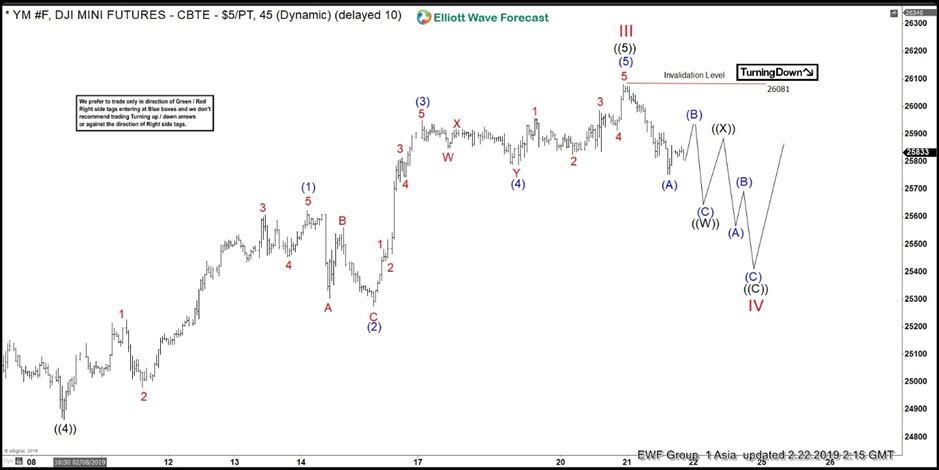
Dow Jones Futures (YM_F) has started to pullback earlier today. We are counting the entire rally from December 26, 2018 low as an Impulse Elliott Wave structure. An Impulse has subdivision of 5 waves within wave I, III, and V. The high on February 21 at 26081 ended wave III of the Impulse. Internal of wave III subdivides in another 5 waves in lesser degree.
On the 1 hour chart, we can see wave ((4)) of III ended at 24862 and wave ((5)) of III ended at 26081. Internal of wave ((5)) further subdivides in another 5 waves of lesser degree wave (1), (2), (3), (4), and (5). This is the idea of fractal in Elliott Wave where each wave is comprised of smaller waves and the pattern repeats itself in smaller degree.
Wave IV pullback is currently in progress to correct wave III cycle which starts from December 28, 2018 low (22242). Potential target for wave IV is 23.6 – 38.2 Fibonacci retracement of wave III at 24617 – 25172. From this area, the Index either resumes to new high in wave V or at least bounce in 3 waves. The structure of wave IV pullback can still change but we propose a double three Elliott Wave structure (WXY). The first leg wave ((W)) subdivides as a zigzag where wave (A) of ((W)) has ended at 25753. Short term, while wave (B) bounce fails below 26081, expect Index to extend lower. If the Index breaks above 26081, then wave III still remains in progress but won’t change the overall idea that we can see a wave IV pullback soon.
1 hour Dow Jones Future (YM_F) Elliott Wave chart
German Economic Activity Data To Be Eyed Closely
Market movers today
Today brings the German Ifo figures. After the economy had a disappointing growth finish in 2018, we will keep an eye out for signs of a rebound in activity following the latest encouraging signs from Chinese leadings indicators and the German car sector .
In the US, many FOMC members are speaking about the target level for the Fed's balance sheet at a conference in New York. However, after Fed minutes on Wednesday revealed that almost all Fed board members want to end the balance sheet reduction by the end of the year, the market impact of today's speeches will probably be more limited.
In the Scandies, the Riksbank is due to publish minutes from the 12 February meeting today at 09:30 CET. The monetary policy decision was taken with only five Board members as Deputy Governor Per Jansson was absent for personal reasons. In connection with the release, Jansson will make a written comment about the decision.
Selected market news
Asian equity markets traded modesty lower after a weak session in the US on weedy economic data and miscellaneous sentiment from the ongoing US-China trade negotiations. US Treasury yields trimmed Thursday's advance.
The US economic data demonstrated weakness across several indicators, with only initial jobless claims keeping a spark of positivism. The ISM-adjusted Philly Fed release at 52.4 was the poorest reading since October 2016, while the Philly Fed headline index went negative for the first time since May 2016. The decline in the new orders sub-index of more than 23pt was the biggest one-month decline since October 2008. New orders fell to their weakest level since May 2016.
As the 1 March and a US-imposed deadline to reach a trade agreement approaches, the US and China 's trade negotiators continued high-level talks in Washington yesterday to hash out a deal that could end their trade war . It is unclear whether the latest round of talks, which are due to conclude today, may be extended into next week, and where those future negotiations might occur, Reuters writes. If the two countries fail to reach an agreement by the 1 March, US tariffs on USD200bn of Chinese imports are set to rise 10% to 25%.
ECB minutes revealed that markets should brace themselves for a hawkish surprise. Not because the minutes were hawkish, but because the market is trading so expensive/dovish expectations. On the TLTRO, it is clear that it needs a monetary policy case and that 'any decisions in this respect should not be taken too hastily, the technical analyses required to prepare policy options for future liquidity operations needed to proceed swiftly.'
Bloomberg reported that the EU expects Theresa May to request a three-month delay to Brexit, quoting two EU officials. EU officials say the three-month extension would happen under their most optimistic scenario. The risk remains that the UK could leave the bloc on 29 March without a deal. Alternatively, May could be forced to contemplate a longer delay if she cannot get backing for the agreement, according to one official.
Euro-Zone’s Manufacturing PMI Fell To A 68-Month Low Level In February, While Services PMI Rose To A 3-Month High...
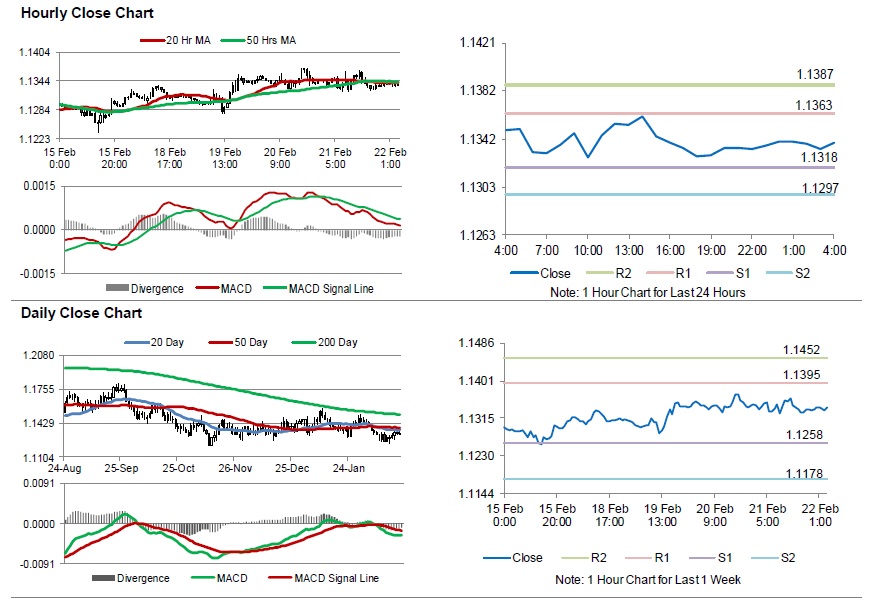
For the 24 hours to 23:00 GMT, the EUR declined 0.08% against the USD and closed at 1.1336, on the back of dismal PMI data.
Data showed that Euro-zone's flash manufacturing PMI fell to a level of 49.2 in February, declining to a 68-month low level and compared to market expectations for a drop to a level of 50.3. In the previous month, the PMI had registered a reading of 50.5.
On the flipside, the region's preliminary services PMI climbed to a 3-month high level of 52.3 in February, following a level of 51.2 in the prior month. Market participants had envisaged the PMI to advance to a level of 51.3.
Separately, in Germany, the preliminary manufacturing PMI unexpectedly declined for the first time since 2013 to a level of 47.6 in February, defying market consensus for a rise to a level of 49.9. In the prior month, the PMI had recorded a level of 49.7. However, the nation's the preliminary services PMI surprisingly rose to a 5-month high level of 55.1 in February, cofounding market anticipations for a drop to a level of 52.9. In the previous month, the PMI had recorded a level of 53.0. Meanwhile, Germany's final consumer price inflation slowed to a 11-month low level of 1.4% on an annual basis in January, in line with market expectations and confirming the preliminary print. In the prior month, the inflation had registered a level of 1.7%.
In the US, data indicated that the US Philadelphia Fed manufacturing index slid to a level of -4.1 in February, compared to market expectations for a drop to a level of 14.0. The index had recorded a reading of 17.0 in the prior month. Moreover, the nation's flash Markit manufacturing PMI slid to a 17-month low level of 53.7 in February, higher than market anticipations for a decline to a level of 54.8. In the prior month, the index gad registered a reading of 54.9. Additionally, the US existing home sales unexpectedly dropped to a 3-year low level of 1.2% on a monthly basis to a level of 4.94 million in January, falling short of market consensus for a reading of 5.0 million. In the prior month, existing home sales had recorded a revised level of 5.0 million. On the contrary, the US flash Markit services PMI advanced to a level of 56.2 in February, compared to a level of 54.2 in the previous month. Market participants had envisaged the PMI to rise to a level of 54.3. Furthermore, the nation's flash durable goods orders jumped 1.2% on a monthly basis in December, undershooting market consensus for a rise of 1.7%. In the prior month, durable goods orders had recorded a gain of 0.7%. Also, the number for Americans filling for fresh unemployment benefits declined to a level of 216.0K in the week ended 16 February 2019, compared to a level of 239.0K in the prior week. Markets had anticipated the initial jobless claims to drop to 228.0K.
In the Asian session, at GMT0400, the pair is trading at 1.1339, with the EUR trading marginally higher against the USD from yesterday's close.
The pair is expected to find support at 1.1318, and a fall through could take it to the next support level of 1.1297. The pair is expected to find its first resistance at 1.1363, and a rise through could take it to the next resistance level of 1.1387.
Looking forward, traders would keep an eye on the Euro-zone's consumer price index for January along with Germany's 4Q gross domestic product and the IFO survey indices for February, set to release in a few hours.
The currency pair is showing convergence with its 20 Hr and 50 Hr moving averages.
UK’s Public Sector Net Borrowing Posted A Surplus In January
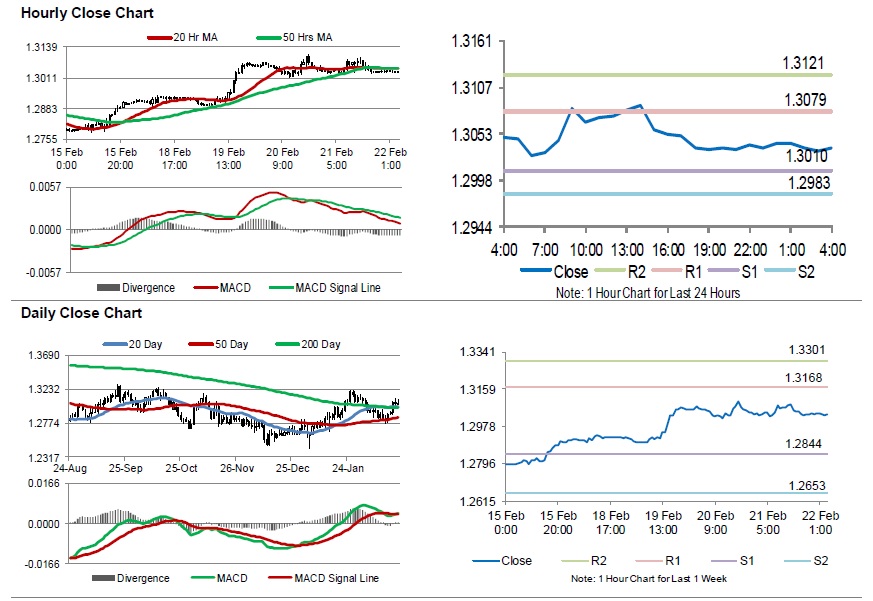
For the 24 hours to 23:00 GMT, the GBP declined 0.08% against the USD and closed at 1.3036.
Data showed that UK's public sector net borrowing posted a surplus of £15.8 billion in January, following a deficit of £2.1 billion in the prior month. Market participants had expected the public sector net borrowing to record a surplus of £11.1 billion.
In the Asian session, at GMT0400, the pair is trading at 1.3036, with the GBP trading flat against the USD from yesterday's close.
The pair is expected to find support at 1.3010, and a fall through could take it to the next support level of 1.2983. The pair is expected to find its first resistance at 1.3079, and a rise through could take it to the next resistance level of 1.3121.
Amid no major economic releases in UK today, investor sentiment would be determined by global macroeconomic factors
The currency pair is trading below its 20 Hr and 50 Hr moving averages.
Japan’s Machine Tool Orders Declined As Estimated In January
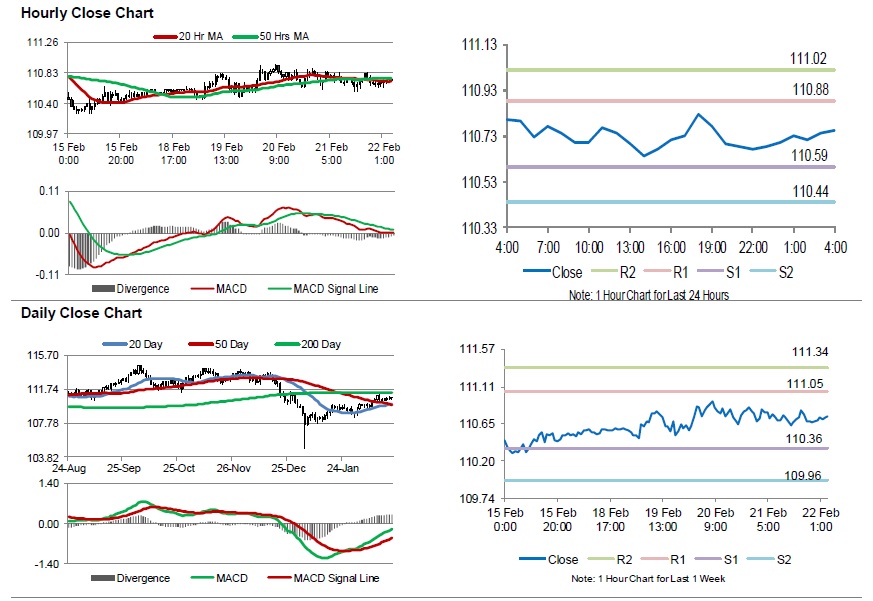
For the 24 hours to 23:00 GMT, the USD declined 0.12% against the JPY and closed at 110.68.
Data showed that Japan's final machine tool orders fell 18.8% on a yearly basis in January, confirming the preliminary print and following a drop of 18.3% in the prior month.
In the Asian session, at GMT0400, the pair is trading at 110.75, with the USD trading 0.06% higher against the JPY from yesterday's close.
Overnight data revealed that Japan's national consumer price index (CPI) climbed 0.2% on an annual basis in January, meeting market expectations. In the previous month, the CPI had registered a rise 0.3%.
The pair is expected to find support at 110.59, and a fall through could take it to the next support level of 110.44. The pair is expected to find its first resistance at 110.88, and a rise through could take it to the next resistance level of 111.02.
Going ahead, traders would closely monitor Japan's industrial production, manufacturing PMI, housing starts, consumer confidence and jobless rate, all set to release next week.
The currency pair is showing convergence with its 20 Hr and 50 Hr moving averages.