Sample Category Title
EUR/USD Outlook: Risk Of Recovery Stall Increases
The Euro regained traction and bounced in early European trading on Monday, retracing the biggest part of post-Fed minutes fall.
Better than expected French PMI data boosted the single currency, while mixed German PMI’s (Manufacturing Feb 47.6 vs 50 f/c / Feb Services 55.1 vs 52.8 f/c) and EU (Feb Manufacturing 49.2 vs 50.3 f/c / Services Feb 52.3 vs 51.5 f/c) slowed recovery
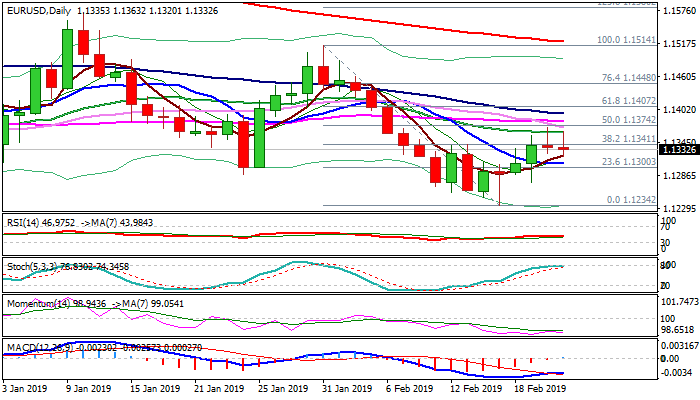
Wednesday’s Doji with long upper shadow signaled strong indecision, as the pair failed to close above cracked pivotal Fibo barrier at 1.1341 (38.2% of 1.1514/1.1234), generating initial signal of possible recovery stall.
Daily 20SMA (1.1363) continues to cap, guarding plethora of barriers provided by 30,55 and 100SMA’s at 1.1372/1.1395.
Daily slow stochastic is reversing at overbought zone border and momentum remains weak, adding to negative signals.
Improved dollar’s sentiment after Fed minutes revived expectations for possible rate hike this year, despite Fed’s strong dovish shift in the previous policy meeting, could also pressure the Euro.
Repeated close below 1.1341 Fibo barrier would generate further bearish signal, however, extension and close below 10SMA (1.1309) is needed to confirm reversal.
Alternative scenario sees sustained break above 1.1341 as initial bullish signal, which would require confirmation on extension above 1.1407 (Fibo 61.8% of 1.1514/1.1234 descend).
Res: 1.1341, 1.1363, 1.1372, 1.1382
Sup: 1.1320, 1.1309, 1.1275, 1.1249
Oil Bulls Run Free On Fears Of Opec Production Cuts
WTI jumped higher in the US session on Wednesday, setting new 2019 highs, strengthened by fears of OPEC led supply cuts. Also, oil prices may have gotten a further boost, as political instability rises in Libya, Nigeria and Venezuela and at the same time US sanctions against Iran continue to trim the oil supply chain. Analysts point out that although there is no lack of resources, access to them gets more and more difficult. On the flip side, a soaring US oil production puts the breaks on oil prices, as it has reached a record high level of 11.9 million bpd. Another factor withholding oil prices is the global economic slowdown, with special focus on China, which could weaken demand for oil. The release of API weekly crude oil inventories last night, showed an injection of 1.26 million barrels and gave oil prices a small boost, as the figure was expected by some analysts to be around 3m. We could see volatility for oil continuing today, especially as the official EIA crude oil inventories figure is due out. WTI prices rose for another session, yesterday testing the 57.55 (R1) resistance line. The commodity’s prices may continue their bullish run in the next few days, as long as the upward trend line incepted since the 11th of February remains intact. We would like to advise caution as some volatility is expected to occur at the release of the EIA crude oil inventories later today. Also please note that the RSI indicator in the 4 hour chart is above the reading of 70, implying a rather overcrowded long position for the commodity. Should oil find fresh buying orders along its path, we could see it breaking the 57.55 (R1) resistance line and aim for the 59.00 (R2) resistance level. Is on the other hand the pair comes under the selling interest of the market, we could see it aiming if not breaking the 55.60 (S1) support line.
USD gets some support from FOMC’s minutes
The USD got some support yesterday, as the FOMC minutes renewed the possibility of a rate hike near the end of the year among investors. The minutes showed that the bank considers that the US economy and its labour market remain strong, appeasing the markets somewhat. The main issue seems to remain trade and market focus seems to remain on the US-Sino negotiations as their result is expected to have a significant impact on US trade and growth. It should be noted though that analysts point out that the bar for the Fed to restart rate hikes in the near term remains high. EUR/USD continued it’s struggling around the 1.1345 (S1) support line, continuously braking it back and forth. We could see the pair trading in a bearish market today, as financial releases could provide some support for the USD while at the same time weaken the EUR. We would like to underscore the release of ECB account of monetary policy meeting which could have a substantial effect on the common currency. Should he bears take over, we could see the pair breaking the 1.1345 (S1) support line and aim if not break the 1.1300 (S2) support level. On the other hand, should the bulls dictate the pair’s direction, we could see it breaking the 1.1385 (R1) resistance line.
Today’s other economic highlights
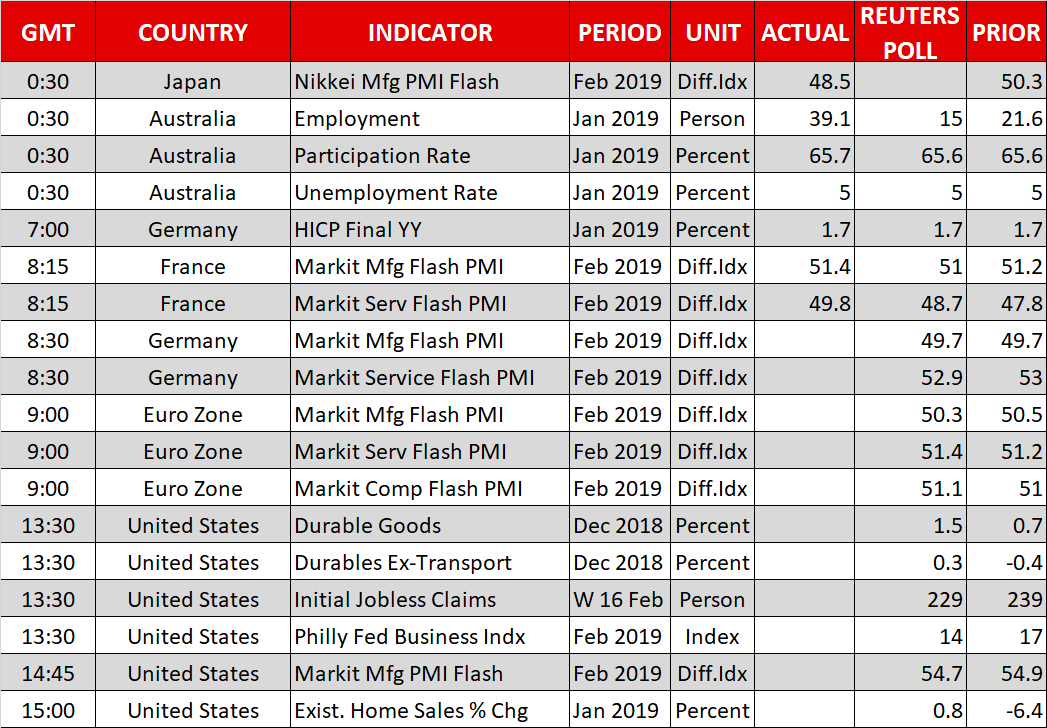
During the European session today, we get Germany’s preliminary manufacturing PMI for February as well as the final HICP rate for January. Also from France we get the final HICP rate for January and later on Eurozone’s preliminary composite PMI for February. The ECB is to release its account of monetary policy meeting minutes just before the American session and could create volatility for the EUR. In the American session we get from the US the durable goods orders growth rates for December, the Philly Fed Business Index for February and the EIA crude oil inventories. From Canada we get the wholesale trade growth rate for December. Please note that ECB’s Peter Praet and Atlanta Fed President Raphael Bostic will be speaking today.
WTI H4
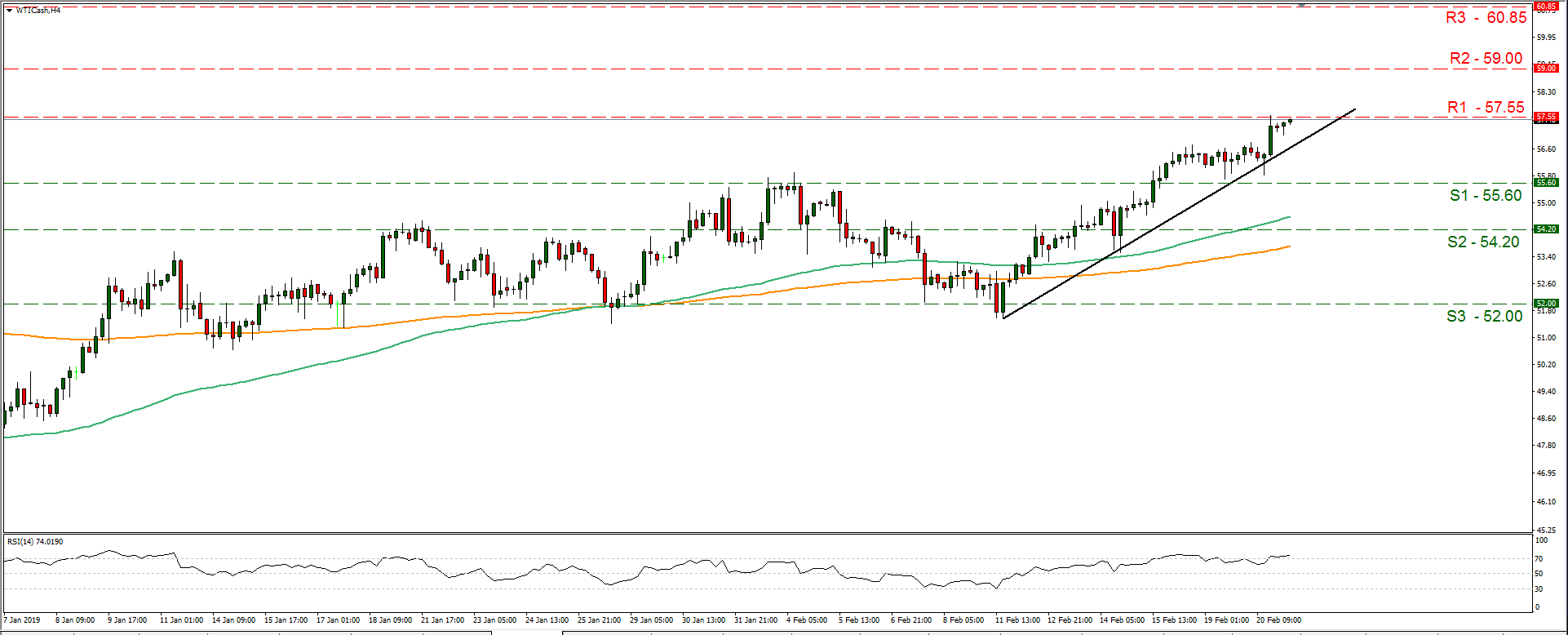
Support: 55.60 (S1), 54.20 (S2), 52.00 (S3)
Resistance: 57.55 (R1), 59.00 (R2), 60.85 (R3)
EUR/USD H4
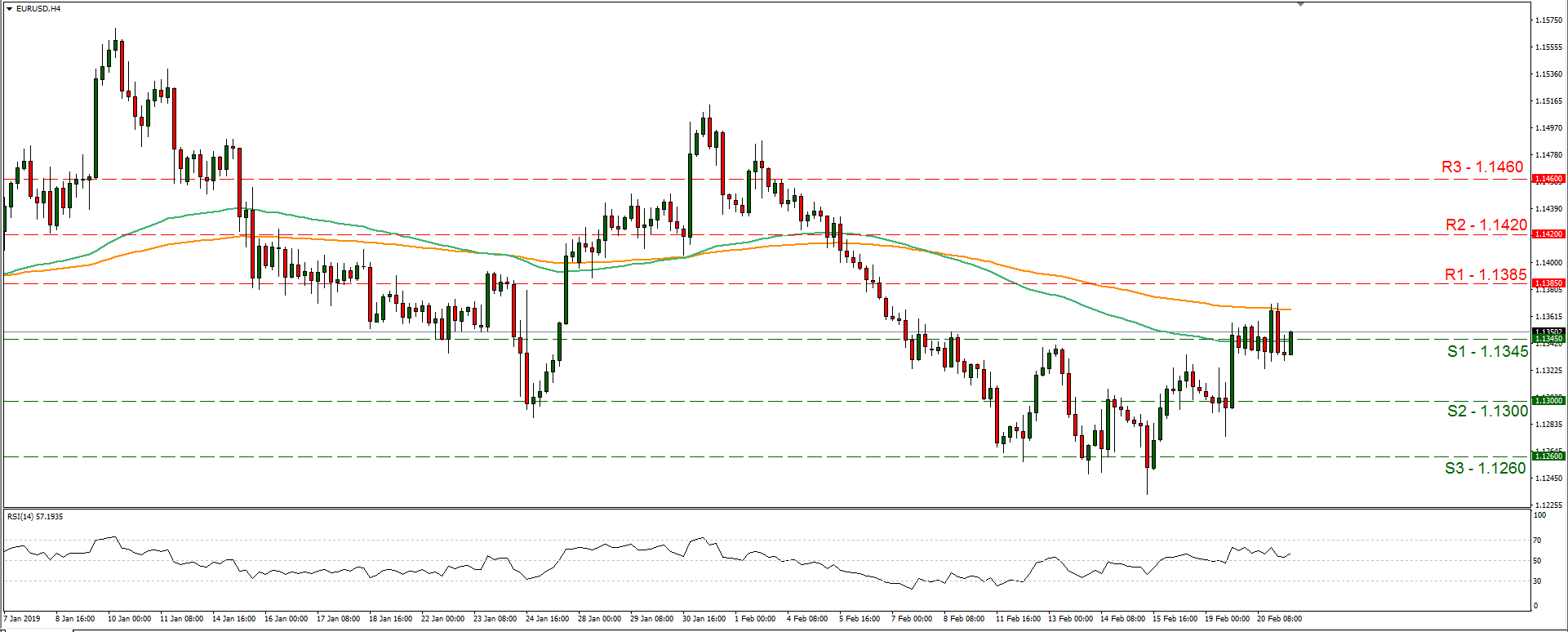
Support: 1.1345 (S1), 1.1300 (S2), 1.1260 (S3)
Resistance: 1.1385 (R1), 1.1420 (R2), 1.1460 (R3)
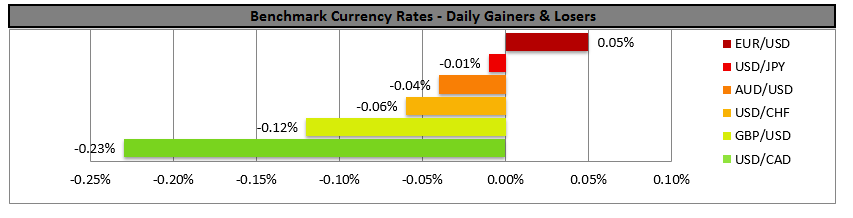
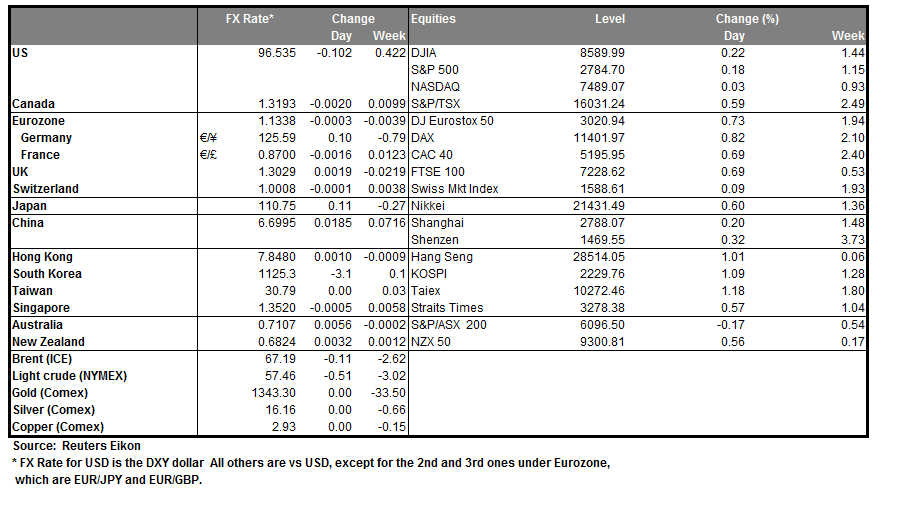
Eurozone PMIs: Eurozone to grow 0.1% in Q2, Germany 0.2%, France to stagnate
Eurozone PMI manufacturing dropped to 49.2 in February, down from 50.5 and missed expectation of 50.3. That's the lowest level in 69-month. PMI services, however, rose to 52.3, up from 51.2 and beat expectation of 51.3. PMI composite improved to 51.4, up from 51.0.
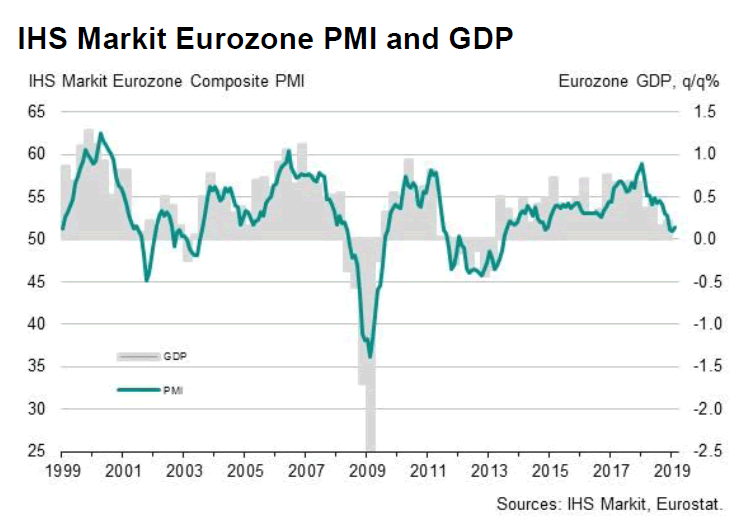
Commenting on the flash PMI data, Chris Williamson, Chief Business Economist at IHS Markit said:
"The Eurozone economy remained close to stagnation in February. The flash PMI lifted only slightly higher during the month, continuing to indicate one of the weakest rates of expansion since 2014. The survey data suggest that GDP may struggle to rise by much more than 0.1% in the first quarter.
"Germany is on course to grow by 0.2%, buoyed by its service sector, but France looks set to stagnate or even contract very slightly. The rest of the region is meanwhile suffering its worst spell since late- 2013, with growth having slipped closer to stalling in February.
"Some uplift was also seen as companies stepped up preparations ahead of Brexit and disruptions from the 'yellow vest' protests in France eased. However, the general picture remained one of a more subdued business environment than seen throughout much of last year.
"Weaker order books were linked to a combination of intensifying headwinds and concerns, including global trade protectionism worries, Brexit, the downturn of the auto sector, increased political uncertainty and anxieties regarding the broader economic outlook. Rising risk aversion has consequently dampened demand, investment and spending.
"The weakness is being led by manufacturing, which has now entered its first downturn since mid- 2013. With factory order books deteriorating at an increased rate, the rate of contraction in the goodsproducing sector will likely worsen in coming months.
"Solid domestic demand in many countries, notably Germany, continued to help support service sector growth and offset the downturn of the manufacturing sector. However, the overall rate of service sector growth remained relatively moribund compared to that seen throughout much of last year.
"Price pressures have meanwhile continued to ease alongside the more subdued demand environment."
Dollar Ticks Up After Fed Minutes, Aussie Sinks
- Dollar ticks up after Fed minutes keep possibility of rate hikes alive
- European PMIs and ECB minutes highlight today’s agenda
- Aussie torpedoed as Chinese port bans Australian coal imports
- High-level trade talks resume in Washington
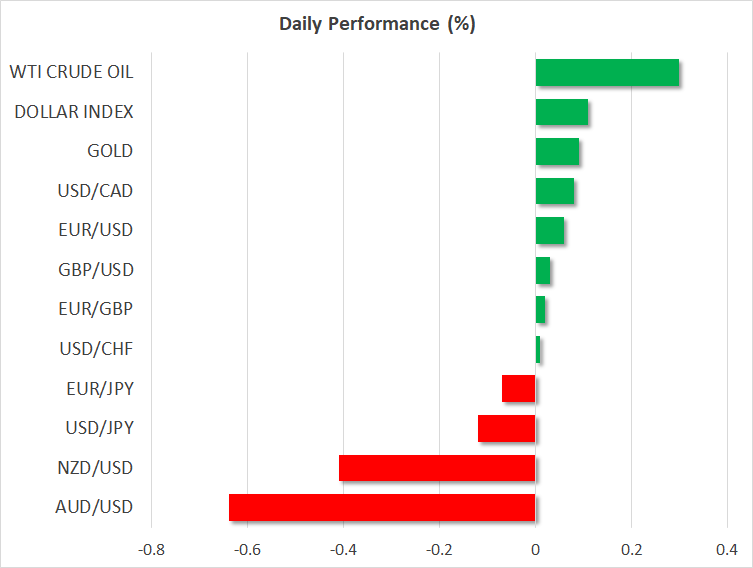
Dollar crawls higher as Fed minutes aren’t as dovish as expected
The minutes of the January Fed meeting confirmed the central bank will stay sidelined for a while amid several uncertainties, particularly in the global outlook. There was also broad consensus to end the balance sheet runoff soon. Yet, officials also retained a shred of optimism, indicating that the US economy remains solid, with “several” members maintaining that rates could be raised again “later this year” – conditional upon inflation picking up. The overall tone – and especially the fact that rate hikes were not taken completely off the table – was likely a touch less dovish than markets had anticipated, helping the dollar to rebound alongside US bond yields.
Where does this leave the dollar? While a major rally from current levels seems unlikely given that the Fed seems to be at – or at least near – ‘terminal rates’, any massive downside seems equally unlikely as long as other major currencies like the euro and sterling lack appeal. That said, there are risks in the near term, with the most notable being a resolution in the trade conflict that leads traders to scale back their safe-haven bets on the dollar, or a strong rebound in European growth that helps the euro become the ‘comeback kid’ again.
Today, US durable goods orders for December are on the docket, as well as the flash Markit PMIs for February.
European PMIs and ECB minutes to dictate euro’s path
It will be a pivotal session for the single currency, with preliminary PMIs (09:00 GMT) for the euro area and minutes of the latest ECB meeting (12:30 GMT) both on the agenda. The PMIs for February are expected to show some stabilization, which on the margin could help the euro recover somewhat. Admittedly though, for a major and sustained recovery, these prints would probably need to come in much higher than expected, which seems unlikely for now given political and trade risks clouding the outlook.
As for the minutes, they are unlikely to reveal much on policy beyond what Draghi signaled back at that meeting. Namely, that the bloc’s slowdown is worrisome, but not severe enough to derail the Bank’s normalization plans. Markets could focus mainly on the discussion around a new round of long-term loans to commercial banks, the so-called TLTROs.
China bans Australian coal imports, torpedoes Aussie
The Australian dollar took a major hit earlier in the session, giving back some gains it had recorded on robust employment data to trade much lower overall, following reports that China’s Dalian port had banned imports of coal from Australia. Meanwhile, major ports throughout China will prolong clearing times for Australian coal.
Coal is among Australia’s biggest exports, and China is the nation’s largest export market, so the news likely painted a bleak outlook for Australia’s terms of trade going forward. The China-sensitive kiwi dollar is also much lower on the session, in sympathy to the aussie.
Markets quiet, look to trade talks for impetus
The wasn’t much else in the broader market, with US stock indices managing to close in the green, albeit only modestly so. It will be a crucial couple of sessions for risk appetite, as senior officials will take over the US-China trade talks in Washington. Expectations for a deal, or at least an extension of the March 1 deadline, are currently riding high as evidenced by the sustained gains in equity markets.
Germany PMIs: Manufacturing and services on very different paths
Germany PMI manufacturing dropped to 47.6 in February, down from 49.7 and missed expectation of 49.9. That' the lowest level in 74 months. PMI services, however, rose to 55.1, up from 53.0 and beat expectation of 52.9. PMI composite improved slightly to 52.7, up from 52.1.
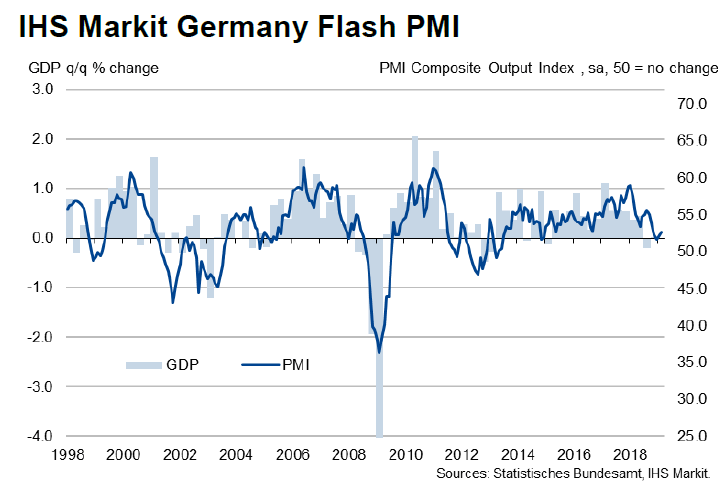
Commenting on the flash PMI data, Phil Smith, Principal Economist at IHS Markit said:
"Germany's manufacturing and service sectors remain on very different paths, according to February's flash PMI data. While strong fundamentals in the domestic market are driving growth in services business activity, falling exports continue to weigh on the performance of the manufacturing sector. Measured overall, the data remain indicative of a very modest rate of underlying output growth.
"The manufacturing PMI fell further into contractionary territory in February to its lowest in over six years, with sustained robust job creation at factories the only positive takeaway. The strength in employment is perhaps surprising given the order book situation and lack of pressures on capacity, but goods producers are seemingly looking through the current soft patch in demand.
"In terms of the factors behind the slowdown in manufacturing order books, many of the usual suspects – the uncertainty relating to US-China trade tensions and weakness in the autos industry – were highlighted, although there were also reports of growing competitive pressures within Europe."
Franc PMI composite rose to 49.9, economy stay below potential as long as social unrest continues
France PMI manufacturing rose to 51.4 in February, up from 51.2 and beat expectation of 51.0. PMI Services rose to 49.8, up from 47.8 and beat expectation of 48.5. PMI composite also improved to 49.9, up from 48.2.
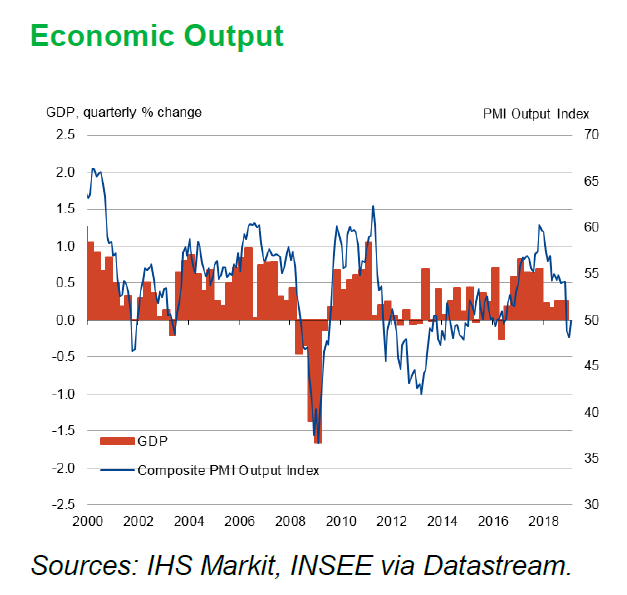
Commenting on the Flash PMI data, Eliot Kerr, Economist at IHS Markit said:
"February flash data pointed to a broad-stabilisation in output at private sector firms in France, offering relatively positive news after the weak performances of December and January.
"Although the 'gilets jaunes' protests are still ongoing and panellists have suggested that these are still causing disruption, the economy showed resilience in the latest survey period. Encouragingly, the rate of job creation accelerated and new orders declined only marginally, arresting the downward momentum seen over the past couple of months.
"That said, the economy will continue to post below its potential as long as social unrest continues. And amid the current uncertainty in the global economy, domestic issues weighing on activity are likely to remain detrimental."
UK Hammond: There may be an opportunity to bring back Brexit vote next week
Sterling appears to be lifted by news that an updated Brexit deal could be ready for voting in the parliament next week. Chancellor of Exchequer Philip Hammond said, regarding next week, "there may be an opportunity to bring a vote back to the House of Commons - there may be an opportunity, but that will depend on the progress that is made in the next few days."
He added that Prime Minister Theresa May's meeting with European Commission President Jean-Claude Juncker went well. He added "both sides have acknowledged that the political declaration could be expanded, for example, to address concerns that have been expressed in some parts of the House of Commons about workers rights."
Separately, it's believed that May and Juncker are working on a statement called "appropriate legal assurance to both sides". Brexit minister Steve Barclay and Attorney General Geoffrey Cox will visit Brussels again today.
XAUUSD Intraday Analysis
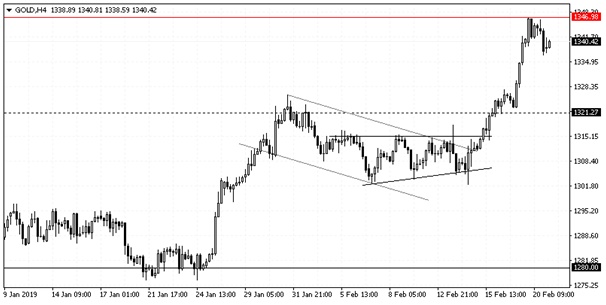
XAUUSD (1340.42): Gold prices were seen retracing the gains following the rally over the previous days. However, with prices easing back, we expect to see another attempt to push to the upside. Establishing firm resistance at 1347 level could signal a potential reversal to the gains. However, if gold prices breakout higher, we expect 1360 to be the next target to the upside. To the downside, the current lows formed at 1337 are important. A break down below this level could signal a move to the downside with the lower support at 1321.27 coming into the picture.
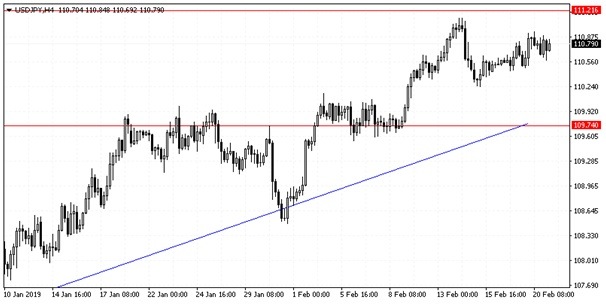
USDJPY Intraday Analysis
USDJPY (110.79): The USDJPY managed to close on a bullish note on Wednesday. Price action, however,trades flat within 111.21 and 109.74 levels of resistance and support. A breakout from this range will dictate further direction to the trend. For the moment, the ranging price action indicates a period of consolidation in prices
EURUSD Intraday Analysis
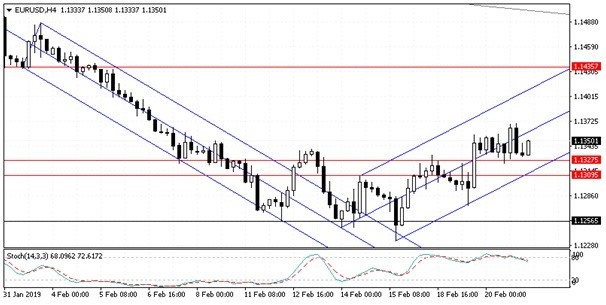
EURUSD (1.1350): The EURUSD currency pair reversed some of the gains. However, price action steadily held to the minor support created at 1.1335. The day’s price action resulted in prices retreating from the intraday highs. Still, with prices steady above the main support level of 1.1327 - 1.1309, we expect to see further gains in the EURUSD. If the intraday high of 1.1365 clears, then the common currency could be seen heading higher targeting 1.1435. To the downside, the support level remains essential as a breakdown below this level could signal declines and invalidate the bullish outlook.