

Sample Category Title
USD/CHF Daily Outlook
Daily Pivots: (S1) 0.9986; (P) 1.0005; (R1) 1.0029; More....
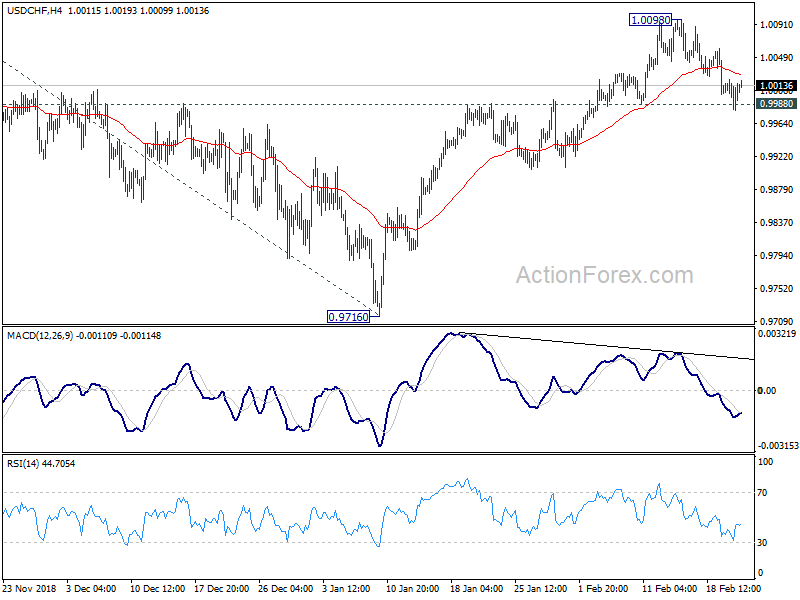
USD/CHF breached 0.9988 support but quickly recovered. Intraday bias stays neutral first. On the upside, above 1.0098 will target 1.0128 first. Break will confirm resumption of up trend from 0.9186. Next target will be 100% projection of 0.9541 to 1.0128 from 0.9716 at 1.0303. However, sustained break of 0.9988 will indicate rejection by 1.0128 and turn intraday bias to the downside for 0.9716 support again.
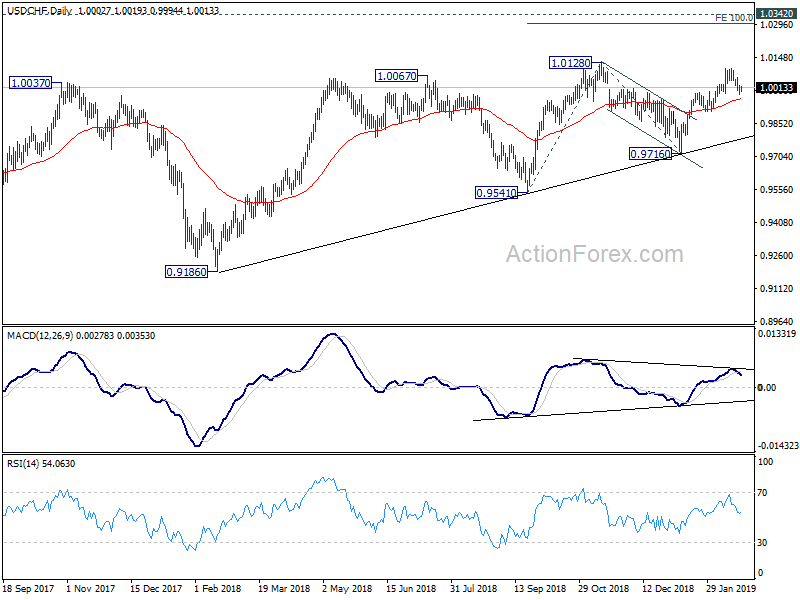
In the bigger picture, USD/CHF drew strong support from medium term trend line and rebounded. That suggests rise from 0.9186 is still in progress. Further break of 1.0128 will confirm up trend resumption and target 1.0342 key resistance. Nevertheless, break of 0.9716 will dampen this bullish view and at least bring deeper fall to 0.9541 key support.
USD/JPY Daily Outlook
Daily Pivots: (S1) 110.61; (P) 110.78; (R1) 111.02; More...
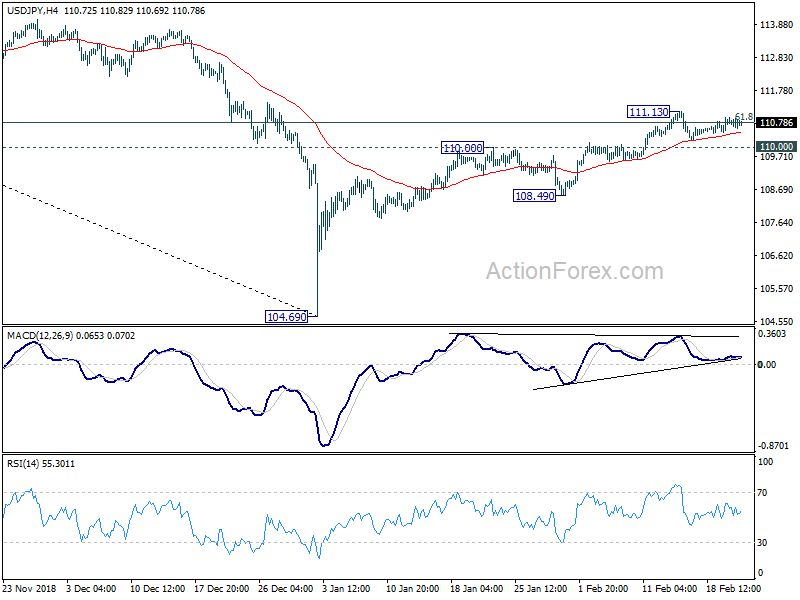
USD/JPY is staying in range below 111.13 temporary top and intraday bias remains neutral. On the downside, break of 110.00 resistance turned support will suggest rejection by 61.8% retracement of 114.54 to 104.69 at 110.77 and the rebound from 104.69 has likely completed. Intraday bias will be turned back to the downside for 108.49 support for confirmation. Nevertheless, break of 111.13 should confirm resumption of rise from 104.69 for 114.54 resistance.
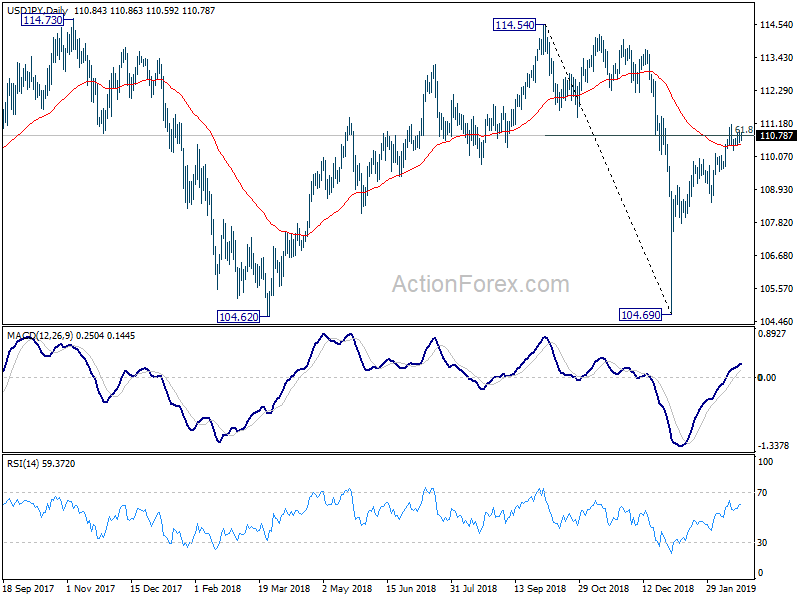
In the bigger picture, while the rebound from 104.69 was stronger than expected, it couldn't sustain above 55 day EMA yet. Outlook is turned mixed first. On the downside, break of 108.49 support will revive that case that such rebound was a correction. And, larger down trend is still in progress for another low below 104.62. But sustained trading above 55 day EMA will turn focus to 114.54. Decisive break there will confirmation completion of the decline from 118.65 (2016 high).
USD/CAD Daily Outlook
Daily Pivots: (S1) 1.3145; (P) 1.3182; (R1) 1.3214; More...
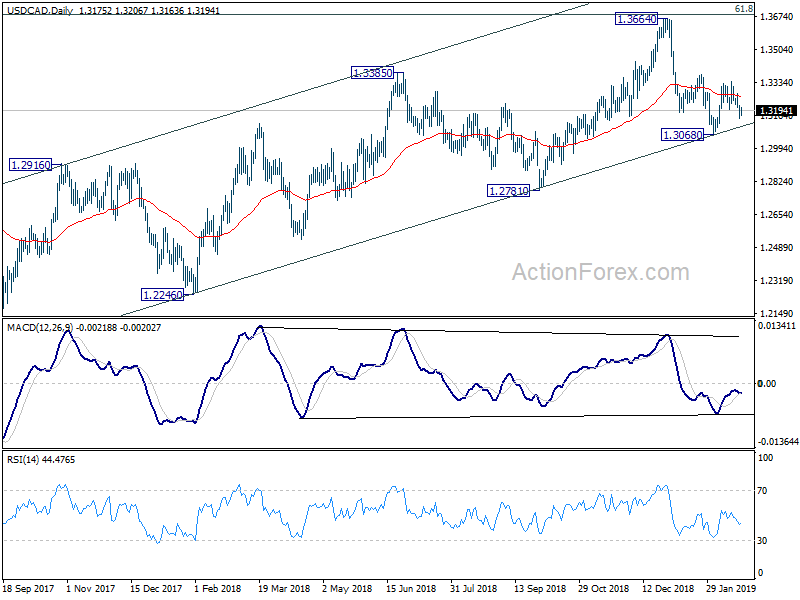
At this point, intraday bias in USD/CAD remains mildly on the downside for 1.3068 key support. We'd expect strong support from there to bring rebound. But decisive break will carry larger bearish implication. On the upside, above 1.3225 minor resistance will turn bias to the upside for 1.3340 first. Break of 1.3340 will resume the rebound from 1.3068 towards 1.3664 high.
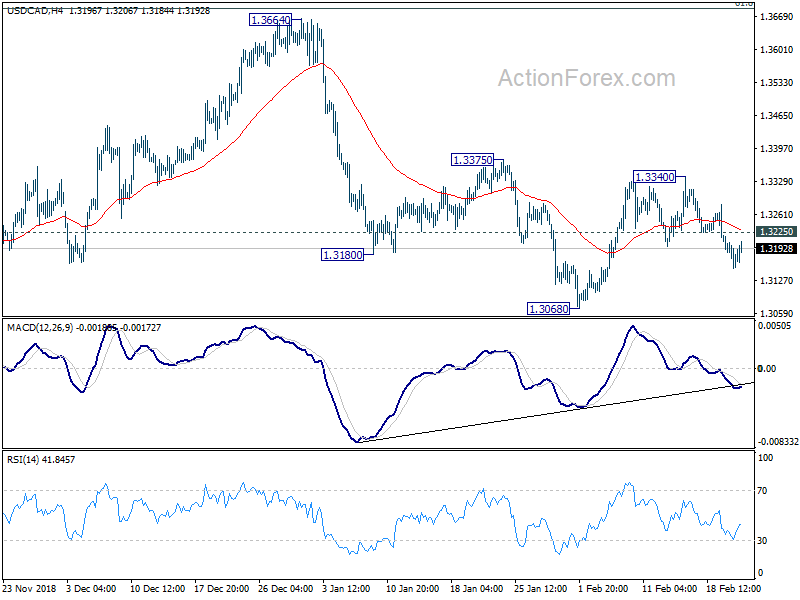
In the bigger picture, structure of the medium term rise from 1.2061 (2017 low) to 1.3664 is not clearly impulsive. Hence, we'd stay cautious on strong resistance from 61.8% retracement of 1.4689 (2016 high) to 1.2061 at 1.3685 and 1.3793 resistance to limit upside, and bring medium term topping. But in any case, medium term outlook will stay bullish as long as channel support (now at 1.3109) holds. Sustained break of 1.3793 will pave the way to retest 1.4689 (2015 high). Firm break of the channel support should confirm reversal target 1.2061 low again.
AUD/USD Daily Outlook
Daily Pivots: (S1) 0.7142; (P) 0.7162; (R1) 0.7184; More...
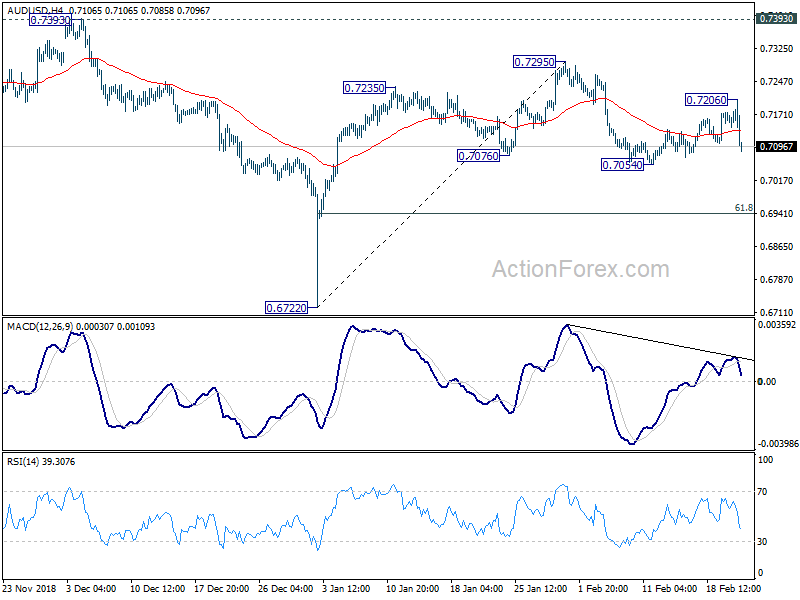
AUD/USD's sharp decline today suggests that recovery from 0.7054 has completed at 0.7206 already. Intraday bias is cautiously back on the downside for 0.7054 support first. Decisive break there will complete a head and shoulder term pattern (ls: 0.7235, h: 0.7295, rs: 0.7206). That should confirm completion of rebound from 0.6722. Further decline should be seen to 61.8% retracement of 0.6722 to 0.7295 at 0.6941 next. On the upside, though, break of 0.7206 will turn focus back to 0.7295 resistance instead.
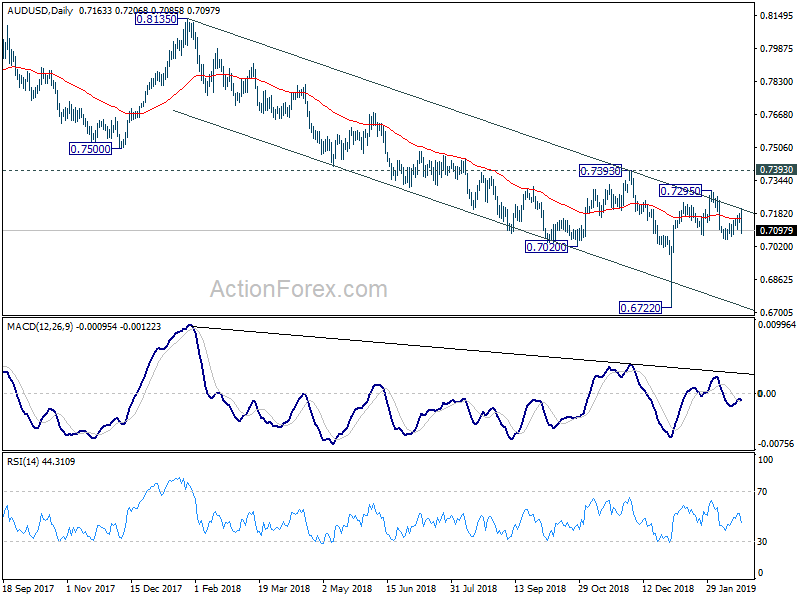
In the bigger picture, as long as 0.7393 resistance holds, we'd treat fall from 0.8135 as resuming long term down trend from 1.1079 (2011 high). Decisive break of 0.6826 (2016 low) will confirm this bearish view and resume the down trend to 0.6008 (2008 low). However, firm break of 0.7393 will argue that fall from 0.8135 has completed. And corrective pattern from 0.6826 has started the third leg, targeting 0.8135 again.
Australian Dollar Tumbles on RBA Cut Talks & Dalian Coal Import Ban
Australian Dollar was the center of focus in Asian session today. Stellar job data provided some brief boost to the Aussie. It was then hammered by talks of two RBA rate cuts this year. Selloff accelerates further on news that China's Dalian ports banned the countries' coal imports. In the background, US and China are working on six MOUs to cover core issues, which could be ready after the high level meetings in Washington which starts today. But the news is somewhat offset by FOMC minutes which suggested Fed could still hike once more this year.
Staying in the currency markets, Aussie is the weakest one for today so far, followed by Kiwi and then Canadian. Yen is the strongest one, followed by Dollar and then Swiss Franc. Over the week, Sterling is the strongest one for now followed by Canadian. New Zealand and Australian Dollars are the weakest.
Technically, AUD/USD is now looking back at 0.7054 support. Break should extend the fall from 0.7295 towards 0.6722 low. With today's rebound, EUR/AUD is also looking at 1.6060 resistance. Break will target 1.6765 high. Dollar's declines against Euro, Sterling, Canadian, Swiss are losing momentum as seen in 4H charts. We'll if the greenback could strike a recovery from here.
In Asia, Nikkei closed up 0.15%. Hong Kong HSI is up 0.21%. China Shanghai SSE is down -0.33%. Singapore Strait Times is down -0.01%. Japan 10-year JGB yield is down -0.0036 at -0.04. Overnight, DOW rose 0.24%. S&P 500 rose 0.18%. NASDAQ rose 0.03%. 10 year-yield rose 0.007 to 2.654. 10-year yield rose 0.009 to 3.000.
AUD lifted by job data, knocked down as Westpac forecasts two RBA cuts in 2019
Australian job market grew 39.1k in January, more than double of expectation of 15.2k. Full time jobs rose 65.4k to 8.M. Part-time jobs dropped -26.3k to 4.01M. Particular rate also rose 0.1% to 65.7% while unemployment rate was unchanged at 5.0%, a seven-year low. Also from Australian, CBA PMI manufacturing dropped to 53.1 in February, down from 53.9. CBA PMI services dropped into contraction region at 49.3, down from 51.0.
Australian Dollar was initially lifted by the employment data, but was then knocked down as Westpac forecasts RBA to cut interest rate in August and November. Westpac noted that "the forces around a slowing economy, falling house prices, and weak consumer spending are already apparent." But RBA might take time to recognize this "persistence".
The central bank's decision to "accept the possibility that interest rates could fall further, despite the current record low levels, is profoundly important." Westpac is now "confident" that if their growth profile does evolve, RBA will be "prepared to act".
China Dalian harbours ban Australian coal imports
Selloff in Aussie accelerates further on news that China's Dalian port has banned imports of the countries' coal. The ban came effective at the start of February already and it's indefinite. Under the control of Dalian customers, Dalian, Bayuquan, Panjin, Dandong and Beiliang harbour will not allow Australian coal to clear through customers.
That's part of the measures to cap overall coal imports through the above harbours to 12m tonnes this year. Coal imports from Russia and Indonesia will not be affected. It's also reported that clearing times for Australian coal at other ports are prolonged to at least 40 days.
US-China trade talks: Six MOUs on structural issues being drawn up
US-China trade negotiation is going to enter into high-level talks in Washington on Thursday. Reuters reported that the broad outline of the trade agreement is beginning to emerge after all the discussions.
The teams are now drawing up six memorandums of understanding on structural issues: forced technology transfer and cyber theft, intellectual property rights, services, currency, agriculture and non-tariff barriers to trade.
The work on the MOUs was seen by an unnamed source as a significant step in getting China agreeing on broad principles and specific commitments.
FOMC minutes keep a rate cut in 2019 alive
Minutes of the January 29/30 FOMC meeting were all in all in-line with the messages delivered by the statement and Chair Jerome Powell's press conference. FOMC members supported the change in forward guidance. That is, Fed would now "be patient as it determines what future adjustments to the target range for the federal funds rate may be appropriate."
Nevertheless, the minutes also noted that "some participants believed "if the economy evolved as they expected, they would view it as appropriate to raise the target range for the federal funds rate later this year." This view keeps the case for another hike in 2019 alive.
Regarding the balance sheet rolloff plan, "almost all participants thought that it would be desirable to announce before too long a plan to stop reducing the Federal Reserve's asset holdings later this year." And, options on "substantially slowing" the runoff were presented during the meeting.
More on FOMC minutes:
- FOMC Minutes – Balance Sheet Reduction Likely Ends This Year
- FOMC Minutes: Two Key Takeaways That Will Shape Monetary Policy Moving Forward
- FOMC Participants Debate Ending Balance Sheet Runoff in its Pivot to Patience
Fed Daly: Balance sheet rolloff and interest rate shouldn't work at cross purposes
San Francisco Fed President Mary Daly said the economy is slowing faster than she expected. And, tighter financial conditions, slower growth abroad, and rising uncertainty are also threatening to slow US growth. Though, she added that "there's nothing on the radar that says we're slipping into recession."
Daly also said interest rates are now within a "hair's breadth" of neutral. And she support a pause in rate hikes until there are signs of overheating. At the same time, she said Fed should align the balance sheet policy with the "patient" interest rate stance. "Those two are meant to work together and not at cross purposes," she said.
UK May and EU Juncker held constructive talks on Irish backstop
European Commission President Jean-Claude Juncker and UK Prime Minister Theresa May held "constructive" talks in Brussels yesterday. According to a joint statement, they discussed the guarantees that could be give to underline once again that the Irish backstop's "temporary nature". And the "role alternative arrangement" could play in "replacing the backstop" in future. Also, additions or changes to the Political Declaration could be made to "increase confidence in the focus and ambition of both sides in delivering the future partnership envisaged as soon as possible." EU Chief Negotiator Michel Barnier and UK Secretary of State Stephen Barclay will follow up and progress will be reviewed in the coming days.
May said after meeting with Juncker that "I have underlined the need for us to see legally binding changes to the backstop that ensure that it cannot be indefinite. That's what is required if a deal is to pass the House of Commons. We have agreed that work to find a solution will continue at pace. Time is of the essence and it is in both our interests that when the UK leaves the EU it does so in an orderly way. So, we have made progress."
Japan PMI manufacturing dropped to 48.5, chance of recession in 2019 rises
Japan PMI manufacturing PMI dropped to 48.5 in February, down from 50.3. That's the lowest level in 32 months and the first contraction reading since 2016. Markit noted that "deterioration in manufacturing sector reflects stronger falls in production and new orders." Also, "future output expectations turn negative for the first time since November 2012."
Joe Hayes, Economist at IHS Markit, said the data reflected "sharper reductions in demand and production" and "underlying business conditions are unfavourable.".And, "this was further highlighted by output expectations turning negative for the first time in over six years, which comes as no surprise given the international headwinds Japanese manufacturers are facing such as a China slowdown and the global trade cycle losing further steam.
He added that "unless service sector activity can offset manufacturing weakness, the chance of Japan entering a recession in 2019 looks set to rise."
Also from Japan, all industry activity index dropped -0.4% mom in December, below expecttion of -0.2% mom.
Looking ahead
ECB monetary policy meeting accounts will be a major focus today. Eurozone PMIs will also be watched for signs on further slowodwn. UK will relase public sector net borrowing.
Later in the day, US will release Philly Fed survey. jobless claims, durable goods orders, PMIs, leading indicator and existing home sales.
AUD/USD Daily Outlook
Daily Pivots: (S1) 0.7142; (P) 0.7162; (R1) 0.7184; More...
AUD/USD's sharp decline today suggests that recovery from 0.7054 has completed at 0.7206 already. Intraday bias is cautiously back on the downside for 0.7054 support first. Decisive break there will complete a head and shoulder term pattern (ls: 0.7235, h: 0.7295, rs: 0.7206). That should confirm completion of rebound from 0.6722. Further decline should be seen to 61.8% retracement of 0.6722 to 0.7295 at 0.6941 next. On the upside, though, break of 0.7206 will turn focus back to 0.7295 resistance instead.
In the bigger picture, as long as 0.7393 resistance holds, we'd treat fall from 0.8135 as resuming long term down trend from 1.1079 (2011 high). Decisive break of 0.6826 (2016 low) will confirm this bearish view and resume the down trend to 0.6008 (2008 low). However, firm break of 0.7393 will argue that fall from 0.8135 has completed. And corrective pattern from 0.6826 has started the third leg, targeting 0.8135 again.
Economic Indicators Update
| GMT | Ccy | Events | Actual | Forecast | Previous | Revised |
|---|---|---|---|---|---|---|
| 22:00 | AUD | CBA PMI Manufacturing Feb P | 53.1 | 53.9 | ||
| 22:00 | AUD | CBA PMI Services Feb P | 49.3 | 51 | ||
| 0:30 | JPY | PMI Manufacturing Feb P | 48.5 | 50.3 | ||
| 0:30 | AUD | Employment Change Jan | 39.1K | 15.2K | 21.6K | |
| 0:30 | AUD | Unemployment Rate Jan | 5.00% | 5.00% | 5.00% | |
| 4:30 | JPY | All Industry Activity Index M/M Dec | -0.40% | -0.20% | -0.30% | |
| 7:00 | EUR | German CPI M/M Jan F | -0.80% | -0.80% | -0.80% | |
| 7:00 | EUR | German CPI Y/Y Jan F | 1.40% | 1.40% | 1.40% | |
| 8:15 | EUR | France Manufacturing PMI Feb P | 51 | 51.2 | ||
| 8:15 | EUR | France Services PMI Feb P | 48.5 | 47.8 | ||
| 8:30 | EUR | Germany Manufacturing PMI Feb P | 49.9 | 49.7 | ||
| 8:30 | EUR | Germany Services PMI Feb P | 52.9 | 53 | ||
| 9:00 | EUR | Eurozone Manufacturing PMI Feb P | 50.3 | 50.5 | ||
| 9:00 | EUR | Eurozone Services PMI Feb P | 51.3 | 51.2 | ||
| 9:30 | GBP | Public Sector Net Borrowing Jan | -11.1B | 2.1B | ||
| 12:30 | EUR | ECB Monetary Policy Meeting Accounts | ||||
| 13:30 | CAD | Wholesale Trade Sales M/M Dec | -0.30% | -1.00% | ||
| 13:30 | USD | Philadelphia Fed Business Outlook Feb | 14.8 | 17 | ||
| 13:30 | USD | Initial Jobless Claims (FEB 16) | 230k | 239k | ||
| 13:30 | USD | Durable Goods Orders Dec P | 1.80% | 0.70% | ||
| 13:30 | USD | Durables Ex Transportation Dec P | 0.30% | -0.40% | ||
| 14:45 | USD | US Manufacturing PMI Feb P | 55 | 54.9 | ||
| 14:45 | USD | US Services PMI Feb P | 54.3 | 54.2 | ||
| 15:00 | USD | Leading Index Jan | 0.20% | -0.10% | ||
| 15:00 | USD | Existing Home Sales Jan | 5.01M | 4.99M | ||
| 15:30 | USD | Natural Gas Storage | -78B | |||
| 16:00 | USD | Crude Oil Inventories | 3.6M |
Is Pound Growth A Bluff?
Pound stronger
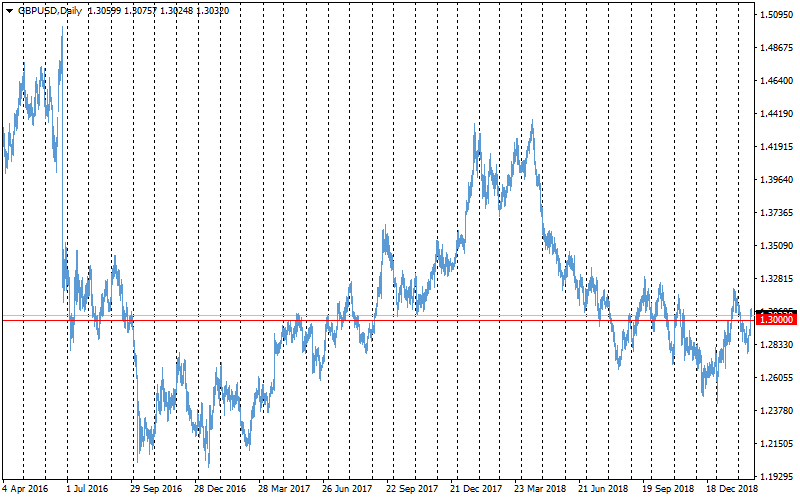
Yesterday the British pound crossed the threshold 1.30 after a sharp jump by more than 1.2%, continue its growth since Friday. The British pound growth is fuelled by hopes that May will be able to agree on the terms of a deal with the EU, which will be supported by the country’s parliamentarians. This helps the pound to overtake the market, including growth against the single currency.
It is also worth noting the general growth of demand for risky assets that prevails in the markets. On Wednesday morning, the positive dynamics has become a little more rest restrained, but still, the key global indices continue their growth.
For the British currency 1.30 looks like a key level, a kind of pessimism barometer around Brexit. Since last August, we have repeatedly seen how the arrow of this “barometer” moved from optimism to pessimism and vice versa. As the Brexit deadline is approaching (it is only 36 days left), we will probably continue to observe sharp jumps in both directions.
Exchange rate fluctuations and constant uncertainty clearly harm the economy, and its negative impact increasing as time passed. Under these conditions, pound growth is more looks like a bluff in poker.
Economy weaker
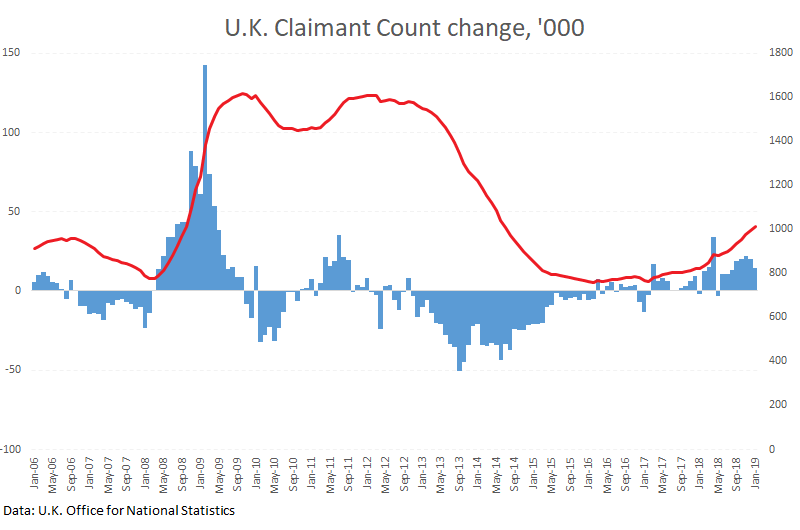
Last week, GDP data (a slowdown to 1.3% Y/Y), industrial production (-2.1% Y/Y in the manufacturing industries) and CPI collapse were unpleasant surprises. Yesterday’s report showed an increase of jobless claims for the eighth consecutive month, while housing prices, according to Rightmove, added only 0.2% over 12 months, well below the overall inflation rate at 1.8%.
Due to weak macroeconomy, it is difficult to count on the steady British currency growth. Moreover, national political news background is extremely volatile. 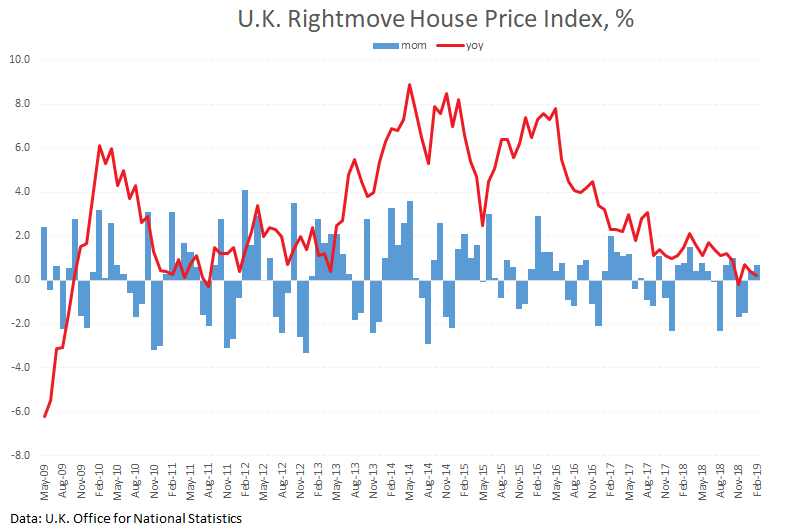
After all, the GBP decline may be a stimulus for the economy, as it has repeatedly happened before, and politics knew it. The devaluation of the national currency, with relatively healthy external demand, increases the competitiveness of British goods, becoming a growth driver for the economy, as it was after the Brexit referendum.
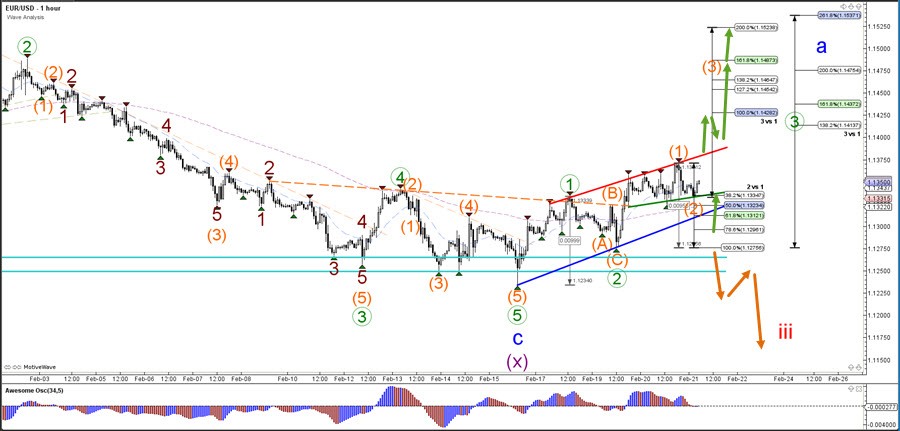
EUR/USD Break in Uptrend Channel Aims At 1.15
The EUR/USD made a bullish bounce / reversal at the 1.1250 round level support zone (blue horizontal lines) and has also broken above the local resistance trend line (dotted orange). This could indicate an ABC (blue) zigzag correction within wave B (purple) as long as price remains above the support levels. A bearish breakout could however indicate a downtrend.
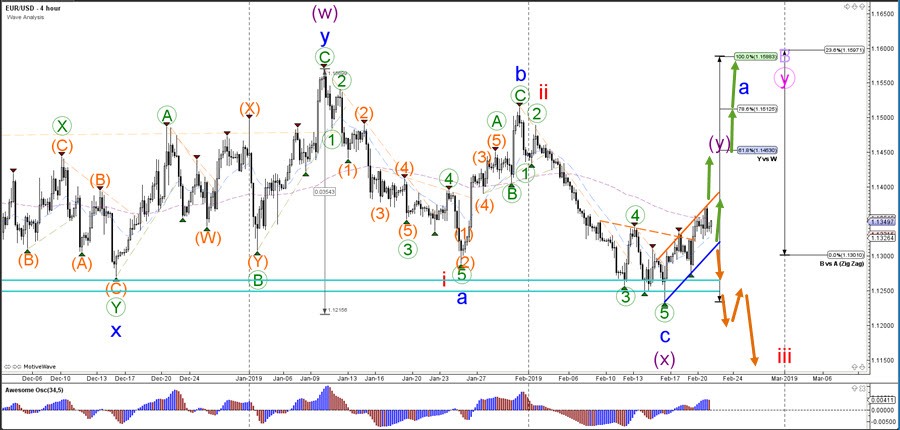
The EUR/USD seems to be completing a second wave 1-2 (orange) pattern after finishing a wave 1-2 (green) earlier. Eventually price will need to show an impulsive breakout in order to confirm a wave 3 (orange) pattern. A break above the resistance trend line (orange) could indicate a push higher towards the Fibonacci targets of wave 3 vs 1 such as 1.15, whereas the Fib levels of wave 2 vs 1 remain potential support.
Asian Equities Trade Mixed, US/China Due To Hold High Level Trade Talks On Thursday-Friday
General Trend:
- There has been speculation US/China are drafting trade-related MOUs, China IT index rises over 2%
- Global iron ore producers continue to warn they don't have ability to raise production in the wake of Vale being forced to cut its production on latest dam disaster
- Shanghai Composite fluctuates in early trading, IT shares gain while property index declines
- Lenovo rises over 11%, Q3 earnings above ests
- Marine Transportation, Brokerage and Machinery firms gain in Japan
- Banks in India rise after government approves recapitalization amounts
- Australian corporate earnings remain in focus, WesFarmers rises after earnings and declaration of special dividend
- Qantas rises after H1 earnings report, buyback announcement
- Australia online travel bookings firm Webjet rises over 28% post earnings
- Australia Jan employment change beats ests, unemployment rate in line
- Westpac now sees RBA cutting rates by 25bps in August and November of 2019 v rates on hold for both 2019 and 2020 prior
- Longer-dated JGB yields hit lowest level since 2016, Japan Feb Manufacturing PMI has first contraction since Aug 2016
- South Korea Feb prelim chip exports decline over 27%, exports to China -13.6% y/y
- Chinese yuan (CNY) gains ahead of trade talks
- On Friday (Feb 22nd), RBA Gov Lowe is expected to appear before the Australia House of Representatives' Standing Committee on Economics
Headlines/Economic Data
Japan
- Nikkei 225 opened -0.1%
- (JP) JAPAN FEB PRELIM PMI MANUFACTURING: 48.5 V 50.3 PRIOR (1st contraction reading since Aug 2016)
- (JP) Japan Dec All Industry Activity Index m/m: -0.4% v -0.2%e
- 6502.JP Toshiba Memory to receive ¥300B investment from Development Bank of Japan - Japan press
- (JP) Japan Investors Weekly Net Buying of Foreign Bonds: ¥193.7B v +¥992.4B prior; Foreign Buying of Japan Stocks: -¥52.9B v -¥102.0B prior
Korea
- Kospi opens -0.1%
- 042660.KR Shipbuilders union voted to strike to oppose Hyundai Heavy's proposed takeover -Korean Press
- (KR) South Korea Feb 1-20th Exports y/y: -11.7% v -1.4% prior; Imports y/y: -17.3% v +2.5% prior
- 000660.KR May invest KRW120T in Yongin chips cluster to build 4 chip fabricators in 2022 -Korean Press
- (KR) South Korea Q4 Real Household Disposable Income y/y: +0.3% v -1.3% prior (first increase in 10 quarters)
China/Hong Kong
- Hang Seng opens -0.2%; Shanghai Composite opens -0.1%
- (US) US and China drafting 6 MOUs related to key structural issues in trade dispute, MOUs said to cover intellectual property (IP), services, tech transfer, agriculture, currency and non-tariff barriers - financial press
- 992.HK Reports Q3 Net $233M v $200Me, Rev $14.0B v $12.9B y/y
- (CN) Reportedly China's benchmark interest rate cut not imminent despite stronger yuan and cooling inflation, benchmark rate cut remains 'last resort' for if growth slows 'sharply' - financial press
- (CN) China PBoC sets Yuan Reference Rate: 6.7220 v 6.7558 prior
- (CN) China PBoC Open Market Operation (OMO): Skips OMO v injected CNY20B 7-day reverse repos prior; Net CNY0B v CNY20B injection prior
- (CN) CHINA PBOC OFFERS CNY71.9B THROUGH PSL (PLEDGED SUPPLEMENTARY LENDING) OPERATION
- (CN) China Premier Li: Reiterates monetary policy will remain prudent; will not flood domestic economy with liquidity
- 489.HK Reports Jan total sales volumes 247.7K units v 298.1K y/y
Australia/New Zealand
- ASX 200 opened +0.1%
- (AU) AUSTRALIA JAN EMPLOYMENT CHANGE: +39.1K V 15.0KE; UNEMPLOYMENT RATE: 5.0% V 5.0%E
- QAN.AU Reports H1 (A$) Underlying pretax 780M v 959M y/y, Rev 9.2B v 8.7B y/y; Announces on-market stock buyback of up to A$305M
- (AU) Follow Up: China Dalian city customs bans Australian coal indefinitely -Local Press
- (NZ) New Zealand Fin Min Robertson: will take a measured response to tax working group report, unlikely all recommendations will need to be implemented
- STO.AU Reports FY18 Net $630M v -$360M y/y, Underlying profit $727M v $318M y/y, Rev $3.7B v $3.1B y/y
- WES.AU Reports H1 (A$) Net 1.1B v 0.9B y/y; EBIT 1.6B v 1.5B y/y; Rev 14.4B v 13.8B y/y; declares special dividend A$1.00/share
- ORG.AU Reports H1 (A$) Net 592M v 428M y/y; EBITDA 1.7B v 1.5B y/y; Rev 7.7B v 7.3B y/y
- (NZ) New Zealand sells NZ$200M v NZ$200M indicated in 2.75% April 2037 bonds, avg yield 2.6079% v 2.6998% prior, bid to cover 2.9x v 1.2x prior
- (AU) Westpac sees RBA cutting rates by 25bps in August and November of 2019 v rates on hold for both 2019 and 2020 prior
Other Asia
- (SG) Singapore Trade Ministry: Want to remain plugged in with US and China economies, want to remain neutral to both
North America
- (US) FOMC MINUTES FROM JAN 30TH MEETING: MEMBERS NOTED THAT FINANCIAL CONDITIONS HAD TIGHTENED SINCE SEPT AND GLOBAL GROWTH HAD MODERATED
- (US) Fed's Daly (dove, non-voter): See more headwinds including slower growth, nothing shows US is falling into a recession
- (US) Fed Vice Chair Clarida (moderate, voter): doesn't believe changes in Fed policy statements represents a U-Turn - CNN interview
- (US) US House Speaker Pelosi (D): House will pass resolution to block Trump's National Emergency order to build wall 'swiftly' (as expected)
- (US) Special Counsel Mueller report may be finalized next week - CNN
Europe
- (UK) PM May and EU's Juncker had a productive meeting; talks focused on potential guarantees around Irish backstop - joint statement
- (UK) Fitch places UK's 'AA' sovereign rating on Watch Negative
- (UK) UK Home Secretary Sajid: Risk of 'No deal' Brexit has risen
- (UK) Scotland Government Chief Economist: No-deal Brexit could see domestic GDP fall by up to 7%
- (UK) Un-named UK senior official said UK is considering a legally enforceable “codicil” to the Brexit deal that could give the UK a unilateral exit mechanism from the Irish backstop - press
Levels as of 12:45E
- Hang Seng +0.8%; Shanghai Composite +1.1%; Kospi +0.1%; Nikkei225 +0.3%; ASX 200 +0.7%
- Equity Futures: S&P500 +0.3%; Nasdaq100 +0.5%, Dax +0.4%; FTSE100 +0.3%
- EUR 1.1332-1.1354; JPY 110.59-110.88; AUD 0.7100-0.7207; NZD 0.6822-0.6877
- Commodity Futures: Gold -0.4% at $1,342/oz; Crude Oil +0.5% at $57.44/brl; Copper -0.2% at $2.91/lb
Fed Wants To Halt Balance Sheet Runoff
Market movers today
Euro area February flash PMIs are due out. In January, PMIs signalled that the euro area economy is edging closer to stagnation - (indicated by PMI level around 50) - with manufacturing PMI falling to a 50-month low at 50.5 while service PMI showed signs of stabilisation. Falling new orders and the ongoing political disputes still point to some downside risk for the manufacturing index, which we therefore expect to fall to 50.2 in February while we see scope for a rebound in services PMI to 51.4 in light of strengthening domestic demand.
Important ECB minutes from the January meeting are out 13:30 CET. We will look for the growth discussion and hints for potential outlook assessment (recall, they changed their assessment to downside risks in January). Further, any wordings for TLTRO will be scrutinized.
US Markit PMIs for February (preliminary) are due out today. We still expect Markit manufacturing PMI to stabilise around the current level of 54.9. While the US is not immune to the global slowdown, expansionary fiscal policy is pulling in the other direction.
US December capital goods data. New capital goods orders fell unexpectedly in November, which shows a slowdown in investments at the end of 2018. We expect investments to continue growing in 2019 but probably not at the same pace as in 2017 and 2018. Today also brings existing home sales numbers. The housing market has begun to show some weakness, likely to driven by higher mortgage rates.
We also have an interesting day ahead today in the Scandi countries, with particular focus on the oil investment survey in Norway (see page 2 for further details).
Selected market news
The FOMC minutes contained a lot of useful information. FOMC members agree to stay patient for now but disagree for how long. While "Many participants suggested that it was not yet clear" whether another Fed hike is "appropriate later this year", "several others" indicated it would be if the economy evolves as expected. So it seems like we are in for another doves versus hawks later this year, especially as "many" said the Fed could change the "patient" language if "uncertainty abated". We stick to our view the Fed may hike again in June based on our optimistic macro outlook but the probability declined after Fed put more weight on inflation in its reaction function.
The FOMC members also discussed the relevance of continuing the dot plot, which is another discussion to look out for in 2019. With respect to the balance sheet, "almost all" think the Fed "before too long" should announce a plan to end the runoff "later this year". We think an announcement on the balance sheet is more likely than not already in March (60% probability, otherwise in May) and the runoff will be completed in Q4. On Friday a lot of FOMC members will be discussing the balance sheet at a conference, which might give us more clues on the timing.
The EU27 and the UK government are likely moving closer to a compromise on the backstop , see Bloomberg . Even if this is the case, it is definitely not a given that it would pass the House of Commons if put forward for a vote on Wednesday 26 February. Many Brexiteers will vote down any deal (they do not mind a "no deal" Brexit) and so far May has not been able to persuade enough Labour and pro-EU Conservative MPs to vote in favour. This is also the reason why the EU leaders have hinted it will no longer approve anything until it has been approved in the House of Commons. However, as the pressure is building, it may change. Right now it seems more likely, though, that the House of Commons will force Theresa May to ask for an extension of the Article 50 deadline next week, or it has to go down to the wire in March.
Into European session: AUD overwhelmingly weakest. USD, JPY, CHF firmer
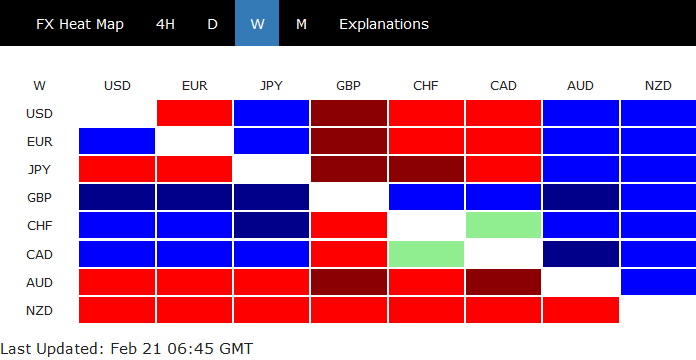
Entering into European session, Australian Dollar is overwhelmingly the weakest one today. Stronger than expected jobless data just gave Aussie a brief lift. It then reversed after Westpac forecasts two RBA cuts this year. The Aussie then tumble further on news that China's Dalian ports banned the countries' coal imports. New Zealand Dollar follows as second weakest, then Canadian.
On other hand, Yen is trading as the strongest one today as risk sentiments stay mixed, followed by Dollar and then Swiss Franc. Strength of the triple suggests that markets might be turning more cautious. There are news that US and China are hammering out multiple MOUs to address the core issues including forced technology transfer and cyber theft, intellectual property rights, services, currency, agriculture and non-tariff barriers to trade. But that seem to be ignored by stock bulls. Dollar is additionally supported as FOMC minutes suggested that Fed is possibly still on track for one more hike by the end of the year. Looking ahead, Eurozone PMIs and ECB accounts will take center stage in European session.
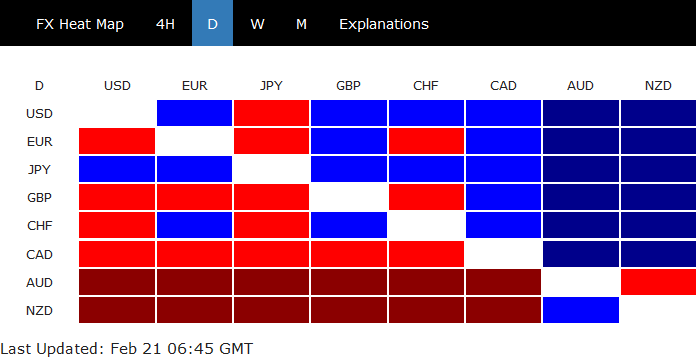
Over the week, Sterling is the strongest one for now. Step by step, the issue on Irish backstop seems to be closer to a resolution with some legal binding language outside of the main withdrawal agreement. Swiss Franc and Canadian are the next strongest. New Zealand and Australian Dollars are now the weakest one, followed by Yen.
In Asia,
- Nikkei closed up 0.15%.
- Hong Kong HSI is up 0.08%.
- China Shanghai SSE is down -0.29%.
- Singapore Strait Times is down -0.11%.
- Japan 10-year JGB yield is down -0.0036 at -0.04.
Overnight,
- DOW rose 0.24%.
- S&P 500 rose 0.18%.
- NASDAQ rose 0.03%.
- 10-yearyield rose 0.007 to 2.654.
- 10-year yield rose 0.009 to 3.000.