Sample Category Title
Euro-Zone’s Consumer Confidence Index Rose More-Than-Estimated In February
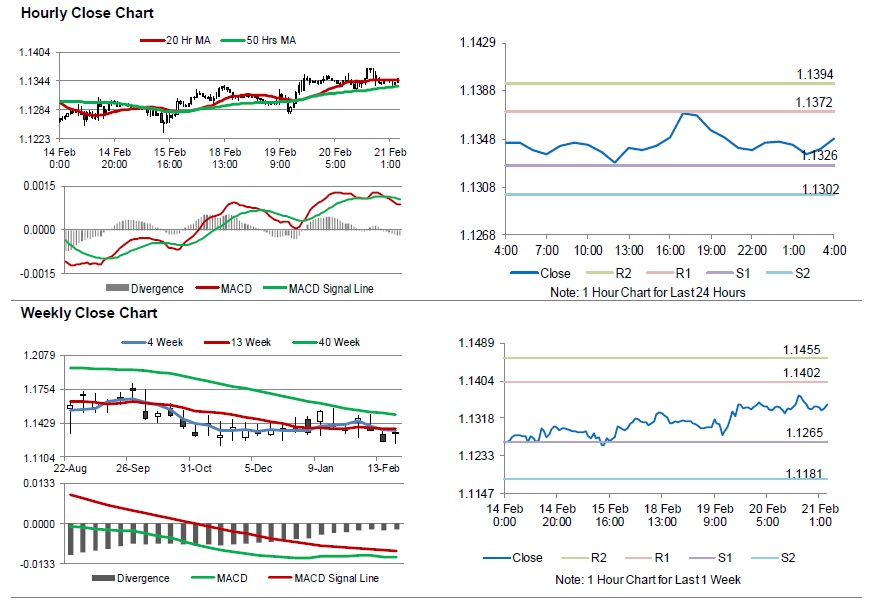
For the 24 hours to 23:00 GMT, the EUR rose 0.05% against the USD and closed at 1.1345.
On the data front, the Euro-zone's flash consumer confidence index advanced to a level of -7.4 in February, more than market consensus for a gain to a level of -7.7. The index had registered a reading of -7.9 in the previous month.
Separately, in Germany, the producer price inflation (PPI) slowed to an eight-month low level of 2.6% on an annual basis in January, compared to a level of 2.7% in the previous month.
In the US, data showed that the US mortgage applications rebounded 3.6% on a weekly basis in the week ended 15 February 2019, rising for the first time in five weeks and following a revised drop of 6.9% in the previous week.
The FOMC meeting minutes revealed why the Federal Reserve (Fed) decided to remain patient with monetary policy and how they would deal with its balance sheet. The minutes also showed extensive discussion of market conditions. Further, the officials expressed uncertainty over whether they would raise interest rates again in 2019. Meanwhile, members stated that holding the federal funds rate in a target range of 2.25% to 2.5% would pose few risks at this point.
In the Asian session, at GMT0400, the pair is trading at 1.1349, with the EUR trading a tad higher against the USD from yesterday's close.
The pair is expected to find support at 1.1326, and a fall through could take it to the next support level of 1.1302. The pair is expected to find its first resistance at 1.1372, and a rise through could take it to the next resistance level of 1.1394.
Moving ahead, traders would closely monitor the Markit manufacturing and services PMI's, set to release across the euro bloc in a few hours. Additionally, Germany's consumer price index for February, will pique significant amount of investors' attention. Later in the day, the US Markit services and manufacturing PMI's and the Philadelphia Fed business outlook, both for February, along with durable goods orders for December and existing home sales for January will keep investors on their toes.
The currency pair is showing convergence with its 20 Hr moving average and trading above its 50 Hr moving average.
British Pound Trading A Tad Higher In The Asian Session
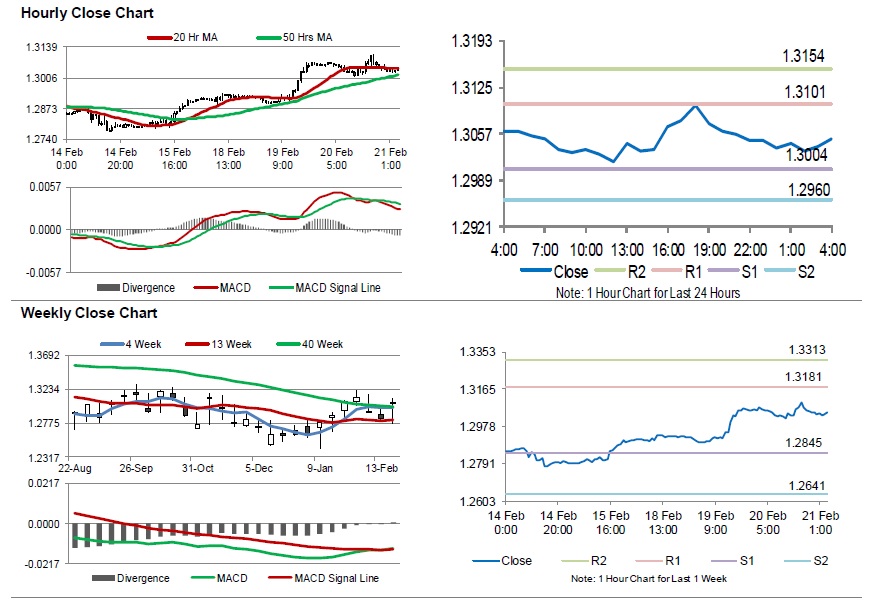
For the 24 hours to 23:00 GMT, the GBP declined 0.11% against the USD and closed at 1.3047, after three prominent lawmakers resigned from Prime Minister Theresa May’s ruling Conservative party over Brexit.
On the macro front, the balance of firms reporting total order book above normal unexpectedly rose to 6.0 in February. The balance of firms reporting total order book above normal had recorded a reading of -1.0 in the prior month.
In the Asian session, at GMT0400, the pair is trading at 1.3049, with the GBP trading marginally higher against the USD from yesterday’s close.
The pair is expected to find support at 1.3004, and a fall through could take it to the next support level of 1.2960. The pair is expected to find its first resistance at 1.3101, and a rise through could take it to the next resistance level of 1.3154.
Trading trend in the Sterling today, is expected to be determined by UK’s public sector net borrowing for January, set to release in a few hours.
The currency pair is showing convergence with its 20 Hr moving average and trading above its 50 Hr moving average.
AUD selloff accelerates as China Dalian harbours ban Australian coal imports
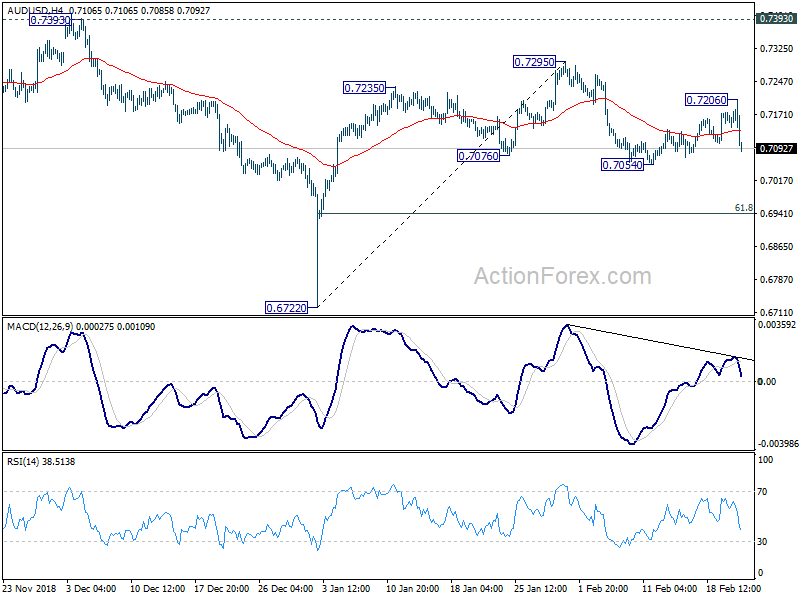
Selloff in Australian Dollar accelerates on news that China's Dalian port has banned imports of the countries' coal. The ban came effective at the start of February already and it's indefinite. Under the control of Dalian customers, Dalian, Bayuquan, Panjin, Dandong and Beiliang harbour will not allow Australian coal to clear through customers.
That's part of the measures to cap overall coal imports through the above harbours to 12m tonnes this year. Coal imports from Russia and Indonesia will not be affected. It's also reported that clearing times for Australian coal at other ports are prolonged to at least 40 days.
AUD/USD was initially lifted by stronger than expected employment data earlier today. But it started to reverse after Westpac forecasts RBA to cut interest rates twice this year in August and November. Selloff then accelerates further on the above news.
Japan’s Nikkei Manufacturing PMI Contracted For The First Time Since August 2016 In February
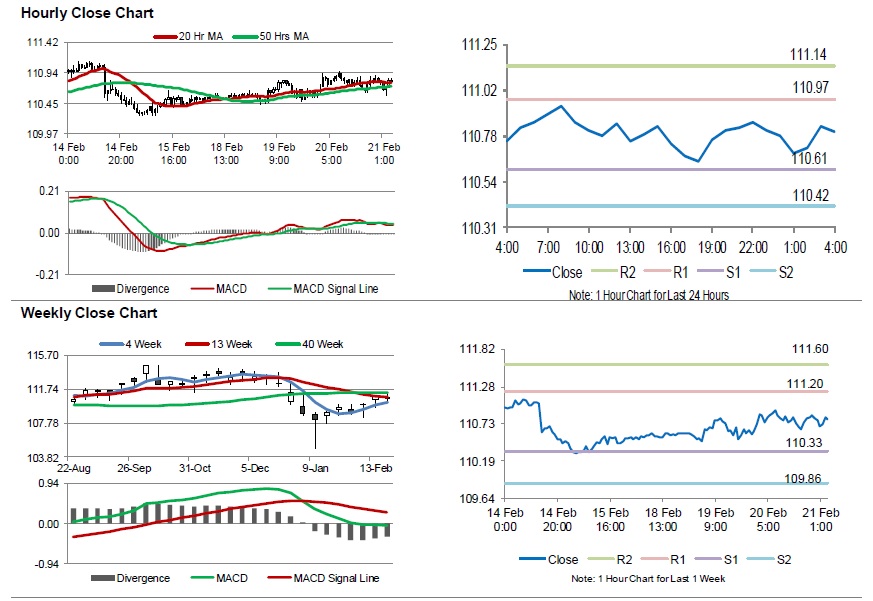
For the 24 hours to 23:00 GMT, the USD rose 0.21% against the JPY and closed at 110.81.
In the Asian session, at GMT0400, the pair is trading at 110.80, with the USD trading slightly lower against the JPY from yesterday's close.
Overnight data indicated that Japan's Nikkei manufacturing PMI declined to a level of 48.5 in February, contracting for the first time since August 2016 and following a reading of 50.3 in the prior month.
The pair is expected to find support at 110.61, and a fall through could take it to the next support level of 110.42. The pair is expected to find its first resistance at 110.97, and a rise through could take it to the next resistance level of 111.14.
Looking ahead, traders would await Japan's machine tool orders for January, slated to release in a while.
The currency pair is showing convergence with its 20 Hr moving average and trading above its 50 Hr moving average.
Swiss Franc Trading Slightly Higher In The Morning Session
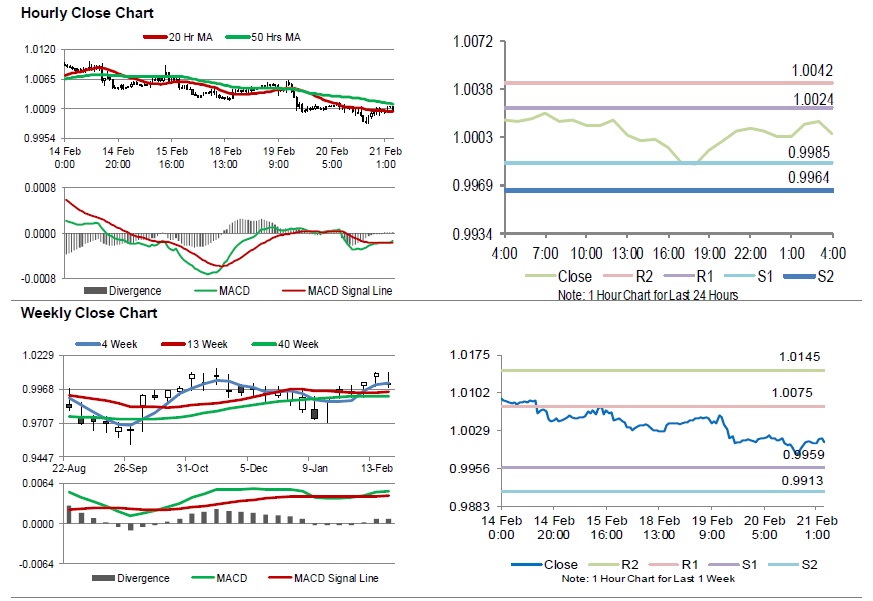
For the 24 hours to 23:00 GMT, the USD declined 0.06% against the CHF and closed at 1.0007.
In the Asian session, at GMT0400, the pair is trading at 1.0006, with the USD trading marginally lower against the CHF from yesterday’s close.
The pair is expected to find support at 0.9985, and a fall through could take it to the next support level of 0.9964. The pair is expected to find its first resistance at 1.0024, and a rise through could take it to the next resistance level of 1.0042.
Going forward, investors would keep an eye on Switzerland’s M3 money supply for January, scheduled to release in a few hours.
The currency pair is showing convergence with its 20 Hr moving average and trading below its 50 Hr moving average.
Loonie Extends Its Gains In The Asian Session
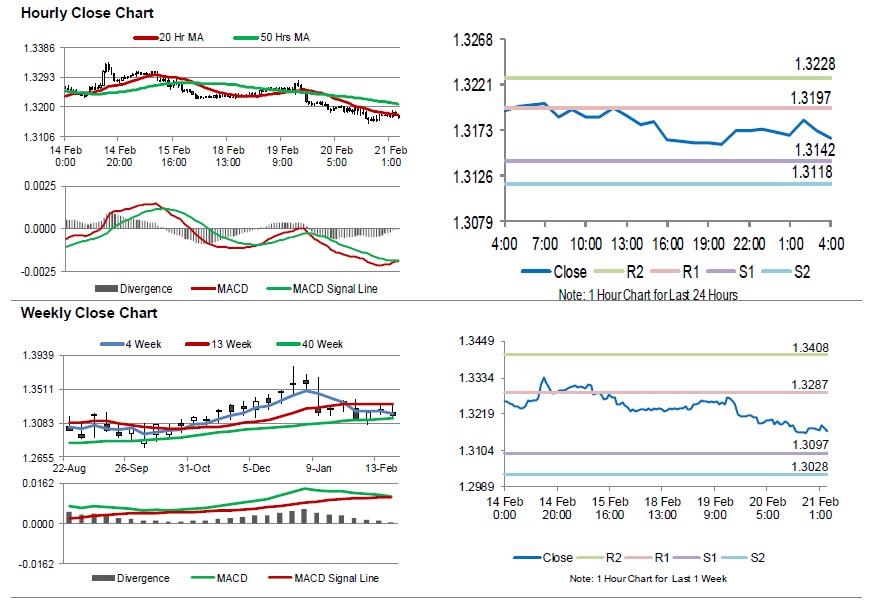
For the 24 hours to 23:00 GMT, the USD declined 0.30% against the CAD and closed at 1.3175.
In the Asian session, at GMT0400, the pair is trading at 1.3165, with the USD trading 0.08% lower against the CAD from yesterday’s close.
The pair is expected to find support at 1.3142, and a fall through could take it to the next support level of 1.3118. The pair is expected to find its first resistance at 1.3197, and a rise through could take it to the next resistance level of 1.3228.
Moving forward, traders would await the Bank of Canada’s Governor, Stephen Poloz’s speech, due later in the day.
The currency pair is showing convergence with its 20 Hr moving average and trading below its 50 Hr moving average.
Australia’s CBA Services PMI Fell In February
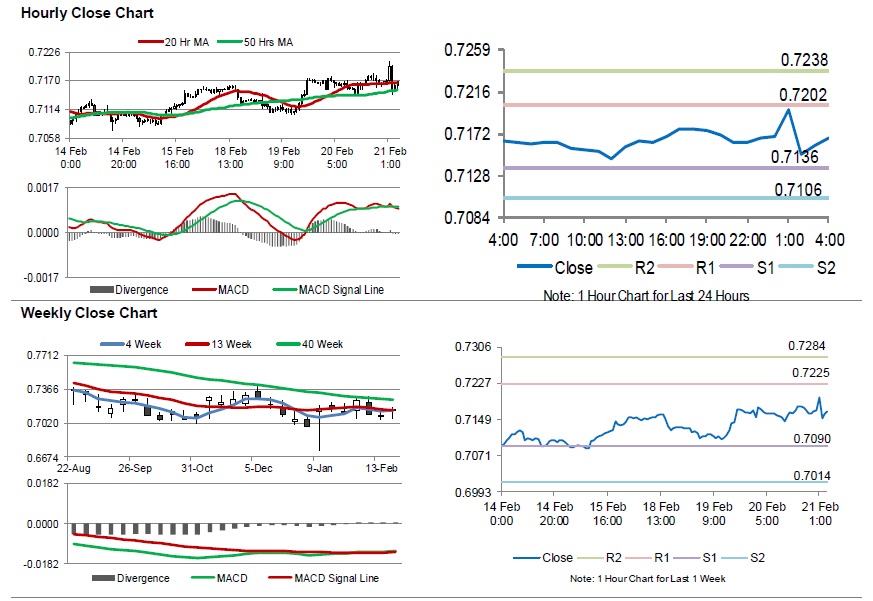
For the 24 hours to 23:00 GMT, the AUD rose 0.06% against the USD and closed at 0.7167.
LME Copper prices rose 1.7% or $105.0/MT to $6351.5/MT. Aluminium prices declined 0.2% or $4.0/MT to $1829.5/MT.
In the Asian session, at GMT0400, the pair is trading at 0.7167, with the AUD trading flat against the USD from yesterday's close.
Overnight data showed that Australia's seasonally adjusted unemployment rate remained unchanged at a rate of 5.0% in January, meeting market expectations. Meanwhile, the nation's flash CBA manufacturing PMI dropped to a level of 53.1 in February, following a reading of 53.9 in the preceding month. Additionally, the services PMI dropped to a level of 49.3 in February, compared to a reading of 51.0 in the prior month.
The pair is expected to find support at 0.7136, and a fall through could take it to the next support level of 0.7106. The pair is expected to find its first resistance at 0.7202, and a rise through could take it to the next resistance level of 0.7238.
In absence of key economic releases in Australia today, investor sentiment would be determined by global macroeconomic events.
The currency pair is showing convergence with its 20 Hr moving average and trading above its 50 Hr moving average.
Gold: Yellow Metal Reverses Its Losses In The Asian Session
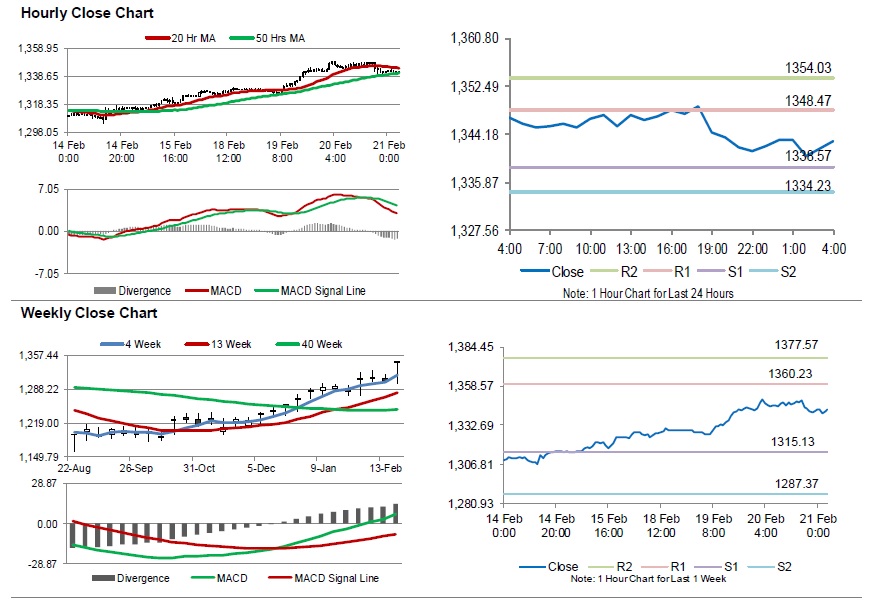
For the 24 hours to 23:00 GMT, Gold declined 0.13% against the USD and closed at USD1341.20 per ounce.
In the Asian session, at GMT0400, the pair is trading at 1342.90, with gold trading 0.13% higher against the USD from yesterday’s close.
The pair is expected to find support at 1338.57, and a fall through could take it to the next support level of 1334.23. The pair is expected to find its first resistance at 1348.47, and a rise through could take it to the next resistance level of 1354.03.
The yellow metal is trading below its 20 Hr moving average and showing convergence with its 50 Hr moving average.
Silver: White Metal Trading On A Weaker Footing In The Morning Session
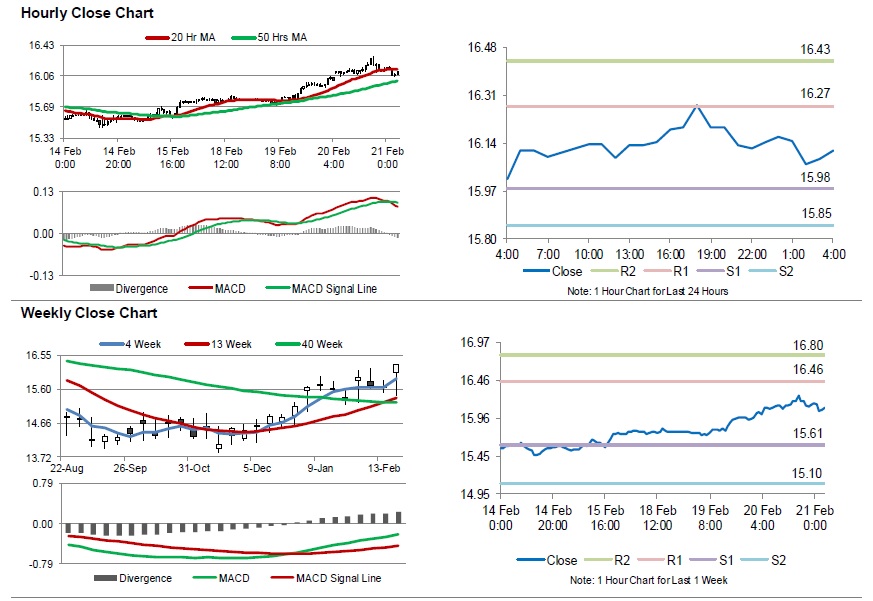
For the 24 hours to 23:00 GMT, Silver rose 1.22% against the USD and closed at USD16.14 per ounce.
In the Asian session, at GMT0400, the pair is trading at 16.11, with silver trading 0.19% lower against the USD from yesterday’s close.
The pair is expected to find support at 15.98, and a fall through could take it to the next support level of 15.85. The pair is expected to find its first resistance at 16.27, and a rise through could take it to the next resistance level of 16.43.
The white metal is trading between its 20 Hr and 50 Hr moving average.
Crude Oil: Oil Trading Higher, Ahead Of EIA’s Weekly Crude Oil Inventories Data
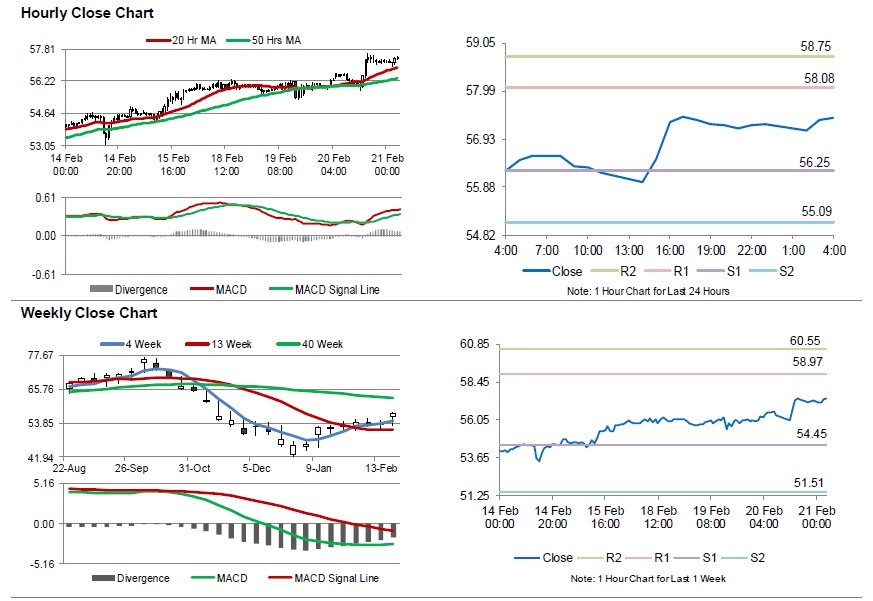
For the 24 hours to 23:00 GMT, Crude Oil rose 2.36% against the USD and closed at USD57.26 per barrel, amid signs of tighter global supplies. Meanwhile, the American Petroleum Institute (API) reported that US crude oil inventories rose 1.26 million barrels to 450.3 million in the week ended 15 February.
In the Asian session, at GMT0400, the pair is trading at 57.40, with oil trading 0.24% higher against the USD from yesterday's close.
The pair is expected to find support at 56.25, and a fall through could take it to the next support level of 55.09. The pair is expected to find its first resistance at 58.08, and a rise through could take it to the next resistance level of 58.75.
Crude oil is trading above its 20 Hr and 50 Hr moving averages.