Sample Category Title
US Durable Goods and Manufacturing Gauges Unlikely to Faze Dollar
Thursday will be a busy day for US data with a slew of releases on the agenda. The delayed durable goods orders report for December, due at 13:30 GMT, could be overlooked in favour of the more up-to-date manufacturing activity indicators for February. The Philly Fed manufacturing index will be posted at 13:30 GMT, followed by the IHS Markit manufacturing PMI at 14:45 GMT. Existing home sale for January will also be watched at 15:00 GMT. The US dollar could swing from the data, especially if there’s any surprises in the manufacturing surveys or home sales, however, with more important numbers coming up next week, the moves are likely to be contained.
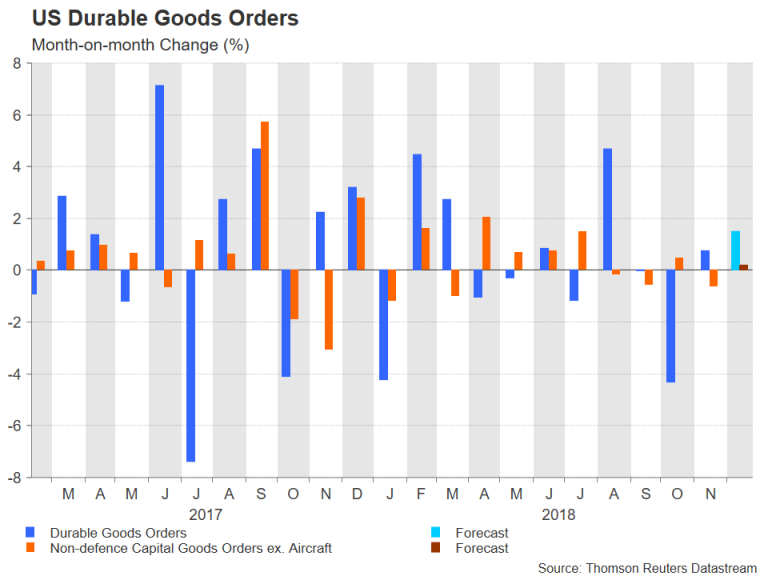
Durable goods orders are forecast to have increased for the second month in a row in December, rising by 1.5% month-on-month after a 0.7% bounce in November. Core capital goods orders, which exclude defence and aircraft orders, are anticipated to have risen by 0.2% m/m, recovering partially from a 0.6% drop in the prior month. A strong reading in the core number, which is used in GDP calculations, would point to a positive end to the fourth quarter. US growth figures for Q4 have yet to be released and are not scheduled until February 28 as they were pushed back due to the government shutdown lasting for most of January.
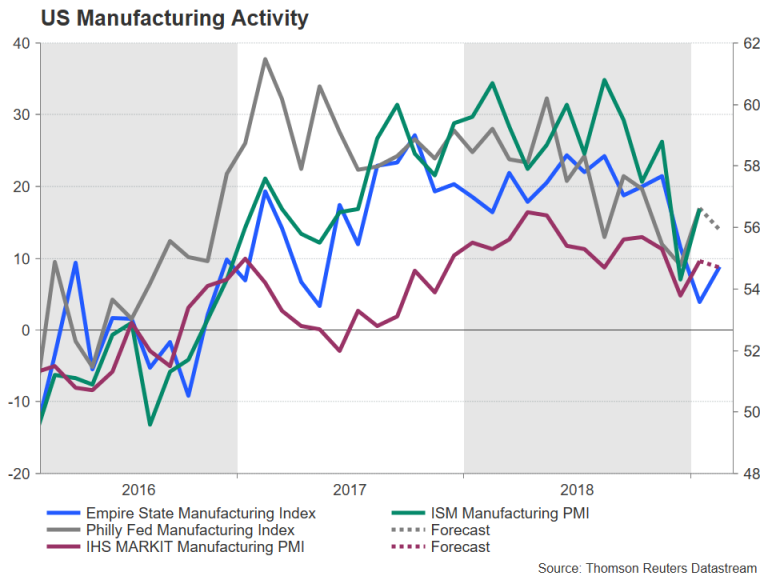
Like in much of the rest of the world, manufacturing activity in the US deteriorated significantly in the final months of 2018, but there was relief when the US indices bounced back in January. That trend might not continue in February as both the Philly Fed manufacturing index and the IHS Markit manufacturing PMI are forecast to have moderated slightly, declining to 14 (from 17) and to 54.7 (from 54.9), respectively. Worse-than-expected figures could revive fears of a sharp slowdown amid a global downturn and ongoing trade uncertainty.
Lastly, existing home sales for January might attract some attention as investors will be looking for a small rebound of 0.8% m/m following a 6.4% plunge in December. The US housing sector has been the most hit by rising Fed interest rates. However, there have been some signs lately that the slowdown in the housing market may have started to ease so a disappointing reading in existing home sales could cast doubt about a possible recovery.
If the data is broadly on the strong side, the dollar could receive a nudge up against the Japanese yen. Dollar/yen could re-challenge the immediate resistance at the 111.10 level, which it failed to break earlier this month. A successful climb above this mark could help the pair clear the next hurdle at the 78.6% Fibonacci retracement of the downleg from 113.7 to 104.96, at 111.83.
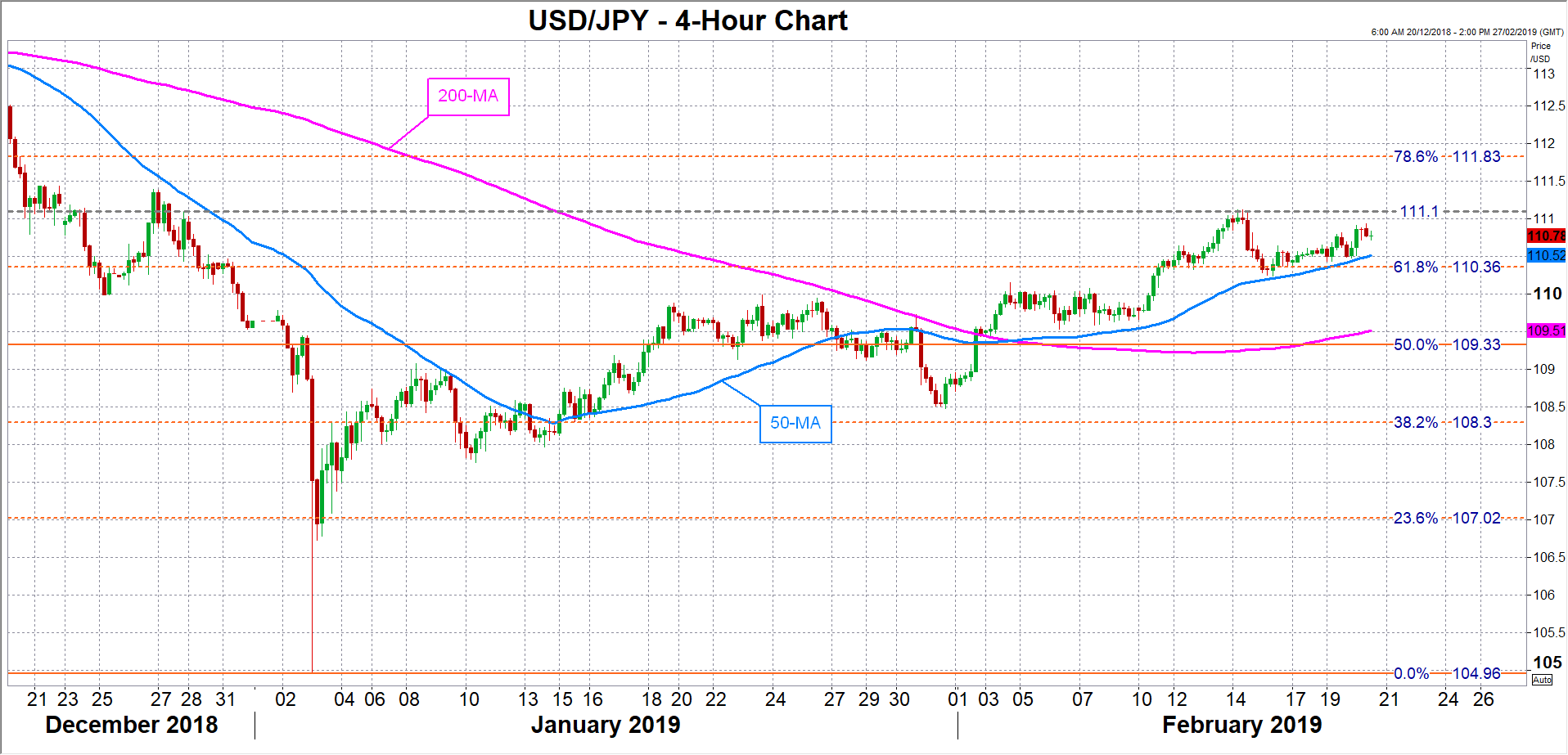
If though, Thursday’s numbers point to some weakness in the US economy, dollar/yen could find it difficult to hold above the 50-period moving average (MA) in the 4-hour chart, which has been acting as support over the past week. Not too far below the 50-period MA (currently around 110.50 is the 61.8% Fibonacci, at 110.36. If this support also fails, the pair could stumble towards the 50% Fibonacci at 109.33.
Japanese Core Inflation to Inch Up But BoJ Asks for More
Inflation pressures in Japan decelerated in the last quarter of 2018, forcing the central bank to lower its inflation expectations for 2019. In January, the core Consumer Price Index (CPI) is anticipated to show a mild rise, but with global risks threatening to boost the safe-haven yen in coming months, questions are now arising about whether the measure could continue to recover in coming months.
On Thursday at 2330 GMT, the core CPI for the month of January is forecast to tick up by 0.1 percentage points to 0.8% y/y, undershooting once again the Bank of Japan’s 2.0% inflation goal. Although the BoJ governor, Haruhiko Kuroda, kept the foot on the easing pedal for more than five years now, the price growth is still more than halfway lower from the target, holding the Bank well behind its US and EU counterparts in unwinding crisis-era policies.
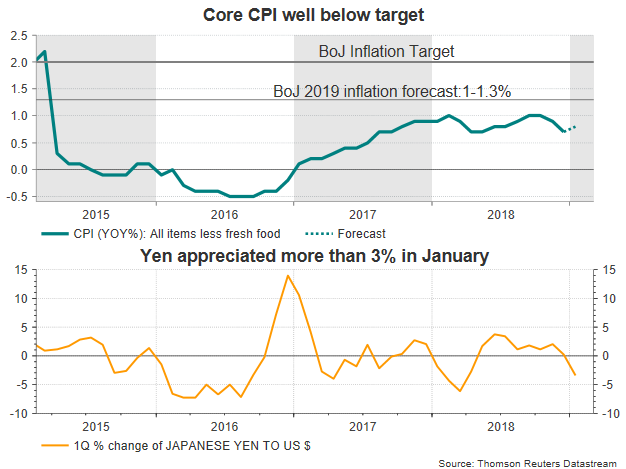
A simmering trade war between the US and China, the still-unresolved Brexit and political uncertainties in the Eurozone are considered as threats that could cause another global economic slowdown in the near future. The BoJ however, has a very narrow window to provide additional economic support in case conditions inside and outside the country deteriorate as interest rates are already in negative territory and money liquidity is abundant given the central bank’s large-scale asset purchases. On top of this, a bulk of funds is anticipated to shift towards safer investments such as the Japanese yen, which tends to gain when risk aversion increases. Consequently, a currency appreciation would make Japanese products more expensive to overseas buyers and imports cheaper to domestic consumers, putting pressure on firms to keep prices low and therefore inflation down in order to remain competitive. Note that Japan’s trade deficit topped 4 ½ -year highs in January as businesses saw demand from the slowing-China tumbling by 8.4%. While the Lunar New Year holiday could be partly responsible for the plunge, exports have also fallen significantly in other regions, evidence that broader economic weakness has probably started to bite in trade-dependent Japan.
With other central banks adopting a more accommodative stance in the face of upcoming economic headwinds, the BoJ is in a big dilemma about its future strategy. On Tuesday and in response to an opposition lawmaker, Kuroda said that lower interest rates and more asset buying could be potential stimulus tools to trim the yen’s appreciation. Yet with criticism rising over BoJ’s inability to drive inflation to the target and financial institutions complaining that low interest rates are squeezing their profits, Kuroda may not use these tactics unless the cost of such a step is worthy to mitigate sharper negative shocks.
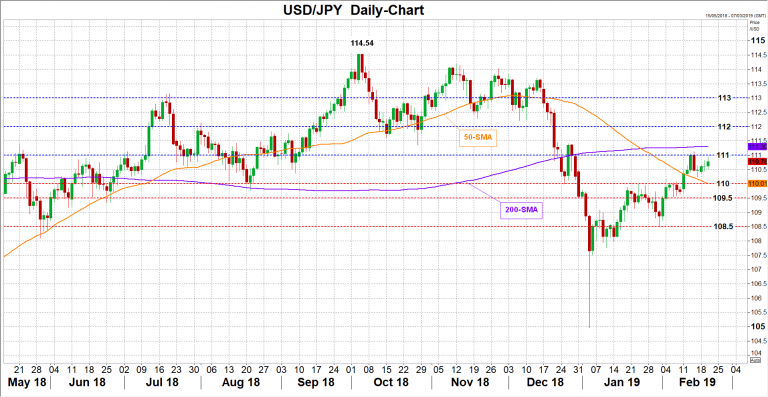
In market reaction, a weaker-than-expected CPI would increase the odds for a more cautious BoJ policy meeting on March 14, helping USDJPY to reach the 111 level and even break above the 200-day moving average currently at 111.30. If the market manages to pierce the 112 mark too, the next pause could be within the 112-113 area.
On the other hand, a CPI below 1.0% may not excite traders. Nevertheless, in the absence of any other important news, the yen could attract some buying, sending USDJPY probably down to 110, where the 50-day MA is currently standing. Moving lower, another challenge may appear between 109.50 and 108.50.
Eurozone PMIs and ECB Minutes Next on the Euro’s Radar
It will be a pivotal week for the euro, as preliminary euro area PMI surveys will hit the markets on Thursday, at 0900 GMT, and will be followed by the minutes of the ECB’s January meeting at 1230 GMT. The PMIs are expected to have stabilized somewhat, which could allay some concerns around the euro area’s growth prospects and perhaps help the single currency recover a little, with relative interest rate differentials also providing support for euro/dollar.
It’s been a tough few months for the Eurozone. Economic data have disappointed time and again, with much of the weakness seen in otherwise “powerhouse” economies like Germany, while the third largest economy in the euro area – Italy – is now in a technical recession. Not only is growth lackluster, but underlying inflation remains subdued, a combination that allows little scope for the European Central Bank (ECB) to actually execute on the rate hikes it previously penciled in. The political environment isn’t any better, with Brexit uncertainties casting a long shadow, Spain headed for early elections, and the looming risk that the US could slap tariffs on European cars.
Bearing all this in mind, investors will scrutinize the upcoming data for clues on whether the situation continues to deteriorate, or is starting to stabilize. Given their forward-looking nature, the PMIs are considered a good gauge of future growth, and true to form, both the manufacturing and services indices have declined sharply lately.
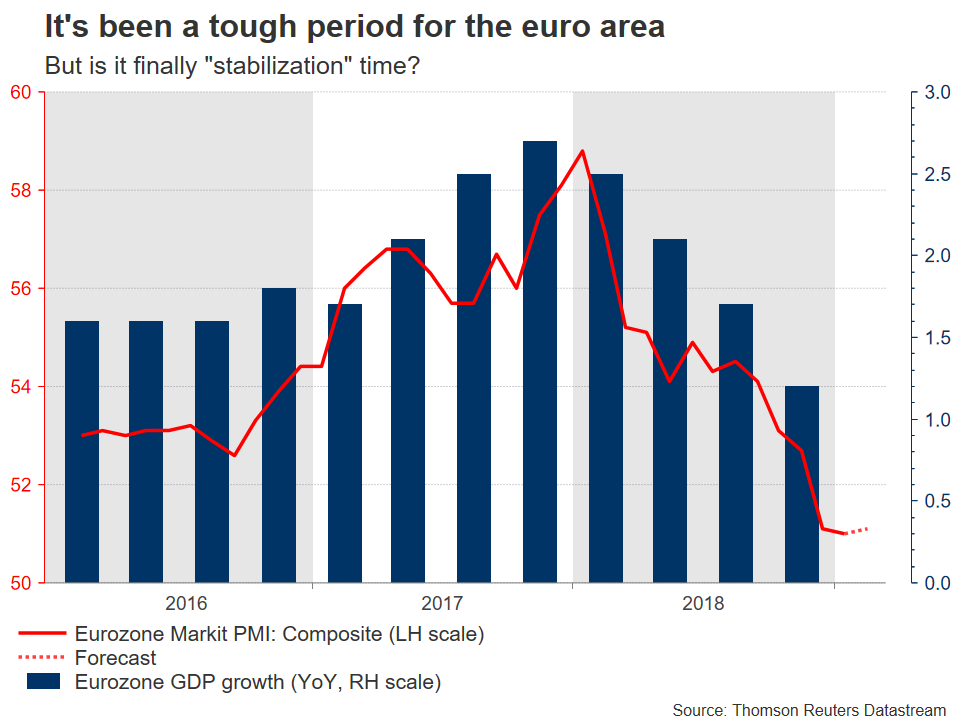
On the bright side, forecasts suggest some stabilization in February. Even though the manufacturing index is expected to dip to 50.3, from 50.5 in January, the services print that accounts for a greater portion of the economy is anticipated to tick up to 51.4, from 51.2 previously. As a result, the composite PMI that blends the two is forecast to inch higher to 51.1, from 51.0. If the actual figures meet expectations, that would be a signal that the worst may be over, which could help the euro recover somewhat. The prints from France and Germany will hit the markets earlier, at 08:00 and 08:30 GMT respectively; any market reaction could begin with them.
A few hours later, the minutes of the latest ECB meeting will be released. President Draghi didn’t reveal much back in January, with his message being that the slowdown is worrisome, but not enough to derail the Bank’s tightening plans. While the minutes are unlikely to reveal much more on this, the conversation around a new round of long-term loans to commercial banks, the so-called TLTROs, may attract attention.
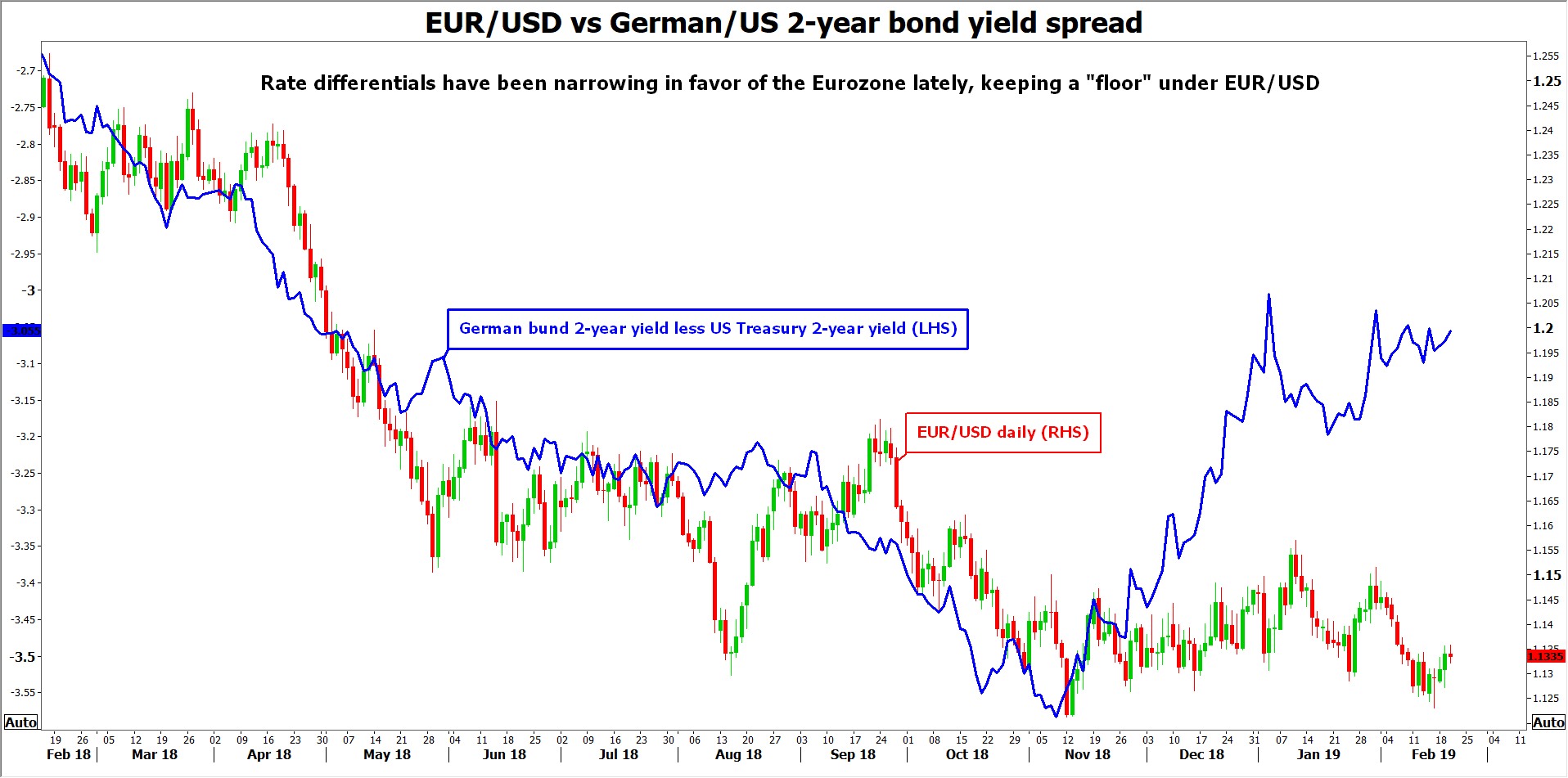
Looking at the bigger picture, the bloc’s economic weakness has dragged euro/dollar much lower in recent months. Yet, rate differentials between Europe and the US have been narrowing in favor of the Eurozone since November, as investors priced out expectations for hikes by the Fed. This implies that relative interest rates are now providing support for the pair, and by extent, that the bears may have a difficult time piercing below the November lows at 1.1213. For such a break, sellers may require a major catalyst, like the US announcing tariffs on European autos – which seems unlikely for now. Having said that, until there’s a material improvement in the Eurozone’s data pulse, any major rebound in euro/dollar looks unlikely either.
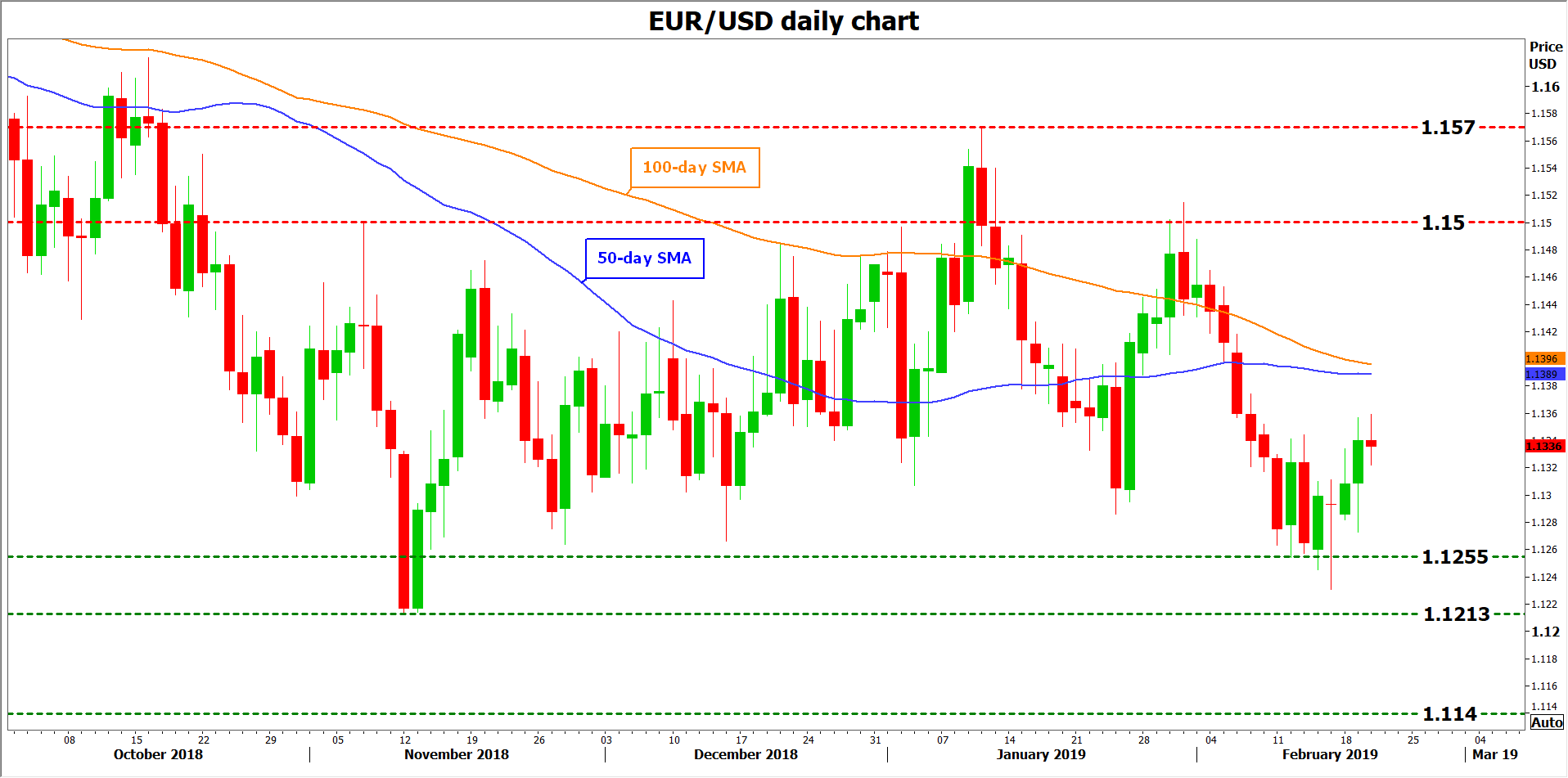
Technically, another wave of declines in euro/dollar could encounter immediate support near 1.1255, the area that halted the pullback in mid-February, with a downside break opening the way for the November lows at 1.1213.
On the other hand, a recovery may stall near the 1.1400 handle, where the 50- and 100-day simple moving averages (SMAs) are roughly located. A bullish violation could see buyers challenge the psychological 1.1500 mark.
WTI OIL Outlook: Bulls Take a Breather after Triple Upside Rejection; Crude Inventories in Focus for Fresh Signals
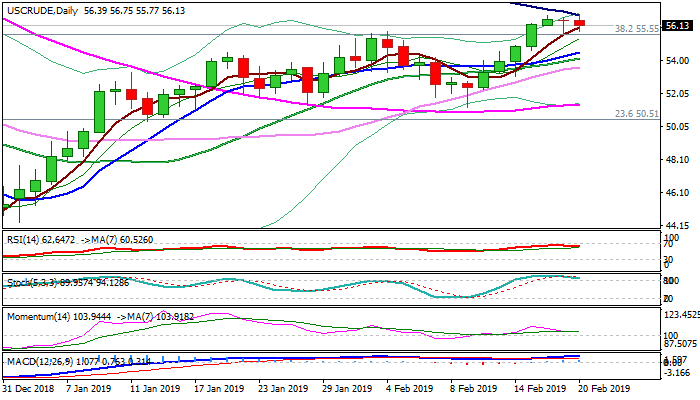
WTI oil price holds in red and eases from 2019 high after bulls faced triple rejection at falling 100SMA.
Corrective easing could be anticipated as daily slow stochastic reverses in deep overbought zone and momentum turned in neutral mode.
Tuesday's Doji signaled indecision, adding to signs of bulls losing traction and subsequent consolidative/corrective phase.
Initial supports at $55.73/55 (former high/broken Fibo barrier) contained Tuesday's dip, keeping bulls intact and signaling extended consolidation above these supports.
However, deeper correction cannot be ruled out on profit-taking after five-day rally and overbought conditions, with deeper dips expected to find ground above converged rising 10/20SMA's ($54.48/$54.14), to maintain bullish bias. Rising US crude production continues to hurt bulls, as booming US shale oil production rose to a record high, offsetting positive signals from OPEC-led output reduction which aims to further tighten oil markets.
Traders await release of US weekly crude inventories reports to get more information about oil's near-term direction.
American Petroleum Institute's report report is due later today, while official government data from US Energy Information Administration (EIA) will be released on Thursday (3.1 mln bls build f/c vs 3.6 mln bls build previous week).
Res: 56.73; 57.43; 58.14; 59.62
Sup: 55.55; 54.48; 54.14; 53.60
Japanese Yen Dips on Surprise Japanese Trade Deficit
USD/JPY has posted slight gains on Wednesday. In the North American session, the pair is trading at 110.86, up 0.23% on the day. On the release front, Japan posted a rare trade deficit in January, with a reading of JPY -37 trillion. The markets are bracing for further weak releases on Wednesday. Flash Manufacturing PMI is forecast to come in at 50.4, pointing to stagnation. As well, All Industries Activity is projected to post a decline of 0.2%. In the U.S., the sole event is the Federal Reserve minutes from the January meeting. Thursday will be busy, with the U.S. posting durable goods and unemployment claims.
The Federal Reserve has turned dovish in 2019, after aggressively raising rates four times in 2018. If recent comments from Fed policymakers are any indication, the minutes from the January policy meeting are also likely to be dovish in tone. The January rate statement discarded previous pledges of “further gradual increases” in interest rates, and said it would be “patient” before any further hikes. The current Fed projection calls for two rate hikes this year, but that is subject to change, based on the strength of the U.S. economy. The markets have priced in a hold on rates for the near-term, with little expectation of a rate hike in the first half of the year.
There is increased optimism over the U.S-China trade spat, and improved risk appetite could weigh on the safe-haven yen. Chinese and U.S. officials are now conducting a fourth round of talks, as the sides look to ease trade tensions after months of tit-for tat tariffs which have hurt global growth and rocked the stock markets. Treasury Secretary Steven Mnuchin joined the talks last week and called the negotiations “productive”. The U.S. has threatened to impose stiff new tariffs on March 1, but on Tuesday, President Trump said that the talks were going well and that March 1 was not a “magical day”. If the March 1 deadline is removed, we could see the yen lose ground.
Sunset Market Commentary
Markets
Global core bonds traded mixed today with German Bunds outperforming US Treasuries. German Bunds temporary lost a few ticks at the opening after German January producer inflation printed above expectations. The move was short-lived as ECB’s Praet struck a cautious tone on new TLTROs. He said the bank will discuss a fresh liquidity injection for the banking sector at the March ECB meeting but was unsure whether any decision will be made at that time. German Bunds soon rebounded and maintained the upward slope throughout the day. The German yield curve moves lower with changes up to -1.0 bp (30-yr). US Treasuries moved modestly higher but reversed trend once US investors joined the debates. Investors are awaiting more news from the US-Sino trade talks in Washington and from the Minutes of the January Fed meeting , scheduled for release tonight. The latter might provide more information on the Fed’s balance sheet run-off process and the future interest rate guidance. US Treasuries are treading water at the time of writing. The US yield curve steepens with changes up to +2.2 bps (30‑yr). Praet’s comments weighed on Italian BTP’s, together with Deputy PM Salvini ruling out any budget adjustments despite the economic downturn. The peripheral spreads over the German 10-yr yield are stable with Italy underperforming (+6 bps).
There was little news to guide trading in the major USD or euro cross rates today. The eco calendar was almost empty. ECB’s Praet confirmed that the ECB is weighing the options regarding new TLTRO’s, but he brought no details on the timing or the structure of a new program. Overnight, headlines on the US asking China to ‘stabilize’ its currency can be considered as a potential USD negative over time. However, the direct impact on the dollar (except for USD/CNY) remains limited for now. EUR/USD revisited this week’s ‘peak’ levels in the 1.1350+ area early in Europe, but there was no strong enough driver neither from the euro side nor from the USD side of the story. EUR/USD settled in a sideways range (currently 1.1335 area). The yen continues to trade soft as markets ponder the impact of soft comments by BOJ governor Kuroda yesterday and this morning. The pair is changing hands in the 110.75 area. The Fed minutes to be published this evening are probably the next point of reference for USD trading.
Sterling took a breather after yesterday’s remarkable rally. The focus remained on UK politics and on the UK-EU Brexit talks, including a meeting between UK PM May and EU’s Juncker. Three Conservatives MP’s left the party, probably making it even more difficult for UK PM May to get any Brexit deal approved by Parliament. Sterling lost a few ticks during the day, but it is still difficult to assess what the new independent group of MP’s will mean for the outcome of the Brexit process. Sterling resilience (EUR/GBP currently near 0.87) suggests that markets assume that there is still a good chance that a disorderly no-deal Brexit can be avoided (via a delay or another outcome).
News Headlines
The South African budget deficit is set to widen to 4.5% in the next fiscal year, the finance minister said while presenting the national budget. That is mainly the result of bailing out Eskom. The country’s distressed power utility is projected to receive $4.8 bn. over 3 years and will have some of its business privatized. Debt to GDP is expected to breach 60% in 2023/24 which might trigger alarm bells at Moody’s, the last rating agency to grant South Africa investment grade status. The rand tanked initially but recovered quickly.
Three pro EU Conservatives have left the party in protest of May’s brexit strategy, which they say is being directed by Conservative Eurosceptics. They are to join the new “Independent Group”, a party recently created by 7 former Labour MP’s who quit the Labour party out of frustration with leader Corbyn.
UK 100 Index Retreats from 4-Month High; Bullish in Near Term
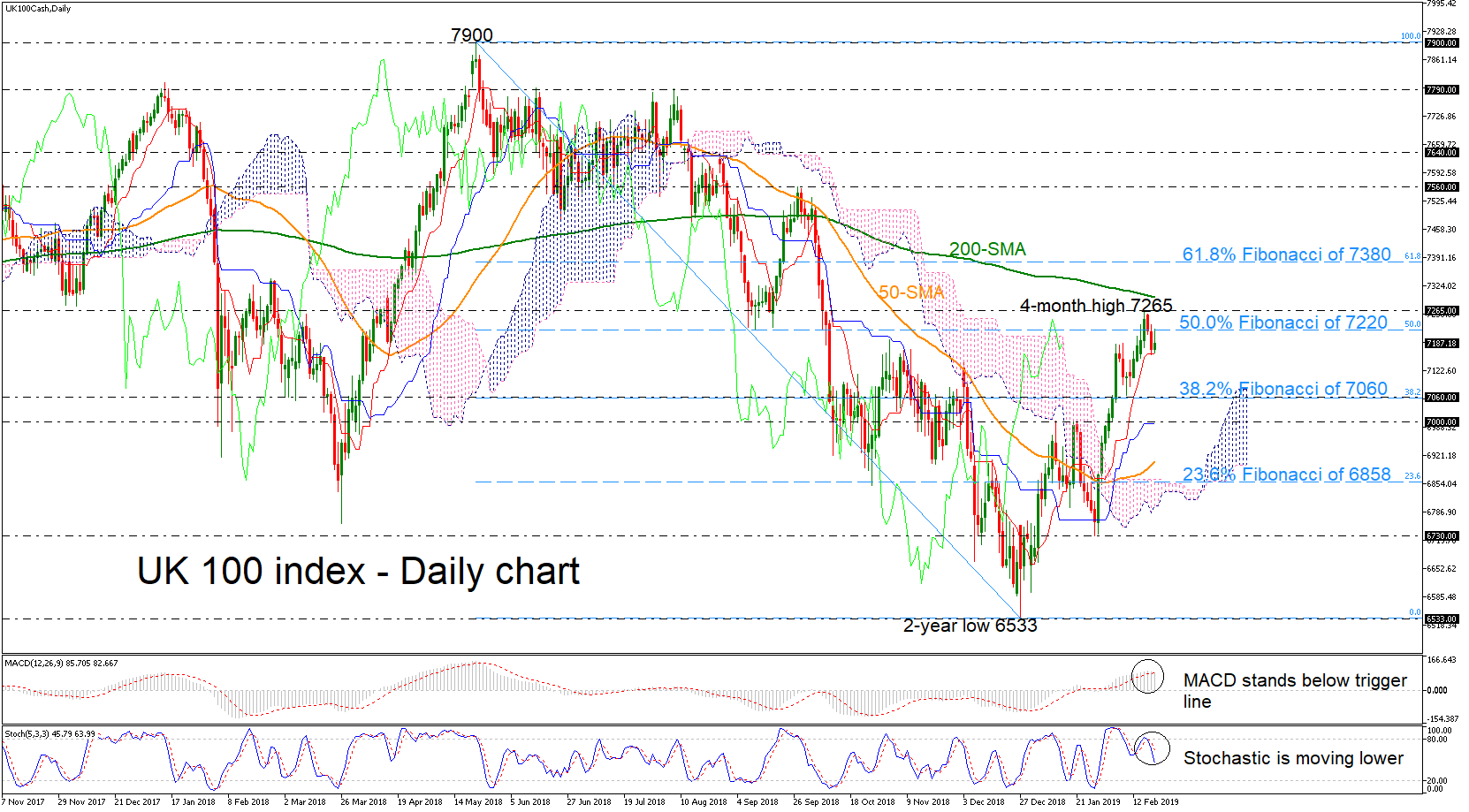
UK 100 stock index (FTSE 100) has declined considerably after touching the four-month high of 7265 on February 15. During Thursday’s trading, the price has gained some ground, while it is currently not far below the 50.0% Fibonacci retracement level of the downleg from 7900 to 6533, near 7220.
The flatly aligned Tenkan- and Kijun-sen lines are indicative of a possible bearish correction, signaling a potentially oversold market. The MACD and the stochastic oscillators are heading south as well.
Should bearish dynamics dominate, the market might revisit the 7060 support, which coincides with the 38.2% Fibonacci, before falling towards the 7000 strong psychological level, taken from the inside swing top on January 21.
If the price manages from more bullish actions and surpasses the four-month high, immediate resistance would come from the 200-day simple moving average (SMA) currently at 7297. Further up, the index could rest around the 61.8% Fibonacci level, around 7380, while a violation of that point may shift the attention to a bullish outlook with the next target being 7560.
Overall, the downfall from 7900 is still active and hence the outlook remains negative despite the short-term upward rally.
Canadian Dollar Breaks Below 1.32 as Greenback Under Pressure
The Canadian dollar continues to improve this week. Currently, the pair is trading at 1.3193, down 0.14% on the day. There are no data releases out of the U.S., but investors will be keeping a close eye on the Federal Reserve minutes from the January meeting. There are no Canadian indicators on the schedule. Thursday will be much busier. In the U.S., key events include durable goods and unemployment claims, and Canada will release ADP nonfarm payrolls.
If recent comments out of the Fed are any indication, the minutes from the January policy meeting are likely to be dovish. The Fed has sent signals that it will ease up on rate policy this year, after aggressively raising rates four times in 2018. The January rate statement had a decidedly dovish tone, as policymakers discarded previous pledges of “further gradual increases” in interest rates, and said it would be “patient” before any further hikes. The current Fed projection calls for two rate hikes this year, but that is subject to change, based on the strength of the U.S. economy. The markets have priced in a hold on rates for the near-term, with little expectation of a rate hike in the first half of the year.
The markets remain optimistic over the U.S-China trade spat, and stonger risk appetite is bullish for the Canadian dollar, a minor currency. Chinese and U.S. officials are now conducting a fourth round of talks, as the sides look to ease trade tensions after months of tit-for tat tariffs which have hurt global growth and rocked the stock markets. Treasury Secretary Steven Mnuchin joined the talks last week and called the negotiations “productive”. The U.S. has threatened to impose stiff new tariffs on March 1, but on Tuesday, President Trump said that the talks were going well and that March 1 was not a “magical day”. If the March 1 deadline is removed, traders can expect the Canadian dollar to respond with strong gains.
USD/JPY Mid-Day Outlook
Daily Pivots: (S1) 110.43; (P) 110.63; (R1) 110.81; More...
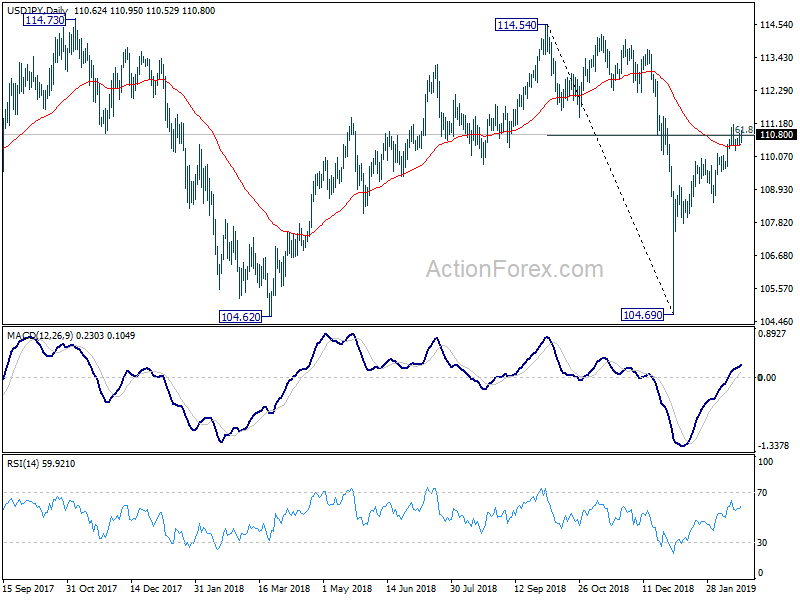
Intraday bias in USD/JPY remains neutral at this point. On the downside, break of 110.00 resistance turned support will suggest rejection by 61.8% retracement of 114.54 to 104.69 at 110.77 and the rebound from 104.69 has likely completed. Intraday bias will be turned back to the downside for 108.49 support for confirmation. Nevertheless, break of 111.13 should confirm resumption of rise from 104.69 for 114.54 resistance.
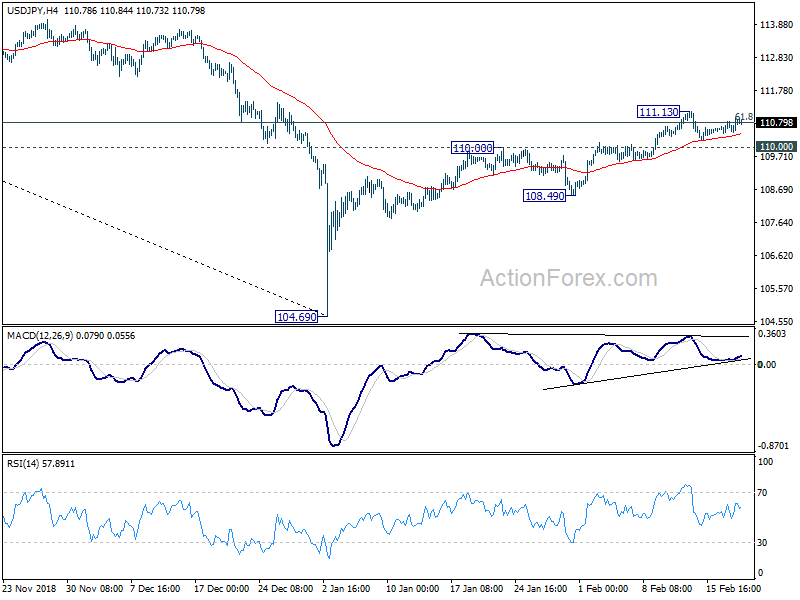
In the bigger picture, while the rebound from 104.69 was stronger than expected, it couldn't sustain above 55 day EMA yet. Outlook is turned mixed first. On the downside, break of 108.49 support will revive that case that such rebound was a correction. And, larger down trend is still in progress for another low below 104.62. But sustained trading above 55 day EMA will turn focus to 114.54. Decisive break there will confirmation completion of the decline from 118.65 (2016 high).
USD/CHF Mid-Day Outlook
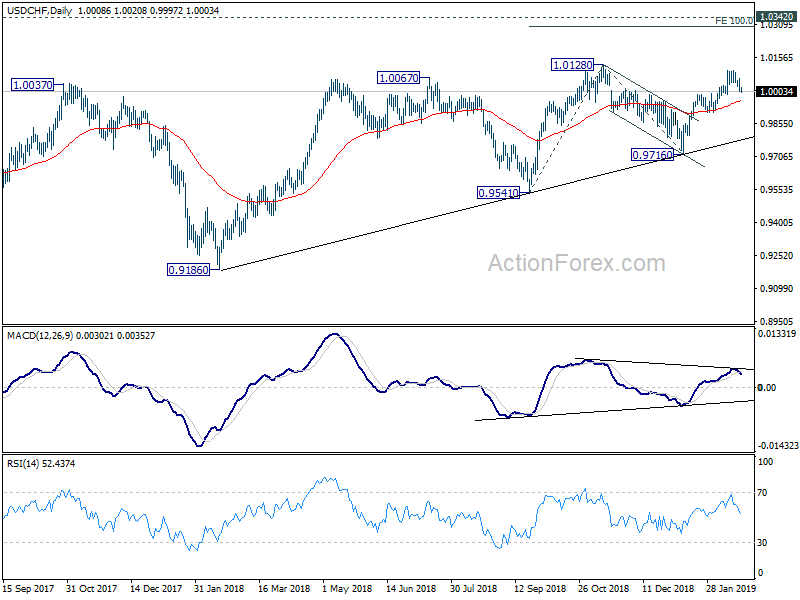
Daily Pivots: (S1) 0.9989; (P) 1.0025; (R1) 1.0049; More....
Intraday bias in USD/CHF remains neutral at this point. With 0.9988 support intact, further rise is still mildly in favor. On the upside, above 1.0098 will target 1.0128 first. Break will confirm resumption of up trend from 0.9186. Next target will be 100% projection of 0.9541 to 1.0128 from 0.9716 at 1.0303. However, break of 0.9988 will indicate rejection by 1.0128 and turn intraday bias to the downside for 0.9716 support again.
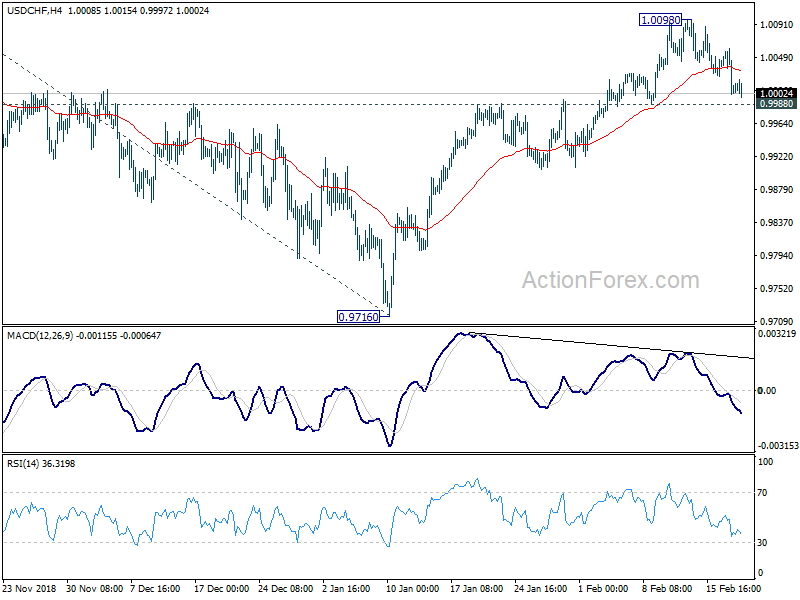
In the bigger picture, USD/CHF drew strong support from medium term trend line and rebounded. That suggests rise from 0.9186 is still in progress. Further break of 1.0128 will confirm up trend resumption and target 1.0342 key resistance. Nevertheless, break of 0.9716 will dampen this bullish view and at least bring deeper fall to 0.9541 key support.