Sample Category Title
Uncertainty Returns As Little Progress Made Between US And China
Asian stocks slid after Chinese data showed a slowdown in inflation. In January, Chinese consumer prices rose by an annualized rate of 1.7%, which was lower than the expected 1.9%. The stocks also dropped after it was revealed that US and China negotiators had made little progress in the negotiations with the United States. The reason for the lack of progress is that China has been unwilling to offer major concessions about its business practices like forced technology transfer and intellectual property theft. In China, the Shanghai and Hang Seng declined by 0.65% and 1.65%. In Japan, the Nikkei dropped by 1.26%. Today, investors will focus on the statement from the negotiators who are meeting in Beijing.
Focus will remain on the United Kingdom today as the country releases the retail sales numbers. The core retail sales numbers are expected to show that in January, the headline retail sales numbers rose by 3.4%, which was higher than December’s 3%. On a MoM basis, the retail sales rose by 0.2%, which was higher than December’s contraction of 0.9%. The core retail sales rose by an annualized rate of 3.0%, which was better than the expected 2.6%. Investors will also focus on news about Brexit. Yesterday, Theresa May’s approach to Brexit suffered when MPs voted against her strategy.
Investors will also focus on important data from Europe and United States. In Europe, Spain will release its inflation numbers for January. The numbers are expected to show that consumer prices remained unchanged at 1% in the month. The harmonized inflation adjusted consumer prices are expected to have remained unchanged at 1%. In Italy, the trade surplus for December is expected to have been 3.47 billion euros. This will be lower than November’s surplus of 4.7 billion euros. In the United States, the core retail sales for December are expected to have increased by 0.1% while the headline number is expected to remain unchanged at 0.2%.
EUR/USD
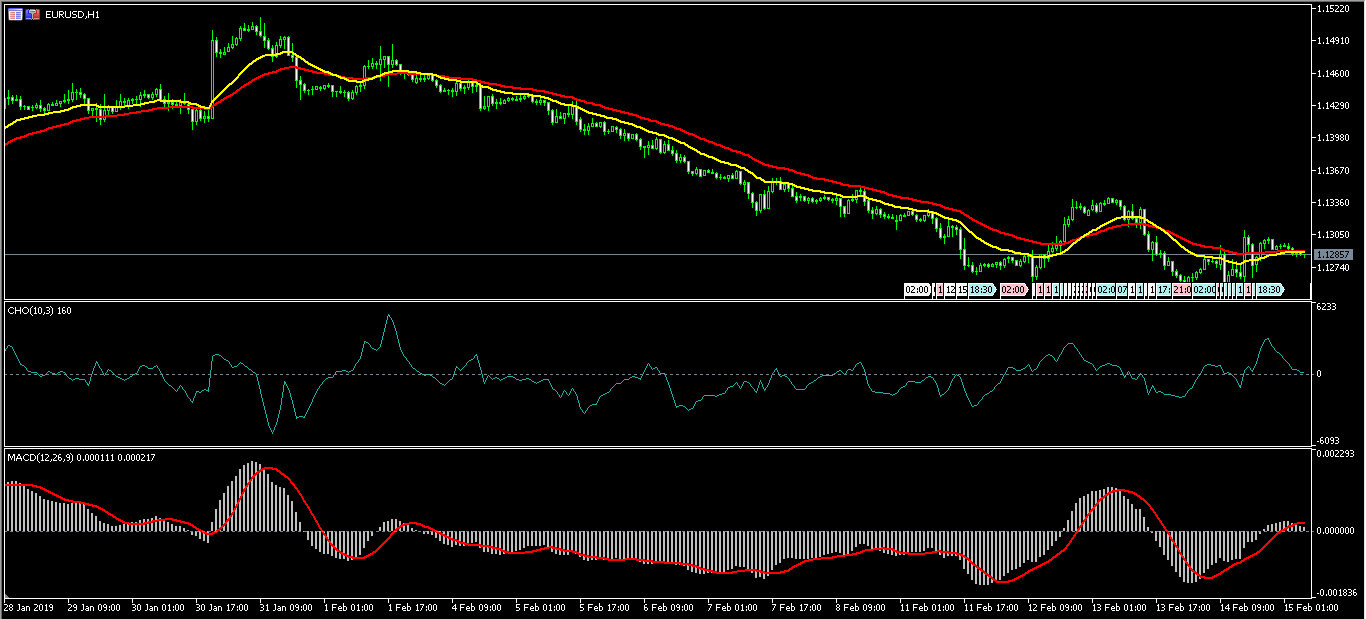
The EUR/USD pair moved slightly lower in overnight trading and reached a low of 1.1285. This was slightly higher than yesterday’s low of 1.1250. On the hourly chart, the pair is trading along the 42-day and 21-day EMA. The Chaikin oscillator has fallen to the neutral level while the signal line of the MACD has just moved above the neutral line. At this point, the pair could move in either direction depending on the data.
GBP/USD
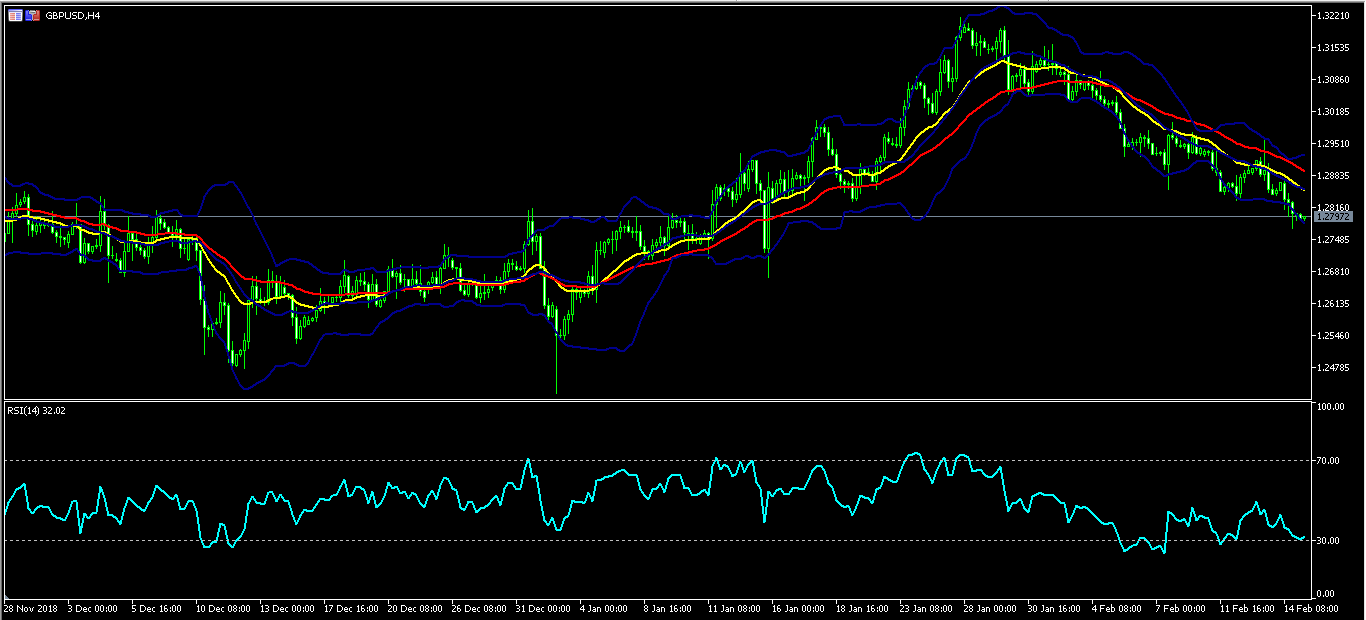
The GBP/USD pair declined sharply after Theresa May’s defeat in parliament. The pair is now trading at 1.2770, which is close to the lowest level since 16 January. On the four-hour chart, the pair is below the 42-day and 21-day EMAs while the RSI has declined close to the oversold level of 70. The price is also along the lower line of the Bollinger Bands. Today, the pair could continue the downward trend as traders follow the Brexit story.
USD/JPY
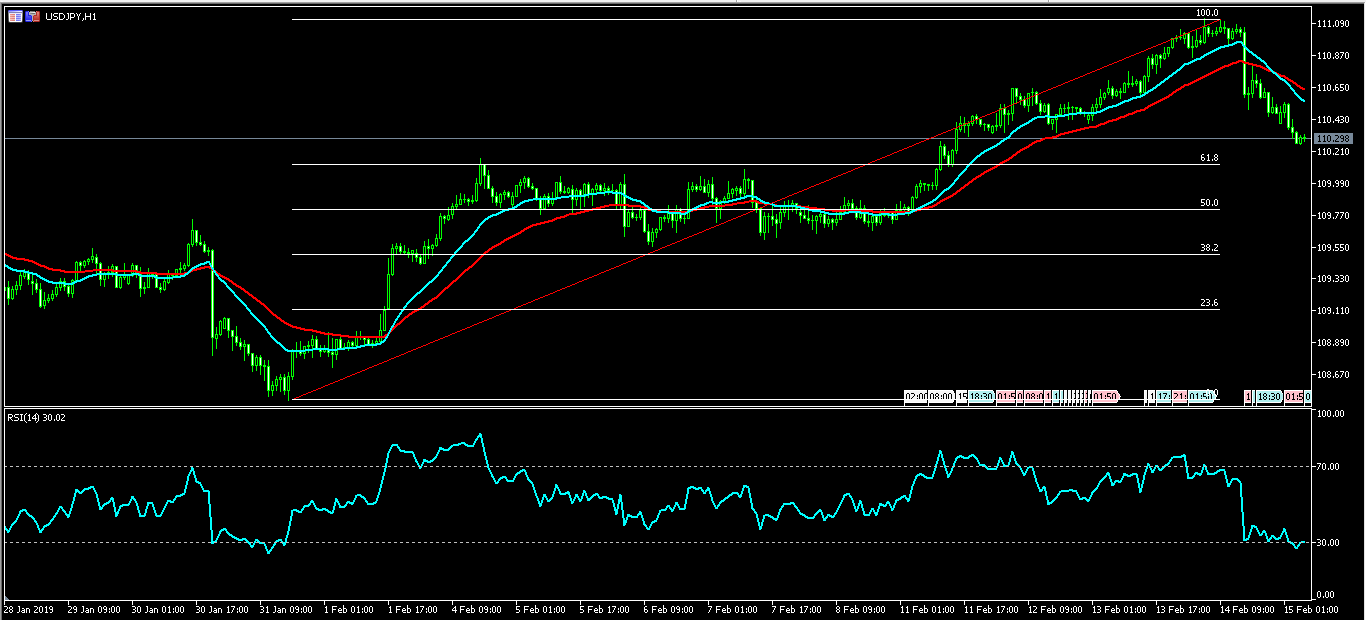
The USD/JPY pair moved lower in overnight trading. The pair reached a low of 110.30. The pair has been on an upward rally since the beginning of the year. On the daily chart, the hourly chart, the 42-day and 21-day EMAs have crossed over, which is an indication that the pair could continue the downward trend. The RSI has moved sharply lower to below 30. The price is also close to the 61.8% Fibonacci Retracement level. The pair will likely resume the upward trend today if it hits the 61.8% retracement level.
China’s Inflation Weakened Sharply. Trade Improvement Masked by Seasonal Factor
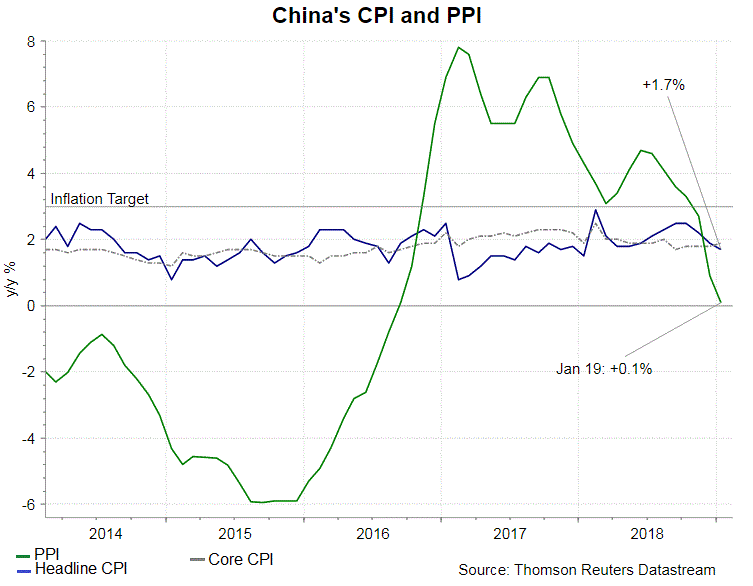
Headline CPI eased to +1.7% y/y in January, missing consensus of and December’s +1.9%. The slowdown was mainly driven by food price which fell -0.6 percentage point to +1.9%. Non-food inflation steadied at +1.7%. PPI decelerated sharply to +0.1% y/y, from +0.9% a month ago. The market had already anticipated a significant slowdown of +0.2% but the actual figure was even worse. Weakness in PPI reveals that the growth industrial profit is negatively affected.
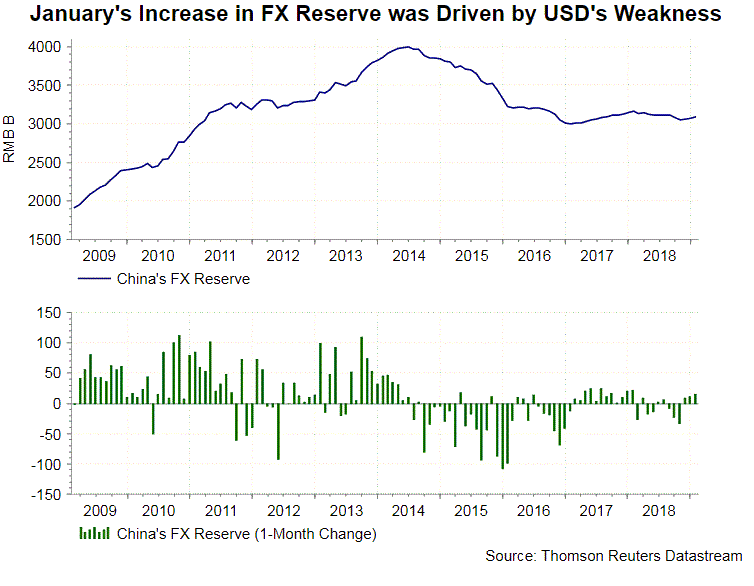
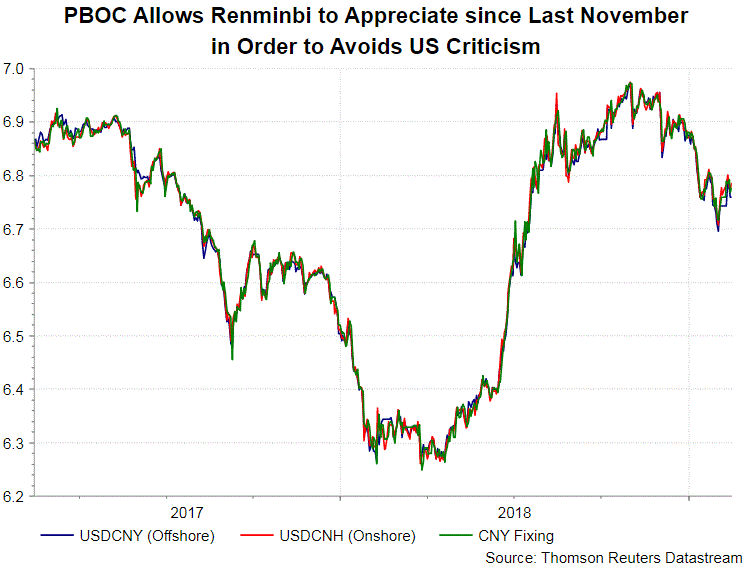
FX reserve increased to US$ 3.088 trillion in January, from US$ 3.073 trillion a month ago. It also came in higher than consensus of US$ 3.082 trillion. We believe most of the increase was driven by valuation effect as the US dollar index slipped about -0.6% last month. While FX reserve has been a tool for PBOC to intervene renminbi’s movement, we do not see much manipulation this time, given that renminbi strengthened more than +2% during the period. USDCNY has been moving in a downtrend after peaking in October 2018. We believe the Chinese government intentionally allows its currency to appreciate as it prepares the negotiate with the US on trade issues.
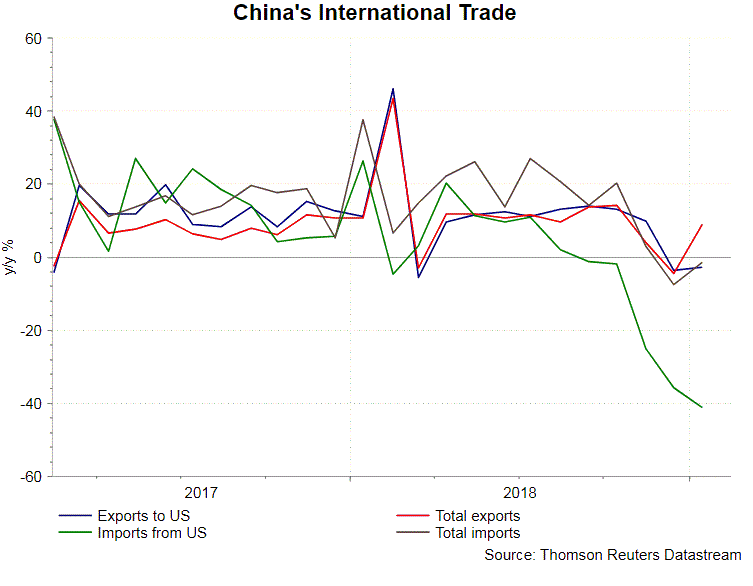
 The seemingly improvement in January’s trade data was mainly driven by seasonal factor. Import growth contracted -1.5% y/y, easing from the -7.6% decline a month ago. Export growth soared +9.1% y/y, more than reversing the -4.4% contraction last December. Trade surplus narrowed to US$ 39B in January from the prior month’s US$57 in December. Yet, this more than doubled the 18.42B surplus in the same period last year. Trade with the US, its biggest trading partner, continued to suffer. Imports from the US contracted -41.09% y/y, accelerated from -35.78% in December. While recovery exports to the US remained in decline, falling -2.77% during the month. Notwithstanding the significant improvement in both headline imports and exports, much was driven by the front-loaded purchases ahead of the Lunar New Year holiday in early February. We expect to see weakness in the February data which would conform to the view that China's economic growth continues to slow.
 Before Lunar New Year holiday, the government announced that the manufacturing PMI edged +0.1 point higher to 49.5 in January. While the reading beat consensus slightly, a reading below 50 signaled that the sector remained in contraction. The report by Markit/Caixin confirmed the gloomy outlook with the final manufacturing PMI slipped -1.4 points to 48.3 last month. Meanwhile, but indices suggested that the services sector stayed in expansionary territory.
As we await more data flow (industrial production, retail sales, fixed asset investment) in coming weeks, continuing softer growth is evident. As such, the Chinese government would continue to adopt more accommodative (the government insists that it is prudent and neutral) policy, both monetarily and fiscally.
USDCAD Holds Within SMAs, Sharp Move Up Needed For More Gains
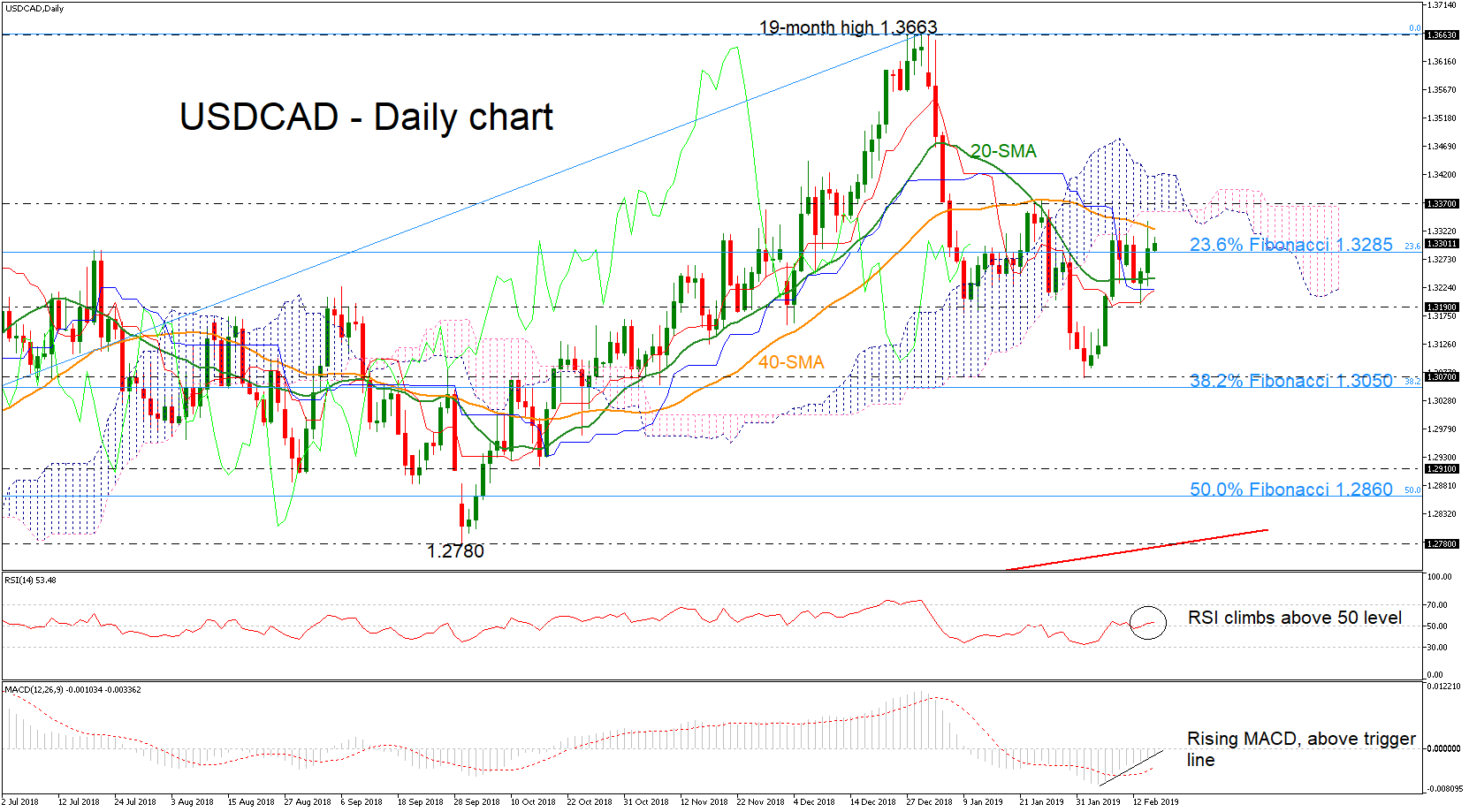
USDCAD came to close to break the 40-day simple moving average (SMA), surpassing the 23.6% Fibonacci retracement level of the upward movement from 1.2060 to 1.3663, around 1.3285, earlier today. The positively aligned Tenkan-sen line serves as a testament to the bullish short-term momentum that is in place. The technical indicators also suggest a positive bias as the RSI entered in bullish territory, while the MACD is rising above the trigger and zero lines.
Should the price stretch north, Thursday’s highs and the 40-SMA could provide immediate resistance around 1.3330 before the pair touches the 1.3370 resistance level. A significant step higher could bring the bullish sentiment back into play, sending the prices towards the 19-month high of 1.3663.
On the other side, the price could challenge the flat 20-day SMA near 1.3240 before heading lower towards the 1.3190 support barrier. If traders continue to sell the pair, the price could fall until the 1.3050 – 1.3070 area, which encapsulates the 38.2% Fibonacci mark. A drop below this key zone would reverse back to the downside, continuing the bearish correction until the 1.2910 region.
Summarizing, dollar/loonie has been developing in an ascending movement since September 2017 in the long-term, while over the last two months the price has been creating a negative tendency, following the pullback from the 19-month high.
GBP/JPY Sellers In Control
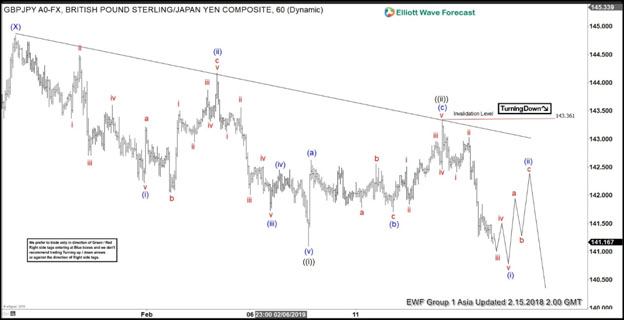
Short term Elliott wave view in GBPJPY favors further downside due to the 5 swing sequence from Jan 26 high (144.84). We are calling the structure of the decline from 144.84 as an Impulse Elliott Wave. An impulse is a 5 waves move where subdivision of wave 1, 3, and 5 is also in 5 waves but in a lesser degree. Down from 144.84, wave ((i)) ended at 141.1 and wave ((ii)) ended at 143.35. Pair has broken below wave ((i)) at 141.1, signalling that the next leg lower has started.
We can see subdivision of wave ((i)) in impulsive 5 waves of a lesser degree. Wave (i) ended at 142.22, wave (ii) ended at 144.17, wave (iii) ended at 141.73, wave (iv) ended at 142.45, and wave (v) of ((i)) ended at 141.1. The internal of wave ((ii)) rally unfolded as a zigzag Elliott Wave structure. Wave (a) ended at 142.63, wave (b) ended at 141.7, and wave (c) of ((ii)) ended at 143.35. Subsequent decline in wave ((iii)) appears impulsive and we expect wave (i) of ((iii)) to end soon. Pair should then rally in wave (ii) to correct the decline from 143.35 high, but the rally should fail in 3, 7, or 11 swing below 143.35 for further downside. We don’t like buying the pair.
GBPJPY 1 Hour Elliott Wave Chart
Gold Remains In $1,300/$1,320 Range Despite Weaker Dollar
May's defeat nothing more than posturing in Parliament
Softer sessions in the US and Asia overnight appear to be taking their toll on European markets ahead of the open, with indices expected to open a little lower on the final trading day of the week.
As much as Brexit may feel like the most important thing in the world right now to those of us sitting in the UK, I don't think the wider community is quite so caught up in all the play-acting and faux drama. Theresa May's so-called humiliating defeat in Parliament on Thursday was just the latest in a series of symbolic gestures designed to give the allusion of weakness of the PMs deal unless Brussels offers more substantial concessions. It is in no way indicative of how MPs will vote at a minute to midnight when it matters.
This kind of political posturing has been a regular feature of the negotiations over the last couple of years and has been significantly ramped up in recent months as MPs have been given the opportunity to express their views and make statements in Parliament. I'm not sure it will be too effective in negotiations with Brussels but perhaps we'll find out the closer we get to the end of March. It's clear that the EU does not take the threat of no deal very seriously and moves like this are deliberately designed to force them to. I'm not convinced it will.
Will Xi involvement be the catalyst for a truce extension
Negotiations in Beijing are likely to attract more of the attention of the investing community as President Xi joins the talks in an attempt to deliver the kind of progress that will ensure a 60 day extension to the truce. A deal after only 90 days of talks was always unlikely making this the more realistic target from day one, something that if achieved will reassure investors.
Gold remains in $1,300/$1,320 range despite weaker dollar
The risk aversion we saw on Thursday in response to the weaker US retail sales data gave gold a little kick higher, with its role as a safe haven seeing it favoured. This was of course helped by a weaker dollar in response to the figures but gold remained in the $1,300 to $1,320 range as neither bulls or bears managed again to significantly seize the upper hand.
Oil strongly pushing major resistance
Oil has previously struggled during previous periods of risk aversion but, like its fellow commodities, is fond of a weaker dollar and is continuing to respond to favourable reports this week, including Saudi Arabia's commitment to cutting output by an additional 500,000 barrels per day by March. Brent and WTI are both now seriously testing a major resistance zone, around $65 and $55, respectively, the break of which could be the catalyst for another rally.
China Inflation Raises Some Deflation Concerns
General Trend:
- Shanghai Composite declines on weakness in property sector
- Telecom services and IT firms rise in Shanghai amid focus on trade talks
- Tech names weigh on the Hang Seng
- Equity markets in Japan weighed down by financials and machinery companies, Heavily-weighted Nikkei components also decline
- Whitehaven Coal declines over 9% in Australia, earnings miss estimates
- National Australia Bank (NAB) credit outlook cut to Negative at Fitch, notes recent management changes
- US retail sales miss estimates
- Singapore Q4 GDP revised lower by more than expected amount
- China inflation data misses ests
- Indonesia trade deficit wider than expected, exports contract more than expected
- Taiwan Semi and AU Optronics release Jan sales figures
Headlines/Economic Data
Australia/New Zealand
- ASX 200 opened -0.1%
- (AU) Fitch: Affirms ratings of 4 major banks in Australia
- (NZ) New Zealand Jan Business Manufacturing PMI: 53.1 v 55.1 prior
China/Hong Kong
- Shanghai Composite opened -0.3%, Hang Seng -0.7%
- (CN) Reportedly US/China trade talks remain deadlocked as Beijing refuses to eliminate coerced technology transfers or government subsidies to Chinese companies – WSJ
- (CN) Trade talks remain far apart on some demands made by US; there have been discussions about removing some of the US tariffs on China – SCMP
- (US) US and China officials said to be 'scrambling' to at least produce memorandum of understanding (MOU) by end of today, MOU could help pave the way for meeting between Trump and China President Xi - FT
- (CN) CHINA JAN CPI Y/Y: 1.7% V 1.9%E (lowest since Jan 2018)
- (CN) China Jan PPI Y/Y: 0.1% v 0.3%e (matches the lowest since 2016, slows for 7th straight month)
- (CN) China state planner NDRC issues statement on stepping up govt financing guarantee funds for smaller firms, & rural development
- (CN) China PBoC Open Market Operation (OMO): Skips reverse repo operations for 5th consecutive session
- (CN) China PBoC sets Yuan Reference Rate: 6.7623 v 6.7744 prior
Japan
- Nikkei 225 opened -0.4%
- (JP) Japan Buying of Foreign Bonds: ¥992.4B v ¥915.3B prior; Foreign Buying Japan Stocks: -¥102.0B v -¥123.8B prior
- (JP) Japan Banking Lobby chief Fujiwara: BOJ should not pay excess attention to the 2% inflation target; should conduct monetary policy in a forward-looking manner
- (JP) Japan Dec Fin Industrial Production M/M: -0.1% v -0.1% prior; Y/Y: -1.9% v -1.9% prior
Korea
- Kospi opened -0.7%
- (KR) South Korea Finance Ministry: Investments and exports undergoing 'corrections'; job creation remains 'sluggish'
- (KR) South Korea Dec Current Account Balance: $4.82B v $5.1B prior; Balance of Goods (BOP): $6.53B v 8.0B prior
- (KR) South Korea sells KRW593B v KRW550B indicated in 50-year bonds: avg yield 1.970% v 1.950% prior
- (KR) South Korea Jan Bank Lending to Household Total (KRW): 828.7T v 827.6T prior
Other
- (ID) Indonesia Jan Trade Balance: -$1.2B v -$0.9B prior
- (IN) India Gov't Minister: Incontrovertible evidence of Pakistan's hand in Kashmir attack; India withdraws most favored nation status from Pakistan
- (SG) Singapore Q4 Final GDP Q/Q: 1.4% v 1.5%e; Y/Y: 1.9% v 2.1%e (2-year low)
- (SG) Singapore MTI: 2019 growth expected to come in slightly below mid-point of 1.5-3.5% forecast range, pace of growth in domestic economy is expected to slow in 2019 vs 2018
North America
- (US) DEC ADVANCE RETAIL SALES M/M: -1.2% V 0.1%E; RETAIL SALES (EX-AUTO) M/M: -1.8% V 0.0%E
- (US) Fed's Brainard (voter, dove): retail sales data today certainly caught my eye but it's only one month's data; data does add to story of downside risks - CNBC interview
- (US) White House Econ Adviser Kudlow: there are "glitches" in today's retail sales data, it was affected by the govt shutdown - Fox News interview
- (US) White House Press Sec Sanders: confirms Pres Trump will sign govt funding bill and declare a national emergency to build a border wall
- (US) US President Trump is expected to speak on border security at 10 am ET on Friday, expected to sign spending bill and declare national emergency (as expected)
- (US) House Speaker Pelosi (D-CA): may file legal challenge if Pres Trump declares national emergency over border wall; she will consider options
- (US) US House advances Border Security Funding Bill (as expected); Majority of House later votes to approve the government funds for border security and other programs, vote 300 to 128
Europe
- (UK) UK lawmakers reject govt motion that sought reaffirmation of support to seek changes to Brexit deal
- (UK) UK Lawmakers Vote against SNP's 'Amendment I' and Labour's 'Amendment A'
Levels as of 01:00ET
- Nikkei 225, -1.3%, ASX 200 +0.1%, Hang Seng -1.8%; Shanghai Composite -1%; Kospi -1.6%
- Equity Futures: S&P500 -0.4%; Nasdaq100 -0.5 %, Dax -0.3%; FTSE100 -0.1%
- EUR 1.1311-1.1283 ; JPY 110.55-110.26 ; AUD 0.7108-0.7079 ;NZD 0.6840-0.6809
- Gold +0.1% at $1,315/oz; Crude Oil +0.5% at $54.65/brl; Copper -0.4% at $2.761/lb
Retail Sales Shock Amid Trade Talks
Market movers today
We expect markets to stay alert to news from Beijing , as high-level trade talks continue. According to Chinese media, US representatives Steven Mnuchin and Robert Lighthizer will meet President Xi Jinping today. The recent newsflow indicates that the two parties remain far apart from each other. We think this is in part expectation management.
Also, we believe focus will remain on the risk of a new partial US government shutdown . At this stage, it seems President Donald Trump will sign the spending bill that Congress has passed this morning. This would avoid another shutdown. Meanwhile, tensions are running high, as the President has indicated he plans to declare a national emergency to get funding for his border wall with Mexico. The deadline is midnight US time.
On the data front, today's highlight is new car registrations in Europe . Bottlenecks in the car sector were one of several Achilles heels for the euro area in Q4 and a continuing rebound in new car registrations would be welcome news. Focus is also set to be on US (manufacturing) data after yesterday's severe retail sales miss. In the Scandies , we are due trade balance figures in Norway but we do not expect any market impact from their release.
Selected market news
Asian equities are trading in the 'red' this morning on the back of a sour US session hit by the retail sales miss (see below), stories that US and China remain far apart in the trade negotiations and Chinese PPI figures falling short of expectations.
The delayed US December retail sales figures released yesterday disappointed significantly, showing the largest monthly fall in the control group since January 2000 (Y2K) (see chart ). In itself the release is very worrying, as the Commerce Department said response rates were at or above the normal level and as there was no immediate explanation from the shutdown (this was the December report) or the weather as online sales were weak. Given retail sales relation to consumer confidence, we find comfort in the recent rebound and expect this retail sales report to be a 'one-off'. However, we intend to monitor this very closely.
Prime Minister Theresa May suffered another defeat, as there was no support for her Brexit statement (the hard Brexiteers abstained). While the vote was only indicative and not legally-binding, it has made life more difficult for May, as she can no longer show she has a united party behind her. See FX markets for more colour and our subjective event probabilities.
The German economy narrowly escaped a technical recession as GDP growth in Q4 18 stayed broadly flat at 0.02% q/q. Apart from continued headwinds from the external front, many domestic factors were still at play. Overall, we expect to see a pickup in the underlying German growth momentum compared with H2 18 but we see annual GDP growth in 2019 still only at 1.0%, due mainly to the zero carry over from 2018.
As expected, Norges Bank's Governor Øystein Olsen did not deliver any new policy signals to markets at his annual address to the Norwegian people yesterday evening (see FX markets ). In an interview with E24 , Olsen criticised the government's recent attempt to run certain expenses next to the fiscal rule. Olsen clarified Norges Bank plans to include all fiscal spending in its monetary assessment, so this constitutes a possible positive factor for NOK rates.
Euro-Zone’s Economic Growth Slowed In 4Q 2018
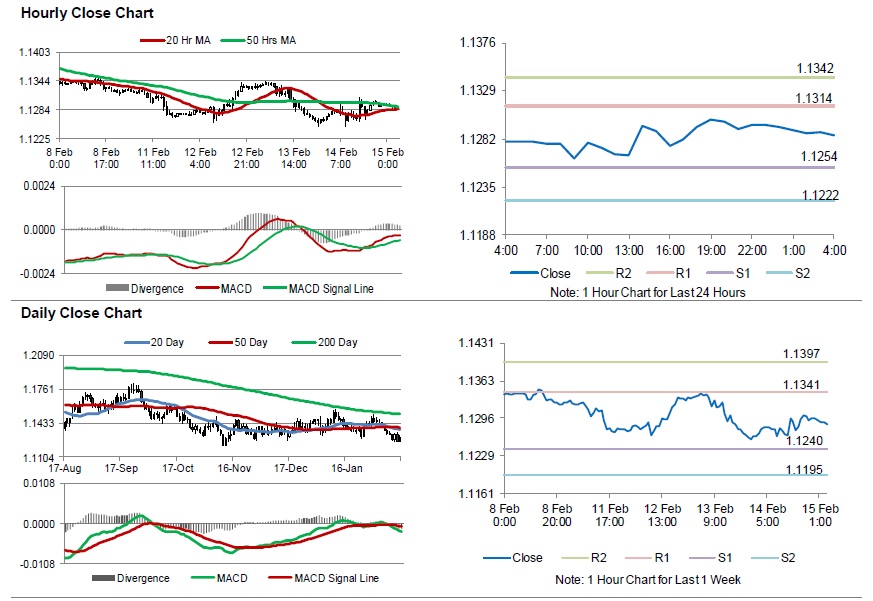
For the 24 hours to 23:00 GMT, the EUR rose 0.33% against the USD and closed at 1.1296.
On the macro front, the Euro-zone’s seasonally adjusted final gross domestic product (GDP) rose 0.2% on a quarterly basis in 4Q18, in line with expectations and compared to a similar rise in the prior quarter. The preliminary figures had also indicated an advance of 0.2%.
In Germany, seasonally adjusted flash GDP remained unchanged on a quarterly basis in 4Q 2018, compared to market anticipation for a rise of 0.1%. In the previous quarter, GDP had registered a fall of 0.2%.
Separately, the US dollar declined against the Euro yesterday, following disappointing US retail sales data.
In the US, data showed that the US advance retail sales unexpectedly fell 1.2% on a monthly basis in December, declining to its lowest level in nine years and defying market consensus for an advance of 0.1%. Advance retail sales had recorded a revised climb of 0.1% in the prior month. Moreover, the nation’s business inventories unexpectedly dropped 0.1% on a monthly basis in November, compared to a rise of 0.6% in the preceding month. Markets had anticipated business inventories to climb 0.2%. Additionally, fresh figures showed that seasonally adjusted initial jobless claims unexpectedly advanced to 239.00K in the week ended 9 February 2019, compared to a revised reading of 235.00K in the prior week.
Meanwhile, the nation’s producer price index climbed 2.0% on an annual basis in January, rising at its weakest pace since July 2017 and compared to a gain of 2.5% in the previous month. Market participants had envisaged the index to rise 2.3%.
In the Asian session, at GMT0400, the pair is trading at 1.1286, with the EUR trading 0.09% lower against the USD from yesterday’s close.
The pair is expected to find support at 1.1254, and a fall through could take it to the next support level of 1.1222. The pair is expected to find its first resistance at 1.1314, and a rise through could take it to the next resistance level of 1.1342.
Looking forward, traders would await the Euro-zone’s trade balance data for December, set to release in a few hours. Later in the day, the US Empire state manufacturing index and the Michigan consumer sentiment index, both for February along with the US industrial production and manufacturing production, both for January, will keep traders on their toes.
The currency pair is showing convergence with its 20 Hr and 50 Hr moving averages.
UK’s Consumer Price Inflation Slowed To A Two-Year Low Level In January
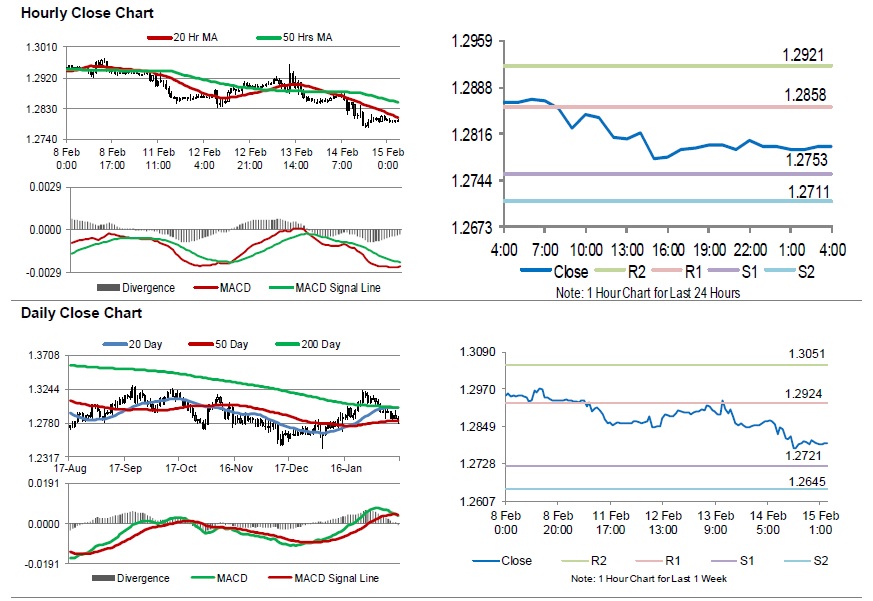
For the 24 hours to 23:00 GMT, the GBP declined 0.34% against the USD and closed at 1.2850, after UK's consumer price inflation (CPI) slowed to a two-year low level of 1.8% on a yearly basis in January, weighed down by falling energy prices and compared to a climb of 2.1% in the prior month. Market had anticipated the CPI to record a reading of 1.9%.
Other data showed that the nation's retail price index rose 2.5% on an annual basis in January, compared to a gain of 2.7% in the preceding month. Additionally, the house price index climbed 2.5% on an annual basis in January, meeting market expectations. The index had recorded a revised rise of 2.7% in the previous month. Also, the non-seasonally adjusted output producer price index (PPI) advanced 2.1% on an annual basis in January, compared to a revised rise of 2.4% in the preceding month. Markets had expected the PPI to climb to 2.2%.
In the Asian session, at GMT0400, the pair is trading at 1.2866, with the GBP trading 0.12% higher against the USD from yesterday's close.
Overnight data revealed that UK's RICS house price balance declined to -22.0% in January, higher than market consensus for a drop to -20.0%. In the previous month, house price balance had registered a reading of -19.0%.
The pair is expected to find support at 1.2821, and a fall through could take it to the next support level of 1.2775. The pair is expected to find its first resistance at 1.2935, and a rise through could take it to the next resistance level of 1.3003.
Amid lack of macroeconomic releases in UK, traders would focus on global macroeconomic releases for further directions.
The currency pair is trading below its 20 Hr and 50 Hr moving averages.
Japan’s Industrial Production Dropped In December
For the 24 hours to 23:00 GMT, the USD declined 0.46% against the JPY and closed at 110.48.
Data showed that Japan's final industrial production fell 1.9% on an annual basis in December, confirming the preliminary print. In the prior month, industrial production had registered a climb of 1.5%.
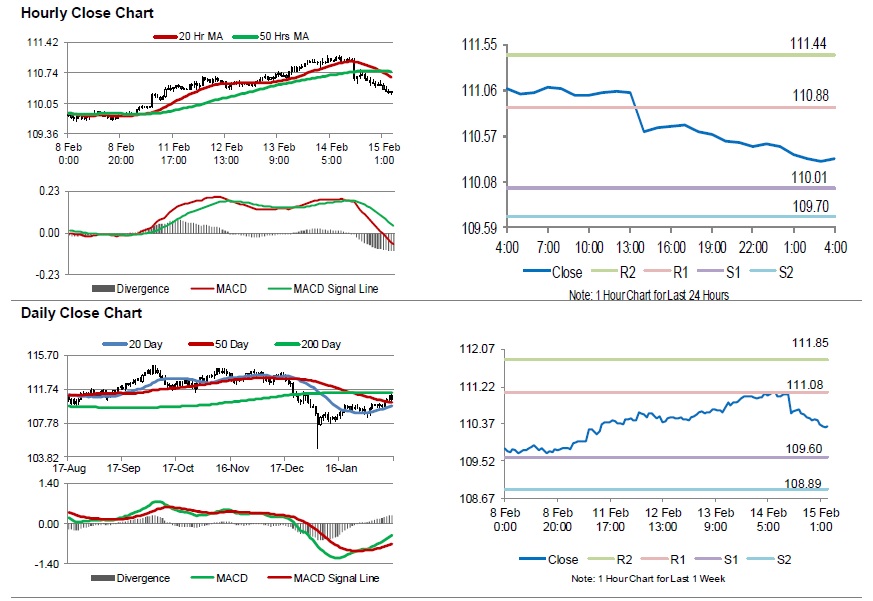
In the Asian session, at GMT0400, the pair is trading at 110.32, with the USD trading 0.14% lower against the JPY from yesterday's close.
The pair is expected to find support at 110.01, and a fall through could take it to the next support level of 109.70. The pair is expected to find its first resistance at 110.88, and a rise through could take it to the next resistance level of 111.44.
The currency pair is trading below its 20 Hr and 50 Hr moving averages.