

Sample Category Title
US update: Limited loss in Dollar and stocks after terrible retail sales
While Dollar and stocks suffered some selling after shockingly poor retail sales data, there was no follow through selling. US retail sales contracted by most in 9 years in December. But some economists are quick to come out to express their skepticism on the data (see here).
Bloomberg also reported that US and China are still far apart on the core issues in trade negotiations. In particular, dialing back subsidies for state-owned enterprises is a non-starter for the Chinese government. But this is actually much of a known in Asia.
That is, for the Chinese government, buy more American products? Sure. Open up some market access? No problem except some sensitive ones, like internet and media. IP theft and forced technology transfer? Maybe, and they can do something to govern private owned companies. But SOEs? Well, it's a fundamental government policy that cannot be touched. It's an area that eventually, the US has to concede. So, this news shouldn't trigger much pessimism among professional investors.
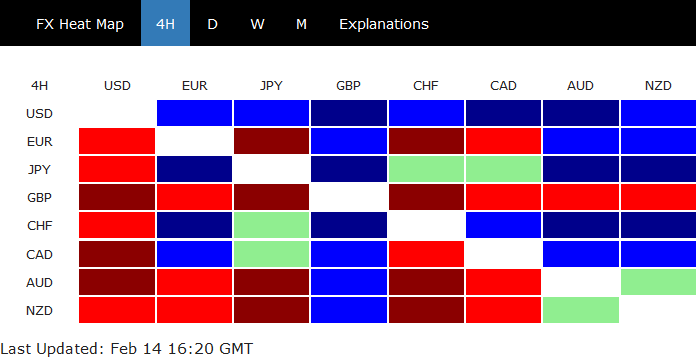
Anyways, Dollar is currently the third weakest one for the day, next to Sterling and Canadian Dollar. Kiwi remains the strongest one. But Yen has already taken the second strongest place, followed by Swiss Franc indicating risk aversion.
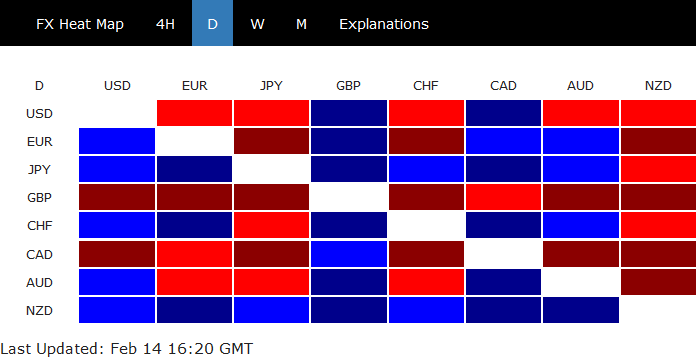
But as seen in the 4H heatmap, Dollar is the strongest one, followed by Swiss Franc and Yen. The greenback might be staging a rebound.
Technically, EUR/USD's recovery is held well below 1.1341 minor resistance. USD/CHF's retreated is held above 1.1004 minor support, not to mention 0.9988 structural support. GBP/USD is in near term decline for 1.2391 low. AUD/USD is in consolidation above 0.7054 temporary low. USD/CAD breached 1.3329 resistance to resume the rebound from 1.3068. So all in all, today's negative news doesn't trigger much bearishness in Dollar.
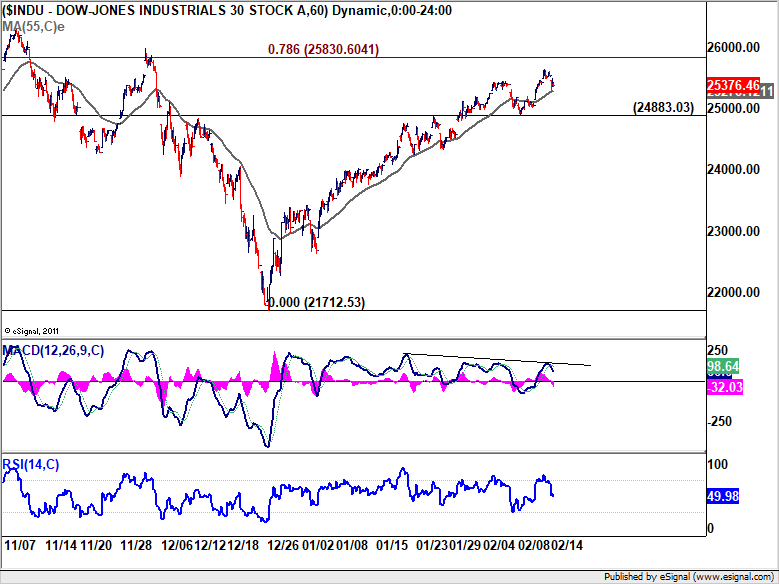
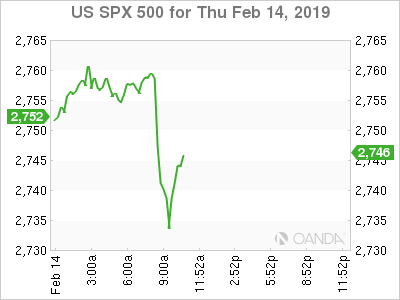
As for stocks, DOW hit as low as 25308.09 earlier today but it's back above 25370, just down -0.66. That isn't too serious. Our own view, as mentioned multiple times before, is that we expect further loss of momentum as DOW approaches 78.6% retracement of 26951.81 to 21712.53 at 25830.60. And the rebound from 21712.53 should complete around that level. However, break of 24883.03 support is needed to be the first sign of near term reversal. Otherwise, we cannot declare we're correct yet.
For now,
- DOW is down -0.66%.
- S&P 500 is down -0.44%
- NASDAQ is down -0.13% only.
- 10-year yield is down -0.045 at 2.663, back below 2.7.
- 30-year yield is down -0.024 at 3.010, still above 3.0.
In Europe:
- FTSE closed up 0.28%, thanks to decline in Sterling.
- DAX closed down -0.51%.
- CAC closed up 0.04% only, erased nearly all early gains.
- German 10-year yield is down -0.022 at 0.105. It breached 0.1 handle earlier.
December Retail Sales: Really?
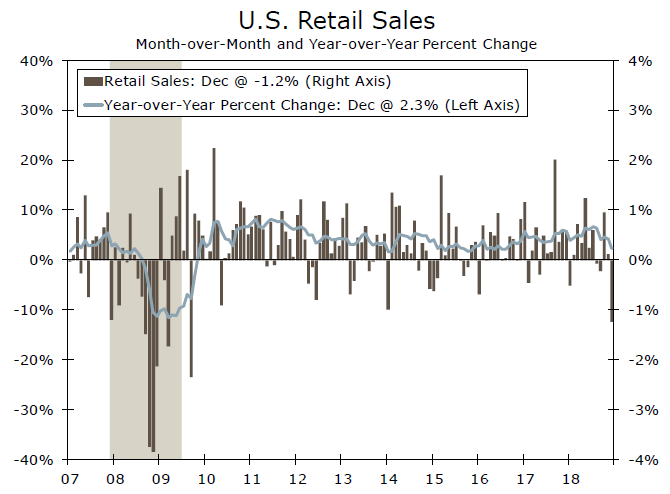
Retail sales unexpectedly plunged 1.2% in December. The fact that this was not the usual collection process opens up potential issues that make us wary to believe that consumer spending is collapsing.
Not a Clean Read
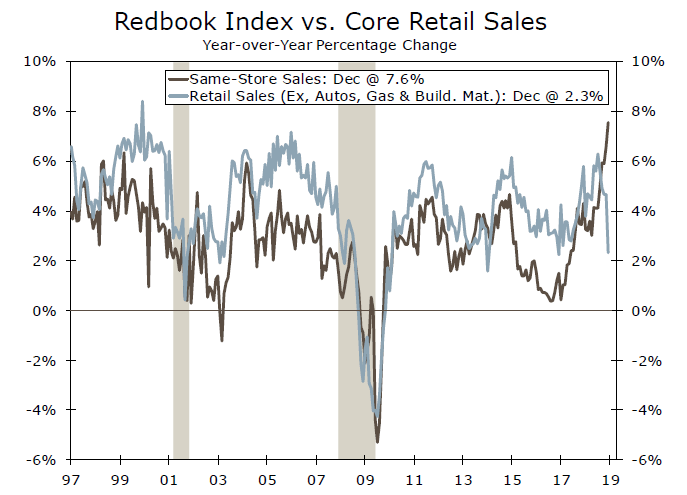
We have a dose of skepticism regarding today's reported drop in December's retail sales. The weekly Redbook index for same-store sales was up more than 6% for every week in December. To put an exclamation point on that, the 9.3% year-over-year increase in same-store sales in the final week of 2018 was the biggest on records that date back to the mid-1990s. That looks at odds with control group sales falling 1.7% in December to end the year up only about 2.0%.
The Redbook survey measures sales at brick and mortar stores, representing over 80% of the Department of Commerce's official retail sales report in regards to dollar value. But the country's biggest online retailer, Amazon, also reported record holiday sales. That is hard to square with non-store sales, i.e., online sales, falling nearly 4% in December.
The weak numbers could be a function of consumers continuing to shift their holiday shopping to November, when control group sales rose 1.0%. But, we think that issues surrounding the government shutdown may be at play. The Department of Commerce noted in its release that "data collection and processing were delayed." It is possible that later collection led respondents to incorporate more of their January sales, which is typically the slowest month of the year for retailers. With seasonal factors expecting a jump in December, the adjusted numbers were depressed more than usual.
Every category of retailers, besides motor vehicle dealers and building materials, saw a decline in December. While some declines can be reasoned, and were even partially expected, like the price-related decline at gasoline stations, we are having difficulty squaring declines elsewhere, such as the 3.9% drop at non-store retailers.
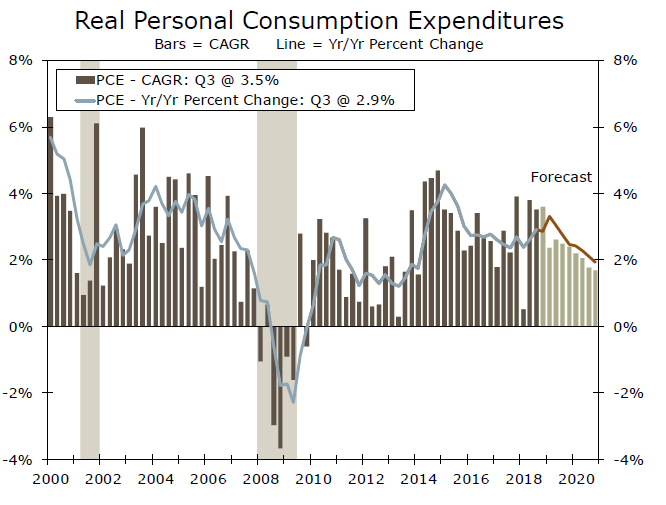
While "processing and data quality were monitored", the fact that this was not the usual collection process opens up potential issues that make us wary to believe that consumer spending is collapsing. Even excluding volatile components, such as food services, autos, gas and building materials, control group retail sales declined 1.7%, the largest month-over-month decline in the series since 2000. This sales group feeds directly into the Bureau of Economic Analysis' calculation of personal consumption expenditures (PCE). But while this measure represents the sale of goods, and with two-thirds of consumer spending stemming from services, we do not expect the December print to completely weigh on PCE in the fourth quarter. That said, even if revisions are in order for December sales, this number will show up in the Q4 GDP release, and we will likely have to modestly cut-back our expectation for a 3.6% annualized pace of PCE in Q4.
This morning's release suggests the economy entered 2019 with less momentum than we previously expected. However, with much of the release hard to square with other variables, we expect revisions may be in order, and are wary to believe consumer spending is collapsing.
Fed Brainard: Downside risks have definitely increased and gathering
Fed Governor Lael Brainard warned that "downside risks have definitely increased relative to that modal outlook for continued solid growth." She added that back in December, she "had already noted that crosscurrents were increasing and that tailwinds were dying down, and I think that is even more true today because of those downside risks that are gathering."
Brainard pointed to external risks including China's economy, US-China trade conflicts and Brexit. And, "We are a very international economy... Our financial system in particular has shown itself to be very responsive to earnings abroad, to financial conditions and volatility abroad. So, yeah, I'm very attentive to the international outlook."
Domestically, she believed that momentum has been "pretty solid". But today's retail sales numbers "caught my eye". Though she "didn't want to make too much" of one month's numbers.
On monetary policy, she's "comfortable waiting and learning" and the current policy is "in a good place". And, she would weigh "what move, if any, later in the year". Meanwhile, she added that the "balance sheet normalization process should probably come to an end later this year".
Markets Fall Out of Love for Dollar and Stocks on Huge Retail Sales Miss
The greenback and US stocks quickly reversed gains after US retail sales for the month of December posted the biggest drop since 2009. The biggest market reaction on the softer data was the move in Treasuries, with the 10-year yield Treasury falling 5.7 basis points to 2.646%. While the December sales data was delayed due to the government shutdown, the concern is that it could reflect that US might be closer to the end of the current economic cycle. Markets may remain very cautious until we see the January data.
Kicking the can down the road appears to key theme for major political events in the financial markets. Last night, President Trump suggested he would be open to moving back the deadline for higher tariffs on Chinese imports by 60 days. After resorting to a stop-gap funding bill to end a record long government shutdown, US lawmakers are planning to vote today on a spending bill that will avoid another government shutdown. President Trump is not happy with the bill, but he has suggested he would approve the plan and possibly use emergency powers to secure additional funding for his border security. On the Brexit front, Parliament will vote on amendments, but a key vote on the Cooper-Boles amendment, which would delay Breixt and would take a no-deal off the table, will not be voted on until the February 27th vote.
- CNY – Trump considers 60-day trade truce extension
- EUR – Germany barely avoids recession
- STOCKS – Industrials lead rally higher in Europe
- GOLD – Saved by the retail sales miss
- OIL – Crude demand will fall if the US continues to show weakness
- ZAR – Rand remains very vulnerable on Eskom, election and investment grade risk
CNY
President Trump appears set on alleviating market fears that we will see an escalation in the trade war and a 60-day extension will allow for more negotiations to tackle key differences on intellectual property theft, forced technology transfer and further opening up their markets to US companies. Conflicting reports this morning circulated that the both sides were close to a deal, while the Wall Street Journal noted talks remain deadlocked and that China is attempting to persuade the US by committing to large purchases of semiconductors and other goods. Markets appear convinced we will not see an escalation in tariffs and that trade talks will continue for some time.
EUR
Germany escaped a recession and their flat quarterly GDP reading did not derail eurozone’s growth of 0.2%. The market reaction to German GDP was limited, the euro rose slightly as expectations seem to be very poor for German economic releases. The data confirmed the narrative we saw from leading indicators that Germany is weak. The worst could be over for Germany, as poor weather conditions, weakness in the auto sector, and weakness from trade war effect on global growth may not remain in the following quarters.
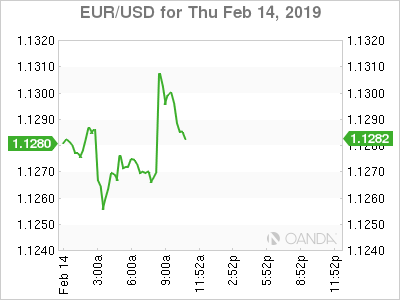
The euro remains stubbornly stuck in a tight range and momentum may not accelerate until we see price breakaway from 1.12 or 1.1550.
Stocks
European markets climbed higher as Industrials and Technology stocks outperformed. Industrials got a boost from Airbus SE earnings results that showed a beats on both EBIT and revenue, also benefitting from the news they will abandon their unprofitable A380 jet and lock in $1.2 billion in charges, paving the way for a fresh beginning for incoming CEO Faury in April. Shares of Rolls Royce and Safran also surged on the news of the scrapping of the A380 superjumbo.
GOLD
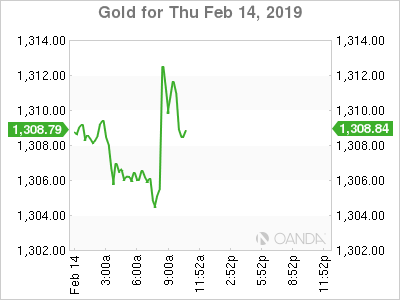
Gold prices were dangerously close to collapsing below the $1,300 before the huge retail sales miss, helped the yellow metal recover most of its earlier losses. The precious metal could remain stable as markets will remain uncertain if the US economic cycle is over.
OIL
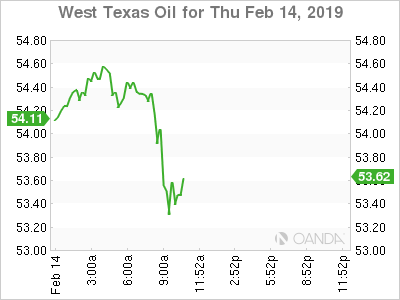
Crude prices remained capped despite OPEC’s reduction of 800,000 barrels a day in January, more cuts pledged from Saudi Arabia and record low exports sent to the US from Venezuela and Saudi Arabia. Weakening data from the US could put a dent in the demand argument for higher prices and we may see traders pare bullish bets.
ZAR
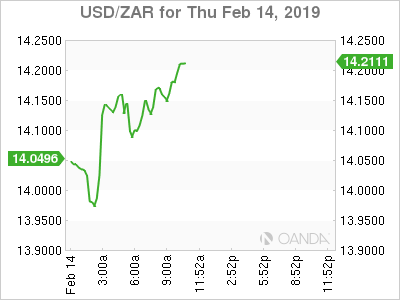
South African President Cyril Ramaphosa is under pressure to save power utility Eskom SOC Holdings Ltd. After multiple days of rolling blackouts, the financial crisis for the state-owned electricity company is reaching a climax as the company appears poised to run out of money by April. South Africa’s largest labor group has been protesting the Eskom job losses and the timing of this crisis is terrible for Ramaphosa as he seeks reelection in May. The Eskom impact to the economy along with uncertainty in the general elections in May and the risk of losing investment grade status could continue to weigh on the rand.
MARKET WRAP: US Retail Sales Data Took The Markets By Surprise
Equity markets lost its mojo after the US retail sales number came much lower than expected, in fact, it was the worst reading since 2009.
Stocks
- The S&P 500 Index plunged 0.54 percent as of 15:20 London time. The underwhelming US retail was the main reason for pessimism
- The Nasdaq 100 dropped 0.20 percent and the Dow Jones Industrial Average also fell by 0.64 percent.
- The Stoxx Europe 600 Index reacted to weak Eurozone GDP reading and fell by 0.30 percent.
- Germany’s DAX Index dropped due to the poor German GDP reading. It dropped nearly 0.61% percent.
- The MSCI Emerging Market Index also moved lower by 0.55% on a volume of 4.8M shares.
Currencies
- The Dollar Spot Index finally dropped today by 0.68% due to the weak US economic readings, the retail sales number fell came in at -1.8% vs forecast of 0.0%.
- The Euro jumped higher mainly due to the weakness in the dollar and the EUR/USD moved higher by 0.10 percent; the high of the day was $1.1310.
- The British pound dropped below a critical level of 1.28 against the dollar due to the Brexit chaos. It GBP/USD fell by 0.58%, the low of the day was 1.2775 and high of the day was 1.2878.
- The Japanese Yen came back as a risk off haven and jumped by 0.15 percent.
Bonds
- The yield on 10-year Treasuries sank by four basis points to 2.65 percent.
- Germany’s 10-year dropped four basis point to 0.09 percent.
- Britain’s 10-year yield also fell by four basis point to 1.195.
Commodities
- West Texas Intermediate crude dropped by 1.28 percent to $53.74.
- Gold failed to move higher because of the lack of any solid demand and moved lower by 0.26%. The support of $1,300 is under focus.
GBPCAD Builds Base around 50.0% Fibonacci; Remains in Upward Range
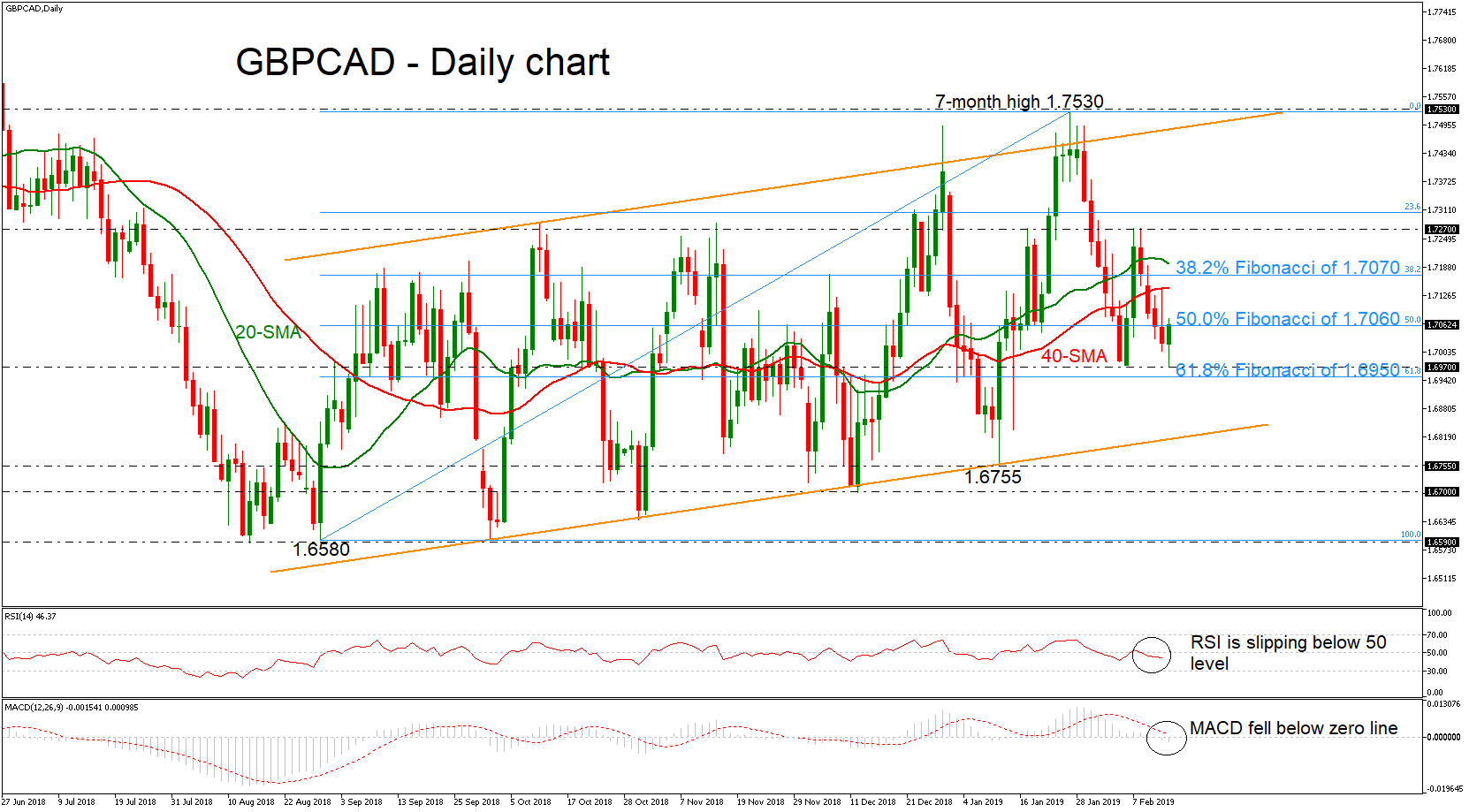
GBPCAD hit the 1.6970 support again following last week’s pullback from the 1.7270 resistance level, slipping below the 20-and 40-simple moving averages (SMAs) in the daily timeframe. The pair has been trading within an ascending sloping channel over the last six months, despite the upside spikes towards 1.7530. The short-term bias looks negative as the MACD keeps losing ground below its red trigger line, while the RSI seems to be making its way down below its 50-neutral mark.
Should the pair extend declines below the 1.6970 and the 61.8% Fibonacci retracement level of the upleg from 1.6580 to 1.7530, it could hit the uptrend line of the upward range around 1.6830. Below that, the focus could shift straight to 1.6755, switching the medium-term bullish bias to bearish.
On the upside, resistance could occur around the 50.0% Fibonacci of 1.7060 before touching the 40- and then the 20-SMAs at 1.7140 and 1.7190 respectively. Also, the 38.2% Fibonacci of 1.7170 stands between the moving averages, possibly acting as a strong resistance obstacle as well. Higher still, the next resistance could come from the 1.7270 barrier.
Concluding, the medium-term picture continues to look predominantly bullish with trading activity remaining within the upward sloping channel.
US: Retail Sales End 2018 on a Very Sour Note
Retail sales fell 1.2% in December, deeply disappointing expectations for a modest 0.1% gain. What's more, the prior two months of data were revised down 0.1 p.p. each to 1.0% for October and 0.1% in November. The December drop erased the prior two months of gains, bringing the level of sales back below the September level.
Given a drop in fuel prices, receipts at gasoline stations fell a hefty 5.1% on the month, while sales at eating and drinking establishments also dropped 0.7%, both weighing on the headline.
On the other hand, sales at autos & auto parts dealers and building materials stores, which rose 1.0% and 0.3% m/m respectively, provided some support.
Excluding the above volatile categories (gas, autos, building materials, and food services), the so-called 'control group' used in calculating GDP fared even worse. It fell 1.7% on the month, disappointing market expectations for a 0.4% gain. Delving into the details, all of the categories under the control group fell on the month, with pullbacks ranging from 0.1% at electronics & appliance stores to 4.9% at sporting goods stores. Factoring in mixed revisions to the prior two months of data, sales in the control group lost steam at the end of the year, but still grew by 1.8% ann. in the fourth quarter.
Key Implications
December's delayed retail report shows that good things do not always come to those who wait. It appears that the sharp stock market selloff, coupled with uncertainty related to trade tensions with China and a late-year government shutdown, prompted American consumers to keep a tighter grip on their wallets. Between downward revisions to the prior months' data and December marking the steepest monthly drop in sales since September 2009, it's hard to find a silver lining in today's report.
Consumer spending in the fourth quarter is now tracking around 2.6%, still a pretty good showing, but weaker than we previously expected. December also provides a weak handoff to 2019. The fact that the government shutdown dragged on until late January and consumer confidence fell on the month, further reinforces a soft quarter for consumer spending at just below 1.5% annualized. Similar to last year, however, we don’t expect the first-quarter performance to set the pace for the rest of the year. Provided that we see no major disruption on the trade front or another government shutdown, a resilient labor market should shore up spending, with consumption expected to rebound in the second quarter.
Sunset Market Commentary
Markets
Global core bonds gained ground today with US Treasuries outperforming German Bunds. Risk sentiment initially remained rather upbeat as political events in the US are making progress (border wall legislation and US-Sino trade talks). European equities moved higher at the opening bell, but the tide turned immediately afterwards. Global core bonds took a first step higher as investors cautiously moved into safe havens. Germany narrowly avoided a recession as Q4 GDP printed 0.0% (QoQ) vs. -0.2% in Q3 and below expectations (+0.1%). The Q4 EMU GDP result was confirmed at 0.2% MoM and 1.2% YoY. Global core bonds took a second step higher as US retail sales heavily missed expectations across the field. The December results set multiyear lows. At the time of writing, the German yield curve is flattening with changes in the range of-4.3 bps (30-yr) to +0.2 bps (2-yr). The US yield curve moves lower too with changes up to -6.6 bps (5-yr). Spanish PM Pedro Sanchez was rumoured to announce the date for early Spanish elections, but the announcement has not (yet) been made. Peripheral spreads remained stable with only the Italian spread rebounding (+5 bps) after the tightening of late.
EUR/USD touched a minor correction low early in Asia. From there, the pair hovered up and down in the upper half of the 1.12 big figure. The EMU data (German & EMU GDP) were weak but mainly as expected. EUR/USD revisited the mid 1.1250 area early in European dealings as EMU equities took a hesitant start. However, despite pending event risks (trade, Spain, EMU data…) there was no concrete enough trigger to push EUR/USD to the 1.1216/1.1187 support. Dollar momentum improved again slightly as investors awaited the US data, but USD bulls were wrong-footed. Jobless claims were weakish and retail sales (-1.2% M/M, -1.7% M/M control group) missed the consensus by a huge margin. Euro softness was replaced by USD weakness. EUR/USD rebounded to the 1.13 area. USD/JPY dropped from 111+ levels and is nearing the 110.50 area. Key question is whether this kind of USD softness will be able to save EUR/USD in a sustainable way if no euro supportive news kicks in.
With no important UK data scheduled, sterling traders mainly watched the political rhetoric in the run-up this evening’s Brexit vote in Parliament. UK PM May asks Commons to confirm her mandate no renegotiate the Irish Backstop arrangement. However, division in the Conservative party remains a source of uncertainty on the outcome of the vote. BoE’s Vlieghe indicated that a no-deal Brexit is more likely to require an easing of monetary policy than a tightening, downplaying recent balanced, moderately optimistic BoE talk. GBP selling accelerated during the day. EUR/GBP trades currently in the 0.8830 area. Cable dropped below the 1.28 handle despite broad USD weakness.
News Headlines
December US retail sales were horrible. The headline reading fell by 1.2% M/M, the biggest decline in 9 years. All but 2 of 13 major retail categories showed a drop. The retail sales control group, which excludes food services, car dealers, building-materials stores and gasoline stations and is used as a proxy for consumer demand in GDP, fell by 1.7% M/M. That’s the worst outcome since the Sept 11 terror attacks.
Bank of England chief economist Vlieghe sounded dovish. He thinks that the economy should be treated with a slower pace of rate hikes than previously anticipated even if the UK secures a brexit deal. More specifically, he has in mind 1 hike a year. This downgrade mainly reflects global weakness starting to impact the UK economy.
Canadian Manufacturing Sales End 2018 on a Negative Note
Canadian manufacturing sales fell 1.3% in December, following on a 1.7% drop in the month prior (previously reported as -1.4%). This came against expectations for a 0.4% increase. After accounting for price changes, the print was just as disappointing, with volumes down 1.2%.
Non-durable goods, down 3.4%, accounted for more than the headline decline. Petroleum and coal products were the culprit, falling 10.4% (down 5.2% in real terms). Nevertheless, negative performance was seen across other categories. Food sales (-2.3%) and chemicals (-1.8%) also had a notably poor showing that impacted the headline number.
Durable good sales were slightly better, up 0.6% on the month. This was driven by increases in primary metals (+3%) and nonmetallic mineral products manufacturing (+6.1%). Providing a slight negative offset were sales of machinery (-1.8%), and transportation equipment, which fell 0.4% on the back of substantial declines in sales for the volatile ship and boat building (-16.2%, following two months of double-digit gains) and motor vehicle body and trailers (-7.1%).
Regionally, manufacturing sales were down in six provinces. Alberta and Ontario drove the overall decline, with manufacturing sales falling 4% and 0.8%, respectively. Sales also disappointed in Saskatchewan (-6.3%), Manitoba (-4.7%), British Columbia (-3.1%), and New Brunswick (-8.8%). Providing a modest offset were sales in Quebec (+0.5%) and the remaining Atlantic provinces.
Inventories reversed from their decline last month, moving up 0.3%, leaving the inventory-to-sales ratio up at 1.5 – a level last seen in 2009. Forward-looking indicators were mixed, with new orders down 0.8% and unfilled orders up 0.6%.
Key Implications
This was definitely a sour ending to the year for Canadian manufacturers. The decline, while in some sense not very eye-catching given the weakness in the energy sector was largely pre-written, was made worse by the negative revision to the prior month's data and the broad-based nature of the decline, which spanned 12 of the 21 industries. The conclusion from several recent indicators (for instance, retail sales, wholesale trade) is a reaffirmation of the ongoing moderating growth narrative.
The release leaves our GDP tracking for Q4 at 0.9%, slightly below the Bank of Canada's assumption in its latest MPR (1.3%).
Again, sub-par manufacturing performance is still expected in the near-term, as Alberta's production curtailment plan starts to reflect in manufacturing sales volumes during the new year. Combining this with other moderating economic indicators, we expect the Bank of Canada to remain on the sidelines in the near term, especially given that there are no signs of emerging inflationary pressures.
Energy Sector Woes Showing Up in Canadian Manufacturing
Highlights:
- Manufacturing sales were down 1.4% in December, with a similar decline in volumes.
- As in November, petroleum and coal sales were a source of weakness.
- We don’t think the manufacturing component of GDP will be as weak as this report indicates, thanks to an increase in inventories and weakness concentrated in petroleum and coal sales. A similar dynamic played out last month. That said, manufacturing was likely a drag on GDP in December.
Our Take:
The final quarter of last year was a tough one for Canada’s manufacturing sector. Sales volumes were down an annualized 4%, retracing much of the previous quarter’s increase. Emerging weakness in the energy sector was apparent with petroleum and coal sales posting sizeable declines in November and December (though refinery maintenance shutdowns were reportedly a factor as well). Other manufacturing subsectors provided little support. While US manufacturing held up well toward the end of last year, the global industrial sector and manufacturing sentiment weakened over the second half of 2018. Some of that might be washing up on Canada’s shores. With manufacturing once again acting as a slight drag on growth—and the energy sector slowdown showing up in other areas (drilling activity fell sharply toward the end of last year)—it looks like we won’t see much of a rebound in December GDP following November’s 0.1% decline. That is consistent with our monitoring for GDP growth to slow to 1.1% annualized in Q4/18 from 2% in the prior quarter.