

Sample Category Title
EUR/GBP Mid-Day Outlook
Daily Pivots: (S1) 0.8742; (P) 0.8769; (R1) 0.8794; More...
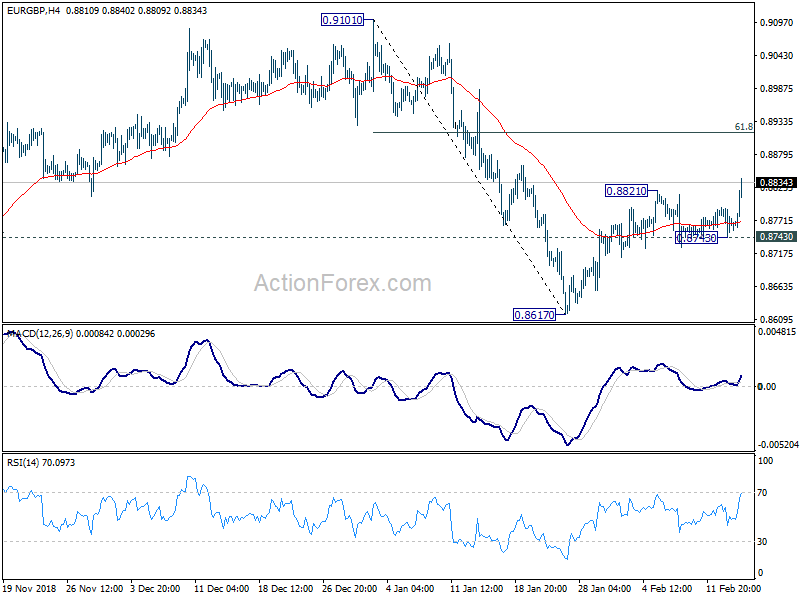
EUR/GBP's break of 0.8821 confirms resumption of rise from 0.8617. Intraday bias is back on the upside for 61.8% retracement of 0.9101 to 0.8617 at 0.8916. Break will pave the way back to 0.9101 key resistance. On the downside, break of 0.8743 support is needed to indicate completion of the rebound. Otherwise, near term outlook will stay cautiously bullish in case of retreat.
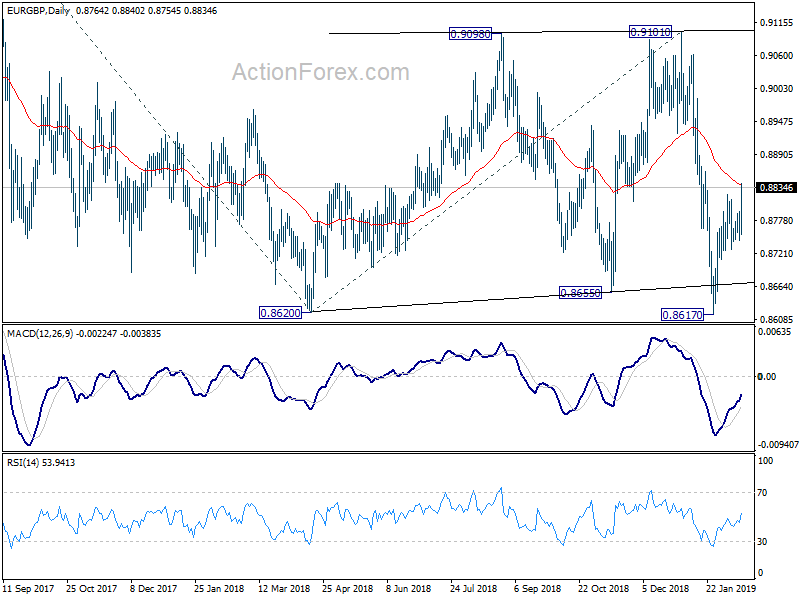
In the bigger picture, EUR/GBP is seen as staying in long term range pattern started at 0.9304 (2016 high). The medium term range is set between 0.8620 and 0.9101. Downside breakout of 0.8620 will pave the way back to 0.8312 support . Break of 0.9101 will bring retest of 0.9304/5 resistance.
USD/JPY Mid-Day Outlook
Daily Pivots: (S1) 110.59; (P) 110.83; (R1) 111.23; More...
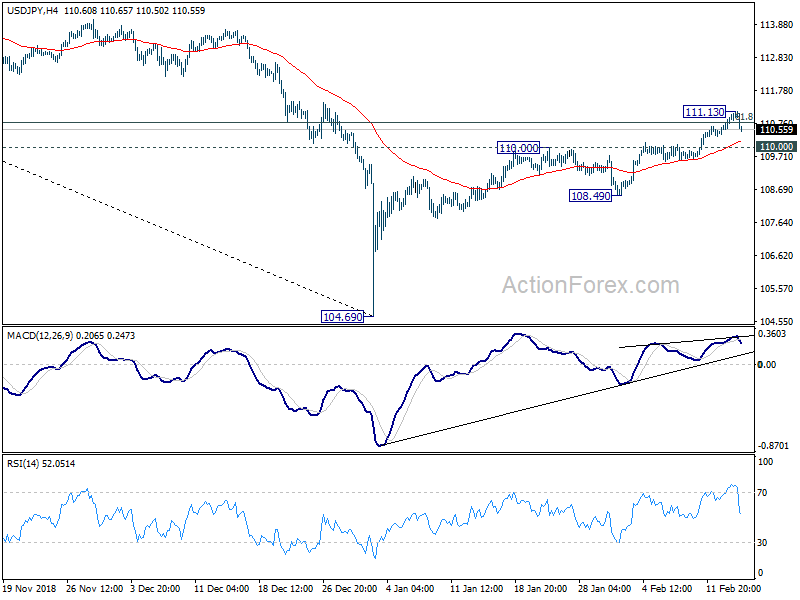
USD/JPY rose to 111.13 earlier today but retreated sharply since then. Intraday bias is turned neutral first. Focus remains on whether USD/JPY could sustain above 61.8% retracement of 114.54 to 104.69 at 110.77. If yes, further rise could be seen back to 114.54 resistance. However, break of 110.00 will suggest that it's actually rejected after the rebound from 104.69 was skewed slightly upwards. In that case, the original bearish view will be revived and further fall should be seen through 108.49 support.
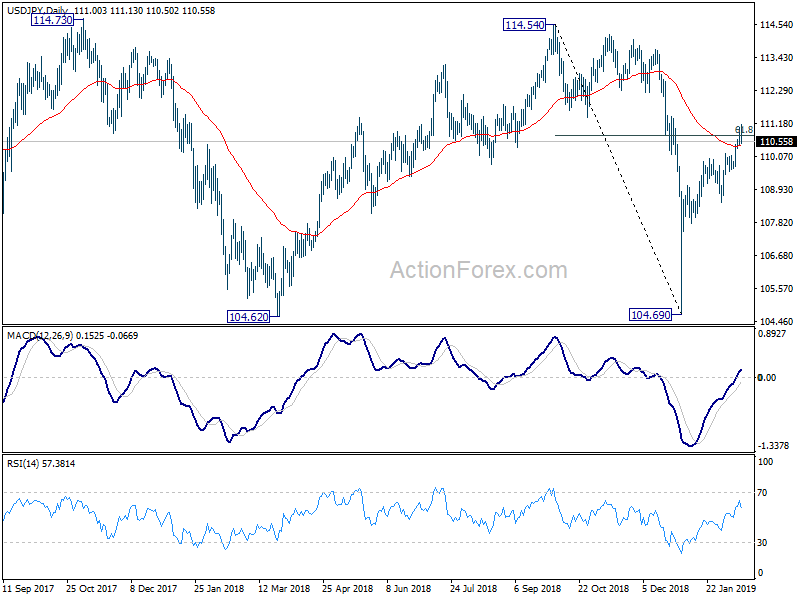
In the bigger picture, the stronger than expected rebound from 104.69 mixed up outlook. We'd turn neutral for now first. On the upside, firm break of 110.77 resistance will suggest that fall from 114.54 has completed at 104.69 already. Such decline is seen as a leg in the corrective pattern from 118.65, which might be finished too. Decisive break of 114.54 will confirm this case and target 118.65 and above. On the downside, break of 108.49 support will turn focus back to 104.62/9 support zone instead.
USD/CHF Mid-Day Outlook
Daily Pivots: (S1) 1.0059; (P) 1.0077; (R1) 1.0110; More....
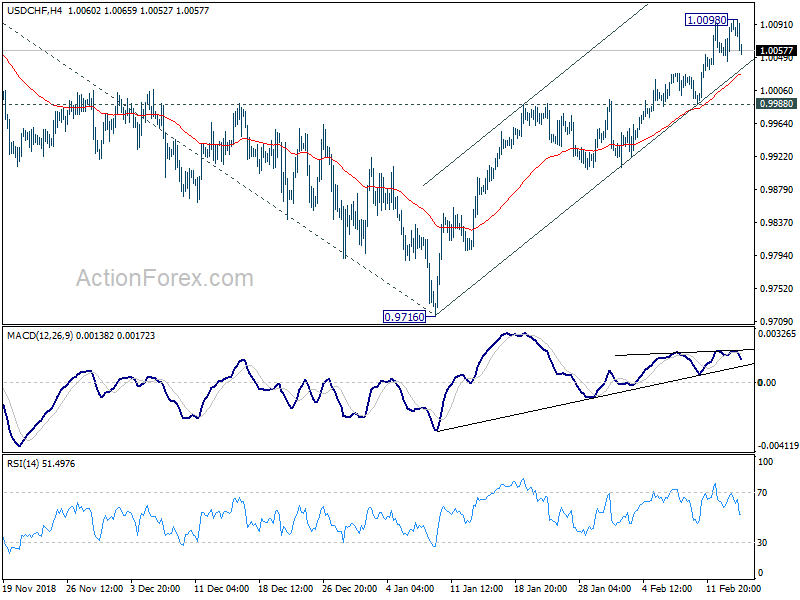
USD/CHF edged higher to 1.0098 but retreated sharply since then. Intraday bias is turned neutral again for some consolidations. For now, further rise is still expected as long as 0.9988 support holds. Above 1.0098 will target 1.0128 first. Break will confirm resumption of up trend from 0.9186. Next target will be 100% projection of 0.9541 to 1.0128 from 0.9716 at 1.0303. However, break of 0.9988 will indicate rejection by 1.0128 and turn intraday bias to the downside for 0.9716 support again.
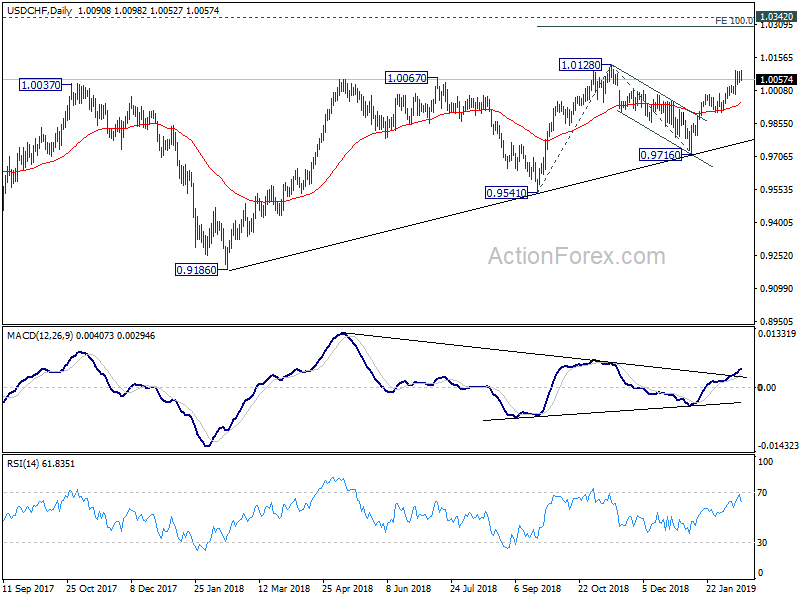
In the bigger picture, USD/CHF drew strong support from medium term trend line and rebounded. That suggests rise from 0.9186 is still in progress. Further break of 1.0128 will confirm up trend resumption and target 1.0342 key resistance. Nevertheless, break of 0.9716 will dampen this bullish view and at least bring deeper fall to 0.9541 key support.
GBP/USD Mid-Day Outlook
Daily Pivots: (S1) 1.2808; (P) 1.2883; (R1) 1.2922; More....
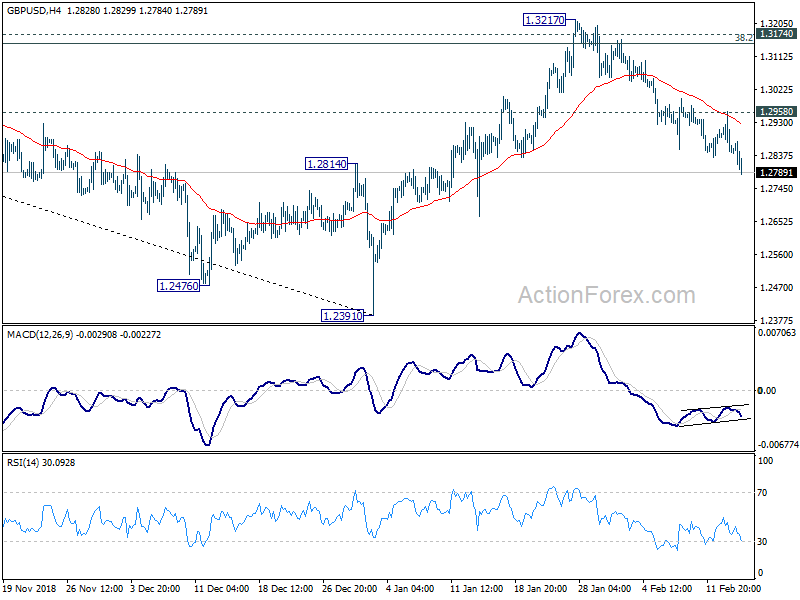
GBP/USD's fall from 1.3217 continues to as low as 1.2784 so far. Intraday bias remains on the downside for further decline. As noted before, we're holding on to the view that rebound from 1.2391 has completed at 1.3217 already, after rejection by 1.3174 key resistance. Further decline should be seen to retest 1.2391 low. On the upside, break of 1.2958 resistance is needed to be the first sign of short term bottoming. Otherwise, further decline is expected even in case of recovery.
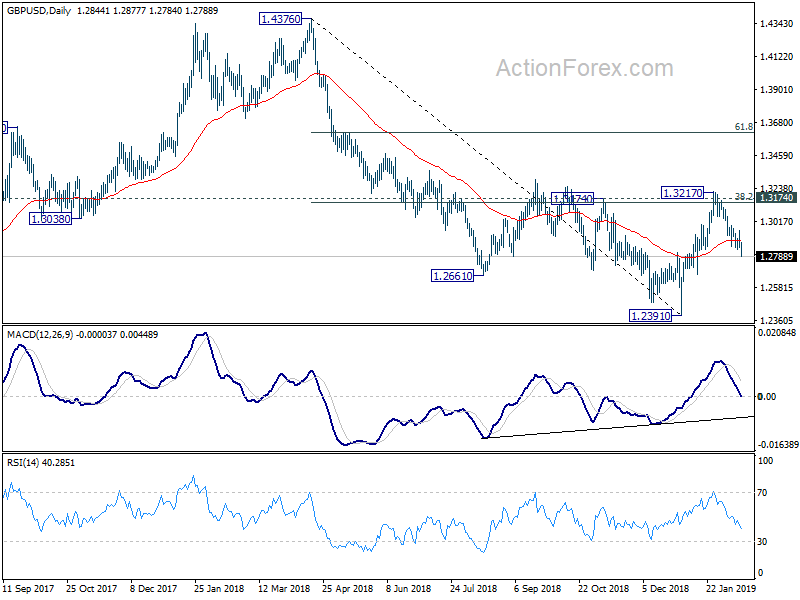
In the bigger picture, the rejection by 1.3174 key resistance revived the original view on GBP/USD. That is, decline from 1.4376 is possibly resuming long term down trend from 2.1161 (2007 high). Firm break of 1.2391 will solidify this bearish case and target 1.1946 (2016 low). However, decisive break of 1.3174 will invalidate this bearish case again and turn outlook bullish.
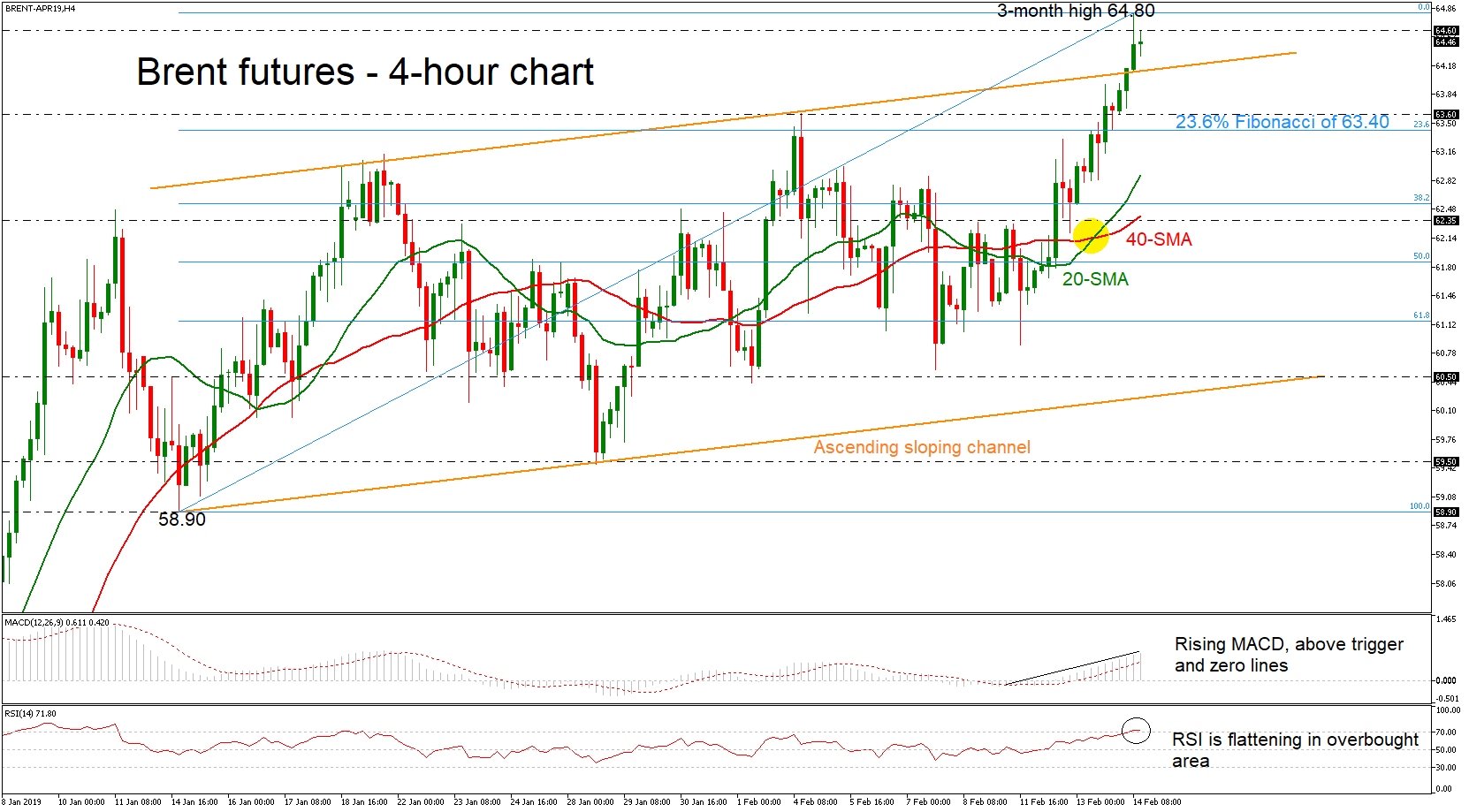
Brent Crude Oil Futures Advance above Ascending Channel; Reach 3-Month Peak
Brent crude oil futures are holding slightly below the three-month high of 64.80 after the aggressive bullish run above the ascending sloping channel. The MACD oscillator suggests that the market might improve in the coming sessions as it is moving upwards, however, the RSI indicator seems to be overbought as it reached the 70 level in the 4-hour chart.
Should the price move higher, it would increase the chances for an extension of the bullish correction and would challenge the next critical level of 68.35, identified by the peak on November 16.
On the flipside, if the price manages to drop below the upper band of the channel, nearby support could come from the 63.60 barrier, which stands near the 23.6% Fibonacci retracement level of the upward movement from 58.90 to 64.60, around 63.40. A decisive close below the latter level would drive the price towards the 20-simple moving average (SMA) currently at 62.90.
In the short-term picture, the price currently stands above the bullish cross within the 20- and 40-SMAs and the structure has turned to a more bullish one.
EUR/USD Mid-Day Outlook
Daily Pivots: (S1) 1.1233; (P) 1.1288; (R1) 1.1315; More.....
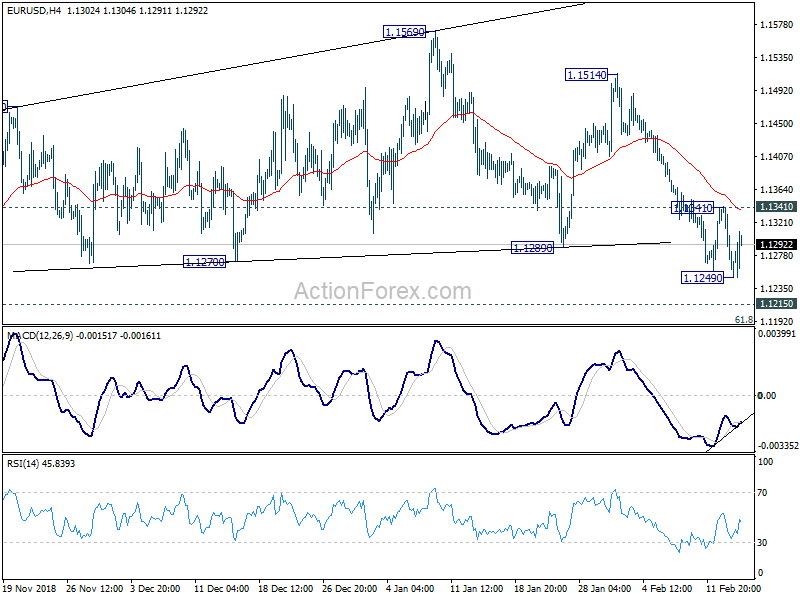
EUR/USD dipped to 1.1249 earlier today but quickly recovered, with 4 hour MACD crossed above signal line again. Intraday bias turned neutral first. Further decline is still expected with 1.1341 minor resistance intact. We'd holding on to the view that consolidation from 1.1215 has completed. Below 1.1249 will target 1.1215 first. Break will resume larger down trend from 1.2555 to 1.1186 fibonacci level. However, considering bullish convergence condition in 4 hour MACD, break of 1.1341 resistance will dampen out view and suggest short term bottoming. Intraday bias will be turned back to the upside to extend the consolidation from 1.1215 with another rising leg.
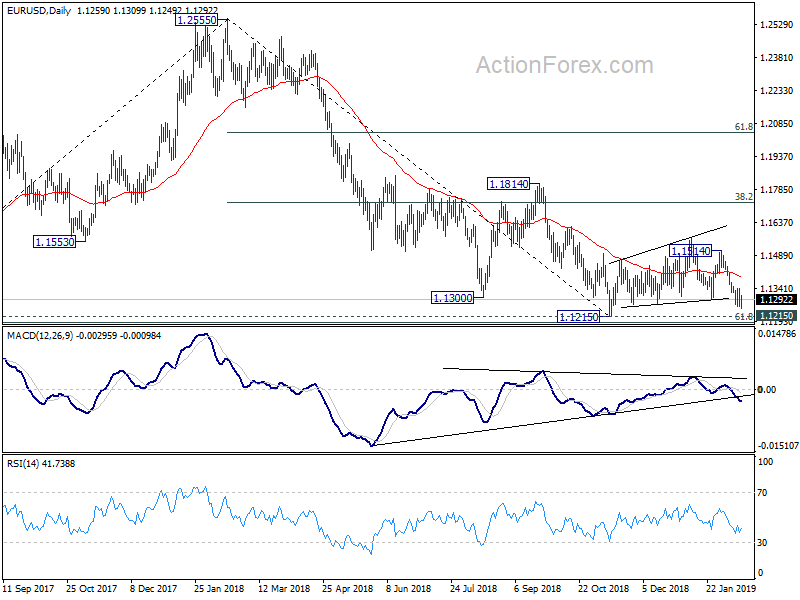
In the bigger picture, as long as 1.1814 resistance holds, down trend down trend from 1.2555 medium term top is still in progress and should target 61.8% retracement of 1.0339 (2017 low) to 1.2555 at 1.1186 next. Sustained break there will pave the way to retest 1.0339. However, break of 1.1814 will confirm completion of such down trend and turn medium term outlook bullish.
Dollar Dives as Retail Sales Dropped Most in 9-Years, But GBP and CAD Even Worse
Dollar suffers steep selloff in early US session after shockingly poor retail sales data. The release of December's sales was delayed due to government shutdown. And we've finally got some clues on how bad the US economy performed on double whammy on shutdown and trade war. Nevertheless, for now, Canadian Dollar is even worse as pressured by poor manufacturing sales. Sterling follows as second weakest as Brexit debate resumes in the Commons. Dollar is just the third weakest.
New Zealand Dollar remains the strongest one for today, feeling the residual support from RBNZ. Euro overtakes Australian Dollar as the second strongest. Germany GDP stagnated in Q4 but after all, it did avoid a technical recession, same as Japan. Yen is trying to fight back as stocks are possibly reversing. We pointed out earlier that stocks and bonds had no positive reaction to the so-called positive news regarding US-China trade talks. Both China and Hong Kong stocks closed lower. Japan JGB yield ended with a decline. German 10-year yield is also currently down. Is a 60-days extension in trade truce something good for the economy? Remember that the current tariffs will likely be in place in case of extension. Such an act is only prolonging the damages.
Technically, EUR/USD and USD/CHF looks set to turn into consolidation after Dollar's pull back. GBP/USD is still in near term decline. AUD/USD is staying in near term consolidation. USD/CAD looks set to resume rebound from 1.3068 and focus is immediately on 1.3329 resistance. EUR/GBP is eyeing 0.8821 resistance and break will resume rebound from 0.8617. The most interesting development is in USD/JPY. Deep decline now argues that prior stronger than expected rise was just false dawn. We'll see.
In other markets, FTSE is currently up 0.30%. DAX is down -0.11%. CAC is up 0.39%. German 10-year yield is down -0.035 at 0.092, below 0.1 handle. Earlier in Asia, Nikkei dropped -0.02%. Hong Kong HSI dropped -0.23%. China Shanghai SSE dropped -0.05%. Singapore Strait Times rose 0.26%. Japan 10-year JGB yield dropped -0.0039 to -0.01, staying negative.
US retail sales suffered largest drop in nine-years, jobless claims rose
Dollar is sold off sharply in early US session after way worse than expected December retail sales data. Headline sales dropped -1.2% versus expectation of 0.1% mom rise. That's also the largest decline in nine years since September 2009. Ex-auto sales dropped -1.8% versus expectation of 0.0% mom.
Initial jobless claims rose 4k to 239k in the week ending February 9, above expectation of 225k. Four-week moving average of initial claims rose 6.75k to 231.75k, highest since January 27, 2018. Continuing claims rose 37k to 1.773M in the week ending February 2. Four-week moving average of continuing claims rose 9k to 1.750M.
Also from the US, headline PPI slowed to 2.0% yoy in January, down from 2.5% yoy and missed expectation of 2.1% yoy. PPI core slowed to 2.6% Yoy, down from 2.7% yoy but beat expectation of 2.5% yoy.
From Canada, manufacturing sales dropped -1.3% mom in December versus expectation of 0.7% mom. New housing price index was flat mom in December.
BoE Vlieghe: Monetary easing more likely than tightening in case of no-deal Brexit
BoE MPC member Gertjan Vlieghe said in a speech that the net balance of economic news for the UK has been to the "downside". Thus, the appropriate pace of monetary tightening is "somewhat slower" than he judged a year ago.
A quarter point hike per year is a "reasonable central case" if global growth does not slow materially further, path to Brexit is in line with government's state objective, and pay growth continues at current pace. Though, if a no-deal Brexit is avoided, he expects Sterling to appreciate. And the exact degree of future monetary tightening will depend on appreciation of the Pound.
However, a no-deal outcome is "likely to lead to some economic disruption, which could possibly be severe". There are some paths that are possible, but "not all are equally likely". In his view, "an easing or an extended pause in monetary policy is more likely to be the appropriate policy response than a tightening." But he emphasized that BoE will have to "judge in real time" how well inflation expectations remain anchored, and how households and businesses are reacting to the disruptions.
Eurozone GDP grew 0.2% qoq in Q4, matched expectations
Eurozone GDP grew 0.2% qoq in Q4, unchanged from Q3 and matched expectations. Annually, GDP grew 1.2% yoy. Over the whole year 2018, GDP grew 1.8%. Employment grew 0.3% qoq, above expectation of 0.2% qoq. EU 28 GDP grew 0.3% qoq, 1.4% yoy. Over 2018, EU 28 GDP grew 1.9%.
German economy stagnated in Q4, but narrowly escaped recession
Germany GDP stagnated in Q4 and grew 0.0% qoq. But that was enough to narrow escape a technical recession following -0.2% contraction in Q3. Over the year, GDP grew 0.9% yoy in Q4. For the whole year of 2018, GDP grew 1.5% calendar adjusted.
Looking at the details, positive contributions mainly came from domestic demand. Development of foreign trade did not make a positive contribution to growth in the fourth quarter. According to provisional calculations, exports and imports of goods and services increased nearly at the same rate in the quarter-on-quarter comparison.
German Economy Ministry said in its monthly bullet that Brexit and trade dispute are still causing uncertainty. Also, indicators point to subdued development of exports in the coming months. Nevertheless, construction boom is likely to continue given increase in orders and private consumption is likely to continue doing well.
Japan GDP rebounded with weak momentum, but avoided recession
Japan GDP grew 0.3% qoq in Q3, rebounding from Q3's -0.6% qoq contraction. The good news is that Japan avoided a technical recession of two consecutive quarters of contraction. But growth was disappointing and missed expectation of 0.4% qoq. GDP deflator dropped -0.3% yoy, slightly better than expectation of -0.4% yoy.
Japanese Economy Minister Toshimitsu Motegi said in a statement that "the economy is in gradual recovery as growth is led by private demand". However, "China-bound exports of information-related materials have weakened as the Chinese economy slowed". He added that the government needs to "monitor uncertainty over global economic outlook including Chinese economy as well as fluctuations in financial markets."
China trade balance: Import from US plunged -41%, from EU rose...
January trade data from China showed a better picture. Exports grew 9.1% yoy versus expectation of -3.3% yoy. Import dropped only -1.5% yoy versus expectation of -10.2% yoy. Trade surplus narrowed to USD 39.2B, above expectation of USD 32.0B. However, it should be noted that the trade data for the first two months of the year are generally distorted by Lunar New Year holidays. Thus, while the data are positive, it's premature to declare that the slow down in China has bottomed. Nevertheless, it's worth noting that exports to the US since tariff war began were not so much affected. But import from the US plunged, quite notably in Jan by -41%.
In USD terms, total trade rose 4.0% yoy to USD 396B. Import dropped -1.5% yoy to USD 178.4B. Exports rose 9.1% yoy to USD 217.6B. Trade surplus rose to USD 39.2B.
With EU, total trade rose 12.4% yoy to USD 64.5B. Import rose 8.2% yoy to 25.9B. Export rose 15.3% yoy to USD 38.6B. Trade surplus was at USD 12.7B.
With US, total trade dropped -13.9% yoy to USD 45.8B. Import dropped -41% yoy to USD 9.2B. Exports dropped -2.4% yoy to USD 36.5B. Trade surplus was at USD 27.3B.
With AU, total trade rose 10.8% yoy to USD 14.4B. Import rose 7.6% yoy USD 10.1B. Export rose 19.1% yoy to USD 4.3B. Trade deficit was at USD 5.8B.
EUR/USD Mid-Day Outlook
Daily Pivots: (S1) 1.1233; (P) 1.1288; (R1) 1.1315; More.....
EUR/USD dipped to 1.1249 earlier today but quickly recovered, with 4 hour MACD crossed above signal line again. Intraday bias turned neutral first. Further decline is still expected with 1.1341 minor resistance intact. We'd holding on to the view that consolidation from 1.1215 has completed. Below 1.1249 will target 1.1215 first. Break will resume larger down trend from 1.2555 to 1.1186 fibonacci level. However, considering bullish convergence condition in 4 hour MACD, break of 1.1341 resistance will dampen out view and suggest short term bottoming. Intraday bias will be turned back to the upside to extend the consolidation from 1.1215 with another rising leg.
In the bigger picture, as long as 1.1814 resistance holds, down trend down trend from 1.2555 medium term top is still in progress and should target 61.8% retracement of 1.0339 (2017 low) to 1.2555 at 1.1186 next. Sustained break there will pave the way to retest 1.0339. However, break of 1.1814 will confirm completion of such down trend and turn medium term outlook bullish.
Economic Indicators Update
| GMT | Ccy | Events | Actual | Forecast | Previous | Revised |
|---|---|---|---|---|---|---|
| 23:50 | JPY | GDP Q/Q Q4 P | 0.30% | 0.40% | -0.60% | |
| 23:50 | JPY | GDP Deflator Y/Y Q4 P | -0.30% | -0.40% | -0.30% | |
| 00:00 | AUD | Consumer Inflation Expectation Feb | 3.70% | 3.50% | ||
| 00:01 | GBP | RICS House Price Balance Jan | -22.00% | -20.00% | -19.00% | |
| 02:00 | CNY | Trade Balance (USD) Jan | 39.2B | 32.0B | 57.1B | |
| 02:00 | CNY | Trade Balance (CNY) Jan | 271B | 235B | 395B | |
| 07:00 | EUR | German GDP Q/Q Q4 P | 0.00% | 0.10% | -0.20% | |
| 07:30 | CHF | Producer & Import Prices M/M Jan | -0.70% | -0.40% | -0.60% | |
| 07:30 | CHF | Producer & Import Prices Y/Y Jan | -0.50% | -0.20% | 0.60% | |
| 10:00 | EUR | Eurozone GDP Q/Q Q4 P | 0.20% | 0.20% | 0.20% | |
| 10:00 | EUR | Eurozone Employment Q/Q Q4 P | 0.30% | 0.20% | 0.20% | |
| 13:30 | CAD | Manufacturing Sales M/M Dec | -1.30% | 0.70% | -1.40% | -1.70% |
| 13:30 | CAD | New Housing Price Index M/M Dec | 0.00% | 0.00% | 0.00% | |
| 13:30 | USD | Initial Jobless Claims (FEB 09) | 239K | 225K | 234K | 235K |
| 13:30 | USD | PPI M/M Jan | -0.10% | 0.10% | -0.20% | -0.10% |
| 13:30 | USD | PPI Y/Y Jan | 2.00% | 2.10% | 2.50% | |
| 13:30 | USD | PPI Core M/M Jan | 0.30% | 0.20% | -0.10% | 0.00% |
| 13:30 | USD | PPI Core Y/Y Jan | 2.60% | 2.50% | 2.70% | |
| 13:30 | USD | Retail Sales Advance M/M Dec | -1.20% | 0.10% | 0.20% | 0.10% |
| 13:30 | USD | Retail Sales Ex Auto M/M Dec | -1.80% | 0.00% | 0.20% | 0.00% |
| 15:00 | USD | Business Inventories Nov | 0.20% | 0.60% | ||
| 15:30 | USD | Natural Gas Storage | -237B |
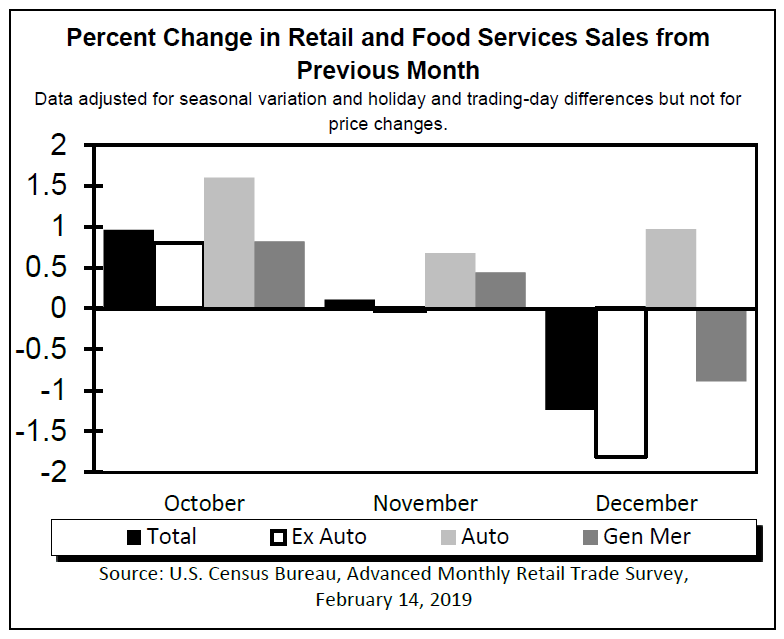
Dollar under pressure on shockingly poor retail sales, jobless claims missed too
Dollar is sold off sharply in early US session after way worse than expected December retail sales data. Headline sales dropped -1.2% versus expectation of 0.1% mom rise. That's also the largest decline in nine years since September 2009. Ex-auto sales dropped -1.8% versus expectation of 0.0% mom.
Initial jobless claims rose 4k to 239k in the week ending February 9, above expectation of 225k. Four-week moving average of initial claims rose 6.75k to 231.75k, highest since January 27, 2018. Continuing claims rose 37k to 1.773M in the week ending February 2. Four-week moving average of continuing claims rose 9k to 1.750M.
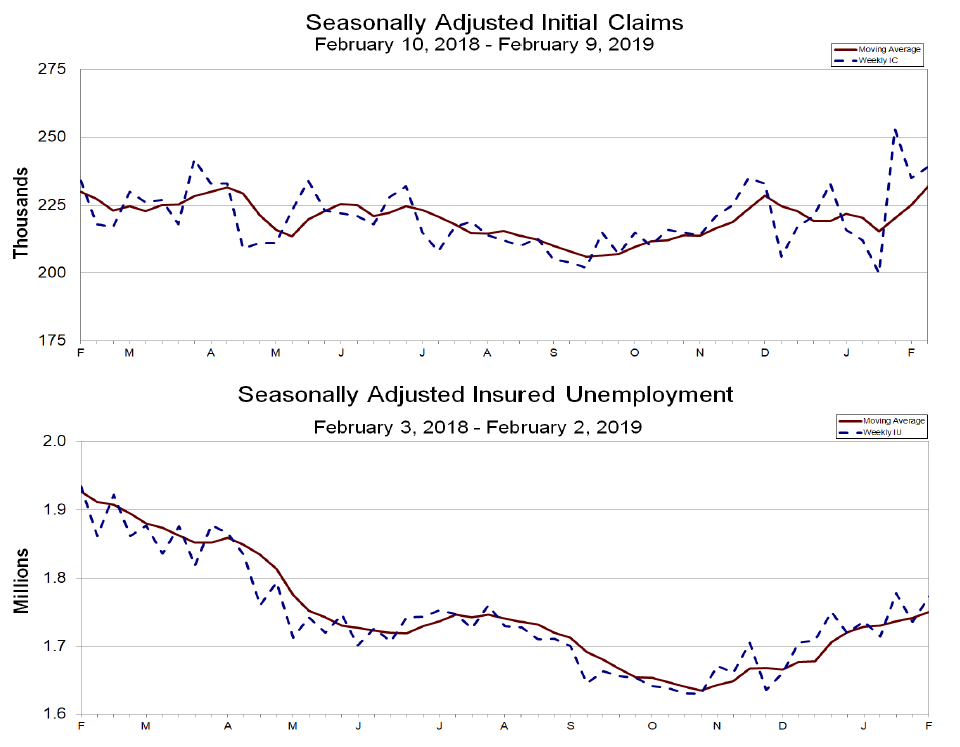
Also from the US, headline PPI slowed to 2.0% yoy in January, down from 2.5% yoy and missed expectation of 2.1% yoy. PPI core slowed to 2.6% Yoy, down from 2.7% yoy but beat expectation of 2.5% yoy.
From Canada, manufacturing sales dropped -1.3% mom in December versus expectation of 0.7% mom. New housing price index was flat mom in December.
GBP/USD: Weakens On Further Bear Pressure Towards 1.2720 Zone
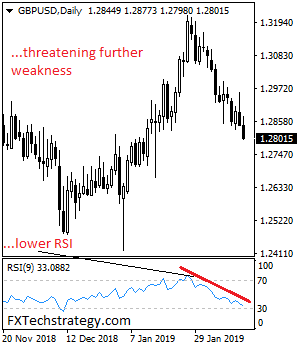
GBPUSD weakens on further bear pressure towards 1.2720 zone following its Wednesday losses. Support sits at 1.2750 level. Further down, support comes in at the 1.2700 level where a break will turn focus to the 1.2650 level. Further down, support lies at the 1.2600 level. Below here will set the stage for more weakness towards the 1.2550 level. On the upside, resistance stands at the 1.2850 with a turn above here allowing for additional strength to build up towards the 1.2900 level. Further out, resistance stands at the 1.2950 level followed by the 1.3000 level. On the whole, GBPUSD faces further downside pressure on more weakness.
Canadian Dollar Quiet ahead of Manufacturing, Retail Sales
USD/CAD is showing little movement in the Thursday session. Currently, the pair is trading at 1.3268, up 0.09% on the day. On the release front, Canada releases manufacturing production, which is expected to rebound with a gain of 0.3%, after two successive declines. In the U.S., it’s a busy schedule. the markets are braced for a slowdown in consumer spending. Retail sales and core retail sales are expected to dip in January, with readings of 0.1% and 0.0%, respectively. PPI is forecast to post a gain of 0.1% and preliminary UoM consumer sentiment is expected to climb to 93.3 points. On Friday, Canada releases foreign securities purchases and the U.S. posts UoM consumer sentiment.
Investors are feeling more optimistic over the U.S-China trade war. On Thursday, China announced that exports had jumped 9.1% in January on an annualized basis, compared to the forecast of -3.2%. This was a strong rebound from December, when exports fell 4.4%. Talks between the U.S. and China are continuing, and the big question is will President Trump suspend the March 1 deadline to impose new tariffs on China. The U.S. has threatened to raise tariffs on some $200 billion of Chinese goods from 10% to 25%, but Trump has said he could let the deadline pass if there is progress in the talks. Risk appetite has improved this week, but the Canadian dollar has failed to make any headway against the greenback.
Taking a page out of the Federal Reserve’s playbook, the Bank of Canada has become more dovish, after raising rates three times in 2018. The BoC is expected to stay on the sidelines at its next policy meeting in March 6. The Canadian economy is being hampered by the global trade war, which has reduced the demand for Canadian exports. Weak oil prices have also weighed on the economy and kept inflation at low levels. The Canadian dollar is under pressure, and has lost close to 1.0% in February.