

Sample Category Title
Into US session: Sterling weakest as Brexit debate resumes
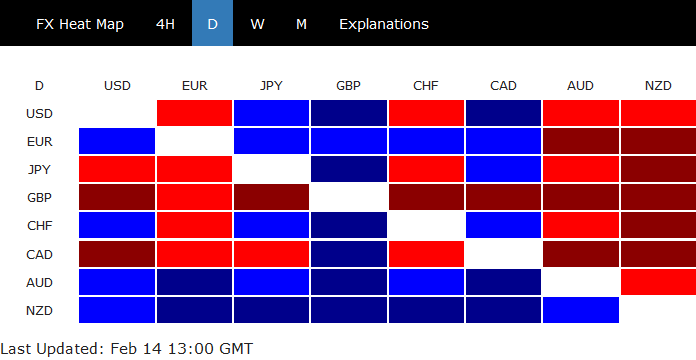
Entering into US session, Sterling is trading as the weakest one for today as Brexit debate resumes in the Commons. Canadian Dollar follows as the second weakest. Though, Yen remains broadly pressured as the third weakest. On the other, New Zealand and Australian Dollar are the strongest ones for today but both lacks follow through buying.
There are talks that investors sentiments are boosted by positive development in US-China trade talks. But we'd like to reiterate that such optimism is not really reflected in stocks and bond markets. Both China and Hong Kong stocks closed lower. Japan JGB yield ended with a decline. German 10-year yield is also currently down. Is a 60-days extension in trade truce something good for the economy? Remember that the current tariffs will likely be in place in case of extension. Such an act is only prolonging the damages.
Anyway, it's still positive that Japan and German avoided recessions in H4 even though the later's GDP was stagnated. At least Germany was not in contraction back then. Eurozone GDP growth also matched expectation. Focus will now turn to US PPI, jobless claims and more importantly retail sales.
In Europe, currently:
- FTSE is up 0.43%.
- DAX is up 0.26%.
- CAC is up 0.66%.
- German 10-year yield is down -0.014 at 0.112.
Earlier in Asia;
- Nikkei dropped -0.02%.
- Hong Kong HSI dropped -0.23%.
- China Shanghai SSE dropped -0.05%.
- Singapore Strait Times rose 0.26%.
- Japan 10-year JGB yield dropped -0.0039 to -0.01, staying negative.
DAX Climbs as Investors Optimistic about US-China Talks
The DAX index continues to gain ground this week. In the Thursday session, the DAX is at 11,192, up 0.23% on the day. On the release front, German Preliminary GDP improved to 0.0%, shy of the estimate of 0.1%. Eurozone Flash GDP posted a second successive gain of 0.2%. On the employment front, eurozone flash employment change edged higher to 0.3%, above the forecast of 0.2%. On Friday, the eurozone releases trade balance.
German and eurozone GDP were unimpressive in the fourth quarter. German Preliminary GDP was flat at 0.0%, after a decline of 0.2% in the third quarter. The eurozone’s largest economy managed to avoid a technical recession, which is two consecutive declines in quarterly growth. Germany’s manufacturing industry is limping, with factory orders and industry production posting declines in December. Eurozone Flash GDP remained stuck at 0.2%, shy of the forecast of 0.3%. On an annualized basis, fourth quarter growth was 0.9% in Germany and 1.2% in eurozone, both weaker than the third quarter numbers. If eurozone and German data remains soft in the first quarter, the DAX could lose ground.
Investors are feeling more optimistic over the U.S-China trade war. On Thursday, China announced that exports had jumped 9.1% in January on an annualized basis, compared to the forecast of -3.2%. This was a strong rebound from December, when exports fell 4.4%. Talks between the U.S. and China are continuing, and the big question is will President Trump suspend the March 1 deadline to impose new tariffs on China. The U.S. has threatened to raise tariffs on some $200 billion of Chinese goods from 10% to 25%, but Trump has said he could let the deadline pass if there is progress in the talks. Risk appetite has improved this week, boosting the DAX by 2.4% this week.
German and eurozone GDP were unimpressive in the fourth quarter. German Preliminary GDP was flat at 0.0%, after a decline of 0.2% in the third quarter. The eurozone’s largest economy managed to avoid a technical recession, which is two consecutive declines in quarterly growth. Germany’s manufacturing industry is limping, with factory orders and industry production posting declines in December. Eurozone Flash GDP remained stuck at 0.2%, shy of the forecast of 0.3%. On an annualized basis, fourth quarter growth was 0.9% in Germany and 1.2% in eurozone, both weaker than the third quarter numbers. If eurozone and German data remains soft in the first quarter, the DAX could lose ground.
BOJ Tapers? It’s Only Yield Curve Control Adjustment. Fragile Growth Outlook Despite Rebound in 4Q18
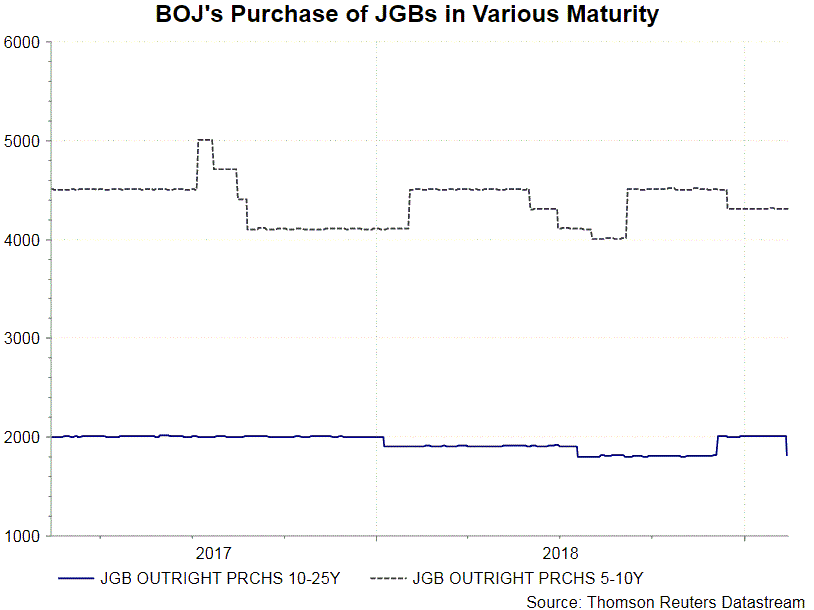
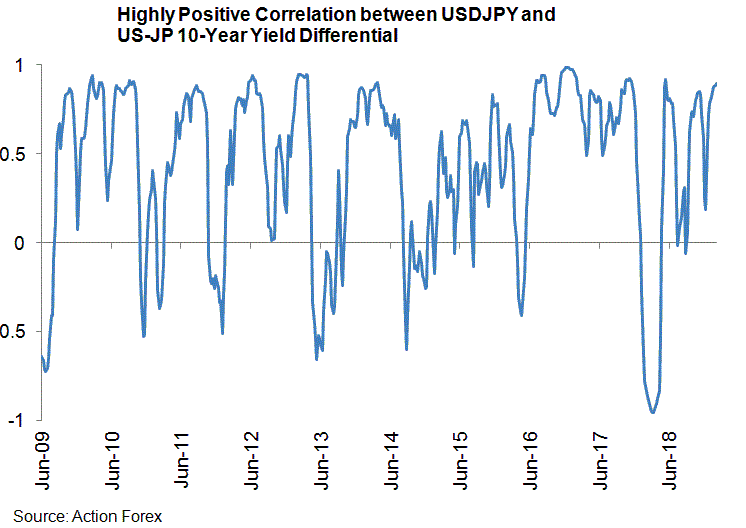
BOJ’s asset purchase activities have again caught market attention. Talks of tapering heightened last week as the central bank offered to buy 180B yen of 10- to 25-year JGBS. Concerns over a less accommodative monetary environment eased as the central bank offered to buy 430B yen of 5- to 10- year JGBs today. BOJ’s asset purchase program does affect the movement of Japanese yen, given the high correlation between USDJPY and the differential of corresponding Treasury yields. As Japan continues to struggle with achieving the inflation target, while risks of falling back to recession remains genuine, the central bank should stick to ultra accommodative monetary policies. Any reduction in asset buying would likely be adjustment to yield curve control.
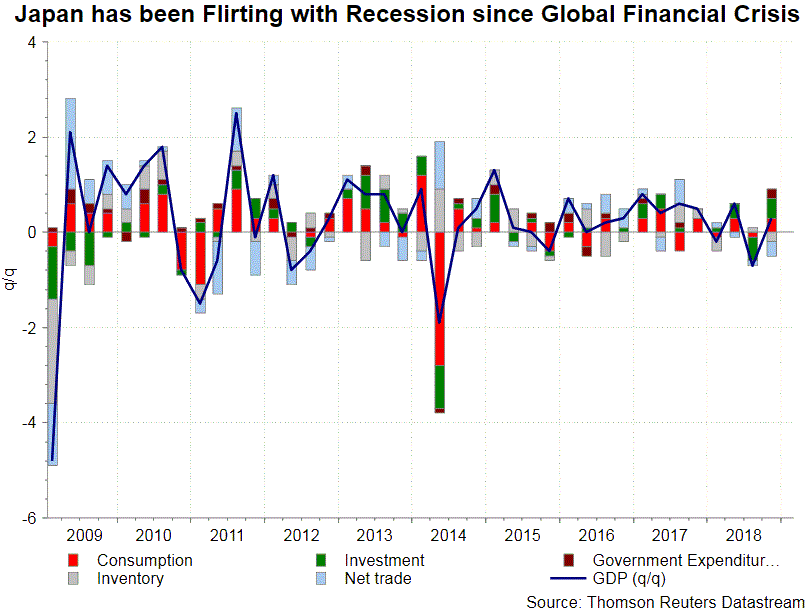
Japan again avoided recession as GDP growth rebounded to an annualized +1.4% q/q in 4Q18, following a -2.5% contraction in the prior quarter. The biggest drivers of growth in the past quarter were capital expenditure and consumption. In the aftermath of 2007/08 global financial crisis, Japan fell into technical recession- two consecutive quarters of negative economic growth- thrice, and recorded negative growth in 2Q14, 4Q15, 1Q18 and 3Q18. Meanwhile, inflation has remained weak. As the government kicks off the new VAT, up from 8% to 10%, in October 2019, personal consumption would worse off, dampening GDP growth. Whether inflation would be boosted by higher VAT remains uncertain. Despite the fact that inflation spiked in 2014 as the government raised the VAT from 5% to 8%, the case this time might not be the same. Meanwhile, the inflationary effect of VAT rise would only be temporary and would not help on the longer-term inflation outlook.
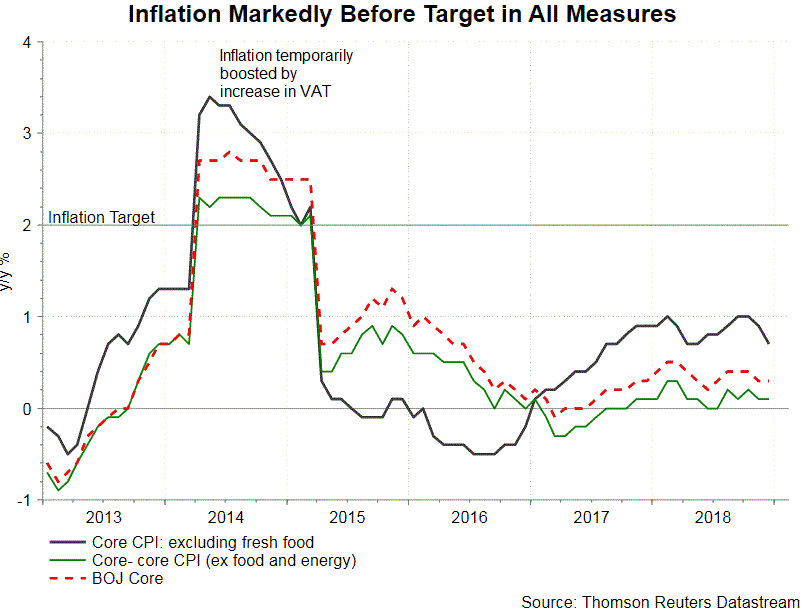
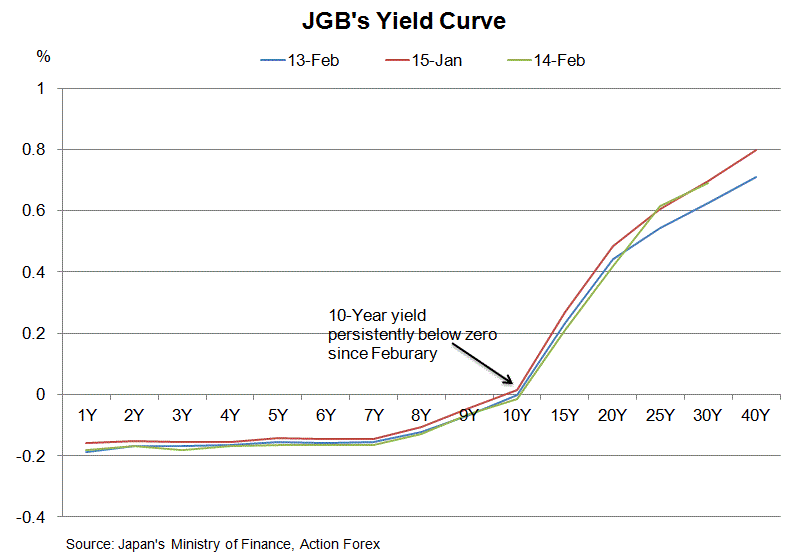
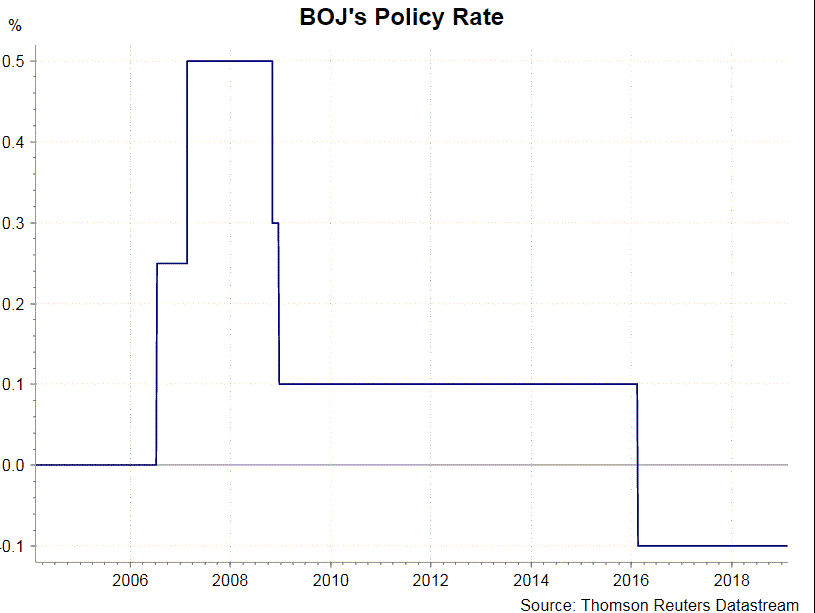
BOJ’s existing monetary policy tools include keeping policy rate at -0.1%, purchasing JGBs at a pace of 80 trillion yen/ year and yield curve control -keeping 10-year JGB yield at 0%, with trading band at +0.2% and – 0.2%. The fragile domestic economic backdrop, together global economic slowdown, suggests that BOJ would have no choice by retain the current ultra-accommodative monetary policy. Testifying before the Parliament, Governor Haruhiko Kuroda pledged that it’s his responsibility to achieve the +2% inflation target. Indeed, the central bank is in a dilemma in keeping the policy rate low. In theory, low interest rates are stimulus for growth. In the case of Japan, the low rate environment has encouraged FX carry trades using Japanese yen as the funding currency, sending yen higher during risk-averse period. A strong yen is detrimental for the country’s exports. While we are not convinced that the current sets of monetary policy would help the country get out of disinflation, it appears that there’s not much the central bank can do.
EUR/USD – Euro Shrugs Off Soft German, Eurozone GDP
EUR/USD has ticked higher in the Thursday session. Currently, the pair is trading at 1.1272, up 0.10% on the day. In economic news, it’s a busy day. German Preliminary GDP improved to 0.0%, shy of the estimate of 0.1%. Eurozone Flash GDP posted a second successive gain of 0.2%. On the employment front, eurozone flash employment change edged higher to 0.3%, above the forecast of 0.2%. In the U.S., the markets are braced for a slowdown in consumer spending. Retail sales and core retail sales are expected to dip in January, with readings of 0.1% and 0.0%, respectively. PPI is forecast to post a gain of 0.1% and preliminary UoM consumer sentiment is expected to climb to 93.3 points.
Economic activity in the eurozone remains weak, underscored by GDP releases in the fourth quarter. German Preliminary GDP was flat at 0.0%, after a decline of 0.2% in the third quarter. The eurozone’s largest economy managed to avoid a technical recession, which is two consecutive declines in quarterly growth. Germany’s manufacturing industry is limping, with factory orders and industry production posting declines in December. Eurozone Flash GDP remained stuck at 0.2%, shy of the forecast of 0.3%. On an annualized basis, fourth quarter growth was 0.9% in Germany and 1.2% in eurozone, both weaker than the third quarter numbers. If eurozone and German data continues to sag, traders can expect the euro to lose ground in the near term.
The U.S-China trade spat has triggered a slowdown in China’s economy, which has dampened global growth. There was positive news on Thursday, as China announced that exports had jumped 9.1% in January on an annualized basis, compared to the forecast of -3.2%. This was a strong rebound from December, when exports fell 4.4%. Despite these rosy numbers, the outlook for global growth remains weak. Much will depend on whether there is a breakthrough in trade talks between the U.S. and China. President Trump has said that he could suspend the March 1 deadline to impose new tariffs on China, if the negotiations continue.
Germany Avoids A Technical Recession
Notes/Observations
- Germany Q4 Preliminary GDP data misses expectations but avoided entering a technical recession
- UK PM May facing another possible defeat in Parliament on a Brexit motion
- Continued optimism on US-China trade front ahead of high-level talks
Asia:
- (CN) China Jan Trade Balance: $39.2B v $34.3Be v $57.1B prior; Exports Y/Y: +9.1% v -3.3%e; Imports Y/Y: -1.5% v -10.2%e; Trade Balance with US: $27.3B v $29.9B m/m with components falling
- Japan Q4 Preliminary GDP Q/Q: 0.3% v 0.4%e v -0.6% prior; Annualized GDP Q/Q: 1.4% v 1.4%e
- Australia Feb Consumer Inflation Expectation: 3.7%e v 3.5% prior - Japan Economy Min Motegi: Economy was in gradual recovery; expected domestic demand to lead recovery
- BoJ said to be shifting its view on CPI, to wanting to include effect of sales tax hike (prior wanted to exclude, on grounds it would be a temporary factor); now expects targeted policies to nearly offset the effect
Europe:
- UK Jan RICS House Price Balance: -22% v -20%e (lowest since July 2012)
- European Research Group (ERG) of Conservative Brexiteers said not to support a Government motion being put to a vote on Thursday, Feb 14th
- EU's Tusk: we're still waiting for concrete and realistic Brexit proposals
- UK Labour Party leader Corbyn faces up to 10 resignations from the Labour frontbench if he fails to throw his party's weight behind a fresh attempt to force Theresa May to submit her Brexit deal to a referendum in a fortnight's time
- Bank of Italy Gov Visco: Italy's problem is debt; need to intervene on public debt
Americas:
- US President Trump said to be considering 60-day extension for deadline on higher tariffs for China imports
- Fed's Harker (non-voter, moderate): In a wait and see mode on rates; saw one rate hike in 2019 and one in 2020
- Senator Rubio (R-FL) plans to 'soon' introduce legislation aimed at taxing corporate stock buybacks like dividends, move seen as attempt to increase corporate investment
- Bi-partisan US Senators renewed Russia sanctions bill to punish the country for interfering in the US elections and exerting malign influence in Syria and aggression in the Ukraine
Macro
- (DE) Germany: German The economy barely escaped a technical recession with a flat q/q reading following the -0.2% q/q print in Q. There was no breakdown, but DeStatis reported that the domestic economy remained robust, with slightly higher private consumption, but a marked rise in public consumption and a strong rise in investment. There was no positive contribution from net exports, however. Companies remain sufficiently optimistic about the outlook to invest, which backs the Bundesbank's assessment that this is a temporary slowdown, partly impacted by one off factors.
- (US) United States: Reports suggest that President Trump is considering pushing back the deadline for imposing higher tariffs on Chinese imports by 60 days. Trump said on Tuesday that he was open to letting the March deadline slide, if the two countries are close to a deal that addresses deep structural changes to China's economic policies, although he also said he was not "inclined" to do so.
- (CN) China: January saw a $39.2B surplus in January, down from $57.1B in December thanks to an unexpected bounce in exports and a decline in imports. Exports jumped 9.1% y/y, rebounding from December's -4.4% y/y reading. The improvement may have been a function of Lunar New Year in early February and an attempt to ship goods ahead of the holidays. Imports fell 1.5% y/y after tumbling 7.6% y/y previously. The surplus with the U.S. fell to $27.3B v $29.9B m/m, and down from the recent high of $35.4B in November.
- (JP) Japan: Q4 GDP recovered as expected with the weather-related temporary factors that impacted Q3 GDP unwound. Consumption recovered 0.6% from -0.2% dip. Exports also recovered 0.9% in Q4 after a -1.4% drop in Q3 & business investment jumped 2.4%.
Equities
- Indices [Stoxx600 +0.30% at 366.06, FTSE +0.21% at 7,205.83, DAX +0.13% at 11,181.57, CAC-40 +0.39% at 5,094.30, IBEX-35 +0.03% at 8,985.25, FTSE MIB -0.36% at 19,917.50, SMI +0.58% at 9,212.90, S&P 500 Futures +0.27%]
Equities
- European Indices trade higher across the board continuing the positive week on as positive earnings help lift the market. This follows on from a mixed session in Asia overnight and higher US futures overnight with reports President Trump considering a 60 day extension for China tariff deadline adding to the risk on tone. On the corporate front shares of Swiss name Nestle trades higher after earnings and continued organic growth in 2019; Astrazeneca rises on a strong top and bottom line beat while Airbus rises over 4% on earnings and guidance which came in ahead of consensus, and as as expected to announced the end of A380 production. French Car giant Renault rises on inline results, with Schneider Electric, Cap Gemeni, Commerzbank, DSM and Microfocus among some of the other notable names rising on earnings this morning. Meanwhile Credit Suisse falls on earnings; Aegon drops on an earnings miss with Unibail, Air Liquide, Puma and Ashmore among other notable decliners on earnings. Elsewhere Restaurant Group shares decline following the stepping down of its CEO; Motif Bio drops over 80% after receiving complete Response Letter from the FDA regarding the NDA for iclaprim. Looking ahead notable earners include Borgwarner, Ryder, Wesco, TransUnion, Coca-Cola and Duke Energy among others.
- Consumer discretionary: Nestle [NESN.CH] +3% (earnings), Puma [PUM.DE] -4% (earnings), Restaurant Group [RTN.UK] -12.5% (CEO steps down), Oriflame Cosmetics [ORI.SE] -12% (earnings)
- Materials: DSM [DSM.NL] +9% (earnings)
- Financials: Credit Suisse [CSGN.CH] -1% (earnings), Credit Agricole [ACA.FR] -1% (earnings), Commerzbank [CBK.DE] +2.5% (earnings), Ashmore [ASHM.UK] -6.5% (earnings)
- Healthcare: AstraZeneca [AZN.UK] +2% (earnings), ConvaTec Group [CTEC.UK] -20% (earnings), MDxHealth [MDXH.BE] +18% (partnership)
- Industrials: Airbus [AIR.FR] +5.5% (earnings; agreement with Emirates), Renault [RNO.FR] +4% (earnings), Gerresheimer [GXI.DE] +11% (earnings)
- Technology: Legrand [LR.FR] +7.5% (earnings), Schneider Electric [SU.FR] +5.5% (earnings)
- Real Estate: Unibail [URW.NL] -2.5% (earnings)
Speakers
- BOE's Vieghe: Global and domestic growth were slower than expected. Saw pace of BOE tightening slower compared to a year ago. If Brexit was smooth then 25bps rate hike likely per year. Easing or extended pause in monetary policy more likely to be appropriate than a tightening in a no-deal scenario
- German Economic Ministry: Domestic economy stabilized in the final quarter of the year but Brexit and trade remained a source of uncertainty
- Spain Budget Min Montoro: Elections will be held at some point in 2019
- Spain Socialist Part President Narbona: Election date announcement coming soon
- German Association of Chambers of Trade and Industry (DIHK): Concrete preperations for Brexit remains difficult for many companies despite intense efforts
- Turkey Central Bank Gov Cetinkaya: Liquidity steps might be taken for stability. Reiterated stance to maintain tight monetary policy until convincing improvement seen in inflation
- Japan Banking Lobby chief Fujiwara: BOJ shpuld not pay excess attention to the 2% inflation target; should conduct monetary policy in a forward-looking manner
- Russia Fin Min Siluanov: Prepared for new US sanctions, taken measure to respond to them. Sanctions of sovereign debt will hurt non-residents (own over 25%)
- Russia Energy Min Novak: oil would have declined to $25/barrel if no production cut agreement was in place. Could have a new OPEC-Non-Opec alliance memorandum in April at the Baku meeting. Saw big risks related to political situation in Venezuela, uncertainty affecting oil markets but no proposal at this time to increase global production
Currencies/Fixed Income
- EUR/USD was hovering just above its recent 3-month lows but unable to get back above the 1.13 level in the session. Germany Q4 Preliminary GDP data missed expectations but avoided a technical recession
- GBP currency was softer ahead of PM May's motion in Parliamentary vote that would not be backed by the ERG because it was perceived to take a no-deal exit off the table
- USD/JPY staying above the 111 level as the pair rose for a 4th straight session to its highest level in almost two months. Continued optimism on US-China trade front ahead of high-level talks prompting selling of safe-haven currencies.
Economic Data
- (NL) Netherlands Jan CPI M/M: +0.1 v -0.1% prior; Y/Y: 2.2% v 2.0% prior
- (NL) Netherlands Jan CPI EU Harmonized M/M: -0.2 v 0.0% prior; Y/Y: 2.0% v 1.9% prior
- (FR) France Q4 ILO Unemployment Rate: 8.8% v 9.1%e; Mainland Unemployment Rate: 8.5% v 8.8%e; Mainland Unemployment Change: -90K v +18k prior
- (IN) India Jan Wholesale Prices (WPI) Y/Y: 2.8% v 3.7%e
- (DE) Germany Q4 Preliminary GDP Q/Q: 0.0% v 0.1%e; Y/Y: 0.6% v 0.7%e; GDP NSA Y/Y: 0.9% v 0.8%e (**Notes: Avoids a technical recession)
- (DE) Germany Jan Wholesale Price Index M/M: -0.7% v -1.2% prior; Y/Y: 1.1% v 2.5% prior
- (RO) Romania Q4 Advance GDP Q/Q: 0.7% v 0.9%e; Y/Y: 4.1% v 4.4%e
- (FI) Finland Dec GDP Indicator WDA Y/Y: 2.7% v 2.6% prior
- (FI) Finland Dec Final Retail Sales Volume Y/Y: -0.1% v -1.4% prelim
- (TR) Turkey Dec Current Account Balance: -$1.4B v -$1.5Be (1st deficit in 5 months)
- (TR) Turkey Dec Industrial Production M/M: -1.4% v -0.3% prior; Y/Y: -9.8% v -7.5%e
- (CN) China Jan Foreign Direct Investment (FDI) at CNY84.2B, Y/Y: 4.8% v 0.9% prior
- (CH) Swiss Jan Producer & Import Prices M/M: -0.7% v -0.4%e; Y/Y: -0.5% v -0.2%e
- (HU) Hungary Q4 Preliminary GDP Q/Q: 1.1% v 0.8%e; Y/Y: 5.0% v 4.6%e (fastest pace since Q2 2004)
- (NL) Netherlands Q4 Preliminary GDP Q/Q: 0.5% v 0.5%e; Y/Y: 2.0% v 2.0%e
- (NL) Netherlands Dec Trade Balance: €3.6B v €7.1B prior
- (SE) Sweden Jan Unemployment Rate: 6.5% v 6.8%e; Unemployment Rate (Seasonally Adj): 6.0% v 6.4%e; Trend Unemployment Rate: 6.2% v 6.2% prior
- (PL) Poland Q4 Preliminary GDP Q/Q: 0.5% v 0.7%e; Y/Y: 4.9% v 4.8%e
- (PL) Portugal Q4 Preliminary GDP Q/Q: 0.4% v 0.3%e; Y/Y: 1.7% v 2.1% prior
- (ZA) South Africa Dec Total Mining Production M/M: -1.2% v -0.5%e; Y/Y: -4.8% v -4.3%e; Gold Production Y/Y: -31.0% v -13.5% prior; Platinum Production Y/Y: 6.1% v 1.1% prior
- (EU) Euro Zone Q4 Preliminary GDP (2nd reading) Q/Q: 0.2% v 0.2%e; Y/Y: 1.2% v 1.2%e
- (EU) Euro Zone Q4 Preliminary Employment Q/Q: 0.3% v 0.2% prior; Y/Y: 1.2% v 1.3% prior
- (GR) Greece Jan CPI Y/Y: 0.4% v 0.6% prior; CPI EU Harmonized Y/Y: 0.5% v 0.6% prior
Fixed Income Issuance
- (IE) Ireland Debt Agency (NTMA) sold toal €1.25B vs. €1.0-1.25B indicated range in 2029 and 2037 IGB bonds
Looking Ahead
- (UR) Ukraine Q4 Preliminary GDP Q/Q: No est v 0.4% prior; Y/Y: No est v 2.8% prior
- 05:30 (CL) Chile Central Bank (BCCh) Jan Minutes
- 05:30 (HU) Hungary Debt Agency (AKK) to sell bonds (3 tranches)
- 05:30 (UK) DMO to sell £2.25B in 1.625% Oct 2028 Gilts
- 06:00 (IE) Ireland Jan CPI M/M: No est v 0.0% prior; Y/Y: No est v 0.7% prior
- 06:00 (IE) Ireland Jan CPI EU Harmonized M/M: No est v 0.1% prior; Y/Y: No est v 0.8% prior
- 06:00 (IE) Ireland Dec Property Prices M/M: No est v -0.5% prior; Y/Y: No est v 7.1% prior
- 06:00 (BR) Brazil Dec IBGE Services Sector Volume Y/Y: -0.5%e v +0.9% prior
- 06:00 (RO) Romania to sell RON200M in 4.5% 2024 bonds
- 06:00 (RO) Romania to sell RON400M in 12-month bills
- 06:30 (TR) Turkey Central Bank TCMB Survey of Expectations: 12-month inflation expectation: from 15.9% to %
- 06:45 (US) Daily Libor Fixing
- 08:00 (RO) Romania Central Bank (NBR) Feb Minutes
- 08:00 (RU) Russia Gold and Forex Reserve w/e Feb 8th: No est v $477.7B prior
- 08:00 (UK) Baltic Dry Bulk Index
- 08:00 (IT) Italy Fin Min Tria in Senate
- 08:30 (US) Jan PPI Final Demand M/M: +0.1%e v -0.2% prior; Y/Y: 2.1%e v 2.5% prior
- 08:30 (US) Jan PPI Ex Food and Energy M/M: +0.2%e v -0.1% prior; Y/Y: 2.5%e v 2.7% prior
- 08:30 (US) Jan PPI Ex Food, Energy, Trade M/M: 0.3%e v 0.0% prior; Y/Y: 2.7%e v 2.8% prior
- 08:30 (US) Initial Jobless Claims: 225Ke v 234K prior; Continuing Claims: 1.74Me v 1.736M prior
- 08:30 (US) Dec Advance Retail Sales M/M: 0.1%e v 0.2% prior; Retail Sales (Ex-auto) M/M: 0.0%e v 0.2% prior; Retail Sales( Ex-auto/gas): 0.4%e v 0.5% prior; Retail Sales (Control Group): 0.4%e v 0.9% prior
- 08:30 (CA) Canada Dec Manufacturing Sales M/M: +0.4%e v -1.4% prior
- 08:30 (CA) Canada Dec New Housing Price Index M/M: 0.0%e v 0.0% prior; Y/Y: 0.0%e v 0.0% prior
- 08:30 (US) Weekly USDA Net Export Sales
- (US) Feb Philadelphia Fed Non-Manufacturing Index
- 10:00 (US) Nov Business Inventories: 0.2%e v 0.6% prior
- 10:00 (CO) Colombia Dec Trade Balance: -$0.7Be v -$0.9B prior; Total Imports: $4.2Be v $4.5B prior
- 10:00 (CO) Colombia Dec Retail Sales Y/Y: 8.4%e v 10.8% prior
- 10:00 (CO) Colombia Dec Industrial Production Y/Y: 4.9%e v 4.7% prior
- 10:30 (US) Weekly EIA Natural Gas Storage Inventories
- 11:00 (US) Fed's Harker (moderate, non-voter)
- 11:00 (US) Treasury announcement on upcoming 2-year FRN
- 11:30 (US) Treasury to sell 4-Week and 8-Week Bills
- 12:00 (NO) Norway Central Bank (Norges) Gov Olsen
- 13:00 (US) Treasury to sell 30-Year TIPS
- 14:00 (AR) Argentina Jan National CPI M/M: 2.5%e v 2.6% prior; Y/Y: No est v 47.6% prior
EUR/USD Brakes Small Pattern
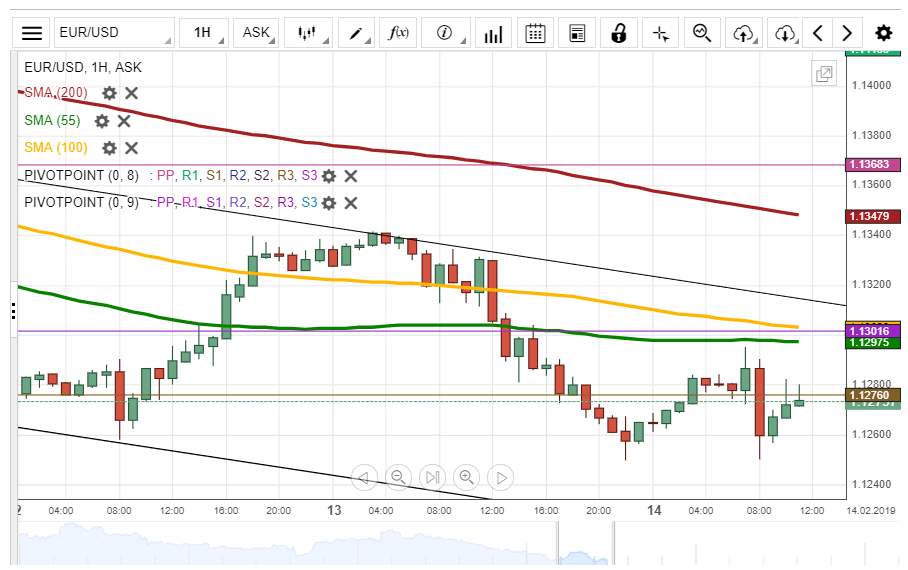
The European Single Currency passed through the strong support level of the small pattern line at 1.1309. On Thursday morning, the rate was resisted by the 55-hour and the 100-hour SMAs to push the rate to the 1.1265 mark. Note, some corrections were applied to the chart!
In regards to the near-term future, it is expected that the currency exchange rate will depreciate towards the 61.80% Fibonacci retracement level at the 1.1203 mark.
On the other hand, today's US Retails Sales, Core Retail Sales, PPI and Core PPI data release at 13:30 GMT could push the US Dollar to appreciate against the European Single Currency to trade at the 1.1280 level.
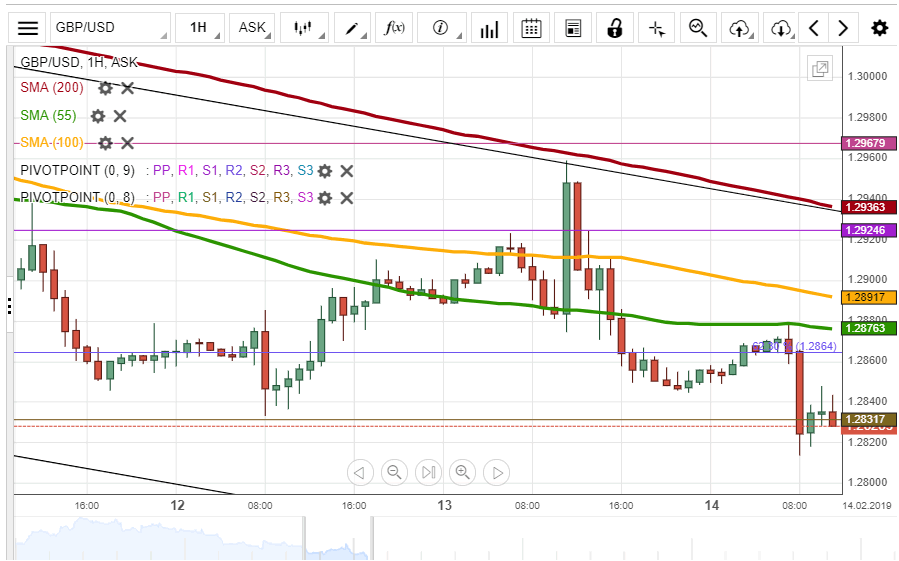
GBP/USD Passes 62.30% Fibo
During the previous trading session, the 200-hour SMA resisted the British Pound to push it to pass through the support level of the 62.30% Fibonacci retracement level. On Thursday morning, the rate was located between the 62.30% Fibo and the weekly S1 at the 1.2840 mark.
In regards to the near-term future, it is expected that the 55-hour simple moving average will continue resist the rate to the 1.2750 level.
However, during today's US Retails Sales, Core Retail Sales, PPI and Core PPI data release at 13:30 GMT, the British Pound could appreciate against the US Dollar to push the rate to brake the resistance levels of the SMAs.
USD/JPY Breaks Dominant Pattern
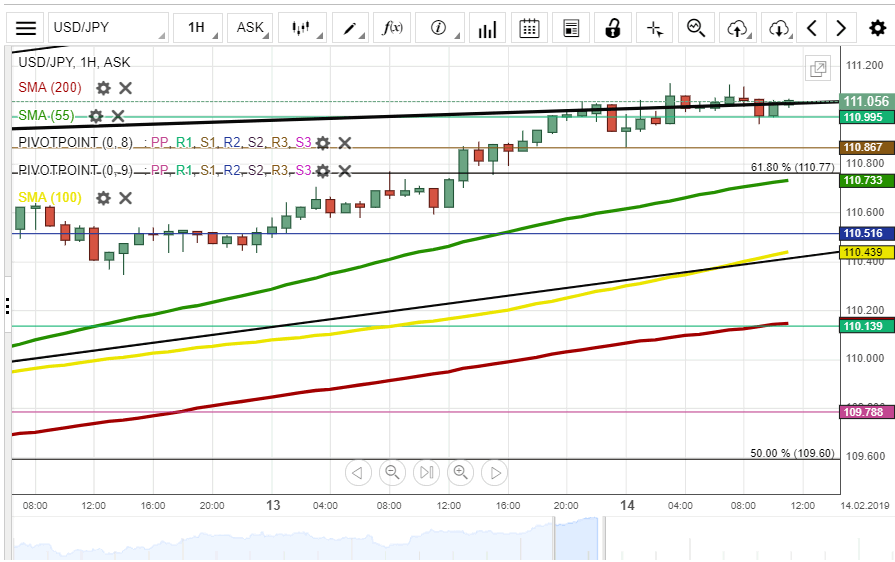
During the previous trading session, the USD/JPY broke the dominant pattern line at 110.82. On Thursday morning, the rate was trading above the monthly R1 at the 111.04 mark. Note, some corrections were applied to the chart!
In regards to the near-term future, most likely the currency exchange rate will trade sideways between the freshly drawn dominant pattern line and the monthly R1 to stay at the 111.00 level.
On the other hand, the US Dollar could appreciate against the Japanese Yen to the 111.20 level during today's US Retails Sales, Core Retail Sales, PPI and Core PPI data release at 13:30 GMT.
XAU/USD Aims To Medium Pattern Line
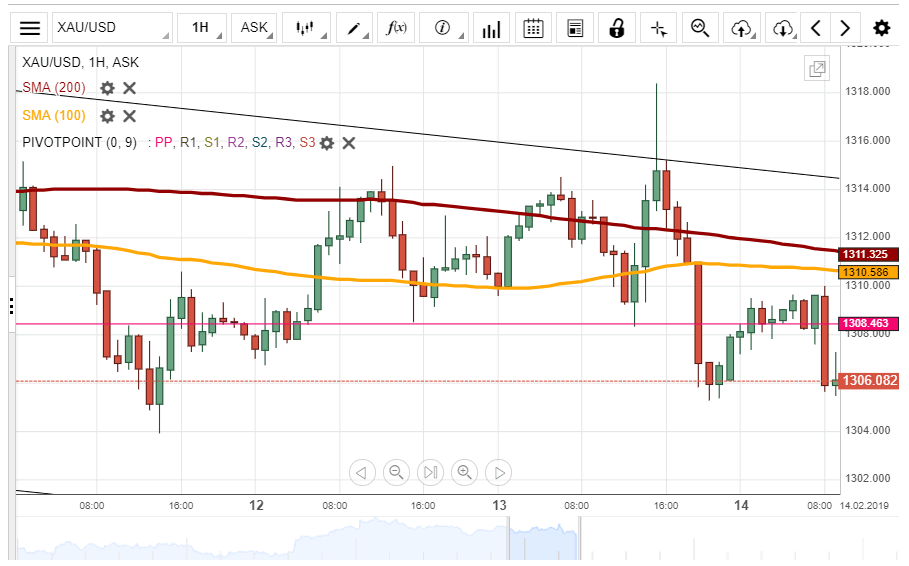
During the previous trading session, the yellow metal traded between the 100-hour and the 200-hour simple moving averages. On Thursday, the gold was located below the monthly pivot point at the 1,306.10 mark.
In regards to the near-term future, most likely, the 100-hour and the 200-hour SMAs will push the rata towards the bottom boundary of the medium pattern line at 1,302.00.
Besides, it is expected that today's US Retails Sales, Core Retail Sales, PPI and Core PPI data release at 13:30 GMT will push the yellow metal to depreciate against the US Dollar.
BoE Vlieghe: Monetary easing more likely than tightening in case of no-deal Brexit
BoE MPC member Gertjan Vlieghe said in a speech that the net balance of economic news for the UK has been to the "downside". Thus, the appropriate pace of monetary tightening is "somewhat slower" than he judged a year ago.
A quarter point hike per year is a "reasonable central case" if global growth does not slow materially further, path to Brexit is in line with government's state objective, and pay growth continues at current pace. Though, if a no-deal Brexit is avoided, he expects Sterling to appreciate. And the exact degree of future monetary tightening will depend on appreciation of the Pound.
However, a no-deal outcome is "likely to lead to some economic disruption, which could possibly be severe". There are some paths that are possible, but "not all are equally likely". In his view, "an easing or an extended pause in monetary policy is more likely to be the appropriate policy response than a tightening." But he emphasized that BoE will have to "judge in real time" how well inflation expectations remain anchored, and how households and businesses are reacting to the disruptions.
Vlieghe's full speech "The Economic Outlook: Fading global tailwinds, intensifying Brexit headwinds".