

Sample Category Title
AUD/USD Daily Outlook
Daily Pivots: (S1) 0.7075; (P) 0.7104; (R1) 0.7135; More...
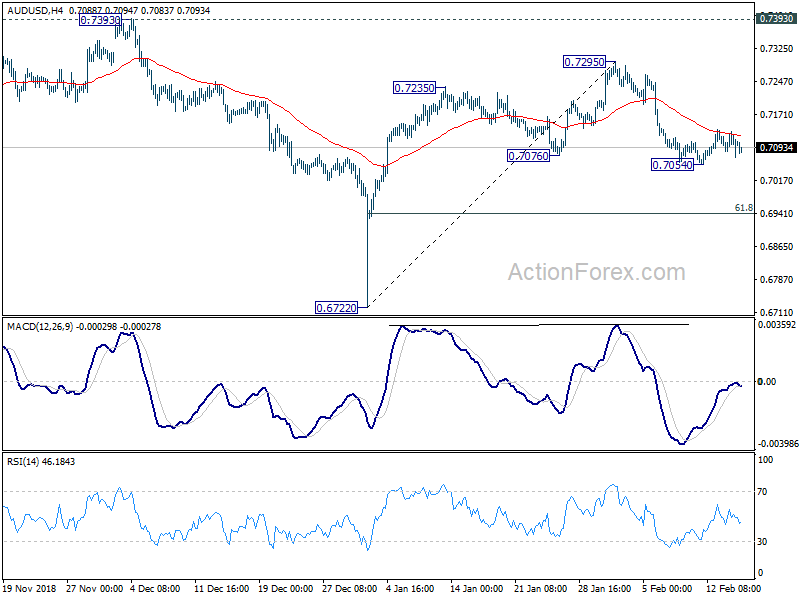
AUD/USD dropped notably after failing to sustain above 4 hour 55 EMA. But downside is held above 0.7054 temporary low. Intraday bias remains neutral first. Some more consolidations could be seen but upside should be limited well below 0.7295 resistance to bring another decline. We're holding on to the view that rebound from 0.6722 has completed at 0.7295 already. On the downside, break of 0.7054 will turn bias to the downside for 61.8% retracement of 0.6722 to 0.7295 at 0.6941 next.
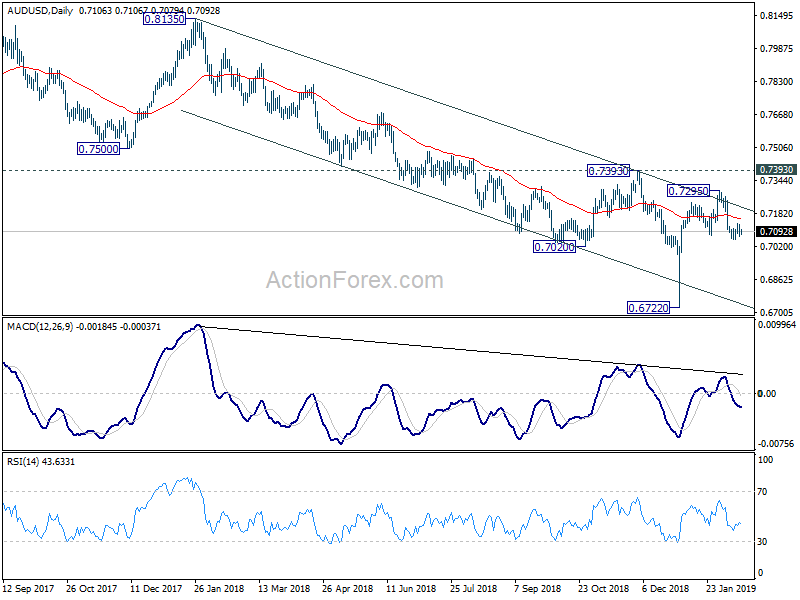
In the bigger picture, as long as 0.7393 resistance holds, we'd treat fall from 0.8135 as resuming long term down trend from 1.1079 (2011 high). Decisive break of 0.6826 (2016 low) will confirm this bearish view and resume the down trend to 0.6008 (2008 low). However, firm break of 0.7393 will argue that fall from 0.8135 has completed. And corrective pattern from 0.6826 has started the third leg, targeting 0.8135 again.
RBA Kent: Markets expect next RBA move to be down than up
RBA Assistance Governor Christopher Kent delivered a speech on "Financial Conditions and the Australian Dollar – Recent Developments" today. There he acknowledged that developments in Australian financial markets have been similar to those offshore, with falling equity prices, rising credit spreads and increased volatility. Such development is "a story of risk premia increasing from low levels and were associated with rising concerns about downside risks, both internationally and domestically."
The outlook for domestic economy has "also shifted" with downward revision in both growth and inflation forecasts. And market expectations for the next move in cash rate have "switched signs too". Kent noted that "markets have assessed that the next move is more likely to be down than up.". And that's reflected in lower bond yields.
Fall in Australian bond yields is "likely to have contributed somewhat to the modest depreciation of the Australian Dollar of late". On the other hand, "higher commodity prices appear to have worked to limit the extent of Australian dollar depreciation".
Trump to delcare national emergency and sign the shutdown averting bill
White House spokesperson Sarah Sanders confirmed that Trump will sign the bill that avert another government shut down. However, as the bill doesn't include the full sum of the funding that Trump demands for the border wall, he's going to declare national emergency.
Sanders said "President Trump will sign the government funding bill, and as he has stated before, he will also take other executive action - including a national emergency."
Top Democrat in the Congress, House of Representatives Speaker Nancy Pelosi said she might file a legal challenge to Trump's action and "that's an option". Senate Democrat leader Chuck Schumer also criticized Trump of a "gross abuse of the power of the presidency."
US-China trade talks set to conclude without substantial progress
Asian equities drop broadly today as the US-China trade talks look set to conclude without substantial progress. US Treasury Secretary Steven Mnuchin and Trade Representative Robert Lighthizer didn't comment on the discussions as the final day of close-door session starts today. But it's reported that both sides are still far apart on the core issues, which would need a meeting between Trump and Xi to make the agreement.
Subsidies on State-Owned Enterprises that create unfair competition is one of the deadlocks as it's considered fundamental policy of the Chinese government that couldn't be touched. Reuters reported that China has pledged to adjust the industrial subsidy program to comply with WTO rules. But without any details, the US side, rightfully, is skeptical on enforcement of Chinese government's promises.
White House economic adviser Larry Kudlow fold fox news that "the vibe in Beijing is good." And, "negotiators in Beijing "are soldiering on". Kudlow also said meeting with Chinese President Xi on Friday is "a very good sign" and the US delegation is "getting the job done". Kudlow was "cautiously optimistic" on the outcome. Meanwhile, there is no decision on the trade truce by 60-days yet. But as we argued before, extending the period while keeping the current tariffs is just prolonging the damage to the economies.
EUR/JPY And GBP/JPY: Yen Buyers Back In Control
The Euro and British Pound declined heavily against the Japanese Yen. Both EUR/JPY and GBP/JPY are under pressure and they could continue to weaken in the near term.
Important Takeaways for EUR/JPY and GBP/JPY
- The Euro topped near the 125.50 level and declined heavily against the Japanese Yen.
- There was a break below a major bullish trend line with support at 125.00 on the hourly chart of EUR/JPY.
- GBP/JPY also declined heavily and broke the key 142.00 support area.
- The pair traded below a crucial bullish trend line with support near 142.25 on the hourly chart.
EUR/JPY Technical Analysis
After a solid upward move, the Euro faced a strong resistance near the 125.50 zone against the Japanese Yen. The EUR/JPY pair started a significant decline and broke many supports such as 125.00 and 124.80.
The last swing high was formed at 125.53 on FXOpen before the pair started a bearish wave. During the decline, the pair traded below the 125.00 support and the 50 hourly simple moving average to move into a bearish zone.
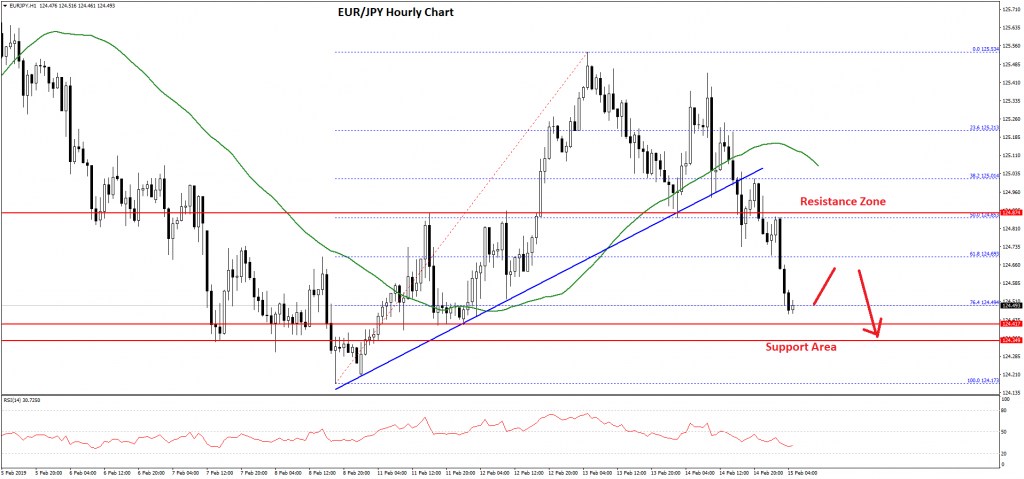
More importantly, there was a break below a major bullish trend line with support at 125.00 on the hourly chart. The pair broke the 61.8% Fib retracement level of the last wave from the 124.17 low to 125.53 high.
The pair is now trading well below the 124.70 support, with bearish signs. An immediate support is near the 124.40 zone, where buyers could take a stand. If there is a break below the 124.40 and 124.35 supports, the pair is likely to extend losses towards the 124.15 swing low.
It is currently trading near the 76.4% Fib retracement level of the last wave from the 124.17 low to 125.53 high, with an immediate resistance near the 124.60 level. However, the main resistance is at 124.80-124.90, which was a support earlier.
Overall, the EUR/JPY pair is currently at a risk of more losses below 124.40 unless buyers push the pair above the 124.90 resistance.
GBP/JPY Technical Analysis
The British Pound also followed a similar structure and declined heavily after forming a high near the 143.33 level against the Japanese Yen. The GBP/JPY pair traded lower and broke many supports such as 142.40 and 142.00.
Besides, there was a break below a crucial bullish trend line with support near 142.25 on the hourly chart. The pair settled below the 142.00 support and the 50 hourly simple moving average.
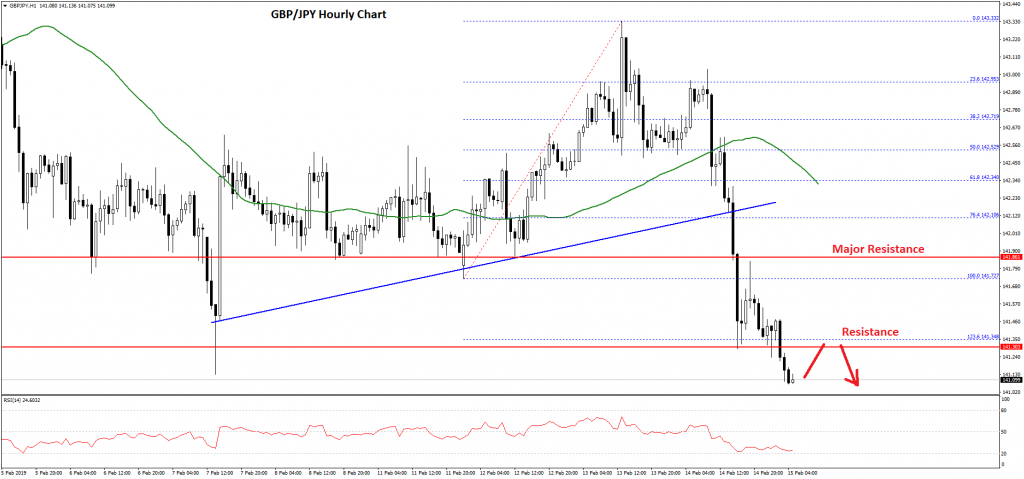
During the decline, the pair broke the 141.80 pivot and the 1.236 Fib extension level of the last wave from the 141.72 low to 143.33 high to move into a bearish zone. The pair is currently trading near the 141.20 level, with a bearish angle.
The next support is near the 141.00 level, below which the pair could trade towards the 140.75 level and the 1.618 Fib extension level of the last wave from the 141.72 low to 143.33 high.
On the other hand, if there is an upside correction, the previous support near the 141.30 level might act as a short term resistance. However, the main resistance is near the 141.80 level, which was a key support earlier for GBP/JPY.
Market Morning Briefing: Euro Seems To Sustain The Break Below 1.13
STOCKS
Weak US retail sales data released yesterday is increasing the concerns of the global growth slowdown. As a result, some profits have been taken-off the table from the global equities that had rallied over the last few days. This may increase the pressure on the Indian indices which have been already falling continuously over the last one week.
Dow Jones (25,439.39, -103.88, -0.41%) has come-off sharply from its high of 25,625. A fall to 25,000 is possible on a break below 25,300.
DAX (11,089.79, -77.43, -0.69%) can dip to test 11,000, a break below which can take it further lower to 10,900. But, a bounce from 11,000 can take the index higher to 11,300 and 11,400
Nikkei (20,886.27, -253.44, -1.20%) has come-off giving back all the gains made on Thursday. Inability to bounce from 20,950 has increased chances of the index falling towards 20,800. Today's closing will play a significant role in determining the move for next week.
Shanghai (2,702.54, -17.16, -0.63%) has support in the 2,690-2,685 region which is likely to be tested in the near term. A bounce from there can take the index higher towards 2,730 and 2,750 again.
Sensex (35,876.22, -157.89, -0.44%) is heading towards 35,800 as expected. A break below 35,800 can drag the index lower to 35,700 and 35,600 in the coming days.
Nifty 50 (10,746.05, -47.60, -0.44%) can test its key support region of 10,700-10,680. A bounce from this support region can trigger a corrective rally to 10,800 and 10,850. But a break below 10,680 can drag Nifty 50 to 10,600.
COMMODITIES
Gold remains stable. Silver is holding above its key support but looks slightly weaker than gold in the near term. The corrective fall in copper has paused and it is stuck in a narrow range over the last few days. Oil on the other hand is gaining strength after having risen above a key resistance and can move higher in the coming days.
Gold (1,315.40) retains its sideways range of 1,300-1,325. The price action on the daily candles retains the bias bullish for gold to break 1,325 and surge to 1,350-1,360 in the coming weeks.
Silver (15.54) can fall to 15.40 if it breaks below the immediate support level of 15.55.
Copper (2.7625) is stuck in between 2.75 and 2.80 over the last few days. A breakout on either side of 2.75 or 2.80 will decide the next move. A strong break above 2.80 will open doors for a test of 2.83 and 2.85 again. But a break below 2.75 can drag copper lower to 2.74 and 2.73.
WTI (55.01) and Brent (64.86) has risen breaching their respective resistances at 54 and 64. The near-term outlook is bullish. WTI can test 56 and 57 while WTI can move up to 66. Indeed, Brent is looking much stronger than WTI. While Brent remains above 63 in the coming days, even a test of 68 on the upside cannot be ruled out over the medium term.
FOREX
Almost all currencies are trading weak against the US Dollar except the Yen. Near term resistance may hold well for Euro and Dollar-Yuan, while we could see upcoming supports on Pound, Aussie and Euro-Yen.
Dollar-Index (97.08) may be expected to target 97.50-98.00 levels while it sustains above 97. Only on a break below 96.50, we would expect further fall towards 96 or lower.
Euro (1.1285) seems to sustain the break below 1.13. It could well test the previous low of 1.1215 (Nov’18) in the near term. A break below 1.1215-1.1200, if seen would open up chances of testing 1.11 on the downside.
Euro-Yen (124.47) has fallen from levels above 125 seen yesterday and could re-test immediate support near 1240.40. While 124.40 holds, a bounce back towards 125-126 is possible; else a fall towards 123.60 could be seen in the near term.
Dollar Yen (110.29) traded above 110.5 for 2-sessions and is now back below 110.50 re-entering the 110.5-109 region. While the pair trades below 110.50, near term looks bearish.
Pound (1.2792) and Aussie (0.7087) are trading lower. Pound has enough room on the downside towards 1.25 in the longer run but could face some interim support at 1.27. Aussie on the other hand could get some support at 0.7050 from where it could bounce back towards 0.7150-0.72. Failure to hold above 0.7050 would make it vulnerable to a fall towards 0.6950-0.6900.
USDCNY (6.7775) has immediate channel resistance at 6.78 which if holds could push the pair down towards 6.74. Above 6.78, we see resistances near 6.80 and 6.82.
Dollar Rupee (71.17) can come off from 71.20 today re-testing 71.00-70.90 on the downside. Failure to come off from 71.20 would take it higher to test 71.50.
INTEREST RATES
The US yields have fallen and could re-test immediate supports on the downside. The 2Yr (2.50%), 5Yr (2.48%), 10Yr (2.66%) and 30Yr (3.00%) are down from 2.53%, 2.52%, 2.6950% and 3.02% respectively. The 5Yr, 10Yr and the 30YR could come down to test immediate supports at 2.43%, 2.60% and 2.95% before again bouncing back from there. We could see the fall to continue in the early sessions next week.
The German-JGB 10Yr (0.13%) is testing immediate support just below current levels and could bounce from here to higher levels of 0.18% in the near term. This indicates a rise in Euro-Yen in the medium term.
The German-US 2Yr differential (-3.06%) has risen back to re-test trend resistance at -3.05%. It is important to see if the yield spread breaks above -3.05% or comes off to test -3.10% again on the downside. Narrow region of -3.05% to -3.10% is likely to hold for a couple of sessions before gaining some clarity on further directions.
The 10Yr GOI (7.5213%) has scope of rising towards 7.55-7.60% in the near term. While the yield rises, Dollar-Rupee could see a rise too. Downside for the yield is limited to 7.38/40% just now.
USD/JPY Correction Approaching Crucial Support
Key Highlights
The US Dollar failed to stay above 111.00 and declined sharply against the Japanese Yen.
There is a connecting bullish trend line formed with support at 110.30 on the 4-hours chart of USD/JPY.
The US Retail Sales in Jan 2019 declined 1.2% (MoM), whereas the forecast was +0.2%.
The US Industrial Production for Jan 2019 will be released today, which could increase 0.1% (MoM).
USDJPY Technical Analysis
The US Dollar started a solid upward move after forming a strong support at 109.60 against the Japanese Yen. The USD/JPY pair rallied above 110.60 and 111.00 before sellers appeared near 111.10.
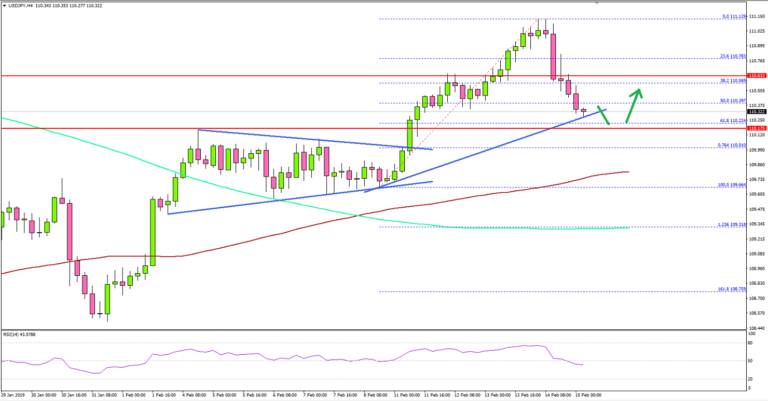
Looking at the 4-hours chart, the pair gained strength after it broke the 110.00 resistance and a contracting triangle with resistance at 109.95. It opened the doors for more gains above 110.50 and the pair settled well above the 100 (red) simple moving average (4-hours).
The pair even spiked above the 111.00 resistance and traded to a new monthly high at 111.12. However, the recent disappointing retail sales report in the US triggered bearish moves in USD/JPY below the 111.00 level.
The pair started a downside correction and traded below the 50% Fib retracement level of the recent wave from the 109.66 low to 111.12 high. However, there are many supports on the downside near 110.30 and 110.20. There is also a connecting bullish trend line formed with support at 110.30.
The main support is near the 110.10 and 110.00 levels, where buyers are likely to take a stand if the pair continues to move down. On the upside, resistances are near 110.60 and 111.00.
Recently in the US, the Retail Sales report for Jan 2019 was released. The market was looking for a 0.2% rise in sales in Jan 2019, compared with the previous month.
However, the result was very disappointing as there was a sharp 1.2% decline in the Retail Sales. Moreover, the Retail Sales ex Autos declined 1.8%, whereas the market was looking for a 0.1% rise.
The report added that:
Advance estimates of U.S. retail and food services sales for December 2018, adjusted for seasonal variation and holiday and trading-day differences, but not for price changes, were $505.8 billion, a decrease of 1.2 percent (±0.5 percent) from the previous month, but 2.3 percent (±0.5 percent) above December 2017.
Overall, the US Dollar came under pressure after the release, but the USD/JPY pair remains well supported as long as it is trading above the 110.00 pivot level.
Economic Releases to Watch Today
- UK Retail Sales for Jan 2019 (YoY) – Forecast +3.4%, versus +3.0% previous.
- UK Retail Sales for Jan 2019 (MoM) – Forecast +0.2%, versus -0.9% previous.
- US Industrial Production Jan 2019 (MoM) – Forecast 0.1%, versus 0.3% previous.
- US Capacity Utilization Jan 2019 – Forecast 78.7%, versus 78.7% previous.
Trade Talks Continue As Trump Vows To Build The Wall
Trade talks continue as Trump vows to build the wall
The US stock markets closed slightly down overnight, shrugging off a worse-than-expected December retail sales report, which plunged 1.20%. Despite this, the US dollar contained its run as the big dog on the block, gaining against all of the majors except the yen, where on target GDP numbers and a slightly elevated risk-averse environment saw USD/JPY fall to 110.50. A healthy degree of scepticism surrounding the accuracy of the retail sales number could explain the almost zero impact on stocks and the dollar, because it doesn’t tally with the strong non-farm payrolls data or wage-growth data from the same period. The retail sales number could potentially be revised upwards in the coming months.
Elsewhere, German and Euro-zone GDP data showed the Euro-zone still bouncing along the bottom activity wise, although narrowly avoiding an official recession. This may well keep the pressure on Brussels as we reach the climactic final episode of Brexit. Euro-zone politicians may way wish to tread carefully in sing the UK too harshly or being too belligerent and shooting themselves in the foot. Imposing an economic shock on Britain will undoubtedly flow strongly to the Euro-zone as well and could tip them into a full-blown recession. A cynic might say this is, in fact, PM May’s strongest negotiating position as Brexit runs to the wire. Both the euro and sterling may continue to be hard to love in the coming weeks.
The markets breathed a sigh of relief as President Trump agreed to sign a no-wall funding deal. His intentions to signal a national emergency to buy 2,000 miles of bricks and barb wire will be an internal domestic issue and should have no impact on the markets.
With this in mind, attention now turns to the final day of this round of the US-China trade talks. So far, mixed messages have emerged, giving the impression that China is rather like a worm on a hook at the moment when it comes to the crux issues of its business practices. Given this, it seems unlikely that simply offering to buy more soybeans, oil, airliners and computers to close the deficit will cut it this time. Still, no news is good news and short of a total breakdown (unlikely), the markets will continue to watch and wait with bated breath. Even if President Trump grants a final extension to the deadline, tensions in the markets should remain benign as this would signal genuine intent from both sides to reach an amicable solution. We could then all turn our attention to Brexit on 29 March. Wonderful.
FX
The US dollar has held up very well overnight despite poor data. Bad news from the trade talks would be reflected in a sell-off of regional currencies rather than the dollar. Against the majors, the dollar reigns supreme with any sell-offs likely to be fleeting as reality bites on the data front around the world.
Stocks
The regional markets will adopt a wait-and-see approach today as they anticipate news from the trade talks. We expect muted sideways trading following North America’s session.
Gold
Gold jumped seven dollars to 1,312.00 an ounce as the main beneficiary of the poor US retail sales data. Traders also chose to hedge their risk ahead of the trade talks’ conclusion and the weekend by buying gold. Gold continues to constructively consolidate above 1,300.00 in the medium term.
Oil
Oil’s rally continued unabated overnight with Brent rising 1.50% and WTI nearly 0.80 %. Oil futures have continued their march higher in early Asia trading and the black gold looks set to enjoy a frothy session. Oil is perhaps the market most bullish in the face of the ongoing trade talks. Another supporting factor perhaps overlooked by most overnight is Cuba accusing the US of moving special forces to the vicinity of Venezuela ahead of a possible “humanitarian” intervention.
Daily Markets Broadcast
Wall Street waiting for trade talk developments
With little sign, or news, or progress in the US-China trade negotiations, it was left to weak economic data to lead the way lower for Wall Street. Weak data also pressured German shares while Chinese counters were capped by the trade talks.
US30USD Daily Chart
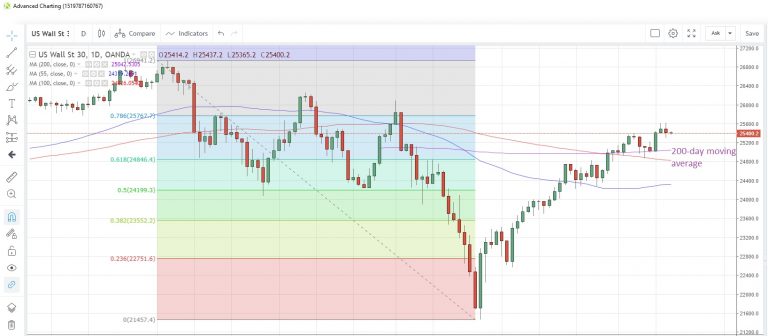
The US30 index closed lower after US retail sales plummeted 1.2% m/m in December, the weakest monthly performance since 2009. White House economic adviser Kudlow said there may be “glitches” in the data due to the government shutdown.
The index touched the highest since December 4 before closing lower. The 200-day moving average is at 25,042
US industrial production expansion is expected to slow to just 0.1% m/m in January, surveys suggest. That would equal the lows since May last year. Capacity utilization is seen steady at 78.7%.
DE30EUR Daily Chart
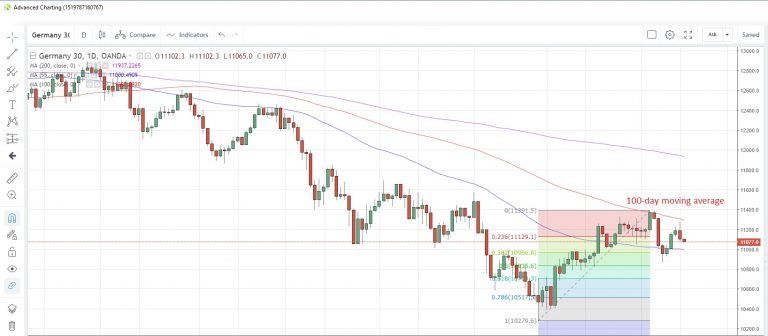
The Germany30 index snapped a three-day winning streak as German GDP growth slowed in Q4, but narrowly avoided a technical recession
The 100-day moving average resistance at 11,292 remains intact, for now. Support may be found at the 55-day moving average at 11,000
Germany’s economy stood still in Q4, with zero growth on a quarter-by-quarter basis. ECB’s Coeure is due to speak today.
CN50USD Daily Chart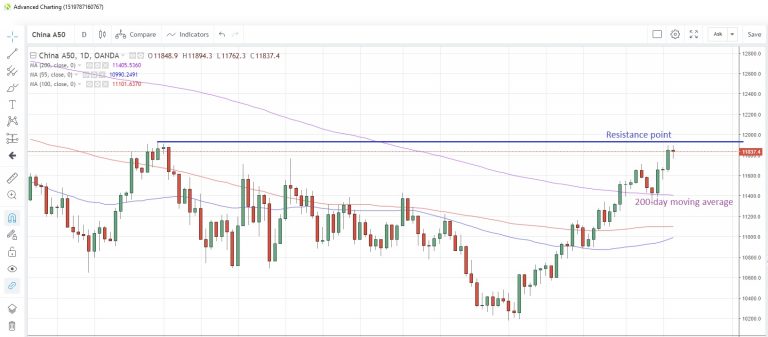
China shares retreated from 4-1/2 month highs yesterday amid a lack of progress in the trade negotiations with the US.
The index snapped a three-day winning streak yesterday as the index’s rally stalled near the previous high on September 28 at 11,931. That could prove to be a significant resistance point. The nearest support level could be the 200-day moving average at 11,405
China’s trade surplus with the US narrowed to $27.3b in January from $29.9b in December, according to data released yesterday. A convenient release as the US-China trade negotiations were underway.
Eco Data 2/15/19
[php_everywhere instance="1"]