Sample Category Title
EUR/USD Outlook: Bears Crack Key 200SMA Support And Look For Firmer Bearish Signal On Firm Break
The Euro resumes lower and hits new lowest levels since 25 Jan in early European trading on Friday, after being entrenched within tight range in Asia.
Overall picture remains firmly bearish as increased safe-haven demand on global growth worries continue to boost US dollar and keep the single currency under pressure.
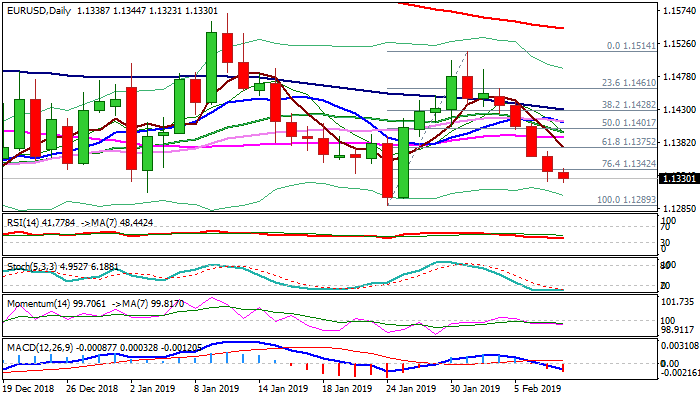
The pair holds in red for the fifth straight day and cracked key support at 1.1331 (200WMA) which, despite several attacks, kept the downside protected since early Nov 2017.
Eventual weekly close below here would reinforce strong bearish stance for test of 1.1289 (24 Jan low) and 1.1269/67 double-bottom (14 Dec / 28 Nov 2018).
Daily techs are in firm bearish setup but deeply oversold stochastic warns that bears may face headwinds on approach to 1.1289 target.
Also, end-of-week profit-taking could slow bears, but limited recovery could be expected while daily cloud (1.1357/92) caps.
Res: 1.1344, 1.1357, 1.1392, 1.1412
Sup: 1.1323, 1.1289, 1.1267, 1.1215
GBPJPY Stops Above 142.00, Negative In Long Term
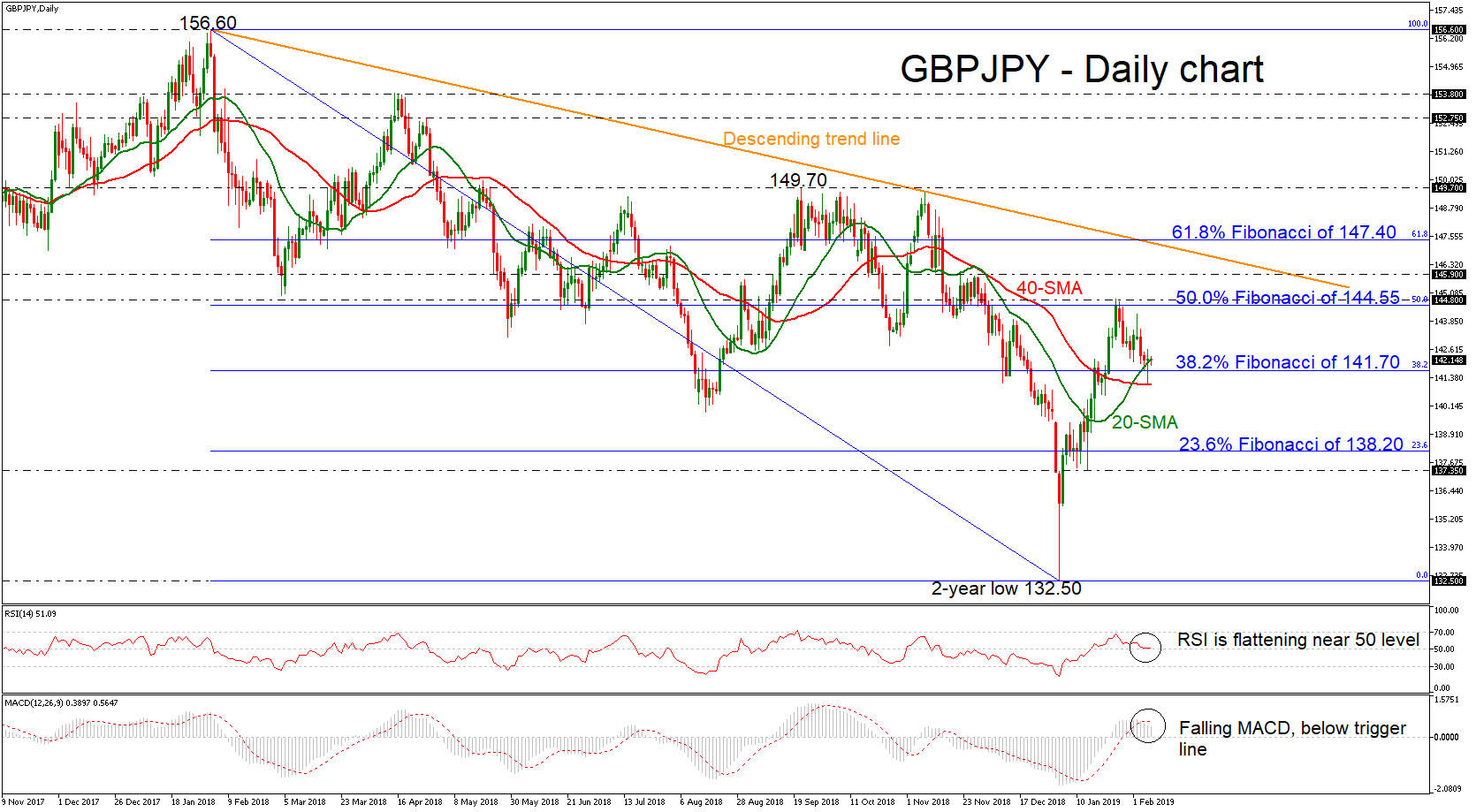
GBPJPY has rebounded somewhat on the 40-day simple moving average (SMA), which posted a bullish crossover with the 20-day SMA. Also, the price surpassed the 38.2% Fibonacci retracement level of the downleg from 156.60 to the more than two-year low of 132.50, around 141.70.
Despite the bullish cross of the SMAs, the technical indicators continue to slow down, mirroring the market’s bearish to neutral behavior over the past couple of days. The RSI indicator is still moving in bullish territory but is flattening, while the MACD oscillator slipped beneath the trigger line, which support the bearish view in the short term as well.
In case the pair drops back below the 38.2% Fibonacci and the 40-day SMA, the bears will probably challenge the 23.6% Fibonacci region around 138.20. A break lower, could last until the 137.35 support, taken from the bottom on January 15.
Alternatively, a recovery to the upside could open the way towards the 50.0% Fibonacci of 144.55 and the 144.80 resistance zone, identified by the peaks on January 25. Above the latter, the 145.90 resistance could act as significant obstacle for investors before touching the long-term descending trend line.
Overall, the long-term structure remains strongly negative over the last year and only a jump above the downtrend line would change the outlook to a more bullish one.
BOE’s Remains Dovishly On Hold, Yet Carney Comes To The Rescue
BoE as was widely expected, remained on hold at +0.75%, yet sounded quite dovish. The bank expects the GDP growth rate to slowdown reaching +1.2% yoy in 2019 and also expects the CPI rate to temporarily slowdown below +2.00% yoy in the coming months. In the following press conference, BoE governor Mark Carney, highlighted the upside potentials for the UK economy should there be clarity on a Brexit deal and stated that markets should not start preparing for a scenario of no further rate hikes, providing some support for the GBP. On the Brexit political front early reports show that, the EU seems to reject the idea of time limitation for the Irish backstop, as asked by Theresa May. Such a development if confirmed and final, could strengthen arguments for a hard Brexit and add to the bearish sentiment for the pound. Cable experienced some choppy trading yesterday, as it briefly broke the 1.2960 (R1) resistance line, yet failed to remain above it, practically maintaining a sideways movement. We would like to note that the pair may prove sensitive to any Brexit headlines reeling in, as Theresa May is in Brussels trying to renegotiate Brexit with her EU counterparts. We maintain a bearish outlook for the pair and for our opinion to change we would require the pair's price action to clearly break the downward trendline incepted since the 31st of January. Should the bears dictate the pair's direction we could see it aiming for the 1.2830 (S1) support line. On the other hand, should the bulls take over, we could see cable breaking the 1.2960 (R1) resistance line, the prementioned downward trendline and aim for the 1.3070 (R2) resistance level.
RBA cuts growth forecasts and the AUD weakens
AUD weakened substantially as the RBA in its quarterly monetary statement, released early in today's Asian session, slashed the GDP growth and inflation forecast for the 1st semester of 2019. The bank revised downward its GDP forecast for June 2019, reaching as low as +2.5% yoy, if compared to prior reading of +3.25%yoy, yet sees a slight rebound by the end of the year. The bank also points out that the resilience of household consumption remains a key uncertainty and that China's indicators suggest a more pronounced slowing in momentum. Analysts point out that such a development could push a potential rate hike even further into the future, with some citing May 2020 as a possible date. We maintain a bearish outlook for the Aussie, yet rising iron ore prices could provide some support. AUD/USD dropped yesterday testing the 0.7065 (S1) support line. We maintain a bearish outlook for the pair, as there do not seem to be any lifting news today, for the Aussie while on the other hand the USD seems to have gotten some slight support in recent past sessions. We would like to note though, that rising iron ore prices could provide some support for the AUD and the pair has reached one of its lowest levels in the past two years. Should the pair continue to be under the selling interest of the market, we could see the pair breaking the 0.7065(S1) support line and aim for the 0.6985 (S2) support level. Should the pair find extensive buying orders along its path, we could see it aiming the 0.7150 (R1) resistance line.
Today's other economic highlights
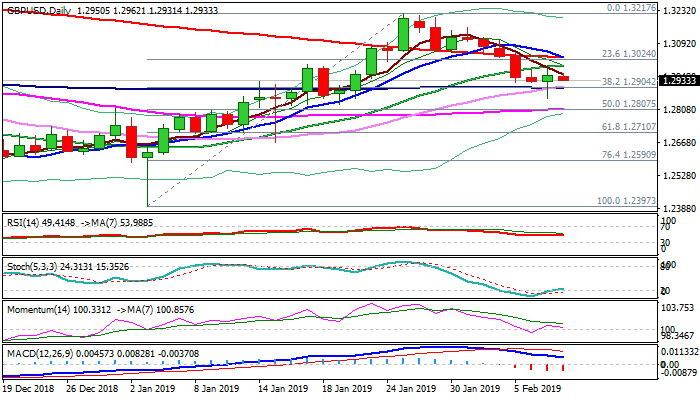
In today's European session, we get Germany's trade balance figure for December. In the American session, we get Canada's house start numbers for January as well as Canada's employment data for January. From the US we get the Baker Hughes oil rig count. As for speakers, please note that San Francisco Mary Daly speaks.
AUD/USD H4
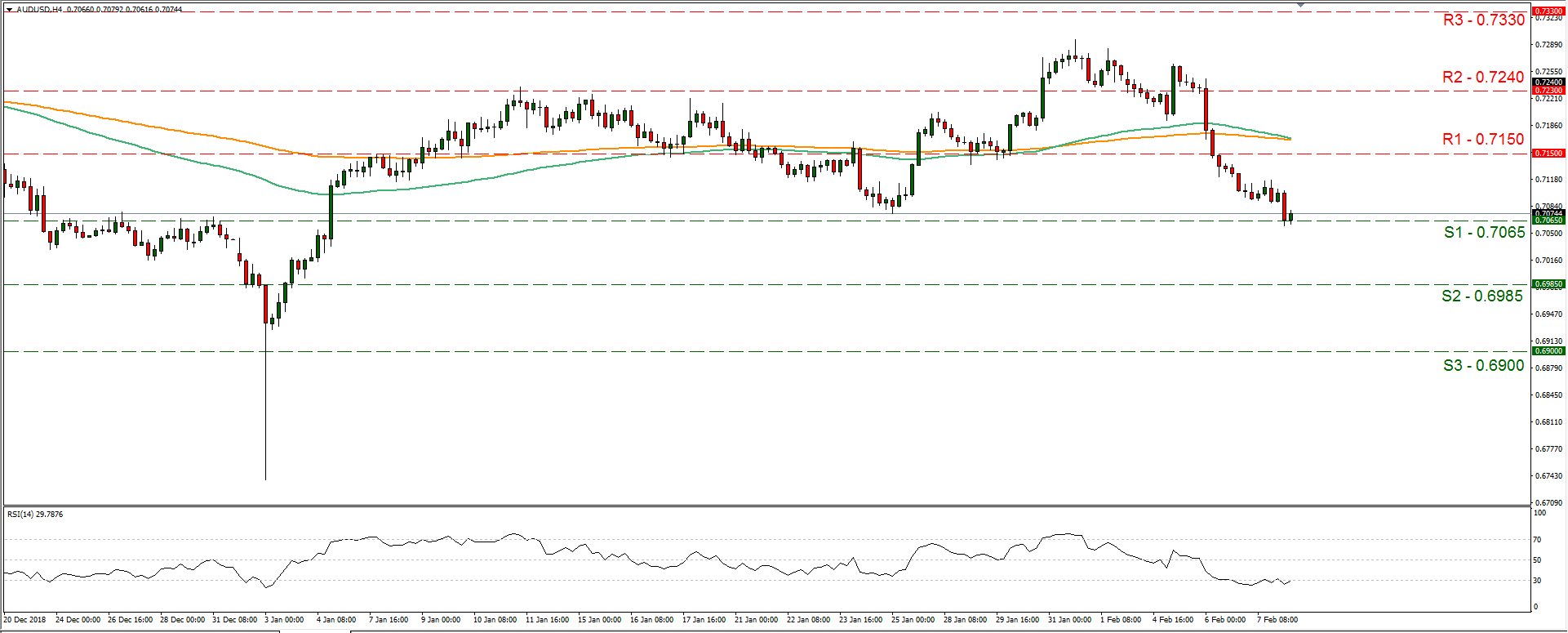
Support: 0.7065 (S1), 0.6985 (S2), 0.6900 (S3)
Resistance: 0.7150 (R1), 0.7240 (R2), 0.7330 (R3)
GBP/USD H4

Support: 1.2830 (S1), 1.2710 (S2), 1.2610 (S3)
Resistance: 1.2960 (R1), 1.3070 (R2), 1.3175 (R3)

Stocks Retreat On Trade Woes, BoE ‘Holds The Line’
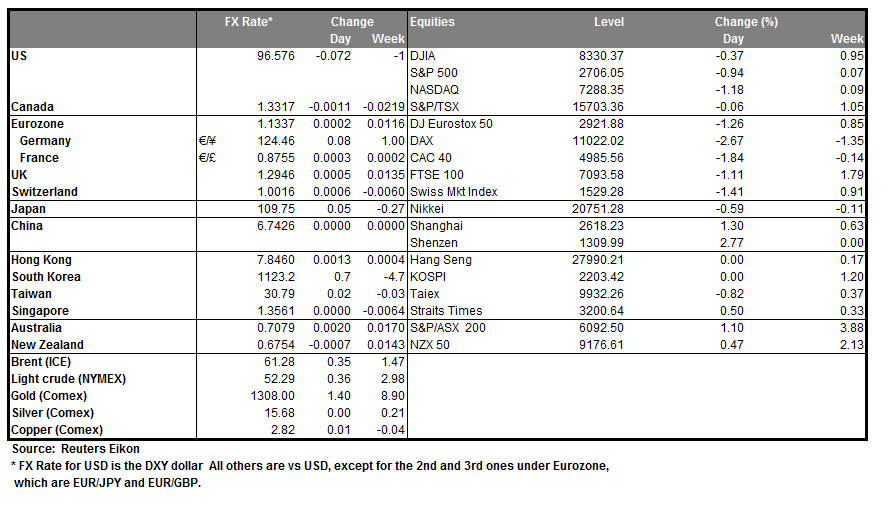
- Risk aversion returns as Trump reignites trade fears, says he won't meet Xi soon
- Sterling rebounds as BoE sticks to hiking plans, but Brexit uncertainty lingers
- Euro drifts lower after EU Commission slashes growth forecasts
- Canadian employment data coming up
Stocks take a hit as Trump says he won't meet Xi soon
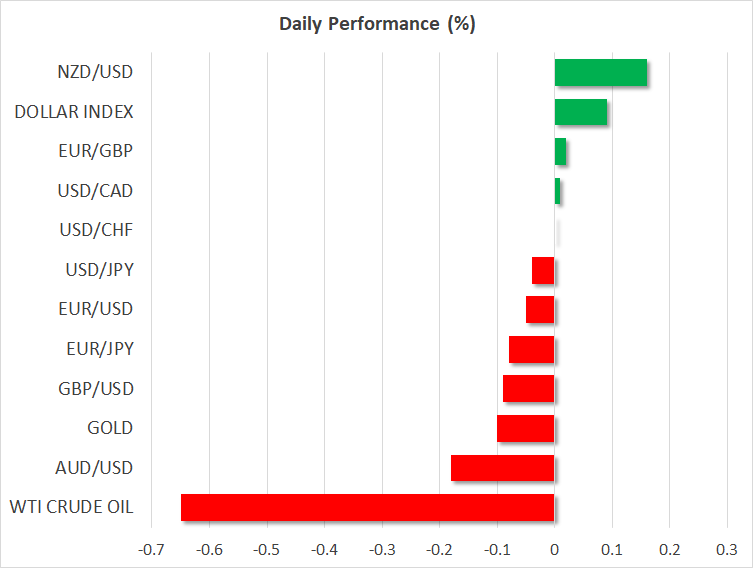
US equity markets closed well into the red yesterday, with the S&P 500 shedding 0.94%, following headlines that President Trump will not meet President Xi before the March 1 deadline for a trade deal, after which tariffs will be raised. The news reignited fears that the 'trade war' may re-escalate soon, something that markets were until recently discounting given numerous signals that the negotiating process was slowly but surely moving forward.
In the FX market, the defensive yen attracted inflows as investors sought safety while commodity-linked currencies, most notably the loonie, retreated in tandem with crude prices. Meanwhile, the battered aussie is also on the back foot on Friday, touching a one-month low earlier in the session, after the RBA's latest economic forecasts were even weaker than markets had expected. The probability for a quarter-point rate cut by October has ticked even higher, to 70% at the time of writing.
BoE 'holds the line', sterling rebounds
As expected, the BoE kept its policy unchanged yesterday and revised down both its growth and inflation forecasts. Cable tumbled on the decision but found fresh buy orders near the 1.2850 area and rebounded substantially, to close the session slightly higher. The recovery came as Governor Carney seemed reluctant to outline the case for a rate cut in case of a no-deal Brexit, instead sticking to the mantra that the Bank's base-case scenario remains an orderly exit, and hence further gradual rate hikes. The strange thing is that the pound climbed even as the market-implied probability for a rate increase this year fell to 40%, from a little over 50% before the meeting.
On the Brexit front, the situation remains as uncertain as ever. PM May's request to include a time limit on the Irish backstop was – predictably – rejected by the EU, though the two sides did agree to hold more talks, which at least keeps alive the possibility of an eventual breakthrough. That said, agreeing to talk is far different from reaching a compromise, and in the highly likely event that no real solution is found over the next days, the pound could remain on the back foot as uncertainty mounts further.
Euro feels the heat as Commission slashes growth forecasts
The single currency was the worst performer on Thursday, logging a fourth day of losses versus the US dollar, after the European Commission slashed its GDP forecasts for the Eurozone. The bloc is now expected to grow by a mere 1.3% in 2019, from 1.9% in the previous forecast. Alarmingly, most of the weakness is seen in the three biggest economies: Germany, France, and Italy.
These substantial downgrades likely enhanced speculation that the ECB may follow suit and take an axe to its own forecasts when it meets next month, something that would be associated with a more dovish message on future tightening. Or at least, may warrant a new round of long-term loans to banks, the so-called TLTROs.
Coming up: Canadian employment figures, Fed's Daly speaks
It's a relatively quiet day on the data front, with the only tier-one release being employment data out of Canada. Forecasts point to a relatively soft report, with the unemployment rate expected to have ticked up in January. Yet, the nation's Markit manufacturing PMI signaled a “robust rate of job creation” during the month, so a positive surprise shouldn't be ruled out. While that may support the loonie on the news, the far bigger driver for the currency will be how oil prices perform.
In the US, San Francisco Fed President Mary Daly will deliver remarks at 18:15 GMT.
GBP/USD Outlook: Directionless Mode Extends But Brexit Fears Keep The Downside Vulnerable
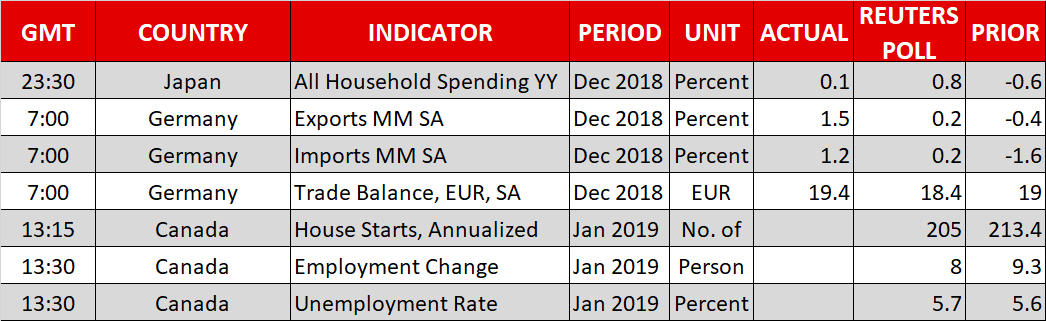
Cable holds in directionless mode for the third straight day, after Thursday's post-BoE volatile trading failed to generate firmer direction signal.
Sterling was initially lower and hit new 2 1/2 week low at 1.2854, following 9-0 vote to keep rates unchanged and the biggest cut to growth view since Brexit vote in 2016.
Uncertainty over Brexit keeps pound under pressure as PM May tries to get more concessions from the EU to try to avoid disorderly Brexit after her divorce plan was voted down by the parliament last month.
Despite very negative environment, optimistic tone from BoE chief Carney, who pointed to possible gradual rate increases in case the Britain reaches divorce deal, offered fresh boost to sterling to bounce from dangerous territory, after initial weakness cracked key 1.29 support zone (Fibo 38.2% of
1.2397/1.3217/100SMA). Recovery action was capped by 20SMA (currently at 1.2997) keeping overall near-term bias in bearish mode, as momentum is weakening and multiple MA bear-crosses (5/200, 5/20, with 10SMA attempting to form death-cross with 200SMA) continue to weigh.
The pair is on track for the second weekly bearish close that adds to negative signals.
However, the downside attempts remain limited as strong 1.29 support zone was reinforced by formation of 30/100SMA bull-cross and north-heading slow stochastic which reversed from oversold territory.
Brexit story remains pound's key driver and traders will be looking for signals to establish in fresh direction.
With price holding between 100 and 20SMA's, violation of either side would generate initial direction signal.
Sustained break below pivotal 1.29 zone would risk bearish acceleration towards next strong supports at 1.2807 (55SMA/50% retracement) and 1.2786 (daily cloud top). Conversely, lift above 20SMA would sideline downside risk, but break and close above 200SMA (1.3032) is needed to confirm reversal.
Res: 1.2959, 1.2997, 1.3032, 1.3051
Sup: 1.2904, 1.2854, 1.2830, 1.2807
Gold And Bitcoin Could Drop Further
Gold
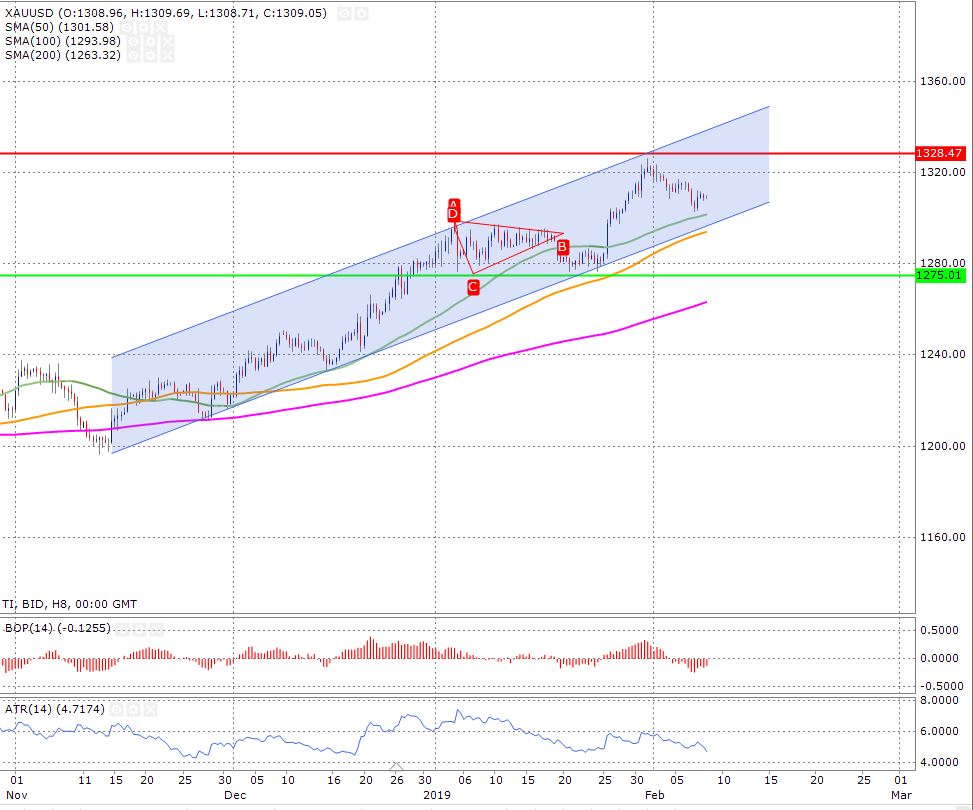
Despite a risk averse trade, gold prices are trading lower due to the strength in the dollar index. This suggest that investors are not really hiding, but they are just taking some profit off the table. If this was a full on risk off trade, then we should have seen the evidence of money moving into safe haven- such as gold. Exchange traded funds for gold have reduced their holdings by 245,397 troy ounces of gold. This was the biggest one-day decrease which we have seen since August 2018.
Gold price is heading for a weekly loss and the psychological level of 1,300 remains under a major threat. As we said yesterday, a break below this level is going to attract more pessimism and that would affect the gold price more negatively. The chart below shows the level of resistance and support.
Bitcoin
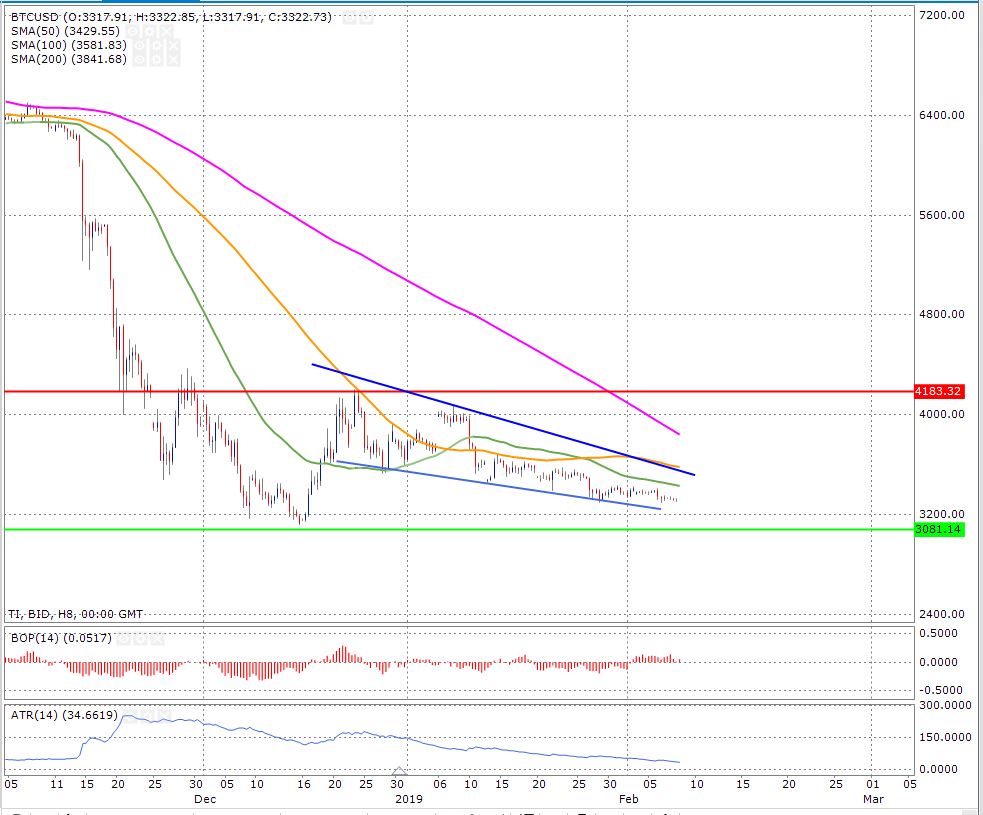
As for Bitcoin, there is one major theme; consolidation and the volatility cooling off. For the past few weeks, we have not seen any significant movement in the Bitcoin price. We are stuck in a price range of 3183 (17 December low) to 4234 (24th December high), as long as we are not breaking out of this range, there is nothing new.
However, there are two price levels which majority of the traders are looking at very closely and a break of these levels is likely going to bring excitement. The upper level is 4K mark, if the price breaks this resistance, it assures that the bulls have strong chances of breaking the resistance of 4234, thus stimulating the odds of a bull rally. On the flip side, the support of 3000 is really important for us and no one wants to see the price breaking below this because that will trigger a blood bath on the street. If we break the 3000 mark, the next support is at 2600.
Futures Plunge, May Returned Home Empty Hand
US futures are trading sharply lower and the S&P500 index in on track for its first weekly loss year-to-date. If it closes the week lower, this would be a strong a sell signal according to the candle pattern- a technical analysis. Market confidence is derailed as trade war concerns have become a major hurdle again. It appears that President Trump and President Xi will not be meeting before the critical deadline (which is at the end of this month). If both countries fail to resolve the issue, the Trump administration is going to increase the tariffs on Chinese import at the end of this month, something which was issued before the truce was establised between the two parties. Investors were hoping that both presidents will be able to put the trade war behind them and move forward. This was one of the major factor that triggered the rally in the equity markets.
However, the tensions have anchored more on the back of the possibility that Trump may actually issue an executive order which would ban Chinese telecom giant from U.S. networks. If he signs such an order, the odds are in favour of this, it would compound the ongoing pessimism. Trump administration has already targeted Huawei, and now this Chinese telecom giant, uncertainty clouds are only becoming darker.
Global equity markets have been struggling to move higher, the upward move was very minimal and there was no support in terms of volume. This was an indication that these markets have run out of steam and they need a new catalyst to move higher. For the S&P 500 index, it was the 200-day moving average which capped any upward move. The price action for the Dow Jones and Nasdaq in terms of price patterns was also very similar- more stocks moving to the downside than the upside.
As long as the tremendous differences remain and trade fight continues, it is difficult to see that warning lights going out of power from traders’ dash board anytime soon.
Back in Europe, the economic data has started to show some serious cracks. The economic engine of the Eurozone: Germany, no longer has the same sort of power which it had when the European Central Bank has its liquidity taps running. The data is confirming economic weakness from 4Q is spilling into the 1Q and if it continues like this, the ECB can no longer keep its monetary policy on the same sailing path. Perhaps, global economy needs a collective effort from central banks; The Fed has already softened their hawkish stance, ECB will be forced to adopt this under the current circumstances, the BOE had the reality check yesterday- lowered its growth and inflation forecast and the People Bank Of China isn’t too far off from dovish stance either.
Closer to home, Theresa May left Brussels empty-handed as expected. The EU told her they are in no mood of opening the negotiations again but there is no harm to come and say hello again if she wants. She failed to achieve anything from the EU and without having anything new, the possibility of a parliamentary vote taking place next week is minuscule. This increases the odds of the U.K. kicked out of the EU without any deal. The government needs to have a plan B to avoid this catastrophe and it appears no one seem to be carrying about it.
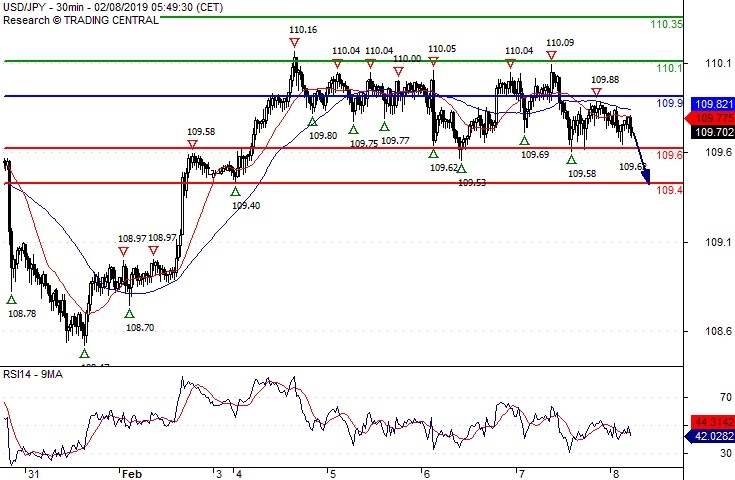
USD/JPY Towards 109.40
Pivot (invalidation): 109.90
Our preference Short positions below 109.90 with targets at 109.60 & 109.40 in extension.
Alternative scenario Above 109.90 look for further upside with 110.10 & 110.35 as targets.
Comment A break below 109.60 would trigger a drop towards 109.40.
GBP/USD Watch 1.3000
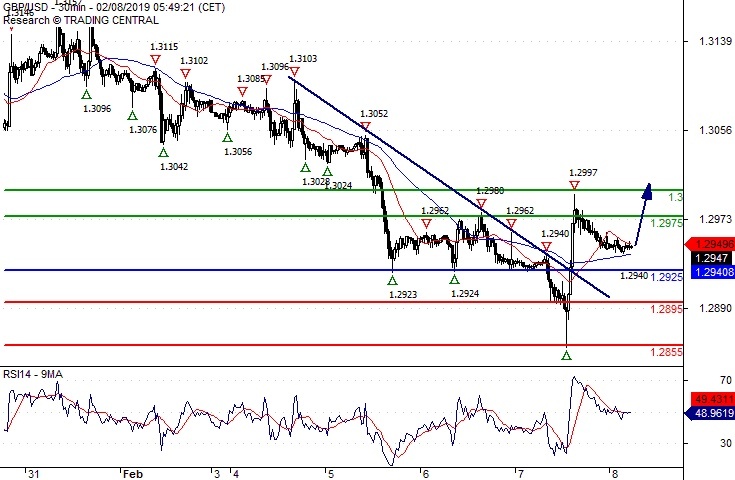
Pivot (invalidation): 1.2925
Our preference Long positions above 1.2925 with targets at 1.2975 & 1.3000 in extension.
Alternative scenario Below 1.2925 look for further downside with 1.2895 & 1.2855 as targets.
Comment Even though a continuation of the consolidation cannot be ruled out, its extent should be limited.
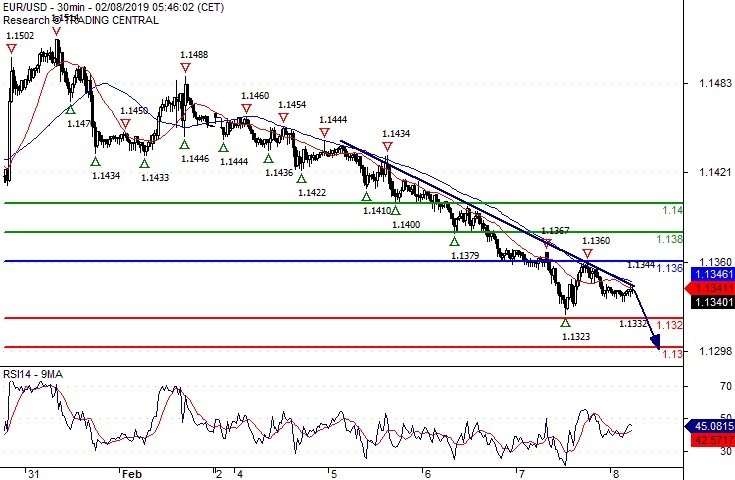
EUR/USD Watch 1.1300
Pivot (invalidation): 1.1360
Our preference Short positions below 1.1360 with targets at 1.1320 & 1.1300 in extension.
Alternative scenario Above 1.1360 look for further upside with 1.1380 & 1.1400 as targets.
Comment As Long as 1.1360 is resistance, look for choppy price action with a bearish bias.