Sample Category Title
CAD on Fire after Wild Jobs Report
- Canada Jan Full-Time Jobs +30,900; Part-Time +36,000
- Canada Jan Avg Hourly Wages +2.0% From Year Ago
- Canada Jan Participation Rate At 65.6% Vs 65.4% In Dec
- Canada Jan Jobless Rate 5.8%; Dec 5.6%
Employment in Canada surged last month, led by the biggest one-month private-sector hiring ever recorded, while the unemployment rate climbed on a sharp increase in the number of younger people looking for a job.
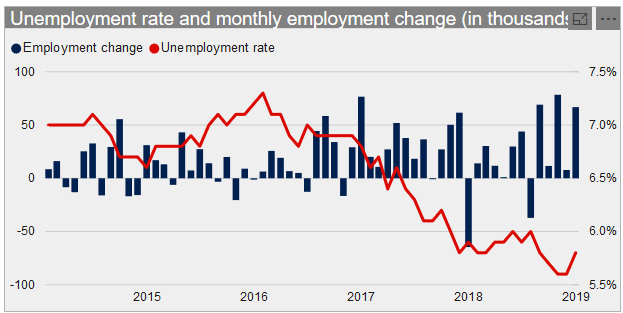
The Canadian economy added a net +66.8K jobs in January – the market was expecting a net job increase of +5K.
Canada’s jobless rate climbed to +5.8% in January, from +5.6% m/m. The uptick is being attributed to more people looking for work.
An estimated +103K Canadians joined the labor force in January, the largest one-month gain in a decade.
CAD has rallied hard on the surprise number, up +0.6% to C$1.3241 – the loonie was trading at C$1.3303 ahead of the release.
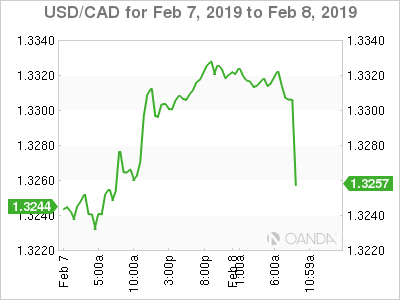
Canada added 67k jobs in January, CAD surges
Canadian Dollar rebounds strongly in early US session after stellar employment data. The job market grew 67k in January, way above expectation of 6.5k. Employment gains were driven entirely by private sector, which grew 112k. Unemployment rate rose to 5.8%, up from 5.6%, higher than expectation of 5.7%. But that was because "more people looked for work."
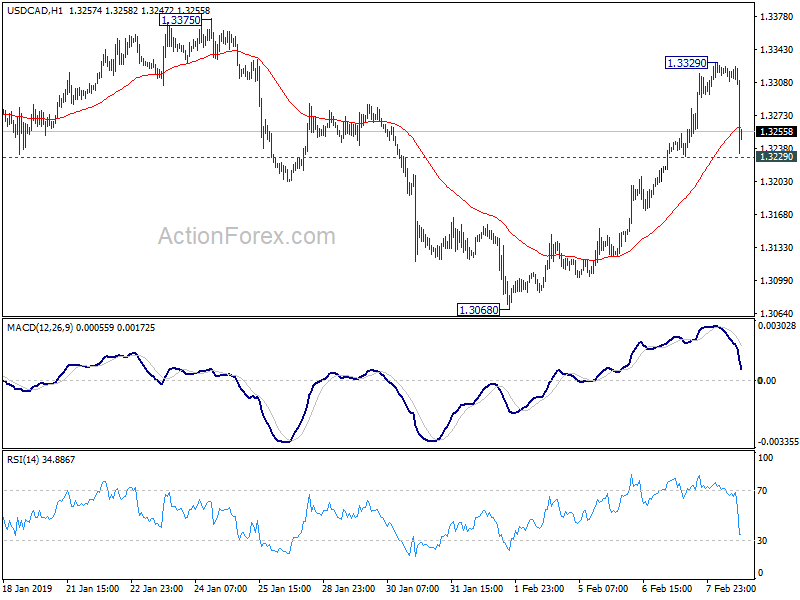
USD/CAD's focus is back on 1.3229 minor support after the dive. As long as 1.3229 holds, we'd still expect another rise to 1.3375 resistance. However, break could indicate completion of rebound from 1.3068 and bring deeper fall back to this short term bottom.
Into US session: Stocks in risk aversion, forex in range
Entering into US session, the forex markets are relatively calm today with major pairs and crosses are back inside Thursday's ranges. Though, risk aversion is clearly seen in other markets. Worries over US-China trade tension escalation resurfaced after Trump said he will not meeting Chinese President Xi this month. This came despite Trump's schedule to meet North Korean leader Kim Jong-Un on February 27-28 in Vietnam, just next to China. Re-escalation in trade tension would drag on the already weakened global recovery.
For today so far, Australian Dollar is the weakest one after dovish RBA economic projections. But there is no follow through selling yet. Dollar also weakens mildly as it's paring this week's gain. Sterling is the strongest one, followed by Swiss France. Both are consolidating this week's moves. Canadian Dollar is also steady but some volatility is envisaged after job data release.
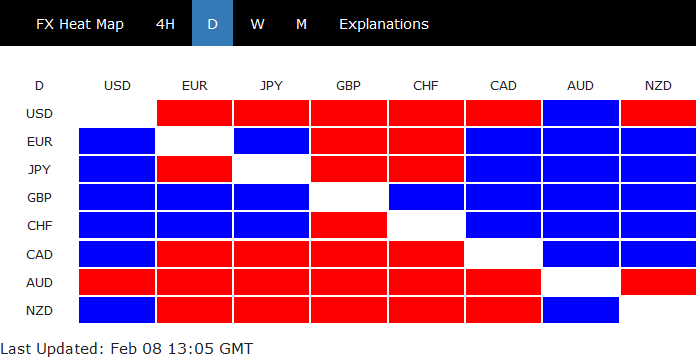
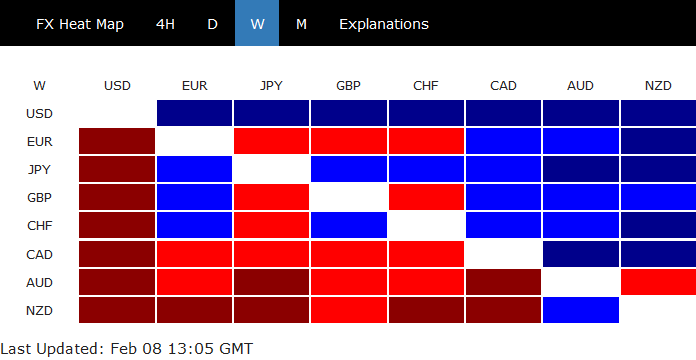
For the week, Dollar is overwhelmingly the strongest one, followed by Yen and then Swiss Franc. Commodity currencies are the weakest, led by Aussie.
In other markets:
- DOW futures are down more than -100 pts right now.
- FTSE is down -0.25%.
- DAX is down -0.51%.
- CAC is down -0.25%.
- German 10-year yield is down -0.0149 at 0.102. Decline in German yield is quite serious this week.
Earlier in Asia:
- Nikkei closed down -2.01%.
- Hong Kong HSI dropped -0.16%.
- Singapore Strait Times rose 0.04%.
- Japan 10-year JGB yield dropped -0.0185 to 0.027.
DAX Sinks to 3-Week Low on Concerns Over U.S.- China Trade Spat
The DAX index has paused for breath in the Friday session, after sharp losses on Thursday. The DAX is currently trading at 10,976 down 0.41% on the day. On the release front, there are no major German or eurozone indicators. Germany’s trade surplus widened to EUR 19.4 billion, above the estimate of EUR 18.3 billion.
Investors remain jittery about trade tensions between the U.S and China, which have been the catalyst for the global trade war which was rocked equity markets. Although the sides met for talks last week in Washington, there have been no signs of progress. On Thursday, U.S. stock markets fell after President Trump said that he had no plans to meet with Chinese President Xi before March 2, when further U.S. tariffs are scheduled to be imposed. This has raised concerns that a trade deal will not be reached prior to the March 2 deadline. On the DAX, bank and automotive shares have dropped sharply. Deutsche Bank has declined 1.08%, and Daimler, BMW and Volkswagen have all dropped over 1.2%.
The European Commission has projected moderate growth in the EU in 2019, but economic uncertainty has dampened confidence. The forecast lowered its growth forecast for the eurozone to 1.9% in 2018, down from 2.1% in the November forecast. For 2019, the growth forecast has also been revised down to 1.5%, compared to 1.9% in the November forecast. Inflation slipped in late 2018 due to lower oil prices, with an average inflation level of 1.7%. This is expected to dip to 1.6% in 2019. The report highlighted Brexit and the slowdown in China as key sources of uncertainty for European economies, adding that the projections were subject to downside risks.
Canadian Dollar Steady ahead of Key Job Data
USD/CAD is almost unchanged in the Friday session. Early in North American trade, the pair is trading at 1.3314, up 0.4% on the day. On the release front, there are no U.S. events. Canada will release employment numbers. Employment change is expected to post modest gains of 6.5 thousand and the unemployment rate is projected to edge up to 5.7%.
It’s been a rough week for the Canadian dollar, which has slipped 1.6%. Will the slide continue? Investors are increasingly concerned that the U.S and China will not be able to reach a trade deal. On Thursday, President Trump said that he had no plans to meet with Chinese President Xi before March 2, when further U.S. tariffs are scheduled to be imposed against China. This has raised concerns that a trade deal will not be reached prior to the March 2 deadline. Trump’s remarks chilled risk appetite, sending U.S. equity markets and the Canadian dollar lower.
The Bank of Canada appears to have taken page out of the Federal Reserve’s playbook, and is expected to ease monetary policy this year after aggressively raising rates in 2018. On Wednesday, BoC Deputy Governor Tim Lane said that Canada’s fundamentals were strong and unemployment was at historically-low rates. However, Lane noted that the Canadian dollar was under pressure due to lower oil prices, a soft housing market and a decline in business investment due to uncertainty over U.S. trade policies.
Dollar In Demand For Now, But….
Friday February 8: Five things the markets are talking about
Investor worries over economic growth and trade disputes have pushed global equities towards their first weekly loss in nearly two-months. Oil and metals are under pressure, while yen and sovereign bond prices have pushed a tad higher.
Equities in Asia mostly saw red on the news that President Trump is unlikely to meet with China’s Xi before the March 1 tariff deadline.
This week saw some central banks revise down economic growth and who have adopted a more ‘dovish’ stance – Fed, ECB, RBA, RBI and BoE.
Reserve Bank of Australia (RBA)
The RBA has adopted a “neutral” policy bias, stating that the Australian economy “could be weaker than it thinks and that the risks to the economic outlook are more balanced.”
Nevertheless, Governor Lowe remains upbeat on the Aussie job market, but has given the RBA the latitude to cut interest rates should growth fall short of expectations and the unemployment rate start to rise.
Reserve Bank of India (RBI)
The RBI cut its Repurchase Rate unexpectedly by -25 bps to +6.00% for its first cut since Oct 2016 and has changed its policy stance to “neutral” from calibrated tightening.
Bank of England (BoE)
No surprises from the BoE on Thursday – It slashed its growth forecast for 2019 (+1.2% from +1.9%), citing the impact of weaker demand for British exports, and the effect of uncertainty about the country’s departure from the E.U on investment and consumer spending.
Europe
Trade tensions, falling demand from China, protests in France, concerns over Italy’s debt, and weakening manufacturing and export outlook in the EU’s powerhouse, Germany. The possibility of a hard Brexit is also fuelling uncertainty and raising the threat of greater-than-anticipated disruption.
On tap: Canadian employment numbers at 08:30 EDT.
1. Stocks see red
In Japan, the Nikkei fell on concerns about slowing corporate earnings growth. The index share average dropped -0.6%, while the broader Topix declined -0.8%.
Down-under, Aussie shares ended lower overnight, with energy and mining stocks accounting for more than half of the losses on Sino-U.S trade tensions. The S&P/ASX 200 index fell -0.34%. The benchmark rose +1.1% yesterday and was up +3.4% for the week. In S. Korea, the Kospi index fell -1.2% on intensifying trade tensions.
China’s markets remain shut for Lunar New Year. In Hong Kong, trade worries pushed the Hang Seng into negativity territory. At the close the index lost -0.25%.
In Europe, regional bourses are trading mixed this morning following a sharp sell off yesterday as Brexit developments and Sino-U.S remain the focus.
U.S stocks are set to open in the ‘red’ (-0.29%)
Indices: Stoxx600 -0.03% at 359.96, FTSE +0.17% at 7,107.25, DAX -0.04% at 11,017.50, CAC-40 +0.03% at 4,987.12, IBEX-35 -0.36% at 8,906.40, FTSE MIB +0.22% at 19,521.50, SMI +0.04% at 9,026.50, S&P 500 Futures -0.29%
2. Oil prices fall hard on growth concerns, gold steady
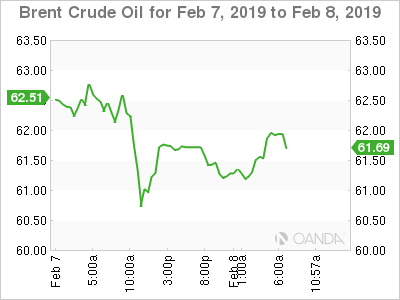
Oil fell more than -2% yesterday on investor concerns that global demand growth would lag in 2019. Also, not providing support, are worries that a trade war between the U.S. and China would continue, weighing on demand and that oil producers would not adhere strictly to cuts agreed to last year.
Brent crude futures are down -14c at +$61.49 per barrel. On the week, they are set for a loss of around -2%. U.S West Texas Intermediate (WTI) crude futures are at +$52.46 per barrel, down -18c, and looking at a -5% weekly slump.
Crude fundamentals are not helping, as weekly data published by the U.S EIA mid-week showed an unwelcome increase in stocks of crude oil.
Crude bulls have been pinning their hopes on OPEC+ production and a squeeze on supply from Iran and Venezuela, due to U.S sanctions, would lead to the market being balanced this year.
And another factor weighing on oil prices this week has been a stronger U.S dollar.
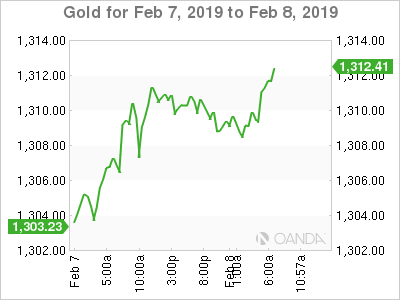
Ahead of the U.S open, gold is trading steady on worries that a prolonged Sino-U.S trade war could worsen global economic slowdown, but a strong dollar has put the yellow metal in line for its first weekly loss in nearly a month. Spot gold is steady at +$1,309 per ounce, while U.S gold futures are down -0.1% at +$1,312.70.
3. Safe haven bonds in demand
Safe-haven government bonds have benefited the most on growing investor anxiety over the global outlook, with German and Japanese debt yields falling to their lowest in over two-years.
Germany’s 10-year Bund yield is just +10 bps away from “zero” percent. Analysts note that its “now in territory that reflects dire concern about economic conditions.”
Note: Three months ago, German bonds out to six years had sub-zero yields.
Elsewhere, British gilt yields hit an eight-month low yesterday after the BoE cuts its growth estimates. Overnight, Japan’s 10-year JGB yield fell to a five-week low and U.S. Treasury yields are down -5 bps this week in a third week of falls.
Elsewhere in Europe, there are some signs of stability in Italy’s bond market, where yields edged lower after sharp increases this week – yields aggressively backed up as weak Italian data supported investor worries about a deterioration in public finances. Italy’s 10-year BTP yield is a tad lower at +2.94% this morning – it has risen some +20 bps this week.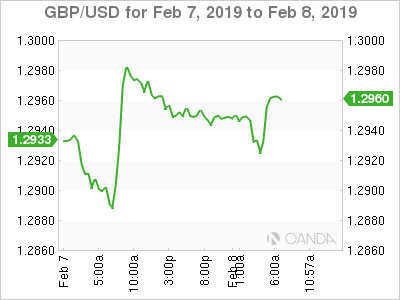
4. Dollar in demand for now, but…
EUR/USD still managing to trade above the psychological €1.13 level as the economic data and commentary for Europe appears somewhat dire. Yesterday, the E.U Commission released its 2019 winter forecasts which had been pared back rather aggressively. The market now believe the ECB will also present lower growth forecasts when the staff projections are updated next month. This has futures dealers pricing in “new easing” and postponing of tightening from the ECB.
GBP/USD is a tad stronger by +0.14% at £1.2965 area in the aftermath of yesterday’s BoE rate decision. The central bank voted unanimously to keep the Bank Rate at 0.75% but lowered both its GDP and CPI inflation projections. The pair is well off yesterday’s low as participants noted that the BoE made no major policy shift and continues to see the next move in rates as higher.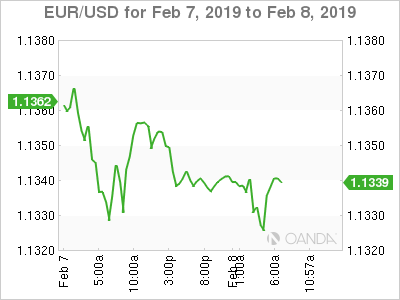
5. German exports rose in December
Germany’s Federal Statistical Office (FSO) this morning reported that exports in December increased +1.5% from the month before while imports rose +1.2%, both figures seasonally adjusted.
Digging deeper, compared with December 2017, exports to EU member states fell -4.6%. Shipments to the eurozone declined -4.1% and those to non-eurozone countries posted a steeper drop of -5.5%.
Germany’s adjusted trade surplus came to €19.40B – the market was forecasting a €18.5B print.
Note: On Thursday, the E.C cut its GDP growth forecast for Germany to +1.1% for 2019 compared with +1.8% previously.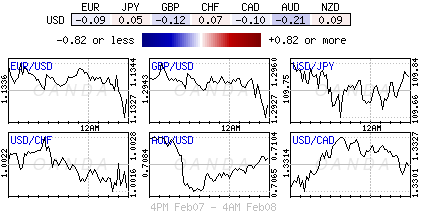
EUR/USD – Euro Pauses For Breath After Dismal Week
EUR/USD is unchanged in the Friday session. Currently, the pair is trading at 1.1341, up 0.02% on the day. On the release front, Germany's trade surplus widened to EUR 19.4 billion, above the estimate of EUR 18.3 billion. With no U.S. events on the schedule, we're unlikely to see much movement from the euro during the day.
It's been a tough week for the euro, which has lost 1.0 percent. The euro lost ground on Thursday after the release of the European Commission economic forecasts. The EC has projected moderate growth in the EU, but plenty of uncertainty has dampened confidence. The forecast lowered its growth forecast for the eurozone to 1.9% in 2018, down from 2.1% in the November forecast. For 2019, the growth forecast has also been revised down to 1.5%, compared to 1.9% in the November forecast. Inflation slipped in late 2018 due to lower oil prices, with an average inflation level of 1.7%. This is expected to dip to 1.6% in 2019. The report highlighted Brexit and the slowdown in China as key sources of uncertainty for European economies, adding that the projections were subject to downside risks.
The Federal Reserve does not hold its policy meeting until mid-March, so investors will be left to focus on remarks from Fed Chair Jerome Powell and his colleagues. The Fed raised interest rates four times last year, but economic conditions are very different in 2019. The U.S-China trade war has dampened global growth and rocked the equity markets. With the U.S. unlikely to replicate the sparkling growth we saw in 2018, the Fed is projecting just two rate increases this year. The markets, however, are predicting no rate moves, and some analysts are even talking about the possibility of a rate cut late in 2019
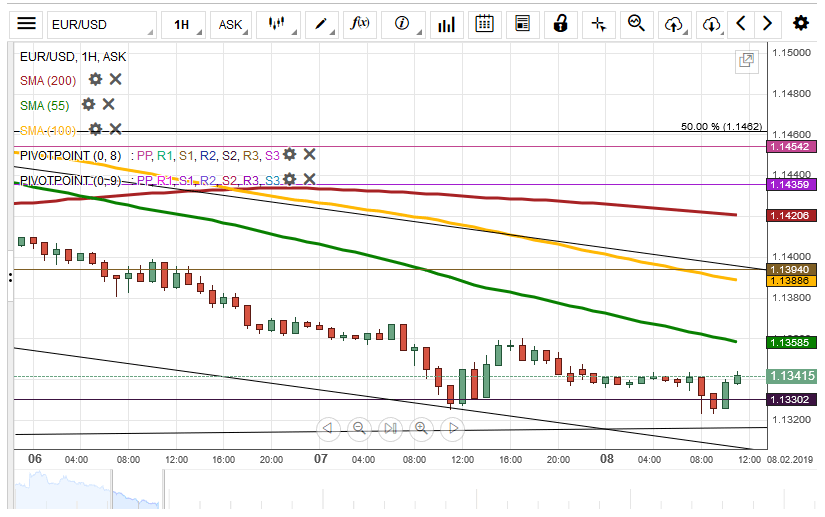
EUR/USD Depreciates To S1 At 1.1301
During Thursday's trading session, the currency exchange rate was retraced by the 55-hour simple moving average to trade sideways at 1.1320. On Friday morning, the rate was located at the 1.1330 mark.
In regards to the near-term future, most likely, the European Single Currency will bounce off the monthly S1 at 1.1301 passing the small pattern line at the 1.1320 mark.
On the other hand, the European Single Currency could appreciate against the US Dollar to the 1.1340 level during today's Canadian Employment change and Unemployment rate announce at 13:30 GMT.
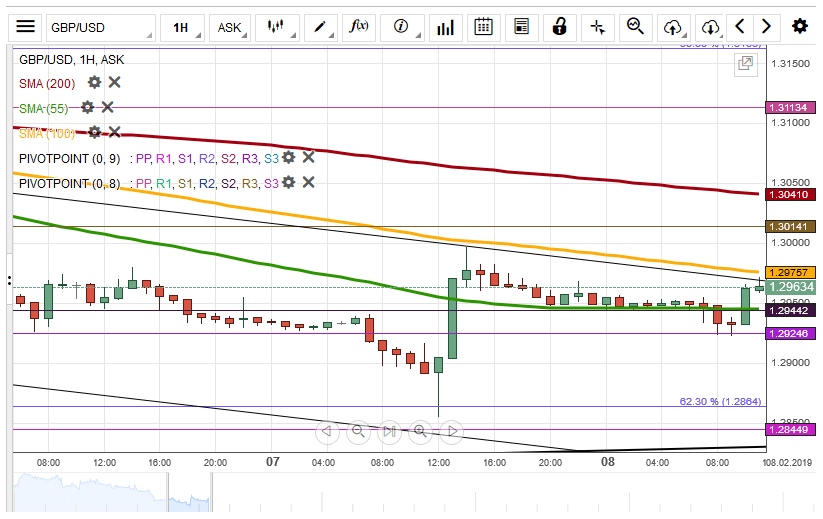
GBP/USD Will Stay At 1.2900
During Thursday's trading session, the currency exchange rate jumped by 142 pips or 1.11% to the 1.3000 mark. On Friday morning, the rate was located between the 55-hour and the 100-hour simple moving averages at the 1.2949 mark.
In regards to the near-term future, most likely, the rate will trade sideways to stay at the 1.2900 level for the rest of the trading session.
However, the 55-hour simple moving average could support the British Pound to appreciate against the US Dollar to break the resistance level of the 200-hour simple moving average. It is expected that the rate could trade near the weekly S1 at the 1.3014 mark.
USD/JPY Will Surge To 110.00
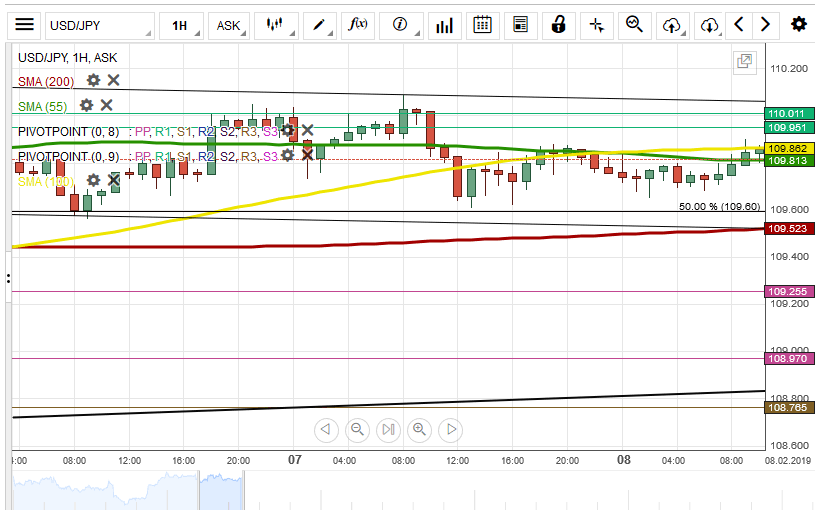
During Thursday's trading session, the currency exchange rate was resisted by the 55-hour simple moving average to trade sideways at 109.60. On Friday morning, the rate was supported by the 55-hour SMA at the 109.81 mark.
In regards to the near-term future, most likely, the 100-hour and the 55-hour simple moving averages will support the US Dollar to appreciated against the Japanese Yen to break the resistance level of the weekly R1 at the 110.01 mark.
However, the weekly R1 at the 110.01 mark could resist the rate to push it to trade sideways at the 109.80 level for the rest of the day.