Sample Category Title
Tesla Elliott Wave Bearish Sequence Favoring More Downside
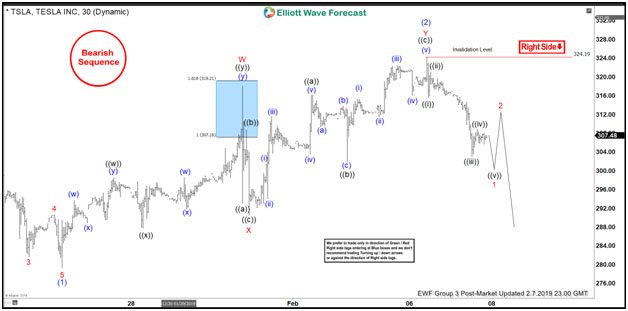
Tesla ticker symbol: $ TSLA short-term Elliott wave view suggests that the cycle from 12/7/2018 peak is showing incomplete structure favoring more downside still. Down from that peak, the decline is unfolding as an impulse structure with sub-division of 5 waves structure in lesser degree cycles. When a decline to $279.28 low ended wave (1) in a lesser degree 5 waves structure. Above from there, Tesla corrected the cycle from 1/16/2019 peak ($352) in wave (2) bounce.
The internals of that bounce unfolded as double three structure with lesser degree cycles showing the sub-division of 3-3-3 corrective structure in each leg. Up from $279.88 low, the initial bounce to $318 peak ended wave W also in lesser degree double three structure. Down from there, a pullback to $290.51 low as zigzag structure. Above from there, a rally to $324.19 high ended wave Y as zigzag structure. And also completed the wave (2) bounce. Near-term, as far as bounces fail below $324.19 high expect Tesla to extend lower in wave (3) lower towards $264.11-$243.39 area lower initially. However, a break below $279.28 low will add more conviction to this bearish view & avoid double correction in wave (2) bounce.
Tesla 1 Hour Elliott Wave Chart
USD/CAD Daily Outlook
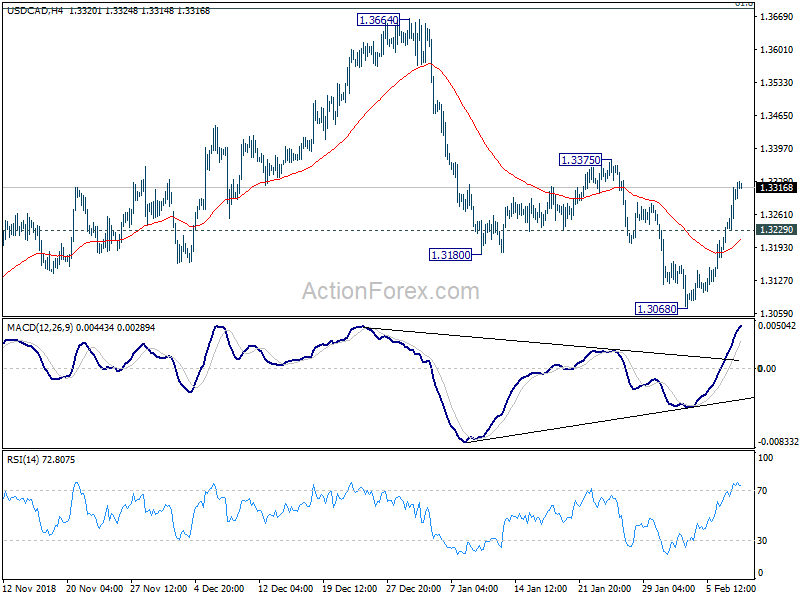
Daily Pivots: (S1) 1.3236; (P) 1.3277; (R1) 1.3351; More...
USD/CAD's rise from 1.3068 is still in progress and intraday bias remains on the upside for 1.3375 resistance. Decisive break there should confirm completion of whole fall from 1.3664. In that case, further rise should be seen back to retest 1.3664. On the downside, below 1.3229 minor support will turn intraday bias neutral first. But risk will now stay on the upside as long as 1.3068 support holds.
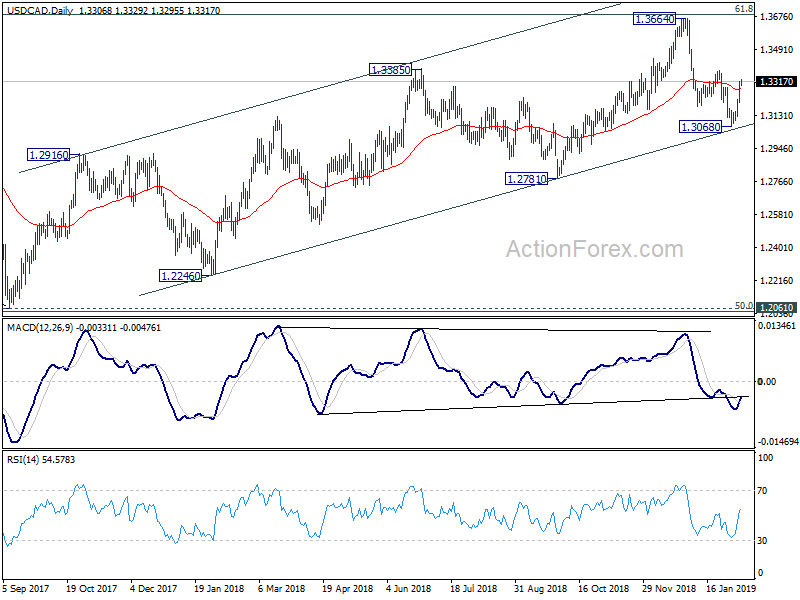
In the bigger picture, structure of the medium term rise from 1.2061 (2017 low) to 1.3664 is not clearly impulsive. Hence, we'd stay cautious on strong resistance from 61.8% retracement of 1.4689 (2016 high) to 1.2061 at 1.3685 and 1.3793 resistance to limit upside, and bring medium term topping. But in any case, medium term outlook will stay bullish as long as channel support (now at 1.3070) holds. Sustained break of 1.3793 will pave the way to retest 1.4689 (2015 high). Firm break of the channel support should confirm reversal target 1.2061 low again.
USD Lifted By Trade Reports But Gold Remains Resilient
Gloomy growth and trade troubles hit sentiment
Equity markets remain in the red heading into the final day of the week, building on Thursday’s sizeable losses as a raft of negative headlines unsurprisingly took its toll on investor sentiment.
Thursday really was a bad news day, with the European Commission and Bank of England both sharply revising lower their growth expectations for 2019, with the latter forecasting the worst year since the financial crisis. This comes amid a global growth slowdown and a huge amount of Brexit uncertainty that’s having a disproportionate impact on the UK.
Theresa May was back in Brussels on Thursday trying to convince her increasingly frustrated – see Tusk’s comments for reference – counterparts to agree to provide the necessary legal assurances on the backstop to get her deal over the line. The meeting went as well as she could have hoped, with both sides agreeing to work together and meet again at the end of the month. Of course, this calls into question the point of the vote on 14th February in Parliament and will lead to further suggestions that May is simply running down the clock again and gambling on her deal being backed to avoid no deal.
This was followed by reports that there will be no meeting between Trump and Xi this month, casting doubt on whether enough has been achieved in talks to avoid further tariffs being imposed. As ever with these negotiations, it can be difficult to discern actual breakdowns from brinkmanship, especially when the narrative change from week to week.
USD lifted by trade reports but gold remains resilient
Not only did these reports take their toll on equity markets, they also triggered a rebound in the dollar. The greenback was favoured throughout the escalation of the trade war and has softened since talks began, on hope that an agreement can be found. The latest setback reversed the trend earlier in the session and saw the dollar trading back around 2019 highs.
Naturally this isn’t great news for gold which typically performs worse when the dollar is appreciating. Interestingly though, as we’ve seen a lot recently, while gold is rallying well on periods of dollar weakness, the inverse is not true to the same extent. So while gold is a little lower on the day, it’s still comfortably off the lows it tested yesterday when it came within touching distance of $1,300 before rebounding. This remains a bullish signal.
AUD Declines As RBA Cuts Near-Term Growth And Inflation Forecasts
General Trend:
- Marine/Transportation, Machinery, Autos and Electric Appliance shares weigh on the Nikkei
- ZTE declines over 4% in Hong Kong , US President Trump expected to sign executive order banning Chinese telecom equipment next week (US press)
- Rusal rises over 8% after quarterly production update
- Chinese markets due to return from holiday on Monday
- Markets in Japan will be closed for holiday on Monday
Headlines/Economic Data
Australia/New Zealand
- ASX 200 opened -0.4%
- (AU) RESERVE BANK OF AUSTRALIA (RBA) QUARTERLY STATEMENT ON MONETARY POLICY (SOMP): REITERATES INTEREST RATE OUTLOOK MORE EVENLY BALANCED THAN PREVIOUSLY THOUGHT; Cuts GDP growth forecast for year through June from 3.25% to 2.5%; Cuts June 2019 Core (trimmed mean) inflation forecast from 2% to 1.75%
- (NZ) ASB Bank expects the Reserve Bank of New Zealand (RBNZ) to keep cash rate unchanged into 2021 vs Q3 2020 rate hike prior view - US financial press
China/Hong Kong
- Shanghai Composite closed, Hang Seng opened -1%
- (US) Pres Trump confirms he will not meet with Xi before the March 1 tariff deadline; may meet later
- (US) White House economic advisor Kudlow: still a pretty sizable distance to go in China trade talks - Fox Business interview
- (CN) US President Trump likely to sign order banning Chinese telecomm equipment next week - US press
Japan
- Nikkei 225 opened -1.2%
- (JP) JAPAN DEC PRELIM BOP TRADE BALANCE: ¥216.2B V 132.4BE
- (JP) JAPAN DEC PRELIM BOP CURRENT ACCOUNT BALANCE: ¥452.8B V ¥469.3BE; ADJUSTED CURRENT ACCOUNT: ¥1.6T V ¥1.5TE
- (JP) JAPAN DEC LABOR CASH EARNINGS Y/Y: 1.8% V 1.7%E; REAL CASH EARNINGS: 1.4% V 1.7%E
- (JP) Japan Dec Household Spending Y/Y: 0.1% v 0.8%e
- (JP) Nikkei 225 Feb Options said to settle at ~20,481
- (JP) In Jan Japan investors sold net ¥1.07T in Foreign Stocks, purchased net ¥2.22T in foreign bonds
Korea
- Kospi opened -0.5%
- (KR) Follow Up: South Korea and US to hold military exercises after Trump-Kim summit - Korean Press
- (KR) South Korea Finance Ministry: To sell KRW6.0T in Treasury bills in Feb, to be used for temporary shortfalls in the budget for job creation.
- (KR) South Korea Jan Foreign Reserves: $405.5B v $403.7B prior
Other
- (TH) Thailand King's eldest sister to run for Prime Minister in March 24 election
North America
- (US) Fed Bullard (dove, FOMC voter): Sees 2019 growth 'considerably' slower than 2018; Balance sheet reserves to be more than previously thought
Europe
- (UK) UK PM May office Senior Official: Positive from today is that there will be talks to find a way through on Brexit; Looking at Labour leader Corbyn's Brexit proposals but there are considerable points of difference
- (UK) UK PM May to guarantee that the UK matches EU on workers' rights after Brexit following deal with Labour - UK Press
Levels as of 12:50ET
- Nikkei 225, -1.9%, ASX 200 -0.3%, Hang Seng -0.4%; Shanghai Composite closed; Kospi -1.1%
- Equity Futures: S&P500 -0.4%; Nasdaq100 -0.5%, Dax -0.1%; FTSE100 -0.2%
- EUR 1.1351-1.1333 ; JPY 109.85-109.64 ; AUD 0.7107-0.7060 ;NZD 0.6757-0.6729
- Gold -0.1% at $1,313/oz; Crude Oil -0.6% at $52.35/brl; Copper -0.4% at $2.821/lb
Gloomy EU Growth Expectations Weigh On Market Sentiment
Market movers today
A quiet day on the data front, but markets will keep an eye on the Brexit headlines.
Italian markets already sold off yesterday, after the European Commission slashed its annual growth forecast for the country to just 0.2%, bringing back concerns about a resumption of last autumn's budget fight. To feed the gloom, today's Italian industrial production figures for December are unlikely to lift investors mood on the economy, which contracted by -0.2% q/q in Q4.
In Scandinavia, we get Norwegian Q4 18 GDP figures and Danish foreign trade data for December. We
Selected market news
Overnight Trump said that he has no plans to meet with Xi Jinping before the 1 March deadline and the end of the 90-day truce on higher tariffs. Hence, the trade war fears are now returning to the market.
Yesterday, the EU Commission released new rather gloomy 2019 winter forecasts. Euro area growth for 2019 was revised down to 1.3% from previously 1.9%. The growth forecasts for Germany was lowered from 1.8% to 1.1%. The EU Commission slashed its 2019 euro area inflation forecast to 1.4%, down from previously 1.8%.
Noteworthy, the growth for Italy was lowered to just 0.2% in 2019 from previously 1.2%. This is well below the assumption in the 2019 budget and further questions the budget deficit assumptions by the Italian government and it could restart the budget fight with the EU. Remember, the EU and Italy agreed on a 2.04% deficit in December. The market reacted negatively to the news and the 10Y Italian spread vs Germany widened almost 15bp. 10Y Bund yields dropped to the lowest level since 2016.
We should expect that also the ECB will present lower growth forecasts when the staff projections are updated next month. It could further trigger market speculations of new easing/postponing of tightening from the ECB.
In light of the gloomy EU commission outlook it is quite important that we now see tentative signs of a bottom in the Chinese business cycle in Q1. Metal prices are up, PMI for large enterprises rebounded in January and export orders also off the lows - see more in China Leading Indicators - First signs of a bottom , 7 February.
As expected, the Bank of England (BoE) yesterday voted unanimously to keep the Bank Rate at 0.75%. BoE lowered both its GDP and CPI inflation projections, but made no big policy signal shifts though it even more strongly highlight the economic growth risks from Brexit.
The poor risk sentiment from Europe was carried over to the US and the major US indices ended the day roughly 1% lower and US Treasury yields dropped further and 10Y US yields are now at 2.65%. Asian markets are also in red.
EU Cuts Euro-Zone’s Growth Outlook
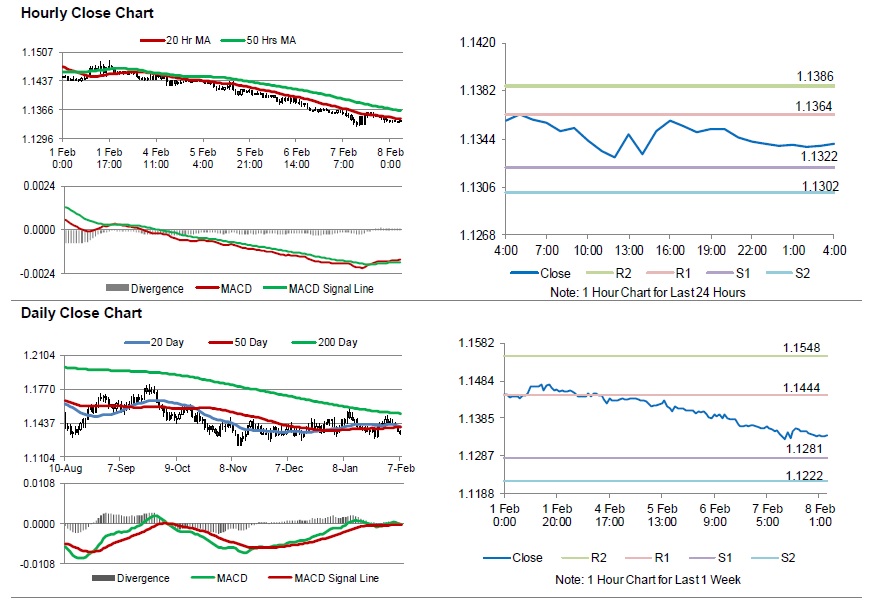
For the 24 hours to 23:00 GMT, the EUR declined 0.23% against the USD and closed at 1.1341, after the European Commission downgraded its growth forecasts for the euro area.
The European Commission downgraded its growth forecasts for the euro area for 2019 and 2020, citing heightened uncertainty and downside risks to the outlook. It slashed Eurozone's economic growth projection for this year to 1.3% from 1.9% and to 1.6% from 1.7% for 2020.
Data indicated that Germany's seasonally adjusted industrial production unexpectedly fell for the fourth consecutive month by 0.4% on a monthly basis in December, confounding market consensus for an advance of 0.8%. In the prior month, industrial production had recorded a revised drop of 1.3%.
In the US, data showed that the US consumer credit rose $16.6 billion in December, less than market expectations for a gain of $17.0 billion. In the prior month, consumer credit had registered a revised increase of $22.4 billion. Moreover, seasonally adjusted initial jobless claims fell to a level of 234.0K in the week ended 02 February 2019, signalling robust labour market strength and less than market expectations for a fall to a level of 221.0K. Initial jobless claims had registered a reading of 253.0K in the previous week.
In the Asian session, at GMT0400, the pair is trading at 1.1341, with the EUR trading flat against the USD from yesterday's close.
The pair is expected to find support at 1.1322, and a fall through could take it to the next support level of 1.1302. The pair is expected to find its first resistance at 1.1364, and a rise through could take it to the next resistance level of 1.1386.
Looking ahead, traders would await Germany's trade balance data for December, set to release in a while.
The currency pair is showing convergence with its 20 Hr moving average and trading below its 50 Hr moving average.
RBNZ Preview – Turning More Dovish while Affirming Next Move Can be Up or Down
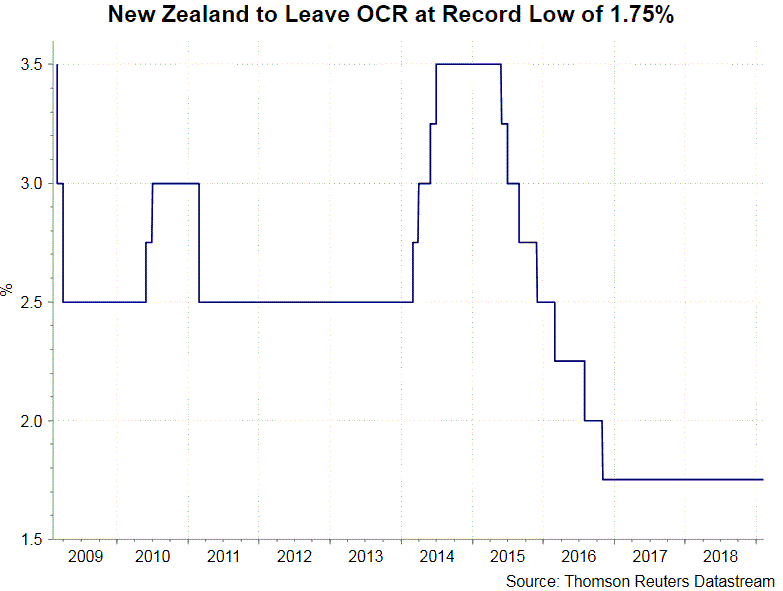
We expect RBNZ, at next week’s meeting, to leave the OCR unchanged at 1.75% and downgrade its economic growth forecasts. We believe the tone would be tilted to the dovish side as both global and domestic environment deteriorated since November. Increased downside risks and heightened uncertainty likely warrant a push back of the next rate move.
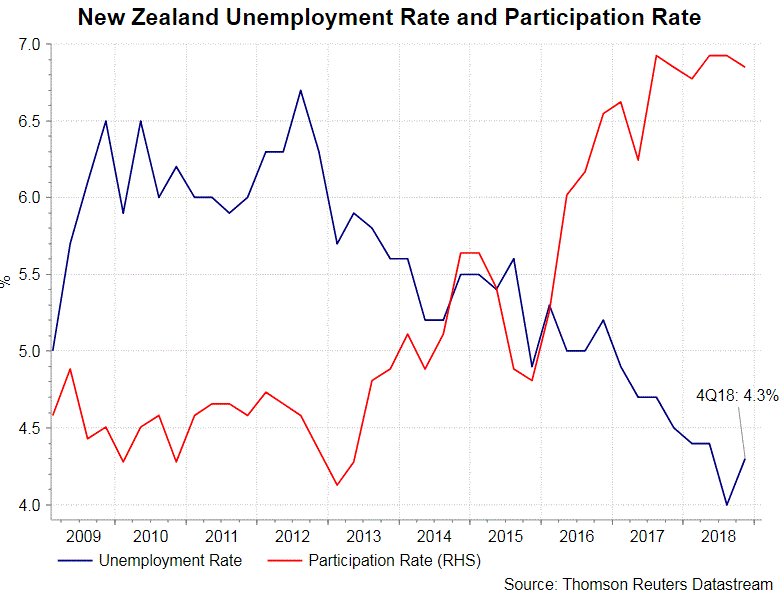
The unemployment rate climbed higher to 4.3% in 4Q18, from a decade low of 4% a quarter ago. The number of people employed increased only +2K during the quarter, the lowest since mid-2017, while the participation rate slipped to 70.9% from 71.1%. The report also shows that the number of unemployed male increased +8K to 65K, while the number of female unemployed added +2K to 55K. The phenomenon that men are more likely to be unemployed than women, first time since 2010. If persists, this could lead to weakness in wage growth, given the fact that male employees are earning 20% more than their female counterparts on average.
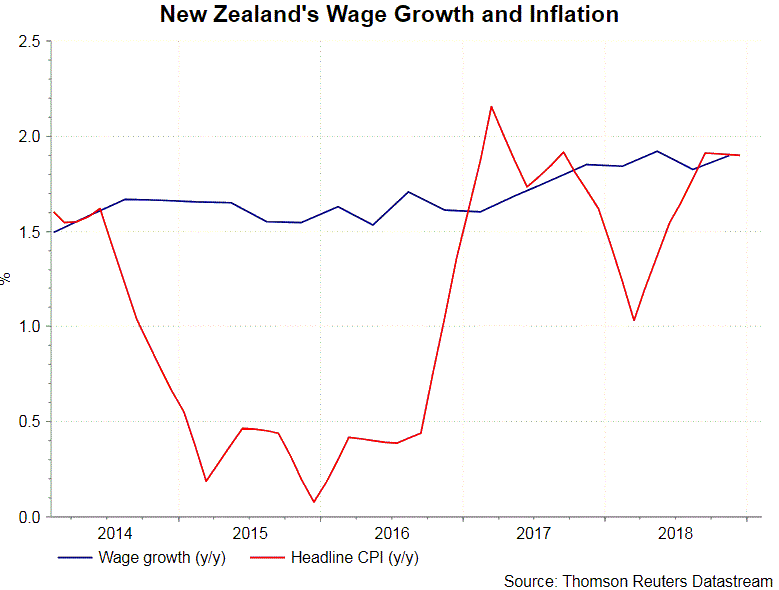
On wage, the annual growth improved to +2%, from +1.9% in 3Q18. GDP growth decelerated to +1.5% q/q in 3Q18, weaker than RBNZ’s forecast of +0.7%. This could lead to downward revision on the economic outlook. Headline inflation steadied at +1.9%y/y in 4Q18, higher than consensus of +1.8% but below the central bank’s target +2%.
As an economy highly reliant on exports of food and raw materials, New Zealand’s economic developments are significantly affected by its trading partners. As PM Jacinda Ardern suggested, “further reductions in Chinese exports could cause a material slowdown in its economy, with adverse effects for New Zealand exporters”. As such, trade negotiations between the US and China are critical to New Zealand’s economic outlook. Should China’s moderation in growth accelerate, it would diminish the country’s demand for New Zealand’s exports, hence affect New Zealand’s growth outlook.
On the monetary policy guidance, the RBNZ would likely reiterate the stance that “the next move in the OCR could be up or down”. While the majority of market participants judge that the policy rate has bottomed at the current 1.75%, some believe that further rate cut is possible. We expect there would be no rate change at least until second half of 2020.
The BoE Left Its Interest Rate Unchanged At 0.75%
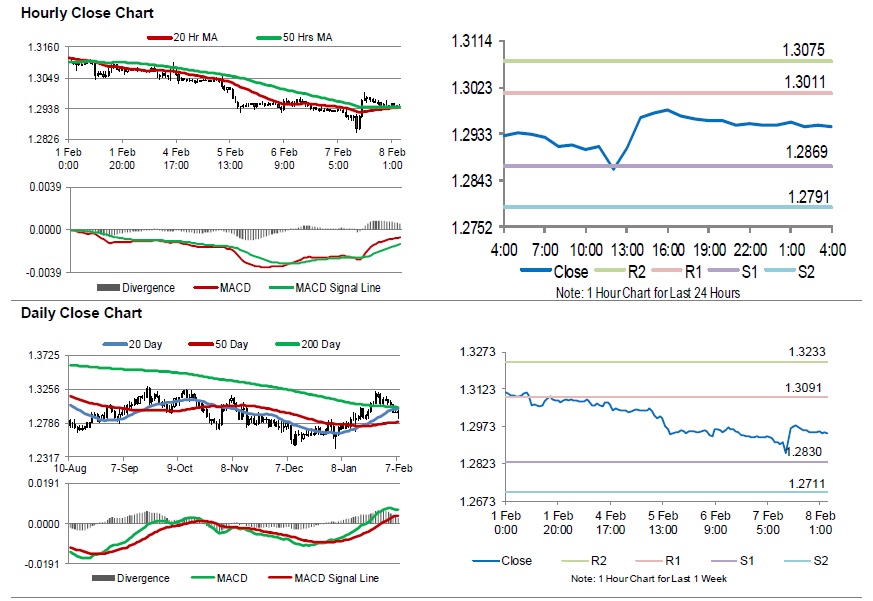
For the 24 hours to 23:00 GMT, the GBP rose 0.15% against the USD and closed at 1.2950.
On the macro front, UK’s Halifax house price index advanced 0.8% on a yearly basis in the three months ended January 2019, falling short of market anticipation for a rise to a level of 1.5%. In the October-December 2018 period, the index had recorded a jump of 1.3%.
The Bank of England, in its latest monetary policy meeting, kept its interest rate steady at 0.75%, as widely expected. The central bank trimmed its GDP outlook to 1.2% from 1.7% in 2019 citing uncertainty over Brexit. Growth projections for 2020 was also lowered to 1.5%, while the growth outlook for 2021 was raised to 1.9%.
In the Asian session, at GMT0400, the pair is trading at 1.2948, with the GBP trading a tad lower against the USD from yesterday’s close.
The pair is expected to find support at 1.2869, and a fall through could take it to the next support level of 1.2791. The pair is expected to find its first resistance at 1.3011, and a rise through could take it to the next resistance level of 1.3075.
Moving ahead, investors would closely monitor UK’s gross domestic product, trade balance data, industrial production and manufacturing production, slated to release next week.
The currency pair is showing convergence with its 20 Hr and 50 Hr moving averages.
Japan Posted A Trade Surplus In December
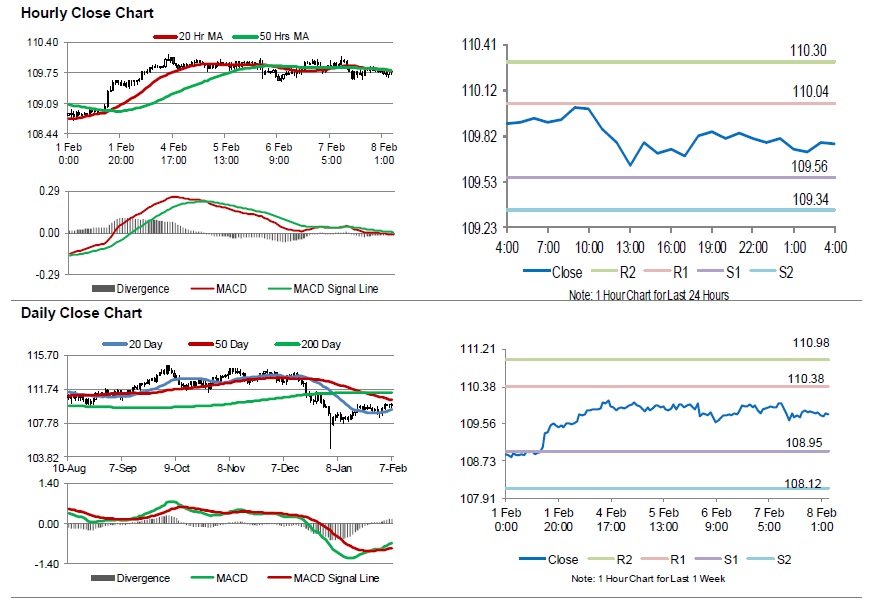
For the 24 hours to 23:00 GMT, the USD declined 0.14% against the JPY and closed at 109.78.
In the Asian session, at GMT0400, the pair is trading at 109.77, with the USD trading marginally lower against the JPY from yesterday’s close.
Overnight data revealed that Japan posted a trade surplus (BOP basis) of ¥216.2 billion in December, following a deficit of ¥559.1 billion in the prior month. Market participants had anticipated the nation to record a surplus of ¥132.4 billion.
The pair is expected to find support at 109.56, and a fall through could take it to the next support level of 109.34. The pair is expected to find its first resistance at 110.04, and a rise through could take it to the next resistance level of 110.30.
The currency pair is showing convergence with its 20 Hr and 50 Hr moving averages.
Swiss Franc Trading Higher In The Asian Session
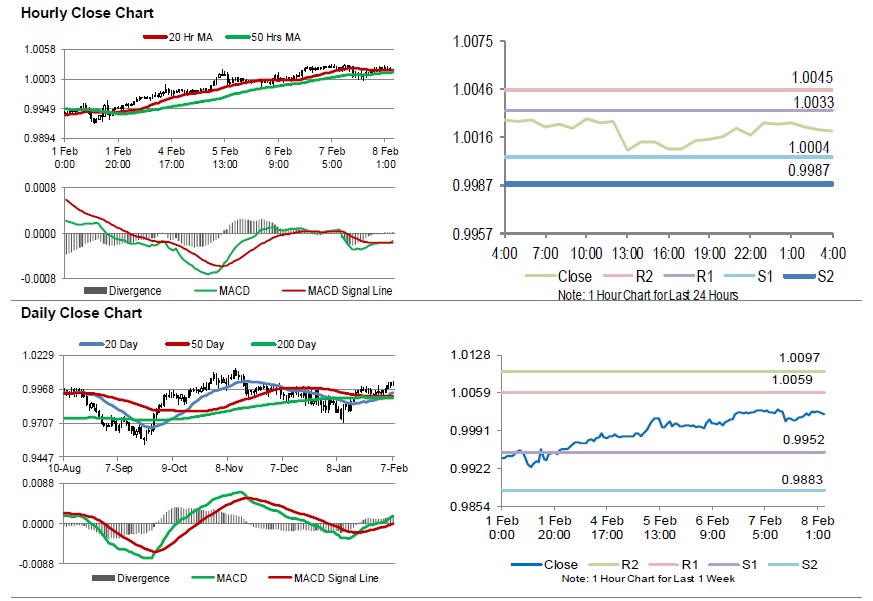
For the 24 hours to 23:00 GMT, the USD slightly rose against the CHF and closed at 1.0025.
In the Asian session, at GMT0400, the pair is trading at 1.0020, with the USD trading 0.05% lower against the CHF from yesterday’s close.
The pair is expected to find support at 1.0004, and a fall through could take it to the next support level of 0.9987. The pair is expected to find its first resistance at 1.0033, and a rise through could take it to the next resistance level of 1.0045.
Trading trend in the Swiss Franc today, is expected to be determined by Switzerland’s unemployment rate for January, scheduled to release in a while.
The currency pair is showing convergence with its 20 Hr and 50 Hr moving averages.