

Sample Category Title
Japanese Yen Slightly Lower, Investors Await Japanese Consumer Releases
USD/JPY has edged lower in the Thursday session. In North American trade, the pair is trading at 109.77, down 0.19% on the day. On the release front, unemployment claims dropped to 234 thousand, but this was above the estimate of 220 thousand. Japan will release consumer data. Houshold spending has posted three successive declines, but is expected to rebound with a gain of 0.8%. Average cash earnings is forecast to slow to 0.7% in December, compared to 1.0% a month earlier. As well, Japan’s current account surplus is expected to rise to JPY 1.52 trillion.
Japanese Prime Minister Shinzo Abe and the Bank of Japan have come under fire over inflation levels, which have stubbornly remained well below the target of 2.0%, despite the BoJ’s ultra-loose monetary policy. On Wednesday, Abe defended the policy, saying it had helped create jobs and had benefited the economy. For its part, the BoJ has said that the inflation target remains elusive due to weak oil prices and the public’s deflationary mindset. Abe said that he “accepts” the BoJ’s explanation. In January, the BoJ maintained its monetary policy, but lower its inflation forecast, warning that protectionism and softer global demand posed significant risks to the Japanese economy.
President Trump’s State of the Union address was a yawner as far as the markets were concerned, but there were some points of interests for investors. Trump spoke about the U.S-China trade war, reiterating that the U.S. would demand “real structural change” from China before a trade deal could be reached. American policymakers have long demanded that China desist from intellectual theft against U.S. companies, and with China experiencing a slowdown, the Chinese may have to make concessions or face further tariffs in March. A third round of negotiations between the sides is scheduled for this month, raising hopes that the U.S. will not impose further tariffs on China in early March. Trump also announced that he will meet North Korean leader Kim in late February, an event which could bolster risk appetite and weigh on the Japanese yen.
How Long Can I Hold the Position in Forex Trading?
Any position in the Forex market is opened with the aim of obtaining profit. How long a position is open depends on the desire of a trader and a margin (the position can be closed automatically if there are not enough funds to maintain it). That is, the trader himself decides how long his position will be open.
Also, entering a position, one should consider swaps. A swap is a fee for moving positions overnight. They can be positive and bring some little additional profit but may be negative as well.
Types of traders according to the duration of positions
The ability to determine the optimal points for opening and closing a position directly influences the effectiveness of trading. The duration of holding an open position has great importance, so beginning traders often have a question: “How long should I keep the position open?”.
The Forex market offers many opportunities for various types of traders. Depending on the chosen trading style, the duration of a position can vary from several minutes to several days. But, all traders, depending on what time period they choose, can be divided into four main categories:
- scalpers;
- intraday traders;
- swing traders;
- position traders.
Scalpers
Scalpers can make a profit from any price movement. A typical trading style is a large number of transactions with a profit or loss of just a few points. They prefer to work on minute charts. They do not rise above the half-hour timeframes. Aggressive scalpers can enter the market with large volumes of contracts.
Intraday traders
They make deals exclusively during the day. All open trades are closed before nightfall. Day traders especially carefully monitor the possible risks, and all transactions that are carried out by such market participants last in the range from a few minutes to several hours. Day traders prefer not to work above 4-hour charts.
Swing traders
Swing traders assume that the transaction will be open from a few days to a couple of weeks. Their main task is to use the medium-term perspective, which allows them to get a stable income. Swing traders, as well as intraday speculators, rely mainly on technical analysis methods, trying to find an entry point that will be located close to the support level.
Position traders
These traders take advantage of global trends. To identify them, position traders pay their attention to the fundamental factors that underlie the trading approach. Usually, W1 and sometimes larger timeframes are used as time intervals for analysis. For position traders, it is quite normal to hold a position for half a year-year. When analyzing the situation, they are guided by the size of interest rates and the main macroeconomic indicators of those countries whose currencies they use in trading.
So, the duration of an open position depends on your goals and your strategy. It can be open from a second to several years. Choose a pattern of behaviour that suits you best, afterwards turn your knowledge into practice in Forex trading. If you’re not sure or haven’t enough experience in Forex market, practice on Demo account then. The usage is free while the registration is quite simple, you’re only shall enter your email address.
Euro Recovery Turns Sour Again as Recession Risks Grow; Will ECB Come to Rescue?
The euro’s slow recovery against the US dollar from November’s 16½-month low appears to have stalled as the outlook for the Eurozone economy grows grimmer by the day with no sign yet that a turnaround is around the corner. Expectations that the European Central Bank will nevertheless press ahead with its plans to start raising rates later this year, along with a pullback in the greenback have been supporting the single currency until recently. However, with the ECB’s normalization plans now in question and the dollar recapturing some of its lost allure, the euro’s prospects in 2019 are not looking very positive.
Two thousand and eighteen was not a good year for the Eurozone economy and 2019 is on course to be an even worse one as a rebound in growth becomes ever more elusive, possibly derailing the ECB’s plans to gradually tighten policy. Growth in the bloc’s largest economy, Germany, fell to 1.5% in 2018 from 2.2% in the previous year and is on path to slow even further in the first few months of 2019. Growth in France – the Eurozone’s second largest economy – is also expected to be very weak in the first quarter as the country has been hit hard by the ongoing ‘yellow vest’ protests, while the third largest economy, Italy, has officially entered recession after GDP contracted for the second straight quarter at the end of 2018.
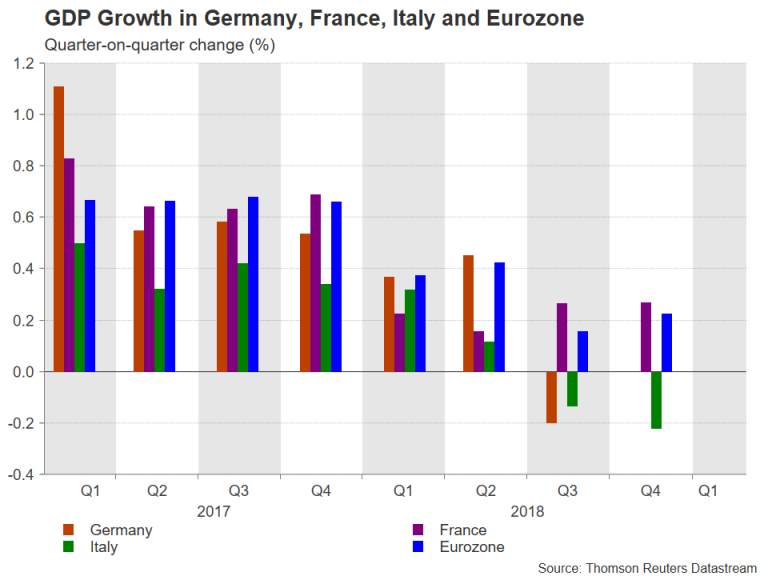
Further confirmation of the deteriorating trend came from the European Commission which this week sharply cut its growth forecasts for the bloc. Germany’s 2019 forecast was cut from 1.8% to 1.1%, and France’s from 1.6% to 1.3%. The most notable revision, though, was for Italy, whose growth projection was slashed from 1.2% to just 0.2%. As for the euro area, the Commission expects 2019 growth to slow to 1.3% from an estimated 1.8% in 2018.
As the Eurozone’s economic engines grapple with sluggish growth, there’s not much else driving the rest of the region, especially as the global economy is also undergoing a deep slowdown. Adding to the ECB’s woes is falling inflation. The headline rate has declined substantially from the peak of 2.2% hit in October to 1.4% in January. It will likely fall further in the coming months following the recent slide in oil prices. More importantly though, underlying inflation has been flat for the past two years, with the two core measures hovering just above 1%.
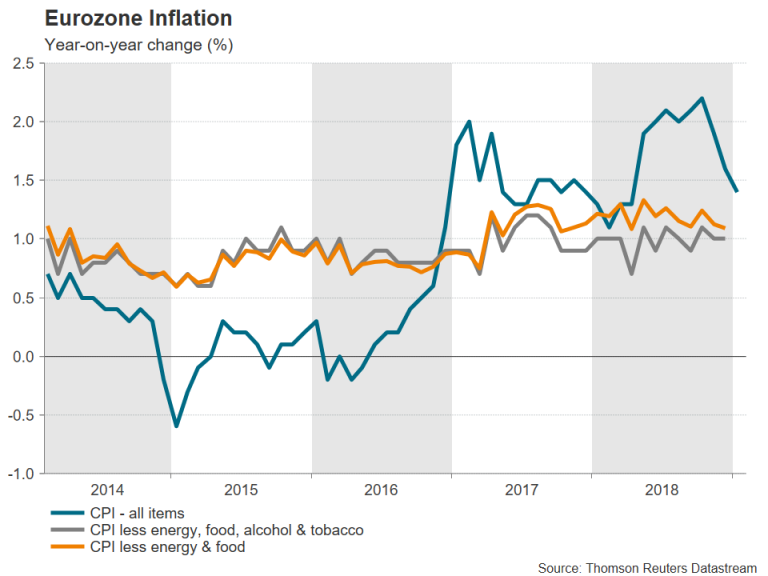
The improving labour market has been one bright spot in the economy, which has shown to be resilient against a weakening economic backdrop. Eurozone wage growth quickened to a 7-year high of 2.5% in the third quarter of 2018, as per last available data. However, the latest PMI report by IHS Markit pointed to slowing employment growth in January, meaning pay increases may begin to ease over the coming months. Without faster wage growth, the ECB would have a difficult time sticking with its projection that underlying inflation will soon begin to edge upwards.
The central bank is probably all too aware of the growing risks to its anticipated build up in price pressures and paved the way for a possible downgrade to its growth and inflation forecasts by adopting a more downbeat tone at its last meeting in January. Revised forecasts will be published at the ECB’s next meeting on March 7. However, while downward revisions are likely, traders expecting any change to the Bank’s forward guidance may be disappointed.
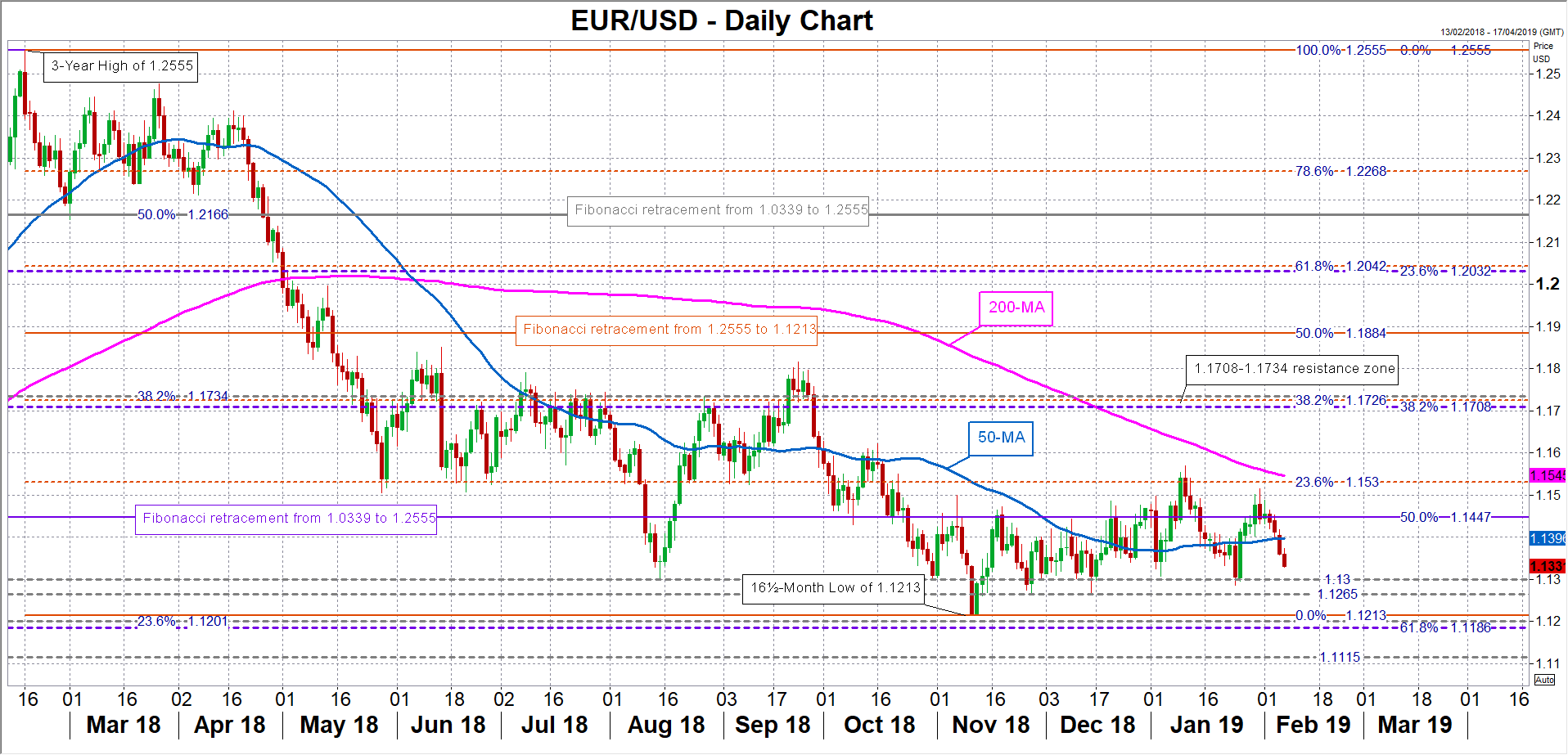
At present, the ECB’s timeline is for the first rate hike to arrive sometime after the summer. A push back of that timeline could place the euro under significantly stronger downside pressure, wiping out the key technical levels that are currently providing support. At the moment, euro/dollar appears to have formed floors around the $1.13 and $1.1265 levels, as well as the November trough of $1.1213.
A breach of these supports is a strong possibility if the ECB began signalling that a shift in its forward guidance was forthcoming and that shelving plans to hike rates in 2019 was on the cards. However, the question about Mario Draghi’s successor might prevent the Bank from making any major changes to its outlook until at least after a new president has been selected. Draghi’s term ends on October 31. The selection process is not expected to start until after the election of a new European Parliament in late May.
Until then, and in the absence of new guidance by the ECB, the euro might be able to hold above the key $1.12 handle. But of course, if by Spring, economic data continues to worsen, markets may completely price out a rate rise for 2019 even before the ECB adjusts its guidance. At the moment, traders are betting there’s a 50% probability of a 10-basis point rate hike by December. This suggests there’s plenty of scope for downside moves if those odds were to be erased over the next few months and euro/dollar could be headed for the $1.1115 support area in such a case.
Although there are still hopes that global growth momentum could pick up speed later in the year, especially if the US and China strike a comprehensive trade deal, the risks are clearly tilted to the downside. European political headaches remain plenty – Brexit, the Italian budget row, French protests to mention a few – and may not disappear anytime soon, weighing on business sentiment for the foreseeable future. The lack of further structural reforms by Eurozone member states, which have become overly reliant on the ECB’s stimulus tap as they’ve opted to put off the tough decisions, is also holding back the bloc from achieving its potential output.
With growth in many euro area economies, including Germany, at or close to zero, it wouldn’t take much to push the region into an outright recession. Even a new trade accord between China and the US may not produce the desirable outcome for European manufacturers as the focus would then turn to EU-US trade differences.
That’s not to say though, that the dark clouds currently casting a shadow over the continent and in much of the rest of the world would not recede and an upturn in growth could still materialise in the second half of 2019. If the growth picture was to improve substantially, a major test for the euro that would signal its fortunes are turning would be the $1.1708-1.1734 zone. This region could be critical as it encompasses a concentration of three 38.2% Fibonacci retracement levels: the downleg from $1.2555 to $1.1213, the uptrend from $1.0339 to $1.2555 and the down move from $1.3992 to $1.0339. Without a successful break above this area, the euro is unlikely to be able to forge a new longer-term bullish structure.
MARKET WRAP: European Stocks Dropped, Sterling Jumped & Euro Dropped
Sterling went on a roller-coaster ride today as Bank of England delivered its statement. Equity investors are on the edge due to the threat of another U.S. government shutdown
Stocks
- The S&P 500 is building on its losses on top of yesterday and fell 0.8 percent at 15:47.
- The Stoxx Europe 600 Index moved lower on the back of the of the feeble economic data and fell 0.9 percent, breaking its winning streak.
- The MSCI World Index followed global markets and dropped 0.3 percent, the biggest drop in more than a week.
Currencies
- The Dollar Index is maintaining its strength and jumped 0.1 percent, continuing its sixth consecutive gain.
- The Euro lost its mojo again and dropped 0.1 percent to $1.1346.
- The British pound dropped sharply at the BOE decision but quickly recovered its losses and jumped 0.4 percent to $1.2983.
Bonds
- The yield on 10-year Treasuries eased off again and dropped three basis points to 2.67 percent.
- Germany’s 10-year yield did what it does best, dropped four basis points to 0.12 percent.
- Italy’s 10-year yield jumped higher as investors became more concerned, it soared seven basis points to 2.933 percent.
Commodities
- Gold is still defending its 1300 support and gained 0.2 percent to $1,309.12 an ounce.
- West Texas Intermediate crude is out of luck and dropped 1.4 percent to $53.26 a barrel.
Dallas Fed Kaplan: The country would be well served if we pause rate hike and be patient
Dallas Fed President Robert Kaplan said today that stimulus from the tax cuts last week and the government are beginning to wane. Meanwhile, the economy is starting to feel the cumulative impact of the Fed's rate hikes. In addition, the US economy is facing risks of spill over from global slow down. In his view, the US economy could only grow just 2% this year.
Thus, Kaplan said, "we would be well served and the country would be well served if we paused and were patient for some number of months and sort of get out of the way."
Sunset Market Commentary
Markets
Global core bonds gain ground today as risk sentiment is deteriorating. This morning, German industrial production for December disappointed again. Later, the European Commission slashed its 2019 growth forecasts for all the major euro zone economies, including Germany and Italy. The latter topped the list with 2019 growth being revised to a meagre 0.2%. Meanwhile, Italian FM Tria said the economy is experiencing a momentary stall, not a true recession. Nonetheless, Italian BTP’s fell while German Bunds rose. The German yield curve edges lower with moves up to -3.8 bps (10-yr). UK Gilts are rising too as the Bank of England has cut its growth forecast. Peripheral spreads over the German 10-yr yield widen, with Greece (+10 bps) and Italy (+12 bps) underperforming. The grimmer sentiment in Europe supported US Treasuries as well. The US yield curve moves south with changes in the range of ‑2.5 bps (30-yr) to -3.5 bps (5-yr).
The post-Fed EUR/USD trading paradigm simply continued. Negative headlines on the EMU/EU economy continue to outweigh a softer Fed and potential less negative news from the US. Poor German production data and the EC downgrading the 2019/2020 growth forecasts were the catalysts for further EUR/USD losses. EUR/USD tested the 1.1325 area (currently near 1.1345). USD/JPY again failed regain the 110 barrier as lower core yields and a risk-off sentiment support the yen.
EUR/GBP developed an erratic sideways trading pattern in the high 0.87 ahead of the BoE policy announcement. The BoE left its policy rate unchanged at 0.75%.The bank cut its growth and inflation forecast for 2019 both due to the global slowdown and uncertainty on Brexit. At the same time the BoE kept its guidance for limited/gradual rate hikes over the 2019/2022 horizon in case a no-deal Brexit can be avoided. EUR/GBP briefly tested the 0.88 area after the BoE decision, but sterling soon reversed the post-BoE loss and even rallied. Sterling bulls apparently found comfort in the BoE holding on to, albeit limited, policy tightening in current uncertain environment. So, today’s BoE message can also be understood that there is room for catch-up demand (and investments) in case a no-deal Brexit can be avoided. This is a (conditional) sterling supportive message. EUR/GBP trades currently in the 0.8750 area. Of course, for now, the condition of an orderly Brexit is not yet fulfilled. So, we look out whether sterling can keep today’s gains as the Brexit sage develops, starting with today’s meeting between EU’s Juncker and UK PM May.
News Headlines
The EC slashed its EMU growth forecast from 1.9% to 1.3% in 2019 and from 1.7% to 1.6% in 2020 with downside risks. These reflect external factors, such as trade tensions and the slowdown in emerging markets, notably in China, concerns about the sovereign-bank loop and debt sustainability in some euro area countries. The possibility of a disruptive Brexit creates additional uncertainty. Among the larger Member States, downward revisions for growth in 2019 were sizeable for Germany, Italy, and the Netherlands.
The BoE unanimously decided the keep its policy unchanged. The UK central bank cut 2019 growth forecasts from 1.7% to 1.2% and from 1.7% to 1.5% for 2020. This year’s inflation forecast was cut from 2.2% to 1.8%. Mounting Brexit uncertainty and the global slowdown caused the dovish turn which was also visual in the expected rate path. New forecasts suggested that 1 à 2 more rate hikes might be needed in the next three years.
The Czech National Bank voted 5-2 in favour of keeping rates unchanged at 1.75%. The two dissenters argued in favour of a 25 bps rate hike. External risks are the CNB’s main concern. More certainty is needed before resuming the tightening cycle. The CNB lowered its growth forecast from 3.3% to 2.9% this year with a slightly lower plotted inflation trajectory (2% by Q1 2020). The 2019 average forecast for EUR/CZK changed from 24.70 to 25.
EUR/USD Mid-Day Outlook
Daily Pivots: (S1) 1.1345; (P) 1.1378; (R1) 1.1394; More.....
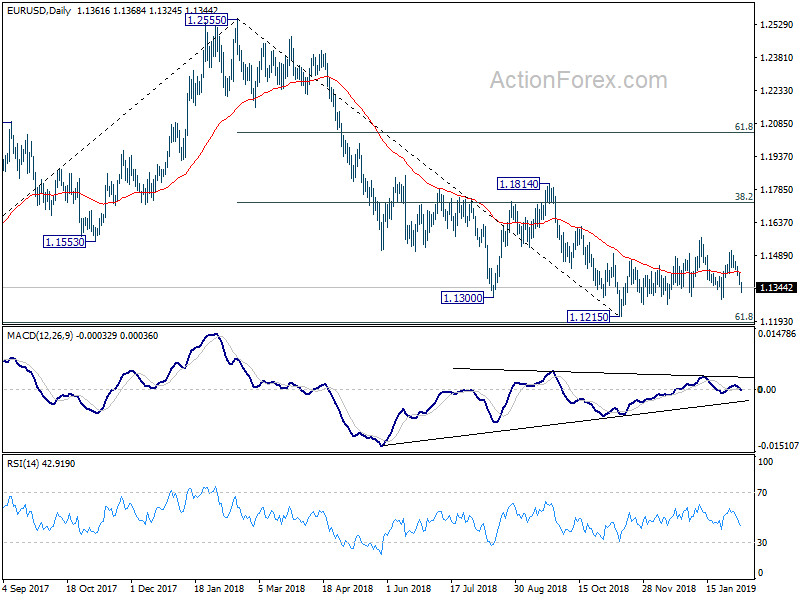
Intraday bias in EUR/USD remains on the downside as fall from 1.1514 is in progress for 1.1289 support. Firm break there will argue that corrective pattern from 1.1251 has completed. And, in that case, larger decline from 1.2555 is ready to resume through 1.1251 low. On the upside, above 1.1380 minor resistance would probably extend the correction pattern with another rise towards 1.1569 resistance.
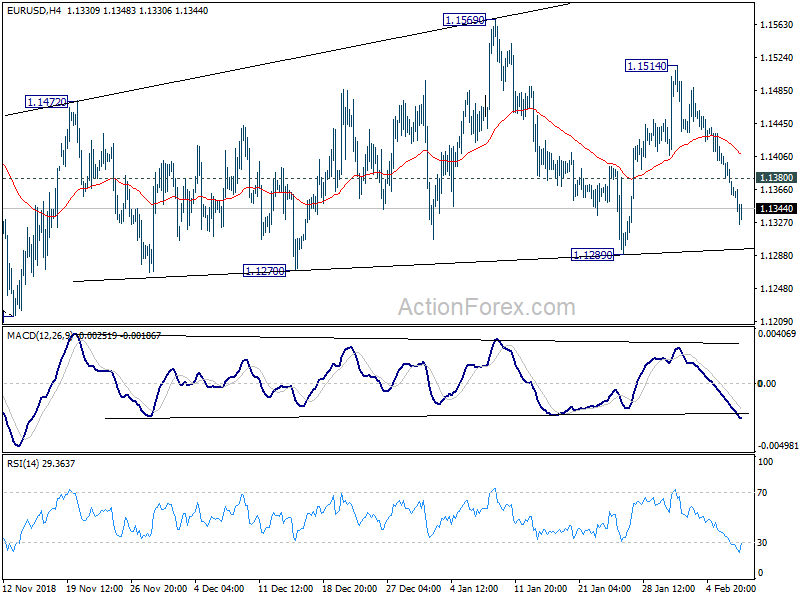
In the bigger picture, as long as 1.1814 resistance holds, down trend down trend from 1.2555 medium term top is still in progress and should target 61.8% retracement of 1.0339 (2017 low) to 1.2555 at 1.1186 next. Sustained break there will pave the way to retest 1.0339. However, break of 1.1814 will confirm completion of such down trend and turn medium term outlook bullish.
USD/JPY Mid-Day Outlook
Daily Pivots: (S1) 109.68; (P) 109.86; (R1) 110.17; More...
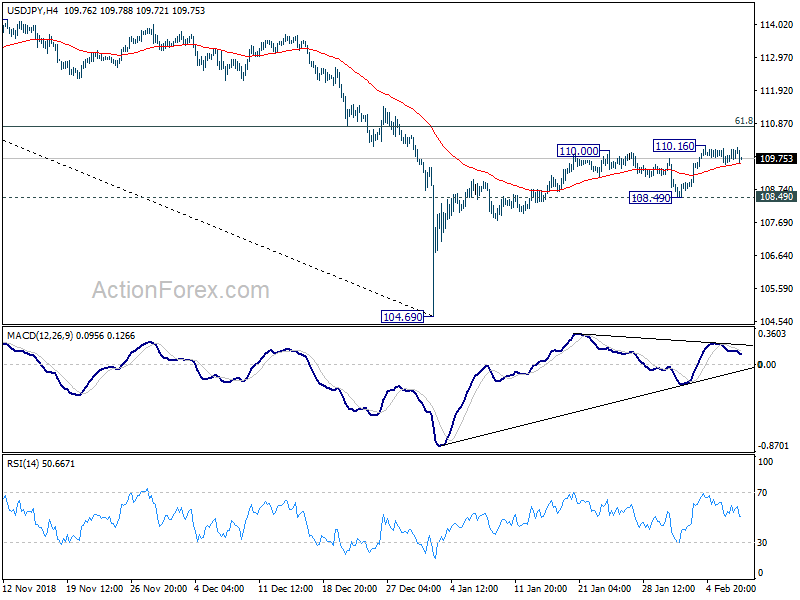
Intraday bias in USD/JPY remains neutral at this point. In case of another rise, we'd expect strong resistance from 61.8% retracement of 114.54 to 104.69 at 110.77 to limit upside to bring reversal. On the downside, break of 108.49 support will now confirm completion of the rebound and bring retest of 104.69 low. However, sustained trading above 110.77 will dampen our bearish view and target a test on 114.54 resistance instead.
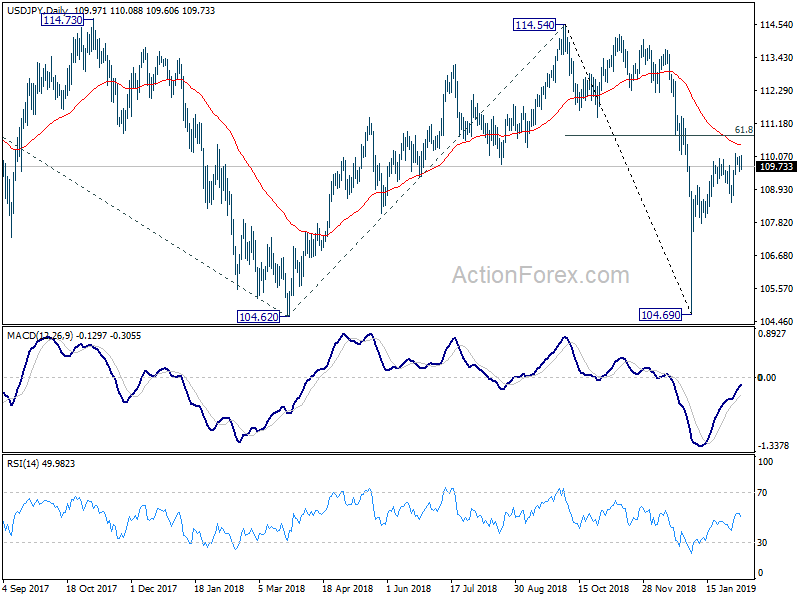
In the bigger picture, while the rebound from 104.69 is strong, there is no change in the view that it's a corrective move. That is, fall from 114.54, as part of the decline from 118.65 (2016 high), is not completed yet. Break of 104.62 will target 100% projection of 118.65 to 104.62 from 114.54 at 100.51, which is close to 100 psychological level. Nevertheless, sustained trading above 55 day EMA (now at 110.55) will dampen this bearish view and turn focus back to 114.54 resistance instead.
USD/CHF Mid-Day Outlook
Daily Pivots: (S1) 0.9999; (P) 1.0013; (R1) 1.0040; More....
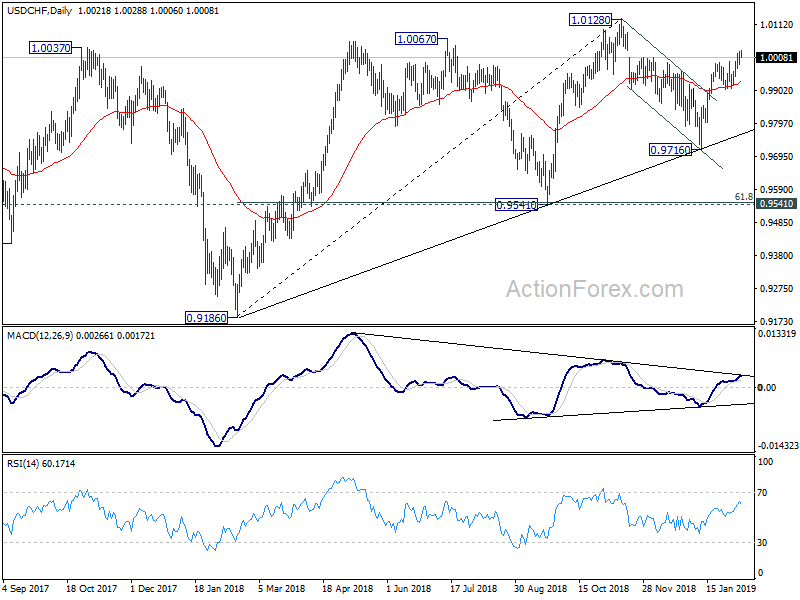
With 4 hour MACD crossed below signal line, a temporary top is in place at 1.0028 in USD/CHF. Intraday bias is turned neutral first. Some retreat could be seen but downside should be contained by 0.9908 to bring another rally. As noted before, corrective decline from 1.0128 should have completed at 0.9716 already, after hitting trend line support. On the upside, above 1.0028 will resume the rise from 0.9716 to retest 1.0128 high first.
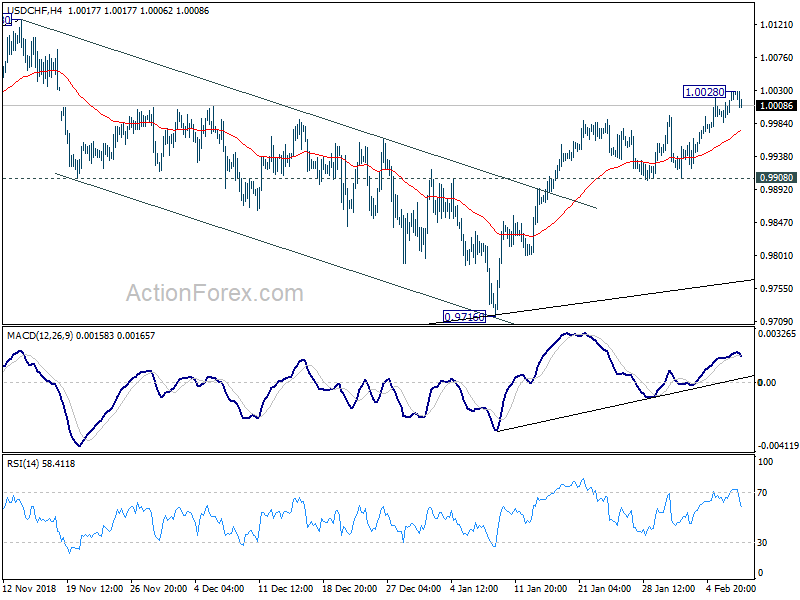
In the bigger picture, USD/CHF drew strong support from medium term trend line and rebounded. That suggests rise from 0.9186 is still in progress. Further break of 1.0128 will confirm up trend resumption and target 1.0342 key resistance. Nevertheless, break of 0.9716 will dampen this bullish view and at least bring deeper fall to 0.9541 key support.
Sterling Recovers Early Losses on Carney Optimism
Mark Carney and his colleagues, like the pound, came through the Bank of England meeting relatively unscathed it seems, although when it comes to the latter, there were some hairy moments.
The event got off to quite a shaky start as the central bank released its latest forecasts showing GDP growth this year suffered its biggest downward revision since August 2016, at the same time projecting the weakest year of growth since 2009. Coming on the same day that the European Commission significantly revised down its forecasts for the euro area, it doesn’t bode well for 2019, a year that many already had expected to be challenging.
Despite that rocky start, the pound gradually recovered throughout the press conference to trade flat on the day against the dollar, having been down by more than half a percent at one point. Carney’s more upbeat tone on the country’s prospects in the event of a deal was likely an important factor in this, while he’ll no doubt also be pleased with his ability to dodge those questions that threatened to put him on the front pages for the wrong reasons, again.
While it’s interesting to hear the central banks views on the outlook, despite the huge uncertainty that still exists – something he repeatedly referred to as “fog” – it’s clear that we’ll have to wait until May to get a better idea on the path of interest rates. Not only will the Brexit fog have cleared, we’ll also have a better idea of whether the global economic slowdown is progressing as is now widely expected.
Carney was keen to stress that the economic fundamentals remain sound which means that assuming the backlog of investment and consumer spending exists, due to lower spending in the run up to Brexit, the economy could weather the global slowdown quite well. Whether the BoE would be brave enough to raise interest rates in that scenario though I’m not convinced.