

Sample Category Title
Sterling Survives Dovish BoE Selloff for Now, Yen Staying Strong
It's a very volatile day with two market moving events in BoE Super Thursday and EU economic forecasts. Sterling initially dived sharply after BoE downgraded economic forecasts and painted a slower rate path. But the Pound appears to rebound after BoE Governor Mark Carney insisted that the markets shouldn't prepare for a rate cut despite the weaker outlook. Nevertheless, with never-ending Brexit uncertainty and a more dovish BoE, there is no special reason to cheer the Pound for now.
At the time of writing, Canadian Dollar is the weakest one for today as selloff accelerates in early US session. New Zealand Dollar is the second weakest after today's job data miss. Euro is the third weakest after EU slashed Eurozone 2019 growth forecasts by -0.6% to 1.3%. Sterling's rebound also weighs on Euro. But it should be noted that the race to be the worst performer today hasn't ended yet. The picture could change again before tomorrow. Though, Yen is the strongest one today, followed by Swiss Franc. These two will likely hold their places, on risk aversion, and falling global treasury yields.
Technically, an immediate focus now is 124.36 minor support in EUR/JPY. Firm break there will be an indication that rebound from 118.62 flash crash low has completed. And near term outlook will be turned bearish for deeper decline back towards 118.62. EUR/GBP is now looking at 0.8726 minor support. Break there will indicate completion of rebound from 0.8617 and turn focus back to 0.8620 key support level.
In Europe, currently, FTSE is down -0.40%. DAX is down -1.79%. CAC is down -1.01%. German 10-year yield is sharply lower by -0.0352 at 0.131. Earlier in Asia, Nikkei dropped -0.59%. Japan 10-year yield closed up 0.0069 at -0.009, staying negative. Singapore Strait Times rose 0.50%. Hong Kong and China were still on holiday.
US initial jobless claims dropped -19k to 234k
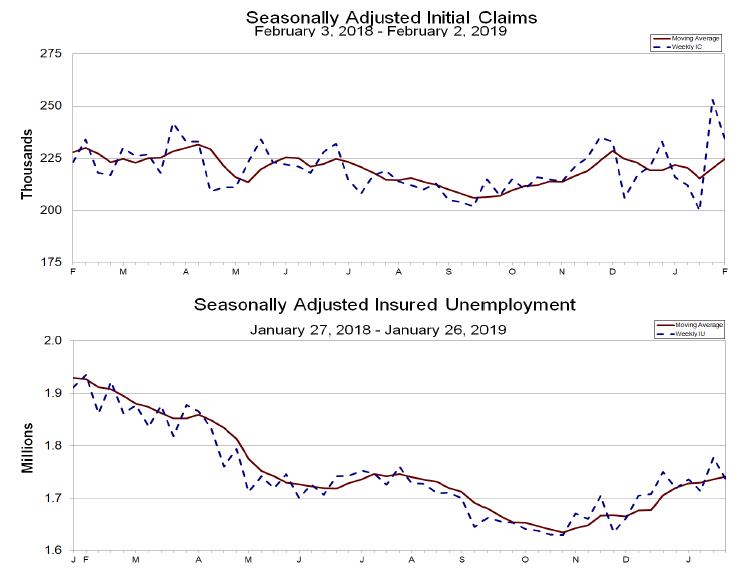
US initial jobless claims dropped -19k to 234k in the week ending February 2, above expectation of 220k. Four-week moving average of initial claims rose 4.5k to 224.75k. Continuing claims dropped -42k to 1.736M in the week ending January 26. Four-week moving average of continuing claims rose 4.25k to 1.741M.
BoE revised down growth and inflation forecast, may only hike once through Q1 2022
BoE left Bank rate unchanged at 0.75% today. Asset purchase target was also held at GBP 435B. Both were done by unanimous 9-0 decision, as widely expected. In the accompanying statement, BoE noted that growth slowed in late 2018 and "appears to have weakened further in early 2019". Such slowdown "mainly reflects weaker global activity and Brexit uncertainties. But BoE remained confidence that "greater clarity on future trading arrangements is assumed to emerge". And growth will bounce back to 2% by 2022. Inflation is expected to "decline to slightly below" target in the near term due to fall in petrol prices. But "as that effect unwinds, CPI inflation rises above 2%".
Meanwhile, BoE reiterated that the outlook will "continue to depend significantly on the nature of EU withdrawal, in particular: the new trading arrangements between the European Union and the United Kingdom; whether the transition to them is abrupt or smooth; and how households, businesses and financial markets respond". And, "the monetary policy response to Brexit, whatever form it takes, will not be automatic and could be in either direction."
In the Quarterly Inflation Report, the overall economic projections are rather dovish with downgrade in growth and inflation forecasts. Unemployment rate projections were revised higher. Meanwhile, the projected Bank rate was also revised lower across the forecast horizon. It's now suggested that BoE may only hike once, within the forecast horizon, possibly in 2020.
Four-quarter GDP growth:
- 1.5% in 2019 Q1, down from November forecast of 1.8%
- 1.3% in 2020 Q1, down from 1.7%
- 1.7% in 2021 Q1, unchanged
- 2.0% in 2022 Q1, new
CPI:
- 1.8% in 2019 Q1, down from 2.2%.
- 2.3% in 2020 Q1, down from 2.4%.
- 2.1% in 2021 Q1, unchanged.
- 2.1% in 2022 Q1.
Unemployment rate:
- 3.9% in 2019 Q1, unchanged.
- 4.1% in 2020 Q1, up from 3.9%
- 4.1% in 2021 Q1, up from 3.9%
- 3.8% in 2022 Q1.
Bank rate:
- 0.7% in 2019 Q1, down from 0.8%.
- 0.9% in 2020 Q1, down from 1.1%
- 1.0% in 2021 Q1, down from 1.3%.
- 1.1% in 2022 Q2, new
EU to UK PM May: No Brexit renegotiation after robust but constructive talks
European Commission spokesman Margaritis Schinas said President Jean-Claude Juncker had "robust but constructive talks with UK Prime Minister Theresa May today. And, "the talks were held in a spirit of working together to achieve the UK's orderly withdrawal from the EU."
However, he reiterated that EU would not renegotiate the Brexit deal. Though, both team would work together on "whether a way through can be found."
May is expected to meet Juncker again before the end of February. EU chief negotiator Michel Barnier and UK Brexit Minister Stephen Barclay will meet next Monday.
European Commission slashes 2019 Eurozone growth forecast by -0.6% to 1.3%
European Commission projected EU growth to continue for the seventh year in a row in 2019, with expansion in all member states. But the pace of growth is expected to slow further as "economic momentum at the start of this year was subdued." Indeed, GDP growth for 2019 was quite sharply downgraded.
For Eurozone:
- 2019 growth is forecast to be 1.3%, versus prior forecast of 1.9%.
- 2020 growth is forecast to be 1.6% versus prior 1.7%.
- 2019 HICP inflation is projected to be 1.4%
- 2020 HICP inflation is projected to be at 1.5%.
For EU:
- 2019 growth is forecast to be 1.5%, versus prior 1.9%.
- 2020 growth is forecast to be 1.7%, versus prior 1.8%.
- 2019 HICP inflation is projected to be 1.6%
- 2020 HICP inflation is projected to be at 1.8%.
The commission also pointed out there is "a high level of uncertainty" surrounding the outlook, and the projections are subject to downside risks. Risks include trade tensions, slowdown in China, global financial markets and emerging markets risks, as well as Brexit.
Valdis Dombrovskis, Vice-President for the Euro and Social Dialogue said the downward revision "reflects external factors, such as trade tensions and the slowdown in emerging markets, notably in China." He warned that being aware of the "mountings risks is half of the job". And, "the other half is choosing the right mix of policies, such as facilitating investment, redoubling efforts to carry out structural reforms and pursuing prudent fiscal policies."
Pierre Moscovici, Commissioner for Economic and Financial Affairs, Taxation and Customs, said slowdown in 2019 is " set to be more pronounced than expected last autumn, especially in the euro area, due to global trade uncertainties and domestic factors in our largest economies".
DIHK slashed Germany 2019 growth forecast to 0.9%
Germany's DIHK Chambers of Industry and Commerce lowered 2019 growth forecast for the country to 0.9%, sharply down from 1.7%. It noted that "companies' outlook is getting clouded. Business expectations have significantly deteriorated in all economic sectors." And, "global trade conflicts are slowing business development, especially in the industrial sector".
In addition, DIHK warned that should exports to the UK drops by -10%, growth could slow further to 0.7%. In case of additional turbulence in the capital markets, growth could even slow to 0.5%.
ECB bulletin: Net trade exerted a drag on activity in Q4
In the Monthly Economic Bulletin, ECB noted again that growth risks surrounding growth outlook have "moved to the downside" on "persistence of uncertainties related to geopolitical factors and the threat of protectionism, vulnerabilities in emerging markets and financial market volatility." And, "ample degree of monetary accommodation" is still needed for the block.
In particular, ECB said downside risks to global activity have been increasing, and warned "further escalation of trade disputes could weigh on global growth." It acknowledged that postponement of US-China tariffs has "sent a positive signal". But "considerable uncertainty" remains to whether negotiations could lead to de-escalation.
For Eurozone, ECB said "incoming information has surprised to the downside". Also, growth in Eurozone foreign trade "appears set to decline further in the fourth quarter of 2018". And it described that "pace of euro area export growth slowed down substantially (to 0.1%) in the third quarter, whereas growth in imports eased (to 1.0%).". Net trade "exerted a drag on economic activity with a large negative contribution to GDP growth".
Released in European session, Germany industrial production dropped -0.4% mom in December. Swiss Foreign currency reserves rose to CHF 741B in January.
New Zealand unemployment rate rose to 4.3%, NZD extends decline
New Zealand unemployment rate rose to 4.3% in Q3, up from 4.0%, notably higher than expectation of 4.1%. Looking at the details, labor force participation rate dropped -0.1% to 70.9%. Employment rate dropped -0.4% to 67.8%. Total labor force rose 12k but there was only 2k growth in the number employed Annual wage inflation accelerated by 0.1% to 1.9%.
Also released in Asian session, Australia AiG performance of construction index recovered to 43.1 in January. NAB business confidence dropped to 1 in Q4. Japan leading indicator dropped to 97.9 in December. Japan leading index dropped to 97.9 in December.
GBP/USD Mid-Day Outlook
Daily Pivots: (S1) 1.2910; (P) 1.2944; (R1) 1.2964; More....
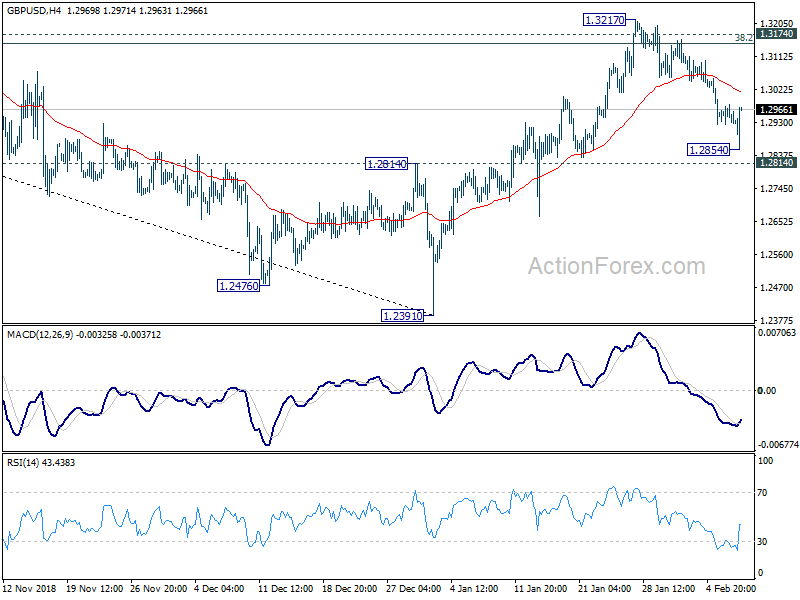
GBP/USD dives to 1.2854 but quickly recovered. With 4 hour MACD crossed above signal line, intraday bias is turned neutral first. But risk will stay on the downside as long as 1.3217 resistance holds. As noted before, rebound from 1.2391 has completed at 1.3217, after rejection by 1.3174 key resistance. Firm break of 1.2814 will bring retest of 1.2391 low.
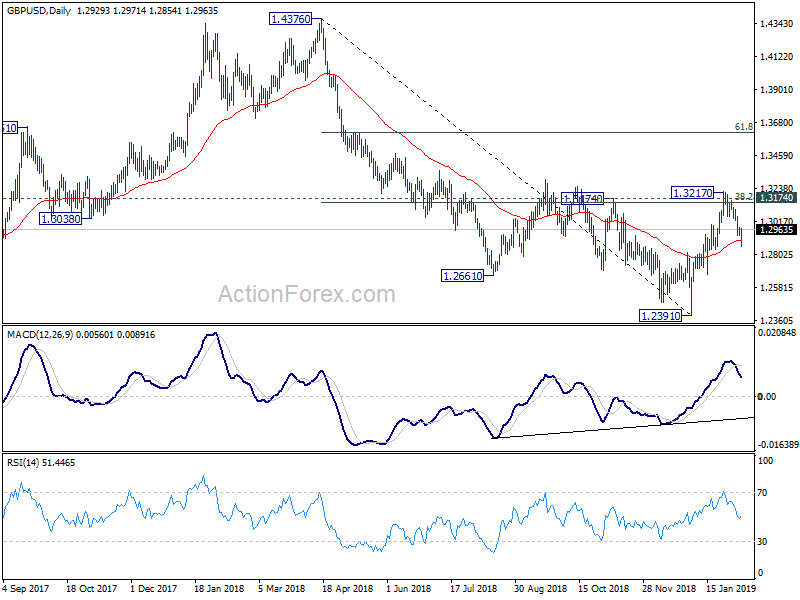
In the bigger picture, the rejection by 1.3174 key resistance revived the original view on GBP/USD. That is, decline from 1.4376 is possibly resuming long term down trend from 2.1161 (2007 high). Firm break of 1.2391 will solidify this bearish case and target 1.1946 (2016 low). However, decisive break of 1.3174 will invalidate this bearish case again and turn outlook bullish.
Economic Indicators Update
| GMT | Ccy | Events | Actual | Forecast | Previous | Revised |
|---|---|---|---|---|---|---|
| 21:30 | AUD | AiG Performance of Construction Index Jan | 43.1 | 42.6 | ||
| 21:45 | NZD | Unemployment Rate Q4 | 4.30% | 4.10% | 3.90% | 4.00% |
| 21:45 | NZD | Employment Change Q/Q Q4 | 0.10% | 0.30% | 1.10% | 1.00% |
| 21:45 | NZD | Labor Cost Private Sector Q/Q Q4 | 0.50% | 0.60% | 0.50% | |
| 00:30 | AUD | NAB Business Confidence Q4 | 1 | 3 | ||
| 05:00 | JPY | Leading Index CI Dec P | 97.90% | 97.90% | 99.10% | |
| 07:00 | EUR | German Industrial Production M/M Dec | -0.40% | 0.80% | -1.90% | |
| 08:00 | CHF | Foreign Currency Reserves Jan | 741B | 729B | ||
| 09:00 | EUR | ECB Monthly Economic Bulletin | ||||
| 12:00 | GBP | BoE Rate Decision | 0.75% | 0.75% | 0.75% | |
| 12:00 | GBP | BoE Asset Purchase Target Feb | 435B | 435B | 435B | |
| 12:00 | GBP | MPC Official Bank Rate Votes | 0--0--9 | 0--0--9 | 0--0--9 | |
| 12:00 | GBP | MPC Asset Purchase Facility Votes | 0--0--9 | 0--0--9 | 0--0--9 | |
| 12:00 | GBP | BoE Inflation Report | ||||
| 13:30 | USD | Initial Jobless Claims (FEB 2) | 234K | 220K | 253K | |
| 15:30 | USD | Natural Gas Storage | -228B | -173B |
US initial jobless claims dropped -19k to 234k
US initial jobless claims dropped -19k to 234k in the week ending February 2, above expectation of 220k. Four-week moving average of initial claims rose 4.5k to 224.75k.
Continuing claims dropped -42k to 1.736M in the week ending January 26. Four-week moving average of continuing claims rose 4.25k to 1.741M.
DAX Slides as European Commission Warns of Uncertainties Ahead
The DAX index has registered sharp losses in the Thursday session. The DAX is currently trading at 11,168 down 1.38%. On the release front, German industrial production declined by 0.4%, well short of the forecast of a 0.8% gain. The European Commission released its economic forecasts for the eurozone. On Friday, Germany releases trade balance.
German manufacturing numbers continue to struggle, as the global trade war and weakness in the German auto sector is weighing on the manufacturing sector. Industrial production fell 0.3% in December, its sixth decline in seven months. This follows manufacturing production, which plunged 1.6% in December. Manufacturing PMI in January slipped below the 50-level, which separates contraction from expansion, for the first time in over four years. Weakness in manufacturing can be seen across the eurozone, as France and Italy both posted manufacturing PMIs in contraction territory in January. German consumer indicators have also stumbled, raising concerns about the health of the eurozone’s largest economy. CPI declined by 0.8% in January and retail sales plunged 4.3% in December. If the soft numbers continue, investor confidence could sag and send the DAX to lower levels.
The European commission economic forecast has projected moderate growth in the eurozone, but uncertainty is weighing on confidence. The bank’s lowered its growth forecast for the eurozone to 1.9% in 2018, down from 2.1% in the November forecast. For 2019, the growth forecast has also been revised down to 1.5%, compared to 1.9% in the November forecast. Inflation slipped in late 2018 due to lower oil prices, with an average inflation level of 1.7%. This is expected to dip to 1.6% in 2019. The report highlighted Brexit and the slowdown in China as key sources of uncertainty for European economies, adding that the projections were subject to downside risks.
BoE Carney Inflation Report press conference live stream
https://www.youtube.com/watch?v=iOb2E7udmpM
Below are some comments from BoE Governor Carney in the press conference
- "The fog of Brexit is causing short term volatility in the economic data, and more fundamentally, it is creating a series of tensions in the economy, tensions for business."
- "We arrive where we're sitting here today and we don't know, we do not know what form of arrangement could be struck. There are still as almost a wide of range of possibilities as there were the morning after the referendum."
- "If there is a shock, which at least in terms of central expansion of business, households and financial markets, a no-deal, a no-transition Brexit, would be, it would be a shock, a negative shock, that would further increase the probability of negative quarters.
- "But for our core central expectation is that we will have higher uncertainty and there will be a path to some sort of arrangement."
- "Although many companies are stepping up their contingency planning, the economy as a whole is still not yet prepared for a no-deal, no transition exit."
- "The core of the financial system is ready for whatever form Brexit takes. And that is a good thing, it doesn't solve all the other issues related to Brexit. It doesn't necessarily help the half of companies in the country that are not ready for that scenario.
- "But it means the financial sector will cushion the blow, and be part of the solution, rather amplifying a shock and being part of the problem."
- "Any persistent adjustment in sterling would likely have material consequences for inflation on the policy relevant horizons due to the slow speed of path through into consumer prices."
- "We have ... recognized the intensification of uncertainty, the bigger impact uncertainty is having on those spending decisions and we have projected it out, projected it to last a little longer than we had previously expected.
- "So a recognition that not everything may be tied up in a nice package by the end of March."
- "The fundamentals of the UK economy are sound. The financial sector is resilient. Corporate balance sheets are strong, and the labor market is tight."
Into US session: Sterling weakest on BoE forecasts downgrade, Yen jumps on falling yields
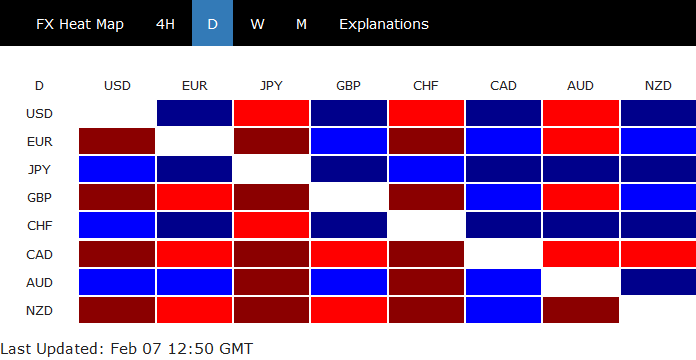
Entering into US session, Sterling is now the weakest one for today after BoE kept interest rate unchanged but lowered both growth and inflation forecast. According to the Quarterly Inflation Report, even with the assumption of smooth Brexit, BoE projects to hike only once through Q1 2022. UK Prime Minister Theresa May's visit to Brussel appears to be rather fruitless too. Canadian Dollar is currently the second weakest one followed by New Zealand Dollar. The latter was weighed down by weaker than expected job data released earlier today. Euro is mixed even though EU slashed 2019 growth forecast by -0.6% to 1.3% only.
At the time of writing, Yen is the strongest one on risk aversion, while Swiss Franc is the second. Both are also helped by sharp decline in German yields. Australian Dollar is the third strongest mainly thanks to weakness elsewhere. Also, Aussie is just taking a breather after yesterday's steep selloff. Dollar remains generally firm and is set to extend gain against all but Yen, and probably Franc.
In Europe, currently:
- FTSE is down -0.08%.
- DAX is down -1.45%.
- CAC is down -0.82%.
- German 10-year yield is sharply lower by -0.0204 at 0.126.
Earlier in Asia:
- Nikkei dropped -0.59%.
- Japan 10-year yield closed up 0.0069 at -0.009, staying negative.
- Singapore Strait Times rose 0.50%.
- Hong Kong and China were still on holiday.
EU to UK PM May: No Brexit renegotiation after robust but constructive talks
European Commission spokesman Margaritis Schinas said President Jean-Claude Juncker had "robust but constructive talks with UK Prime Minister Theresa May today. And, "the talks were held in a spirit of working together to achieve the UK's orderly withdrawal from the EU."
However, he reiterated that EU would not renegotiate the Brexit deal. Though, both team would work together on "whether a way through can be found."
May is expected to meet Juncker again before the end of February. EU chief negotiator Michel Barnier and UK Brexit Minister Stephen Barclay will meet next Monday.
GBPCAD Stops Below 40-SMA; Stands in Ascending Channel
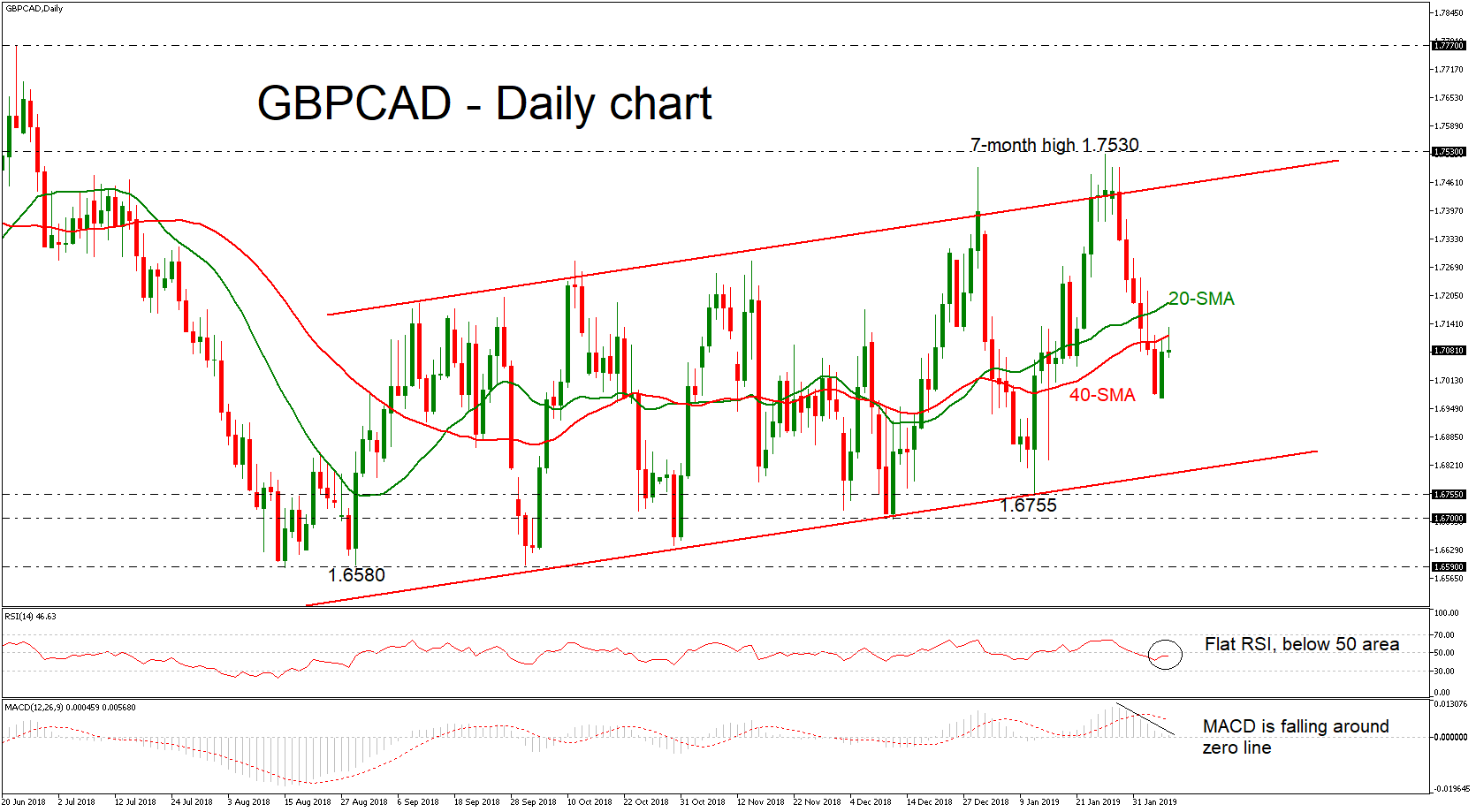
GBPCAD is holding below the 20- and 40-simple moving averages (SMAs) in the daily timeframe, following the bounce off the resistance level of 1.7530 – a seven-month high reached on January 25. The pair has been trading within an ascending sloping channel over the last six months, despite the upside spikes towards 1.7530. The RSI indicator is flattening slightly below the 50 level, while the MACD stands below the trigger and zero lines.
Further declines may meet support around the lower channel line, which stands near the 1.6800 strong psychological level. More losses could endorse the long-term bearish view and drive the price until the 1.6755 – 1.6700 support zone, while even lower, the pair could hit the October 2017 low of 1.6380.
On the upside, resistance could occur around the 40- and then at the 20- SMAs at 1.7112 and 1.7190 respectively. Higher still, the next resistance could come from the upper band of the channel around 1.7450.
Overall, the medium-term picture continues to look predominantly bullish with trading activity remaining within the upward sloping channel.
BoE revised down growth and inflation forecast, may only hike once through Q1 2022
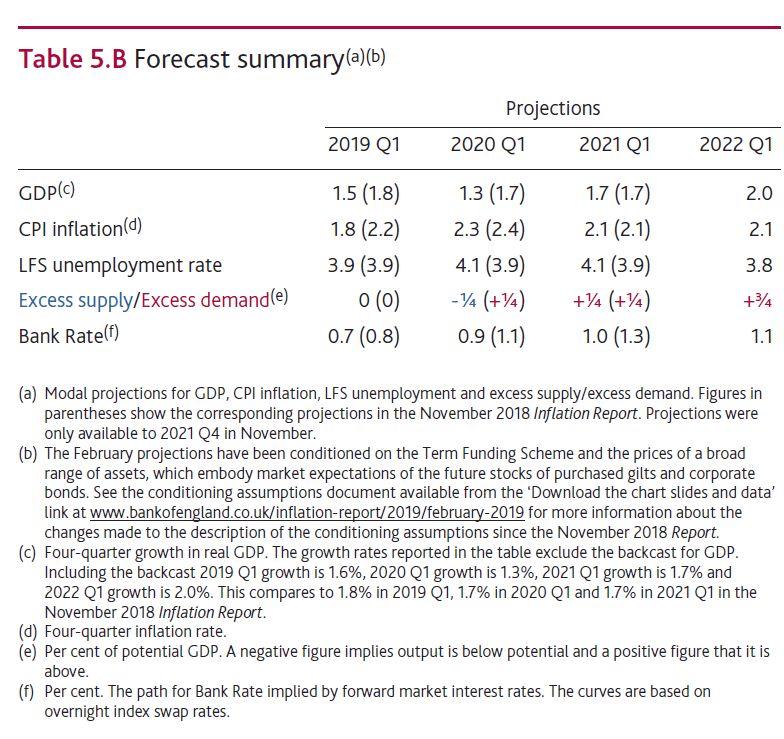
In BoE Quarterly Inflation Report, the overall economic projections are rather dovish with downgrade in growth and inflation forecasts. Unemployment rate projections were revised higher. Meanwhile, the projected Bank rate was also revised lower across the forecast horizon. It's now suggested that BoE may only hike once, within the forecast horizon, possibly in 2020.
Four-quarter GDP growth:
- 1.5% in 2019 Q1, down from November forecast of 1.8%
- 1.3% in 2020 Q1, down from 1.7%
- 1.7% in 2021 Q1, unchanged
- 2.0% in 2022 Q1, new
CPI:
- 1.8% in 2019 Q1, down from 2.2%.
- 2.3% in 2020 Q1, down from 2.4%.
- 2.1% in 2021 Q1, unchanged.
- 2.1% in 2022 Q1.
Unemployment rate:
- 3.9% in 2019 Q1, unchanged.
- 4.1% in 2020 Q1, up from 3.9%
- 4.1% in 2021 Q1, up from 3.9%
- 3.8% in 2022 Q1.
Bank rate:
- 0.7% in 2019 Q1, down from 0.8%.
- 0.9% in 2020 Q1, down from 1.1%
- 1.0% in 2021 Q1, down from 1.3%.
- 1.1% in 2022 Q2, new
BoE kept bank rate unchanged at 0.75%, full statement
BoE noted that growth slowed in late 2018 and "appears to have weakened further in early 2019". Such slowdown "mainly reflects weaker global activity and Brexit uncertainties. But BoE remained confidence that "greater clarity on future trading arrangements is assumed to emerge". And growth will bounce back to 2% by 2022. Inflation is expected to "decline to slightly below" target in the near term due to fall in petrol prices. But "as that effect unwinds, CPI inflation rises above 2%".
Meanwhile, BoE reiterated that the outlook will "continue to depend significantly on the nature of EU withdrawal, in particular: the new trading arrangements between the European Union and the United Kingdom; whether the transition to them is abrupt or smooth; and how households, businesses and financial markets respond". And, "the monetary policy response to Brexit, whatever form it takes, will not be automatic and could be in either direction."
In the Quarterly Inflation Report, BoE revised both growth and inflation forecasts. New Bank rate forecasts suggest there will only be one rate hike through Q1 2022. More here.
Full statement.
Bank Rate maintained at 0.75%
Our Monetary Policy Committee has voted unanimously to maintain Bank Rate at 0.75%. The committee also voted unanimously to maintain the stock of corporate bond purchases and UK government bond purchases.
The Bank of England's Monetary Policy Committee (MPC) sets monetary policy to meet the 2% inflation target, and in a way that helps to sustain growth and employment. At its meeting ending on 6 February 2019, the MPC voted unanimously to maintain Bank Rate at 0.75%.
The Committee voted unanimously to maintain the stock of sterling non-financial investment-grade corporate bond purchases, financed by the issuance of central bank reserves, at £10 billion. The Committee also voted unanimously to maintain the stock of UK government bond purchases, financed by the issuance of central bank reserves, at £435 billion.
The MPC's latest projections for inflation and activity are set out in the accompanying February Inflation Report. They are conditioned on a smooth adjustment to the average of a range of possible outcomes for the UK's eventual trading relationship with the European Union and the gently rising path of Bank Rate implied by market yields.
The world economy has continued to slow over recent months, with a broad-based softening across all regions. That deceleration reflects the past tightening in global financial conditions, as well as the initial impact of trade tensions on business sentiment. Global growth is expected to dip below trend in coming quarters, weighing on UK net trade, before rising to around potential rates. Activity is projected to be supported by the more accommodative monetary policies in all major economic areas that markets now expect.
UK economic growth slowed in late 2018 and appears to have weakened further in early 2019. This slowdown mainly reflects softer activity abroad and the greater effects from Brexit uncertainties at home. These uncertainties could lead to greater-than-usual short-term volatility in UK data, which may therefore provide less of a signal about the medium-term outlook. Heightened uncertainty and elevated bank funding costs are assumed to subside over time, as greater clarity on future trading arrangements is assumed to emerge. These developments, together with looser fiscal policy, provide support to domestic spending. In the Committee's central projection, quarterly GDP growth recovers later this year, with four-quarter growth rising to 2% by the end of the forecast period.
CPI inflation fell to 2.1% in December and is expected to decline to slightly below the MPC's 2% target in the near term, largely due to the sharp fall in petrol prices which has occurred since November. As that effect unwinds, CPI inflation rises above 2%. The MPC judges that demand and potential supply are currently broadly in balance. The weaker near-term outlook is likely to lead to a small margin of slack opening up this year. Thereafter, demand growth exceeds the subdued pace of supply growth and excess demand builds over the second half of the forecast period. As a result, domestic inflationary pressures firm, as the upward pressure on inflation of sterling's past depreciation wanes. Under the assumptions that condition the February Report, inflation settles at a rate a little above the target.
The Committee judges that, were the economy to develop broadly in line with its Inflation Report projections, an ongoing tightening of monetary policy over the forecast period, at a gradual pace and to a limited extent, would be appropriate to return inflation sustainably to the 2% target at a conventional horizon.
The economic outlook will continue to depend significantly on the nature of EU withdrawal, in particular: the new trading arrangements between the European Union and the United Kingdom; whether the transition to them is abrupt or smooth; and how households, businesses and financial markets respond. The appropriate path of monetary policy will depend on the balance of these effects on demand, supply and the exchange rate. The monetary policy response to Brexit, whatever form it takes, will not be automatic and could be in either direction. The MPC judges at this month's meeting that the current stance of monetary policy is appropriate. The Committee will always act to achieve the 2% inflation target.
(BOE) Bank Rate maintained at 0.75%
Our Monetary Policy Committee has voted unanimously to maintain Bank Rate at 0.75%. The committee also voted unanimously to maintain the stock of corporate bond purchases and UK government bond purchases.
The Bank of England's Monetary Policy Committee (MPC) sets monetary policy to meet the 2% inflation target, and in a way that helps to sustain growth and employment. At its meeting ending on 6 February 2019, the MPC voted unanimously to maintain Bank Rate at 0.75%.
The Committee voted unanimously to maintain the stock of sterling non-financial investment-grade corporate bond purchases, financed by the issuance of central bank reserves, at £10 billion. The Committee also voted unanimously to maintain the stock of UK government bond purchases, financed by the issuance of central bank reserves, at £435 billion.
The MPC's latest projections for inflation and activity are set out in the accompanying February Inflation Report. They are conditioned on a smooth adjustment to the average of a range of possible outcomes for the UK's eventual trading relationship with the European Union and the gently rising path of Bank Rate implied by market yields.
The world economy has continued to slow over recent months, with a broad-based softening across all regions. That deceleration reflects the past tightening in global financial conditions, as well as the initial impact of trade tensions on business sentiment. Global growth is expected to dip below trend in coming quarters, weighing on UK net trade, before rising to around potential rates. Activity is projected to be supported by the more accommodative monetary policies in all major economic areas that markets now expect.
UK economic growth slowed in late 2018 and appears to have weakened further in early 2019. This slowdown mainly reflects softer activity abroad and the greater effects from Brexit uncertainties at home. These uncertainties could lead to greater-than-usual short-term volatility in UK data, which may therefore provide less of a signal about the medium-term outlook. Heightened uncertainty and elevated bank funding costs are assumed to subside over time, as greater clarity on future trading arrangements is assumed to emerge. These developments, together with looser fiscal policy, provide support to domestic spending. In the Committee's central projection, quarterly GDP growth recovers later this year, with four-quarter growth rising to 2% by the end of the forecast period.
CPI inflation fell to 2.1% in December and is expected to decline to slightly below the MPC's 2% target in the near term, largely due to the sharp fall in petrol prices which has occurred since November. As that effect unwinds, CPI inflation rises above 2%. The MPC judges that demand and potential supply are currently broadly in balance. The weaker near-term outlook is likely to lead to a small margin of slack opening up this year. Thereafter, demand growth exceeds the subdued pace of supply growth and excess demand builds over the second half of the forecast period. As a result, domestic inflationary pressures firm, as the upward pressure on inflation of sterling's past depreciation wanes. Under the assumptions that condition the February Report, inflation settles at a rate a little above the target.
The Committee judges that, were the economy to develop broadly in line with its Inflation Report projections, an ongoing tightening of monetary policy over the forecast period, at a gradual pace and to a limited extent, would be appropriate to return inflation sustainably to the 2% target at a conventional horizon.
The economic outlook will continue to depend significantly on the nature of EU withdrawal, in particular: the new trading arrangements between the European Union and the United Kingdom; whether the transition to them is abrupt or smooth; and how households, businesses and financial markets respond. The appropriate path of monetary policy will depend on the balance of these effects on demand, supply and the exchange rate. The monetary policy response to Brexit, whatever form it takes, will not be automatic and could be in either direction. The MPC judges at this month's meeting that the current stance of monetary policy is appropriate. The Committee will always act to achieve the 2% inflation target.