

Sample Category Title
EURUSD Bearish Breakout Underway
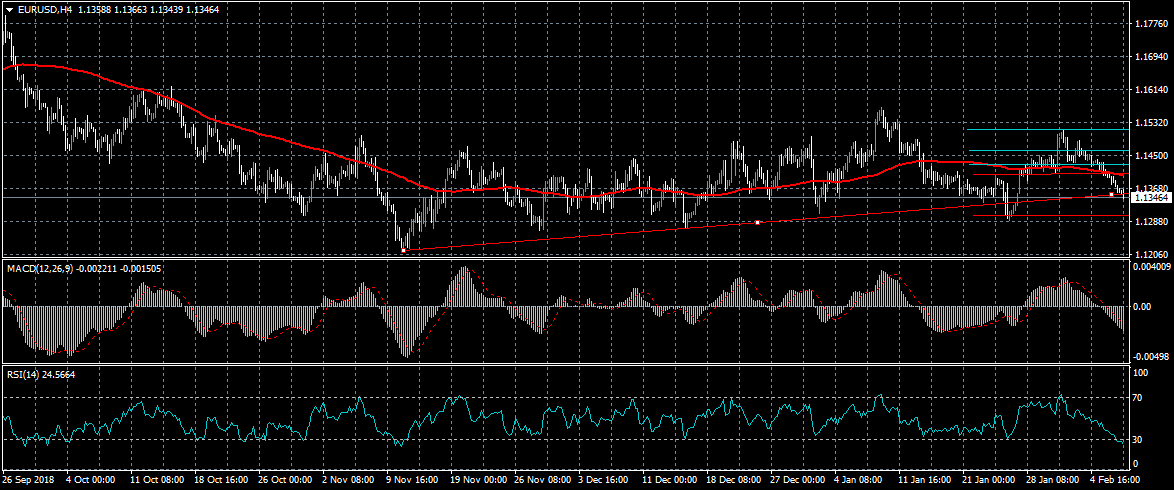
The euro has come under further selling pressure against the US dollar during the European trading session, with the pair breaking below trendline support. The EURUSD pair is increasingly likely to test the important 1.1300 level while trading under the key trendline. The RSI indicator on the four-hour time frame is turning sharply lower and is approaching levels not seen since November last year.
The EURUSD pair is bearish while trading below the 1.1360 level, key technical support remains at the 1.1330 and 1.1300 levels.
If the EURUSD pair moves above the 1.1360 level, buyers may test towards the 1.1390 and 1.1410 resistance levels.
BOE’s Interest Rate Decision In Focus
BoE will be announcing its interest rate decision (12:00, GMT) and is widely expected to remain on hold at +0.75%, GBP OIS is implying a probability of 99.60% for such a scenario currently. We could see the market's attention turning to the accompanying statement as well as the quarterly inflation report, as it's a “Super Thursday” and both are to be released at the same time. On the one hand we could see Brexit uncertainty along with a decelerating inflation rate and weak economic activity (PMIs, retail sales) advising caution, while on the other though a tight UK labour market provides optimism. Should the dovish comments prevail we could see the GBP weakening. Also any possible downward revisions of the inflation rate and the GDP growth rate in the quarterly inflation report could add to the bearish sentiment for the pound. Cable tested the 1.2960 (R1) resistance line yesterday, yet failed to break it and remained clearly below it. We maintain a bearish outlook for the pair and for opinion to change we would require the pair's price action to clearly break the downward trendline incepted since the 31st of January. Technically it should also be noted that RSI indicator in the 4 hour chart is below the reading of 30, implying a possibly overcrowded short position. Should the bears dictate the pair's direction we could see it breaking the 1.2830 (S1) support line and aim for lower grounds. On the flip side, should the bulls take over, we could see cable breaking the 1.2960 (R1) resistance line, the prementioned downward trendline and aim for the 1.3070 (R2) resistance level.
NZD weakens against USD, on employment data
The kiwi weakened against the USD yesterday, as New Zealand's employment data for Q4 were worse than expected. The unemployment rate rose to 4.3%, as the job growth rate dropped to 0.1% qoq and the labour cost index ticked up to +2.0% yoy. Given that the RBNZ has a dual mandate for inflation and employment and was between a rate cut and a hike for its next move, we could see chances for the next move tilting to the downside. Analysts point out that growth momentum has started to fade and the employment data released could add to a more cautious tone by the RBNZ. Overall, the main commodity currencies (NZD, AUD, CAD) were under pressure yesterday and we could see the bearish momentum for the Kiwi lingering on for a few days. NZD/USD tumbled yesterday during the late American session and today's Asian session, as it broke consecutively the 0.6825 (R2) and the 0.6780 (R1) support lines, now turned to resistance. We see the case for the pair to continue to trade in a bearish market yet some correction could take place after the steep drop. Please be advised that the RSI indicator is below the reading of 30 in the pair's 4 hour chart, implying that the pair's short position could be overcrowded and underscoring the possibility of a correction. Should the pair continue to be under the selling interest of the market, we could see the pair breaking the 0.6725(S1) support line and aim for the 0.6675 (S2) support level. Should the pair find extensive buying orders along its path, we could see it breaking the 0.6780 (R1) resistance line and aim for the 0.6825 (R2) resistance level.
Today's other economic highlights
In today's European session, we get Germany's industrial output growth rate for December, UK's Halifax House Prices for January and just before the American session from the Czech Republic we get CNB's interest rate decision. In the American session, we get the US initial jobless claims figure. As for speakers, please note that ECB's Yves Mersch, Dallas Fed President Robert Kaplan and Fed's Richard Clarida will be speaking today.
NZD/USD H4
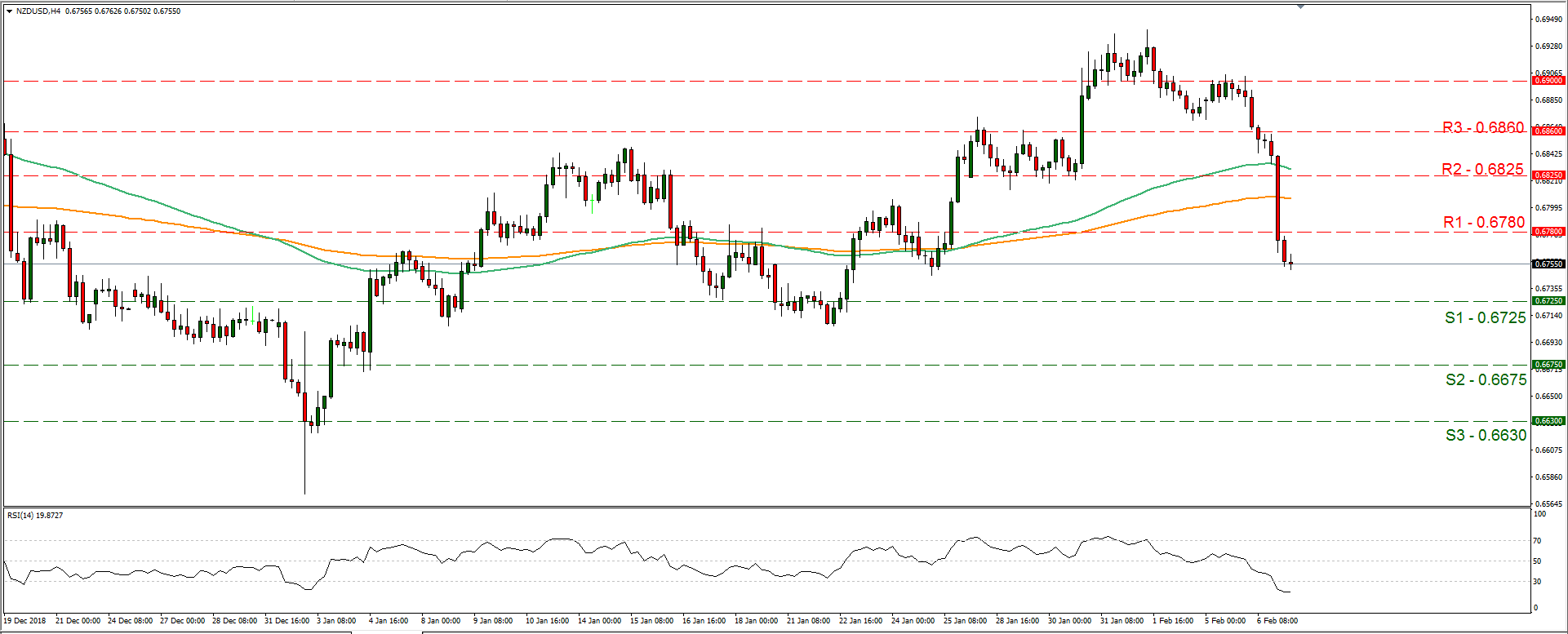
Support: 0.6725 (S1), 0.6625 (S2), 0.6630 (S3)
Resistance: 0.6780 (R1), 0.6825 (R2), 0.6860 (R3)
GBP/USD H4
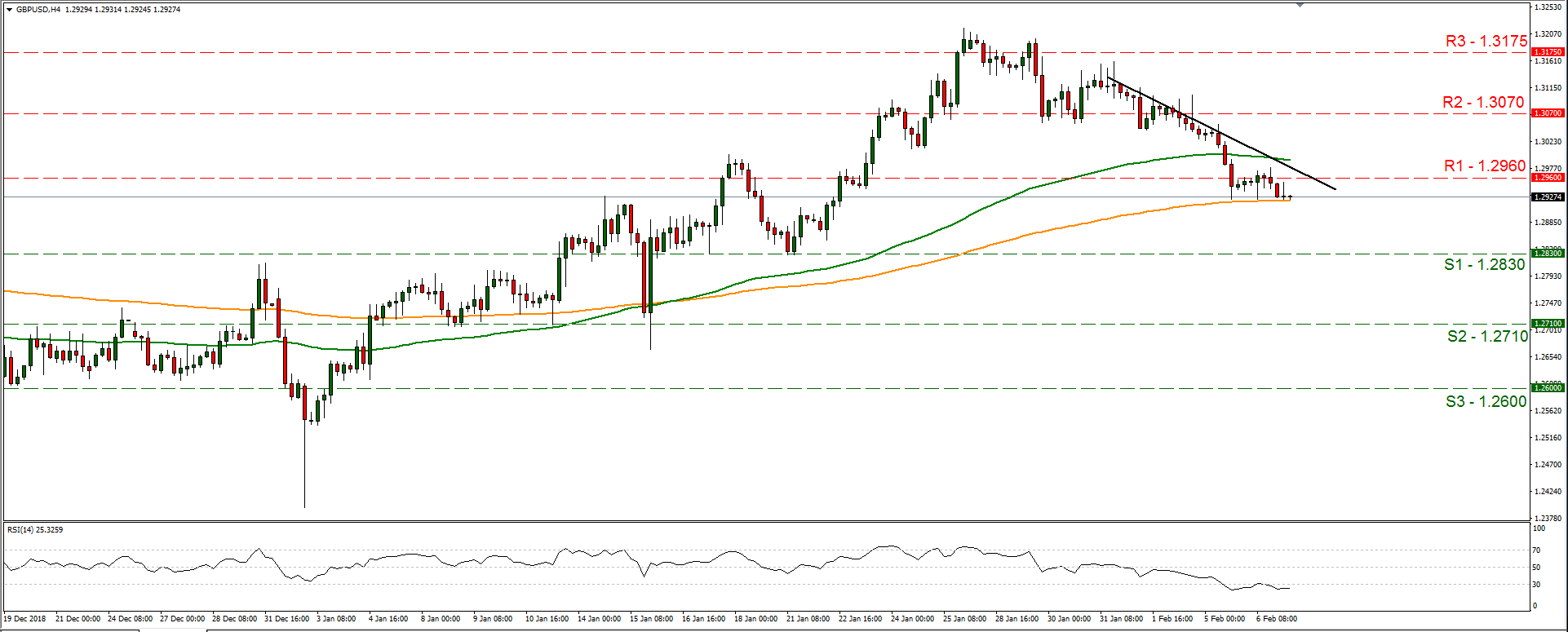
Support: 1.2830 (S1), 1.2710 (S2), 1.2610 (S3)
Resistance: 1.2960 (R1), 1.3070 (R2), 1.3175 (R3)
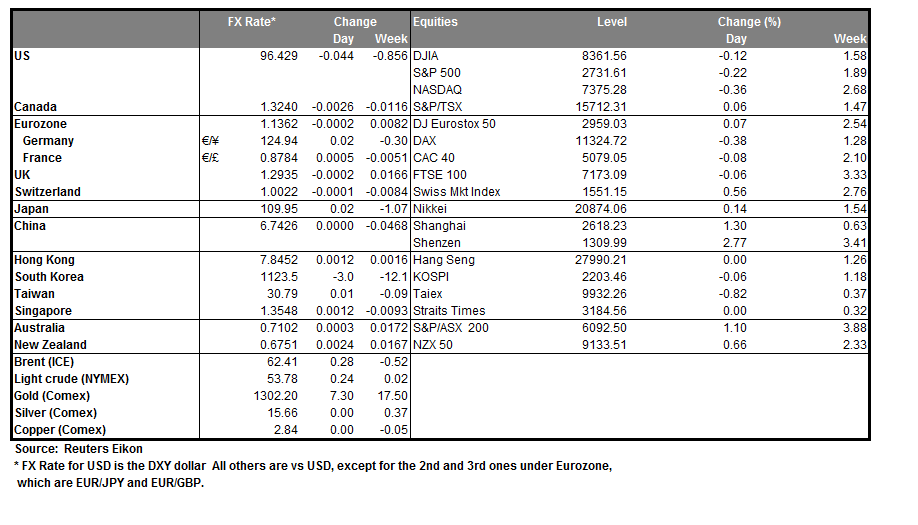
The Analytical Overview Of The Main Currency Pairs
The EUR/USD currency pair
Technical indicators of the currency pair:
Prev Open: 1.14026
Open: 1.13611
% chg. over the last day: -0.44
Day's range: 1.13465 – 1.13683
52 wk range: 1.1214 – 1.2557
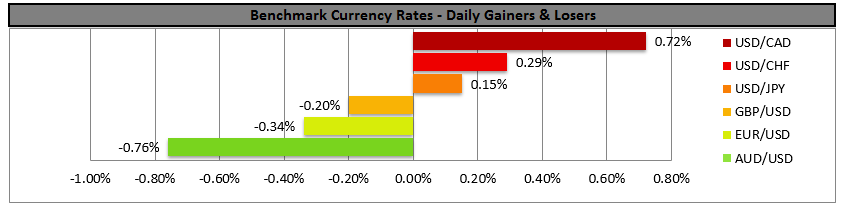
The USD keeps strengthening its positions against the world currencies. The demand remains at a high level. During the last two days of trading, EUR/USD fell by more than 50 points. Right now EUR is testing the local support of 1.13500. 1.13800 acts as a mirror resistance. The trading instrument has a tendency to descend. You should open positions from the key levels.
At 15:30 (GMT+2:00) the US will publish the primary data on the US benefits applications.
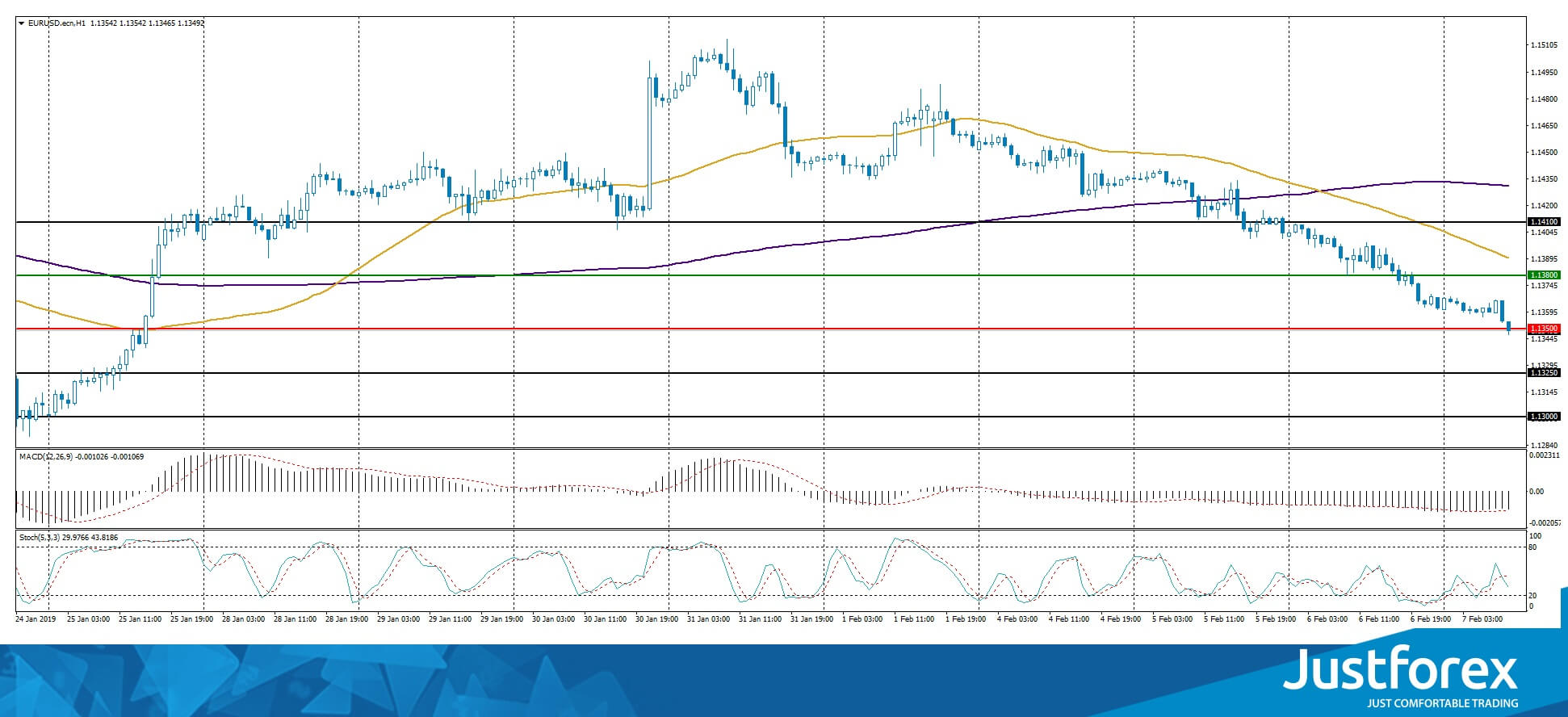
The price fixed below 50 MA and 200 MA which points to the power of the sellers.
The MACD histogram is in the negative zone but below the signal line, which gives a weak signal to sell EUR/USD.
The Stochastic Oscillator is in the neutral zone, the %K line is crossing the %D line. There are no signals.
Trading recommendations
Support levels: 1.13500, 1.13250, 1.13000
Resistance levels: 1.13800, 1.14100
If the price fixes below 1.13500 expect the quotes to fall toward 1.13250-1.13000.
Alternatively, the quotes can recover toward 1.14000-1.14200.
The GBP/USD currency pair
Technical indicators of the currency pair:
Prev Open: 1.29461
Open: 1.29296
% chg. over the last day: -0.11
Day's range: 1.28972 – 1.29395
52 wk range: 1.2438 – 1.4378
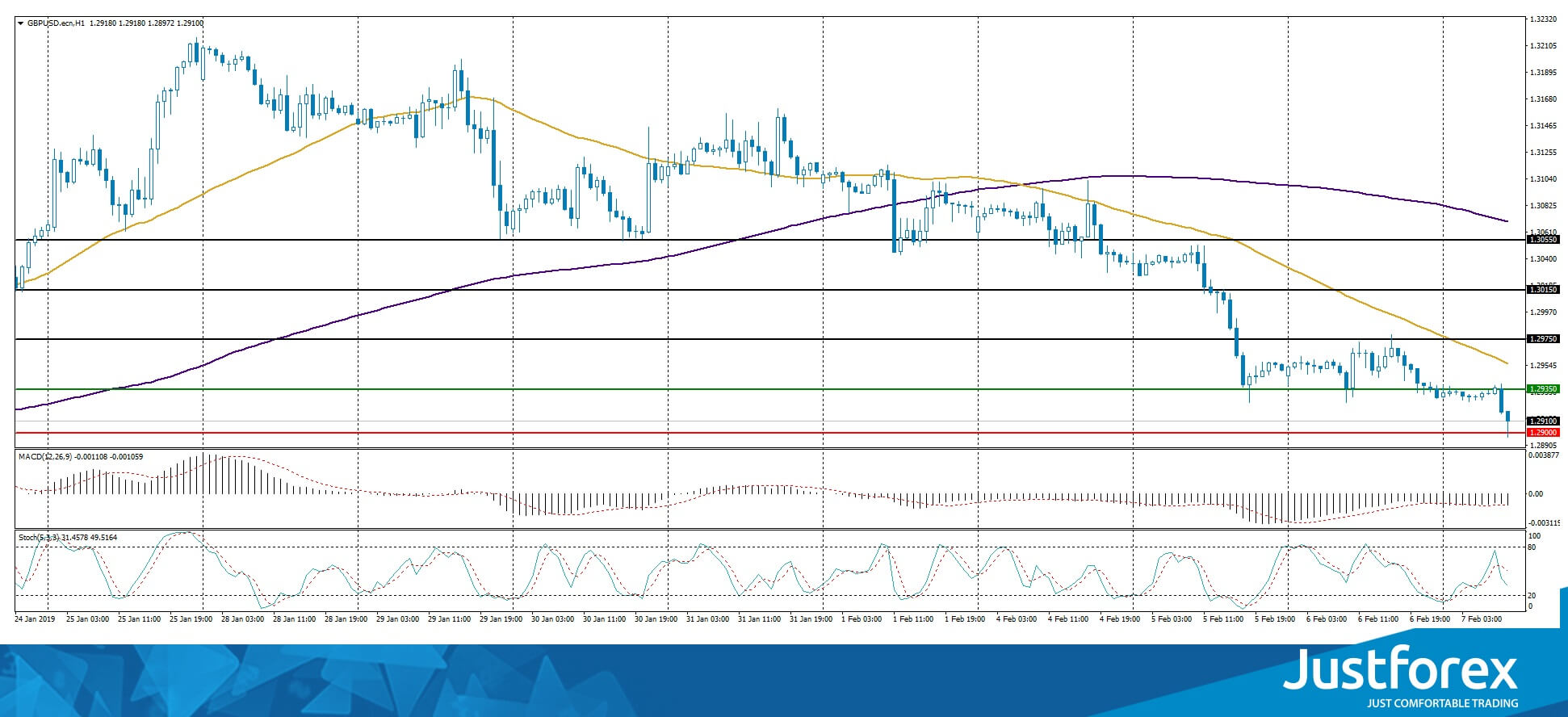
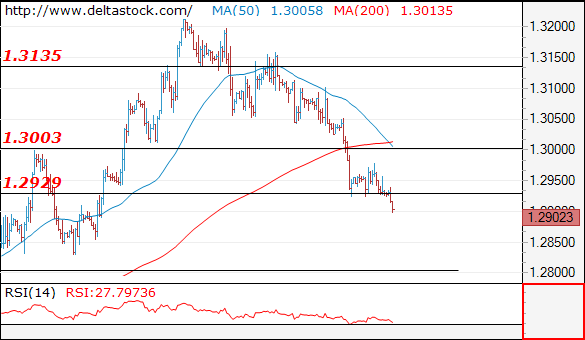
GBP/USD keeps showing a negative trend. The pound is consolidating around the round 1.29000. The local resistance is 1.29350. The financial market participants are waiting for the Bank of England meeting. The regulator is expected to keep the main paramenters of monetary policy at the same level. You should look for market entry points at the key levels.
At 14:00 (GMT+2:00) the Bank of England will publish the new key interest rate.
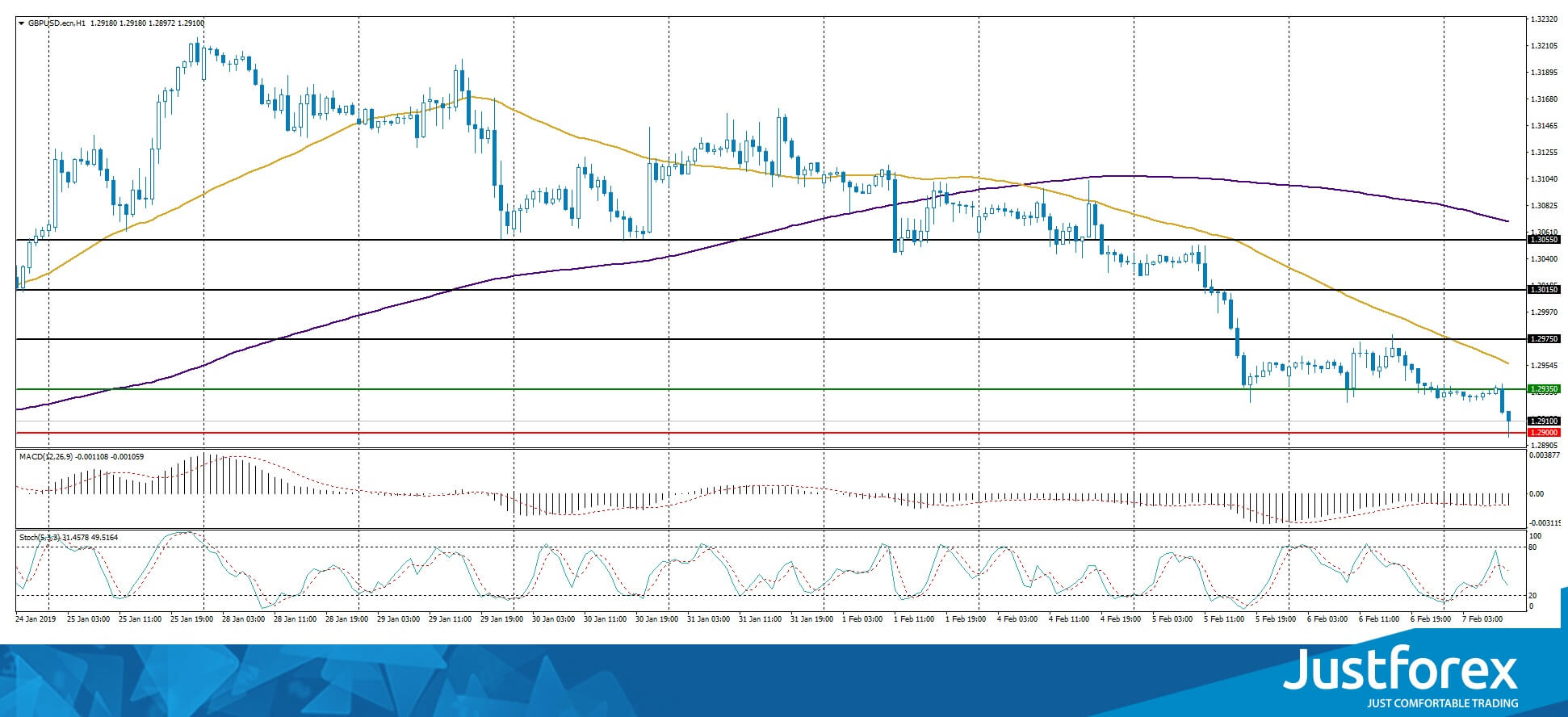
The price fixed below 50 MA and 200 MA which points to the power of the buyers.
The MACD histogram is in the negative zone and keeps descending which gives a strong signal to sell GBP/USD.
The Stochastic Oscillator is in the neutral zone, the %K line is below the %D line which points to a bearish mood.
Trading recommendations
Support levels: 1.29000, 1.28500
Resistance levels: 1.29350, 1.29750, 1.30150
If the price fixes below the round 1.29000 expect the quotes to fall toward 1.28500-1.28250.
Alternatively, the quotes can recover toward 1.29750-1.30000.
The USD/CAD currency pair
Technical indicators of the currency pair:
Prev Open: 1.31357
Open: 1.32099
% chg. over the last day: +0.66
Day's range: 1.32036 – 1.32535
52 wk range: 1.2248 – 1.3664
The USD recovered the majority of the losses regarding the CAD after a fall at the beginning of January. During the last two days of trading, the quotes grew by 100 points. Right now the key levels are 1.32300 and 1.32600. There are prospects for further growth. Keep an eye on the oil quotes dynamics and open positions from the key levels.
The Economic News Feed for 07.02.2019 is calm.
The indicators do not provide precise signals: 50 MA started to cross 200 MA.
The MACD histogram is in the positive zone and above the signal line, which points to a bullish mood.
The Stochastic Oscillator is out of the overbought zone, the %K line is below the %D line which gives a signal to sell USD/CAD.
Trading recommendations
Support levels: 1.32300, 1.32000, 1.31550
Resistance levels: 1.32600, 1.32850, 1.33150
If the price fixes above the local resistance of 1.32600 expect the quotes to grow toward 1.33000-1.33250.
Alternatively, the quotes can fall toward the round 1.32000.
The USD/JPY currency pair
Technical indicators of the currency pair:
Prev Open: 109.955
Open: 109.964
% chg. over the last day: +0.01
Day's range: 109.725 – 110.086
52 wk range: 104.56 – 114.56
USD/JPY keeps trading in a long flat. There is no single defined trend. The demand on the safe haven currencies remains during the next round of the Washigton/Beijing negotiations. The USD/JPY quotes are testing the key resistance level of 110.000-110.150. 109.800 acts as a local support. You should open positions from these levels.
The Economic News Feed for 07.02.2019 is calm.
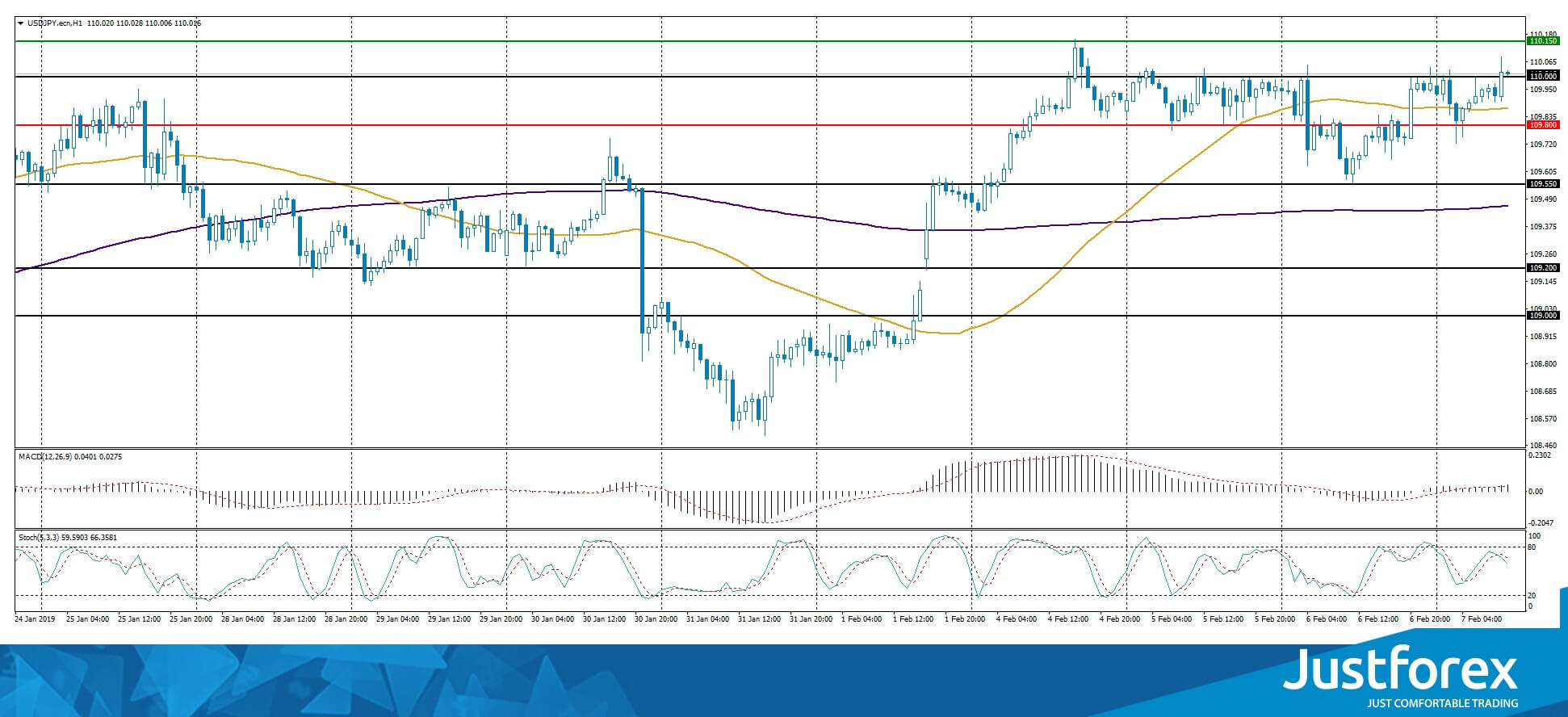
The price fixed above 50 MA and 200 MA which points to the power of the buyers.
The MACD histogram is in the positive zone and keeps rising which also points to the bullish mood.
The Stochastic Oscillator is in the neutral zone, the %K line is below the %D line which also gives a signal to sell USD/JPY.
Trading recommendations
Support levels: 109.800, 109.550, 109.200
Resistance levels: 110.000, 110.150, 110.500
If the price fixes above 110.150 expect the quotes to grow toward 110.500-110.700.
Alternatively, the quotes can descend toward 109.500-109.300.
NZDUSD Erases Bearish Rally Below Upward Channel, Posts 2-Week Bottom
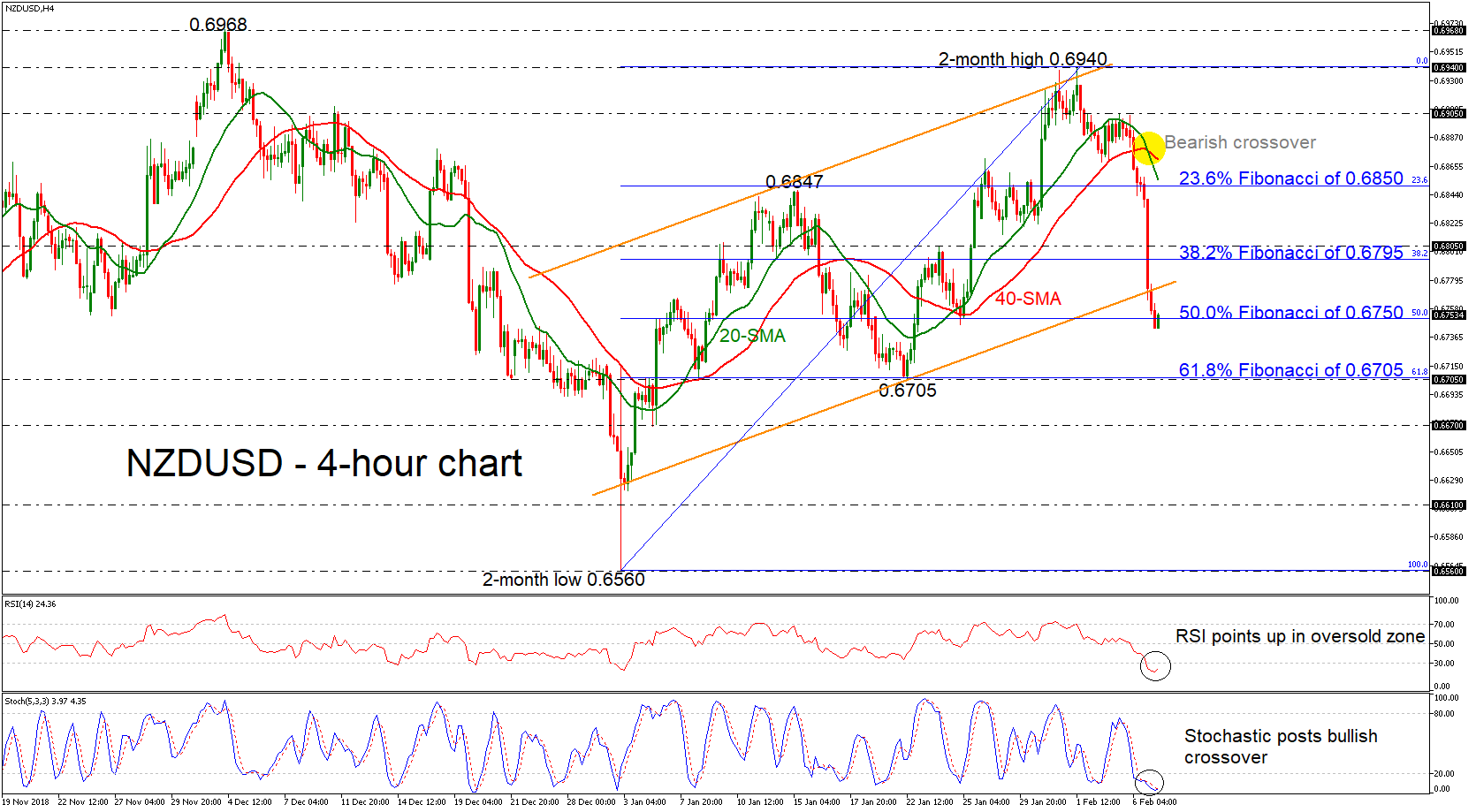
NZDUSD plummeted below the upward sloping channel during yesterday’s session, which had been holding over the last month, creating a fresh two-week low near 0.6743. Currently, the price is easing slightly to the upside around the 50.0% Fibonacci retracement level of the upleg from 0.6560 to 0.6940, around 0.6750, paring some of the previous sessions’ losses.
Technically, the RSI indicator seems to be oversold as it is pointing up below the 30 level, and the stochastic oscillator is ready for a bullish crossover of the %K and %D lines. Moreover, the 20- and 40-simple moving averages created a strong bearish cross, indicating further losses.
In the positive scenario, where the price continues to expand above today’s high, a new top could be formed around the 38.2% Fibonacci of 0.6795 ahead of the 0.6805 resistance level. If the market manages to overcome that area, traders could look for resistance at the 23.6% Fibonacci of 0.6850, around the 20-SMA.
A slip to the downside again, could stall at the bottom of January 22, which coincides with the 61.8% Fibonacci of 0.6705. Further below, the 0.6670 could also provide support to traders.
To sum up, the short-term bias has switched to bearish after the strong sell-off over the last days, while the long-term outlook remains slightly bullish.
UK Growth To Slow
50 days before the official divorce of the UK from the EU, it seems that nothing has fundamentally evolved from 2 months ago, when controversies over the initial Withdrawal Agreement forced Prime Minister Theresa May to postpone the vote to January 2019. The Irish backstop is still a stumbling block for the House of Commons.
We don’t see the Bank of England changing its monetary position, since it adopted a “wait and see” approach in December. In case of a hard Brexit, the BoE would most likely not raise its key rate but cut it if the economy requires, regardless of inflation. In the event of a sharp pound devaluation, the bank might do the opposite in order to curb a collapse. If a constructive agreement is found, the BoE might hike its key rate to maintain inflation within the target range of 2% amid strong wage growth and low unemployment rates. We see the GBP negatively, since growth forecasts (November projections for GDP: 0.30% Q4 2018 and 1.70% for next 3 years) are expected to be reduced amid a global economic slowdown.
Accordingly, we expect the cable to continue its drop during today’s session and close the week in negative territory (week-to-date: -1.37%) as the BoE is expected to trim its growth forecast while PM May’s meeting with both President of the Commission Juncker and EU President Tusk in Brussels today is not helping. Currently trading at 1.2907, GBP/USD is approaching 1.2890 short-term.
EU Cuts Growth Forecasts For Region, Will BOE Emulate Other Central Banks And Adopt A More Dovish Tone?
Notes/Observations
- European economic data remains weak (Germany Dec Industrial Production misses expectations)
- EU Commission Winter forecasts slashed 2019 growth outlook for the region as well for Germany and Italy
- India Central Bank (RBI) cuts Repurchase Rate by 25bps to 6.00% (not expected) for its 1st hike since Oct 2016; changes policy stance to neutral from calibrated tightening
- Central banks have adopted a move dovish stance lately (Fed, ECB, RBA, RBI)...BOE next????)
Asia:
- New Zealand Q4 Unemployment Rate: 4.3% v 4.1%e
Europe:
- PM May said to be planning the second Brexit vote for the week of Feb 25th; ministers believed this means extending Article 50 was now inevitable
- Labour's Corbyn sent letter to PM May with 5 Brexit demands in order for Labour to support a Brexit deal
Americas:
- Fed's Quarles: We have better tools on monetary policy to address financial stability concerns. Labor market extremely solid, inflation remains muted; China was a downdraft as contemplating any possible spillover for the US -Fed's Powell noted that the US economy was in a good place but lagging labor force participation was a concern
- Brazil Central Bank (BCB) left the Selic Target Rate unchanged at 6.50% (as expected) fir its 7th straight pause in the current easing cycle
Macro
- (UK) United kingdom: Halifax's measure of house prices fell sharply by -2.9% m/m in January, according to the Halifax measure for January. Inventory levels of property to sell remained low but new buyer inquiries fell for a fifth month. In the three months to December, prices fell -0.6%, while prices rose 0.8% in the annual comparison.
- (DE) Germany: Industrial production fell -0.4% m/m in December against expectations of a 0.9% rebound, thus marking the fourth consecutive month of decline for overall production. The breakdown also showed the production ex-construction actually ticked up 0.2% m/m, the first improvement since august. Production fell -1.5% q/q in Q4, this was actually already a slight improvement versus the -1.7% q/q print in Q3. Brexit risks and rising global protectionism still weighs then on the German manufacturing sector.
- (UK) United kingdom: No changes to the base rate and QE are expected from the BOE today, and by unanimous votes at the nine-member committee, with Brexit uncertainty keeping the MPC on the sidelines. The BoE will also publish its latest quarterly Inflation Report, which will provide updates on its growth and inflation outlooks. GDP and CPI projections should be trimmed relative to those given in the last Inflation Report in November.
SPEAKERS/FIXED INCOME/FX/COMMODITIES/ERRATUM
Equities
- Indices [Stoxx600 -0.17% at 364.90, FTSE +0.10% at 7,179.93, DAX -0.50% at 11,268.51, CAC-40 -0.28% at 5,064.98, IBEX-35 -0.56% at 9,050.00, FTSE MIB -0.46% at 19,904.50, SMI +0.14% at 9,155.50, S&P 500 Futures -0.22%]
- Market Focal Points/Key Themes: Equities European Indices trade lower across the board with the Dax and Ibex under performing, as US Index futures trade slightly lower following a lower close yesterday. On the Macro front PM May is due to travel to Brussels to try renegotiate the backstop, while the EU Commission cut GDP growth forecasts across Europe. On a heavy day for corporate earnings shares of Publicis trade sharply lower, falling over 12% marking the worst day in 27 years as Q4 organic revenue growth fell far short of estimates. Elsewhere ArcelorMittal trades lower after missing revenues, while Norsk Hydro also declines sharply following a top and bottom line miss. Other notable decliners include TUI Group, GEA Group, Voestalpine and Swisscom among others. Meanwhile Thomas Cook trades higher on upbeat guidance, with Sanofi edges higher following inline results; FTSE component Compass group also trades higher after strong organic sales numbers. Other notable gainers include Smith & Nephew, Unicredit, Pernod Ricard and ICA Gruppen among others. Looking ahead notable earners include Tyson Foods, Kellogg, T-Mobile, Tapestry and Philip Morris among others.
- Consumer discretionary: Thomas Cook [TCG.UK] +17% (earnings; strategic review), Publicis [PUB.FR] -12%, WPP [WPP.UK] -6% (Publicis earnings), Pernod-Ricard [RI.FR] +2% (earnings), TUI [TUI.UK] -17% (profit warning), Superdry [SDRY.UK] -1% (trading update), Norwegian Air [NAS.NO] -5% (earnings; denies acquisition talks)
- Consumer staples: Tate & Lyle [TATE.UK] +1% (trading update), Cranswick [CWK.UK] -20% (trading update), ICA Gruppen [ICA.DE] +6% (earnings)
- Energy: Total [FP.FR] -1% (earnings), Norsk Hydro [NHY.NO] -9% (earnings)
- Financials: Societe Generale [GLE.FR] -1% (earnings), Unicredit [UCG.IT] +4% (earnings)
- Healthcare: Sanofi-Aventis [SAN.FR] +1% (earnings)
- Industrials: Interserve [IRB.UK] -5% (shareholder against restructuring), GEA Group [G1A.DE] -13% (prelim earnings)
- Technology: accesso Technology Group [ACSO.UK] -31% (trading update)
- Materials: Voestalpine [VOE.AT] -5% (earnings)
- Telecom: Swisscom [SCMN.CH] -2% (earnings)
Speakers
- ECB Economic Bulletin noted incoming information had surprise to the downside; economic indicators signaled a moderation in global growth momentum (in-line with Draghi press conference). Economic downside risks had been increasing. Private consumption was expected to regain momentum. Rising labor costs pressures did not translate into further increase in overall domestic price pressures
- EUCommission Winter Economic Forecasts cut EU-19 GDP growth forecasts for both 2019 and 2020. Cut EU-19 GDP from 1.9% to 1.3% and 2020 from 1.7% to 1.6%. EU also cut Germany GDP from 1.8% to 1.1% but maintained the 2020 growth at 1.7%. As speculated EU slashed Italy's 2019 GDP from 1.2% to 0.2%
- EU's Moscovici: Economic deceleration set to continue in 2019 with the slowdown to be more pronounced than expected
- UK Govt official Lidington (de facto Dep PM): No plans yet to meet Labour on Corbyn proposal in order to accept any Brexit plan; could hold talks in an attempt to find a compromise. UK could not be trapped in an indefinite backstop; PM May is open to options
- EU's Katainen: Brexit negotiations were as messy as they appear
- Italy PM Conte confirmed that 2019 GDP growth maintained at 1.0%
- France Survey of Industrial Investment: Companies raised their plan to increase investment by 10% from 4% prior (would be the highest level since 2011)
- German Association of Chambers of Trade and Industry (DIHK) cuts Germany's 2019 GDP growth forecast from 1.7% to 0.9%
- India Central Bank (RBI) Policy Statement noted that the decision to cut rates was not unanimous (4-2) with dissenters looking for a hold). Shift policy stance from calibrated tightening to neutral to provide flexibility to address challenges to sustain growth in coming months Decision to cut rates in consonance with objective of achieving medium term CPI inflation target while supporting economic growth. Inflation projected to remain soft in the near-term but warrants careful monitoring
- India Central Bank (RBI) GoV Das post rate decision press conference noted that it had room to act if CPI inflation remained below 4.0%; any decision to be data driven
- Philippines Central Bank (BSP) Policy Statement noted that it was prepared to take further policy action as appropriate. Risks to inflation outlook were tilted to the downside and saw inflation expectations declining further. BSP now saw CPI below the upper end of the target level of 4.0% by March. Inflation seen settling within the 2.0-4.0% target range for both 2019 and 2020. Domestic demand was strong
Currencies/Fixed Income
- Central banks have adopted a move dovish stance lately (Fed, ECB, RBA, RBI)...BOE next????). USD higher for the 6th straight session.
- EU Commission's winter forecasts slashed its forecasts and this could affect the European Central Bank's policy as it would be scrutinized for more insight into the EU's economic outlook this year. German industrial output data contributes fresh evidence of an economic slowdown in Germany. EUR/USD holding above the 1.13 level just ahead of the US morning.
- Going into today's BOE meeting analysts see a 50-50 change that MPC would also drop their tightening bias altogether and move to neutral. GBP/USD at 2-week lows. GBP/USD hovering around 1.29 in the session.
Economic Data
- (ZA) South Africa Jan Gross Reserves: $50.8B v $51.6B prior; Net Reserves: $43.6B v $43.1B prior
- (IN) India Central Bank (RBI) cuts Repurchase Rate by 25bps to 6.00% (not expected) for its 1st hike since Oct 2016; changes policy stance to neutral from calibrated tightening
- (DE) Germany Dec Industrial Production M/M: -0.4% v +0.8%e; Y/Y: -3.9% v -3.4%e
- (NO) Norway Dec Industrial Production M/M: -1.0% v -1.5% prior; Y/Y: 1.2% v 2.6% prior
- (NO) Norway Dec Manufacturing Production M/M: 0.5% v 0.3%e; Y/Y: 2.5% v 2.8% prior
- (FI) Finland Dec Preliminary Trade Balance: -€0.4B v -€0.0B prior
- (DK) Denmark Dec Industrial Production M/M: 12.6% v 0.6% prior
- (CH) Swiss Q4 UBS Real Estate Bubble Index: 0.87 v 0.87 prior
- (FR) France Dec Trade Balance: -€4.7B v -€4.6Be
- (FR) France Dec Current Account Balance: -€1.1B v -€2.8B prior
- (AT) Austria Jan Wholesale Price Index M/M: -0.6% v -2.2% prior; Y/Y: 0.8% v 2.2% prior
- (ES) Spain Dec Industrial Output NSA Y/Y: -4.2% v -3.2% prior; Industrial Output SA Y/Y: -6.2% v -2.2%e; Industrial Production M/M: +2.5% v 0.4%e
- (CH) Swiss Jan Foreign Currency Reserves (CHF): 741.5B v 731.3Be
- (HU) Hungary Dec Industrial Production M/M: +2.5% v -1.1% prior; Y/Y: 5.7% v 3.0%e
- (PH) Philippines Central Bank (BSP) left the Overnight Borrowing Rate unchanged at 4.75% (as expected) for its 2nd straight pause in the current tightening cycle
- (UK) Jan Halifax House Prices M/M: -2.9% v -0.7%e; 3M/Y: 0.8% v 1.5%e
- (SE) Sweden Jan Average House Prices (SEK): 3.111M v 2.975M prior
- (SE) Sweden Jan Budget Balance (SEK): +8.7B v -78.3B prior
- (IT) Italy Dec Retail Sales M/M: -0.7% v -0.2%e; Y/Y: -0.6% v +0.8%e
- (IS) Iceland Q4 Unemployment Rate: 2.4% v 2.2% prior
- (CZ) Czech Jan International Reserves: $143.3B v $142.5B prior
- (SG) Singapore Jan Foreign Reserves: $293.9B v $287.7B prior
- FAO World Food Price Index: 164.8 v 161.8 prior; M/M: 0.2% v 0.0% prior
- (BR) Brazil Jan FGV Inflation IGP-DI M/M: 0.1% v 0.2%e; Y/Y: 6.6% v 6.7%e
- (GR) Greece Nov Unemployment Rate: 18.5% v 18.6% prior
- (RO) Romania Central Bank (NBR) leaves Interest Rates unchanged at 2.50%; as expected
Fixed Income Issuance
- (ES) Spain Debt Agency (Tesoro) sold total €3.73B vs. €3.0-4.0B indicated range in 2021, 2026 and 2033 bonds
- Sold €1.20B in 0.05% Oct 2021 SPGB; Avg yield: -0.086% v -0.047% prior, Bid-to-cover: 3.86x v 2.13x prior
- Sold €1.07B in 5.90% July 2026 SPGB; Avg Yield: 0.862% v 0.953% prior; Bid-to-cover: 1.85x v 1.40x prior
- Sold €1.46B in 2.35% July 2033 SPGB; Avg Yield: 1.776% v 2.116% prior; Bid-to-cover: 1.45x v 1.45x prior
- (ES) Spain Debt Agency (Tesoro) sold €B vs. €0.5-1.0B indicated range in 1.0% Nov 2030 Inflation-linked Bonds; Real Yield: 0.252% v 0.239% prior; Bid-to-cover: 2.10x v 2.15x prior
- (FR) France Debt Agency (AFT) sold total €8.998B vs. €8.0-9.0B indicated in 2028, 2030 and 2039 bonds
- Sold €4.450B in 0.75% Nov 2028 Oat; Avg Yield: 0.57% v 0.68% prior; Bid-to-cover: 2.15 v 1.71x prior
- Sold €2.884B in 2.50% May 2030 Oat; Avg Yield: 0.70% v 0.92% prior; Bid-to-cover: 1.92x v 2.05x prior
- Sold €1.664B in 1.75% Jun 2039 green Oat; Avg Yield: 1.25% v 1.34% prior; Bid-to-cover: 2.09x v 1.76x prior
- (SE) Sweden sold SEK500M vs. SEK500M indicated in 0.125% 2026 Inflation-Linked bonds; Avg Yield: -1.6130% v -1.5813% prior; Bid-to-cover: 6.03x v 2.15x prior
Looking Ahead
- (IT) Bank of Italy (BOI) on Balance-Sheet Aggregates
- (IL) Israel Jan Foreign Currency Balance: No est v $115.3B prior
- (EU) EU's Juncker meets with UK PM May on Brexit
- 05:30 (HU) Hungary Debt Agency (AKK) to sell 12-month bills
- 05:30 (PL) Poland to sell PLN3-5B in 2021, 2024, and 2028 Bonds
- 06:00 (IE) Ireland Jan Live Register Monthly Change: No est v -3.0K prior; Live Register Level: No est v 204.0K prior
- 06:00 (ZA) South Africa Electricity Production Y/Y: No est v -0.2% prior; Electricity Consumption Y/Y: No est v 0.9% prior
- 06:30 (CL) Chile Jan Trade Balance: $1.0Be v $0.6B prior; Total Exports: $6.7Be v $6.5B prior; Total Imports: $5.7Be v $5.9B prior
- 07:00 (UK) Bank of England (BOE) Interest Rate Decision: Expected to leave Interest Rates unchanged at 0.75%
- 07:00 (UK) Bank of England (BOE) Feb Minutes
- 07:00 (UK) Bank of England (BOE) Quarterly Inflation Report (QIR)
- 07:00 (CZ) Czech Central Bank (CNB) Interest Rate Decision: Expected to leave Repurchase Rate unchanged at 1.75%
- 07:00 (CL) Chile Dec Nominal Wage M/M: No est v 0.6% prior; Y/Y: No est v 4.1% prior
- 07:00 (RO) Romania Central Bank gov Isarescu to hold post rate decision press conference
- 07:15 (LX) ECB's Mersch (Luxembourg) in Brussels
- 08:00 (PL) Poland Jan Official Reserves: No est v $117.0B prior
- 08:00 (RU) Russia Gold and Forex Reserve w/e Feb 1st: No est v $469.8B prior
- 08:00 (RU) Russia Jan Official Reserve Assets: $470.9Be v $468.5B prior
- 08:00 (UK) Baltic Dry Bulk Index
- 08:15 (CZ) Central Bank Gov Rusnok to hold post Rate Decision press conference
- 08:30 (US) Initial Jobless Claims: 221Ke v 253K prior; Continuing Claims: 1.73Me v 1.782M prior
- 08:30 (US) Weekly USDA Net Export data
- 09:00 (MX) Mexico Jan CPI M/M: 0.2%e v 0.7% prior; Y/Y: 4.5%e v 4.8% prior; CPI Core M/M: 0.2%e v 0.5% prior
- 09:15 (US5) Fed's Kaplan in Dallas
- 09:30 (US) Fed's Clarida on Global Factor in Neutral Rate
- 09:30 (TR) Turkey Jan Cash Budget Balance (TRY): No est v -23.7B prior
- 10:30 (US) Weekly EIA Natural Gas Storage Inventories
- 11:30 (US) Treasury to sell 4-Week and 8-week Bills
- 12:00 (CA) Canada to sell CAD3.0B in 2% 2021 Bonds
- 13:00 (US) Treasury to sell $19B in 30-Year Bonds
- 14:00 (MX) Mexico Central Bank (Banxico) Interest Rate Decision: Expected to leave Overnight Rate unchanged at 8.25%
- 14:00 (CO) Colombia Central Bank Monetary Policy Minutes
- 15:00 (US) Dec Consumer Credit: $17.0Be v $22.2B prior
- 18:00 (PE) Peru Central Bank (BRCP) Interest Rate Decision: Expected to leave Reference Rate unchanged at 2.75%
Forex Technical Analysis: EUR/USD, USD/JPY, GBP/USD
EUR/USD
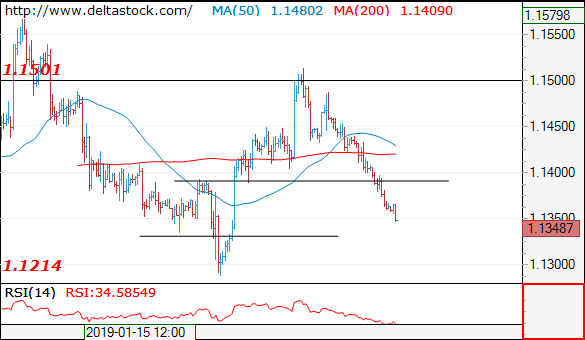
Current level - 1.1348
As the pair approaches 1.1330 support, my outlook is already counter-trend against 1.1290 low, for a reversal and another corrective leg towards 1.1450.
| Resistance | Support | ||
| intraday | intraweek | intraday | intraweek |
| 1.1390 | 1.1630 | 1.1330 | 1.1214 |
| 1.1440 | 1.1820 | 1.1290 | 1.1100 |
USD/JPY
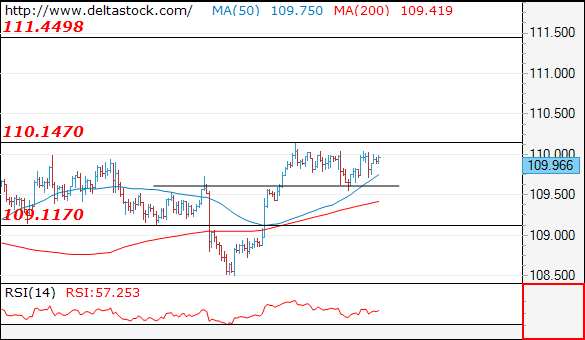
Current level - 109.96
The failure at 109.60 signals a completion of the consolidation phase below 110.20 and the outlook is positive, for a new leg upwards, to 111.45.
| Resistance | Support | ||
| intraday | intraweek | intraday | intraweek |
| 110.20 | 111.45 | 109.60 | 106.70 |
| 111.45 | 112.20 | 109.10 | 104.60 |
GBP/USD
Current level - 1.2902
The downtrend is intact, heading towards 1.2800 area. Crucial on the upside is 1.2980 peak.
| Resistance | Support | ||
| intraday | intraweek | intraday | intraweek |
| 1.2930 | 1.3290 | 1.2800 | 1.2800 |
| 1.3000 | 1.3480 | 1.2800 | 1.2610 |
Brexit And BoE Put Spotlight On The UK
Could we still get a 'Super Thursday' from the BoE?
It's been a relatively calm start to trading in Europe on Thursday but that may change in the coming hours with the UK very much at the heart of it.
'Super Thursday' has very much fallen off the radar this time around, which is hardly surprising when you consider that the country is less than two months from exiting the European Union and there's no agreement in place. While the interest rate announcement and everything that comes with it may not be the knockout event that is has been in the past – and will in the future – there is still a lot to be gained from it and the markets may be very sensitive to what comes.
We may not currently know what shape Brexit will take at the end of March but people are becoming increasingly confident that no deal will be avoided and an agreement – perhaps after an extension – will come, meaning the bank's base case of a smooth and orderly exit materialises. So its forecasts and rate expectations may be open to change depending on the outcome but they may not be too far from the reality so we should pay close attention to their current views. Most notably, how the global slowdown and dovish shift of others influences their own projections and whether they think the UK could buck the trend if a backlog of investment and consumer spending is unleashed in the event of a deal, which could mean more interest rate hikes than others are currently planning.
How will May's 'alternative arrangements' go down in Brussels?
Of course, it's likely that Mark Carney and his colleagues will try to be dragged back into the Brexit debate during the press conference but this isn't of much interest. It may make the headlines though alongside the Theresa May's visit to Brussels which the Prime Minister will be hoping results in more MPs getting on board with her deal. That may be very optimistic unless she can convince Jean-Claude Juncker and Donald Tusk that the 'alternative arrangements' her working group have come up with are workable. They are unlikely to replace the backstop though as they have refused to reopen the Withdrawal Agreement but they could be entered alongside and provide enough assurance by MPs to get the deal over the line. Unfortunately, this process has never been that straightforward and I don't expect it to start now. There's still more to run yet.
Dollar rally continues putting $1,300 gold support under pressure
The rebound in the dollar appears to be gathering momentum which is weighing on gold and driving back towards $1,300, a level is broke above a couple of weeks ago. With the momentum that gold currently has, this could be a big test for gold bulls who have been very resilient until now. The declines yesterday indicated a slight softening in sentiment but the big test is $1,300.
Gold has already found support just above here this morning, prompting a small bounce in price, but if the dollar continues to push on it will likely come under pressure again. If this can hold and rotate higher, it would be a very bullish signal for gold, with this having been a major level of resistance for most of last month. A break below here on the other hand would present some near-term challenges, with $1,280 becoming the next area of support below.
Oil rally stalls around key resistance
The rally in oil has very much paused in recent weeks but bulls are not giving up that easily. Resistance around $55 and $65 in WTI and Brent, respectively, are proving to be more of a test than bullish traders may have hoped for but we're seeing no signs of bearish momentum growing. A few factors are potentially causing the rally to stall, such as record US output figures, a series of inventory builds and questions around the speed of OPEC+ compliance but these may not last much longer.
OPEC+ has a history of delivering on promised cuts which have been effective in bringing down output and lifting prices, albeit not sustainably. US output is at record levels but the rig count has been headed in the wrong direction for a couple of months. Finally, Venezuela and Iran output is expected to decline which could aid the efforts of the OPEC+. Of course, much of the gains in oil has coincided with a similar rebound in equity markets and risk appetite, if that turns then regardless of these other factors, oil may tumble with it.
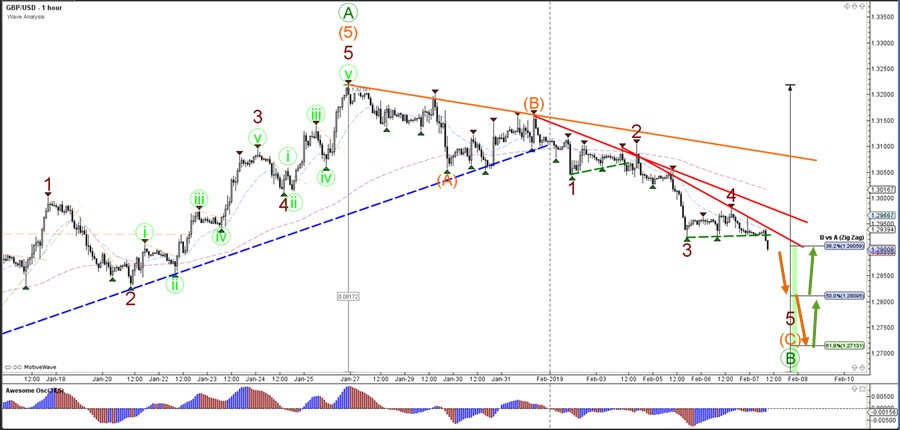
GBP/USD Bearish Price Action Testing Fib Support
The GBP/USD could be completing a wave B (green) if price manages to make a bullish bounce at the Fibonacci support levels. A break below the bottom and 100% Fib could, however, invalid the bullish ABC (green) wave pattern.
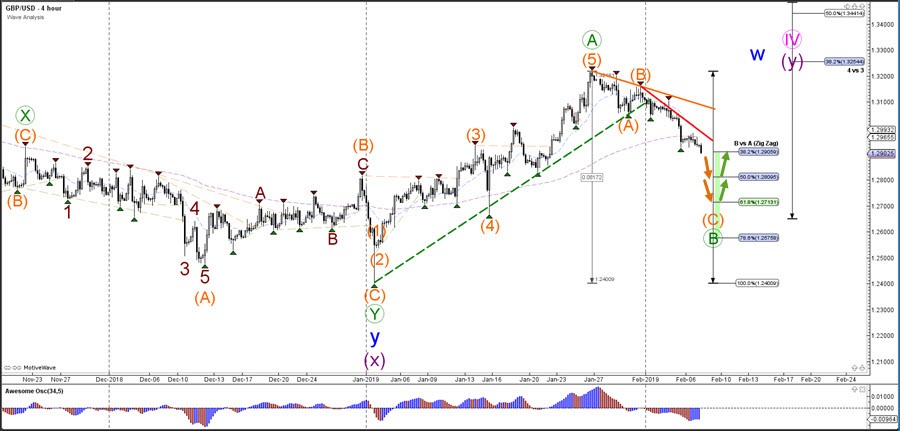
The GBP/USD is expected to make at least one more lower low which could be finishing a final wave 5 (brown) of wave C (orange). The Fibonacci retracement levels are key support zones.
European Commission slashes 2019 Eurozone growth forecast by -0.6% to 1.3%
European Commission projected EU growth to continue for the seventh year in a row in 2019, with expansion in all member states. But the pace of growth is expected to slow further as "economic momentum at the start of this year was subdued." Indeed, GDP growth for 2019 was quite sharply downgraded.
For Eurozone:
- 2019 growth is forecast to be 1.3%, versus prior forecast of 1.9%.
- 2020 growth is forecast to be 1.6% versus prior 1.7%.
- 2019 HICP inflation is projected to be 1.4%
- 2020 HICP inflation is projected to be at 1.5%.
For EU:
- 2019 growth is forecast to be 1.5%, versus prior 1.9%.
- 2020 growth is forecast to be 1.7%, versus prior 1.8%.
- 2019 HICP inflation is projected to be 1.6%
- 2020 HICP inflation is projected to be at 1.8%.
Here is the summary table:
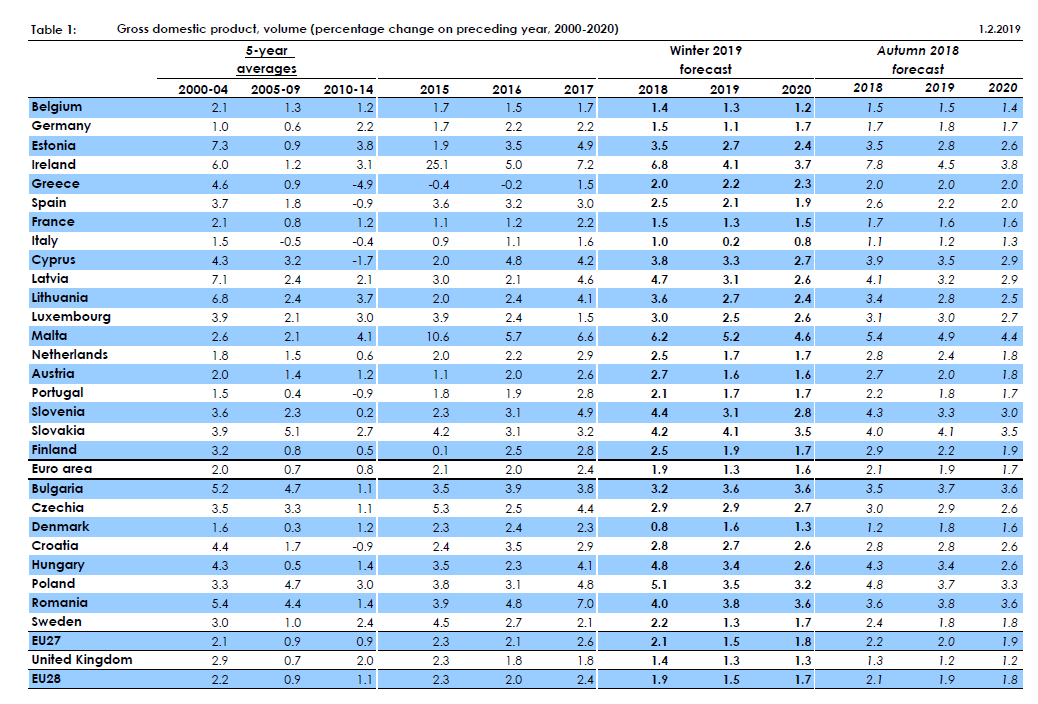
The commission also pointed out there is "a high level of uncertainty" surrounding the outlook, and the projections are subject to downside risks. Risks include trade tensions, slowdown in China, global financial markets and emerging markets risks, as well as Brexit.
Valdis Dombrovskis, Vice-President for the Euro and Social Dialogue, also in charge of Financial Stability, Financial Services and Capital Markets Union, said: "All EU countries are expected to continue to grow in 2019, which means more jobs and prosperity. Yet our forecast is revised downwards, in particular for the largest euro area economies. This reflects external factors, such as trade tensions and the slowdown in emerging markets, notably in China. Concerns about the sovereign-bank loop and debt sustainability are resurfacing in some euro area countries. The possibility of a disruptive Brexit creates additional uncertainty. Being aware of these mounting risks is half of the job. The other half is choosing the right mix of policies, such as facilitating investment, redoubling efforts to carry out structural reforms and pursuing prudent fiscal policies."
Pierre Moscovici, Commissioner for Economic and Financial Affairs, Taxation and Customs, said: "After its 2017 peak, the EU economy's deceleration is set to continue in 2019, to growth of 1.5%. This slowdown is set to be more pronounced than expected last autumn, especially in the euro area, due to global trade uncertainties and domestic factors in our largest economies. Europe's economic fundamentals remain solid and we continue to see good news particularly on the jobs front. Growth should rebound gradually in the second half of this year and in 2020."