

Sample Category Title
The RBA Downgraded Its Inflation And GDP Forecasts
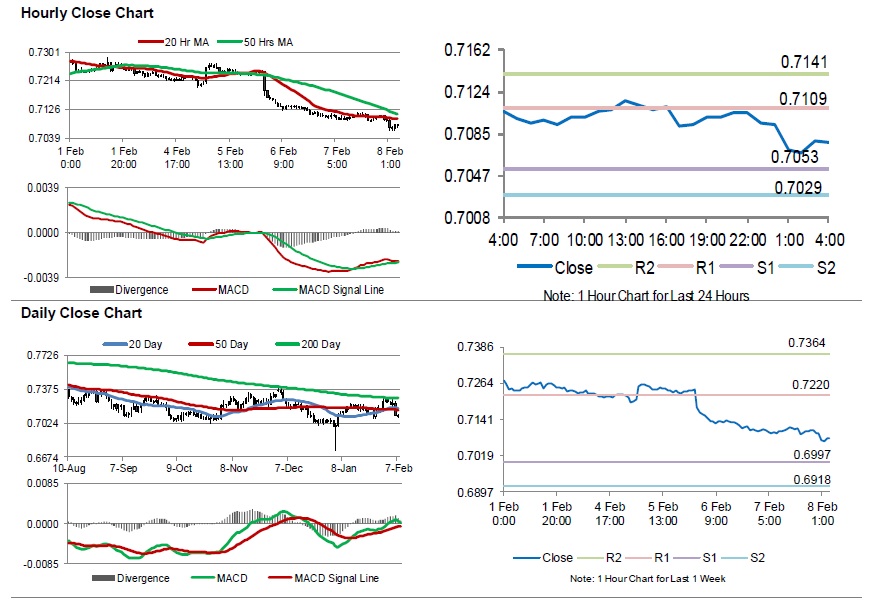
For the 24 hours to 23:00 GMT, the AUD declined 0.20% against the USD and closed at 0.7095.
LME Copper prices rose 0.3% or $17.0/MT to $6227.0/MT. Aluminium prices declined 1.3% or $24.0/MT to $1862.5/MT.
In the Asian session, at GMT0400, the pair is trading at 0.7077, with the AUD trading 0.25% lower against the USD from yesterday’s close.
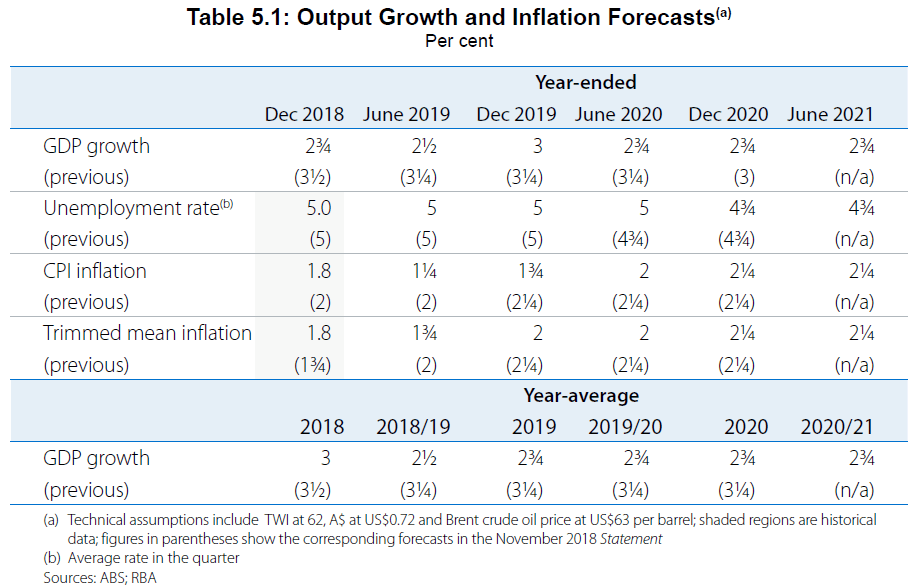
The Reserve Bank of Australia, in its monetary policy statement, cut its economic and inflation growth forecasts. Accordingly, the central bank now expects economic growth of 2.50% in the 12 months ended 30 June, down from its previous forecast of 3.25%. Additionally, the bank cut its inflation forecast for the same period from 2.00% to 1.25%. Further, the board stated that it does not see strong case to move rates in the near term.
The pair is expected to find support at 0.7053, and a fall through could take it to the next support level of 0.7029. The pair is expected to find its first resistance at 0.7109, and a rise through could take it to the next resistance level of 0.7141.
Going ahead, traders would keep an eye on Australia’s NAB business confidence and Westpac consumer confidence index, both set to release next week.
The currency pair is trading below its 20 Hr and 50 Hr moving averages.
Gold: Yellow Metal Reverses Its Gains In The Morning Session
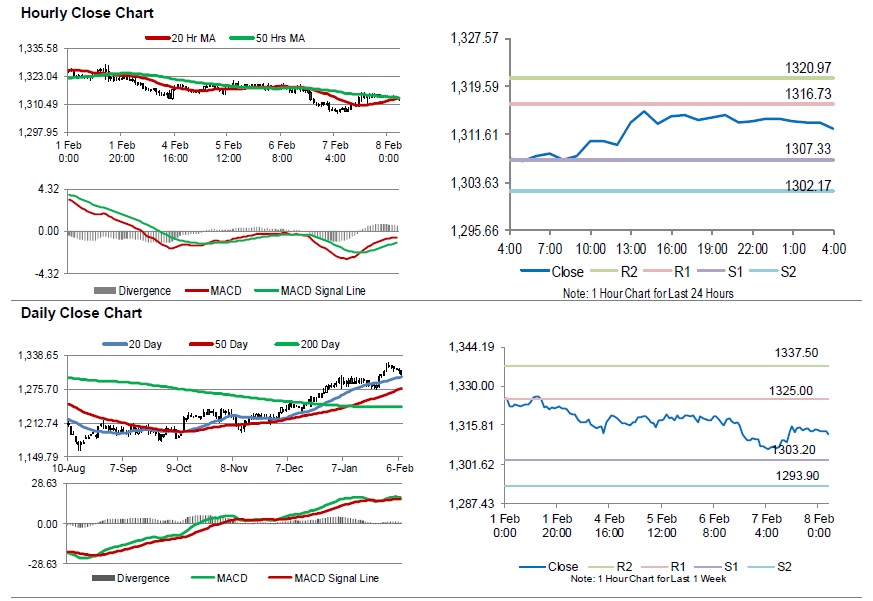
For the 24 hours to 23:00 GMT, Gold rose 0.20% against the USD and closed at USD1313.80 per ounce.
In the Asian session, at GMT0400, the pair is trading at 1312.50, with gold trading 0.10% lower against the USD from yesterday’s close.
The pair is expected to find support at 1307.33, and a fall through could take it to the next support level of 1302.17. The pair is expected to find its first resistance at 1316.73, and a rise through could take it to the next resistance level of 1320.97.
The yellow metal is showing convergence with its 20 Hr and 50 Hr moving averages.
AUD/USD Daily Outlook
Daily Pivots: (S1) 0.7088; (P) 0.7103; (R1) 0.7118; More...
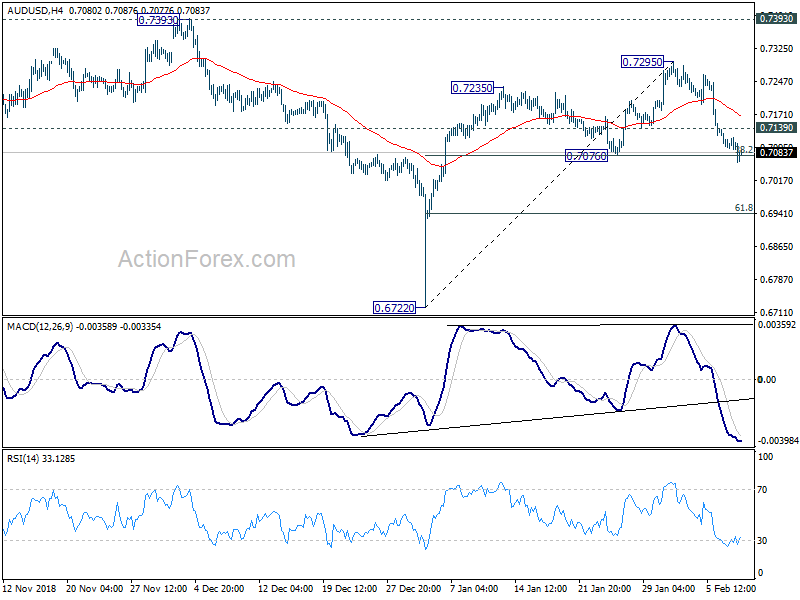
AUD/USD's fall from 0.7295 is still in progress and intraday bias stays on the downside. Break of 0.7076 cluster support (38.2% retracement of 0.6722 to 0.7295 at 0.7076) affirms the case that rebound from 0.6722 has completed at 0.7295. Further decline should be seen to 61.8% retracement at 0.6941 next. On the upside, above 0.7139 minor resistance will turn intraday bias neutral first. But risk will remain on the downside as long as 0.7295 resistance holds.
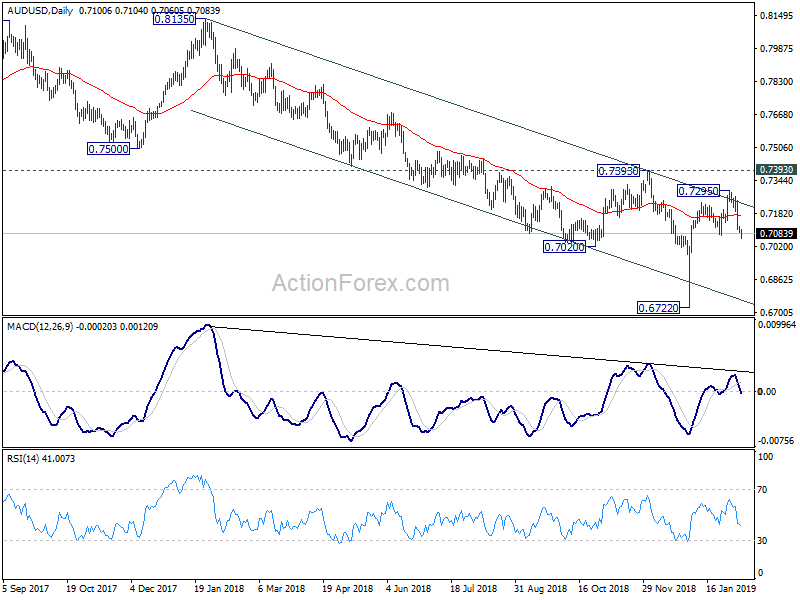
In the bigger picture, as long as 0.7393 resistance holds, we'd treat fall from 0.8135 as resuming long term down trend from 1.1079 (2011 high). Decisive break of 0.6826 (2016 low) will confirm this bearish view and resume the down trend to 0.6008 (2008 low). However, firm break of 0.7393 will argue that fall from 0.8135 has completed. And corrective pattern from 0.6826 has started the third leg, targeting 0.8135 again.
Yen Rises as Trade War Concern Resurfaces, RBA Hammers Aussie Again
Global markets are in mild risk averse mode on concerns over US-China trade talk. That came after Trump said he will not meet Chinese President Xi this month to complete the trade agreement. Yen and Swiss Franc are trading as the stronger ones, as lifted by falling treasury yields too. But upside momentum of both is a bit weak.
On the other hand, dovish RBA sent Australian Dollar lower again. Canadian Dollar follows as the second weakest as oil price weakens. But the fate of the Loonie hinges on job data to be released later today. Sterling turned mixed as yesterday's post BoE rebound fades. Dollar is also mixed for now but it's the strongest one for the week.
Technically, AUD/USD's break of 0.7076 support further affirms the case of bearish reversal and opens up decline back to 0.6722 low. Dollar is losing some momentum. But more upside remains in favor against Euro and Swiss Franc. USD/CAD is also on track for 1.3375 resistance to confirm near term bullish reversal. Euro is a currency to watch this week as EUR/JPY is pressing 124.35 support while EUR/GBP is pressing 0.8726 support. Break of both these levels could prompt more broad based decline in the common currency.
In other markets, Nikkei closed down -2.01%. Hong Kong HSI is back from holiday and is down -0.08%. China is still on holiday. Singapore Strait Times is down -0.10%. Japan 10-year JGB yield is down -0.029 at -0.0204. Overnight, DOW dropped -0.87%. S&P 500 dropped -0.94%. NASDAQ dropped -1.18%. 10-year yield dropped -0.050 to 2.652, back below 2.7% handle. 30-year yield dropped -0.045 to 2.993, lost 3.0% handle.
Trump said he will not meet Chinese President Xi this month to seal trade deal
Stocks are apparently a bit troubled by the development in US-China trade negotiations. When asked whether he will meet Chinese President Xi Jinping this month to seal the trade deal, Trump bluntly said "No", shaking his head. He went further and said "Not yet. Maybe. Probably too soon. Probably too soon" for a meeting next month.
The current trade-war ceasefire will end on Mar 1 and for now, US maintains the plan to impose tariffs on USD 200B in Chinese goods from 10% to 25% after that. While Trump's comment triggered concerns of further escalation in trade war, it's seen not as the most likely scenario.
US Trade Representative Robert Lighthizer and Treasury Secretary Steven Mnuchin will travel to Beijing to resume trade talks next week. Trump's comment could be just a negotiation tactic. And, more importantly, Trump has scheduled to meet North Korean leader Kim Jong-un in Vietnam on February 27-28. It's easy for him to travel from Vietnam to China after that. And last but not least, the cease-fire deadline can be extended if there is enough progress in the negotiations.
Fed Bullard: Interest rate now a little bit restrictive
St. Louis Fed President James Bullard just described current interest rate as "a little bit restrictive" after that rate hike in December. And, to him, Fed is now "putting downward pressure rather than upward pressure on inflation". And that could drag core inflation further below Fed's 2% target. Thus, he expects Fed to miss inflation target again in 2019.
Further, Bullard warned that "I do think it has damaged us to have continually missed on the low side." Thus, Fed has too "tread carefully" this in regarding interest rate decisions.
According to Fed's own December projections, the longer run federal funds rate sat at 2.5-30% (central tendency) and 2.5-3.5% (range). Current federal funds rate is at 2.25-2.50%, which is still below the long running range.
ECB Coeure: Eurozone not in lasting and serious slowdown, just broader and longer
ECB Executive Board member Benoit Coeure said Eurozone is facing a broader and longer slowdown, but not a lasting and serious one. And he's confidence that ECB has existing and new tools to fight a slowdown.
Coeure told Barron's in an interview that "We don't think that we have enough elements to conclude that we're facing a lasting and serious slowdown of the euro zone economy." He added that "what we're seeing now is that the slowdown may be broader and longer-lasting than originally forecast."
RBA projects slower rise in inflation and fall in unemployment
Australian Dollar suffers another round of selloff today after RBA revealed rather dovish economic forecasts in the Statement on Monetary Policy. In the summary part, Governor Philip Lowe's "balanced" turn was echoed.
The first scenario is "further progress in reducing unemployment and bringing inflation into the target range can reasonably be expected." In this case, higher interest rate "would become appropriate at some point". However, in other scenarios, "If there were then to be a sustained increase in unemployment and a lack of progress in returning inflation to target, it might instead be appropriate to lower the cash rate."
RBA now judges " the probabilities of these two sets of scenarios have shifted to be more evenly balanced than previously."
In the new economic projections:
- 2019 year-end growth was revised to 3%, down from 3.25%.
- 2020 year-end growth was revised to 2.75%, down from 3%.
- June 2020 unemployment rate was revised to 5%, up from 4.75%.
- That is, unemployment rate will fall at a slower pace.
- 2019 year-end CPI was revised to 1.75%, down from 2.25%.
- 2020 year-end CPI was unchanged at 2.25%.
- That is, CPI will rise at a slower pace.
On the data front
Japan household spending rose 0.1% yoy in December, below expectation of 0.8% yoy. Labor cash earnings rose 1.8% yoy, matched expectations. Current account surplus widened to JPY 1.56T.
Swiss unemployment and German trade balance will be featured in European session. But main focus will be on Canadian job data to be released later today.
AUD/USD Daily Outlook
Daily Pivots: (S1) 0.7088; (P) 0.7103; (R1) 0.7118; More...
AUD/USD's fall from 0.7295 is still in progress and intraday bias stays on the downside. Break of 0.7076 cluster support (38.2% retracement of 0.6722 to 0.7295 at 0.7076) affirms the case that rebound from 0.6722 has completed at 0.7295. Further decline should be seen to 61.8% retracement at 0.6941 next. On the upside, above 0.7139 minor resistance will turn intraday bias neutral first. But risk will remain on the downside as long as 0.7295 resistance holds.
In the bigger picture, as long as 0.7393 resistance holds, we'd treat fall from 0.8135 as resuming long term down trend from 1.1079 (2011 high). Decisive break of 0.6826 (2016 low) will confirm this bearish view and resume the down trend to 0.6008 (2008 low). However, firm break of 0.7393 will argue that fall from 0.8135 has completed. And corrective pattern from 0.6826 has started the third leg, targeting 0.8135 again.
Economic Indicators Update
| GMT | Ccy | Events | Actual | Forecast | Previous | Revised |
|---|---|---|---|---|---|---|
| 23:30 | JPY | Household Spending Y/Y Dec | 0.10% | 0.80% | -0.60% | |
| 23:50 | JPY | Current Account (JPY) Dec P | 1.56T | 1.52T | 1.44T | |
| 0:00 | JPY | Labor Cash Earnings Y/Y Dec | 1.80% | 1.80% | 2.00% | 1.70% |
| 0:30 | AUD | RBA Statement on Monetary Policy | ||||
| 6:45 | CHF | Unemployment Rate Jan | 2.40% | 2.40% | 2.40% | |
| 7:00 | EUR | German Trade Balance Dec | 19.4B | 18.1B | 19.0B | 18.9B |
| 13:15 | CAD | Housing Starts Jan | 206K | 213K | ||
| 13:30 | CAD | Net Change in Employment Jan | 9.3K | |||
| 13:30 | CAD | Unemployment Rate Jan | 5.60% |
Silver: White Metal Trading On A Weaker Footing In The Asian Session
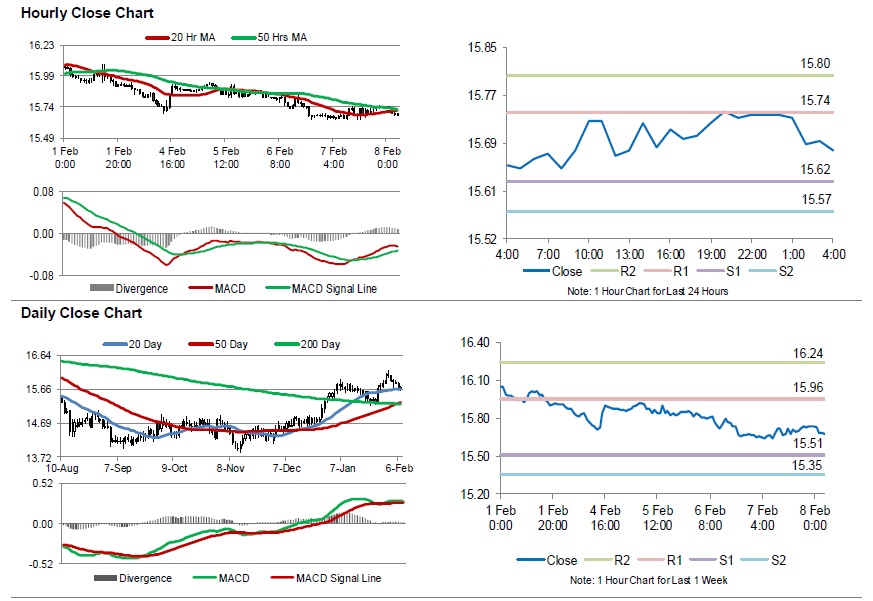
For the 24 hours to 23:00 GMT, Silver rose 0.38% against the USD and closed at USD15.74 per ounce, tracking gains in gold prices.
In the Asian session, at GMT0400, the pair is trading at 15.675, with silver trading 0.38% lower against the USD from yesterday’s close.
The pair is expected to find support at 15.62, and a fall through could take it to the next support level of 15.57. The pair is expected to find its first resistance at 15.74, and a rise through could take it to the next resistance level of 15.80.
The white metal is trading below its 20 Hr and 50 Hr moving averages.
Crude Oil: Oil Trading Lower, Ahead Of Baker Hughes Weekly Rig Count Data
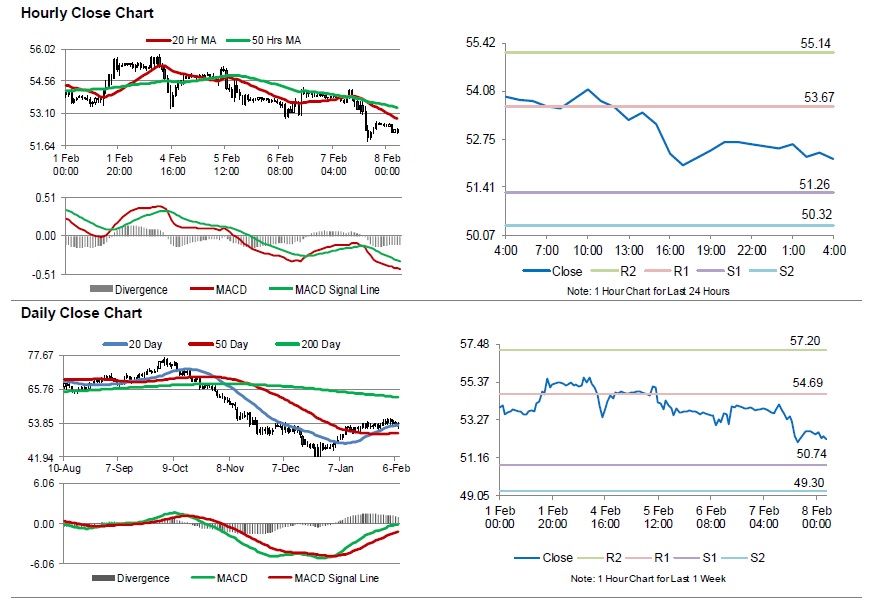
For the 24 hours to 23:00 GMT, Crude Oil declined 2.67% against the USD and closed at USD52.54 per barrel, as fears over global economic slowdown weighed on the demand outlook for the commodity.
In the Asian session, at GMT0400, the pair is trading at 52.19, with oil trading 0.67% lower against the USD from yesterday’s close.
The pair is expected to find support at 51.26, and a fall through could take it to the next support level of 50.32. The pair is expected to find its first resistance at 53.67, and a rise through could take it to the next resistance level of 55.14.
Crude oil is trading below its 20 Hr and 50 Hr moving averages.
Into European Session: Falling yields support Yen and Swiss, Aussie tumbles again
Entering into European session, Australian Dollar is the weakest one for today. RBA revealed new economic projections that indicate slow rise in inflation and unemployment rate. Also, it reiterated the stance that the chance for a hike or cut next is evenly balanced. Canadian Dollar is the second weakest as WTI crude oil dips below 52.5. The Loonie will look into job data to be released later today. Sterling's post BoE rebound lost steam and is now the third weakest.
Yen and Swiss Franc are strong on risk aversion. Investors are apparently troubled by news that Trump is not going to meet Chinese Xi to seal the trade deal this month. New Zealand Dollar is also strong today but it's just recovering yesterday's steep post-job data selloff. Dollar is mixed for now.
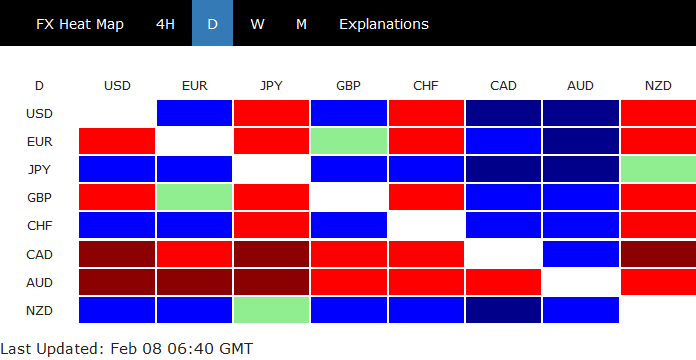
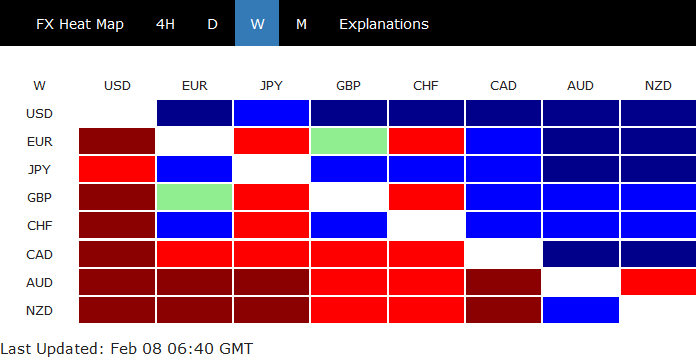
For the week, Dollar is overwhelmingly the strongest one, trading above prior week's high against all but Yen. Yen is the second strongest, followed by Swiss Franc. Falling global treasury yields and mild risk aversion are support these two safe-haven currencies. Commodity currencies are weakest, led by Australian Dollar.
In Asia:
- Nikkei closed down -2.01%.
- Hong Kong HSI is back from holiday and is down -0.22%.
- China is still on holiday.
- Singapore Strait Times is down -0.10%.
- Japan 10-year JGB yield is down -0.0227 at -0.031.
Overnight:
- DOW dropped -0.87%.
- S&P 500 dropped -0.94%.
- NASDAQ dropped -1.18%.
- 10-year yield dropped -0.050 to 2.652, back below 2.7% handle.
- 30-year yield dropped -0.045 to 2.993, lost 3.0% handle.
RBA projects slower rise in inflation and fall in unemployment
Australian Dollar suffers another round of selloff today after RBA revealed rather dovish economic forecasts in the Statement on Monetary Policy. In the summary part, Governor Philip Lowe's "balanced" turn was echoed.
The first scenario is "further progress in reducing unemployment and bringing inflation into the target range can reasonably be expected." In this case, higher interest rate "would become appropriate at some point". However, in other scenarios, "If there were then to be a sustained increase in unemployment and a lack of progress in returning inflation to target, it might instead be appropriate to lower the cash rate."
RBA now judges " the probabilities of these two sets of scenarios have shifted to be more evenly balanced than previously."
In the new economic projections:
- 2019 year-end growth was revised to 3%, down from 3.25%.
- 2020 year-end growth was revised to 2.75%, down from 3%.
- June 2020 unemployment rate was revised to 5%, up from 4.75%.
- That is, unemployment rate will fall at a slower pace.
- 2019 year-end CPI was revised to 1.75%, down from 2.25%.
- 2020 year-end CPI was unchanged at 2.25%.
- That is, CPI will rise at a slower pace.
Trump said he will not meet Chinese President Xi this month to seal trade deal
Stocks are apparently a bit troubled by the development in US-China trade negotiations. When asked whether he will meet Chinese President Xi Jinping this month to seal the trade deal, Trump bluntly said "No", shaking his head. He went further and said "Not yet. Maybe. Probably too soon. Probably too soon" for a meeting next month.
The current trade-war ceasefire will end on Mar 1 and for now, US maintains the plan to impose tariffs on USD 200B in Chinese goods from 10% to 25% after that. While Trump's comment triggered concerns of further escalation in trade war, it's seen not as the most likely scenario.
US Trade Representative Robert Lighthizer and Treasury Secretary Steven Mnuchin will travel to Beijing to resume trade talks next week. Trump's comment could be just a negotiation tactic. And, more importantly, Trump has scheduled to meet North Korean leader Kim Jong-un in Vietnam on February 27-28. It's easy for him to travel from Vietnam to China after that. And last but not least, the cease-fire deadline can be extended if there is enough progress in the negotiations.
ECB Coeure: Eurozone not in lasting and serious slowdown, just broader and longer
ECB Executive Board member Benoit Coeure said Eurozone is facing a broader and longer slowdown, but not a lasting and serious one. And he's confidence that ECB has existing and new tools to fight a slowdown.
Coeure told Barron's in an interview that "We don't think that we have enough elements to conclude that we're facing a lasting and serious slowdown of the euro zone economy." He added that "what we're seeing now is that the slowdown may be broader and longer-lasting than originally forecast."