

Sample Category Title
GBP/USD Daily Outlook
Daily Pivots: (S1) 1.2981; (P) 1.3031; (R1) 1.3119; More....
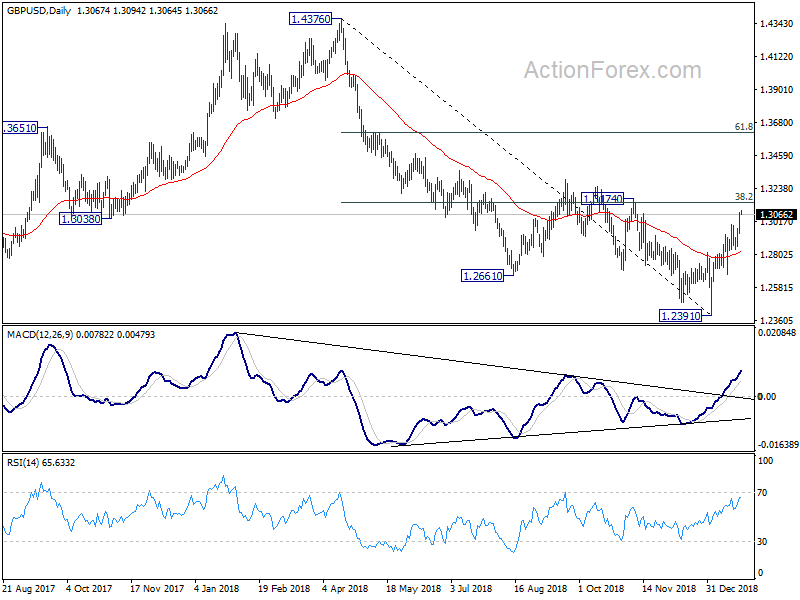
Intraday bias in GBP/USD remains on the upside as rebound form 1.2391 is in progress. Further rally would be seen towards 1.3174 resistance, which is close to 38.2% retracement of 1.4376 to 1.2391 at 1.3149. We'd expect strong resistance from there to limit upside, at least on first attempt. On the downside, break of 1.2830 support is needed to be the first sign of near term reversal. Otherwise, outlook will stays cautiously bullish in case of retreat.
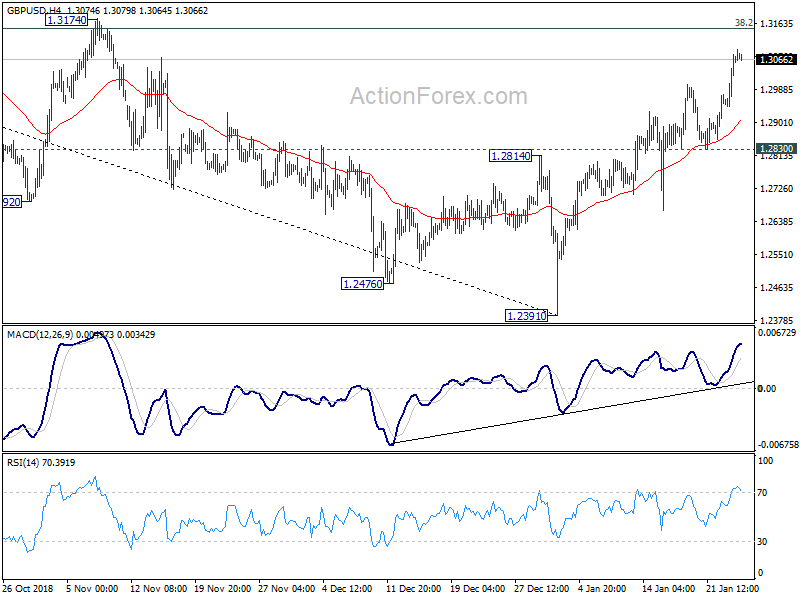
In the bigger picture, whole medium term rebound from 1.1946 (2016 low) should have completed at 1.4376 already, after rejection from 55 month EMA. The structure and momentum of the fall from 1.4376 argues that it's resuming long term down trend from 2.1161 (2007 high). And this will remain the preferred case as long as 1.3174 structural resistance holds. GBP/USD should target a test on 1.1946 first. Decisive break there will confirm our bearish view. However, sustained break of 1.3174 will invalidate this case and turn outlook bullish.
EUR/USD Daily Outlook
Daily Pivots: (S1) 1.1356; (P) 1.1375; (R1) 1.1400; More.....
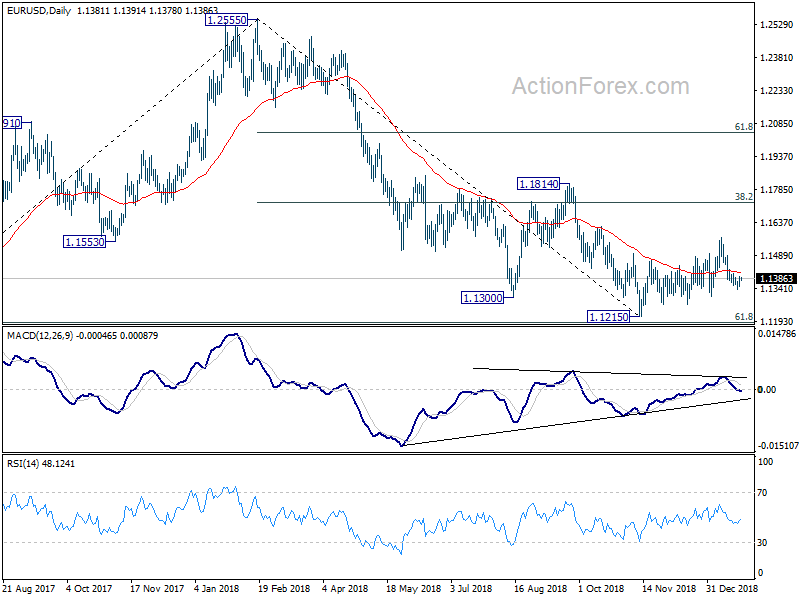
EUR/USD's recovery today suggests temporary bottoming at 1.1336. As such recovery is weak so far, we'd treat is as a correction. Intraday bias is turned neutral first. At this point, we're still slightly favoring that corrective rise from 1.1215 should have completed at 1.1569. On the downside, break of 1.1336 will resume the fall from 1.1569 to retest 1.1215 low. However, break of 1.1450 resistance will argue that the corrective pattern from 1.1215 is extending with another rise. And, intraday bias will be turned to the upside for 1.1569 and above.
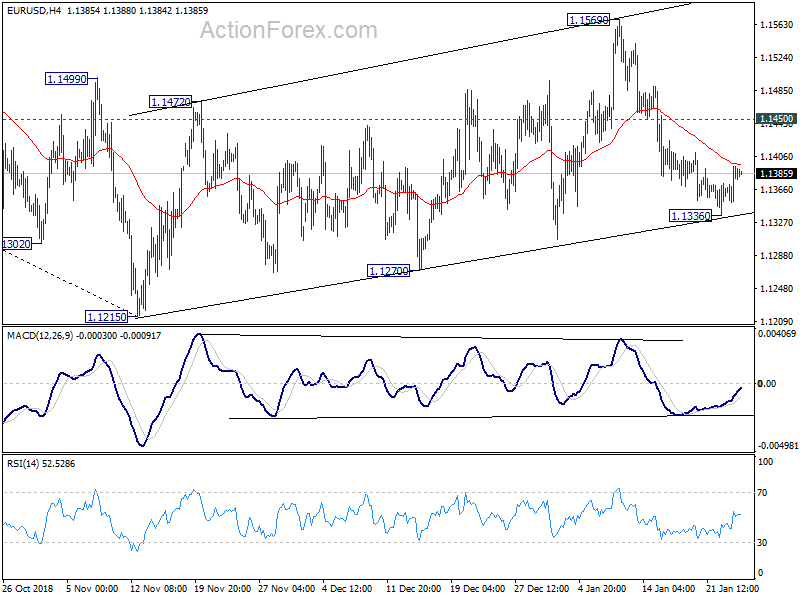
In the bigger picture, as long as 1.1814 resistance holds, down trend down trend from 1.2555 medium term top is still in progress and should target 61.8% retracement of 1.0339 (2017 low) to 1.2555 at 1.1186 next. Sustained break there will pave the way to retest 1.0339. However, break of 1.1814 will confirm completion of such down trend and turn medium term outlook bullish.
Euro’s Recovery Might be Cut Short by Weak PMIs and Cautious ECB
European majors are trading generally higher today as Eurozone will take the center of stage. There are worries of deeper and longer than expected slowdown in the Eurozone economy. PMIs from Germany, France and Eurozone will provide some hints on economic performance at the start of the year. ECB rate decision will for sure be the focus too. In particular, the tone of the post-meeting press conference will likely turn more cautious, if not dovish. Hence, while Euro is recovering, there is risk of renewed selling ahead, which might also drag down the Swiss Franc and, to a lesser extent, Sterling.
On the other hand, commodity currencies are generally lower despite lack of risk aversion in the markets. Australian Dollar turns south after mixed job data, strong in the headline by questionable in the details. New Zealand Dollar is paring some CPI prompted gains. Meanwhile, Canadian Dollar weakens as oil recovery lost momentum.
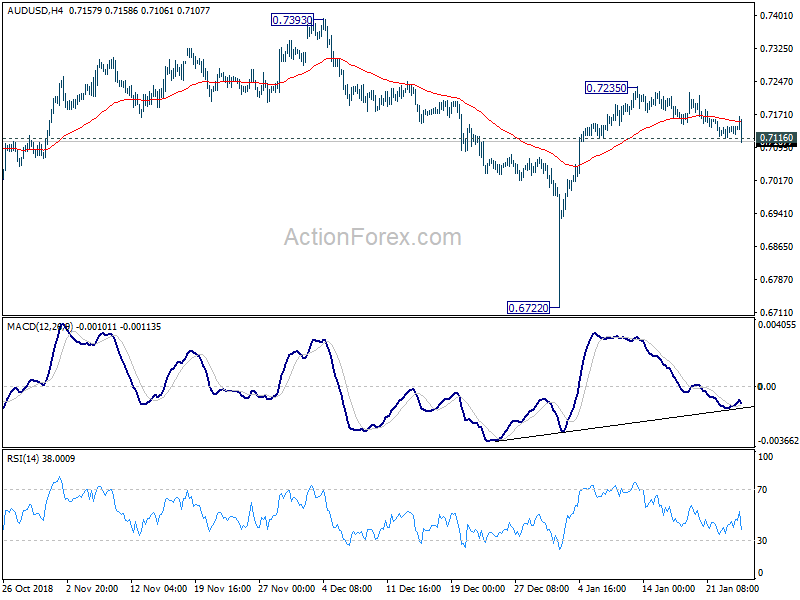
Technically, AUD/USD's break of 0.7116 minor support today suggests that the rebound from flash crash low at 0.6722 has completed at 0.7235 already. More downside is now in favor in AUD/USD to retest 0.6722 low. Sterling's rallies against Dollar, Euro and Yen are in progress, still with firm intraday momentum. EUR/USD is in recovery while USD/CHF is in retreat. But there is no change in near term outlook. That is, more upside is in favor in Dollar against Euro and Franc.
In other markets, Nikkei closed down -0.11% today. At the time of writing, Hong Kong HSI is up 0.28%, China Shanghai SSE is up 0.47%. Singapore Strait Times is up 0.37%. Japan 10 year JGB yield is up 0.0031 at 0.0009, staying positive. Overnight, DOW rose 0.70%. S&P 500 rose 0.22%. NASDQ rose 0.08%. 10-year yield rose 0.025 to 2.744.
ECB to turn cautious but no change in forward guidance yet
ECB rate decision and press conference is a main focus for today. No change is expected in monetary policy. And the main refinancing rate will be held at 0.00%. As recent economic data pointed to further weakness in the Eurozone economy, ECB president Mario Draghi might turn a bit more cautious or even dovish in the press conference.
Market has already pushed back their expectations on the first rate hike to mid-2020. But, ECB is still unlikely to make any change to the forward guidance. That is, ECB will reiterate that interest rates will stay at present level at least through summer of 2019. ECB probably would wait for more incoming data before making such a change.
Here are some suggested previews on ECB:
- ECB Preview – ECB to Turn More Dovish as Economic Data Surprise to Downside
- ECB Meeting and Eurozone PMIs Eyed as Euro/Dollar Flirts with Trendline
- ECB Preview: Dovish Draghi Expected, So Could EUR/USD Rise?
- No NY's Resolutions from ECB
- ECB Preview: We Assign 60% Chance of ECB Hike in December 2019
BoE Haldane: People to take finger of pause button, if some Brexit deal is done
BoE Chief Economist Andy Haldane said in a newspaper interview that "if the economy continues to tick along, as we expect, then we might expect some further limited and gradual rises".
In particular, if some Brexit deal is done, "that would reduce uncertainty and, we think, cause people to take their finger of the pause button and do a bit more investment spending".
And if the economy begins to "change direction, "we will be flexible in the face of that."
EU Barnier: Opposing no-deal Brexit won't stop no-deal Brexit
EU chief Brexit negotiator Michel Barnier said yesterday that no-deal Brexit is now the default, and "Preparing for a no-deal scenario is more important now than ever, even though I still hope that we can avoid this scenario."
He also warned that "Opposing no-deal will not stop no-deal from happening at the end of March. To stop no-deal, another majority will have to emerge." And he added, "This is the objective of the political consultations that Theresa May has started and we hope, sincerely, we hope that this process will be successful".
Meanwhile, he also pointed out there are two possible ways to leave the EU. "Number one, an orderly withdrawal based on the agreement that we have built step by step with the UK over the last 18 months." Or, "Number two, a disorderly withdrawal, leaving the EU without a deal, is a default scenario and there appears to be a majority in the House of Commons to oppose a no-deal."
BoC Poloz: Timing of next rate hike depends on how the economy responds to the shocks
BoC Governor Stephen Poloz reiterated that more rate hikes are warranted for the central bank. But the timing would be "data dependent" and "it will depend on how the economy responds to the shocks we've described." He referred to developments including Canada's housing market, trade tensions and import of lower oil prices.
In particular, Poloz noted the past increase interest rates could lead to slumping activity. And the housing markets hasn't "quite settled down". He would like to see how the markets stabilize to know "where we stand". That's a sign taken then BoC could opt for a pause for a while.
But Poloz also defended past rate hikes of BoC and some other central banks. He noted "we are at a stage in the cycle where it always looks like monetary policy is doing the wrong thing". And, given the economy is "near its steady state, interest rates also should be near their steady state." But Poloz emphasized that the actual level of the so called steady state, or neutral rate, is an "open question". BoC estimates it to be 2.5-3.5%.
WH Hassett said there will be a US-China trade deal by March 1
White House economic adviser Kevin Hassett said yesterday he's confidence that US and China will reach a trade deal by March 1 deadline. He said in a CNN interview that "Yes, I am confident that it can happen, that the talks are moving forward".
And, "There's a lot of progress to be made but it's a very strong situation right now. And I think the Chinese recognize that they've got a big potential gain for coming up with a deal because as you mentioned their growth has really fallen off the cliff."
Also, Hassett talked down the risk of government shut down on credit rating. He said "I don't think a downgrade is in play … I don't think that there's any risk at all, given how strong the economy is, that we will be downgraded."
Japan PMI manufacturing dropped to 50, exports drop steepest in over 2.5 years
Japan PMI manufacturing dropped to 50.0 in December, down from 52.6. That also marked the end of the longest expansionary run for over a decade. In particular, exports decline at strongest pace in two-and-a-half years. And, production scaled back for first time since July 2016, while confidence lowest in over six years.
Joe Hayes, Economist at IHS Markit, noted "Preliminary PMI data for January bodes ill for Japan's manufacturing sector, indicating the end of a near two-and-a-half-year growth run as the index dropped to 50.0. The underlying picture will raise concern given renewed reductions were seen in new orders and output. Further signs that the downturn in the global trade cycle could yet worsen were also signalled, with new export orders falling at the sharpest rate since July 2016. The widely-anticipated rebound in Q4 should not distract from the bigger picture. Domestic economic weakness compounded with slowing global growth coincided with the lowest level of business confidence for over six years."
Australia job growth driven by part time jobs, participation rate fell
Australia job market grew 21.6k in December, above expectation of 18.1k. Full-time jobs, however, dropped -3k. Part-time jobs rose 24.6k. Unemployment rate dropped -0.1% to 5.0%, better than expectation of 5.0%. That equals the lowest level in more than 6 years, as touched back in September and October. However, participation rate dropped by -0.1% to 65.6%. While the set of data was solid, it isn't too encouraging and paints no sign of tightening in the Australian job market.
Looking ahead
In addition to ECB rate decision and press conference, Eurozone will release PMIs. US will also release PMIs and leading indicator.
EUR/USD Daily Outlook
Daily Pivots: (S1) 1.1356; (P) 1.1375; (R1) 1.1400; More.....
EUR/USD's recovery today suggests temporary bottoming at 1.1336. As such recovery is weak so far, we'd treat is as a correction. Intraday bias is turned neutral first. At this point, we're still slightly favoring that corrective rise from 1.1215 should have completed at 1.1569. On the downside, break of 1.1336 will resume the fall from 1.1569 to retest 1.1215 low. However, break of 1.1450 resistance will argue that the corrective pattern from 1.1215 is extending with another rise. And, intraday bias will be turned to the upside for 1.1569 and above.
In the bigger picture, as long as 1.1814 resistance holds, down trend down trend from 1.2555 medium term top is still in progress and should target 61.8% retracement of 1.0339 (2017 low) to 1.2555 at 1.1186 next. Sustained break there will pave the way to retest 1.0339. However, break of 1.1814 will confirm completion of such down trend and turn medium term outlook bullish.
Economic Indicators Update
| GMT | Ccy | Events | Actual | Forecast | Previous | Revised |
|---|---|---|---|---|---|---|
| 0:30 | AUD | Employment Change Dec | 21.6K | 18.1K | 37.0K | |
| 0:30 | AUD | Unemployment Rate Dec | 5.00% | 5.10% | 5.10% | |
| 0:30 | AUD | Part Time Employment Change Dec | 24.6k | 43.4k | ||
| 0:30 | JPY | PMI Manufacturing Jan P | 50 | 52.6 | ||
| 8:15 | EUR | France Manufacturing PMI Jan P | 50 | 49.7 | ||
| 8:15 | EUR | France Services PMI Jan P | 50.5 | 49 | ||
| 8:30 | EUR | Germany Manufacturing PMI Jan P | 51.4 | 51.5 | ||
| 8:30 | EUR | Germany Services PMI Jan P | 52.2 | 51.8 | ||
| 9:00 | EUR | Eurozone Manufacturing PMI Jan P | 51.3 | 51.4 | ||
| 9:00 | EUR | Eurozone Services PMI Jan P | 51.5 | 51.2 | ||
| 12:45 | EUR | ECB Rate Decision | 0.00% | 0.00% | ||
| 13:30 | USD | Initial Jobless Claims (JAN 19) | 215K | 213K | ||
| 14:45 | USD | US Manufacturing PMI Jan P | 53.5 | 53.8 | ||
| 14:45 | USD | US Services PMI Jan P | 54.1 | 54.4 | ||
| 15:00 | USD | Leading Index Dec | -0.10% | 0.20% | ||
| 15:30 | USD | Natural Gas Storage | -81B | |||
| 16:00 | USD | Crude Oil Inventories | -2.7M |
Asian update: Commodity currencies lower despite steady market sentiments
Commodity currencies are trading broadly lower today even though Asian markets show no sign of risk aversion. Australian Dollar turns lower after solid but un-encouraging job data. New Zealand Dollar is paring yesterday's CPI triggered gains. Canadian Dollar is follow oil prices low as WTI is back at 52.3 after brief recovery.
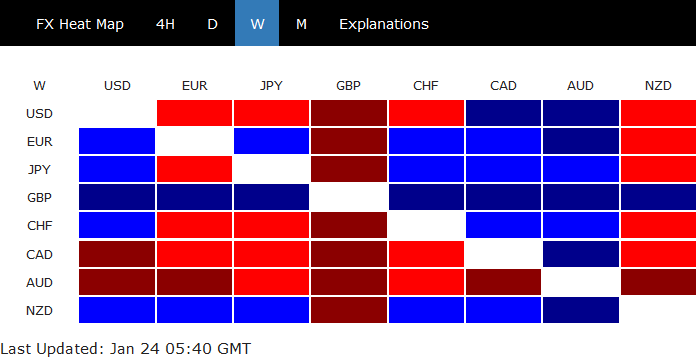
For now, European majors are the strongest ones today, led by Swiss Franc. Euro will look into PMIs, ECB rate decision and press conference.
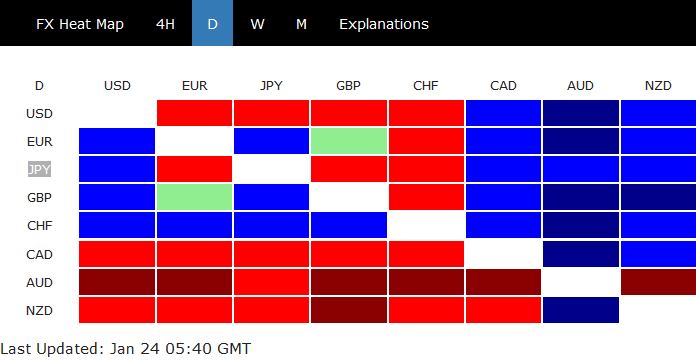
For the week, Sterling is the strongest one on receding chance of no-deal Brexit. Kiwi is the second strongest on lower chance of RBNZ rate cut after solid CPI. Australian and Canadian Dollar are the weakest, followed by Dollar.
In Asia:
- Nikkei is currently down -0.14%.
- Hong Kong HSI is up 0.16%.
- China Shanghai SSE is up 0.40%.
- Singapore Strati Times is up 0.42%.
- Japan 10-year JGB yield is up 0.0009 at 0.006.
Overnight:
- DOW rose 0.70%.
- S&P 500 rose 0.22%
- NASDQ rose 0.08%.
- 10-year yield rose 0.025 to 2.744.
ECB to turn cautious but no change in forward guidance yet
ECB rate decision and press conference is a main focus for today. No change is expected in monetary policy. And the main refinancing rate will be held at 0.00%.
As recent economic data pointed to further weakness in the Eurozone economy, ECB president Mario Draghi might turn a bit more cautious or even dovish in the press conference.
Market has already pushed back their expectations on the first rate hike to mid-2020. But, ECB is still unlikely to make any change to the forward guidance. That is, ECB will reiterate that interest rates will stay at present level at least through summer of 2019. ECB probably would wait for more incoming data before making such a change.
Here are some suggested previews on ECB:
Japan PMI manufacturing dropped to 50, exports drop steepest in over 2.5 years
Japan PMI manufacturing dropped to 50.0 in December, down from 52.6. That also marked the end of the longest expansionary run for over a decade. In particular, exports decline at strongest pace in two-and-a-half years. And, production scaled back for first time since July 2016, while confidence lowest in over six years.
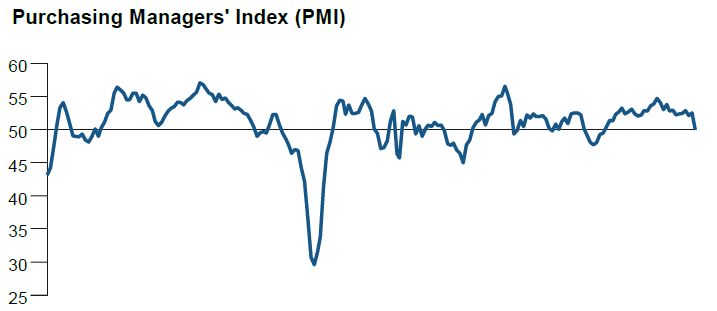
Commenting on the Japanese Manufacturing PMI survey data, Joe Hayes, Economist at IHS Markit, which compiles the survey, said:
"Preliminary PMI data for January bodes ill for Japan's manufacturing sector, indicating the end of a near two-and-a-half-year growth run as the index dropped to 50.0. The underlying picture will raise concern given renewed reductions were seen in new orders and output. Further signs that the downturn in the global trade cycle could yet worsen were also signalled, with new export orders falling at the sharpest rate since July 2016. The widely-anticipated rebound in Q4 should not distract from the bigger picture. Domestic economic weakness compounded with slowing global growth coincided with the lowest level of business confidence for over six years."
Australia job growth driven by part time jobs, participation rate fell
Australia job market grew 21.6k in December, above expectation of 18.1k. Full-time jobs, however, dropped -3k. Part-time jobs rose 24.6k. Unemployment rate dropped -0.1% to 5.0%, better than expectation of 5.0%. That equals the lowest level in more than 6 years, as touched back in September and October. However, participation rate dropped by -0.1% to 65.6%.
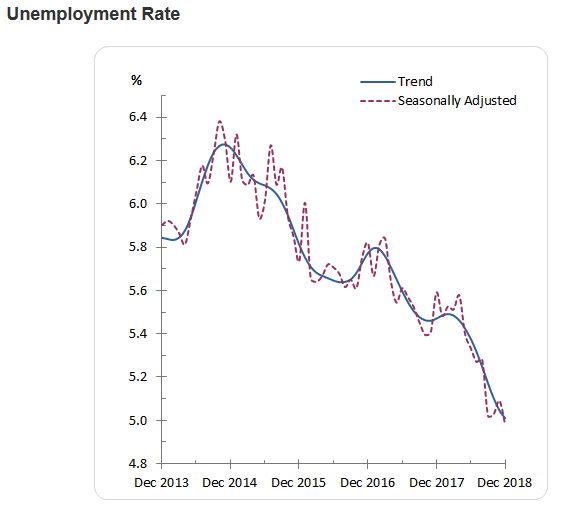
While the set of data was solid, it isn't too encouraging and paints no sign of tightening in the Australian job market. AUD/USD dips through 0.7116 minor support, which suggests completion of rebound form flash crash low at 0.6722. Further downside would be seen in the pair.
BoE Haldane: People to take finger of pause button, if some Brexit deal is done
BoE Chief Economist Andy Haldane said in a newspaper interview that "if the economy continues to tick along, as we expect, then we might expect some further limited and gradual rises".
In particular, if some Brexit deal is done, "that would reduce uncertainty and, we think, cause people to take their finger of the pause button and do a bit more investment spending".
And if the economy begins to "change direction, "we will be flexible in the face of that."
BoC Poloz: Timing of next rate hike depends on how the economy responds to the shocks
BoC Governor Stephen Poloz reiterated that more rate hikes are warranted for the central bank. But the timing would be "data dependent" and "it will depend on how the economy responds to the shocks we've described." He referred to developments including Canada's housing market, trade tensions and import of lower oil prices.
In particular, Poloz noted the past increase interest rates could lead to slumping activity. And the housing markets hasn't "quite settled down". He would like to see how the markets stabilize to know "where we stand". That's a sign taken then BoC could opt for a pause for a while.
But Poloz also defended past rate hikes of BoC and some other central banks. He noted "we are at a stage in the cycle where it always looks like monetary policy is doing the wrong thing". And, given the economy is "near its steady state, interest rates also should be near their steady state." But Poloz emphasized that the actual level of the so called steady state, or neutral rate, is an "open question". BoC estimates it to be 2.5-3.5%.
Australian Employment Had a Solid End to 2018
December Labour Force Survey. Employment 21.6k, unemployment 5.0%, participation 65.6%.
Total employment printed a solid 21.6k gain in December which was in line with market expectations for +20k. This has locked in a solid trend pace of growth with a three month average gain of 29.1k.
Employment ended 2018 with a sound run. In the year to December total employment grew 268.6k, or 2.2%, which matches the six month annualised pace of 2.2%yr. While it is true that the momentum in the Australian labour market eased through 2018 - annual growth peaked at 3.6%yr in January - it can still be described as sound.
The mix of employment gains also painted a picture of a solid, rather than accelerating labour market with a –3.0k loss in full-time employment being more than offset by a 24.6k gain in part-time employment. Hours worked rose 0.1% (total employment rose 0.2%) as hours worked per person fell 0.1%. Through 2018 total hours worked increased by 1.5%yr which is quite a bit softer compared to the 2.2%yr pace in employment.
Given the December gain in employment it is not surprising that the unemployment rate eased back 0.1ppt to 5.0% (market median was for 5.1%). This fall was helped by a 0.1ppt moderation in the participation rate to 65.6% (65.63% at two decimal places) which limited the rise in the labour force to just 7.5k.
In December the gains were in Victoria (10.5k/120.2k in the year) and Queensland (11.6k/54.7k in the year) while NSW added just 3.8k (94.3k in the year). The labour market has softened in WA (–15.3k/–5.5k in the year) and saw a modest recovery in SA (1.1k/13.2k in the year).
Looking at the state unemployment rates highlights the relative strength of the various labour markets. On a national level, the unemployment rate has fallen from 5.5% in Q1 to 5.0% in Q4. Victoria was the state showing the greatest improvement with the unemployment rate falling –1.1ppts to 4.4% (now on par with NSW) while in NSW unemployment fell just –0.6ppts to 4.4%. The Qld labour market appears to have stalled with the unemployment rate lifting 0.1ppt to 6.2% while it has been flat in WA and SA at 6.2% and 5.6% respectively.
It is also worth noting that 2018 produced a –0.2ppt decline in the underemployment rate from Q1 to Q4. However, at 8.4% it is still at a historically elevated level.
For 2019 we are looking for a pause in the pace in employment growth due to the economic uncertainties surrounding the Federal Election at the same time as we expect to see a moderation in momentum in NSW and Victoria on the back of a moderation in housing activity. We are expecting this to slow employment growth to below the pace of growth in the labour force lifting the unemployment rate to 5.3% around mid-2019.