Sample Category Title
USD/CHF Mid-Day Outlook
Daily Pivots: (S1) 0.9903; (P) 0.9929; (R1) 0.9969; More....
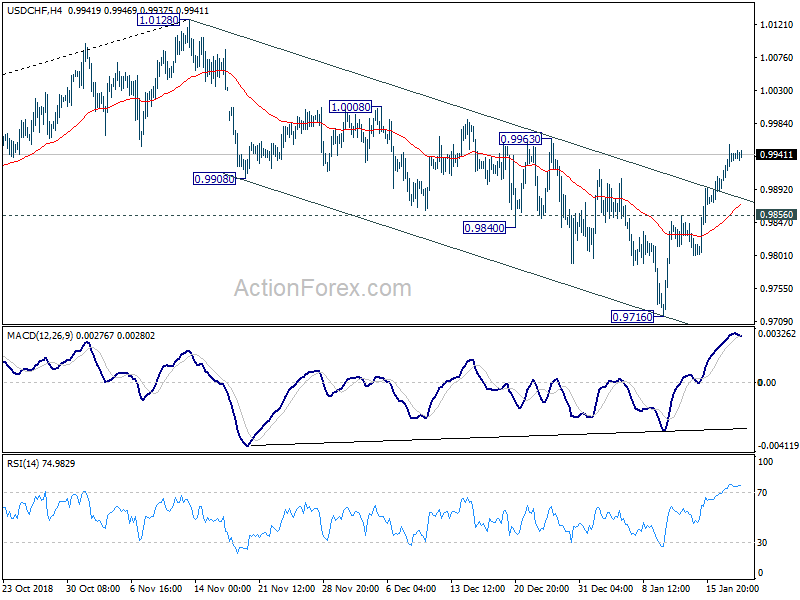
USD/CHF's rebound from 0.9716 is still in progress and intraday bias stays on the upside for 0.9963 resistance first. Break there should confirm completion of corrective fall from 1.0128 to 0.9716. Further rise should then be seen to retest 1.0128. However, break of 0.9856 minor support will turn bias back to the downside for 0.9716 low.
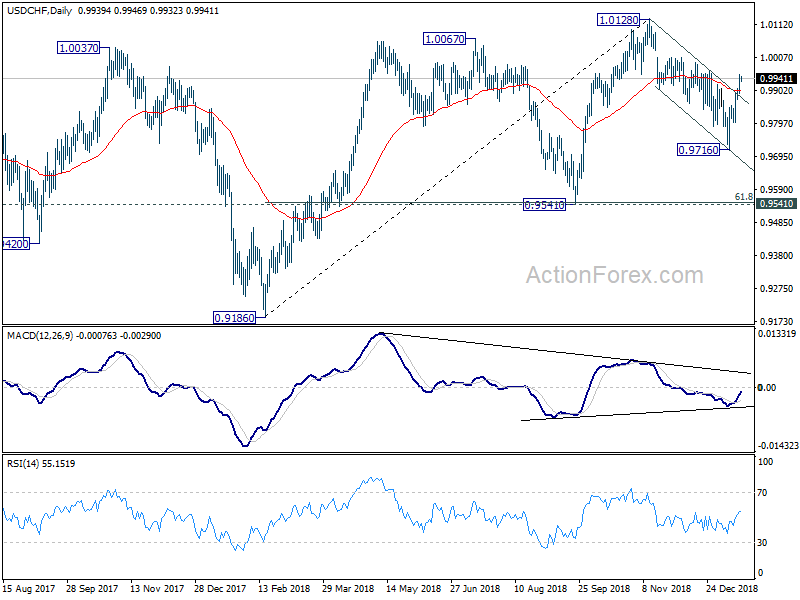
In the bigger picture, current development suggests that rise from 0.9186 has possibly completed with three waves up to 1.0128 already. Decline from 1.0128 could either be correcting this move, or reversing the trend. As long as 0.9541 support holds, we'd slightly favor the former scenario, and expect another rise through 1.0128 at a later stage. However, sustained break of 0.9541 will confirm trend reversal and bring deeper fall back to 0.9186 low.
USD/JPY Mid-Day Outlook
Daily Pivots: (S1) 108.82; (P) 109.11; (R1) 109.53; More...
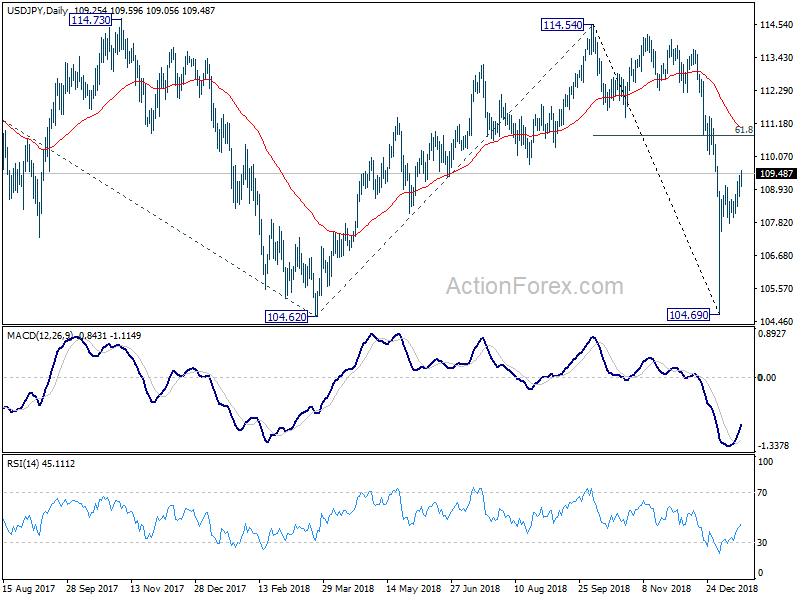
Intraday bias in USD/JPY remains mildly on the upside. The rebound from 104.69 is likely stronger than originally expected. Break of 109.46 will pave the way to 61.8% retracement of 114.54 to 104.69 at 110.77 and above. On the downside, below 107.77 will turn bias to the downside for retesting 104.69 low.
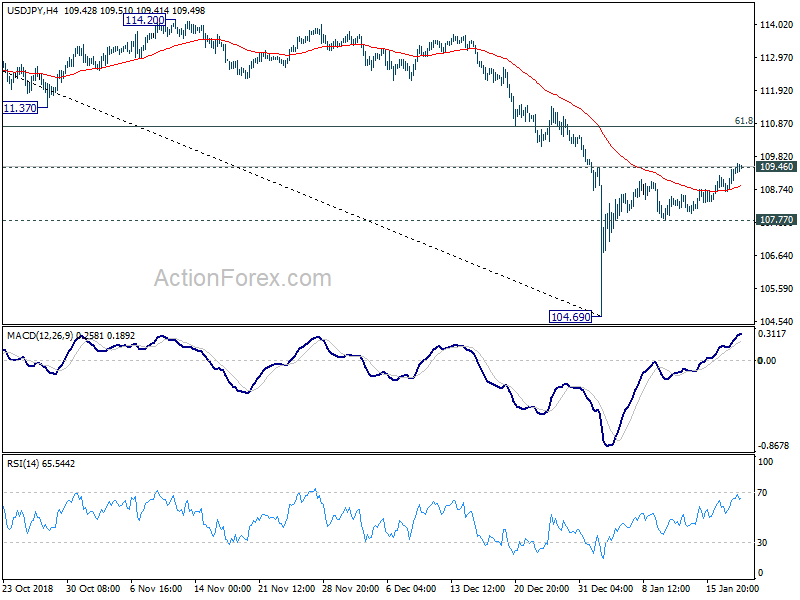
In the bigger picture, price actions from 125.85 (2015 high) are seen as a long term corrective pattern, no change in this view. Apparently, such corrective pattern is not completed yet. Fall from 114.54 is seen as part of the falling leg from 118.65 (2016 high). Break of 104.62 will target 100% projection of 118.65 to 104.62 from 114.54 at 100.51, which is close to 100 psychological level. But in that case, we'd expect strong support from 98.97 to contain downside to bring reversal. Also, this bearish case will remain the preferred one as long as 114.54 resistance holds.
Canada: Air Travel Drives a Modest Climb in December Inflation
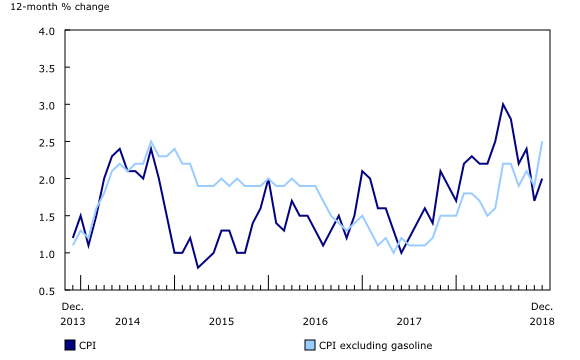
Canadian consumer price inflation was 2.0% y/y in December, up a bit from November's 1.7% pace. Markets were looking for a repeat of November's 1.7% pace. On a seasonally-adjusted basis, prices were up 0.2% month-on-month.
Much of the acceleration can be put down to the transportation category, with a rebound of airfares over the holiday season the primary driver. In contrast, the energy sub-index was down 3.7% y/y on falling gasoline prices.
With energy prices holding back goods price growth (up just 0.2% y/y in December), it was service sector price growth that led the overall rise, up 3.5% year-on-year. This was the strongest gain in services since 2008, reflecting not only the aforementioned rise in airfares, but also higher telephone service costs (remember that December 2017 saw industry sales that drove down prices at that time). Statistics Canada also noted travel tours (+6.6%) and vehicle insurance premiums (+5.1%) as factors in the climb.
The Bank of Canada's preferred measures of core inflation were flat in December. CPI-common and CPI-trim remained at 1.9% year-on-year, while CPI-median held at (a downwardly revised) 1.8%.
Key Implications
Put it down to holiday travel. Markets were expecting an effectively unchanged inflation reading, but a surge in airfares led headline inflation higher in December despite a continued drag from energy prices. Some caution is needed before we get too excited, with Statistics Canada reminding us that a methodology change in the airfares category in early 2018 means we should remain cautious on year-on-year comparisons.
Indeed, despite the upside surprise to headline inflation, core measures continued their 2018 theme of slow and steady. These may be somewhat backwards-looking indicators, but the message remains clear: there are few signs of fundamental inflationary pressure at the moment.
The bigger story for the Bank of Canada right now is the impact of oil prices, which are still holding headline inflation back. The impact of production shut-ins, which have boosted heavy oil prices, will be slower real growth this quarter and heightened uncertainty. Their bias towards further interest rate hikes remains, but wait and see looks to be the Bank's guiding principle for the near future. With inflation tame, there appears to be little harm in this approach.
USD/CAD Mid-Day Outlook
Daily Pivots: (S1) 1.3245; (P) 1.3283; (R1) 1.3317; More...
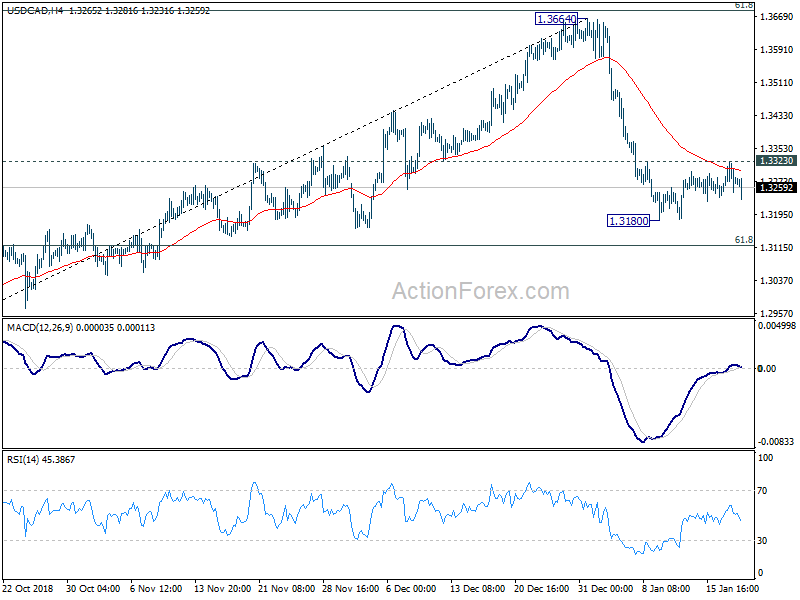
USD/CAD dips notably today but stays above 1.3180 temporary low. Intraday bias remains neutral first. With 1.3323 resistance intact, further decline is expected. On the downside, break of 1.3180 will resume the fall from 1.3664 and target 61.8% retracement of 1.2781 to 1.3664 at 1.3118. We'll start to look for bottoming sign below there. On the upside, above 1.3323 will suggest short term bottoming and turn bias back to the upside for stronger rebound.
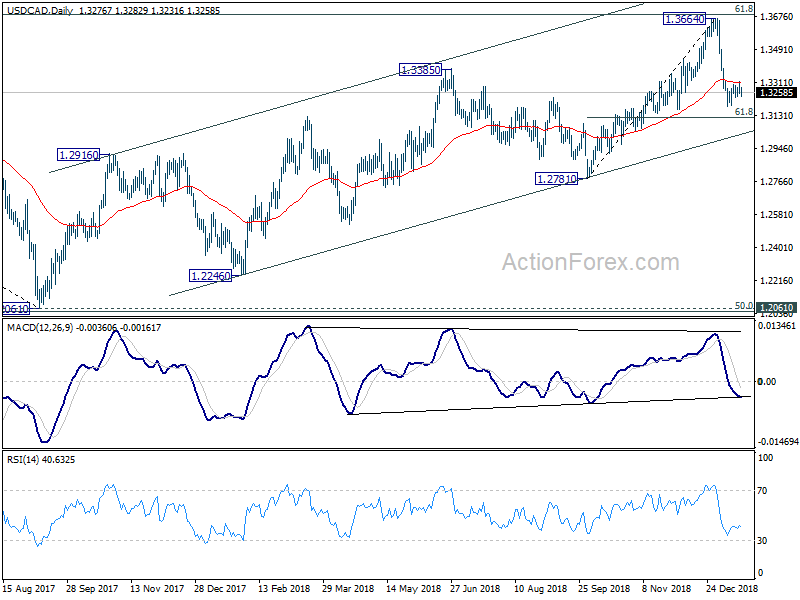
In the bigger picture, the medium term rise from 1.2061 (2017 low) might continue further. But the structure of such rise is not clearly impulsive so far. Hence, we'd stay cautious on strong resistance from 61.8% retracement of 1.4689 (2016 high) to 1.2061 at 1.3685 and 1.3793 resistance to limit upside, and bring medium term topping. But in any case, medium term outlook will stay bullish as long as channel support (now at 1.2993) holds. Sustained break of 1.3793 will pave the way to retest 1.4689 (2015 high).
Canadian Dollar Jumps on CPI and Oil, Sterling Pares Gain after Weak Retail Sales
Canadian Dollar strengthens mildly in early US session and is trading as the strongest one for today so far. Recovery in oil price has been supporting the Loonie through the day. And, further lift is given by stronger than expected CPI reading. Euro is following as the second strongest, partly thanks to recovery in EUR/GBP.
Meanwhile, Sterling is paring some of this week's Brexit chaos gains, also pressured by way worse than expected retail sales. Yen is the second weakest on return of risk appetite, on optimism on a US-China trade deal. For the week, Sterling remains the strongest one, followed by Canadian and then Dollar. Swiss Franc is the weakest, followed by Kiwi and then Yen.
Technically, a focus before weekly close is on 1.3180 temporary low in USD/CAD. Break will resume the decline from 1.3664 to 1.3118 fibonacci level. 0.9963 in USD/CHF and 1.1340 and EUR/CHF will also be watch for confirming near term bullish reversals in the pairs. DOW futures point to another day of rally in US stocks. That could push Yen crosses higher too.
In other markets, FTSE is currently up 1.76%. DAX is up 2.05%. CAC is up 1.65%. German 10 year yield is up 0.0148 at 0.26. Earlier in Asian, Nikkei rose 1.29%. Hong Kong HSI rose 1.25%. China Shanghai SSE rose 1.42%. Singapore Strait Times rose 0.31%. Japan 10 year JGB yield rose 0.0019 to 0.013.
Canadian Dollar rises mildly after stronger than expected CPI data.
Headline CPI dropped -0.1% mom in December versus expectation of -0.3%. Annually, CPI accelerated to 2.0% yoy, up from 1.7% yoy and beat expectation of 1.8% yoy.
Core CPI readings were steady. CPI core-common was unchanged at 1.9% yoy. CPI core-median dropped from 1.9% yoy to 1.8% yoy. CPI core-trimmed was unchanged at 1.9% yoy.
Sterling dips after poor December UK retail sales
Sterling weakens notably after rather poor December UK retail sales data. Retail sales including auto fuel dropped -0.9% mom versus expectation of -0.7%. Retail sales excluding auto fuel dropped -1.3% mom versus expectation of -0.5% mom. Also, for the three months to December, compared with the previous three months, retail sales including auto fuel dropped -0.2%. Retail sales excluding auto fuel dropped -0.4%
Also released in European session, Eurozone current account surplus narrowed to EUR 20.3B in November. Swiss PPI slowed to 0.4% yoy in December.
EU: UK will still need to elect MEP if it leaves after July 2
European Commission spokesman Margaritis Schinas once again told a regular news briefing that there is no request for Article 50 extension from the UK yet. But he pointed out that if the UK is going to leave after July 2, Britons will need to elect their representatives to the next European Parliament.
He said, "We ... as the guardian of EU treaties, suggest caution with any suggestion that the right of EU citizens to vote in the European Parliament elections, according to the rules that are applicable, could be called into question".
And, "we have a legally composed European Parliament which requires directly elected MEPs from all member states at the latest on the first day of the new term of the new parliament, which this time is the second of July."
European Commission publishes draft trade negotiating mandates with the US
European Commission publishes draft negotiating mandates with the US today. The negotiating directives cover two potential agreements with the U.S:
- A trade agreement strictly focused on the removal of tariffs on industrial goods, excluding agricultural products;
- A second agreement, on conformity assessment, that would help address the objective of removing non-tariff barriers, by making it easier for companies to prove their products meet technical requirements on both sides of the Atlantic.
EU Commissioner for Trade Cecilia Malmström said in the statement: "Today's publication of our draft negotiating directives is part of the implementation of the July joint statement of Presidents Juncker and Trump. Ambassador Lighthizer and I have already met several times in the Executive Working Group and I have made it very clear that the EU is committed to upholding its side of the agreement reached by the two Presidents. These two proposed negotiating directives will enable the Commission to work on removing tariffs and non-tariff barriers to transatlantic trade in industrial goods, key goals of the July Joint Statement."
In a press conference, Malmström added "We are prepared to put our vehicles tariffs on the negotiating table (..) if the U.S. agree to work together toward zero tariffs on industrial goods." But still, EU was ready to retaliate if the U.S. imposed car import tariffs.
Germany and China signed pacts to deepen financial sector cooperation
Germany and China pledged to deepening cooperation in the finance sector and fight trade protectionism during Finance Minister Olaf Scholz's two-day visit to Beijing. And three pacts are signed, including agreements with the China Banking and Insurance Regulatory Commission and China's Securities Regulatory Commission.
Ahead of today's meeting with Chinese Vice Premier Liu He, Scholz said "it is important that, contrary to recent trends that we can observe elsewhere, we are seeing progress in our cooperation". And, "we have a lot of common interests in financial matters, and then we need to bring different perspectives together. I believe that is the very important task of this financial dialogue."
Japan core CPI slowed more than expected to 0.7% in Dec
In December, Japan all item CPI slowed to 0.3% yoy, down from 0.8% yoy and matched expectation. Core CPI, all item ex-fresh food, slowed to 0.7% yoy, down from 0.9% yoy and missed expectation of 0.8% yoy. Core-core CPI, al item ex-fresh food, energy, stayed unchanged at 0.3% yoy.
The data showed that even discounting the fall in energy prices, consumer inflation stayed week. And apparently, the recovery is not passed on to consumers. And business remained reluctant to raise prices.
The data added to the case for BoJ to cut inflation forecasts next week. Back in October, BoJ projects core CPI to hit 1.4% in fiscal 2019 and then 1.5% in fiscal 2020. Such projections would be trimmed to reflect the decline in oil as well as global slowdown.
USD/CAD Mid-Day Outlook
Daily Pivots: (S1) 1.3245; (P) 1.3283; (R1) 1.3317; More...
USD/CAD dips notably today but stays above 1.3180 temporary low. Intraday bias remains neutral first. With 1.3323 resistance intact, further decline is expected. On the downside, break of 1.3180 will resume the fall from 1.3664 and target 61.8% retracement of 1.2781 to 1.3664 at 1.3118. We'll start to look for bottoming sign below there. On the upside, above 1.3323 will suggest short term bottoming and turn bias back to the upside for stronger rebound.
In the bigger picture, the medium term rise from 1.2061 (2017 low) might continue further. But the structure of such rise is not clearly impulsive so far. Hence, we'd stay cautious on strong resistance from 61.8% retracement of 1.4689 (2016 high) to 1.2061 at 1.3685 and 1.3793 resistance to limit upside, and bring medium term topping. But in any case, medium term outlook will stay bullish as long as channel support (now at 1.2993) holds. Sustained break of 1.3793 will pave the way to retest 1.4689 (2015 high).
Economic Indicators Update
| GMT | Ccy | Events | Actual | Forecast | Previous | Revised |
|---|---|---|---|---|---|---|
| 21:30 | NZD | BusinessNZ Manufacturing PMI Dec | 55.1 | 53.5 | 53.7 | |
| 23:30 | JPY | National CPI Core Y/Y Dec | 0.70% | 0.80% | 0.90% | |
| 04:30 | JPY | Industrial Production M/M Nov F | -1.00% | -1.10% | -1.10% | |
| 07:30 | CHF | Producer & Import Prices M/M Dec | -0.60% | -0.20% | -0.30% | |
| 07:30 | CHF | Producer & Import Prices Y/Y Dec | 0.60% | 1.40% | ||
| 09:00 | EUR | Eurozone Current Account (EUR) Nov | 20.3B | 24.1B | 23.0B | 26.8B |
| 09:30 | GBP | Retail Sales Ex Auto Fuel M/M Dec | -1.30% | -0.50% | 1.20% | 1.00% |
| 09:30 | GBP | Retail Sales Ex Auto Fuel Y/Y Dec | 2.60% | 4.00% | 3.80% | 3.50% |
| 09:30 | GBP | Retail Sales Inc Auto Fuel M/M Dec | -0.90% | -0.70% | 1.40% | 1.30% |
| 09:30 | GBP | Retail Sales Inc Auto Fuel Y/Y Dec | 3.00% | 3.50% | 3.60% | 3.40% |
| 13:30 | CAD | International Securities Transactions (CAD) Nov | 9.45B | 2.05B | 3.98B | 3.97B |
| 13:30 | CAD | CPI M/M Dec | -0.10% | -0.30% | -0.40% | |
| 13:30 | CAD | CPI Y/Y Dec | 2.00% | 1.80% | 1.70% | |
| 13:30 | CAD | CPI Core - Common Y/Y Dec | 1.90% | 1.80% | 1.90% | |
| 13:30 | CAD | CPI Core - Median Y/Y Dec | 1.80% | 1.90% | 1.90% | |
| 13:30 | CAD | CPI Core - Trimmed Y/Y Dec | 1.90% | 1.80% | 1.90% | |
| 14:15 | USD | Industrial Production M/M Dec | 0.20% | 0.60% | ||
| 14:15 | USD | Capacity Utilization Dec | 78.40% | 78.50% | ||
| 15:00 | USD | U. of Mich. Sentiment Jan P | 96.1 | 98.3 |
Canadian Dollar rises mildly after stronger than expected CPI data.
Headline CPI dropped -0.1% mom in December versus expectation of -0.3%. Annually, CPI accelerated to 2.0% yoy, up from 1.7% yoy and beat expectation of 1.8% yoy.
Core CPI readings were steady. CPI core-common was unchanged at 1.9% yoy. CPI core-median dropped from 1.9% yoy to 1.8% yoy. CPI core-trimmed was unchanged at 1.9% yoy.
EU: UK will still need to elect MEP if it leaves after July 2
European Commission spokesman Margaritis Schinas once again told a regular news briefing that there is no request for Article 50 extension from the UK yet. But he pointed out that if the UK is going to leave after July 2, Britons will need to elect their representatives to the next European Parliament.
He said, "We ... as the guardian of EU treaties, suggest caution with any suggestion that the right of EU citizens to vote in the European Parliament elections, according to the rules that are applicable, could be called into question".
And, "we have a legally composed European Parliament which requires directly elected MEPs from all member states at the latest on the first day of the new term of the new parliament, which this time is the second of July."
Canadian Dollar Steady ahead of CPI
USD/CAD has posted small gains in the Friday session, recovering the losses from Thursday. Currently, the pair is trading at 1.3265, down 0.12% on the day. On the release front, Canada releases CPI, which is expected to post its third decline of 0.4% in the past four months. In the U.S., today’s key event is UoM Consumer Sentiment. The indicator has slowed over the past three months, and the downward trend is expected to continue, with an estimate of 97.0 points.
Risk appetite remains steady, which has been good news for the Canadian dollar. The currency has sparkled in January, posting gains of 2.7 percent. The U.S-China trade war, which is one of the biggest threats to the global economy, has triggered a slowdown of the Chinese economy, and there are concerns that U.S growth will slow if the sides don’t resolve the conflict. Senior Chinese and U.S. officials are meeting for another round of trade talks on January 30, and investors remain hopeful that the U.S will not impose new tariffs on March 1.
The U.S. government shutdown has meant that the flow of economic data has been reduced. This has magnified the importance of the Beige Book, which was released on Wednesday. The report found that businesses across the country had become less optimistic, due to higher interest rates, swings in the financial markets and global trade tensions. At the same time, most of the regional Feds said that growth in their region was “modest to moderate”. The report reiterates the recent dovish stance we are seeing from the Federal Reserve, which has sent strong signals to the markets that rate hikes could be on hold for the near future.
Market Sentiment Lifted by Renewed Trade Optimism
It was a week defined by Brexit drama, US-China trade developments and ongoing political uncertainty in Washington.
Renewed optimism over US-China trade talks stimulated global risk sentiment on Friday with Asian stocks ending mostly higher. Although European markets are benefiting from the improved market mood, investors must remain alert and guarded. Geopolitical risks in the form of Brexit uncertainties, a partial government shutdown in the United States and the unpredictable nature of trade negotiations have left market sentiment fragile. With concerns over slowing global growth adding to the cocktail of fundamental themes impacting risk appetite, stock markets remain vulnerable to downside shocks.
Sterling was the main talking point across currency markets after aggressively appreciating yesterday evening. The sharp gains were attributed to growing expectations over the UK avoiding a nightmare no-deal outcome with the European Union. Appetite towards the currency was boosted further by speculation of a second referendum. Investors who were expecting the Pound to extend gains today were left empty-handed after the currency weakened across the board. With uncertainty clearly a major theme obstructing the Pound’s upside potential, the medium- to longer-term outlook remains in favour of bears. In regards to the technical picture, the GBPUSD is seen trading back down towards 1.2820 if sellers are able to secure a weekly close below 1.2920.
It was a relatively muted week for Gold, with bears eventually making an appearance on Friday afternoon. At $1,285 at the time of writing, bullion is enroute to concluding the trading week negative – breaking four consecutive weeks of gain.
The sentiment pendulum for Gold swung back and forth this week due to reports surrounding Brexit and US-China trade tensions. Within 24 hours, UK Prime Minister Theresa May went from having her Brexit plan dealt with a resounding loss, to winning a no-confidence vote. China started the week on a downer by announcing its worst trade decline since October 2016. Heading into Friday, optimism resurfaced on news that US Treasury Secretary Steven Mnuchin may dial back some tariffs on China.
Safe haven assets, including bullion, may see resistance if global risks become less pronounced by way of substantial positive developments on Brexit and US-China trade talks.
WTI futures dipped at the start of the week, before climbing back above $52/bbl at time of writing. Oil is on course for three consecutive weeks of gains.
Saudi Arabia got a head start on its supply cuts in December, ahead of the OPEC+ deal that went into effect this month. With Russia also pledging to reduce production at a faster pace, efforts to support oil prices appear to be gathering traction, despite the record crude output out of the US. Set against a slower economic growth backdrop for 2019, oil’s return to a bull market will be tested should global demand falter.
EURGBP Pares Some Losses after Strong Sell Off in Near Term
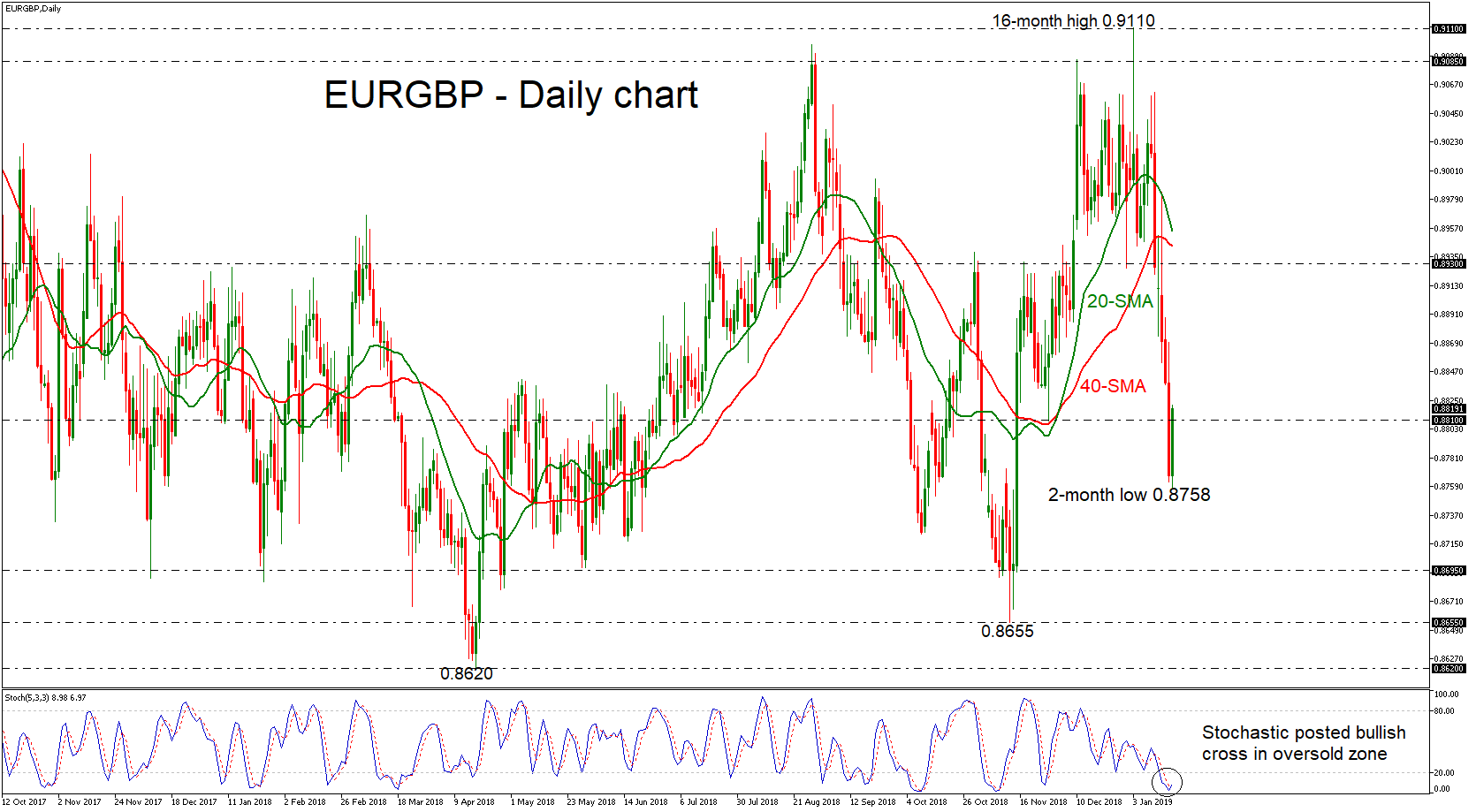
EURGBP has been erasing the strong bearish rally that was created the previous six consecutive days, sending prices towards a new two-month trough of 0.8758. The stochastic oscillator is suggesting a positive retracement as the %K line jumped above the %D line creating a bullish crossover in the daily timeframe.
An upside rally in the pair and a successful close above the 0.8810 barrier may retest the 0.8930 resistance barrier. Even higher, the price could test the 40- and then the 20-simple moving averages (SMAs) around 0.8940 and 0.8955 respectively.
Alternatively, a decline again in the price may retest the 0.8695 support level, taken from the low on May 29. More downside pressure could send the market until the 0.8655 region, identified by the bottom on November 13.
Concluding, in the bigger view, EURGBP has been trading in a consolidation area over the last 16 months.