Sample Category Title
Gold Could Move Above $1300 Soon
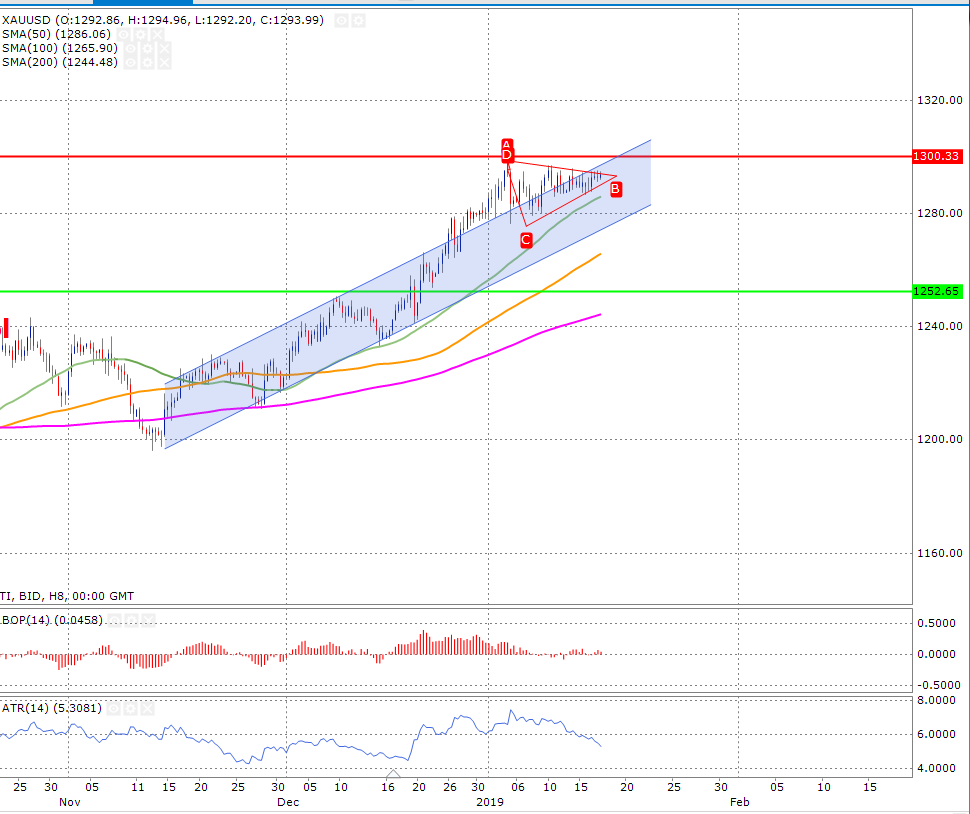
The yellow metal is clearly trading in strong uptrend on a 8-hour time frame. The confirmation of this comes from the fact that the price is trading above the 50, 100 and 200-day moving averages (shown in green, orange and pink respectively). The bull strength can be measured from the fact that the price has broken out of the upward channel to the upside and now it is testing the 50-day moving average which could become the first support.
The most interesting part is that the price has formed a symmetrical triangle pattern and this shows that the capitulation is about to happen because the price has started to trade in a short range. The symmetrical triangle patterns usually break in the direction of the current trend and by this what I mean is that the price is likely to move to the upside. The steel drop in the ATR is also a confirmation of this that the price is likely to come out of its current range of 1280- 1300.
The balance of power shows that the bulls have still some strong of the price but the momentum isn’t that strong.
The support zone is shown by the green horizontal solid line and the resistance zone is shown by the red horizontal solid line.
Stocks Move Lower | What Is May’s ‘Plan B’
European markets and US futures are trading lower as investors focus on the rising tension between the US-China trade talks and investors are largely concerned about the earning season despite the fact that Goldman Sachs printed a blowout number yesterday. Investors are paying attention to the ongoing investigation by the US about Huawei technologies for stealing their trade secrets. This isn’t going to break the deadlock which are currently facing on trade talk. Generally speaking, risk assets have performed well so far this month because if you look at the overall progress of the major indices, all of them are holding on to some strong gains.
Closer to home, we have seen another surprise in British politics, Theresa May survived a vote of no confidence in the parliament yesterday. The prime minister has a strong come back after a string of brutal losses and the fact is that her victory shows that the opposition party isn’t strong enough to take the control.
Perhaps, it is more down to their non friendly market policies. For now, the question of general election is pushed back into the box. Her victory has sent a strong signal in the parliament and she has invited the opposition leaders to come work with her and break the deadlock. The general feeling is that her recent victory will be able to get her across the line and somehow MPs will show their support for her upcoming variant version of Brexit deal.
Moving on from here, traders are going to keep a close eye on the possibility of every scenario taking place. The first one among of them will be the extension of the Article 50 so that the government has enough time to strike a divorce deal before the Brexit date. No one wants to have a disorderly Brexit. The extension can only be agreed by the EU if they see that Theresa May will be able to secure enough votes (321) so that she can win the majority in the House of Commons.
The most exciting move that we have seen on the back of this is in the Euro-Sterling pair. The pair touched a level which we have not since December and the move towards the 0.88 looks solid for now. Sterling’s strength is clearly picking up momentum. The Sterling-dollar pair also made another higher since she lost the Brexit vote and the fact is that as long as the support of 1.2668 remains intact, it is likely that the path of the least resistance is skewed to the upside. Investors also need to be mindful about the current trading range of 1.2668 to 1.2930 and only a break of this would establish another trend.
NZDUSD Selling Interest In Progress, Hits One-Week Low
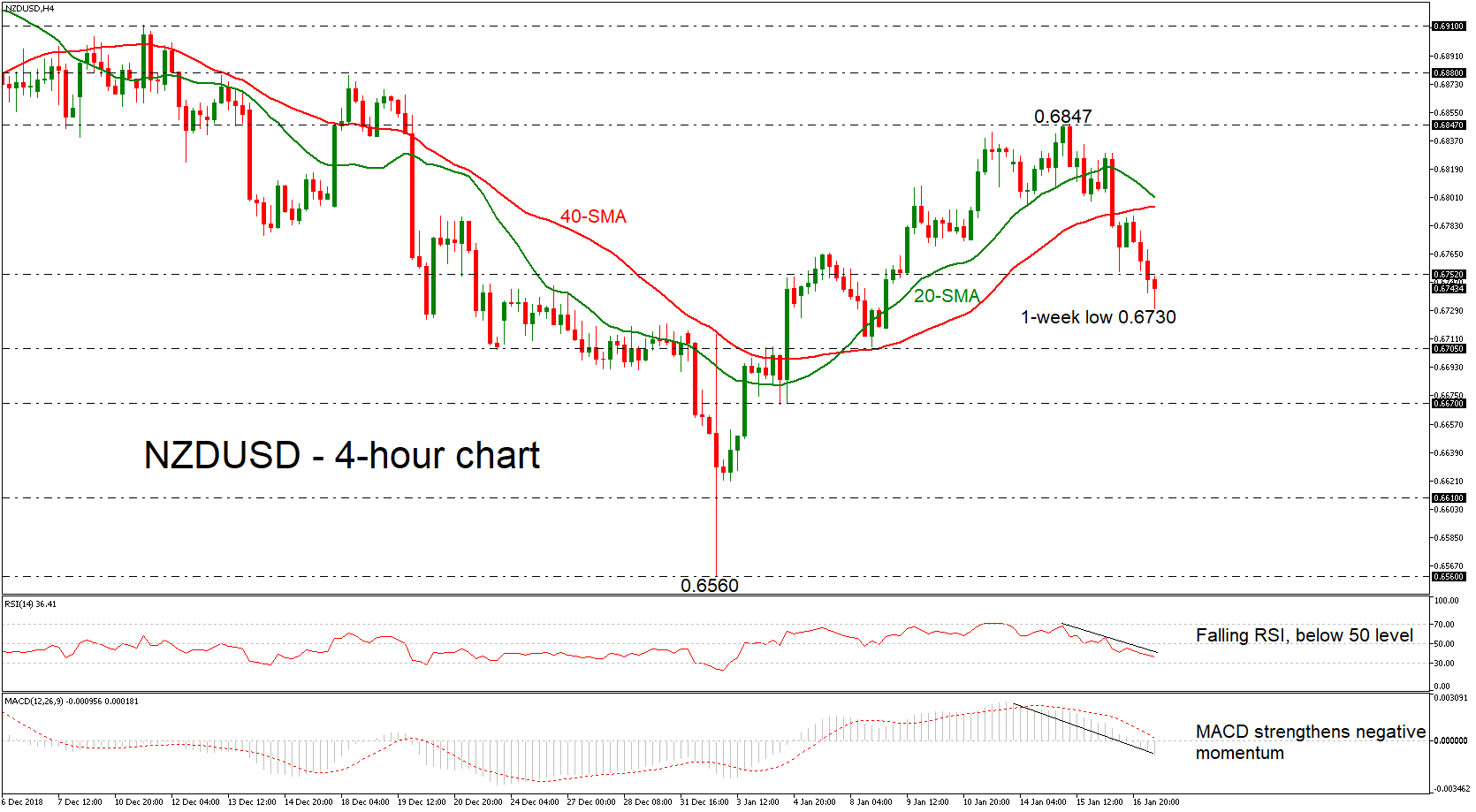
NZDUSD is continuing this week's sell off with strong momentum, reaching a one-week low around 0.6730 and at the same time confirming the start of a bearish movement. The short-term bias looks negative as the MACD keeps losing ground below its red trigger line, while the RSI seems to be making its way down beneath its 50 neutral mark, moving towards the oversold territory.
The 0.6705 could be a critical level for steeper bearish actions if the pair continues the negative tendency. Also, the 0.6670 could attract some attention, taken from the low on January 4, while a significant leg below this hurdle could open the door for the next support of 0.6610.
However, if the pair reverses back to the upside and rise above 0.6752, investors could make a pause at the 40- and then at the 20-simple moving averages (SMAs) around the 0.6800 handle. If the price continues to extend gains, resistance could come next somewhere near the latest high of 0.6847.
Overall, kiwi/dollar has reversed back to the downside in the 4-hour chart, slipping below the SMAs, which are ready to post a bearish cross in the near future.
Pound Yawns As May Survives, Risk Appetite Shaky
- Theresa May survives the no-confidence vote, but sterling barely advances
- News the US will pursue a criminal case against Huawei are hurting sentiment
- Dollar extends gains versus euro as ECB officials sing a dovish tune
May survives no-confidence vote, but sterling yawns
Theresa May’s government survived the no-confidence motion in the House of Commons yesterday via a 325-306 vote, as was broadly expected. The Prime Minister immediately stated she will reach across the aisle and attempt to find common ground with opposition parties on a way forward; she has to present an alternative EU withdrawal plan to Parliament by Monday. The pound advanced, albeit only marginally, as the result was more or less priced in.
For better or worse, the Brexit process is now back to square one, with different factions of Parliament calling for different approaches – ranging from another referendum to an extension of Article 50 and more negotiations to a no-deal exit. Hence, business as usual in UK politics, but with one exception: there seems to be a clear majority of lawmakers opposing a no-deal, disorderly exit. As such, while it may take a while to get Brexit clarity, the worst-case scenario for the pound seems to be getting less and less probable as Parliament gets more involved, which may help to keep an implicit “floor” under the currency even amid all the uncertainty.
Risk sentiment takes a hit from Huawei-related headlines
Investors’ risk appetite was reined in yesterday by reports that US prosecutors would pursue a criminal case against Huawei for “stealing trade secrets”. US equity markets pared some of their early gains to close the session only marginally higher, with the S&P 500 gaining a mere 0.22%. Meanwhile, futures are pointing to a lower open today, while risk-sensitive currencies like the kiwi are on the back foot.
The latest signals on the trade front have also been less than encouraging, with US Trade Representative Lighthizer reportedly seeing “no progress” on issues such as intellectual property protection last week. Hence, if one excludes the latest dovish shift from Fed and ECB policymakers, the bullish near-term catalysts for equities seem to be running out, leading one to question whether the latest rally can last for much longer uninterrupted. The threat of auto tariffs shouldn’t be discounted either. And while markets have ignored it thus far, the longer the partial US government shutdown lasts, the bigger of a drag it becomes for individuals and businesses; investors won’t remain indifferent forever.
As for today, the earnings season fires up with firms like Netflix and Morgan Stanley releasing their quarterly results.
Dollar continues to capitalize on euro-weakness
The euro continued to underperform the dollar on Wednesday, as more key ECB officials started to shift towards a more dovish stance. The latest was Bank of France Governor Villeroy De Galhau, who echoed the cautious bias of his colleagues, noting that the outlook is clouded by uncertainty. He also said that Eurozone’s growth is merely slowing and that the region is not in a downturn, but admittedly, even the mere reference to a slump doesn’t bode well for sentiment around European assets. The ECB’s Lautenschlager will deliver remarks today, at 1100 GMT.
Meanwhile, the dollar advanced, likely aided by an unexpected uptick in the NAHB housing index, which may have alleviated some concerns around a major slowdown in the US housing sector. Today, attention may fall on the Philly Fed business conditions index, while a speech by the Fed’s Quarles at 1535 GMT will also be in focus.
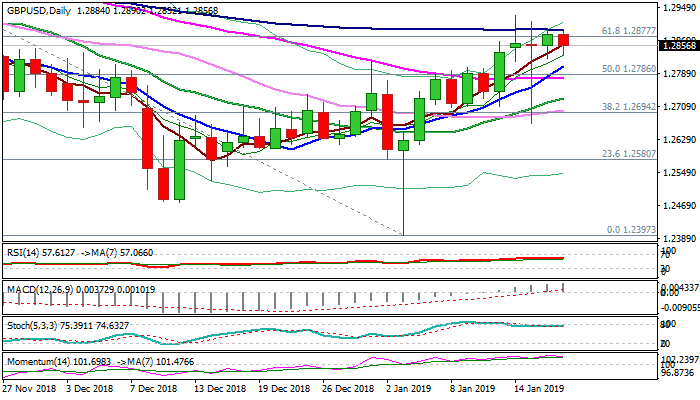
GBP/USD Outlook: Stall Signal On Repeated Rejections At 100SMA, Loss Of 1.2820 Support To Risk Pullback
Cable remains directionless in early Thursday's trading after Tuesday's turbulent action on parliament's rejection of Brexit plan and no significant reaction on Wednesday's no-confidence vote which PM May's government survived.
The action remains capped by sideways-moving 100SMA (1.2893) for the fourth straight day, which provides initial signal of stall, despite break above falling daily cloud.
Weakening bullish momentum on daily chart warns, but flat RSI and slow stochastic maintain neutral mode for now.
Also, bulls are losing traction on weekly chart as falling 30WMA caps, momentum is neutral and slow stochastic in overbought, keeping weekly action so far shaped in long-legged Doji candle.
The pair looks for a catalyst to emerge from current range and generate fresh direction signal.
The floor of congestion at 1.2820 zone marks initial support, loss of which would signal deeper pullback and expose key support at 1.2746 (daily cloud base).
Close below cloud would generate stronger reversal signal.
At the upside, sustained break above 100SMA / 30WMA barriers is needed to generate bullish signal for continuation of recovery.
Res: 1.2893, 1.2930, 1.3000, 1.3108
Sup: 1.2820, 1.2804, 1.2780, 1.2746
Sterling Unchanged As Theresa May Survives Vote Of No Confidence
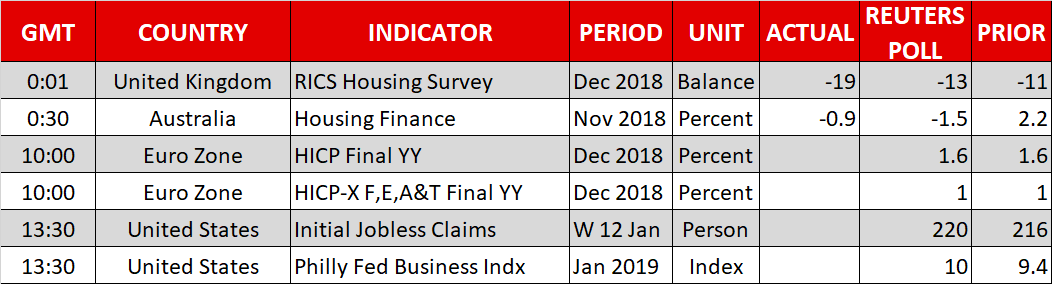
Sterling was little moved after Theresa May survived a vote of no confidence yesterday. The vote was introduced by Labor party leader Jeremy Corbyn. It came a day after her Brexit proposal was rejected by the House of Commons. In a speech after the vote, the premier said that she will work across party lines to prevent the chances of a no-deal Brexit. While there is a long way to go, the vote yesterday was a positive thing for the UK because it reduced the possibility of exiting without a deal. Other than Brexit news, the country also released house price data, which declined by 19% in December. This was the sharpest decline since 2013.
In the United States, the government shutdown extended for the third week and there is a likelihood that it could go on. The shutdown has been caused by a division between the White House and Congress. The White House and Senate have insisted that only a bill with wall funding will be signed. Congressional democrats have rejected this. Yesterday, JP Morgan’s CEO, Jamie Dimon advised the two sides to agree on a bill that will produce a win-win scenario. Under his plan, the White House will get its wall while congressional democrats will get their DACA.
The euro was little moved in overnight trading as investors waited for CPI data from the EU and housing data from the United States. Data from Eurostat is expected to show that CPI in December was unchanged at an annualized rate of 1.9%. On a MoM basis, the CPI is expected to decline by 0.2%. The core CPI is expected to rise by an annualized rate of 1.0%, which will be unchanged from the previous month. In the United States, the building permits for December are expected to reduce to 1.29 million while new home sales are expected to rise to 569K.
EUR/USD
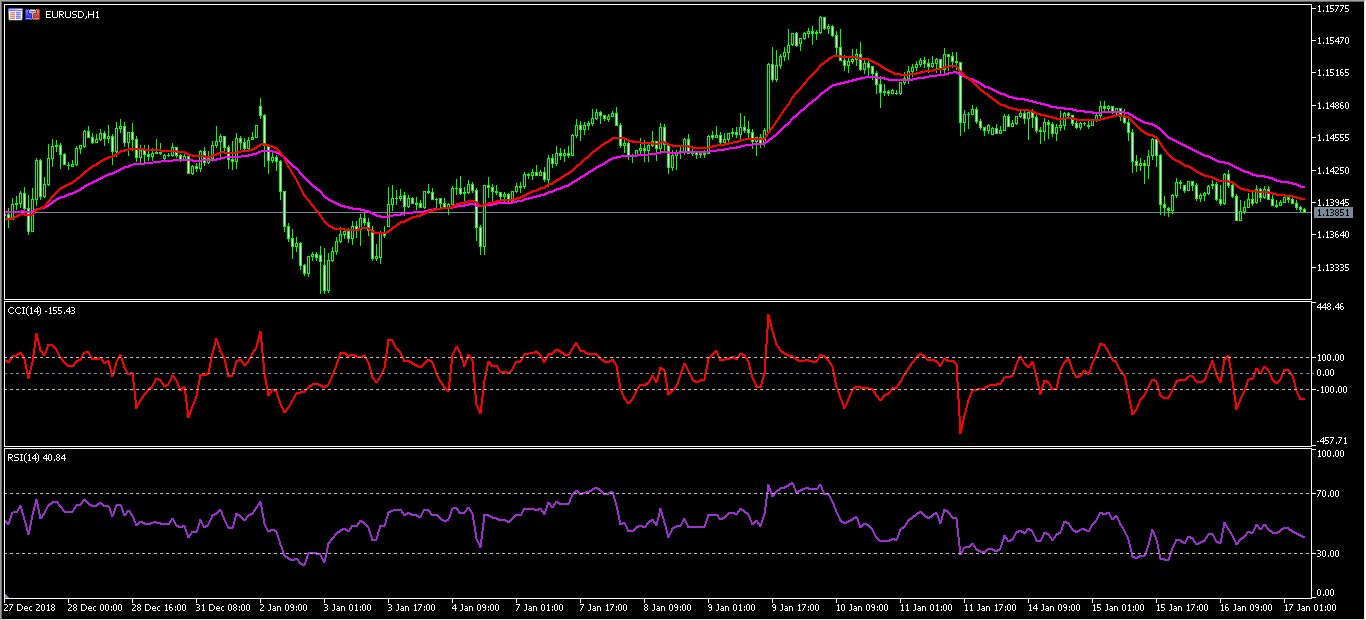
The EUR/USD pair declined slightly to a low of 1.1385. Over the past week, the pair has declined sharply from a high of 1.1570. On the hourly chart, the price is below the 42-day and 21-day exponential moving average while the commodity channel index has declined to the oversold territory. The RSI has remained stable along the mid-40s levels. There is a likelihood that the pair will continue to decline. If it does, investors should look at the important support of 1.1350.
USD/CHF
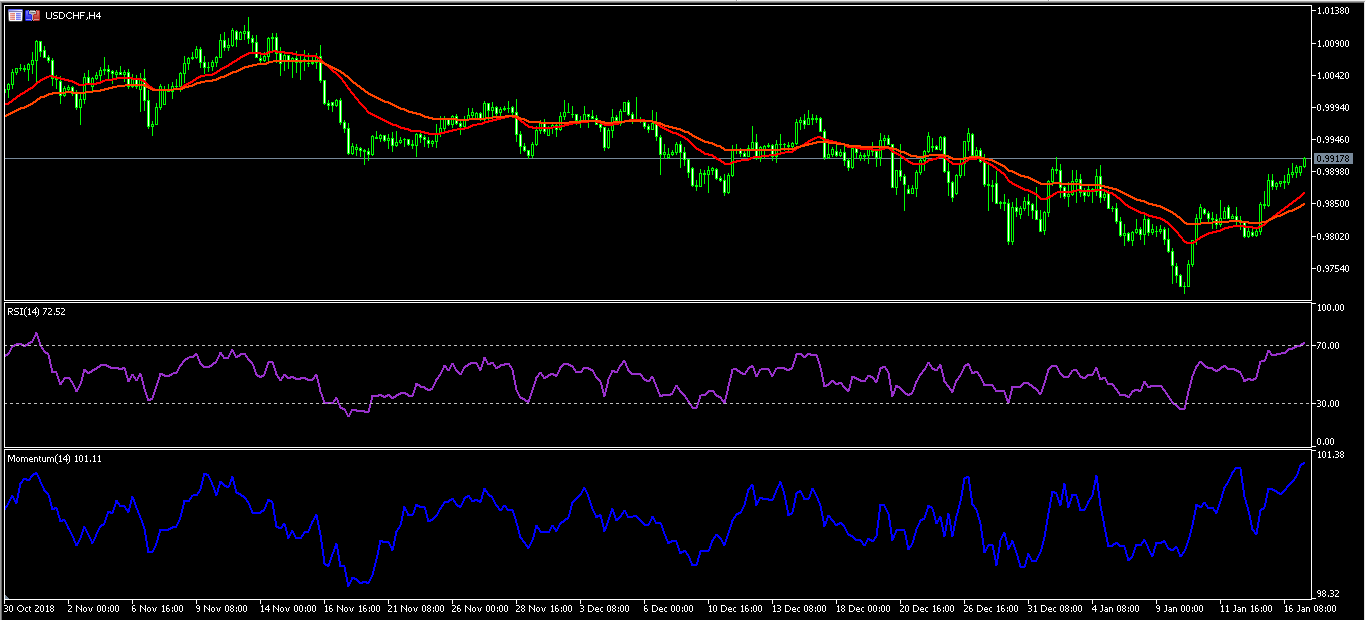
The USD/CHF pair continued to move up as the dollar strengthened. In the past week, the pair has gained sharply, rising from 0.9715 to a high of 0.9920. On the hourly chart, the pair has just crossed an important resistance level and is attempting to reach the parity level of 1. Parity was lastly reached in November last year. On the hourly chart, the pair’s price is above the short and medium-term EMAs while the RSI has moved to above the overbought level. The momentum indicator is also moving higher. There is, therefore, a likelihood that the price will continue moving up.
XPD/USD
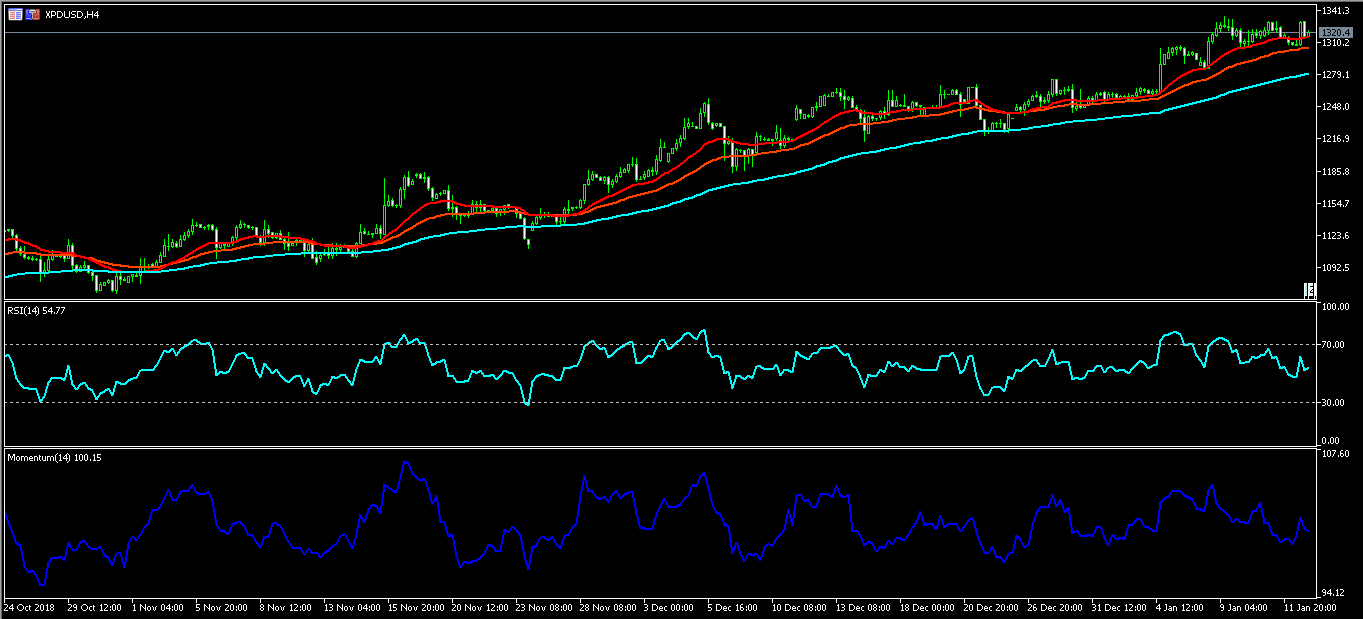
The price of palladium remains at multi-year highs as emission standards rise around the world. The XPD/USD pair is trading at 1320, which is slightly lower than the high of 1335. On the four-hour chart, the price is above the short and long-term moving averages as shown below. The RSI has moved slightly lower from the previous highs of 80 to the current 70. With the momentum indicator falling, there is a possibility that the price will ease a bit as traders take profit.
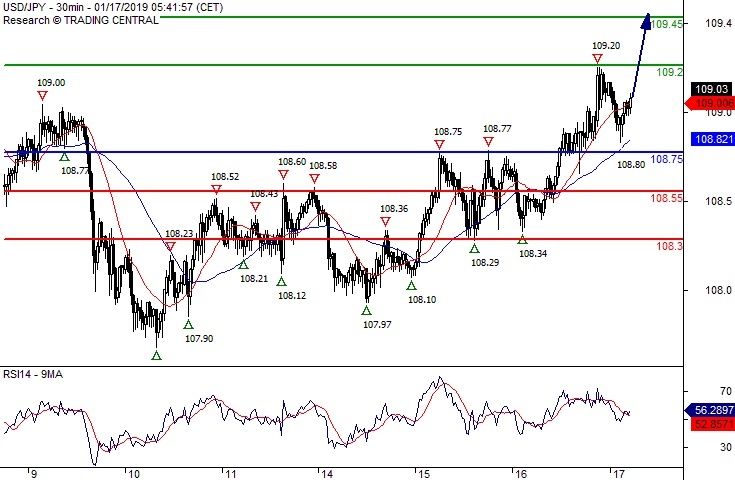
USD/JPY The Upside Prevails
Pivot (invalidation): 108.75
Our preference Long positions above 108.75 with targets at 109.20 & 109.45 in extension.
Alternative scenario Below 108.75 look for further downside with 108.55 & 108.30 as targets.
Comment The RSI lacks downward momentum.
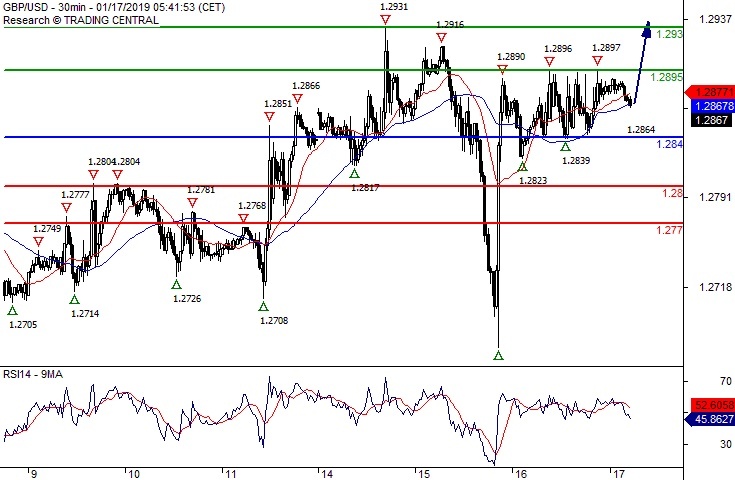
GBP/USD The Bias Remains Bullish
Pivot (invalidation): 1.2840
Our preference Long positions above 1.2840 with targets at 1.2895 & 1.2930 in extension.
Alternative scenario Below 1.2840 look for further downside with 1.2800 & 1.2770 as targets.
Comment A support base at 1.2840 has formed and has allowed for a temporary stabilisation.
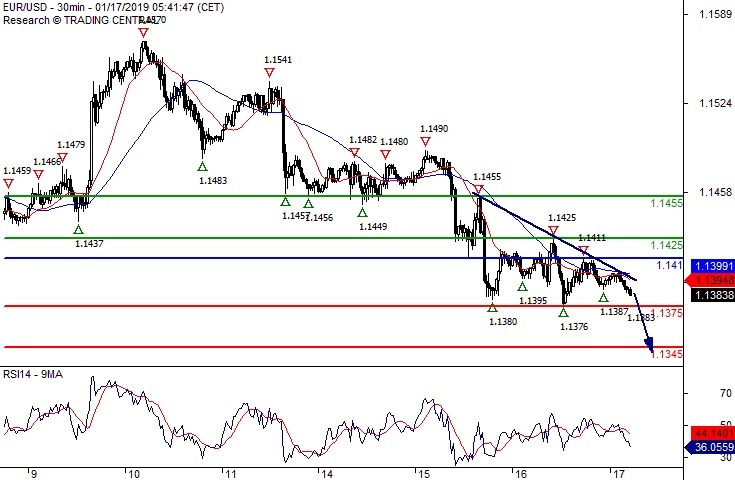
EUR/USD Capped By A Negative Trend Line
Pivot (invalidation): 1.1410
Our preference Short positions below 1.1410 with targets at 1.1375 & 1.1345 in extension.
Alternative scenario Above 1.1410 look for further upside with 1.1425 & 1.1455 as targets.
Comment A break below 1.1375 would trigger a drop towards 1.1345.
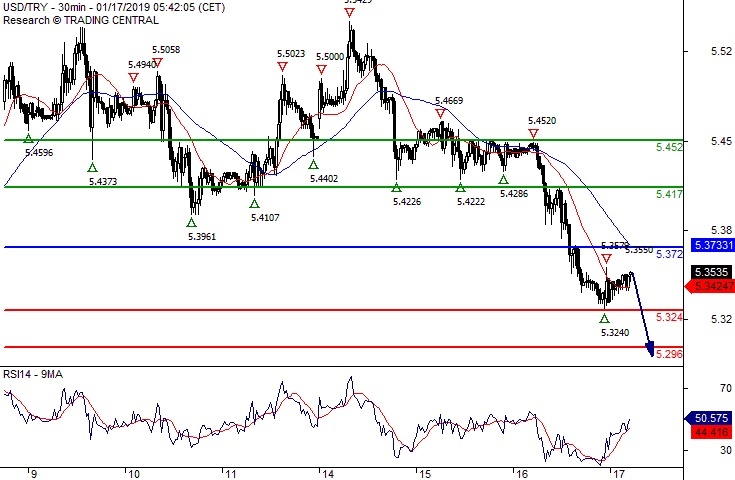
USD/TRY Key Resistance At 5.3720
Pivot (invalidation): 5.3720
Our preference Short positions below 5.3720 with targets at 5.3240 & 5.2960 in extension.
Alternative scenario Above 5.3720 look for further upside with 5.4170 & 5.4520 as targets.
Comment Even though a continuation of the technical rebound cannot be ruled out, its extent should be limited.