Sample Category Title
UK Brexit Minister Barclay: No deal Brexit likely if MPs reject the deal
UK Brexit Minister Stephen Barclay warned that "no deal will be far more likely if MPs reject the PM's Brexit deal later this month." And, he urged fellow MPs to "put the national interest first and vote for this deal so we can get on with delivering Brexit and building the UK's prosperous future as an outward-looking global trading nation, outside the EU." And he also emphasized that people "people did not vote for the disruption and uncertainty of no deal."
Foreign Minister Jeremy Hunt also said "there will be some tough negotiations to follow in the years ahead but I think getting this clearer language on the backstop will help to get it through Parliament." And, there will be "devastating social consequences" if a second EU referendum was triggered.
GBP/USD Bearish Reversal Drops 400 Pips In Hours
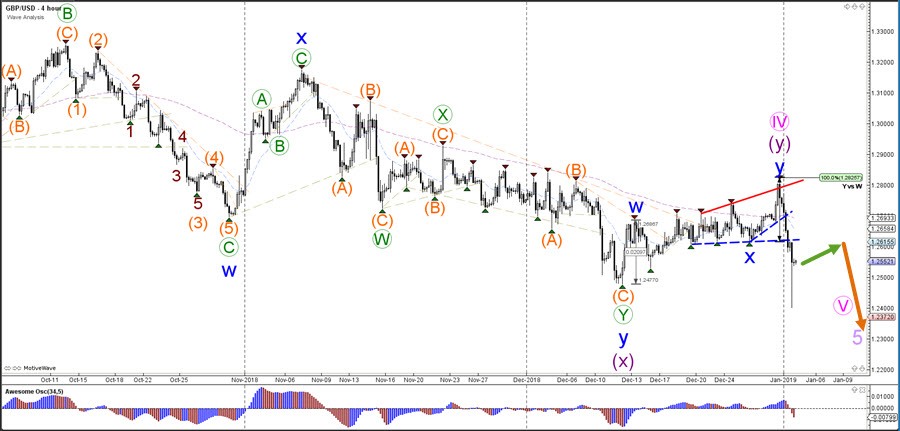
The GBP/USD completed a complex corrective WXY (blue/purple) wave pattern within wave 4 (pink). The current bearish price action is probably part of a wave 5 (pink) of wave 5 (purple). A new low is expected after a consolidation pattern appears.
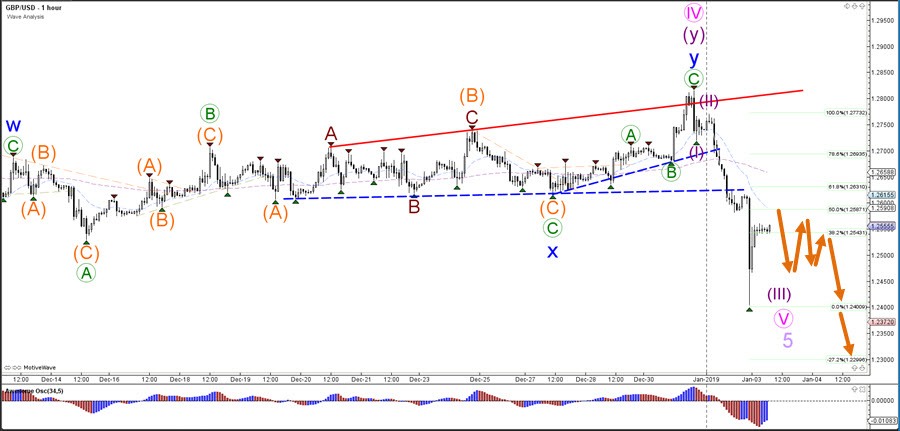
The GBP/USD is expected to respect the 38.2-50-61.8% Fibonacci retracement levels for a bearish bounce and bearish continuation. Keep in mind though that price could make an extended sideways pattern in this spot. Price could go flat and build a triangle chart pattern for instance. Eventually a bearish breakout is expected which should aim for the -27.2% Fibonacci target at the very minimum.
AUDJPY Dives Near Decade Lows, Bias Still Negative
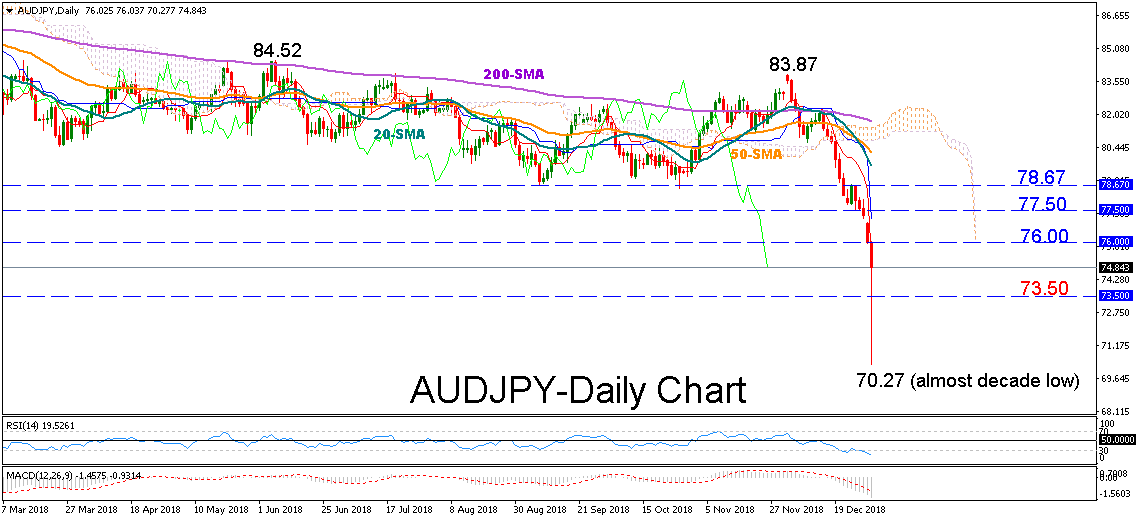
AUDJPY came under sharp sell-off on Thursday, diving towards 70.27 for the first time in more than nine years. With the RSI fluctuating in oversold area below 30, a rebound is likely in the short term. Yet the falling MACD which trends under its red signal line suggests that downside pressures may dominate.
An upside extension could pause near 0.76 which could be of psychological importance, while even higher the 0.7750 level could halt upside forces as it did last week. If the bulls overcome the latter too, a stronger barrier is expected to appear around 78.67, identified by the lows on September 7.
On the other hand, if weakness persists, the pair would likely retest support between 73.50 and 0.72 before hitting the 70.27 bottom. Under that trough, the way could open towards the 67.00 area last visited in 2009.
In the bigger picture, today’s freefall turned the outlook increasingly bearish, with the negatively sloped moving averages signaling that the bear market could stay in place for longer.
Yen Spike Triggers ‘Flash Crash’ As Growth Fears Intensify
- Yen soars after Apple profit warning sends jitters across FX markets
- Aussie plunges to multi-year lows versus the dollar and yen
- Oil back down after sharp gains the previous day
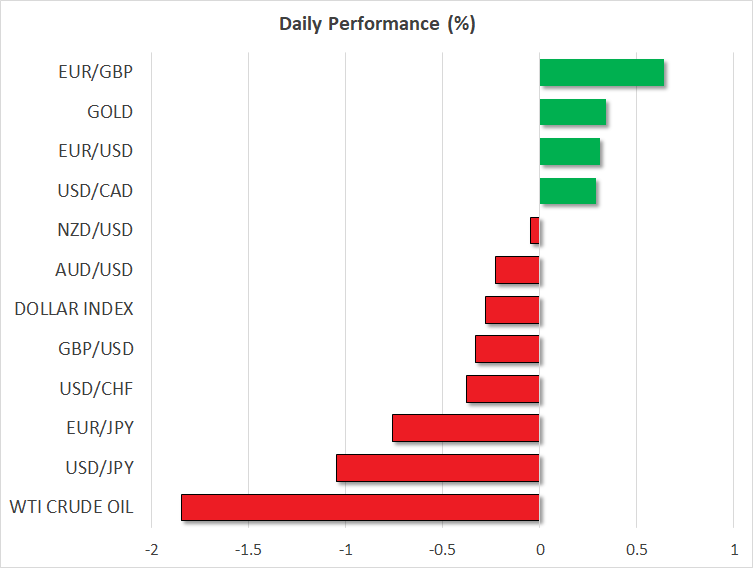
Volatility sweeps financial markets
Currency markets had a volatile start to the new year as risk sentiment took another turn for the worse in the first two days of trading of 2019. The Japanese yen soared across the board as investors fled to safety on heightened concerns about the global growth outlook for the coming year. The surge in the safe-haven yen came after tech giant, Apple Inc., cut its revenue guidance for the first quarter on weakening sales to China. The shock profit warning sent Apple shares down by about 8% in after hours trading and added to existing worries about the strength of China's economy.
The yen immediately jumped on the news, triggering stop-losses and causing a 'flash crash' in all major yen crosses. The dollar plummeted to a 9-month low of 104.96 against the yen but against other currencies, the greenback was only marginally weaker, with the dollar index easing by 0.2% to 96.60 at the start of European trading after rallying strongly the previous day.
Risk barometer Aussie underperforms
The Australian dollar, which was already under pressure from poor Chinese manufacturing PMI prints this week, slumped to a 10-year low of 0.6742 versus the US dollar, while against the yen, it fell to 73.07 – its lowest since October 2011. The aussie is sensitive to sentiment towards China and broader market risk appetite and the latest slide reflects the growing pessimism in financial markets about the global growth picture for 2019.
The euro also slid on Wednesday on disappointing manufacturing PMIs out of the Eurozone. The single currency dipped back below the $1.14 level but was slightly firmer on Thursday. The pound, however, was unable to find much positives from yesterday's stronger-than-expected UK manufacturing PMI and rising Brexit uncertainty pushed the currency to a near 21-month low of $1.2436 earlier today.
US stock futures deep in red after Apple warning
Risk sentiment is unlikely to recover later in the day as US stock futures are pointing to losses of around 1.5% for the Dow Jones and the S&P 500 when US trading opens, while the tech-heavy Nasdaq is poised to start the day 2.5% lower following Apple's revenue guidance downgrade.
Equities markets will probably not be able to get any boost either from the energy sector, which yesterday was lifted from a 2% jump in oil prices. A modest improvement in risk appetite helped oil prices to briefly turn higher yesterday, taking a lead from US stocks, but were back down today in line with the broader market mood. WTI was last trading 2.1% lower at $45.52, while Brent crude was off by 1.4% at $54.15 a barrel.
In other commodities, gold extended its gains to a fresh 6½-month high of $1292.32 an ounce on strong safe-haven demand.
US ISM manufacturing PMI coming up
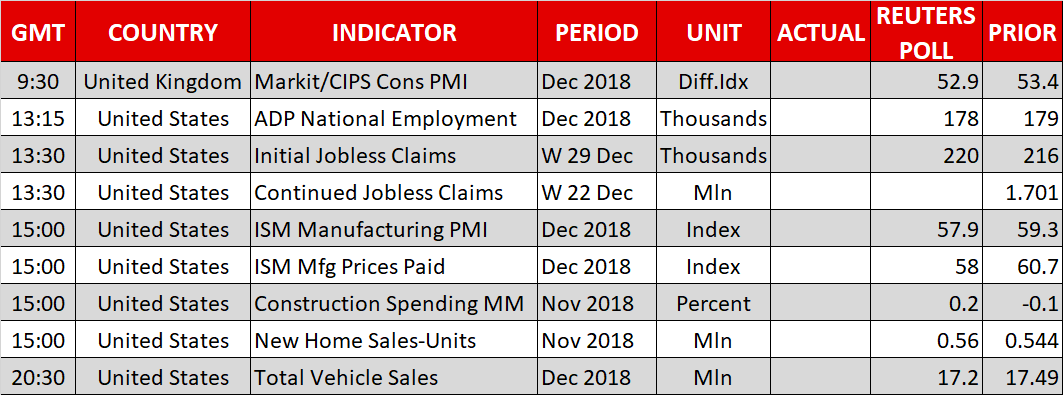
The focus later in the day will turn to ISM manufacturing PMI for December (15:00 GMT) out of the US. After the dismal manufacturing PMIs out of Asia and Europe this week, a poor reading for the US would be seen as further evidence of the deteriorating global economic backdrop, with the yen likely to again be the main beneficiary of any fresh risk averse moves.
However, it's possible traders might decide to wait until tomorrow's key risk events before making any large best. The US jobs report for December will be watched closely for fresh clues on the health of the US labour market. But the bigger highlight could come from Fed Chairman Jerome Powell and his latest views on the economy when he participates in panel discussion in Atlanta with former Fed chairs.
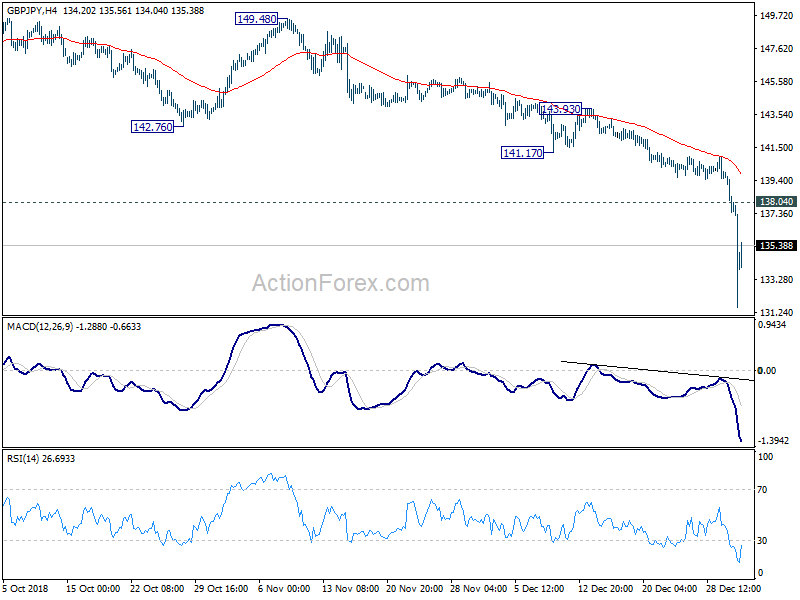
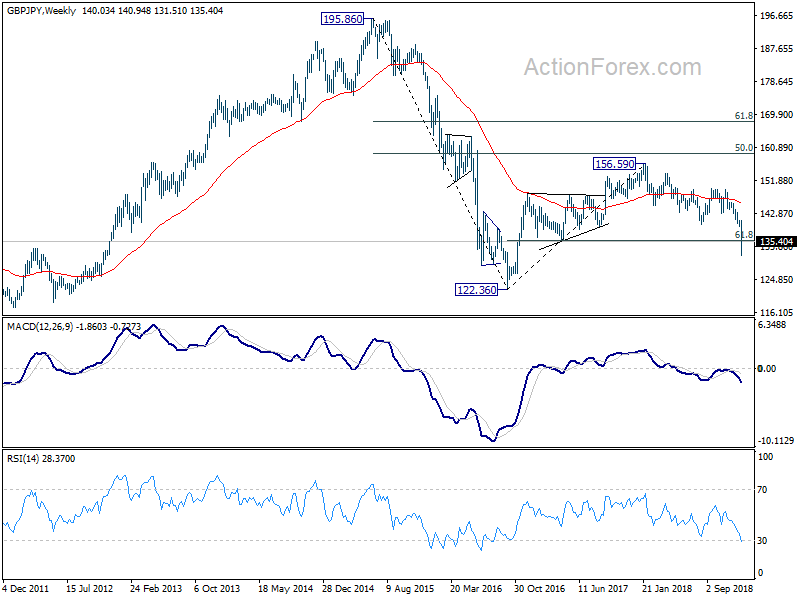
GBP/JPY Daily Outlook
Daily Pivots: (S1) 136.44; (P) 138.18; (R1) 139.08; More...
GBP/JPY's decline accelerated further to as low as 131.51 and broke 135.43 fibonacci level. Some consolidation would likely be seen after climax selling. But outlook will stay bearish as long as 138.04 minor resistance holds. Sustained break of 135.43 will pave the way back to 122.36 (2016 low). Nevertheless, touching of 138.04 will confirm short term bottoming and bring lengthier consolidation first, before staging another fall.
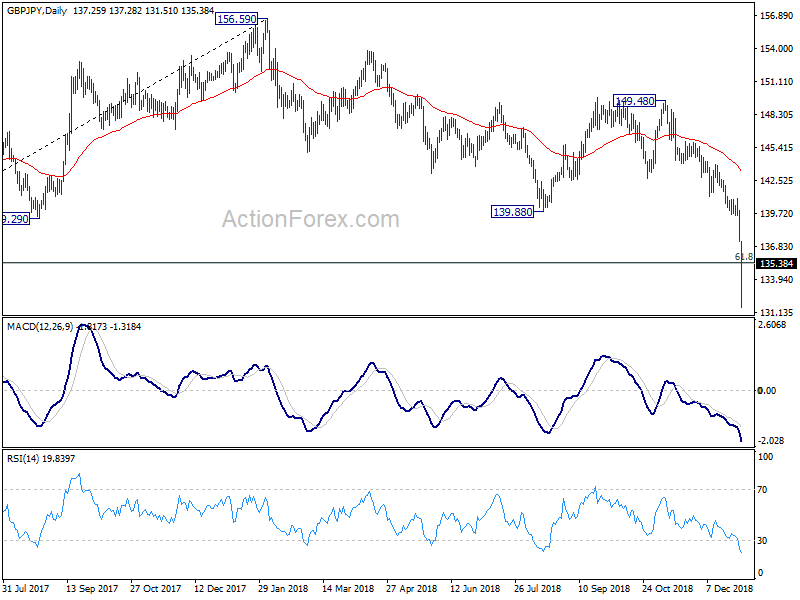
In the bigger picture, corrective medium term rise from 122.36 (2016 low) has completed at 156.69 already. That came after failing to break through 55 month EMA. Fall from 156.69 (2018 high) is seen as resuming the long term down trend from 195.86 (2015 high). Break of 122.36 will target 116.83 low first (2011 low). And this will now remain the preferred case as long as 139.88 support turned resistance holds.
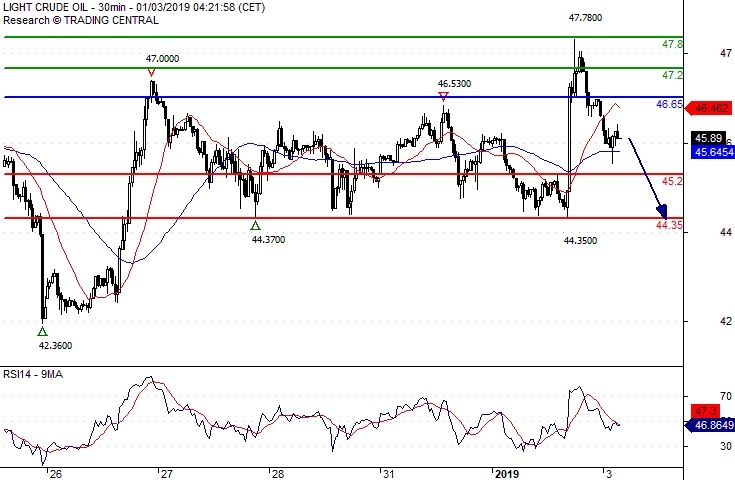
Crude Oil Choppy
Pivot (invalidation): 46.65
Our preference Short positions below 46.65 with targets at 45.20 & 44.35 in extension.
Alternative scenario Above 46.65 look for further upside with 47.20 & 47.80 as targets.
Comment As Long as 46.65 is resistance, look for choppy price action with a bearish bias.
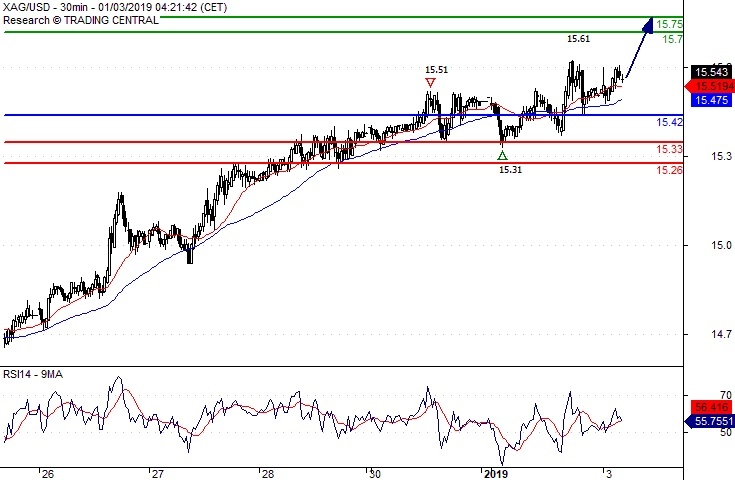
Silver Spot Further Advance
Pivot (invalidation): 15.4200
Our preference Long positions above 15.4200 with targets at 15.7000 & 15.7500 in extension.
Alternative scenario Below 15.4200 look for further downside with 15.3300 & 15.2600 as targets.
Comment The RSI advocates for further advance.
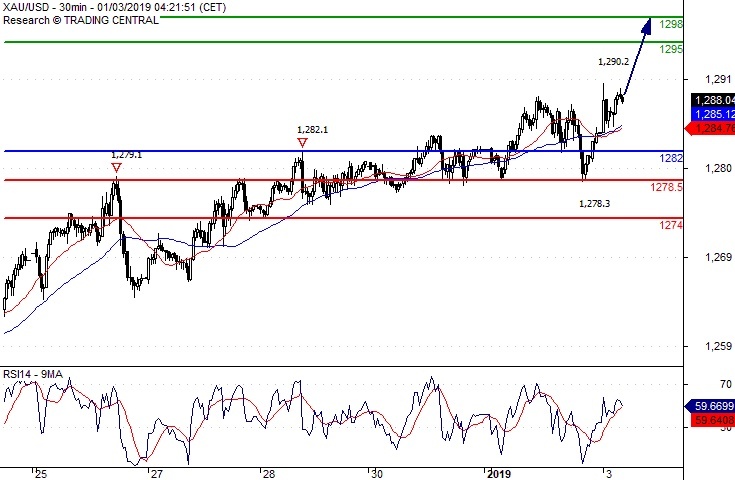
Gold Spot Further Advance
Pivot (invalidation): 1282.00
Our preference Long positions above 1282.00 with targets at 1295.00 & 1298.00 in extension.
Alternative scenario Below 1282.00 look for further downside with 1278.50 & 1274.00 as targets.
Comment The RSI is bullish and calls for further upside.
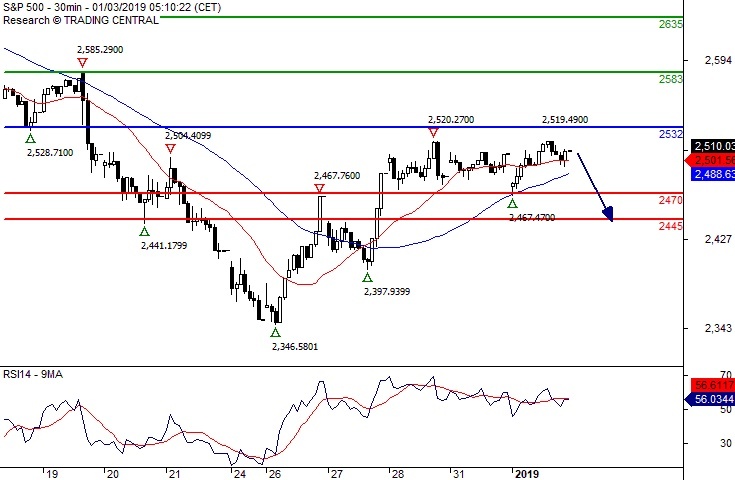
S&P 500 Consolidation In Place
Pivot (invalidation): 2532.00
Our preference Short positions below 2532.00 with targets at 2470.00 & 2445.00 in extension.
Alternative scenario Above 2532.00 look for further upside with 2583.00 & 2635.00 as targets.
Comment As Long as 2532.00 is resistance, look for choppy price action with a bearish bias.
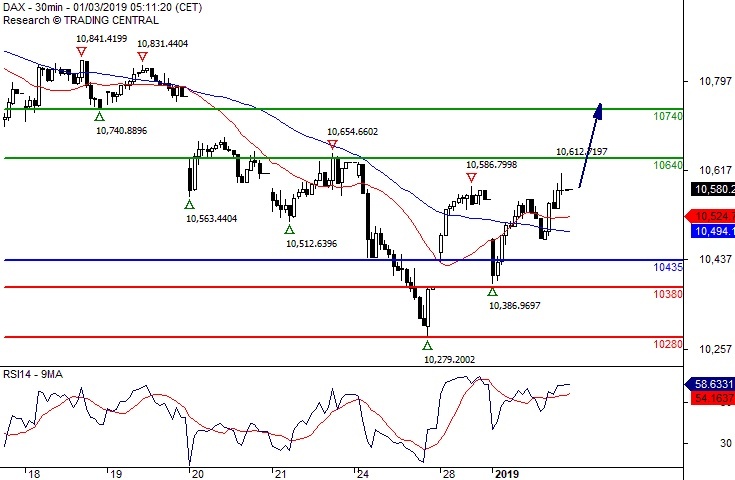
DAX Intraday Support Around 10435.00
Pivot (invalidation): 10435.00
Our preference Long positions above 10435.00 with targets at 10640.00 & 10740.00 in extension.
Alternative scenario Below 10435.00 look for further downside with 10380.00 & 10280.00 as targets.
Comment The RSI is mixed.