Sample Category Title
Canadian Dollar Unchanged, Investors Await Employment Data
USD/CAD is unchanged in the Thursday session. Currently, the pair is trading at 1.3588, up 0.03% on the day. In the U.S., the focus will be on employment numbers for the remainder of the week. ADP nonfarm payrolls are expected to remain unchanged at 179 thousand, while unemployment claims are forecast to continue climbing, with an estimate of 220 thousand. On Friday, the U.S. will post nonfarm payrolls and wage growth, and Canada publishes employment change and the unemployment rate. As well, ISM Manufacturing PMI is forecast to dip to 57.7 points.
The Canadian dollar endured a rough December, and it’s doubtful if January will bring much relief. Turmoil on global stock markets has soured risk appetite and made minor currencies like the Canadian dollar less attractive. The volatility in U.S. markets was especially pronounced last week, as stocks plunged but then rebounded. There is widespread concern that the global trade war will continue to take a bite out of the global economy, which could mean more headwinds for the Canadian dollar, a commodity currency.
After four rate hikes in 2018, the Federal Reserve will be drastically easing up on raising rates in 2019. Just a few months ago, there was heady talk of three or four rate hikes in 2019, but the Fed made an abrupt U-turn, saying the “neutral rate range” had been reached. Analysts expect one rate hike in 2019, as this year’s hikes and the global trade war have lessened the pace of expansion in the U.S. economy. According to the CME Group, the likelihood that the Fed will stay on the sidelines in January and March stands at 98% and 93%, respectively. This dovish stance from the Fed could weigh on the dollar in the coming months.
Into US session: Yen stays strongest after paring gains, Sterling weakest
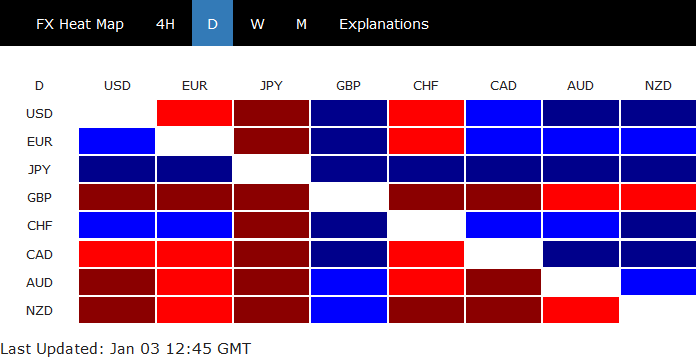
Entering into US session, Yen remains the strongest one for today even though it has already pared back much of the "flash crash gains". Risk aversion intensifies in European session and Swiss Franc is now the second strongest, followed by Euro and then Dollar. Sterling overtook Aussie's place as the weakest one. Australian Dollar stays the second weakest after paring some of the spike losses, followed by Kiwi.
Risk aversion will likely stay, at least at the beginning of risk aversion. After Apple's sales outlook downgrade, DOW future is now trading down over -300 pts. But 10 year yield is back at 2.65, up from premarket low at 2.626. Stocks will be facing multiple tests in job data and ISM manufacturing in US session.
In Europe, at the time of writing:
- FTSE is down -0.33%
- DAX is down -1.16%
- CAC is down -1.09%
- German 10 year bund yield is up 0.018 at 0.187, much better than yesterday's low of 0.150
Earlier in Asia, selloff was not to serious:
- Hong Kong HSI dropped -0.26%
- China Shanghai SSE dropped -0.04%
- Singapore Strait Times dropped -0.86%
- Japan was still on holiday
EUR/USD – Steady after Yen Surge Sends Euro Tumbling
EUR/USD has edged lower in the Wednesday session. Currently, the pair is trading at 1.1347, up 0.03%. On the release front, there are no major U.S. events on the schedule. In the U.S., the focus will be on employment numbers for the remainder of the week. ADP nonfarm payrolls are expected to remain unchanged at 179 thousand, while unemployment claims are forecast to continue climbing, with an estimate of 220 thousand. On Friday, the eurozone releases CPI reports, while the U.S. will post nonfarm payrolls and wage growth. As well, ISM Manufacturing PMI is forecast to dip to 57.7 points.
The euro took a plunge on Wednesday, declining 1.0 percent. The catalyst for the sharp drop was a surge by the Japanese yen, as investors remain nervous about the global economy and flocked to the yen, which posted strong gains against the dollar, with other currencies such as the euro feeling the effect. The markets are thin on liquidity this week, and with Japanese banks closed for most of the week, the yen’s movement was even more pronounced. The dollar has traditionally been a safe-haven asset, but this role is being re-evaluated, with some analysts calling the yen the “safer safe-haven”. If investor jitters continue, the euro could resume its downward slide.
After four rate hikes in 2018, the Federal Reserve will be drastically easing up on raising rates in 2019. Just a few months ago, there was heady talk of three or four rate hikes in 2019, but the Fed made an abrupt U-turn, saying the “neutral rate range” had been reached. Analysts expect one rate hike in 2019, as this year’s hikes and the global trade war have lessened the pace of expansion in the U.S. economy. According to the CME Group, the likelihood that the Fed will stay on the sidelines in January and March stands at 98% and 93%, respectively. This dovish stance from the Fed could weigh on the dollar in the coming months.
WTI OIL Outlook: Directionless Mode Exists As Fibo Barrier At $47.01 Caps Recovery
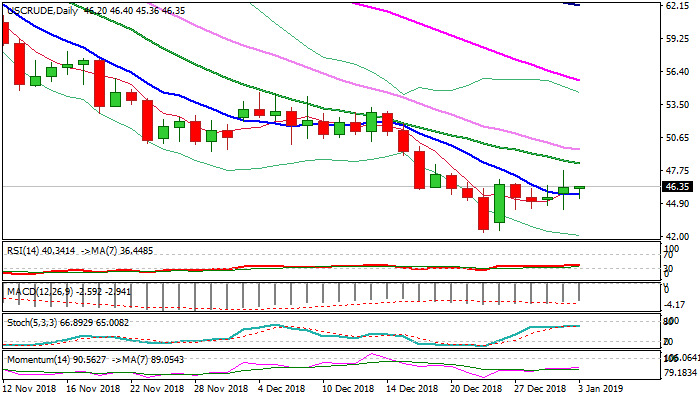
WTI oil trades in a choppy mode on Thursday, amid volatile stocks and currency marks and still lacking clearer direction signal after three straight Dojis.
Recovery attempts from new multi-month low at $42.36 (2018 low, posted on 24 Dec) were so far unable to extend above pivotal $47.01 barrier (Fibo 38.2% of $54.54/$42.36 downleg).
The downside is expected to remain vulnerable while $47.01 holds, as persisting fears about oversupply and global growth slowdown which could reduce demand, keep oil prices under pressure.
Overall bearish daily techs add to negative outlook, although oil price eventually closed above 10SMA ($45.76).
Higher base at $44.40 zone (lows of past few sessions) mark pivotal support, loss of which would re-expose key supports at $42.36/04 (24 Dec 2018/21 Jun 2017 lows).
Bears could be sidelined on close above $47.01 for recovery extension towards 20SMA ($48.36), 30 SMA ($49.59) and psychological $50 barrier.
Res: 47.01, 47.75, 48.36, 49.59
Sup: 45.68, 44.40, 42.36, 42.04
New Year, Same Old Markets
Apple warning triggers latest wobble
Another wobble in financial markets has raised anxiety among investors once again as an Apple revenue warning, followed by a flash crash in various currency pairs in illiquid trade increases concerns.
Apple’s warning, specifically around the speed of the deceleration in China and the impact of a trade war, has fed into people’s already bleak outlook for this year. Coming at a time when anxiety is already heightened has clearly exacerbated the move also, with traders seemingly jumping at any excuse to take risk off the table, which has naturally been beneficial for safe havens.
This was clearly the situation with the yen, although in this case there was obviously other factors at play given the speed and magnitude of the move. The yen is widely considered a safe haven currency, hence the appeal, and continues to trade significantly higher across the board, although much of the initial rally has since been reversed.
USDJPY Daily Chart
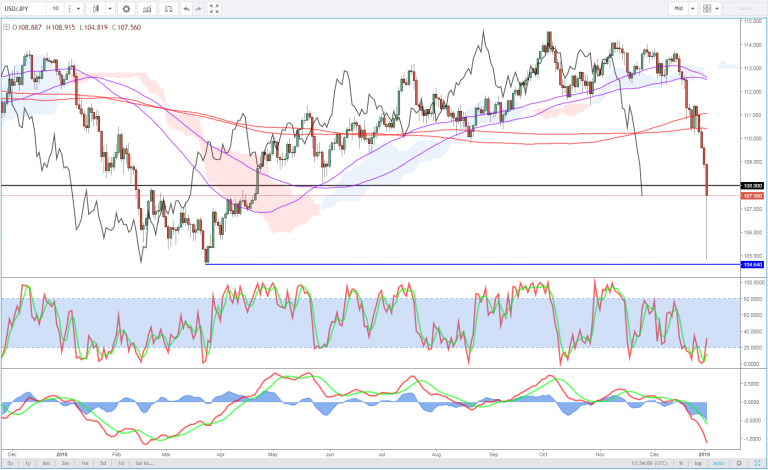
The yen has been performing well for much of the last month as US markets suffered their worst December since 1931 although the gains over the last 24 hours are extreme.
Safe haven gold continues climb to $1,300
Gold once again looks to have benefited from the market instability, with the traditional safe haven quickly closing in on $1,300 after rallying around 8% from its mid-November lows. The dollar has had a better start to the year but the recent trend is very much against it which is likely to be supportive for gold in the near-term.
Gold Daily Chart
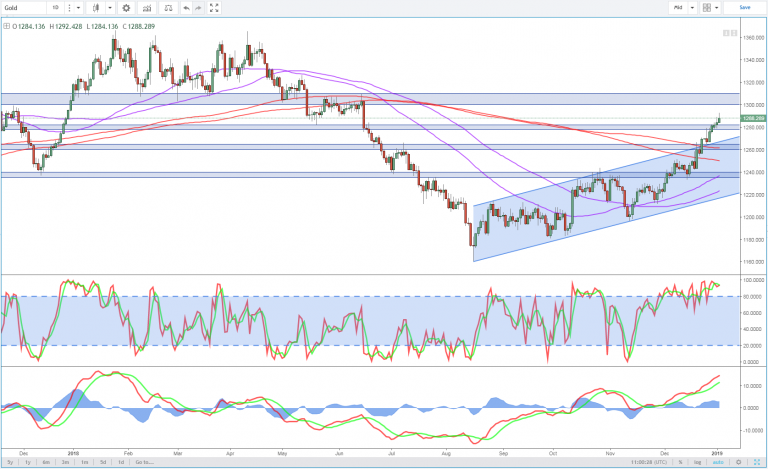
Momentum very much remains with the yellow metal, although that may wane the closer we get to $1,300, at which point the $1,280 becomes a notable area of potential support.
Bullish case for bitcoin?
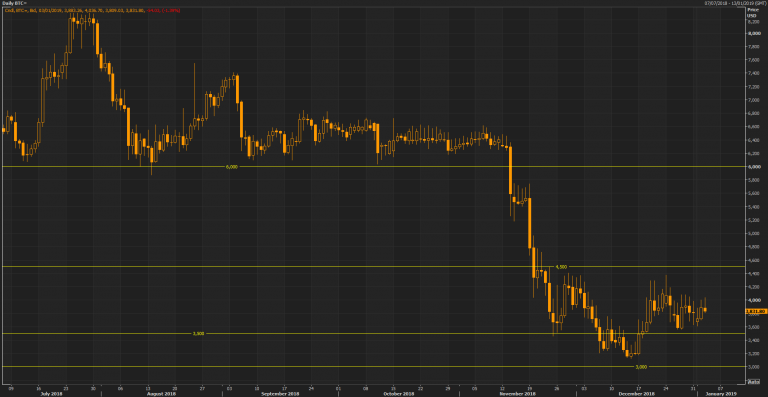
Cryptocurrency enthusiasts may have been encouraged by how the market has stabilized over the last month, with the month previous being quite devastating for the space as bitcoin finally broke below $6,000 before quickly falling around 50%. Since then, bitcoin has failed to make a new low and has peaked close to $4,500 – a near 50% gain. Just another month in cryptoland.
More encouraging – at least in the near-term – has been the fact that the late December drop saw bitcoin bottom around $3,500, a similar level to where it found support late November. What this means, from a technical standpoint, is that a break of $4,500 would now complete an inverse head and shoulders, potentially laying the groundwork for a nice rally.
A completion of this pattern gives a conservative possible price projection of around $5,500 – based roughly on the size of the shoulder to the neckline (≈$4,500-$3,500) – and a full possible projection of around $6,000 – based roughly on the size of the head to the neckline (≈$4,500-$3,000). This coincidentally coincides with the previously mentioned long-term support making it a very interesting level of potential resistance.
Bitcoin Daily Chart
USDJPY And AUDUSD Flash-Crash On The Thin Market
The foreign exchange market is experiencing serious turbulence in the first days of the new year. At the beginning of the Asian trading on Thursday, the Japanese yen added more than 7.5% to the dollar in a matter of minutes. The Australian dollar collapsed by 8% against the yen and by 5% against the dollar for no apparent fundamental reason.
In fact, we saw some kind of forex flash-crash, when markets are experiencing very sharp and significant movements due to the trade in high-frequency computer-driven algorithms. It is worth mentioning that AUD has managed to return significant part of initial losses. AUDUSD traded by 07:00 GMT at 0.6945, against 0.6980 at the beginning of the day and intraday lows at 0.6635. USDJPY was at 107.0, after failing to 99.90, compare to 108.65 at the start of the day.
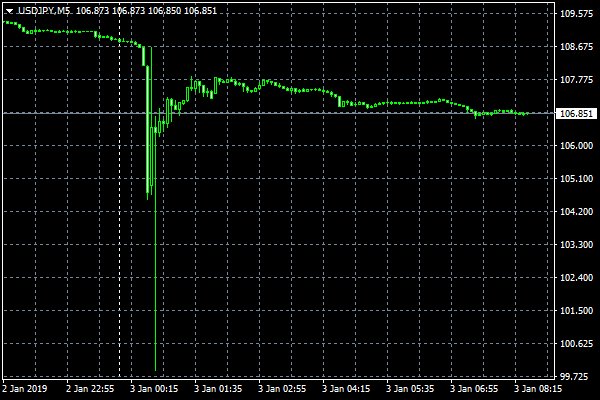
Behind such crashes there is often a combination of unfavorable factors, which strengthens the market’s magnitude: reduced market liquidity, proximity of significant levels, the presence of a trend.
Market activity remains subdued as most participants have not returned yet after the New year holidays. In particular, the stock exchanges are still closed in Japan. Moreover, the explosion of volatility occurred at the very beginning of the Asian trading, after the closure of the American exchanges and long before the start of European session.
Decrease of USDJPY accelerated after falling below 108.0, which has been a significant level for the last 1 ½ years. The decline was even more accelerated when the rates immediately approached 105.
AUDUSD also attracted the attention of the market players, coming up in the previous days to 0.7000, the support level for the last three years and minimums for almost 10 years.
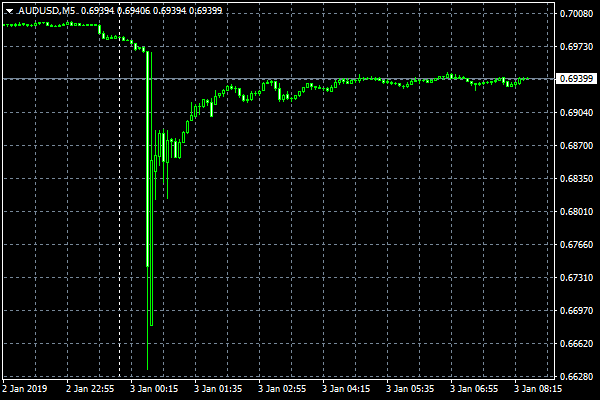
As in the case of JPY, AUD sharp weakening became an extreme development of events but coincided with the existing trend: markets continue demand for safe-heavens, which is also seen in the rising gold prices and pressure for the world stock markets.
It is hardly expected that the buying after flash-crash in pairs AUDUSD and USDJPY lead to reverse in trend for decline as the key fundamentals are still in play. In addition, the market showed its vulnerability to drawdowns. In these conditions, there are high chances of further sales on the highs, unless the monetary authorities of Japan will not come out with verbal or currency interventions, fearing the negative impact of the yen’s volatility on the economy.
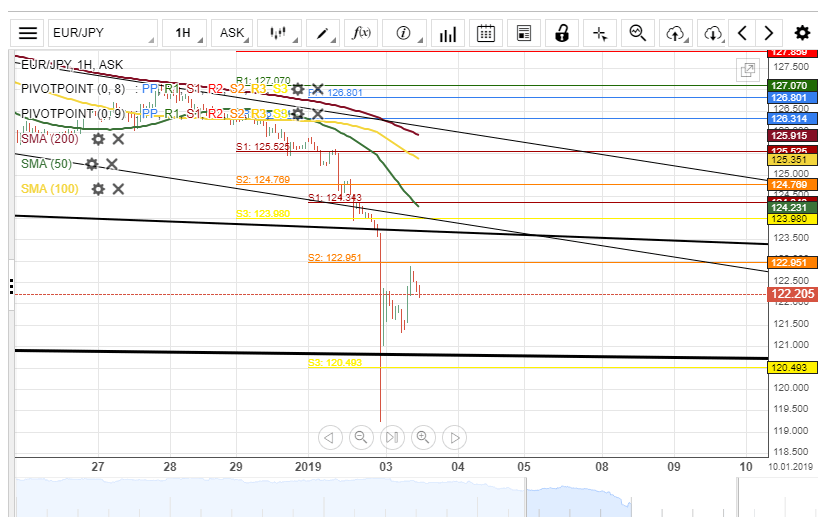
EUR/JPY Likely To Rebound
The common European currency depreciated about 628 base points against the Japanese Yen on Wednesday. This sharp decline was caused by the general strength of the Yen against a basket of major currencies.
The exchange rate has recovered about 1.58% of its values since the starts of today's trading session.
As for the short-term future, it is likely that the Euro will continue its rebound and potentially aim at a resistance cluster formed by the combination of the weekly S1 and the 50-hour simple moving average at 124.45 during the following trading session.
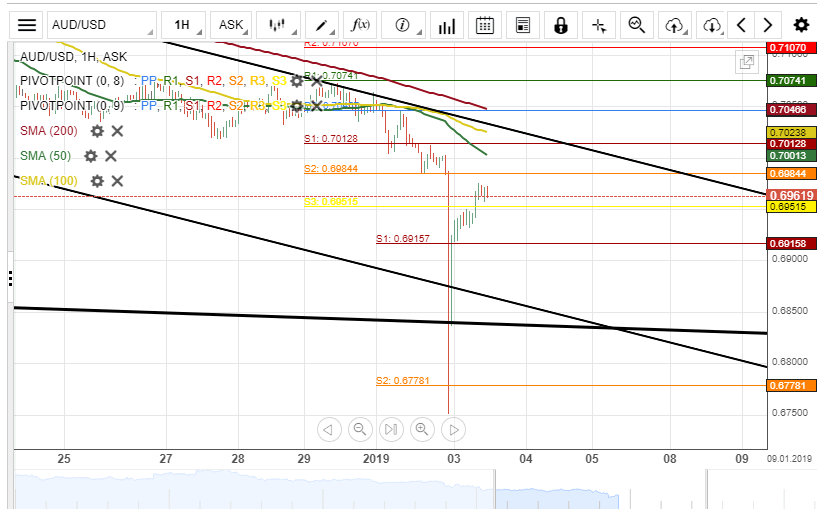
AUD/USD Pair Still Shows Weakness
The Australian Dollar depreciated about 289 base points against the US Dollar on Wednesday. The currency pair tested a psychological support level at the 0.6800 during the previous trading session.
However, the exchange rate began today's trading session with about 130 pips gains. The pair could possibly target a resistance level formed by the 50– and 100-hour SMAs at 0.7007 today.
Although, technical indicators suggest that the currency exchange rate is likely to continue its southern movement during the following trading session.
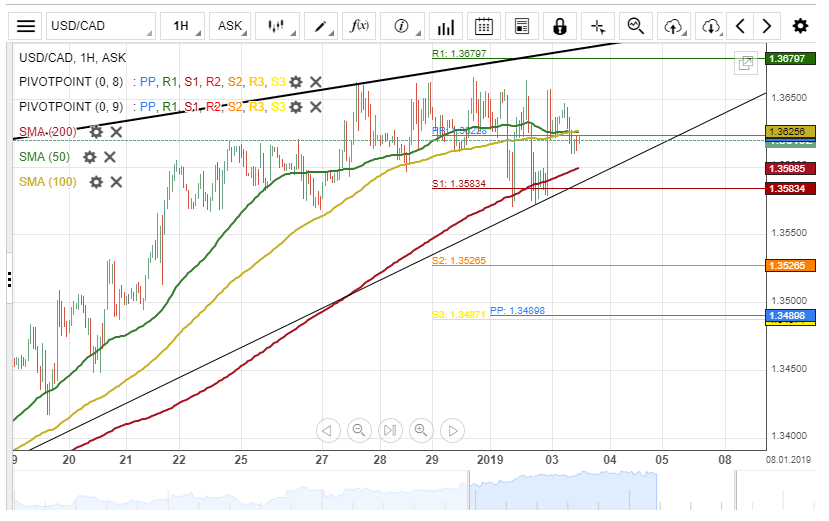
USD/CAD Buy Signals Today
The US Dollar has been trading in an ascending channel pattern against the Canadian Dollar since the beginning of December. The pair revealed a new uptrend line during the previous session and tested the bottom border by the end of Wednesday's trading session.
Technical indicators suggest that the bullish sentiment is likely to continue within this session.
However, given that the 50– and 100-hour SMAs are above the price level, it is possible that the currency exchange rate will target the 200-hour simple moving average at 1.3596 today.
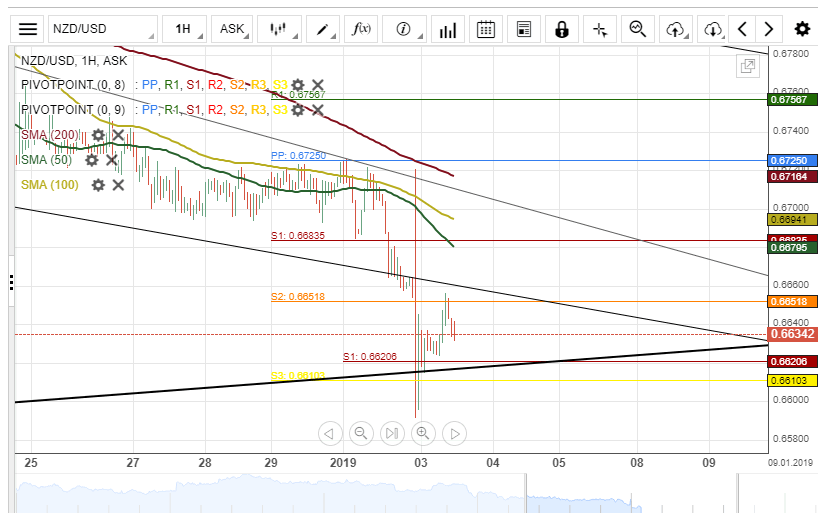
NZD/USD Surge Insight
The New Zealand Dollar depreciated about 129 base points against the US Dollar on Wednesday. The currency pair breached the lower boundary of an ascending channel during yesterday's trading session.
The exchange rate opened above the bottom border of the channel pattern during Thursday's session.
As for the near future, it is likely that the currency exchange rate continues to gain strength and potentially target a resistance cluster formed by the combination of the 50– hour simple moving average and the monthly S1 at 0.6683.