Sample Category Title
Sunset Market Commentary
Markets
Global core bonds lost ground today despite the persisting risk-off environment and with trading volumes still rather low. Apple’s revenue warning pushed equities further south during Asian trading. European equities went along and opened lower. Global core bonds couldn’t really profit despite this risk aversion. Both US Treasuries and German Bunds moved gradually lower throughout the day. Investors already priced in a lot of growth concerns the last couple of weeks, possibly suggesting that core yields are setting a bottom. Rising oil prices probably played a role as well. Solid to strong employment data in the US had little impact on trading, with investors the US Note future currently gaining modest ground on a disappointing US manufacturing ISM. Focus now shifts to tomorrow’s payrolls report. The US yield curve flattens with changes in the range of +0.9 bps (2-yr) to -1.8 bps (30-yr). German bonds lost ground as well but in a smaller order. The German yield curve flattens, with changes varying between -0.2 bps (2-yr) to +2.1 bps (30-yr). Peripheral spreads over the German 10-yr yield widened with Italy heavily outperforming (+15 bps), despite the Italian FTSE MIB equity index outperforming other EU equity indices.
Global FX markets tried to find their composure after this morning’s ‘flash crash’. In this move, the yen jumped sharply higher against most majors as investors were looking for shelter in the wake of growing evidence of an economic slowdown in China. EUR/JPY and USD/JPY are trading well off the intraday lows touched in Asia this morning. However, the yen is still trading about 2 % to 3% stronger since the start of the year against the dollar and the euro, respectively. This morning, the euro tried a cautious rebound as the sales warning from Apple suggested US companies/the US economy might face bigger than expected fall-out from the Chinese slowdown. However, as was the case yesterday, the EUR/USD intraday uptick had no strong legs. EUR/USD hovered sideways in the mid 1.13 area. US-German interest rate differentials widened slightly after recent sharp narrowing, but are providing few clues for EUR/USD trading. The US ADP December private job report contrasted with recent negative headlines, printing a strong 271k of additional jobs. US jobless claims rose slightly more than expected. The reaction of US interest rates and the dollar was insignificant. A weak manufacturing ISM currently pushes EUR/USD for a test of 1.14. USD/JPY is trading in the low 107 area.
Sterling trading was mainly driven by technical considerations today. EUR/GBP eased after the pair tested the 0.91 area during the overnight spike in FX volatility. The UK construction PMI declined from 53.4 to 52.8, mainly as expected. There was still little news on Brexit. EUR/GBP is trading in the 0.9020/35 area, returning to yesterday’s trading range close to/slightly north of 0.90.
News Headlines
The US labour market added the most jobs in December since February 2017, according to wage processor ADP. The bulk of the 271k increase came from the services sector. Soft weather conditions helped. The outcome significantly beat 180k consensus, coming from a downwardly revised 157k in November. US weekly jobless claims rose from 221k to 231k. Markets expected a stabilization, but claims remain extremely low in absolute terms. The US manufacturing ISM unexpectedly plunged from 59.3 to 54.1 in December with new orders slumping the most in nearly five years. Employment, delivery and inventory gauges fell as well.
Dallas Fed Kaplan suggested that the Fed should take no action in the first couple of quarters and watch the impact from the global growth deceleration, weakness in interest and economic-sensitive industries and tighter financial conditions (credit spreads widening). He expects US GDP growth to drop below 2% this year and to trend in 2020 (1.75% of GDP) as the fiscal stimulus boost wanes and as past Fed rate hikes kick in.
Crude Oil Looks To Recover Further Higher
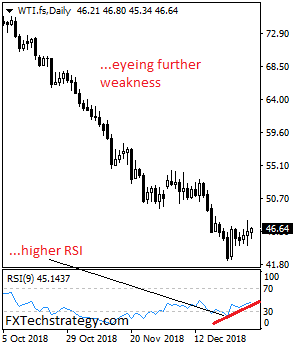
CRUDE OIL looks to recover further higher on corrective upside pressure. Support lies at the 46.50 level where a break will expose the 46.00 level. A cut through here will set the stage for a run at the 45.50 level. Further down, support comes in at the 45.00 level. On the upside, resistance resides at the 47.50 level. Further out, resistance comes in at the 48.00 level. A break above here will aim at the 48.50 level and then the 49.00 level followed by the 49.50 level. Its daily RSI is bullish and pointing higher suggesting more strength. All in all, CRUDE OIL remains biased to the downside medium term but with risk of a recovery.
USD/CAD Mid-Day Outlook
Daily Pivots: (S1) 1.3547; (P) 1.3605; (R1) 1.3642; More...
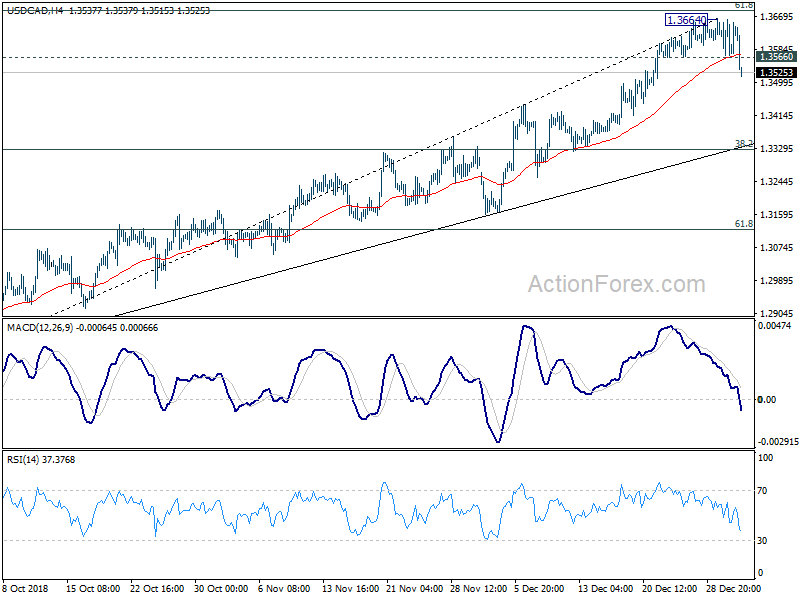
USD/CAD's break of 1.3566 minor support suggests short term topping at 1.3664, ahead failing 1.3685 fibonacci level. Intraday bias is now back on the downside for pull back to 38.2% retracement of 1.2781 to 1.3664 at 1.3327. We'd expect downside to be contained there to bring rebound. But on the upside, firm break of 1.3664 is now needed to confirm up trend resumption. Otherwise, risk will stay on the upside even in case of recovery.
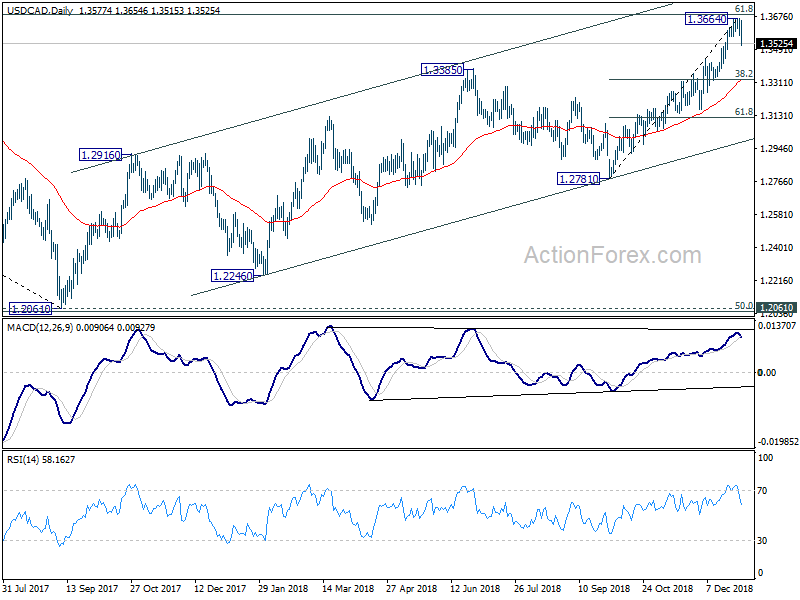
In the bigger picture, up trend from 1.2061 (2017 low) is still in progress and should target 61.8% retracement of 1.4689 (2016 high) to 1.2061 at 1.3685. At this point, the structure is not clearly impulsive yet. Hence, we'd be cautious on topping between 1.3685/3793. But in any case, medium term outlook will stay bullish as long as channel support (now at 1.2993) holds. Sustained break of 1.3793 will pave the way to retest 1.4689 (2015 high).
Dollar Weighed Down by Dovish Fed Comments, Canadian Lifted by Oil Rebound
Dollar received no support from better than expected ADP employment data. Instead, it's weighed down by dovish comments from a Fed official. The greenback is trading as the second weakest for today in early US session. It's just slightly better than Sterling, which continues to be pressured by Brexit uncertainties. Yen pared back much of the "flash crash" gains but remains the strongest one for today, thanks to risk aversion. It's now followed by Canadian Dollar as the second strongest, as WTI crude oil is back at 47.5, trying to extend recent rebound.
European stocks are weighed down by Apple's revenue downgrade and worries over China's slow down. At the time of writing, DAX is down -0.89% while CAC is down -0.81%. But FTSE reversed earlier loss and is up 0.12%. German 10 year yield is up 0.0092 at 0.177, much better than yesterday's low of 0.150. Earlier in Asia, Hong Kong HSI closed down -0.26%, China Shanghai SSE dropped -0.04%, Singapore Strait Times dropped -0.86%. Focus will now turn to US markets.
Technically, Yen and Aussie pairs are in consolidation after earlier spike move. Such consolidation should extend for a while. EUR/USD is staying in range of 1.2700/1496. USD/CHF is in range of 0.9789/9963. EURGBP back in range of 0.8927/9086 despite a brief rally attempt. Breakouts are still being awaited. USD/CAD's sharp fall today and break of 1.3566 now suggests short term topping ahead of 1.3685 fibonacci level. Deeper pull back is now in favor in the near term.
Fed Kaplan: My base case is no action on interest rate in 2019 at all
Dallas Fed President Robert Kaplan said in a Bloomberg interview that he favored pausing the rate hike cycle until the uncertainties are cleared. He pointed to concerns over global growth, weakness in interest-sensitive industries and tighter financial conditions and warned "there's three big issues that I see reflected in the markets that are consistent with what I'm seeing in the economy and discussions with contacts."
He added that "I think those three issues -- I'm sure -- are affecting the markets, but they're also affecting my thinking about monetary policy. It's going to take some time so see the depth and breadth of those three issues."
Thus he said, "my own view is we should not take any further action on interest rates until these issues are resolved, for better, for worse." And, "I would be an advocate of taking no action and -- for example -- in the first couple of quarters this year, if you asked me my base case, my base case would be take no action at all."
US ADP added 271k jobs, low unemployment will get even lower
US ADP report shows 271k growth in private sector jobs in December, up from 157k and beat expectation of 175k. Ahu Yildirmaz, vice president and co-head of the ADP Research Institute, said in the release that "we wrapped up 2018 with another month of significant growth in the labor market." And, "Although there were increases in most sectors, the busy holiday season greatly impacted both trade and leisure and hospitality. Small businesses also experienced their strongest month of job growth all year."
Mark Zandi, chief economist of Moody's Analytics, said, "Businesses continue to add aggressively to their payrolls despite the stock market slump and the trade war. Favorable December weather also helped lift the job market. At the current pace of job growth, low unemployment will get even lower."
US initial jobless claims rose 10k to 231k
US initial jobless claims rose 10k to 231k in the week ending December 29, above expectation of 215k. Four-week moving average of initial claims dropped -500 to 218.75k. Continuing claims rose 32k to 1.74M in the week ending December 22. Four-week moving average of continuing claims rose 26k to 1.7035M.
UK Brexit Minister Barclay: No deal Brexit likely if MPs reject the deal
UK Brexit Minister Stephen Barclay warned that "no deal will be far more likely if MPs reject the PM's Brexit deal later this month." And, he urged fellow MPs to "put the national interest first and vote for this deal so we can get on with delivering Brexit and building the UK's prosperous future as an outward-looking global trading nation, outside the EU." And he also emphasized that people "people did not vote for the disruption and uncertainty of no deal."
Foreign Minister Jeremy Hunt also said "there will be some tough negotiations to follow in the years ahead but I think getting this clearer language on the backstop will help to get it through Parliament." And, there will be "devastating social consequences" if a second EU referendum was triggered.
UK PMI construction dropped to 52.8, slowdown in housing and commercial activity growth
UK construction PMI dropped to 52.8 in December, down from 53.4 and missed expectation of 52.9 slightly. Markit noted that "business activity expands at weakest pace for three months", "softest rise in commercial work since May 2018", but "rebound in business optimism amid hopes of infrastructure boost in 2019".
Tim Moore, Economics Associate Director at IHS Markit, said in the release that "UK construction firms signalled a slowdown in housing and commercial activity growth during December, which more than offset a strong performance for civil engineering at the end of 2018." And "Subdued domestic economic conditions and an intense headwind from political uncertainty resulted in the weakest upturn in commercial work for seven months."
Also relesed in European session, Eurozone M3 rose 3.7% yoy in November. Swiss PMI manufacturing rose 0.1 to 57.8 in December.
USD/CAD Mid-Day Outlook
Daily Pivots: (S1) 1.3547; (P) 1.3605; (R1) 1.3642; More...
USD/CAD's break of 1.3566 minor support suggests short term topping at 1.3664, ahead failing 1.3685 fibonacci level. Intraday bias is now back on the downside for pull back to 38.2% retracement of 1.2781 to 1.3664 at 1.3327. We'd expect downside to be contained there to bring rebound. But on the upside, firm break of 1.3664 is now needed to confirm up trend resumption. Otherwise, risk will stay on the upside even in case of recovery.
In the bigger picture, up trend from 1.2061 (2017 low) is still in progress and should target 61.8% retracement of 1.4689 (2016 high) to 1.2061 at 1.3685. At this point, the structure is not clearly impulsive yet. Hence, we'd be cautious on topping between 1.3685/3793. But in any case, medium term outlook will stay bullish as long as channel support (now at 1.2993) holds. Sustained break of 1.3793 will pave the way to retest 1.4689 (2015 high).
Economic Indicators Update
| GMT | Ccy | Events | Actual | Forecast | Previous | Revised |
|---|---|---|---|---|---|---|
| 08:30 | CHF | PMI Manufacturing Dec | 57.8 | 56.9 | 57.7 | |
| 09:00 | EUR | Eurozone M3 Money Supply Y/Y Nov | 3.70% | 3.80% | 3.90% | |
| 09:30 | GBP | UK Construction PMI Dec | 52.8 | 52.9 | 53.4 | |
| 12:30 | USD | Challenger Job Cuts Y/Y Dec | 35.30% | 51.50% | ||
| 13:15 | USD | ADP Employment Change Dec | 271K | 175k | 179k | 157K |
| 13:30 | USD | Initial Jobless Claims (DEC 29) | 231K | 215K | 216K | 221K |
| 15:00 | USD | Construction Spending M/M Nov | 0.40% | -0.10% | ||
| 15:00 | USD | ISM Manufacturing Dec | 58.4 | 59.3 | ||
| 15:00 | USD | ISM Prices Paid Dec | 58 | 60.7 | ||
| 15:00 | USD | ISM Employment Dec | 58.4 |
Fed Kaplan: My base case is no action on interest rate in 2019 at all
Dallas Fed President Robert Kaplan said in a Bloomberg interview that he favored pausing the rate hike cycle until the uncertainties are cleared. He pointed to concerns over global growth, weakness in interest-sensitive industries and tighter financial conditions and warned "there's three big issues that I see reflected in the markets that are consistent with what I'm seeing in the economy and discussions with contacts."
He added that "I think those three issues -- I'm sure -- are affecting the markets, but they're also affecting my thinking about monetary policy. It's going to take some time so see the depth and breadth of those three issues."
Thus he said, "my own view is we should not take any further action on interest rates until these issues are resolved, for better, for worse." And, "I would be an advocate of taking no action and -- for example -- in the first couple of quarters this year, if you asked me my base case, my base case would be take no action at all."
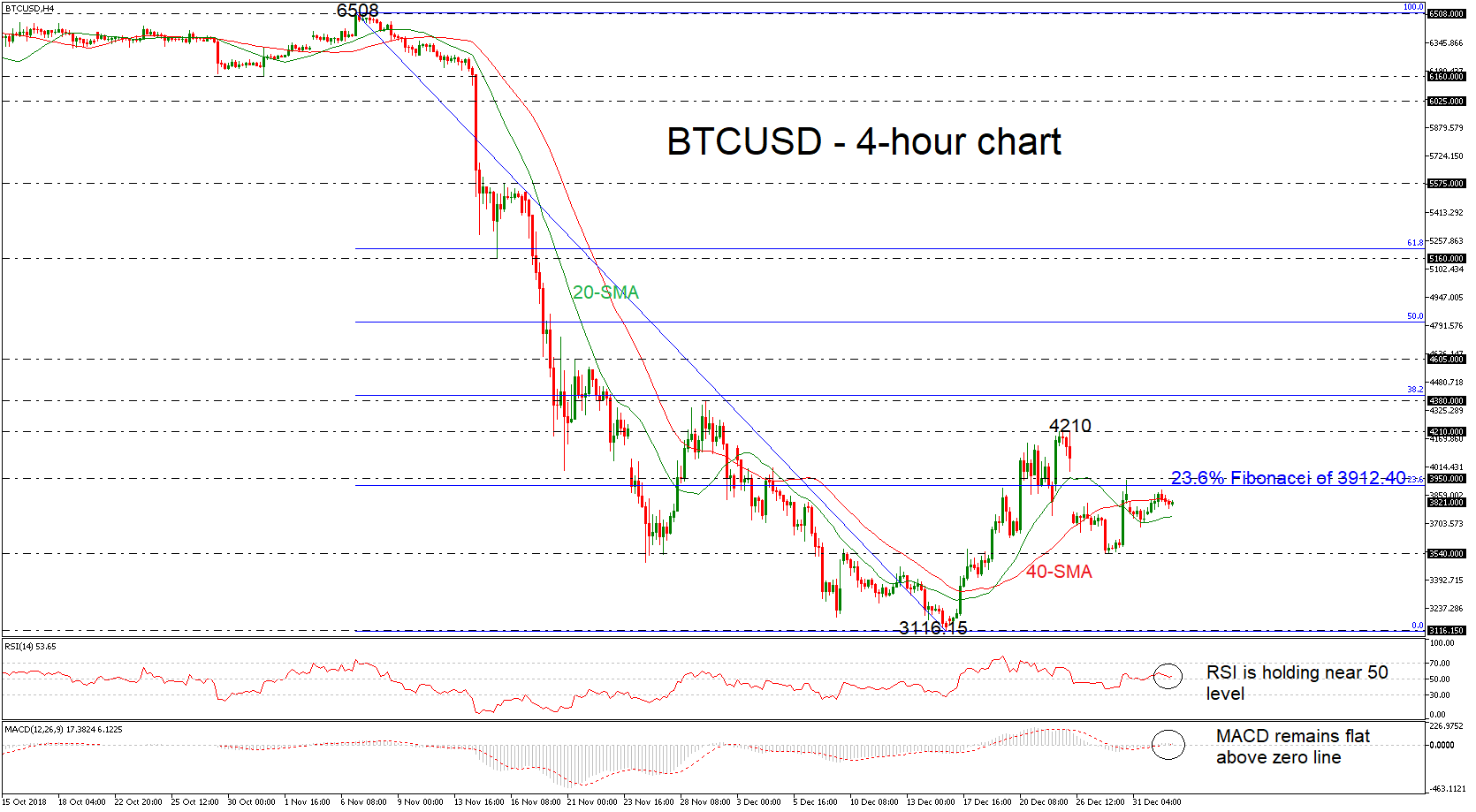
BTCUSD Still Stuck Below 23.6% Fibonacci; Bearish Outlook
BTCUSD has been moving sideways after it found strong support at the 3116.15 barrier on December 14. The price holds within the 20- and 40-simple moving averages (SMAs) in the 4-hour chart, while the RSI indicator stands around the neutral level and is pointing slightly up. Moreover, the MACD oscillator is losing momentum near the zero line.
Resistance could occur around the 23.6% Fibonacci retracement level of the downleg from 6508 to 3116.15 of 3912.40. Slightly above this area, the 3950 resistance could come in focus. Higher still, the 4210 taken from the highs on December 24 would increasingly come into scope.
On the downside, the bitcoin may meet immediate support at the 20-SMA around 3747 before heading lower to the 3540 support hurdle. If the market manages to drop below this level and bearish actions take place again, traders could look for the next support at the multi-month low of 3116.15
To sum up, the short-term bias remains neutral bearish especially after BTCUSD plunged below the 23.6% Fibonacci.
EUR/USD Risk Remains Higher With Eyes On 1.1499 Zone
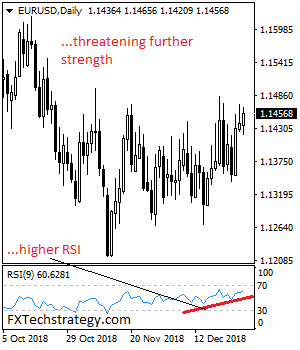
EURUSD risk remains higher with eyes on 1.1499 zone. Support comes in at the 1.1400 where a violation will aim at the 1.1350 level. A break below here will target the 1.1300 level. Further down, support lies at the 1.1250. On the upside, resistance resides at 1.1500 level with a break through there opening the door for further upside towards the 1.1550 level. Further up, resistance comes in at the 1.1600 level where a violation will expose the 1.1650 level. Its daily RSI is bullish and pointing higher suggesting more strength. All in all, EURUSD continues to threaten further upside.
US initial jobless claims rose 10k to 231k
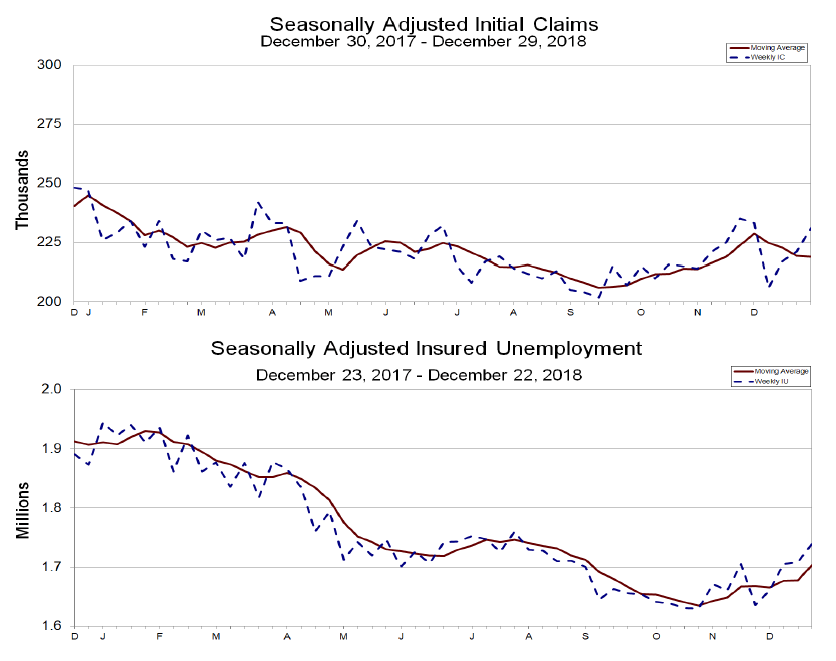
US initial jobless claims rose 10k to 231k in the week ending December 29, above expectation of 215k. Four-week moving average of initial claims dropped -500 to 218.75k.
Continuing claims rose 32k to 1.74M in the week ending December 22. Four-week moving average of continuing claims rose 26k to 1.7035M.
US ADP added 271k jobs, low unemployment will get even lower
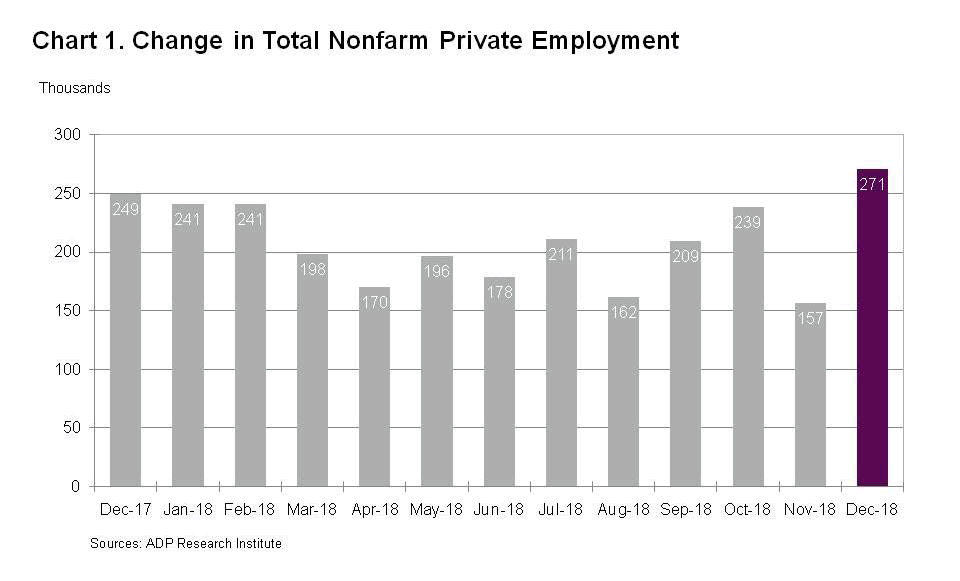
US ADP report shows 271k growth in private sector jobs in December, up from 157k and beat expectation of 175k. Ahu Yildirmaz, vice president and co-head of the ADP Research Institute, said in the release that "we wrapped up 2018 with another month of significant growth in the labor market." And, "Although there were increases in most sectors, the busy holiday season greatly impacted both trade and leisure and hospitality. Small businesses also experienced their strongest month of job growth all year."
Mark Zandi, chief economist of Moody's Analytics, said, "Businesses continue to add aggressively to their payrolls despite the stock market slump and the trade war. Favorable December weather also helped lift the job market. At the current pace of job growth, low unemployment will get even lower."
What Happens after a Currency Flash Crash?
After a flash crash or a historic currency move, many traders are baffled on what to expect next? Below are some examples of some major currency moves we have seen over the past decade.
- October 7th 2016, the British pound fell 6% overnight and initially traders were clueless. At one point the currency was down 10% and that was attributed to a fat finger transaction. Some also attributed the weakness to some harsh comments from French President Francois Hollande on Brexit, but most knew that would not be responsible for such a move. Rogue algorithm trading was also believed to be partially responsible for the plunge. The end result of the sterling flash crash was the key low around 1.18 was made and has not been tested since.
- January 15th 2015, the SNB surprised markets by abandoning the EUR/CHF 1.20 floor. The 20% freefall was solely attributed to the central bank. What is interesting is that the low made that day has still held and that on April 20th, 2018 we saw the cross retest the former floor at 1.20 for the first time.
- May 6th 2010, the crash of 2:45PM ET, was a US stock market crash that lasted for 36 minutes and took the Dow down about 9% and USD/JPY spiked lower by over 6%. The low made with dollar-yen held for a couple months, but the longer-term bearish trend returned and took out that low in over 2 months.
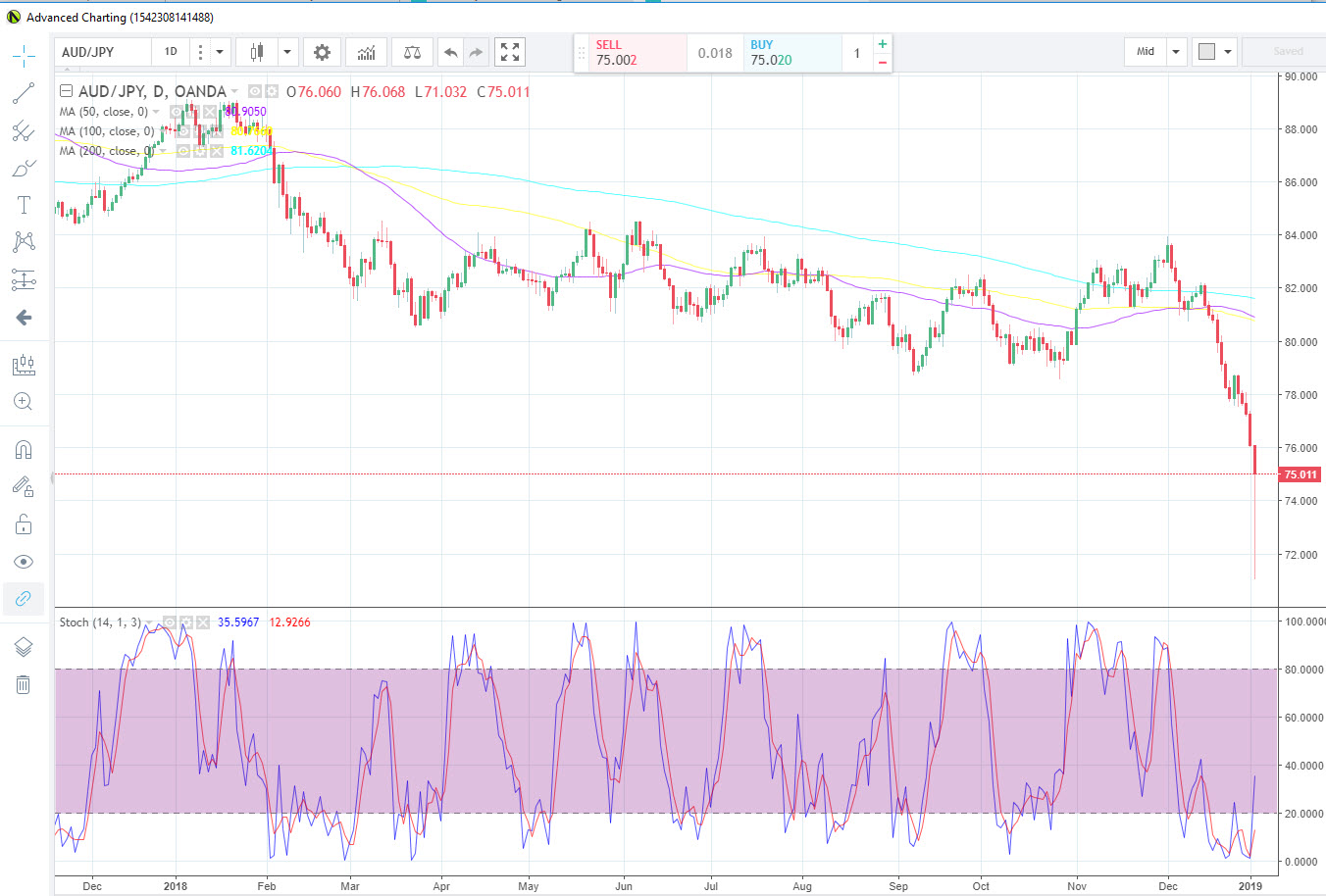
Yesterday, Apple news of cutting their guidance citing a steep drop in sales in China amid the trade war with the United States, sparked weakness in equities. Roughly an hour later we saw seven minutes of chaos with AUD/JPY, as it collapsed through major support that has been in place in over a decade. Markets were fragile at 5:30PM ET as trading desks were not fully staffed and Japan was in the middle of a 4-day holiday that ends on Friday. AUD was the most liquid currency and the lira was the most illiquid one.
A near 8% dive with AUDJPY may have formed a key bottom if we continue to see progress on the trade front and if we do not see another major leg lower with equities. Barring a policy mistake from the Fed would also be required for this low to hold, but it may be quite a while before we get the chance to see that clarified.
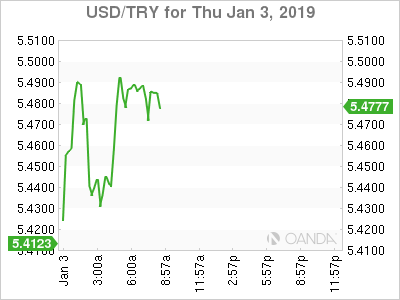
Regarding the lira, it has already recovered most of its losses against both the dollar and yen.