Sample Category Title
Aussie Touched 10 Year Low & Lira Dropped Again
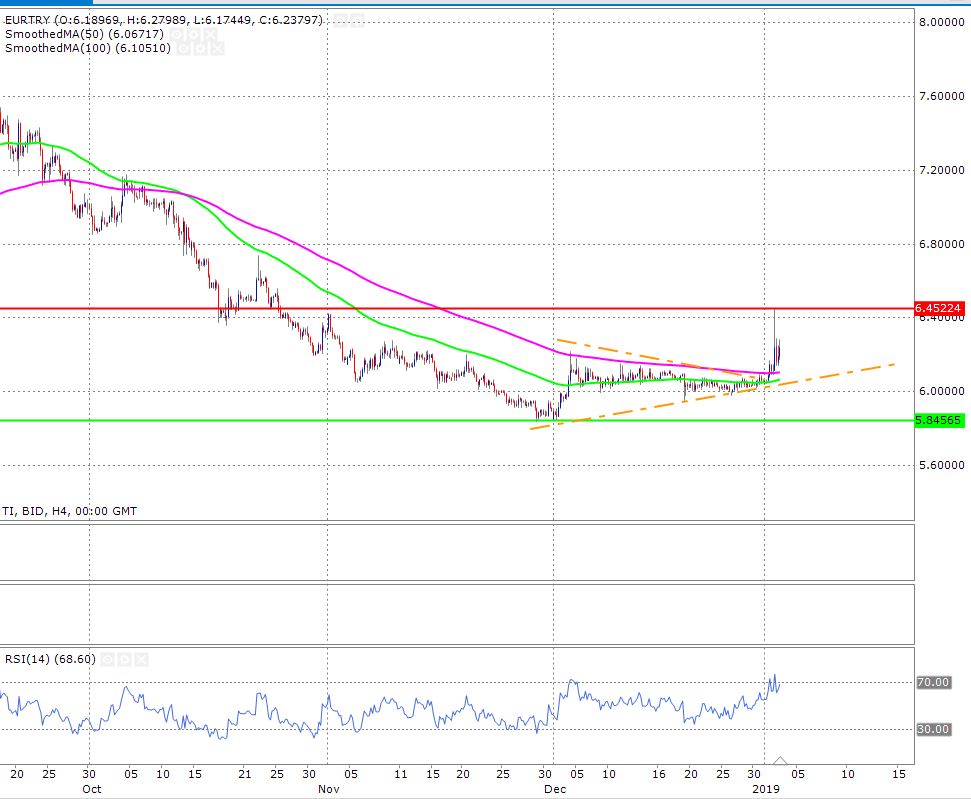
The EUR/TRY has eased off from its high after a huge spike. The spike pushed the price to a level not seen since October 24. The overall trend is skewed to the upside as the price is trading above the upward trend line on a 4-hour time frame. Moreover, the price has also broken out of the symmetrical triangle pattern, generally speaking, these patterns usually break in the direction of the current trend.
In terms of moving averages, the price is trading above the 50 and 100-day moving averages (shown in green and pink respectively).
The RSI has entered in the extremely over bought zone and this calls for caution. A level of 70 shows that the price may retrace from its recent highs or at least show some consolidation. Similarly, a level of 30 shows an extreme oversold reading.
The support zone is shown by the green horizontal line
The resistance zone is shown by the red horizontal line
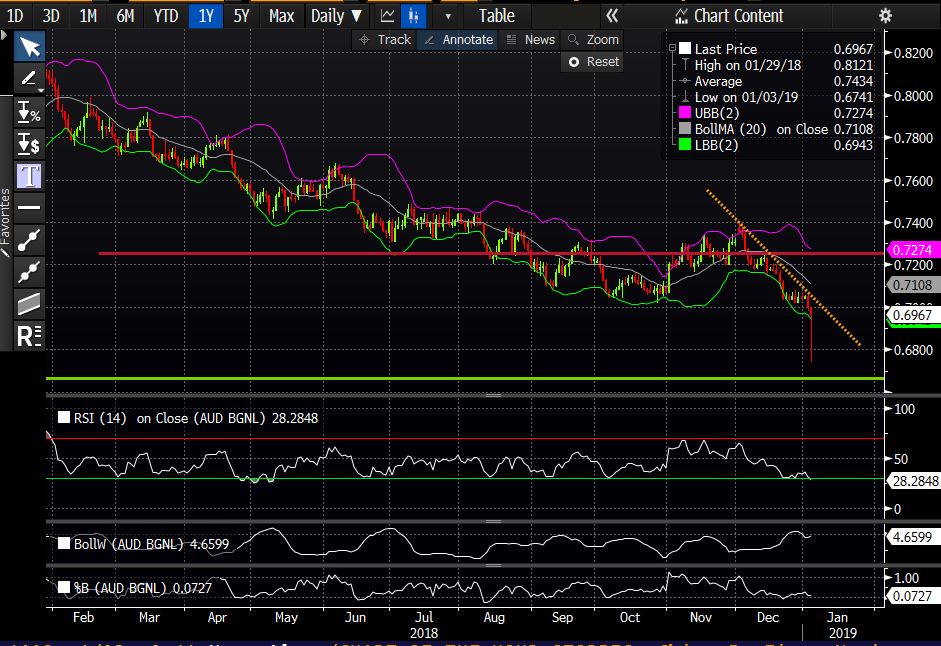
The AUD/USD pair has dropped to a level not seen since June 2009. The price dropped dramatically overnight before it recovered its massive losses. We have not seen this kind of intensity going back all the way to late 2014.
On a daily time frame, the price is trading below the downward trend and this confirms that the dominant trend is to the downside. Initially, the price pierced the lower line of the Bollinger band but now it has moved back into the Bollinger band which shows that the volatility has returned to the normal level. However, given the current momentum, I will not be surprised if the price may fall a little further.
The RSI is showing an extreme reading of 28.13 and this means that it is likely that the price may pause its current momentum before it resumes in the same direction or changes its path.
The support zone is shown by the green horizontal line.
The resistance zone is shown by the red horizontal line.
U.S Dollar Moves Exaggerated In Twilight Zone Hand-Over
Thursday January 3: Five things the markets are talking about
The U.S dollar fell aggressively on Wednesday evening (17:30 pm EDT), causing a brief currency crash in the U.S/Asian desk handover, on risk aversion rising due to falling equities in the U.S and after Apple’s warning that sales in China have been weak.
Apple cut its Q1 guidance for the first time in 20-years, citing an unforeseen slowdown in China and fewer upgrades to its flagship mobile device.
Coupled with weaker Chinese manufacturing data this week, Trump’s U.S protectionist confrontation is starting to have an impact on economic activity, and this despite U.S President implying, via rhetoric and social media, that a Sino-U.S trade deal is within grasp.
The dollar fell outright versus the safe-haven yen to a nine-month low of ¥104.79 and is last trading down by -0.8% at ¥107.73. EUR/USD is up by +0.2% at €1.1370.
The lack of market liquidity – Tokyo has been on holiday all week and does not return until this evening – and some assertive short-yen positioning, has helped to push some aggressive currency moves in what is know as the ‘twilight zone,’ as trading shifted from the North American session to the open of the Australasian markets. Also, various algorithmic programs exacerbated the moves.
Elsewhere, U.S Treasuries trade steady, while most Euro sovereign bonds have climbed. WTI crude futures have again slipped as it reversed some recent gains on the back of Saudis’ lowering exports. Gold prices have rallied.
On tap: PM Theresa May will today meet with EC President Tusk, German Chancellor Merkel and Dutch Prime Minister Rutte. She is reportedly hoping to win concessions on the Irish border backstop.
1. Apple earnings warning rocks global shares
Asian and Euro equities have fallen sharply, led by a sell-off in the tech sector, and U.S stock futures point to a weaker open on Wall Street this morning, after Apple cut its revenue forecast, its first downgrade in nearly a dozen years, citing weaker iPhone sales in China.
Note: In Japan, the Nikkei was closed in observance of the four-day Bank Holiday.
Down-under, Aussie shares closed +1.4% higher overnight as a ‘flash crash’ in the AUD (AUD/JPY fell -8% at one point) boosted the appeal of export-oriented stocks, with gold stocks topping the gains. In S. Korea, the Kospi stock index fell to a two-month low, down -0.81%, on Apples Q1 forecast news.
In China and Hong Kong, regional bourses falter as economic concerns take over. The Shanghai Composite index ended nearly flat, while the blue-chip CSI300 index fell -0.2%. In Hong Kong, the Hang Seng index edged down -0.3%, while the Hang Seng China Enterprises index closed flat.
In Europe, regional indices are trading mostly lower across the board with the tech sector in focus following Apples cut in Q1 revenue forecasts for iPhone sales in China.
U.S stocks are set to open deep in the ‘red’ (-1.65%).
Indices: Stoxx600 -0.69% at 334.50, FTSE -0.50% at 8,410.50, DAX -1.06% at 10,468.56, CAC-40 -1.02% at 4,641.50, IBEX-35 -0.39% at 8,517.00, FTSE MIB -0.81% at 18,182.50, SMI -0.20% at 8,410.50, S&P 500 Futures -1.68%
2. Oil prices decline on swelling oversupply, gold higher
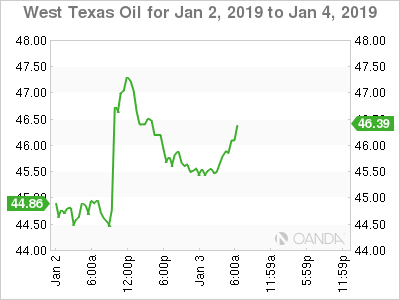
Crude oil prices remain under pressure amidst volatile currency and equity markets, coupled with concerns that economic slowdowns this calendar year will cut into fuel demand just as global crude supplies are surging.
Brent crude futures are down -50c at +$54.41 a barrel, while U.S. West Texas Intermediate (WTI) crude oil futures have dropped -75c to +$45.79 a barrel ahead of the U.S open.
Note: Oil prices registered their first yearly decline in three-years in 2018 – Brent tumbled -20%, while WTI slumped -25%.
A number of factors are expected to provide further heightened volatility in the commodity space in Q1, 2019. There is the markets uncertainty on Sino-U.S trade; there is Brexit, as well as political instability and conflict in the Middle East. There is U.S shale output numbers and there is OPEC’s and Russia’s supply discipline. Oil markets are also under pressure from a surge in supply just as demand growth is expected to slow.
Note: U.S crude production stood at a record +11.7M bpd in late 2018, making the U.S the world’s biggest oil producer.
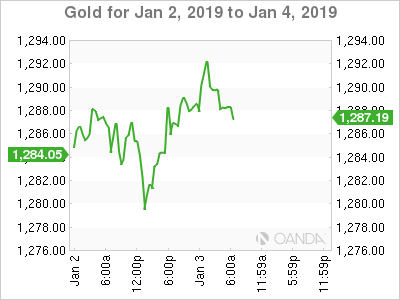
Ahead of the U.S open, gold prices scaled to a new six-month high earlier this morning as investor worries about a global economic slowdown, couple with equity markets volatility is supporting investor safe-haven buying, while a weaker dollar also offered some support.
Spot gold touched +$1,292.32 per ounce, and was up +0.4% at +$1,289.10. U.S gold futures are up +0.6% at +$1,291.20 per ounce.
3. Euro sovereign yields remain under pressure
Eurozone government bond yields have extended their fall in this holiday shortened trading week, as global growth concerns convince nervous investors to seek safe havens.
The rally in the core E.U bond markets may be overdone, however, given the economic and political uncertainty in markets, the risk is that yields will continue to decline.
After falling to levels unseen in two-years, the 10-year German Bund yield is trading just below +0.16%, down -1 bps overnight. Bond bears believe that the bounce higher in Euro bond prices is perhaps owed more to a lack of liquidity than any real turn in market sentiment, especially when considering that the ECB terminated its net asset purchases last month and that the usual start-of-the-year supply wave is about to begin.
Elsewhere, the yield on U.S 10-year Treasuries has rallied less +1 bps to +2.62%. In the U.K, the 10-year Gilt yield has dipped -2 bps to +1.191%, the lowest in more than three-weeks, while Italy’s 10-year BTP yield has jumped +4 bps to +2.728%, the biggest surge in almost two-weeks.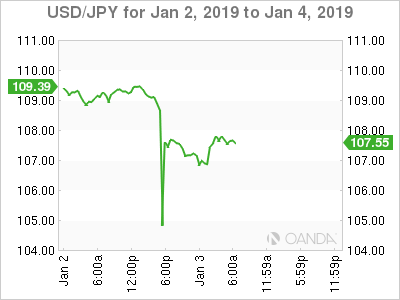
4. Dollar demise remains on track
Investors continue to err on the side of ‘risk aversion’ trading strategies now that Apples has cut its Q1 earnings guidance – this sent the markets safe haven currency of choice, the yen, higher across the board.
During the thin Asian trade, the yen spiked higher by over +7% against AUD (¥73.07) and while the USD/JPY pair tested below ¥105 handle (¥104.96).
Note: USD/JPY has since managed to re-approach the ¥108 level in the early part of the E.U session and after the ‘stops’ were triggered in Asia.
Elsewhere, EUR/USD is at €1.1365 and marginally higher with key resistance still seen at €1.15 level.
GBP/USD remains soft on investor concerns over a potential ‘no-deal’ Brexit ahead of the upcoming meaningful vote in the U.K parliament. The pound is at £1.2575 just ahead of the open stateside.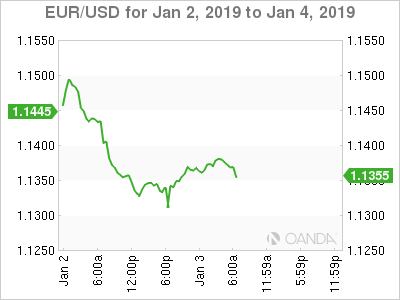
5. Sterling lower as U.K construction PMI falls to three-month low
The pound (£1.2575) has declined a tad after this morning’s U.K purchasing managers’ survey on construction activity fell to a three-month low of 52.8 in December, from 53.4 in November.
Note: Market consensus was looking for a headline print of 52.9.
“U.K. construction firms indicated a disappointing end to 2018 as business activity growth eased to a three-month low and new orders expanded at a relatively subdued pace,” the report said. However, “survey respondents cited hopes of a boost to growth from work on big-ticket transport and energy infrastructure projects in 2019.”
Note: U.K services PMI, due tomorrow (04:30 am EDT), is more important for pound investors given that the U.K. economy is heavily reliant on services.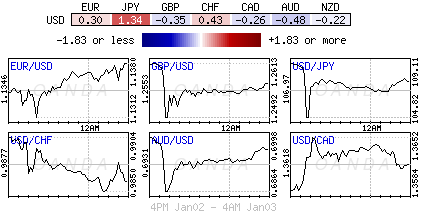
Bullish Outlook In Euro Cross
Six years ago in 2012, Euro zone was in the midst of crisis, with bailouts of Greece pushing the Euro to the verge of a collapse. Peripheral European countries like Greece, Portugal, Italy were unable to sell government bonds without offering significant yield. In order to convince international investor, ECB President Mario Draghi back in July 26, 2012 famously made the remark: “Within our mandate, the ECB is ready to do whatever it takes to preserve the euro. And believe me, it will be enough.” ECB then announced a program to buy the bonds of distressed member countries. It never ended up using this program as the promise was enough to calm investors. It eventually launched a bond buying (QE) program in 2015. However, the Euro Zone’s peripheral yields have already stabilized by then as chart below shows:
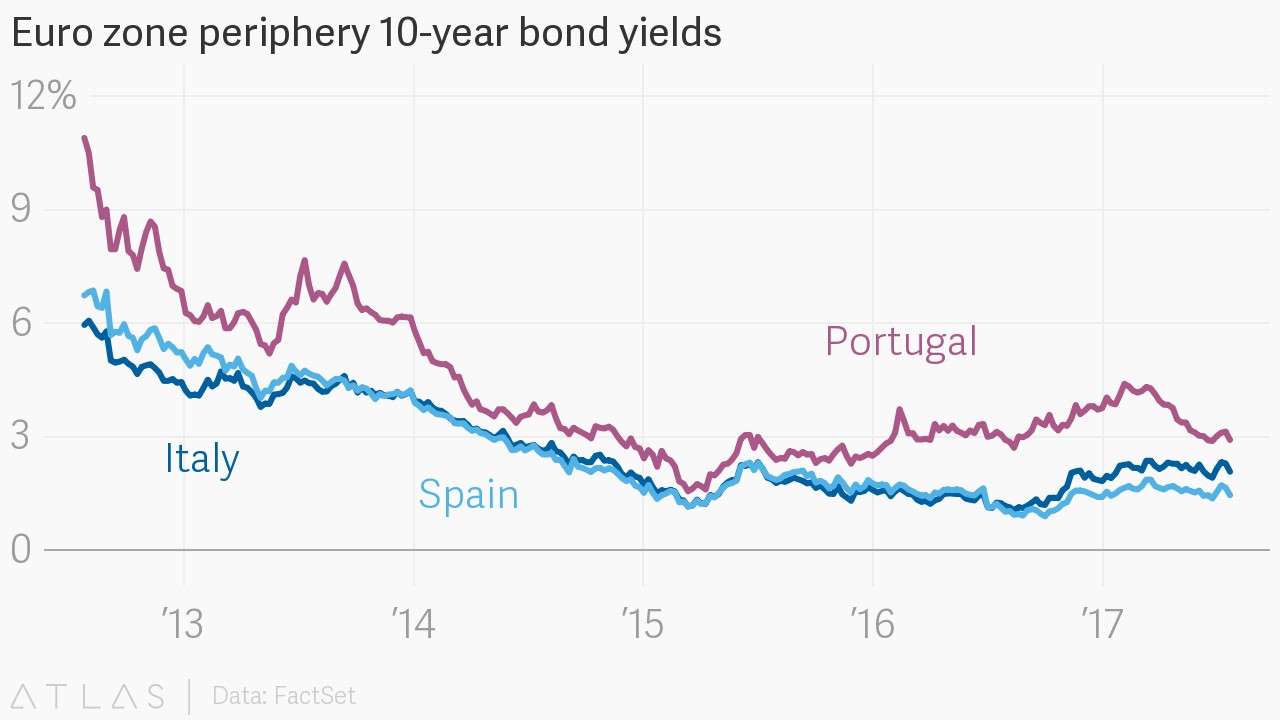
Fast forward to today, ECB has confirmed on 13 December that it would end the Quantitative Easing program after almost 4 years. The bank has also left its guidance on interest rate intact. Interest rate will stay unchanged at least through the summer of 2019 or longer. ECB will also continue to reinvest the proceeds from maturing securities for as long as necessary. So is Quantitative Easing successful? At the outset, it helped to improve the region’s growth, stabilize financial market (bond, currency and equities market). It’s however too early to judge the long term implication.
In the chart below, we will look at a Euro cross pair (EURAUD). The pair looks bullish and we can see that the QE in 2015 did not really weaken Euro much further. Now that the Euro Zone has stabilized and the program ended, there’s a chance that the pair can continue the bullish move in 2019.
Weekly Elliott Wave Chart of EURAUD
Weekly Elliott Wave chart of EURAUD above shows that pair has a higher high sequence from 2.22.2017 low. If it breaks above Aug 21.2015 high (1.6585), it will show a larger degree bullish sequence from Aug 2, 2012 low. The rally from Aug 2, 2012 low is unfolding in a double three Elliott Wave structure. A double three Elliott Wave structure is a 7 swing structure, labelled as WXY. This structure suggests that EURAUD should continue to trend higher as far as it stays above 1.533 in first degree, and 1.36 in second degree. Potential 100% target area to the upside in wave (y) comes at 1.859 – 1.977.
Risk Aversion Continues To Simmer
- Concerns over global growth persist
- Apple cut Q1 revenue outlook citing weak sales in China; risk aversion ramps up as its suggests some grounds for worry on the impact of Trump's trade war with China
Asia:
- China International Capital Corporation (CICC) Research: PBoC's RRR criteria easing might release up to CNY400B (Reminder: On Jan 2nd reports circulated that China PBoC adjusted its rules on bank lending to small business)
Europe:
- UK PM May to hold talks on Brexit this week with Germany Chancellor Merkel, Dutch PM Rutte, and EU Council President Tusk in hopes of pressing the EU leaders for Brexit concessions
- UK PM May said to be urged to delay Brexit "meaningful vote" again as attempts to win party rebels to her side fail
- British Chambers of Commerce (BCC): In Q4 2018 UK services sales growth hit 2-year low
Americas:
- Apple [AAPL} cut its Cuts Q1 Revenue guidance for 1st time since 2002 ( $84B v $91.3Be)
Macro
- (UK) United Kingdom: Prime Minister May will today meet with European Council President Tusk, German Chancellor Merkel and Dutch Prime Minister Rutte. She is reportedly hoping to win concessions on the Irish border backstop. Dublin sees the backstop as crucial to guaranteeing that the 1998 Good Friday agreement won't been breached. Ireland and the EU are gambling that UK Parliament won't allow the UK to exit the EU without a deal. Parliament would ultimately be able to overrule the government on this, should the Withdrawal Agreement by voted down, which continues to look likely. The delayed vote on the Brexit deal and outline for a future relationship is expected to take place he week of January 14, before the legislated deadline of January 21.
- (EU) Eurozone: M3 money supply growth decelerated to 3.7% y/y. The annual growth rate of loans to households was unchanged at 3.2% y/y, and actually accelerated a tick to 3.3% y/y. Loans to non-financial corporations meanwhile rose 2.9% y/y, up from 2.8% y/y in the previous month. No evidence to suggest then that the ECB's gradual phasing out of net asset purchases has had an impact on credit but financing conditions should remain very accommodative.
SPEAKERS/FIXED INCOME/FX/COMMODITIES/ERRATUM
Equities
- Indices [Stoxx600 -0.69% at 334.50, FTSE -0.50% at 8,410.50, DAX -1.06% at 10,468.56, CAC-40 -1.02% at 4,641.50, IBEX-35 -0.39% at 8,517.00, FTSE MIB -0.81% at 18,182.50, SMI -0.20% at 8,410.50, S&P 500 Futures -1.68%]
- Market Focal Points/Key Themes: European Indices trade mostly lower across the board with the tech sector in focus following the the a decline in demand for Iphones led to a cut in Revenue forecasts. Apple suppliers trade under pressure with AMS down sharply, ASML, Dialog Semi, STMicro and Infineon among others declining. Elsewhere UK retailer Next trades higher after better than expected Q4 Brand sales; Vectura and Costain also rise after upbeat trading updates. In other news Zalando trades higher on takeover chatter, DBV Tech rises on the resignation of its CMO while airliners Ryanair and Wizz Air trade higher on Dec traffic metrics. Looking ahead notable earners include Unifirst, Park Electrochemical and Simply Good Food.
Equities
- Consumer discretionary: Next [NEXT.UK] +5.5% (brand sales; outlook adjustment), Zalando [ZAL.DE] +3.5% (takeover speculation), Ryanair [RYA.UK] +1%, Wizz Air [WIZZ.UK] +2% (load factors)
- Energy: Faroe Petroleum [FPM.UK] +5.5% (DNO extends offer timeline; acquires additional shares; offer is now mandatory)
- Financials: Randstad [RAND.NL] -5% (analyst action)
- Healthcare: Vectura Group Plc [VEC.UK] +10.5% (trading update), DBV Technologies [DBV.FR] +16.5% (Chief Medical Officer resigns), Genfit [GNFT.FR] +4.5% (licensing agreement)
- Industrials: Costain Group [COST.UK] +8% (trading update)
- Technology: AMS AG [AMS.CH] -21%, ASML Holdings [ASML.NL] -4.5%, Dialog Semiconductors [DLG.DE] -6%, STMicroelectronics [STM.FR] -7.5%, Infineon [IFX.DE] -4% (Apple outlook cut; Infineon CEO affirms FY19 Rev growth target)
Speakers
- UK Brexit Min Barclay: 'No-deal' EU exit far more likely if parliament rejected PM May's Brexit deal
- Italy's 2019 budget said to be under strict EU surveillance for 6 months
- Thailand Dep PM Wissanu: Elections planned for Feb 24th may be delayed due to the royal coronation in May
Currencies/Fixed Income
- Risk aversion trade on the guidance cut by Apple sent the JPY currency firmer across the board. During the thin Asian trade, the Yen spiked higher by over 7% against both Aussie while the USD/JPY pair tested below ¥105 handle. There was some speculation that USD/JPY volatility was part of Apple hedge or the infamous Japanese retail investors cover bad bets. Reports circulated that Japanese retail FX players were forced out of AUD/JPY cross which created a liquidity vacuum as Japanese markets continued to be closed for holiday. The resulting ‘flash crash' in the yen-related pairs was not really viewed as any real turn in sentiment. USD/JPY managed to re-approach the 108 level in the early part of the EU session after the stops were run in Asia.
- EUR/USD at 1.1365 and marginally higher with key resistance still seen at 1.15 level.
- GBP/USD was softer as concerns over a potential ‘no-deal' Brexit persisted ahead of the upcoming meaningful vote in parliament. Pair at 1.2575 just ahead of the US morning.
Economic Data
- (NO) Norway Nov AKU Unemployment Rate: 4.0% v 4.0%e
- (TR) Turkey Dec CPI M/M: -0.4% v -0.8%e; Y/Y: 20.3% v 20.5%e; CPI Core Y/Y: 19.5% v 19.8%e
- (TR) Turkey Dec PPI M/M: -2.2% v -1.5%e; Y/Y: 33.6% v 34.6%e
- (ES) Spain Dec Net Unemployment M/M: -50.6K v -55.0Ke
- (CH) Swiss Dec PMI Manufacturing: 57.8 v 56.9e (36th month of expansion)
- (SE) Sweden Nov Household Lending Y/Y: 5.7% v 5.8% prior
- (HK) Hong Kong Nov Retail Sales Volume Y/Y: 1.2% v 4.6%e; Retail Sales Value Y/Y: 1.4% v 4.5%e
- (EU) Euro Zone Nov M3 Money Supply Y/Y: 3.7% v 3.8%e
- (DE) Germany Dec CPI Brandenburg M/M: 0.3% v 0.1% prior; Y/Y: 1.6% v 1.8% prior
- (UK) Dec Construction PMI: 52.8 v 52.9e (9th month of expansion)
Fixed Income Issuance
- (ES) Spain Debt Agency (Tesoro) sold total €4.55B vs. €4.0-5.0B indicated range in 2021, 2023 and 2028 Bonds
- Sold €1.2B in 0.05% Oct 2021 SPGB; Avg yield: -0.039% v +0.021% prior, Bid-to-cover: 2.26x v 3.65x prior
- Sold €1.345B in 0.35% July 2023 SPGB; Avg yield: 0.329% v 0.412%; Bid-to-cover: 1.75x v 1.65x prior
- Sold €1.997B in 1.40% July 2028 SPGB; Avg yield: 1.402% v 1.456% prior, Bid-to-cover: 1.27x v 1.93x prior
- (ES) Spain Debt Agency (Tesoro) sold €500M vs. €250-750M indicated range in inflation-linked 0.7% Nov 2033 bonds ; Real Yield: 0.752%; Bid-to-cover: 2.94x
Looking Ahead
- (PT) Portugal Dec Consumer Confidence Index: No est v -1.8 prior; Economic Climate Indicator: No est v 2.3 prior
- 05:30 (HU) Hungary Debt Agency (AKK) to sell bonds (3-tranches)
- 06:45 (US) Daily Libor Fixing
- 07:00 (US) MBA Mortgage Applications w/e Dec 28th: No est v -5.8% prior (1st release in two weeks)
- 07:00 (US) Dec Vehicle Sales data throughout the session
- 07:30 (US) Dec Challenger Job Cuts: No est v 53.1K prior; Y/Y: No est v 51.5% prior
- 08:00 (CZ) Czech Dec Budget Balance (CZK): No est v -21.6B prior
- 08:00 (SG) Singapore Dec Purchasing Managers Index (PMI): No est v 51.5 prior; Electronics Sector Index: No est v 49.9 prior
- 08:10 (UK) Baltic Dry Bulk Index
- 08:15 (US) Dec ADP Employment Change: +180Ke v +179K prior
- 08:30 (US) Initial Jobless Claims: 220Ke v 216K prior; Continuing Claims: 1.69Me v 1.701M prior
- 09:45 (US) Dec ISM New York
- 10:00 (US) Dec ISM Manufacturing: 57.5e v 59.3 prior; Prices Paid: 57.7e v 60.7
- 10:00 (MX) Mexico Central Bank (Banxico) Dec Minutes
- 10:00 (CO) Colombia Nov Exports: $3.3Be v $3.8B prior
- 11:00 (DK) Denmark Dec Foreign Reserves (DKK): No est v 467.3B prior
- 11:30 (US) Treasury to sell 8-Week Bills
- 16:00 (KR) South Korea Dec Foreign Reserves: No est v $403B prior
- 16:30 (US) Weekly API Oil Inventories
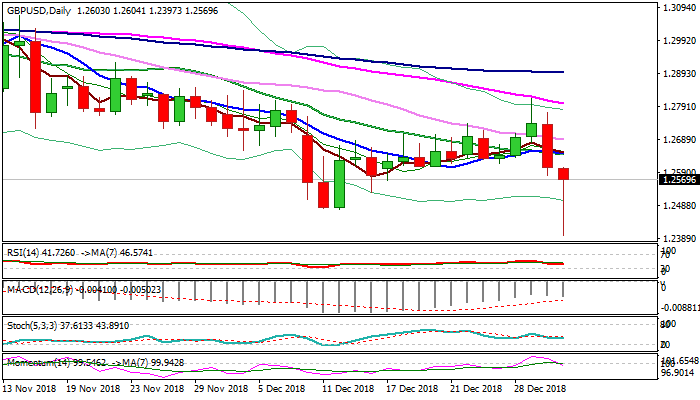
GBP/USD Outlook: Pound Recovered Ground After Sharp Fall Overnight But Weak Tone Persists
Cable maintains soft tone despite swift recovery after overnight's crash to 1.2400 zone hit new lowest level since early April 2017.
Rising fears over the health of the global economy which prompted traders from riskier assets, keep sterling under pressure.
Wednesday's strong close in red after repeated failure to clearly break above pivotal 1.2743 Fibo barrier, which formed bearish outside day and weak UK Construction PMI data (Dec 52.8 vs 52.9 f/c and 53.4 in Nov) add to negative outlook.
Also, fading expectations of BoE's rate hike in 2019 and persisting fears about no-deal Brexit, maintain pressure on pound, as focus turns towards 14 Jan parliamentary vote on PM May's Brexit withdrawal agreement.
Daily techs show MA's in bearish setup and momentum breaking into negative territory also weigh.
Consolidation above cracked key support at 1.2476 (12 Dec low) is expected to precede fresh weakness, with eventual close below here to generate strong bearish signal for extension of broader downtrend.
Converged 5, 10 & 20SMA's mark strong resistance at 1.2650 zone which is expected to limit stronger upticks.
Res: 1.2604, 1.2650, 1.2690, 1.2772
Sup: 1.2528, 1.2476, 1.2397, 1.2365
EURUSD Sellers Fail To Break 1.1300 Level
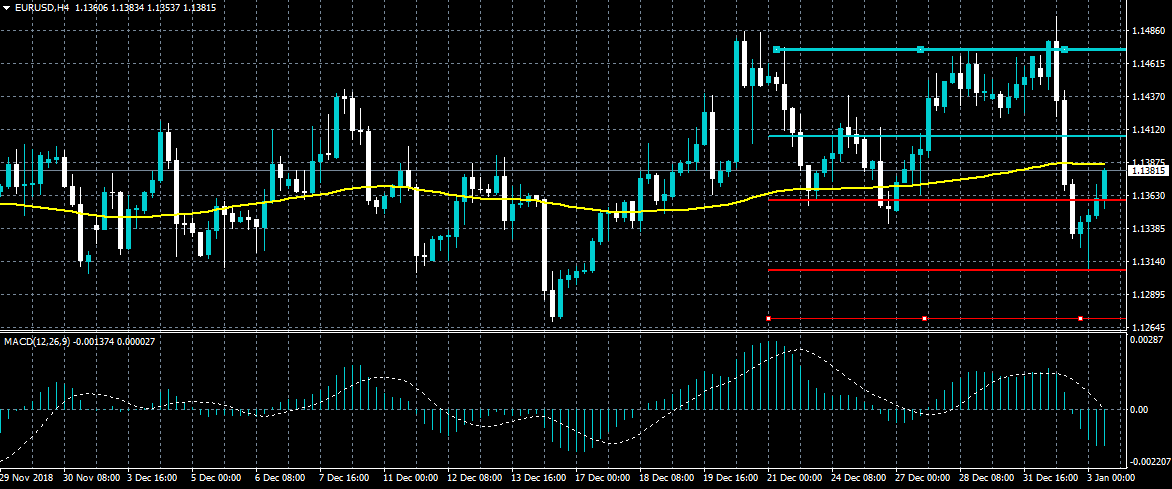
The euro is attempting to recover towards the 1.1400 level against the US dollar, following the pairs sharp decline to the 1.1308 level on Wednesday. EURUSD sellers need to push price back under the 1.1360 support level to encourage technical selling, although the 1.1300 level is the key support level to watch. Only a strong move back above the 1.1430 resistance level will change the current bearish sentiment towards the EURUSD.
The EURUSD pair is intraday bearish while trading below the 1.1360 level, key technical support is found at 1.1300 and 1.1268 levels.
If the EURUSD pair moves above the 1.1410 resistance level, buyers may test towards the 1.1430 and 1.1470 levels.
GBPUSD Awaiting Improtant Economic Data
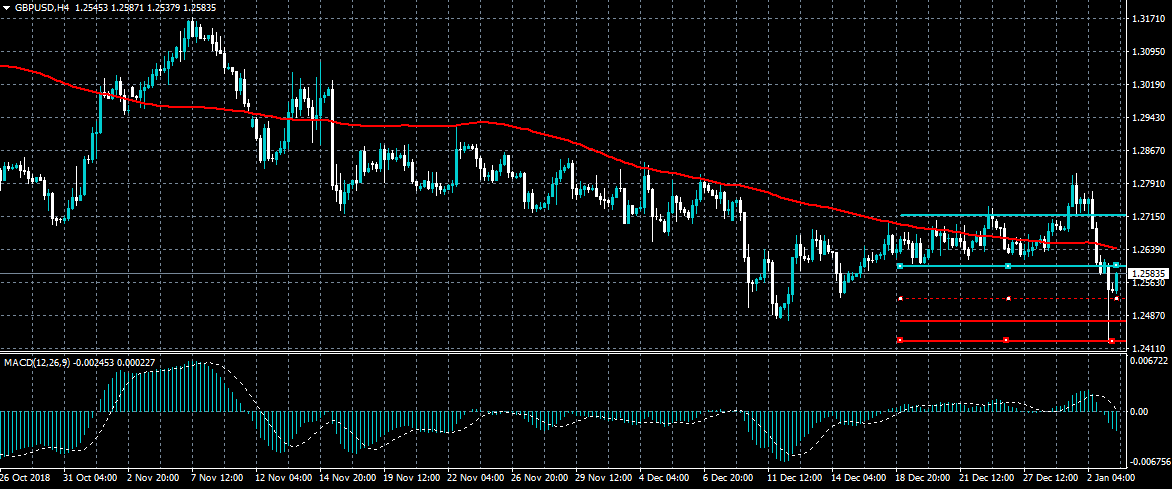
The British pound is attempting to recover back towards the 1.2600 level against the US dollar after sellers failed to hold price below the pivotal 1.2528 level during the European trading session. A sustained move above the 1.2600 resistance level may prompt GBPUSD buyers to test the important 1.2660 area. Traders now await the release of key ISM manufacturing and ADP jobs data from the United States economy.
The GBPUSD pair is intraday bullish while trading above the 1.2528 level, key resistance is found at the 1.2600 and 1.2660 levels.
If GBPUSD sellers move price below the 1.2528 level, further losses towards the 1.2460 and 1.2425 levels may occur.
Forex Technical Analysis: EUR/USD, USD/JPY, GBP/USD
EUR/USD
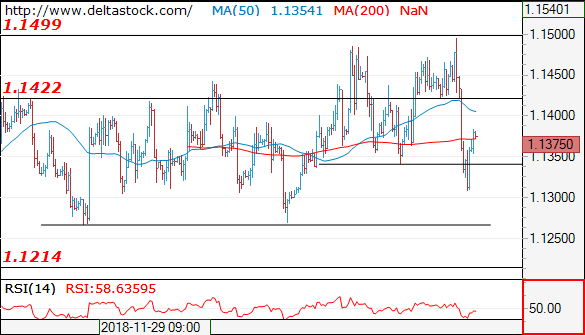
Current level - 1.1375
The violation of 1.1420 allowed a slide to 1.1310 and the overall outlook is bearish, for a continuation of the slide towards 1.1214 lows. Intraday allow a brief corrective rebound, which is expected to be limited below 1.1420 hurdle.
| Resistance | Support | ||
| intraday | intraweek | intraday | intraweek |
| 1.1420 | 1.1500 | 1.1310 | 1.1214 |
| 1.1500 | 1.1630 | 1.1214 | 1.1100 |
USD/JPY
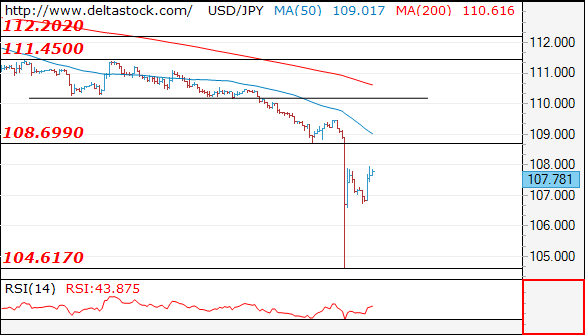
Current level - 107.78
Last night's flash crash led to a local low at 104.60 and now the bias is already positive, for a test of 108.70 static resistance. Initial support lies at 106.70.
| Resistance | Support | ||
| intraday | intraweek | intraday | intraweek |
| 108.70 | 111.45 | 106.70 | 106.70 |
| 110.20 | 112.20 | 104.60 | 104.60 |
GBP/USD
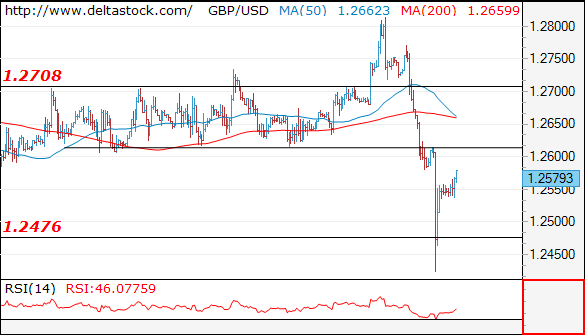
Current level - 1.2579
The break through 1.2710 support was followed by a massive sell-off, all the way down to 1.2420. The current rebound is corrective and the intraday bias is positive, for a rise towards 1.2620 area.
| Resistance | Support | ||
| intraday | intraweek | intraday | intraweek |
| 1.2620 | 1.2885 | 1.2540 | 1.2420 |
| 1.2710 | 1.3250 | 1.2420 | 1.2340 |
Elliott Wave Analysis: USD/CAD Trading Bullish
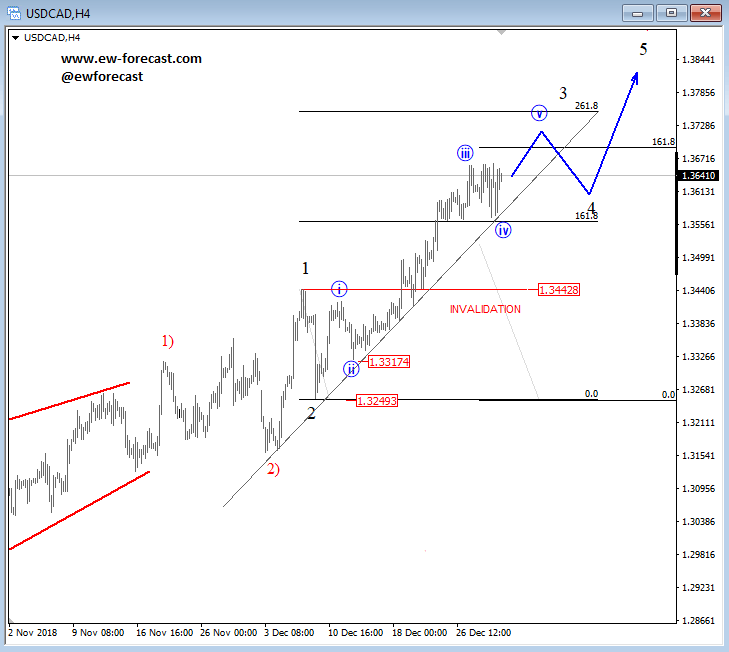
USDCAD is seen trading in a bullish impulse, up from 1.315 region which can be labelled as a higher degree wave 3) in play. Wave three is an impulse and also the strongest one, so be prepared to see even more upside. At the moment we see price unfolding sub-wave 3) of three, which can look for resistance and a temporary high near the Fibonacci projection zone of 161.8/261.8. From the mentioned zones a pullback in three legs can follow, labelled as wave 4.
USDCAD, 4h
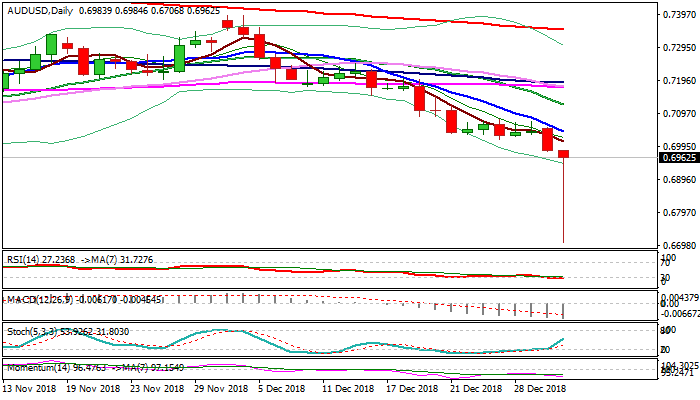
AUD/USD Outlook: Strong Barriers At 0.7000/42 To Cap Extended Upticks And Keep Bears Intact
The Australian dollar plunged to 10-year low in wild start of trading on Thursday, pulled by Apple forecasts warning and heavy sales in AUDJPY cross in strong safe-haven demand. Quick recovery followed spike to 0.6706 low (the lowest since 2009), was helped by resilient Asian stocks, with session high (0.6984) and psychological 0.7000 barrier, being intact for now. Negative daily studies keep bears in play after overnight's fall broke below key med-term support at 0.6825 (18 Jan 2016 low), marking full retracement of 0.6825/0.8135, 2016/2018 advance). Bears need confirmation on close below 0.6825, but consolidation on oversold conditions is likely to precede final break. Stronger upticks should be capped at 0.7000/42 zone (psychological / falling 10SMA) to keep bears intact. Only sustained break above falling 10SMA would put bears on hold for stronger corrective action.
Res: 0.6984, 0.7000, 0.7042, 0.7077
Sup: 0.6933, 0.6878, 0.6825, 0.6790