

Sample Category Title
China Caixin PMI manufacturing in first contraction since 2017, greater downward pressure ahead
The Caixin China PMI manufacturing dropped to 49.7 in December, down from 50.2 and missed expectation of 50.3. That's also the first contractionary reading since May 2017.
Zhengsheng Zhong, Director of Macroeconomic Analysis at CEBM Group, noted in the release that "external demand remained subdued due to the trade frictions between China and the U.S., while domestic demand weakened more notably". And, "it is looking increasingly likely that the Chinese economy may come under greater downward pressure."

Democrats to offer a deal to end government shutdown without border wall
The partial US government shutdown is now in its second week. Democrats, who will take control over House with 36-seat majority, plan to vote on a two-part package on Thursday, intending to break the deadlock. One part of the package include a bundle of six measures worth USD 265B for funding non homeland security agencies through September 30. The second part include funding for the Department of Homeland Security through February 8, and provide $1.3 billion for border fencing and $300 million for other border security items including technology and cameras. But there won't be funding for the border wall that Trump demanded and shut down the government for.
Democrat leaders Nancy Pelosi and Chuck Schumer said in a joint statement that "While President Trump drags the nation into Week Two of the Trump Shutdown and sits in the White House and tweets, without offering any plan that can pass both chambers of Congress, Democrats are taking action to lead our country out of this mess."
The fate of the Democrats' package is rather uncertain in the Republican controlled Senate. spokesman for Senate Republican leader Mitch McConnell already said "It's simple: The Senate is not going to send something to the president that he won't sign."
But Trump himself hinted that he might want to make a deal.
https://twitter.com/realDonaldTrump/status/1080177487517233157
Eco Data 1/2/19
[php_everywhere instance="1"]
Steeper yield curve inversion and practically no chance of March Fed hike
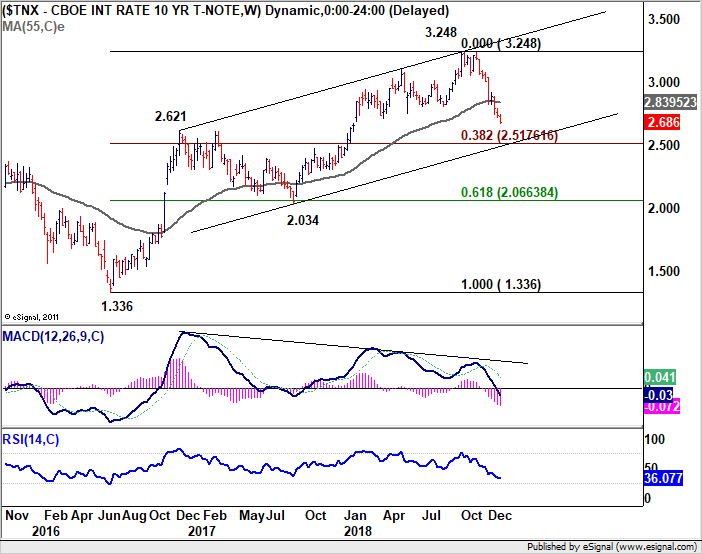
The impressive pre-year-end rebound in US stocks might have caught most attention. But there are two very important developments. Firstly, bond yields took a sharp tumble. 10-year yield closed the year at 2.686, comparing 2018 high at 3.248. Also, it's actually the lowest since January 2018.
We're maintaining our view that TNX is heading back to key support at 38.2% retracement of 1.336 to 3.248 at 2.517, which is close to long term channel support at around 2.49.
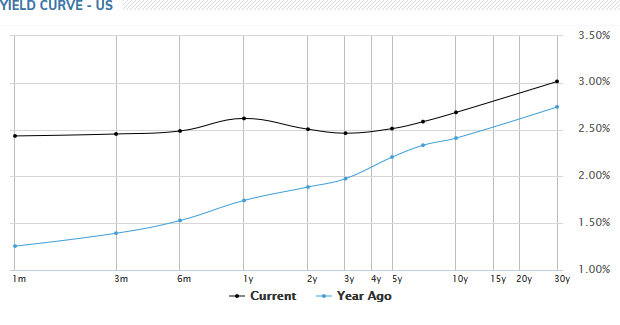
And more importantly, the yield curve hasn't be that inverted for a long time. It's clearly inverted from 1-year (2.619) to 2-year (2.504) and then 3-year (2.462). 5-year yield at 2.511 is way below 1 year yield. 6-month yield at 2.486 isn't too far.
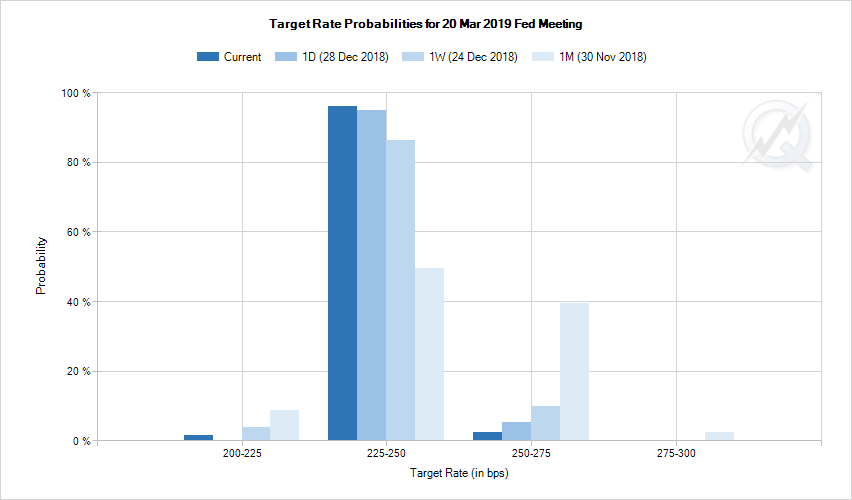
Another development to note is that markets are now pricing in just around 2.5% chance of a Fed hike in march to 2.50-2.75%.
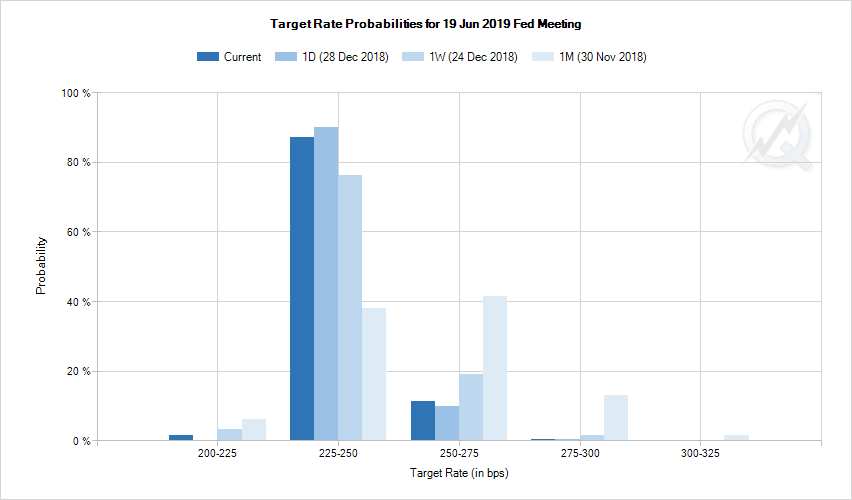
And there's just around 11% chance of a rate hike in 1H.
It looks like investors are expecting something rather ugly ahead in 2019.
FX 2019 – Market Too Optimistic about BOC’s Rate Hike Path and Success of NAFTA 2.0
Canadian dollar weakened against US dollar in 2018, first time in three years. Loonie declined over -7% against the greenback last year, with much of the selloff took place in the third quarter. Key factors driving CAD’s movement are BOC’s rate hike path, crude oil price, ratification of USMCA (or NAFTA 2.0) by the US Congress. Consensus forecast is that CAD would strengthen against USD in 2019 as BOC would continue to raise the policy (the market has priced in three rate hike in 2019, oil price would rebound as OPEC+ continue to cut output and the new trade deal with the US would drive business confidence. After the severe price slump in the fourth quarter of 2018, we don’t feel surprise to see a rebound in Canadian dollar in the first half of 2019. However, we are not as optimistic as the market. In particular, we expect downside surprise to BOC's rate hike and big hurdle to US ratification of the USMCA agreement. Meanwhile, the upcoming Canadian federal election in October could raise the volatility of loonie.
BOC Rate Hike
Amidst intensification of global economic slowdown, financial market turmoil and sell of oil prices, BOC kept the policy rate unchanged at 1.75% and turned dovish at its December meeting. At noted in the meeting statement, the central bank envisaged that, in the global economy, “signs are emerging that trade conflicts are weighing more heavily on global demand”. It added, however, that “there are upside as well as downside risks around trade policy”. Concerning Canada, BOC acknowledged that production cut in Alberta would affect GDP. Yet, the duration and size of the impact would depend on global and domestic oil prices. While forecasting less momentum in 4Q18, policymakers also revised lower GDP projections, leading to “additional room for non-inflationary growth”.
Despite turning more dovish, BOC retained the view that the policy rate would “need to rise into a neutral range to achieve the inflation target”. It added that “the persistence of the oil price shock, the evolution of business investment, and the Bank’s assessment of the economy’s capacity will also factor importantly into our decisions about the future stance of monetary policy”.
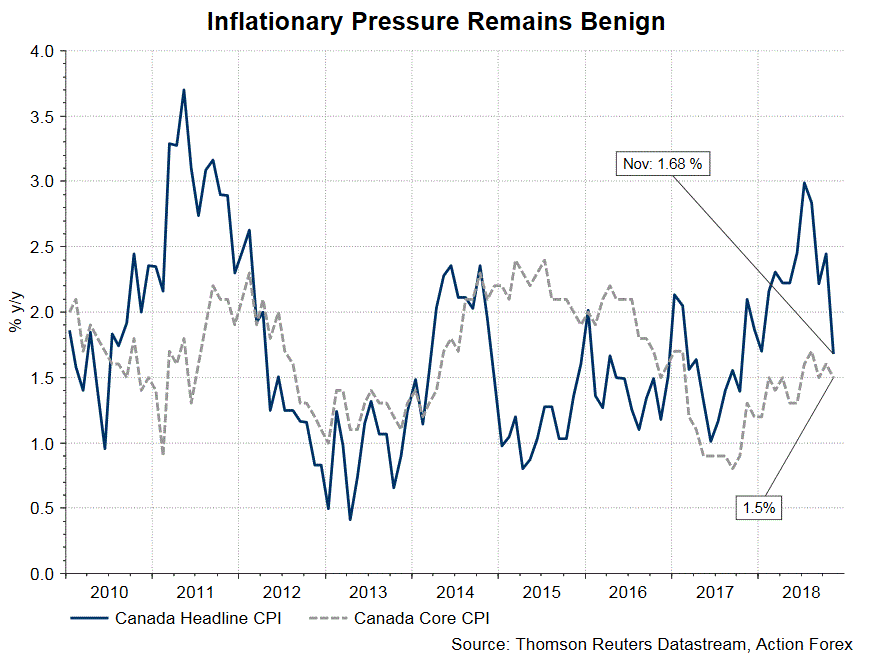
The market currently expects three rate hikes in 2019 with the first two rate hikes coming in first and second quarters. Such bets for three rate hikes have reduced to 56% from 60% in late-October. Risks on the number of rate hikes are skewed to the downside. Indeed, Fed’s slowdown in the pace of monetary policy tightening might reduce the urgency for BOC to increase its policy rate. The Conference Board of Canada expects the country's GDP to expand +1.9% in 2019, easing from +2.1% this year. Domestic inflationary pressure has diminished markedly in 2H18. Headline CPI plunged to +1.7%, lowest since October 2017, amidst energy price slump. Core CPI was at +1.5% in November, a benign level that does not call for a rate hike. The momentum for future price increase is not strong, at all. Year-over-year average hourly wage growth continued its decline +1.46%, its lowest reading since July 2017, in November. This was in spite of the fact that the unemployment rate fell further to 5.6%.
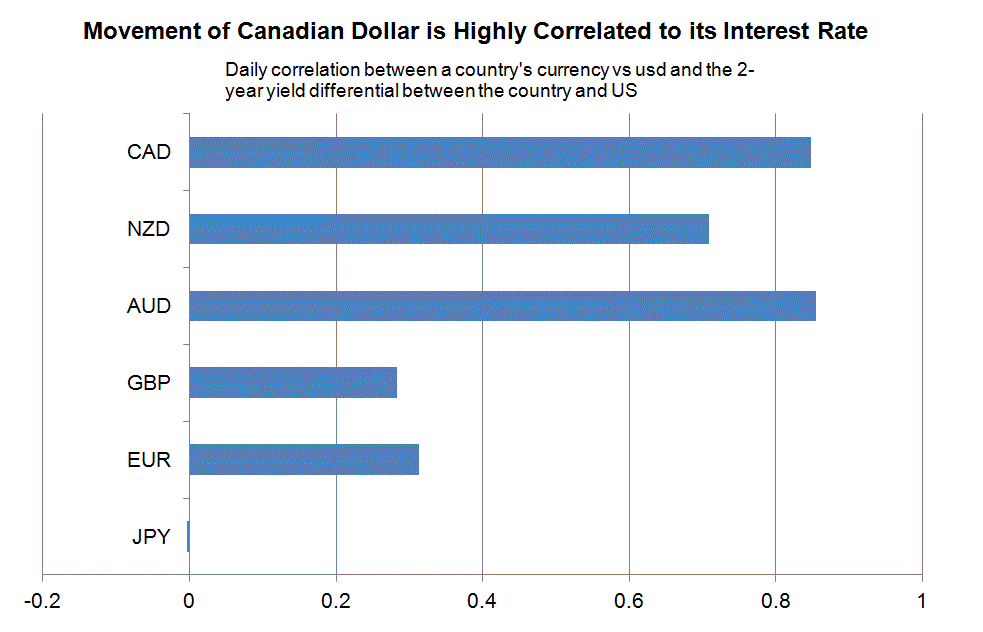
BOC’s rate hike schedule is closely related to loonie’s movement. Indeed, the (positive) correlation between interest rates and Canadian dollar has been the highest among major currencies.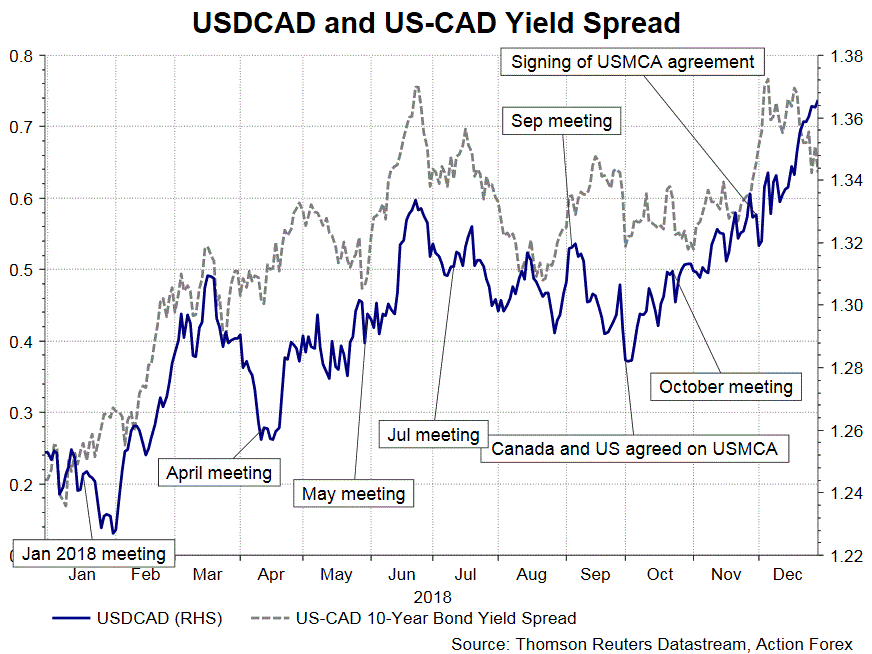
Oil Price
Canada’s energy sector is critical to its economy. Being the 6th largest energy producer, the 5th largest net exporter and the 8th largest consumer, the country’s energy sector accounts for almost 11% of the nominal GDP in 2017. Government revenues from energy were CAD 10.3B in 2016. Therefore, concerns on oversupply in oil and the recent slump in oil prices have led the selloff in the loonie. Meanwhile, excessive inventory also widened the spread of Canadian oil and WTI prices. The good news is that a rebound in oil price could materialize in the beginning of next year, following the massive selloff in 2018 and driven by the output cut by OPEC+. Domestic oil price has also narrowed its discount to WTI due to Alberta provincial government's announcement of output cut. These should help support the loonie.
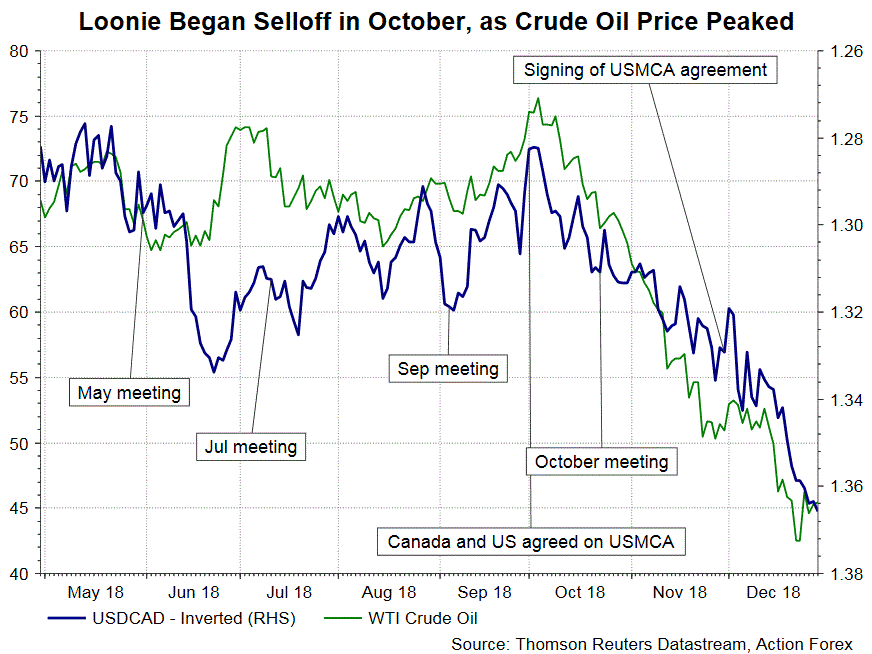
In early December, the majority of OPEC members and several non-OPEC producers agreed to reduce the overall production by 1.2M bpd (from October’s output), effective as of January 2019 for an initial period of 6 months. Alberta’s output cut plan would also lend support to Canada’s oil price narrowing its gap with international benchmarks. Effective January 1, 2019, producers in the province of Alberta with more than 10K bpd are required to lower production by about 8.7%, making up the total cut of 325K bpd. After three months, when there is enough shipping space on pipelines to improve prices, the reduction will be lowered to 95K bpd through the rest of year.
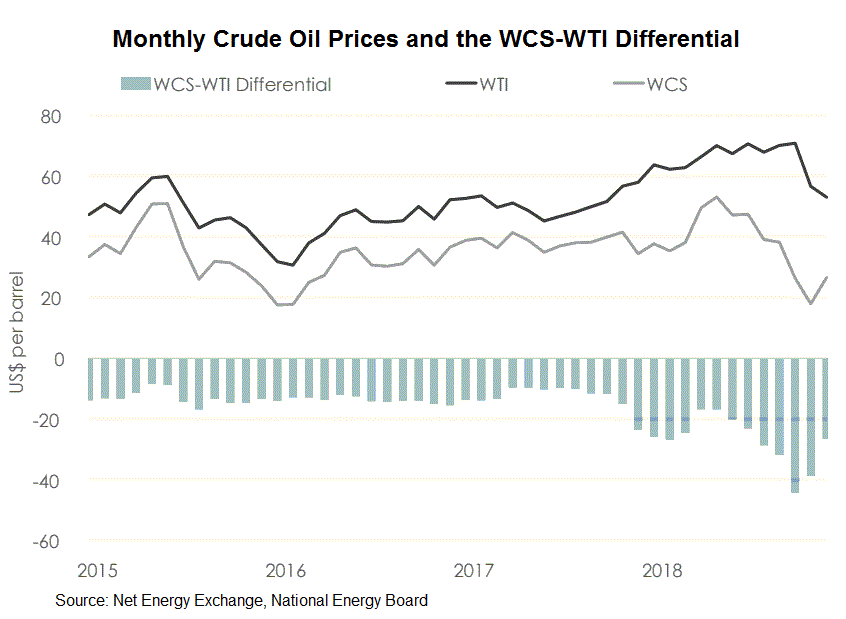
The chart below shows that the Western Canadian Select (WCS) oil price has historically sold at a discount to WTI, reflecting the lower quality of WCS and the cost to transport the crude oil to US refineries. Between 2015 and 2017, this differential averaged a discount of US$12.95/ bbl. However, the discount widened significantly to an average of US$27.09 in 2018, with a discount of US$50 on some trading days in October 2018.
Trilateral Trade Deal - USMCA
Announcement of Canada's joining of the bilateral deal between Mexico and US (now becomes the trilateral USMCA) on September 30, and the signing of the USMCA agreement on November triggered short-lived rallies in the loonie. The boosts were temporary as the market remained cautious, mainly on whether it would be ratified by the US Congress. The tax reform and the repeal of Obamacare have illustrated the hurdles in getting a bill passed by the legislature - albeit dominated by Republicans. The challenge would even be bigger as the Congress is divided after the midterm elections. Indeed, House Democratic Leader Nancy Pelosi has noted that the deal might not win congressional approval without changes to bolster its labor and environmental protections. An eventual ratification should, however, boost the loonie, as this could resume momentum on exports and investment.
UK PM May urged support to her Brexit deal to turn a corner
UK Prime Minister Theresa May continued to sell her Brexit agreement in her New Year message. He said that "the Brexit deal I have negotiated delivers on the vote of the British people and in the next few weeks MPs will have an important decision to make." She emphasized that "if parliament backs a deal, Britain can turn a corner."
May added that "the referendum in 2016 was divisive but we all want the best for our country and 2019 can be the year we put our differences aside and move forward together, into a strong new relationship with our European neighbors and out into the world as a globally trading nation," And, "we have all we need to thrive and if we come together in 2019 I know we can make a success of what lies ahead."
MPs are expected to re-start the debate on the Brexit agreement in the week of January 7 and a Commons vote is scheduled for the week of January 14. In the coming days, a focus will be on what further political and even legally assurances the EU will give regarding the non-permanent nature of the Irish backstop.
China Xi to Trump: History has proven cooperation is best for both sides
In his New Year address, Chinese President Xi Jinping reminded US President Donald Trump that "history has proved that cooperation is the best choice for both sides." Xi added that "I attach great importance to the development of China-U.S. relations and am willing to work with President Trump to summarize the experience of the development of China-U.S. relations and implement the consensus we have reached in a joint effort to advance China-U.S. relations featuring coordination, cooperation and stability so as to better benefit the two peoples as well as the people of the rest of the world."
The official Xinhua new agency also echoed in the commentary that "At a time when the world is undergoing unprecedentedly profound changes and is fraught with risks and uncertainties, the global community expects even closer collaboration between the two largest economies."
Trump tweeted on December 29 that "Just had a long and very good call with President Xi of China. Deal is moving along very well. If made, it will be very comprehensive, covering all subjects, areas and points of dispute. Big progress being made!". China's state media also said Xi believed both sides wanted "stable progress", and China-US ties had reached a "vital stage" on its 40th anniversary.
It's believed that Deputy U.S. Trade Representative Jeffrey Gerrish will lead a delegation including Treasury Under Secretary for International Affairs David Malpass, to travel to China in the week of January 7 for face-to-face meeting on trade negotiations.
EURUSD Risk Remains Higher With Eyes On 1.1499 Zone
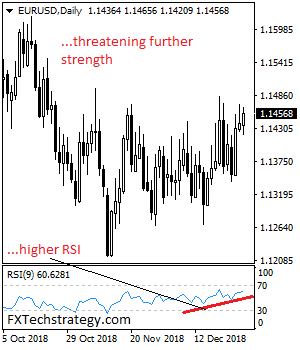
EURUSD risk remains higher with eyes on 1.1499 zone. Support comes in at the 1.1400 where a violation will aim at the 1.1350 level. A break below here will target the 1.1300 level. Further down, support lies at the 1.1250. On the upside, resistance resides at 1.1500 level with a break through there opening the door for further upside towards the 1.1550 level. Further up, resistance comes in at the 1.1600 level where a violation will expose the 1.1650 level. Its daily RSI is bullish and pointing higher suggesting more strength. All in all, EURUSD continues to threaten further upside.
Gold Takes Investors on Roller-Coaster Ride in 2018
On the final trading day of 2018, gold is trading quietly. In the Monday session, the pair is at 1279.49, down 0.08% on the day. With no U.S. events on the schedule, traders can expect an uneventful day.
Gold prices showed plenty of volatility in 2018 and declined 3 percent over the year. The base metal started the year strongly, with gains of 3.3% in January, only to give up most of these gains in February. Gold posted consecutive monthly losses from April until September, gold declining 10.4 percent during that time. However, gold has recovered in the fourth quarter with strong gains. Gold prices are up 4.7 percent in December, as the safe-haven asset has taken full advantage of tumultuous equity markets.
The chart below shows the commodity’s movement over the past year:
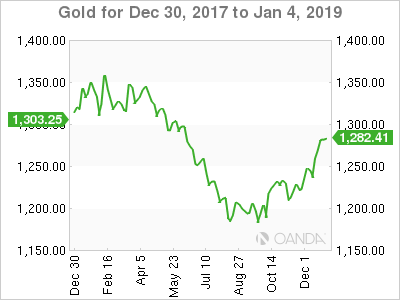
Open: 1302.18 High: 1365.16 Low: 1160.06 Close: 1279.49
I am bullish on XAU/USD
As we welcome 2019, here are some items the markets will be closely following:
Global trade war
Gold has been a beneficiary of the ongoing global trade war, which has shaken global equity markets and dampened the global economy. China and the U.S. have slapped tariffs on each other’s products, and the U.S. has threatened to raise the tariffs on Chinese goods from 10 percent to 25 percent on March 1. However, President Trump has agreed to suspend the tariffs while talks are ongoing, and U.S. and Chinese teams are slated to meet this week. If the sides can reach an agreement, risk appetite will rise and gold prices could reverse directions and head lower.
Federal Reserve rate policy
After four rate hikes in 2018, the Fed will be drastically easing up on raising rates in 2019. Just a few months ago, there was heady talk of three or four rate hikes in 2019, but the Fed made an abrupt U-turn, saying the “neutral rate range” had been reached. Analysts expect one rate hike in 2019, as this year’s hikes and the global trade war have lessened the pace of expansion in the U.S. economy.
U.S Government shutdown
A partial shutdown of the U.S. government has entered its second week, with no resolution in sight. President Trump has insisted that a spending bill include some $5 billion for a wall on the Mexican border, but Democrats in the Senate have blocked the bill. The impasse will continue into 2019 and will cost the taxpayer billions of dollars. Previous shutdowns have been resolved within a few weeks, as politicians are wary to drag out the fight and risk the wrath of voters for the lack of government services. The U.S. dollar will be under pressure while the shutdown continues, which is bullish for gold.
Eco Data 1/1/19
[php_everywhere instance="1"]